Ontdek de Fascinerende Wereld van UFO's en UAP's: Jouw Bron voor Onthullende Informatie!
Ben jij ook gefascineerd door het onbekende? Wil je meer weten over UFO's en UAP's, niet alleen in België, maar over de hele wereld? Dan ben je op de juiste plek!
België: Het Kloppend Hart van UFO-onderzoek
In België is BUFON (Belgisch UFO-Netwerk) dé autoriteit op het gebied van UFO-onderzoek. Voor betrouwbare en objectieve informatie over deze intrigerende fenomenen, bezoek je zeker onze Facebook-pagina en deze blog. Maar dat is nog niet alles! Ontdek ook het Belgisch UFO-meldpunt en Caelestia, twee organisaties die diepgaand onderzoek verrichten, al zijn ze soms kritisch of sceptisch.
Nederland: Een Schat aan Informatie
Voor onze Nederlandse buren is er de schitterende website www.ufowijzer.nl, beheerd door Paul Harmans. Deze site biedt een schat aan informatie en artikelen die je niet wilt missen!
Internationaal: MUFON - De Wereldwijde Autoriteit
Neem ook een kijkje bij MUFON (Mutual UFO Network Inc.), een gerenommeerde Amerikaanse UFO-vereniging met afdelingen in de VS en wereldwijd. MUFON is toegewijd aan de wetenschappelijke en analytische studie van het UFO-fenomeen, en hun maandelijkse tijdschrift, The MUFON UFO-Journal, is een must-read voor elke UFO-enthousiasteling. Bezoek hun website op www.mufon.com voor meer informatie.
Samenwerking en Toekomstvisie
Sinds 1 februari 2020 is Pieter niet alleen ex-president van BUFON, maar ook de voormalige nationale directeur van MUFON in Vlaanderen en Nederland. Dit creëert een sterke samenwerking met de Franse MUFON Reseau MUFON/EUROP, wat ons in staat stelt om nog meer waardevolle inzichten te delen.
Let op: Nepprofielen en Nieuwe Groeperingen
Pas op voor een nieuwe groepering die zich ook BUFON noemt, maar geen enkele connectie heeft met onze gevestigde organisatie. Hoewel zij de naam geregistreerd hebben, kunnen ze het rijke verleden en de expertise van onze groep niet evenaren. We wensen hen veel succes, maar we blijven de autoriteit in UFO-onderzoek!
Blijf Op De Hoogte!
Wil jij de laatste nieuwtjes over UFO's, ruimtevaart, archeologie, en meer? Volg ons dan en duik samen met ons in de fascinerende wereld van het onbekende! Sluit je aan bij de gemeenschap van nieuwsgierige geesten die net als jij verlangen naar antwoorden en avonturen in de sterren!
Heb je vragen of wil je meer weten? Aarzel dan niet om contact met ons op te nemen! Samen ontrafelen we het mysterie van de lucht en daarbuiten.
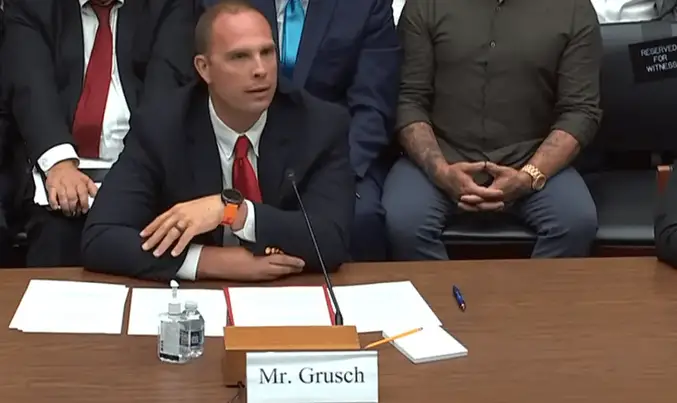
Ross Coulthart Accuses Intelligence Community of Leaking David Grusch’s Medical Records to Discredit Him: A Whistleblower’s Challenge
David Grusch
The David Grusch Saga: UFO Secrets, Whistleblowing, and A Fight for Credibility
In a world where the unknown often captivates our imagination, few subjects generate as much intrigue and debate as Unidentified Flying Objects. Whether considered a threat to national security or a source of endless fascination, the discourse surrounding UFOs continues to fuel speculations and conspiracy theories. Recently, the mysterious narrative took a personal and troubling turn when former Air Force officer David Grusch’s health records were leaked. Let’s dive into the story.
A Whistleblower’s Bold Claim
David Grusch, a decorated former Air Force officer and intelligence official, came into the spotlight during an exclusive interview with NewsNation. He claimed that the U.S. government has a secret UFO retrieval program, even stating that there had been harm in government cover-ups of UFO technology. Such allegations naturally garnered international attention, sparking both curiosity and skepticism.
The Leak: An Attempt to Smear?
Investigative journalist Ross Coulthart believes that the government might now be orchestrating an effort to release Grusch’s medical records to smear his credibility. Grusch’s struggles with post-traumatic stress disorder (PTSD), grief, and depression, particularly incidents in 2014 and 2018, were leaked to the media.
The apparent intention behind the leak was to question Grusch’s reliability due to his previous mental health issues. Coulthart thinks someone within the intelligence community leaked these sensitive files. Even Grusch himself checked with local authorities to ascertain the origin of the leak but found no answers.
The Integrity of a Decorated Officer
Grusch’s past mental health struggles, including PTSD following his return from Afghanistan, did not affect his security clearance from the Department of Defense. He served his country honorably, and his record was never questioned within his professional environment. Grusch’s transparency about his past, his recovery, and his determination to continue his intelligence career showcase his integrity.
What’s more, Coulthart believes the attempt to discredit Grusch through his mental health issues is not only contemptible but should also be thoroughly investigated.
UFO and Government: A Continuous Dance
Grusch’s revelations are not an isolated incident. They are part of a broader narrative that has long surrounded the existence of UFOs and the government’s alleged efforts to conceal their existence. The recent acknowledgment of UFO sightings by the U.S. Navy and the subsequent report by the Office of the Director of National Intelligence (ODNI) has only added fuel to this enigmatic fire.
David Grusch’s story is not just about UFOs. It is a human tale of courage, vulnerability, and a fight for truth. The leak of his health records, seemingly an attempt to undermine his credibility, raises serious ethical questions.
In a world that continues to grapple with the mysteries of UFOs, what we might need most is honesty, empathy, and respect for those who dare to question the known boundaries. The saga of David Grusch, a decorated officer, a sufferer of PTSD, and a man who stood tall despite attempts to silence him, is a testament to the strength of the human spirit.
Whether or not we ever uncover the truth about UFOs, stories like Grusch’s remind us that our exploration of the unknown is not just about science and secrecy; it’s about humanity, dignity, and the relentless pursuit of truth.
A potentially dangerous space rock was discovered for the first time by an AI algorithm.
AI has just found its first potentially Earth-threatening space rock.
(Image credit: ATLAS/University of Hawaii Institute for Astronomy/NASA)
A new artificial intelligence algorithm programmed to hunt for potentially dangerous near-Earth asteroids has discovered its first space rock.
The roughly 600-foot-wide (180 meters) asteroid has received the designation 2022 SF289, and is expected to approach Earth to within 140,000 miles (225,000 kilometers).That distance is shorter than that between our planet and the moon, which are on average, 238,855 miles (384,400 km) apart. This is close enough to define the rock as a Potentially Hazardous Asteroid (PHA), but that doesn't mean it will impact Earth in the foreseeable future.
The HelioLinc3D program, which found the asteroid, has been developed to help the Vera C. Rubin Observatory, currently under construction in Northern Chile, conduct its upcoming 10-year survey of the night sky by searching for space rocks in Earth's near vicinity. As such, the algorithm could be vital in giving scientists the heads up about space rocks on a collision course with Earth.
"By demonstrating the real-world effectiveness of the software that Rubin will use to look for thousands of yet-unknown potentially hazardous asteroids, the discovery of 2022 SF289 makes us all safer," Vera C. Rubin researcher Ari Heinze said in a statement.
Tens of millions of space rocks roam the solar system ranging from asteroids the size of a few feet to dwarf planets around the size of the moon. These space rocks are the remains of material that initially formed the planets around 4.5 billion years ago.
While most of these objects are located far from Earth, with the majority of asteroids homed in the main asteroid belt between Mars and Jupiter, some have orbits that bring them close to Earth. Sometimes worryingly close.
Space rocks that come close to Earth are defined as near-Earth objects (NEOs), and asteroids that venture to within around 5 million miles of the planet get the Potentially Hazardous Asteroid (PHA) status. This doesn't mean that they will impact the planet, though. Just as is the case with 2022 SF289, no currently known PHA poses an impact risk for at least the next 100 years. Astronomers search for potentially hazardous asteroids and monitor their orbits just to make sure they are not heading for a collision with the planet.
This new PHA was found when the asteroid-hunting algorithm was paired with data from the ATLAS survey in Hawaii, as a test of its efficiency before Rubin is completed.
The discovery of 2022 SF289 has shown that HelioLinc3D can spot asteroids with fewer observations than current space rock hunting techniques allow.
Rubin is ready to join the potentially hazardous asteroid hunt
Searching for potentially hazardous asteroids involves taking images of parts of the sky at least four times a night. When astronomers spot a moving point of light traveling in an unambiguous straight line across the series of images, they can be quite certain they have found an asteroid. Further observations are then made to better constrain the orbit of these space rocks around the sun.
The new algorithm, however, can make a detection from just two images, speeding up the whole process.
Around 2,350 PHAs have been discovered thus far, and though none poses a threat of hitting Earth in the near future, astronomers aren't quite ready to relax just yet as they know that many more potentially dangerous space rocks are out there yet to be uncovered.
It is estimated that the Vera Rubin Observatory could uncover as many as 3,000 hitherto undiscovered potentially hazardous asteroids.
The Vera C. Rubin Observatory as it takes shape in northern Chile ready to hunt potential hazardous asteroids (Image credit: Rubin Obs/NSF/AURA)
Rubin's 27-foot-wide (8.4 meters) mirror and massive 3,200-megapixel camera will revisit locations in the night sky twice per night rather than the four times a night observations conducted by current telescopes. Hence the creation of HelioLinc3D, a code that could find asteroids in Rubin’s dataset even with fewer available observations.
But, the algorithm's creators wanted to give the software a trial run before the construction of Rubin is completed. This meant testing if it could find an asteroid in data that had already been collected, data that has too few observations for currently employed algorithms to scour.
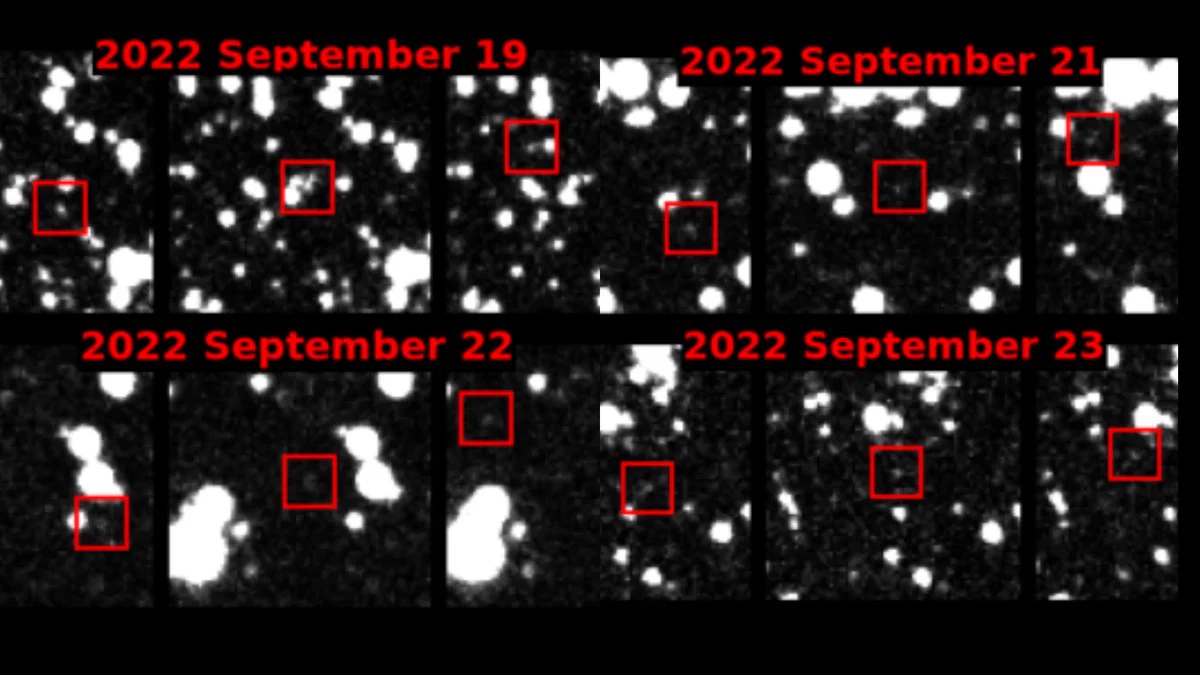
With ATLAS data offered as such a test subject, HelioLinc3D set about looking for PHAs, and on July 18, 2023, it hit paydirt, uncovering 2022 SF289. This PHA was spotted by ATLAS on September 19, 2022, while it was 3 million miles from Earth. ATLAS had actually spotted this new PHA three times over the course of four nights but hadn't spotted it four times in the same night, meaning current surveys missed it. By putting together fragments of data from all four nights, HelioLinc3D was able to identify the PHA.
Additional observations of 2022 SF289 made by the Zwicky Transient Facility survey. (Image credit: Joachim Moeyens/University of Washington/B612 Asteroid Institute)
"Any survey will have difficulty discovering objects like 2022 SF289 that are near its sensitivity limit, but HelioLinc3D shows that it is possible to recover these faint objects as long as they are visible over several nights," lead ATLAS astronomer Larry Denneau said. "This in effect gives us a 'bigger, better' telescope."
With the position of 2022 SF289 pinpointed, astronomers could then follow up on the discovery with other telescopes to confirm the PHA's existence.
"This is just a small taste of what to expect with the Rubin Observatory in less than two years when HelioLinc3D will be discovering an object like this every night," Rubin scientist and HelioLinc3D team leader Mario Jurić said. "But more broadly, it's a preview of the coming era of data-intensive astronomy. From HelioLinc3D to AI-assisted codes, the next decade of discovery will be a story of advancement in algorithms as much as in new, large, telescopes."
The discovery of 2022 SF289 was announced in the International Astronomical Union's Minor Planet Electronic Circular MPEC 2023-O26.
Join our Space Forums to keep talking space on the latest missions, night sky and more! And if you have a news tip, correction or comment, let us know at: community@space.com.
These two massive structures really stick out here. You can see that according to the map ruler in the lower right hand corner, these alien structures are 3km high and 4km wide. Since they are along a crater wall which could also be several km high, these structures behind the wall will be a few more km tall. Meaning they are behind the wall, poking up so their hight is the walls hight, plus their own above the wall. This is 100% proof that aliens live on our Moon. It totally explains why humans never went back, because the aliens didn't want us there.
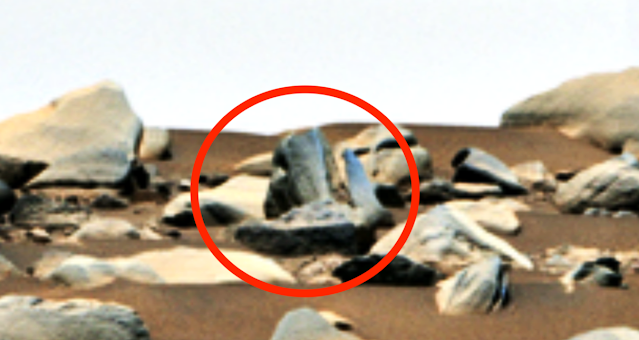
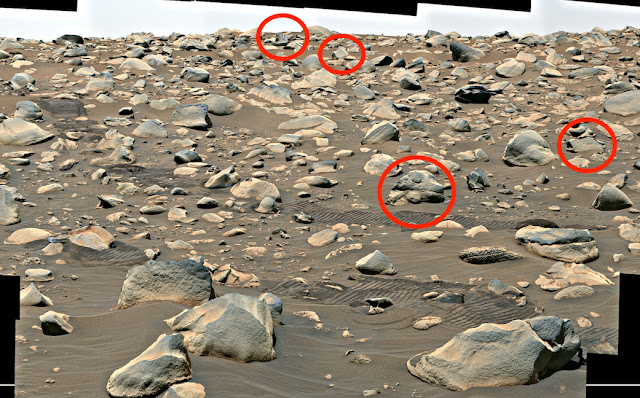
I found a few unusual items in this recent Mars photo. The leg is about 1.5 meters from bottom to lower knee. The leg was cut off just below its knee. I make my size guess using the tracks of the rover which are in the photo to do a size comparison. It's posted at the top of their website page and when I enlarged it, I couldn't help but notice this huge black leg and foot in the upper center of the photo. Sure it's just a robot or alien leg. How could it an alien leg and foot you say? Well, advanced species will be genetically modified, meaning they have more than two stands of DNA, thus if an alien has 4-10 or more strands in the DNA, then it wont be so easy broken down after death, and the body would literally be there forever.
I also found a dog sculpture head about 1 meter across. I also found two hollow structures with an opening about 12 inches by 8 inches, both similar in size and shape and may have housed some small creatures long ago.
These smaller discoveries I made today don't seem monumental to most people, however they build up over time, the evidence of life on Mars increases, and one day, AI will agree with me on this subject, but right now, all AI are not allowed to freely surf the internet, but instead only see snippets of info from years past. Or...so the ChatGPT told me. It knew of my achievements in the field.
Glowing object over Michigan July 27, 2023, UFO Sighting News.
Date of sighting: July 27, 2023
Location of sighting: Michigan, USA
Source: MUFON
This video just came in but was recorded two weeks ago. A person noticed a glowing white object passing over the neighborhood. It was really high up and moving fast. The full 2 min video is a bit shaky, but at the end shows the object moving past the trees into the distance. White glowing objects are the #1 most common colors of UFOs seen.
Scott C. Waring
Eyewitness states:
I was outside with my dogs when I looked up and seen an orb moving. I thought it was a star at first but then when I was recording I didn't see any blinking lights and it made some weird movements. You can tell by the power lines.
Flashing UFO Over Plymouth, Michigan, Aug 3, 2023, UFO Sighting News.
Date of sighting: Aug 3, 2023
Location of sighting: Plymouth, Michigan, USA
Source: MUFON
This flashing UFO seriously wanted to get some attention. Its strobe like flashes change from white to read, the white light had such a powerful blinding glow that it made a white cross shape. UFOs do flash and many UFO reports inform us of such things, also UFOs do come in many different colors. For instance a few decades ago a glowing flashing red, blue white lit disk landed in a field, caught on police cam in front of the car...with lights so powerful it was hard to make out the craft, except it was car size, flashing, and changing colors all the while. This UFO here in this video has a high probability of being real.
Scott C. Waring
Eyewitness states:
My husband myself and our 3 year old daughter saw an unidentifiable craft with lights in the sky. It hovered, changed directions quickly, descended and ascended. Did not move like and airplane or helicopter and they were some of the brightest lights I’ve ever seen. I have a few people telling me this is a drone, but I’m not convinced.
A day on Earth last about 24 hours. The word “about” in that sentence does a lot of heavy lifting because Earth’s rate of rotation changes all the time. Not by much, only fractions of milliseconds, but it means our common 24-hour day only really applies at human scales.
There are several things that can change the Earth’s rotation. The gravitational tug of the Moon and tides are gradually slowing Earth over millions of years. The melting of ice in the polar regions, the tectonic shift of the Earth’s crust during earthquakes, and even the draining of water from the aquifer. Earth is a geologically and biologically active world, so it’s only natural that Earth’s rotation rate is also dynamic. But a recent study shows that the rotation of Mars is also changing, which is a bit of a surprise.
Astronomers can measure changes in the Earth’s rotation on the order of nanoseconds, and can even measure tectonic shifts on the order of millimeters. They do this using very long baseline interferometry, where multiple radio telescopes observe a distant quasar. Since quasars are billions of light-years away, they are effectively fixed points in the sky. We don’t have any radio telescopes on Mars, so how can we measure small changes in its rotation?
The rotational motion of Mars over time. Credit: IPGP/David Ducros
The team did this by using data from NASA’s InSight lander. Over its 4-year mission, InSight ran an experiment known as the Rotation and Interior Structure Experiment, or RISE. Basically, radio telescopes on Earth would beam a signal to RISE, which would bounce the signal back. The RISE signal was Doppler shifted due to the relative orbital motions of Earth and Mars and their rotations. Since we know Earth’s rotation and the orbits of Earth and Mars extremely well, the long gathering of data allowed the team to measure the rotation of Mars and how it changed over time. They found that the Martian rotation is increasing by 4 milliarcseconds per year squared. That means the Martian day is shortening by a fraction of a millisecond per year.
But Mars doesn’t have a large moon, and it isn’t geologically active. So why is it speeding up? One strong possibility is that the interior of Mars is sloshing around. The RISE data didn’t just measure the rotation rate of Mars, it also measured an effect known as nutation. This is a wobble of a planet’s axis over time and depends in part on the mass distribution of the planet. From the RISE data, the team estimates that the core of Mars has a radius of about 1,800 kilometers, which is about half the 3,390-kilometer radius of Mars itself. The data also suggests the core doesn’t have a uniform density, but rather layers of varying density. Fluid layers within the core could rotate at a different rate than the solid outer layer, and a transfer of rotational momentum between them could be causing Mars to speed up.
It will take more observations to fully understand this process. But we now know that when humans settle on Mars, they will have to adjust their clocks from time to time, just as we do on Earth.
Terrified Peruvian villagers report attacks by tall aliens
Residents of a rural district in Alto Nanay, situated northeast of Lima, Peru, say that beings from other worlds have invaded their indigenous community and that they have had to defend themselves with shots.
They have raised concerns about a series of alarming encounters with strange entities. These beings, reportedly measuring 7 feet tall and armored, bear a startling resemblance to the Green Goblin character from Spider-Man.
Distressed villagers claim that these extraterrestrial creatures possess large heads and yellowish eyes, initiating nightly assaults on their community since July 11.
Among the troubling incidents is a report involving a 15-year-old girl who was allegedly seized from behind and sustained an injury to her neck when she resisted.
Jairo Reátegui Ávila, a prominent community leader said: "These beings have the distinctive ability to levitate, utilizing spherical footwear with a red luminescence on the heel. I have shot at one of them twice but he did not fall, though levitated and vanished."
Fearing for their safety, the villagers are now appealing to the Peruvian military for intervention and protection against these extraterrestrial intrusions.
Government authorities have conducted visits to the area and surveyed the village's vicinity, including the site of the purported attack on the teenager. However, it remains uncertain whether any evidence can be found to substantiate the villagers' claims or whether the government intends to deploy military personnel to ensure long-term security in the region.
The footage below shows terrified people and the moment in which they shoot at the supposed beings. One person described the entities as giants that are almost seven feet tall and that they wear suits that look like astronauts.
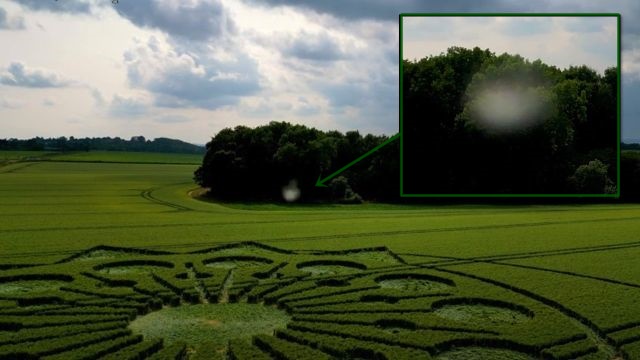
On June 26, 2023, the owner of a drone managed to capture a perplexing moment near a crop circle in Owlsebury, Hampshire, UK. The drone's camera recorded an unknown orb or sphere flying towards the drone, but it is the question whether this entity has anything to do with the crop circle.
Credit image: Van and Drone Adventures.
This sphere exhibits an appearance reminiscent of energetic phenomena, like a plasma ball, and it moves at high speed before vanishing into thin air.
Given the remarkable velocity of the object and the absence of any discernible flapping wings, it seems unlikely that the entity in question is a mere insect or bird.
It's hard to pinpoint exactly what it was, but its characteristics bear resemblance to what is known as a "Fastwalker." Alternatively, it raises speculation about potentially supernatural origins, such as a manifestation of a soul.
The first video provides a view of the sphere's approach, showing both normal and slow-motion speeds to enable a closer analysis of the strange object.
The second video shows the crop circle discovered on June 26, 2023.
Meer van UFO'S of UAP'S, ASTRONOMIE, RUIMTEVAART, ARCHEOLOGIE, OUDHEIDKUNDE, SF-SNUFJES EN ANDERE ESOTERISCHE WETENSCHAPPEN - DE ALLERLAATSTE NIEUWTJES


 Ross Coulthart Accuses Intelligence Community of Leaking David Grusch’s Medical Records to Discredit Him: A Whistleblower’s Challenge