Ontdek de Fascinerende Wereld van UFO's en UAP's: Jouw Bron voor Onthullende Informatie!
Ben jij ook gefascineerd door het onbekende? Wil je meer weten over UFO's en UAP's, niet alleen in België, maar over de hele wereld? Dan ben je op de juiste plek!
België: Het Kloppend Hart van UFO-onderzoek
In België is BUFON (Belgisch UFO-Netwerk) dé autoriteit op het gebied van UFO-onderzoek. Voor betrouwbare en objectieve informatie over deze intrigerende fenomenen, bezoek je zeker onze Facebook-pagina en deze blog. Maar dat is nog niet alles! Ontdek ook het Belgisch UFO-meldpunt en Caelestia, twee organisaties die diepgaand onderzoek verrichten, al zijn ze soms kritisch of sceptisch.
Nederland: Een Schat aan Informatie
Voor onze Nederlandse buren is er de schitterende website www.ufowijzer.nl, beheerd door Paul Harmans. Deze site biedt een schat aan informatie en artikelen die je niet wilt missen!
Internationaal: MUFON - De Wereldwijde Autoriteit
Neem ook een kijkje bij MUFON (Mutual UFO Network Inc.), een gerenommeerde Amerikaanse UFO-vereniging met afdelingen in de VS en wereldwijd. MUFON is toegewijd aan de wetenschappelijke en analytische studie van het UFO-fenomeen, en hun maandelijkse tijdschrift, The MUFON UFO-Journal, is een must-read voor elke UFO-enthousiasteling. Bezoek hun website op www.mufon.com voor meer informatie.
Samenwerking en Toekomstvisie
Sinds 1 februari 2020 is Pieter niet alleen ex-president van BUFON, maar ook de voormalige nationale directeur van MUFON in Vlaanderen en Nederland. Dit creëert een sterke samenwerking met de Franse MUFON Reseau MUFON/EUROP, wat ons in staat stelt om nog meer waardevolle inzichten te delen.
Let op: Nepprofielen en Nieuwe Groeperingen
Pas op voor een nieuwe groepering die zich ook BUFON noemt, maar geen enkele connectie heeft met onze gevestigde organisatie. Hoewel zij de naam geregistreerd hebben, kunnen ze het rijke verleden en de expertise van onze groep niet evenaren. We wensen hen veel succes, maar we blijven de autoriteit in UFO-onderzoek!
Blijf Op De Hoogte!
Wil jij de laatste nieuwtjes over UFO's, ruimtevaart, archeologie, en meer? Volg ons dan en duik samen met ons in de fascinerende wereld van het onbekende! Sluit je aan bij de gemeenschap van nieuwsgierige geesten die net als jij verlangen naar antwoorden en avonturen in de sterren!
Heb je vragen of wil je meer weten? Aarzel dan niet om contact met ons op te nemen! Samen ontrafelen we het mysterie van de lucht en daarbuiten.
UFOs Over Northwest Las Vegas, Nevada 7-18-2023 UFO Sighting News.
Date of sighting: 7-18-2023
Location of sighting: Las Vegas, Nevada, USA Source: MUFON
Watch this video footage and you will notice several glowing objects moving across the tops of the mountains in Las Vegas. The objects seem to be communicating and waiting for each other to organize and leave. The movement of the craft indicates that they are probably trying to get a newer pilot use to it before leaving. Such UFOs often are seen behind the old firing range of Nellis AFB in Las Vegas. It's said that a Tall White alien base was made back there with the agreement of the US gov in exchange for technology. Yeah...I believe these UFOs originated from there.
Scott C. Waring
Eyewitness states:
I went up to our rooftop deck. We are in Northwest Las Vegas just a few blocks from the geographic formation called "Lone Mountain". I have reported 2 or 3 other sightings from our rooftop deck since we moved here in 2015. I often go up to the roof to look at the famous "Strip" which is visible to our East-Southest. Tonight I was sitting and enjoying the warm evening air when I spotted a bright white light coming from the direction of Area 51 which is 150 miles Northwest from our house. I turned on the camera of my I-Phone 12 and started to record. As the light came closer it turned slightly to the right towards me (east) and I then realized it was an airplane. I stopped recording and was about to put my I-Phone away. Instead I noticed 2 white lights emerge from behind Lone Mountain and they were headed due west. They seemed perfectly spaced apart. The light was constant from them. I turned my i-Phone back on.
The airplane I was recording previously was still visible below the 2 lights as it headed in the opposite direction, but you can see it has blinking colored lights. I continued to record the 2 steady lights above and followed them as they seemed to head west over the Sheep Mountain Range which is about 15 miles north of us. The lead light then seemed to burn out after 30 seconds or so.
After another few seconds, the second light then burned out as well. Nothing seemed to remain of either light. Both were steady and followed a seemingly level path parallel to the ground before disappearing.
2,000 year old Nazca Ant Drawing Found In Peru, UFO Sighting News.
Date of discovery: July 18, 2023
Location of discovery:Peru
Location of discovery: 14°59'58.83"S 75° 0'56.54"W
I found something in Peru using Google Earth map. I found what I thought was an ant carved into the ground. Most Nazca lines were created over 2,000 years ago by the people of the Nazca culture. This particular drawing has never before been reported before today. It's easy to understand why, it's hard to see. It was so hard that I clicked the history button to see past photos of that area and found that the best image of it is from 1/2016 as you can see in the screenshots here. The ant has three main body parts unlike a spider which has two. So this is an ant. Its antenna really stick out. However ants have six legs, this little fellow has 6 legs on one side and 7 on the other. No ant has 13 legs so wow! Never before seen or reported by anyone. They were often said to be messages created as signs to the gods or aliens above.
Divers encounter enormous ‘doomsday"' deep sea fish off the coast of Ruifang, Taiwan
Divers off Taiwan were mesmerized after encountering a giant oarfish off the coast of Ruifang, Taiwan.
In the enchanting footage, divers can be seen encircling the shimmery silver critter as it hovers near the surface. At one point, one of the divers reaches out and touches the alleged doomsaying denizen of the deep.
Remarkable, the oar fish had several round bite marks believed to have been caused by a shark.
Diving instructor Wang Checng-Ru said that the oarfish must have been dying so it swam into shallower waters, however, locals believe this creature, which typically inhabit depths ranging from 656 to 3200 feet below the ocean's surface, is a harbinger of an impending earthquake or other misfortune.
Harvard Scientist Suggests Potential Discovery of Alien Technology
In a stirring announcement from Harvard, a team of intrepid researchers, led by the renowned Professor Avi Loeb, claimed to have potentially unearthed fragments of what could be alien technology. The fragments were meticulously retrieved from a meteor that plunged into the ocean near Papua New Guinea in 2014.
A typical morning turned into a historic moment when an enigmatic meteor was found to contain unexpected materials. This ground-breaking discovery could reshape our understanding of the cosmos and bring us closer to answering the age-old question: are we alone in the universe?
Instead of peering into the abyss of the cosmos through telescopes, these researchers have switched to a micro-scale approach, investigating under microscopes. The microscopic explorers of the universe have discovered a multitude of metallic spheres amidst the recovered debris. These metallic marbles from the depths of the ocean floor have captured the imagination of scientists across the globe.
Identifying these materials proved a challenging feat, as the team had to filter out minuscule particles from magnetic material collected from the ocean floor. While this might sound like a scene from a science fiction movie, these determined researchers managed to acquire the material and then embark on an extensive examination to reveal its secrets.
Interestingly, it’s not just the size or shape of these spheres that’s fascinating. Data suggests that the strength of these meteorite fragments is significantly higher than the majority of space rocks cataloged by NASA. This raises a tantalizing question: could these fragments be of technological, rather than natural, origin? Could they be remains of some alien technology, zipping through interstellar space?
The mysterious nature of these fragments conjures up images of interstellar voyages, like NASA’s Voyager spacecraft. Imagine if Voyager was on a similar trajectory, colliding with a planet in a distant star system and disintegrating, leaving only traces of its existence that journey through the cosmos and ultimately land on an alien world. Could these microscopic fragments be the messengers of such a voyage, sent by an unknown civilization?
VIDEO:
CBS NEWS – Harvard professor believes he may have found alien technology
The speed at which this particular meteor moved – faster than 95% of stars in our solar vicinity – adds another layer of intrigue to this interstellar riddle. The meteor’s remnants that the team retrieved might contain clues to its astounding speed and unusual strength.
To add to the mystique, this is the first time an object from another solar system has been identified and retrieved by our planet’s residents. The meteor was roughly half a meter in size, and when it exploded above the Pacific Ocean, it released energy equivalent to a small percentage of the Hiroshima atomic bomb. The aftermath of this explosion left behind a trail of melted droplets, concentrated in a specific region of the ocean.
The real revelation, however, would be if these droplets could be proven to be artificial in origin. Imagine if we find traces of semiconductors or an unusually high concentration of rare elements, which are typically not found in such quantities in nature. This would be a game-changer, potentially pointing to an advanced civilization’s interstellar craft debris.
As scientists analyze the material and continue their quest for answers, one thing is certain: this investigation has the potential to be a historical turning point. Even if these fragments turn out to be of natural origin, we stand to learn much about the universe and our place in it. For now, we eagerly await the next chapter in this exciting voyage of discovery.
Pink disc seen from plane, Tennessee, May 24, 2023, UFO Sighting News. .
Date of sighting:May 24, 2023
Location of sighting: Over Tennessee, USA
Source: MUFON
This report just came in today. A person was on a passenger jet when they noticed that a pink glowing disk was outside. The disk is on top of the cloud ceiling and is brightly lit up. The footage reveals much about it. It shows the color, luminosity, size and shape of the craft. The size is close to that of a 747 jet. This UFO was caught during sunset, which is one of the best times to go out UFO hunting. The setting sun disrupts the cloak of the UFO due to the sun being below and at a right angle of the UFO. The cloak cannot function properly that way and is visible to people above the craft.
Scott C. Waring
Eyewitness states:
While flying to ATL from DTW on May 24 between 8:30 and 9pm. I was sitting in a window seat and caught out the corner of my eye a bright ink disc just cursing long not to far off the right side. I recorded and took a pic of the sighting.
Two Orbs Caught On Animal Cam, May 28, 2023, UFO Sighting News
Date of sighting: May 28, 2023
Location of sighting: Nieuwschans, Netherlands
Watch this raw footage of an animal cam recording creatures going to the water hole for a drink. This little rat is seen twice trying to get a drink, but each time he get too frighted of these two flying orbs near him. Animals an sense things that humans cannot, they also often have great night vision so they can see in the dark the things that are hidden from our own eyes.
Aliens have long been a topic of controversy and fascination. However, are we edging closer to unveiling their mysterious presence on Earth? From ancient texts to unexplained artifacts, let’s delve into this extraterrestrial enigma, as we unpack revelations from an interview with Richard Lawrence, a noted UFO expert.
Ancient Alien Artifacts: The Undeniable Imprints
Ancient structures and artifacts across the globe have stirred debates among historians, archeologists, and alien enthusiasts alike. The Temple Mount in Jerusalem, the depths of the Aegean Sea, and Mt. Sinai in Egypt have all been focal points of such discussions. How could these complex, precise structures have been created with the limited technology of the time? Are they evidence of ancient alien interaction, or is there a more mundane explanation?
Unveiling the Unknown: Declassifying UFO Records
In recent years, there’s been a growing demand for governments worldwide to declassify UFO records. This demand has been fuelled in part by a persistent belief among a section of the public that governments are withholding truth about the existence of extraterrestrial life. This skepticism towards government transparency isn’t unfounded. Over time, it has been proven that governments, including the U.S., have indeed lied about UFO-related incidents.
As per Richard Lawrence, there’s a chance that governments across the world might be on the brink of revealing long-withheld information on UFOs, but it’s also a probability that these revelations might be tied up with defense policies, creating a barrier to complete transparency.
Alien Technology: Extraterrestrial Advantage or Manmade Marvel?
One of the intriguing aspects of the UFO narrative is the claim of alien technology being present on Earth. This theory proposes that advanced technology, capable of feats beyond our current scientific understanding, has either been given to us by extraterrestrial beings or reverse-engineered from captured alien spacecraft. This could encompass innovations related to sound or light speed, or even unprecedented materials that could be utilized in warfare.
This raises an intriguing question: could these technologies actually have an alien origin, or are they just the products of human ingenuity and scientific progression?
Unidentified Aerial Phenomena (UAPs): More than just a Name
UAP is a term increasingly used by officials, replacing the popular term UFO. It’s still a term that refers to unexplained flying objects, but with a fresher, less stigmatized branding. But what’s in a name? Be it UFO or UAP, the major question remains the same – are they terrestrial or extraterrestrial?
Ancient Accounts: A Testimony to Alien Existence?
Ancient texts, like the Sanskrit records and the Bible, often narrate tales that could be interpreted as encounters with UFOs or extraterrestrial beings. UFO believers argue these records could be evidence of alien visitations in the past. However, the interpretation of these records is contentious, and skeptics often regard these as myth, not fact.
VIDEO:
Ancient Aliens: Top 3 Unbelievable Alien Artifacts (Season 19)
The extraterrestrial narrative is a captivating topic that continues to be debated globally. As we anticipate more transparency from governments and continue to examine ancient texts and artifacts, we might get closer to answering these mysteries. Until then, the debate between UFO skeptics and believers rages on. Whether these mysterious phenomena are the result of alien interaction or just misinterpreted natural occurrences is a question that continues to puzzle us. One thing is clear – our fascination with the possibility of life beyond Earth isn’t going away anytime soon.
UFO Expert Richard Lawrence: The Pentagon May Unveil Its UFO Secrets
In the world of ufology – the study of unidentified flying objects – there’s perhaps no name as instantly recognizable as Richard Lawrence. With a reputation steeped in decades of research and analysis, Lawrence has been at the forefront of the push for UFO transparency. The recent drive by US senators towards declassification of all government records regarding UFOs brings this conversation back into the limelight. Will we finally see what’s been lurking behind the curtain of government secrecy?
Lawrence, a stalwart figure in ufology, stands firm in his conviction that the truth may soon be revealed. This arises from the fact that the Pentagon, under bipartisan pressure, might have to disclose what they know about UFOs. Yet, the path to such disclosure raises more questions than answers. How much information will be revealed, and how long will we have to wait to see it?
Ever the skeptic, Lawrence refuses to shy away from the hard truths. He shares his skepticism about governments and their habitual shrouding of information related to UFOs. Historically, if you made the claim that governments were concealing the truth about UFOs, you were often labeled a conspiracy theorist. However, the narrative is gradually changing as governments are seen to be more open about their knowledge of unidentified aerial phenomena (UAPs), the current term used for UFOs.
Lawrence notes that, contrary to popular belief, this isn’t a modern conspiracy. There are countless references to UFO-like phenomena in ancient texts like the Sanskrit records and the Bible, hinting at a long history of extraterrestrial encounters. Interestingly, Lawrence points out that the term ‘star’ used in many historical contexts, could very well have been a reference to these mysterious flying objects.
VIDEO:
The Pentagon could be forced to declassify what it knows about UFOS | UFO expert Richard Lawrence
So, why has there been so much secrecy around UFOs? Lawrence posits that much of this can be tied to defense policies and a race among nations to harness this advanced technology. Evidence suggests that governments, not just in the US but worldwide, are scrambling to understand and potentially replicate the high-tech capabilities demonstrated by these phenomena.
Despite the veil of secrecy, the potential for UFO technology to advance our understanding of the universe is astounding. We’re looking at possibilities ranging from travel beyond the speed of sound to the discovery of new materials that could revolutionize industries. These possibilities can often overshadow the most existential questions: Who are they, and why are they here?
In this climate of increased transparency, the discussion around UFOs has been progressively destigmatized. Despite the skepticism that continues to surround the topic, there is hope that the impending declassification by the Pentagon will spark new conversations, leading to a better understanding of these mysterious phenomena.
In the wake of these revelations, one thing is clear – the call for truth has never been louder. As Richard Lawrence, and indeed the entire ufology community, wait with bated breath for more information to be revealed, it’s a reminder that the quest for knowledge is an ongoing journey. It’s a journey that spans not just our lifetimes, but the annals of history, ever reaching towards the stars.
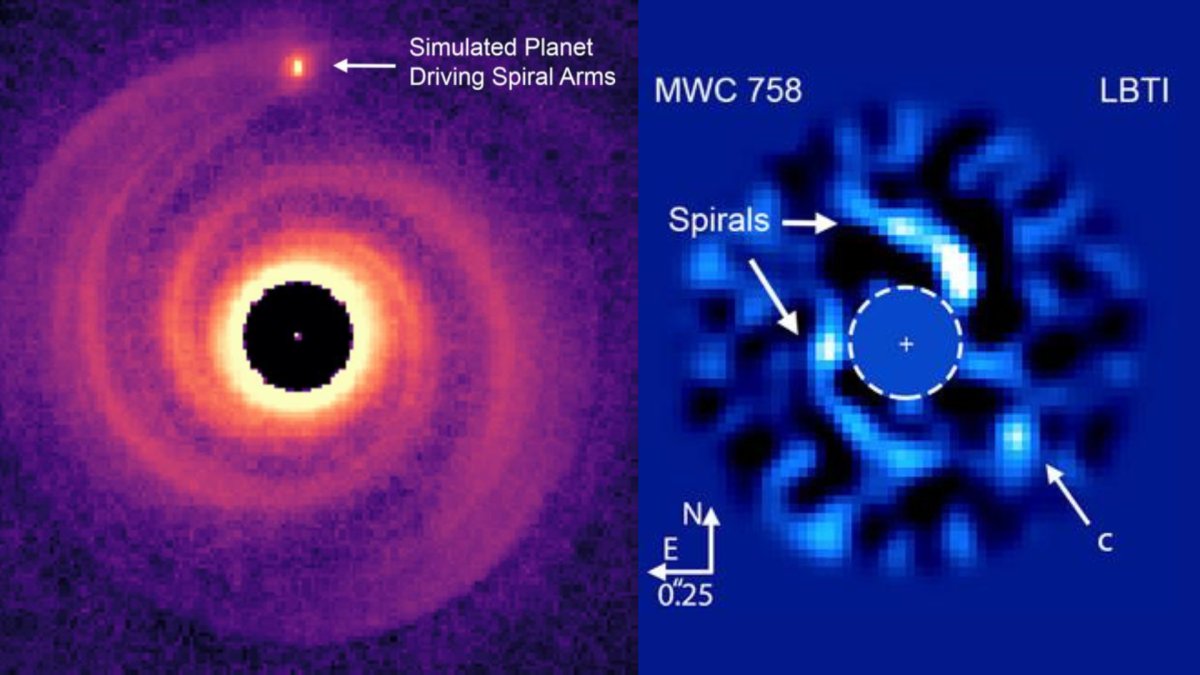
The giant exoplanet MWC 758c offers a glimpse into the birth of alien solar systems.
(Left) A simulation shows a giant exoplanet diving the spiral arms around a star. (Right) The MWC 758 planetary system observed by the Large Binocular Telescope Interferometer (LBTI
(Image credit: K. Wagner et al./ L. Krapp and K. Kratter, University of Arizona)
Astronomers have discovered a giant alien planet that is shaping the spiral arms developing in gas and dust around its parent star.
The planet also happens to be the reddest planet outside the solar system, or 'exoplanet,' ever seen, scientists have said.
Spiral arms are structures usually associated with galaxies, with images of our spiral galaxy, the Milky Way, providing a striking example of such a structure. Spiral arms aren't limited to galaxies; gas and dust around young stars can also develop these features too.
This still from a simulation shows how the giant exoplanet MWC 758c is carving spiral arms of its parent star. (Image credit: L. Krapp and K. Kratter, University of Arizona)
Located around 500 light-years from Earth, the star, MWC 758, is estimated to be just a few million years old, practically an infant in comparison to our 'middle-aged' sun, which is around 4.6 billion years old.
And just as the sun was in its infancy, MWC 758 is surrounded by a disk of planet-birthing material called a protoplanetary disk. But since at least 2013, astronomers have been aware of a spiral pattern forming two arms in this protoplanetary disk. University of Arizona researchers now think that those twin spiral arms are the work of a massive planet, dubbed MWC 758c, which orbits the star at a distance equivalent to 100 times the distance between Earth and the sun.
"Our study puts forward a solid piece of evidence that these spiral arms are caused by giant planets," research lead author and University of Arizona Steward Observatory postdoc Kevin Wagner said in a statement. "And with the new James Webb Space Telescope, we will be able to further test and support this idea by searching for more planets like MWC 758c."
The MWC 758 planetary system as observed by the Large Binocular Telescope Interferometer at infrared wavelengths. Its spiral arms are clearly apparent, as its the giant exoplanet sculpting them. (Image credit: L. Krapp and K. Kratter, University of Arizona)
Protoplanetary disks like this one and the one that once formed the solar system usually take around 10 million years to dissipate. The debris comprising them can either be ejected from the system, can be swallowed by the infant star, or can be used as the building blocks for planets, moons, asteroids, and comets.
"I think of this system as an analogy for how our own solar system would have appeared less than 1% into its lifetime," Wagner said. "Jupiter, being a giant planet, also likely interacted with and gravitationally sculpted our own disk billions of years ago, which eventually led to the formation of Earth."
Spiral arms in protoplanetary disks are fairly common. Of 30 disks identified in relatively nearby young star systems, astronomers have found around 10 have their own spiral arms.
"Spiral arms can provide feedback on the planet formation process itself," Wagner said. "Our observation of this new planet further supports the idea that giant planets form early on, accreting mass from their birth environment, and then gravitationally alter the subsequent environment for other, smaller planets to form."
The leading theory is that these spiral arms are sculpted when a massive gas giant pulls on material swirling around its parent star. Until now, however, astronomers have failed to spot the planets that could be acting as cosmic sculptors for these arms.
"It was an open question as to why we hadn't seen any of these planets yet," Wagner said. "Most models of planet formation suggest that giant planets should be very bright shortly after their formation, and such planets should have already been detected."
How a spiral arms dealer remained hidden
If MWC 758c is enshrouded by a large amount of dust, this material would be absorbing short-wavelength light resulting in the planet appearing bright only at longer red wavelengths.
If the exoplanet is surrounded by a great deal of dust, this may indicate that it is still forming or even that it is in the process of gathering its own moons as the solar system gas giant Jupiter did billions of years ago.
"In the other scenario of a colder planet surrounded by less dust, the planet is fainter and emits more of its light at longer wavelengths," research co-author and University of Arizona theoretical astrophysicist Kaitlin Kratter said.
If this chillier model for MWC 758c is correct, this means that there may be something happening in young planetary systems such as this that results in planets being colder than expected when they form. This might have an impact on planet formation models and on the techniques that astronomers currently use to hunt exoplanets.
"In either case, we now know that we need to start looking for redder protoplanets in these systems that have spiral arms," Wagner said.
The researchers behind the detection of MWC 758c will now view the exoplanet with the JWST in 2024 in an effort to distinguish between potential scenarios at work in this infant planetary system.
The MWC 758 planetary system is shown directly imaged by the Large Binocular Telescope Interferometer (LBTI) in infrared wavelengths. Theoretical models suggest that the newly discovered exoplanet, MWC 758C, is likely producing spiral arms in the protoplanetary disk encircling the young star.
"Depending on the results that come from the JWST observations, we can begin to apply this newfound knowledge to other stellar systems," Wagner said, "and that will allow us to make predictions about where other hidden planets might be lurking and will give us an idea as to what properties we should be looking for in order to detect them."
Join our Space Forums to keep talking space on the latest missions, night sky and more! And if you have a news tip, correction or comment, let us know at: community@space.com.
Four Glowing Objects Over Dallas, Texas 7-4-2023, UFO Sighting News.
Date of sighting: 7-4-2023 Location of sighting: Dallas, Texas, USA Source: MUFON
This interesting video just came in last night. Four egg shaped UFOs were seen over Dallas and they moved swiftly away and out of sighting. The objects were white glowing objects and were too bright to see any details. UFOs frequent the Texas area, for instance the 300 meter rectangle UFO flying low over Stephenville just a few years ago seen by thousands of residents. These glowing white eggs are alien craft.
Scott Waring
Eyewitness states:
I was driving home right off I-35 when I saw 3 orb like objects in the early night sky. I pulled out my phone and began filming these objects with my phone. As I observed further, I noticed a 4th object suddenly appear. They broke the triangle formation and went into a horizontal hover. As I kept driving closer to the objects, the 4th one appeared directly in front of me within seconds of being on my left. I came to a stop sign. I observed and listened. I saw a helicopter near the object that appeared near me, but did not get that on film. The object began hovering closer to me. From my past experiences, I assumed I would be taken and placed back with missing time like I was before. It is woth mentioning I've had many sightings of UFOs, encounters with various beings, and up to 12 hours of missing time. I've seen these beings, "the Greys" fully manifest these egg crafts with harmonic and tonal frequencies, along with the advanced use of psionic technology.
Meer van UFO'S of UAP'S, ASTRONOMIE, RUIMTEVAART, ARCHEOLOGIE, OUDHEIDKUNDE, SF-SNUFJES EN ANDERE ESOTERISCHE WETENSCHAPPEN - DE ALLERLAATSTE NIEUWTJES


 UFOs Over Northwest Las Vegas, Nevada 7-18-2023 UFO Sighting News.