Ontdek de Fascinerende Wereld van UFO's en UAP's: Jouw Bron voor Onthullende Informatie!
Ben jij ook gefascineerd door het onbekende? Wil je meer weten over UFO's en UAP's, niet alleen in België, maar over de hele wereld? Dan ben je op de juiste plek!
België: Het Kloppend Hart van UFO-onderzoek
In België is BUFON (Belgisch UFO-Netwerk) dé autoriteit op het gebied van UFO-onderzoek. Voor betrouwbare en objectieve informatie over deze intrigerende fenomenen, bezoek je zeker onze Facebook-pagina en deze blog. Maar dat is nog niet alles! Ontdek ook het Belgisch UFO-meldpunt en Caelestia, twee organisaties die diepgaand onderzoek verrichten, al zijn ze soms kritisch of sceptisch.
Nederland: Een Schat aan Informatie
Voor onze Nederlandse buren is er de schitterende website www.ufowijzer.nl, beheerd door Paul Harmans. Deze site biedt een schat aan informatie en artikelen die je niet wilt missen!
Internationaal: MUFON - De Wereldwijde Autoriteit
Neem ook een kijkje bij MUFON (Mutual UFO Network Inc.), een gerenommeerde Amerikaanse UFO-vereniging met afdelingen in de VS en wereldwijd. MUFON is toegewijd aan de wetenschappelijke en analytische studie van het UFO-fenomeen, en hun maandelijkse tijdschrift, The MUFON UFO-Journal, is een must-read voor elke UFO-enthousiasteling. Bezoek hun website op www.mufon.com voor meer informatie.
Samenwerking en Toekomstvisie
Sinds 1 februari 2020 is Pieter niet alleen ex-president van BUFON, maar ook de voormalige nationale directeur van MUFON in Vlaanderen en Nederland. Dit creëert een sterke samenwerking met de Franse MUFON Reseau MUFON/EUROP, wat ons in staat stelt om nog meer waardevolle inzichten te delen.
Let op: Nepprofielen en Nieuwe Groeperingen
Pas op voor een nieuwe groepering die zich ook BUFON noemt, maar geen enkele connectie heeft met onze gevestigde organisatie. Hoewel zij de naam geregistreerd hebben, kunnen ze het rijke verleden en de expertise van onze groep niet evenaren. We wensen hen veel succes, maar we blijven de autoriteit in UFO-onderzoek!
Blijf Op De Hoogte!
Wil jij de laatste nieuwtjes over UFO's, ruimtevaart, archeologie, en meer? Volg ons dan en duik samen met ons in de fascinerende wereld van het onbekende! Sluit je aan bij de gemeenschap van nieuwsgierige geesten die net als jij verlangen naar antwoorden en avonturen in de sterren!
Heb je vragen of wil je meer weten? Aarzel dan niet om contact met ons op te nemen! Samen ontrafelen we het mysterie van de lucht en daarbuiten.
Ross Coulthart Sheds Light on ‘Extraterrestrial’ Craft, Alien Entities and the Journey Towards Disclosure
In an era where skepticism and disbelief seem to reign supreme, there’s one man who stands out with his relentless pursuit of the truth – Ross Coulthart. A renowned investigative journalist and author, Coulthart has spent years digging deep into the subject of Unidentified Aerial Phenomena (UAPs), popularly known as UFOs.
Ross Coulthart: Unmasking the UFO Mystery
Having spent over three decades in journalism and law, Coulthart brings a unique perspective to the mystery surrounding UAPs. He’s not an alien activist or a conspiracy theorist but a devoted pursuer of the truth. His book, “In Plain Sight,” (Amazon link) has become a beacon for those seeking clarity about the UFO phenomenon.
A Government in Paralysis
According to Coulthart, the US government is currently in a state of paralysis concerning the UAP issue. While the existence of these phenomena is not disputed, the Pentagon has been reluctant to divulge what they know. The challenge seems to be more political than scientific, with the government hoping the issue doesn’t surface before the next presidential elections. However, as Coulthart asserts, the truth is destined to come out, whether they like it or not.
Witness Intimidation and Threats
One of the most alarming revelations from the discussion was the potential intimidation of witnesses. There have been allegations of threats and reprisals against individuals willing to testify about their encounters with UAPs. If true, this not only highlights a breach of law but also a grave injustice to those seeking the truth. According to Coulthart, it’s time for Congress to determine whether it has the courage to investigate these allegations.
The Push for UAP Transparency
Coulthart asserts that there is a legislative pushback against UAP transparency. Some factions within the Pentagon and intelligence community seem intent on preventing the full disclosure of their knowledge on the matter. However, the public, he argues, has a voice. By expressing their concern and demanding answers, citizens can push their congressional representatives and senators to address the issue seriously.
The Right Side of History
In his closing remarks, Coulthart sends a strong message to officials not yet engaged with the subject, urging them to choose the right side of history. For those holding information about UAPs, he calls it a “patriotic duty” to come forward, ensuring that Congress is properly informed. It’s not the UFO phenomena that are hard to grasp; it’s the silence surrounding them.
VIDEO:
Ross Coulthart Reveals More on “Non-Human” Spacecraft, Alien Bodies and Disclosure in STS Exclusive
Ross Coulthart’s candid conversation underscores the urgent need for transparency regarding UAPs. The quest for truth is not solely about unveiling the existence of extraterrestrial life, but about illuminating a subject that has been shrouded in secrecy for too long. With the rise of public interest, it seems that the days for derision and ridicule are over. Whether the truth turns out to be benign or earth-shattering, one thing is clear – the demand for UFO transparency is only growing stronger.
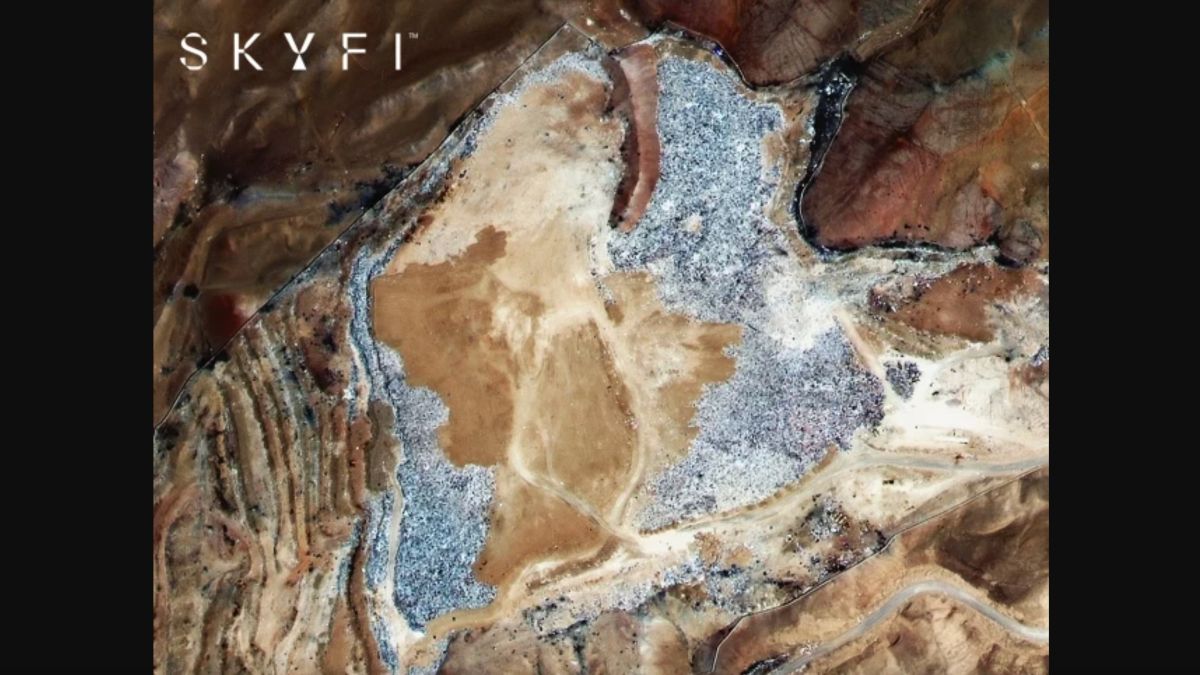
The huge garment pile is growing by about 39,000 tons a year.
A pile of discarded clothes in the Atacama Desert, northern Chile, as seen by a satellite.
(Image credit: SkyFi)
A mountain of discarded clothes in the Atacama Desert of northern Chile has reached such huge proportions that it can be seen from space.
Last month, the satellite imagery app SkyFi revealed views from orbit of the pile of clothes that is created as a result of the fast fashion industry, which produces an estimated 92 million tons of waste a year. Included in the clothing mountain are some unusual items, such as ski boots and unwanted Christmas sweaters.
The 20-inch (50 centimeters) resolution image, posted to the SkyFi blog on May 10, shows how large the clothes mountain has grown in comparison to a nearby city, revealing the true scale of the problem it represents.
A satellite photo shows the huge and growing pile of discarded clothes in Chile's Atacama Desert, with a nearby town providing perspective. (Image credit: SkyFi)
"The satellite image that we ordered of the clothes pile in Chile's Atacama Desert really puts things into perspective," SkyFi wrote in the blog post. "The size of the pile and the pollution it's causing are visible from space, making it clear that there is a need for change in the fashion industry."
The clothes in the mountain are mainly manufactured in China or Bangladesh and are then sent to stores in the U.S., Europe, and Asia, Agence France-Presse reported in 2021. The garments that fail to sell are dumped in the Atacama.
The news organization added that, as of 2021, it was estimated that around 59,000 tons of clothes arrive in the region each year, coming in through the nearby port of Iquique, in the Alto Hospicio free zone in northern Chile.
Some of the clothes are bought by clothing merchants from the capital of Chile, Santiago, which is 1,100 miles (1,800 kilometers) to the south of the clothing mountain, and some are taken by clothing smugglers to resell in other parts of Latin America. Even with this taken into account, the mountain of discarded clothes is still growing by 39,000 tons a year.
The clothing can't be sent to municipal landfills because it is not biodegradable and contains chemical products, Franklin Zepeda, the founder of EcoFibre, a company that turns some clothes into insulation panels, told the AFP.
SkyFi explained how the imaging of the clothes mountain lines up with the app's ongoing mission to make Earth observation data transparent and easy to access, something it said is vital to identifying and addressing problems like this one.
"With our web and mobile apps, anyone can access satellite imagery to confirm stories and see the world from a new perspective," SkyFi wrote.
Join our Space Forums to keep talking space on the latest missions, night sky and more! And if you have a news tip, correction or comment, let us know at: community@space.com.
From within a supergiant elliptical galaxy located in the constellation Virgo, in 2019, the world was given its first glimpse of a massive black hole at the heart of Messier 87, one of the largest galaxies in our local universe.
One of the most remarkable images ever produced in physics, a fiery golden ring encircling the dark remnants of the collapsed former star—almost reminiscent of the flaming eye of Sauron depicted in Peter Jackson’s Lord of the Rings films—finally presented astrophysicists with an idea of how a black hole might actually look.
Since light is unable to escape the event horizon, these images weren’t an actual photograph of a black hole but a representation based on data that conveys glowing gas in orbit around it, captured by the Event Horizon Telescope (EHT) array. Since the images were revealed, scientists have anticipated that more data might be forthcoming, revealing even greater details about the dark, distant singularity.
Early on, simulations had already predicted that photons captured by the extreme gravity of the black hole would be spun around behind it, giving rise to an additional ringlike formation comprised of light unable to escape its incredible mass.
Now, astrophysicist Avery Broderick with Perimeter Institute and the University of Waterloo, along with an international research team, says they have “remastered” the groundbreaking 2019 images, revealing new details from within the data that produced the world’s first clear view of a black hole.
In a recent statement, Broderick likened his team’s efforts to that of shutting off a bright searchlight to reveal the light of hundreds of fireflies, whose faint light would otherwise remain hidden. The result, according to Broderick and the recent paper’s authors, represents “the first in an infinite series of so-called ‘photon rings’ around the supermassive black hole M87.”
In their recent research, Broderick and his team were able to provide measurements of gravitationally lensed secondary imagery, which relies on the way a distant light source is bent on account of the presence of matter in our universe as it travels toward an observer.
“The most striking feature of any gravitationally lensed object is the possibility for more than one image,” Broderick told The Debrief in an email, which he said is “associated with light that was launched in some direction other than toward us, that is bent around the mass by gravity to our line of sight.”
For the emissions around black holes, Broderick says this process is even greater, effectively becoming “supercharged.”
“The ‘primary’ image is associated with the radio waves that left the emission region,” Broderick told The Debrief, “and came (nearly) directly to Earth.”
“The ‘secondary’ image is associated with those radio waves that start propagating away from Earth, but subsequently have their trajectories bent by the black hole’s extreme gravity, and are redirected toward us after completing a half-orbit.”
Along with the primary and secondary images, Broderick explained that a third “tertiary” image was obtained through radio waves that make a complete orbit prior to reaching Earth, which he likened to a “gravitational infinity mirror.”
“There is an infinite sequence of such images, though only the first two (primary and secondary) are bright enough for EHT to disentangle,” Broderick said.
According to the paper, the observed photon ring remained constant in appearance and size over a week-long period in data collected by the EHT array back in 2017. This, according to the researchers, is “consistent with theoretical expectations, providing clear evidence that such measurements probe spacetime and a striking confirmation of the models underlying the first set of EHT results.”
Significantly, the research team was also able to detect what appeared to be an extension of the ring oriented to the southwest, indicating the presence of a jet, characterized as “rapidly rotating in the clockwise direction.” Broderick and his team believe these observations support the presence of a black hole spin-driven outflow, a proposed means for the extraction of energy out of a rotating black hole first proposed by astrophysicists Roger Blandford and Roman Znajek in 1977.
Additionally, the team’s observations of the photon ring around the black hole led them to revise previous calculations about the mass of M87.
“We present three revised estimates for the mass of M87 based on identifying the modeled thin ring component with the bright ringlike features seen in simulated images,” the paper’s authors wrote, who further noted that one of these appears “only weakly sensitive to the astrophysics of the emission region.”
“All three estimates agree with each other and previously reported values,” the researchers wrote.
In correspondence with Broderick, he elaborated on the uncertainties of the physical environment that he and his research team had to overcome in order to reach their calculations.
“The largest uncertainty in the M87 mass was systematic: the relationship between the diffuse ring (dominated by the primary image) and the shadow edge,” Broderick told The Debrief.
“This relationship is fundamentally dependent on the imperfectly known astrophysical environment, what the plasma and magnetic fields are doing near the black hole, and is therefore led to a ~10% range of potential masses.”
“However,” he added, “the secondary image, the narrow ring, is much less dependent on the astrophysics and more indicative of the gravitational physics. That is, the narrow ring provides a fingerprint of gravity, from which we can read the mass far more clearly.”
Employing unique algorithms that allowed Broderick and his team to isolate certain data in the existing EHT data, the researchers were able to remove layers of information that allowed the distinct, ring-like array of photons to be made visible. The results appear to confirm several predictions about the black holes and theoretical models that have been devised about them over the decades, while relying on this very same information to help detect the “hidden” photons in question.
Dominic Pesce, part of the research team and a member of Harvard’s Black Hole Initiative, said the approach the team took “involved leveraging our theoretical understanding of how these black holes look to build a customized model for the EHT data.”
According to Pesce, the resulting model “decomposes the reconstructed image into the two pieces that we care most about, so we can study both pieces individually rather than blended together.”
For Broderick, the new information is just one more example of the kinds of unique imagery researchers will be able to produce in the years ahead based on the vital data collected by the EHT array.
“Cutting-edge algorithmic developments have allowed us to probe key features of the image while rendering the remainder in the EHT’s native resolution,” Broderick said in a statement.
“We have been able to do something profound,” Broderick says. “To resolve a fundamental signature of gravity around a black hole.”
The team’s paper, “The Photon Ring in M87,” was published in The Astrophysical Journal, and can be read online.
Micah Hanks is Editor-in-Chief and Co-Founder of The Debrief. Follow his work at micahhanks.com and on Twitter: @MicahHanks.
Perseverance is in de Jezero-krater op veelbelovende organische moleculen gestuit, die ook wel worden gezien als ‘de bouwstenen voor leven’. Maar of ze ook echt door Martiaanse microben zijn achtergelaten, blijft twijfelachtig.
Het is alweer zo’n twee jaar geleden dat Marsrover Perseverance in de Jezero-krater op Mars landde. Sindsdien speurt het Marswagentje zorgvuldig de krater af, op zoek naar tekenen van (voormalig) leven. En dat kan de rover nu zomaar eens gevonden hebben. Zo blijkt Perseverance bewijs te hebben ontdekt van verschillende soorten organische moleculen, zo laten onderzoekers weten.
Organische moleculen De aangetroffen organische moleculen zijn een klasse van op koolstof gebaseerde moleculen. “Ze komen overeen met moleculen die koolstof bevatten en de bouwstenen zijn van het leven zoals wij dat kennen,” zegt teamlid Ashley Murphy. “Dit is één van de eerste keren dat we potentiële organische stoffen in de Jezero-krater vinden.” De ontdekking is dan ook best spannend. Want mogelijk zijn de ontdekte organische moleculen wel achtergelaten door oud microbieel leven! Al hoeft dat overigens niet per se het geval te zijn.
Bouwstenen voor leven Organische moleculen bestaan voornamelijk uit koolstof en bevatten gewoonlijk waterstof- en zuurstofatomen. Ze kunnen ook andere elementen bevatten, zoals stikstof, fosfor en zwavel. De vondst van dergelijke organische moleculen zijn van belang, omdat sommige van deze verbindingen de bouwstenen van leven zijn. De aanwezigheid van deze specifieke moleculen wordt beschouwd als een potentiële biosignatuur – een stof of structuur die een bewijs zou kunnen zijn van voormalig leven. Toch houden wetenschappers een slag om de arm. Sommige organische moleculen kunnen namelijk ook door middel van chemische processen, zonder de aanwezigheid van leven, ontstaan.
Geen biologische oorsprong “Niet alle organische moleculen hebben een biologische oorsprong,” legt Murphy uit. “Daarom is het belangrijk om de relatie tussen mineralen en organische stoffen te bestuderen. Alles wat we weten over het leven op aarde is beperkt tot wat bewaard is gebleven in het gesteente en mineralen. Op aarde worden biosignaturen gevonden in bepaalde mineralen en sommige mineralen zijn beter in het bewaren van organische stoffen dan andere.”
Mars en de aarde Het betekent dat onderzoekers de aarde vaak als voorbeeld gebruiken om te achterhalen wat er op Mars kan hebben plaatsgevonden. “Mars kan een vergelijkbare vroege geologische geschiedenis hebben gehad als de aarde, dus we gebruiken onze kennis van het leven zoals we dat op aarde kennen om te zoeken naar mogelijk bewijs van voormalig leven op Mars,” aldus Murphy. “Het in kaart brengen van organische stoffen zorgt voor een beter begrip van de koolstofcyclus van Mars. We kunnen dan bepalen of deze vergelijkbaar is met of juist verschilt van die van de aarde. Ook zal het ons meer kunnen vertellen over hoe waarschijnlijk het is dat Mars leven herbergde.”
Close-up of NASA's Mars 2020 Rover's SHERLOC Instrument
SHERLOC De organische moleculen werden aan het licht gebracht met behulp van Perseverance’ SHERLOC-instrument. SHERLOC – een afkorting voor Scanning Habitable Environments with Raman & Luminescence for Organics & Chemicals – gebruikt een ultraviolette laser om mineralen in gesteente te identificeren. Daarnaast is het instrument uitgerust met camera’s en spectrometers om te zoeken naar organische stoffen en mineralen die mogelijk tekenen zijn van microbieel leven uit het verleden. “Met het SHERLOC-instrument, gemonteerd op de robotarm van Perseverance, kunnen we potentiële biosignaturen evalueren,” licht Murphy toe.
Máaz en Séítah De onderzoekers gebruikten het SHERLOC-instrument om twee Martiaanse rotsformaties, Máaz en Séítah, nader te bestuderen. Perseverance boorde daarvoor kleine gaatjes in het gesteente. En op alle tien de plekken trof het team sporen van organische moleculen aan. “De potentiële organische stoffen zijn te vinden in meerdere lagen,” vertelt Murphy. “Dit kan erop wijzen dat Mars ooit verschillende oppervlakteprocessen en een relatief complexe organische geochemie had. Op aarde wordt dit geassocieerd met bepaalde bewoonbare omgevingen waar tekenen van oud leven bewaard kunnen blijven.”
Andere vondsten Overigens is het niet de eerste keer dat er op Mars organisch materiaal wordt gevonden. Zowel Perseverance als de Curiosity-rover hebben dit al eerder aangetroffen. “De nieuw ontdekte moleculen lijken op de exemplaren die al eerder in de Gale-krater en in verschillende meteorieten zijn gevonden,” vertelt Murphy. “De detectie van diverse organische stoffen in twee oude meren (de Gale- en Jezero-krater) is belangrijk voor ons begrip van de omvang en diversiteit van oppervlakteprocessen en hoe dit verband houdt met de leefbaarheid van de planeet.”
Oorsprong Maar nogmaals, de ontdekking is geenszins een bevestiging dat er ooit leven op Mars bestond. Organische moleculen kunnen op verschillende manieren worden gevormd, waaronder door niet-biologische processen zoals interacties tussen water en gesteente, afzettingen door interplanetair stof of meteoren of door synthese met vulkanisch materiaal. Op dit moment is het nog niet duidelijk wat precies de oorsprong van de opgeduikelde organische moleculen is.
Ondanks dat de organische stoffen dus geen bewijs zijn van voormalig leven, is de vondst alsnog opwindend, omdat het wel laat zien dat Mars over de bouwstenen van leven beschikt. De monsters zullen nu eerst terug naar de aarde moeten worden gebracht en hier nader moeten worden onderzocht, voordat er definitieve conclusies kunnen worden getrokken. We zullen dus nog even geduld moeten hebben voordat er voor eens en voor altijd kan worden bepaald of er leven is (geweest) op Mars.
Meer weten… …over de toekomstige Mars Sample Return-missie, waarin de door Perseverance verzamelde Marsmonsters op aarde zullen worden afgeleverd?
Van stoffige kraamkamers vol protosterren tot gigantische sterrenstelsels met supermassieve zwarte gaten en van ijswerelden in ons zonnestelsel tot zeldzame Wolf-Rayetsterren. Een jaar geleden deelde de Amerikaanse ruimtevaartorganisatie de eerste kiekjes van de James Webb-telescoop en sindsdien worden we wekelijks verwend met de fraaiste kosmische ruimtefoto’s.
In dit artikel zetten we de tien allermooiste James Webb-foto’s op een rij. Deze foto’s zijn gerangschikt door de bezoekers van Scientias.nl. De laagste foto in deze lijst kreeg gemiddeld een 8, terwijl de eerste plek beloond is met een hoog gemiddeld cijfer, namelijk een 9.
10. James Webb maakt fantastische foto van Uranus (en zijn ringen!)
In het eerste jaar maakte de James Webb-telescoop al verschillende foto’s van gasplaneten in ons zonnestelsel, zoals Jupiter en Neptunus. Hoogtepunt is volgens jullie deze foto van Uranus. Ruim 37 jaar na de scheervlucht van Voyager 2 langs de ijskoude blauwe planeet vervaardigde James Webb nieuwe foto’s. Daarop zien we een planeet met een complex ringsysteem, een heldere poolkap en waarschijnlijk zelfs onweerswolken.
De ijsreus is uitgerust met dertien ringen, waarvan er elf zichtbaar zijn op de foto hieronder. Sommige van deze ringen zijn echter zo helder, dat wanneer ze dicht bij elkaar in de buurt liggen, ze lijken samen te vloeien tot één grotere ring. Waar we daarnaast niet omheen kunnen, is de extreem heldere poolkap van Uranus, te zien aan de rechterkant. Momenteel is het nog lente op de noordpool, het deel van de planeet dat op de foto’s zichtbaar is. De zomer zal pas in 2028 aanbreken. Aan de rand van de poolkap is tevens een heldere wolk te zien. Dergelijke wolken zijn typerend voor Uranus en houden waarschijnlijk verband met onstuimige stormen.
9. Fotogenieke Orionnevel waar sterren geboren worden
James Webb richtte het vizier op het sterrenbeeld Orion en zocht daar vervolgens naar de op 1350 lichtjaar van de aarde gelegen Orionnevel. Het resulteert in een fantastische foto van het binnenste van de nevel, waarop tal van spectaculaire structuren te zien zijn. Wat natuurlijk direct in het oog springt is de balkvormige wolk die zich van de linkerbovenhoek naar de rechteronderhoek van de foto uitstrekt. Het is een ‘muur’ van dicht gas en stof, waarin de heldere ster θ2 Orionis A nestelt. Rechtsboven zie je een aantal hete, jonge zware sterren die deel uitmaken van het zogenoemde Trapeziumcluster; een open sterrenhoop in de Orionnevel. Deze sterren geven intense ultraviolette straling af, waardoor de balkvormige wolk langzaam erodeert.
8. NGC 3132
Op 2000 lichtjaar van de aarde vinden we een planetaire nevel, die ook wel de Zuidelijke Ringnevel wordt genoemd. De nevel (een groeiende gaswolk rond een stervende ster) breidt zich momenteel uit met 14,5 kilometer per seconde. Met behulp van de krachtige ruimtetelescoop James Webb zijn onderzoekers er nu in geslaagd de rommelige dood van deze ster te reconstrueren en te achterhalen hoe de nevel zijn unieke vorm heeft gekregen. En daaruit blijkt dat er behoorlijk wat ‘medeplichtigen’ aan te wijzen zijn: minstens vier sterren waren verantwoordelijk voor het creëren van deze prachtige planetaire nevel.
7. James Webb ziet pasgeboren ster een hoop stennis schoppen
Hoe zagen de zon en het zonnestelsel er in de beginperiode uit? Misschien wel zoals op de foto hieronder. Op de foto is een kleurrijke zandloper te herkennen. En precies in het midden, in de ‘hals’, bevindt zich een pasgeboren ster zich op. Deze ster – L1527 – is piepjong, namelijk slechts 100.000 jaar oud. Dat is een oogwenk in kosmische termen. De vlammende oranje en blauwe wolken boven en onder de jonge ster zijn alleen zichtbaar in infrarood licht. Daarom waren ze nog nooit gezien voordat ze werden vastgelegd door Webb’s Near-Infrared Camera (Nircam).
6. Webb tuurt in buitenaardse kraamkamer en ziet wat voorheen onzichtbaar was
Dit was één van de eerste foto’s die James Webb deelde met de buitenwereld. Dit zijn de zogenoemde Cosmic Cliffs in de Carinanevel. Dit is een gebied aan de rand van een gigantische, gasvormige holte in de sterrenhoop NGC 3324. Het is een broeinest van piepjonge sterren in een zelden geziene ontwikkelingsfase. Concreet ontdekten de onderzoekers dankzij de aanwezigheid van moleculair waterstof tientallen voorheen aan het oog onttrokken energetische jets (straalstromen) die uit extreem jonge sterren schieten.
5. James Webb maakt ongeëvenaard gedetailleerde opname van superzeldzame Wolf-Rayetster
Wolf-Rayetsterren zijn zware sterren die door toedoen van krachtige sterrenwinden veel massa verliezen. Ze leven maar kort en exploderen uiteindelijk tot supernova. Op de opname van James Webb schittert de Wolf-Rayetster WR 124. De ster bevindt zich op zo’n 15.000 lichtjaar afstand, in het sterrenbeeld Boogschutter. WR 124 is ongeveer 30 keer zwaarder dan de zon en druk bezig om zijn buitenste lagen af te stoten. Inmiddels heeft de ster al zo’n 10 zonsmassa’s aan gas weggeslingerd. Dat weggeslingerde gas koelt – op enige afstand van de ster – af, waarna stof ontstaat.
4. James Webb-telescoop werpt een blik in het Karrenwielstelsel – en dat levert mooie beelden op
Het Karrenwielstelsel op 500 miljoen lichtjaar van de aarde is bekend om zijn vrij eigenaardige vorm. Zoals de naam al doet vermoeden ziet het stelsel er namelijk uit als het wiel van een wagen; het resultaat van een immense botsing tussen een groot spiraalstelsel en een kleiner sterrenstelsel. De botsing had met name gevolgen voor zijn vorm en structuur; zo bestaat het Karrenwielstelsel nu uit twee ringen – een heldere binnenring en een kleurrijke buitenring. Deze twee ringen breiden zich naar buiten toe uit, vergelijkbaar met rimpelingen in een vijver nadat er een steen in is gegooid.
3. James Webb maakt fantastische opnames van Tarantulanevel (en spot tienduizenden voorheen onzichtbare sterren)
De goedbestudeerde Tarantulanevel heeft zijn naam te danken aan de stoffige filamenten die zich als spinnenpoten uitstrekken. Wetenschappers bestuderen de nevel graag, omdat het een stervormingsgebied is en ons als zodanig meer inzicht kan geven in de totstandkoming van sterren. Nu blijkt dat de nevel nog veel verrassingen voor ons in petto heeft. James Webb nam vorig jaar het hart onder de loep en ontdekte nieuwe (proto)sterren.
2.James Webb en Hubble slaan de handen ineen en leveren prachtige foto af
Op de tweede plaats een samenwerking van James Webb en Hubble. Aanschouw het spiraalvormige sterrenstelsel Messier 74 zoals je ‘m nog nooit eerder hebt gezien. Beide telescopen vullen elkaar goed aan. Webb bestudeert objecten namelijk op infrarode golflengten, terwijl Hubble de ultraviolette en zichtbare golflengten goed weet vast te leggen.
Op deze prachtige foto zijn zelfs kleine details zichtbaar. Webbs scherpe blik onthult bijvoorbeeld de delicate filamenten van gas en stof in de grandioze spiraalarmen van Messier 74, die vanuit het midden van het beeld naar buiten kronkelen. De afwezigheid van gas in het nucleaire gebied geeft bovendien een onbelemmerd zicht op de sterrenhopen in het centrum van het stelsel.
1. Gloednieuwe foto van wereldberoemde Arendnevel jaagt kijkers de stuipen op het lijf
De top 3 van deze James Webb-top 10 zal geen verrassing zijn, want eind vorig jaar eindigde deze drie foto’s ook op het podium tijdens de verkiezing ‘Ruimtefoto van het jaar 2022‘. Het goud gaat opnieuw naar de Arendnevel, ook wel bekend als de Adelaarsnevel. Deze nevel bevindt zich op zo’n 6.500 lichtjaar afstand en is natuurlijk vooral bekend om de gaszuilen. In de stoffige pilaren ontstaan veel jonge sterren. Deze pilaren blijven helaas niet voor altijd bestaan. Sterrenwinden van zware, nabije sterren zorgen ervoor dat de pilaren ‘eroderen’ en uiteindelijk worden vernietigd.
De foto is gemaakt met Webbs Mid-Infrared Instrument (MIRI). Leuk weetje over de MIRI-camera: NOVA (de Nederlandse Onderzoeksschool Voor Astronomie) was verantwoordelijk voor de hoofdoptiek van de MIRI-spectrometer en leverde daarmee een belangrijke bijdrage aan het instrument. De foto heeft dus een fraai Nederlands tintje.
Klik op de foto om een grotere versie te bekijken.
De afgelopen decennia hebben ruimtetelescopen en satellieten prachtige foto’s gemaakt van nevels, sterrenstelsels, stellaire kraamkamers en planeten. Ieder weekend halen we een indrukwekkende ruimtefoto uit het archief. Genieten van alle foto’s? Bekijk ze op deze pagina.
Titanium regendruppels vallen er uit metaalwolken die boven een gloeiend heet oppervlak zweven. We hebben het hier over de bijzondere wereld van exoplaneet LTT9779b, die meer licht reflecteert dan elke andere planeet buiten ons zonnestelsel, tenminste, zo ver astronomen weten.
Deze vreemde wereld bevindt zich op meer dan 260 lichtjaar van de Aarde en is ontdekt door de in 2019 gelanceerde ruimtetelescoop Cheops. Die speurt voor het Europese ruimteagentschap ESA sindsdien de hemel af op zoek naar bijzondere exoplaneten.
Zo schitterend als Venus Door het licht voor- en nadat de exoplaneet achter zijn ster verdween te vergelijken kon Cheops vaststellen dat LTT9779b 80 procent van het licht van zijn ster reflecteert. Meer precies: omdat de planeet licht van de ster naar ons toe weerkaatst, neemt de hoeveelheid licht die Cheops bereikt iets af als de planeet uit het zicht verdwijnt achter zijn ster. Deze kleine afname kon gemeten worden dankzij de zeer geavanceerde technologie van Cheops.
Zo konden astronomen vaststellen dat de exoplaneet de eerste is die net zo hard schittert als Venus, het helderste ruimteobject aan onze nachtelijke hemel na de maan.
LTT9779b werd voor het eerst waargenomen in 2020. De exoplaneet is ongeveer even groot als Neptunus maar draait in slechts negentien uur om zijn ster. Omdat hij zo dichtbij staat, is de kant van de planeet die naar de ster is gericht een gloeiendhete 2000 graden Celsius. Dat is in principe veel te warm voor wolken en toch zijn die er wel.
Net een badkamer “Het was echt een puzzel”, vertelt onderzoeker Vivien Parmentier van het Franse Côte d’Azur-observatorium. “Maar toen realiseerden we ons dat we over deze vorming van wolken op dezelfde manier moeten nadenken als over condens in de badkamer na een hete douche.”
Net zoals de warme douchestraal ervoor zorgt dat er stoom ontstaat in de badkamer, leidt een gloeiend hete stroom metaal en silicaat – waar glas van wordt gemaakt – tot verzadiging van de atmosfeer van de exoplaneet tot er metalen wolken worden gevormd.
Geen gasreus en geen rots
Maar dat is niet het enige speciale aan de planeet, die ongeveer vijf keer zo groot is als de Aarde. De enige tot nu toe ontdekte exoplaneten die in minder dan 24 uur om hun ster draaien zijn óf gasreuzen, die tien keer zo groot zijn als de Aarde, óf rotsachtige planeten die maar half zo groot zijn.
Maar LTT9779b bevindt zich in een zone die de ‘Neptunus-woestijn’ wordt genoemd, een gebied vlakbij een ster waar planeten van dit formaat normaal gesproken niet worden gevonden. “Het is een planeet die niet zou moeten bestaan”, aldus Parmentier. “We gingen er altijd van uit dat de atmosfeer van dergelijke planeten wordt weggeblazen door hun ster, waardoor er alleen een kale rots overblijft.”
Een schild uit Star Trek Maar dat is dus bij deze exoplaneet niet het geval. En dat komt door die metalen wolken. Die reflecteren niet alleen zoveel licht dat de planeet wel een spiegel lijkt, ze voorkomen ook dat de atmosfeer wordt weggeblazen, legt wetenschapper Maximilian Guenther uit van het Cheops-project. “Het is een beetje zoals het schild dat je kent uit die oude Star Trek-films, waar ze van die schilden hebben rond hun ruimteschepen”, vertelt hij beeldend.
De ontdekking is ‘een grote mijlpaal’ volgens de onderzoeker, omdat is aangetoond hoe een planeet zo groot als Neptunus kan overleven in de Neptunus-woestijn.
Searching for Signs of Intelligent Life: Technosignatures
By Pat Brennan, NASA's Exoplanet Exploration Program
This illustration shows a hypothetical distant planet inhabited by a technological civilization, with “city lights” visible on the darkened surface.
Illustration: NASA/JPL-Caltech/Lizbeth B. De La Torre
Our first confirmed proof of life beyond Earth might not involve biology at all. It’s possible that we might intercept communication through electromagnetic waves, like radio, or find telescopic evidence of epic engineering.
While the search remains largely focused on non-technological life, NASA scientists also have begun to consider what technological traces of intelligent life – “technosignatures” – might look like. They wouldn’t come from planets in our solar system, but rather far-flung exoplanets that we cannot see up close. Among the possibilities are laser or radio pulses, signs of artificial chemicals in the atmospheres of distant planets, or “Dyson spheres” – massive structures built around stars to collect their energy.
Search for Life
This is the fifth in a series of articles on how NASA is searching for life in the cosmos. Read Part 1 | Part 2 | Part 3 | Part 4
And as acceptance in the scientific community slowly grows, a field once derided as a search for “little green men” is showing early signs of blossoming into a mature, serious investigation.
“That’s something we’ve worked very hard on: to establish our legitimacy, and distance ourselves from pseudo-science,” said Jill Tarter, an astronomer known for decades as a leader in the search for intelligent life beyond Earth. “If anything, my conviction that this is an important and reasonable thing to do has increased.”
Tarter is the co-founder and former director of the Center for SETI (Search for Extraterrestrial Intelligence) Research at the SETI Institute, as well as the inspiration for the main character in Carl Sagan’s 1985 novel “Contact.” She says one of the biggest challenges today is moving the search for signs of technology beyond just radio signals.
“We still want to look at all the sky all the time, at all wavelengths,” Tarter said, including pulses of laser light that might be used for communication.
Another challenge is short-lived “transient” signals, one-time events that can be bright and energetic. Mixed among the many natural sources for such signals, like gamma-ray bursts or supernovae, might be artificial transients from distant civilizations – an engineered signal lasting less than a few minutes. But teasing them apart likely would require enormous amounts of computer time.
“We’re trying to figure out how to do that,” Tarter said. “That is our focus now.”
Artificial intelligence could prove an ally in such searches. Sophisticated algorithms can sort through large amounts of data for patterns that could indicate an engineered signal. And AI searches likely would have fewer of the possible biases of human analysts, who might tend to focus their search on types of signals they’ve defined in advance, or view as more likely.
Stretching boundaries in the search for technosignatures is a high priority for Ravi Kopparapu, a researcher at NASA’s Goddard Space Flight Center in Greenbelt, Maryland, who specializes in the hunt for habitable worlds as well as technosignatures.
He, like Tarter, seeks to define potential signals beyond the radio realm.
In published work, Kopparapu has explored using “nitrogen dioxide pollution as a signature for technology,” he said. After all, Earth’s pollution levels reflect human activity. Satellites monitoring our own planet have observed changes, too – for example, a temporary dip in such pollution around urban centers during COVID-19 lockdowns.
“I thought, OK, can we use that as a signature of technology another civilization might be using?” he said.
Carbon is the fourth most abundant element in the observable universe, and is relatively reactive, making it a natural candidate for involvement in synthetic reactions that any life-form might use. Carbon has formed the basis of life and many technologies on Earth.
“We should expect similar things to happen on other planets,” Kopparapu said. “They should be having the same elements we have here; then they could have carbon-based life, carbon-based technology, and fossil fuel technology as well.”
Another clearly artificial chemical would be chlorofluorocarbons, or CFCs, once heavily used as refrigerants here on Earth. Highly damaging to the planet’s protective ozone layer, they were phased out after the Montreal Protocol agreement in the late 1980s. Detection of the chemical in the atmospheres of exoplanets – planets around other stars – might be possible under some conditions, Kopparapu said.
And another phenomenon sometimes considered a form of “pollution,” at least by astronomers, is artificial light. Though difficult to observe, capturing the glimmer of “city lights” on the night side of a rocky, Earth-sized planet would be a clear sign of at least moderately advanced technology.
One speculative product of a super-advanced civilization could be “Dyson spheres” – megastructures around other stars, as outlined decades ago by the late physicist Freeman Dyson. A hypothetical structure could partially block the light from, say, a mature, Sun-like star, as it gathers the star’s energy. A Dyson sphere’s presence would be revealed by “waste heat” – observed as excess infrared radiation.
“If the technology is using lots of solar energy, giant solar panels in space blocking 1% of the star’s light, there will be a huge, whopping infrared signature,” said Jason Wright, an astronomy and astrophysics professor at Penn State who works on a variety of problems involving stars, planets and the potential for life in the universe.
Infographic: NASA/JPL-Caltech/Lizbeth B. De La Torre
Infrared radiation is usually associated with young stars, surrounded by dusty disks where planets are forming. The disks absorb the starlight and emit an excess of telltale infrared light.
"An old star like the Sun doesn't have any right having that much [infrared] emission coming off it,” Wright said.
Investigations of these and other potential technosignatures have begun to proliferate, prompting some NASA astrophysicists to conduct a survey of such efforts – and to identify the technologies the investigators might require.
Nick Siegler, chief technologist for the Exoplanet Exploration Program at NASA’s Jet Propulsion Laboratory in Southern California, and his team have so far catalogued more than 40 technosignature investigations by scientists in related fields.
The investigations run from the familiar to the exotic. That includes well-known searches for radio signals as well as novel approaches: looking for strange gamma-ray emissions that might indicate highly advanced propulsion systems, or light signatures of large, obviously artificial structures passing in front of – “transiting” – their stars.
“Imagine that some ETs, for not a huge price, built a massive triangle,” Siegler said. “Those don’t naturally appear in the cosmos. The light curve [measurements of the star’s brightness over time] of a massive, transiting triangle doesn’t look like a disk.”
He sees the renewed focus on technosignatures as a natural outgrowth of NASA’s broader search for life beyond Earth. And he says technosignatures, defined as evidence of advanced life, are a subset of biosignatures – evidence of all biological life, including microorganisms.
“NASA is fully committed to the search for life being one of its key science goals,” Siegler said. “Technosignatures will be part of the continuum of evidence of life we will search for on exoplanets.”
Tarter was, in fact, the project scientist for NASA’s former SETI Microwave Observing Project and High Resolution Microwave Survey from 1989 to 1993. But NASA’s recent, more visible involvement in technosignature searches began with a workshop in Houston in 2018. The organizer, exoplanet researcher Dawn Gelino, says both the number and membership of technosignature working groups have grown since then. And several agency research programs have begun to allow technosignature proposals.
Gelino is deputy director of the NASA Exoplanet Science Institute, and also a co-lead for NASA’s Nexus for Exoplanetary System Science (NExSS) research coordination network. She says NExSS’ technosignatures working group is planning a webinar on the topic in summer 2023. NExSS also supported the NASA-sponsored “Technoclimes” online workshop in 2020 to develop a research agenda for non-radio technosignatures.
More workshops by privately funded groups also are being added to the mix.
“We have to show everyone that technosignatures is a real field of study – quantitative, hard science – and needs funding in order to be able to grow and be part of the whole exoplanet ecosystem,” Gelino said.
One way to grow technosignature studies, Tarter, Siegler and other scientists say, is to “piggyback” on studies of exoplanets and other cosmic phenomena. If a space telescope is already looking at a star for other reasons, the same data can be examined for signs of technosignatures. That would help contain costs while widening the aperture in the search for signs of technological civilizations.
And seeking technosignatures in data beyond radio – chemistry, for example, or patterns in absorption and emission of energy – also could broaden the scientific basis of technosignature investigations.
“It’s a really exciting time to be in the search,” said Wright, the Penn State researcher. “I think we have a real shot if something’s out there.”
New evidence suggests that organic molecules, the building blocks for life, are not bound to a particular corner of Mars. Instead, they might be found all over the place.
In a study published Wednesday in the journal Nature, NASA Perseverance mission scientists announced that signatures for several types of organic molecules were present in rocks along the crater floor where the rover has been exploring Mars.
Perseverance landed in February 2021, and when it did, it brought along an investigative tool mounted to the end of its robotic arm. SHERLOC, short for Scanning Habitable Environments with Raman & Luminescence for Organics & Chemicals, extracts information from the rocks Perseverance visits when its six wheels roll across the ancient lakebed basin of Jezero Crater.
“A rock is effectively a storybook that’s extremely hard to read. And we try our best to decode these rocks with the tools available at the surface of Mars.”
On another corner of the planet, NASA’s Curiosity rover has previously detected evidence of organic molecules in rocks. On Earth, scientists have analyzed meteorites that hail from the Red Planet. The mounting evidence has suggested to scientists like Sunanda Sharma, an astrobiologist at NASA’s Jet Propulsion Laboratory (JPL) and lead researcher of the new paper, that organics could be global on Mars.
DO ORGANIC MOLECULES SIGNAL LIFE ON MARS?
Organic molecules are a compelling argument that life could have sprouted on Mars, but they don’t necessarily mean life was around. Organic molecules on Mars may have lent themselves to scaffolding alien life. Or, they are simply a sign of how water and rock interacted, plain and simple.
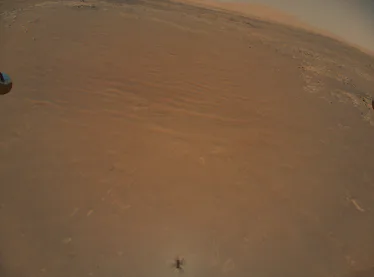
Perseverance detected organics in two rock formations, called Séítah and Máaz. This image shows the "South Séítah" region of Jezero Crater. NASA’s Ingenuity Mars Helicopter, which accompanies the Perseverance rover, took this image during its 11th flight on August 4, 2021.
As NASA officials succinctly state in a 2020 video, organic molecules can exist without you, but you can’t exist without them. So, anytime that signatures for organic molecules appear in the clouds of a distant planet, or on the surface of Mars, they catch the attention of scientists.
Sharma says astrobiology, the study of life and its origins across the universe, is akin to working on a painting. “Every piece of information that we find out about Mars, like the first time Galileo looked through a telescope at Mars, all the way up to the recent findings coming out this week, and after this, each one of those findings is a dot that’s making this big beautiful pointillist painting. And when we step back, probably decades from now, we’re going to see what the full picture is,” Sharma tells Inverse.
STUDYING MARS ROCKS
Whether or not the Red Planet captured lightning in a bottle eons ago, so to speak, and gave birth to life in much the way Earth did during its ancient Archean Period, scientists need a bevy of science observations to learn the truth.
When Perseverance places its robotic arm a credit card’s distance away from a rock formation, the rover scans the rock, and Sharma then leads a discussion with her team about what to do next. As a primary operator of SHERLOC, she takes an analysis of the rock with a NASA team, and then compares it to mineral analogs known on Earth obtained via a researcher network.
Keyron Hickman-Lewis, who collaborated on the paper, offered a refreshing perspective as a paleontologist. Hickman-Lewis studies rocks found in South Africa and Australia that survived the passage of time. Within these time capsules are biosignatures of the earliest known life forms of Earth’s Archean Period billions of years ago.
The newest data from Perseverance offers a more robust perception of ancient Mars. “We can draw parallels at this point with what we know of the environment from the early Earth,” Hickman-Lewis tells Inverse.
PUTTING CONSTRAINTS
The organics that have been found in Gale Crater with Curiosity, within Martian meteorites on Earth, and now at Jezero Crater by Perseverance suggests life’s building blocks were scattered throughout Mars. Together, they put constraints on what happened eons ago on Mars, and if the planet ever nourished alien life.
Though it’s still unclear how the organic molecules got onto Mars, what is evident is that Mars is preserving them. Whether generated by some water-rock interactions of the Red Planet’s ancient past, or if dropped off by a comet, or a byproduct of some lifeform as can sometimes be the case, each sample is a science puzzle piece.
“I think the major takeaway here is that we can use these excellent samples to teach ourselves something complex about the ancient history of Mars,” Hickman-Lewis says.
THE FUTURE STUDY OF ANCIENT MARS
Sharma and Hickman-Lewis support the Mars Sample Return endeavor currently in development between NASA and the European Space Agency. If it takes off, the ambitious program would use a team of robotic explorers to ferry samples Perseverance has obtained from Mars, and ship them to Earth for a closer analysis.
“We can do much of the work there on Mars as you see in the paper, we can obtain images with an exceptional resolution, we can obtain spectral data, again which give us very clear signatures of the compositions of the rocks and the associations of organic materials with minerals, we can use these associations to build a history of the rock. A rock is effectively a storybook that’s extremely hard to read. And we try our best to decode these rocks with the tools available at the surface of Mars,” Hickman-Lewis says.
“The information in the paper gives us a very detailed first view at the samples, and they seem very promising for future analysis here on Earth,” he adds.
Decoding the Enigma: Unraveling the Secrets of Indrid Cold, Planet Lanulos, and the Enigmatic Smiling Man
The realm of UFOlogy is no stranger to unusual narratives, often carrying tales of surreal encounters with extraterrestrial beings that straddle the boundary between fact and fiction. Few such narratives, however, are as compelling and contentious as the tale of Woodrow Derenberger’s encounters with a mysterious entity known as Indrid Cold.
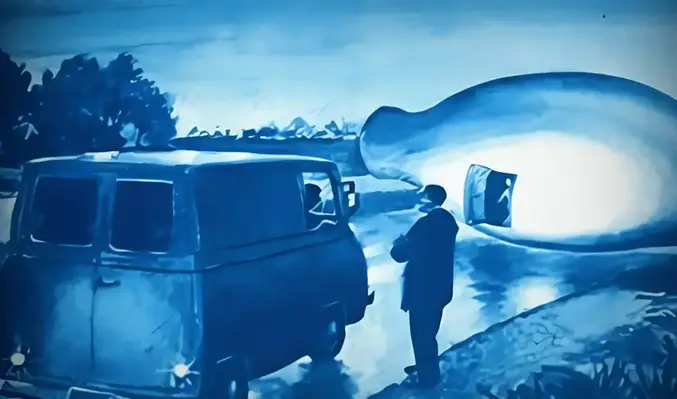
Woodrow Derenberger, or “Woody” as he was commonly known, was an ordinary sewing machine salesman from West Virginia. His life was thrown into the extraordinary on November 2, 1966, when he reported encountering a metallic spacecraft on his drive home. The purported occupant of this spacecraft was a smiling man, who introduced himself telepathically as Indrid Cold from the planet Lanulos.
This narrative was laid bare in Woody’s book, “Visitors from Lanulos” (Amazon link), an account that fused extraterrestrial encounters and tales of interstellar journeys. However, skeptics and believers alike often point out inconsistencies and embellishments that make the story difficult to accept at face value.
It is critical to consider that Woody admitted to some degree of embellishment in his account, as urged by his publisher. This was confirmed by his daughter Tanya, who, though she recalls spending time with Indrid and his crew, was only three years old at the time.
Psychological studies have raised questions about the reliability of children’s memories, particularly in distinguishing between experienced events, dreams, and second-hand narratives. This may cast a shadow of doubt over Tanya’s recollections. Furthermore, her narrative has fluctuated over the years, at one point associating Indrid Cold with the famous alien figure, Valiant Thor.
VIDEO:
The Why Files – Indrid Cold, the Truth about Planet Lanulos and the Mystery of the Smiling Man
Woody’s encounter with Indrid Cold sparked an avalanche of attention, leading to numerous TV and radio interviews. However, the limelight eventually turned harsh, leading to job loss, social ostracism, and even his wife’s departure with a UFO investigator working on Woody’s case.
A particularly damning incident involved a caller named Tom during a TV interview, who claimed to also know Indrid Cold. Tom, later revealed as science fiction writer Thomas F. Monolioni, tricked Woody into confirming a series of fabricated details about Lanulos. This prank, when exposed, discredited Woody’s account further.
Despite the controversy, Indrid Cold’s story continues to have fervent believers who are out there even today, narrating the tale and attempting contact. Their conviction presents a compelling counter-narrative to the skeptic’s viewpoint.
While the factual authenticity of Indrid Cold’s story is contestable, the underlying message is strikingly profound. Indrid Cold advocated for honesty about extraterrestrial contact, projecting a vision of a world where acceptance of our cosmic neighbors could herald an era of global unity, void of territorial wars and racial division. It is a message that transcends the realm of UFOlogy, urging humanity to perceive itself as one global race, the human race.
Regardless of belief in the story’s veracity, it underscores the power of narratives to weave a compelling tapestry of ideas that can challenge our perceptions of the universe and our place in it. As the famous paranormal investigator John Keel suggested, even if the story isn’t true, it is a story worth telling. Thus, the tale of Indrid Cold remains an enduring enigma, offering a blend of intrigue, skepticism, and the enduring allure of the extraterrestrial.
Ultimately, the story of Indrid Cold is less about a man’s contact with an extraterrestrial entity and more about our collective fascination with the unknown, our desire to seek answers beyond our planetary confines, and our shared longing for universal unity. As we continue to explore the cosmos, narratives like these serve as fascinating reminders of the possibilities that may await us among the stars.
The cold and mysterious Oort cloud at the edge of our solar system may be hiding a rogue exoplanet, new research suggests.
A large, icy world from an alien star system could lurk in the mysterious Oort cloud, new research suggests.
(Image credit: Getty)
In 1906, astronomer and businessman Percival Lowell launched a search for "Planet X," a hypothetical giant planet orbiting the sun beyond Neptune. Lowell was convinced that Planet X existed based on some supposed irregularities he had observed in the orbits of Neptune and Uranus. His belief eventually led to the discovery of Pluto in 1930, though scientists later determined that the dwarf planet was too small to have a gravitational impact on Neptune's orbit (let alone Uranus').
Today, the Planet X hypothesis is largely considered to be discredited. However, that hasn't stopped astronomers from looking for planets in the far reaches of the solar system. And according to a new study, they might be out there — only much farther away than Lowell could have predicted.
An international team of researchers recently simulated the unstable celestial mechanics of the early solar system. They found that there is a possibility that one or more planet-size bodies came to rest in the Oort cloud, a vast collection of icy objects stretching between a few hundred billion to several trillion miles from the sun, according to NASA. The new paper describing the work has been published to the preprint server arXiv and has yet to be peer-reviewed.
Approximately 4.5 billion years ago, when the solar system was first forming, it was an unsettled place. Gravity sent debris from the rapidly cooling protoplanetary dust cloud pinging around like cosmic pool balls. Occasionally, the researchers calculated, large pieces of debris — even planet-size ones — would have been hurled far enough to escape the sun's gravity altogether.
Scientists have observed such "rogue planets" wandering around in distant solar systems. According to the researchers, there's about a 0.5% chance that one of these wayward planets might have formed in our own system and ended up in the Oort cloud as it drifted away from the sun.
But, the team calculated, it's slightly more likely that a rogue, Neptune-like planet from another solar system was snagged by the sun's gravity and came to rest somewhere in the Oort cloud. The chances of this are about 7%, and if this is the case, then an object akin to Lowell's long-sought Planet X might be out there after all, though it would still be too far away to influence Neptune's orbit.
However, the researchers think it's most likely that the Oort cloud is made of a collection of much smaller icy objects. Given the size and distance of the Oort cloud, though, we may never know for sure what's lurking out there.
Meer van UFO'S of UAP'S, ASTRONOMIE, RUIMTEVAART, ARCHEOLOGIE, OUDHEIDKUNDE, SF-SNUFJES EN ANDERE ESOTERISCHE WETENSCHAPPEN - DE ALLERLAATSTE NIEUWTJES


 Ross Coulthart Sheds Light on ‘Extraterrestrial’ Craft, Alien Entities and the Journey Towards Disclosure