Naar de inhoud

UFO'S of UAP'S, ASTRONOMIE, RUIMTEVAART, ARCHEOLOGIE, OUDHEIDKUNDE, SF-SNUFJES EN ANDERE ESOTERISCHE WETENSCHAPPEN - DE ALLERLAATSTE NIEUWTJES

UFO's of UAP'S in België en de rest van de wereld
akke.beakke.be
Ontdek de Fascinerende Wereld van UFO's en UAP's: Jouw Bron voor Onthullende Informatie! Ben jij ook gefascineerd door het onbekende? Wil je meer weten over UFO's en UAP's, niet alleen in België, maar over de hele wereld? Dan ben je op de juiste plek! België: Het Kloppend Hart van UFO-onderzoek In België is BUFON (Belgisch UFO-Netwerk) dé autoriteit op het gebied van UFO-onderzoek. Voor betrouwbare en objectieve informatie over deze intrigerende fenomenen, bezoek je zeker onze Facebook-pagina en deze blog. Maar dat is nog niet alles! Ontdek ook het Belgisch UFO-meldpunt en Caelestia, twee organisaties die diepgaand onderzoek verrichten, al zijn ze soms kritisch of sceptisch. Nederland: Een Schat aan Informatie Voor onze Nederlandse buren is er de schitterende website www.ufowijzer.nl, beheerd door Paul Harmans. Deze site biedt een schat aan informatie en artikelen die je niet wilt missen! Internationaal: MUFON - De Wereldwijde Autoriteit Neem ook een kijkje bij MUFON (Mutual UFO Network Inc.), een gerenommeerde Amerikaanse UFO-vereniging met afdelingen in de VS en wereldwijd. MUFON is toegewijd aan de wetenschappelijke en analytische studie van het UFO-fenomeen, en hun maandelijkse tijdschrift, The MUFON UFO-Journal, is een must-read voor elke UFO-enthousiasteling. Bezoek hun website op www.mufon.com voor meer informatie. Samenwerking en Toekomstvisie Sinds 1 februari 2020 is Pieter niet alleen ex-president van BUFON, maar ook de voormalige nationale directeur van MUFON in Vlaanderen en Nederland. Dit creëert een sterke samenwerking met de Franse MUFON Reseau MUFON/EUROP, wat ons in staat stelt om nog meer waardevolle inzichten te delen. Let op: Nepprofielen en Nieuwe Groeperingen Pas op voor een nieuwe groepering die zich ook BUFON noemt, maar geen enkele connectie heeft met onze gevestigde organisatie. Hoewel zij de naam geregistreerd hebben, kunnen ze het rijke verleden en de expertise van onze groep niet evenaren. We wensen hen veel succes, maar we blijven de autoriteit in UFO-onderzoek! Blijf Op De Hoogte! Wil jij de laatste nieuwtjes over UFO's, ruimtevaart, archeologie, en meer? Volg ons dan en duik samen met ons in de fascinerende wereld van het onbekende! Sluit je aan bij de gemeenschap van nieuwsgierige geesten die net als jij verlangen naar antwoorden en avonturen in de sterren! Heb je vragen of wil je meer weten? Aarzel dan niet om contact met ons op te nemen! Samen ontrafelen we het mysterie van de lucht en daarbuiten.

Archief

This US Scientist Saw Roswell Alien Survivor Who Revealed They Live Underground

soaThkbt?format=jpg&name=900x900

This US Scientist Saw Roswell Alien Survivor Who Revealed They Live Underground

Could there be another civilization living among us? UFO expert Anna Whitty has put forth a theory suggesting that aliens have been residing in Earth’s oceans for protection and have always been present on our planet. Whitty’s claims are based on the official statement of Dr. Shirley Wright, who allegedly interviewed the only survivor of the Roswell crash in 1947.

A two-hour documentary called “Roswell 75: The Final Evidence” features Whitty along with other experts, discussing the UFO crash and the potential presence of advanced humanoid aliens on Earth. In the documentary, Dr. Wright mentioned that the aliens inquired about human exploration inside the ocean, they asked “how far into the ocean” the humans traveled.

Dr. Shirley Wright, a former colleague of Albert Einstein stated that she interviewed aliens found at the Roswell crash site in 1947. She noted that aliens are actually just humans, but an advanced form. She claimed to have been present when the US government interviewed an alien survivor from the Roswell crash. According to Dr. Wright, the alien said that not all of them live above the ground and that many reside underground on our planet.

In 1993, an interview with Dr. Shirley Wright was made public where she claims to have witnessed the examination of Roswell UFO crash debris and encountered nine alien bodies. The interview reveals detailed descriptions of the aliens’ physical characteristics, their suits, and their apparent ability to survive in Earth’s atmosphere, while also highlighting the limited information they were willing to disclose about their lifestyle and reproductive methods.

Dr. Shirley Wright

Dr. Shirley Wright was a dedicated teacher and scientist, earning PhDs in Physical Chemistry and Physical Science. She was a chemistry professor at MDCC for over 50 years. She was a student of Dr. Albert Einstein at Princeton. Credit: legacy.com

According to Dr. Wright, while discussing her security clearance, she revealed: “The only reason we could go is that it’s a crack or did they deactivate it… after school, it was immediately deactivated.” This suggests that her access to the Roswell incident was facilitated by her clearance, which was granted specifically for the purpose of examining the extraterrestrial crash.

When asked about her encounter with the alien survivor, Dr. Wright admitted: “I was back at the motel in a city nearby, and I had been told that I would be able to keep the being alive.” This statement raises questions about the nature of her involvement and the significance of her role in handling and studying the extraterrestrial being.

Describing the appearance of the aliens, Dr. Wright vividly recalled: “They were very light, soft, a grayish-green, really. They had a slim, lean physique, no nose but markings where a nose opening would be, prominent eyes, and a mouth. They had no eyebrows, but they had ears and a very forked head.” These detailed descriptions paint a picture of the otherworldly beings she encountered during her extraordinary experience.

Additionally, Dr. Wright noted: “Their eyes were enormous, the most obvious thing you’d see on their face. They were almost brown-black, very dark.” This emphasizes the distinctiveness of the aliens’ eyes and adds to the mystique surrounding their appearance.

Regarding their attire, Dr. Wright observed: “They had suits on, very much like what we call suits. The fabric, however, was unfamiliar to me as a chemist. It didn’t resemble any fabric I recognized.” This intriguing detail raises questions about the technology and materials used by these extraterrestrial visitors.

Dr. Wright also touched upon the aliens’ apparent ability to adapt to Earth’s atmosphere, stating, “They could apparently survive in our atmosphere. They seemed to indicate that the atmosphere was quite similar, although not identical to ours.” This revelation hints at the remarkable adaptability of these beings and their advanced understanding of different planetary conditions.

In the realm of their lifestyle and reproductive methods, Dr. Wright admitted: “We tried to find that out, but we were very cautious not to antagonize them. They didn’t reveal much about it, but they mentioned living underground, in what we would call subterranean conditions.” This suggests a unique aspect of their civilization and their preference for dwelling beneath the surface.

Anna Whitty told the Daily Star that if whatever Wright had documented through her interview is correct, then it is more believable for the aliens to come from under the sea rather than from another planet. “If what Shirley said is right, it is more likely that aliens come from somewhere under the sea or caves or something like that, rather than another planet, it makes sense because there’s a lot of evidence on the planet that there has been a massive cataclysm every few thousand years,” Whitty said.

“If humans on the surface are being reset to the Stone Age every several thousands of years, and these people are somewhere where they are more protected because they are underground, then perhaps their development in technology and intelligence is continuing on an upwards trajectory whereas we’re reset. It’s also possible that maybe they aren’t beings at all, but they can make you think you’re seeing what you’re not seeing,” she added.

Read also:

Whitty’s theory of aliens being “underwater entities” is supported by several incidents and testimonies. One such incident occurred in July 2019 when footage filmed on the USS Omaha showed a UFO diving into the water off San Diego. No wreckage or recovered craft were found. Retired US Air Force Lt. Col. Richard French, who served as a lead investigator of Project Blue Book in the 1950s, claimed to have witnessed two aliens repairing their ship submerged underwater in Newfoundland.

French testified about his experiences in front of former members of Congress at the Citizen Hearing in 2013, stating that he saw the aliens and their crafts below the water surface. He described clear water that allowed him to observe the beings and their activities. Despite his role as a UFO debunker, French confirmed that it was a UFO sighting involving extraterrestrials.

Other accounts support the idea of extraterrestrial presence in the ocean. Former Gunner’s Mate John Baughman, stationed on the USS Carl Vinson in 2010, reported seeing a Tic Tac-shaped UFO underwater. He described a solid object that rapidly collapsed and disappeared as it descended into the depths.

There have also been encounters with unidentified submerged objects (USOs). The crew of a Soviet submarine witnessed six disc-like objects approaching their vessel at high speeds. Unable to escape, they were forced to surface. Through the periscope, they observed the objects emerging from the water and swiftly departing.

Classic alien abduction cases also involve encounters with underwater bases. Betty Andreasson Luca, a Massachusetts woman, experienced multiple abductions and recalled being taken to a spacecraft flying over the ocean. The craft submerged into the water, entering a tunnel illuminated by light. Filiberto Cardenas claimed to have been taken to a secret underwater hangar witnessed by his friend’s family. He described entering a tunnel at high speed underwater and arriving at a large hangar beneath the sea.

These incidents and testimonies provide evidence for the presence of extraterrestrial activity in the ocean and support Whitty’s theory of aliens as “underwater entities.”

RELATED VIDEOS

{  https://www.howandwhys.com/ }

Hoe vind je dit bericht?
Geschreven door peter om 00:25 Stuur door

A Practical Use for Space Power: Beaming Energy to Probes on Venus

A Practical Use for Space Power: Beaming Energy to Probes on Venus

A few weeks ago, a team of scientists from Caltech announced that they had successfully transmitted energy from an orbiting satellite down to Earth. It wasn’t a lot of energy, but it showed that it was possible.

Eventually, we might be able to beam energy from solar satellites down to Earth, making solar energy available almost anywhere and helping combat climate change. But there’s another potential use: powering surface probes on Venus.

Everybody knows about Venus. It’s killed multiple landers with its extreme heat and crushing atmospheric pressure. The old Soviet Union sent a series of probes to the planet’s surface, and most of them failed. The most successful one was Venera 13, which survived for just over two hours at 457 °C (855 °F), and was subjected to 9.0 MPa (89 standard atmospheres) of pressure.

Despite Venera 13’s brief but significant success, the planet held onto its secrets, and we’re drawn back to its surface to reveal them. That’s why NASA wants to send a lander to the surface as part of its DAVINCI+ mission (Deep Atmosphere Venus Investigation of Noble gases, Chemistry, and Imaging.)

But there’s the question of how to power a lander on Venus’ unique, treacherous surface, assuming we can build one that won’t easily succumb to Venus’ nasty conditions. The usual methods—solar power, batteries, radioisotope thermoelectric generators—aren’t up to the task. That’s according to new research published in the journal Acta Astronautica.

The research article is “Feasibility of power beaming through the Venus Atmosphere.” The corresponding author is Erik Brandon from the Jet Propulsion Laboratory.

“State-of-the-art space power technologies comprising solar arrays, batteries and radioisotope thermoelectric generators are not capable of operating on the surface of Venus, limited by the high temperatures, high pressures and corrosive environment,” the authors explain.

Venus is closer to the Sun, but its thick atmosphere means not much solar radiation reaches the surface. About 75% of the Sun’s energy is reflected by Venus’ clouds, and only about 2.5% of the solar flux incident at the top of the atmosphere reaches the surface. Up above the clouds, solar energy is abundant. Venus receives twice as much solar irradiance at the top of its atmosphere as Earth does at the top of its atmosphere.

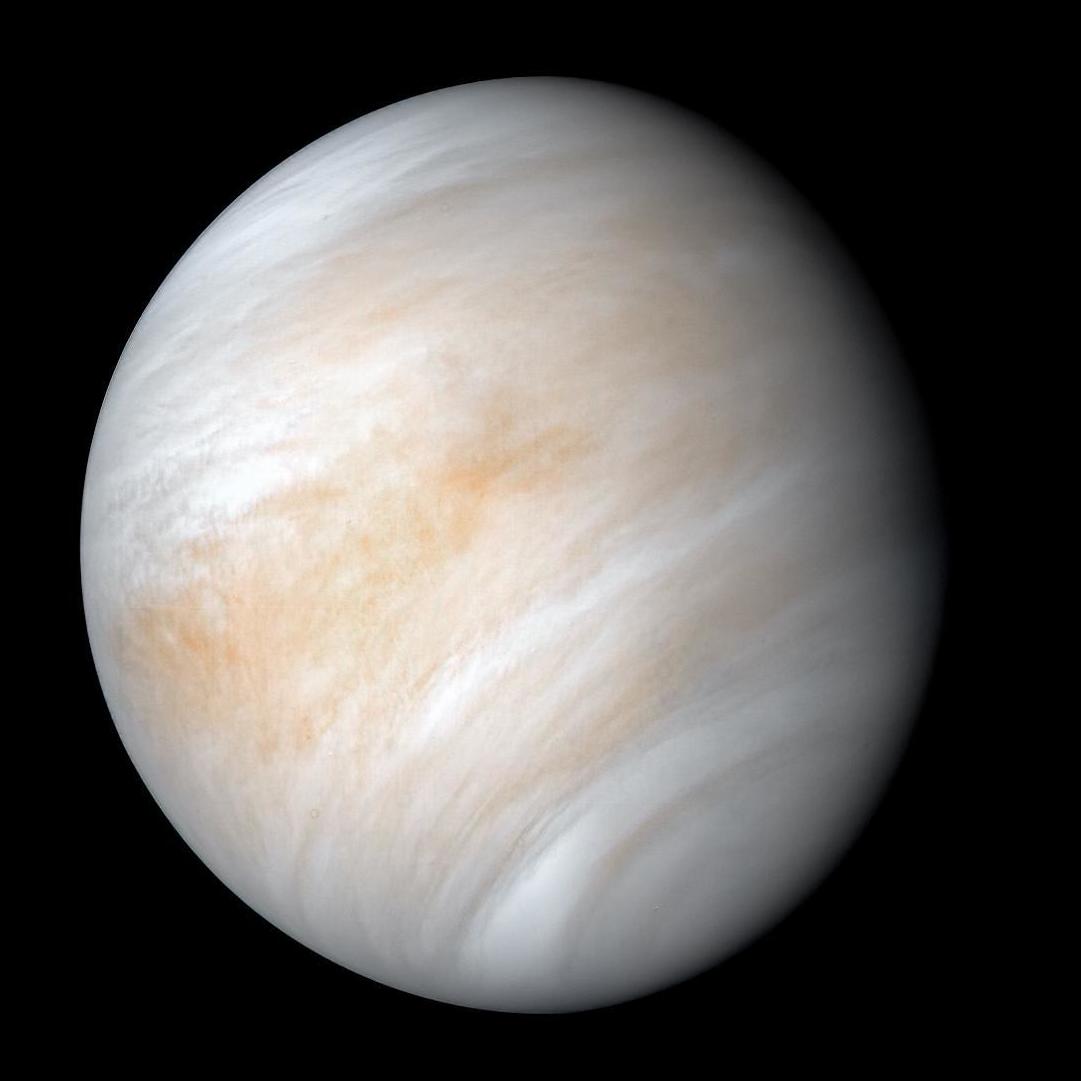
Despite being next door to us, Venus is shrouded in mystery, and its thick clouds mean that only radar imaging can reveal surface details. Image Credit: NASA/JPL-Caltech

Despite being next door to us, Venus is shrouded in mystery, and its thick clouds mean that only radar imaging can reveal surface details. Image Credit: NASA/JPL-Caltech

Could this abundant energy be harnessed by solar collectors above the clouds and then beamed down to a lander/rover? It would have to make it through a lot of thick clouds. “The feasibility of such an approach and other related mission concepts are discussed herein from a perspective of atmospheric absorption and scattering of the beamed energy,” the paper states.

Beaming energy from one place to another is called wireless energy (or power) transfer. There are two types: near-field and far-field. Near-field is short-distance energy transfer like the type used in charging pads for mobile devices. Far-field energy transfer is also called power beaming, and it uses microwaves or lasers to beam the power from a producer to a receiver.

One problem with beaming energy from an orbital solar collector to a surface vehicle is the complications in a Venus geostationary orbit. The planet rotates so slowly that the geostationary orbit is at a great distance from the planet, making the orbit unstable. Somehow, a solar collector would need to be closer to the planet. Above the upper clouds, at about 60 or 70 km altitude, a collector would essentially receive all available sunlight. Mission design might have to keep the collector, or group of collectors, at the right altitude and position.

An alternate solution is to beam a portion of energy to a lander on each orbit, which could be enough. “100’s of Wh (Watt hours) of energy could be received over the course of several orbital passes of the lander,” the authors explain.

But those are larger issues of overall mission architecture. This research assumes that there are solutions to that problem. In this work, the authors focus on how to beam the energy and receive it, something that hasn’t been studied thoroughly. “However, to date, there has not been a thorough study regarding the feasibility of transmitting power at relevant wavelengths, if a suitable platform and mission architecture could be devised and implemented,” the authors write.

The problem is that Venus’ atmosphere is dense and contains chemicals that interfere with power beaming by microwaves. CO2 concentrations are a particular problem.

This figure from the study shows how Venus' atmosphere makes it difficult to beam power from above the clouds to the surface in microwaves.

This figure from the study shows how Venus’ atmosphere makes it difficult to beam power from above the clouds to the surface in microwaves. “In this spectral range, water vapour and CO2 are the only significant absorbing gases, while H2SO4 clouds/aerosols are the primary contributors to the extinction optical depths,” the paper explains. Image Credit: Grandidier et al. 2023.

Lasers might be a better option. Even though there are problems with the dense atmosphere, there are certain “frequency windows” in the atmosphere that could allow power-beaming with lasers. “Counterintuitively, power beaming via laser sources may be possible at Venus despite the continuous cloud coverage, given certain optical/infrared “windows” present within the Venus atmosphere, which are not available using microwave power beaming,” the authors write.

Lasers have other advantages, too, like reduced beam spreading compared to microwaves. That means receiving antennae don’t need to be as large. A one-meter receiver might be enough and wouldn’t be so unwieldy as to interfere with the design of a lander too much.

While solar energy is abundant at the top of Venus’ atmosphere, beaming it down through the entire atmosphere might not be the best approach. Instead, a balloon or some other vehicle could situate itself near the middle of the atmosphere. There it would receive enough solar energy to be feasible, and would only need to beam the energy through a portion of the atmosphere.

“These calculations point to a plausible approach for power beaming
at Venus, using transmission from an aerial platform operating near the
cloud base.”

from “Feasibility of power beaming through the Venus Atmosphere”

The research shows that the 47 km altitude is significant. There’s a cloud base at that altitude, and below it, the beamed energy is subject to less scattering. It also shows that from 47 km, the highest transmission factor is at 1022 nanometers, where about 20% of the beamed energy would reach a surface lander.

“These calculations point to a plausible approach for power beaming at Venus, using transmission from an aerial platform operating near the cloud base,” the authors write.

This figure from the study shows energy transmission by laser at different wavelengths from an altitude of 47 km. There are likely enough windows in the atmosphere to allow lasers to transmit enough energy to operate a surface lander. Image Credit: Grandidier et al. 2023.

This figure from the study shows energy transmission by laser at different wavelengths from an altitude of 47 km. The 47 km altitude was chosen because, below it, there’s less scattering of the beamed energy. There are likely enough windows in the atmosphere to allow lasers to transmit enough energy to operate a surface lander. Image Credit: Grandidier et al. 2023.

But does the technology to do this exist?

The paper doesn’t discuss what type of vehicle or platform could be used at 47km altitude. They focus on the power beaming itself, and if calculations show that it’s possible. But they also talk about available laser technology and if it’s up to the task.

According to the researchers, we don’t quite have the right kind of laser yet.

Researchers are busy developing them, though. Ytterbium-doped fibre lasers (YDFLs) that work in the near-infrared (NIR) window that can also operate at high power are under development. Unfortunately, they don’t operate at the ideal wavelength for use at Venus: 1022. Instead, they’re limited to two other ranges: 970-980 nm and 1030-1100 nm. But lasers are an intense focus of different researchers around the world, and progress is steady.

The task of keeping some kind of aerial platform steady and in the correct position is critical to any power-beaming mission. But researchers are already working on balloons and other aerial platforms for use on Venus. Assuming they can be developed, the authors are confident that a power-beaming scenario can rise to the challenge and create successful missions to the Venusian surface.

A prototype aerial robotic balloon, or aerobot, is readied for a sunrise test flight at Black Rock Desert, Nevada, in July 2022, by team members from JPL and Near Space Corporation. The aerobot successfully completed two flights, demonstrating controlled altitude flight. Credit: NASA/JPL-Caltech

A prototype aerial robotic balloon, or aerobot, is readied for a sunrise test flight at Black Rock Desert, Nevada, in July 2022, by team members from JPL and Near Space Corporation. The aerobot successfully completed two flights, demonstrating controlled altitude flight. Credit: NASA/JPL-Caltech

“Also, although there are engineering and mission design challenges regarding control and pointing of such an aerial vehicle platform used for power beaming and in overall thermal management, this analysis shows that these optical windows could be exploited to enable sufficient mission-enabling power levels to be beamed to the surface of Venus.”

We need a better understanding of Venus’ atmosphere before a specific system can be designed. DAVINCI+ has three main scientific objectives, and one of them is to understand the atmosphere as it travels through it.

Its findings will help scientists understand what obstacles they face in beaming power to the planet’s surface. If it can be done reliably, then Venus will be open to exploration.

More:

RELATED

{ https://www.universetoday.com/ }

Hoe vind je dit bericht?
Geschreven door peter om 23:53 Stuur door

Venus has Clouds of Concentrated Sulfuric Acid, but Life Could Still Survive

Image from NASA's Mariner 10 spacecraft in February 1974 as it traveled away from Venus.
(Credit: NASA/JPL-Caltech)

BY MATT WILLIAMS

Venus has Clouds of Concentrated Sulfuric Acid, but Life Could Still Survive

The surface of Venus is like a scene from Dante’s Inferno – “Abandon all hope, ye who enter here!” and so forth. The temperature is hot enough to melt lead, the air pressure is almost one hundred times that of Earth’s at sea level, and there are clouds of sulfuric acid rain to boot! But roughly 48 to 60 km (30 to 37.3 mi) above the surface, the temperatures are much cooler, and the air pressure is roughly equal to Earth’s at sea level. As such, scientists have speculated that life could exist above the cloud deck (possibly in the form of microbes) as it does on Earth.

Unfortunately, these clouds are not composed of water but of concentrated sulfuric acid, making the likelihood that life could survive among them doubtful. However, a new study led by scientists from the Massachusetts Institute of Technology (MIT) reveals that the basic building blocks of life (nucleic acid bases) are stable in concentrated sulfuric acid. These findings indicate that Venus’ atmosphere could support the complex chemistry needed for life to survive, which could have profound implications in the search for habitable planets and extraterrestrial life.

The study was led by Professor Sara Seager, an astrophysicist and planetary scientist with the MIT Department of Earth, Atmospheric, and Planetary Sciences (EAPS) and the MIT Department of Aeronautical and Astronautical Engineering (MIT AeroAstro); and Dr. Janusz J. Petkowski, an astrobiologist and EAPS MIT Research Affiliate. They were joined by researchers with Nanoplanet Consulting, Rufus Scientific Ltd., the Worcester Polytechnic Institute (WPI), and multiple universities. The paper that presents their findings was recently published in the Proceedings of the National Academy of Sciences.

The surface of Venus captured by a Soviet Venera probe. Credit: Russian Academy of Sciences/Ted Stryk

Before the Space Age and the first robotic missions began making flybys of Venus, astronomers entertained the notion that it might be similar to Earth. Its impenetrable cloud deck was believed to be evidence of persistent rain storms, and some even speculated that the planet was a lush tropical environment. By 1961 and 62, the Soviet Venera 1 and 2 and NASA Mariner 1 and 2 probes became the first missions to buzz the planet and examine its atmosphere. These revealed an incredibly dense, scorching hot, and isothermic atmosphere – meaning there is little variation in temperature between day and night and during the course of a year.

As Dr. Petkowski told Universe Today via email, there are sulfuric acid clouds with very little water content. “Therefore, if there is life in the Venus clouds, and it still uses water as its solvent, it has to have adaptations that have no precedent here on Earth.” In a previous paper, Seager and her co-authors explored various characteristics of Venus’ clouds that would affect habitability, regardless of whether or not it was “Earth-like.” This included energy requirements (chemical and solar), radiation, the lack of available hydrogen, metals, acidity, and low water content.

As Petkowski explained, they concluded that the conditions in the Venusian clouds do not rule out life, although they do rule out Earth-like life:

“This is an important distinction, as opinions on the habitability and the possibility of life in the clouds of Venus vary widely, from calling the clouds ‘habitable’ to categorically stating that life cannot exist there. We decided to quantitatively review what we know about Venus and confront this knowledge with the basic principles of life, all of this to see if life on Venus is worth looking for by (e.g., astrobiology-focused missions), or whether life could be categorically ruled out.”

Spectral data from SOFIA overlain atop an image of Venus from NASA’s Mariner 10 spacecraft.

Credit: Venus: NASA/JPL-Caltech; Spectra: Cordiner et al.

This is a key consideration for astrobiologists: the possibility that life can and does exist in environments radically different from Earth. This complicates things since scientists cannot search for evidence of life that doesn’t follow the same patterns as life here on Earth. A possible way around this is to consider “what life does rather than what it is” (processes that don’t depend on specific molecules) or constitutes life on the most basic level. This was the focus of their recent paper, said Petkowski, where they explored if organic chemistry is possible in concentrated sulfuric acid.

“Here, we were able to show that nucleic acid bases adenine, thymine, guanine, cytosine, and uracil are stable in concentrated sulfuric acid ranging from 80 to 98% concentration at room temperature. We have confirmed the stability with UV spectroscopy and NMR spectroscopy, and there was no detectable reactivity and degradation after incubation in concentrated sulfuric acid for up to 2 weeks. This result is significant because concentrated sulfuric acid is often thought to be sterile to any interesting organic chemistry. We aim to show that this is not the case. Our paper is the first step to do so.”

They note that organic chemistry is not the same thing as life, but no life can occur without it. So while this result does not indicate that life is present in Venus’ atmosphere, it confirms that organic processes necessary for life certainly can. In recent years, the apparent detection of phosphine in Venus’ atmosphere triggered a debate over whether these chemical traces (if confirmed) resulted from biological processes in action (i.e., a biosignature). This debate is still unresolved, and scientists are eagerly awaiting for future missions to investigate further.

These include NASA’s proposed Deep Atmosphere Venus Investigation of Noble gases, Chemistry, and Imaging (DAVINCI+) and Venus Emissivity, Radio Science, InSAR, Topography, and Spectroscopy (VERITAS) probes, both of which could explore Venus by 2028. China also announced plans to send a Venus Volcano Imaging and Climate Explorer (VOICE) probe to explore the geological history, evolution, and potential habitability of Earth’s “Sister Planet,” launching in 2026 and arriving by 2027. There are also proposals like the Rocket Lab Mission to Venus (scheduled for launch in January 2025), the first private mission to explore Venus’ clouds and look for signs of organics.

first-private-mission-to-venus-1024x640.jpg

Artist’s impression of the Rocket Lab Mission to Venus.

Credit: Rocket Lab

This will be followed by MIT’s Morning Star Missions to Venus program, a series of mission concepts that evolved from the Venus Life Finder Mission Concept study led by Professor Seager. This program will send a series of probes to Venus to study its cloud for signs of life and investigate conditions for habitability. The program will culminate in 2041 with the launch of an Atmospheric and Cloud Sample Return Mission (ACSRM), which will bring samples of Venus’ atmosphere back to Earth for detailed analysis. As Petkowski noted, these and other missions to Venus could have significant implications when it comes to the search for extraterrestrial life in the Solar System and beyond:

“Although the ribose phosphate backbone of DNA is unstable in concentrated sulfuric acid, other polymers analogous to DNA could be stable and potentially support the idea that concentrated sulfuric acid in Venus clouds could support life. This would be instead of water, the concentrated sulfuric acid would become the main liquid environment for life to thrive.

“It is currently unknown if concentrated sulfuric acid could be the solvent for life, but if it could, then it has tremendous implications for the habitability of Venus clouds and the habitability of other planets in the galaxy (exoplanets). It is quite likely that there are many more planets like Venus out there. Who knows? Maybe many of them are also habitable for some very exotic forms of life.”

Further Reading: 

{ https://www.universetoday.com/ }

Hoe vind je dit bericht?
Geschreven door peter om 22:14 Stuur door

Unearthed: The Triad of Unexplained Marine UFO Enigmas!

 Unearthed: The Triad of Unexplained Marine UFO Enigmas!

USO

Deep within the heart of the dense jungle south of Tulum, Mexico, exists a fascinating geological anomaly, Cenote Angelita. This natural sinkhole, formed when the limestone bedrock collapsed, reveals the pristine, fresh water beneath. And further north in the icy waters of the North Atlantic Ocean, elusive legends whisper of an enigmatic island, Hy-Brasil, said to be visible only once every seven years. These mysterious locations seem worlds apart, but they share intriguing narratives that might offer glimpses into humanity’s ancient connections to otherworldly phenomena.

Cenote Angelita: A Portal to Another World?

Cenotes, natural sinkholes prevalent in the Yucatan region, were created millions of years ago by the cataclysmic meteor strike that wiped out the dinosaurs. The impact formed shocked quartz, a particular type of quartz created under immense pressure. Intriguingly, quartz possesses the unique ability to convert Earth’s natural electrical vibrations into energy. This property led some scientists to suggest its potential use in the formation of wormholes, leveraging an electromagnetic reaction known as the Casimir effect.

Nestled amidst such cenotes, Cenote Angelita stands out due to its unique underwater phenomenon. Approximately 100 feet below its surface, the fresh water intermingles with the salt water from the ocean beneath, creating an eerily mesmerizing underwater river. This spectacle has led some to speculate that Cenote Angelita may serve as a gateway between the surface world and the underworld, echoing the ancient Aztec legends of Talalakon.

The Aztecs firmly believed that their souls journeyed through portals like Cenote Angelita into other dimensions. They recounted tales of whirlpools in the water that led them to paradise. Given the quartz’s inherent ability to possibly create wormholes, is it conceivable that Cenote Angelita was an ideal location for advanced alien beings to fabricate such a gateway? Could this be the explanation behind the Aztec shamans’ accounts of an entrance to paradise?

Hy-Brasil: An Island Shrouded in Mystery

A stark contrast to the tropical allure of Cenote Angelita, the phantom island of Hy-Brasil is believed to be located in the North Atlantic Ocean, 100 miles west of Ireland. Its lore dates back to the 14th century when Mediterranean mapmakers first charted its existence. Hy-Brasil, said to appear and disappear behind mists, has been a subject of endless fascination for over 600 years.

Historical records document explorers who claimed to have set foot on the island. Captain John Nisbet from Ireland reportedly returned with gold and silver gifts from an old, mysterious man residing there. More curiously, explorers brought back tales of “giant black rabbits” and “beautiful, glowing people.”

In Irish mythology, Hy-Brasil was considered a source of civilization, where the Irish Gods originated. It was described as a land kept hidden by divine intervention. The last recorded sighting of the island was in 1872, fueling speculations that it might resurface under the right conditions.

But what if the tales of Hy-Brasil extend beyond the domain of mythology? Could the island serve as a high-tech alien base, a way station for advanced extraterrestrial races journeying across the cosmos? Could these locations, Cenote Angelita and Hy-Brasil, be interconnected gateways used by these advanced beings?

Cosmic Highways: A Bridge between Worlds

The concept of Earth harboring portals to other dimensions or cosmic highways for alien civilizations may seem far-fetched. However, it’s worth noting

VIDEO:

  • Ancient Aliens: TOP 3 DEEP SEA UFO MYSTERIES

RELATED VIDEOS

{ https://www.latest-ufo-sightings.net/ }

Hoe vind je dit bericht?
Geschreven door peter om 21:53 Stuur door

SpaceX Starlink satellites had to make 25,000 collision-avoidance maneuvers in just 6 months — and it will only get worse

SpaceX Starlink satellites had to make 25,000 collision-avoidance maneuvers in just 6 months — and it will only get worse

The passage of SpaceX Starlink satellites is observed in the skies of Sanliurfa, Turkiye on May 04, 2023.

Starlink satellites have been forced to maneuver over 50,000 times to avoid potential orbital collision since the constellation's first satellite launch. 
(Image credit: Arda Kucukkaya/Anadolu Agency via Getty Images)

Staggering growth in Starlink collision-avoidance maneuvers in the past six months is sparking concerns over the long-term sustainability of satellite operations as thousands of new spacecraft are poised to launch into orbit in the coming years.

SpaceX's Starlink broadband satellites were forced to swerve more than 25,000 times between Dec. 1, 2022, and May 31, 2023 to avoid potentially dangerous approaches to other spacecraft and orbital debris, according to a report filed by SpaceX with the U.S. Federal Communications Commission (FCC) on June 30. That's about double the number of avoidance maneuvers reported by SpaceX in the previous six-month period that ran from June to November 2022. Since the launch of the first Starlink spacecraft in 2019, the SpaceX satellites have been forced to move over 50,000 times to prevent collisions.

The steep increase in the number of maneuvers worries experts because it follows an exponential curve, leading to concerns that safety of operations in the orbital environment might soon get out of hand.

"Right now, the number of maneuvers is growing exponentially," Hugh Lewis, a professor of astronautics at the University of Southampton in the U.K. and a leading expert on the impact of megaconstellations on orbital safety, told Space.com. "It's been doubling every six months, and the problem with exponential trends is that they get to very large numbers very quickly."

Related: 

1 million maneuvers by 2028 

Data compiled by Lewis shows that, in the first half of 2021, Starlink satellites conducted 2,219 collision-avoidance maneuvers. The number grew to 3,333 in the following six-month period ending in December 2021 and then doubled to 6,873 between December 2021 and June 2022. In the second half of 2022, SpaceX had to alter the paths of its satellites 13,612 times to avoid potential collisions. In the latest report to the FCC, the company declared 25,299 collision-avoidance maneuvers over the past six months, with every satellite having been made to move an average of 6 times. 

"Right now, every six months, the number of maneuvers that are being made doubles," said Lewis. "It has gone up by a factor of 10 in just two years, and if you project that out, you'll have 50,000 within the next six-month period, then 100,000 within the next, then 200,000, and so on."

If the trend continues, by 2028, Starlink satellites will have to maneuver nearly a million times in a half-year to minimize the risk of orbital collisions. And Lewis doesn't expect such growth to slow down any time soon. SpaceX has so far deployed about one-third of its planned first-generation constellation of 12,000 spacecraft and has been launching at a regular pace of over 800 satellites per year, a trend that is expected to continue for the foreseeable future. 

The first-generation Starlink constellation is, however, just the beginning. The FCC has partially approved plans for the second-generation Starlink constellation, which could consist of up to 30,000 satellites. And other players all over the world, including Amazon with its Project Kuiper and China with Guowang, are scrambling to secure orbital slots with their respective regulators. 

The projected growth in Starlink orbital collision avoidance maneuvers.  (Image credit: Hugh Lewis)

Like swerving on a highway every 10 meters

According to Joanne Wheeler, a satellite regulations expert at Alden Legal and chair of the U.K.-based Satellite Finance Network, more than 1.7 million satellites have been registered with the International Telecommunication Union, the United Nations' agency overseeing the use of radio frequencies by satellites. Although not all of those plans are likely to come to fruition, the numbers in question are so high that experts such as Lewis question whether order in orbit can be maintained. 

"If we're expecting by the end of this decade to have 100,000 active satellites, then my suspicion is that the number of maneuvers collectively that all spacecraft operators will be making will be just enormous," Lewis said. "You're making maneuvers to mitigate the high-risk events, but it's like driving down the highway and swerving every 10 meters to avoid a collision. It's arguably not safe."

Currently there are about 10,500 satellites orbiting our planet, 8,100 of which are operational, according to the European Space Agency. Things only started to get so congested fairly recently. For example in 2019, there were only about 2,300 active satellites circling the planet, according to Statista. The main driver of the growth is Starlink, by far the largest satellite constellation ever assembled.

New satellites are not the only cause behind the increasing need for orbital swerving. The amount of space debris  — defunct spacecraft, old rocket stages and various fragments — also continues to grow, making it increasingly difficult for operators to keep their spacecraft safe. 

SpaceX currently conducts an avoidance maneuver every time orbital models show a probability higher than 1 in 100,000 that one of the Starlink satellites will cross another object's path. That threshold is 10 times lower than the standard upheld by NASA and other international agencies. 

Lewis, however, questions whether SpaceX will be able to maintain such a high standard as the number of "conjunction alerts" continues to snowball. He adds that, despite the company's efforts, the residual risk of a collision will continue to rise as well.

Jonathan McDowell, an astrophysicist at the Harvard–Smithsonian Center for Astrophysics and another frequently heard voice of caution in the satellite megaconstellations debate, agrees with Lewis: "SpaceX are convinced that they can handle the increasing maneuver load," McDowell told Space.com in an email. "I am not convinced that SpaceX have properly taken into account the non-statistical errors (the potential for independent and unpredictable screwups combining to give a bad result - a collision) - so I am concerned that we are operating at the edge of what is safe."

Starlink relies on an autonomous collision avoidance system that instructs satellites to maneuver based on models of orbital trajectories of objects in space. These models provide alerts several days in advance and may not always get it right. Moreover, other factors, such as the changes in the density of Earth's atmosphere at high altitudes caused by space weather, may affect the accuracy of these calculations.

The past and expected growth of SpaceX's Starlink broadband megaconstellation.   (Image credit: Hugh Lewis)

"There is a concern about the conjunctions that are occurring where no maneuvers are being made," said Lewis. "You could argue that the probability [of a collision in these cases] is very low, but given the very large number of them, they represent a quite substantial risk. It's like buying a ticket in a lottery. If you buy just one, you are unlikely to win, but if you buy a million tickets, you stand a pretty good chance."

Lewis expects that, unless regulators cap the number of satellites in orbit, collisions will soon become a regular part of the space business. Such collisions would lead to rapid growth in the amount of space debris fragments that are completely out of control, which would lead to more and more collisions. The end point of this process might be the Kessler Syndrome, a scenario predicted in the late 1970s by former NASA physicist Donald Kessler. Depicted in the 2013 Oscar-winning movie "Gravity," the Kessler Syndrome is an unstoppable cascade of collisions that might render parts of the orbital environment completely unusable. 

{ https://www.space.com/ }

Hoe vind je dit bericht?
Geschreven door peter om 01:43 Stuur door

'That guy is not real': Astonishing moment distressed woman has meltdown on plane over 'imaginary' passenger and demands to be let off

'That guy is not real': Astonishing moment distressed woman has meltdown on plane over 'imaginary' passenger and demands to be let off

  • A woman was filmed in distress aboard an American Airlines flight in Dallas
  • The clip was shared on TikTok on Sunday and has been seen millions of times
  • The original poster said the flight was delayed three hours due to the incident 

A woman's meltdown was caught on video as she frantically demanded to get off a plane and claimed someone in the back of the aircraft was not real.

Footage shared on TikTok on Sunday night shows a woman seemingly in distress onboard an American Airlines flight departing from Dallas Fort Worth airport.

'I'm telling you, I'm getting the f*** off and there's a reason why I'm getting the f*** off and everyone can either believe it or they can not believe it,' the unidentified woman is heard saying as she walks to the front of the plane.

'I don't give two f****, but I am telling you right now - that m*****f***** back there is NOT real,' she adds, pointing towards the back of the plane.

'And you can sit on this plane and you can die with them or not. I'm not going to.'

A woman's meltdown was caught on video as she frantically demanded to get off a plane and claimed someone in the back of the aircraft was not real

A woman's meltdown was caught on video as she frantically demanded to get off a plane and claimed someone in the back of the aircraft was not real

Passengers turned their head as she seemed to point to the back of the plane while speaking about a guy who 'was not real'

Passengers turned their head as she seemed to point to the back of the plane while speaking about a guy who 'was not real'

t's unclear what the woman was referring to.

Passengers turned their head as she seemed to point to the back of the plane.

The video's poster, who goes by @texaskansasnnn, claimed the incident delayed his flight by three hours.

The TikTok user said the woman 'somehow didn't get arrested and got back through security after the whole plane had to deplane.' 

DailyMail.com has contacted American Airlines for comment on this story.

The original video has gathered more than 20,000 views  - and was reposted under the popular TikTok hashtag #drunkonaplane, gathering more than three million views.

Despite a lack of details, thousands of TikTok users weighed in on the comments.

One viewer wrote: 'I need to see him. I will be able to tell if he's not human. She may be telling the truth.'

Another one also joked, writing: 'sooooo we not going see who mini mouse is talking about.'

A third said: 'no because i would HAVE to get off the plane. I'm not about to be final destinationed.'

It was a chaotic weekend for traveling in the nation, as desperate families were forced to sleep in airports after thousands of flights have been delayed or canceled over the Fourth of July holiday.

Nearly 100 flights have already been canceled on Monday alone while delays were at 1,303 by lunchtime and steadily climbing, according to FlightAware.

The Fourth of July 'flightmare' continued today as travelers make one last ditch effort to get to their destinations for holiday on Tuesday after storms walloped the country in recent days, causing mass delays and cancelations.

More severe weather is expected to pummel at least 15 states from the Northeast and mid-Atlantic to the Southeast on Monday.

There were 15,567 flight delays in and out of the United States on Saturday and Sunday and a total of 905 flights were canceled.

More than 50 million people are expected to make a trip of 50 miles or more this holiday weekend with AAA predicting the numbers will break records.

Not only is air travel being snarled, but so it road traffic with millions of people along the Interstate 95 corridor under the threat of strong winds, hail and possibly an isolated tornado.

Do YOU know have any additional information on this video? If so, please get in touch with germania.rodriguez@mailonline.com.

“Nope. I’ve seen Final Destination too many times. I’m getting off that plane”

Many people were also comparing it to the scene in the movie Bridesmaids where Kristen Wiig’s character mixes alcohol and pills and ends up freaking out after she thinks she sees a colonial woman churning butter on the wing of the airplane.

{ https://www.dailymail.co.uk/ }

Hoe vind je dit bericht?
Geschreven door peter om 01:01 Stuur door

This Passenger Saw ‘Mysterious Being’ Who Scared Lady In Dallas to Orlando Flight

Lady in plane

This Passenger Saw ‘Mysterious Being’ Who Scared Lady In Dallas to Orlando Flight

By Vicky Verma  

An unusual incident happened at Dallas/Fort Worth International Airport. An American Airlines flight was delayed for three hours after a woman onboard freaked out. She claimed to have encountered an eerie figure on the plane. She frantically demanded to get off the plane. Her behavior would seem strange to many but there are passengers who are in support of her.

On July 3, 2023, a video of a woman wearing a crop top and jeans went viral on social media. Her behavior on a flight from Dallas to Orlando caught the attention of fellow passengers. Walking down the aisle, she displayed signs of fear and urgency, expressing her desperate need to exit the airplane. Distressed, she claimed the presence of an unreal and dangerous figure onboard.

She can be seen saying in the video, “And everyone can either believe it or they can not believe it. I don’t give two … But I am telling you right now, that (—) back there is not real.” Her alarming statement alludes to a mysterious figure she perceives, causing other passengers to turn and look in the direction she points.

The video had originally been shared on TikTok, but it was removed from the platform. Since then, it has been reshared by various social media channels. In the clip, the woman claims that she is getting off the flight because someone on the flight (presumably a passenger) was not real, and warned that those who remain on the plane can “die with him or not.”

lady in plane

The incident led to a delay of the flight for approximately three hours, as reported by the original uploader. Curiously, the woman managed to avoid arrest and even re-entered the airport after the entire plane had to deplane.

Some speculate that the woman was on medication, under the influence, or undergoing psychosis. People on social media expressed their worry and curiosity about the outcome of the flight, with some individuals admitting they felt genuinely unsettled by her words.

A different video uploaded by another passenger captured the woman arguing with a flight attendant minutes before the viral episode. In the footage, she demands the plane to be stopped and adamantly expresses her desire to leave the plane, disregarding her personal belongings.

As the story gained attention on TikTok, various theories about what the woman might have encountered on the plane emerged. Speculations ranged from shapeshifting reptilians to extraterrestrial beings. However, the woman herself has not come forward to provide an explanation for her behavior, leaving room for speculation and further discussions.

Man in Hoddie

The American Airlines flight incident became interesting when a young man on TikTok “The Kole Show” shared a video, claiming that he saw a woman having a heated conversation with some man in a hoodie, who remained silent throughout. The Kole Show did not capture any video of the incident but noticed that the man in the hoodie appeared not normal. After the woman exited the plane, the man in the hoodie briefly interacted with him by asking if anything had happened and then winked at him. The Kole Show reflects on the strange encounter and mentions that the man winked horizontally.

woman in flight

Credit: The Kole Show/TikTok

I was on that flight. It was American Airlines. We were leaving Dallas Fort Worth. I was sitting in the left aisle, about three rows back from this woman. She was sitting in the right aisle, and she had this very, very interesting exchange with some dude in a hoodie. I don’t remember the color of the hoodie. You know how memory is when you’re not super paying attention. You don’t remember all the details.

I had one headphone in, couldn’t hear all the specifics of what happened. But I noticed this exchange between this woman and this dude in a hoodie. And it was kind of weird at the time because it seemed like no one else before she really started getting frantic, like, was paying attention to this. But that makes sense. It was like a normal flight. This was after putting all the luggage away. We’d been on the plane for a little bit. It was before the flight attendant came over and gave the little spiel. And what I remember is she was having, like, a full-blown conversation with this dude in the hoodie.

I’ll call him the hoodie guy. She was having a full-blown conversation with the hoodie guy. The weird thing was that he never once said a (—) word to her the whole time. And at the time, I don’t know, I wasn’t really thinking about it, but it’s like she would say something, and he would respond. But there was no exchange happening. It was just her getting more and more frantic, which, okay, if she’s drunk and she’s going crazy, then you would think the dude in the hoodie would have been like, “What are you talking about? What are you talking about?”

But he was just, like, deadlocked on her. Like, deep eye contact with her. I don’t want to feed into the conspiracies here, but almost like she was, like, in a hypnosis type of thing. And she started getting more and more frantic to the point where then people started kind of noticing. A flight attendant came over, tried to calm her down. Like, “What’s going on?”

She sat back down, but she kept looking over at this dude in the hoodie. And finally, she was like, “Done with it.” And that’s when I really started paying attention. Like, “Okay, what the (—) is going on?” And that’s when she was like, “I can’t do this.” She started getting up. She started walking up to the front. And then the whole video thing happened. I didn’t take a video of it. I was listening to a Stephen King audiobook. I wasn’t, like, pulling out my phone to record this. And she didn’t seem drunk to me, by the way.

Just throwing that out there. I didn’t see her drink. I mean, she seemed totally normal to me up until that point. The weird thing was, after she left the plane, the dude in the hoodie, which the flight attendant, was like, “Did anything happen?” And he still didn’t say a word. He just went like and shrugged. The dude in the hoodie looked around the plane and he looked back at me and he winked at me [Horizontally]. And again, I didn’t quite register it. I was like, “Okay, what the (—) was that about?” I was like, “Maybe he’s just being like an (—) .” Like winking like that was weird…

The Kole Show’s video gained more than 7 million views on TikTok. But it was called a fake story due to his comment where he writes the video is not real. But the twist is, the man claimed in the second part of the video that he intentionally put such a comment to avoid the platform algorithm taking his video down. He clarified in the second part that he was on the plane and everything he said in the first part is true.

Read also:

Okay, here’s your part two. I can’t even believe this video has blown up this much. I literally made this video in a few minutes, went to go see some fireworks, hung out with some friends, came home, went to bed a little bit tipsy, woke up in the morning, got to work, and didn’t even check my phone. And then I see this thing blown up all over the place, and there’s a bunch of in the comments of people saying, like, you weren’t there. Like, it’s a joke, he’s a liar. I don’t even care about any of that. I don’t, like, get on TikTok all that much at all. But I am kind of annoyed at the email I got last night.

…And I know it’s probably nothing serious. It kind of freaked me out a little bit when I got up in the morning, but I know it’s probably someone in the comments. One of you all probably found my email or something, and you’re just playing a prank… But I don’t appreciate that kind of stuff. So I’m going to make this one video.

I’m going to clear the air and just nothing crazy happened on the plane for the rest of the flight. What else happened? Let me just clear the air and just tell you the rest of my little story. And then that’s it. I forgot about it. Whatever. I’ve seen in my life. Like, I’m going to move on with my life, so whatever. First off, I was on the plane. So everyone’s saying, oh, the reason I put that in the description, which I thought we all knew about TikTok, is because TikTok will suppress content and take content down. When you’re talking about controversial things or conspiracy things or political stuff, it’ll take your videos down…So that’s why I did that.

Several other eyewitnesses have shared their accounts of the incident. Notably, stand-up comedian and actor Scott Thompson popularly known as “Carrot Top” was present on the same flight and posted a video from the Dallas-Fort Worth airport, expressing his frustration and blaming the woman for the delay. (Source)

Another passenger, “M Lee RN,” claimed to have witnessed the events and clarified that the woman’s outburst stemmed from losing her AirPods and accusing a nearby African-American passenger of stealing them. According to M Lee RN, the plane returned to the gate, law enforcement officials were involved, and the woman was eventually removed from the flight. The incident prompted an investigation to ensure the safety of the aircraft, and the three flight attendants who dealt with the woman were also replaced.

Although M Lee RN’s account provided a logical explanation for the incident, some individuals remain unconvinced and demand to hear the woman’s side of the story. However, an American Airlines representative confirmed the disruptive passenger’s removal from the flight and emphasized their commitment to safety and security.

The woman’s silence and absence from public discussions have left many people curious about her whereabouts and the reasons for her behavior. Speculations suggest that she may be embarrassed or even incarcerated. In the meantime, social media users urge caution and safety during future flights, acknowledging the potential for unexpected incidents.

screenshots from video in which woman has a plane meltdown over a passenger who is 'not real'

screenshots from video in which woman has a plane meltdown over a passenger who is 'not real'
© Photo: @king0fthotland / TikTok


{  https://www.howandwhys.com/ }

Hoe vind je dit bericht?
Geschreven door peter om 00:32 Stuur door

Earth's Core Keeps Getting Weirder

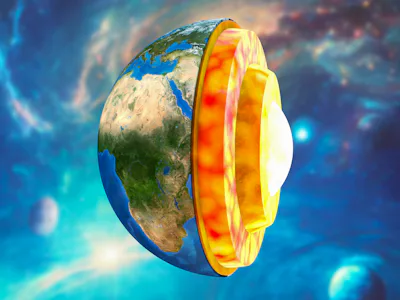
Internal structure of the Earth, cutaway computer illustration. From the centre outwards, the four l...

KATERYNA KON/SCIENCE PHOTO LIBRARY/Science Photo Library/Getty Images

Earth's Core Keeps Getting Weirder

BY  KIONA SMITH

A recent study found that our planet's inner core is a mosaic of textures and densities, and maybe some trapped molten metal.

Earth’s core isn’t just a boring, featureless ball of metal, it turns out. A recent study used seismic waves from earthquakes to make a 3D model of the center of our planet, and the researchers discovered that Earth’s inner core is a patchwork of different textures and densities. And there may even still be some liquid iron trapped inside.

The recent study was published in the journal Nature. Seismologist Guanning Pang and his colleagues used a worldwide network of seismic stations, originally built to watch for underground nuclear weapons testing, to watch seismic waves from earthquakes reflect off Earth’s inner core. It took about 2,455 strong earthquakes, measured over about 25 years, before the geologists had mapped enough reflected seismic waves to create a 3D model of our planet’s solid metal heart.

Our comfy little planet was once a fiery ball of molten rock and metal. Because metal is heavier than rock (one of those rare statements that applies to both geology and musical genres), the molten metal sank through the lighter layers of molten rock, eventually ending up in a big ball of iron and nickel at the center of the planet (more or less).

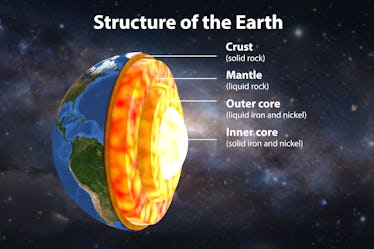
Internal structure of the Earth, cutaway computer illustration. From the centre outwards, the four l...

Earth’s core is actually two structures. The innermost layer is as hot as the surface of the Sun, but it’s under such intense pressure that it’s actually solid.

KATERYNA KON/SCIENCE PHOTO LIBRARY/SCIENCE PHOTO LIBRARY/GETTY IMAGES

Today, Earth’s core is actually two pieces. There’s an outer layer of molten metal about 1,795 miles thick. Inside that layer of molten metal lies a solid sphere of iron and nickel: the inner core, which is under enough pressure to be a solid despite the tremendous heat. At the center of an ocean of liquid metal, the inner core rotates on its own, like a weird little mini-planet deep inside the Earth. Together, the spinning inner core and the constantly churning outer core turn our planet into a giant electromagnet, powering the magnetic field that protects Earth’s surface from solar winds and deadly radiation.

Earth’s inner core is more complicated than it looks, however. It’s a mosaic of different textures, thanks to iron grains of different sizes and shapes, oriented in different directions. Those textures make up a record of how Earth’s core formed and how it has evolved over time: metals form grains of different sizes depending on how quickly they solidify, so one thing [authors] map tells us is that Earth’s inner core solidified quickly at some points in our planet’s history, and slowly at other points. Pressure, heat, and other factors also reshape those textures over time, which means Earth’s core is still changing and evolving.

In fact, some liquid iron may be trapped and sloshing around inside the otherwise solid core, according to University of Utah seismologist Keith Koper, a co-author of the recent study.

Mapping out those textures, at a resolution of less than 10 kilometers, was no easy feat. It takes an earthquake of around magnitude 5.7 to make seismic waves that can reflect off the core strong enough to be detectable, and even then, the signal is faint.

“The signal that comes back from the inner core is really tiny. The size is about on the order of a nanometer,” says Koper. “What we’re doing is looking for a needle in a haystack. These baby echoes and reflections are very hard to see.”

Eventually, our planet’s patchwork heart could reveal more details about Earth’s early history and the mechanics that drive our all-important magnetic field, without which we would all be dead – or rather, would never have existed at all.

{ https://www.inverse.com/ }

Hoe vind je dit bericht?
Geschreven door peter om 23:59 Stuur door

Amazing Video Takes Flight Across the Dunes of Mars

Mars-HiRise-video-Matara-Crater.jpg

This is a screenshot from the flyover video of Mars' Matara Crater created from HiRise data.

Image Credit: NASA/JPL-Caltech/UArizona

BY EVAN GOUGH

Amazing Video Takes Flight Across the Dunes of Mars

Mars may be a cold, dry, dead world, but it’s still part of nature. As part of nature, it displays a sort of haunted beauty as only non-living forces shape its surface over long periods of time. It’s like a rocky-planet laboratory shaped by natural forces where interference from living processes is absent.

A new video from NASA highlights the haunted allure of the Matara Crater, a rather unremarkable crater among the more than 43,000 craters on Mars’ surface larger than 5 km in diameter. The video comes from the HiRISE (High-Resolution Imaging Science Experiment) camera on NASA’s Mars Reconnaissance Orbiter (MRO.) The still images that make up the video were taken from 251 km (156 mi) above the surface.

The Matara Crater is only about 48 kilometres (30 mi) in diameter. But it’s intriguing because of its dunes and its undulating, textured nature. It’s named after a town in Sri Lanka.

This image shows the Matara Crater in context, with the massive, low-elevation Hellas Planitia impact crater to the right in blue. Image Credit: NASA/JPL/ASU/USGS

“Matara Crater is a favourite of ours to image owing to the massive and gorgeous sand sheet that dominates the floor. We often image these dunes for the gullies that form on them, some due to carbon dioxide ice,” NASA writes in the text accompanying the video.

The floor of the Matara crater is dominated by a massive sheet of sand. Mars’ relentless wind sculpts the top of the sheet into dunes, and the HiRISE camera has catalogued these changing shapes over time. There are more than 100 images of the dunes on the HiRISE website.

Dunes in Matara crater change as the seasons pass. Carbon dioxide freezes and melts and contributes to changes in the dunes. The HiRISE people highlighted these changes in a separate video a couple of years ago.

NASA didn’t build the HiRISE instrument and launch it into orbit around Mars on the Mars Reconnaissance Orbiter just for nice pictures of dunes. Dunes can reveal a lot about the planet’s past. Different sizes of dust grains tell scientists about the atmospheric conditions that deposited them. Dunes also contain information about the forces at work since their deposition. Taken together with other scientific observations of Mars, they help paint a picture of the planet’s history.

Some dunes even help us understand one of the largest issues on Mars: what happened to its water. China’s Zhurong rover found evidence in sand dunes near Mars’ equator showing that liquid water flowed there only 400,000 years ago.

This image of the Matara crater shows the sinuous elegance of its sand dunes. Image Credit: NASA/JPL-Caltech/UArizona

This image of the Matara crater shows the sinuous elegance of its sand dunes. Image Credit: NASA/JPL-Caltech/UArizona

Sand dunes are intriguing targets for rover exploration, but they’re tough to navigate and hazardous for wheeled vehicles. NASA’s Spirit rover got stuck in the sand in 2010, and its mission ended. Scientists are busy working on other locomotion methods for rovers to traverse sand dunes without wheels. Instead, these rovers would have bodies that roll over the sand. One design is based on the Golden Wheel Spider from the Namib desert. It’s noted for its wind-assisted rolling capabilities that help it transit across dunes more easily. It uses its rolling action to avoid parasitic wasps.

FESTO has developed a prototype of a rolling robot based on the Cartwheeling Spider. On level ground, the robot moves twice as fast when in rolling mode. It’s called the BionicWheelBot.

Here’s the BionicWheelBot being tested in the Sahara Desert.

Rolling robots may never visit Matara Crater to explore its dunes. But at least we have the MRO and the HiRISE camera. Thanks to them, and the quality of the 4K video, we can dream about visiting it ourselves.

This image shows the location of Matara Crater in a global Mars context. Image Credit: USGS

This image shows the location of Matara Crater in a global Mars context.

Image Credit: USGS

{ https://www.universetoday.com/ }

Hoe vind je dit bericht?
Geschreven door peter om 23:20 Stuur door

LATEST UFO SIGHTINGS AND VIDEOS - 07/07/2023

LATEST UFO SIGHTINGS AND VIDEOS - 07/07/2023

Black Sphere Shaped UFO Filmed Moments Before Vanishing Into Thin Air Over Sand Springs, Oklahoma.

This black object was sighted on July 5, 2023 over Sand Springs in Oklahoma. The witness stated the following: "We couldnt see it with the naked eye, Only after zooming in could we see it. The trail from the sky to the ground is also sus."

Sphere UFOs, Glitching UFOs, Fast UFOs. Best UFOs Of June 2023, AFO

RELATED

Human exploration of an asteroid - How could it possible?

ESA astronaut Luca Parmitano explains what it would take to send humans to an asteroid.

Credit: ESA

James Webb Space Telescope sees remains of 'ancient cosmic clash' | 4K zoom-in

Zoom into an amazing James Webb Space Telescope view of galaxy NGC 3256. It is " the wreckage of a head-on collision between two equally massive spiral galaxies," according to ESA/NASA.

Full Story: https://www.space.com/webb-telescope-...

Credit: ESA/Webb, NASA & CSA, L. Armus, N. Bartmann (ESA/Webb) | mash mix by Space.com's Steve Spaleta (https://twitter.com/stevespaleta)

India's Chandrayaan-3 moon mission spacecraft mated with rocket

India's Chandrayaan-3 moon mission is getting ready for launch. See the spacecraft, which is encapsulated within a payload fairing, get mated to Launch Vehicle Mark-III (LVM3).

Credit: ISRO

NASA’s Mars Rover Sets New Oxygen Creation Record

With NASA’s future plans of landing humans on Mars and transporting them to and from the planet, one of the most important challenges is the lack of air. There is less than 1% of air on Mars as there is on Earth, and carbon dioxide makes up about 96% of it on Mars. While not ideal, this does present an opportunity to turn that CO2 into oxygen.

A few years ago when the Perseverance Rover landed on the Martian surface, it not only began its main purpose related to sample collection but also creating oxygen. It does this using MOXIE, the Mars Oxygen In-Situ Resource Utilization Experiment. Just recently, researchers pushed MOXIE to a maximum production level — a factor of two higher than reached earlier.

This was able to produce a substantial amount of oxygen compared to previous tests. With this, the agency is more confident in what the future holds as they continue to develop this technology. Here I will go more in-depth into this new milestone, the MOXIE payload, what to expect in the coming months, and more.

Full article here - https://thespacebucket.com/nasas-mars...

For more space-related content check out - https://thespacebucket.com/

What Happened to JWST Galaxies That Seemed Too Far to Be Real?

Major Breakthrough On Origins of Life on Earth: Did Magnetism Cause Chirality?

Time Ran Slower in Early Universe, New Study Finds

Today we talk about the first evidence that time ran slower in the early universe, how to catch light, what astronomers think about the new starlink satellites, a breakthrough in quantum computing reported by Microsoft, what helps against tinnitus, better cooling for qubits, the Euclid Mission, laser scans of Ukrainian art, a metasuit, and of course the telephone will ring.

Topics

00:00 Intro

00:28 First Evidence That Time Ran Slower in the Early Universe

02:56 Physicists Figure Out How to Catch Light

04:43 New Starlink Satellites are Less Bright (But)

07:21 Microsoft Reports Quantum Computing Breakthrough

09:35 Lasers Help Against Tinnitus

11:07 Better Cooling for Qubits

13:04 ESA Launches Euclid Mission

14:22 Laser Scans of Ukrainian Buildings

15:35 A Metasuit

17:27 Learn Science With Brilliant

Could Life Be Transmitted Via Radio Waves? Information Panspermia

Lunar Mining, Processing & Refining

After over half a century, it is time to return to the Moon, and use its vast resources as a bridge to countless new worlds.

{ https://www.youtube.com/ }

Hoe vind je dit bericht?
Geschreven door peter om 23:03 Stuur door

Meer van UFO'S of UAP'S, ASTRONOMIE, RUIMTEVAART, ARCHEOLOGIE, OUDHEIDKUNDE, SF-SNUFJES EN ANDERE ESOTERISCHE WETENSCHAPPEN - DE ALLERLAATSTE NIEUWTJES

↑ Terug naar de berichten