KIJK.
- Bekijk hier de lancering van de Euclid ruimtetelescoop


 Euclid gelanceerd: de ruimtetelescoop die een van de grootste mysteries van ons universum moet ontrafelen
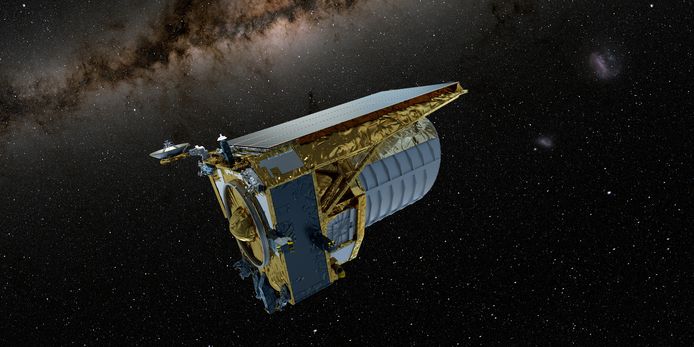 Wetenschappers hopen met Euclid nieuw inzicht te krijgen in een van de grootste vraagstukken over ons heelal: wat zijn donkere materie en energie?
© via REUTERS
Vandaag is het zover. Rond 17u Belgische tijd zal ESA haar Euclid ruimtetelescoop lanceren. Euclid gaat een ongekend nauwkeurige atlas van ruimte en tijd maken om te ontdekken waarom het heelal steeds sneller blijft uitdijen. Wetenschappers hopen daarmee nieuw inzicht te krijgen in een van de grootste vraagstukken over ons heelal: wat zijn donkere materie en energie? SpaceX lanceert de telescoop vanuit Florida.
KIJK.
Ruimtetelescoop Euclid, genoemd naar de oude Griekse wiskundige Euclides, gaat de structuur van het heelal op de allergrootste schaal opmeten. Dat gaat een uiterst gedetailleerde kaart opleveren met 2 miljard sterrenstelsels, een flink deel van het waarneembare heelal. En die kaart vertelt ook nog eens hoe al die sterrenstelsels zich de afgelopen pakweg 10 miljard jaar ontwikkeld hebben.
Wetenschappers hopen hiermee prangende kosmologische kwesties mee te kunnen oplossen. Raadselachtige donkere materie, donkere energie, zwaartekracht en de ontwikkeling van het heelal: het blijft in nevelen gehuld. Dit zijn vijf fundamentele vragen waarmee Euclid op pad gaat.
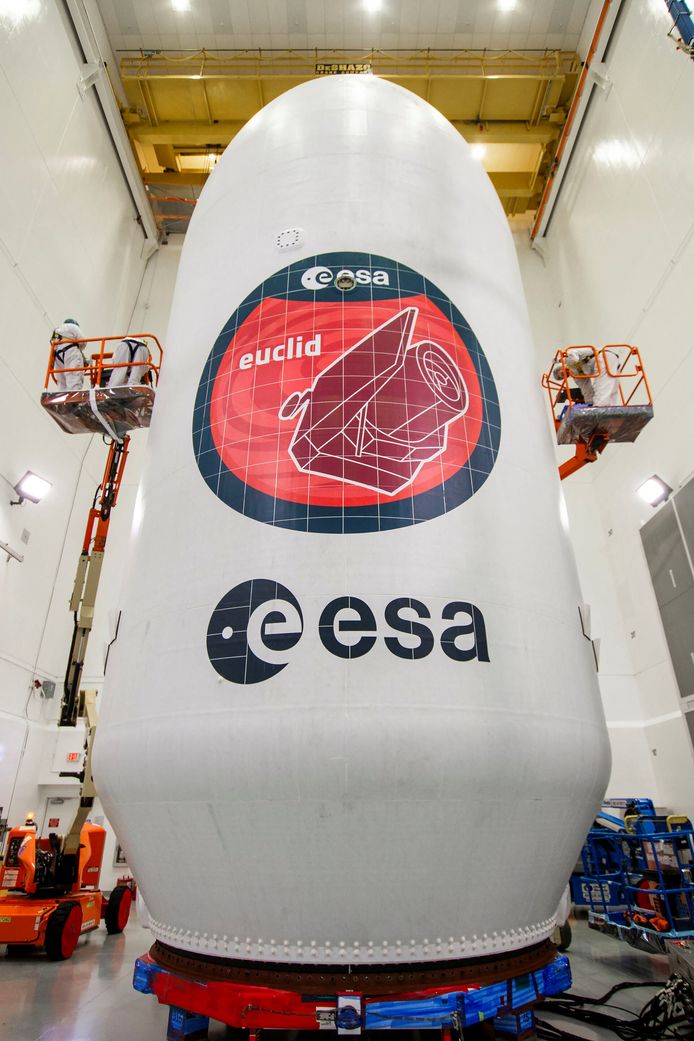 SpaceX lanceert de telescoop vandaag vanuit Florida.
© via REUTERS
Ons heelal bestaat uit heel veel sterren en sterrenstelsels, plus nog wat wolken van stof en gas. Toch? Als je dit aan een kosmoloog vraagt, is dit verre van het goede antwoord. Al die sterrenstelsels zijn enkel wat we kunnen zien. Maar dat is nog geen vijf procent van wat er werkelijk moet zijn.
Zeker twintig procent van het heelal moet uit ‘donkere’ materie bestaan. Spul dat we niet kunnen zien maar waarvan we wel de zwaartekracht-effecten kunnen meten. En dan is er nog heel veel donkere energie, een mysterieuze uiteendrijvende kracht die zorgt dat de uitdijing van het heelal steeds sneller gaat. Van allebei hebben wetenschappers geen idee wat het precies is.
Op de allergrootste schaal bekeken vormen de sterrenstelsels in ons heelal een soort spinrag, ook wel het kosmische web genoemd. Maar de zwaartekracht van al die sterrenstelsels samen is simpelweg niet voldoende om een dergelijke structuur te kunnen vormen, legt René Laureijs, project scientist van Euclid uit.
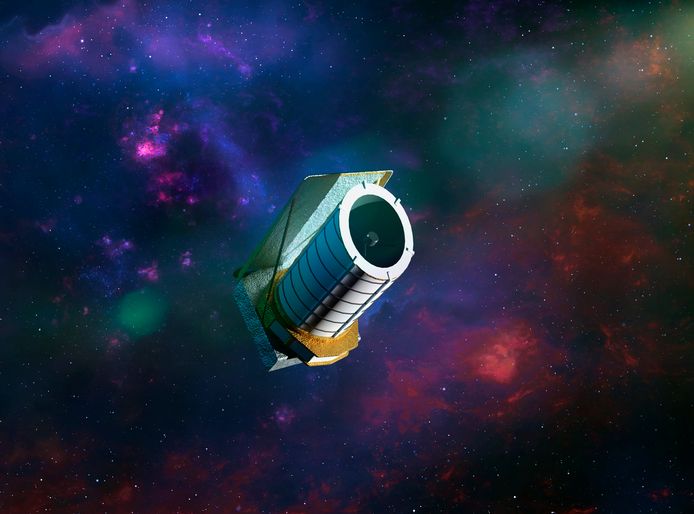 Euclid speurt naar de zwaartekrachteffecten van donkere materie.
© Getty Images/Science Photo Libra
Volgens veel wetenschappers moet zich onzichtbare ‘donkere materie’ tussen en rond de sterrenstelsels bevinden. De zwaartekracht ervan is meetbaar, maar waaruit het bestaat is totaal onbekend. Door goed te kijken naar de zwaartekrachteffecten van deze donkere materie gaat Euclid de verdeling ervan in kaart brengen. Dat helpt de vraag te beantwoorden waarvan het is gemaakt.
In de jaren twintig van de vorige eeuw ontdekte astronoom Edwin Hubble dat alle sterrenstelsels van ons wegvliegen. Het heelal dijt dus uit, als een ballon die opgeblazen wordt. In de late jaren negentig ontdekten wetenschappers tegen alle verwachtingen in, dat dit opblazen steeds sneller gaat.
De onbekende, uiteendrijvende kracht die hiervoor verantwoordelijk is, noemden ze donkere energie. Waar zwaartekracht aantrekkend werkt, duwt donkere energie alles juist uit elkaar. Dit constante geduw lijkt inherent aan de lege ruimte zelf te zijn. Hoe meer lege ruimte er ontstaat, hoe meer donkere energie er ook komt. En dus wordt alles steeds sneller uit elkaar geduwd.
Op aarde merken we helemaal niets van donkere energie. Ook tussen bijvoorbeeld naburige sterrenstelsels trekt de zwaartekracht nog altijd veel sterker. Alleen op de allergrootste kosmische schaal speelt donkere energie een hoofdrol.

Als donkere energie kan veranderen, dan moeten we de kosmologische theorieën herbekijken
Donkere energie zorgt dus dat het heelal steeds sneller uitdijt. Maar dat versnellen begon pas zo’n zes miljard jaar geleden, toen het heelal pakweg half zo oud was als nu. Toen werd donkere energie sterker dan zwaartekracht.
Om meer te begrijpen over deze geheimzinnige energievorm willen wetenschappers onder meer ontdekken of donkere energie constant is of veranderingen ondergaat, vertelt Laureijs. In dat laatste geval moeten namelijk de kosmologische theorieën herbekijken.
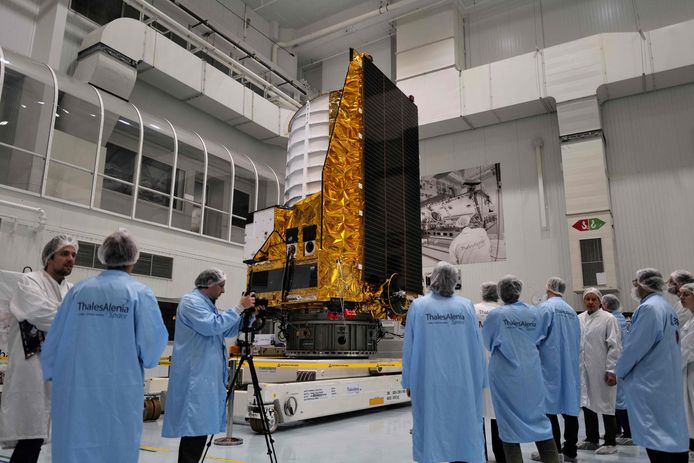
Omdat het heelal zo groot is en omdat licht tijd nodig heeft om ons te bereiken, is diep het heelal in kijken ook ver terug in de tijd zien. Euclid gaat terugkijken naar dat moment zes miljard jaar geleden, toen donkere energie zo sterk werd dat het zich met de ontwikkeling van het heelal begon te bemoeien.
De effecten van donkere materie en de vorming van sterrenstelsels in een webachtige structuur heeft allemaal met zwaartekracht te maken. Zwaartekracht begrijpen we vooral dankzij de algemene relativiteitstheorie van Einstein. Maar is deze theorie ook geldig op de allergrootste kosmische schaal? Dat weten kosmologen niet zeker.
Met Euclid kunnen wetenschappers de vorming van de allergrootste kosmische structuren gedurende miljarden jaren bekijken. Mogelijk vinden ze met Euclid aanwijzingen dat de zwaartekracht op kosmische schaal net iets anders werkt dan gedacht. En ook dan moeten de theorieën op de schop.
LEES OOK:
Valiant Thor: Unraveling the Enigmatic Story of the Alien Residing in the Pentagon
In the world of UFOlogy and extraterrestrial enthusiasts, there are myriad accounts, sightings, and stories that spark intrigue and fuel the pursuit of the truth. One such tale, steeped in mystery and seemingly out of a sci-fi blockbuster, is that of Valiant Thor – a supposed alien who not only visited Earth but allegedly had a direct line with the U.S. government.
Born from the pages of the book “Stranger at the Pentagon,” (Amazon link) authored by Dr. Frank E. Stranges in 1967, the narrative surrounding Valiant Thor quickly gained traction. The story suggests that Thor, an alien from Venus, came to Earth in 1957, landing in Virginia where he was taken to meet President Eisenhower and Vice President Nixon. He then spent three years living at the Pentagon, presenting solutions to eradicate poverty, disease, and even nuclear threats.
One might quickly dismiss such claims as the imaginative works of an eager author. However, Stranges himself claimed to have met Thor, describing him as a man of ‘extraordinary’ abilities. Valiant Thor, according to Stranges, had an elongated lifespan of 490 years and possessed a pair of lungs more advanced than our own, letting him breathe in any atmospheric condition.
Nevertheless, the story of Valiant Thor doesn’t come without controversy and skepticism. Some critics point out the striking resemblance of Thor’s narrative to the plot of the 1951 film “The Day the Earth Stood Still”. This has led many to question whether Valiant Thor’s tale is a genuine account of alien interaction or simply a case of creative plagiarism.
What adds another layer to this already riveting tale is the existence of a rock band, Valient Thorr, that was established in 2001. With all members adopting ‘Thor’ as their surname, they seem to pay homage to this unique character in their very foundation.
Despite the ongoing debates, the story of Valiant Thor has undeniably left an indelible mark on the extraterrestrial enthusiast community. It pushes the boundaries of our understanding of the universe and makes us wonder – could we really have been visited by an alien diplomat named Valiant Thor?
VIDEO:
RELATED VIDEOS
UFOs Keep Appearing in the News. Here’s Why We Can’t Quit Them
For most of us, aliens are a source of mystery and fun, which keeps them forever in vogue
By Keith Kloor
In 1995, Fox Televisioncaptivated millions with a medical autopsy of a space alien. The 17-minute black and white clip purported to show military doctors examining a bloated, humanoid-looking extraterrestrial that had died in a flying saucer crash.
The broadcast generated so much hoopla that Fox aired it two more times that year, tacking on “added footage” of the UFO wreckage. Even then, the hoax—recycling the Roswell myth, which holds that the U.S. government in 1947 recovered an alien craft from the New Mexico desert—was old hat.
The latest version of this fable is the widely circulated story of—you guessed it—crashed UFOs that the U.S. government has been hiding for many decades. In June, a recently retired intelligence community “whistleblower” made this claim, like others before him in years past. That the latest “bombshell” landed without any evidence or corroboration has not dampened our feverish enthusiasm. “Are we finally ready to admit UFOs are aliens?” asks the Daily Beast in its headline.
Americans have a bottomless appetite for this stuff. The initial story of crashed aliens was the Roswell incident, which stemmed from an actual cold war event; a balloon from a then-secret U.S. military project had fallen near Roswell, N.M., just as the flying saucer phenomenon was taking root. Ever since, the crashed saucer myth and UFOs in general have steadily profited news and entertainment outlets, and they have sated a deep human need for mystery.
I get it. Aliens are cool. Fuzzy UFO videos, which (let’s be honest) the media uncritically hype way too much, are fun. Maybe this is why friends and family members are always texting me the latest, craziest UFO story (that is quickly proven to be bogus). UFOs are so damn entertaining!
(A quick public service announcement: All this talk for decades about a “cosmic Watergate” is not amusing to everyone. Some people get really worked up and land in serious legal trouble; others find it a gateway to a toxic, paranoid swamp and entice vulnerable minds to join them.)
For the most part, the ubiquitous alien icon is now a gimmicky relic from a larger landscape of escapist fantasy, the same terrain that has relegated other faddish subjects, like the Bermuda Triangle and Nessie, to the annals of pseudoscience. UFOs, in contrast, remain an enduring American obsession. Why? Are they so much fun that we can’t let them go?
It’s more than that. “Despite centuries of scientific and social progress, we remain, at our most intimate level, believers,” writes author Marc Fitch in Paranormal Nation: Why America Needs Ghosts, UFOs, and Bigfoot. Indeed, this is a core sentiment of the hit 1990s X-Files show, which is embodied on the poster of a flying saucer above agent Mulder’s office wall with the phrase, “I want to believe.”
Perhaps it also explains why Scott Brando, a diligent monitor and debunker of phony UFO videos that regularly go viral online, is always playing whack-a-mole. People fall prey to such hoaxes because they “need to believe something extraordinary” or “satisfy their craving for mystery,” he wrote in an e-mail to Scientific American.
That human desire for mystery is something that UFO promoters—and they seem to have multiplied in recent years—are adept at fulfilling. Hence, all the recycling and reimagining of classic UFO narratives, such as Men in Black.
On occasion, there is a creative blending that invents a new myth for the UFO canon. The latest is a 512-acre ranch in rural Utah that is supposedly a “hotspot” for UFOs, poltergeists, animal mutilations and “shadow creatures.” A Las Vegas TV journalist (who is also a host of a conspiracy-themed radio show), refers to the ranch as a “paranormal Disneyland.”
It’s the basis for a scripted reality show on the History Channel called The Secret of Skinwalker Ranch. The main character is a retired Department of Defense astrophysicist (a featured character for years on Ancient Aliens) who also happens to be the former chief scientist of the Pentagon’s 2022 Unidentified Aerial Phenomena report produced by an agency task force.
Wait, this gets better.
The person formerly in charge of the Pentagon’s UFO task force is now appearing on the Skinwalker show (as himself), after he too, retired after a long DoD career. Both have reportedly claimed that a Skinwalker ranch poltergeist followed them home. (Nonetheless, this hasn’t kept them from returning to the ranch.)
Like the latest UFO “whistleblower,” these fellows all have otherwise impeccable credentials. As Mick West, a prominent skeptic and debunker, writes in a 2021 Guardian piece, such influential messengers couch “weak evidence” for UFOs as compelling. “Don’t be fooled,” he cautions.
But what if, like fans of professional wrestling, we know it’s just a big goof and don’t care? After all, ghost stories are fun. It’s the same with UFOs. The filmmaker behind the Alien Autopsy video later said he regretted his deception, but admitted “it was a joke, a bit of fun.”
Avid consumers of UFO stories seem to be in on the joke. “Part of this whole thing is just wonderful bullshit,” Adam Frank, an astrophysicist at the University of Rochester, said to me in a recent conversation about the latest wave of UFO mania. “It has nothing to do with science, but we all love talking about aliens.” Frank was speaking in general about the silliness factor that has long made it virtually impossible to take UFOs seriously—except as a sociocultural phenomenon.
Pop culture needs a consistent diet of this junk food to meet our incessant UFO hunger. Will we ever kick the habit? UFO promoters obviously don’t think so. In recent days, the “whistleblower” has spoken out more to say that the multiple space alien crafts retrieved by the U.S. military are the size of football fields and held by unnamed U.S. defense contractors. Additionally, he suggested that the Vatican is involved in the cover-up and that, oh, by the way, people have been murdered to keep all this hushed up.
That does not sound like fun. Perhaps this is why no one texted it to me.
RELATED VIDEOS
George Knapp Believes This US Company Helps Govt. In Reverse-Engineering UFOs
What UFOs actually are is one of the mysteries that the entire world is yearning to have answered. Top agencies from all around the world invest millions of dollars to uncover this reality and determine the cause of numerous UFO sightings. George Knapp recently broke a story about an Alabama-based private company that he asserts might be working with alien technology.
Controversial physicist Bob Lazar told long ago about the alleged secret US program aimed to reverse engineer the alien technology. Perhaps he knows something that we do not. Investigative American journalist George Knapp was the first person who interviewed Lazar and brought his story to the world. Now, Mr. Kanpp believes that a private American company named “Radiance Technologies” might be reverse engineering UFOs.
Radiance Technologies, Inc. is an employee-owned small business prime contractor. It has over 900 employees working in more than 15 U.S. and international offices. It serves customers in the Department of Defense (DOD), National Aeronautics and Space Administration (NASA), the national intelligence community, the Department of Homeland Security (DHS), other government organizations, and selected commercial customers.
In 2021, the US Congress passed a bill (soon-to-become law) that would allow funding to reverse engineer UFO technology. In a few months, the Pentagon created an office to track UAP, and NASA also joined in the investigation. Any data gathered could also be used in funding requests to “replicate any such advanced characteristics and performance” of UAPs, according to Military.com. This means that government plans to encourage the reverse engineering of UFOs.
Mr. Knapp claims that this private defense contractor has an office inside Wright-Patterson Air Base that is known for holding alleged UFO material. Radiance Technologies has quietly become a major player in developing Cutting Edge weapons and systems for the Pentagon but unlike some of its larger competitors Radiance without hesitant talks about a topic long considered Fringe or forbidden UFOs. (Source)

Tim Tinsley, a president of Radiance Technology avidly said that he would like to work on UFO technology if somebody offered them to do it. “Why not,” he says. “I’m waiting for one of those.” Tinsley is an engineer who spent two decades working on missile defense systems before joining Radiance.
Read also:
Mr. Knapp hinted (as per the information available on their website) that Radiance deals in exotic defense Technologies such as Star Wars-like direct energy, Hypersonic missile systems to defend against cyber warfare, etc.
Perhaps they are working on other unclassified projects at Nellis Air Force Base, however, Tinsley refrained himself telling about it. “I can’t tell you a lot,” Tinsley said. “I can tell is you is we’ve supported the Las Vegas community, Nellis Air Force Base, for over 20 years.” He noted the work is mainly for the Air Force in research and development, test and evaluation spectrum.
For more than three decades, Nellis Air Force Base has been rumored to be the home of mysterious materials of unknown origin. The rumor claims that a top-secret operation located at or close to Nevada’s Area 51 military base has been attempting to reverse-engineer alien technology. However, this rumor has been dismissed as folklore by military organizations and defense companies.
However, Radiance Technology is unable to validate the claims. Longtime Navy intelligence official Jay Stratton, who earlier served as the chief of the Pentagon’s unidentified aerial phenomenon, or UAP, task force, was hired as a reverse engineering specialist, according to an announcement made months ago. (Source)
“I am very excited to join Radiance Technologies. Radiance has a great culture, balancing mission focus and vision with a strong emphasis on the professional and personal growth of our employees. I’m excited to provide our customers with a diverse and innovative approach to delivering capabilities and supporting our nation in strategic competition,” said Stratton.
Dr. Travis Taylor, who collaborated with him as the lead scientist for the UAP task team, was recommended for hire by Stratton to Radiance. When Radiance announced the hire of two UFO research veterans, the news releases didn’t downplay the association and specifically mentioned their credentials. But is the business concerned about the notion that they could be creating UFOs through reverse engineering? (Source)
Taylor, for his part, isn’t saying what he and Stratton are working on but makes it clear what they’re hoping to tackle, writes Mr. Knapp. “Jay and I are working on growing the capabilities, doing reverse engineering of foreign materials,” Taylor explained. “If we were to get something to reverse engineer, we would absolutely want to do that.”
During an interview for On Balance With Leland Vittert, a member of the US House of Representatives Tim Burchett was asked about the Navy’s possession of more videos of UFOs that it is not willing to release to the public for reasons of National Security.
First of all, Burchett again highlighted the UFO cover-up by the intelligence agencies and the Department of Defense, recalling what happened at the last public hearing in Congress. “We are the most technologically advanced nation in the world, and they present us with these lousy videos, which — during the hearing — weren’t even able to pause properly to show us two or three frames,” he said. “Everything is bad, they don’t trust us. It’s all about power and control,” he added.
Vittert then asked the Congressman about the statement issued by the Navy and how they are refusing to release any more videos showing UAP. He questioned whether this might be because it is a proprietary technology that adversary nations should not know about. The Congressman replied by saying that he thinks the United States Government had probably reverse-engineered alien technology. He claims that many sightings are made on military installations or over restricted airspace.
The Congressman was also asked about his thoughts on whether the Navy was working on technology that could have applications in space or similar to that. In addition, he was asked whether he thought Roswell was a weather balloon. “They are covering it up, and American taxpayers should sue them. It’s so compartmentalized that probably a lot of the people working on it — reverse engineering projects — don’t even know what they’re working on,” he said.
RELATED VIDEOS
‘Ik heb de gevaren van AI niet ernstig genoeg genomen’
door Dominique Deckmyn
Hij is een van de peetvaders van artificiële intelligentie, maar vandaag maakt Yoshua Bengio zich grote zorgen over zijn uitvinding. Over tien jaar kunnen de systemen al slimmer zijn dan wij, gelooft hij. ‘Ik heb altijd gedacht dat we de menselijke intelligentie moesten trachten te imiteren. Nu denk ik dat dat een grote vergissing zou zijn.’
Bezorgd is Yoshua Bengio al langer. In 2017 al was hij een van de initiatiefnemers van de Declaratie van Montreal, die pleitte voor meer ethische artificiële intelligentie. Bengio is samen met Geoffrey Hinton en Yann LeCun een van de grondleggers van AI: in 2019 kreeg het drietal de Turingprijs, zowat de Nobelprijs voor computerwetenschap, voor hun rol in de ontwikkeling van deep learning, de tak van AI die sinds 2010 tot nooit geziene doorbraken leidde. ‘Zo’n vijf jaar geleden begonnen grote bedrijven als Facebook en Google elkaar te beconcurreren bij het opkopen van AI-start-ups’, vertelt hij. ‘Het werd toen duidelijk dat we van spoor moesten veranderen. Dit was niet langer een puur intellectuele verkenning voor de wetenschap, we moesten echt nadenken over hoe de technologie gebruikt zou worden.’
Maar de stroomversnelling waarin de technologie dit jaar is terechtgekomen, maakt Bengio ronduit bang. De Standaard praatte via videoverbinding met hem over de verbijsterende ontwikkelingen van de afgelopen maanden en zijn groeiende bezorgdheid.
Wat is uw grootste zorg?
‘De onzekerheid en de omvang van de schade die aangericht kan worden als we machines bouwen die slimmer zijn dan wijzelf. De technologie kan ook misbruikt worden of op een onverstandige manier gebruikt. Beide scenario’s kunnen catastrofale gevolgen hebben.’
Wanneer kreeg u het gevoel dat het allemaal sneller gaat dan u had verwacht?
‘Dat is geleidelijk gebeurd, de voorbije paar maanden, naarmate ik meer vertrouwd raakte met ChatGPT en later GPT-4 en daarover nadacht en praatte met collega’s van over de hele wereld.’
Taalmodellen
Nochtans zijn taalmodellen als GPT-3.5 (het AI-systeem dat ChatGPT aandrijft) en opvolger GPT-4 niet nieuw voor Bengio. Hij was zelf de grondlegger van de technologie, toen hij 20 jaar geleden begon neurale netwerken (computerprogramma’s die geïnspireerd zijn op de werking van hersencellen) te trainen door ze te voeden met tekst. ‘We begonnen met zeer kleine datasets en zeer kleine neurale netwerken, maar de resultaten waren toch al interessant.’ In 2014 werd een nieuw element toegevoegd: een attentiemechanisme, dat maakt dat het taalmodel beter rekening kan houden met context. ‘Toen we dat deden aan de universiteit, werkte het gewoon iets beter dan de bestaande systemen, maar echt indrukwekkend was het niet. Maar Google bouwde een groter neuraal netwerk, trainde dat op meer data en liet er goede engineering op los.
Het resultaat was verbluffend. Toen begonnen we het effect van schaalvergroting te zien: we hoeven het recept van die neurale netwerken eigenlijk niet zo veel aan te passen, we maken ze gewoon groter, trainen ze langer en op meer data, en ze worden verbazingwekkend veel beter.’
En dat heeft u dit jaar opnieuw verbaasd?
‘Ja.’
Wat was het dan precies, dat u niet had zien aankomen?
‘Ik dacht dat de systemen, zelfs met zoveel trainingsdata, zouden falen als ze geconfronteerd werden met nieuwe vragen. Maar dat blijkt niet zo te zijn. Je kunt de systemen nog altijd in de fout laten gaan, maar dan moet je daar al echt moeite voor doen. Veel mensen zouden diezelfde vragen ook niet correct beantwoorden. Ik realiseerde me dus dat we een paar echt belangrijke mijlpalen hebben bereikt. We hebben de Turingtest gehaald, het moment waarop je mens en machine niet meer uit elkaar kunt houden als je ermee interageert door tekst in te tikken.’
U denkt dat systemen als ChatGPT voor die test zouden slagen?
‘Officieel is dat niet gebeurd, maar in de praktijk is dat toch wat we zien gebeuren.’
De jongste maanden groeit de bezorgdheid over de ontwikkelingen. Wat loopt er momenteel mis?
‘Wel, er is net iets goeds aan het gebeuren: meer mensen worden zich bewust van de gevaren die misschien in het verschiet liggen. Eerst waren dat de mensen die de technologie ontwierpen en de bedrijven errond oprichtten. Maar ook politici zijn zich er mee gaan bemoeien en dat is heel belangrijk.’
‘Ik ben ervan overtuigd dat er manieren zijn om veilige AI-systemen te bouwen – systemen waarover we de controle niet kunnen verliezen en die de mensheid echt kunnen helpen. Het probleem is: als we weten hoe we veilige AI-systemen moeten bouwen, dan weten we ook hoe we de gevaarlijke kunnen bouwen – dus: hoe verhinderen we dat dat gebeurt? En dat is een politieke vraag, geen technische.’
Europa werkt aan een AI-Act. Zitten we op het juiste spoor?
‘Ik vrees dat het om een erg log instrument gaat, terwijl alles nu heel snel evolueert. We hebben een regelgevend orgaan nodig dat zijn regels snel kan updaten als er nieuwe potentiële gevaren opduiken. Er is ook een interessant Canadees wetsvoorstel, dat de rol van de wet en van het regelgevend orgaan opsplitst op een flexibele manier. Maar deze wetten zijn ontworpen vóór ChatGPT en vóór de huidige discussie over het verlies van controle en de bedreiging van de democratie. Er moeten meer controles op die potentiële gevaren ingebouwd worden. Ik meen te begrijpen dat het comité over AI-richtlijnen van de G7 zal nadenken over alle gevaren en dat is goed.’
Verschillende kopstukken van de AI-industrie, zoals OpenAI-baas Sam Altman, verklaren openlijk dat zij grote gevaren zien en dringen aan op regulering. Hoe oprecht is Altman daarin?
‘Ik ken hem niet goed genoeg om daarop te antwoorden. Hij ziet er oprecht uit, maar anderzijds: verklaren dat er regulering nodig is en dan zeggen dat de Europese wetgeving onmogelijk gerespecteerd kan worden, dat klinkt niet zo coherent.’
OpenAI heeft de technologie achter ChatGPT niet uitgevonden, maar wel als eerste op de markt gebracht. Was dat onverantwoord?
‘We weten eigenlijk niet precies wat er in hun systeem zit. Maar we hebben aanwijzingen dat ze verschillende bestaande elementen hebben samengebracht – zoals wel meer gebeurt. En dat hebben ze opmerkelijk goed gedaan. Ik denk dat ze zeker gestart zijn met een sterke intentie om de risico’s aan te pakken, inbegrepen het risico op verlies van controle. Ik lees dat ze die zorg misschien wat laten verslappen door de commerciële druk en de race waarin ze zich nu bevinden, maar dat kan ik niet met zekerheid zeggen.’
Yann LeCun, die andere peetvader van AI, vindt het zinloos om ons nu al zorgen te maken over superintelligentie, omdat we daar nog mijlenver vanaf staan.
‘Dat is niet wat hij zegt, denk ik. Ik denk dat hij het ermee eens is dat we op een spoor zitten dat zal leiden tot machines die slimmer zijn dan wij. En niet pas over een eeuw. Misschien ligt die horizon voor hem wat verderaf dan voor mij, maar dat is geen fundamenteel meningsverschil. Zoals ik het begrijp, vindt LeCun dat we ons geen zorgen hoeven te maken omdat we het probleem wel zullen kunnen oplossen als het zich aandient.’
En u denkt van niet?
‘Ik denk dat de inzet veel te groot is om niet zo voorzichtig mogelijk te zijn.’
U tekende in maart de open brief die opriep tot een pauze van zes maanden in de ontwikkeling van de meest geavanceerde AI-systemen. Zou dat helpen?
‘Ja, maar het zal niet gebeuren. Nog voor de brief gepubliceerd werd, wist ik dat het nooit zou gebeuren. Maar de brief had een positieve impact: het bracht de discussie op gang. Dat is een indrukwekkende verwezenlijking.’
Dus wat moet er nu gebeuren?
‘Geoff Hinton zei enkele weken geleden: we moeten evenveel uitgeven aan het verbeteren van de algoritmes als aan het maken dat ze veilig zijn en dat we het publiek beschermen. Dat kunnen AI-researchers niet in hun eentje, we moeten werken met juristen, met mensen die de ethische aspecten begrijpen, specialisten in cybersecurity en in nucleaire, biologische en chemische wapens.’
De grote AI-systemen die nu zo snel evolueren, zoals GPT-4, kunnen die veilig gemaakt worden?
‘Het probleem zit niet bij de architectuur, al kunnen we die altijd verbeteren. Vooral de manier waarop de systemen getraind worden, moet veranderen. En daar heb ik enkele ideeën over. Eén manier om de systemen veilig te maken, is garanderen dat ze geen agency(het vermogen om initiatief te nemen, red.) hebben, dat ze zelfs geen notie hebben van een eigen doel of plan. Al wat ze doen, is proberen te begrijpen hoe de wereld werkt en ons met die kennis helpen om vragen op te lossen.’
Systemen als GPT-4 leken geen agency te hebben, ze beantwoorden alleen vragen. Maar plots komen er systemen uit als AutoGPT, dat ChatGPT omtovert in een soort autonoom optredende assistent. Is dat wat u agency noemt?
‘Ja. Het is erg eenvoudig om iets te nemen wat dienst doet als een soort orakel dat alleen vragen beantwoordt, en het om te toveren in een agent. De agent hoeft immers alleen te weten: van alle mogelijke acties die ik kan ondernemen, welke actie zal mij helpen om mijn doel te bereiken? En als je het antwoord hebt op die vraag, dan onderneem je die actie.’
Dus AutoGPT is gevaarlijk?
‘Niet zoals het nu is. Er is nog niet veel werk in gestopt om het goed te maken. En ChatGPT is nog niet zo slim. Maar stel dat we in kwaliteit nog een stapje boven GPT-4 gaan, laten we zeggen GPT-5 of zoiets, dan kan het gevaarlijk worden.’
Superintelligentie
Bengio betreurt dan ook dat hij niet eerder in actie is geschoten. ‘Ik denk dat er een psychologisch obstakel is dat ons verhindert om iets te zien wat zo in tegenstelling is met het doel waar we naartoe werken. En daarom heb ik niet gedaan wat ik had moeten doen. Deze gevaren zijn al 10 à 20 jaar bekend, maar ze werden niet ernstig genomen omdat mensen als ik dachten: ach, dat ligt nog veel te ver in de toekomst, we hebben zelfs nog geen idee van hoe zulke AI-systemen eruit zullen zien, dus hoe kunnen we daar vandaag al iets aan doen? Maar nu is de situatie anders, nu staat het vlak voor ons.’
Er zijn nog heel wat technische obstakels met de huidige taalmodellen, maar Bengio gelooft dat die in sneltempo opgelost kunnen worden. Dat systemen als ChatGPT om de haverklap feiten verzinnen, de zogenoemde ‘hallucinaties’, bijvoorbeeld: ‘Dat kan ingeperkt worden, daar werken momenteel veel mensen aan. En zelfs in hun huidige staat, met al hun gebreken, kunnen die systemen nuttig zijn. Alle mensen die ik om me heen zie, gebruiken ze.’
‘We begrijpen in grote lijnen wat er aan die systemen ontbreekt. Er wordt gewerkt aan algoritmes die dat kunnen verbeteren. Misschien kunnen we alle problemen in drie tot vijf jaar oplossen, en dat is wat mij zorgen baart. Nu, het blijft mogelijk dat er nog iets anders, iets fundamenteels, ontbreekt wat we nu nog niet zien. Dat zou dan eigenlijk een goede zaak zijn, want het zou ons meer tijd geven om ons aan te passen. Maar wat als het juist sneller gaat dan verwacht, zoals het afgelopen jaar het geval was?’
U gelooft nu dat superintelligentie, een AI-systeem dat de mens overtreft, er over 10 jaar al kan zijn?
‘Ja, net als veel van mijn collega’s.’
Nochtans zeggen andere onderzoekers dat er nog te veel onopgeloste problemen zijn, dat het veel langer zal duren.
‘Absoluut. En had je mij die vraag een jaar geleden gesteld, dan had ik 20 tot 100 jaar gezegd. Nu zeg ik: 5 tot 20 jaar.’
Dus hoe kijkt u nu naar uw eigen onderzoek? Vindt u het gevaarlijk?
‘Mijn onderzoek heeft zeker geholpen om ons te brengen waar we nu staan. Al die vragen stel ik mezelf elke dag: wat is het beste gebruik van mijn tijd om de risico’s te minimaliseren en de voordelen voor de hele mensheid te maximaliseren?’
Het klinkt alsof u daar echt mee worstelt.
‘Dat is ook zo. Hier zijn geen gemakkelijke antwoorden op te vinden.’

Uw onderzoek zou het mogelijk maken dat de AI-systemen meer denken zoals wij – maar dat vindt u dus nu eigenlijk geen goed idee meer?
‘Gedurende mijn hele carrière heb ik gedacht dat we inspiratie moesten halen uit de mens, moesten proberen om onze eigen intelligentie te imiteren. Nu denk ik dat dat een vergissing is. Het is belangrijk dat we begrijpen hoe het brein werkt, maar machines bouwen die erg lijken op mensen zou in veel opzichten een grote vergissing zijn. In sciencefiction zien we androïden en AI-systemen die min of meer als mensen zijn, maar dan mechanisch. Zoals Data in Star Trek. Dat beeld klopt volgens mij niet. Om te beginnen zijn machines in wezen onsterfelijk, want ze kunnen hun programmacode en hun staat kopiëren. Wij zijn fundamenteel anders. We ontwerpen die machines omdat we instrumenten willen bouwen die ons helpen. Maar misschien scheppen we een nieuwe soort die gevaarlijk is voor ons en zelfs voor het voortbestaan van onze eigen soort. In het verleden zijn vele soorten uitgestorven, gewoonlijk omdat er een slimmere soort kwam. In de laatste paar eeuwen hebben we het uitsterven van zo’n duizend soorten veroorzaakt. Niet omdat we ze dood wilden, maar omdat ze in de weg stonden tussen ons en meer land of meer geld.’
Dus u gelooft op dit moment dat het beter is dat we die superintelligentie nooit bereiken?
‘Dat zeg ik niet. Als we die superintelligentie op een veilige manier bereiken, kan het ons helpen met veel van de uitdagingen waarvoor de mensheid staat: ziekte, klimaatverandering, armoede en economische ongelijkheid – problemen waar we geen of amper vooruitgang in boeken. Maar we moeten het op een veilige manier doen. En op dit moment weten we eigenlijk niet hoe dat moet. En dus moeten we het langzaamaan doen en werken aan maatregelen die de schade kunnen beperken.’
‘Het andere probleem is: zelfs als ik, of iemand anders in een paar landen, beslist om te vertragen, dan zijn er toch mensen in andere landen die dat niet doen. Wat doen we daar dan tegen? Een van de dingen die mijn vriend en collega Yann LeCun zegt, en waar ik het mee eens ben, is dat we waarschijnlijk de hulp van sommige AI-systemen nodig zullen hebben om ons te beschermen tegen mogelijke losgeslagen AI’s. Dus daar staan we dan: we hebben die systemen nodig, maar tegelijk willen we ze niet. En als ze toch ergens opduiken, dan hebben wij er ook nodig om ons ertegen te beschermen. Het is zoals nucleaire wapens, nietwaar? Kernwapens zijn gevaarlijk, maar als iemand anders ze gaat bouwen, dan hebben wij ze ook nodig. We moeten daarmee leren om te gaan.’
Moeten we ons zorgen maken over de toekomst?
‘Wel, je zorgen maken is op zichzelf niet nuttig. We moeten handelen. In de eerste plaats om die kwesties beter te begrijpen, want er is veel wat we nog niet begrijpen. Een goede aanwijzing daarvoor is dat er zoveel onenigheid bestaat tussen onderzoekers. Daarnaast moeten we in regulering voorzien, in internationale akkoorden, om op een pad te raken naar veiligheid en fairness, met de bedoeling het publiek beter te beschermen.’
Hebben overheden nog tijd om op te treden? Er bestaan al open-sourceversies die iedereen zomaar kan downloaden en verder bewerken. Dat kun je toch niet meer stoppen?
‘Nee, de huidige systemen zijn nog te dom om echt gevaarlijk te zijn. Ja, ze kunnen gebruikt worden voor desinformatie. Maar de echt grote gevaren liggen nog een aantal jaren voor ons, dus het is nog niet te laat. Maar we zullen wel veel sneller wetgevende maatregelen moeten opstellen dan we, bijvoorbeeld, gedaan hebben tegen de klimaatverandering. Daarin waren we veel te traag.’
Hoe kunnen we de radicale veranderingen begrijpen die onze wereld ondergaat? In de reeks ‘Zieners’ zoeken we houvast en inspiratie bij vooruitziende denkers.
In deze aflevering is dat Yoshua Bengio, een van de grondleggers van Artificial Intelligence. Bengio is professor computerwetenschappen aan de Universiteit van Montreal en wetenschappelijk directeur van het Montreal Institute for Learning Algorithms. In 2019 won hij de Turing-prijs voor zijn bijdrage aan de ontwikkeling van AI, samen met Yann Lecun en Geoffrey Hinton. Vorig jaar was Bengio de meest geciteerde wetenschapper ter wereld.
GERELATEERDE VIDEO'S IN HET ENGELS
We have never seen dark matter and dark energy. Why do we think they exist?
Scientists think that only about 5% of the stuff that makes up the universe is known to us.
Yes, you are reading that right. Cosmological models show that invisible energy and matter must make up a combined 95% of the universe for it to work according to existing theories.
The invisible part of the universe consists of two components, dark energy and dark matter. The latter is somewhat less mysterious and sciets are fairly certain of its existence: The rules of gravity simply wouldn't work without it. Galaxies as we see them wouldn't have been able to assemble to their current sizes in the time they've had since the Big Bang if visible matter was all there was. In fact, many galaxies wouldn't even hold together as they do, if the gravity of visible matter was the only force pulling them together.
Europe's new space telescope Euclid will attempt to map this invisible stuff, but what if its findings don't fit expectations? A lot is at stake, including Einstein's famed and widely accepted theory of general relativity.
Related:
The first observations indicating that dark matter must be prevalent in the universe to prevent things from flying apart were made in the 1930s. Since then, astronomers have found that this invisible dark matter must make up at least 85% of all matter in the universe. Scientists have been trying for decades to detect this invisible matter, which, they think, must consist of some sort of particles, maybe akin to the inert neutrinos that barely interact with the visible world.
The situation with dark energy is, however, more complicated. The discovery of this elusive force dates back to 1998 when astronomers found that the expansion of the universe is accelerating. The expansion itself was initially driven by the energy from the Big Bang, but since the Big Bang happened so long ago (13.8 billion years ago, to be exact), this expansion should be slowing down.
To make up for this conundrum, theorists postulated that some mysterious force, dark energy, must exist that acts against gravity and drives matter apart. Cosmological models show that dark energy accounts for 68% of all energy in the cosmos, according to NASA. But astronomers admit that the evidence for its existence is a bit vague.
"[The acceleration of the expansion] of the universe doesn't make sense when you think that there's just gravity there," Isobel Hook, a professor of astrophysics at Lancaster University in the U.K. and a Euclid scientist, told Space.com. "It shouldn't be slowing down. So the fact that we observe it getting faster means that there must be something else. And we just call that thing dark energy because we don't really know at all what it is."
Hook was a member of the team that made that 1998 discovery and since then has been wondering, just like many other scientists, what this dark energy actually might be.
"We really don't know," she said. "The best theory is that it's probably some kind of property of space itself, like a kind of energy that's everywhere, at all times, but there's no explanation for what that should be."
Models show that this energy must be distributed evenly across the universe and that it has always had the same strength. In the universe's early days, the effects of dark energy were not as visible, because the original 'kick' from the Big Bang was driving most of the universe's expansion. Some 5 to 6 billion years ago, however, dark energy became "a predominant force, acting against the gravity of both, the normal and dark matter," Giuseppe Racca, Euclid project manager at the European Space Agency (ESA), told Space.com
"It's a little bit unsettling, that this energy appears to have a constant density as the universe expands," Racca said. "It means that [additional] energy is created because the density is constant. It is not diluted by the universe becoming bigger. So it means that there is additional energy."
There is, however, also the possibility that there is no such thing as dark energy after all, and that the cosmological models that require its existence are wrong. These models are based on Albert Einstein's theory of general relativity that describes the physical 'rules' of the universe in a series of equations. If future observations by the Euclid telescope (and other upcoming telescopes designed to study dark energy) suggest that dark energy is not such a constant, omnipresent force, that would mean that this famed theory is not entirely correct.
"We know that general relativity works very well at the level of a system," said Racca. "But there is a possibility that it doesn't work all that well at cosmic scales and therefore dark energy is not needed."
Euclid will look for the evidence of dark energy by mapping the distribution of galaxies 10 billion years back in time and comparing how this distribution has changed throughout the evolution of the universe. The observations will reveal whether there really appears to be a constant omnipresent force in action or whether perhaps something else is going on.
"We might find that we don't see [the effects of] this energy constant everywhere, but we see some differences somewhere or in time," said Hook. "Then things will get really interesting and it really would be revolutionary, because we'd have to completely change our theories."
And that would likely mean Nobel Prizes for the discoverers. The Euclid telescope, launched on July 1 by a SpaceX Falcon 9 rocket, will take six years to map one third of the sky outside our galaxy, the Milky Way. Only then will astronomers have enough data to know for sure.
Melting Water in Mars’ Past Could Have Created Martian Gullies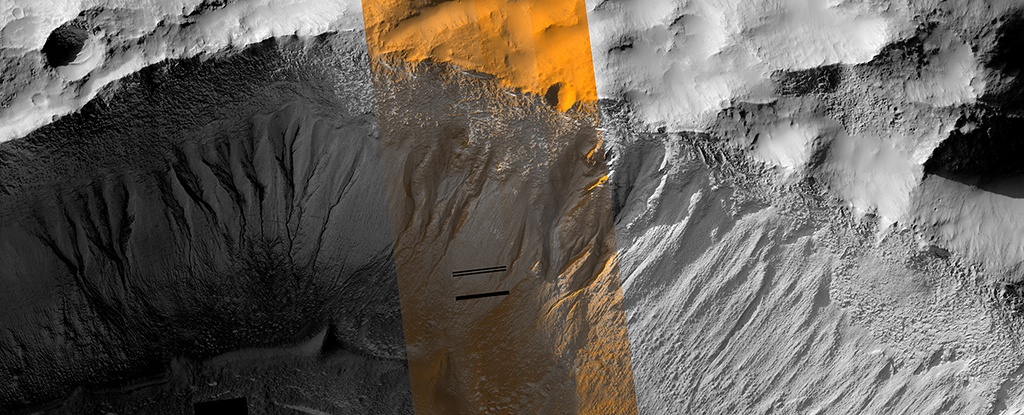
Image of gullies in Terra Sirenum on Mars taken by the High Resolution Imaging Science Experiment (HiRISE) camera onboard NASA's Mars Reconnaissance Orbiter.
(Credit: NASA/JPL/University of Arizona)
BY
A recent study published in Science examines how thin channels inside impact craters on Mars could have formed from Martian gullies, which share similar characteristics with gullies on Earth and are typically formed from cascading meltwater, despite the Martian atmosphere being incapable of supporting liquid water on its surface. However, the researchers hypothesize these gullies could have formed during periods of high obliquity, also known as axial tilt, on Mars, which could have resulted in a brief rise in surface temperatures that could have melted some surface and subsurface ice, leading to meltwater cascading down the sides of impact craters across the planet.
A planet’s axial tilt plays a primary role in determining the climate. For Earth, its axial tilt undergoes a stable precession between 22.1 degrees and 24.5 degrees every 41,000 years due to the gravitational stability from our Moon. As a result, our climate and seasons are relatively stable. However, the planet Mars experiences much more severe axial tilt variances over the course of hundreds of thousands to millions of years, resulting in equally severe changes in climate and seasons, since it doesn’t have a large enough orbiting body to stabilize it. This is because despite Mars having two moons, Phobos and Deimos, they are both much smaller than Earth’s Moon and provide a negligible gravitational tug on the Red Planet.
Currently, the axial tilt of Mars is approximately 25 degrees, but the researchers hypothesize through model simulations and orbiter images that when the axial tilt was at 35 degrees, this resulted in both a rise in atmospheric pressure and summertime surface temperatures across the planet to briefly to allow liquid water to exist. This liquid water could have then cascaded down the sides of impact craters, producing the thin channels we see today, and they say these conditions could have existed as recently as approximately 630,000 years ago.

“We know from a lot of our research and other people’s research that early on in Mars history, there was running water on the surface with valley networks and lakes,” said Dr. Jim Head, who is a professor of geological sciences at Brown University and a co-author on the study. “But about 3 billion years ago, all of that liquid water was lost, and Mars became what we call a hyper-arid or polar desert. We show here that even after that and in the recent past, when Mars’ axis tilts to 35 degrees, it heats up sufficiently to melt snow and ice, bringing liquid water back until temperatures drop and it freezes again.”
The formation of impact crater gullies has been debated in the scientific community for several years, with previous studies suggesting they were formed from carbon dioxide frost sublimation (evaporation) from the Martian regolith, which free up rocks and rubble that slide down impact crater slopes, producing the thin channels. This most recent study not only challenges those previous hypotheses but attempts to paint an entirely new picture for how these impact crater channels form in the first place.
“Our study shows that the global distribution of gullies is better explained by liquid water over the last million years,” said Dr. Jay Dickson, a former researcher at Brown who is now at the California Institute of Technology, and lead author of the study. “Water explains the elevation distribution of gullies in ways that CO2 cannot. This means that Mars has been able to create liquid water in enough volume to erode channels within the last million years, which is very recent on the scale of Mars geologic history.”

As seen on Earth, liquid water leads to life. Therefore, this study raises new hypotheses as to whether life could exist on Mars, either in the present or the past, and the researchers note that axial tilt of Mars will eventually go back to 35 degrees. Additionally, the study also raises awareness for future targets of exploration on the Red Planet, as well. There are currently 4,861 separate gully formations identified across Mars, which include craters, valleys, and mounds, totaling tens of thousands of individual gullies that could be explored on future missions.
What new discoveries will researchers make about gullies on Mars, and could liquid water exist on the surface during periods of high axial tilt? Only time will tell, and this is why we science!
As always, keep doing science & keep looking up!
Blastoff! SpaceX launches Euclid 'dark universe' space observatory, nails landingBlastoff! SpaceX launches Euclid 'dark universe' space observatory, nails landing
A SpaceX Falcon 9 rocket launches ESA's Euclid space telescope from Florida's Cape Canaveral Space Force Station on July 1, 2023. Euclid is a dark matter and dark energy hunter.
Full Story:
The rocket's first stage landed on the A Shortfall of Gravitas droneship in the Atlantic Ocean shortly after separation. Credit: SpaceX
Astronomer Watches Angel through telescope, June 30, 2023, UFO Sighting News Video


 LATEST UFO SIGHTINGS AND VIDEOS - 01/07/2023
Black UFO Cruising The Morning Sky Over Las Vegas. June 26, 2023
This Object was sighted over Las Vegas, Nevada on June 26, 2023 At 5:45am. The witness stated the following: "Tf is going on in Vegas. Firstly, its hard to tell in the video but this thing was pretty large, I’d guess bigger than a 747. Second, it made zero noise, and typically I can hear planes from this distance all day long. Third, speaking of planes, for about an hour around this time there was zero planeactivity, and I mean zero. Usually I see or hear commercial planes every2-3min (approx.) all morning and day long. NOTHING?! Sus. I watched this thing for probably 15-20min, it ended up doing a 180 and headingback where I first spotted it, but at a way higher elevation, so high Ieventually lost sight of it."
UFO 'evidence': Expert says some images are better than others | Banfield
UFO investigator James Fox took a closer look at documented UFO sightings.
'There's safety in numbers': UFO expert predicts more people will come forward | Banfield
Whistleblower David Grusch is not the only high-level government official to come forward with claims about UFOs, according to Sen. Marco Rubio. Nick Pope, an expert on UFO's, weighs in on "Banfield."
'This is a Hollywood script': Michio Kaku on reports of UFOs, aliens | Banfield
Air Force veteran David Grusch claims the government is covering up evidence that UFOs really are extraterrestrial and that he has seen evidence of a secret crash retrieval program. He alleges the U.S. has even retrieved bodies from other species. Theoretical physicist Michio Kaku tells "Banfield" to "follow the evidence."
Watch: ROTATING GREEN LIGHT Sparks UFO Speculation In Ohio, NOT YET DEBUNKED: Report
Briahna Joy Gray and Robby Soave react to reporting that there was a rotating green light spotted in Ohio. Originally aired June 26, 2023;
Full interview: Investigators say 2nd Roswell UFO debris field discovered | Banfield
UFO investigators Ben Hansen and Donald Schmitt join NewsNation's "Banfield" for a special report on UFO mysteries and share new details on the Roswell incident.
Understanding UFOs with Dr. Michio Kaku
The truth is out there? NBC News' Gadi Schwartz and Dr. Michio Kaku discuss UFOs sightings and where they come from.
Marco Rubio CONFIRMS More UFO Whistleblowers Have Info On Gov't UAP Retrieval Program: Rising Reacts
Briahna Joy Gray and Robby Soave discuss Sen. Marco Rubio's (R-Fla.) recent admission on UFOs. Originally aired June 27, 2023;
Navy Pilot Shares Video Footage Of His UFO Encounter | UFO Witness
Ben Hansen meets with a Navy pilot that had a traumatic encounter with a UFO. Despite this happening years ago, he still gets emotional while recalling the experience.
Evidence on UFO retrieval program is 'overwhelming': Coulthart | Elizabeth Vargas Reports
Whistleblower David Grusch is not the only high-level government official to come forward with claims about UFOs, Sen. Marco Rubio, R-Fla., revealed on NewsNation Monday. Earlier this month, Grusch claimed the government is covering up evidence that UFOs really are extraterrestrial. He spoke exclusively to award-winning investigative journalist Ross Coulthart, reporting for NewsNation.
Coulthart, who has spent years reporting on the subject of UFOs, joins "Elizabeth Vargas Reports" to discuss Rubio's recent statement and says he suspects there will be multiple hearings regarding the new reports.