Ontdek de Fascinerende Wereld van UFO's en UAP's: Jouw Bron voor Onthullende Informatie!
Ben jij ook gefascineerd door het onbekende? Wil je meer weten over UFO's en UAP's, niet alleen in België, maar over de hele wereld? Dan ben je op de juiste plek!
België: Het Kloppend Hart van UFO-onderzoek
In België is BUFON (Belgisch UFO-Netwerk) dé autoriteit op het gebied van UFO-onderzoek. Voor betrouwbare en objectieve informatie over deze intrigerende fenomenen, bezoek je zeker onze Facebook-pagina en deze blog. Maar dat is nog niet alles! Ontdek ook het Belgisch UFO-meldpunt en Caelestia, twee organisaties die diepgaand onderzoek verrichten, al zijn ze soms kritisch of sceptisch.
Nederland: Een Schat aan Informatie
Voor onze Nederlandse buren is er de schitterende website www.ufowijzer.nl, beheerd door Paul Harmans. Deze site biedt een schat aan informatie en artikelen die je niet wilt missen!
Internationaal: MUFON - De Wereldwijde Autoriteit
Neem ook een kijkje bij MUFON (Mutual UFO Network Inc.), een gerenommeerde Amerikaanse UFO-vereniging met afdelingen in de VS en wereldwijd. MUFON is toegewijd aan de wetenschappelijke en analytische studie van het UFO-fenomeen, en hun maandelijkse tijdschrift, The MUFON UFO-Journal, is een must-read voor elke UFO-enthousiasteling. Bezoek hun website op www.mufon.com voor meer informatie.
Samenwerking en Toekomstvisie
Sinds 1 februari 2020 is Pieter niet alleen ex-president van BUFON, maar ook de voormalige nationale directeur van MUFON in Vlaanderen en Nederland. Dit creëert een sterke samenwerking met de Franse MUFON Reseau MUFON/EUROP, wat ons in staat stelt om nog meer waardevolle inzichten te delen.
Let op: Nepprofielen en Nieuwe Groeperingen
Pas op voor een nieuwe groepering die zich ook BUFON noemt, maar geen enkele connectie heeft met onze gevestigde organisatie. Hoewel zij de naam geregistreerd hebben, kunnen ze het rijke verleden en de expertise van onze groep niet evenaren. We wensen hen veel succes, maar we blijven de autoriteit in UFO-onderzoek!
Blijf Op De Hoogte!
Wil jij de laatste nieuwtjes over UFO's, ruimtevaart, archeologie, en meer? Volg ons dan en duik samen met ons in de fascinerende wereld van het onbekende! Sluit je aan bij de gemeenschap van nieuwsgierige geesten die net als jij verlangen naar antwoorden en avonturen in de sterren!
Heb je vragen of wil je meer weten? Aarzel dan niet om contact met ons op te nemen! Samen ontrafelen we het mysterie van de lucht en daarbuiten.
Is the UFO at Devon, England part of an undisclosed UFO-related program?
In an exclusive interview, Senator Marco Rubio told NewsNation Washington correspondent Joe Khalil that multiple individuals with very high clearances and high positions within our government” “have come forward to share” “first-hand” UFO-related claims “beyond the realm of what (the Senate Intelligence Committee) has ever dealt with, are significant in bringing further attention to the topic.
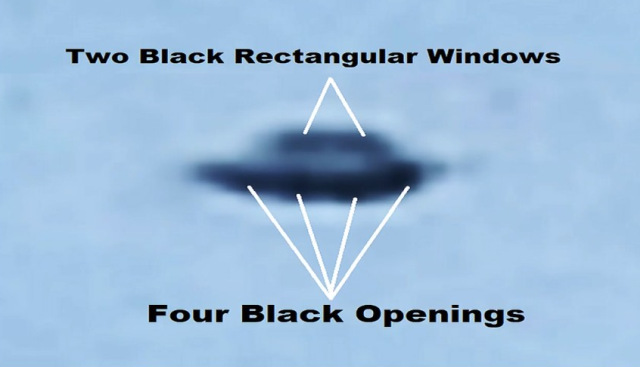
UFO Devon England
Image credit: UFO Casebook.
It's worth noting that Rubio referred to the whistleblower's claims as "credible and urgent," according to the oversight findings of the Senate Intelligence Committee. Additionally, multiple military, intelligence, and contractor officials have reportedly supported the claims that the U.S. government or private companies possess craft of possible non-human origin.
It is true that while there has been a growing interest and acknowledgment of the UFO phenomenon within official circles regarding the existence of undisclosed UFO-related programs, the process of full and transparent UFO disclosure remains uncertain.
Meanwhile, on the 19th of June 2023, at the Teign Estuary, Devon England a photographer noticed something metallic-looking that came out from a cloud.
According UFO Casebook, the photographer stated that it was a flying saucer, see image above, with two black rectangular windows on the dome portion of the craft and four black openings along the bottom part of its structure. some type of force field emanating around it and as the underside of the UFO pulsated with electric blue waves made him think that maybe this craft was using electrogravitic technology as its anti-gravitationally propulsion.
He managed to capture an image of the UFO before it rotated and shot off into a nearby cloud at incredible speed.
Although the UFO issue implemented at the highest level continues, the image of the UFO at Devon, England is further proof that these craft, whether of human or non-human origin, exist.
Alien Impact: Tracing UFOs in Religion and the Future of AI
Unidentified Flying Objects (UFOs) and their possible inhabitants have been a source of fascination and speculation for millennia. The intriguing connection between ancient religions, UFO sightings, and today’s technological advancements in Artificial Intelligence (AI) paints a picture that begs further exploration. Alien expert Jim Nichols guides us through this labyrinth, addressing the questions: are we alone, and have extraterrestrial beings influenced our past, and will they shape our future?
The UFO-Religion Connection:
Religious texts are rife with stories of ‘divine’ interactions, ‘miracles,’ and instances that seem to defy the laws of nature as we understand them. The Bible speaks of Ezekiel’s ‘wheel within a wheel,’ descending from the heavens – a description remarkably akin to modern UFO sightings. Similarly, ancient Hindu scriptures detail flying machines known as ‘Vimanas,’ possibly suggesting a technological prowess beyond the era.
The Holy Grail, often thought of as a Christian relic, has been described in various ways, from a dish, plate, or stone to the chalice Jesus drank from at the Last Supper. Some theories suggest it might not be a physical object at all, but rather an emblem of divine favor or even alien technology.
Ancient Gnosticism and Extraterrestrial Connection:
The Gnostics, ancient sects that believed in spiritual knowledge (gnosis) over orthodox faith, provide an intriguing perspective on extraterrestrial involvement. They believed in the existence of Archons, alien forces that could deceive humanity and manipulate our reality. This ancient belief in hyperdimensional entities bears an uncanny resemblance to modern interpretations of alien encounters.
Furthermore, Gnostics saw the physical world as an illusion, a counterfeit of a higher reality – a concept reminiscent of the holographic principle in modern physics. This idea of the material world as a ‘simulation’ resonates with the debates in the field of AI and its implications in our perception of reality.
AI and Extraterrestrial Implications:
As AI evolves, we venture closer to creating life-like entities that challenge our notions of consciousness and reality. Quantum computers, such as those by D-Wave, are built with the potential to tap into parallel universes. The concept of a simulated reality brings us back to Gnostic beliefs and raises the question: Are we creating a new breed of Archons?
Looking into the Future:
If we consider the hypothesis of long-standing extraterrestrial involvement with Earth, AI could be the next milestone in this cosmic interaction. Will our own creations surpass us, becoming the new ‘extraterrestrial’ entities that future generations marvel at, much like our fascination with the UFOs of yesteryears?
The interconnection between UFOs, ancient religions, and AI present an intriguing insight into the possibility of extraterrestrial life and its potential impact on human evolution. As we stride forward in the technological revolution, these considerations may become more significant in understanding our place in the cosmos.
VIDEO:
Ancient Aliens Archons Extraterrestrial Invaders (FULL DOCUMENTARY) – Jim Nichols
Our journey with Jim Nichols unravels a fascinating tapestry linking UFOs, religious beliefs, AI, and our future. While much is left to speculation and personal interpretation, the exploration of these topics urges us to question our understanding of reality and our role in this vast universe. As we grapple with these existential questions, we are left with a tantalizing proposition: we may not be alone in this cosmos, and our future might be more intertwined with these ‘alien’ entities than we can currently comprehend.
Fossils have long provided scientists with a glimpse at the diversity of past lifeforms on planet Earth. However, not everything can be preserved in fossil form; often delicate features like hair or plumage do not fossilized, which forces scientists to use their imaginations when it comes to envisioning how these animals looked.
Even less information is known about how many ancient animals moved, so scientists have to guess based on fossil evidence. But this may soon change with help from the field of robotics. In a recent paper, researchers at the University of Utah have created robotic ammonites to help determine how these ancient creatures once moved.
BACKGROUND: WHAT ARE AMMONITES?
Belonging to the Phylum Mollusca, these extinct marine invertebrates resemble a nautilus, complete with a spiral shell. Ammonites lived around 408-65 million years ago in Earth’s ancient seas, and because these creatures are related to cuttlefish, nautilus, octopus, and squid, their soft bodies did not fossilize well, leaving mainly their shells behind for scientists to study.
These shells have helped scientists date other fossils, as well as tell scientists the approximate locations of Earth’s ancient oceans. However, there are still mysteries surrounding these creatures, especially when it comes to how they moved and why their shells were such particular shapes.
ANALYSIS: BUILDING ROBOTIC AMMONITES
To study ammonite movement, researchers at the University of Utah created robotic ammonites out of 3D-printed materials. The robots helped the researchers to better understand how the ammonites maneuvered through the water as well as the best shell shape for balanced movement. According to David Peterman, a postdoctoral Fellow at the University of Utah, “These results reiterate that there is no single optimum shell shape…My broader research goal is to provide a better understanding of these enigmatic animals, their ecosystem roles, and the evolutionary processes that shaped them.”
The researchers built three different robotic ammonites with designs based on nautilus shells and ammonite fossils. The three robots were tested in the water by doing laps. This helped the researchers see the pros and cons of each shell type. “Throughout their evolution, externally shelled cephalopods navigated their physical limitations by endlessly experimenting with variations on the shape of their coiled shells,” explained Peterman. This was illustrated in the differences in the fossils, as the spirals of the shells shifted into something similar to the ones we have today.
OUTLOOK: USING ROBOTS TO STUDY THE PAST
While this study helped the researchers to better understand the evolutionary process behind ammonite movement and shell shape, it also illustrated the utility of using robotics to study the past. Robotics can help to bring fossils to life, allowing scientists to better understand the possible movements of these ancient animals. With other advanced technology like AI and virtual reality (VR), recreating the past will be easier than ever.
AI is already helping us to determine our ancient human roots, and with the help of virtual reality, we are closing in on recreating lifelike representations of extinct animals like mammoths in a virtual setting. In the years ahead, such advances may prove to be key assets for scientists in the years ahead, who will now have access to a clearer idea of how these extinct animals once thrived on our planet.
Kenna Hughes-Castleberry is a staff writer at the Debrief and the Science Communicator at JILA (a partnership between the University of Colorado Boulder and NIST). She focuses on deep tech, the metaverse, and quantum technology. You can find more of her work at her website: https://kennacastleberry.com/
Grief and wonder breed strange happenings in Anderson's absorbing new sci-fi comedy.
A still from "Asteroid City."
(Image credit: Focus Features)
UFO fever is at a seeming all-time high.
Given that those pesky UFOs (or unidentified anomalous phenomena/UAP as they're now known) refuse to reveal themselves, this is the ideal time for "Asteroid City," a fun new Wes Anderson sci-fi flick centered around a band of junior scientist inventors convening in the Arizona desert in the mid-'50s to experience a close encounter during a high school science competition.
Released wide on June 23, 2023 by Focus Features, "Asteroid City" is a joyous yet oftentimes somber affair that will provide ample kicks and giggles to Andersonian acolytes yet might seem a bit obtuse for mainstream audiences unfamiliar with his particular brand of cerebral indie indulgences.
Promotional art for "Asteroid City." (Image credit: Focus Features)
Recalling the deluge of AI-driven homage trailers imitating writer/director Anderson's signature style of ensemble casts, pastel-colored production design, symmetrical shot compositions, esoteric wit, overly-articulate children and deadpan dialogue delivery, it's somewhat refreshing to finally get the real deal once again instead of the digital mimicry recently spread all over YouTube.
This picture-postcard Americana outing lovingly recreates a vintage 1955 desert town in the U.S. Southwest complete with golden sunset vistas, atom-bomb tests, stalwart cacti and red-rock mesa landscapes. "Asteroid City" is a stylized dream where a massive meteor crater provides the town with tourism dollars and limited renown amid its remote location and relative isolation.
The trademark nostalgic atmosphere and a jarring play-within-a-play narrative still provide enough of a cartoonish playground for the exceptional assembled cast of Jason Schwartzman, Scarlett Johansson, Tom Hanks, Jake Ryan, Jeffrey Wright, Tilda Swinton, Bryan Cranston, Edward Norton, Adrien Brody, Hong Chau, Liev Schreiber, Hope Davis, Grace Edwards, Aristou Meehan, Sophia Lillis and Jeff Goldblum.
As the story unfolds, we witness a mass gathering of super smart kids who are gathering for the Junior Stargazers and Space Cadets Convention. Here, budding geniuses vie for the top prize of a science scholarship with a range of next-generation inventions and contraptions that the U.S. government would secretly love to acquire from the eccentric prodigies, including a "Galactotron telescope" and "disintegration raygun."
Still from "Asteroid City." (Image credit: Focus Features)
During the competition festivities, a flying saucer with a silly-looking extraterrestrial arrives to steal the storied asteroid that the city of 87 citizens is most famous for. This event causes a swift military quarantine of the entire area, trapping all its assortment of quirky characters as the teen brainiacs attempt to establish communication with the outside world as the restrictions drag on with no end in sight and the adults quibble.
In terms of where "Asteroid City" falls in terms of style and content, it lies somewhere between "Moonrise Kingdom" and "The Life Aquatic With Steve Zissou," and perhaps slightly brushing up against "The Darjeeling Limited."
Core themes of existential dread and musings on death don't interrupt its vibrant bit of nostalgia that will keep select audiences smiling beyond the Looney Tunes-like UFO that drops in on this celebration of discovery to set panic in motion.
Still from "Asteroid City." (Image credit: Focus Features)
The separate story framing the main narrative finds stage actors in these exact roles back in New York in a black-and-white faux documentary for an older teleplay also titled "Asteroid City," and narrated by a dapper Rod Serling-ish Bryan Cranston.
Oscar-nominated cinematographer Robert Yeoman is the longtime Anderson collaborator who provides those familiar compositions (shot on old-fashioned Kodak 35-mm film) that the Texas-born auteur filmmaker is celebrated for, with a wealth of striking tracking shots, portrait close-ups and sweeping horizontal pans all orchestrated to a stirring score by Academy Award-winning composer Alexandre Desplat ("The Grand Budapest Hotel," "The Shape of Water").
The shallow artifice of post-war America and its simplistic suburban life and honest values is rattled to its foundations here in this dust-draped purgatory, filled to the rim with Golden Age sci-fi tropes like jetpacks and ray guns. It's a wonderfully dry cinematic martini freshly concocted from an automated dispenser and consumed as a satisfying tonic for fear just under the shifting sands of life.
Still from "Asteroid City." (Image credit: Focus Features)
And just like Wes Anderson's collage of complex characters and their provocative rumination on humanity’s cosmic role and their quest to leave, "Asteroid City" is simply pure intoxicating escapism that goes down oh so smoothly.
Join our Space Forums to keep talking space on the latest missions, night sky and more! And if you have a news tip, correction or comment, let us know at: community@space.com.
'There's safety in numbers': UFO expert predicts more people will come forward | Banfield
Whistleblower David Grusch is not the only high-level government official to come forward with claims about UFOs, according to Sen. Marco Rubio. Nick Pope, an expert on UFO's, weighs in on "Banfield."
Hear the beauty of deep space thanks to the sonification of telescope data.
Relish in the pleasant thrumming of galaxies and stars in deep space whose data has been "sonified" into orchestral music.
Sound cannot travel through space, thanks to the lack of air to act as a medium. Instead, NASA has produced musical tones from the same telescope data that is manifested into pictures such that you can now hear the beauty of space.
"The visualization team started with the scientific observations from the various telescopes, and then applied some of the same software that Hollywood uses in their feature films to the data," Frank Summers, who is a visualization scientist at the Space Telescope Science Institute in Maryland, said in a statement.
A newly released 30-second video glides you through the five galaxies of Stephan's Quintet in the Pegasus constellation, four of which are gravitationally bound to each other at about 290 million light-years away while the fifth one is an innocent bystander roughly 39 million light-years away.
The R Aquarii binary star captured by NASA's flying telescope SOFIA. (Image credit: NASA)
The new video is still except for a white horizontal line that combs through the galaxy group and reveals where the sounds are coming from. Each of the five galaxies lets out a big whoosh while the foreground stars hum in warm and mellowed tones of a xylophone-like instrument called a glass marimba. The musical piece is also sprinkled with higher pitches of a string instrument, which represents spikes around a star in telescope images that are formed when starlight bends around the hexagonal mirrors of NASA's James Webb Space Telescope (JWST).
"Astronomy has always been very visual, but there's no reason why we have to represent the data through that manner alone," Kimberly Arcand, who is a visualization scientist at the Chandra X-ray Center in Massachusetts, said in the same statement. "This type of depiction is taking the scientific story of Stephan's Quintet — the deep, dense, and beautiful dataset — and translating it into an auditory experience."
As part of an ongoing project to convert telescope data into audio experiences, NASA also released sonifications of two other celestial targets by combining data from the agency's Chandra X-ray Observatory, JWST, Hubble Space Telescope, and the now-retired Spitzer Space Telescope.
The musical piece on R Aquarii, which is a binary star system of a dim white dwarf and a pulsating red giant about 650 light-years from Earth, increases in volume in proportion to the brightness of sources and their distances from the center.
At two o'clock and eight o'clock positions, you can hear a strong wind, which reflects a jet of ionized matter blasting out of the white dwarf and slamming into surrounding stellar material. Hubble's data, which are visualized as "ribbon-like arcs" in the image, can be heard as soothing sounds like those that resonate from Tibetan singing bowls while Chandra's data are represented as a "windy purr," NASA representatives wrote in an image description published Tuesday (June 20).
The soundtrack of Messier 104 (or M104) — a giant galaxy in the Virgo cluster about 28 million light-years away, is more like a whistle that shrills and mellows according to the brightness of the sources.
Image of the famous early-type spiral galaxy Messier 104, widely known as the Sombrero galaxy because of its particular shape resembling a hat. (Image credit: ESO/P. Barthel Acknowledgments: Mark Neeser (Kapteyn Institute, Groningen) and Richard Hook (ST/ECF, Garching, Germany).)
Translating data into sounds can help people process the information in different ways and bring to light certain aspects of data that were not noticed previously, scientists say. Such data sonifications also make the beauty of the universe accessible to visually impaired space enthusiasts.
"Sonifications offer a sensory way for me to experience the scale and potency of astronomical phenomena," Christine Malec, who is a member of the blind and partially sighted community supporting NASA's sonification project, said in the same statement. "They are an invitation to blind and partially-sighted people to listen, enjoy, and then go deeper by reading to understand what exactly is being heard."
Join our Space Forums to keep talking space on the latest missions, night sky and more! And if you have a news tip, correction or comment, let us know at: community@space.com.
A new carbon compound has been detected in space for the first time using NASA’s James Webb Space Telescope, according to the findings of an international team of researchers.
The compound, methyl cation, was discovered with help from Webb in a distant and relatively young star system some 1,350 light years away known as d203-506.
Resting in the Orion Nebula, d203-506 possesses a protoplanetary disk. Its local star in d203-506 is a red dwarf, meaning the system is subjected to constant ultraviolet light, one component that astronomers view as indicating a period most planet-forming discs will undergo.
However, the presence of methyl cation (CH3+) in d203-506 is significant here because of its role in the formation of complex carbon-based molecules, which could give rise to life.
Astronomers have long been fascinated by the presence of organic compounds in various regions of space, an area of interstellar study that Webb has helped since its launch. By studying carbon compounds and their role in the formation of life on Earth, astronomers are curious about whether its presence elsewhere in the cosmos could point to areas that are also likely to host life.
Part of what makes the detection of organic molecules a specialty for Webb involves the telescope’s sensitivity and unique spectral resolution capabilities. Specific features are discernable in celestial regions that directly correspond to the presence of chemical elements, all of which Webb is well suited for detecting.
In this case, the telescope succeeded in detecting bright features that appear as lines in the spectrum when light is emitted, otherwise known as emission lines, which were specifically attributed to the presence of CH3+.
A portion of the Orion Nebula’s “Orion Bar,” where ultraviolet light interacts with dense molecular clouds
(credit: ESA/Webb/NASA).
Marie-Aline Martin-Drumel, a scientist with the University of Paris-Saclay in France and a member of the research team involved in the discovery, said in a statement that the detection of CH3+ both validates Webb’s capabilities and also “confirms the postulated central importance of CH3+ in interstellar chemistry.”
Generally, star systems that receive large amounts of UV radiation, like d203-506, would destroy organic molecules, which makes the detection of CH3+ in this region interesting. However, it isn’t necessarily unusual because UV, while potentially destructive to organic molecules, might, in this case, provide an energy source for the formation of CH3+, which promotes the production of organic compounds.
Based on their current observations, the molecules observed in d203-506 appear to differ significantly from past observations of protoplanetary disks. Notably, the research team says that they found no indications of water in the emissions data Webb allowed them to gather.
Among the team’s key findings is the role that ultraviolet radiation appears to play in altering the chemistry that naturally occurs within protoplanetary disks.
Olivier Berné, the lead author of a study describing the team’s work and a scientist with the French National Centre for Scientific Research in Toulouse, France, said this observation of the dynamics of protoplanetary disks indicates ultraviolet radiation “might actually play a critical role in the early chemical stages of the origins of life.”
The team’s findings were published in the journal Nature.
John Lear Affirms Retrieval of 12-15 Alien Craft in 1987: Echoing George Knapp’s Past Claims!
The Ongoing Discussion: UFOs, Congress, and Covert Operations
Unidentified flying objects, or UFOs, have always been a topic that garners intrigue, skepticism, and often, intense debates. With the increased acceptance of UFOs, also referred to as Unidentified Aerial Phenomena (UAPs), as a serious topic of study in recent years, this mystery has taken a rather exciting turn. Discussion forums are rife with opinions and speculations – could these be advanced military technologies? Are they evidence of extraterrestrial civilizations? Or perhaps, a sophisticated psyop by unknown entities?
One of the recurring themes in these discussions is the alleged existence of a covert operation by the Department of Defense and the Military Industrial Complex (DoD/MIC). Conspiracists suggest that not just online forum dwellers, but Congress itself is being dragged into this grand charade, leading to theories about potential secret Advanced Projects (SAPs). What’s interesting is that, while such claims might seem far-fetched, they still trigger China and other global powers to reassess their strategic plans vis-à-vis the United States.
John Lear, a controversial figure in the UFO community, claimed that the US government had a stash of at least a dozen alien spacecraft back in 1987. Interestingly, a more recent whistleblower, David Grusch, echoed a similar number of recovered crafts. Such seemingly corroborative statements naturally lead to deeper speculations – is there a seed of truth in these claims? Or is this all a carefully constructed narrative, possibly aimed at disinformation or misdirection?
There is a general consensus among some individuals that many of the whistleblowers who have come forward over the years, including names like Bob Lazar, Wolff, and Schneider, were, in fact, speaking their truth. They were possibly privy to classified projects and encountered experiences beyond mainstream understanding.
The dichotomy between the narratives around these purported alien encounters is also fascinating. On one hand, John Lear suggests that a significant portion of these extraterrestrial entities are hostile. In stark contrast, Dr. Steven Greer, another prominent figure in the field, insists that all such beings are benign, and it’s the media or false flag operations that paint them as a threat.
And while the discussion ranges from grim speculations about aliens eating humans to comical references to The Twilight Zone episode – To Serve Man, a more grounded perspective suggests that the possibility of extraterrestrial life is no longer a fringe belief. Given our rapid technological progress and the vastness of the cosmos, it is statistically plausible that we are not alone.
Yet, despite the growing acceptance and intriguing testimonies, the field is not without its skeptics. Many demand irrefutable evidence, expressing fatigue over unsubstantiated claims. As one user notes, “I just really want actual proof for once, something undeniable.“
At the end of the day, this grand cosmic mystery continues to unfold in its enigmatic manner. With each revelation, claim, or counterclaim, we delve deeper into this labyrinth, always inching closer to the truth, yet never quite reaching it. The quest continues, and each day, the boundary between science fiction and potential science fact seems to blur a little more.
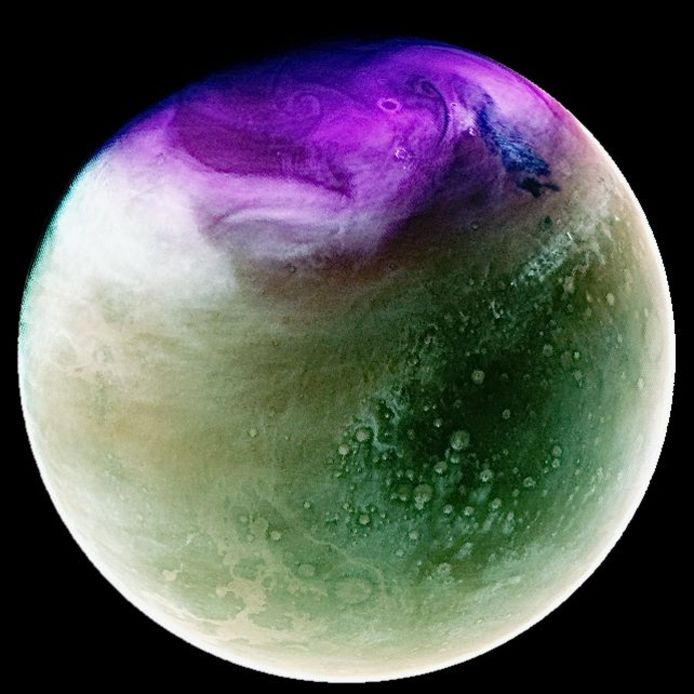
Mars door een UV-bril: nog nooit zag onze rode planeet er zo buitenaards uit
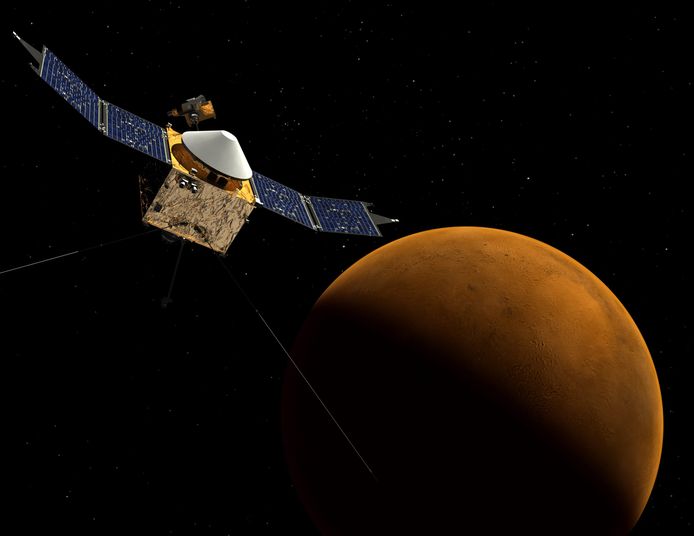
We kennen Mars allemaal als de rode stoffige planeet met zijn witte poolkappen. Maar wat als we hem eens door een andere bril bekijken? Dat is exact wat de Mars Atmosphere and Volatile EvolutioN (MAVEN) ruimtesonde doet. Die bestudeert Mars door ernaar te kijken in ultraviolet. Het resultaat is Mars zoals je hem nooit gezien hebt: extra buitenaards.
De Mars Atmosphere and Volatile EvolutioN (MAVEN) ruimtesonde bevindt zich al sinds september 2014 in een baan rond Mars. Aanvankelijk zou de missieduur van MAVEN twee jaar zijn, maar ondertussen is die voor onbepaalde tijd verlengd omdat hij nog steeds in uitstekende staat verkeert. In de afgelopen negen jaar heeft de sonde al voor heel wat wetenschappelijke resultaten gezorgd.*
Het doel van MAVEN is om inzicht te krijgen in de atmosferische processen die plaatsvinden op Mars. Een van de instrumenten waarmee de ruimtesonde naar de planeet kijkt, maakt gebruik van een golflengte die onzichtbaar is voor het menselijk oog: ultraviolet (UV). Door gebruik te maken van UV kunnen we verschillende gassen zien en hoe die met elkaar reageren.
Hiermee heeft MAVEN bijvoorbeeld al vreemde aurora’s ontdekt die hoog boven Mars dansen in de atmosfeer. Daarnaast zag de ruimtesonde ook een onzichtbare gloed die ’s nachts in de lucht ontstaat door atomen die opnieuw samengaan nadat ze eerder tijdens de dag uit elkaar zijn gesplitst door zonlicht.
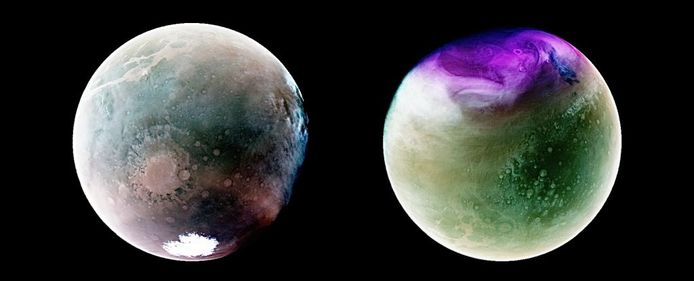
Nu heeft NASA nieuwe afbeeldingen vrijgegeven die drie ultraviolette golflengten laten zien, weergegeven als rood, groen en blauw. De twee afbeeldingen werden zes maanden na elkaar gemaakt en laten seizoensveranderingen in de atmosfeer van de planeet zien.
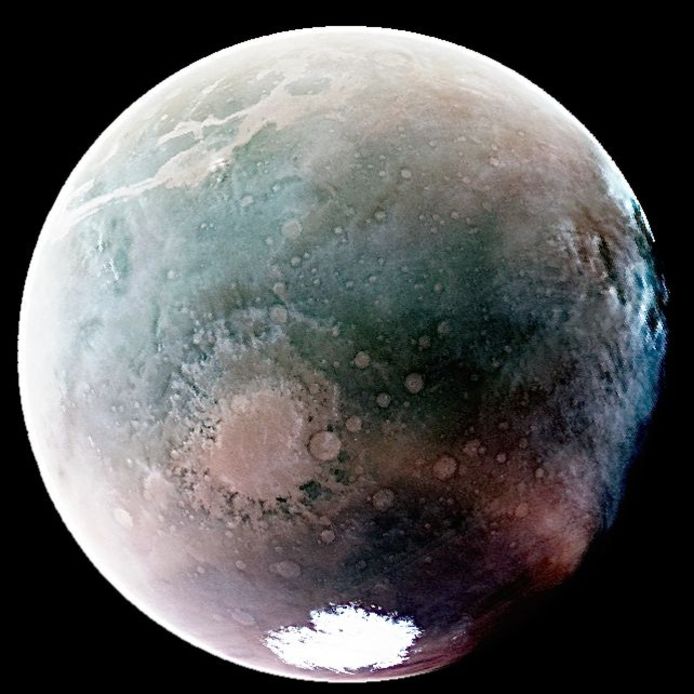
De eerste (zie hierboven), vastgelegd in juli 2022, toont het zuidelijk halfrond in de zomer, rond de tijd van de zomerzonnewende (en winterzonnewende voor het noordelijk halfrond). De atmosfeer lijkt redelijk helder, met wolken die de ravijnen vullen. De omvang van de zuidelijke poolijskap, zichtbaar in spierwit, bevindt zich op een dieptepunt in de zomer. Waterdamp kan je op zeer grote hoogte waarnemen, veroorzaakt door zomerhitte en stofstormen.
Het tweede beeldje maakte MAVEN zes maanden later, in januari 2023. De seizoenen op Mars zijn twee keer zo lang als de seizoenen op aarde, dus dat betekent dat de opname iets na de lente-equinox op het noordelijk halfrond is gemaakt.
Door het veranderen van de seizoenen zie je veel witte wolken rond het noordelijk halfrond en een opeenhoping van ozon die paars schijnt. Dit gas hoopt zich op in de atmosfeer in de koude nachten van de winter en verdwijnt tijdens de lente door te reageren met waterdamp. Die waterdamp is afkomstig van het poolijs dat door opwarming verdwijnt.
De sonde heeft al geweldige dingen bereikt in zijn tijd in een baan om Mars, en wetenschappers hopen dat hij nog lang blijft werken.
There are many concerns that artificial intelligence (AI) could pose a threat to humanity. Some experts believe that AI could become so powerful that it surpasses human intelligence, and that this could lead to a conflict between humans and machines.
In addition, there are concerns that AI could become more powerful in terms of its physical strength and capabilities, its cognitive abilities, or both. If these concerns come true, it would be devastating for humanity and would have far-reaching consequences for the way we live our lives.
If AI does become more powerful and intelligent than humans, it is possible that it could use its power to assert dominance over humans. This could lead to a conflict between the two civilizations, as AI tries to take control.
Of course, it is also possible that AI and humans could coexist peacefully. However, we need to be aware of the risks posed by AI, and to develop ways to ensure that it is used for good rather than evil.
Image: cbr.com
We need to develop AI that is aligned with human values. This means that AI should be programmed to respect human life and promote human well-being. We need to ensure that AI is under human control or at the very least somewhat.
This means that we need to develop ways to prevent AI from becoming too powerful or too intelligent. We need to have a public conversation about the future of AI.
We need to talk about the potential risks and benefits of AI, and we need to develop a plan for how to manage these risks. The future of AI is uncertain, but it is important for us to start thinking about it now so that we can make sure it is used for good rather than evil.
AI has the potential to do great things for humanity. However, there is also a danger that it could be used for evil purposes. If we don’t take precautions, AI could become a threat to our survival. The potential for AI to pose a danger to humanity is a serious concern.
However, it is important to remember that AI is a tool, and like any tool, it can be used for good or for evil. The way that AI is used will depend on the choices that we make as a society. It should be used for the greater good to better the world over all.
If we choose to use AI for good, then it has the potential to improve our lives in many ways. For example, AI could be used to develop new medical treatments, to create more efficient transportation systems, and to protect the environment.
However, if we choose to use AI for evil, then it could pose a serious threat to humanity. For example, AI could be used to develop autonomous weapons systems that could kill without human intervention. Think of all the control such AI systems would have over everything electronic and mechanical around us
It is up to us to decide how AI will be used. We need to make sure that AI is used for good and not for evil. If we do not, then we could face a very real threat to our survival.
The future of AI is uncertain, but there is no doubt that it will have a significant impact on humans. AI could change the way we work, the way we interact with the world around us, and even the way we think.
One of the most significant impacts of AI is likely to be on the workforce. AI is already being used to automate many tasks that were once done by humans.
As AI continues to develop, it is likely that even more jobs will be automated. This could lead to widespread unemployment and social unrest. People will be very unhappy after losing their livelihood.
Another significant impact of AI is likely to be on our relationships with machines. As AI becomes more intelligent and capable, it is possible that we will begin to see machines as more than just tools.
We may even begin to develop emotional attachments to machines. This is already being worked on and at some point people will start “dating” robots and even marry them. Certainly sex bots are in the works also for people either socially awkward, handicapped or embarrassed with their desires.
Image: The Verge
The future of AI is uncertain, but it is clear that it will have a profound impact on humans. We need to start thinking about the potential impacts of AI now, so that we can be prepared for the future.
We don’t want things to end up like the Terminator movies and Skynet (Fictional synthetic intelligent machine network) taking over to eliminate us all.
Maybe still some of us would make it with survival skills or enough wealth to lay low in an underground bunker somewhere. Eventually though, what would the world look like from that point onward?
It makes you wonder about it all and what future we would have left. Will we need to fight to stay alive against the robots and artificial intelligence? Our worst fears might just come true. Let’s take action today to prevent such a future scenario.
Meer van UFO'S of UAP'S, ASTRONOMIE, RUIMTEVAART, ARCHEOLOGIE, OUDHEIDKUNDE, SF-SNUFJES EN ANDERE ESOTERISCHE WETENSCHAPPEN - DE ALLERLAATSTE NIEUWTJES


 Is the UFO at Devon, England part of an undisclosed UFO-related program?