Ontdek de Fascinerende Wereld van UFO's en UAP's: Jouw Bron voor Onthullende Informatie!
Ben jij ook gefascineerd door het onbekende? Wil je meer weten over UFO's en UAP's, niet alleen in België, maar over de hele wereld? Dan ben je op de juiste plek!
België: Het Kloppend Hart van UFO-onderzoek
In België is BUFON (Belgisch UFO-Netwerk) dé autoriteit op het gebied van UFO-onderzoek. Voor betrouwbare en objectieve informatie over deze intrigerende fenomenen, bezoek je zeker onze Facebook-pagina en deze blog. Maar dat is nog niet alles! Ontdek ook het Belgisch UFO-meldpunt en Caelestia, twee organisaties die diepgaand onderzoek verrichten, al zijn ze soms kritisch of sceptisch.
Nederland: Een Schat aan Informatie
Voor onze Nederlandse buren is er de schitterende website www.ufowijzer.nl, beheerd door Paul Harmans. Deze site biedt een schat aan informatie en artikelen die je niet wilt missen!
Internationaal: MUFON - De Wereldwijde Autoriteit
Neem ook een kijkje bij MUFON (Mutual UFO Network Inc.), een gerenommeerde Amerikaanse UFO-vereniging met afdelingen in de VS en wereldwijd. MUFON is toegewijd aan de wetenschappelijke en analytische studie van het UFO-fenomeen, en hun maandelijkse tijdschrift, The MUFON UFO-Journal, is een must-read voor elke UFO-enthousiasteling. Bezoek hun website op www.mufon.com voor meer informatie.
Samenwerking en Toekomstvisie
Sinds 1 februari 2020 is Pieter niet alleen ex-president van BUFON, maar ook de voormalige nationale directeur van MUFON in Vlaanderen en Nederland. Dit creëert een sterke samenwerking met de Franse MUFON Reseau MUFON/EUROP, wat ons in staat stelt om nog meer waardevolle inzichten te delen.
Let op: Nepprofielen en Nieuwe Groeperingen
Pas op voor een nieuwe groepering die zich ook BUFON noemt, maar geen enkele connectie heeft met onze gevestigde organisatie. Hoewel zij de naam geregistreerd hebben, kunnen ze het rijke verleden en de expertise van onze groep niet evenaren. We wensen hen veel succes, maar we blijven de autoriteit in UFO-onderzoek!
Blijf Op De Hoogte!
Wil jij de laatste nieuwtjes over UFO's, ruimtevaart, archeologie, en meer? Volg ons dan en duik samen met ons in de fascinerende wereld van het onbekende! Sluit je aan bij de gemeenschap van nieuwsgierige geesten die net als jij verlangen naar antwoorden en avonturen in de sterren!
Heb je vragen of wil je meer weten? Aarzel dan niet om contact met ons op te nemen! Samen ontrafelen we het mysterie van de lucht en daarbuiten.
The stories about UFOs and the Vatican primarily revolve around alleged encounters, documents, and speculation linking the Vatican to the study and investigation of unidentified flying objects. Which brings us to today’s whistleblower.
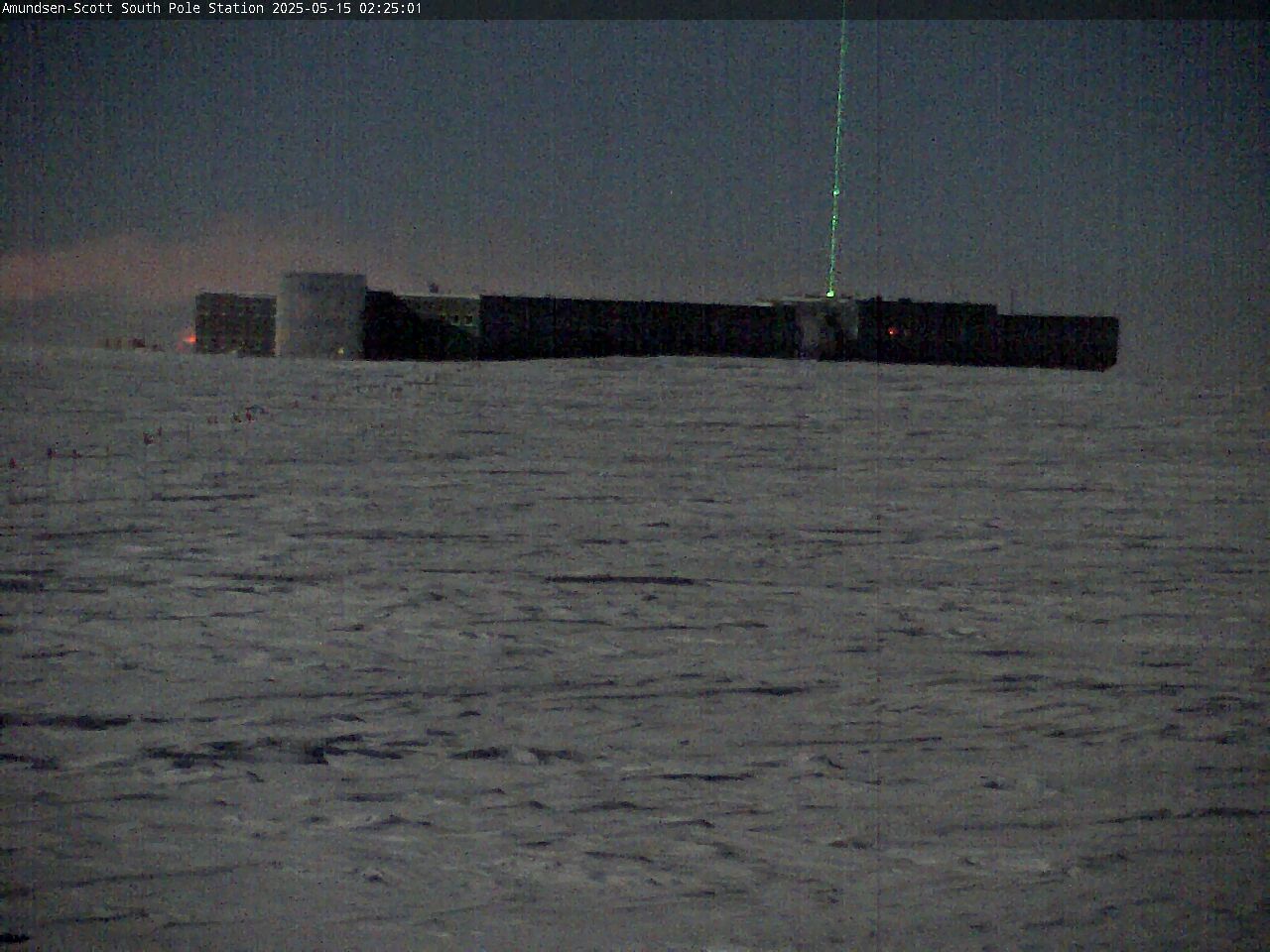
Powerful green laser beaming into space from the Amundsen-Scott Antarctica Station
On June 12, 2023, Dr. Steven Greer held a stunning UFO disclosure press event at Washington's D.C. press club.
One of the whistleblowers was Eric Hecker, Raytheon contractor who worked at the Ice Cube Neutrino observatory, constructed at the Amundsen–Scott South Pole Station in Antarctica, from 2010-2011.
Green laser beaming into space from the Amundsen-Scott Antarctica Station on June 17, 2023.
Not only Eric Hecker stated that this Antarctica station is a huge air traffic control power station that monitors all interstellar craft that be operated by humans as well as non-humans but he also said that he witnessed a powerful green laser on top of this facility beaming into the cosmos.
According to the official statement, this green laser instrument, the so-called LIDAR, is used to study the atmosphere. Now, on June 17, 2023 the webcam of the Amundsen-Scott base captured such a green laser beaming directly into space, but Eric believes this laser is a form of long range communications or defense system.
If Eric is right that this green laser is used for long range communications, then it may be possible that this instrument is used to communicate with interstellar craft (like the secret space fleet) that be operated by humans.
Green laser beaming into space from the Amundsen-Scott Antarctica Station on June 17, 2023.
See also our article posted on June 14, 2023:
Dr. Steven Greer: UFO whistleblowers drop bombshell on D.C. - Secrets Antarctica station, secret space program and more.
Megalodon once dominated Earth's oceans. Despite vanishing from the fossil record millions of years ago, rumors persist that these gigantic sharks are still alive.
Megalodon (Carcharodon carcharias) was the largest shark to ever live, growing to around 60 feet (18 meters) in length. (Image credit: Damiano Pierotti/Shutterstock)
From 20 million to 3.6 million years ago, Earth's oceans were dominated by an enormous species of shark called the megalodon. The scientific name, Otodus megalodon, means "giant tooth" — and it's easy to see why. With teeth up to three times the size of those of a great white shark (Carcharodon carcharias), the megalodon also reached lengths of 60 feet (18 meters) — making it the ultimate apex predator until it became extinct.
Yet rumors persist that these supersized sharks are still alive, with TikTok and YouTube videos speculating on how they might have survived gaining millions of views. Is it really possible for the megalodon to be alive today, lurking somewhere in the ocean?
Jack Cooper, a doctoral student at Swansea University in the U.K., is a member of the Pimiento Research Group, which studies marine diversity through time. He has spent years studying the megalodon — and says they are most definitely extinct.
"Any suggestion that megalodon potentially still exists in unexplored ocean regions is complete nonsense based on not a shred of credible evidence," he told Live Science in an email.
Although the majority of the ocean hasn't been explored, Cooper said there are several reasons why the megalodon isn't still lurking in our oceans. Firstly, the food chain would look very different if the species was still alive.
"Megalodon was not only a very big coastal shark that would definitely have been seen by now, it was also an apex predator higher on the food web than any living marine predator. As such, it would've been a huge influence on ocean ecosystems," he explained.
Megalodon (left tooth) may have been driven to extinction, in part, by the arrival of great white sharks (right tooth). (Image credit: Mark Kostich/Getty Images)
"Its disappearance had cascading consequences. Whales, one of their key prey items, got even bigger after megalodon went extinct with nothing around to eat them," he added. "Some of the biggest marine mammals today like the blue whale only evolved after megalodon went extinct. So, in short, the modern day food web has partially been shaped by megalodon not being there."
Megalodon in the Mariana Trench?
Scientists are still learning about some of the most mysterious and unmapped regions of our oceans, particularly the deepest areas like the Mariana Trench, which stretches down 35,876 feet (10,935 m) below the ocean surface. Although it's exciting to imagine giant sharks living secretly in the depths, Cooper said they wouldn't be able to survive in such an inhospitable environment.
"The deep sea would be totally unsuitable habitats for such a big apex predator," he said. "We find deep sea sharks all the time and none come anywhere close in size to a 20-meter [65 feet] giant. As megalodon was likely consuming fairly large prey, those smaller animals wouldn't be great sources anyway. The Mariana Trench has mostly microscopic life that wouldn't even feed one megalodon, let alone a secret population."
Kenshu Shimada, a paleobiologist at DePaul University in Chicago who has studied megalodon, said that claims these massive sharks still live somewhere today have never been substantiated.
To understand why the megalodon would not be able to survive in today's oceans, it can help to understand how it went extinct. Although the exact cause is unknown, Shimada said there are several dominant theories.
"A couple of major hypotheses include extinction due to climate change or competition with the great white shark that emerged a few million years ago. It is also possible that the extinction could have been caused by a combination of multiple factors."
Cooper agrees that climate change may be a key reason why the megalodon went extinct. He said the megalodon's extinction has largely been attributed to a reduction in sea level from the Pliocene epoch (5.3 to 2.6 million years ago).
"That reduction would have dramatically affected the coastal habitats of both the megalodon and their prey," he said. "It meant less area for them to live in and less food availability to replenish the huge amount of energy they needed to justify their enormous sizes and active predatory lifestyles. Today's sea levels generally remain much lower than the Pliocene, so such conditions are far from ideal for them."
Finally, if megalodon were alive today, we would likely know about it as they would be under threat from poaching — much like the great white shark. "We would have seen crystal clear evidence of megalodon," Cooper said. "As humans kill as many as 100 million sharks every year, with larger sharks being at particular risk to this, they would probably not be able to survive us rather than the other way around."
Astronauts Land On Mars But 1Billion Years Before That It Was Already Populated By People
It's a good, kind-hearted science fiction film shot many years ago does not stand out for its dynamic plot, but despite numerous scientific inaccuracies, it is interesting to watch and keeps the tension until the last seconds.
Movie - "Mission to Mars" (2000)
Astronaut Finds a Glass Ball On a Mysterious Planet, Lifting It, He Saw That It Was Earth!
After NASA picks up a trio of mysterious signals from within our own solar system, astronaut Roger Nelson is dispatched on a multi-year solo mission aboard the Magellan spacecraft to investigate the sources.
Our team strives to create quality recaps of your favorite films. On the channel, you will find stories about movies in Sci-Fi, thriller, fantasy, horror, drama, fiction, trash, comedy, detective, psychological thriller, and dystopia genres. Each video will intrigue you with surprises and mystery. Leave the names of your favorite movies in the comments, and we will make an exciting review about each of them. We will be very grateful if you give us a like for our efforts and subscribe to the channel so as to not miss the next entertaining video. Thank you for watching our recap.
Astronaut Returns to Earth After 95 Years, But Realise He’s No Longer Human
After an explosion in space and subsequent two-minute radio-out period, two astronauts return home to their wives. Slightly it's revealed that they're not the same as they were
Scientists Turned 5 Astronauts Into Super-Humans So They Can Populate an Alien Planet
When humanity starts looking for other planets to inhabit, a group of soldiers will put themselves through genetic experiments that will allow them to withstand the conditions of outer space.
Astronauts Land On Unknown Planet But It Turns Out It Is Earth in 3978 AD
The picture is based on the book by the French writer Pierre Boule, who considered his novel almost his most unsuccessful work, and therefore had great doubts about the success of its transfer to the big screen. But in the end the film was ranked 350th on Empire magazine's list of the 500 best films.
Movie name: "Planet of the Apes" (1968)
Aliens Of Planet Mul are Facing Extinction Because of Humans.
A dark force threatens Alpha, a vast metropolis and home to species from a thousand planets. Special operatives Valerian and Laureline must race to identify the marauding menace and safeguard not just Alpha, but the future of the universe.
NASA Just Dectected An Extraterrestrial Object 30 Times BIGGER than Earth...
In a stunning discovery, NASA has detected an extraterrestrial object that is 30 times larger than Earth. Dubbed 'Goliath,' this mysterious object has left scientists scrambling to understand its origins and potential for supporting life.
"We need to fine tune everything before we can apply it to humans. But I would say that 10 years is a realistic timeline."
In science-fiction movies, astronauts frequently cross vast distances while hibernating.
(Image credit: 20th Century Fox, Aliens)
The first hibernation studies with human subjects could be feasible within a decade, a European Space Agency (ESA) researcher thinks.
Such experiments would pave the way for a science-fiction-like approach to long-duration space missions that would see crew members placed into protective slumber for weeks or months on their way to distant destinations.
Hibernating on a year-long trip to Mars would not just prevent boredom in a tiny space capsule; it would also save mission cost, as the hibernating crew members wouldn't need to eat or drink and would even require far less oxygen than those awake. There are other, rather odd benefits of hibernation, as well. Research in animals suggests that bodies of hibernating astronauts might waste away much less than the bodies of those awake in microgravity. Upon arrival, these hibernators would thus be fit and ready to commence challenging exploration almost straight away after regaining consciousness.
For all these reasons, hibernation, also known as torpor, has long been a staple of sci-fi space movies. From "Alien" to "2001: A Space Odyssey," fictional space travelers have crossed vast distances cocooned unconscious inside high-tech pods while AI machines and android robots keep their spacecraft on a steady course.
Despite being a sci-fi trope, putting humans into long-term induced torpor may not be a far-fetched idea after all. Jennifer Ngo-Anh, a research and payload coordinator of Human and Robotic Exploration at ESA and a co-author of arecent paper outlining the space agency's approach to hibernation research, told Space.com that depending on funding availability, the first human torpor trials could take place as early as the mid-2030s.
"Of course, we need to finetune everything before we can apply it to humans. But I would say that 10 years is a realistic timeline," Ngo-Anh said.
This fine-tuning is already underway. First studies have shown that it's possible to induce torpor in otherwise non-hibernating animals, such as rats, and bring them safely back to life a few days later. The process of triggering hibernation is rather intricate and involves reduced exposure to daylight and a period of intense feeding followed by a strict fast.
"The rats receive a drug, a neurotransmitter substance, and are brought into a dark space with reduced temperature," Jürgen Bereiter-Hahn, professor emeritus in neuroscience and cell biology at Goethe University in Frankfurt, Germany, and member of ESA's hibernation research group, told Space.com in an interview. "It works very nicely, but the problem is that you have to apply the signaling molecule repeatedly to maintain the state. You need to maintain very high levels of the neurotransmitter and that could have deleterious effects over the longer term."
Why do we want to make people hibernate?
The question is whether induced torpor could ever be safe enough to be administered to space travelers in tiny spacecraft with minimal medical supervision and equipment. Ngo-Anh sees the problem from a different perspective. Torpor, she said, could, in fact, be the only way forward for long-duration space missions.
Loss of bone and muscle mass is a big issue for spacefarers. Even at the International Space Station, where high-tech fitness machines are available and strict exercise protocols are followed, astronauts lose up to 20% of their muscle mass in a month. Their bones get gradually weaker too. Footage of crews returning to Earth frequently shows fragile beings transported by medical personnel in wheelchairs and stretchers. But there will be no support crews waiting by after a landing on Mars.
"This is a real problem for astronauts in microgravity," Bereiter-Hahn said. "Astronauts need to train a lot because otherwise they really would have serious problems when they get back to gravity conditions."
Research shows that the effects of microgravity on the human body resemble those of long-term bed rest. Strangely, bed rest while hibernating doesn't seem to result in such effects at all. Unlike a patient recovering from a long illness or medical coma, an animal waking up from hibernation shows surprisingly high fitness levels.
"When animals wake up from hibernation, they very quickly remember their surroundings," Ngo-Anh said. "Within seconds, they remember where they hid their food before they went into hibernation, and they actually don't suffer much muscle loss, which is quite surprising after months just lying and sleeping in a cave."
Researchers think that the key to the protective effects of the torpor state is its physiology. Although hibernation superficially resembles sleep, inside the body the process works in a completely different way. Unlike a sleeping brain, a hibernating brain produces barely any electromagnetic activity. The heart rate of an animal in torpor drops to only a few beats per minute, and its body temperature declines to what would otherwise be considered dangerous hypothermia. Even the cells that make up the animal's body stop their usual business of processing or creating nutrients, dividing and dying. By all biological measures, the torpor state is almost like hitting a pause button on life.
"We know from studies that it reduces the lifespan of animals which normally go into torpor when they are prevented from going into torpor," Alexander Choukèr, a professor of medicine and an anesthesiology expert at the Ludwig Maximilians University in Munich, Germany, who is also a member of the ESA team, told Space.com. "When they have these torpor phases in between, the animals can live five years, for example. When the torpor is missing, it could be just four years."
This pause-button quality of the torpor state is key to its promise for spaceflight missions. The hibernating astronaut in a Mars-bound capsule would not only save the agency cost for water, food and oxygen. He or she would, most likely, wake up rather fit, without suffering many of the negative side effects of long-term bed-rest or living in microgravity. In fact, studies show that the slowed down cells of a hibernating body don't get damaged by radiation, which is one of the biggest health-concerns during lung-duration space missions.
Boon to medicine
These protective properties make hibernation a fascinating possibility not just for spaceflight, but also for medicine. Just like astronauts in microgravity, patients in long-term bed-rest and those in medically-induced coma waste away quickly. The recovery is slow and painstaking.
"We put people under anesthesia all the time, but they still degrade," said Choukèr. "After you leave an Intensive Care Unit, if you are there for a long time, you are like a skeleton because of the degradation metabolism that sets in. To be able to hit that pause button would be a game-changer."
Slowing life processes, including the degradatory ones, to a minimum would provide what Bereiter-Hahn calls a "bridge," a period of time that would allow physicians to look for solutions without racing against the clock.
"You can use that time to, for instance, develop special antibodies for a tumor and treat that tumor very successfully," said Bereiter-Hahn. "Also in organ transplantation, you would put the whole organ into torpor, as well as the patient, and then you could exchange those organs at much less danger for the patient."
In fact, added Ngo-Anh, cooling has been used by brain and cardiac surgeons for decades to improve outcomes of complicated surgeries.
Although most of the current hibernation research is funded by space agencies and zoology institutions, Choukèr thinks that the first human to be put into this paused state of being will most likely be an intensive care patient. Once the first human survives and benefits from torpor, things will likely start moving forward much faster.
"As it has always happened in medicine, you have to have the first human to be subjected to these conditions," Choukèr said. "At a certain point, there is a case number one where you apply [the new technique] because the risks and benefits are in a balance, and leaning more to the benefits of the subject. And then you can start from there."
Choukèr is not worried if medicine doesn't have the complex biological intricacies of the torpor state including all of its neurotransmitter signaling and environmental factors perfectly nailed down by that time. Patients (and astronauts) could still benefit, just as they have done from general anesthetics for decades.
"We do [anesthesia] every day but we still don't 100% understand how it works," Choukèr said. "We've gained a lot of knowledge over the past 20 years but certainly, when they first started applying anesthesia, there was no real idea how this was working in the brain."
The researchers, however, agree that for hibernation to be of any use in spaceflight, it would have to work without complicated life support machines and constantly monitored intravenous lines. The journey from patient one to a trip to Mars may therefore take quite a bit longer.
Decoding the Intrigue: Wiltshire’s 2023 Eastleigh Court Crop Circles Explained!
Crop circles have been a global enigma for decades. These intricate patterns, mysteriously appearing in crop fields, have sparked a spectrum of interpretations, from the work of highly creative pranksters to signs of extraterrestrial communication. In 2023, the world was once again captivated by an astonishing discovery. On 18th June 2023, an intricate and beautiful crop circle appeared at Eastleigh Court, near Bishopstrow, Wiltshire. This article aims to delve deep into the mysteries surrounding the 2023 crop circles, with an emphasis on this particular Wiltshire pattern.
The “Crop Circles 2023” phenomenon at Eastleigh Court was reported by locals who woke up to find the sprawling wheat fields transformed overnight into a canvas of complex geometric artistry. The formation, unique in its design, boasted flawless symmetry and precision, further augmenting the mystery surrounding its origin.
What makes the Eastleigh Court crop circles of 2023 fascinating is their scale, design complexity, and the fact that they appeared without any prior indication or evidence of human activity. The design features a concentric pattern of circles and intricate shapes, which has stimulated a flurry of interpretations from enthusiasts worldwide.
Historically, Wiltshire has been a hotbed for crop circle appearances, making it a focal point for researchers, enthusiasts, and skeptics alike. The region’s rich history, including its close proximity to the Stonehenge and Avebury stone circles, adds a layer of historical intrigue to the crop circle phenomenon. The Eastleigh Court crop circles continue this tradition, making “Wiltshire Crop Circles 2023” a key subject for those interested in this fascinating phenomenon.
Theories about the creation of crop circles range from the scientifically grounded to the wildly speculative. Some believe these patterns are the result of atmospheric phenomena, while others propose the work of elaborate human hoaxes. A more speculative perspective suggests the influence of extraterrestrial beings. Despite the varied viewpoints, the 2023 Eastleigh Court Crop Circle adds another captivating chapter to the ongoing debate.
In an increasingly digital age, the Eastleigh Court crop circles have been widely shared across social media, trending under the hashtag #CropCircles2023. The viral spread has catalyzed international discussions, leading to an influx of visitors seeking a firsthand view of the spectacle. This public interest, combined with the inherent mystery of their creation, propels the relevance of the term “Crop Circles 2023” in online searches.
The crop circle phenomenon provides a unique intersection of agriculture, geometry, artistry, and mystery. While we may never definitively solve the puzzle of their creation, we can appreciate the awe-inspiring spectacle they present. The Eastleigh Court crop circles of 2023 have once again placed Wiltshire in the global spotlight, providing yet another reason to marvel at the intriguing phenomenon of crop circles.
Last year, NASA announced that it would convene a team of selected experts across many professions, all at the peak of their fields, to figure out a roadmap for a topic the agency has traditionally avoided: UAP, shorthand for “unidentified anomalous phenomena.”
UAP has become the official government parlance for UFOs, and NASA wanted to know what to make of the several dozens of UAPs reported by military personnel yet without an explanation. But to know what to make of it, analysts need to know what to look for in the first place.
In a public meeting on May 31, team members announced that a full report from the 16-person team — encompassing, among others, astrobiologists, cosmologists, and even a former astronaut — would be forthcoming in July. The report will place all their various recommendations for the Pentagon’s All-domain Anomaly Resolution Office (AARO) on how to solve these cases going forward.
Weather balloons are frequent triggers for UAP sightings, according to the Pentagon.
THE WASHINGTON POST/THE WASHINGTON POST/GETTY IMAGES
Paula Bontempi, an oceanographer at the University of Rhode Island and former acting deputy director of Earth science at NASA, is one of those team members. She tells Inverse she was initially surprised by the invitation.
Inverse spoke with Bontempi about the ocean’s role in our study of the cosmos, how to decide what’s normal, and Earth’s climatic “cholesterol.”
Inverse: How were you approached to be part of the UAP Independent Study team?
Bontempi: One day I got an email invitation. And I thought, do they really mean me? At the time, [UAP] was defined as “unidentified aerial phenomena” and then the National Defense Authorization Act redefined the “A” from “aerial” to “anomalous.” And that [new word] was to be all-inclusive in maybe reporting underwater [UAP] as well as in space; it wasn’t just Earth’s atmosphere where UAPs have been reported.
I reached back out to Dan Evans, who was the NASA official in charge of the independent study team. And I had a chat with him, and they wanted me to participate as an oceanographer and as an Earth scientist who had a career at NASA. So, it seemed like a really exciting opportunity.The really cool thing was I probably never would have interacted with that group of people and expertise prior to this. That was one of the advantages of the study team, which all came from just a huge range of backgrounds.
How often do you meet?
Everything to this point has been sort of preliminary, but we have had a few briefings and meetings. But this was our first real deliberative meeting. It was nice to do that fully publicly. And I appreciate very much that NASA has been completely open and transparent about the process.
What will happen between now and later this summer when the report from the group is ready?
We will take the deliberations and the discussions, and we turn that into a report. That report will be publicly released sometime in the middle of summer — hopefully in July 2023. That will all be open and transparent and publicly available.
When you introduced yourself, you said you study how light interacts with the ocean’s surface. Why is this important as a scientist to investigate? Could this knowledge help the team or the AARO understand the anomalous UAPs?
In optical oceanography, in general, we study the propagation of light — electromagnetic radiation from the Sun — through the atmosphere and then through the air-sea interface.
Think about it: if you’ve ever been diving into a swimming pool or swimming underwater, and you open your eyes. The further down you go, the darker it gets.
Divers at a 100m depth in the ocean.
ALEXIS ROSENFELD/GETTY IMAGES NEWS/GETTY IMAGES
Sometimes you can even see the interplay of the light with stuff that’s in the water. It’s almost like seeing the rays of the Sun penetrating the ocean.
Using satellites, we can detect sunlight in the upper layer of the ocean. We can also tell what's in the ocean from satellites. Which is kind of mind-blowing, if you think about it, right? We can tell what’s living from what’s dead. Sometimes we can tell what types of algae or other organisms are in the ocean.
NASA is continually developing new technologies and approaches to actually detail that information about our Earth system better. NASA explores the furthest reaches of the universe, and also the deepest depths of what’s happening on our planet. That’s very exciting.
The UAP [team] could actually use that information. We aren’t a research panel, we are just trying to figure out what is a UAP, and can NASA data and technology be used to understand this.
Data is the key to the explanation. For instance, it could be optical illusions, where you’re like “Oh my God, what was that? What was that I just saw?” And you know, what you see in that split second that you think you see something can really fool you into thinking something was real.
That doesn’t mean somebody didn’t report that as a UAP, and maybe we have the data to explain that, and maybe not. But that was what the May 31 panel was about: Can we gather more data? What data should we be gathering to actually look at some of these reported events?
Are you ever struck by the oddities of the ocean, and how much we don’t know?
Yes I am. All the time. We’ve explored more of the surface of the Moon than we have of the deepest depths of our ocean. The ocean covers 71 percent of Earth’s surface, and it’s 96 percent of the available living space on the planet. We’re discovering new species and new things on our home planet all the time.
One of the interesting things is there are initiatives at NASA called Oceans Across the Solar System. It asks, could Earth be an analog if and when we discover oceans or remnants of oceans on other worlds? Will we have learned enough about our planet and will studying those other worlds and the potential oceans there lead us to understand more information about our home planet? So it’s really an interesting field to think about, but yes, our oceans are a big mystery in many ways still.
You spent a lot of your career addressing the climate crisis. From the UAP NASA team’s public meeting on May 31, I took away that the scientific method is the answer to solving the UAP unsolved mysteries, but also something many people in the public don’t often think about. If they are convinced that alien life is causing UAP, they’ll stick to their beliefs; and if someone sees UAP news as sensationalized events, they won’t engage with it at all.
What does your experience tell you about how the public engages with the scientific method? Especially in the context of climate deniers, who don’t acknowledge the climate has gotten warmer due to human activity.
The way I like to explain this to people, and this is relevant to UAP as well, is, how do we get information about what’s normal?
The example I like to use is that it’s like going to the doctor and getting your cholesterol checked every year. If you just went one time you might know where you stand at that moment in time or that year. But if you go every year, you create a time series of information.
We do the same thing with gathering data about Earth. And if you show a plot of carbon dioxide in the atmosphere, the major greenhouse gas, or you show the warming of the Earth itself and it’s going up, and in the last 10 years we’ve had the majority of our warmest years ever. If your cholesterol looked like that, you would be like, “Oh my God, I have to do something about my health.”
Well, that's what the Earth is showing us. Yet we’re still denying that our cholesterol is going up. We have a crisis, and it’s not pending, it’s here. So the same thing with UAP. Gathering enough data to know what’s normal so we can actually understand what is anomalous in our data. That is what NASA and scientific integrity is about.
Author’s note: This interview has been edited for length and clarity.
A space agency scientist explains NASA's efforts to find life beyond Earth.
A sample collected by NASA's Perseverance rover in it search for traces of past life on Mars.
(Image credit: NASA)
A new viral video details the efforts that NASA is making to find out whether we are alone in the universe.
In the video, which at the time of writing has been viewed almost 1.8 million times, NASA astrobiologist at the Goddard Space Flight Center Heather Graham explained what actions the space agency is taking to hunt for the signs of alien life.
The video is hosted by Australian YouTuber AstroKobi, also known as Kobi Brown, who explains in the video that the NASA astrobiology program is currently working to address three fundamental questions: How does life begin and evolve? Does life exist elsewhere in the universe? And how do we best search for life in the universe?
Graham says to even begin considering these questions, scientists must first understand what life actually is, with Brown explaining that life isn't just creatures like humans, but can include a range of radically different organisms.
"Everywhere we go on this planet, we see life, down at the very bottom of the ocean in the deepest sediments, encased in ice, and at the top of dry mountaintops," Graham said in the video. "We don't actually know yet how life on this planet began, and it's really a hard and tricky problem to get at because the Earth has looked wildly different over its history."
This means, she added, that "rolling back clock" on Earth means considering environments that are now very foreign to us, with the fossil record providing examples of organisms that were, at one time, best suited to these different environments. That means when NASA is considering how life began, it has to think about how any life could begin.
"When we start to look at life this way and realize that life is this grand conversation happening with its environment, it makes it easier for us to imagine that on other planets, they also have rich histories, and they also may have been many planets over the course of their lifetime," Graham said. " And even more significant, this means that they may have also been able to accommodate many different types of life."
As Graham pointed out, however, the fact that water is essential for all life as we understand it, as is energy from a star or another source and an environment that promotes the chemistry unique to life, narrows the search down somewhat.
Small lifeforms would be a big deal
The main type of life that NASA concentrates on in the solar system is microscopic life forms or microorganisms. Though a world away from little green men crashing spacecraft into backyards in rural America as is often envisioned, Graham explains that the discovery of microbes on another world would be of tremendous importance. And given the history of our own world, hunting for microbes as a form of alien life makes complete sense.
"We have to remember that the majority of our history has been microbial. Microbes were in charge of our planet for some three billion years before bigger organisms even showed up. If you think about the grand history of the Earth, it was a micro world for 70% of its existence," Brown explains. "If we find a microbe, it means we found a planetary chemistry that discovered how to build life. Yeah, maybe we wouldn't be able to talk to it, but at least we would know that we aren't alone and life isn't a one-off occurrence."
Currently, one of the most intense searches for microbial life is underway on Mars, where the robotic rovers Curiosity and Perseverance are exploring regions that billions of years ago overflowed with abundant water in stark contrast to the barren and arid planet seen today. It is hoped that the rocks of these fossilized waterways of Mars could contain within them traces of ancient microbial life.
"A great example of a mission that's using chemical biosignatures is the Curiosity Rover on Mars," Graham said. "On that rover is an instrument called SAM [Sample Analysis at Mars], and it's basically an entire chemistry lab stuffed down into something about the size of a big microwave oven. Right now, on the surface of Mars, it's taking rock and pulling out organic molecules that we think might be possible chemical biosignatures."
The astrobiologist also pointed out that scientists from NASA and the European Space Agency (ESA) are hard at work devising a Mars sample return mission that will pick up tubes dropped on the Martian surface by Perseverance and return them to Earth for analysis.
And Mars isn't the only place where NASA is collecting samples.
"We are all madly working to get ready for the return of Bennu, the asteroid sample that's coming to us from OSIRIS-REx in September of this year," Graham said.
Understanding asteroid samples is important because these space rocks are believed to have formed from the material that also birthed the planets. Unlike samples of asteroids that break away and land on Earth as meteorites, the samples returned by missions like OSIRIS-REx will be protected from the effects of entering Earth's atmosphere at high speeds, thus offering a more "pristine" look at the matter that formed our planet. This could also reveal potential organic molecules essential to life, implicating that these molecules could have been delivered to our planet in its infancy by space-rock impacts.
Some moons orbiting other planets of the solar system are also of particular interest to NASA in its ongoing search for life beyond Earth. Ocean worlds like Enceladus, the sixth-largest moon of Saturn, and Europa, a moon of Jupiter, are especially enticing targets.
"A mission coming up that I'm really excited about is the Europa Clipper launching next year. When we get better imagery [of Europa] we'll be able to better understand if it's a geologically active world," Graham said. "Previous missions suggest that at the bottom of Europa's oceans, there could be hydrothermal vents or openings in the sea floor."
She added that these openings heat water and could fuel life beneath the icy shell of Europa, an ecosystem that sunlight struggles to reach. "On Earth, we see those same hydrothermal vent systems on our own sea floor as an oasis for life fueled by chemical energy," the astrobiologist continued.
Graham also highlighted the potential of the James Webb Space Telescope (JWST) to hunt for traces of life beyond the solar system. The grand telescope can detect biosignatures around extrasolar planets or "exoplanets" that indicate something in the atmosphere of these worlds orbiting other stars is using energy in that environment.
"We may not know yet how life began on this planet, but we've learned how varied life is, and given time, how little it needs to rise," Brown concludes. "We also got a glimpse into some of the tools for how to detect it, and we found a possibility that life could have arisen beyond Earth and is somewhere hidden in the universe yet to be discovered. But my key takeaway is that today, we live in a world that is extraordinary and full of possibilities."
The Curiosity image can be seen in its full gloryhere, with users able to switch between a plain and an annotated view of Mars.
Join our Space Forums to keep talking space on the latest missions, night sky and more! And if you have a news tip, correction or comment, let us know at: community@space.com.
Alex Collier, Elena Danaan, Dr. Michael Salla, Chris O Connor, Jean-Charles Moyen, Tony Rodrigues and Dani Henderson share intel on current events and discuss the military personnel who came forward this week with Dr. Stephen Greer in Washington D.C. Love wins and our world is opening the doors to the dark ones who tried to take our life and liberties from us - NOTHING WILL STOP WHAT IS HAPPENING - LOVE WINS!
Another historic extraterrestrial event has happened in the United States that will be debated in the UFO community until the truth comes out. On May 1, 2023, an object in the sky was noticed by several people in eastern California, Nevada, and Utah, which was later reported to be crashed including the alleged sighting of peculiar creatures in a residential backyard.
The incident shares similarities with other extraordinary cases from around the world, involving crashes, encounters with strange beings, and puzzling elements that defy explanation. Such stories can be easily called hoaxes, as happened with the Las Vegas crash. But independent investigative journalist and former police officer Doug Poppa shed light on his involvement in the case and provided additional information about the crash incident, according to which it is not a hoax.
Crash Incident
Both the police and news investigators took the incident seriously from the outset. Just before midnight on April 30, 2023, numerous skywatchers across multiple Western States observed a bright fireball streaking across the heavens. Around the same time, a police officer captured footage of the colorful object on his body camera, and a nearby ring camera recorded an unusual sound resembling a crash.
A fireball recorded in the camera that crashed in Las Vegas on May 1, 2023. Credit: 8newsnow
On May 1, 2023, Las Vegas Metropolitan Police Department received a distressing call from a terrified family. In a ranch-style home close to the crash site, a family, consisting of two brothers and their father, was engaged in vehicle repairs in their yard. Suddenly, they caught sight of a sparkling object hurtling toward the ground, followed by what they described as a shockwave.
Witness Account
One of the witnesses, a 16-year-old teenager named “Angel,” reported that the area where the object landed appeared obscured and blurry, almost as if concealed by an unknown form of camouflage. Their curiosity led them to peer into the yard, where they were confronted by a sight that prompted them to urgently contact emergency services. They described the creatures as large, measuring between 9 and 10 feet tall, with notable features such as big eyes and shiny, non-human mouths. Angel emphasized their alien-like appearance, unable to find adequate words to describe them.
Angel presents video evidence from police body cameras and a nearby ring camera, providing glimpses of the incident. The footage, albeit blurry, captures the intensity of the event and supports Angel’s account. He highlights specific moments in the videos where the creature is barely discernible but clearly present, further validating his claims.
Describing the creature in detail, Angel recollects its tall and slender frame, sporting a gray-greenish hue. When he locked eyes with it, his body froze, reminiscent of sleep paralysis experiences. The creature had distinctive features, including peculiar feet, a large face with eyes, and a sizeable mouth. Angel recalls the creature’s loud, deep breathing, which resonated with his entire being.
Overcoming the temporary paralysis, Angel sprinted toward the safety of his house, urgently dialing 911 to report the unearthly encounter. The 911 call records his distress and desperation, as he tries to convey the presence of two enormous, non-human entities in his backyard. Meanwhile, a cacophony of footsteps and whispered voices echoed in the background, further amplifying the sense of unease.
Las Vegas Metropolitan Police Department (Metro Police) initially contemplated sending a crisis intervention team to assist the shaken witness. However, upon receiving further information from other officers, they treated the incident seriously. Two officers arrived at the scene 38 minutes after the distress call, exercising caution and even managing nervous laughter.
The officers ventured into the backyard, discovering a perfectly formed circular impression on the ground, mysterious aftermath of the encounter.
Several days later, two Metro sergeants returned to the location to conduct follow-up inquiries. The family also claimed to have observed individuals in suits and sunglasses driving a government-plated car slowly past their house. However, Nellis and Creech, nearby military installations, denied any involvement or interest in the incident.
As the officers conducted their investigation, one of them expressed his own astonishment, stating that his partner had witnessed a similar light falling from the sky. This newfound validation encouraged the officers to take the situation seriously, engaging in further inquiries and canvassing the neighborhood for additional witness accounts.
Remarkably, before departing, one officer advised Angel that if he ever encountered the creatures again, he should refrain from contacting the police and instead protect himself by any means necessary. This chilling advice underscores the gravity of the situation and the officers’ own apprehension.
With the police’s departure, Angel and his family retreated indoors, seeking solace in prayer. However, their respite was abruptly shattered when an unnerving, human-like scream pierced the night from the backyard. The harrowing experience left the family shaken, questioning the nature of the events that unfolded before them.
Las Vegas Story is Not Hoax
Doug Poppa has been closely following the story of the mysterious object falling from the sky and the subsequent claims of encounters with aliens in a Las Vegas backyard. He was the first person to interview the family involved in the incident. Poppa conducted an interview with the family who made the initial call to the police, and they informed him that the law enforcement authorities installed surveillance cameras outside their home to protect them from UFO enthusiasts.
Note:
Poppa is an independent investigative journalist. He has authored more than 160 articles on the 2017 Las Vegas Massacre that were published by the Baltimore Post-Examiner. He is a former NYPD Auxiliary Police Officer, U.S. Army Military Police veteran, and former law enforcement officer. In 1986, he was the LCSO Criminal Investigator of the Year. He served 18 years in the Las Vegas hotel-casino industry as an investigator and Director of Security and Surveillance and worked for the U.S. Department of Homeland Security.
While Poppa remains somewhat skeptical about the incident, he acknowledges that the family appears to be credible. In his tweet, he sarcastically questioned the Las Vegas Metro Police Department’s disbelief in the video camera surveillance system he recorded at the residence, emphasizing the extensive measures taken by the Technical and Surveillance Squad.
According to local TV channel 8 News Now, an officer’s camera captured the object at around 11:50 PM local time, following a report from a resident about a non-human presence on their property. In an audio recording obtained by the TV channel, the homeowner described an eight-foot figure and another entity with big eyes inside their house, emphasizing that the beings were still present.
Poppa expressed his surprise at the police installing expensive video equipment to respond to a UFO report, stating that it is unusual for law enforcement to take such measures in such cases. His doubts and observations contribute to the ongoing intrigue surrounding the incident, raising questions about the authenticity and nature of the reported encounters.
During one of the interviews, Doug Poppa observed a peculiar occurrence. While interviewing Angel, the teenager who recorded YouTube videos about the incident, there was a mysterious female voice on the phone with Angel, instructing him to obtain Doug Poppa’s license plate. This strange interaction added an intriguing element to the investigation.
In an interview with News Nation on June 15, 2023, Poppa confirms that he recently spoke with the family and shared his experience with them. He mentions that Angel has been facing intense scrutiny and backlash on social media. The family, being Hispanic, has also received threats and derogatory comments. Poppa expresses his disappointment and highlights the need for respect and understanding.
Poppa emphasizes that three members of the family, including Angel, his brother, and their father, witnessed the strange creatures. He points out that during his interactions with the family, their accounts remained consistent, which he finds significant in assessing their credibility. As an experienced investigator with 40 years of experience, Doug Poppa made efforts to gauge the authenticity of their claims but found no reason to doubt their story.
Regarding evidence, Doug Poppa mentions that Angel posted a video on his YouTube channel, but many people have criticized and analyzed it extensively. He notes that the Baltimore Post-Examiner was the first to publish a photo of the impression left in the soil, which Angel captured on the night of the incident. Additionally, Poppa obtained a photograph from Angel showing two sergeants from the Las Vegas Metropolitan Police Department who allegedly returned to speak with the family a few days after the initial incident.
Doug Poppa also discusses the installation of surveillance cameras on the family’s roof. These cameras were reportedly installed by the Las Vegas Metropolitan Police Department’s Homeland Security division for the family’s protection. However, Poppa finds it peculiar that the cameras had been removed a few days before he returned to the residence on May 27th.
Poppa highlights the ongoing investigation and the need for further verification of certain aspects, such as the location of the ring camera mentioned in social media posts. He expresses his commitment to continuing his investigation into the incident and implies that there is more to uncover.
To be noted:
According to NASA’s planetary defense officer Lindley Johnson, the green fireball observed in Las Vegas last month was most likely a bright meteor less than a meter in size and not a UFO that fell in anyone’s backyard. Johnson clarified that the object was high in the atmosphere and hundreds of miles away from Las Vegas when it was spotted, so nothing from the meteor landed in anyone’s backyard. He explained that NASA’s Center for Near Earth Object Studies (CNEOS) captures reports for objects estimated to exceed 1 meter in size based on the observed energy released. Therefore, smaller objects like the green fireball may not be included in NASA’s records.(Source)
Meer van UFO'S of UAP'S, ASTRONOMIE, RUIMTEVAART, ARCHEOLOGIE, OUDHEIDKUNDE, SF-SNUFJES EN ANDERE ESOTERISCHE WETENSCHAPPEN - DE ALLERLAATSTE NIEUWTJES


 The Vatican Whistleblower: What You Need to Know