Ontdek de Fascinerende Wereld van UFO's en UAP's: Jouw Bron voor Onthullende Informatie!
Ben jij ook gefascineerd door het onbekende? Wil je meer weten over UFO's en UAP's, niet alleen in België, maar over de hele wereld? Dan ben je op de juiste plek!
België: Het Kloppend Hart van UFO-onderzoek
In België is BUFON (Belgisch UFO-Netwerk) dé autoriteit op het gebied van UFO-onderzoek. Voor betrouwbare en objectieve informatie over deze intrigerende fenomenen, bezoek je zeker onze Facebook-pagina en deze blog. Maar dat is nog niet alles! Ontdek ook het Belgisch UFO-meldpunt en Caelestia, twee organisaties die diepgaand onderzoek verrichten, al zijn ze soms kritisch of sceptisch.
Nederland: Een Schat aan Informatie
Voor onze Nederlandse buren is er de schitterende website www.ufowijzer.nl, beheerd door Paul Harmans. Deze site biedt een schat aan informatie en artikelen die je niet wilt missen!
Internationaal: MUFON - De Wereldwijde Autoriteit
Neem ook een kijkje bij MUFON (Mutual UFO Network Inc.), een gerenommeerde Amerikaanse UFO-vereniging met afdelingen in de VS en wereldwijd. MUFON is toegewijd aan de wetenschappelijke en analytische studie van het UFO-fenomeen, en hun maandelijkse tijdschrift, The MUFON UFO-Journal, is een must-read voor elke UFO-enthousiasteling. Bezoek hun website op www.mufon.com voor meer informatie.
Samenwerking en Toekomstvisie
Sinds 1 februari 2020 is Pieter niet alleen ex-president van BUFON, maar ook de voormalige nationale directeur van MUFON in Vlaanderen en Nederland. Dit creëert een sterke samenwerking met de Franse MUFON Reseau MUFON/EUROP, wat ons in staat stelt om nog meer waardevolle inzichten te delen.
Let op: Nepprofielen en Nieuwe Groeperingen
Pas op voor een nieuwe groepering die zich ook BUFON noemt, maar geen enkele connectie heeft met onze gevestigde organisatie. Hoewel zij de naam geregistreerd hebben, kunnen ze het rijke verleden en de expertise van onze groep niet evenaren. We wensen hen veel succes, maar we blijven de autoriteit in UFO-onderzoek!
Blijf Op De Hoogte!
Wil jij de laatste nieuwtjes over UFO's, ruimtevaart, archeologie, en meer? Volg ons dan en duik samen met ons in de fascinerende wereld van het onbekende! Sluit je aan bij de gemeenschap van nieuwsgierige geesten die net als jij verlangen naar antwoorden en avonturen in de sterren!
Heb je vragen of wil je meer weten? Aarzel dan niet om contact met ons op te nemen! Samen ontrafelen we het mysterie van de lucht en daarbuiten.
The shocking revelation about government secrets and alien technology
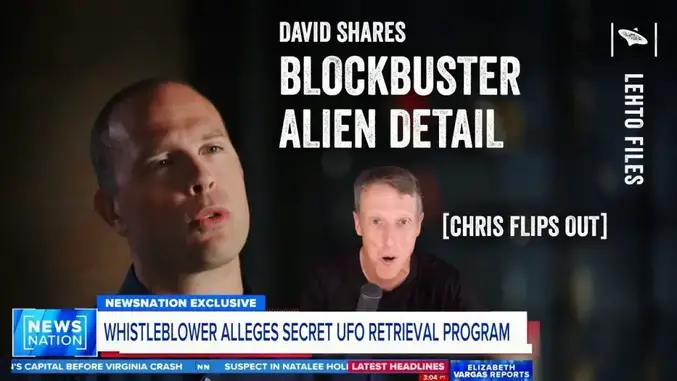
In an era when information is at our fingertips, it seems almost impossible for any global entity, especially the government, to keep a secret. However, in a recent interview with David Grusch, a former intelligence officer turned whistleblower, new light has been shed on undisclosed government programs and the possible existence of non-human intelligence, or NHI, as it is referred to.
Grusch, who had been embedded deep within the U.S government’s clandestine operations, has come forward to share the extent of the government’s knowledge and cover-up of extraterrestrial life and technology. He asserts that while our government has secretively kept this information under wraps, it has simultaneously perpetuated an elaborate disinformation campaign to stigmatize the very idea of extraterrestrials.
This disinformation strategy has been so skillfully executed that anyone daring to broach the subject of extraterrestrials was immediately sidelined as a conspiracy theorist, discrediting their claims, no matter how legitimate. The general consensus fostered was that talking about aliens was a mark of madness, hence the stereotype of the “tinfoil hat guy.”
However, David Grusch stands as a credible counter to this narrative. As someone with an intimate knowledge of the government’s inner workings, he presents a strong case – strong enough that the U.S Inspector General deemed his whistleblower complaint as “urgent and credible.”
Yet, one might ask why such earth-shattering information has not been leaked before. The answer, according to Grusch, lies in the government’s adept control of information flow and its ability to keep secrets. Many secrets have never seen the light of day, maintained under the tight wraps of national security and the imperative to avoid widespread panic. But these justifications become hard to swallow when we consider the potential benefits of such advanced technologies.
Grusch’s ultimate goal is not just the public revelation of NHI existence, but more importantly, the release of non-human technology for the benefit of all. He draws a comparison with nuclear physics – while nuclear weapons designs are kept classified, the underlying nuclear physics is open for all to study. In the same vein, Gruschargues, knowledge about extraterrestrial life and associated technology should not be suppressed.
Grusch’s revelations leave us standing at the precipice of a massive paradigm shift. If his allegations are indeed valid, the implications are world-changing, pushing us to reevaluate our place in the universe. We are now left grappling with the potential reality of non-human intelligence coexisting with us and the need to figure out our next steps.
What will be the reaction of these non-human intelligences when they realize we know about their existence? According to Grusch, they appear neutral, having stood by as humanity fought wars and perpetrated genocides.
Will the governments admit the truth, disband the military-industrial complex responsible for this colossal cover-up? Or will they continue to operate in shadows, keeping secrets and muzzling voices that dare to question?
The future of our planet and humanity is in question, underscoring the need for courage, integrity, and transparency from our governments. It took one individual to shed light on these secrets. It will require collective willpower to confront these revelations, navigate the uncharted waters, and make informed decisions about our shared future.
An illustration of a binary system in which a white dwarf is feeding on material stripped from a companion star.
(Image credit: NASA/CXC/M.Weiss)
Astronomers studying the fastest and most dramatic nova ever recorded continue to find more puzzles than answers.
Novas are sudden, bright flares of light in a two-star system created when a white dwarf, the core of a dying star that has run out of fuel, steals material away from its companion star, causing the white dwarf to temporarily brighten. A nova known as V1674 Hercules found in a bizarre binary star system — made up of a white dwarf and a shredded companion in the Hercules constellation — has been the object of much interest since it first erupted two years ago on June 12, 2021. Astronomers were baffled by its light and energy, which rang like a bell, as well as its mysterious and intense winds that pumped stellar material into surrounding space.
Now, a team of researchers has spotted strange radio emissions sprouting from deep inside the V1674 Hercules nova that are very different from the high-temperature emissions normally seen during such events. "Right now, we're trying to determine if the non-thermal energy is coming from clumps of gas running into other clumped gas which produces shocks, or something else," Montana Williams, a graduate student at New Mexico Tech who is leading the new research, said in a statement.
Wiliams revealed the strange emissions last week in a news briefing at the 242nd meeting of the American Astronomical Society being held in Albuquerque and online. Those emissions may be from interactions among chunks of stellar material ejected during the explosion, which is quite rare for "classical nova" such as V1674 Hercules, Williams said.
"Classical novas have historically been considered simple explosions, emitting mostly thermal energy," she added in the statement. "Instead, it seems they're a bit more complicated."
To study V1674 Hercules, Williams and her colleagues are using the Very Long Baseline Array, which is a network of ten antennas spanning the United States from Mauna Kea in Hawaii to Saint Croix in Virgin Islands. By combining those observations with similar data from other telescopes also watching the nova, including the Karl G. Jansky Very Large Array telescope facility in New Mexico and the space-based Nuclear Spectroscopic Telescope Array (or NuSTAR), the team hopes to understand what's causing the mysterious radio emissions.
An artist's conception of V1674 Hercules, a classical nova hosted in a binary star system that is made up of a white dwarf and dwarf companion star. (Image credit: B. Saxton (NRAO/AUI/NSF))
Researchers can measure how fast a nova evolves by observing how long the explosion takes to fade two magnitudes from its peak brightness. Extremely fast events take less than 10 days, moderate can ones take up to 80 days and the slow ones take anywhere from 80 to 150 days. The V1674 Hercules nova (or V1674 Her), whose flash of light was so bright that it could be seen with the unaided eye, took only 1.1 days to dim two magnitudes, or to about one-sixth of its original brightness.
"V1674 Her at 1.1 days is on an extreme end of an already extreme end, so it earns the title of the fastest nova," Williams said at the news conference last week.
A newly released pair of images by Williams and her team depicts just how drastic that pulsating change in brightness was between July 2, 2021 and July 6, 2021.
V1674 Hercules, currently the fastest nova on record, fades dramatically across four days from July 2, 2021 to July 6, 2021. (Image credit: M. Williams/New Mexico Tech, B. Saxton (NRAO/AUI/NSF))
Unlike supernovas which completely destroy a star in violent explosions, classical novas such as V1674 Hercules leave the host stars intact and fully capable of putting on multiple shows, giving astronomers many opportunities to study how the system works.
In a broad brush, astronomers say studying the behavior and evolution of V1674 Hercules could also shed light on how galaxies evolve across eons, since the material that novas blast out into surrounding space is eventually recycled by nearby galaxies to feed the next generation of stars and planets.
Join our Space Forums to keep talking space on the latest missions, night sky and more! And if you have a news tip, correction or comment, let us know at: community@space.com.
Synthetic human embryos raise ethical questions among experts
Credit: Cavan Images / Getty Images
A team of UK and US scientists has announced that it’s created “synthetic human embryos”: embryos made from stem cells rather than human eggs or sperm.
The research, which is not yet peer-reviewed, was presented at the International Society for Stem Cell Research’s annual conference in Boston.
This breakthrough, which has previously been demonstrated in mice, could allow scientists to study human development during a period where comparatively little is known about how the foetus develops.
Currently, regulations in most countries stipulate that embryos and embryo-like structures cannot be cultivated in a lab for research beyond 14 days.
Stem-cell synthetic embryos are not caught up in the ban, and therefore could be used to sidestep the rule and study foetal development beyond two weeks.
The researchers, who are based at the University of Cambridge and the California Institute of Technology, have cultivated their synthetic embryos to “just beyond” the equivalent of 14 days of development, according to The Guardian, which was the first to report on the discovery.
But it’s not yet clear whether these embryos could actually develop into humans, or if they should be subject to the same rules as other embryo-like structures.
“It is extremely important to develop a much deeper understanding of the earliest stages of human development, particularly as these are essential for developing better clinical responses to infertility, miscarriage, and developmental errors,” says Professor Rachel Ankeny, a researcher at the University of Adelaide who watched the presentation in Boston.
“We need to engage various publics about their understandings of and expectations from this sort of research, and more generally about their views on early human development, as these biological processes are deeply tied to our values and what we think counts as human life.”
Dr Kathryn MacKay, from the University of Sydney, points out that, while they didn’t need a full egg and sperm cell, the embryos still needed human embryonic cells to grow.
“If human embryonic stem cells are needed to create these human-like embryos for research, then synthetic embryos may not avoid having to use human embryos for research. This is an ongoing moral issue around respect for human life,” says MacKay.
“Further, there is a moral issue involved in creating something for research that may or may not have the potential to live as its own full entity. If they could live as their own full entities, then we must ask whether it is morally permissible to create living beings purely for research purposes.
MacKay says that, based on animal models, the synthetic embryos shouldn’t be able to grow into a human baby.
“This raises two further questions: One, if they are not the sort of thing that can really grow into a human baby, then how useful are they really for scientific knowledge into human reproduction and development? And two, will researchers decide that ‘fixing the problem’ of these embryos not being able to grow into human babies is something worth pursuing, for questionable ends?”
Other experts point out that, in addition to fertility and foetal development, synthetic embryos could be used to understand more about genetic diseases, longevity and ageing.
“It is likely that this work will allow us to develop new strategies to treat different developmental dysfunctions, and perhaps even extend lifespan,” says Professor Wojciech Chrzanowski, from the University of Sydney.
“This work on the one hand mitigates any ethical concerns related to fundamental biology research on embryos, but on the other hand, raises substantial concerns about whether such embryos will not be misused to generate some ‘super forms’ of life. Similarly, to the use of AI, the regulatory, ethical and integrity aspects are important to consider.”
Associate Professor Karinne Ludlow, from Monash University’s Faculty of Law, compares the discovery to a similar one announced by a Monash team in 2021: iBlastoids, structures also made from stem cells that closely resemble human embryos.
“The regulator ultimately determined that iBlastoids met the definition of a human embryo and were therefore subject to existing laws on embryo research. However, this decision was controversial,” says Ludlow.
Much remains to be learned about the synthetic embryos, including how similar they really are to human embryos, and what research they could help to encourage.
Professor Ankeny says: “It is critical that researchers be transparent about this type of research and what is known and unknown, in order to ensure that our regulatory processes address the necessary issues and that the public is assured that there are adequate oversight mechanisms and safeguards.”
No wonder the whole world will unite if tomorrow Earth is invaded by aliens. It may sound like science fiction but the probability of it cannot be denied. There are many accounts of encountering non-human beings but such stories are often neglected due to a lack of strong evidence. However, things become different when a government itself supports such claims. Some of them were Gen. Douglas McArthur, Gen. George Marshall, Werner Von Braun, President Ronald Reagan, Gen. Nathan Twining, Gen. Walter Bedell Smith, Dr. Carl Gustav Jung, and many others.
Former US President Ronald Reagan expressed his concern about an alien invasion in his speeches from 1985 to 1988. In one of his speeches to the UN, he said: “What if all of us in the world were threatened by an outer power, from outer space, from another planet? We would all of a sudden find out that we didn’t have any differences at all.” None of the presidential aides, speechwriters, and handlers liked what he said. Besides, it never appeared on original drafts. Despite it, Reagan continued adding it subtly.
In 1982, there was a special screening of the movie “ET: The Extra-Terrestrial” at the White House. During the screening, President Reagan whispered to Steven Spielberg that everything depicted in the film was real. Spielberg confirmed this during an interview with Quint (also known as Eric Vespe).
Spielberg said: “No, he wasn’t ushered out of the room. He was the President of the United States! Nobody could usher Ronald Reagan out of the room! It was in the White House screening room and Reagan got up to thank me for bringing the film to show the President, the First Lady, and all of their guests, which included Sandra Day O’Connor in her first week as a Justice of the Supreme Court, and it included some astronauts… I think Neil Armstrong was there, I’m not 100% certain, but it was an amazing, amazing evening.”
Reagan was criticized for his bizarre comments on aliens, he was called an actor reading a script but the truth is that they were his own words. In the following years, many officials in the White House hinted at the presence of outer world life.
One such interesting case is brought to light by the writer, producer, co-host of the podcast Need To Know, and former CNN correspondent Bryce Zabel. Mr. Bryce discovered the story of a Reagan administration cabinet member crying himself to sleep after being briefed on the truth about UFOs.
John Herrington, Former US Navy AS R&MA and served as the United States Secretary of Energy under Ronald Reagan during his second term.
President Reagan and James Baker interviewing John Herrington for the cabinet position of Secretary of Energy in Oval Office Photo courtesy of U.S. National Archives and Records Administration: Ronald Reagan Presidential Library & Museum.
Mr. Bryce was telling a story originally told by his friend Brent Friedman. According to him, Brent was a family friend of John S. Herrington, who served as Assistant Secretary of the Navy and Secretary of Energy in the Reagan Administration. Herrington “had Brent drive his car across the country in 1981 because he had just taken a position in the Reagan administration.” This is where Herrington allegedly told this story to Friedman. (Source)
Friedman said: “A good family friend of ours, when I was just getting out of high school, was working at a very high level in the Reagan administration. One night, he took me aside and was telling me some of the things he was doing in the government. He was going to get us a White House tour and everything and ended up telling me some pretty shattering stories.
And in particular, he knew that I had always been into science fiction and fantasy and comic books and very casually just threw out there that aliens were real. They’re here, and I’ve seen them. The story goes on to much greater detail because at the time, I was just absolutely shocked. And this is a person I grew up with and I completely trusted, and he just rocked my world.”
“In addition to Sauder’s well-documented research, there are other tantalizing links to the underground world. One, for example, concerns an assistant secretary to a branch of the armed forces in a new Republican administration. This person told a family friend that he had been ‘briefed’ for some eight weeks at an underground facility outside of Washington.”
When asked the purpose of the briefing, this highly-positioned man, who went on to become a cabinet secretary, said: “There is intelligent life in the universe. It’s here. And I’ve seen it.” The man said that the information he had been given caused him to cry himself to sleep for a number of nights. The reason, he told his shocked listener, was that he had children. “This is not the kind of world I thought they’d grow up in.
What kinds of things are going on that require months-long briefings in underground facilities and cause grown men to cry? The cabinet secretary told the family friend that aliens were just the ‘tip of the iceberg’ in terms of mind-blowing revelations. It is clear, then, that large underground facilities not only are real, but are connected in some way with the reality of ETs or ‘Others’ here on Earth
The claims of non-human intelligence living with us are not new and have been told by more than a dozen of government officials.
The Honorable Paul Hellyer (1923-2021), former Canadian Minister of Defense said extraterrestrials have been visiting our planet for thousands of years and it is likely that at least two of them are working with the U.S. government and sharing their highly-advanced technologies with humans.
Hellyer stated that “aliens are living among us and that it is likely at least two of them are working with the U.S. government.” More specifically, Hellyer announced that at least four species of extraterrestrials had been visiting Earth for thousands of years. According to Huffington Post Canada, he also stated that some extraterrestrials originate from the “Zeta Reticuli, the Pleiades, Orion, Andromeda, and Altair star systems” and “may have different agendas.”
In December 2020, Haim Eshed, a retired Israeli general and former head of the Israeli Defense Ministry’s space directorate gained attention for making controversial claims about extraterrestrial life and alleged secret collaborations between humans and aliens. He stated that aliens and the U.S. government had reached some type of deal to stay quiet about their experiments on Earth and secret facilities on Mars.
In his claims, Mr. Eshed said ETs exist and monitor our nuclear capabilities. There is a “Galactic Federation,” and the alien species with whom humanity will contact is “Grey.” According to him, Earth is their Petri dish, and they are also trying to understand the whole fabric of the universe. He further stated that some of the smaller UFOs are robots/AI, consciousness is present after death, and humans have anti-gravity technology but it is still classified.
Jim Semivan, a former CIA officer has recently made a shocking statement, saying “there’s a whole other reality that surrounds us that we just simply don’t have the ability to see or interact with. There’s an entity out there! There’s some kind of non-human intelligence that’s living with us on this planet!”
“I think they mention that the phenomenon is a natural part of our universe, and we’re living in it but we don’t recognize it. The same way that insects and animals don’t recognize the human universe. A cat and a dog could be running through a library, but they don’t have the faintest idea what the books are all about and what libraries are all about. We might be walking through our existence and there’s a whole other reality that surrounds us that we just simply don’t have the ability to see or interact with.”
“It seems to be peeking inside our little consensus reality. As I explained to somebody once, it comes close, it teases us, it cajoles us, it lies to us, but you can never take it home to meet the parents. It won’t allow you to do that. There’s no formal introduction. Add on top that there’s no ontology, which is just a fancy word, it basically means there’s no structure to even discuss this. We don’t have a common lexicon. Somebody said we have dots but no connections. I don’t even think we have dots.”
The reason it couldn't be left in orbit around Saturn is because some of Saturn's major moons - like Titan and Enceladus - are considered to have prime conditions that could support the emergence of life.
Not wanting to risk contamination, NASA scientists decided to end the mission by destroying the Cassini spacecraft.
One of the key bodies in the search for signs of life within our Solar System is Enceladus, due to the liquid water that exists beneath its frozen exterior.
As we know water is a key ingredient for life on Earth, Enceladus's liquid subsurface ocean makes it a prime target.
During its mission, the Cassini spacecraft made several dives through plumes erupting from deep inside Enceladus and found the moon's ice grains contain a wealth of minerals and organic compounds that are associated with life as we know it.
An illustration of NASA's Cassini spacecraft diving through plumes erupting on Saturn's moon Enceladus from the ocean below its icy crust. Will exploration of these oceans reveal evidence of life? Credit: NASA/JPL-Caltech
Now, scientists studying Cassini data have discovered phosphorus, which is a building block for DNA and is found in the bones of mammals, cell membranes and plankton in our ocea
"We previously found that Enceladus’ ocean is rich in a variety of organic compounds," says Frank Postberg of the Freie Universität Berlin, Germany, who led the new study, which has been published in the journal Nature.
"But now, this new result reveals the clear chemical signature of substantial amounts of phosphorus salts inside icy particles ejected into space by the small moon’s plume. It’s the first time this essential element has been discovered in an ocean beyond Earth."
Finding the ingredients for life
A 2006 observation of Saturn's E ring by the Cassini spacecraft. The E ring is fed with icy particles via plumes erupting from the subsurface ocean of Saturn's icy moon Enceladus. The moon's shadow is seen as a dark dot within the ring. Credit: NASA/JPL/Space Science Institute
To make the discovery, the team studied Cassini data: specifically that collected by the spacecraft's Cosmic Dust Analyzer instrument when it sampled particles of ice from Enceladus found in Saturn's E ring.
They found high concentrations of sodium phosphates – molecules of chemically bound sodium, oxygen, hydrogen, and phosphorus – inside some ice grains.
Lab tests found that Enceladus’s ocean contains phosphorus in concentrations of at least 100 times that of Earth's oceans.
Plumes of water ice and vapour spray from the south polar region of Saturn's moon Enceladus. Credit: NASA/JPL/Space Science Institute
"High phosphate concentrations are a result of interactions between carbonate-rich liquid water and rocky minerals on Enceladus’ ocean floor and may also occur on a number of other ocean worlds," says co-investigator Christopher Glein of the Southwest Research Institute in San Antonio, Texas.
"This key ingredient could be abundant enough to potentially support life in Enceladus’ ocean; this is a stunning discovery for astrobiology."
However, the study authors are keen for caution when interpreting these results.
"Having the ingredients is necessary, but they may not be sufficient for an extraterrestrial environment to host life," says Glein.
"Whether life could have originated in Enceladus’ ocean remains an open question."
Claims the US government has secretly retrieved crashed alien spacecraft and their non-human occupants are hardly new. They are firmly entrenched in post-war American UFO lore and conspiracy theory, inspiring the most famous narrative in ufology: the "Roswell incident".
Now, however, journalists Leslie Kean and Ralph Blumenthal have injected fresh vigor into these aging claims – apparently with the Pentagon's approval.
In an article for science and technology news site The Debrief, they report the US government, its allies, and defense contractors have retrieved multiple craft of non-human origin, along with the occupants' bodies.
Additionally, they report this information has been illegally withheld from US Congress, the All-domain Anomaly Resolution Office established by the US Department of Defense in 2022 to look into UFOs, and the public.
What are the claims?
The primary source for the new claims is former US intelligence official David Grusch.
Grusch's credentials, verified by Kean and Blumenthal, are impressive. He is a veteran of the National Geospatial-Intelligence Agency and the National Reconnaissance Office. He represented both organizations on the US government's task force studying unidentified aerial phenomena (the official term for UFOs).
Unidentified aerial phenomena, such as this video taken by a US Navy pilot released in 2020, have been a source of renewed interest in recent years. (United States Navy/Public Domain/Wikimedia Commons)
Grusch says the retrieved materials are: "of exotic origin (non-human intelligence, whether extraterrestrial or unknown origin) based on the vehicle morphologies and material science testing and the possession of unique atomic arrangements and radiological signatures."
Grusch's claims are supported by Jonathan Grey, who works for the National Air and Space Intelligence Center, where he focuses on analysis of unidentified aerial phenomena.
Grey told Kean and Blumenthal: "The non-human intelligence phenomenon is real. We are not alone […] Retrievals of this kind are not limited to the United States."
How credible are the claims?
Kean and Blumenthal are credible and accomplished reporters on UFOs.
In 2017, writing with Helene Cooper for the The New York Times, they revealed a secret US$22 million Pentagon UFO research program. That article did much to initiate a wider rethinking about UFOs, avoiding stereotypes, stigma, and sensationalism.
Most of the subsequent "UFO turn" in US defense policy and public discourse has focused on images and eyewitness testimony of anomalous airborne objects.
Now, Kean and Blumenthal may have brought anomalous objects themselves – and even their supposed non-human occupants – into the conversation.
Shortly after the Debrief article, Australian journalist Ross Coulthart's interview with Grusch appeared on US news network News Nation. Former Deputy Assistant Secretary of Defense for Intelligence, Christopher Mellon, has also published an article in Politico calling for greater transparency.
This looks a lot like an orchestrated effort to convince the public (and US Congress) something much more substantial than "things in the sky we can't explain" is going on.
Approved by the Pentagon?
Grusch seems to have followed Pentagon protocol in publishing his information.
Kean and Blumenthal write Grusch: "provided the Defense Office of Prepublication and Security Review at the Department of Defense with the information he intended to disclose to us. His on-the-record statements were all "cleared for open publication" on April 4 and 6, 2023, in documents provided to us."
What does that mean?
A Prepublication and Security Review is how the Pentagon confirms information proposed for public release is reviewed to ensure compliance with established national and Department of Defense policies, and to determine it: "contains no classified, controlled unclassified, export-controlled, or operational security related information."
If Grusch's information is true, it is surely both "classified" and "operational security related".
So why would the Pentagon approve its publication?
If Grusch's information is false, it would probably not qualify as classified or operational security related. But this raises another question: why would the Pentagon approve the publication of an unfounded conspiracy theory about itself?
Doing so would likely mislead the public, journalists, and Congress. It would also undermine the Pentagon's own attempt to understand the unidentified aerial phenomena problem: the All-domain Anomaly Resolution Office.
An official denial
Indeed, the All-domain Anomaly Resolution Office told News Nation it: "has not discovered any verifiable information to substantiate claims that any programs regarding the possession or reverse-engineering of extraterrestrial materials have existed in the past or exist currently."
Grusch has an explanation for this apparent ignorance.
When it comes to unidentified aerial phenomena investigations, he says, the US government's left hand doesn't know what its right is doing, with: "multiple agencies nesting [unidentified aerial phenomena] activities in conventional secret access programs without appropriate reporting to various oversight authorities."
Timothy Good's classic 1987 exploration of UFO investigations, Above Top Secret, described similar bureaucracy.
Nested activities and segregated knowledge
The notion of "nested" unidentified aerial phenomena activities, segregating knowledge within vast bureaucracies, is partly what makes Grusch's claims both intriguing and (for now) unverifiable.
If this is the case, organizations focusing on unidentified aerial phenomena, such as the All-domain Anomaly Resolution Office, may operate in earnest and report transparently on the best information they have. Yet they may also be deprived of information essential to their activities.
This would make them little more than PR fronts, designed to create the impression of meaningful action.
In the absence of direct experience of unidentified aerial phenomena, most of us rely on information about them to form our beliefs. Scrutinizing how this information is produced and distributed is essential.
US government activity in this area will continue. Congressman James Comer, chair of the House Oversight Committee, has said he will hold a hearing on UFOs in response to Grusch's allegations.
NASA Says ‘UFO’ Spotted Crashing in Las Vegas Was a Small Meteor; Cops Say They Hope to Find Aliens
After police and citizens saw a bright meteor in the sky, cops unsuccessfully stalked what witnesses said were beings with glowing eyes nearly 10 feet tall.
SCREENCAPTURE FROM LAS VEGAS POLICE BODY CAMERA FOOTAGE; RED CIRCLE DRAWN BY MOTHERBOARD STAFF.
NASA’s planetary defense officer, Lindley Johnson, tells Motherboard that a green fireball observed last month by, among others, a Las Vegas police officer was likely a bright meteor less than a meter in size and certainly not a UFO that fell in anyone’s backyard.
Las Vegas cops, meanwhile, tell Motherboard that while they didn’t find aliens in a manhunt last month, they do hope to do so in the future, citing the city’s proximity to Area 51.
At issue here is footage that went wildly viral over the weekend depicting the aftermath of a UFO sighting. Last month, as reported by KLAS, a man called the Las Vegas police to report something startling: After an object fell from the sky, he and his family saw a non-human being at least eight feet tall in their backyard.
“It has big eyes and it’s looking at us,” the man told a 911 dispatcher.
Body camera footage documenting the police response to the call shows that officers on the scene found the report credible. The first of two videos released in response to records requests show officers responding to the call in the early morning hours of May 1. As they pull up to a house, four people are on a lawn. The footage went viral over the weekend after the KLAS report.
“It was like a big creature,” says another. “Around 10 feet tall.”
A police officer immediately reassures him that he finds their story credible.
“I’m not gonna BS you guys,” he says. “One of my partners saw something fall out of the sky, too.”
Footage captured by another police officer’s body camera earlier that night in the same area indeed appears to show a glowing green orb falling out of the sky. This object was recorded in the American Meteor Society’s fireball logs, but not those of NASA’s Center for Near Earth Object Studies, or CNEOS. While discrepancies like this are the sort of thing that fuels conspiracy theories about NASA coverups, Johnson, the planetary defense officer, offered a straightforward explanation, saying, “The CNEOS website only captures reports for objects that are estimated to have exceeded 1 meter in size based on the observed total energy released—in other words natural objects which were large enough to be categorized as asteroids prior to entering Earth’s atmosphere.”
Based on its observed speed, he added, it would have been high in the atmosphere and hundreds of miles away from Las Vegas at the time it was spotted. “So nothing from the meteor landed in anyone’s backyard in Vegas,” he said.
Unaware of all this, police responding to the 911 call promptly and apparently conscientiously searched the family’s backyard; 16 minutes of this footage was redacted because, police told Motherboard, it was taken on private property. (They assured Motherboard that no UFO was found.) When the footage resumes, the officer is assuring witnesses that even though he hasn’t found a UFO he finds their report credible, noting that while he was on a call at a nearby Target, one of his partners had seen what she thought was a shooting star in the sky—exactly at the same time the eyewitnesses had seen a mysterious object fall from the heavens.
More body camera footage from another officer reveals that an extensive search took place, with the officer, after asking a witness if he’d seen which way the aliens went, flagging down a car to ask the occupants to ask if they’d seen a UFO or tall, non-human beings.
“Hey, this might sound like a really dumb question,” he says, “but did you guys see anything fall out of the sky?”
The people in the car say they did not see anything.
“We got a call and one of my partners actually said that they saw it, too,” the officer says before explaining that their neighbors had described a UFO crashing and urging them to call 911 if they saw an alien. “They said they saw something with eight to nine feet, no clothes, green-colored men, not human, with, like, the eyes were glowing and it was not a human being.”
As the officers were departing the scene, one of the witnesses said he was uneasy spending the night at home after what he’d seen.
“I’m going to a hotel, man,” he said.
Last week, one of the witnesses released a video describing his experiences titled “I had aliens in my backyard.”
It takes a lot of work to send a postcard from Mars.
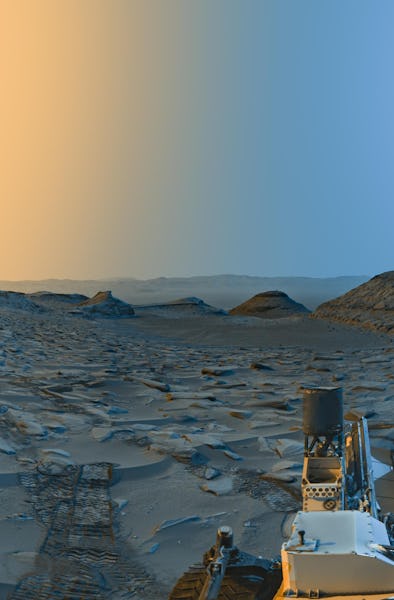
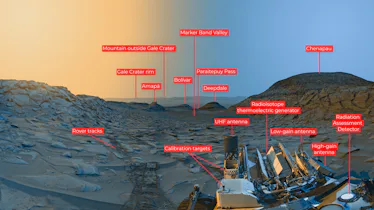
NASA’s Curiosity Rover recently pointed its navigation cameras back the way it had come to capture two panoramic photos of the rover’s tracks leading out of Marker Band Valley. Curiosity imaging team members created a composite of the images, which was released Monday
You can still get a hint that it’s a composite: The giveaway is in the drastically different angles of the shadows on each side of the image. One panorama shows a mid-morning view, while the other shows late afternoon — both timed to take advantage of the most dramatic natural lighting and the dark, deep shadows of Martian winter.
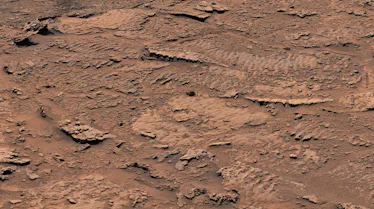
The Marker Band Valley gets its name from a thin, dark, and surprisingly tough layer of rock that runs along the valley’s walls. Scientists aren’t sure exactly what the marker band is made of because the frustratingly tough rock has resisted all of Curiosity’s efforts to drill out a sample. But it’s home to surprising traces of an ancient lake in an area that mission planners expected to have been dry even during Mars’s warmer, wetter past, Curiosity found layers of rippled rock, still bearing the texture left behind by waves in an ancient lake.
Billions of years ago, waves in an ancient lake carved these ripples into the lake bottom, and now they’re preserved in rock.
NASA
If you want to send home a panoramic view from Mars, though, it’s not quite as easy as clicking the panorama option on your phone’s camera and then panning around the horizon (yet). Combined, the two images took about 15 minutes to capture, and each one arrived on Earth as five individual photos, which NASA teams had to carefully stitch together using computer software.
Next, they carefully blended the two panoramas together. And because Curiosity’s navigation camera only takes photos in black and white, NASA decided to add a filter; they carefully colorized both images, using a deep blue sky for the morning shot and a cheery yellow for the afternoon.
This panorama is actually ten separate photos, carefully stitched together and with false color added.
NASA
The result is a stunning postcard from Gale Crater, where Curiosity has been exploring since 2012. Curiosity’s tracks in the Martian sand lead back toward a valley called Marker Band Valley, which is home to an ancient lakebed. In the far background, you can see the edge of Gale Crater, 25 miles away and receding into the distance as Curiosity scales Mount Sharp. Beyond the crater’s rim, clear winter skies afford a rare view of an even more distant mountain, 75 miles away from the rover.
How Science Fiction Sparked Our Flights to the Final Frontier
The commercial spaceflight revolution didn’t begin with Elon Musk. Or with Jeff Bezos, or Richard Branson, or any of the other billionaires who’ve spent a fortune on the final frontier over the past 20 years.
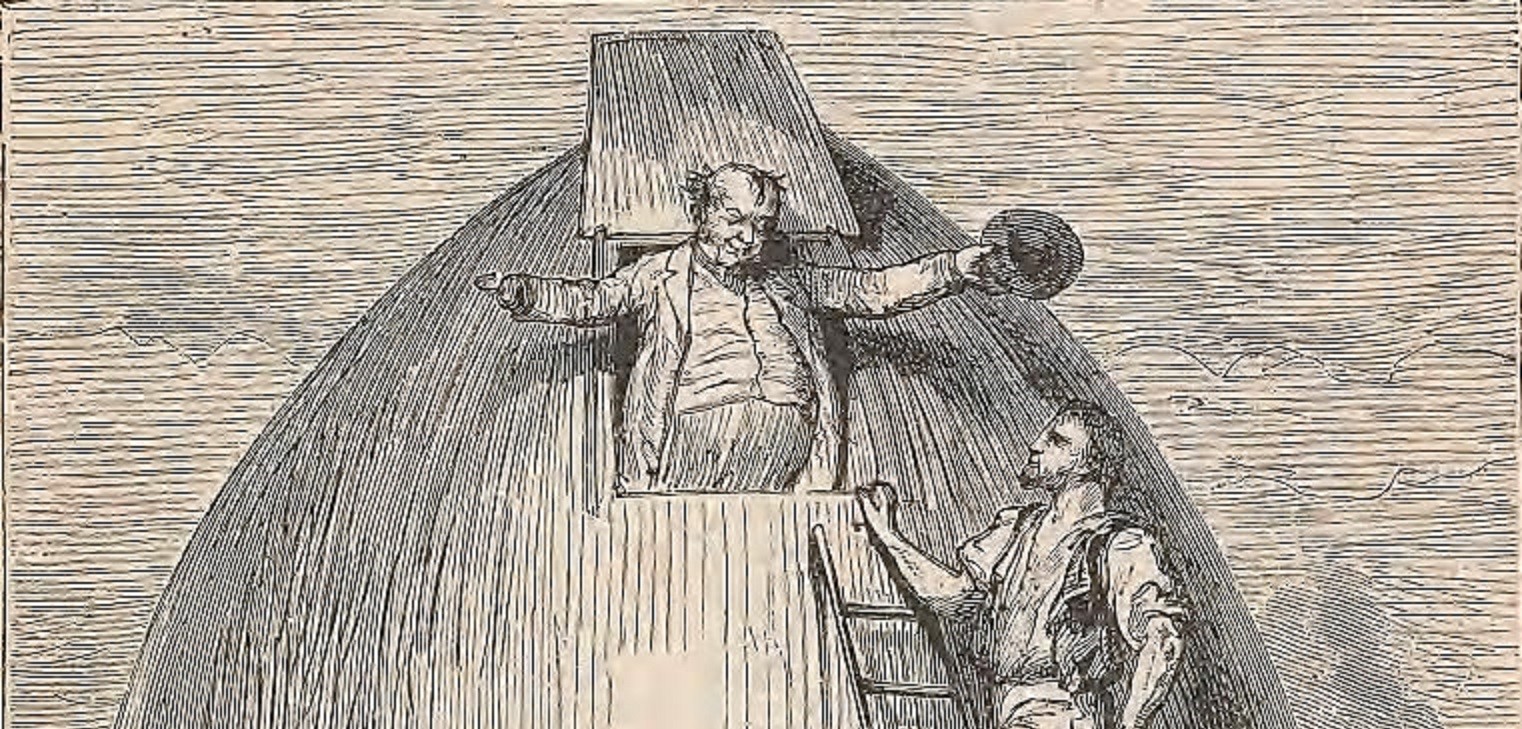
Would you believe it began with Jules Verne in the 1860s?
That’s the perspective taken by Jeffrey Manber, one of the pioneers of the 21st-century spaceflight revolution, in a book tracing the roots of private-sector spaceflight to the French novelist.
“The first realistic steps taken in rocket development were because of a French science-fiction book,” Manber says in the latest episode of the Fiction Science podcast. “And that’s an underlying theme, in that we really needed a commercial ecosystem to get going. It’s not a government decree.”
The influence of Verne’s classic spaceflight novel, “From the Earth to the Moon,” continues to the present day: For example, when Bezos built the headquarters for his Blue Origin rocket venture, he brought in a Verne-inspired, Victorian-style rocket ship (complete with a cushy cockpit) to serve as the centerpiece of the building’s lobby.
Manber also pays tribute to Jules Verne in the title of his book series: “From the Earth to Mars.” He’s writing the story chapter by chapter, and the first two chapters recently came out as a 106-page volume.
Verne’s story resonated with Manber for several reasons: First, the heroes of the story aren’t government employees, but members of a a group called the Baltimore Gun Club. They raise the money to build a giant gun as well as a projectile big enough for three club members to climb inside. A blastoff from Florida sends the trio on a thrilling ride to the moon and back, ending with a Pacific Ocean splashdown.
Manber loves the “eerie similarities” to NASA’s Apollo moon missions, but he’s even more impressed by the tale’s impact on early rocketeers.
Russian rocket scientist Konstantin Tsiolkovsky was so taken by the tale that he looked into whether a giant gun could actually fire a spaceship to the moon. He determined that it couldn’t, but went on to work out what’s now known as the Tsiolkovsky rocket equation. Tsiolkovsky also came up with the idea of using multistage rockets, with liquid oxygen and hydrogen as an option for propellants.
“From the Earth to Mars: The Surprising History of the Rocket Pioneers Who Launched Humanity Into Space,” by Jeffrey Manber. (Multiverse Media)
In his book, Manber traces the cross-fertilization that took place between Russian and German rocketeers, as well as between those rocketeers and science-fiction writers. For example, German rocket scientist Hermann Oberth collaborated with famed filmmaker Fritz Lang on a 1929 movie called “The Woman in the Moon,” based on Oberth’s ideas as well as a story written by Lang’s wife, Thea von Harbou. (You can watch the full movie on the Internet Archive, but skip the first 90 minutes to get to the good stuff.)
Once again, the connections between fiction and reality are eerie: During the making of the movie, Lang invented the second-by-second countdown as a device to heighten the drama of a rocket launch. He even tried to film an actual rocket launch for a scene in the movie. That idea fizzled out — but years after the movie was released, the Nazis recruited Oberth along with other technical advisers to work on their V-2 missile program. (They also banned showings of the movie and destroyed Lang’s rocket models, for fear they would expose secrets.)
“You can trace that to the V-2,” Manber said.
The first installment of “From the Earth to Mars” ends before the Nazis and the V-2 enter the picture. But future installments will address that dark chapter as well as the development of government-led space programs in Russia, the U.S. and China.
“I want people to know what our roots are, and it’s going to keep going all the way to the present,” Manber said.
Fast-forward to the future
Some of the narrative will surely draw upon Manber’s decades of personal experience in space commercialization. As the head of a company called MirCorp, he basically turned Russia’s Mir space station into a privately financed operation during its final days in 2000. A couple of years later, he came oh-so-close to sending boy-band singer Lance Bass to the International Space Station.
Manber was more successful with the space venture that followed, Nanoracks, which blazed a trail for commercial research and satellite deployment on the space station. Nanoracks and its current parent company, Voyager Space, arranged to have the Bishop Airlock added to the space station in 2021, marking another milestone for commercial space development. Today, Voyager Space and Nanoracks are part of an industry team that’s developing a commercial space station called Starlab with backing from NASA.
Manber has eased back on his corporate responsibilities — but last month, he was awarded NASA’s Distinguished Public Service Medal for “developing the foundation for the nascent commercial economy” in low Earth orbit through his work at MirCorp and Nanoracks. “I can take some solace that in space, with what we were handed, we’ve taken it and passed it along in better shape,” he said.
So, what about the next chapters in the real-life space saga? Manber offered a few predictions about the twists that are likely to lie ahead on the path from the Earth to Mars:
When will humans set foot on Mars? “I am a very cautious human being,” Manber said. “My cautious answer will be, I finally believe we will return to the moon and go on to Mars sooner than the pessimists believe.” But SpaceX and its CEO, Elon Musk, could force a radical change in Manber’s calculations. “I’ll put it to you this way,” he said. “If he gets Starship going in the next year or two, we’re going to Mars sooner than you and I think.”
If SpaceX can get itsStarship super-rocket through testing and into operation, that would be a game-changer, Manber said. “In fact, it’s so much of a game-changer, I have concerns about monopolistic behavior,” he said. “I didn’t fight for 30, 40 years to make this a commercial marketplace, or a competition, to replace one single point with another, which would be SpaceX. … I like the dream. I like all that. But I want competition.”
Manber said U.S.-Chinese space cooperation seems more likely, despite longstanding limits on technological ties. “I understand very well the tensions in the South China Sea, the economic tensions, but there’s always that room for that thing called commercial,” he said. “I see no reason today, 2023, that we should not be doing commercial work in space with the Chinese.”
The consequences of Russia’s invasion of Ukraine have shaken Manber’s faith in international space cooperation. U.S.-Russian cooperation is continuing on the International Space Station, but Manber doubts that will carry over to future projects. “Everything I worked on grinds to a halt, except for the ISS,” he said.
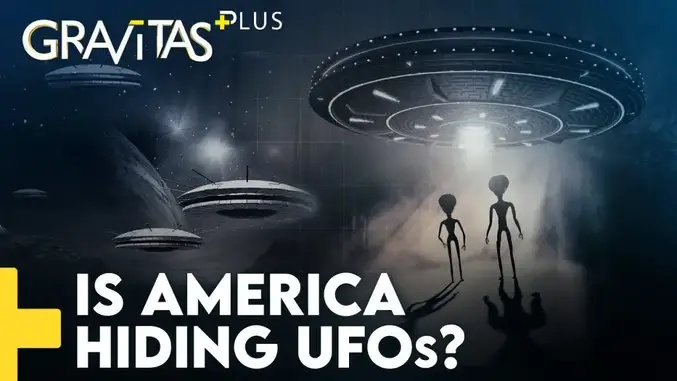
Is America hiding Alien technology? – Indian Media covers the Grusch story
In the unending stretch of the cosmos, secrets are born and concealed. Among these mysteries, the question of the existence of extraterrestrial life has long sparked intrigue and debate. The universe, sprawling across 93 billion light years and cradling approximately two trillion galaxies, is a treasure trove of infinite possibilities. Yet, despite its vastness, the question persists: Are we alone?
Since time immemorial, the human species has reported enigmatic sightings of inexplicable lights and flying objects. The first known mention dates back to 440 BCE in ancient Egypt, when scribes reported observing fiery discs floating in the skies. Interestingly, even 10,000-year-old rock paintings found in India’s Bastar region depict UFO-like entities.
Despite these historical records, the concrete evidence of otherworldly beings remains elusive. However, recent claims made by an ex-U.S intelligence official, David Charles Grusch, have rekindled this perennial debate.
Grusch, a combat veteran of Afghanistan and an ex-member of the Unidentified Aerial Phenomena (UAP) task force, asserts that the U.S. is harboring intact and partially intact vehicles of non-human origin. Moreover, Jonathan Gray, another U.S Intel official working at the National Air and Space Intelligence Center, has confirmed these allegations, suggesting that we are not alone.
The credibility of these claims is underpinned by Grusch’s formidable credentials. Serving on the UAP task force from 2019 to 2021 as a representative of the National Reconnaissance Office, his reputation is considered solid within intelligence circles. His whistleblowing has led to the U.S House of Representatives planning an oversight committee to investigate these assertions.
This isn’t the first time the U.S. government has probed the UFO phenomena. Past endeavors include Project Blue Book, Project Grudge, and Project Serpo. These investigations, although suspended or concluded without definitive answers, have nonetheless strengthened the idea that UFOs exist.
Worldwide, other nations have also delved into the enigma of extraterrestrial life, from the United Kingdom’s secret studies to the Soviet Union’s 13-year operation, Institute 22. All these probes, while not conclusively determining the origin of UFOs, concur on their existence.
Yet, in spite of the global fascination, the source of these UFOs remains shrouded in mystery. Some theories suggest they’re controlled by extraterrestrial beings with no interest in human contact, while others propose they’re human-made, leveraging unknown laws of physics.
Today, the quest for truth continues. If Grusch’s claims hold water, it could potentially turn our understanding of the cosmos upside down. As the U.S. House of Representatives prepares to delve deeper into these allegations, we might be on the brink of a revelation.
In the vast expanse of the universe, the possibility of other civilizations existing seems less like fiction and more like a hidden truth waiting to be discovered. Whether these elusive entities are cosmic neighbors or mere figments of our collective imagination, the human yearning for knowledge and the thrill of the unknown will continue to drive our quest for answers.
The reality of alien existence, whether proven or disproven, will bring a seismic shift in our understanding of life and our place in the universe. The clock is ticking, and perhaps, we are on the precipice of an ontological shock that could redefine our perception of the cosmos forever.
Meer van UFO'S of UAP'S, ASTRONOMIE, RUIMTEVAART, ARCHEOLOGIE, OUDHEIDKUNDE, SF-SNUFJES EN ANDERE ESOTERISCHE WETENSCHAPPEN - DE ALLERLAATSTE NIEUWTJES


 The shocking revelation about government secrets and alien technology