Ontdek de Fascinerende Wereld van UFO's en UAP's: Jouw Bron voor Onthullende Informatie!
Ben jij ook gefascineerd door het onbekende? Wil je meer weten over UFO's en UAP's, niet alleen in België, maar over de hele wereld? Dan ben je op de juiste plek!
België: Het Kloppend Hart van UFO-onderzoek
In België is BUFON (Belgisch UFO-Netwerk) dé autoriteit op het gebied van UFO-onderzoek. Voor betrouwbare en objectieve informatie over deze intrigerende fenomenen, bezoek je zeker onze Facebook-pagina en deze blog. Maar dat is nog niet alles! Ontdek ook het Belgisch UFO-meldpunt en Caelestia, twee organisaties die diepgaand onderzoek verrichten, al zijn ze soms kritisch of sceptisch.
Nederland: Een Schat aan Informatie
Voor onze Nederlandse buren is er de schitterende website www.ufowijzer.nl, beheerd door Paul Harmans. Deze site biedt een schat aan informatie en artikelen die je niet wilt missen!
Internationaal: MUFON - De Wereldwijde Autoriteit
Neem ook een kijkje bij MUFON (Mutual UFO Network Inc.), een gerenommeerde Amerikaanse UFO-vereniging met afdelingen in de VS en wereldwijd. MUFON is toegewijd aan de wetenschappelijke en analytische studie van het UFO-fenomeen, en hun maandelijkse tijdschrift, The MUFON UFO-Journal, is een must-read voor elke UFO-enthousiasteling. Bezoek hun website op www.mufon.com voor meer informatie.
Samenwerking en Toekomstvisie
Sinds 1 februari 2020 is Pieter niet alleen ex-president van BUFON, maar ook de voormalige nationale directeur van MUFON in Vlaanderen en Nederland. Dit creëert een sterke samenwerking met de Franse MUFON Reseau MUFON/EUROP, wat ons in staat stelt om nog meer waardevolle inzichten te delen.
Let op: Nepprofielen en Nieuwe Groeperingen
Pas op voor een nieuwe groepering die zich ook BUFON noemt, maar geen enkele connectie heeft met onze gevestigde organisatie. Hoewel zij de naam geregistreerd hebben, kunnen ze het rijke verleden en de expertise van onze groep niet evenaren. We wensen hen veel succes, maar we blijven de autoriteit in UFO-onderzoek!
Blijf Op De Hoogte!
Wil jij de laatste nieuwtjes over UFO's, ruimtevaart, archeologie, en meer? Volg ons dan en duik samen met ons in de fascinerende wereld van het onbekende! Sluit je aan bij de gemeenschap van nieuwsgierige geesten die net als jij verlangen naar antwoorden en avonturen in de sterren!
Heb je vragen of wil je meer weten? Aarzel dan niet om contact met ons op te nemen! Samen ontrafelen we het mysterie van de lucht en daarbuiten.
Unprecedented UFO Sighting Over Deerfield Beach: A Cosmic Ballet at Dawn
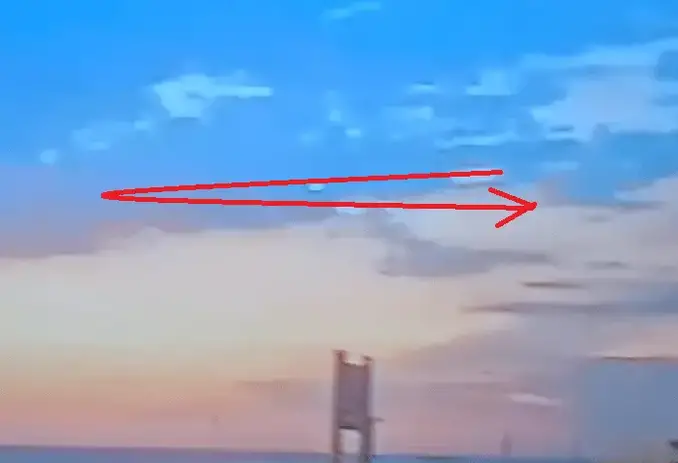
As the sun began to crest over the eastern horizon, Deerfield Beach, Florida, became the stage for an extraordinary event that has left locals and online viewers astonished. On May 4th, 2023, at the crisp early hour of 6:13 a.m., a UFO sighting of remarkable clarity was captured on a Youtube live cam.
The video shows a fast-moving object streaking across the tranquil Florida sky, before it abruptly halts mid-air. In an astonishing display of aerial acrobatics, the UFO then catapults in the opposite direction, reaching velocities that defy our current understanding of physics. The event was over as quickly as it began, leaving only a trace of mystery and an excited online community in its wake.
This Deerfield Beach UFO sighting has sparked fervent discussion and speculation among both skeptics and believers. The object’s speed and maneuverability, combined with the crispness of the video, have left viewers in awe. Was it a drone? A secret military project? Or perhaps evidence of extraterrestrial life?
A new animation shows how these cosmic monsters compare to other cosmic objects, and to each other.
A new animation from NASA illustrates the tremendous scale of supermassive black holes, which are believed to dwell at the heart of most, if not all, large galaxies.
These cosmic titans have masses anywhere between 100,000 and tens of billions of times that of the sun. But astrophysicists aren't quite sure how supermassive black holes attain their incredible heft.
"Direct measurements, many made with the help of the Hubble Space Telescope, confirm the presence of more than 100 supermassive black holes," Jeremy Schnittman, a theorist at NASA's Goddard Space Flight Center in Greenbelt, Maryland, said in a statement(opens in new tab). "How do they get so big? When galaxies collide, their central black holes eventually may merge together, too."
The new NASA video travels through 10 supermassive black holes of increasing mass, including the one at the heart of our galaxy, Sagittarius A* (Sgr A*), and the first black hole ever imaged by humanity, the black hole at the core of the galaxy Messier 87 (M87). The sizes of the supermassive black holes in the animation are scaled up based on the width of their "shadows."
All black holes have a spherical outer boundary called an event horizon, which is the point at which not even light can escape the black hole's tremendous gravitational pull. The diameter of the event horizon is determined by the mass of the black hole; more mass means a wider black hole. The shadow of the black hole is about twice the size of its event horizon, NASA officials said.
The animation begins at our sun, which is the most massive object in the solar system, accounting for 99% of its mass. Our view then pulls back to gradually reveal increasingly wider structures in the solar system, such as the orbits of planets like Mercury, Earth and Jupiter and the distance to features like the main asteroid belt and the Oort Cloud, a vast comet repository far from the sun. The animation compares these widths to supermassive black hole shadows of increasing size.
The first supermassive black hole featured is that of the dwarf galaxy J1601+3113, with a mass about 100,000 times that of the sun. This black hole's shadow is comparable to the width of the sun.
The animation also highlights Sgr A*, which has a mass 4.3 million times that of the sun and a shadow with a diameter around half the distance between Mercury and the sun. Pulling out further, the animation passes the two massive black holes located in the galaxy NGC 7727.
About 1,600 light-years separates these two black holes, which have masses 6 million and 150 million times that of the sun, respectively. The distance between the two behemoths is declining all the time, however, and astronomers estimate that, within 250 million years or so, the two black holes will merge, forming an even more massive daughter black hole.
Collisions like this could be the key to understanding how supermassive black holes grow. Such mergers cause ripples in space-time called gravitational waves, which detectors here on Earth such as the LIGO system have measured. And NASA is working toward a space-based gravitational wave detector called the Laser Interferometer Space Antenna (LISA), which could detect even more of these space-time ripples, helping us better understand these violent events.
From these two collision-bound black holes, the animation moves on to larger-scale objects that would no longer fit within our solar system, such as the supermassive black hole at the heart of M87. This object, known as M87*, has a mass of about 5.4 billion suns, researchers recently determined.
M87,* which was directly seen by the Event Horizon Telescope (EHT) in an image released to the public in 2019, has a shadow so wide it would take light two and a half days to traverse it, NASA officials said.
The video culminates at Tonantzintla 618 (Ton 618), which has a mass around 60 billion times that of the sun — the highest discovered to date. To put that into perspective: Ton 618 is around 15,000 times more massive than Sgr A* and is about six times more massive than every star in the Large Magellanic Cloud combined. (The LMC is a dwarf satellite galaxy of our own Milky Way.)
Ton 618 is located around 10 billion light-years from Earth and is so wide that it would take a beam of light several weeks to cross its shadow. The new animation lingers on the giant black hole for a few seconds before fading to black, giving viewers a chance to reckon with its mind-bending immensity.
Follow us on Twitter @Spacedotcom(opens in new tab)or onFacebook(opens in new tab).
A mysterious object that punched through the hole of a New Jersey home has been confirmed as a meteorite.
The object, which weights around 4lbs and measured four to six inches long, was discovered by the Kop family from Hopewell Township, New Jersey, earlier this week.
There were no injuries and minimal damage to the home itself. Suzy Kop, whose family owns the home, said she believed someone had thrown a rock into a bedroom upstairs.
The College of New Jersey, in nearby Ewing, tested it and confirmed it to be a space rock.
A meteorite punched a hole in the roof of the central New Jersey home, smashing into a hardwood floor and bouncing around a bedroom
The meteorite blasted through the ceiling of an upstairs bedroom. Fortunately nobody was in the room at the time
Suzy Kop, pictured, whose family owns the home, said they initially thought someone had thrown a rock into an upstairs bedroom Monday, but soon realized that wasn't the case
'It is most likely type LL-6, which means that it is lower in iron than most chondrite meteorites, and has been highly metamorphosed by intense heat even before entering the Earth's atmosphere,' the school said.
The family was initially shocked by the rock that crashed from space.
'We are thinking it's a meteorite, came through here, hit the floor here because that's completely damaged, it ricocheted up to this part of the ceiling and then finally rested on the floor there,' Kop told KYW.
'I did touch the thing because it thought it was a random rock, I don't know, and it was warm.'
Kop said hazmat officials responded to their home in case she and her family had been exposed to radioactive material, but those checks were all negative.
Kop said that she is thankful that no one was at the house when it happened.
Chief astronomer at the Franklin Institute, Derrick Pitts, said the rock could be four to five billion years old.
'It's been running around in space all that time, and now it's come to earth and it fell right into their laps, but for it to actually strike a house and people be able to pick up, that's really unusual. It has happened very few times in history,' he said.
Homeowner Suzy Kop surveys the outside of her home through which the rock penetrated
The object measured about 4 by 6 inches and weighs about 4lbs. Nobody was hurt
Some of the plaster can be seen hanging from the ceiling after a meteorite punched through
NASA said anyone who thinks they have found a meteorite must contact the Smithsonian.
'Although meteorites tend to hit Earth's atmosphere at high speeds, they slow as they travel through the atmosphere, breaking into small fragments before hitting the ground,' NASA said.
'Meteorites cool rapidly and generally are not a risk to the public.'
Meteoroids are bits of asteroids that have broken off. Once they enter Earth's atmosphere they become meteors. An asteroid the size of Mt Everest is what led to the extinction of the dinosaurs.
Astrophysicist Neil Degrasse Tyson recently appeared on CBS This Morning to discuss how officials are preparing to combat asteroids.
Kop said she is thankful that no one was at the house when it happened
The family who owns the home discovered the black, potato-sized rock in a corner - still warm. It left a dent in the hardwood flooring
The meteorite landed very close to the bed after landing at the New Jersey home
The discovery caught the attention of neighbors who stopped by the Kop's home for a look
'We've always known we don't want to get hit,' Tyson said. 'We've been hit - and let's talk to the dinosaurs about what happens when you get hit.
'We remember the dinosaurs because they have big teeth and they are ferocious - but a few people think about that 70 percent of all the world's species - of life - went extinct in that very same episode.'
Tyson continued: 'Little ones can come, and maybe we won't go extinct, but it can take out our grid, and we might have to jump-start civilization.'
The Astrophysicist called the operation to stop asteroids as 'the most expensive mission' and said it wasn't as simple as simply 'blowing it up.'
If you find a meteorite in the UK, it's yours to keep. In the US, however, if you find a meteorite on your land, you own it, but the US government has stated that no matter who finds a meteorite on public lands, it belongs to the Smithsonian Institute.
Chief astronomer at the Franklin Institute, Derrick Pitts, said the rock could be four to five billion years old
On November 30, 1954, Ann Hodges, then 34, was having a nap on the sofa in her Alabama home when she awoke with a jolt. She became the only human known to have suffered an injury after being struck by a meteorite. It caused a large bruise on her left side
Ann Hodges is seen standing where the meteorite crashed through her roof in 1954. The approximately 8.5-pound, 4.5-billion-year-old interplanetary traveler shot like a bullet through her Sylacauga home's roof
The Air Force formally returned the ten-pound meteorite to her. Major General Joe W. Kelly (right) handed it over to Love in the office of Rep. Kenneth A Roberts (D-Ala.) (leaning on cane)
Explained: The difference between an asteroid, meteorite and other space rocks
An asteroidis a large chunk of rock left over from collisions or the early solar system. Most are located between Mars and Jupiter in the Main Belt.
A cometis a rock covered in ice, methane and other compounds. Their orbits take them much further out of the solar system.
A meteoris what astronomers call a flash of light in the atmosphere when debris burns up.
This debris itself is known as a meteoroid. Most are so small they are vapourised in the atmosphere.
If any of this meteoroid makes it to Earth, it is called a meteorite.
Meteors, meteoroids and meteorites normally originate from asteroids and comets.
For example, if Earth passes through the tail of a comet, much of the debris burns up in the atmosphere, forming a meteor shower.
A metallic-looking rock that smashed through the roof of a residential home in New Jersey’s Hopewell Township earlier this week is indeed a meteorite — a rare one about 4.6 billion years old, scientists confirmed on Thursday (May 11).
"It was obvious right away from looking at it that it was a meteorite in a class called stony chondrite," Nathan Magee, chair of the physics department at The College of New Jersey (TCNJ), whose office was contacted by the Hopewell Township police soon after the rock was found on Monday (May 8), told Space.com.
Chondrites are primitive rocks that make up 85% of meteorites found on Earth. Most chondrites found to date have been discovered in Antarctica; only rarely does one crash in populated areas.
Researchers at The College of New Jersey have confirmed that this rock, which struck a house in Hopewell Township, New Jersey on May 8, 2023, is a 4.6-billion-year-old meteorite. (Image credit: The College of New Jersey)
The New Jersey rock, which is about 6 inches long by 4 inches wide (15 by 10 centimeters), is a notable exception. It slammed into the Hopewell Township house, dented the floorboard, punched two holes in the ceiling and was still warm when it was discovered by Suzy Kop in her father's bedroom around noon on Monday.
"I'm looking up on the ceiling and there's these two holes, and I'm like, 'What in the world has happened here?'" Kop told 6 ABC's Trish Hartman(opens in new tab).
Once emergency responders cleared Kop, her family and their home of any harmful radioactive residues, Kop handed over the space rock to the nearby college for further inspection.
At TCNJ, Magee's team consulted Jerry Delaney, a retired meteorite expert who had worked on the meteorite collection at the American Museum of Natural History in New York. The team confirmed the space rock to be about 4.56 billion years old, which means it has been around since the beginning of our solar system and represents the leftover fragments from its creation.
The 2.2-pound (0.9 kilograms) meteorite, which will likely be named Titusville, NJ — the postal address closest to its landing site — is "in excellent condition, and one of a very small number of similar witnessed chondrite falls known to science," Magee said in a statement on Thursday.
The top layer of the meteorite has a blackened crust a few millimeters thick from partially burning up in Earth's atmosphere. Using a hand lens designed to look at rocks closely, his team found that the meteroite's minerals are blue and gray in color, with a small amount of other metals mixed in, Magee told Space.com.
The team studied the rock's texture and composition by placing it inside a large chamber of a scanning electron microscope. Based on initial estimates, the meteorite is a chondrite of class LL-6, which has less iron than other members of its family and is at least 30 to 40% denser than the most common rocks on Earth, like slate or granite.
"So it was clear it was not an Earth rock," Magee told Space.com.
Even before the space rock had breached Earth's atmosphere, it was exposed to a lot of heat in outer space that had heavily altered its structure and composition, so much so that it is difficult to easily distinguish individual grains or chondrules that make up the meteorite, scientists shared in Thursday's update(opens in new tab).
Follow Sharmila Kuthunur on Twitter @skuthunur(opens in new tab). Follow us on Twitter @Spacedotcom(opens in new tab) and on Facebook(opens in new tab).
Extraterrestrial Life: Ancient & New. Proof of it Would be Incredible
Nick Redfern
In the December 1960 / January 1961 issue of the NICAP UFO Investigator journal, a small article was published under the heading of Space-Life Report Could be Shock. It read as follows: “The discovery of intelligent space beings could have a severe effect on the public, according to a research report released by the National Aeronautics and Space Administration. The report warned that America should prepare to meet the psychological impact of such a revelation. The 190-page report was the result of a $96,000 one-year study conducted by the Brookings Institution for NASA’s long-range study committee. “Public realization that intelligent beings live on other planets could bring about profound changes, or even the collapse of our civilization, the research report stated. ‘Societies sure of their own place have disintegrated when confronted by a superior society,’ said the NASA report. ‘Others have survived even though changed. Clearly, the better we can come to understand the factors involved in responding to such crises the better prepared we may be.’
“Although the research group did not expect any immediate contact with other planet beings, it said that the discovery of intelligent space races ‘could nevertheless happen at any time.” NICAP – the National Investigations Committee on Aerial Phenomena, which was a public UFO research study group – continued: “Even though the UFO problem was not indicated as a reason for the study, it undoubtedly was an important factor. Fear of public reaction to an admission of UFO reality was cited as the main reason for secrecy in the early years of the AF [Air Force] investigation. “Radio communication probably would be the first proof of other intelligent life, says the NASA report. It adds: ‘Evidences of its existence might also be found in artifacts left on the moon or other planets.’”
(Nick Redfern) Life on Mars? I say "Yes!"
NICAP further noted that the document gave weight to “…previous thinking by scholars who have suggested that the earth already may be under close scrutiny by advanced space races. In 1958, Prof. Harold D. Lasswell of the Yale Law School stated: ‘The implications of the UFOs may be that we are already viewed with suspicion by more advanced civilizations and that our attempts to gain a foothold elsewhere may be rebuffed as a threat to other systems of public order.’” NICAP concluded: “The NASA warning of a possible shock to the public, from the revelation of more advanced civilizations, support's NICAP’s previous arguments against AF [Air Force] secrecy about UFOs. All available information about UFOs should be given to the public now, so that we will be prepared for any eventuality.”
The document to which NICAP was referring was titled Proposed Studies on the Implications of Peaceful Space Activities for Human Affairs. It was a document written by an employee of the Brookings Institution named Donald N. Michael. The report was contracted by the Committee on Long Range Studies, which was an arm of NASA, the National Aeronautics and Space Administration. The document was completed and provided to the House of Representatives in the 87th United States Congress on April 18, 1961. What is particularly, intriguing, though, is that a copy of this particular document – on extraterrestrial life – was made available to personnel at the Nevada Test and Training Range. We know this, as a photocopy of the NT&T copy is now in the public domain. This raises a very important question: if the personnel at Area 51 are only working on programs relative to high-tech weaponry and secret aircraft, why, in the early 1960s, did they have a seemingly pressing need to learn all about the latest theories and data on extraterrestrial activity? With that important question in mind, let us now take a closer look at the document at issue.
More than half a century after it was completed, the document is still noted for its intriguing and controversial content, much of which has potential impact on the UFO phenomenon. One of the most notable entries reads: “While face-to-face meetings with it will not occur within the next twenty years (unless its technology is more advanced than ours, qualifying it to visit earth), artifacts left at some point in time by these life forms might possibly be discovered through our space activities on the Moon, Mars, or Venus.” It has been suggested by UFO theorists that this “artifacts” statement might imply Brookings and NASA had already uncovered data on – and secured photographs of - the controversial “Face on Mars,” which is discussed in an earlier chapter. The report then makes what can only be interpreted as a thinly veiled threat, regarding what the future might bring, if the presence of intelligent, extraterrestrial life in our midst was confirmed:
(Nick Redfern) What is the real truth of alien life?
“Anthropological files contain many examples of societies, sure of their place in the universe, which have disintegrated when they have had to associate with previously unfamiliar societies espousing different ideas and different life ways; others that survived such an experience usually did so by paying the price of changes in values and attitudes and behavior.” On this very issue, in 2004 Mac Tonnies told me: “If our own history is any example, technologically robust civilizations inevitably subsume less sophisticated cultures, not merely by violently dismantling them, but by introducing a virulent strain of apathy. The infamous Brookings report to NASA, recommending that the discovery of extraterrestrial artifacts be covered up for fear of paralyzing research and development enterprises, stands as perhaps the most explicit elucidation of this idea.” The Michaels paper continued: “Since intelligent life might be discovered at any time via the radio telescope research presently under way, and since the consequences of such a discovery are presently unpredictable because of our limited knowledge of behavior under even an approximation of such dramatic circumstances, two research areas can be recommended:
“Continuing studies to determine emotional and intellectual understanding and attitudes -- and successive alterations of them if any -- regarding the possibility and consequences of discovering intelligent extraterrestrial life. “Historical and empirical studies of the behavior of peoples and their leaders when confronted with dramatic and unfamiliar events or social pressures. Such studies might help to provide programs for meeting and adjusting to the implications of such a discovery. Questions one might wish to answer by such studies would include: How might such information, under what circumstances, be presented to or withheld from the public for what ends? What might be the role of the discovering scientists and other decision makers regarding release of the fact of discovery?” The questions were many. Granted they were theoretical, but they provoked raised eyebrows and concerned thoughts within NASA and the U.S. Government.
An individual’s reactions to such a radio contact, said Brookings, “…would in part depend on his cultural, religious, and social background, as well as on the actions of those he considered authorities and leaders, and their behavior, in turn, would in part depend on their cultural, social, and religious environment.” And, as the Brookings team also noted: “The discovery would certainly be front-page news everywhere; the degree of political or social repercussion would probably depend on leadership's interpretation of (1) its own role, (2) threats to that role, and (3) national and personal opportunities to take advantage of the disruption or reinforcement of the attitudes and values of others. Since leadership itself might have great need to gauge the direction and intensity of public attitudes, to strengthen its own morale and for decision making purposes, it would be most advantageous to have more to go on than personal opinions about the opinions of the public and other leadership groups.”
Brookings noted an important issue that the conformation of alien life might have on the Human Race, as a whole: “The knowledge that life existed in other parts of the universe might lead to a greater unity of men on earth, based on the ‘oneness’ of man or on the age-old assumption that any stranger is threatening. Much would depend on what, if anything, was communicated between man and the other beings.” One of the most controversial issues that occupied Brookings was that relative to the impact that the existence of alien life would have on the world of religion: “The positions of the major American religious denominations, the Christian sects, and the Eastern religions on the matter of extraterrestrial life need elucidation. Consider the following: 'The Fundamentalist (and anti-science) sects are growing apace around the world. For them, the discovery of other life - rather than any other space product - would be electrifying. Some scattered studies need to be made both in their home centers and churches and their missions, in relation to attitudes about space activities and extraterrestrial life.
“If plant life or some subhuman intelligence were found on Mars or Venus, for example, there is on the face of it no good reason to suppose these discoveries, after the original novelty had been exploited to the fullest and worn off, would result in substantial changes in perspectives or philosophy in large parts of the American public, at least any more than, let us say, did the discovery of the coelacanth or the panda.” The matter of extraterrestrial existence, and specifically its impact on religion, was still impacting on NASA in the 2000s. As evidence of this, in November 2009, NASA announced that: “This past week in Rome as part of the International Year of Astronomy, the Pontifical Academy of Sciences hosted a Study Week on Astrobiology. Their discussion ranges from what it would mean to the Church if alien life were found, to whether or not science needs religion.” This final sentence, from NASA’s November 2009 press release, is highly significant, since it extremely closely echoes the words and recommendations of the Brookings report of 1960. The Human Race stood a very good chance of having its collective ego bruised by a close encounter with aliens, Brookings advised NASA: “If super intelligence is discovered, the results become quite unpredictable. It is possible that if the intelligence of these creatures were sufficiently superior to ours, they would choose to have little if any contact with us. On the face of it, there is no reason to believe that we might learn a great deal from them, especially if their physiology and psychology were substantially different from ours.”
(Nick Redfern) The second face on Mars
Ironically, Brookings noted, those most likely to be “devastated” by the discovery of extraterrestrial life might not be the general public, but the scientific community – the very people looking for the aliens. Brookings explained its stance on this matter thus: “It has been speculated that, of all groups, scientists and engineers might be the most devastated by the discovery of relatively superior creatures, since these professions are most clearly associated with the mastery of nature, rather than with the understanding and expression of man. Advanced understanding of nature might vitiate all our theories at the very least, if not also require a culture and perhaps a brain inaccessible to earth scientists. “It is perhaps interesting to note that when asked what the consequences of the discovery of superior life would be, an audience of Saturday Review readership chose, for the most part, not to answer the question at all, in spite of their detailed answers to many other speculative questions.
“A possible but not completely satisfactory means for making the possibility ‘real’ for many people would be to confront them with present speculations about the I.Q. of the porpoise and to encourage them to expand on the implications of this situation. “Such studies would include historical reactions to hoaxes, psychic manifestations, unidentified flying objects, etc. Hadley Cantril's study, Invasion from Mars (Princeton University Press, 1940), would provide a useful if limited guide in this area. Fruitful understanding might be gained from a comparative study of factors affecting the responses of primitive societies to exposure to technologically advanced societies. Some thrived, some endured, and some died.” It is, perhaps, this final sentence that humankind had – and still has – the most to worry about. If extraterrestrials – friendly or hostile – one day show themselves to us, en masse, there is a very good chance that, as the Brookings report noted all those decades ago, from a psychological perspective we might not survive the encounter, at least not intact. This is one of the reasons why Brookings made what turned out to be its most controversial statement of all. It was a statement that said NASA should think very carefully about not when it should reveal, to the public, the truth about confirmed alien visitation, but if it should do so.
When local police in Wyoming set up a camera to catch a possible mountain lion roaming the area, instead they were surprised to see that something else was caught. An human like creature in athletic wear and a face like no other. Now over the centuries, stories of humans that turned into werwolves, vampires, zombies have lingered, and often the oldest stories have a grain of truth in them that keeps them spreading. Here it seems an alien who disguises himself as human was caught walking past the hunting cam at night. But the digital infrared camera can see things the human eye cannot and it lets you see the true alien. Yes you heard me right, I do know that aliens walk, live and even work along side us. This is one of them. No human could detect infrared light emitted from this camera, however an alien eyes are superior to our and could in fact detect it easily. This is 100% proof that alien live, work and take walks in Evansville, Wyoming.
The Enigma of the Varginha UFO Incident: A Critical Reassessment
In the realm of UFOlogy, few incidents stir as much intrigue and skepticism as the Varginha UFO incident of Brazil. Often compared to the Roswell event, this case has been the topic of many debates, documentaries, and discussions over the years. This article aims to critically reassess the intriguing tales surrounding this incident, sifting through the multitude of witness accounts, conspiracy theories, and official explanations to provide a comprehensive picture of the event.
The Incident Unfolds
In January 1996, in the town of Varginha, located in southern Brazil, a series of unusual occurrences set the stage for what would later be known as the Brazilian Roswell. It began with the sighting of a UFO by a few local residents, followed by reports of strange, alien-like creatures being encountered in different parts of the town. The narrative of the incident was further fueled by the unfortunate death of a young military policeman, Marco Eli Chereze, who was allegedly involved in capturing one of these creatures.
The Witnesses
The narrative was primarily driven by the testimony of numerous witnesses. The first were three young girls who claimed to have encountered a strange creature, which they initially thought was a demon, near a vacant lot. This creature was described as being roughly humanoid, with oily, brown skin, red eyes, and a strong, unpleasant smell.
VIDEO:
The Why Files – Varginha UFO Crash: Alien Contact, Government Denial and Coverup
In subsequent days, other witnesses came forward, describing similar encounters or providing accounts of unusual military activity in the town. One of the key figures in these accounts was Eric Lopes, Marco Chereze’s partner, who was allegedly present during the capture of the creature and its transportation to the hospital. However, despite repeated attempts by UFO investigators to interview him, Lopes has consistently refused to discuss the incident.
The Skeptical Perspective
While the Varginha incident is often presented as a compelling case for the existence of UFOs and extraterrestrial beings, it is essential to consider the skeptical perspective. There is, to date, no physical evidence supporting the claims of alien encounters, and the entire narrative is based on witness testimonies, which have shown inconsistencies over the years.
One of the main counter-arguments presented against the alien theory is the possibility that the creature encountered by the girls was actually a local man, Luis Antonio de Paula, known as Mudinho, who suffered from physical and mental disabilities. Additionally, some skeptics suggest that the widespread attention given to the incident, including its coverage in international news, might have influenced the recollection of events by the witnesses, leading to unintentional embellishments or alterations in their stories.
The Official Explanation and Conspiracy Theories
As with any high-profile UFO incident, the Varginha event has been subject to an array of conspiracy theories. The Brazilian military released a detailed report countering the alien encounter claims, stating that the military activities in the area were part of a routine training exercise and that the creature was actually a dwarf couple visiting the hospital.
However, these explanations have been met with skepticism, especially given the timing and the alleged cover-up attempts. Speculations suggest that the Brazilian government, possibly in collaboration with the U.S., is concealing the truth about the incident, a sentiment echoed by numerous UFO investigators and enthusiasts.
The Unresolved Mystery
More than two decades later, the Varginha UFO incident remains an unresolved mystery. The refusal of key witnesses like Eric Lopes to speak publicly about the incident only adds to the intrigue and speculation surrounding the event. However, without concrete physical evidence, the debate on whether this was a genuine extraterrestrial encounter or a case of mistaken identity and mass hysteria continues to rage on.
The incident serves as a testament to the enduring allure of the unknown and the lengths to which human curiosity will
Tot die conclusie komen onderzoekers nadat ze zich nog eens bogen over data die ruimtesonde Voyager 2 in de jaren tachtig over de manen verzamelde.
Recent kwamen onderzoekers tot de conclusie dat het hoog tijd wordt dat we de planeet Uranus en zijn manen eens van dichtbij gaan bestuderen. Maar stel dat we op korte termijn daadwerkelijk een sonde op deze planeet afsturen, wat voor instrumenten moeten we deze dan meegeven? Om die vraag te kunnen beantwoorden, moeten we eigenlijk een beetje kunnen voorspellen wat we daar gaan aantreffen. En in het blad Journal of Geophysical Research doen wetenschappers wat dat betreft nu een interessante duit in het zakje. Ze stellen namelijk dat zeker vier van de grote manen die Uranus rijk is mogelijk over een ondergrondse oceaan beschikken. Het gaat om Ariel, Umbriel, Titania en Oberon. Deze manen hebben een diameter van 1.160 tot 1.580 kilometer.
Met dank aan Voyager 2 De onderzoekers baseren hun conclusie op een nieuwe analyse van data die ruimtesonde Voyager 2 decennia geleden, tijdens een scheervlucht langs Uranus, verzamelde. Daarnaast maakten ze ook gebruik van observaties die vanaf het aardoppervlak van Uranus zijn gemaakt én bogen ze zich over de bevindingen van ruimtesondes Galileo, Cassini, Dawn en New Horizons (die stuk voor stuk ondergrondse oceanen op andere werelden ontdekten). Op basis van al die informatie maakten ze computermodellen, om daarmee vervolgens na te gaan hoe poreus het oppervlak van Uranus’ grootste manen is.
De modellen onthullen dat het ijzige oppervlak van deze manen waarschijnlijk weinig poreus is en als het ware dienst doet als een isolatielaag die voorkomt dat de warmte uit het binnenste van de manen ontsnapt. Op die manier is het intern warm genoeg om een oceaan te herbergen. Bovendien vonden ze een mogelijke warmtebron in de rotsachtige mantels van de manen, die hete vloeistof afgeven, waardoor de oceanen nog meer warmte kunnen vasthouden. Het is aannemelijk dat grote manen als Titania en Oberon ondergrondse oceanen hebben die warm genoeg zijn voor buitenaards leven.
Nieuwe modellen van de vier grootste manen van Uranus. Alleen Miranda (rechts) lijkt geen vloeibare oceaan onder haar oppervlak te hebben.
Miranda valt buiten de boot Miranda – de vijfde grootste maan van Uranus – valt helaas buiten de boot. Miranda is één van de meest bijzondere manen in ons zonnestelsel en ziet er een beetje uit als een misbaksel. Mogelijk is de maan tijdens een botsing met een ander hemellichaam uit elkaar gespat, waarna de brokstukken weer samen zijn gekomen en Miranda vormden. Opmerkelijk zijn ook de gigantische valleien op de maan: sommige zijn wel twaalf keer dieper dan de Grand Canyon. Deze maan heeft een diameter van 470 kilometer en is te klein om oceaan te hebben. Wel zijn er op het oppervlak van Miranda sporen te zien van geologische activiteit. Mogelijk heeft deze maan in het verleden wel water vastgehouden, maar is deze oceaan inmiddels bevroren.
Het Frankenstein-maantje Miranda.
Antivries in de oceanen Een andere belangrijke ontdekking is dat er waarschijnlijk chloriden – net als ammoniak – aanwezig zijn in de oceanen van de grootste manen van de ijzige reus. Ammoniak is een antivries en heeft een laag vriespunt. Ook de aanwezige zouten in het water zouden een antivries kunnen zijn, waardoor de interne oceanen op deze natuurlijke satellieten in stand blijven.
Naar de tekentafel Nu kunnen de wetenschappers instrumenten ontwerpen die in staat zijn om de ondergrondse oceanen in kaart te brengen. Nu het aannemelijk lijkt dat ammoniak en chloriden aanwezig zijn onder het oppervlak, is het verstandig om het golflengtebereik van de spectrometers te verbreden, zodat het gereflecteerde licht van deze verbindingen kan worden opgevangen. Laten we hopen dat een ruimtevaartorganisatie in de nabije toekomst een missie naar Uranus aankondigt en dat we dan eindelijk meer te weten komen over deze buitenaardse werelden.
'We're thinking about rivers on a different scale than we have before.'
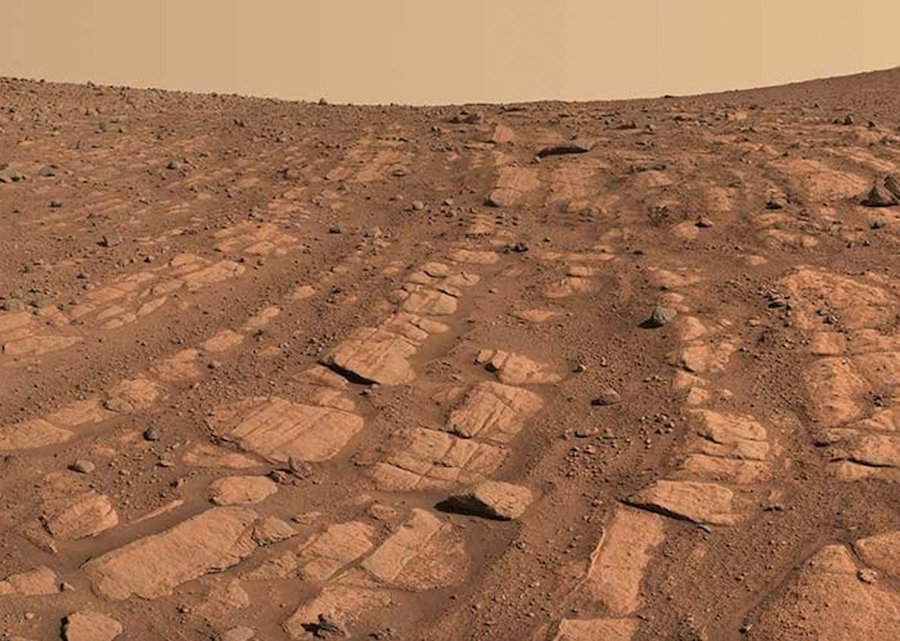
Scientists think that these bands of rock may have been formed by a deep, fast-flowing river — the first time such evidence has been found on Mars. NASA's Perseverance Mars rover captured this scene at a location nicknamed "Skrinkle Haven" using its Mastcam-Z camera between Feb. 28 and March 9, 2023. (Image credit: NASA/JPL-Caltech/ASU/MSSS)
Ancient Mars may have had its share of raging rivers.
There are plenty of signs that liquid water flowed on the Red Planet long ago. But most of that evidence points to lakes, oceans or relatively gentle streams, such as the ancient creeks uncovered by NASA's Curiosity rover in Mars' huge Gale Crater.
But Curiosity's younger cousin Perseverance, which is been exploring a different Mars crater called Jezero, has rolled up on a long-dead riverbed that looks completely different. This one features coarse grains and cobbles, bulky stuff that couldn't be displaced by a mere trickle.
"Those indicate a high-energy river that's truckin' and carrying a lot of debris," Libby Ives, a postdoctoral researcher at NASA's Jet Propulsion Laboratory (JPL) in Southern California, which operates Perseverance, said in a statement(opens in new tab) on Thursday (May 11). "The more powerful the flow of water, the more easily it's able to move larger pieces of material."
NASA's Perseverance Mars rover captured this mosaic of a hill nicknamed "Pinestand." Mission scientists think the tall sedimentary layers stacked on top of one another here could have been formed by a deep, fast-moving river. (Image credit: NASA/JPL-Caltech/ASU/MSSS)
Perseverance gathered some of this newfound evidence at a spot the mission team calls Skrinkle Haven (apparently in a nod to a beach in England(opens in new tab)). The site features curving bands of layered rock, which were almost certainly formed by powerfully flowing water, NASA officials said.
But the nature of the river that sculpted this landscape remains a matter of some debate. It may have been a snaking river whose banks shifted over time, or a "braided" one marked by protruding sand bars, mission team members said.
In either scenario, the rock bands were likely much taller initially but were cut down to their present size by the sandblasting Martian wind.
"The wind has acted like a scalpel that has cut the tops off these deposits," Perseverance science team collaborator Michael Lamb, a river specialist based at the California Institute of Technology in Pasadena, said in the same statement.
"We do see deposits like this on Earth, but they're never as well exposed as they are here on Mars," Lamb added. "Earth is covered in vegetation that hides these layers."
Further potential evidence of fast-flowing ancient water comes from Pinestand, a hill that lies about 0.28 miles (0.45 kilometers) from Skrinkle Haven. Pinestand features sedimentary rock layers, some of which rise as high as 65 feet (20 meters).
"These layers are anomalously tall for rivers on Earth," Ives said. "But at the same time, the most common way to create these kinds of landforms would be a river."
The 28-mile-wide (45 km) Jezero hosted a big lake and a river delta long ago. Perseverance will continue exploring and characterizing this intriguing environment, which researchers think was capable of supporting Earth-like life long ago.
"What's exciting here is we've entered a new phase of Jezero's history. And it's the first time we're seeing environments like this on Mars," Perseverance Deputy Project Scientist Katie Stack Morgan of JPL said in the same statement. "We're thinking about rivers on a different scale than we have before."
Perseverance landed on Jezero's floor in February 2021, along with NASA's tiny Ingenuity helicopter. The rover is studying Jezero's geology, hunting for signs of past Mars life and collecting samples for future return to Earth.
Mike Wall is the author of "Out There(opens in new tab)" (Grand Central Publishing, 2018; illustrated by Karl Tate), a book about the search for alien life. Follow him on Twitter @michaeldwall(opens in new tab). Follow uson Twitter @Spacedotcom(opens in new tab) and on Facebook(opens in new tab).
Meer van UFO'S of UAP'S, ASTRONOMIE, RUIMTEVAART, ARCHEOLOGIE, OUDHEIDKUNDE, SF-SNUFJES EN ANDERE ESOTERISCHE WETENSCHAPPEN - DE ALLERLAATSTE NIEUWTJES


 Unprecedented UFO Sighting Over Deerfield Beach: A Cosmic Ballet at Dawn