Ontdek de Fascinerende Wereld van UFO's en UAP's: Jouw Bron voor Onthullende Informatie!
Ben jij ook gefascineerd door het onbekende? Wil je meer weten over UFO's en UAP's, niet alleen in België, maar over de hele wereld? Dan ben je op de juiste plek!
België: Het Kloppend Hart van UFO-onderzoek
In België is BUFON (Belgisch UFO-Netwerk) dé autoriteit op het gebied van UFO-onderzoek. Voor betrouwbare en objectieve informatie over deze intrigerende fenomenen, bezoek je zeker onze Facebook-pagina en deze blog. Maar dat is nog niet alles! Ontdek ook het Belgisch UFO-meldpunt en Caelestia, twee organisaties die diepgaand onderzoek verrichten, al zijn ze soms kritisch of sceptisch.
Nederland: Een Schat aan Informatie
Voor onze Nederlandse buren is er de schitterende website www.ufowijzer.nl, beheerd door Paul Harmans. Deze site biedt een schat aan informatie en artikelen die je niet wilt missen!
Internationaal: MUFON - De Wereldwijde Autoriteit
Neem ook een kijkje bij MUFON (Mutual UFO Network Inc.), een gerenommeerde Amerikaanse UFO-vereniging met afdelingen in de VS en wereldwijd. MUFON is toegewijd aan de wetenschappelijke en analytische studie van het UFO-fenomeen, en hun maandelijkse tijdschrift, The MUFON UFO-Journal, is een must-read voor elke UFO-enthousiasteling. Bezoek hun website op www.mufon.com voor meer informatie.
Samenwerking en Toekomstvisie
Sinds 1 februari 2020 is Pieter niet alleen ex-president van BUFON, maar ook de voormalige nationale directeur van MUFON in Vlaanderen en Nederland. Dit creëert een sterke samenwerking met de Franse MUFON Reseau MUFON/EUROP, wat ons in staat stelt om nog meer waardevolle inzichten te delen.
Let op: Nepprofielen en Nieuwe Groeperingen
Pas op voor een nieuwe groepering die zich ook BUFON noemt, maar geen enkele connectie heeft met onze gevestigde organisatie. Hoewel zij de naam geregistreerd hebben, kunnen ze het rijke verleden en de expertise van onze groep niet evenaren. We wensen hen veel succes, maar we blijven de autoriteit in UFO-onderzoek!
Blijf Op De Hoogte!
Wil jij de laatste nieuwtjes over UFO's, ruimtevaart, archeologie, en meer? Volg ons dan en duik samen met ons in de fascinerende wereld van het onbekende! Sluit je aan bij de gemeenschap van nieuwsgierige geesten die net als jij verlangen naar antwoorden en avonturen in de sterren!
Heb je vragen of wil je meer weten? Aarzel dan niet om contact met ons op te nemen! Samen ontrafelen we het mysterie van de lucht en daarbuiten.
Glowing Object Over Minnesota March 3, 2023, UFO Sighting News.
Date of sighting: March 3, 2023 Location of sighting: City unknown, Minnesota, USA
Watch this amazing and beautiful UFO as it moves across the Minnesota night sky last month. The eyewitness recorded a short video of it passing overhead, but they forgot to write down the city location in Minnesota. The UFO looks like a bright orange X as it moves quickly across the horizon. This alien craft is really moving fast, too fast to be a balloon, too slow and quiet to be a jet or plane. This is just a fantastic an rare close up catch of a real UFO.
Scott C. Waring - Taiwan
Eyewitness states:
Moving against the wind, no sound, steady speed, unsure how big or how far away.
Footage shows NASA satellite firing green laser beams to Earth
On Sept. 16, 2022, motion-sensing cameras set up by museum curator Daichi Fujii to capture meteors instead caught the laser beams of NASA's ICESat-2 satellite as it passed over Japan. It's the first time the ICESat-2 team has seen footage of the lasers at work in orbit.
The beams were synchronized with a tiny green dot that was briefly visible between the clouds. He guessed it was a satellite, so he investigated orbital data and got a match. NASA’s Ice, Cloud and Land Elevation Satellite 2, or ICESat-2, had flown overhead that night.
ICESat-2 was launched in September 2018 with a mission to use laser light to measure the height of Earth's ice, water, and land surfaces from space. The laser instrument, called a lidar, fires 10,000 times a second, sending six beams of light to Earth. It precisely times how long it takes individual photons to bounce off the surface and return to the satellite.
Now, this is an example of a common laser beam used to measure the height of the ice, water and land surface of the earth from space but it also indicates that they may have the knowledge to use such technology as an energy weapon to shoot laser beams or microwaves from space when it comes to warfare, to carry out a staged alien attack, such as the infamous Blue Beam project or to attack individuals or groups in which people become sick, causing the infamous 'Havana syndrome'.
The Unsolved Swedish UFO Mystery: An Encounter for the Ages
In November 1988, a strange event occurred in Sweden that left people baffled and questioning the existence of extraterrestrial life. Witnesses from different areas reported seeing a mysterious object in the sky, with descriptions that were eerily consistent. Decades later, this unsolved mystery continues to intrigue UFO enthusiasts and skeptics alike. In this article, we will delve into the fascinating story of the Swedish UFO encounter, exploring the various accounts and possible explanations for this mysterious sighting.
The Olafsons’ Encounter
The story begins with the Olafson family, who were driving home one evening when they noticed a bright light in the sky near a golf club. As they approached, the light became brighter and seemed to illuminate the entire area. Fearing for their safety, the family decided to retreat to the safety of their grandparents’ house.
Upon arriving at the grandparents’ house, the family discovered that their electronic devices, including their phone and television, were no longer working. Later, they found out that their closest neighbor, a couple of kilometers away, had also experienced similar issues with their electronics.
Despite the fear and confusion, the family bravely decided to return to the golf club to investigate the mysterious light further. However, once they arrived, the area was silent and there was no sign of the object they had seen earlier. They returned home with more questions than answers.
Multiple Witnesses
What makes this story even more intriguing is that the Olafsons were not the only ones to witness something strange that night. Other residents in the area reported seeing a mysterious, Zeppelin-shaped object with green and red lights hovering silently in the sky. These sightings were consistent across unrelated witnesses, suggesting that there was indeed a physical object in the sky that night.
UFO Sweden Investigation
The case caught the attention of UFO Sweden, an organization dedicated to investigating UFO and paranormal reports. They contacted defense authorities to inquire about any unusual radar activity that night, but received inconclusive responses. Some documents and reports from witnesses were allegedly lost or destroyed, further adding to the mystery.
Possible Explanations
As with any UFO sighting, there are several possible explanations to consider. Some have suggested that the object could have been a Zeppelin or airship, as there were reports of such aircraft being tested in the area at the time. However, the pilot of a known Zeppelin claimed they rarely flew during the winter months, and the descriptions provided by witnesses did not match the appearance of the Zeppelin in question.
Others have proposed the possibility of military experiments or spy activities, but these explanations seem unlikely given the conspicuous lights and attention the object drew to itself.
VIDEO:
The UFO That SCARED SWEDES in the 80s 👽🛸(Unsolved Mystery)
The Swedish UFO mystery remains unsolved to this day, with no definitive explanation for the strange object seen in the sky that night. The consistency in witness testimonies and the lack of plausible explanations make this case particularly intriguing. Whether the object was extraterrestrial or not, it serves as a reminder of the vast and unexplored mysteries that our world holds. As we continue to search for answers, stories like the Swedish UFO encounter remind us to keep an open mind and embrace the unknown.
Mysterious difficulties are still preventing the release of information related to the government’s hoarding and suppressing data about the first known interstellar object to land on Earth, nearly a year after U.S. Space Command confirmed that scientists had correctly identified it. Whereas, scientists provide an explanation for the trajectory of the most controversial “Oumuamua.”
Scientists Jennifer Bergner and Darryl Seligman submitted a paper, concluding that Oumuamua contained water and molecular hydrogen, which froze into ice due to the extreme cold of deep space. When the interstellar object entered the inner solar system and warmed up, the ice converted to its crystalline state, causing the H2 to be forced out and provide the propulsive push that explained the acceleration. The scientists ruled out nitrogen and carbon monoxide as possible explanations for the outgassing and acceleration because their levels were too low.
Dr. Avi Loeb said: “Oumuamua was not a Hydrogen-Water iceberg.” He submitted a new paper in collaboration with Thiem Hoang, challenging the surface temperature calculation of Oumuamua made by Bergner and Darryl in their recent paper published in Nature. He and Hoang argue that the calculation ignored the cooling effect of evaporating hydrogen, leading to an overestimation of the surface temperature by a factor of 9. The decrease in surface temperature limits the thermal annealing of water ice, further challenging the original model’s credibility.
Additionally, Dr. Loeb argues that Oumuamua’s lack of a visible coma, absence of carbon-based molecules or dust, and its unusual elongated shape, are all inconsistent with it being a generic comet. Dr. Loeb has previously proposed the possibility that Oumuamua is artificial in origin, which has sparked debates among experts.
In 2019, Amar Siraj and Dr. Loeb discovered an interstellar meteor near Papua New Guinea in 2014 and attempted to confirm their discovery. Relevant data had been collected by Department of Defense sensors, which were used to track nuclear explosions and was classified. In 2022, after delays, Space Command confirmed the researchers were correct about the meteor’s origin. This raised questions about why the government had suppressed information about the discovery for years.
According to this report, Motherboard filed a request under the Freedom of Information Act with different federal agencies seeking insight into why the government was not sharing data about alien bodies transiting our solar system. One request was filed with the Department of Energy in April 2022, and sought emails from two scientists at Los Alamos National Laboratory, who mentioned the terms asteroid, meteor, or debris. Motherboard requested expedited processing due to the public’s interest in the topic.
The Department of Energy informed Motherboard that the request had been forwarded to the National Nuclear Security Administration, and a government information specialist later informed Motherboard that they had not demonstrated a compelling need for expedited processing. The request’s estimated completion date was moved several times, and Motherboard was ultimately told there is no estimated completion date due to “a few difficulties that the NNSA’s Los Alamos Field Office and/or Lab will have to work out.”
There is no definite answer to why mainstream scientists are trying to diminish Dr. Loeb’s discovery of Oumuamua and his bold acceptance of extraterrestrials. However, in his recent blog post, he mentioned that he was visited by two government representatives from Washington DC, who assumed he was on the right path. Perhaps, he is right about some UFOs might be extraterrestrial. (Source)
“‘Am I wasting my time?’ I asked the two visitors who came all the way from Washington DC to my home a couple of days ago. ‘Not at all,’ they assured me,” writes Dr. Loeb. He further added: “There is, of course, a lingering possibility that I am naïve and UAP are smoke and mirrors. In that case, we will find out soon enough. This is why I asked my guests from DC whether I may be wasting my time. I have no access to classified data and the publicly available data is not convincing. But the known facts are intriguing enough to get me going. Just as the nature of dark matter inspired me to write many scientific papers as a theoretical astrophysicist.”
Dr. Loeb has written extensively about dark matter and other cosmic phenomena. However, he is now leading the Galileo Project, which aims to investigate unident ified aerial phenomena (UAP) and determine if any have an extraterrestrial technological origin. The author notes that the scientific community has not been open to exploring UAP in the same way they have been with dark matter, and that this is a problem.
He argues that new scientific knowledge is gained through high-quality data, and the path to this knowledge should not be hindered by academic intolerance or low-quality data. He also notes that UAP research is often hindered by unsubstantiated claims and low-quality data, and that the focus should be on collecting new high-quality data to determine the nature of UAP.
A recent poll conducted by Professor Brian Keating from the University of California, San Diego, shows that 51.1% of respondents believe that the first Oumuamua was of extraterrestrial technological origin, despite inconclusive scientific evidence.
According to Dr. Loeb, “three of the known four interstellar objects (ISOs) appear anomalous, namely the meteors IM1 and IM2 in their high material strength and Oumuamua in its non-gravitational acceleration without a visible cometary tail, is intriguing for those who maintain their childhood curiosity or beginner’s mind (Shoshin) of Zen Buddhism. This evidence is not intriguing for everyone. Some science journalists celebrated a Nature paper last week and chose to ignore a follow-up paper which demonstrated that the Nature paper violated energy conservation, in order ‘not to confuse their readers.'”
On March 7, 2023, Avi Loeb presented a paper co-authored with Dr. Sean Kirkpatrick, Director, All-domain Anomaly Resolution Office (AARO) of the Pentagon, stating that some UAPs could be small probes from an alien mothership. The paper describes physical constraints on UAPs using known forms of matter and radiation and states that the lack of radio signatures could indicate inaccurate distance measurements.
Dr. Loeb suggests that an artificial interstellar object could release many small probes during its close passage to Earth, which could reach Earth or other Solar system planets for exploration, and would be undetectable for existing survey telescopes but could be detected by deep space radars and space fences. The changes in arrival time and distance of the closest approach to Earth would manifest due to a small ejection speed far away, leading to a large deviation from the trajectory of the parent craft near the Sun.
In conclusion, the idea that Oumuamua and some UAPs could be of alien origin is a topic that continues to intrigue and spark debate among scientists and the general public. While some believe that the inconclusive scientific evidence does not support this claim, others like Dr. Loeb and Dr. Sean Kirkpatrick have presented research and theories that suggest the possibility of alien probes. As technology advances, it will be interesting to see if we can detect more evidence that could provide answers to this ongoing mystery.
A prototype robotic "mason" could fly on the Chang'e 8 lunar south pole mission.
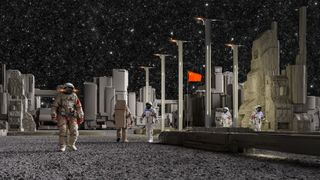
A notional illustration of a Chinese moon base.
(Image credit: gremlin/Getty Images)
China aims to test printing bricks from lunar regolith later this decade in a step towards constructing a permanent base on the moon.
The country's Chang'e 8 mission is scheduled to land on the moon around 2028 and will likely include in-situ resource utilization tests, or using resources found on the lunar surface. Scientists gathered at a conference in Wuhan this week confirm that they are looking at 3D printing bricks using materials from the lunar surface, China Science Daily reported(opens in new tab).
Ding Lieyun, a scientist at Huazhong University of Science and Technology, revealed a six-legged, insect-like robot prototype called a "super mason" which could put these printed bricks together in a similar fashion to Lego pieces, according to the report. "Eventually, building habitation beyond the earth is essential not only for all humanity’s quest for space exploration, but also for China's strategic needs as a space power," Ding told China Science Daily during the conference, according to(opens in new tab) a report by the South China Morning Post (SCMP).
The conference was the first dedicated to discussing approaches to building a crewed base, according to SCMP.
3D printing for space activities has been under consideration and testing for many years, with the European Space Agency working (opens in new tab)on making bricks with lunar regolith simulant, and Airbus set to send a metal 3D printer to the International Space Station. Such capabilities mean that items could be produced or replaced in space, rather than need to be launched from Earth, greatly reducing cost of exploration.
China is currently working on its next set of lunar missions, namely Chang'e 6, which will collect the first samples from the far side of the moon in 2025, and the multi-spacecraft Chang'e 7, which is scheduled to launch in 2026 and will search for water-ice in shadowed craters among other objectives.
Chang'e 8 will follow in 2028 and lay some of the groundwork for the larger ILRS project.
What do other world governments know about the UFO mystery? When the USSR collapsed in the early '90s, a brief window of opportunity opened. With the help of a well-connected Russian physicist, journalist George Knapp traveled to Moscow and interviewed high ranking Russian military officials and scientists about what might be the largest UFO study ever conducted. The witnesses, who had never before spoken with any journalist, confirmed the Russian military had conducted a ten-year nationwide investigation into UFOs and UFO technology. The Russians also knew plenty about what the US government had been doing with UFO investigations; Both governments had been lying to their citizens. In this episode, Jeremy and George dive into the Russian UFO files and we hear from some of the key witnesses associated with the Ministry of Defense program.
•••
In WEAPONIZED, Jeremy Corbell and George Knapp pull back the veil on the world of the known, to explore the unexplained. This multi-platform investigative series features exclusive interviews, never-before-seen footage, previously-suppressed documents, original audio and video recordings, and hard evidence related to UFOs, the paranormal, cutting-edge science, cover-ups, conspiracies, and big-time crimes. Original, groundbreaking conversations with government whistleblowers, spies, spooks, scientists, military officials, muckraking journalists, filmmakers, historians, artists, musicians, and major celebrities will cast a wide shadow through the other-world… and detail the human experiences that inform these extraordinary phenomena. Your curiosity will be WEAPONIZED.
ANGRY Starship Orbital Test Analysis - The rocket was a success, but serious problems remain!
Starship's first flight was perhaps the most impressive thing I've ever watched. However, once the dust and elation subsided, it became painfully obvious that Starship's launch facilities have serious problems that could have produced a devastating accident.
Important Mars Updates: 50th Flight, Strange Dunes, Electric Chemistry and More!
11:10 Crewed mission redesigned and may include Venus
Congress holds 2nd hearing on UFOs, UAPs in last 50 years
When you hear the term, do you think of ET or a more down-to-earth explanation? Are UFOs of the exotic origin or of Earth? That’s what lawmakers want to know.
The UFO/UAP video footage THE WORLD is talking about! A must see!
The UFO/UAP video footage THE WORLD is talking about! A must see!
The Antioquia UAP/UFO: A Closer Look
A closer look at the Antioquia, Colombia UAP video, revealing some harder-to-spot details. For those looking for the pilot's statements regarding the video: YouTube won't yet let me post links in the description (since the channel is so new), but search for this phrase on Google: "Jorge A. Arteaga, quien presuntamente grabó el video". You should find an article on a website called telemedellin. You'll need to translate it into English (or whichever language you prefer).
The Secret Truth & Strange Happenings Over At Dulce Base - New Mexico
Dulce Base in New Mexico is a top secret underground facility that's home to scores of alien visitors. They cooperate with U.S. military personnel in mutually beneficial experiments conducted on human beings. Allegedly, in exchange, alien technology is provided to the U.S. government and today you’ll hear the accounts of researchers, scientists and witnesses, as well as non-believers, relating to one of the most extraordinary alien conspiracy theories to date.
Ancient Aliens: Egyptian Mysteries Hide Proof of UFOs
These Ancient Egyptian mysteries will have you scratching your head... See more in this compilation from Ancient Aliens.
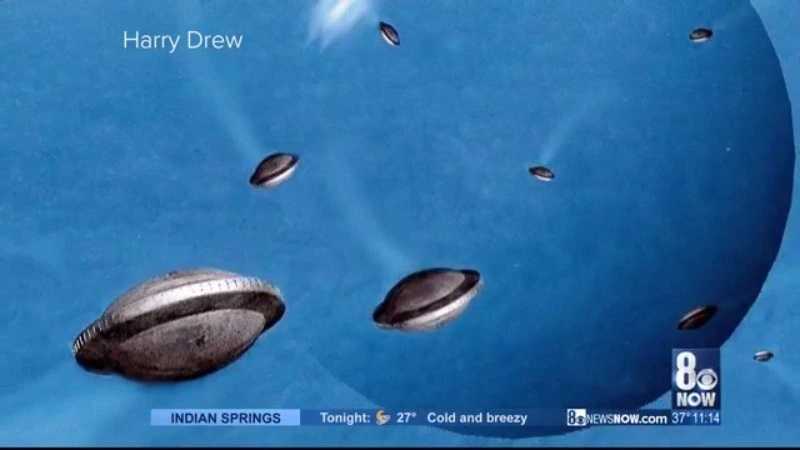
In 1953, the Atomic Energy Commission conducted a series of powerful explosions at the Nevada Test Site, known as “Upshot Knothole.” During the same period, witnesses reported seeing eight unidentified flying objects engaged in a dogfight near Arizona. Historian and former museum curator Harry Drew spent ten years investigating the incident and discovered that three of the craft had crashed on the outskirts of Kingman, Arizona in May 1953.
Drew did not expect to find evidence of the Kingman UFO and was surprised to learn about the third crashed craft. Mystery Wire reports he researched old records and interviewed original witnesses to uncover a complicated story that was more intricate than the Roswell UFO crash story.
In 1973, a retired Nevada Test Site technician named Arthur Stansel revealed that he and his team were taken to a remote desert location in Arizona to recover a secret experimental craft that had crashed. The team found a perfectly intact 40-foot diameter disc-shaped craft with four alien beings associated with it, and it was shipped to Groom Lake, Nevada, where Area 51 was later built around it.
An artist’s rendition of the 1953 Kingman UFO Crash. Credit: Harry Drew via Mystery Wire
In his book, “7 Days in May: The Kingman UFO Story,” Drew describes what happened to the three crashed crafts. One was destroyed when it crashed into a mountain near Kingman, another was found intact miles away from the crash site, and the third one crashed next to a small reservoir after clipping a rocky butte. The military took the last unknown craft back to a Nevada base. He found military-issued food containers dating back to 1953 around the exact crash site, proving that military teams camped there.
UFO enthusiasts have speculated that the Kingman UFO incident might be linked to the nuclear tests conducted in Nevada. However, Drew’s research suggests that the cause was a trio of powerful experimental radar sites set up around Kingman.
Drew claimed that he was able to document the crashes and the secret transport of the crafts to Nevada. He also asserted that one of the crafts was entirely intact when discovered. Despite the hotly contested nature of the story, Drew has evidence to support his findings.
According to MUFON researcher Richard Hall, in April 1964, the first report of a crash near Kingman was relayed to him by a future Vietnam commander. However, it was not until June 1973 that the case of the Kingman UFO retrieval was brought to the public’s attention by renowned UFO researcher Raymond Fowler.
The incident involved an engineer, Arthur G. Stancil (also known as “Fritz Werner”), who took preliminary measurements to assess the momentum of the crashed craft, which could prove useful in any reverse engineering attempts. Stancil, an Ohio University mechanical engineering graduate, who worked at Wright-Patterson Air Force Base in Dayton, Ohio, first made the story public.
Dr. Eric Wang, who was suspected of leading a reverse engineering team on alien craft, headed the Installations Division within the Office of Special Studies where Stancil worked. Stancil provided an affidavit in April 1976 vouching for the honesty of his testimony, which was released by Ray Fowler in the UFO Magazine. In his statement, Stancil revealed that he was loaned out to the Atomic Energy Commission and designated as a project engineer on some atomic bomb tests referred to as “Operation Upshot Knothole.”
The craft was reported to have a brushed aluminum exterior finish, measuring approximately 30 feet in diameter, and contained two swivel seats, instruments, and display panels. The hatch was five feet high and three feet wide. Additional reports from the book “Majic Eyes Only,” written by Ryan S. Wood, indicate that the craft was embedded 20” into the desert sand on impact
Re-Engineered UFO And Four Aliens
There are varying reports about the number of extraterrestrial biological entities (EBEs) recovered at the crash site. Some sources claim that four small EBEs were recovered, while others state that only one was found. Despite these discrepancies, there is evidence to suggest that a military blockade was set up along Highway 40, possibly in 1953, to secure the area leading to and from the potential crash site.
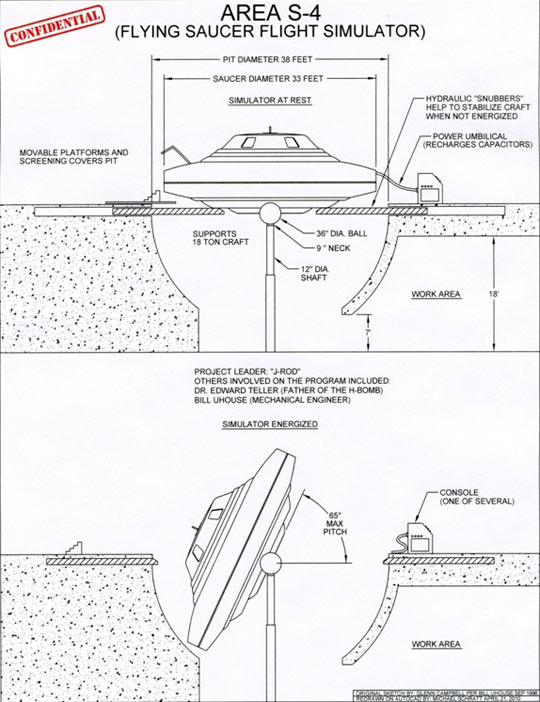
It is unclear whether the military recovered objects of extraterrestrial origin and transported them to a clandestine hangar, but there are reports of crashed discs being housed at a top-secret facility known as Area S-4, located 12 miles south of Area 51.
According to Wendelle Stevens, a retired US Air Force pilot-turned-UFO researcher, the disc that crashed near Kingman was transported to Area 51 via a U.S. Army tank transporter. The recovery crew attempted to tilt the craft on end to facilitate transportation across the country but abandoned this procedure when it became clear that it was impossible. Telephone poles had to be removed when the main road intersected with unimproved surfaces or dirt roads due to the oversized load of the disc on the trailer.
Bill Uhouse, a retired mechanical engineer, claimed to have been part of a top-secret program to design and build flight simulators used to teach American test pilots how to control flying saucers. He stated that the origin of the program came from the UFO crash at Kingman.
Mr. Uhouse claimed to have served in the Marine Corps and Air Force for a total of 14 years as a fighter pilot and flight tester of experimental aircraft. Later in his career, he worked as an engineer for defense contractors, focusing on antigravity propulsion systems and flight simulators for exotic aircraft, as well as actual flying discs.
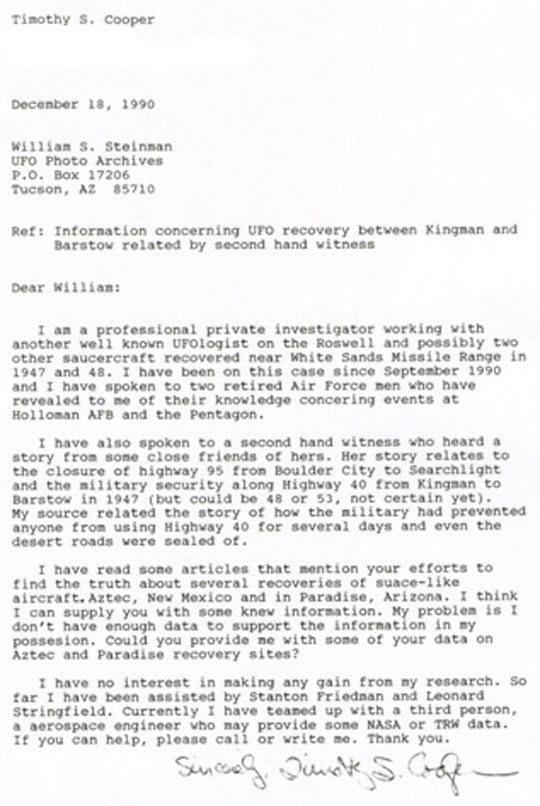
A letter written by investigator Timothy Cooper to UFO researcher Wendelle Stevens dated December 18 1990, may provide additional confirmation to rumored Kingman UFO crash
According to his testimony, the first disc they tested was a re-engineered ET craft. Mr. Uhouse was invited to work on a flying disc simulator by an unknown man. He was reassigned to link aviation and worked on building the F-102 simulator and B-47 simulator. He claimed that extraterrestrials presented a craft to the US government which was taken to Area 51, and the four ETs were taken to Los Alamos. His specialty was the flight deck and instruments, and he met with an ET called J-rod who helped engineers with the craft’s engineering.
“There was only one of them (alien) that would talk to scientists in the lab with them and the rest wouldn’t talk to anybody or even have a conversation with them. First, they thought it was mental telepathy but it is kind of a joke to me because they actually speak maybe not like we do but uh they actually speak,” Mr. Uhouse said on Sirius Disclosure.
In his 2013 interview, Mr. Uhouse discussed his work on a craft that was different from Bob Lazar’s alleged reactor. He explained that the simulator he worked on had six capacitors charged with a million volts each, which created a gravitational field that allowed the craft to lift off and turn left to right.
The craft had no windows, and visibility was through cameras, and there were no seat belts as the craft had its own gravitational field. Uhouse mentioned that it took a significant amount of training to operate the craft, and its design did not allow for the installation of external weapons like traditional aircraft. He also claimed that Area-51’s secrecy was due to a peace pact signed between the US and the United Nations during the time of President Eisenhower.
In 1977, UFO researcher Len Stringfield shared another account supporting the Kingman UFO crash. According to this new story, a man who served in the National Guard at Wright Patterson claimed to have witnessed the delivery of three bodies packed in dry ice, measuring four feet tall with large heads and brownish skin. The bodies were reportedly recovered from a crash site in Arizona in 1953. Since then, several other witnesses have come forward, but further details are currently unavailable. (Source)
Interestingly, UFO expert Charles Wilhelm heard a strikingly similar story in 1966 from a man who claimed that his father had shared the account on his deathbed. In 1995, an individual who went by the name of Jarod-2 contacted The Groom Lake Desert Rat, an Internet publication, and revealed that he had worked on a secret project for the USAF. The project aimed to construct a flying saucer simulator and had gathered materials from the Roswell and Kingman crash sites.
Several AI tools aim to summarize scientific findings to help researchers.
Credit: Dimitri Otis/Getty
As large language models (LLMs) gallop ever onwards — including GPT-4, OpenAI’s latest incarnation of the technology behind ChatGPT— scientists are beginning to make use of their power. The explosion of tools powered by artificial intelligence (AI) includes several search engines that aim to make it easier for researchers to grasp seminal scientific papers or summarize a field’s major findings. Their developers claim the apps will democratize and streamline access to research.
But some tools need more refinement before researchers can use them to help their studies, say scientists who have experimented with them. Clémentine Fourrier is a Paris-based researcher who evaluates LLMs at Hugging Face, a company in New York City that develops open-source AI platforms. She used an AI search engine called Elicit, which uses an LLM to craft its answers, to help find papers for her PhD thesis. Elicit searches papers in the Semantic Scholar database ad identifies the top studies by comparing the papers’ titles and abstracts with the search question.
Variable success
Fourrier says that, in her experience, Elicit didn’t always pick the most relevant papers. The tool is good for suggesting papers “that you probably wouldn’t have looked at”, she says. But its paper summaries are “useless”, and “it’s also going to suggest a lot of things that are not directly relevant”, she adds. “It’s very likely that you’re going to make a lot of mistakes if you only use this.”
Jungwon Byun, chief operating officer at Ought, the company in San Francisco, California, that built Elicit, says: “We currently have hundreds of thousands of users with diverse specializations so Elicit will inevitably be weaker at some queries.” The platform works differently from other search engines, says Byun, because it focuses less on keyword match, citation count and recency. But users can filter for those things.
Other researchers have had more positive experiences with the tool. “Elicit.org is by far my favourite for search,” says Aaron Tay, a librarian at Singapore Management University. “It is close to displacing Google Scholar as my first go-to search for academic search,” he says. “In terms of relevancy, I had the opposite experience [to Fourrier] with Elicit. I normally get roughly the same relevancy as Google Scholar — but once in a while, it interprets my search query better.”
These discrepancies might be field-dependent, Tay suggests. Fourrier adds that, in her research area, time is critical. “A year in machine learning is a century in any other field,” she says. “Anything prior to five years is completely irrelevant,” and Elicit doesn’t pick up on this, she adds.
Full-text search
Another tool, scite, whose developers are based in New York City, uses an LLM to organize and add context to paper citations — including where, when and how a paper is cited by another paper. Whereas ChatGPT is notorious for ‘hallucinations’ — inventing references that don’t exist — scite and its ‘Assistant’ tool remove that headache, says scite chief executive Josh Nicholson. “The big differentiator here is that we’re taking that output from ChatGPT, searching that against our database, and then matching that semantically against real references.” Nicholson says that scite has partnered with more than 30 scholarly publishers including major firms such as Wiley and the American Chemical Society and has signed a number of indexing agreements — giving the tool access to the full text of millions of scholarly articles.
Nicholson says that scite is also collaborating with Consensus — a tool that “uses AI to extract and distill findings” directly from research — launched in 2022 by programmers Eric Olson and Christian Salem, both in Boston, Massachusetts. Consensus was built for someone who’s not an expert in what they’re searching for, says Salem. “But we actually have a lot of researchers and scientists using the product,” he adds.
Like Elicit, Consensus uses Semantic Scholar data. “We have a database of 100-million-plus claims that we’ve extracted from papers. And then when you do a search, you’re actually searching over those claims,” says Olson. Consensus staff manually flag contentious or disproven claims — for example, that vaccines cause autism, says Olson. “We want to get to a state where all of that is automated,” says Salem, “reproducing what an expert in this field would do to detect some shoddy research.”
Room for improvement
Meghan Azad, a child-health paediatrician at the University of Manitoba in Winnipeg, Canada, asked Consensus whether vaccines cause autism, and was unconvinced by the results, which said that 70% of research says vaccines do not cause autism. “One of the citations was about ‘do parents believe vaccines cause autism?’, and it was using that to calculate its consensus. That’s not a research study giving evidence, yes or no, it’s just asking what people believe.”
Mushtaq Bilal, a postdoc at the University of Southern Denmark in Odense, tests AI tools and tweets about how to get the most out of them. He likes Elicit, and has looked at Consensus. “What they’re trying to do is very useful. If you have a yes/no question, it will give you a consensus, based on academic research,” he says. “It gives me a list of the articles that it ran through to arrive at this particular consensus,” Bilal explains.
Azad sees a role for AI search engines in academic research in future, for example replacing the months of work and resources required to pull together a systematic review. But for now, “I’m not sure how much I can trust them. So I’m just playing around,” she says.
Students at Carnegie Mellon University are sending America's first robotic lunar rover to the moon this May, beating NASA to the punch by about a year.
An artist's illustration of the Orion spacecraft orbiting the moon.
(Image credit: NASA/Liam Yanulis)
After 65 years of lunar exploration, the United States is finally going to put its first autonomous rover on the moon. But this mission won't be helmed by NASA engineers — instead, it is the brainchild of a dedicated group of college students.
The Iris rover was developed by students, faculty and alumni at Carnegie Mellon University in Pennsylvania over the span of three years. It is being carried to the moon as part of NASA's Commercial Lunar Payload Services (CLPS) program, the agency's foray into partnering with the commercial space industry.
Initially, it was scheduled to launch in late 2021 or early 2022, but setbacks in NASA's moon agenda delayed the launch to this spring.
The mission represents America's first robotic moon rover (NASA's VIPER rover is scheduled to launch next year), as well as the first rover to be developed by university students. (NASA famously launched astronaut-driven "moon buggies" on the final three Apollo missions.)
The 4.4-pound (2-kilogram) Iris has a chassis as big as a shoebox, and its carbon-fiber wheels are shaped like bottle caps. Its 60-hour-long mission will be a primarily visual one: Snapping images of the moon's surface for geographic study. It will also test new localization techniques as it transmits data about its position back to Earth.
In addition to Iris, the Carnegie Mellon team plans to send along an art installation called the MoonArk, a tiny time capsule filled with poems, music, pictures and small objects. The project is meant to convey a narrative "that is moving to people now, but also 1,000 years down the road," Dylan Vitone(opens in new tab), an associate professor at Carnegie Mellon and the MoonArk director, said in a statement(opens in new tab). A second, identical ark is currently on display at the Smithsonian National Air and Space Museum.
MoonArk and its pint-sized rover companion will hitch a ride to space aboard United Launch Alliance's Vulcan Centaur rocket, and be shuttled down to the lunar surface by Pittsburgh-based space company Astrobotic's Peregrine lander. The launch is scheduled for no earlier than May 4 — which, fittingly, the internet has christened international Star Wars Day — from Cape Canaveral Space Force Station in Florida.
"Hundreds of students have poured thousands of hours into Iris," Raewyn Duvall, a research associate at Carnegie Mellon University and commander of the mission said in a statement(opens in new tab). "We've worked for years toward this mission, and to have a launch date on the calendar is an exciting step."
Follow us on Twitter @Spacedotcom(opens in new tab) or Facebook(opens in new tab).
Meer van UFO'S of UAP'S, ASTRONOMIE, RUIMTEVAART, ARCHEOLOGIE, OUDHEIDKUNDE, SF-SNUFJES EN ANDERE ESOTERISCHE WETENSCHAPPEN - DE ALLERLAATSTE NIEUWTJES


 Glowing Object Over Minnesota March 3, 2023, UFO Sighting News.