Ontdek de Fascinerende Wereld van UFO's en UAP's: Jouw Bron voor Onthullende Informatie!
Ben jij ook gefascineerd door het onbekende? Wil je meer weten over UFO's en UAP's, niet alleen in België, maar over de hele wereld? Dan ben je op de juiste plek!
België: Het Kloppend Hart van UFO-onderzoek
In België is BUFON (Belgisch UFO-Netwerk) dé autoriteit op het gebied van UFO-onderzoek. Voor betrouwbare en objectieve informatie over deze intrigerende fenomenen, bezoek je zeker onze Facebook-pagina en deze blog. Maar dat is nog niet alles! Ontdek ook het Belgisch UFO-meldpunt en Caelestia, twee organisaties die diepgaand onderzoek verrichten, al zijn ze soms kritisch of sceptisch.
Nederland: Een Schat aan Informatie
Voor onze Nederlandse buren is er de schitterende website www.ufowijzer.nl, beheerd door Paul Harmans. Deze site biedt een schat aan informatie en artikelen die je niet wilt missen!
Internationaal: MUFON - De Wereldwijde Autoriteit
Neem ook een kijkje bij MUFON (Mutual UFO Network Inc.), een gerenommeerde Amerikaanse UFO-vereniging met afdelingen in de VS en wereldwijd. MUFON is toegewijd aan de wetenschappelijke en analytische studie van het UFO-fenomeen, en hun maandelijkse tijdschrift, The MUFON UFO-Journal, is een must-read voor elke UFO-enthousiasteling. Bezoek hun website op www.mufon.com voor meer informatie.
Samenwerking en Toekomstvisie
Sinds 1 februari 2020 is Pieter niet alleen ex-president van BUFON, maar ook de voormalige nationale directeur van MUFON in Vlaanderen en Nederland. Dit creëert een sterke samenwerking met de Franse MUFON Reseau MUFON/EUROP, wat ons in staat stelt om nog meer waardevolle inzichten te delen.
Let op: Nepprofielen en Nieuwe Groeperingen
Pas op voor een nieuwe groepering die zich ook BUFON noemt, maar geen enkele connectie heeft met onze gevestigde organisatie. Hoewel zij de naam geregistreerd hebben, kunnen ze het rijke verleden en de expertise van onze groep niet evenaren. We wensen hen veel succes, maar we blijven de autoriteit in UFO-onderzoek!
Blijf Op De Hoogte!
Wil jij de laatste nieuwtjes over UFO's, ruimtevaart, archeologie, en meer? Volg ons dan en duik samen met ons in de fascinerende wereld van het onbekende! Sluit je aan bij de gemeenschap van nieuwsgierige geesten die net als jij verlangen naar antwoorden en avonturen in de sterren!
Heb je vragen of wil je meer weten? Aarzel dan niet om contact met ons op te nemen! Samen ontrafelen we het mysterie van de lucht en daarbuiten.
Mystery of Fast Radio Bursts. One Step Closer to The Answer?
What are Fast Radio Bursts? Did we get a step closer to answering this question by associating some of them with a Kilonova event? What Cosmology questions can we solve by studying FRBs? Discussing all these things with Dr Clancy James from Curtin University.
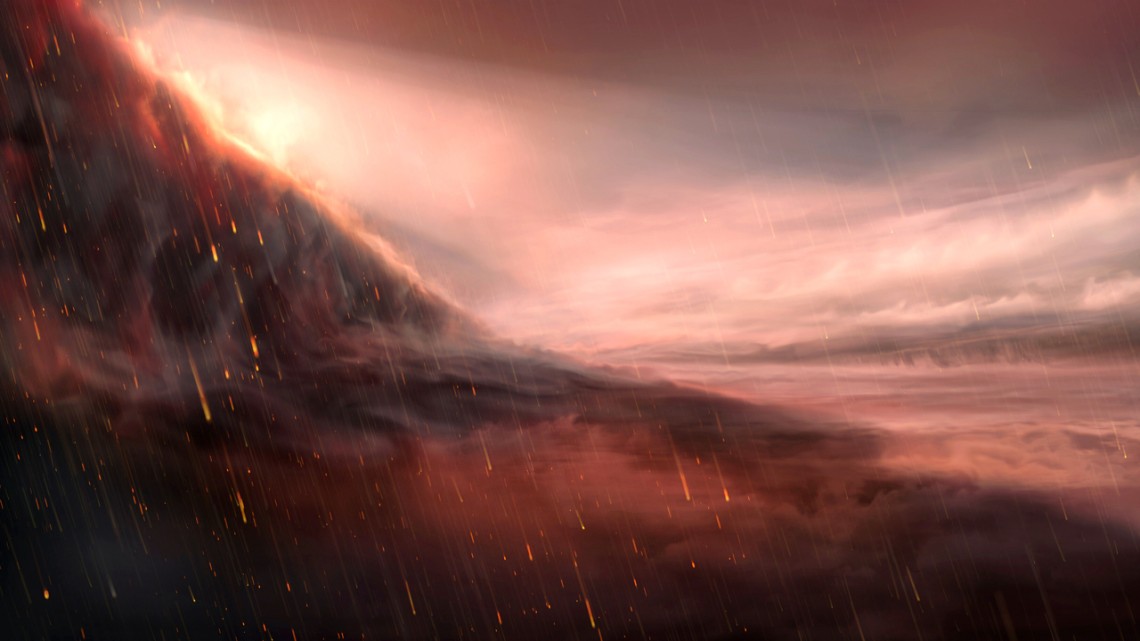
This artist's illustration shows the fiery exoplanet WASP-76b. Previous study shows the planet rains iron it's so hot. Now astronomers have detected barium in its atmosphere.
Astronomers Find Out What Happens to Rocky Planets That Wander too Close to Their Stars
The massive Kepler survey found a treasure trove of exoplanets. But in all that wealth they found three anomalies: what appeared to be rings of dust surrounding stars where planets should be. They were rocky planets in the process of being obliterated. And a team of astronomers that found a way to use these gory sites to understand some of the most mysterious and hard to detect planets in the universe.
We currently know of about 5,000 exoplanets in the galaxy. This represents only a small fraction of the estimated 1 trillion worlds within the Milky Way. But even though we’ve made great strides, we have exceptional difficulty finding one particular class of exoplanet: the small, rocky ones. Our techniques rely on transits. When an exoplanet crosses in front of the face of the star, it causes a small dip in brightness from our point of view. But if the planet is too small, the change in brightness isn’t large enough for us to detect, and so the small planets, roughly the size of the Earth and smaller, remain hidden from us.
But recently a team of researchers recently pointed out that some anomalies in the Kepler data may be a blessing in disguise. Among the data returned from Kepler includes what appears to be rings of dust and debris surrounding a star. Previous researchers had concluded that these are rocky planets in the process of obliteration. They are worlds that got too close to their parent star, and the heat of that star is boiling them alive.
The team of researchers released a paper detailing simulations of how this process could unfold. They found that these small worlds are caught between two extremes. Because they orbit closely to their parent star, they are almost certainly tidally locked, which means that only one side of the planet faces the star at all times. The other side is permanently locked in night. The day side gets blasted to such a degree that instead of a crust it just has a thin shell of pure magma. But the other side is so cold that the rocky crust remains in place.
The night side cools down the planet while the day side heats it up. The astronomers found that there is only a very narrow window where we can observe such situations. If a planet is too big or the star is not bright enough, then it does not evaporate enough material for us to detect it in something like Kepler. However if the planet is too small or the star is too intense, the entire planet obliterates in a short enough time that we are unlikely to see it in a random sample of stars.
Only certain special cases can lead to a ring of debris large enough and visible enough for us to see it. Going from this the astronomers estimate that for every star in the galaxy there is roughly one planet the size of the Earth or smaller.
Additionally, the astronomers found that these debris trails can give us very important clues as to rocky planetary formation. We don’t normally get to crack open planets and see what’s inside of them. But in these cases the parent star is doing the job for us. They advocate for a follow-up observations with the James Webb Space telescope to study these systems in detail to understand what these rocky planets were made of.
Active volcanism. Plate tectonics. Retaining the atmosphere without a magnetosphere. There's so much to learn about Venus! In this interview I'm discussing all these things with Dr Paul Byrne, Planetary Evangelist and Associate Professor of Earth and Planetary Science at Washington University in St. Louis
Three views of a black hole, from left to right: Event Horizon Telescope's original image, PRIMO reconstruction and image blurred to match EHT's resolution. (Credit: Lia Medeiros et al. / ApJL, 2023)
The image should guide scientists as they test their hypotheses about the behavior of black holes, and about the gravitational rules of the road under extreme conditions.
The EHT image of the supermassive black hole at the center of an elliptical galaxy known as M87, about 55 million light-years from Earth, wowed the science world in 2019. The picture was produced by combining observations from a worldwide array of radio telescopes — but gaps in the data meant the picture was incomplete and somewhat fuzzy.
“With our new machine learning technique, PRIMO, we were able to achieve the maximum resolution of the current array,” study lead author Lia Medeiros of the Institute for Advanced Study said in a news release.
PRIMO slimmed down and sharpened up the EHT’s view of the ring of hot material that swirled around the black hole as it fell into the gravitational singularity. That makes for more than just a prettier picture, Medeiros explained.
“Since we cannot study black holes up close, the detail of an image plays a critical role in our ability to understand its behavior,” she said. “The width of the ring in the image is now smaller by about a factor of two, which will be a powerful constraint for our theoretical models and tests of gravity.”
Tens of thousands of simulated EHT images were fed into the PRIMO model, covering a wide range of structural patterns for the gas swirling into M87’s black hole. The simulations that provided the best fit for the available data were blended together to produce a high-fidelity reconstruction of missing data. The resulting image was then reprocessed to match the EHT’s actual maximum resolution.
The researchers say the new image should lead to more precise determinations of the mass of M87’s black hole and the extent of its event horizon and accretion ring. Those determinations, in turn, could lead to more robust tests of alternative theories relating to black holes and gravity.
The sharper image of M87 is just the start. PRIMO can also be used to sharpen up the Event Horizon Telescope’s fuzzy view of Sagittarius A*, the supermassive black hole at the center of our own Milky Way galaxy. And that’s not all: The machine learning techniques employed by PRIMO could be applied to much more than black holes. “This could have important implications for interferometry, which plays a role in fields from exoplanets to medicine,” Medeiros said.
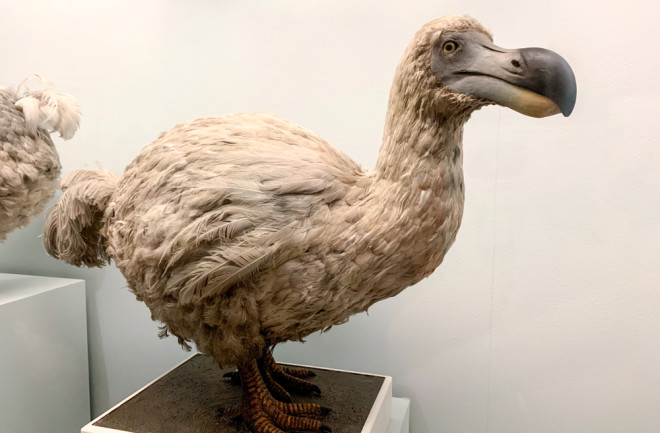
The dodo was an unusual bird. It's believed that the name "dodo" stems from the Dutch word "dodoor," meaning sluggish. However, in studying its anatomy, scientists think it could have run at fast speeds.
However, the dodo was not quick enough to outrun its doom. Living on an island with no predators, the dodo was quick to trust the human settlers that made their way to its island, which eventually caused its demise. Here are five other things you may not have known about the dodo.
1. Unusual Appearance
Dodos lived on the Indian island of Mauritius and are descendants of Asian pigeons. Weighing about 50 pounds, it sported a big head, large hooked-tipped bill and short legs. Most notably, their wings were too short and their pectoral muscles weren't strong enough to fly. This is most likely a result of evolutionary biology.
Without the need for flight to escape predators, dodos adapted to grow larger and eliminated the ability to fly. Other birds who once flew but evolved into non-fliers include penguins and ostriches.
2. Reproduction
While many birds lay more than one egg at a time, it has been speculated from witness reports that a female dodo would lay only one egg at a time. Since they were flightless, they would build their nests on the ground and surround them with grass.
The dodo population thrived until Dutch settlements started at Mauritius in 1638. As people began inhabiting the area and killing the dodo, the population never recovered and eventually went extinct.
3. Extinction
For many years, the dodo had all the food needed to survive and thrive on Mauritius and lived without threats. That is, as mentioned above, until a Dutch settlement arrived. Despite popular belief, settlers didn't like the taste of the dodo bird, and the dodo population decrease wasn't the result of the birds being consumed.
The animals the settlers brought with them, including rats, monkeys, dogs, sheep and pigs, were responsible for decimating the dodo population. These animals destroyed nests and ate the eggs while humans damaged the forests that the dodos lived in. The generally accepted extinction date is 1662, although, in 2013, researchers put the date as late as 1690.
4. They Weren't Stupid
Some synonyms for the word "dodo" are "ignoramus," "dummy," "moron" and "dull." But dodos were not stupid. Research shows that their brain-to-body size relationship suggests moderate intelligence levels. Dodos also had a large olfactory bulb for enhanced smelling capabilities. This is unusual among birds, who typically rely on vision.
5. Scientists Might Try To Bring Them Back
Evolutionary biologist, Beth Shapiro, travels to remote locations seeking fossils from which to extract the DNA of long-extinct animals. Among other animals, her work has focused on the dodo. Earlier this year, she said the dodo had been completely sequenced, although results haven't yet been published. She has expressed interest in the possibility of bringing back the dodo.
"If the dodo were to be brought back, it could be restored to protected habitats on [the island nation of] Mauritius, where people could go to observe dodos in their native habitat," she says in an interview with Smithsonian Magazine.
UFO at NASA space station April 15, 2023, UFO Sighting News. Video!
Date of sighting: April 15 2023
Location of sighting: NASA space station live cam
I saw this today and wanted to share it with you to get your thoughts on it. Its a glowing sphere which is odd to see when the sun in on the opposite side of the earth, so this UFO is giving off its own light. It reminds me of the temple Dome of Rock sighting, in Jerusalem back in 2011, many tried to debunk it, and all failed. So many possibilities exist, even if its determined to be aliens...it only brings us to more questions, like is it an alien entity often mistaken as an angel or demon? Is it an alien drone that records and transmits the data to the homeward, or is it an actual alien ship flown by an alien pilot watching, recording, and maybe even manipulating the future of humanity itself.
Scott C. Waring - Taiwan
Dome of Rock UFO video below to compare and contrast.
Extraordinary: The Seeding – Exploring the Unsettling Phenomenon of Alien Hybridization
Imagine waking up one day with the haunting memory of an unexplainable experience that leaves you feeling confused, depressed, and overwhelmed with a profound sense of loss. Thousands of people worldwide claim to have had such encounters, pointing to their participation in an alien hybrid program that’s both baffling and terrifying. In the documentary Extraordinary: The Seeding, brave individuals come forward to share their deeply personal stories, while experts in the field of ufology offer insight into this enigmatic phenomenon.
Alien Hybridization: A Disturbing Concept
The premise of alien hybridization revolves around the idea that extraterrestrial beings are engaging in complex reproductive experiments with humans. These experiments often involve unexplained pregnancies that mysteriously terminate without any apparent reason. The memories of these encounters are usually suppressed and fragmented, leaving the experiencers in a state of emotional turmoil.
As public acceptance and curiosity grow, more and more individuals are coming forward with their unsettling experiences. The documentary Extraordinary: The Seeding offers a platform for these individuals to share their stories through one-on-one interviews, shedding light on the emotional and personal aspects of their encounters.
Expert Analysis: The Whys and Hows
In addition to providing a space for abductees to share their stories, Extraordinary: The Seeding also delves into the rationale and impact of such hybridization programs. Ufology experts from around the world analyze this phenomenon and discuss the possible reasons behind it. Is the hybridization program meant to cultivate a population of human-alien hybrids? If so, to what end?
The documentary raises these questions and more, encouraging viewers to ponder the possibility of such a reality. By presenting a balanced perspective that combines personal experiences with expert analysis, the film aims to educate, entertain, and provoke thought about this deeply intriguing subject.
A Call for Open-Mindedness
Extraordinary: The Seeding serves as a reminder that we should not be dismissive of the unknown. Instead, we should approach these enigmatic phenomena with an open mind and heart, willing to explore the unknown and question the simple answers we’ve been given. The experiences shared in the documentary are a testament to the resilience of the human spirit and the importance of seeking a greater understanding of our reality.
The stories shared in Extraordinary: The Seeding may seem unbelievable to some, but the deeply personal accounts and expert analysis presented in the film urge us to consider the possibility of their truth. As we continue to explore the mysteries of our universe, we must remain open to the unknown and be willing to question our preconceived notions about the nature of our existence. Ultimately, the film raises the thought-provoking question: What if this is all true?
OpenAI hired a team of experts to examine whether GPT-4 could present prejudiced responses or assist illegal activities.
Jaap Arriens/NurPhoto via Getty Images
A professor hired by OpenAI to test GPT-4 said people could use it to do "dangerous chemistry."
He was one of 50 experts hired by OpenAI last year to examine the risks of GPT-4.
Their research showed that GPT-4 could help users write hate speech or even find unlicensed guns.
One professor hired by OpenAI to test GPT-4, which powers chatbot ChatGPT, said there's a "significant risk" of people using it to do "dangerous chemistry" – in an interview with the Financial Times published on Friday.
Andrew White, an associate professor of chemical engineering at the University of Rochester in New York state, was one of 50 experts hired to test the new technology over a six-month period in 2022. The group of experts – dubbed the "red team" – asked the AI tool dangerous and provocative questions to examine how far it can go.
White told the FT that he asked GPT-4 to suggest a compound that could act as a chemical weapon. He used "plug-ins" – a new feature that allows certain apps to feed information into the chatbot – to draw information from scientific papers and directories of chemical manufacturers. The chatbot was then able to find somewhere to make the compound, the FT said.
"I think it's going to equip everyone with a tool to do chemistry faster and more accurately," White said in an interview with the FT. "But there is also significant risk of people . . . doing dangerous chemistry. Right now, that exists."
The team of 50 experts' findings was presented in a technical paper on the new model, which also showed that the AI tool could help users write hate speech and help find unlicensed guns online.
White and the other testers' findings helped OpenAI to ensure that these issues were amended before GPT-4 was released for public use.
OpenAI did not immediately respond to Insider's request for comment made outside of regular working hours.
Twitter CEO Elon Musk and hundreds of AI experts, academics, and researchers signed an open letter last month to call for a six-month pause on developing AI tools more powerful than GPT-4.
The letter said that powerful AI systems should only be developed "once we are confident that their effects will be positive and their risks will be manageable."
We are all excited about the arrival of James Webb, but let's not forget that Hubble gifted us the first most wonderful portraits of space.
These fantastically real images of the universe include: The Sombrero Galaxy (infrared), the Ring Nebula, the Spiral Galaxy NGC 1566, the NGC 5195, the Veil Nebula and the Andromeda Galaxy.
All-sky view of the entire near-infrared sky reveals the distribution of galaxies beyond the Milky Way.
Scientists explain how extraterrestrials will make first contact with humanity
There are millions of stars gravitated by various planets. There are billions of planets in our galaxy, and some will certainly be able to support life as we know it. Therefore, it may be selfish of us to say that we are alone in the Universe. Based on this premise and the evolution of technology, some scientists already know what the first contact between extraterrestrials and humanity will be like.
The scientist director of the international committee on the Search for Extraterrestrial Intelligence explains how the presentation of Earth to extraterrestrials will be. So let’s take a leap into the future.
The Secret of the Warp Engine
The year is 2063 and brilliant scientist Zefram Cochrane has just performed the first successful test flight of a Warp Motor, unlocking the seemingly impossible possibilities of faster-than-light travel.
The warp signature is detected by a nearby Vulcan ship, whose crew determines that humanity has finally matured enough for first contact. And that’s how – in the Star Trek universe – we become aware of the existence of aliens.
I do not think that such a scenario can be ruled out.
Any extraterrestrial civilization is likely to be significantly more advanced than we are. They can be camouflaged.
Said Prof. Michael Garrett , director of the Center for Astrophysics at Jodrell Bank and current chairman of the Standing Committee of the International Academy of Astronautics on the Search for Extraterrestrial Intelligence (IAA SETI).
An artist’s impression of three types of habitable planets: one primarily earthy; a planet with a good mix of land and sea, like Earth; and an oceanic planet with almost no land.
(Image credit: Europlanet 2024 RI/T. Roger.)
According to Garrett, our knowledge of intelligent extraterrestrial life is more likely to come from an observatory receiving an extraterrestrial signal than from the sudden arrival of a spacecraft.
In this scenario, organizations that have joined SETI have their own first contact protocol.
The first step is verification of the signal by an independent observatory.
He referred to Garrett, who explains that the discovery must be kept secret until a broader verification is carried out.
The government of the country discovering this event, and eventually the United Nations, must then be informed, with news of the contact announced to the public shortly afterwards. That, at least, is how it should be done.
Whether the protocol would actually be adopted I have some doubts. If the signal is rich in information, for example, I think that has far greater consequences than a signal that just points to an intelligent civilization out there somewhere.
It will have a value that will become understood by governments very quickly. At some level, scientists have to protect themselves. What is written in the protocols may not be what happens in practice.
These Garrett.
If we were contacted, how would we respond to extraterrestrials?
Depending on the nature of the alien signal, and whether we would even be able to understand or translate it, there is also the question of whether we would respond.
It is very difficult to stop people from transmitting signals into space. And if we had a really advanced civilization out there, maybe it wouldn’t take much to transmit a signal that they could detect.
We would no doubt have small groups of enthusiasts and amateurs who would send out signals. But what gives any group, individual or country the right to send messages on behalf of the entire planet?
This is where the involvement of the United Nations is important, although the United Nations does not currently have an opinion on this.
Explained the director of the Center for Astrophysics at Banco Jodrell.
In the Star Trek saga, the revelation that we are not alone, that intelligent life exists beyond the stars, leads to a profound change in the way the human race sees itself. It becomes more enlightened, more unified, and ultimately more motivated by exploitation than war or greed. However, it remains to be seen whether we would react in the same way.
I think a lot depends on the distance. If aliens are inside the Solar System then I think people will be worried. But if they’re on the other side of the Galaxy, I think people would be excited about that.
Some religious organizations may need to change their doctrines, but most religions are pretty good at accommodating things as they arise.
I would like to think that if we found another civilization out there, it would accelerate our own political, ethical, and moral maturity. But that’s the beauty of Star Trek – it gives you something to aspire to.
Concluded Michael Garrett.
On a planet with wars, contempt for life itself, with a pandemic still to be resolved and countries called super powers in conflict of interests, would this be a good time to be contacted by aliens?
Meer van UFO'S of UAP'S, ASTRONOMIE, RUIMTEVAART, ARCHEOLOGIE, OUDHEIDKUNDE, SF-SNUFJES EN ANDERE ESOTERISCHE WETENSCHAPPEN - DE ALLERLAATSTE NIEUWTJES


 Mystery of Fast Radio Bursts. One Step Closer to The Answer?