Naar de inhoud

UFO'S of UAP'S, ASTRONOMIE, RUIMTEVAART, ARCHEOLOGIE, OUDHEIDKUNDE, SF-SNUFJES EN ANDERE ESOTERISCHE WETENSCHAPPEN - DE ALLERLAATSTE NIEUWTJES

UFO's of UAP'S in België en de rest van de wereld
akke.beakke.be
Ontdek de Fascinerende Wereld van UFO's en UAP's: Jouw Bron voor Onthullende Informatie! Ben jij ook gefascineerd door het onbekende? Wil je meer weten over UFO's en UAP's, niet alleen in België, maar over de hele wereld? Dan ben je op de juiste plek! België: Het Kloppend Hart van UFO-onderzoek In België is BUFON (Belgisch UFO-Netwerk) dé autoriteit op het gebied van UFO-onderzoek. Voor betrouwbare en objectieve informatie over deze intrigerende fenomenen, bezoek je zeker onze Facebook-pagina en deze blog. Maar dat is nog niet alles! Ontdek ook het Belgisch UFO-meldpunt en Caelestia, twee organisaties die diepgaand onderzoek verrichten, al zijn ze soms kritisch of sceptisch. Nederland: Een Schat aan Informatie Voor onze Nederlandse buren is er de schitterende website www.ufowijzer.nl, beheerd door Paul Harmans. Deze site biedt een schat aan informatie en artikelen die je niet wilt missen! Internationaal: MUFON - De Wereldwijde Autoriteit Neem ook een kijkje bij MUFON (Mutual UFO Network Inc.), een gerenommeerde Amerikaanse UFO-vereniging met afdelingen in de VS en wereldwijd. MUFON is toegewijd aan de wetenschappelijke en analytische studie van het UFO-fenomeen, en hun maandelijkse tijdschrift, The MUFON UFO-Journal, is een must-read voor elke UFO-enthousiasteling. Bezoek hun website op www.mufon.com voor meer informatie. Samenwerking en Toekomstvisie Sinds 1 februari 2020 is Pieter niet alleen ex-president van BUFON, maar ook de voormalige nationale directeur van MUFON in Vlaanderen en Nederland. Dit creëert een sterke samenwerking met de Franse MUFON Reseau MUFON/EUROP, wat ons in staat stelt om nog meer waardevolle inzichten te delen. Let op: Nepprofielen en Nieuwe Groeperingen Pas op voor een nieuwe groepering die zich ook BUFON noemt, maar geen enkele connectie heeft met onze gevestigde organisatie. Hoewel zij de naam geregistreerd hebben, kunnen ze het rijke verleden en de expertise van onze groep niet evenaren. We wensen hen veel succes, maar we blijven de autoriteit in UFO-onderzoek! Blijf Op De Hoogte! Wil jij de laatste nieuwtjes over UFO's, ruimtevaart, archeologie, en meer? Volg ons dan en duik samen met ons in de fascinerende wereld van het onbekende! Sluit je aan bij de gemeenschap van nieuwsgierige geesten die net als jij verlangen naar antwoorden en avonturen in de sterren! Heb je vragen of wil je meer weten? Aarzel dan niet om contact met ons op te nemen! Samen ontrafelen we het mysterie van de lucht en daarbuiten.

Archief

Steven Spielberg Called himself UFOlogist & Said 2009 James Fox UFO Documentary Was ‘Compelling’

Steven Spielberg UFO

Steven Spielberg Called himself UFOlogist & Said 2009 James Fox UFO Documentary Was ‘Compelling’

Steven Spielberg is among the few commercially successful movie directors who has a great interest in the UFO phenomenon. He probably knows something intriguing about aliens and UFOs, and that is why he did the 1982 blockbuster “E.T.” and the 1972 “Close Encounters of the Third Kind.”

Spielberg expressed his thoughts on UFOs and extraterrestrials during a 2023 interview on “The Late Show with Steven Colbert.” While he admitted to never having seen a UFO himself, he stated his belief in those who have experienced unexplainable encounters:

“I think what has been coming up recently is fascinating, absolutely fascinating. And I think the secrecy that is shrouding all of these sightings and the lack of transparency… I think there is something going on that just needs extraordinary due diligence.”

When it comes to the possibility of extraterrestrial life, Spielberg firmly believes that we are not alone in the universe. He stated: “I don’t believe we’re alone in the universe. I think it’s mathematically impossible that we are the only intelligent species in the cosmos. I think that’s totally impossible.”

However, he is skeptical about the idea of interstellar travel: “At the same time, it also seems impossible that someone would visit us from 400 million lightyears from here — except in the movies, of course — unless it figures out some way of jumping the shark, so to speak, and getting here through wormholes.”

While he doubts that any beings have yet mastered faster-than-light travel, he believes that time travel may be a possibility for humans. Spielberg shared an engaging theory: “What if it’s us, 500,000 years in the future, that is coming back to document the second half of the 20th century and into the 21st century because they’re anthropologists? And they know something we don’t quite know yet that has occurred, and they’re trying to track the last hundred years of our history.”

Spielberg believes that the 1982 film had a valid point and suspects that the US government is hiding information about UFOs from the public. “I think the secrecy that is shrouding all of these sightings and the lack of transparency until the Freedom of Information Act compels certain materials to be released publicly, I think that there is something going on that simply needs extraordinary due diligence,” he said on “The Late Show With Stephen Colbert.”

In 2009, filmmaker James Fox, an advocate for government transparency on the subject of UFOs released a documentary titled “I Know What I Saw,” which explores reasons behind government secrecy and features credible witnesses from around the world testifying at the National Press Club event in November 2007. (Source)

Spielberg viewed the documentary and commented on it in a letter, but did not give permission for the comments to be made public at this time. Fox stated that Spielberg is an advocate of government transparency on the UFO phenomena. However, in 2013, Fox finally revealed the contents of a letter to Larry King regarding his UFO documentary.

The letter said:

Dear Larry,

With great curiosity, I watched the documentary you sent over and found it compelling. Personally, I would like to think we are not alone, and even though I have devoted a generous percentage of my movies to extraterrestrial related themes, I for one have never seen a UFO. That is so unfair! (sic)

I hope you will continue to pursue this topic on your program, and that some day our government will offer a total disclosure about what they know about unidentified flying objects and their true and natural origins.

I continue to enjoy watching you and all your guests.

All my best,

Signed: Steven

Fox expressed his disappointment in Spielberg’s lack of public endorsement for his film. According to him, Spielberg is someone who is aware of a cover-up and holds significant influence in the entertainment industry. In the movie “Close Encounters,” Spielberg included Dr. J. Allen Hynek as a nod to those familiar with the topic, suggesting that it was based on actual events. Despite this, Fox felt that Spielberg did not make a small effort to support an independent filmmaker like himself and help his movie succeed.

Very few people know about the secret conversation that happened between Spielberg and President Ronald Reagan about extraterrestrials and close encounters. According to Journalist Alejandro Rojas, during a special screening of ET at the White House in 1982, President Reagan did make a comment about everything in the movie being true.

Steven Spielberg UFO

Ronald and Nancy Reagan speaking with Spielberg after the screening of ET. image credit: Ronald Reagan Library

Reagan whispered to Spielberg that everything shown in the movie was real. It was confirmed by Spielberg while giving an interview to Quint (aka Eric Vespe).

Spielberg said:

“No, he wasn’t ushered out of the room. He was the President of the United States! Nobody could usher Ronald Reagan out of the room! It was in the White House screening room and Reagan got up to thank me for bringing the film to show the President, the First Lady, and all of their guests, which included Sandra Day O’Connor in her first week as a Justice of the Supreme Court, and it included some astronauts… I think Neil Armstrong was there, I’m not 100% certain, but it was an amazing, amazing evening.

He just stood up and he looked around the room, almost like he was doing a headcount, and he said, “I wanted to thank you for bringing E.T. to the White House. We really enjoyed your movie,” and then he looked around the room and said, “And there are a number of people in this room who know that everything on that screen is absolutely true.”

And he said it without smiling! But he said that and everybody laughed, by the way. The whole room laughed because he presented it like a joke, but he wasn’t smiling as he said it.

The room did laugh and then later on I’ll never forget my conversation with the President. He pulled me aside, he said… and I can’t do Reagan. I wish I could do that breathy, wonderful voice of his… And Nancy Reagan was standing right next to him and the President said to me, “I only have one criticism about your movie,” and I said “What’s that?” He said, “How long were the end credits?” I said, “Oh, I don’t know. Maybe three, three and a half minutes?” He said, “In my day, when I was an actor, our end credits were maybe 15 seconds long.”

He said, “Why don’t you let everybody get a credit… three and a half, four minutes, that’s fine, but only show that inside the industry, but throughout the rest of the country reduce your credits to 15 seconds at the end?” Nancy Reagan turned to him and said, “Oh, Ronny, they can’t do that. You know that.” And he went, “Oh, yes, yes. I suppose.” (laughs) That was the extent of my conversation about that. That was his only criticism, he felt the end credits were too long!

Spielberg was skeptical that President Reagan accidentally revealed anything important. He thought Reagan made a deliberate joke without any indication of humor. Although the joke was successful and garnered laughter from the audience, Spielberg, who called himself a UFOlogist, was hoping that there was a deeper meaning behind it. However, Spielberg ultimately concludes that Reagan was only trying to tell a joke.

{ https://www.howandwhys.com/ }

Hoe vind je dit bericht?
Geschreven door peter om 00:56 Stuur door

China Tests a Stirling Engine in Orbit

87d420bc4eb34fdb8a35c0743f66e35b.jpg

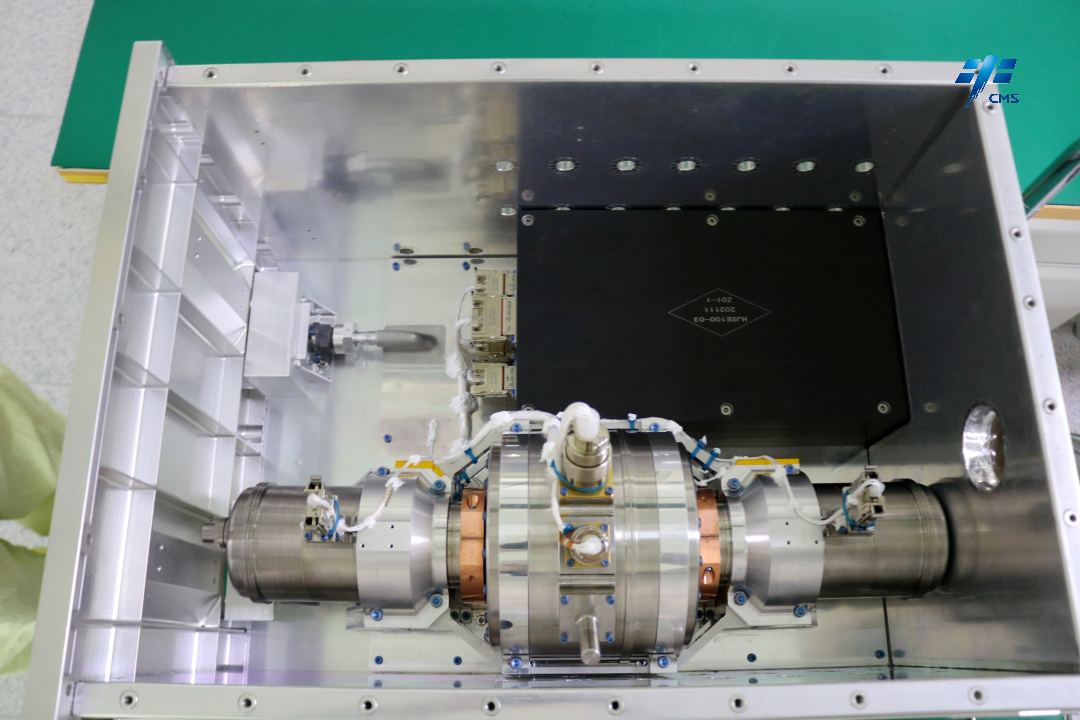
The uncapped Stirling thermoelectric converter. Credit: China Manned Space Agency

China Tests a Stirling Engine in Orbit

The China National Space Agency (CNSA) has made considerable progress in recent years with the development of its Long March 5 (CZ-5) rocket and the completion of its Tiangong-3 space station. The agency also turned heads when it announced plans in June 2021 to create an International Lunar Research Station (ILRS) that would rival the Artemis Program. On top of all that, China upped the ante when it announced later that month that it also had plans to send crewed missions to Mars by 2033, concurrent with NASA’s plans.

As part of their growing efforts to become a major power in space, which includes human exploration, China recently announced the completion of the first in-orbit test of a Stirling thermoelectric converter. The Shenzou-15 mission crew performed the test aboard Tiangong-3, and it was the first successful verification of the technology in space. This technology is also being investigated by NASA and is considered a technological solution to the challenges of space exploration, especially where long-duration stays and missions to locations in deep space are concerned.

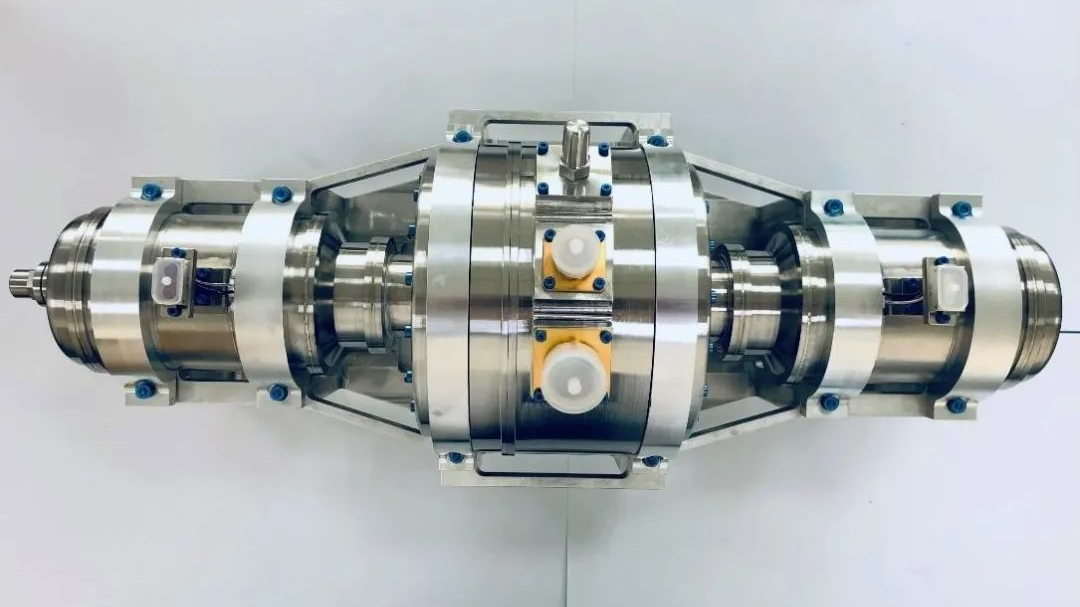
Similar to how hydroelectric dams generate power, a Stirling unit converts heat into electrical energy through a series of piston-driven magnets. These pistons rely on a fuel source to generate heat, pushing the magnets back and forth through a coil of wire, generating electrical current. This process is known as the Stirling Cycle, which is more efficient than solar-powered systems and conventional batteries. Compared to other power systems, it is also lightweight, has a simple structure, a quick start-up cycle, and produces minor vibrations and low noise.

All of this makes the technology appealing to spacecraft engineers and mission planners, who see it as a more sustainable means for providing power to spacecraft and surface habitats. On the one hand, it can reduce their dependence on solar energy, which is limited by solar cell efficiency and is not always accessible in certain environments. Around the Moon’s South Pole-Aitken Basin, where multiple agencies plan to build research stations before the end of the decade (including China’s ILRS), a lunar night lasts fourteen days.

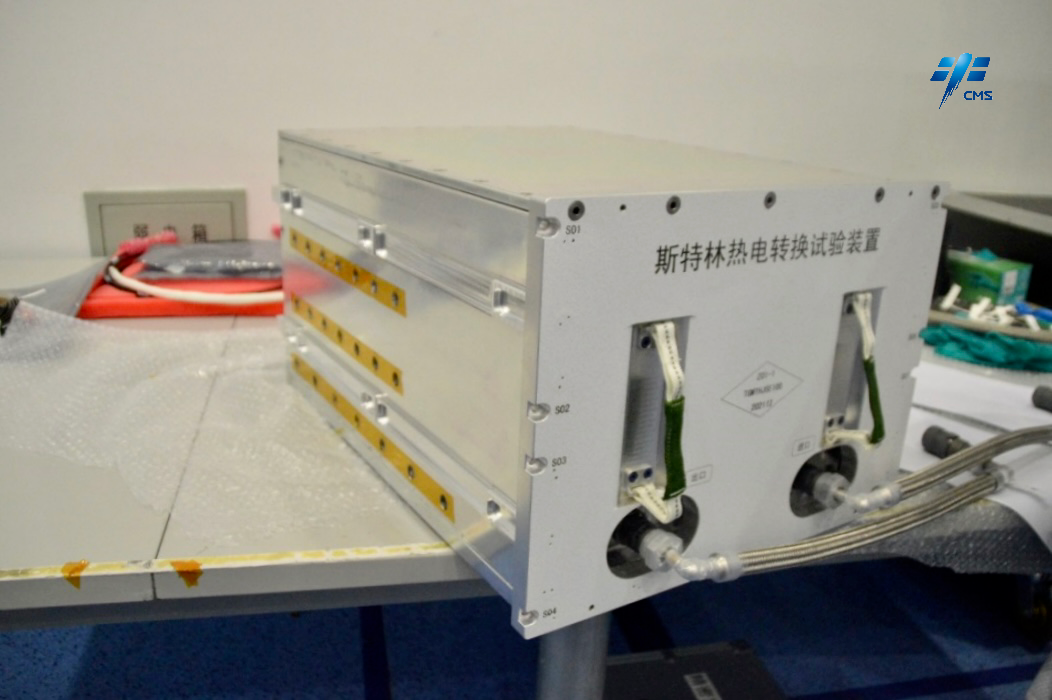
The Stirling power converter was developed by the Lanzhou Institute of Physics at the China Academy of Space Technology (CAST). It was transported aboard the space station by the Shenzou-15 crew and installed in the equipment cabinet in the Mengtian lab module. As the China Global Television Network (CGTN) reported, three in-orbit experiments were carried out in the lab module before the test run. The converter produced a stable power supply throughout, reportedly achieving a level of thermoelectric conversion efficiency that reached “an advanced international level under the same isothermal ratio.”

When paired with a nuclear reactor as a power source, Sterling engines could allow for long-duration stays on the Moon and Mars, augmenting solar power, batteries, fuel cells, and other conventional power sources. NASA is currently researching the technology as part of its Kilopower Reactor Using Sterling Technology (KRUSTY) experiment, which evolved from previous efforts to develop nuclear power applications for space exploration. NASA and DARPA recently announced a partnership to test a prototype nuclear thermal propulsion system in space (scheduled for 2027).

Artist’s impression of four KRUSTY generators providing power to an outpost on the surface of Mars. Credit: NASA/STMD

Shortly after that, the UK Space Agency (UKSA) announced they had contracted with Rolls-Royce to develop nuclear systems for space exploration, which could power a future lunar base. These and other attempts to realize next-generation power and propulsion systems are part of a growing effort to realize the next great leap in space exploration. They also reflect an undeniable truth about the modern space age: it’s an international affair characterized by competition and cooperation.

The capped device of Stirling thermoelectric converter. /China Manned Space Agency

The capped device of Stirling thermoelectric converter. /China Manned Space Agency

The Stirling thermoelectric converter. /China Manned Space Agency

The Stirling thermoelectric converter. /China Manned Space Agency

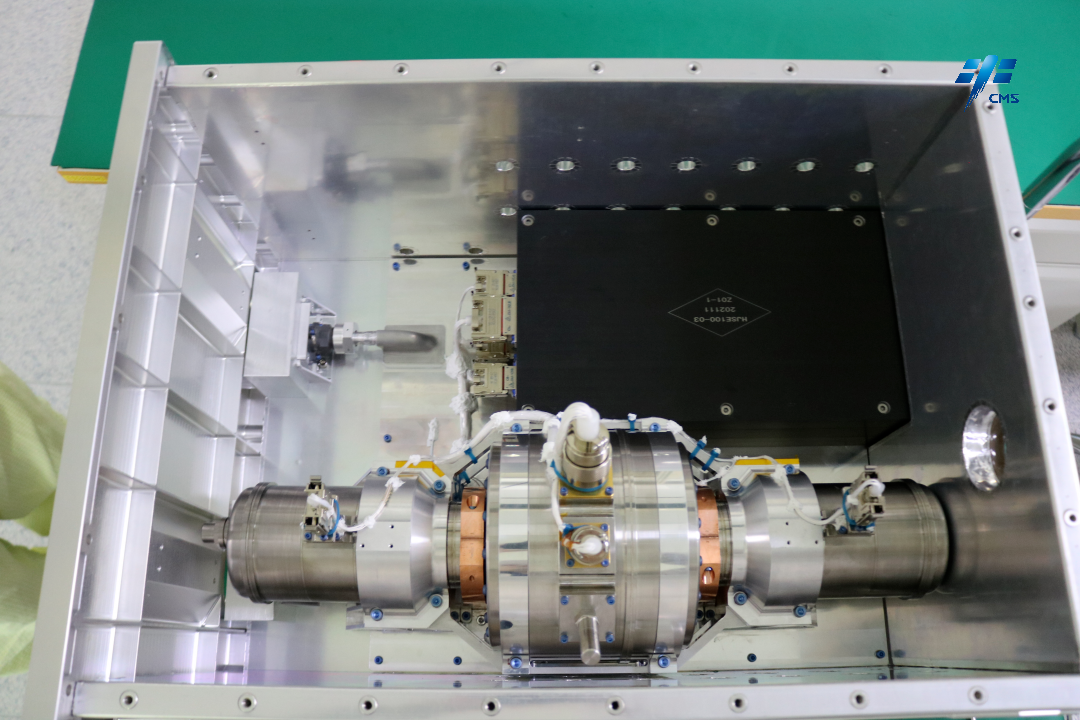
The uncapped Stirling thermoelectric converter. /China Manned Space Agency

The uncapped Stirling thermoelectric converter. /China Manned Space Agency

Further Reading: 

RELATED VIDEOS

{ https://www.universetoday.com/ }

Hoe vind je dit bericht?
Geschreven door peter om 00:31 Stuur door

We Now Have a Map of all 85,000 Volcanoes on Venus

global-catalog-1024x684-1.jpg

The most comprehensive map of all volcanic edifices on Venus ever compiled. Map created by Rebecca Hahn, Washington University in St. Louis.

We Now Have a Map of all 85,000 Volcanoes on Venus

A new map created with decades-old radar imagery from NASA’s 1990’s Magellan mission shows the locations of a whopping 85,000 volcanoes on Venus. The detailed map shows where the volcanoes are, how they’re clustered, and how their distributions compare with other geophysical properties of the planet such as crustal thickness.

This comprehensive study of Venus will help planetary scientists answer many outstanding questions about the planets’ geological history, such as why doesn’t it have plate tectonics like Earth? Was it ever habitable, and if so, for how long?

Sapas Mons, a large volcano on Venus, is about 400 km in diameter. It was imaged by the Magellan spacecraft, with a light source coming from the left side of the image. (Image courtesy of JGR Planets)

This is the second major finding from archival Magellan mission data, as just a few weeks ago scientists announced they found evidence of recent active volcanism on Venus. The authors of this new paper, graduate student Rebecca Hahn, and Paul Byrne, an associate professor of earth and planetary sciences, both from Washington University in St. Louis, say their new map can help locate the next active lava flow on Venus, and more.

“This paper provides researchers with an enormously valuable database for understanding volcanism on that planet — a key planetary process, but for Venus is something about which we know very little, even though it’s a world about the same size as our own,” said Byrne, in a press release.

It has long been known that volcanism has been a major, widespread process on Venus. And even if 85,000 volcanoes on Venus sounds like a large amount, Hahn said it is probably a conservative number. She believes there are hundreds of thousands of additional geologic features that have some volcanic properties lurking on the surface of Venus. However, they’re just too small to have been picked up by Magellan’s synthetic-aperture radar (SAR).

Building this global map was tedious work, as Hahn pored through planetary radar scans captured by Magellan. On Twitter, Byrne said this took years of work by Hahn. But she also took advantage of new technology.

“It was tedious, but I had experience using ArcGIS software, which is what I used to build the map,” Hahn said. “That tool wasn’t available when these data first became available back in the ’90s. We came up with this idea of putting together a global catalog because no one’s done it at this scale before.”

Image of “pancake volcanoes” located in the Eistla region, taken by the Magellan space probe. Credit: NASA/JPL

In building this global map, the researchers found that Venus is home to thousands of volcanic landforms, distributed across virtually the entire planet. The volcanoes range in size from much less than 5 km (3 miles) to well over 100 km (60 miles) in diameter. However, 99% of Venus’ volcanoes are smaller than 5 km (3 miles) in diameter.

“Although there are volcanoes across almost the entire surface of the planet, there seem to be relatively fewer volcanoes in the 20–100 km [12-60 mile] diameter range, which may be a function of magma availability and eruption rate,” the researchers wrote in their paper — (which is free to read online until early May 2023.)

While Venus is nearly the same size and composition of Earth, it doesn’t have plate tectonics so all Venus’ internal heat likely emerges through its volcanoes.

How does the amount of volcanoes on Venus compare with Earth? Right now, there are about 1,350 potentially active volcanoes on Earth, but the amount under the ocean is not well known. We also don’t know how many volcanoes have been active over Earth’s history. Of course, Venus is without oceans and without weathering to change planet’s surface. But we do know that more than 80 percent of the Earth’s surface–above and below sea level–is of volcanic origin.

The new Venus volcanoes dataset is hosted at Washington University and publicly available for other scientists to use.

“We’ve already heard from colleagues that they’ve downloaded the data and are starting to analyze it — which is exactly what we want,” Byrne said. “Other people will come up with questions we haven’t, about volcano shape, size, distribution, timing of activity in different parts of the planet, you name it. I’m excited to see what they can figure out with the new database!”

{ https://www.universetoday.com/ }

Hoe vind je dit bericht?
Geschreven door peter om 23:50 Stuur door

Plant Grows From Rock On Latest Mars Photo! UFO Sighting News. Video, please subscribe to my channel for more.

Plant Grows From Rock On Latest Mars Photo! UFO Sighting News. Video, please subscribe to my channel for more.

UAP,%20%E0%A4%89%E0%A4%AB%E0%A5%8C%20,%20%E0%A6%87%E0%A6%89%E0%A6%8F%E0%A6%AB%E0%A6%93,%20%C4%91i%CC%83a%20bay,%20MUFON,%20%E7%9B%AE%E6%92%83%E3%80%81%E3%82%A8%E3%82%A4%E3%83%AA%E3%82%A2%E3%83%B3,%20%20UFO,%20UFOs,%20%D0%9D%D0%9B%D0%9E%20,%20NLO,%20sighting,%20sightings,%20alien,%20aliens,%20ET,%20anomaly,%20anomalies,%20ancient,%20astrobiology,%20vreemdelinge,%20%203%20copy%206.png

 
ovni,%20omni,MUFON,%20%E7%9B%AE%E6%92%83%E3%80%81%E3%82%A8%E3%82%A4%E3%83%AA%E3%82%A2%E3%83%B3,%20%20UFO,%20UFOs,%20sighting,%20sightings,%20alien,%20aliens,%20ET,%20astrobiology,%20paleontology,%20waarneming,%20.png

Date of discovery: April 5, 2023

Location of discovery: Mars

Source photo: 
I found this pink and green plant growing from a rock on Mars, its one of the latest Mars Perseverance rover photos so its 100% news stuff. I have reported a white rose on Mars I found back in 2020, but this one being two colors and close up is just mind-blowing. Now you know why NASA puts most photos into false-color. To hide the truth from the public. 100% proof that life exists on planet Mars right now! 
 Scott C. Waring - Taiwan
  
RELATED VIDEOS

{https://www.ufosightingsdaily.com/ }

Hoe vind je dit bericht?
Geschreven door peter om 23:27 Stuur door

Mysterious portal appears above the Arabian Sea

Mysterious portal appears above the Arabian Sea

Two days ago the ISS live stream captured an unknown object that suddenly appeared above the Arabian Sea. 
ISS%20portal%20ufo%20Arabian%20Sea.jpg

The strange object not only turns into a what looks like a portal or planet but it rotates and it moves through space until it slowly disappears again. 
Could this object be an interdimensional portal that gave a glimpse of a parallel universe or could it have been a UFO or a small celestial body that cloaked and uncloaked itself? 
While is unknown what the object may have been, one commenter questioned: "Could the ISS be layering an image to block out any UFO we may see and that was a spot that the real view got thru? 
ISS%20portal%20ufo%20Arabian%20Sea.png

Whatever it was, it remains a mystery what exactly happened above the Arabian Sea. 
Take a look at the strange appearance:
  

{ http://ufosightingshotspot.blogspot.com/ }

Hoe vind je dit bericht?
Geschreven door peter om 22:56 Stuur door

The Craziest Alien Theories That Will Blow Your Mind

The Craziest Alien Theories That Will Blow Your Mind

aliens

When it comes to the existence of extraterrestrial life, there’s no shortage of imaginative and wild theories. Some are grounded in scientific speculation, while others are purely the products of vivid imaginations. In this article, we explore some of the craziest alien theories that have intrigued and entertained UFO enthusiasts and conspiracy theorists alike. Fasten your seatbelts; we’re going on a journey to the outer limits of human imagination

  1. The Reptilian Elite Theory

One of the most bizarre theories is that shape-shifting reptilian aliens control the world’s governments and major institutions. These extraterrestrial beings, known as the Reptilian Elite, are said to be able to take human form, infiltrating powerful organizations to manipulate global events and enslave humanity. Proponents of this theory often cite alleged sightings of prominent figures, such as politicians and celebrities, briefly revealing their reptilian nature.

  1. The Ancient Astronaut Hypothesis

The ancient astronaut hypothesis posits that extraterrestrial beings visited Earth in the distant past and played a crucial role in the development of human civilization. Proponents of this theory argue that ancient structures like the pyramids of Egypt, Stonehenge, and the Moai statues on Easter Island are too advanced for the civilizations of that time, suggesting alien intervention or guidance. They also point to ancient texts and artwork depicting otherworldly beings and flying craft as evidence of these cosmic encounters.

  1. The Hollow Earth Theory
    This theory proposes that the Earth is hollow, with an entire civilization of advanced beings living beneath our feet. These subterranean beings, sometimes referred to as “Agarthans” or “Lemurians,” are said to reside in a world lit by a central sun, complete with oceans, continents, and advanced technology. Some variations of the Hollow Earth theory claim that these inner-Earth inhabitants are actually extraterrestrial in origin, having retreated underground to escape surface cataclysms or hostile alien races.
  1. The Moon as an Alien Base

Some conspiracy theorists propose that the Moon is not a natural satellite but an artificial construct or even a spacecraft, created by advanced extraterrestrial beings. This theory suggests that the Moon is hollow, and its dark side is home to alien bases and facilities. Proponents of this idea often point to alleged anomalies in lunar photographs, such as unexplained lights or structures, as evidence of extraterrestrial activity.

  1. The Galactic Federation

This outlandish theory claims that Earth is part of a vast interstellar alliance called the Galactic Federation, comprising numerous extraterrestrial species that have banded together to maintain peace and order in the galaxy. According to this theory, Earth’s governments are aware of the existence of the Galactic Federation and maintain secret communications with its members. Some versions of the theory even assert that the Federation is actively involved in preventing catastrophic events on Earth, such as nuclear war or asteroid impacts.

The world of alien theories is filled with fascinating, outlandish, and sometimes downright bizarre ideas. While most of these theories lack concrete evidence or scientific support, they do offer a window into the boundless creativity of the human mind. As we continue to explore the cosmos and search for signs of extraterrestrial life, it’s important to keep an open mind while remaining grounded in the principles of critical thinking and scientific inquiry.

RELATED VIDEOS

{ https://www.latest-ufo-sightings.net/ }

Hoe vind je dit bericht?
Geschreven door peter om 22:46 Stuur door

Repeating radio signal leads astronomers to an Earth-size exoplanet

Repeating radio signal leads astronomers to an Earth-size exoplanet

Hoe vind je dit bericht?
Geschreven door peter om 00:33 Stuur door

Meet the Four Astronauts Who’ll Fly Around the Moon for Artemis II

Artemis II crew portrait

The Artemis II crew includes, clockwise from left, Christina Koch, Victor Glover, Jeremy Hansen and Reid Wiseman. (Credit: Josh Valcarcel / NASA)

Meet the Four Astronauts Who’ll Fly Around the Moon for Artemis II

The four astronauts chosen for NASA’s Artemis II mission will check off a string of firsts during their flight around the moon, scheduled for next year. It’ll mark the first trip beyond Earth orbit for a woman, for a person of color and for a Canadian. Artemis II will represent yet another first for Canadian astronaut Jeremy Hansen: Based on the current crew schedule, it’ll be his first-ever space mission.

Commander Reid Wiseman, pilot Victor Glover and mission specialist Christina Koch round out the first crew for NASA’s Artemis moon program, which picks up on the legacy of the Apollo moon program. If all goes according to plan, they’ll be the first humans to circle the moon since Apollo 17 in 1972.

As NASA Administrator Bill Nelson geared up to introduce the crew, he echoed the moonshot vision that President John F. Kennedy laid out in 1962 in his famous “We Choose to Go to the Moon” speech.

“We choose to go to back to the moon, and on to Mars,” Nelson said. “And we’re going to do it together, because in the 21st century, NASA explores the cosmos with international partners. We will unlock new knowledge and understanding. We’ve always dreamed about what more is ahead. Why? Because it’s in our DNA. It’s part of us. It’s who we are, as adventurers, as explorers, as frontierspeople.”

Dozens of astronauts and scores of VIPs attended today’s big reveal at NASA’s Johnson Space Center in Texas. Joe Acaba — the chief of the Astronaut Office — joked onstage about the secrecy that surrounded the selection of the four Artemis II crew members. “I’ll give you one hint: I am not one of them,” he said, drawing a laugh. “Don’t be so happy about that.”

Metaphorically speaking, the stage was set for Artemis II last fall when NASA’s Space Launch System sent an uncrewed Orion deep-space capsule on a weeks-long Artemis I mission around the moon and back. That flight was designed to test NASA’s hardware and procedures for Artemis II — and for the even more ambitious Artemis III mission, which currently aims to put astronauts on the lunar surface in late 2025.

The flight plan for the 10-day Artemis II mission, officially planned for November 2024, is analogous to the Apollo 8 round-the-moon mission in 1968. As was the case for Artemis I, the trip would begin with an SLS launch — but this time with people instead of test dummies inside the Orion capsule. After an initial systems checkout in high Earth orbit, the crew would fly past the moon and then make a gravity-assisted turnaround 6,400 miles beyond lunar orbit. The return to Earth would feature a 25,000 mph re-entry and an Apollo-style splashdown.

artemis2map-1024x692.jpg

This NASA infographic lays out the flight plan for Artemis II. Click on the image for a larger version.

“Am I excited? Absolutely,” Christina Koch, who would become the first woman to see the moon’s far side with her own eyes, told today’s audience. “But my real question is, are you excited? I see you and I ask that, because the one thing I’m most excited about is that we are going to carry your excitement, your aspirations, your dreams with us on this mission.”

Jeremy Hansen, the only space rookie on the Artemis II crew, gave a shout-out to America’s leadership in space and Canada’s “can-do attitude.” His role on the mission recognizes Canadian contributions to NASA’s space effort, including the robotic arms for the space shuttle and the International Space Station as well as a lunar utility vehicle that Canadian companies are building for moon missions.

“For decades now, literally thousands upon thousands of Canadians have risen to that challenge to bring real value to the international partnership with respect to space exploration, to bring real solutions,” Hansen said.

Victor Glover, who became the first Black astronaut to join a long-duration crew on the International Space Station in 2020, said the hoopla surrounding the Artemis II mission had a Hollywood feel to it. “I feel like Denzel Washington should be up here talking to you, but you just got us,” he said with a laugh.

“Human spaceflight is like a relay race,” Glover said. “And that baton has been passed from generation to generation, and from crew member to crew member, from Mercury, Gemini, Apollo, Apollo-Soyuz, Skylab, Mir, the shuttle, International Space Station, commercial crew and now the Artemis missions. We understand our role in that. And when we have the privilege of having that baton, we’re going to do our best to run a good race, to make you proud.”

Artemis II commander Reid Wiseman closed out the ceremony with a round of thanks to NASA’s workforce, its international partners — and particularly to his fellow astronauts, including the International Space Station’s current crew.

“If any of you over there are looking for heroes, go Google these folks, because they’re our heroes,” Wiseman said.

To save you a Google search, here are the basic stats for Artemis II’s crew:

Commander Reid Wiseman
Hometown: Baltimore, Md.
Born: 1975
Background: Naval aviator, test pilot, selected to become astronaut in 2009.
Spaceflight experience: Expedition 40/41 on International Space Station, 2014.

Pilot Victor Glover
Hometown: Pomona, Calif.
Born: 1976
Background: Naval aviator, test pilot, selected as NASA astronaut in 2013.
Spaceflight experience: SpaceX Crew-1 and Expedition 64 on International Space Station, 2020-2021.

Mission specialist Christina Hammock Koch
Hometown: Grand Rapids, Mich.
Born: 1979
Background: Engineer at NASA Goddard Space Flight Center, research associate in U.S. Antarctic Program, electrical engineer at Johns Hopkins University Applied Physics Laboratory, researcher at National Oceanic and Atmospheric Administration, selected as NASA astronaut in 2013.
Spaceflight experience: Expedition 59/60/61 on International Space Station, 2019-2020.

Mission specialist Jeremy Hansen (Canada)
Hometown: London, Ontario
Born: 1976
Background: Fighter pilot, selected as Canadian Space Agency astronaut in 2009.
Training experience: Cave test subject with European Space Agency’s CAVES program in 2013, aquanaut with NEEMO 19 underwater test program in 2014.

And here are a few reactions from notables on Twitter:

{ https://www.universetoday.com/ }

Hoe vind je dit bericht?
Geschreven door peter om 23:58 Stuur door

Astronomers Think They've Found One of the Biggest Black Holes Ever Seen

Ultramassive-Black-Holes-WEB-.jpg

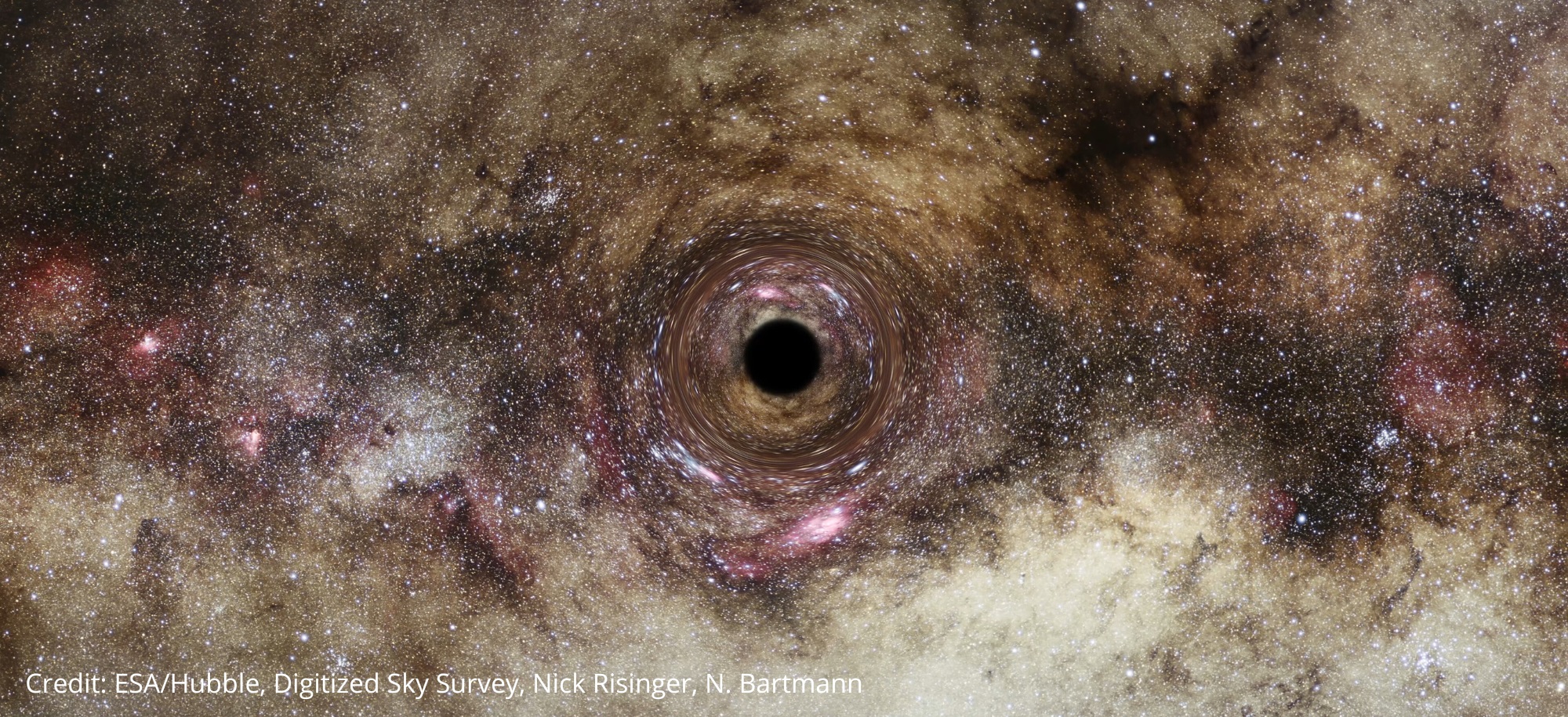
Artist's impression of an ultramassive black hole (UBH). Credit: ESA/Hubble/DSS/Nick Risinger/N. Bartmann

Astronomers Think They've Found One of the Biggest Black Holes Ever Seen

In 1931, Indian-American physicist Subrahmanyan Chandrasekhar proposed a resolution to Einstein’s Theory of General Relativity that postulated the existence of black holes. By 1972, astronomers obtained the first conclusive evidence that these objects existed in our Universe. Observations of quasars and the center of the Milky Way also revealed that most massive galaxies have supermassive black holes (SMBHs) at their cores. Since then, the study of black holes has revealed that these objects vary in size and mass, ranging from micro black holes (MBHs) and intermediate black holes (IMBHs) to SMBHs.

Using astronomical simulations and a technique known as Gravitational Lensing, an international team of astrophysicists detected what could be the largest black hole ever observed. This ultramassive black hole (UMBH) has a mass roughly 30 billion times that of our Sun and is located near the center of the Abell 1201 galaxy cluster, roughly 2.7 billion light-years from Earth. This is the first time a black hole has been found using Gravitational Lensing, and it could enable studies that look farther into space to find black holes and deepen our understanding of their size and scale.

The study was conducted by researchers from the Centre for Extragalactic Astronomy (CEA) at Durham University, the Max Planck Institute for Astrophysics (MPIA), and NASA’s Ames Research Center. It was led by Dr. James Nightingale, a post-doctoral research associate at the CEA, with support provided by the UK Space Agency (UKSA), the Royal Society, the Science and Technology Facilities Council (STFC), and the European Research Council (ERC). A paper that describes their findings recently appeared in the Monthly Notices of the Royal Astronomical Society.

Gravitational-lensing-galaxyApril12_2010-1024x683.jpg

This illustration shows how gravitational lensing works. The gravity of a large galaxy cluster is so strong it bends, brightens, and distorts the light of distant galaxies behind it.

Credit: NASA, ESA, L. Calcada

Gravitational Lensing (GL) refers to a phenomenon predicted by General Relativity, which describes how spacetime curvature is warped by the presence of massive objects. This technique involves astronomers using massive objects in the foreground (like galaxies or galaxy clusters) to amplify light from more distant objects. This enables astronomers to study objects that would otherwise be inaccessible to them, either because of distance or the presence of other objects along the same line of sight. This technique also allows astronomers to study distant objects in greater detail, such as the Abell 1201 cluster.

Dr. Nightingale and his associates began studying this cluster in 2004 when Prof. Alastair Edge, a fellow Durham University astronomer and a co-author of this paper, reviewed images of a galactic survey and noticed a giant lens in its vicinity. For this study, Dr. Nightingale, Prof. Edge, and their colleagues consulted data from the Hubble Space Telescope (HST) in multiple bands – including visible light, X-rays, and other wavelengths. Following up on what Hubble saw years ago, the team compared the data to simulations on the new DiRAC COSmology MAchine 8 (COSMA8) supercomputer facilities at Durham University.

Using open-source software (PyAutoLens) that astronomers rely on to model strong lenses, the team simulated light traveling between Abell 2021 and Earth thousands of times. Each simulation included a black hole with a different mass and how this would influence the way the light traveled over 2.7 billion years to reach Earth. Their results showed that a UMBH located in the foreground galaxy, over 30 billion times as massive as our Sun, would account for what Hubble saw. Astronomers rarely see black holes this massive, and this find (if confirmed) would constitute the largest black hole ever detected.

On top of that, it was the first time astronomers used the GL technique to detect such a massive black hole. What’s more, it could help astronomers learn more about UMBHs and dormant black holes in the future. Ordinarily, astronomers are largely restricted to studying active black holes because of how bright they are in multiple wavelengths. This is caused by gas and dust being pulled in toward black holes and forming tightly-bound disks that are accelerated to velocities approaching the speed of light (aka. relativistic speed).

This causes the material in the disk to become highly energetic, emitting radiation in visible light, infrared, X-rays, radio waves, and other wavelengths. The same occurs when the material infalls and is accreted onto the face of the black hole, being torn apart at the subatomic level. This is characteristic of Active Galactic Nuclei (AGN), where a galaxy’s center shines brighter than all the stars in the galactic disks. This study has shown how dormant black holes, which are significantly less luminous, can be inferred by the presence of a powerful GL.

The team hopes that this study will lead to deeper explorations of black holes, which will benefit from the new class of 30-meter telescopes that will become operational in the near future. These include the Extremely Large Telescope (ELT), the Giant Magellan Telescope (GMT), and the Thirty Meter Telescope (TMT), which will combine greater sensitivity with adaptive optics and interferometers. Along with improved data analysis and new methods, astronomers will likely be able to study even more distant black holes and gain additional insights into these behemoths.

Further Reading: 

{https://www.universetoday.com/ }

Hoe vind je dit bericht?
Geschreven door peter om 22:56 Stuur door

Denver’s Hidden Secrets: Underground Bunkers and The Elite’s Escape Plan

Denver’s Hidden Secrets: Underground Bunkers and The Elite’s Escape Plan

denver-airport-ufo-conspiracy

The thought of a catastrophic event leading to the annihilation of a large percentage of Earth’s population is both intriguing and terrifying. While we can’t predict when or how such a disaster may strike, it’s worth considering the measures that have been put in place to protect select individuals in the face of catastrophe. In the United States, the chosen few would likely find refuge in Denver, Colorado – a location shrouded in mystery, conspiracy theories, and rumored connections to UFOs and aliens.

A Haven for the Elite

It’s no secret that world leaders and key government figures, like the President of the United States and Vice President, would be taken to secure underground facilities in the event of a doomsday scenario. Members of Congress and the military would also find themselves in protected locations. But what about the civilians? There are facilities around the world designed to house thousands of people, but who gets to decide who is saved and who is left behind?

The Denver Connection

Denver, Colorado, has long been associated with conspiracy theories and underground bunkers. One of the most famous theories revolves around the Denver International Airport, which has sparked numerous speculations due to its unusual artwork, Masonic symbols, and rumors of a vast network of underground tunnels.

Some believe that Denver International Airport serves as a cover for an extensive underground bunker system, built to house the elite in the event of a cataclysmic event. In 2011, when the Comet Elenin was headed towards Earth, President Obama was reportedly taken to a secret facility near Denver Airport instead of the usual Cheyenne Mountain bunker.

UFOs, Aliens, and Area 51

Adding to the mystery surrounding Denver is the purported connection to UFOs, aliens, and the infamous Area 51. Denver International Airport, with its peculiar design, has been linked to extraterrestrial activity, fueling speculations that the underground bunkers may serve a dual purpose – not only to protect the elite but also to hide evidence of alien encounters and advanced technologies.

Area 51, a highly classified US Air Force facility located in Nevada, has long been the subject of conspiracy theories related to UFOs and extraterrestrial life. While there is no direct evidence connecting Area 51 to the alleged underground bunkers in Denver, the secrecy surrounding both locations has led some to believe that they may be part of a larger, covert network of facilities designed to deal with potential alien contact and technology.

The Veil of Secrecy

The existence of these hidden bunkers and the role of Denver in sheltering the chosen few during an apocalyptic event, as well as its possible connections to UFOs and aliens, remains shrouded in secrecy. While many dismiss these theories as baseless conspiracies, others argue that the government’s reluctance to address these questions fuels suspicion.

Conclusion

As we continue to ponder the possibility of a catastrophic event that could force humanity to “reset,” the debate around underground bunkers, the elite’s escape plans, and Denver’s mysterious role in the world of UFOs and aliens will likely persist. Ultimately, the question of who gets to survive while the rest of the population is left to face the consequences is a sobering reminder of the potential inequality in the face of disaster and the importance of transparency and accountability from governments around the world.

VIDEO:

  • The Why Files: What Are They Hiding Underneath? The Truth about the Denver International Airport Conspiracy

RELATED VIDEOS

{ https://www.latest-ufo-sightings.net/ }

Hoe vind je dit bericht?
Geschreven door peter om 22:28 Stuur door

Meer van UFO'S of UAP'S, ASTRONOMIE, RUIMTEVAART, ARCHEOLOGIE, OUDHEIDKUNDE, SF-SNUFJES EN ANDERE ESOTERISCHE WETENSCHAPPEN - DE ALLERLAATSTE NIEUWTJES

↑ Terug naar de berichten