The Pre-Egyptian Mystery: The Osiris Shaft Beneath Giza

The Pre-Egyptian Mystery: The Osiris Shaft Beneath Giza
Chris Bledsoe Says “The Lady” Showed Him a Vision of an Israel-Iran Nuclear Crisis—Then the Sky Filled With Orbs

The vision, as he tells it, involved Israel and Iran exchanging missiles until the situation reached the nuclear point. Bledsoe says he saw Israel launch six nuclear weapons, four apparently heading toward Iran and two toward Syria. Then, at the most catastrophic moment of the vision, he says the entire sky suddenly filled with orbs.
What happened next is less clear, even to Bledsoe. He says everything went black and he could not see what followed, but he came away believing the orbs were intervening. Just as importantly, he says the Lady told him that this future was not fixed and “doesn’t have to happen.”
The Lady has been at the center of Bledsoe’s story for years. He describes her as a heavenly female being rather than an alien, and in different interviews has connected her with religious and mythological figures including Hathor. In his recent interview, he again described her simply as a beautiful “lady from heaven” who appeared in a way he associated with the wind.
Previously, Bledsoe claimed that the Lady told him that when Regulus appeared on the horizon before daylight in the gaze of the Sphinx, a “new knowledge” would come to humanity. Bledsoe has associated that astronomical language with 2026 and has treated it as one of the most important parts of his entire experience.
He has also claimed that the message attracted interest from scientists and people connected with the US government. In the new interview, Bledsoe says he was asked to put what he had been shown into writing and that the document was hand-delivered to two generals at the Pentagon. According to him, the material he wrote down included the Israel-Iran conflict he now discusses publicly.
Bledsoe says another major encounter took place around Easter 2019, during a particularly difficult period of his life. He describes being seriously ill at the time and says he had largely withdrawn from speaking publicly about his experiences.
According to Bledsoe, he walked outside near a pond at his home and saw the Lady appear in front of him. This time, he says, her message centered on suffering.
He remembers being told that “trouble was coming” and that human suffering would become too great. He says the beings connected with the phenomenon would eventually step in, help humanity and make their presence increasingly difficult to ignore. He also claims the Lady told him he would be allowed to share that presence publicly, including through cameras and television.
Bledsoe now interprets part of that 2019 warning as referring to the pandemic. According to him, the lady warned him to pay attention when Israel and Iran began directly firing missiles at one another. According to his account, she told him to “take heed” if events advanced far enough.
Bledsoe says he saw Israel being hit extremely hard by Iran. The situation became so severe, he says, that Israel responded by launching six nuclear weapons. He recalls seeing four heading toward Iran and another two going toward Syria.
Then something changed.
“The whole sky lit up with orbs,” Bledsoe says. Immediately afterward, everything in the vision went black. He does not claim to have watched what happened next, nor does he describe the nuclear weapons being visibly destroyed.
Instead, he says that although he does not know exactly what followed, he understood that “they were intervening.”
That wording is worth preserving because it is easy to exaggerate what Bledsoe actually says. He does not explicitly say extraterrestrials arrived and shot nuclear missiles out of the sky. He does not even identify the orbs as extraterrestrials. His interpretation of the phenomenon is almost the opposite of the standard alien narrative.
For Bledsoe, the appearance of the orbs represents intervention by the intelligence he has been interacting with for years. Bledsoe believes the beings want humanity to become aware of their presence before civilization reaches that stage. In his view, revealing themselves would change human hearts and minds because people would discover that the phenomenon is not what they have been taught to fear.
This idea runs through almost everything Bledsoe says about UFOs. To him, disclosure is not mainly about governments admitting that machines from another planet have entered our airspace. It is about humanity discovering that consciousness, spirituality and what previous cultures called the divine may be connected to the same mystery.
“I’m looking for the angels,” he tells the interviewer at one point. Bledsoe even speculates that the phenomenon may appear in forms influenced by human consciousness, which he uses to explain why reported UFO shapes have changed across different historical periods.
Bledsoe has claimed that NASA personnel became interested in his experiences after encounters involving mysterious orbs around astronauts. He has described enormous luminous beings emerging from or accompanying these objects, sometimes with wings, and has interpreted them as angelic rather than extraterrestrial. In one of his more extraordinary claims, he said some beings observed around astronauts were reported to be as large as 125 feet. (Full read)
He has also claimed that officials were interested in why the phenomenon appeared willing to interact with him while remaining difficult for institutions to control or understand.
Whether those claims can ultimately be independently established is another matter. But they are important for understanding Bledsoe’s worldview because he does not separate the NASA story, the orbs, the Lady and the spiritual message into different phenomena. He increasingly talks about them as pieces of the same mystery.
In the latest interview, Bledsoe says he has dealt with what he considers at least three different “levels” of the phenomenon. He describes some manifestations as beings with wings and claims to have filmed objects or creatures he considers angelic. One, he says, appeared larger than a Cessna 150 aircraft. He specifically connects such beings with the seraphim described in biblical tradition.
Bledsoe says the phenomenon can appear in different colors, something he has discussed many times before. Our previous article covered his descriptions of orbs shifting between white, red, orange, yellow, blue and other shades. He has generally rejected simplistic claims that each color automatically represents a hostile or friendly category.
But in this interview, he gives green orbs a somewhat more specific role. Bledsoe says green orbs seem to arrive with a message and describes them as communicators. He refers to a NASA scientist who, according to Bledsoe, believed one particular green orb might have been assigned to watch over him or maintain some form of communication.
Bledsoe himself says he feels the green orb marks a transition toward “what’s next.” The next stage, he suggests, may involve something he has wanted for years: publicly capturing the Lady herself on camera.
“I feel like I’m going to film the Lady in her full-blown glory,” he says.
For someone who has already published years of orb footage, that would represent a very different kind of claim. A distant point of light can always be debated. A clearly recorded figure matching the being Bledsoe has described for more than a decade would be something else entirely.
According to him, the object moved through the forest, weaving around and behind trees while multiple high-definition cameras recorded it. He estimates that it came within roughly 40 or 50 feet of the witnesses. His son Ryan adds that during six days of filming, the crew recorded well over 100 orbs on professional cameras, sometimes capturing dozens in a single night. Yet only a small portion of that material appeared in the broadcast.
Bledsoe says he does not know why the most dramatic footage was omitted. He does not claim in this exchange to know that someone ordered it suppressed; he simply says he saw the footage himself and was disappointed that it never aired.
He argues that the public is going to be presented with a terrifying interpretation of non-human intelligence. In his telling, people will be told that these beings are monsters, that there is no God and that humanity is essentially livestock for a powerful “Galactic Federation.”
At one point he refers to a story involving beings that “eat people” and raise humanity “like sheep.” Bledsoe says he has warned his own children about this type of narrative for roughly a decade and insists that it is false.
Bledsoe believes there is a struggle over how the phenomenon will ultimately be understood. One version presents non-human intelligence as an external threat. His version presents at least the intelligence he interacts with as spiritual, benevolent and deeply connected with consciousness.
Read also:
He admits that there may be many different things operating within the broader UFO mystery and says he would never claim to speak for every unexplained phenomenon. But when it comes to the orbs he personally associates with his experiences, Bledsoe is emphatic that fear is the wrong response. He wants people, as he puts it, to see the “beauty” rather than only the ugly interpretation.
During the interview, Ryan describes what he sees as a spiritual awakening already taking place. He argues that “disclosure” should not simply mean revealing aliens but uncovering something hidden about the nature of reality itself.
Ryan’s practical message is surprisingly ordinary compared with the visions, nuclear weapons and luminous beings surrounding it. He tells people interested in contact to begin with kindness, love and opening the heart. Those principles, he says, are at the center of what his father has taught him over the past twenty years.
Chris argues that the deeper challenge presented by the phenomenon is not merely technological. If consciousness is fundamental and the beings he encounters belong to a spiritual order, he believes humanity would have to reconsider some of its most basic assumptions about life. For Bledsoe, “consciousness” is ultimately another word for God.
Bledsoe says the Lady warned him years ago that human suffering would reach a dangerous level. He now believes COVID was part of that warning. He says he was also shown an escalating conflict between Israel and Iran and told to pay attention when the two began directly exchanging missiles.
His vision then moved toward an extreme outcome in which Israel launched nuclear weapons. At that moment, according to Bledsoe, the sky filled with orbs and the vision went dark. He believes the implication was intervention. But he also says the Lady told him that humanity does not have to reach that point.
RELATED
Ancient Alien Pyramid Found Below The Ocean 15 Miles Across! Google Earth Blurred It Out! UFO Sighting News.
Pentagon UFO Program Scientist Says “Gifted” Chinese Children Teleported Objects Through Sealed Containers Last updated: August 30, 2026 11:28 pm By Vicky Verma 4 days ago

Psychokinesis (Telekinesis): Can Mind Power Move Matter?

Psychokinesis, often called telekinesis, is the alleged ability of a person to influence or move physical objects using the power of the mind alone, without physically touching them. The word psychokinesis comes from Greek roots meaning roughly “mind movement.” Telekinesis means movement at a distance. The idea is one of the most famous and controversial subjects in paranormal research. Stories of people supposedly bending metal, moving objects, levitating themselves, influencing dice, or even affecting electrical and mechanical devices have fascinated the public for more than a century. But there is an important distinction between claims of psychokinesis and scientific evidence for psychokinesis. Despite numerous experiments and dramatic personal accounts, science has not established that human beings can reliably move or influence objects solely through thought.
Psychokinesis is generally divided into several kinds of alleged phenomena. Moving objects. The classic form of telekinesis is the supposed ability to move an object without touching it. A person might supposedly cause a pencil to roll across a table, make a coin move, or cause a small object to rise into the air. Another famous claim involves bending spoons, forks, keys, or other metal objects through mental concentration. This became particularly popular during the twentieth century, especially after performers and alleged psychic individuals demonstrated spoon bending before audiences.
Some alleged psychokinetic practitioners have claimed the ability to make themselves or other objects float. Stories of levitation have appeared in religious traditions, spiritualism, séances, and modern paranormal reports.Psychokinesis has also been investigated in a much less dramatic form. Instead of attempting to move an object visibly, researchers have sometimes asked people to concentrate on dice, random-number generators, or other systems and attempt to influence their results. The supposed effect, if present, would be extremely small and detectable only statistically.
Interest in mind-over-matter phenomena became especially strong during the nineteenth century. The rise of Spiritualism produced séances in which mediums claimed that spirits could communicate with the living and produce physical effects. Tables allegedly moved by themselves, objects supposedly appeared or disappeared, bells rang without being touched, and other strange events were reported.Some of these events were attributed to spirits rather than to the medium’s own mind. Nevertheless, they helped establish the cultural background from which modern psychokinesis developed. Unfortunately, many famous séance phenomena were eventually exposed as tricks, deception, or misinterpretations. That did not prove that every paranormal claim was fraudulent, but it demonstrated how easily people can be fooled by apparently impossible physical effects.
One of the most important figures in the history of parapsychology was Joseph Banks Rhine, a researcher at Duke University. Beginning in the 1930s, Rhine investigated alleged extrasensory perception and psychokinesis under experimental conditions. Rather than asking someone to perform spectacular feats such as levitating a table, Rhine used statistical experiments. For example, subjects might attempt to influence the results of dice. If a person could mentally cause a particular number to appear more frequently than chance would predict, researchers could look for a statistical deviation. This was an important change in approach.
Perhaps the most recognizable image associated with telekinesis is the bending spoon. During the 1970s, Israeli-born performer Uri Geller became internationally famous for demonstrations involving supposedly psychic abilities. He appeared on television and performed demonstrations in which spoons and other metal objects appeared to bend or deform. Geller maintained that psychic abilities were involved. Skeptics, however, argued that the effects could be produced through ordinary magician’s techniques, preparation of the objects, misdirection, or other physical methods.Professional magicians have demonstrated many ways in which an apparently impossible spoon-bending performance can be accomplished without paranormal powers. Consequently, spoon bending became less convincing as evidence for genuine telekinesis.
One of the most famous alleged psychokinetic individuals was Nina Kulagina, a Soviet woman who became well known in paranormal circles during the Cold War. Films and reports claimed that Kulagina could move small objects across tables without touching them. Some demonstrations allegedly showed her moving objects while sitting several feet away. She reportedly underwent experiments involving investigators and scientists. The demonstrations attracted considerable attention because the Soviet Union was a scientific and technological rival of the United States, leading some Western paranormal researchers to take the reports seriously. However, critics pointed out problems with experimental controls and the possibility of concealed physical mechanisms. There has never been a generally accepted scientific demonstration establishing that Kulagina possessed genuine psychokinetic powers.

The controversy surrounding Uri Geller became particularly interesting because some scientists believed that at least some of his performances deserved investigation, while magicians argued that his demonstrations could be duplicated using conventional methods. The debate illustrated an important problem in paranormal research: An extraordinary demonstration is not necessarily extraordinary evidence. If a person can bend a spoon, for example, the important scientific question is not merely whether the spoon bent. The question is: Can the effect still occur when every ordinary method of producing the effect has been eliminated? That is a much more difficult test.
The human brain certainly produces physical effects. Electrical activity occurs throughout the nervous system. The brain controls muscles, releases chemical signals, regulates organs, and influences behavior. But this is very different from telekinesis. When a person picks up a cup, the brain sends signals through the nervous system to muscles in the arm and hand. The muscles physically move the cup. In alleged telekinesis, there would be no physical contact. The proposed mechanism would somehow have to allow mental activity in the brain to exert a measurable force on an object outside the body. Modern physics does not have an established mechanism that allows ordinary human thoughts to exert such forces at a distance
Some people have suggested that brain waves might be responsible for telekinesis. The brain does generate electrical activity, and this electrical activity can be measured with instruments such as an EEG. However, the electrical fields produced by the brain are extremely weak and decrease rapidly with distance. There is no established evidence that ordinary brain activity can generate enough force to push an object across a table or bend metal. Brain-computer interfaces demonstrate something interesting, however. Modern technology can detect certain patterns of brain activity and use computers to translate those patterns into commands. A person can therefore sometimes control a cursor, robotic device, or prosthetic limb using brain signals.But this is not telekinesis.
The brain is providing information to an electronic system, which then supplies the physical force. There are many ways apparently impossible physical effects can occur without paranormal abilities. These include: hidden wires, magnets, air currents, vibrations, static electricity, specially prepared objects, concealed physical contact, mechanical devices, misdirection, sleight of hand
unconscious movements, selective reporting, video editing, deliberate deception.
There is another important factor: human perception is imperfect. People naturally look for patterns and explanations. When something unexpected happens, we may remember the remarkable event while forgetting all the ordinary occasions when nothing happened. Suppose someone places a lightweight object on a table and concentrates intensely on it. After several minutes, the object moves slightly. It can be very tempting to conclude that the person’s mind caused the movement. But there could have been an air current, vibration from the building, unevenness in the table, static electricity, or another ordinary explanation. If the experiment is repeated hundreds or thousands of times under controlled conditions, however, researchers can determine whether the movement occurs more often than would be expected by chance. That is where scientific testing becomes important.
The scientific consensus is that psychokinesis has not been demonstrated reliably under controlled, independently reproducible conditions. Parapsychology researchers have reported statistical anomalies in some experiments, particularly experiments involving random-number generators and other statistical systems. However, these results remain controversial. Critics have raised concerns involving: experimental design, statistical analysis, publication bias, inadequate controls, multiple testing, replication failures, possible unconscious methodological errors. A phenomenon as fundamental as psychokinesis would require extraordinarily strong evidence because it would represent a major discovery about the relationship between consciousness and physical matter.
Could Psychokinesis Ever Be Proven? In principle, yes. A convincing demonstration would need to be repeatable.For example, imagine a person claiming to move a small object mentally. Researchers could place the object inside a transparent enclosure that prevented air movement and physical contact. Multiple cameras could record the experiment from every direction. Independent investigators could control the equipment. The object could be weighed and monitored by sensitive instruments. The person could then attempt to move the object repeatedly. If the object consistently moved in a measurable direction whenever the person concentrated—and independent laboratories could reproduce the same result—it would be extraordinarily important. Scientists would investigate the mechanism. If ordinary explanations were eliminated and the phenomenon survived repeated testing, psychokinesis would become a legitimate scientific discovery rather than merely a paranormal claim.
Telekinesis has become one of the most popular supernatural abilities in movies, television, books, and video games. Characters with telekinetic abilities are often portrayed as being able to: throw people across rooms, lift cars, crush objects, stop bullets, levitate, move weapons, open doors, manipulate objects from a distance. These abilities are fictional and dramatically exaggerated. Real-world psychokinesis claims, by comparison, generally involve very small effects—if the reported phenomena are genuine at all.
The most interesting aspect of psychokinesis may not be the spectacular claims. It is the possibility that consciousness could somehow interact with physical reality in ways that science does not yet understand. Modern neuroscience has made enormous progress in understanding how the brain works, yet consciousness itself remains a profound scientific problem. We know that thoughts are associated with measurable activity in the brain. We know that thoughts can cause the body to act. We know that technology can detect brain activity and translate it into commands. What has not been established is that thoughts alone can directly push, pull, bend, or otherwise manipulate external physical objects. Therefore, psychokinesis remains an intriguing paranormal hypothesis rather than an established scientific ability. The subject sits at the boundary between psychology, neuroscience, physics, magic, and the study of unexplained phenomena—and that is precisely why it has remained fascinating for so long.
RELATED
What lies beneath: Scientists discover six never-before-seen mystery structures lurking deep inside the Earth
Scientists have uncovered six never-before-seen mystery structures lurking deep inside the Earth.
Although our planet's deep layers are totally inaccessible, scientists can use the seismic waves from powerful earthquakes to probe the hidden depths.
Now, Chinese scientists have uncovered structures sitting on the boundary between the viscous mantle and the liquid outer core, 1,800 miles (2,900km) beneath our feet.
These 'deep-seated scatterers' are all but invisible, except for the way that they subtly influence the path of passing seismic waves.
In their paper, published in the journal JGR Solid Earth, the scientists suggest these structures could have been formed when material from the outer layers was dragged deep into the Earth.
They could include pieces of the continental crust or even the remains of Theia, a Mars-sized protoplanet believed to have formed the moon after hitting Earth 4.5 billion years ago.
Under the vast pressures and incredible temperatures at the mantle boundary, these chunks transform, partially melt, or undergo mineral transformation.
The researchers suggest that this has left six 'thermochemical piles' of material very different from the surrounding mantle.

Scientists have uncovered six never-before-seen mystery structures lurking deep inside the Earth (labelled in dashed boxes)

These structures are located right on the boundary between the solid yet malleable mantle and the liquid metal outer core (stock image)
While Earth looks relatively stable from our perspective up on the surface, deep below the planet is violent and dynamic, especially at the boundaries between layers.
One particularly dramatic boundary is the one between the mantle and the outer core, where solid-yet-viscous rocks meet liquid nickel and iron.
There is an enormous temperature jump across the boundary, with a difference of about 1,000°C (1,800°F) from one layer to another.
The massive heat escaping from the outer core drives convection currents in the mantle known as mantle plumes, which play a key role in determining where volcanic activity occurs on the surface.
Due to the huge density differences, seismic waves also dramatically slow down at this boundary, which allows geologists to 'see' what is going on.
To learn more about this strange part of the planet, the researchers looked at a special type of seismic wave called a PKP precursor.
These are relatively weak waves that arrive shortly before the stronger seismic waves triggered by earthquakes.
PKP precursors are extremely useful for scientists because they get scattered by the subtle differences in the hidden structures, known as heterogeneities, on the mantle boundary.

To learn more about this strange part of the planet, the researchers looked at a special type of seismic wave called a PKP precursor, weak waves that arrive shortly before the stronger seismic waves triggered by earthquakes
These scattered waves then pass through the liquid outer core, but not the solid inner core, and bounce back to arrive at seismic detectors before the main wave.
The issue is, because they are so weak, PKP precursors are extremely difficult to find in seismic data and have to be manually searched for among the thousands of signals collected every year.
In their paper, the researchers explain: 'Manual identification of these precursors is inefficient, subjective, and insufficient for vast global seismic data sets.'
To get around this, the researchers trained an artificial intelligence (AI) model to spot PKP precursors in seismic data.
After training the model on human-identified waves, the team let their AI loose on over two million recordings from 5,000 different earthquakes.
Eventually, their model identified 174,929 high-quality PKP precursor signals – more than ten times all previous studies combined.
That has given an unprecedented view of the mantle boundary, revealing huge areas of previously unknown structures.
The researchers write: 'We also discovered six areas that likely host significant heterogeneities that had never been documented before, providing clear priority targets for future exploration of Earth's deep interior.'

Using an AI model, the researchers identified 174,929 high-quality PKP precursor signals from over two million recordings of 500 earthquakes. Pictured: Earthquakes with identified PKP precursors that travelled from the source (pink stars) to seismic array detectors (blue triangles).
Earlier studies have found fragmented, seemingly random structures in a few locations around the world.
But this new map shows that those fragments were actually connected into much larger, continuous belts.
Currently, the researchers aren't exactly sure what these structures are made of or how they formed, only that they are different from the surrounding mantle.
However, with AI models allowing even more powerful analysis of data collected over the last few decades, the picture could soon become clearer.
The researchers add: 'As the catalogue continues to expand, its high-resolution spatiotemporal coverage will advance the refinement of fine-scale structural models of the lowermost mantle, and offer increasingly rich constraints for deepening our understanding of the geodynamic state of Earth's deep interior.'
RELATED
Reason for mysterious orange and white balls seen floating on power lines across America revealed by expert
While driving along American roadways, especially near airports, many have wondered about the mysterious orange and white orbs that can be seen on top of the power lines.
They're not just for decoration. In fact, they serve a vital purpose to keep residents safe.
Power lines carry high voltages of electricity to homes and businesses, making them crucial to any community. If they were to be damaged or hit, it could knock out power for thousands and even create a dangerous situation where a live wire is within reach.
So the white and orange balls are placed on the top wires of taller power lines, especially in areas where airplanes will be flying low, to make them easily recognizable to pilots, Missouri University Professor Rui Bo wrote for The Conversation.
'They’re like bright warning signs in the sky, protecting pilots, passengers and people on the ground below,' he wrote.
But unlike power lines, the big orange balls, which are the size of a large beach ball and weigh around 25 pounds, are not electricized.
'They’re made of insulating materials, so electricity does not flow through them,' Bo added.
They're typically made of plastic or fiberglass, so they can last 10 to 15 years. And their orange color is deliberate, as it is easy for pilots to spot.

Orange balls can be seen on power lines, often in places where there are low flying aircrafts

The balls, which come in two halves, are the size of a large beach ball and weigh around 25 pounds

Missouri University Professor Rui Bo said the balls act as 'warning signs'
The power lines themselves easily blend into the scenery of the houses and trees nearby, making it hard for pilots to avoid when they're flying low to land at airports, so the brightly colored balls are essential to safe navigation.
The installation of the balls can be difficult, especially for very high power lines. It requires a specialized team, especially when a helicopter is involved.
The power lines are not turned off during installation, meaning high voltages of electricity continue to pass through them.
Depending on the height of the power line, a ground or air crew is required.
Ground crews use buckets to get up high enough to secure the ball, which comes in two halves, to the line.
Air crews, however, have to hover near the line while crews on the end of the helicopter connect it to the power line.

The balls themselves are made of plastic or fiberglass and do not conduct electricity, despite being on a live wire

One lower lines, it can be install via bucket truck, but on higher lines, one has to be attached to a helicopter to do so

The orange or white color of the ball is meant to be bright and easily visible to pilots
'They don’t need much maintenance, but utilities inspect them from time to time to make sure they haven’t cracked or faded too much,' Bo wrote.
Most neighborhood power lines are too low to need the balls.
The Daily Mail has reached out to Bo for comment.
4 Black Spheres Found 4 Miles Beneath the Pacific Contained Bizarre, Alien-Like Creatures Inside
These black spheres from nearly 4 miles beneath the Pacific conceal fragile creatures with biology scientists did not expect to find in the abyss.

© Their Contents Set A New Record.
Credit: Shutterstock
At nearly 4 miles below the Pacific, even basic facts about animal life are difficult to establish. The seafloor is sampled rarely, and fragile animals may never survive the trip to the surface.
Now, direct evidence has come from a handful of black spherical capsules attached to rocks, showing that free-living flatworms reproduce at more than 6,000 meters deep. In a paper published in Biology Letters, researchers described cocoons recovered from the abyssal slope of the Kuril-Kamchatka Trench in the northwestern Pacific, at depths of 6,176 to 6,200 meters.
Against that background, marine biologist Sylvia Earle told EL PAÍS that “we know the surface of Mars better than our ocean floors.” Her point was broader than these worms, but it captures the difficulty researchers face when studying animals living thousands of meters below the surface.

Scientists opened four jet-black eggs from 6,200 meters down and found a creature never seen before
At first, most of the capsules were already damaged. Researchers found many dark spherical bodies on rock fragments, but most had been torn open and were empty. Only four intact cocoons were available for close examination.
On Sept. 21, 2023, the rocks were collected during a cruise of the research vessel Hakuho-maru. According to the peer-reviewed account, researchers used a beam trawl to recover the two rock fragments carrying the capsules. That detail matters because some later reports described the samples as having been retrieved by a remotely operated vehicle, an account that does not match the methods section of the paper.
Above are the egg capsules, or cocoons. (A) Egg capsules on rock fragment. (B) Partly opened egg capsule containing three spherical-stage flatworms. (C) Spherical-stage flatworm extracted from egg capsule. (D) Cracked egg capsule containing seven flatworms. (E) The same, half of egg capsule shell removed. (F) Flatworm extracted from egg capsule. Credit: Kakui and Tsuyuki/Biology Letters
At Hokkaido University, invertebrate researcher Keiichi Kakui, who helped examine the cocoons and embryos, did not initially recognize the objects. He told IFLScience, “I thought they may be protists or something.” Then he opened one: “I cut one of them, and a milky liquid-like thing leaked from it,” Kakui said.
Inside were pale, fragile flatworms.
Working with co-author Aoi Tsuyuki, Kakui found that, where measurements were available, the capsules measured about 3.1 to 3.3 millimeters and each held three to seven embryos; while some embryos were still roughly spherical, others were already shaped like worms, forms the researchers interpreted as earlier and later developmental stages.
What the researchers found inside
Back at Hokkaido University, researchers cracked open the intact capsules to see what was inside. What came out wasn't liquid or sediment. It was tiny, fragile white organisms, three to seven of them packed into each egg. Once the team looked closer, they realized these were developing flatworms, still at early embryonic stages.
Genetic testing on the embryos confirmed they belonged to the order Tricladida, a group of flatworms, but represented a previously undocumented species. Scientists say the closest known relatives of this species live in much shallower coastal waters, not the crushing depths of the abyssal zone.
That is what makes the discovery notable. Before this, the deepest confirmed record for a free-living flatworm sat at a little over 5,200 meters, and even that case had some doubt attached to it since the specimen had drifted down attached to sunken wood. This new find is the real deal: a flatworm living, laying eggs, and reproducing at depth on its own.
The surprising part: the flatworms changed little
You'd expect an animal thriving in one of the most extreme environments on the planet to look drastically different from its shallow-water cousins. That's not really what happened here.
Genetic analysis of the eggs showed that these deep-sea flatworms develop in a way that's strikingly similar to flatworms living in tide pools and coastal reefs just a few meters underwater. Same basic body plan, same general reproductive strategy, just relocated to a spot with none of the light, warmth, or oxygen levels those shallow-water relatives are used to.
Researchers involved in the study suggest these points to something interesting about evolution: sometimes survival in an extreme environment doesn't require reinventing the biological playbook. It just requires the existing one to be tough enough to handle new conditions.
To work out what the animals were, the team extracted DNA from two specimens, one spherical and one worm-shaped. They compared sequences from genes commonly used to reconstruct evolutionary relationships and also prepared one specimen as microscopic sections just 7 micrometers thick.
In the genetic analysis, the worms fell within Maricola, a small group within the flatworm order Tricladida. The paper notes that Maricola contains about 80 described species and that nearly all comparable members represented in genetic databases came from freshwater, brackish or shallow marine habitats. From that pattern, the researchers suggested that the lineage may have expanded from coastal waters into the abyss

ML tree for triclad platyhelminths.
Credit: Kakui and Tsuyuki/Biology Letters
Using DNA, the team also connected the different-looking embryos. The sequences showed only minor variation consistent with members of the same species, supporting the conclusion that the spherical and worm-shaped specimens represented different points in development rather than different kinds of animal. The authors concluded that at least two adults had laid them. On the same rock, genetically distinct individuals appeared among the cocoons.
Before the new specimens were analyzed, the deepest certain record cited for a free-living flatworm was Oligocladus voightae, collected at 3,232 meters. That’s a long way down. The species was described in a 2006 Zootaxa paper on deep-sea polyclad flatworms from the North Pacific.
Although researchers had reported a possible flatworm from sunken wood at more than 5,200 meters, that record was uncertain because the animal itself was not firmly established as a flatworm and the wood could have carried an organism downward after sinking.
Cocoons fixed to rocks at abyssal depth provide stronger evidence that the newly examined worms were actually reproducing there.
More unexpectedly, the embryos themselves showed “no obvious differences” from developmental stages already known in other triclads, the authors wrote, despite living under enormous pressure in permanent darkness.
From that comparison, Kakui and Tsuyuki proposed that adapting to the abyss may have involved physiological or ecological changes more than fundamental changes to early development. Their shallow-water relatives also enclose embryos in capsules attached to hard surfaces, and the deep-sea specimens appear to follow much the same basic plan.
As the sampling gear operated, video showed a muddy seabed scattered with rocks and gravel. The researchers suggested those hard surfaces could provide places for the flatworms to attach their cocoons, including the rock fragment that returned to the surface carrying seven late-stage embryos.
The next clues are likely to arrive the same way: attached to whatever researchers manage to bring back from the abyss.
Why does this actually matter to you
It's easy to see a headline like this and file it under "cool but irrelevant," but it's worth a second look.
Humans have mapped more of the surface of Mars than we have of our own ocean floor. However, the deep ocean remains one of the least explored environments on the planet, even though it's right here.
Each discovery like this expands what scientists think is possible for life under extreme depth, pressure, and cold. That has real implications beyond marine biology, too. NASA and other space agencies are increasingly interested in icy moons like Europa and Enceladus, which may hide oceans under their frozen surfaces. Understanding how life adapts, or doesn't need to adapt much at all, to darkness and pressure here on Earth gives scientists a better framework for what to look for out there.
The bottom line
Four small black eggs, pulled up almost by accident from one of the least explored corners of the planet, ended up rewriting what scientists thought they knew about how deep flatworms can live. According to the report of the research published in Phys. org, the discovery gives scientists their first real window into how these animals develop at extreme depth, and the early signs suggest life down there is more resilient and more familiar than expected.
The coverage says the eggs were first spotted by Yasunori Kano while he was piloting a remotely operated vehicle in the Kuril-Kamchatka Trench, then passed to Keiichi Kakui and Aoi Tsuyuki for closer study. Their follow-up work found each capsule held several flatworms and used genetic analysis to place them with shallow-water relatives, suggesting a surprisingly conservative body plan even at 6,200 meters.
UFOs and Crop Circles: Believe It — or Don’t

Alleged evidence of extraterrestrial visits often evolves from local news headlines into a game, an art, and an industry
Magical things have been seen in the skies for thousands of years, often interpreted by Earthlings as visitors from other planets. In modern times, unidentified flying object (UFO) sightings have become a popular hobby. Established in 1974, the National UFO Reporting Center has compiled a list of nearly 100,000 UFO sightings, an average of more than five a day.
There have been more UFO sightings in California than in any other state, indeed more than in New York, Texas, and Massachusetts put together. Perhaps aliens prefer California, or maybe California really is la-la land. There have also been more reported UFO sightings in the U.S. on the week of July 4 than during any other week of the year, which shows that aliens like to watch fireworks as much as Americans do (joke).
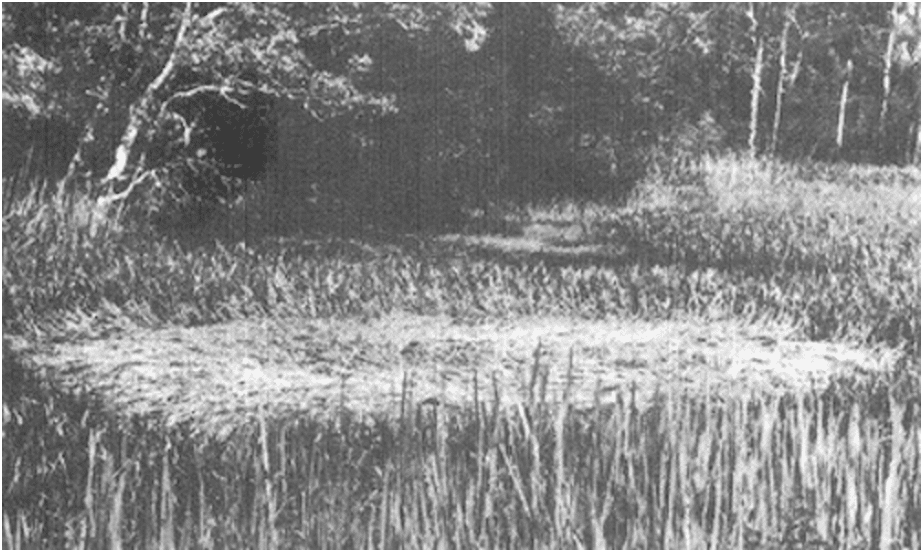
On a foggy January morning in 1966, an Australian farmer named George Pedley heard a hissing sound. When he looked for the source, he saw a flying saucer ascend “in a puff of blue vapor” from a nearby swamp known locally as Horseshoe Lagoon. On closer inspection, he found a 30-foot circle of weeds that had been pressed flat in a clockwise direction, as if the weeds had been flattened by spinning air from a flying saucer.
Figure 1: A Tully nest/UFO Insight.
The local newspaper ran a story about Pedley’s saucer sighting and soon his neighbors discovered five more “saucer nests.” These were all near the town of Tully in Queensland and they became known as the Tully nests.
Local residents told the Royal Australian Air Force that circular weed patterns were common that time of year. An investigation by a local police officer and professors at the University of Queensland concluded that that the circles were most likely caused by short-lived whirlwinds called willy-willies in Australia.
Nonetheless, the idea that extraterrestrials were touring Tully resonated with UFO fans — and locals were happy to offer lodging and stories to tourists who came to see the Horseshoe Lagoon and squint at faded photographs of saucer nests.
A dozen or so years after the Tully nests were reported, designs created by flattened crops of canola, barley, wheat, or other grains began showing up in farmers’ fields in southern England. Some suggested that sexually active hedgehogs may have created these crop circles. (No, this time I am not joking!) Even less plausibly, a molecular biologist named Horace Drew proposed that time travelers from the future were leaving markers to help them navigate our planet (or, at least, England). Never mind that the crop circles disappear when the crops are harvested.
Dust devils and bizarre wind patterns might explain simple circles like the Tully nests, but cannot explain the increasingly precise, complex patterns found in England. Aliens and time travelers were popular explanations. Many of the crop circles were in the county of Wiltshire, the home of the Stonehenge and Avebury prehistoric monuments, and a fertile area for tales of haunted houses, demonic dogs, and sacred geometries. Crop-circle enthusiasts (“croppies”) began compiling detailed records of crop-circle sightings and traveling thousands of miles to absorb spiritual experiences by hugging the canola or lying down inside a crop circle.
Some people, who clearly had too much time on their hands, claimed to have decoded secret messages, such as “believe,” “there is good out there,” and “we oppose deception.” They did not explain why extra-terrestrials would waste their time traveling to earth to create vapid coded messages. Another theory was that the circles were some sort of secret code related to the pre-Columbian Mayan calendar’s Long Count and first Great Cycle, a 5,125-year period that would culminate in the end of the world on December 21, 2012. (Spoiler alert: nothing special happened on that day.)
There were doubters and a few obvious questions. Why are crop circles created at night in remote areas near roads? Why are aliens so fond of farms in southern England? Why would extraterrestrials use secret codes if they had something to tell us?
In 1991, two Brits, Doug Bower and Dave Chorley, confessed that they had made hundreds of crop circles using boards with rope handles to smoosh the crops.
One night in 1978, they had been sitting in a pub, drinking warm English beer and talking about the Tully nests. They decided it would be a hoot to create flattened crop circles to make it seem that flying saucers had landed in English fields. The croppies bought their decades-long prank hook, line, and sinker.
Figure 2: The Julia Set Crop Circle/Ancient Pages.
Crop circles have evolved into an elaborate game. Pranksters and locals both appear eager to keep the story going. Pranksters like messing with the croppies and enjoy creating competitive crop-circle art, enhanced by the thrill of avoiding being caught. There are implicit rules: the circles should be created at night, anonymously, with no incriminating evidence of human involvement. Crop-circle creators now think of themselves as artists and often use sophisticated tools to aid their increasing complicated designs. Photos of the best designs are published in books, catalogues, and calendars.
Local farmers are annoyed that parts of their crops are damaged, first by the pranksters and then by trespassing tourists. But many locals are more than happy to sell lodging, tours, and souvenirs to the thousands of New Age visitors who arrive during each crop circle season. Some towns have pilots flying over their fields daily in order to take pictures of fresh designs that can be downloaded to the internet and lure more tourists.
Many croppies acknowledge the pranksters but insist that some patterns are too complex to be made by humans working for a few hours in the dark. One croppie insisted that,
I can tell a real one, by the energy I feel once inside it. Different crop circles seem to resonate different energies, which I usually feel within my chakras . . . . Each one is different, some seem to energize me, giving me a real buzz, others make me want to lay down in them, and be very still.
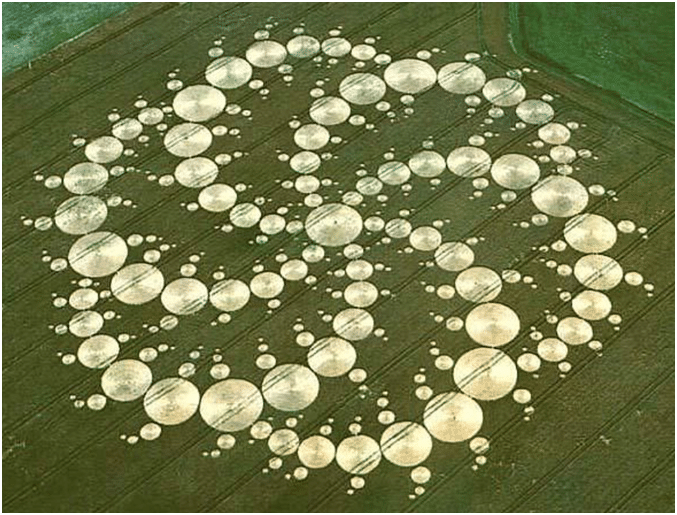
The spectacular crop circle shown in Figure 2 above appeared in July 1996 near Stonehenge. The design is a fractal pattern called the Julia Set and was said to have appeared in less than an hour during the daytime — seemingly ruling out human pranksters. The owner of the field that provided the canvas for this pattern reportedly made about £30,000 charging admission to his field.
Three pranksters later confessed that they had created the pattern in about three hours in the early morning the day before and they were noticed by an airplane. An even more elaborate double-triple Julia Set pattern is shown in Figure 3 (pranksters unknown).
In a bizarre full-circle take on the crop-circle saga, a 2009 BBC article titled “Stoned wallabies make crop circles” stated that a government official in the Australian island state of Tasmania had reported that “we have a problem with wallabies entering poppy fields, getting as high as a kite and going around in circles.” (available at Reuters)
RELATED
The Atlantic: The ocean that holds Earth’s hidden history