Stonehenge / Atlantis - Momentous discovery has potential to completely rewrite World history - PART II
Even when we search the description for the most obscure references to test this hypothesis we find correlation -
“There was an abundance of wood for carpenter’s work, and sufficient maintenance for tame and wild animals. Moreover, there were a great number of elephants in the island; for as there was provision for all other sorts of animals, both for those which live in lakes and marshes and rivers, and also for those which live in mountains and on plains, so there was for the animal which is the largest and most voracious of all.”
Plato is clearly referring to tropical animals such as Elephants and Lions and anyone living in Britain today would find this unlikely and therefore rule out this continent. But again, we found in the catches of North Sea trawler men the bones of Elephants, Mammoths, Lions and Tigers in the last 100 years in Doggerland making this scenario ‘quite probable’ and it would not take much of a stretch of the imagination to classify ‘the largest and most voracious of all’ as the ferocious Sabre-Toothed Tiger, which coincidently went extinct during the ‘Atlantean period’ 14,000 BCE – 4000 BCE.
So we are looking at a civilisation of megalithic builders that once lost their ‘homeland’ and no doubt a great number of friends family and loved ones in the deluge. This being the case - how would we expect a civilisation to mark such a momentous occasion?
We are a civilisation that has had great losses through war and tragedy in the past, 9/11 in America we commemorated by memorial gardens and here in Britain the war losses are remembered by the cenotaph in London, where we come annually to remember the dead with a two minute silence.
How would future archaeologists view the cenotaph, if all written records are lost 10,000 years in the future - when the wind and rain have wiped the stone monument bear, but still resembling the stone pillar it once was?
 |
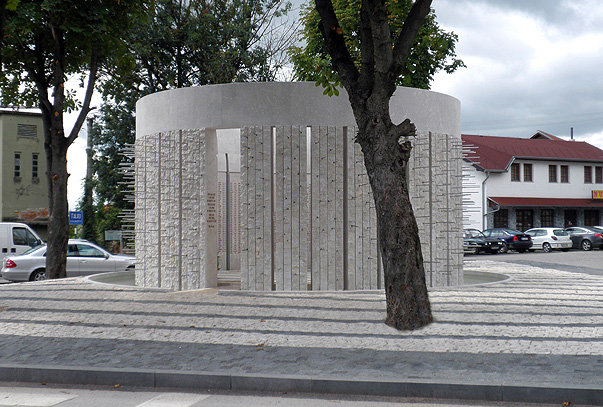
| Kozarac War Memorial - Does it remind you of something? |
We now know from previous chapters (of the Stonehenge Enigma) that Stonehenge was built about 8500 BCE as a place for the sick and dead, we also know that the site was remodelled some four to five thousand years later, roughly at the time that Atlantis finally ‘disappeared’. What I am suggesting is that the new monument continued its commemoration to the dead, but not to individual dead but the death of Atlantis, which would explain how and why this historically massive construction was erected.
Furthermore, it will explain some of the features of Stonehenge we have not mentioned to date in this book. The popular view of Stonehenge is of a completely round monument with lintel stones completing the circle - but there is a massive problem, for not all the stones or the stone post holes are present. Some people have suggested that the monument is incomplete, but those individuals do not understand the monument and the reason for its construction.
A monument to the dead does not face the Summer Solstice Sunrise it faces the Winter Solstice Sunset or Sunrise to mark the shortest day - when light overcomes the darkness, the symbolism of life after death. That being the case, a monument to the dead should face either Winter Sunrise or Winter Sunset and Stonehenge faces the latter. Another reason to ignore the reference to the Sun is that the Sun is usually a representation of life and a completed circle, were as the Moon represents the dead and a crescent. So, the monument would be crescent shaped and hence the reason for the lack of two stones in the South West Quadrant.
So why the horseshoe crescent in the centre of the monument?
The crescent within the crescent faces the Summer Sunrise, this is very symbolic as it represents rebirth or reincarnation. It’s a poignant message through the ages to us decedents of the Atlanteans, where they are telling us that their homeland maybe dead, but the survivors are still alive and will begin again. So the ‘open’ end of the horseshoe points to the Solstice Sunrise, but the ‘main’ direction of the symbol points in the opposite direction – the winter solstice sunset.
 |
| This is how Stonehenge would have looked when new in 4200 BCE |
Furthermore, there in the centre of the Circle lays a very special stone - the Altar stone. The reason it is special is two-fold. Firstly, it’s made of a material unlike the other Sarsen standing stones, it called mica. “Hawkins makes note that while all the other stones were either Bluestone or Sarsen, the so called altar-stone is ‘of fine-grained pale green sandstone, containing so many flakes of mica that its surface, wherever freshly exposed, shows the typical mica glitter’. Currently, geologists are trying to locate the source of this sandstone in Wales. Sadly, they are looking in the wrong direction as I would imagine it’s from their homeland and currently under less than 30m of water in Doggerland.
But this is not the only piece of Sarsen that is made of ‘mica-sandstone’. The most important piece of this special mica-sandstone lays by the moat of the monument to the north east and is called the ‘Slaughter Stone’. I will not delve into the reason that this stone is called the 'Slaughter Stone', but it is interesting that even the druids some 4000 years after the stone was laid into the ground still associated it with death.
Most archaeologists believe that the Slaughter Stone was once a standing stone at the entrance of the monument, this flawed ideas is the result of a hypothetical drawing by Inigo Jones in 1655. This drawing shows Stonehenge as a perfect circle with hexagon trilithon interior and three entrances into the site with six erect standing stones as access points, of which the Slaughter Stone was one. This idea was incorporated in John Aubrey’s drawing in 1666, which was more accurate, but again had the tendency to place all the fallen stones in upright positions.
 |
| The 'Slaughter Stone' |
This false assumption was further compounded by William Cunning in 1880, when (it was reported) that he suggested his grandfather “saw” the upright slaughter stone in the 17th Century). This mistake was latter corrected yet the myths amongst archaeologists still remain (Stones of Slaughter, E Herbert Stone, 1924 pp120).
The reality is that the Slaughter Stone was always (like the Altar Stone) a deliberate recumbent as the excavations of this stone by Hawley and Newall in the 1920’s clearly show. As the chalk subsoil was also deliberately flattened before it was placed in its current position, Hawley presumed that the Slaughter Stone was once ‘buried’,. This idea is understandable as the stone does lay below ground level, but what Hawley never understood is that the reason the stone was in this position was for the same reason the ditch was built around Stonehenge, as it was made to be full of water.
 |
| Cross-section of the Slaughter Stone - showing it was 'deliberately' only partially buried |
This can be observed by the size of the stone hole called ‘E’ (WA1165) which lays two metres north west of the Slaughter Stone, but still within the ‘hollow’ that also contains the stone. Most stone holes at Stonehenge are quite shallow – less than a metre in depth, but stone hole ‘E’ is twice as deep, over 2m. If the Slaughter Stone was placed in it (as some have suggested) it would only be 3m high on the surface, compared to 4.57m for the Heel Stone a few yards away. The only other places in Stonehenge with these large holes is found in the Ditch surrounding the site, which are deep as we have shown to reach the ground water level at construction.
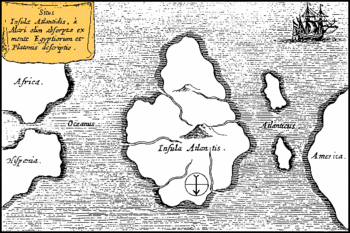
In the past when the Slaughter Stone was placed in this ditch, like the moat, water would have surround the stone similar to an island - for what we see today at Stonehenge is a 6,000 year old model of the land we call Atlantis that lay in the current North Sea.
 |
| Slaughter Stone as it would have originally looked surrounded by water |
Not only did they place a piece of special mica-sandstone in a watery ditch surrounded by water, but they also carved out the contours of the island, showing high and low ground like a contour release. Archaeologists have always believed these features were ‘weather worn’ by age (although the other recumbent stones have not weathered in the same fashion) but recent laser technology has confirmed our belief that this stone was carved as the markings from the tools used can still be seen at microscopic levels.
Finally, and more importantly, the stone has been placed in a very strange position, almost in the way of The Avenue. This shows that this stone and the Avenue have a connection, this type of connection we see in association with Egyptian Pyramids when ‘slight line’ are cut into the sides of the burial chambers to important star constellations to show their associations with the gods. At Stonehenge, the Slaughter Stone and the Avenue are important as they link rebirth with the death of this Great Civilisation, for if we look from the Major Sight line stone - the Altar Stone and look towards the Slaughter Stone, it is quite remarkably a direct line POINTING TOWARDS the location of Atlantis in the North Sea, a place we now call Doggerland.
 |
| A line from the Altar Stone points towards Doggerland/Atlantis |
Yet, when you read the two detailed accounts of Plato’s work in ‘The Timaeus’ and ‘Citias’ where some of the narrative is repeated, but you get a sense that Plato is talking about two different times of Atlantis’ history. The original landscape and people, as we have seen his dialogue are not fixed -
“and it was possible for travellers OF THAT TIME to cross from it to the other islands”,
“Many great deluges have taken place during the nine thousand years, for that is the number of years WHICH HAVE ELAPSED since the time of which I am speaking”.
So are we hearing about the original Atlanteans of 9000 years ago who lived in this green and pleasant land or are we being told of a land that was once great during that time then sunk overnight leaving nothing?
The secret is in the text at the start of the story of Solon and what the Egyptians told him -
“As for those genealogies of yours which you just now recounted to us, Solon, they are no better than the tales of children. In the first place you remember a single deluge only, but there were many previous ones; in the next place, you do not know that there formerly dwelt in your land the fairest and noblest race of men which ever lived, and that you and your whole city are descended from a small seed or remnant of them which survived. And this was unknown to you, because, for many generations, the survivors of that destruction died, leaving no written word.”
What the priests was trying to tell Solon, is that the deluge remembered that Greek history was the one that wiped out Athens and that many such deluges happened in the past - so we can see the confusion with the dates of these floods. Again we see this two-fold story unveiling with Atlanteans referred to as -
“in your land dwelt the fairest and noblest race of men which ever lived”.
Does this give us a description of an Atlantean?
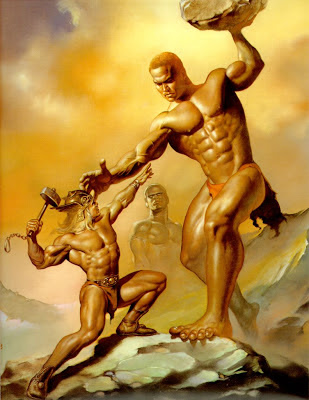 |
| The Legend of Thor from oral traditions |
We know from DNA the Scandinavians are descended from blonde and blue eyed ancestors with a pale complexion – this description seems to me to confirm that fact, as if we use the word fair, we generally are referring to their hair and features. Moreover, it also shows that two stories are being recited here as within the same book the Atlanteans are also called -
“various tribes of Barbarians” and “a mighty power unprovoked” and “invaders”.
Moreover, does the line -
“And this was unknown to you, because, for many generations, the survivors of that destruction died, leaving no written word.”
Suggest this race had no written language? It is well known that the Nordic races relied on verbal story telling for their histories. I believe this confirms a ‘Nordic’ Atlantean. But, the most explosive revelation not picked up by most scholars is the line
“and that you and your whole city are descended from a small seed or remnant of them which survived.”
The priests are telling Solon that the Greeks are ‘seeds’ of their great nation. Are they implying that they were the first people to colonise Athens and leave their philosophy and beliefs?
The writing then goes on to say -
“Solon marvelled at his words, and earnestly requested the priests to inform him exactly and in order about these former citizens”
and it continues to reinforce this suggestion by saying -
“You are welcome to hear about them, Solon, said the priest, both for your own sake and for that of your city, and above all, for the sake of the goddess who is the common patron and parent and educator of both our cities.”
So we now, not only have the Atlanteans ‘seeding’ the Greek population but also the Egyptian population a thousand years later. The only question left to answer is when, and that is revealed just a paragraph later when he writes -
“And the duration of our civilisation as set down in our sacred writings is 8000 years. As touching your citizens of nine thousand years ago”.
So we have our answer, probably the most astonishing revelation in the history of world civilisation, the Atlanteans (“ from a distant point in the Atlantic ocean was insolvently advancing to attack the whole of Europe and Asia, to boot” in boats from a land beyond the “pillars of Hercules”) seeded and established the kingdoms of Greece nine thousand years ago and Egypt a thousand years later.
The interesting aspect of this two-fold story is that some scholars get confused and believe that Atlantis sunk 9000 years ago, when clearly Plato was talking about the colonisation of Greece and Egypt, and then goes on to talk about the Atlanteans coming to conquer and enslave the Greeks and Egyptians, which is clearly a later date.
When he does talk about Atlantis sinking, no dates are offered. This is when the second story totally conflicts with the first, initially they were “the fairest and noblest race of men which ever lived” but within a paragraph or two become -
“For these histories tell of a mighty power which unprovoked made an expedition against the whole of Europe and Asia, and to which your city put an end. This power came forth out of the Atlantic Ocean, for in those days the Atlantic was navigable; and there was an island situated in front of the straits which are by you called the Pillars of Hercules.
This vast power, gathered into one, endeavoured to subdue at a blow our country and yours and the whole of the region within the straits; and then, Solon, your country shone forth, in the excellence of her virtue and strength, among all mankind. She was pre-eminent in courage and military skill, and was the leader of the Hellenes.
And when the rest fell off from her, being compelled to stand alone, after having undergone the very extremity of danger, she defeated and triumphed over the invaders, and preserved from slavery those who were not yet subjugated, and generously liberated all the rest of us who dwell within the pillars.”
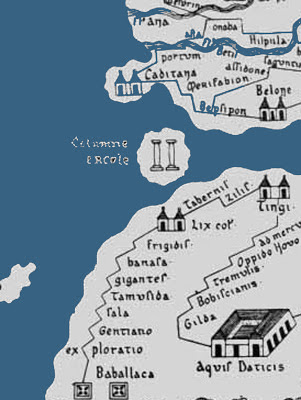 |
| Pillars of Hercules |
This dichotomy does not make sense unless we are talking about two separate time periods. Nine thousand years ago Athens was being seeded and Egypt did even exist as a civilisation for another one thousand years. But the Atlantean army set forth to conquer and enslave, but was defeated by a nation that was in its infancy!
Clearly, this shows two stories with independent time lines. With this in mind, we can date the end of Atlantis after the armed conflict and deluge that destroyed Athens. For Plato writes -
“But afterwards there occurred violent earthquakes and floods; and in a single day and night of misfortune all your warlike men in a body sank into the earth, and the island of Atlantis in like manner disappeared in the depths of the sea. For which reason the sea in those parts is impassable and impenetrable, because there is a shoal of mud in the way; and this was caused by the subsidence of the island.” B.Jowett (1871).
But another interpretation is -
“But at a later time there occurred portentous earthquakes and floods, and one grievous day and night befell them, when the whole body of your warriors was swallowed up by the earth, and the island of Atlantis in like manner was swallowed up by the sea and vanished; wherefore also the ocean at that spot has now become impassable and unsearchable, being blocked up by the shoal mud which the island created as it settled down”. W.R.M.Lamb (1925).
I think the key here is ‘But afterwards’ or ‘But at a later time’, this was a time period unknown ‘after’ the conflict and I would imagine that conflict would be many thousands of years after the establishment of Greece and Egypt with independent armies and leadership.
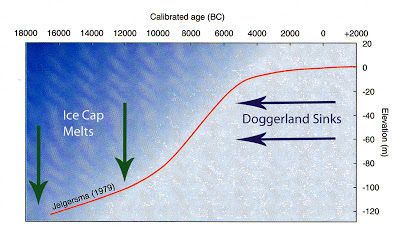
We know from geologists that the last piece of Doggerland sank in about 4000 BC, which is about the time that the Greece Empire was at its height and the Atlantis Empire was all but gone, so it’s my opinion this is the time period Plato was referring too. This would also make sense of the line -
“For which reason the sea in those parts is impassable and impenetrable, because there is a shoal of mud in the way; and this was caused by the subsidence of the island.”
For even today some 6,000 years later, we refer to the area as the ‘dogger sand bank’.
Finally, there is evidence within Plato’s writing that there was contact with the Atlanteans even after the flood had taken way their major city Atlantis, for a line in Critias talking about the final flood gives us get another clue to the location of this legendry land, for Plato writes -
“ there are remaining in small islets only the bones of the wasted body, as they may be called, all the richer and softer parts of the soil having fallen away, and the mere skeletons of the country being left.”
So what was left after Doggerland disappeared?
We have to remember this sea level increase was happening all over the lost continent, so much so the Irish Sea separated Ireland from Wales, the English Channel was formed separating Britain from mainland Europe and the North Sea took the last of the peninsulas land mass and island to become a vast watery landscape – but the British Isles remained. In comparison would you not call that the ‘bones’ of what was formerly there, and does the makeup of this island look like a ‘skeleton of a country’............
Available on Kindle as 'Atlantis - The Stonehenge Enigma'
RJL
(by Robert John Langdon)


 Fast moving UFO reported over Delaware




 <img src="http://therundownlive.com/wp-content/uploads/2015/02/St.-Paul-daily-globe.-April-14-1885-SM-Kristan-T-Harris.png">