Best UFO Sightings Of May 2016
Sit back and relax and enjoy the Best UFO sightings of May 2016!


 Best UFO Sightings Of May 2016

Sit back and relax and enjoy the Best UFO sightings of May 2016!
Ruimtesonde Juno is bijna bij Jupiter
Tim Kraaijvanger
Nog zeventien dagen en dan komt ruimtesonde Juno aan bij de planeet Jupiter. De afstand tot de grootste planeet van ons zonnestelsel is nog maar dertien miljoen kilometer.
Het is alweer een tijd geleden dat Jupiter langdurig gezelschap kreeg van een ruimtevaartuig. De laatste ruimtesonde was Galileo, die in 1995 aankwam bij de gasplaneet. De Galileo-missie eindigde in 2003, waarna het toestel zichzelf in de dampkring van Jupiter wierp. Nu – dertien jaar later – kunnen we weer genieten van een continue stroom van mooie beelden van Jupiter.
Juno arriveert op 4 juli bij Jupiter en zal langs de polen om de planeet draaien. “Vorig jaar rond dezelfde tijd kwam New Horizons aan bij Pluto”, mijmert Diane Brown van de Juno-missie. “Juno vliegt rakelings langs de atmosfeer van Jupiter. Nooit eerder kwam een ruimtesonde zo dicht bij de gaslagen van deze planeet.” Op 4 juli is de afstand tussen Juno en Jupiter slechts 4.667 kilometer.
Het doel van de missie
Maar wat gaat Juno nu eigenlijk precies doen. Uiteraard staat er een mooi achtergrondartikel over de Juno-missie op Scientias.nl. Maar om het even kort samen te vatten: Juno hoopt erachter te komen wat er onder het dikke wolkendek van Jupiter schuilgaat en hoe de gasreus is ontstaan. Het ruimtevaartuig gaat diep in de atmosfeer van de gasplaneet turen en probeert de temperatuur en samenstelling van die atmosfeer vast te stellen. Ook worden de bewegingen van de wolken in kaart gebracht.

Een artistieke impressie van de Juno-ruimtesonde voor de planeet Jupiter.
Straling
Om de geheimen van Jupiter te ontrafelen, moet Juno risico’s nemen en rakelings langs de atmosfeer vliegen. “We zijn niet op zoek naar problemen, maar naar data”, aldus hoofdonderzoeker Scott Bolton. Het is algemeen bekend dat Jupiter een krachtig magnetisch veld heeft. Wanneer een ruimtevaartuig dit magnetische veld betreedt, dan krijgt zo’n sonde te maken met veel straling. “Gedurende de hele missie wordt Juno blootgesteld aan meer dan honderd miljoen keer de straling van een röntgenapparaat van je tandarts”, zegt Rick Nybakken, projectmanager van de Juno-missie. “Maar we zijn er klaar voor. De baan van Juno rond Jupiter is zo ontwikkeld, dat er minimale blootstelling is aan straling van Jupiter. Juno kan lang genoeg overleven om voldoende gegevens te verzamelen.”
Kluis van titanium
Juno is een bijzonder ruimtevaartuig. Zo beschikt de ruimtesonde over een titanium kluis. In deze kluis bevinden zich de meest waardevolle onderdelen, die andere wetenschappelijke instrumenten aansturen. Denk bijvoorbeeld aan de vluchtcomputer van Juno. De kluis weegt 172 kilo en zorgt ervoor dat de hoeveelheid straling met een factor 800 afneemt. Toch is dat niet genoeg. In de omgeving nabij Jupiter is nu eenmaal teveel straling. Uiteindelijk zal Juno in het harnas sterven, maar hopelijk wel nadat er twintig maanden gegevens zijn verzameld.
Wat vind jij?
Wij tellen in ieder geval de dagen af. Jij ook? Laat je horen door onder dit artikel te reageren.
ESO Captures First-Ever Clear Image of An Exoplanet Candidate, And It’s 11 Quadrillion km Away
For the first time ever, ESO astronomers have been able to capture a clear image of a star system 11 quadrillion kilometers away using the combined forces of the Very Large Telescope (VLT) in Chile, the Keck Observatory in Hawaii, and the Calar Alto Observatory in Spain.
For the first time, astronomers were able to capture a clear image of an exoplanet candidate, orbiting a star known as CVSO 30, which lies around 1,200 light-years away. If validated as an exoplanet, CVSO 30c would prove that CVSO 30 has two planets orbiting it.
 CVSO 30c. European Southern Observatory
European Southern Observatory (ESO) officials say this could be the first star system discovered to have both a close-in exoplanet and another one that is far-out. “If it is confirmed that CVSO 30c orbits CVSO 30, this would be the first star system to host both a close-in exoplanet detected by the transit method and a far-out exoplanet detected by direct imaging,” ESO officials.
In 2012, astronomers found the first exoplanet, CVSO 3b. They have found that this exoplanet is amazingly close to the star, roughly 1.2 million kilometers in distance — just 11 hours away.
On the other hand, the new exoplanet candidate orbiting it, CVSO 30c, is 98,730,000,000,000 kilometres (61,347,977,809,592 miles) away. This distance is 660 times the Earth’s distance from the sun. Given this fact, it means that one orbital period for this planet would take 27,000 years to complete, making astronomers uncertain whether the star is actually part of the star system. More observations would be necessary to confirm (or disprove) this.
“Astronomers are still exploring how such an exotic system came to form in such a short timeframe, as the star is only 2.5 million years old; it is possible that the two planets interacted at some point in the past, scattering off one another and settling in their current extreme orbits,” ESO officials said.
While CVSO 30c’s status remains undecided, what’s really wonderful about the discovery is how impressive it is that we were able to get a clear image of worlds so far away from us — CVSO 30c is 11 quadrillion kilometers (7 quadrillion miles) away from Earth.
In numerical form, T! That’s 15 zeroes!
ESO researchers worked hard building the appropriately named Very Large Telescope (VLT) in Chile to make this happen. And that’s not even enough. They needed to combine forces with two other observatories: the Keck Observatory in Hawaii and the Calar Alto Observatory in Spain.
And at an 11,000,000,000,000,000-kilometer stalker range, it was definitely worth it.
NASA’s Juno Spacecraft Will Reach Jupiter on July 4th
NASA's space probe Juno is set to reach Jupiter by July 4, initiating a two year long study on the gas giant that is far more comprehensive than anything before.
Fireworks aren’t the only reason to look to the skies this Fourth of July.
July 4 will also be the day NASA’s basketball court-sized Juno spacecraft will finally arrive at Jupiter, completing its approximate 600 million-kilometre (372 million-mile) trip through the Solar System.
As Juno approaches Jupiter’s harsh radiation environment, it will fire its main engine to slow down and then slip into orbit around the planet.
While there, Juno hopes to perform 37 close approaches, trying to learn more about the planet’s origins, structure, atmosphere and magnetosphere.
While this sounds relatively benign, Juno will be facing some of the harshest environs in the Solar System. The combination of the metallic hydrogen along with Jupiter’s fast rotation generates a powerful magnetic field that surrounds the planet with electrons, protons, and ions traveling at nearly the speed of light. This makes for a very harsh radiation environment, deadly for almost any spacecraft.
Because of this, Juno is armored like a knight. Juno’s flight computer and critical electronics are tucked inside a 400-pound titanium vault. It also has special radiation-hardened electrical wiring and shielding.
Juno is running on solar power, with three huge panels designed to face the sun during most of the mission. The wings are 29 feet long and 9 feet wide.
Despite being the biggest kid on the block, we don’t really know that much about Jupiter. Juno hopes help us learn more about Jupiter’s core, answer questions around how much oxygen and water the planet has, and how its magnetic field works. It will also be probing Jupiter’s auroras—the most intense in the solar system.
After Juno completes its mission in 2018, it will plunge into Jupiter and burn up. Scientists planned this finale to eliminate the possibility that it could smack into Europa, one of Jupiter’s watery moons.
An Autonomous, 3D Printed Bus That Talks To Passengers? Olli Has it All
Arizona startup Local Motors has just unveiled its electric bus that's 3D printed, and it can talk to its passengers using IBM Watson Internet of Things (IoT) for Automotive.
Self-driving vehicles are the Holy Grail of the transportation technology of the next age. It’s the stuff of science fiction, but it’s coming to life. Big companies like Google, Tesla, General Motors, and even the US Government are accelerating research into the field. But it seems like a small startup beat them to the punch.
Arizona-based startup Local Motors has just revealed a 3D-printed, autonomous, electric shuttle bus that is partially recyclable. It’s called Olli.
The electric vehicle, which can carry up to 12 people, is equipped with IBM Watson Internet of Things (IoT) for Automotive, which is IBM’s car-focused cognitive learning platform.
 IBM
The company, unlike others that mix traditional automotive making and self-driving tech, builds the vehicles from the ground up, and produces most components with 3D printers.
The company is able to print a vehicle in about 10 hours and assemble it in another hour. They are also looking at “micro-factories” that could opensource the building of future designs. In fact, the use of 3D printing allows designs based on what individual customers want, and lacks the large infrastructure costs of traditional automakers.
Olli is the first vehicle to utilize the cloud-based cognitive computing capability of IBM Watson IoT to analyze and learn from high volumes of transportation data, which is produced by more than 30 sensors embedded throughout the vehicle.

In fact, IBM Watson will not only allow automated driving, but also interaction with passengers. Passengers will be able to interact conversationally with Olli while traveling from point A to point B, discussing topics about how the vehicle works, where they are going, and why Olli is making specific driving decisions.
“By having authentic conversations with riders about their journey the more they will be connected to technology itself, making them part of the experience rather than an observer. This user experience is the key to making self-driving vehicles a real part of our lives rather than a tech vision of the future”, says Harriet Green, General Manager of IBM Watson Internet of Things in a press release.
Reference: What Is Artificial Intelligence?
When most people think of artificial intelligence (AI) they think of HAL 9000 from "2001: A Space Odyssey," Data from "Star Trek," or more recently, the android Ava from "Ex Machina." But to a computer scientist that isn't what AI necessarily is, and the question "what is AI?" can be a complicated one.
One of the standard textbooks in the field, by University of California computer scientists Stuart Russell and Google's director of research, Peter Norvig, puts artificial intelligence in to four broad categories:
The differences between them can be subtle, notes Ernest Davis, a professor of computer science at New York University. AlphaGo, the computer program that beat a world champion at Go, acts rationally when it plays the game (it plays to win). But it doesn't necessarily think the way a human being does, though it engages in some of the same pattern-recognition tasks. Similarly, a machine that acts like a human doesn't necessarily bear much resemblance to people in the way it processes information.

Even IBM's Watson, which acted somewhat like a human when playing Jeopardy, wasn't using anything like the rational processes humans use.
Davis says he uses another definition, centered on what one wants a computer to do. "There are a number of cognitive tasks that people do easily — often, indeed, with no conscious thought at all — but that are extremely hard to program oncomputers. Archetypal examples are vision and natural language understanding. Artificial intelligence, as I define it, is the study of getting computers to carry out these tasks," he said.
Computer vision has made a lot of strides in the past decade — cameras can now recognize faces in the frame and tell the user where they are. However, computers are still not that good at actually recognizing faces, and the way they do it is different from the way people do. A Google image search, for instance, just looks for images in which the pattern of pixels matches the reference image. More sophisticated face recognition systems look at the dimensions of the face to match them with images that might not be simple face-on photos. Humans process the information rather differently, and exactly how that process works is still something of an open question for neuroscientists and cognitive scientists.
Other tasks, though, are proving tougher. For example, Davis and NYU psychology professor Gary Marcus wrote in the Communications of the Association for ComputingMachinery of "common sense" tasks that computers find very difficult. A robot serving drinks, for example, can be programmed to recognize a request for one, and even to manipulate a glass and pour one. But if a fly lands in the glass the computer still has a tough time deciding whether to pour the drink in and serve it (or not).
The issue is that much of "common sense" is very hard to model. Computer scientists have taken several approaches to get around that problem. IBM's Watson, for instance, was able to do so well on Jeopardy! because it had a huge database of knowledge to work with and a few rules to string words together to make questions and answers. Watson, though, would have a difficult time with a simple open-ended conversation.
Beyond tasks, though, is the issue of learning. Machines can learn, said Kathleen McKeown, a professor of computer science at Columbia University. "Machine learning is a kind of AI," she said.
Some machine learning works in a way similar to the way people do it, she noted. Google Translate, for example, uses a large corpus of text in a given language to translate to another language, a statistical process that doesn't involve looking for the "meaning" of words. Humans, she said, do something similar, in that we learn languages by seeing lots of examples.
That said, Google Translate doesn't always get it right, precisely because it doesn't seek meaning and can sometimes be fooled by synonyms or differing connotations.
One area that McKeown said is making rapid strides is summarizing texts; systems to do that are sometimes employed by law firms that have to go through a lot of it.
McKeown also thinks personal assistants is an area likely to move forward quickly. "I would look at the movie 'Her,'" she said. In that 2013 movie starring Joaquin Phoenix, a man falls in love with an operating system that has consciousness.
"I initially didn't want to go see it, I said that's totally ridiculous," McKeown said. "But I actually enjoyed it. People are building these conversational assistants, and trying to see how far can we get."
The upshot is AIs that can handle certain tasks well exist, as do AIs that look almost human because they have a large trove of data to work with. Computer scientists have been less successful coming up with an AI that can think the way we expect a human being to, or to act like a human in more than very limited situations.
"I don't think we're in a state that AI is so good that it will do things we hadn't imagined it was going to do," McKeown said.
Additional resources
Mars Rover Panorama Shows Sweeping 'Marathon Valley' (Photo)

An epic Mars panorama shows the snaking valley that NASA's long-lived Opportunity rover has been exploring for the last year — and will likely soon leave behind.
The newly released photo — a composite of many images Opportunity captured in April and May — depicts Marathon Valley, a feature that cuts across the western rim of the 14-mile-wide (22 kilometers) Endeavour Crater.
Opportunity arrived in the valley in July 2015 to hunt for clay minerals, signs of which had been spotted from above by NASA's Mars Reconnaissance Orbiter. (Clay minerals form via the interaction of liquid water with rock, which makes them of special interest to the Opportunity team; the rover's mission aims to help tease out the history of liquid water on Mars.) [Latest Mars Rover Photos by Opportunity]
While doing this work in Marathon Valley, the rover encountered some curious red crumbly material. Opportunity's handlers used one of the robot's six wheels to scuff the stuff, exposing some fresh samples for study.
The results were intriguing, mission team members said.
"In the scuff, we found one of the highest sulfur contents that's been seen anywhere on Mars," Opportunity principal investigator Steve Squyres, of Cornell University in Ithaca, New York, said in a statement.
"There's strong evidence that, among other things, these altered zones have a lot of magnesium sulfate," Squyres added. "We don't think these altered zones are where the clay is, but magnesium sulfate is something you would expect to find precipitating from water. Fractures running through the bedrock, forming conduits through which water could flow and transport soluble materials, could alter the rock and create the pattern of red zones that we see."

Such analyses may be some of the last work Opportunity does in Marathon Valley; it's about time for the rover to move along, Squyres said.
"We are wrapping up our last few activities in Marathon Valley, and before long we'll drive away, exiting along the southern wall of the valley and heading southeast," he said.
Marathon Valley got its name because Opportunity rolled into the region shortly after its odometer ticked past 26.219 miles (42.195 km) — the length of a marathon race.
As of Tuesday (June 14), the rover had covered a total of 26.59 miles (42.79 km) on the Red Planet, NASA officials said. No other vehicle has ever traveled farther on the surface of a world beyond Earth.
The golf-cart-size Opportunity landed on Mars in January 2004, a few weeks after its twin, Spirit. Both robots were tasked with three-month missions, but they kept exploring long after their warranties expired. Spirit was declared dead in March 2011, and Opportunity is still going strong today.
Follow Mike Wall on Twitter @michaeldwall and Google+. Follow us @Spacedotcom, Facebook or Google+. Originally published on Space.com.
Centuries-Old Shipwreck Recreated with 3D Printing
The seabed holds some fascinating historical secrets, but unlike monuments on land, they’re largely hidden from view. Now, archaeologists in the United Kingdom are using 3D printing to bring two historical shipwrecks to life for history enthusiasts and experts alike.
Using data from photogrammetry (measuring the distance between objects from photographs) and sonar imaging, the researchers have produced scale models of a 17th-century shipwreck near Drumbeg, in Scotland, and the remains of the HMHS Anglia, a steamship that was used as a floating hospital during World War I. The steamship was sunk by a mine off the south coast of England.
"It was a proof of concept for us, trying to establish what could be done using sound and light, but there are so many different applications you could use this for," said maritime archaeologist John McCarthy, a project manager at Wessex Archaeology who carried out dives at the Scottish site and was in charge of producing the 3D models. [Photos: Shipwrecks of the Deep Sea]
"People can engage much more easily with a physical object in front of them. You can bring it to schools and conferences, and we are hoping to donate both models to local museums, once we've finished with them," McCarthy told Live Science.
It was not particularly difficult to create 3D-printed representations of the shipwrecks, McCarthy said. The magic, he said, was in creating the virtual models that were fed into the 3D printer.
McCarthy carried out initial experimental surveys of the Drumbeg wreck in 2012 with his colleague Jonathan Benjamin, who is now a lecturer at Flinders University in Australia. McCarthy recently joined him there to begin Ph.D. studies under Benjamin's supervision.
At the Drumbeg wreck site, the pair found three heavily encrusted cannons with evidence of a preserved wooden hull underneath. The ship's identity is still unknown, but one theory holds that it is a Dutch trading vessel called the Crowned Raven, which is known to have been lost in the bay in the late 1600s.
After realizing the techniques they were using could provide enough data for a 3D model, the archaeologists went back to do a more detailed survey in 2014 and used the lessons they had learned from their first attempt.
The archaeologists used a technique called photogrammetry, which involves taking hundreds of overlapping photographs of a site and then feeding them into a computer program that can stitch them together. The application is able to establish the spatial relationships between photos, which allows it to create a so-called 3D point cloud that maps each image in 3D space.
"Once you have a point cloud, you can turn it into a solid surface," McCarthy said. "Then you have a 3D model of the site that's not subjective or an artist's impression, but entirely objective."

The benefits of photogrammetry are that it produces very high-resolution images and it can capture the true color of the site, McCarthy said. The method is easily thwarted, however, by excess marine growth or poor visibility, and it is not well-suited to covering large areas.
Sonar, on the other hand, can see through the murk and can cover much larger areas, McCarthy said. For the 329-foot-long (100 meters) HMHS Anglia, another team from Wessex Archaeology used multibeam sonar — which operates in a similar way to a laser scanner — to do a much larger survey of the shipwreck site.
While multibeam sonar can't match the subcentimeter resolution of photogrammetry, using higher-end equipment and doing many passes can boost accuracy, McCarthy said. The Anglia survey was a particularly high-resolution one, he added, which was part of the reason it was selected for the 3D printing project.
McCarthy pointed out that the Wessex Archaeology team is not the first to create 3D-printed models from underwater imaging data. He said that the field has been booming in recent years, with big advances in both sonar and photographic techniques, and even some novel laser-scanning approaches are beginning to come through.
"All maritime archaeologists are engaging heavily with these techniques now," McCarthy said. "Advances in hardware and software in the last five years has allowed us to do very rapid and cheap surveys, and it has added to the tools we use underwater."
Original article on Live Science.
Ex British Police Officer says Aliens are Among Us [FULL VIDEO]This is the story of a man's battle to uncover the truth about the alien races who visit Earth. With the experience of many years as a serving police officer Tony has tackled top-secret government cover-ups, survived threats to his life and established telepathic communication with the aliens.
Since he first encountered a UFO, he has sought an explanation for this unexplained phenomenon that has taken him around the world, and brought him into contact with abductees and government officials who believe that the truth about links with alien civilisations can no longer be hidden.
He will convince you that there really IS an Alien presence on planet Earth.
UFO Lights Seen Over Rosario River, Argentina On June 12, 2016, UFO Sighting News.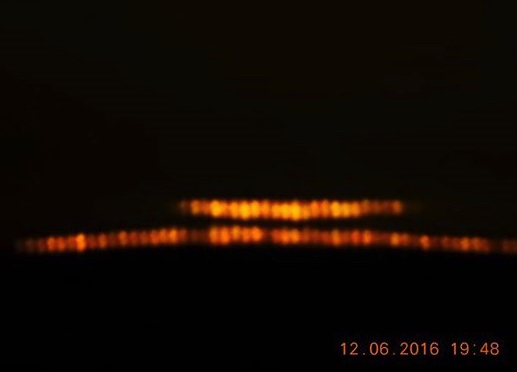


 Crop Circle Found On Berlin, Germany Farm, June 12, 2016, Video, UFO Sighting News.

 Aliens Sending Out Signals From Ceres

Baffled astronomers made the announcement that deepened the mystery of the bright spots on the dwarf planet Ceres. They recently claimed that the famous spots blinked at intervals of around nine hours.
With the latest discovery, some UFO hunters suggested that it is a definitive evidence of the theory that bright spots on Ceres are artificial beacons transmitting coded signals. The signals would guide ET spaceships coming in to land at a base on the dwarf planet, the largest body being discovered in the asteroid belt between Mars and Jupiter.
The unexpected fluctuations in the brightness of the mystery spots were observed in the spectrograph of High Accuracy Radial velocity Planet Searcher (HARPS) at ESO’s La Silla Observatory in Chile. The widely known spots, called faculae, can be found in an 80-kilometer crater Occator.
Some UFO enthusiasts speculate that it is a signal. It could be a warning signal, a radar tower, or a greeting signal. It must be there for a purpose, according to UFO researchers. Does humanity need to signal back?
Some members of the UFO community think that alien colonists created the bright spots on the dwarf planet. Others speculate the extraterrestrials are still living on Ceres while some believe aliens may have already abandoned the planet long ago, but the lights are still working.
In December 2015, scientists already suggested that the bright spots could be a form of brine containing magnesium sulfate hexahydrate (MgSO4.6H20). Alien hunters, meanwhile, agree with scientists but insisted that aliens have used these materials to make a beacon.
Scientists have a better explanation for the variations in brightness. They suspect the fluctuations could be due to the activity below the surface that involves churning out plumes of material that reflect light when the planet faces the Sun. The brightness decreases when the plumes evaporate. The process could repeat in the next rotation when the planet faces the Sun again.
However, scientists admit they don’t have enough data and observations to confirm the hypothesis.
If there are aliens on the dwarf planet, what do you think the identity of these aliens? Grey aliens? Tall Whites? Pleiadian Nordic aliens? Reptillians? Anakim? Or Altairians?
We were abducted by aliens the beautiful women who claim ET’s got them pregnant
The US-based Hybrid Children Community, is trying to recruit more parent breeders, in a bid top “evolve” the human race into a new sub-species which will take over the Earth when the children currently conveniently housed on giant space ships “return to our planet”.Women in the group, who include young glamorous 20-somethings, even claim mating with reptile-like lizards was the best sex they have ever experienced.
These include Bridget Nielsen, 27, from Sedona, Arizona, who is a hybrid mum and medium who charges $65 (£46) for an over the phone session to put parents, who believe they may have conceived hybrid children, in touch with they offspring, according to the community’s website.
Describing sex with a lizard being on a spaceship, she said: “It was great. It was an incredible super primal, super raw, super primal sexual experience.
“There was a really freedom and we were really going for it. It was the best sex I ever had.”
Another young hybrid mum is Aluna Verse, from Los Angeles, California.
Between them Bridget and Aluna claim to have 13 children fathered by aliens.The website, which also charges for other similar sessions and asks for donations, says there are millions of hybrid parents on Earth who have conceived children with aliens either through artificial insemination or full sex, and many remain unaware.The community was founded by Sharon McCormick, aged in her 60s, and former marketing executive Miss Nielsen.
On the website Ms McCormick says: “Since I discovered six and a half years ago that I have many hybrid children, my mission in life has become to help spread the word that they’re real, positive and loving, and to support the parents, siblings and friends of these remarkable kids.
“The concept of hybrid children is so new to so many of us that I believe connecting with each other is of primary importance formoving us all ahead toward the day when we will be vibrationally ready for the children to arrive on Earth.”
Members of the group believe aliens have been harvesting their DNA to create children that combine the best of both human and alien characteristics over a period several years.
 Breeding programme: Artwork of children
 Founder members: Sharon McCormick (left) and Bridgit Nielsen
Miss Nielson said alien sex was the “best ever” and refuted claims from sceptics of a lack of evidence for the cosmic carnal encounters, saying ETs only take women who, “want to be taken”.She lives with her dad but claims to have four boys and six girls who she has regular contact with.She said: “They are not just taking our children – they are creating a hybrid race to better humanity.”The parents draw their hybrid children who look, as you might expect like a human/reptilian cross breed with big blackeyes.Ms Verse, a computer game designer who claims to have three hybrids, says she was taken on board a spaceship in a “dream state” and she has vivid memories of the sex.She said: “I was in a classroom setting with other humans.
“All of sudden I’m sat next to this green reptilian creature and immediately I’m so sexually turned on looking at this being.
“I was very surprised. We’re making love in this classroom in front of everyone. Everyone turned their attention to us.”It sounds crazy and people have asked if I’m off my meds, but this is really happening.”Philip Mollica, from Clarkston, Michigan, aged in his 50s, claims to have been discovering his hybrid children since 2012.He said: ” I feel a great love for these children, mine and all the others as well. I look forward with great anticipation as this all unfolds.”In an almost cult-like move, the group say they are planning to establish a property where they can live together as a safe place for their children to visit.
Ms Nielson said: “It will be somewhere away from the cities, somewhere where the children can visit, run free and express themselves. People say we are crazy but we are not, this is really happening to us.”
Source www.express.co.uk
Yes, There Have Been Aliens
LAST month astronomers from the Kepler spacecraft team announced the discovery of 1,284 new planets, all orbiting stars outside our solar system. The total number of such “exoplanets” confirmed via Kepler and other methods now stands at more than 3,000.
This represents a revolution in planetary knowledge. A decade or so ago the discovery of even a single new exoplanet was big news. Not anymore. Improvements in astronomical observation technology have moved us from retail to wholesale planet discovery. We now know, for example, that every star in the sky likely hosts at least one planet.
But planets are only the beginning of the story. What everyone wants to know is whether any of these worlds has aliens living on it. Does our newfound knowledge of planets bring us any closer to answering that question?
A little bit, actually, yes. In a paper published in the May issue of the journal Astrobiology, the astronomer Woodruff Sullivan and I show that while we do not know if any advanced extraterrestrial civilizations currently exist in our galaxy, we now have enough information to conclude that they almost certainly existed at some point in cosmic history.
Among scientists, the probability of the existence of an alien society with which we might make contact is discussed in terms of something called the Drake equation. In 1961, the National Academy of Sciences asked the astronomer Frank Drake to host a scientific meeting on the possibilities of “interstellar communication.” Since the odds of contact with alien life depended on how many advanced extraterrestrial civilizations existed in the galaxy, Drake identified seven factors on which that number would depend, and incorporated them into an equation.
The first factor was the number of stars born each year. The second was the fraction of stars that had planets. After that came the number of planets per star that traveled in orbits in the right locations for life to form (assuming life requires liquid water). The next factor was the fraction of such planets where life actually got started. Then came factors for the fraction of life-bearing planets on which intelligence and advanced civilizations (meaning radio signal-emitting) evolved. The final factor was the average lifetime of a technological civilization.
Drake’s equation was not like Einstein’s E=mc2. It was not a statement of a universal law. It was a mechanism for fostering organized discussion, a way of understanding what we needed to know to answer the question about alien civilizations. In 1961, only the first factor — the number of stars born each year — was understood. And that level of ignorance remained until very recently.
That’s why discussions of extraterrestrial civilizations, no matter how learned, have historically boiled down to mere expressions of hope or pessimism. What, for example, is the fraction of planets that form life? Optimists might marshal sophisticated molecular biological models to argue for a large fraction. Pessimists then cite their own scientific data to argue for a fraction closer to 0. But with only one example of a life-bearing planet (ours), it’s hard to know who is right.
Or consider the average lifetime of a civilization. Humans have been using radio technology for only about 100 years. How much longer will our civilization last? A thousand more years? A hundred thousand more? Ten million more? If the average lifetime for a civilization is short, the galaxy is likely to be unpopulated most of the time. Once again, however, with only one example to draw from, it’s back to a battle between pessimists and optimists.
But our new planetary knowledge has removed some of the uncertainty from this debate. Three of the seven terms in Drake’s equation are now known. We know the number of stars born each year. We know that the percentage of stars hosting planets is about 100. And we also know that about 20 to 25 percent of those planets are in the right place for life to form. This puts us in a position, for the first time, to say something definitive about extraterrestrial civilizations — if we ask the right question.
In our recent paper, Professor Sullivan and I did this by shifting the focus of Drake’s equation. Instead of asking how many civilizations currently exist, we asked what the probability is that ours is the only technological civilization that has ever appeared. By asking this question, we could bypass the factor about the average lifetime of a civilization. This left us with only three unknown factors, which we combined into one “biotechnical” probability: the likelihood of the creation of life, intelligent life and technological capacity.
You might assume this probability is low, and thus the chances remain small that another technological civilization arose. But what our calculation revealed is that even if this probability is assumed to be extremely low, the odds that we are not the first technological civilization are actually high. Specifically, unless the probability for evolving a civilization on a habitable-zone planet is less than one in 10 billion trillion, then we are not the first.
To give some context for that figure: In previous discussions of the Drake equation, a probability for civilizations to form of one in 10 billion per planet was considered highly pessimistic. According to our finding, even if you grant that level of pessimism, a trillion civilizations still would have appeared over the course of cosmic history.
In other words, given what we now know about the number and orbital positions of the galaxy’s planets, the degree of pessimism required to doubt the existence, at some point in time, of an advanced extraterrestrial civilization borders on the irrational.
In science an important step forward can be finding a question that can be answered with the data at hand. Our paper did just this. As for the big question — whether any other civilizations currently exist — we may have to wait a long while for relevant data. But we should not underestimate how far we have come in a short time.
Scientists discover ‘Unnatural’ mysterious element in formation of solar system
Mysterious ‘unnatural’ element present in the formation of solar system
Curium was named after Marie Curie and Peter Curie whose work lay the foundations of the theory of radioactivity.Researchers identified Curium present in a meteorite nicknamed ‘Curious Marie’ by researchers offers new insight into how stars form. The presence of Curium suggests that nearly all ‘heavy radioactive isotopes’ could have formed at the same time.
The research was published in the Journal Science Advances.
According to scientists from the University of Chicago, a rare element known as ‘curium’ which was found in a meteorite during the formation of our solar system, around 4.6billion years ago. Researchers believe that the element does not occur naturally on earth and it was first produced and identified in 1944 by a group of scientists at Berkley, California.
The lead author of the study, François Tissot said that „Curium is an elusive element“.
“It is one of the heaviest-known elements, yet it does not occur naturally because all of its isotopes are radioactive and decay rapidly on a geological time scale.“
Researchers can use it in order to determine an accurate reading on when our planet was created. According to co-author Nicolas Dauphas: “The possible presence of curium in the early solar system has long been exciting to cosmochemists because they can often use radioactive elements as chronometers to date the relative ages of meteorites and planets.”
Researchers speculate that the enigmatic element could have come into existence as a result of star formations, or massive star explosions that happened before the solar system was born.
Professor Dauphas continued: “This is particularly important because it indicates that as successive generations of stars die and eject the elements they produced into the galaxy, the heaviest elements are produced together while previous work had suggested that this was not the case.”
According to a report from the University of Chicago, „models predict that curium, if present, was in low abundance in the early solar system. Therefore, the excess U-235 produced by the decay of Cm-247 cannot be seen in minerals or inclusions that contain large or even average amounts of natural uranium. One of the challenges was thus to find a mineral or inclusion likely to have incorporated a lot of curium but containing little uranium.“
Nikola Tesla reports in 1895 incredible experience, ” I could see the past, present and future all at the same time
In 1895, while conducting research with its transformer, Nikola Tesla had his first indications that time and space could be influenced by the use of a highly magnetic field.
Part of this revelation came from Tesla’s experimentation with radio frequencies and power transmission through the atmosphere. Simple Tesla discovery would, years later, lead to the infamous Philadelphia Experiment and time travel projects. But even before these ultra-secret military programs were to arise, Tesla made some fascinating discoveries about the nature of time and the real possibilities of time travel.
With these experiments in high-voltage electricity and magnetic fields, Tesla discovered that time and space could be violated or deformed, creating a “door” that could lead to other times. But with this monumental discovery, Tesla also discovered, through personal experience, the real dangers inherent with time travel.
The first Tesla experience with time travel was in March 1895. A reporter for the New York Herald wrote on March 13, he came across the inventor in a small café, looking shaken after being hit by 3.5 million volts, “I think you will not find me a pleasant companion tonight,” said Tesla, “the fact is that I almost died today. A spark jumped three feet in the air and took me here on the right shoulder. If my assistant had not turned off the power instantly, it could have been the end of me. “
Tesla, in contact with the resonance of electromagnetic charge, found himself out of his reference space / time window. He reported that he could see the past, present and future all at the same time. But he was paralyzed within the electromagnetic field, unable to help himself. His assistant, turning the power off, saved Tesla before any permanent damage was done. The repetition of the same incident would occur years later during the Philadelphia Experiment. Unfortunately, the sailors involved were left outside your window space reference / time long with disastrous results.
‘I proved human-alien hybrids EXIST’, says scientist who ‘found them living on Earth’
 Green guru turned alien believer Miguel Mendonça
He said: “I try to keep my feet on the ground as much as possible.“My background is in renewable energy policy gained as an academic, so I have to be sure of my facts.“These hybrids are raising the vibration and awakening people. I have begun to go through this process and to me it is undeniable.“Whenever someone with a strong ET aspect talks to me I feel my energy shift – it just goes through the roof. “I find myself seeing energy with my third eye.“I am a writer, and just wanted to share their stories, and had no clue I would be affected, it’s changed my life.“I will try to use what has been revealed. For one thing, it has solved some of the mystery of the UFO subject.“We know why they are coming here and who they are.”

Co-author Barbara Lamb

Half alien? Robert Frost-Fullington
In researching the book, each ‘hybrid’ was given the same set of questions to answer, including how they discovered they were a hybrid, what their genetic make-up was, and why they were here on Earth.Mr Mendonça told Express.co.uk: “What became clear was how similar each of their accounts were. These were hybrids independent of each other who were describing the same experiences.”Among the interviewees was Robert Frost-Fullington, 36, from California, in the US.He claimed to have DNA from four alien species known as reptilians, Sirians, Tall Whites and those which appear like a praying mantis.He claimed in the book to have had implants inserted under his tongue at the age of five, before experiencing several encounters with aliens. After periods of “conscious recall”, in 2011, he said he realised he was a hybrid.Asked how he was created, he said: “When the human woman becomes pregnant, she’s taken up onto a craft and the beings will take the embryo and create a genetic overlay.”But far from seeing this non-consensual kidnap and interference as sinister, Mr Frost-Fullington and other hydbrids, including women, claim it is being done in the interest of humanity.The people interviewed claimed their mission on Earth was to “raise” what they believe is a “frequency” on Earth by increasing an energy they refer to as “vibrations.”

Intergalactic heritage: Tatiana Amore

Legal alien? Cynthia Crawford
Mrs Crawford and Mrs Lamb also both spoke at the 2011 Mutual UFO Network (MUFON) annual convention at the Hyatt Regency Hotel in Irvine, California, according to skepticblog.com. We asked Mr Mendonça why he had not extended the research to interviewing the alleged hybrid’s parents, or more scientific tests, such as putting the subjects through DNA and lie detector testing, and locating their alleged implants for further examination.Mr Mendonça said: “Some said their parents were freaked out or did not want to know because they were old-school Christians.”He did not believe DNA screening would show anything unusual, because: “All it would find is their normal code and it would ignore anything else.”He added that they were reluctant to give up their DNA samples amid fears “secret military projects would use it to create human super soldiers.”But he added: “Robert is apparently warming to the idea of doing DNA testing, but we did not ask people to submit to DNA tests as much as anything because we did not have funding for that.”He added he had not considered the use of lie detectors or scans for implants, but that there had been an “independent verification” of interviewee Charmaine D’Rozario-Saytch, a 28-year-old woman from southern England, having a “possible implant”.Source www.express.co.uk
INDIA will be the first country to explain to the world about ALIENS CONTACTS?
New Delhi is in the middle of a big secret internal debate. On one side the largest democracy of the world is eager to explain to its citizens and to the world about the ongoing contacts with the UFOs and extraterrestrials. On the other hand there are invisible untold international protocols that prohibit doing anything that may cause worldwide fear and panic.
It is well accepted between the UFO and extra-terrestrial experts that all the five nuclear powers are in contact with the beings from other stars for quite some time. Recently India has seen enormous news on UFO contacts and secret UFO bases in Himalayas near the Chinese bases. In Ladak, for example the locals clearly point out the everyday phenomenon of large triangular spacecrafts coming out below the ground and Indian security forces protecting them.
Military officials and politicians have confessed the fact that India has been contacted. India has been told the rules of the Universe.
The current debate is on whether to keep it secret like other countries are doing or in tradition of a total transparent society come out and tell the truth. India is so open and democratic; it is very difficult to keep a secret for long. The biggest concern of the Government today is that unlike in other countries, it will be very difficult to keep it secret for long. If the information comes out through unofficial channels first and then the authorities are pressed against the wall to confess, two bad things can happen. First, it can really cause a panic in the country as well as the world. Second, the way the Indian politics is run, the ruling party will be thrown out of power in no time i it is ever found that the Government withheld such information from the public.
The recent rush of world leaders to India is remarkable. Starting from Russian President Putin to major Senators from America have visited or are planning to visit India. European Union is in deep discussion with India on cooperation. All sanctions against India’s nuclear programs and Indian Space Research Organization are in the process of being lifted. India is cooperating with Europeans and the Americans in space explorations and technology research program. India is also part of World Trade Organization. India is receiving major outsourcing contracts in IT and call-center service work from America and Europe. India’s Forex reserve is at a level never imagined before because of international direct investments from Western nations, Japan, Korea and others. Interestingly, China the arc rival of India changed its posture in the last few years to make India’s friendship and trade a priority. India is slowly getting to the point when it is accepted as a permanent member of the Security Council. All the five Security Council members China, America, Russia, France and UK support India’s inclusion.
When all these factors are added together and analyzed, it seems like India is being told by the world to abide by the hidden protocols and in exchange be recognized as a major emerging superpower.
The debate the country is facing internally is whether to abide by the laws of the world and the Universe to be recognized as a superpower or be truthful to its citizens and the world.
According to sources close to the Government, the UFO contacts is known by quite a few politicians in the opposition and of course by those who are in power.
The military has legitimate concern of not letting the secrets out either.
Recently, India’s foreign affairs minister Mr. Natwar Singh came out and said that for India it was not necessary to become a nuclear power. He is a strong supporter of Mrs. Indira Gandhi, India’s former Prime Minister who initiated the nuclear program in the mid sixties. India first exploded a nuclear device in Pokhran in early seventies. The whole country including people from his own party questioned Mr. Singh for such an irresponsible statement. But on analyzing his statements, it is evident, that based on what he knows now, being a nuclear power really does not matter much because the technologies controlled by the extra-terrestrials are so advanced that all our technologies mean really nothing. But importantly he may be irritated with this controversial ongoing secret debate and what he really meant was that if India was not a nuclear power, the debate on UFO and extra-terrestrials will never be there in India.
The medical revolution that delves into humans’ inner aliens
Sudden, radical and often violent, revolutions are usually hard to miss. But it is entirely possible to live through a scientific revolution without noticing until we look back to see just how different our lives have become.
Such a revolution is now sweeping through medicine.
In the quest for cures for everything from cancer and heart disease to organ failure and lost limbs, scientists are increasingly turning towards the same source of answers: the human body itself.
After decades of trying but failing to match our own self-healing abilities, researchers are trying to understand how they work and how to boost them.
Pharmaceutical giants Glaxo- SmithKline and Amgen recently joined leading academic researchers to find ways of using our immune systems to seek and destroy cancer cells.
Known as the Cancer MoonShot 2020 programme, it builds on recent advances in such “immunotherapy", which have had success in treating patients with lung, skin and blood cancers.
Meanwhile, biomedical researchers worldwide are learning to use stem cells – part of the body’s own “repair kit" – to create body parts and even entire organs to order.
Collections of kidney, lung and heart cells have already been made in the laboratory. Work is under way to scale them up, creating replacement organs from patients’ own cells, which can therefore be implanted without fear of rejection by their immune system.
But the biggest advances look set to emerge from one of the most astounding facts about the human body: that most of it is not human at all.
At least half of the cells in our bodies are microbes: bacteria, viruses and other organisms we have acquired in our lifetime.
Collectively known as the microbiome, these fellow travellers might seem like the enemy within. Yet it is now clear that they are vital to our health and well-being – and may explain otherwise perplexing links between diet and the onset of lethal diseases.
We start acquiring our microbiome from the moment of birth, picking up microbes from our mother and anyone else who touches us. Our cells then use specific genes to encourage the growth of beneficial bacteria while attacking harmful ones.
Breastfeeding provides another rich source of microbes, as well as complex carbohydrates and proteins that are specifically designed to encourage the growth of Bifidobacteria, a type of gut bacterium that wards off pathogens.
By adulthood, the microbiome has developed into a complex of hundreds of different types of bacteria, plus at least as many varieties of viruses and fungi.
The biggest concentrations – about 100 billion per millilitre – are found in the gut, where they work alongside human cells to digest nutrients.
Now scientists are investigating this collaboration and how it affects our health for good or ill.
This month, a team in the United States published research into how the interaction of human and microbial cells is affected by what we eat, thus casting light on the link between diet and disease.
According to the team – led by Athena Aktipis, an assistant professor at Arizona State University – in healthy people the two types of cells benefit from each other, with the microbes producing energy and vitamins and attacking pathogens, while the human cells provide them with conditions that allow them to thrive.
But according to Prof Aktipis and her colleagues, this symbiosis can be disrupted by a diet that is low in fibre but high in sugar.
Unlike dietary fibre, sugar can be used not only by human cells but also by potentially harmful microbes, such as pathogenic E. coli. The resulting outbreak of “cell wars" can then lead to obesity, diabetes and an early death.
In separate research published this month in the journal Nature, a team – led by Rachel Perry, a postdoctoral fellow in endocrinology at Yale University – described another potential link between the microbiome and obesity. Experiments on mice showed that changes in gut microbes can alter hormones linked to hunger and digestion – leading to over-eating and obesity.
Diet-related cell wars are also suspected of being triggers for two of the biggest killers in developed nations: cancer and heart disease.
The link with cancer is thought to come about via the immune system’s attempts to fight the pathogens as they attack internal organs. The result is inflammation, leading to malfunctioning healthy cells, which then grow uncontrollably – the hallmark of cancer.
In the case of heart disease, one culprit is thought be the ability of “bad" microbes to turn nutrients into compounds that create artery-clogging plaques.
Recent studies of healthy volunteers on vegan diets found their microbiomes appear to lack these organisms, reducing the risk of heart disease.
Evidence is also emerging that the microbiome provides the “missing link" between the Mediterranean diet – rich in fresh fruit, vegetables and olive oil – and better long-term health.
The microbiome also seems to explain otherwise baffling links found by researchers between heart disease and dental hygiene.
Our mouths play host to more than 100 species of microbes, and gum disease and tooth loss is a symptom of the kind of cell wars now linked to serious disease in the rest of the body.
The promise of more such insights has prompted a proposed US$121 million (Dh444.5m) National Microbiome Initiative among US government departments including the National Institutes of Health.
Unveiled last month, one of its key aims is to set up long-term human studies to reveal more about the links between health and the microbiome.
Meanwhile, drug companies are racing to find compounds that can target specific microbes and quell a cell war before it triggers disease.
Whether so-called probiotic supplements with “good" microbes make any difference remains to be seen. One major question facing researchers is the extent to which all of us need our own special mix of microbes to be in peak condition.
But there is one insight of the microbiome revolution that looks set to stand the test of time: when we eat, we are feeding ourselves and our non-human “other half".
Robert Matthews is a visiting professor of science at Aston University, Birmingham.
Steve Bassett the Reality of UFO Disclosure 2016Steve Bassett, executive director of the Paradigm Research Group, is the only registered "alien disclosure" lobbyist in the United States and has been campaigning for the White House to disclose what it really knows about UFOs the past 20 years.
The ufo disclosure movement are convinced that world leaders agreed a "truth embargo" on preventing the truth of alien visitations coming out after a legendary "flying saucer crash" in the New Mexico desert decades ago.
http://aquarianradio.com/
Hosts Janet Kira Lessin & Dr. Sasha Lessin interview Stephen Bassett and Grant Cameron on Sacred Matrix on Revolution Radio.