Ontdek de Fascinerende Wereld van UFO's en UAP's: Jouw Bron voor Onthullende Informatie!
Ben jij ook gefascineerd door het onbekende? Wil je meer weten over UFO's en UAP's, niet alleen in België, maar over de hele wereld? Dan ben je op de juiste plek!
België: Het Kloppend Hart van UFO-onderzoek
In België is BUFON (Belgisch UFO-Netwerk) dé autoriteit op het gebied van UFO-onderzoek. Voor betrouwbare en objectieve informatie over deze intrigerende fenomenen, bezoek je zeker onze Facebook-pagina en deze blog. Maar dat is nog niet alles! Ontdek ook het Belgisch UFO-meldpunt en Caelestia, twee organisaties die diepgaand onderzoek verrichten, al zijn ze soms kritisch of sceptisch.
Nederland: Een Schat aan Informatie
Voor onze Nederlandse buren is er de schitterende website www.ufowijzer.nl, beheerd door Paul Harmans. Deze site biedt een schat aan informatie en artikelen die je niet wilt missen!
Internationaal: MUFON - De Wereldwijde Autoriteit
Neem ook een kijkje bij MUFON (Mutual UFO Network Inc.), een gerenommeerde Amerikaanse UFO-vereniging met afdelingen in de VS en wereldwijd. MUFON is toegewijd aan de wetenschappelijke en analytische studie van het UFO-fenomeen, en hun maandelijkse tijdschrift, The MUFON UFO-Journal, is een must-read voor elke UFO-enthousiasteling. Bezoek hun website op www.mufon.com voor meer informatie.
Samenwerking en Toekomstvisie
Sinds 1 februari 2020 is Pieter niet alleen ex-president van BUFON, maar ook de voormalige nationale directeur van MUFON in Vlaanderen en Nederland. Dit creëert een sterke samenwerking met de Franse MUFON Reseau MUFON/EUROP, wat ons in staat stelt om nog meer waardevolle inzichten te delen.
Let op: Nepprofielen en Nieuwe Groeperingen
Pas op voor een nieuwe groepering die zich ook BUFON noemt, maar geen enkele connectie heeft met onze gevestigde organisatie. Hoewel zij de naam geregistreerd hebben, kunnen ze het rijke verleden en de expertise van onze groep niet evenaren. We wensen hen veel succes, maar we blijven de autoriteit in UFO-onderzoek!
Blijf Op De Hoogte!
Wil jij de laatste nieuwtjes over UFO's, ruimtevaart, archeologie, en meer? Volg ons dan en duik samen met ons in de fascinerende wereld van het onbekende! Sluit je aan bij de gemeenschap van nieuwsgierige geesten die net als jij verlangen naar antwoorden en avonturen in de sterren!
Heb je vragen of wil je meer weten? Aarzel dan niet om contact met ons op te nemen! Samen ontrafelen we het mysterie van de lucht en daarbuiten.
Zondag 10 juli 2016
UFO In Lightning Storm Over Italy, Night July 2016, Triangle disk, Video, UFO Sighting News.
UFO In Lightning Storm Over Italy, Night July 2016, Triangle disk, Video, UFO Sighting News.
Date of sighting: July 2016
Location of sighting: Italy
UFOs like this one have been known to either be the cause of the lighting in some clouds, or be attracted to it, because around the globe, UFOs have been seen in the clouds when the lighting flashes. This is not a first time ever. Just here in Taiwan in the last 10 years, they saw UFOs in clouds two times, on two different storms. So...everhwere there is a storm, there is the potential that it could be a UFO causing it, or attracted to it. Excellent video by UFOvni2012.
Large UFO Orbiting Earth Seen On ISS Live Cam May Be Chinese Space Lab, July 2016, Video, UFO Sighting News.
Date of sighting: July 9, 2016 Location of sighting: Earths Orbit An excellent find by Streetcap1 of Youtube. Although this could be a giant UFO, I believe it to be something else. Its just my opinion, but I have watched the International Space Station a lot over the last 6 years and I can tell you that this is not the moon, nor a meteor. It may be the Chinese space station cargo ship, called Tangong 1, or the other one Tangong 2. Both are advanced space laboratories and a cargo ship, but I don't believe they hold astronauts. In 2020 the Chinese will have a 20 ton section that will hold up to 3 astronauts for a period of time. Thats just my thoughts on this. Its been seen in many ISS videos. Scott C. Waring www.ufosightingsdaily.com Streetcap1states: Remember a ufo is an unidentified flying object. This could well be a meteor or the like. What made it interesting was the camera cut off when the ufo seemed to stop. Streetcap1.
This Drone Footage Proof Of Mermaids That We Have Been Waiting For? July 2016, Video, UFO Sighting News.
Date of sighting: July 2016
Location of sighting: Ocean
Do I believe in Mermaids? Yes, such creatures do exist and must be alien species that made a base below our ocean. The evidence is overwhelming, bodies dried out, caught by fishermen and kept in a glass case with the old 1950s newspaper clipping tapped to it. Yeah, I saw such a thing in an old store along the coast here in Taiwan. I looked it over and could find no evidence to point to it being fake. I even talked to the son of the person who caught it, and he attested its real. When going back, I could not find the store any longer. Maybe the closed, but its just gone. That is why I have never talked about it until now. Mermaids are real and I believe them to be aliens.
This drone footage has been featured in many YouTube videos that claim it shows real mermaids caught on tape. These videos make the claim that the humanoid figures seen swimming in the footage are mermaids that have been caught on tape by the drone. Some people have gone as far as to say that this depicts a pack of mermaids caught on tape by the drone. The footage is investigated further in this video.
Two UFOs Captured Over Seattle, Findings Still Under Investigation
If you are one of the thousands of people who witnessed aliens and extraterrestrial beings, you have seen the best of both worlds. As you know, the alien is too far from reality in public’s perspective. The fact that you have experienced and encountered it, the story will not lie. A witness from Washington reported seeing and recording two highly reflective strange objects. The encounter took place during daylight on June.21, 2016, and the witness was outside when two stationary points of light were noticeable. As soon as it came to the attention, the witness told a co-worker to get a camcorder while the witness kept an eye to the two objects. As soon as the camcorder was turned on, the witness attempted to zoom the objects. Unfortunately, the object was so small that the camera had a hard time focusing on them.
While the witness was able to zoom the object, it appeared highly reflective and had squared appearance. In other words, the flying object does not come in curvy shape, but is square in shape and has sharp edges. It also comes with a short bar in the middle part and bears exactly a capital H.
The witness continued to record the strange objects when they slowly hid behind a building. The witness puts the recorder tool away only to see the objects again to the right. Because of this, the witness has concluded that they either came back to the point where they were originally seen, or there were two more strange objects. Apparently, the new two vessels drifted to the building as well.
While the sighting sounds and looks genuine, some experts it is too good to be true. Meanwhile, Timothy Ward, the Washington State Director is still investigating. Therefore, the case has not been debunked as a hoax or fictional story yet.
President Barack Obama or David Cameron are among the names that have been tipped to reveal the information conspiracy theorists have long sought-after
Bookies have slashed the odds on a world leader revealing before the end of this year that aliens are visiting us.
Activists are stepping up calls today for governments around the world to formally acknowledge that extra-terrestrials are engaging the human race.
World Disclosure Day is being held to raise awareness of the so-called Roswell incident 69 years ago and end the 'truth embargo', say organisers.
It is claimed an alien spaceship crashed on a remote ranch in New Mexico in the first week of July 1947.
Getty
Barack Obama could reveal that aliens are visiting us
The Roswell Army Air Force issued a press release saying the military had recovered the remains of "flying disc" which made front page news around the world.
But on July 8, General Roger Ramey announced at a press conference that the object was just a weather balloon, sparking claims of a cover-up.
Stephen Bassett, America's only registered lobbyist on the UFO /ET issue, spoke at the Alien Cosmic Expo late last month: "World Disclosure Day is not a prediction that disclosure will happen on July 8.
"It is a designated day to draw focus on the issue. Think Earth Day.
Getty
David Cameron has previously stated he would be open with the public
"However, on the day the first nation comes forward to finally and formally acknowledge the alien presence, that date will then become World Disclosure Day historically recognising the most profound event in human history."
William Hill has now slashed the odds of a UK prime minister or US president announcing aliens are visiting the planet from 1000/1 to just 25/1.
It follows Democrat nominee Hillary Clinton's pledge to "get to the bottom" of "unexplained aerial phenomena" if she is elected president. She also vowed to send a "task force" into Area 51 in Nevada where craft are said to be kept hidden away.
Getty
Bookies have now slashed the odds on a world leader revealing the presence of aliens
Bassett, executive director of Paradigm Research Group, worked with Earth Mystery News and is so convinced President Obama will disclosure before the end of the year, he has put his money where his mouth is by placing a 100/1 wager - dubbed the 'Disclosure bet' - which has a $30,000 payout.
And he believes the UK Prime Minister, which looks odds-on to be Theresa May, would back up the US commander in chief.
He added: "It is notable that not too many years back, similar wagers received odds of 1000 to 1 odds. The odds are much lower now."
A William Hill spokesman said: "There has definitely been a decent number of bets in recent weeks but with the election around the corner we expect loads more.
Getty
There are questions about the suspected alien crash at Roswell
"The last bet was 100/1 but we are now just 25/1 and will be offering maximum bets of £50.
"Over the years we have had many bets for aliens but this is the first time that we have been worried. If we are truly going to find out then this year's American election looks like the catalyst."
Paul Hellyer, a former deputy Prime Minister and ex-defence minister of Canada, spoke out at the First Canadian National Inquiry into UFOs last week, claiming that a 'cabal' of bankers, oil cartels, industrial corporations, the military and intelligence agencies were behind the cover-up.
He also believes an alien craft did crash at Roswell and the US and Canadian governments signed a deal not to tell the public about visitations.
Notorious Area 51 Secured by Snipers, Unmarked Choppers (VIDEOS)
As the promise of declassifying whatever information there might be regarding the visitation of Earth by extraterrestrials is yet to be fulfilled, Area 51 in Nevada, a place that has excited UFO seekers for decades, has increased its security, employing snipers and unmarked helicopters to patrol the region’s perimeter.
Several viral YouTube videos suggest that an entrance into the restricted US Air Force base is being kept safe from prying eyes.
One video, recorded May 18, depicts curious travelers who stray too close to the restricted area. A person claiming to be an author of the footage states during the video that there is a sign at the Area 51 entrance, warning off anyone from wandering onto the base.
“It says use of deadly force authorized," the voice in the footage says. “We have been to every other gate and this is the only one that says use of deadly force.”
The videographers claim to have observed what they describe as a “sniper man” on a rocky hilltop who, they believe, is standing guard.
Another video, recorded on May 15, documents a tour group prowling around the vicinity of the air base’s main entrance. A Black Hawk helicopter appears, flying low enough that a man could “hit it with a rock," one of the witnesses notes. The helicopter circles the tourists closely.
The observer in the video asserts that the helicopter is a “black ops” aircraft, a term commonly used by conspiracy theorists to describe covert operations by a government.
According to Andre Milne, founder of defense technology firm Unicorn Aerospace, the Area 51 operations aren’t about aliens. In an interview with Express.co.uk, Milne statesthat the US military tests classified aircraft at the remote facility.
"Area 51 is a highly-secured facility for the painfully obvious necessity to restrict any and or all witness observations of the classified aircraft," he said.
Area 51 became notorious in 1947, when representatives of the US military claimed that they had discovered a crashed alien spacecraft outside the town of Roswell, Nevada. Subsequent statements claimed that the ‘UFO’ was a crashed weather balloon, but many insisted that the remains of a spaceship had been moved to Area 51 for examination.
Earlier this year, Democratic presidential candidate Hillary Clinton µ
Roswell & The US Military: The Truth Really Is Out There
by John-Paul Tooth
Ever wanted to find out what really happened at Roswell? Well now you can.
In 1947 there was a crash at a ranch near the city of Roswell, in New Mexico.
And that's pretty much the only thing that's been universally agreed upon ever since.
It all started when a foreman, William Brazel, noticed clusters of debris around 30 miles north of Roswell.
Brazel told the Roswell Daily Record that he and his son saw a "large area of bright wreckage made up of rubber strips, tinfoil, a rather tough paper and sticks."
He paid little attention to it at the time but later returned with his family to gather up the material.
The next day, after hearing reports about 'flying disks', the foreman began to wonder if that was what he had picked up.
During a visit to the local sheriff, Brazel "whispered kinda confidential like" that he may have found a flying disc.
Sheriff Wilcox then called Major Jesse Marcel from the nearby Roswell Army Air Field (RAAF), at which point a "man in plainclothes" accompanied Brazel back to the ranch. But what they found doesn't really sound very alien at all..
As reported in the July 9, 1947 edition of the Roswell Daily Record:
"The balloon which held it [the 'flying disk] up... must have been 12 feet long, [Brazel] felt, measuring the distance by the size of the room in which he sat. The rubber was smoky grey in colour and scattered over an area about 200 yards in diameter.
"When the debris was gathered up, the tinfoil, paper, tape, and sticks made a bundle about three feet long and 7 or 8 inches thick, while the rubber made a bundle about 18 or 20 inches long and about 8 inches thick. In all, he estimated, the entire lot would have weighed maybe five pounds.
"There was no sign of any metal in the area which might have been used for an engine, and no sign of any propellers of any kind, although at least one paper fin had been glued onto some of the tinfoil."
"There were no words to be found anywhere on the instrument, although there were letters on some of the parts. Considerable Scotch tape and some tape with flowers printed upon it had been used in the construction.
"No strings or wires were to be found but there were some eyelets in the paper to indicate that some sort of attachment may have been used."
The object was flown to Fort Worth Army Air Field, where the object was identified as being a weather balloon and its "kite", a nickname for a radar reflector used to track the balloons from the ground.
Public attention was grabbed, however, after the RAAF issued a press release stating that military personnel had recovered a "flying disc" which had crashed on a ranch near Roswell.
But interest subsided pretty quickly after the military informed the public that the crash was of a standard weather balloon; with a press conference held featuring debris (foil, rubber and wood) said to be from the crashed object, which matched the weather balloon description.
The incident on the front page of the Roswell Daily Record
And the desired effect was achieved - historian Robert Goldberg describes the story as having "died the next day" - but the story didn't end there, and the military hadn't in fact told the whole truth (but we'll come to that later).
It was over 30 years until interest was reignited - with conspiracy theories surrounding the event starting to take hold amongst UFO enthusiasts (known as 'ufologists') in the late 1970s.
UFO researchers began to interview hundreds of people who claimed to have had a connection with the events at Roswell, while hundreds of documents were obtained via Freedom of Information Act requests, and 'government documents' supposedly leaked by insiders.
Books, articles and television shows were produced, and by the mid-1990s a poll revealed that most people interviewed believed aliens had landed at Roswell, and that a government cover-up had taken place.
A US weather balloon
Many also believe that alien bodies were recovered, with film footage causing an international sensation in 1995 that claimed to show an alien autopsy and have been taken by a US military official shortly after the Roswell incident.
Its creator admitted in 2006 that the film was 'mostly a reconstruction', although he claimed it was based on since-lost genuine footage, with some original frames having allegedly survived. A fictionalised version of the story of the footage then became the subject of the 2006 comedy film Alien Autopsy (2006).
It's been reported that as many as 11 'alien recovery sites' have been identified, with some of these having possibly confused accounts of the several known recoveries of injured and dead service personnel from four military plane crashes that occurred in the area from 1948 to 1950.
In fact, there's no evidence that a UFO crashed at Roswell.
B. D. Gildenberg has called the incident "the world's most famous, most exhaustively investigated, and most thoroughly debunked UFO claim".
There have been a number of explanations for the hold Roswell has taken over the public imagination. Former CIA intelligence officer and author Karl T. Pflock said:
"[T]he case for Roswell is a classic example of the triumph of quantity over quality. The advocates of the crashed-saucer tale […] simply shovel everything that seems to support their view into the box marked 'Evidence' and say, 'See? Look at all this stuff. We must be right.' Never mind the contradictions. Never mind the lack of independent supporting fact. Never mind the blatant absurdities."
Others point to a public preoccupation in the 1980s with "conspiracy, cover-up and repression" following the Watergate scandal of the previous decade, while it's also been suggested that people may have had motives for promoting the idea of aliens at Roswell. Author Kal Korff says:
"[The] UFO field is comprised of people who are willing to take advantage of the gullibility of others, especially the paying public. Let's not pull any punches here: The Roswell UFO myth has been very good business for UFO groups, publishers, for Hollywood, the town of Roswell, the media, and Ufology […] [The] number of researchers who employ science and its disciplined methodology is appallingly small."
It's also been argued that the Roswell story has all the hallmarks of a traditional folk narrative, with a core narrative having been built upon as it was shared and passed on.
Other 'witnesses' were then sought out to expand the core story, with any accounts not in agreement with it not being included. The story was then retold, and the process started again.
Most of the supposed witnesses, meanwhile, were repeating the claims of others, which would be considered as hearsay in a court of law and therefore inadmissible as evidence.
Indeed, by the 2000s physicist and sceptic Dave Thomas commented: "Is Roswell still the 'best' UFO incident? If it is, UFO proponents should be very, very worried."
Things should have been cleared up in the mid-90s - when the US military admitted that it hadn't, in fact, told the whole truth.
After the global spread of reports on the incident, the US Air Force was instructed to conduct an internal investigation.
It resulted in two reports, the first of which admitted the true purpose of the crashed device - nuclear test monitoring.
It concluded that the material recovered in 1947 was likely debris from Project Mogul, a top secret US military operation which involved microphones flown on high-altitude balloons to detect sound waves generated by Soviet atomic bomb tests.
Click below to see President Barack Obama's reaction when asked about his knowledge of aliens...
Carried out from 1947 until early 1949, the project was ultimately superseded by a cheaper, more reliable network of seismic detectors and air sampling for fallout, which were easier to deploy and operate.
The second report, released in 1997, concluded that reports of recovered alien bodies were probably in part caused by innocently transformed memories of military accidents involving injured or killed personnel.
Memories of the recovery of anthropomorphic dummies used in 1950s military programs and hoaxes perpetrated by various witnesses and UFO proponents were also offered as explanations.
UFO believers, meanwhile, dismissed the reports, attacking their credibility or claiming they were released as disinformation.
So we're agreed - a cover-up of a top secret military operation led to allegations of a cover-up of an unimaginable scale further down the line. Case closed. Or is it?
Mysterious St. Elmo’s fire ignites blue sparks on finger tips at Lake Monona, Wisconsin
Look at this! These guys are experiencing small blue sparks on their finger tips as well as a static noise at Lake Monona, Wisconsin.
Yes, that’s the rare and mysterious St. Elmo’s fire phenomenon.
The St. Elmo’s fire phenomenon occurs when tiny charges in electricity from an object meet the naturally occurring charges in the air.
If the charges in the air are unusually high, often caused by a nearby storm, the clash can be so great that currents ionize and, when combined with nitrogen and oxygen, produce a blue color.
In this case, a snowstorm close by filled the air with the buzz of electricity.
Site of famous alleged UFO landing in Wales up for sale
In 1977, there were a string of UFO sightings in Wales that included alleged UFO landings and alien visitation. The incident is referred to as The Broad Haven Triangle, and now, one of the primary locations of the incident is up for sale.
The old Haven Fort Hotel is listed for £1.3m.
(Credit: Wales Online)
Formerly the Haven Fort Hotel, the building looks like it is out of a period television show. It is right off the cliffs of the picturesque Pembrokeshire coastline. While it does not look like a place where an alien visitation might have occurred, if they were in town for recreation, it is a great choice.
According to Wales Online, the current owner, Francis Granville, says she first heard about the alien visitations when her father wrote her a letter while she was in Spain. Granville says her father’s letter claimed that her mother had seen a UFO and two aliens.
“It was early morning and mum was woken by a buzzing noise and she thought she’d left the gas boiler on. Once downstairs she realized the noise was from outside,” recalled Granville.
A closer view of the property.
(Credit: Wales Online)
“She looked out and saw about 100 feet away an oval object she could only describe as a ‘space craft’ with lights, slowly land and two figures emerge in silver suits,” Granville continued. “She was terrified because the figures, although reminiscent of men, had exceptionally long arms and legs. Their heads were covered by helmets. She called them creatures.”
After Granville’s mother called her father over, the craft and the aliens had disappeared. However, upon examination of the area, they found a small crater in the ground.
Fortunately for Granville’s mother, she was not the only witness. 14 students at nearby Broad Haven Primary say they also saw the UFO land, and they all drew pictures of what they saw.
The children from Broad Haven Primary showing their UFO drawings.
(Credit: Wales Online)
A map showing the location of Broad Haven Primary in relation to Haven Fort Hotel (the small marker left of center near the cliffs).
(Credit: Google Maps)
Others also claimed to have had strange experiences. Francine says, “At the farm across St Bride’s Bay the farmer’s wife said she heard scratching at the window and saw the two creatures looking in! Lots of people in the county saw the craft.”
According to a book on the sightings titled The Watchers, written by Neil Spring, a local Minister of Parliament, Nicholas Edwards, commented on the events. Apparently, Edwards reported at the time, “I am being inundated at the present time with representations about UFOs said to have been seen in Pembrokeshire.”
One the Broad Haven Primary student’s UFO drawings.
(Credit: Wales Online)
Granville’s property looks a bit like a small castle. It is on 4.6 acres and the sale includes the pebble shoreline and beach at the base of the cliffs. The beach even has its own name, Settlands Bay. The home has a lounge area, a restaurant, a commercial kitchen and 14 guest rooms. It is perfect for the enterprising UFO enthusiast who would like to get into the UFO tourism business.
To find out more about the sightings at The Broad Haven Triangle, you can view the documentary below.
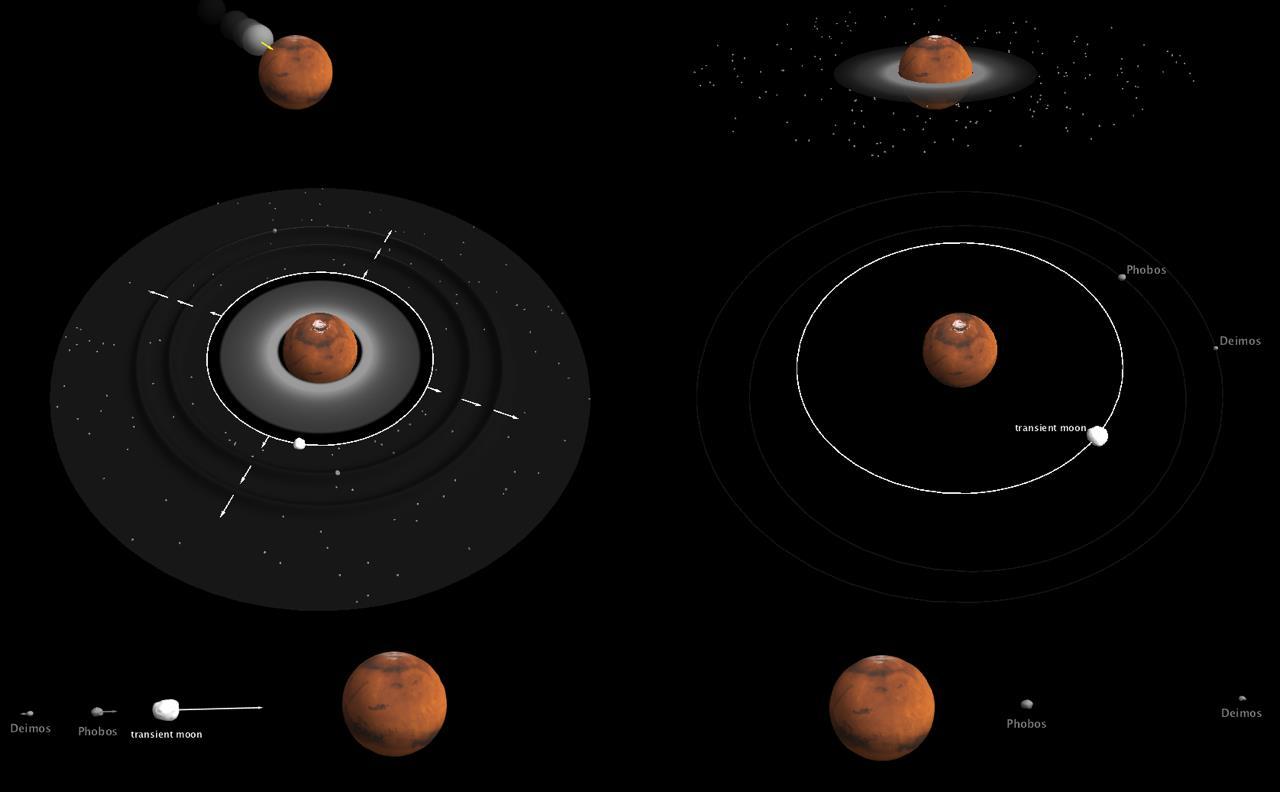
A multidisciplinad.ry study involving French, Belgian and Japanese researchers has proposed a model that may explain the origins of the two satellites and shed light on how moons develop in the Solar System.
In the past, two theories dominate the debate on the satellite’s history. One proposes capture, where the two are asteroids trapped by Mars’ gravity well. The other is that the moons formed from the debris of a collision between Mars and a protoplanet. This is the same theory proposed for our Moon’s formation (colorfully known as the “Big Splat”)—but how two satellites could form from such a process constituted a major hole in this argument, at least as far as Phobos and Deimos were concerne
Illustration of the stages of Martian moon formation. Credit: A. TRINH/ Observatoire Royal de Belgique
PATCHING HOLES
But the new model fills the void in the impact argument. It contends that the two satellites formed because of a much slower axial rotation than what was the case with the Earth and Moon.
The study, published in Nature Geoscience, proposes the following chain of events:
Some 4 to 4.5 billion years ago (i.e., very early in the Solar System’s history), Mars suffered a colossal impact with a body about a third of its size. The debris, captured by Mars’ gravity, formed into a disk à la Saturn’s glorious adornment. Here an enormous moon a thousand times the mass of Phobos gradually formed. This is exactly the scenario that created our Moon.
But the divergence occurs because of the slower rotation speeds. Earth took less than 4 hours to spin on its axis whereas Mars rotated very slowly over a 24-hour period. The slower rotation allowed the debris to coalesce into smaller moons. These moons were all forced by Martian tidal action to fall back onto the planet’s surface (including the largest one), leaving only the two most distant moons: Phobos and Deimos.
The theory may also explain another longstanding Martian mystery: why its northern hemisphere is lower in altitude than its southern. The Borealis Basin, it turns out, may be the remnant of this primordial, moon-forming impact.
However, while this establishes a concrete theory, it is still speculation until future missions collect images and samples that prove that the moons are composed of a mixture of Martian mantle and debris.
Lost Japanese Spacecraft Shares Groundbreaking View of Galaxy Group
By Nola Taylor Redd, Space.com Contributor
This image illustrates how supermassive black holes at the center of galaxy clusters could heat intergalactic gas, preventing it from cooling and forming stars. The black hole inflates bubbles (dark areas) of ultrahot, ionized gas, called plasma. The bubbles, which reach tens of thousands of light-years into space, drag gas (blue clouds) from the cluster center, which explains the long streaks of gas, or filaments, seen in optical images. In the outer regions, the bubbles cause turbulence, which heats the gas. The hot gas emits bright X-rays detected by X-ray satellites.
Credit: SLAC National Accelerator Laboratory
Like a confectioner trying to reach the right consistency in a sweet concoction, a supermassive black hole is vigorously stirring the gas within a collection of galaxies to keep star formation at a minimum. The new finding, revealed bythe doomed spacecraft Hitomi, may help solve the question of why so few stars form within collections of hundreds or thousands of galaxies.
Hitomi measured the motion of gas in the center of the Hitomi measured the motion of gas in the center of the the Perseus galaxy cluster with unprecedented precision, as much as 50 times better than previous instruments, said Andrew Fabian, a professor of astronomy at the University of Cambridge in England. The black hole, by stirring the gas, keeps the material from cooling down and forming new stars.
Without that mixing activity from the black hole, "the central galaxy would be much brighter and have a much higher stellar mass," Fabian told Space.com by email. Fabian is chairperson of part of Hitomi's science working group, an international collaboration headed by the Japan Aerospace Exploration Agency (JAXA). That group published the results of the only science completed by the HItomi spacecraft before it disintegrated in orbit last April. [Images: Black Holes of the Universe]
"We already knew that supermassive black holes, which are found at the center of all galaxy clusters and are tens of billions of times more massive than the sun, could play a major role in keeping the gas from cooling by somehow injecting energy into it," Norbert Werner, a research associate at Stanford University in California who analyzed data from Hitomi, said in a statement. "Now we understand this mechanism better and see that there is just the right amount of stirring motion to produce enough heat."
A massive spoon
Galaxy clusters are made up of anywhere from 50 to thousands of galaxies. Hot gas reaching tens of millions of degrees Fahrenheit makes up about 15 percent of a cluster, causing it to shine brightly in the X-ray spectrum. Studying the gas helps astronomers make estimates of how massive the cluster is, but these estimates can change based on how quickly the gas is stirred, a process that can also affect the birth of stars.
Other instruments have studied the Perseus cluster, the brightest X-ray cluster in the sky, and one of the most massive. These glimpses revealed enormous bubbles of gas thousands of light-years wide, spat out by thesupermassive black hole at the center of the cluster.
For the first time, Hitomi was able to link the movement of the gas to the bubbles. As they rise from the black hole, the bubbles drag gas from the center of the cluster, stirring it up and heating it. Because the gas can't cool, it is unable to form new stars. (Visible-light images reveal streaks of colder gas pulled away from the galactic center).
"Although the motions heat the gas at the center of the Perseus cluster, their speed is only about 100 miles [160 kilometers] per second, which is surprisingly slow considering how disturbed the region looks in X-ray images," Hitomi's co-principal investigator Roger Blandford, a physics professor at Stanford University and a professor of astrophysics and particle physics at the Department of Energy's SLAC National Accelerator Laboratory.
While understanding how the gas moves can affect estimates of mass in the cluster, Blandford said the new measurements haven't led to significant changes in previous mass calculations.
Unfortunately, Hitomi was able to study the Perseus cluster only briefly before the satellite was lost.
Due to the spacecraft failure, "We are not able to make these measurements in other clusters and galaxies and so understand better how the feedback process operates," Fabian said.
The research, along with an accompanying perspective piece, was published online today (July 6) in the journal Nature.
A combined image of the (background) Chandra X-ray image of the core of the Perseus cluster with Hitomi's X-ray image outlined in yellow. The X-ray spectrum shows helium-like iron on the left and hydrogen-like iron on the right, with its narrow lines mapping the speed of the hot gas.
Credit: Hitomi Collaboration/JAXA, NASA, ESA, SRON, CSA
'A new chapter'
Launched in February 2016, Hitomi carried an X-ray detector that was designed to spot objects 10 to 100 times fainter than those visible to previous spacecraft, according to JAXA. By probing high-energy objects such as black holes, galaxy clusters and supernova remnants from space, Hitomi was able to observe in X-ray and gamma-ray wavelengths that can't make it through Earth's atmosphere.
But after a little more than a month in space, a glitch resulted in Hitomi spinning wildly out of control. The high-speed rotation caused several pieces of the satellite to snap off, permanently disabling the spacecraft. As many as 11 fragments were detected flying through space. By the end of April, JAXA ended its efforts to reconnect to the spacecraft, well before the end of what was supposed to be a three-year mission.
Despite its early destruction, Hitomi managed to perform significant science. In its first week after launch, the spacecraft spent three days observing the Perseus cluster, making a total of four observations. Hitomi began its fateful position change before the craft had completed all of the studies that researchers had intended it to make.
"Eventually, it would have mapped much of the cluster over a total of a month or more, and much longer on many other clusters," Fabian said.
He told Space.com that only a handful of other sources were observed for calibration purposes, and these would be "much less interesting scientifically."
"Being able to measure gas motions is a major advance in understanding the dynamic behavior of galaxy clusters and its ties to cosmic evolution," study co-author Irina Zhuravleva of the Kavli Institute for Particle Astrophysics and Cosmology, said in the same statement from SLAC National Accelerator Laboratory. "Although the Hitomi mission ended tragically after a very short period of time, it's fair to say that it has opened a new chapter in X-ray astronomy."
Strange Object in the Solar Neighborhood Has Clouds of Water
Futurism, VC
IN BRIEF
The brown dwarf known as WISE 0855 has fascinated astronomers. Now they've begun to study its composition—with surprising results.
The brown dwarf WISE 0855 has piqued the interest of astronomers since it was first detected in 2014. It is 7.2 light-years away from Earth and is known to be the coldest object outside the Solar System. When viewed using ground-based telescopes, it is just barely visible at infrared wavelengths.
Using the Gemini North telescope in Hawaii, astronomers at UC Santa Cruz succeeded in getting an infrared spectrum of the brown dwarf which gives the first set of details regarding its composition and chemistry. Included among the details is the strong evidence that clouds of water or water ice exist on the object. These are the first water ice clouds to be detected outside of the Solar System.
“The spectrum allows us to investigate dynamical and chemical properties that have long been studied in Jupiter’s atmosphere, but this time on an extrasolar world,” said Andrew Skemer, assistant professor of astronomy and astrophysics at UC Santa Cruz.
This vivid view of the Crab nebula combines an infrared view from ESA's Herschel Space Observatory with an optical image from the archives of the NASA/ESA Hubble Space Telescope.
Credit: ESA/Herschel/PACS/MESS Key Programme Supernova Remnant Team; NASA, ESA and Allison Loll/Jeff Hester (Arizona State University)
Glittering, glamorous, graceful. The latest red-carpet fashion statement? No, of course not. I'm talking about nebulas, the wispy clouds of gas and dust scattered through each galaxy. Earthly fabrics can't come close to the heavenly, tenuous beauty of these objects.
Peppered throughout the Milky Way, they provide amateur astronomers an eyeful of delight and give professional astronomers plenty to ponder. We see these objects in all sorts of shapes, sizes, colors and configurations, from almost-perfect spheres and shells to dazzlingly complex helices to tangled wrecks. But where exactly do they come from? And, perhaps more importantly, where are they going?
To get a good look at nebulas, let's first look at the stars. Tiny, compact and dense — at least, astronomically speaking — a star is pretty much the opposite of a nebula. The power of a star comes from nuclear fusion, which occurs because of the intense pressures shoving elements together way past their personal comfort zones. That fusion creates heavier elements and a tiny bit of leftover energy, which is enough to maintain the star for millions (in the case of huge stars) to trillions (in the case of teensy-tiny-barely-above-brown-dwarf stars) of years. [50 Fabulous Deep-Space Nebula Photos]
No matter how long they last, stars are finite creatures. Thus, they must have come from somewhere and will end up going to somewhere else. Presumably, they didn't start life as tiny, dense balls and they won't end life the same way either. So where do stars come from, and where are they going?
Based on this article's topic, you can probably guess what the answer is: nebulas. Stars come from nebulas and end up turning into nebulas. Likewise, nebulas can generally be classified into two categories: about-to-be-stars and used-to-be-stars.
About to be stars
One could argue that the natural state of matter is clouds of stuff. In fact, I'm about to make just that argument. Stars depend on a specific process, nuclear fusion, to survive, and once that process ends, they quit being stars. The objects known as stars are altogether temporary. But a cloud of gas and dust? It can just hang out being a cloud of gas and dust for as long as it wants. If no forces nudge it one way or the other, it's perfectly happy just being what it is.
That will change only when a nebula does get nudged, say by a chance gravitational interaction with a neighbor, or by being too close to a nearby supernova (you gotta hate it when that happens). Once nudged, the nebula can become unstable, its natural self-gravitational pull overwhelming its equally natural gas pressure (an event marked by reaching a threshold dubbed the "Jeans instability"). Very quickly, pieces of the nebula branch and break off, smashing down in on themselves to get the fusion party started and make some stars.
The smashed-down bits turn into "dark nebulas" (hint: they're kind of black) as their high densities shroud the light coming from any newly forming stars. Fortunately, radio and infrared radiation penetrate even the densest of these nebulas, allowing astronomers to peer into these clouds' stellar wombs.
A typical cloud of gas, once unsettled, might make hundreds or even thousands of stars in a single batch. The largest and brightest of those stars will spew out tons of hot, heavy, high-energy radiation, exciting the molecules in the remaining nebula and causing it to glow rosy red.
Called "emission nebulas" — because their material is, well, emitting light — they won't last long. Those big, bright stars spewing radiation are sure to go supernova, ripping apart the already-tenuous veils of dust and gas and spreading this material so thin even the keenest observers are unable to distinguish it from the general spacey background.
Used to be stars
And that brings us to where nebulas come from in the first place. The answer, of course, is stars. When stars die, it's not pretty — or it's very pretty, depending on your point of view. [Supernova Photos: Great Images of Star Explosions]
The largest stars go off in spectacular fashion, unleashing almost all their unspent energy in a blast that can outshine entire galaxies (to be fair, the blast will last only a few days or weeks, while galaxies keep on shining for trillions of years). That blast naturally carries a lot of "stuff" far from the original star; basically, the whole star is turned inside out and goes from point-like to cloud-like in one fantastic event.
The ejected material rides the shockwaves at a healthy fraction of the speed of light, so it doesn't take long for a decent-size nebula to form. Even supernovas that occurred only hundreds of years ago (which in astronomical terms might as well be yesterday) have already become beautiful artistic displays. One such example is the Crab nebula, which is itself lit by the intense radiation still pouring out of the hot, left-over core of its dead star.
Stars like Earth's sun don't go off as intensely, but that doesn't mean they don't get to create their own masterpieces. Near the ends of these stars' lives, the switchover from hydrogen- to helium-based fusion in the cores leads to complex interplay in the stellar interiors. This causes the outmost layers to swell, expand and eventually slough off. The erratic nature of the star during this time pushes the outward-moving gas in weird directions.
The result: planetary nebulas, which unfortunately have absolutely nothing to do with planets. They come in a wild variety of shapes and patterns. They don't last long. Like their supernova cousins, they're lit by the remaining core of the star, and once that peters out after a few thousand years, the fireworks show is over.
But since stars like the Earth's sun are so common, this galaxy continues to produce new planetary nebulas, decorating the galactic disk like Christmas ornaments.
So that's it: Nebulas turn into stars, and stars turn into nebulas. It's a cycle that has persisted for over 13 billion years, starting when the first nebula scrunched down into a star. And it will continue to last for trillions more. Eventually, though, the nebulas will win: You need to pack enough stuff into a small enough space to make a star, and once you run out of opportunities you run out of stars, and the universe will return to its natural, long-term state: a bunch of gas and dust floating around.
Follow all of the Expert Voices issues and debates — and become part of the discussion — on Facebook, Twitter and Google+. The views expressed are those of the author and do not necessarily reflect the views of the publisher. This article was originally published on Space.com.
Voor het eerst met water gevulde wolken ontdekt buiten ons zonnestelsel
Caroline Kraaijvanger
Wetenschappers hebben sterke aanwijzingen gevonden dat in de atmosfeer van WISE 0855 – een bruine dwerg – wolken gevuld met water of waterijs te vinden zijn.
Wetenschappers bestudeerden de bruine dwerg met behulp van de Gemini North-telescoop op Hawaii. “Je zou verwachten dat een object dat zo koud is, waterwolken bezit,” stelt onderzoeker Andrew Skemer. En nu is er dus sterk bewijs gevonden dat dat ook echt zo is.
Over de bruine dwerg WISE 0855 werd in 2014 ontdekt. Het is een bruine dwerg, oftewel een mislukte ster. Bruine dwergen ontstaan – net als sterren – wanneer een gas- en stofwolk ineenstort, maar slagen er niet in om zoveel massa te verkrijgen dat ze in staat zijn tot kernfusie (en net als sterren gaan schijnen). WISE 0855 is ongeveer vijf keer zwaarder dan Jupiter en bijna net zo koud als deze gasreus. De bruine dwerg bevindt zich op ongeveer 7,2 lichtjaar van de aarde.
Spectrum Eerdere waarnemingen van WISE 0855 wezen er al op dat deze waterwolken bezat. Maar om daar zeker van te zijn, moesten onderzoekers het spectrum van de mislukte ster verkrijgen. Aan de hand van dat spectrum konden de onderzoekers meer zeggen over de samenstelling van de bruine dwerg.
Het onderzoek laat zien dat WISE 0855 sterk lijkt op Jupiter en ook gedomineerd wordt door waterdamp en -wolken. Er zijn echter ook verschillen. Zo bezit de atmosfeer van Jupiter veel fosfine, waarschijnlijk omdat de atmosfeer van deze gasreus zeer turbulent is. Dat WISE 0855 weinig fosfine bevat, wijst erop dat de atmosfeer van de bruine dwerg een stukje rustiger is.
Deze zeven technologieën gaan de wereld voorgoed veranderen
Caroline Kraaijvanger
Zeven nieuwe technologieën denderen als een niet te stoppen trein op ons af. En hun impact is enorm. Alles wordt anders.
Dat schrijft arbeids- en organisatiepsycholoog Dik Bijl in zijn nieuwste boek dat – heel toepasselijk – de titel ‘Alles wordt anders‘ draagt. In het boek stipt hij zeven technologieën aan die er hoe dan ook aan zitten te komen en een enorme impact zullen hebben op de maatschappij: robots, kunstmatige intelligentie (KI), zelfrijdende auto’s, 3D-printen, synthetische biologie, nanotechnologie en genomische geneeskunde. Het boek is een hartenkreet: “Laten we hier alsjeblieft eens goed over na gaan denken.”
Geen doemscenario’s In het boek geen doemscenario’s over kunstmatige intelligentie die onze pet te boven gaat en de macht grijpt of genetische manipulatie die uit de klauwen loopt. Nee, Bijl blijft nuchter. En dat is een bewuste keuze, zo vertelt hij aan Scientias.nl. “Ik wil een beeld schetsen van de ontwikkelingen die op ons afkomen en de gevolgen die deze ontwikkelingen hebben. Dat kunstmatige intelligentie de macht grijpt, is niet zo aannemelijk. Ik zeg niet dat het niet gaat gebeuren, maar het lijkt niet erg waarschijnlijk. Wat we wel zeker weten, is dat robots en kunstmatige intelligentie onze banen over gaan nemen. Naar schatting gaat zo’n 40 tot 75 procent van de banen verloren. Dat is een zekerheidje en dus veel belangrijker dan de doemscenario’s.”
MEER WERKGELEGENHEID
De nieuwe technologieën kosten banen. Maar ze creëren toch ook werkgelegenheid? Ja, stelt Bijl. Maar die nieuwe banen wegen niet op tegen de banen die verloren gaan. “Ik las laatst een artikel over een 3D-printbedrijfje. Het bedrijf had al meer dan twintig mensen in dienst en dus werkgelegenheid gecreëerd. Maar die paar banen wegen niet op tegen de tienduizend banen die bij V&D verloren zijn gegaan.”
Werkloosheid En daarmee stipt Bijl direct misschien wel één van de belangrijkste gevolgen van de zeven opkomende technologieën aan: een enorm verlies aan banen. “Robots, inclusief zelfrijdende auto’s, gaan het lager geschoolde fabrieks-, vervoers- en dienstenwerk uitvoeren; KI-systemen nemen op termijn het hoger geschoolde kenniswerk over,” zo schrijft Bijl in zijn boek. Dat lijkt slecht nieuws. Want miljoenen mensen komen dan zonder werk te zitten. “Maar is dat erg?” vraagt Bijl zich in gesprek met Scientias.nl hardop af. “Het speelt ons vrij om een geweldige maatschappij op te bouwen.” Hij wijst erop dat uit onderzoek blijkt dat slechts 10 procent van de mensen met een baan heel blij is met die baan. “Dat betekent dat zo’n 90 procent niet blij is met zijn baan en zich liever met andere dingen bezighoudt. Zo’n 20 procent daarvan heeft zelfs een hekel aan het werk en werkt alleen om een inkomen te verkrijgen.” Voor die 90 procent heeft Bijl met het oog op de opkomende technologieën goed nieuws. “Als we het goed regelen met elkaar dan kan iedereen in de toekomst gaan doen wat hij leuk vindt.” Het dagelijkse werk wordt dan immers uitgevoerd door de nieuwe werkers: onder meer robots en zelfrijdende auto’s. En dat biedt ons de gelegenheid om onze passies na te jagen.
“ALS WE HET GOED REGELEN MET ELKAAR DAN KAN IEDEREEN IN DE TOEKOMST GAAN DOEN WAT HIJ LEUK VINDT”
Nieuwe welvaartsverdeling Ik hoor je denken: Ho, even, dat is allemaal leuk en aardig, maar zonder werk geen inkomen. Hoe moet dat dan? De opkomst van nieuwe technologieën en de daarmee gepaard gaande werkeloosheid schreeuwt om een nieuwe welvaartsverdeling, stelt Bijl. Stel: je werkt in de bouw. Dan heb je alle reden om de 3D-printer te vrezen. Onderzoekers zijn namelijk al aardig ver met het printen van huizen en naar schatting zal zo’n 40 tot 50 procent van de 20 miljoen mensen die wereldwijd in de bouwsector werken door toedoen van zo’n printertje aan de kant worden geschoven. Wat gebeurt er dan? De werknemers komen in armoede te leven. Terwijl de werkgevers – die hun dure arbeidskrachten inruilen voor een veel efficiëntere 3D-printer – aanzienlijk rijker worden. “Het aantal arme mensen groeit en het aantal rijke mensen neemt af, maar de weinige rijken die er dan nog zijn, worden wel steeds rijker,” zo vat Bijl het krachtig samen. De kloof tussen arm en rijk wordt onoverbrugbaar. “En dan stort de economie in: burgers krijgen niets meer en alle voordelen van de technologieën vallen ten deel aan een handjevol rijken. Dat is het doemscenario waar we op afstevenen als we de welvaart niet fundamenteel anders gaan verdelen.” Maar zo’n nieuwe welvaartsverdeling is nog niet zo eenvoudig. Het vereist namelijk dat je de welvaart weghaalt bij de mensen die welvarend zijn. En die hebben daar vaak geen zin in. Bovendien zal zo’n nieuwe verdeling van de welvaart op hoog niveau – Europees of misschien zelfs op wereldniveau – moeten worden bewerkstelligd. Dat betekent dat heel veel neuzen dezelfde kant op moeten wijzen. En diezelfde neuzen slagen er in feite nu al niet in om de armoede effectief te bestrijden. “Wat dat betreft ben ik eigenlijk best pessimistisch,” erkent Bijl. “Als wij geen manier vinden om de welvaart eerlijk te verdelen, dan stort alles in. En dat is wel het pad waarop we ons nu bevinden.”
Onlangs verrees in Dubai ’s werelds eerste 3D-geprinte kantoor. Afbeelding: overheid van Dubai.
Het milieu Behalve uitdagingen brengen de technologieën natuurlijk ook mogelijkheden met zich mee. Zo is Bijl ontzettend enthousiast over de consequenties die de nieuwe technologieën hebben voor het milieu. Neem bijvoorbeeld de 3D-printer. Deze stelt ons in staat om lokaal te produceren. Dat betekent dat producten niet meer van de ene kant van de wereld naar de andere kant verscheept hoeven worden. En dat scheelt enorm veel uitstoot. Ook de synthetische biologie is op dit gebied veelbelovend. Deze tak van sport draait om het (om)vormen van organismen tot levende fabrieken die producten vervaardigen. Denk aan bacteriën die met wat aanpassingen bioplastics of biobrandstoffen kunnen produceren en zo een bijdrage leveren aan een groenere wereld.
Onze gezondheid En ook over de consequenties die deze nieuwe technologieën hebben voor onze gezondheid is Bijl enthousiast. “In de eerste plaats heb je nieuwe werkers zoals humanoïde robots die ouderen en zieken gaan verzorgen en KI-systemen die medische diagnoses stellen en helpen om veel meer kennis te vergaren over de relatie tussen genen en erfelijke ziektes,” zo schrijft hij in zijn boek. “3D-printers en synthetische biologie worden ingezet om menselijk weefsel en menselijke organen te produceren die geschikt zijn voor transplantatie. Nanotechnologie draagt bij door het ontwikkelen van nanomedicijnen en het stellen van medische diagnoses met behulp van nanodeeltjes. De genomische geneeskunde gaat bijdragen door een betere diagnostiek, het effectievere gebruik van medicijnen en de inzet van gentherapie.” Veel van deze dingen klinken misschien nog als verre toekomstmuziek, maar daarin moeten we ons niet vergissen. “Deze technologieën komen er echt aan,” vertelt Bijl. “Daar is geen discussie over mogelijk.” Het verbieden van bepaalde aspecten van deze technologieën – bijvoorbeeld de veelgenoemde ‘designer baby’, waarbij embryo’s genetisch gescreend en eventueel gemanipuleerd worden om er zeker van te zijn dat ze uitgroeien tot gezonde baby’s met bepaalde gewenste kenmerken – is zinloos. “Er is altijd wel een plek op aarde te vinden waar je wel een designer baby kunt krijgen. Dus verbieden heeft geen zin. Wel moeten we goed nadenken over de ethische aspecten van deze technologieën.”
“OVERHEDEN MOETEN GAAN EXPERIMENTEREN, BIJVOORBEELD MET HET BASISINKOMEN”
Samengevat kun je tot de conclusie komen dat de mens bij de opkomst van deze technologieën gebaat is. “In principe brengen ze een hoop goeds,” vindt Bijl. Mits we er goed mee om weten te gaan en op hun komst zijn voorbereid. Wat dat laatste betreft, is een belangrijke rol weggelegd voor de overheid. “De politiek is vaak zo bezig met problemen op de korte termijn: vluchtelingen, Brexit, Nexit,” somt Bijl op. “En natuurlijk is dat allemaal best belangrijk, maar dat zijn geen dingen die een wereldwijde impact hebben.” En de nieuwe technologieën hebben dat wel. “Dat is iets wat absoluut op ons af gaat komen.” En de tijd dringt. “Als we ons hier nu op gaan richten, kunnen we het tij nog keren. Maar dan moet het prominent op de politieke agenda. Overheden moeten erover gaan nadenken en gaan experimenteren. Bijvoorbeeld met het basisinkomen. Ik zeg niet dat dat de oplossing is, maar we moeten ons daar wel in verdiepen. Deze technologieën gaan enorme gevolgen hebben en zijn niet meer te stoppen. Aan ons de taak om ze goed te gebruiken, ervoor te zorgen dat niemand achterblijft en iedereen meedeelt in de bonussen die deze technologieën met zich meebrengen.”
Bronmateriaal:
Gesprek met Dik Bijl De afbeelding bovenaan dit artikel is gemaakt door Emilee Spokus.
Rare Noah's Ark Mosaic Uncovered in Ancient Synagogue in Israel
By Kacey Deamer, Staff Writer
A mosaic floor panel depicts soldiers being swallowed by large fish, surrounded by overturned chariots in the parting of the Red Sea
Credit: Baylor University
Mosaics depicting prominent Bible scenes were uncovered during annual excavations of an ancient synagogue in Israel's Lower Galilee.
During the excavation in June, archaeologists found two new panels of amosaic floor in a Late Roman (fifth-century) synagogue at Huqoq, an ancient Jewish village. One panel showed Noah's ark with pairs of animals, such as lions, leopards and bears. The other panel depicted soldiers being swallowed by large fish, surrounded by overturned chariots in the parting of the Red Sea.
Such images are extremely rare for the time period, according to excavation director Jodi Magness, of the University of North Carolina at Chapel Hill, whose work was funded by the National Geographic Society. [Photos: Unusual Mosaics Decorated Ancient Synagogue in Israel]
"I know of only two other scenes of the parting of the Red Sea in ancient synagogues," Magness told National Geographic.
"One is in the wall paintings at Dura Europos [in Syria], which is a complete scene but different from ours — no fish devouring the Egyptian soldiers," Magness said. "The other is at Wadi Hamam [in Israel], but that's very fragmentary and poorly preserved."
The Noah's ark mosaic included pairs of animals, such as lions, leopards, bears, and donkeys.
Credit: Baylor University
The ark scenes are also uncommon; Magness said she knows of only two other mosaics showing such depictions.
Along with a team of university scholars and students, and the Israel Antiquities Authority, Magness has excavated at Huqoq since 2012. Previous mosaic discoveries have depicted Bible scenes such as Samson and the foxes and Samson carrying the gate of Gaza on his shoulders.
The Huqoq excavations revealed the first nonbiblical mosaic found in an ancient synagogue. That three-tiered mosaic included a scene showing a meeting between two important male figures, thought to be the legendary meeting between Alexander the Great and the Jewish high priest.
These previous discoveries were uncovered in the synagogue's eastern aisle, and the researchers were uncertain whether the mosaics would continue into the nave, the large central area of the synagogue. However, the excavations did, indeed, reveal the Red Sea and Noah's ark mosaics.
"This panel is exactly as it should be," Magness said of the ark mosaic. "It's facing north, so people could see it as they entered from the south," where the main door would have been located.
Excavations at this site also uncovered coins spanning 2,300 years.
"The ancient coins … are critical for our knowledge of the monumental synagogue and the associated village," Nathan Elkins, a member of the research team and a professor of art history at Baylor University, said in a statement.
As is the case after each excavation season, the researchers will remove the uncovered mosaics for conservation and backfill the excavated areas. Excavations are scheduled to continue in the summer of 2017.
Digital Scan of Dead Sea Scrolls Reveal that Noah’s Ark Was Piramid Shaped
The newly digitized scroll fragments scanned by Dr. Alexey Yudistky, revealed some unexpected details of well-known biblical stories that have been released to the world wide public: Noah’s Ark was shaped like a pyramid.
The story of Noah’s Ark and the Great Flood is widely known, many old religions around the world share this myth, but with slim cultural differences. From India to ancient Greece, Mesopotamia and some North American tribes, few legends have survived the centuries without significant changes according to their culture, leading us to believe that there has been a global cataclysm that afflicted every culture of those days.
The Great Flood and Noah’s Ark is not mentioned only in the Book of Genesis, like it was commonly believed, as new related clues are revealed in the Dead Seas Scrolls.
The Dead Seas Scrolls are probably the greatest archaeological and biblical find, ever recorded in our history, the Bible itself being one large historical chronicle. The ancient scrolls are rather an archive of major events and mentions of symbolic personalities that had a massive influence over the history that took place in the last 2000 years.
Since their discovery almost 50 years ago by a Bedouin shepherd in the Qumran Caves of the Judean Desert, scientists have channeled all their knowledge to the restoration and deciphering of the 800 manuscripts that may hold unimaginable secrets that could shake the foundations of our most fundamental beliefs.
QUMRAN CAVE 4 IN THE JUDEAN DESERT, WHERE NINETY PERCENT OF THE SCROLLS WERE FOUND
Of the 800 scrolls, 200 comprise portions of the Hebrew Bible text and the rest are being thoroughly analyzed by the Israel Antiquities Authority within the Leon Levy Dead Sea Scrolls Digital Library Project. Using a custom-made camera, tens of thousands of scroll fragments have been scanned, each fragment being photographed 28 times at high resolution, with several different wavelengths of light. Thanks to nowadays’ sophisticated technology, archaeologists are able to read symbols and words that until recently were simply unintelligible hieroglyphs.
The newly digitized scroll fragments scanned by Dr. Alexey Yudistky, revealed some unexpected details of well-known biblical stories that have been released to the world wide public: Noah’s Ark was shaped like a pyramid. This was concluded after the correct translation of a word following the phrase “the ark’s tallness”, that was illegible until now: “ne’esefet”, meaning “gathered”, thus the ark’s ribs were gathered together at the top in the shape of a pyramid.
In addition to this evidence, a Greek translation of the bible called “the Septuagint”, dating from the 3rd century, described the Ark using a verb with a similar meaning of “gathered”. Medieval scholars like Maimonides also suggested that the Ark’s roof was pointy, a trait of a pyramidal shape.
PART OF THE SCROLL DISCUSSING JUDGEMENT DAY AFTER THE SCAN. CREDIT: ISRAEL ANTIQUITIES AUTHORITY
Skeptics thought to be a mere bedtime story to feed one’s imagination, but now they have strong reasons to reconsider, as Noah’s Ark and the Great Flood are no longer just a biblical story. The Dead Sea Scrolls clear the controversia around this legendary event, since Christos Djonis claimed in this articles “Evidence of The Great Flood – Real or Myth?” that this was no fiction at all.
The lack of evidences is due to the archaical timeline, being estimated that the ocean levels started to stabilize after 7000 BC. Only between 6000 BC and 5000 BC, have been recorded signs of human activity near the shorelines. This span of 1000-2000 years of this complete human absence is most like due to the primitivity that made their existence untraceable, but luckily, we are the proof of man’s ability to get back on the course of evolution.
Overall, the light shed on the story of Noah’s Ark is tremendous news for those who seek the truth, for as the answers will come, more aching questions will rise in their ardent minds.
DAVID ICKE EXPLAINING THE REPTILIAN ET THEORY (video)
Are the global elites so evil because they are actually not from this world?
David Icke recently made headlines for a new appearance on the BBC where host Andrew Neil attempt to draw out Icke in the hopes of ridiculing Icke for his opinions and finding.
When Neil asks the question: “Do you still think the Royal Family were shape shifting lizards?” – to which David replied: “Yes, I do.”
In the following 30 minute presentation, Icke presents some clarification regarding the ‘reptilian’ issue in full and traces this idea’s lineage back to numerous historical examples that depict humanity supposedly interacting with non-human entities.
Meer van UFO'S of UAP'S, ASTRONOMIE, RUIMTEVAART, ARCHEOLOGIE, OUDHEIDKUNDE, SF-SNUFJES EN ANDERE ESOTERISCHE WETENSCHAPPEN - DE ALLERLAATSTE NIEUWTJES


 UFO In Lightning Storm Over Italy, Night July 2016, Triangle disk, Video, UFO Sighting News.


 I


