Ontdek de Fascinerende Wereld van UFO's en UAP's: Jouw Bron voor Onthullende Informatie!
Ben jij ook gefascineerd door het onbekende? Wil je meer weten over UFO's en UAP's, niet alleen in België, maar over de hele wereld? Dan ben je op de juiste plek!
België: Het Kloppend Hart van UFO-onderzoek
In België is BUFON (Belgisch UFO-Netwerk) dé autoriteit op het gebied van UFO-onderzoek. Voor betrouwbare en objectieve informatie over deze intrigerende fenomenen, bezoek je zeker onze Facebook-pagina en deze blog. Maar dat is nog niet alles! Ontdek ook het Belgisch UFO-meldpunt en Caelestia, twee organisaties die diepgaand onderzoek verrichten, al zijn ze soms kritisch of sceptisch.
Nederland: Een Schat aan Informatie
Voor onze Nederlandse buren is er de schitterende website www.ufowijzer.nl, beheerd door Paul Harmans. Deze site biedt een schat aan informatie en artikelen die je niet wilt missen!
Internationaal: MUFON - De Wereldwijde Autoriteit
Neem ook een kijkje bij MUFON (Mutual UFO Network Inc.), een gerenommeerde Amerikaanse UFO-vereniging met afdelingen in de VS en wereldwijd. MUFON is toegewijd aan de wetenschappelijke en analytische studie van het UFO-fenomeen, en hun maandelijkse tijdschrift, The MUFON UFO-Journal, is een must-read voor elke UFO-enthousiasteling. Bezoek hun website op www.mufon.com voor meer informatie.
Samenwerking en Toekomstvisie
Sinds 1 februari 2020 is Pieter niet alleen ex-president van BUFON, maar ook de voormalige nationale directeur van MUFON in Vlaanderen en Nederland. Dit creëert een sterke samenwerking met de Franse MUFON Reseau MUFON/EUROP, wat ons in staat stelt om nog meer waardevolle inzichten te delen.
Let op: Nepprofielen en Nieuwe Groeperingen
Pas op voor een nieuwe groepering die zich ook BUFON noemt, maar geen enkele connectie heeft met onze gevestigde organisatie. Hoewel zij de naam geregistreerd hebben, kunnen ze het rijke verleden en de expertise van onze groep niet evenaren. We wensen hen veel succes, maar we blijven de autoriteit in UFO-onderzoek!
Blijf Op De Hoogte!
Wil jij de laatste nieuwtjes over UFO's, ruimtevaart, archeologie, en meer? Volg ons dan en duik samen met ons in de fascinerende wereld van het onbekende! Sluit je aan bij de gemeenschap van nieuwsgierige geesten die net als jij verlangen naar antwoorden en avonturen in de sterren!
Heb je vragen of wil je meer weten? Aarzel dan niet om contact met ons op te nemen! Samen ontrafelen we het mysterie van de lucht en daarbuiten.
Zaterdag 30 juli 2016
Two 500 Meter UFOs Seen On Live Cam Over Colima Volcano, Mexico On July 29, 2016, Photos, UFO Sighting News.
Two 500 Meter UFOs Seen On Live Cam Over Colima Volcano, Mexico On July 29, 2016, Photos, UFO Sighting News.
I found these two long cigar shaped UFOs over the Colima volcano in Mexico this morning. They are both very close to the mouth of the active volcano. No aircraft would ever attempt such a dangerous feat. You can also tell the distance of the UFO is far away because both the volcano and UFOs have the same focus. The largest of the UFOs (upper left) has a slight metallic tint to it, which makes sense since there is a sunrise happening and you know what I always say about sunrises and sunsets...those are the most popular times to catch UFOs, due to the angle of the sun.
The volcano is 480km from Mexico city. Since the mouth of the volcano is about 500 meters across, and the UFOs length is also the same as the mouth, we can assume that these two UFOs are 500 meters long.
Fecha de avistamiento: July 29, el año 2016 07:36:02
Localización de avistamiento: Volcán de Colima, México
He encontrado estos dos ovnis en forma de cigarro largo sobre el volcán Colima en México esta mañana. Ellos son a la vez muy cerca de la boca del volcán activo. Ningún avión volvería a intentar una hazaña tan peligrosa. También puede indicar la distancia del OVNI está muy lejos ya que tanto el volcán y los ovnis tienen el mismo enfoque. El mayor de los OVNIS (superior izquierda) tiene un ligero tinte metálico a la misma, lo cual tiene sentido ya que no es una salida del sol pasando y que saben lo que siempre digo acerca de amaneceres y atardeceres ... esos son los momentos más populares para la captura de los OVNIS, debido al ángulo del sol.
El volcán se encuentra 480 kilometros de la ciudad de México. Desde la boca del volcán está a unos 500 metros de diámetro y la longitud de los ovnis es también la misma que la boca, se puede asumir que estos dos OVNIS son 500 metros de largo.
"These Beings Came Through The Walls" - My First ET Contact, A Witness Testimony, July 2016, Video, UFO Sighting News.
Date of video: July 26, 2016 Maker of video:EMN Earth Mystery News. Here is a brave testimony of a first encounter as a child. Its rare that a person comes out and tells anyone what happened during an abduction, but people need to be brave and put trust in themselves that it did happen and it has happened to thousands of other around the world. Scott C. Waring www.ufosightingsdaily.com EMN states: Lisa is a Intuitive Specialist and Transformational Coach with a busy practice in Idaho, USA, and internationally via Skype. Throughout her life Lisa recalls experiences with Extraterrestrial beings on many different levels of contact. Some are of a physical, 3-Dimensional level, experienced through her physical senses when awake and fully conscious. Others are experienced more on an energetic plain of consciousness, while still others can be described as multi-dimensional communications. Lisa feels a strong kinship and sense of community with these ET beings, so much so that she describes them like family. While it may be difficult for many people to distinguish between one's own thinking and imagination, or that of a conscious connection to more subtle levels of consciousness and life, let alone extraterrestrial and inter-dimensional beings, Lisa has made it her life work to open up to these possibilities and communicate them to others. Says Lisa, "I want people to know its alright to talk about this and to stop being afraid of the stigma of; 'you're crazy'... This is more normal than people want to admit."
Two UFOs Flying Into Military Owned Land, Tall White Alien Ships Inbound, Video, UFO Sighting News
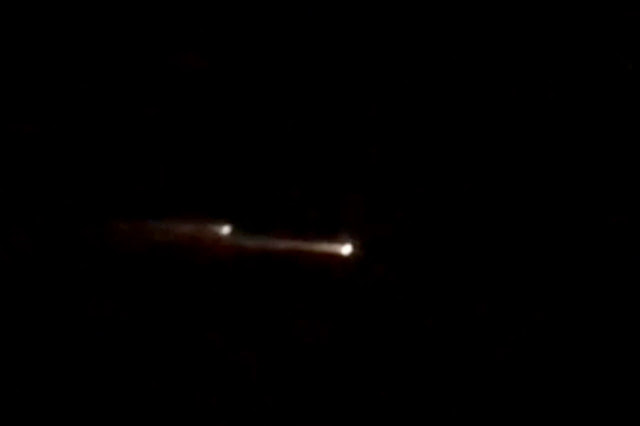
Date of sighting: Nov 12, 2015 Location of sighting: Las Vegas, Nevada, USA Holy cow! Did you see that? Check out Steven Barones video below that shows two UFOs flying into Nellis AFB privately owned land. Thats right, this area is 100% military and only they can come and go, but these are not fighter jets. These are Tall White alien ships. The base of the Tall Whites is located at the end of the Nellis old firing range, which is mostly out of sight from Los Vegas, but object flying in to it will always be within view. Scott C. Waring www.ufosightingsdaily.com Steven Barone states: I shot this video from my backyard in the Summerlin area of Las Vegas, Nevada on the night of July 28, 2016, and the older clip in the same spot on November 12, 2015. Last night was very stormy all the way around the city. There were moments where it wasn't too bad but when you combine the lightning and wind with a daytime temperature of over 115 degrees you know the night isn't going to be very productive. I only took the night vision camera out because it can handle a little wind. I wasn't seeing anything so for the fun of it I aimed the night vision camera at a mountain which is only about six miles away and that is to the top of the mountain and not the base. I aimed the night vision camera that way because of an earlier video I caught right there. I included a small portion of the older video in this one because both events happened in the same spot. I don't know what it was I filmed last night but I don't think it was a meteorite or I would have seen it the entire time. It only showed up for a fraction of a second. I am publishing it because it came down where the older objects did. Ironically it was facing the exact direction to the north where Area 51 would be. I do believe these objects were much closer than Area 51 though. From my home to the center of the base at Area 51 is 77 miles in a straight line. I ended having to come back into the house because it was getting even windier and the lightning was getting closer.
Pop Star Singer Claims She Once Spotted A Worm-Like UFO
The latest comments of a pop star are literally out of this world. Singer Demi Lovato shared her theories on extraterrestrial life in an interview with Elle Canada’s September issue. When the magazine’s reporter asked her of things she believes in, the 23-year-old “Confident” singer exclaimed “Aliens!” “I’ve seen a UFO,” she added.
Lovato claimed she had the UFO sighting several years ago. The celebrity said she saw something in the sky while doing some walks outside. She described it as a worm-like object that “was changing shapes and moving all over the place.”
Interestingly, in June 2014, Lovato also discussed aliens in an interview. The former Disney star backed up the conspiracy theory that mermaids are aliens during her interview on Late Night With Seth Meyers. She revealed her belief of aliens as real, and for her, it is very self-centered to believe that humans are the only living things in the universe.
On the same interview, she noted Atlantis as a possible home of mermaids, which she believes an alien species living in parts of the Indian Ocean. She continued saying that Christopher Columbus has seen three mermaids on his way to America.
Miss Lovato is not the only celebrity who discusses aliens. Earlier this month, former One Direction Zayn Malik claimed that he left the group because an alien spoke to him in a dream.
Ceres en de grote verdwijntruc: waar zijn alle grote kraters gebleven?
Caroline Kraaijvanger
Aangenomen werd dat de dwergplaneet rijkelijk bedekt zou zijn met enorme kraters. Maar ze zijn er gewoon niet. Hoe kan dat?
In maart 2015 kwam ruimtesonde Dawn bij Ceres aan. Voorafgaand aan de aankomst van Dawn hadden onderzoekers al nagedacht over hoe Ceres er waarschijnlijk uit zou zien. De dwergplaneet moest bedekt zijn met enorme kraters, zo redeneerden ze. Maar Dawn liet een heel andere dwergplaneet zien. “Toen we voor het eerst naar de beelden van Ceres keken, viel het ons op dat er niet echt heel grote inslagbekkens zijn op het oppervlak,” vertelt onderzoeker David Williams. Geen van de kraters op Ceres zijn groter dan 285 kilometer.
Mysterie En dat is een mysterie. Want Ceres moet in de 4,5 miljard jaar dat deze bestaat herhaaldelijk flinke klappen hebben gehad. “Zelf Vesta (een planetoïde die Dawn voorafgaand aan Ceres bezocht, red.) heeft – ondanks dat deze de helft kleiner is dan Ceres twee grote kraters op de zuidpool. Maar op Ceres zien we alleen het Kerwan-bekken dat een diameter van slechts 285 kilometer heeft.”
Er is ‘iets’ gebeurd Het suggereert volgens Williams dat er ‘iets’ gebeurd is op Ceres. Want er moeten grote inslagen hebben plaatsgevonden. Simulaties suggereren dat de dwergplaneet zeker tien tot vijftien kraters zou moeten hebben die een diameter hebben die groter is dan 400 kilometer. Daarnaast zouden er ook nog eens zo’n 40 kraters moeten zijn die groter zijn dan 100 kilometer. In werkelijkheid bezit Ceres echter zestien kraters groter dan 100 kilometer en is Kerwan-bekken met 258 kilometer de grootste krater die Ceres heeft. “We concluderen dat een groot aantal kraters op Ceres waarschijnlijk door de tijd heen is verdwenen,” vertelt onderzoeker Simone Marchi. “En dat is waarschijnlijk het resultaat van de bijzondere samenstelling en interne evolutie van Ceres.”
Op deze afbeelding zie je de grootste krater van Ceres: het Kerwan-bekken. Het bekken ligt in een cirkelvormige laagvlakte: mogelijk was dit ooit één van de grootste kraters van Ceres, maar is deze door geologische en interne processen vrijwel onherkenbaar geworden.
De grote verdwijntruc Maar hoe zijn de grote kraters op Ceres dan precies verdwenen? Er zijn verschillende mogelijkheden. Zo weten we allereerst dat de korst van Ceres niet puur rotsachtig is: deze bevat ook heel wat ijs. Het maakt de korst flexibeler, zeker als dat ijs zich gemixt heeft met zouten. En dat kan er zomaar voor gezorgd hebben dat een groot bekken geleidelijk aan vlakker en uiteindelijk onherkenbaar is geworden. “Daarnaast zien we bewijs voor cryovulkanisme,” vertelt Williams. Cryovulkanisme is in grote lijnen vergelijkbaar met het vulkanisme dat we hier op aarde kennen, alleen komt er geen gesmolten gesteente, maar ‘gesmolten ijs’ (water of pekel) vrij. Ook cryolava dat over het oppervlak van de dwergplaneet stroomde, kan hebben bijgedragen aan het verdwijnen van de grote kraters.
Hoe de kraters ook precies verdwenen zijn: Ceres moet er zelfs lang na het Late Heavy Bombardment – zo’n 4 miljard jaar geleden – nog mee bezig zijn geweest. Onderzoekers hopen in de nabije toekomst nog veel meer te weten te komen over de geologische geschiedenis van de dwergplaneet. Dawn zal nog wel een tijdje rond Ceres cirkelen en in ieder geval getuige zijn van Ceres’ perihelium: het moment waarop de dwergplaneet het dichtst bij de zon in de buurt komt (april 2018). Onderzoekers willen graag achterhalen of er onder invloed van de warmte van de zon veranderingen op het oppervlak van Ceres plaatsvinden.
Bronmateriaal:
"The case of the missing craters" - Arizona State University De afbeelding bovenaan dit artikel is gemaakt door NASA / JPL-Caltech / UCLA / MPS / DLR / IDA.
Solar Probe Plus zal in 2018 gelanceerd worden, in de atmosfeer van de zon duiken en dichter bij onze ster in de buurt komen dan elk ander ruimtevaartuig ooit gedaan heeft.
Het belooft een prachtige missie te worden: de missie van Solar Probe Plus. De sonde moet ergens tussen eind juli en eind augustus 2018 gelanceerd worden en zal zevenmaal langs Venus scheren om geleidelijk aan dichter bij de zon in de buurt te komen. Uiteindelijk zal de afstand tussen de sonde en het oppervlak van de zon nog maar zo’n 6,2 miljoen kilometer zijn. Dat lijkt veel, maar daarmee komt Solar Probe Plus zeven keer dichter bij de zon in de buurt dan elk ander ruimtevaartuig ooit heeft gepresteerd.
LEKKER DICHTBIJ
Het ruimtevaartuig Helios 2 is op dit moment recordhouder: het ruimtevaartuig kwam het dichtst bij de zon in april 1976. De afstand tussen de zon en Helios 2 was op dat moment ongeveer 44 miljoen kilometer.
Fase D Een ruimtevaartuig ontwikkelen dat de zon zo dicht nadert en dus aan extreme straling en temperaturen wordt blootgesteld, is nog niet zo eenvoudig. Maar de Solar Probe Plus nadert zijn voltooiing. De sonde bevindt zich momenteel in fase D van zijn ontwikkeling. In deze fase wordt de bouw van de sonde afgerond. Tevens worden de instrumenten geïnstalleerd en zal de sonde enkele experimenten ondergaan om te kijken of deze werkelijk klaar is voor de missie.
Belangrijk “Het bereiken van dit stadium betekent heel veel voor het team en onze aandeelhouders,” stelt Andy Griesman, namens het John Hopkins Applied Physics Laboratory dat de sonde in opdracht van NASA bouwt. “Het laat zien dat we een ruimtevaartuig, instrumenten en een missie hebben ontworpen die de uitdagingen die samenhangen met de omstandigheden dicht bij de zon aankan en de gegevens waar wetenschappers al decennia naar op zoek zijn, kan terugsturen.”
De Solar Probe Plus moet onder meer inzicht geven in de verwarming van de atmosfeer van de zon en uitzoeken hoe de zonnewind – een continue stroom van geladen deeltjes die bij de zon wegstroomt – op snelheid komt. “De sonde zal dicht genoeg bij de zon in de buurt komen om de zonnewind te zien versnellen: van subsonisch naar supersonisch,” zo is op de site van de missie te lezen. “En deze zal door de geboorteplaats van de energierijkste zonnedeeltjes vliegen.” Naar verwachting zal de sonde heel wat oude vraagstukken oplossen, maar tevens – zoals we dat van baanbrekende missies gewend zijn – vragen oproepen.
Grote Rode Vlek lijkt de atmosfeer van Jupiter te verwarmen
Caroline Kraaijvanger
De beroemde roodkleurige storm op de gasreus kan mogelijk verklaren waarom de atmosfeer van Jupiter – ondanks dat de planeet ver van de zon verwijderd is – zo warm is.
Uit eerder onderzoek is gebleken dat het bovenste deel van de atmosfeer van de aarde ongeveer net zo warm is als het bovenste deel van de atmosfeer van Jupiter. En dat is vreemd. Want onze atmosfeer en die van Jupiter worden verwarmd door de zon, maar Jupiter staat wel vijf keer verder van de zon verwijderd dan onze planeet. Het suggereert dat de zon niet de enige warmtebron is voor de atmosfeer van Jupiter. Maar wat zorgt er dan nog meer voor dat de atmosfeer van de gasreus opwarmt?
Temperaturen meten op Jupiter Een nieuw onderzoek schept meer duidelijkheid. Onderzoekers brachten de temperatuur hoog boven de wolken van Jupiter vast met behulp van een telescoop op aarde. Door het onzichtbare infraroodlicht honderden kilometers boven de gasreus te bestuderen, ontdekten de onderzoekers dat de temperaturen in de omgeving van de Grote Rode Vlek veel hoger lagen. “We zagen bijna direct dat onze maximumtemperaturen op grote hoogte zich boven de Grote Rode Vlek bevonden: toeval of een belangrijke aanwijzing?” vertelt onderzoeker James O’Donoghue.
Botsende golven O’Donoghue en collega’s concluderen dat de storm in de Grote Rode Vlek twee soorten golven produceert. Die golven komen met elkaar in botsing en verwarmen de atmosfeer. “De extreem hoge temperaturen die we boven de storm geobserveerd hebben, getuigen van deze energietransfer,” stelt O’Donoghue. “Dit vertelt ons dat een planeet-brede opwarming een plausibele verklaring is voor het feit dat de temperaturen in de hogere delen van de atmosfeer honderden graden hoger liggen dan door zonlicht alleen verklaard kan worden.” Hetzelfde effect is al gespot boven de Andes op aarde en onderzoekers sluiten niet uit dat het op meer plekken in en buiten het zonnestelsel een rol speelt.
De Grote Rode Vlek spreekt al eeuwenlang tot de verbeelding. De vlek werd in de zeventiende eeuw ontdekt en is ongeveer twee tot drie keer zo groot als de aarde. Wetenschappers hopen op korte termijn meer over de vlek te weten te komen. En wel dankzij de onlangs bij Jupiter gearriveerde ruimtesonde Juno. Deze zal onder de wolken van Jupiter gaan gluren en onder meer onthullen hoe de Grote Rode Vlek in elkaar steekt.
Amazing Fireball Over Western US Caused by Chinese Space Junk
By Mike Wall, Space.com Senior Writer
A brilliant fireball created by falling space junk from a Chinese Long March 7 rocket lit up the skies over Utah, Nevada, Colorado, Idaho and California late Thursday, July 27, 2016. This still image is from a video captured by observer Matt Holt in Utah, who posted his account on Twitter and YouTube.
A giant piece of a recently launched Chinese rocket fell to Earth last night (July 27), blazing a spectacular sky trail that left observers across parts of the western United States slack-jawed.
The dazzling fireball, which you can see in this awesome video by observer Matt Holt, lit up skies over Utah, Nevada, Colorado, Idaho and California about 9:40 p.m. local time Wednesday (12:40 a.m. EDT and 0440 GMT today, July 28), breaking into many bright pieces as it went.
The sky show occurred around the peak of the annual Delta Aquarid meteor shower, but it wasn't caused by bits of comet dust. Rather, experts say, the culprit was the second stage of China's Long March 7 rocket, whichlaunched on its maiden flight June 25.
The 6-ton rocket stage hit Earth's atmosphere at about 18,000 mph (29,000 km/h), said astronomer Jonathan McDowell of the Harvard-Smithsonian Center for Astrophysics, also an assiduous satellite tracker.
Amazing Fireball Over Western US Caused by Chinese Space Junk
"So far in 2016 there have been 25 re-entries of objects massing 1 ton or more. But objects of 5 ton+ class like this are rare," McDowell said last night via his Twitter account,@planet4589.
"Only bigger re-entry so far this year was a Russian Zenit rocket stage that came down over Vietnam on New Year's Day," he said in another tweet.
China developed the Long March 7 in part to help build the space station it wants to have up and running by the early 2020s. On June 25 — the rocket's first flight — the Long March 7 lofted a prototype crew capsule and a variety of technology demonstrations, Chinese officials have said.
The Long March 7 initially launched to an orbit that took it as close to Earth as 126 miles (203 km), and as far away as 235 miles (378 km). By yesterday morning, friction with Earth's atmosphere had reduced that orbit to 81 miles by 89 miles (131 km by 144 km), McDowell tweeted.
Edward Snowden Reveals Intricate Details about Earth’s Innermost Inhabitants
Among the groundbreaking disclosures forwarded by Edward Snowden to humanity, one speaks of the possibility of the inner earth being populated by an advanced civilization that had been monitoring us ever since the beginning.
By some he’s considered a traitor, but some think of him as a hero. Edward Snowden had the courage to reveal secrets that the world deserved to know, and among the relevant facts made public, few are told regarding UFOs and extraterrestrial beings.
According to some documents copied from the CIA, the U.S. government has long known about the existence of highly intelligent species, more advanced than humanity. While we were busy gazing the starts for an otherworldly race of humanoids with their disc-shaped UFOs, they were in fact under our very noses, probably for millions of years, and far ahead of us in technological development.
Taking a closer look at Earth’s geology and we’ll see its rigid crust, a rather thin layer of rock that divides the continents and the ocean floor. The crust sits on tectonic plates that shift slowly in time in the lithosphere. At the bottom of the tectonic plates, around 80 to 100 kilometers below the surface, the asthenosphere begins.
Earth’s inner flow occurs in the asthenosphere, and the convection phenomenon at this level is believed to assist the perpetual motion of tectonic plates, but the exact method and visual aspect of the frontier between the lithosphere and asthenosphere is not yet clear. The CIA stocks data tracking systems and deep-sea sonar imagery, but the high-level confidentiality status prohibits the scientists’ access in the absence of specific security clearance.
This type of intelligent Homo Sapiens may have evolved differently, considering the much more stable climate inside the planet. The general consensus is that we’re just ants from their point of view, and there is a small chance that they’ll intervene in our world’s affairs, of those from the surface who struggle with their not so beneficent existence.
“So if you have an an alien civilization trying to listen for other civilizations, or our civilization trying to listen for aliens, there’s only one small period in the development of their society when all of their communication will be sent via the most primitive and most unprotected means.
So when we think about everything that we’re hearing through our satellites or everything that they’re hearing from our civilization (if there are indeed aliens out there), all of their communications are encrypted by default.
“So what we are hearing, that’s actually an alien television show, or you know, a phone call… is indistinguishable to us from cosmic microwave background radiation.”
Having these uncertainties in reference to Earth’s inner structure and layer appearance leaves room for serious suspicions, since the Earth’s mantle could provide better living conditions than its surface. Jules Verne may have been onto something big that might prove to be as real as it can get, while we are taught to believe that everything related to fiction is rejected by the dull reality we live in.
But is this really the case? Is the material realm that we live in fully explored and understood by humanity’s scientific tools? Or is it rather a mirage from which we cannot escape unless we open our eyes and see beyond the illusions?
Despite the fact we had no problems with the occupants of the hallow earth so far, or recorded none that we would know of, the military are considering detonating a nuclear warhead that will seal the deep caves which connect the surface of the Earth with the settlers of the mantle, ultimately preventing the alleged passage from opening again. At least that’s what Snowden revelead in a recent interview.
The idea of our governments irrationally intervening into such important matters is not a foreign idea. NASA nuked the moon in 2009, destroying whatever alien outpost was located out there, and if you remember the Colares UFO incident where the military had gathered unquestionable proof of extraterrestrial existence but afterwards decided to evacuated the local population and set the dust on the entire report until recently. Even the US military officials warned about little green men and the threath they’ll pose in the near future.
With all these neglijent moves, the inner earth’s inhabitants might be up to something. With a wave of mysterious sounds that were heard all over the world, including the one from the Caribbeans that can be heard from outer space, there’s a good chance our intra-terrestrial neighbors are up to something.
If we’re going to assist to a clash between the earthly powers and the mythical dwellers of the far reaches of the Earth we’re yet to find out. Hopefully, this historic period of hasty transition will bring full disclosure for the human race. Everyone deserves to be aware and understand what’s going on.
Elon Musk: We MUST leave our Planet for ONE imperative reason
According to Elon Musk, in order to ensure the existence of the human species we need to leave our planet as soon as possible. This is why Musk wants to send a MILLION people to the surface of the ‘red planet’ in order to create a ‘thriving’ colony on Mars.
Elon Musk, the visionary behind Tesla Motors and SpaceX, has come to the conclusion that the human race must leave this planet as soon as possible, as a measure to ensure the human species does not become extinct. According to Musk, because of the future and the inevitable cycle that Earth will cross at some point, we need to make sure our species survives the test of time.
According to a lengthy article published in the blog Wait But Why, under the title How (and Why) SpaceX Will Colonize Mars, the site editor, Tim Urban, had the opportunity to sit down Elon Musk and talk about SpaceX and their goals concerning Mars.
Elon Musk revealed his concern about the future of the planet and mankind, in general, saying that space colonization will be the only safe alternative in order for our species to survive the future.
There are some people who love, and others who hate Musk largely because he has NEVER missed an opportunity to share his –crazy yet innovative— visions of the world, filled with ‘extravagant’ ideas which range from ‘dropping nukes on the red planet’ to leaving Earth before Earth faces the next Armageddon.
Elon Musk: Let’s put a MILLION people on Mars
While many of us are loving the idea that in the near future, there will most likely be a human colony on Mars, Elon Musk is taking the entire Martian colonization to a NEW level.
Musk believes we need a bigger colony, and when he says BIGGER, he means a million-people-bigger.
According to Elon Musk, sending a handful of people to the surface to the red planet every couple of years will ensure a thriving and prosperous human colony is established on Mars.
According to an interview with Ross Anderson for Aeon Magazine Musk believes that if we are to achieve the level of industrialization and infrastructure currently present on Earth, we are going to require a HUMONGOUS labor force present on Mars:
“Even at a million, you’re actually assuming an incredible amount of productivity per person, because you would need to recreate the entire industrial base on Mars. You would need to mine and refine all of these different materials, in a much more challenging environment than Earth. There would be no trees growing. There would be no oxygen or nitrogen that are just there. No oil.”
Musk is right; we need to LEAVE Earth behind
Looking back at the distant history of planet Earth, we come to realize that our planet has been continuously bombarded by space rocks. According to researchers, these cosmic collisions turned our planet in what we see today, a thriving Oasis in somewhere in a ‘cosmic desert’ we call the universe.
Interestingly, our planet is still being bombarded by thousands of tons of space matter. Looking at Earth’s modern history, we see that rarely has a larger space object collided with our planet.
We do, however, have to realize that some 65 million years ago, a massive space rock smashed into our planet kick starting the extinction of the predominant species on the planet back then: Dinosaurs.
But if we look back at Earth and asteroids, in 2013, the Russian Chelyabinsk meteor collided with our planet entering at a shallow able of 60 times the speed of sound.
Upon ‘touching’ Earth’s atmosphere, the ‘alien rock’ exploded in an air burst.
Scientists found that the size of the space rock –before it made contact with Earth’s atmosphere and exploded— was around 20 meters across, weighing around 13,000 metric tons. While this isn’t a BIG asteroid, it had sufficient power to injure thousands of people and damage to 15,000 buildings in the region.
Just imagine what would happen if an object of 200 meters smashed into Earth?
So where should mankind go to?
Well, if we are to ensure our species continues to live on, we need to head to the stars.
However, before we venture out of our solar system, it is imperative that we start colonizing anything that’s close to Earth.
This is where Mars comes into play. According to an interview in 2013, at the Wall Street Journal’s D: All Things Digital Conference Musk said: “Either we spread Earth to other planets, or we risk going extinct. An extinction event is inevitable, and we’re increasingly doing ourselves in. The goal is to improve rocket technology and space technology until we can send people to Mars and establish life on Mars.”
“Mars is a fixer-upper of a planet,” Musk said. “But we could make it work.” And honestly, even if we can’t make it work, it seems that we have no real choice but to try. Musk concludes, “I agree this is an unlikely outcome, but if we don’t keep improving technology every year, we won’t get there.”
Two Enormous Sunken Alien Bases Discovered on Google Earth
During the past month or so, UFO hunters made two seemingly unrelated discoveries that immediately got added to the portfolio evidencing the signs of a strange, ancient presence on our planet. The controversial images were obtained through Google Maps, revealing two enormous underwater structures that conventional science cannot explain.
The next time you set your eyes upon a tall mountain, remind yourself that long ago, that gargantuan chunk of rock was on the bottom of the ocean. The face of the Earth is shaped by processes like erosion and accretion and what was once standing tall might now rest covered by the watery abyss. And since our planet is mostly covered with water, just imagine what things still lie unseen, hidden from our curious, collective gaze.
The first underwater edifice was spotted on July 15 by YouTube user MEXICOGEEK just off the coast of the Gulf of California and conspiracy theorists are already calling the remains of a massive alien city. Measuring over 70 miles in length, the strange structure looks like it was constructed with geometric patterns in mind. Its symmetry and straight lines stretching for tens of miles seem to rule out any natural formation, favoring the intelligently-designed hypothesis.
UFO Sightings Daily’s Scott C. Waring believes this alien base is connected to all the UFO sightings coming out of Mexico and the .Central and South America
“This base is huge and it’s no wonder why we hear about so many UFO sightings over Mexico,” he writes. “This base is just 45 miles away from the Mexican coast. The chances of this being an intelligently-made structure… I put that at 100 percent.”
t’s interesting to note the similarity between the structure’s arrangement and that of an airport’s landing strips when viewed from above. However, the sheer size of the tubular structures that make up the underwater network means they must have served a different purpose. It is unfortunate that we might never know what that purpose was, but unless the scientific community decides to investigate the matter in a thorough, transparent way, we’ll remain clueless. Coordinates for the underwater base here.
he second place of interest can be found near the coast of Venezuela, halfway between Curacao and Puerto Rico (Coordinates here). It has an even stranger, more discrepant architecture consisting of zigzag lines. In terms of size, it is just as massive as the one from the Gulf of California, measuring approximately 90 miles from tip to tip. But the strangest characteristic has to be its shape. What geological processes could have produced such an odd contour, exhibiting symmetry, straight lines and 90-degree angles? Is it even reasonable to comfortably assume this underwater structure is natural?
Furthermore, the mystery is compounded by another set of structural artifacts resting just 50 miles northeast of the Venezuela anomaly (coordinates). Due to its proximity, this secondary irregularity appears to be connected to the first one. Images suggest it is composed of a string of rectangular structures spread across the ocean floor in a straight line. Virtually nothing is known about these mysterious sunken objects, save for the fact that they must be huge. They are located quite close to the Bermuda Triangle’s southernmost tip but there isn’t enough data for a connection to be made.
The enigma of the Unidentified Aerial Phenomena wouldn’t be complete without taking into account USOs or unidentified submerged objects. It is very possible that UFOs and USOs are the same craft, the only difference being that the latter have been spotted entering or exiting aquatic environments. Since it makes sense for an extraterrestrial presence to place its base and perform its activities undisturbed by human eyes, what place could be better than the bottom of the ocean? If UFOs are capable of traversing cosmic distances with the help of faster than light travel, surviving the pressure of the oceanic depths seems an easy task.
So if Earth’s seas and oceans are harboring otherworldly visitors, could these two anomalies be still operational? If so, they could be responsible for the numerous UFO sightings reported on or around the American continents. These places would make a great starting point in our search for alien life here on Earth. Even if they were operational a long time ago and have since been deserted, compelling evidence could still be found.
If the structures are artificial but were not made by aliens, the mystery shifts but retains its intensity. Our current technological level wouldn’t allow us to build such complex underwater constructions, meaning that whoever built them was far more advanced than we are. Both of the areas where the anomalies were discovered have been submerged for millions of years and the dynamics of the seabed would have erased all signs of their existence had they been built before the area was covered with water.
In the end, no-one can say for sure what these structures are and, until someone goes on an underwater expedition James Cameron style, the puzzle will remain unanswered.
Veel wensen doen? Kijk dan de komende nachten naar de hemel
De komende nachten is er een verhoogde kans om vallende sterren te zien. Verschillende meteorenzwermen en losse meteoren dringen door tot in de dampkring. Vandaag wordt een piek verwacht van 20 meteoren per uur.
De vallende sterren zijn ook volgende week nog te zien, maar het aantal per uur neemt dan geleidelijk af. Zo rond 8 augustus neemt het aantal meteoren weer toe. Op 12 augustus kunnen we een heuse meteorenregen van de Perseïden verwachten met liefst 72 meteoren per uur.
Bekendste
De meteorenzwerm van de Perseïden is de bekendste in Nederland, vanwege het hoge aantal vallende sterren en vanwege het feit dat veel mensen vakantie hebben.
Het lichtspoor van meteoren wordt niet alleen veroorzaakt doordat de stenen in brand vliegen. Het pad van de meteoor wordt door de hoge valsnelheid ook elektrisch geladen en bij het opheffen van het ladingsverschil komt licht vrij.
Piek
De komende nacht zijn de vallende sterren niet of nauwelijks te zien, meldt Weeronline. Alleen in het zuiden van Noord-Brabant en Limburg is kans op enkele opklaringen. Het goede nieuws is dat de piek het hele weekend aanhoudt. De kans op opklaringen is de volgende twee nachten een stuk groter.
Tijdens de nacht van zaterdag op zondag zijn er in het hele land opklaringen mogelijk. Met om 03.00 uur een piek van 21 vallende sterren per uur is er een behoorlijke kans om een wens te mogen doen. De nacht van zondag op maandag is waarschijnlijk nog beter.
A United Arab Emirates witness at Dubai reported photographing an unusual light that appeared to hover over a workplace building with lights forming a triangle shape, according to testimony in Case 76996 from the Mutual UFO Network (MUFON) witness reporting database.
Cropped Witness Image 1.
(Credit: MUFON)
The witness was at “Bin Ladin Signal near the police station” about 3 a.m. on June 11, 2016, when the incident occurred.
“The first thing I saw was the light,” the witness stated. “I thought it was an airplane or star, but when I looked more, it moved very fast and from different directions the craft was three – and came together forming a triangle shape.”
Cropped and enlarged Witness Image 1.
(Credit: MUFON)
The craft stayed in place for several minutes.
“Then about 10 minutes later, the craft changed direction and flew different ways so I quickly try to record, but my mobile battery is not charged to record video, so I took some pictures with my phone before the battery died.”
Cropped and enlarged Witness Image 2.
(Credit: MUFON)
The witness included three images with the MUFON report, which was filed on June 12, 2016.
“During this process I can see some highway lights and stop. Then I was so scared to even go home. When I got home, I charged my mobile and zoomed in on the picture to understand the shape. I got home and I feel confused, so that is why I try to look for a site to report this.”
Cropped and enlarged Witness Image 3.
(Credit: MUFON)
The witness has seen unusual lights in the past.
“Also, this is the second time I saw that at my company. I was doing over-time at night when a big light moved across my company around 1:30 a.m. I was scared and I stopped work instantly. So the following day I asked my manager to tell my boss to get CCRV cameras to install around the company, but since then I didn’t see any, because I work inside the company.”
Monique Lessan is investigating for MUFON International.
UFO IN MEXICO SCHIET RAKELINGS LANGS PASSAGIERSVLIEGTUIG ( VIDEO )
De laatste tijd zijn er weer opvallend veel waarnemingen van UFO’s in de buurt van verkeersvliegtuigen.
Onlangs was er ook het voorval in Turkije en nu schiet een UFO in Mexico rakelings langs een passagierstoestel.
Waar we in Turkije de bemanning van het vliegtuig hadden die verklaarde dat er een vreemd object rakelings over hun Boeing 737 vloog, is daar in het volgende geval geen sprake van.
We hebben geen idee of de bemanning van het verkeerstoestel in Mexico iets heeft opgemerkt, want de waarneming van de UFO gebeurde vanaf de grond.
Het voorval vond plaats in Trujillo in Mexico, ergens vorige week. Iemand filmde het vliegtuig toen er plotseling van achteren een UFO in beeld kwam. Zo te zien kwam deze even poolshoogte nemen, schoot rakelings achter het vliegtuig langs en liet deze vervolgens achter zich met zo’n duizelingwekkende snelheid dat het leek alsof het vliegtuig niet bewoog.
De onderstaande video zou bijzonder interessant zijn voor luchtvaartautoriteiten, ook om te zien of een dergelijk object op hun radarschermen verschijnt.
Waarschijnlijk niet, want onze gebruikte radartechnologie is ondertussen al ongeveer 60 jaar hetzelfde en wie of wat de controle heeft over de UFO zal ongetwijfeld manieren hebben om onzichtbaar te blijven voor onze gangbare systemen.
Nooit of te nimmer zul je dit soort beelden aantreffen in het acht uur journaal of bij één, twee of drie vandaag.
Eigenlijk hilarisch. Iedereen kan dit soort dingen met eigen ogen aanschouwen en toch zeggen overheden dat ze niet bestaan, dus zien we ze niet en wie ze wel ziet, is een aluhoedje die ze ziet vliegen.
Welkom op de meest maffe planeet in dit zonnestelsel.
Glowing UFO Over Newcastle, England On July 26, 2016, Video, UFO Sighting News.
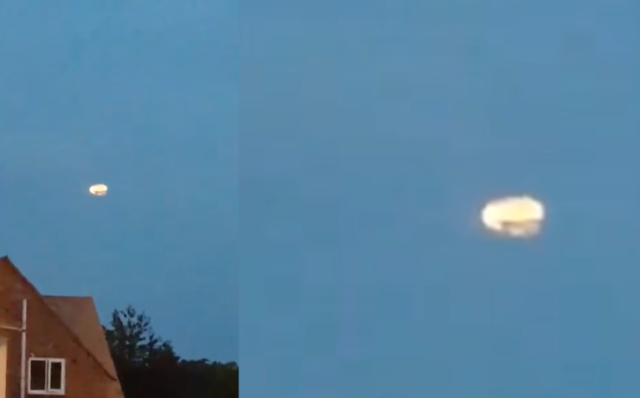
Date of sighting: July 26, 2016 Location of sighting: Newcastle, England Maker of video: Thirdphaseofmoon This is a great video by Third Phase of Moon of Youtube. It shows a glowing triangular UFO with a cloud cloak surrounding it. This was seen at Newcastle during the sunset, which is the most common time to see UFOs. The setting sun hits the UFO at just the right angle, causing the UFO to become visible for between 45 seconds to 15 minutes. I do believe the time is a mistake that was reported as 2:20...it does look later...I'm thinking sunset time. The glowing orange is actually caused not by the UFO itself, but by the setting sun hitting it. Scott C. Waring www.ufosightingsdaily.com Thirdphaseofmoon states: Quote From Cat Roberts "Hey! I caught this video the other day. I live in Newcastle Upon Tyne, around 2:20 pm. Never seen anything like it. It was a lot bigger to see in person, it was very unusual and I haven't seen anything like that before. I had food shopping with me at the time, I stopped recording to put the food in the freezer and went back out. It was still there but it quickly disappeared like it sucked in on itself. "
UFO Over Las Vegas Said To Be Chinese Rocket Reentry, Can We Believe The Gov? July 27, 2016, UFO Sighting News
Date of sighting: July 27, 2016 Location of sighting: Las Vegas, Nevada, USA I noticed that the world news is trying hard to make the public believe that what was seen over Las Vegas was just a Chinese rocket, but I find that extremely hard to believe. Why? Because most rockets and satellites often have devices to help power the long term flight of such craft...these batteries are often nuclear. If the rocket was carrying a Chinese satellite in it as it fell, America would be in panic over the nuclear fall out of all the hazardous material, but America doesn't seem to care. Also if it was a rocket, it could be a nuclear rocket test to see if a Chinese Nuke would make it to America and how to prevent it from being shot down by pretending its just a failed space mission. If this was true, then there is a conspiracy within the conspiracy. Also with a tall whites alien base a Nellis AFB, this is very possible a tall white ship coming it to land at its base, which is located at the end of the old rifle range at Nellis AFB.
America seemed to take no precautions,which means this was not a rocket, but a UFO of unknown origin. This UFO was seen all across Nevada this week, many of the eyewitnesses swearing it was a UFO. So...who are you going to believe? Scott C. Waring www.ufosightingsdaily.com
A still from the July 28 video showing the bright UFO.
Here’s one really interesting footage of a huge unidentified flying object flying across the sky above Tyumen, the largest city and the administrative center of Tyumen Oblast, Russia. This was filmed on 28th July 2016.
MUFON*XISSUFOTODAY.SPACE
More UFOs caught in a still from the July 26 video.
YouTube Channel Features “Leaked” Video From NASA Showing UFO in Jupiter’s Orbit
A YouTube video entice a lot of viewers with its claim that it shows leaked footage from the NASA Juno probe. The footage, which supposedly a secret, shows a mysterious UFO orbiting Jupiter. NASA probe apparently recorded the footage that is featured in the viral video, which has been viewed nearly 200,000 times.
In the description of the YouTube clip, it says that the Juno captured a strange UFO floating over the giant red spot for a few minutes before leaving in deep space.
Last February 2016, a man claimed to have spotted a massive structure moving in the direction of Europa, one of the largest moons of Jupiter. Some UFO hunters believe that the enormous structure, which resembles an interstellar mothership or the so-called intergalactic ship, has something to do with space aliens.
There has been a lot of research about the likelihood of alien life existence in the vast oceans under its icy surface. The probability increases speculations that aliens are hiding behind Jupiter. However, for alien followers/enthusiasts who want to find a real UFO video recorded in deep space, this is probably not the case.
YouTube channel Section 51 2.0 is known to make hoax videos. Many people think that the video sharing channel has done several clips using CGI animation. It also suspiciously blocks comments on most of its videos.
Real UFO investigators hate hoax videos as they can damage the credibility of genuine research. Section 51 2.0 is also being accused of only after the funds on advertising revenue from thousands of viewers in its videos.
Contacting Section 51 2.0 to get their reactions on the allegations towards them has failed.
Science-fiction author Stephen Baxter co-wrote the "A Time Odyssey" series of books with Arthur C. Clarke, author of "2001: A Space Odyssey." More recently, Baxter teamed up with author Alastair Reynolds to write "The Medusa Chronicles" (Saga Press, 2016) which expands on a short story Clarke wrote in 1971.
Baxter was inspired to write this piece for Space.com after he drew heavily from Clarke's spaceship designs for that work; in the pages of fiction and in the real world, Clarke "was a postwar visionary regarding possible spacecraft designs and purposes," Baxter told Space.com.
It's the year 2099. What do spaceships look like? The great science fiction author Arthur C. Clarke had some pretty visionary — yet surprisingly realistic — ideas.
"The Medusa Chronicles" (Saga Press, 2016), by Stephen Baxter and Alastair Reynolds, expands on a short story by Arthur C. Clarke.
Credit: Saga Press
"The Medusa Chronicles," a book I co-authored with Alastair Reynolds, is a sequel to Clarke's 1971 novella "A Meeting with Medusa," a saga of the exploration of space (and, specifically, of Jupiter). In the course of drafting the book, we had a lot of fun with speculative spacecraft designs, drawing heavily on Clarke's wider work.
Thus, in the year 2099, our hero Howard Falcon flies "Discovery"-class, interplanetary, fusion-propelled ships — a nod to Clarke's "2001" series (1968 onward). And by 2284, he uses more advanced "Goliath"-class ships — a reference to "The Hammer of God" (1993), as well as an homage to later entries in the "2001" series. [Gallery: Visions of Interstellar Starship Travel]
Clarke was a real-world spaceflight visionary, but he never forgot his boyhood science-fiction dreams. And that background is reflected in his fiction.
Born in 1917, Clarke had grown up with gaudy and mostly impractical pulp-era visions of spaceflight. But as a young man, working with early space-advocacy bodies such as the British Interplanetary Society (BIS), he contributed to speculative but realistic designs of craft capable of interplanetary travel, as documented in his highly readable nonfiction survey "Interplanetary Flight" (1950) as well as in his fiction.
Thus, Clarke's 1951 novel "The Sands of Mars" featured what may have been the first reasonably realistic fictional depiction of a spacecraft powered by a fusion rocket. Earlier writers, such as Olaf Stapledon, had vaguely described spaceflight using nuclear energy, but Clarke gave precise numbers for his spaceliner Ares, which he described as flying in the 1990s, capable of a 100-day trip to Mars.
Ares is a luxurious passenger liner that includes a dining hall measuring about 400 feet (120 meters) across. The design is a dumbbell — similar to the later Discovery of "2001" (1968). There is a main sphere with a radius of about 200 feet (60 m) containing passenger cabins and a lower hemisphere that's "almost entirely fuel." A 330-foot (100 m) strut connects the main sphere to the smaller engine sphere. Ares is an "atomic rocket," and specifically fusion-driven: "The forces that powered the stars themselves were being unleashed," clarke wrote. And the dumbbell design is logical, with the inhabited sections positioned as far as possible from the leaked radiation of the engine.
Stephen Baxter (right) with Alastair Reynolds, co-author of "The Medusa Chronicles."
Credit: Saga Press
Where Clarke gives specific numbers, they are sensible. To drive the ship out of high Earth orbit, the engines of Ares burn for 11 hours at 5 percent the acceleration of Earth's gravity, and then Ares coasts for 100 days to Mars and decelerates. You can work out that after such a journey, 1.1 astronomical units (AU) would have been traveled — a reasonable distance for an Earth-Mars flight. (One AU is the average distance from the Earth to the sun — 93 million miles, or 150 million kilometers.) Clarke doesn't give a specific mass breakdown, but a reasonable estimate is that the engine's exhaust velocity would be several hundred kilometers per second. That's well within the anticipated performance of fusion engines; the uncrewed starship of the BIS'Daedalus design had an exhaust velocity of 9,000 km/s (5,600 miles per second). Clarke's spacecraft always had reasonable and consistent designs — a lesson for any budding hard-sci-fi writer.
But, with time, those designs evolved.
Arthur C Clarke - Fractals - The Colors Of Infinity
While we worked on "Medusa," I took the chance to re-read the four books of the Odyssey series: "2001: A Space Odyssey" (1968); "2010: Odyssey Two" (1982); "2061: Odyssey Three" (1987); and "3001: The Final Odyssey" (1997). And I was very struck by how Clarke's visions of spacecraft developed over the course of those books.
Although the movie "2001" was first screened the same year Apollo 8 circled the moon, its vision was a sort of summary of older dreams of spaceflight — including Clarke's own. The space clippers and great rotating space wheels were straight out of a blueprint that German aerospace engineer Wernher von Braun had been developing for NASA since the 1950s, while the beautiful, elegant Discovery is a classic Clarke dumbbell shape.
But by the time "2010" was published in 1982, the last Apollo mission was already 10 years in the past, and the space shuttle had just begun flying; we had learned what space is really like. In the story, a new spacecraft, called Leonov, goes to Jupiter to retrieve the lost Discovery. The contrast between the old and new spacecraft is very striking — visually so in the movie. Leonov is an expression of the reality of spaceflight as it had been experienced: It is cramped, uncomfortable, squat and ugly — and there's certainly no gravity-inducing carousel. When the two spacecraft dock, it's a collision of post-Apollo reality with pre-Apollo dreams, as if two universes were overlapping. [Arthur C. Clarke: Luminaries Pay Tribute]
But by "3001," thanks to the advanced-physics "inertial drive," more extravagant spacecraft designs became possible. With a craft that can travel at several thousand kilometers per second, even the very sparse interplanetary dust is a significant hazard, and streamlining and shielding are necessary. And so the old pulp-magazine fantasies of Clarke's boyhood are back, as Clarke says explicitly through a character in the novel. As reincarnated "2001" astronaut Frank Poole puts it, "Do you know what Goliath reminds me of? … When I was a boy, I came across a whole pile of old science-fiction magazines that my Uncle George had abandoned — 'pulps', they were called … They had wonderful garish covers, showing strange planets and monsters — and of course, spaceships! As I grew older, I realised how ridiculous those spaceships were. They were usually rocket-driven — but there was never any sign of propellant tanks! Some of them had rows of windows from stem to stern, just like ocean liners. There was one favourite of mine with a huge glass dome — a space-going conservatory … Well, those old artists had the last laugh … Goliath looks more like their dreams than the flying fuel-tanks we used to launch from the Cape."
Though the "2001" books were obviously written within the span of a single lifetime, they date from different epochs. There is an immense gulf especially between the first two books. As Clarke noted in his foreword to "2010," "2001" was written in an age that now lies beyond one of the Great Divides in human history; we are sundered from it forever by the moment when Neil Armstrongset foot upon the Moon [in 1969]." But Clarke's visionary work — as refined and updated by such studies as the BIS' current fusion-ship study Project Icarus — still stands as a bridge between the fantastic dreams of the past and the practicalities of the future.
Follow all of the Expert Voices issues and debates — and become part of the discussion — on Facebook, Twitter and Google+. The views expressed are those of the author and do not necessarily reflect the views of the publisher. This article was originally published on Space.com.
Asteroid Defense: Scanning the Sky for Threats From Space
By Elizabeth Howell, Space.com Contributor
This graphic shows all of the potentially hazardous asteroids (and their orbital paths) around Earth (not to scale). As of 2013, scientists had counted over 1,400 of these potentially hazardous asteroids.
Credit: NASA/JPL-Caltech
Earth is hit every day by small bits of space dust. Slightly larger chunks burn up colorfully in the atmosphere, causing the shooting stars you see in the sky. Occasionally even bigger rocks hit our atmosphere; they are known as fireballs, because the light from them burning up is particularly bright. These tend to smack the Earth a few times a year and may produce a few fragments for rock-hunters to find.
NASA and other organizations do regular scans of the sky to catalog any small bodies that are at risk of crashing into our planet. No imminently threatening bodies have been found yet, but it's clear that sooner or later Earth will be struck by something big. The organizations are actively researching the best ways to protect Earth from asteroids, meteoroids or comets that may come crashing down
Asteroids refer principally to small, rocky bodies. Comets contain more ice and can also pose a threat to Earth. Before fragments enter our atmosphere, they are known as meteroids. During their path in the atmosphere, they are called meteors. If any of these pieces reach the ground, those pieces are called meteorites. The best hunting ground on Earth for meteorites is Antarctica because the ice makes it so easy to see the fragments, and the ground is not disturbed as much as a typical urban area or forest.
The difference between a meteroid and an asteroid is a little vague. In 1961, The International Astronomical Union (the official body for naming objects in space) said a meteroid is much smaller than an asteroid, but bigger than an atom. A 2010 Meteoritics and Planetary Science paper led by Alan Rubin, a geophysicist at the University of California, Los Angeles, suggested that the limit for meteoroids be about 1 meter in size.
This is the trail of Chelyabinsk asteroid which exploded about 14 miles above ground with a force nearly 30 times more powerful than the Hiroshima atomic bomb in 2013.
Credit: Neuromainker via YouTube/Screenshot by Irene Klotz for Discovery News
Characterizing the threat
It is clear that even small bodies can pose a threat; the asteroid that broke up over Chelyabinsk, Russia, in 2013 was roughly 56 feet (17 meters) across, shattering glass and injuring hundreds of people. In 1908, an estimated 130-foot (40-meter) object exploded over Siberia and flattened trees over 825 square miles (2,137 square kilometers). Around 50,000 years ago, before human civilization began, a rock about 150 feet wide (46 meters) smacked into what is now called Arizona. It left behind Meteor Crater, which is roughly 0.7 miles (1.2 kilometers) wide today.
Even bigger collisions happened far in the past. The dinosaurs were wiped out 66 million years ago by an object about 6 miles (10 km) wide, which left behind a 110-mile (180 km) crater in Mexico known as Chicxulub. But that's nothing compared to evidence of another impactor found in 2014. A rock formation in our planet's crust pointed to a possible impactor 23 to 36 miles (37 to 58 kilometers) across that smacked into Earth 3.26 billion years ago, just a few million years after life evolved.
NASA began tracking near-Earth objects (NEOs) in the 1970s. Its goal is to find objects that are at least tens of meters in size, “which could cause significant harm to populated areas on the Earth if they were to strike without warning,” NASA stated in 2014.
Congress directed NASA in 1994 to find at least 90 percent of potentially hazardous NEOs larger than 0.62 miles (1 kilometer) in diameter, which NASA fulfilled in 2010. Congress also asked NASA in 2005 to find at least 90 percent of potentially hazardous NEOs that are 460 feet (140 meters) in size or larger. That's supposed to be finished by 2020. NASA created a Planetary Defense Coordination Office in 2014 — a year after Chelyabinsk — to better coordinate its efforts, in response to an Office of the Inspector General report. Other space agencies such as the European Space Agency also have their own offices, and the different nations regularly collaborate with each other.
An artist's concept for the Asteroid Impact & Deflection Assessment (AIDA) mission led by the European Space Agency to intentionally strike an asteroid and test deflection capabilities that could protect Earth.
Credit: ESA
Scanning the sky
NASA works with several sky surveys to maintain a list of potentially hazardous objects. These include the Catalina Sky Survey (University of Arizona), Pan-STARRS (University of Hawaii), Lincoln Near-Earth Asteroid Research or LINEAR (Massachussetts Institute of Technology) and Spacewatch (University of Arizona). These observatories are constantly upgrading their capabilities to try to catch fainter asteroids.
Asteroids are also observed from space by several telescopes, but the one most regularly used for NEO searches is called NEOWISE. It's the new mission of the Wide-field Infrared Survey Explorer (WISE) telescope, which launched in 2009 and was revived from hibernation in 2013 to search for asteroids. The telescope is expected to keep operating until 2017, when the angle from the sun in its orbit will be too bright to search for asteroids. A follow-up mission called Near Earth Object Camera (NEOCam) has been proposed for 2021, but is competing against five other missions for funding. Mission selection will be announced in September 2016.
There are other NASA missions that are looking to get up close to asteroids to better characterize their composition. Some recent examples: The Dawn mission visited asteroid Vesta between 2011 and 2012, and has now been at Ceres (a dwarf planet) since 2015. OSIRIS-REx (Origins, Spectral Interpretation, Resource Identification, Security, Regolith Explorer) is expected to depart for asteroid Bennu in 2018 for a sample-return mission, which will come back to Earth in 2023. Additionally, NASA uses data available from other space agency missions that visited asteroids, such as the Japanese Hayabusa (completed) and Hayabusa 2 (in progress).
Some planned missions will take even more daring steps at asteroids. NASA has been working on concepts for an Asteroid Redirect Mission (ARM) that would have a robot move a small body into the moon's orbit, for astronauts to study. Also: NASA, the European Space Agency and other partners are planning a mission called AIDA, or Asteroid Impact and Deflection Assessment. The goal is to change the path of a small moon orbiting the asteroid Didymos using a kinetic impactor.
A kinetic impactor (perhaps with a nuclear bomb inside) would deflect the orbit, tugging the asteroid slowly using a spacecraft, redirecting it with solar heat, or blasting it with a laser. That is just one idea. There is ongoing research as to what sort of asteroid deflection technique would be best. The best approach depends on many factors, such as cost, the composition of the asteroid, time to impact and technology maturity. Studies are ongoing in these fields; in 2007, NASA said that non-nuclear kinetic impactors had the most mature technology.
Meer van UFO'S of UAP'S, ASTRONOMIE, RUIMTEVAART, ARCHEOLOGIE, OUDHEIDKUNDE, SF-SNUFJES EN ANDERE ESOTERISCHE WETENSCHAPPEN - DE ALLERLAATSTE NIEUWTJES


 Two 500 Meter UFOs Seen On Live Cam Over Colima Volcano, Mexico On July 29, 2016, Photos, UFO Sighting News.