Naar de inhoud

UFO'S of UAP'S, ASTRONOMIE, RUIMTEVAART, ARCHEOLOGIE, OUDHEIDKUNDE, SF-SNUFJES EN ANDERE ESOTERISCHE WETENSCHAPPEN - DE ALLERLAATSTE NIEUWTJES

UFO's of UAP'S in België en de rest van de wereld
akke.beakke.be
Ontdek de Fascinerende Wereld van UFO's en UAP's: Jouw Bron voor Onthullende Informatie! Ben jij ook gefascineerd door het onbekende? Wil je meer weten over UFO's en UAP's, niet alleen in België, maar over de hele wereld? Dan ben je op de juiste plek! België: Het Kloppend Hart van UFO-onderzoek In België is BUFON (Belgisch UFO-Netwerk) dé autoriteit op het gebied van UFO-onderzoek. Voor betrouwbare en objectieve informatie over deze intrigerende fenomenen, bezoek je zeker onze Facebook-pagina en deze blog. Maar dat is nog niet alles! Ontdek ook het Belgisch UFO-meldpunt en Caelestia, twee organisaties die diepgaand onderzoek verrichten, al zijn ze soms kritisch of sceptisch. Nederland: Een Schat aan Informatie Voor onze Nederlandse buren is er de schitterende website www.ufowijzer.nl, beheerd door Paul Harmans. Deze site biedt een schat aan informatie en artikelen die je niet wilt missen! Internationaal: MUFON - De Wereldwijde Autoriteit Neem ook een kijkje bij MUFON (Mutual UFO Network Inc.), een gerenommeerde Amerikaanse UFO-vereniging met afdelingen in de VS en wereldwijd. MUFON is toegewijd aan de wetenschappelijke en analytische studie van het UFO-fenomeen, en hun maandelijkse tijdschrift, The MUFON UFO-Journal, is een must-read voor elke UFO-enthousiasteling. Bezoek hun website op www.mufon.com voor meer informatie. Samenwerking en Toekomstvisie Sinds 1 februari 2020 is Pieter niet alleen ex-president van BUFON, maar ook de voormalige nationale directeur van MUFON in Vlaanderen en Nederland. Dit creëert een sterke samenwerking met de Franse MUFON Reseau MUFON/EUROP, wat ons in staat stelt om nog meer waardevolle inzichten te delen. Let op: Nepprofielen en Nieuwe Groeperingen Pas op voor een nieuwe groepering die zich ook BUFON noemt, maar geen enkele connectie heeft met onze gevestigde organisatie. Hoewel zij de naam geregistreerd hebben, kunnen ze het rijke verleden en de expertise van onze groep niet evenaren. We wensen hen veel succes, maar we blijven de autoriteit in UFO-onderzoek! Blijf Op De Hoogte! Wil jij de laatste nieuwtjes over UFO's, ruimtevaart, archeologie, en meer? Volg ons dan en duik samen met ons in de fascinerende wereld van het onbekende! Sluit je aan bij de gemeenschap van nieuwsgierige geesten die net als jij verlangen naar antwoorden en avonturen in de sterren! Heb je vragen of wil je meer weten? Aarzel dan niet om contact met ons op te nemen! Samen ontrafelen we het mysterie van de lucht en daarbuiten.

Astronomers Found A Binary System With Two of the Closest-Orbiting Stars Ever Seen

Astronomers Found A Binary System With Two of the Closest-Orbiting Stars Ever Seen

 Image
Caption: Artist’s conception of the binary system with three giant planets discovered in this study. One star hosts two planets and the other hosts the third. The system represents the smallest-separation binary in which both stars host planets that has ever been observed.
Image is courtesy of Robin Dienel.
IN BRIEF

A peculiar binary system has been spotted by American scientists, one with the tightest embraace of its kind, and a slew of other unique properties.

TWIN STARS

Looking for Earth-like alien planets (or exoplanets) seems to be all the rage nowadays. Humanity has invested much in searching for planets that may harbor life, or civilizations that may be broadcasting their signals.

But searching just for planets that look like Earth isn’t going to answer some of the questions we have about our Universe.

Luckily, there are a number of fellows who look for things that are decidedly unEarth-like. To that end, American scientists have located a unique binary system, and both stars are harboring remarkably large planets. Notably, these stars are locked in the tightest embrace ever discovered.

The scientists, who were using the Planet Finder Spectrograph mounted at Carnegie’s Las Campanas Observatory in Chile, were trying to find Jupiter-sized planets in order to better understand how they impact star systems. Actually, the broader goal of their study is to look at how unique our Solar System is by finding these Jupiter-sized planets and then comparing their orbits to those in our own system.

But what they found was is truly wild.

UNIQUENESS

This particular system is far more unique more than the usual binary system. One of the stars, HD 133131A , has two planets, and the other, HD 133131B, has one. For that class of system, these stars are the closest to each other: 360 Astronomical units, or 54 billion kilometres (33 billion miles).

  Carnagie Science

And these planets are definitely huge: HD 133131A has one planet 1 and a half times Jupiter’s mass, and the other just half of Jupiter. HD 133131B’s planet is 2.5 times Jupiter’s mass.

But the uniqueness doesn’t stop there. These stars are “metal-poor”, being made-up mostly of hydrogen and helium. In contrast, other stars with giant planets have heavier elements. They are also not exactly identical, having slightly different compositions. This suggests the stars have consumed smaller planets before.

Hoe vind je dit bericht?
Geschreven door peter om 22:35 Stuur door

Verloren gewaande ruimterobot Philae gelokaliseerd - HLN.be

Verloren gewaande ruimterobot Philae gelokaliseerd - HLN.be

 Bron: Belga

media_xll_9030791.jpg

Deze illustratie gaf in 2013 weer hoe de Philae op de komeet Tchouri moest landen. De echte landing verliep turbulent. 

© afp.

RUIMTEVAART De Europese ruimterobot Philae, waarmee alle contact verloren was na diens turbulente landing in november 2014 op de komeet Tchouri, is door een hogeresolutiecamera van de ruimtesonde Rosetta gelokaliseerd. Dat heeft het Europese Ruimtevaartagentschap ESA vandaag meegedeeld.

De kleine robot had sinds de zomer van 2015 niets meer van zich laten horen. Sinds 27 juli had Rosetta geen pogingen meer ondernomen om weer met Philae in contact te komen.

Philae werd bijna twee jaar geleden door Rosetta op de komeet gedropt. Nog geen zestig uur na de landing viel de landingsrobot stil omdat de batterij leeg was.

De komeetlander stuurde in 2014 korte tijd foto's en data over zijn locatie. Ook vorig jaar gebeurde dat, maar de onderzoekers konden aan de hand daarvan niet achterhalen waar de robot zich precies bevond. Vandaag verscheen Philae ineens voor de camera van Rosetta, die in een baan rond komeet 67P Tchouri zweeft. "We zijn zo blij dat we Philae eindelijk hebben gevonden", zegt een onderzoeker van ESA. De komeetlander is net op tijd gevonden: over een maand wordt ruimtevaartsonde Rosetta buiten dienst gesteld.

Philae was de eerste robot in de geschiedenis die een gecontroleerde landing uitvoerde op een komeet. De bedoeling was dat de lander monsters uit de bodem zou nemen. Maar de batterij was al snel na de landing leeg. De robot is alleen in de zomer van 2015 nog twee keer kort aan geweest.

Onherstelbaar beschadigd

De komeetlander is onherstelbaar beschadigd en keert niet meer terug naar de aarde. De robot bleek nog maar twee van de drie poten te hebben. Ook andere onderdelen zijn kapot gegaan door de extreem lage temperaturen in de ruimte.

Toch zijn de onderzoekers blij dat ze weten wat er met Philae is gebeurd. Nu ze weten waar de komeetlander ligt, kunnen ze de data en foto's die de robot tijdens zijn korte dienstverband stuurde beter in kaart brengen.

Lees ook

{ http://www.hln.be/ }

Hoe vind je dit bericht?
Geschreven door peter om 21:09 Stuur door

Mysterieuze vuurbal gespot aan hemel in Oregon - HLN.be

Mysterieuze vuurbal gespot aan hemel in Oregon - HLN.be

Bron: KOIN 6, Daily Mail, American Meteorology Society

video_placeholder.png

Ruim 130 mensen hebben vrijdagavond gemeld dat ze een enorme vuurbal hadden gezien aan de nachtelijke hemel in Oregon en Washington, aan de westkust van de Verenigde Staten. Het licht verscheen even voor middernacht en was een tiental seconden te zien, terwijl het van west naar oost schoot.

media_l_9030492.jpg Een overzicht van waar de vuurbal allemaal werd waargenomen.  © American Meteorology Society.

De waarnemingen kwamen uit het gebied tussen Port Angeles, Washington in het noorden en Medford, Oregon in het zuiden. Maar zelfs in Canada werd de mysterieuze vuurbal gespot. De meeste waarnemingen werden gedaan aan de kust van Oregon en in de Willamette Valley. 

Meteoor
Het is nog niet duidelijk of het om een meteoor gaat of resten van ruimtetuigen. "De vuurbal was heel fel en bewoog vrij snel. Hij had een helder witte tot blauwe kleur en leek uiteen te vallen in kleinere stukken", aldus Jim Todd, directeur van de afdeling ruimtevaart van het Oregon Museum of Science and Industry. "Als er nog stukken op de aarde terecht zijn gekomen, moet dat in de Rocky Mountains geweest zijn."

Lees ook

{ http://www.hln.be/ }

Hoe vind je dit bericht?
Geschreven door peter om 21:03 Stuur door

New research points to Planet Nine: There is something massive out there

New research points to Planet Nine: There is something massive out there

Scientists searching for Planet X have found a number of new objects in the confines of the Solar System leading to believe the search for Planet X, Planet Nine may soon conclude successfully.
 
According to experts, the presence of these celestial bodies at extreme distances from the sun may help experts determine the exact position of the alleged, massive planet, lurking the edges of our solar system.
 
Last January, scientists from the California Institute of Technology (Caltech) in Pasadena (USA) reported their suspicions based on mathematical calculations, of the existence of a ninth world hidden in the confines of the solar system, known popularly as Planet X or Planet 9.
 
Even though the news stormed the world by surprise, the idea of the existence of such a planet isn’t new.
 
In 2014, researchers Scott Sheppard and Chad Trujillo, of the Carnegie Institution, had already pointed to the potential existence of a giant planet whose gravity affected the orbits of smaller bodies, a group of Transneptunian objects –whose orbits around the sun are beyond Neptune— that had similar orbital angles. The hypothetical planet would be several times larger than Earth and would be located some 200 times the distance  from the sun.
 
When Sheppard and Trujillo proposed this theory, they were nearly tagged as being crazy and their hypothesis was rejected by the scientific community.
 
However, today their theory is reinforced by the discoveries made by their colleagues at Caltech who are searching for Planet X like never before.
 
While they have still not discovered the alleged massive planet, they have detected a bunch of smaller celestial bodies with anomalous orbits, located at extreme distances from the sun.
  • “If you want to put a number on it, I’d be somewhere like 80 percent sure that there’s a Planet X out there,” Sheppard told Space.com. “I don’t think it’s a slam dunk; it’s not 100 percent, because it’s such low-number statistics. But there are a lot of strange things that seem to be going on that would be explained quite well with there being some kind of massive planet out there.”
 
However, if we look back in history, we will notice that numerous other times in the past, scientists found indications that such a planet may in fact exist.
 
According to the Washington Post: “A heavenly body possibly as large as the giant planet Jupiter and possibly so close to Earth that it would be part of this solar system has been found in the direction of the constellation Orion by an orbiting telescope aboard the U.S. infrared astronomical satellite… ‘All I can tell you is that we do not know what it is,’ said Gerry Neugebauer, chief IRAS scientist.”
 
An article published in Newsweek on July 13, 1987, NASA disclosed that there may be a 10th planet orbiting our Sun.  According to NASA research scientist John Anderson, Planet X might be out there, but nowhere near our planets.
 
The article from Newsweek states: “if he is right, two of the most intriguing puzzles of space science might be solved: what caused mysterious irregularities in the orbits of Uranus and Neptune during the 19th Century? Moreover, what killed off the dinosaurs 26 million years ago.”
 
While the new discoveries point to the fact that its very likely that there is in fact as massive planet lurking the outer edges of our solar system, its still to early to party. Scientists believe that our understanding of whats really happening out three, at the outer edges of our solar system is at best rudimentary.
  • “Objects found far beyond Neptune hold the key to unlocking our Solar System’s origins and evolution,” Sheppard explained in a statement released Monday.
  • “Though we believe there are thousands of these small objects, we haven’t found very many of them yet, because they are so far away. The smaller objects can lead us to the much bigger planet we think exists out there. The more we discover, the better we will be able to understand what is going on in the outer Solar System.”

http://www.ewao.com/

{ http://7tales.net/ }

Hoe vind je dit bericht?
Geschreven door peter om 20:49 Stuur door

Alien megastructure mystery deepens for Tabby’s Star (KIC 8462852)

Alien megastructure mystery deepens for Tabby’s Star (KIC 8462852)

In 2011 and 2013 the light shining from a distant star dropped by an unprecedented 20 percent.
 
Some say the star’s brightness has been gradually dimming over the last century. Other suggest large comets, huge dust cloud or a massive ‘alien megastructure’ could be blocking the light.
 
There is something very, very big blocking Star KIC 8462852, also known as ‘Tabby’s Star’, from Earth’s view. But nobody knows what.
 
 
KIC 8463852 is located in the Cygnus constellation, about 1,480 light years from Earth.
 
Some say the star’s brightness has been gradually dimming over the last century. Others suggest that large comets or a huge dust cloud could be blocking the light. A number of people think a massive ‘alien megastructure’ is to blame.
 
New study, new questions
 
Results from a new study that observed Tabby’s Star over four years confirmed that the star has dimmed continuously. But this new study also reveals some new mysteries.
 
Astronomers Ben Montet and Joshua Simon recorded a slight decrease in light from the star at first before a dramatic plummet of 2.5 percent in just 200 days – after which the drop in light returned to a steady fade.
 
And astronomers couldn’t believe their eyes: The part that really surprised me was just how rapid and non-linear it was. We spent a long time trying to convince ourselves this wasn’t real. We just weren’t able to.
 
Tabby’s star continues to defy easy explanation.
 
These intriguing new findings suggest that none of the considered phenomena can alone explain the observations. Of course, the star doesn’t have to abide by our hope for a single explanation. In the end, figuring out this puzzle may require accounting for a combination of effects.


http://strangesounds.org/

{ http://7tales.net/ }

Hoe vind je dit bericht?
Geschreven door peter om 20:43 Stuur door

BASIAGO AND EISENHOWER CONFIRMED THE EXISTENCE OF A SECRET HUMAN SURVIVAL COLONY ON MARS

BASIAGO AND EISENHOWER CONFIRMED THE EXISTENCE OF A SECRET HUMAN SURVIVAL COLONY ON MARS

We get interesting news about the Red planet, Mars, from time to time always with new evidence of it being a world similar to Earth in terms of sustaining lifeforms and with a nice breathable atmosphere.
 
 SECRET HUMAN COLONY ON MARS REVEALED 
 
But could all of these news be a way to coverup what's really going on out there? Giving people the impression that scientists and researchers are still on their genesis of studying the planet? Conspiracy tells of Mars being habitable, terraformed and colonized for a few decades now without the public knowing. 
 
Witnessed by Laura Magdalene Eisenhower, great-ganddaughter of Ex United States President Dwight D. Eisenhower, she tells of government recruitment to a Mars colony accessed via advanced teleporting technology. 
 
The colony is a means to insure the survival of the human genome in the case of a cataclysm that could wipe out all life on Earth. 
 
Watch the following video to learn more! 


http://www.disclose.tv/

{ http://7tales.net/ }

Hoe vind je dit bericht?
Geschreven door peter om 20:36 Stuur door

100 keer hoger dan Mount Everest: Twee reusachtige structuren ontdekt op 3000 kilometer diepte

100 keer hoger dan Mount Everest: Twee reusachtige structuren ontdekt op 3000 kilometer diepte

100 keer hoger dan Mount Everest: Twee reusachtige structuren ontdekt op 3000 kilometer diepte

Diep in de aarde zijn twee reusachtige structuren ontdekt. De twee structuren, die elk zo groot zijn als een continent en 100 keer hoger dan de Mount Everest, bevinden zich op bijna 3000 kilometer diepte.

Wetenschappers van de Arizona State University suggereren dat deze structuren uit ander materiaal bestaan dan de rest van de mantel. Ze schrijven over de ontdekking in het wetenschapsblad Nature Geoscience.

Belangrijke inzichten

“Hoewel we nog niets weten over de herkomst en samenstelling van de enorme bollen, vermoeden we dat ze belangrijke inzichten kunnen geven over de vorming van de aarde,” zei hoofdonderzoeker Edward Garnero.

De bollen kunnen mogelijk helpen verklaren hoe vulkaanuitbarstingen ontstaan en hoe de platentektoniek precies werkt. De ene kolossale structuur bevindt zich onder de Grote Oceaan, de andere is gelegen onder Afrika en de Atlantische Oceaan.

Heel weinig bekend

De bollen zijn warmer dan het overige mantelgesteente en hebben ook een andere chemische samenstelling. Er is op dit moment nog maar heel weinig bekend over de enorme structuren.

“Als een neurowetenschapper een onbekende structuur in het menselijk brein zou vinden, zouden hersenwetenschappers gelijk onderzoek doen naar de rol ervan in de rest van het brein,” besloot Garnero. “We hopen dat andere aardwetenschappers op dezelfde manier het mysterie achter deze structuren gaan ontrafelen.”

[ASU]

© Copyright (c) NineForNews.nl
Hoe vind je dit bericht?
Geschreven door peter om 20:29 Stuur door

GREEN UFO ORB, Angels Among Us? Animal totem? WOLF SPIRIT? SPOTTED IN WOODS ENGLAND 2016, UFO Sighting News.

GREEN UFO ORB, Angels Among Us? Animal totem? WOLF SPIRIT? SPOTTED IN WOODS ENGLAND 2016, UFO Sighting News.

UFO%252C%2BUFOs%252C%2BJustin%2BBieber%252C%2Bomni%252C%2Bsighting%252C%2Bsightings%252C%2Bspace%2Bstation%252C%2Baztec%252C%2Bstone%252C%2Bcarvings%252C%2Balien%252C%2Baliens%252C%2BET%252C%2Bevidence%252C%2Bgreen%252C%2Blight%252C%2Bapril%252C%2BChina%252C%2BRussia%252C%2BAmerica%252C%2B.png


Date of sighting: Sept 2016
Location of sighting: England

Here is an interesting photo of a green alien behind the dog on the trail. I say alien, because it has been seen before, running along someones house a few years back. I was in personal contact with them back then, and she said it was a small running creature that disappeared...sinking into the ground. I saw her photos and they look similar to this. 

Scott C. Waring
www.ufosightingsdaily.com


{ http://www.ufosightingsdaily.com/ }

Hoe vind je dit bericht?
Geschreven door peter om 19:01 Stuur door

UFO SIGHTINGS 2016 Alien Documentary Hangar 18 The UFO Warehouse, UFO Sightings Daily.

UFO SIGHTINGS 2016 Alien Documentary Hangar 18 The UFO Warehouse, UFO Sightings Daily.

UFO%252C%2BUFOs%252C%2BJustin%2BBieber%252C%2Bomni%252C%2Bsighting%252C%2Bsightings%252C%2Bspace%2Bstation%252C%2Baztec%252C%2Bstone%252C%2Bcarvings%252C%2Balien%252C%2Baliens%252C%2BET%252C%2Bhanger%2B18%252C%2Bapril%252C%2BChina%252C%2BRussia%252C%2BAmerica%252C%2B.jpg
This documentary has been on my mind a lot, so I want to share it with you. You may like it as much as I did. Its informative and enlightening.
Scott C. Waring
www.ufosightingsdaily.com

What happens when a UFO crashes? Some experts claim that the UFO wreckage and even the pilots are transported to a top-secret facility in Dayton, Ohio called Hangar 18 located on Wright Patterson Air Force Base.

Declassified Government documents prove that the disk from the famous Roswell event and fragments of other mysterious crashes were shipped to Wright Patterson. Hear stories involving elected officials, UFO researchers, and former base employees, some of whom are going on the record regarding Hangar 18.


They spin a tale of flying saucer debris, alien bodies, cryogenic chambers and a vast underground network that may hold the secrets to the UFO mystery. Is there a conspiracy to hide UFO evidence from the highest branches in the U.S. Government, or is it all just a myth?


{ http://www.ufosightingsdaily.com/  }

Hoe vind je dit bericht?
Geschreven door peter om 18:59 Stuur door

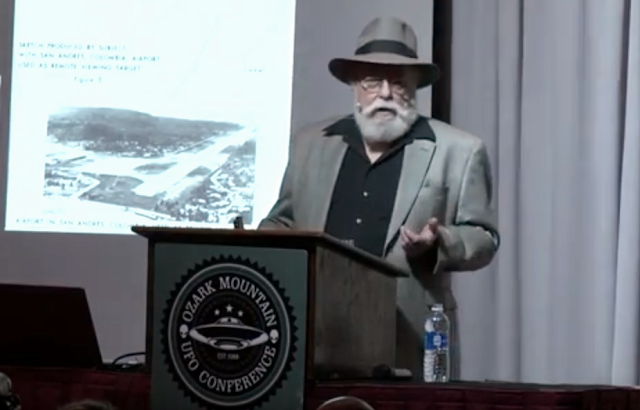
Jim Marrs at the 2016 Ozark Mountain UFO Conference, Psychic Techniques The US used, Video, UFO Sighting News.

Jim Marrs at the 2016 Ozark Mountain UFO Conference, Psychic Techniques The US used, Video, UFO Sighting News

UFO%252C%2BUFOs%252C%2BJustin%2BBieber%252C%2Bomni%252C%2Bsighting%252C%2Bsightings%252C%2Bspace%2Bstation%252C%2Baztec%252C%2Bstone%252C%2Bcarvings%252C%2Balien%252C%2Baliens%252C%2BET%252C%2Bhanger%2B18%252C%2BOzark%252C%2BRussia%252C%2BAmerica%252C%2B.png
Date of conference: Sept 2016
Location of conference: Ozark Mountain, Arkansas, USA

I really wish I attended this conference. It had lots of great speakers attending. Here is Jim Marrs, talking about how the US has trained psychic warriors to both gain information, and to kill. 
Scott C. Waring
www.ufosightingsdaily.com

Video states:

Jim Marrs continued his presentation REMOTE VIEWING ALIENS at the 2016 Ozark Mountain UFO Conference in Eureka Springs, Arkansas! Remote Viewing, a psychic technique developed and utilized by the U.S. Army, may have been instrumental in ending the Cold War. This practice has since been used to take a look at the different extraterrestrial species interacting with the people of Earth. 

 { http://www.ufosightingsdaily.com/ }

Hoe vind je dit bericht?
Geschreven door peter om 18:56 Stuur door

Witness Claims UFOs Performed Multiple Late Night Reconnaissance Flights Over A City In Arizona

Witness Claims UFOs Performed Multiple Late Night Reconnaissance Flights Over A City In Arizona

arizona-ufo

Orb-shaped bright light UFOs were spotted in the sky conducting multiple low-altitude flights. The incident reportedly took place over Chandler City in Maricopa County, Arizona in a three-hour period on the evening of August 19-20, 2016.

The unnamed witness reported the sighting to Mutual UFO Network, which filed it as Case 78571. He believes that the spaceships of alien origin may have performed five separate reconnaissance flights over the city on the evening of August 19 and early hours of August 20. The two UFOs may have been extraterrestrials as they were not something he had ever witnessed.

The witness recorded his encounter and submitted a report to MUFON along with three separate videos showing strange aerial activity in the sky.

The first sighting took place at around 9:15 p.m. PST, northeast direction. He was then with friends during the sighting that lasted approximately seven minutes. Together with friends, he watched the UFO hovered in the night sky very brightly.

As they tried to get abetter position to see what was just transpired, they noticed two smaller lights below the larger UFO.

The strange UFO lights hovered on the same spot for few minutes before one of the smaller objects disappeared. The other smaller UFO also vanished moments later, leaving only the unidentified flying object with a large bright light in the sky.

The remaining lone UFO then started to drift in the sky towards west until it also vanished, according to the reporting witness.

Because they were apparently overwhelmed on their first sighting, it did not come to their mind to record it on video.

They saw the same UFO about an hour later and this time, the witness managed to record two videos of the sighting that lasted approximately five minutes, but, as the witness admitted, they were of poor quality.

Fortunately, the witness was able to record a better video on the third sighting. The third clip shows an airplane flying with blinking navigational lights at first and then the mysterious UFO becomes visible. The strange object appears to fly at a lower altitude than the plane as it moves slowly westward.

As he tried to zoom in the object, the orb UFO changed into a doughnut-shaped circle. After the UFO had disappeared, it reappeared again after 30 minutes and accompanied this time by another UFO. But, he missed recording the sighting on video and did not give any reason in his report.

{ http://www.latest-ufo-sightings.net }

Hoe vind je dit bericht?
Geschreven door peter om 18:51 Stuur door

Jupiter's Wild North Pole, Southern Auroras Photographed for 1st Time

Jupiter's Wild North Pole, Southern Auroras Photographed for 1st Time

Jupiter's Wild North Pole, Southern Auroras Photographed for 1st Time
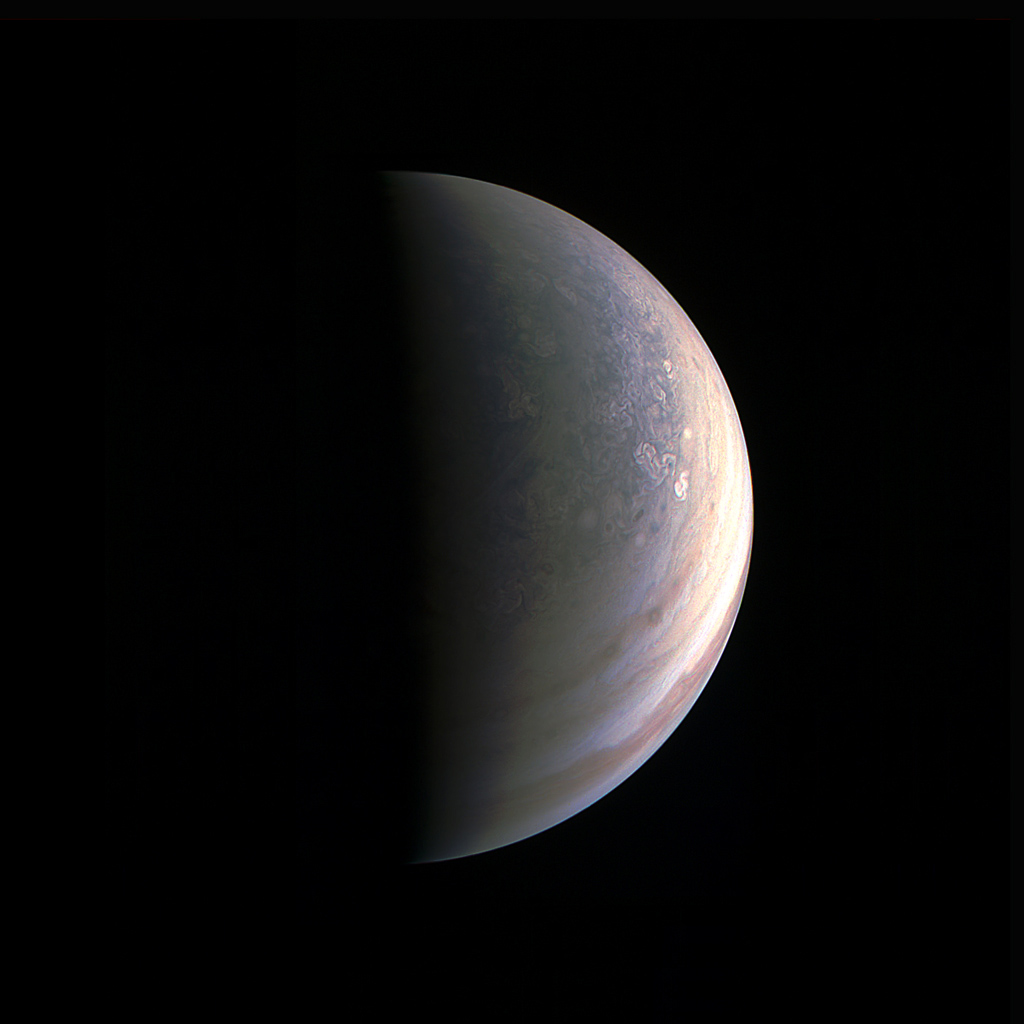
NASA’s Juno spacecraft captured this image of Jupiter’s north pole on Aug. 27, from a distance of 120,000 miles (195,000 kilometers).
Credit: NASA/JPL-Caltech/SwRI/MSSS

NASA's Juno spacecraft has beamed home the first-ever photos of Jupiter's north pole, and scientists can hardly believe their eyes.

Juno captured the images on Aug. 27, when the probe skimmed just 2,600 miles (4,200 kilometers) above Jupiter's cloud tops during the first of three dozen close flybys of the solar system's largest planet.

"First glimpse of Jupiter's north pole, and it looks like nothing we have seen or imagined before," Juno principal investigator Scott Bolton, of the Southwest Research Institute in San Antonio, said in a statement. [Photos: NASA's Juno Mission to Jupiter]

This view of Jupiter's north pole — captured by NASA's Juno probe on Aug. 27, 2016, from a distance of 48,000 miles (78,000 kilometers) — shows storms and weather systems unlike any seen elsewhere in the solar system.
Credit: NASA/JPL-Caltech/SwRI/MSSS

"It's bluer in color up there than other parts of the planet, and there are a lot of storms," Bolton added. "There is no sign of the latitudinal bands or zone and belts that we are used to; this image is hardly recognizable as Jupiter. We're seeing signs that the clouds have shadows, possibly indicating that the clouds are at a higher altitude than other features."

Saturn has a huge hexagonal storm swirling at its north pole. But Jupiter lacks such a vortex, the new photos show.

"There is nothing on Jupiter that anywhere near resembles that," Bolton said. "The largest planet in our solar system is truly unique. We have 36 more flybys to study just how unique it really is."

The $1.1 billion Juno mission launched in August 2011 and reached Jupiternearly five years later, on July 4 of this year. But Juno's instruments were turned off on this latter date, because mission team members wanted to focus on executing the make-or-break, 35-minute orbit-insertion burn.

NASA’s Juno probe took this image of Jupiter’s south pole on Aug. 27, 2016, from a distance of 58,700 miles (94,500 kilometers).
Credit: NASA/JPL-Caltech/SwRI/MSSS

So the Aug. 27 approach marked the first opportunity for the Juno team to photograph Jupiter up close and make detailed measurements with its suite of eight science instruments. (The spacecraft is currently in a highly elliptical, 54-day orbit around the planet.)

One of these instruments, the Jovian Infrared Auroral Mapper (JIRAM), captured views of Jupiter's north and south poles in infrared light, revealing hot spots that had never been seen before, mission scientists said.

Juno captured this infrared image of Jupiter’s southern lights on Aug. 27, 2016. Such views are not possible from Earth.
Credit: NASA/JPL-Caltech/SwRI/ASI/INAF/JIRAM

Like Earth, Jupiter has auroras — dramatic light displays that dance above the planet's north and south polar regions. JIRAM got unprecedented looks at the powerful Jovian southern aurora, Juno team members said.

"We were amazed to see it for the first time," JIRAM co-investigator Alberto Adriani, of the Istituto di Astrofisica e Planetologia Spaziali (Institute of Astrophysics and Space Planetology) in Rome, said in the same statement.

"No other instruments, both from Earth or space, have been able to see the southern aurora," he added. "Now, with JIRAM, we see that it appears to be very bright and well-structured. The high level of detail in the images will tell us more about the aurora's morphology and dynamics."

Juno also managed to "hear" Jupiter's auroras, using the spacecraft's Radio/Plasma Wave Experiment (also known as Waves).

Spectacular aurora lights up Jupiter’s North Pole

Jupiter's Wild North Pole, Southern Auroras Photographed for 1st Time

"Waves detected the signature emissions of the energetic particles that generate the massive auroras which encircle Jupiter's north pole," said Waves co-investigator Bill Kurth, a research scientist in the Department of Physics and Astronomy at the University of Iowa. "These emissions are the strongest in the solar system. Now we are going to try to figure out where the electrons come from that are generating them."

Next month, Juno is scheduled to perform another engine burn that will shift the probe into a 14-day-long orbit. The spacecraft will continue gathering data — especially during its close flybys over the planet's poles — before ending its mission with an intentional death dive into Jupiter's atmosphere in February 2018.

These 10 images show Jupiter growing and shrinking in apparent size before and after NASA's Juno spacecraft made its close approach to the planet on August 27, 2016.
Credit: NASA/JPL-Caltech/SwRI/MSSS

Juno's observations should help scientists better understand Jupiter's composition and structure, including whether the giant planet harbors a core of heavy elements. This information should, in turn, shed light on the formation of Jupiter, the solar system and planetary systems in general, NASA officials have said.

Follow Mike Wall on Twitter @michaeldwall and Google+. Follow us@Spacedotcom, Facebook or Google+. Originally published on Space.com.

{ http://www.space.com/ }

Hoe vind je dit bericht?
Geschreven door peter om 00:58 Stuur door

Reference: Van Allen Radiation Belts: Facts & Findings

Van Allen Radiation Belts: Facts & Findings

By Elizabeth Howell, Space.com Contributor

Van Allen Radiation Belts: Facts & Findings
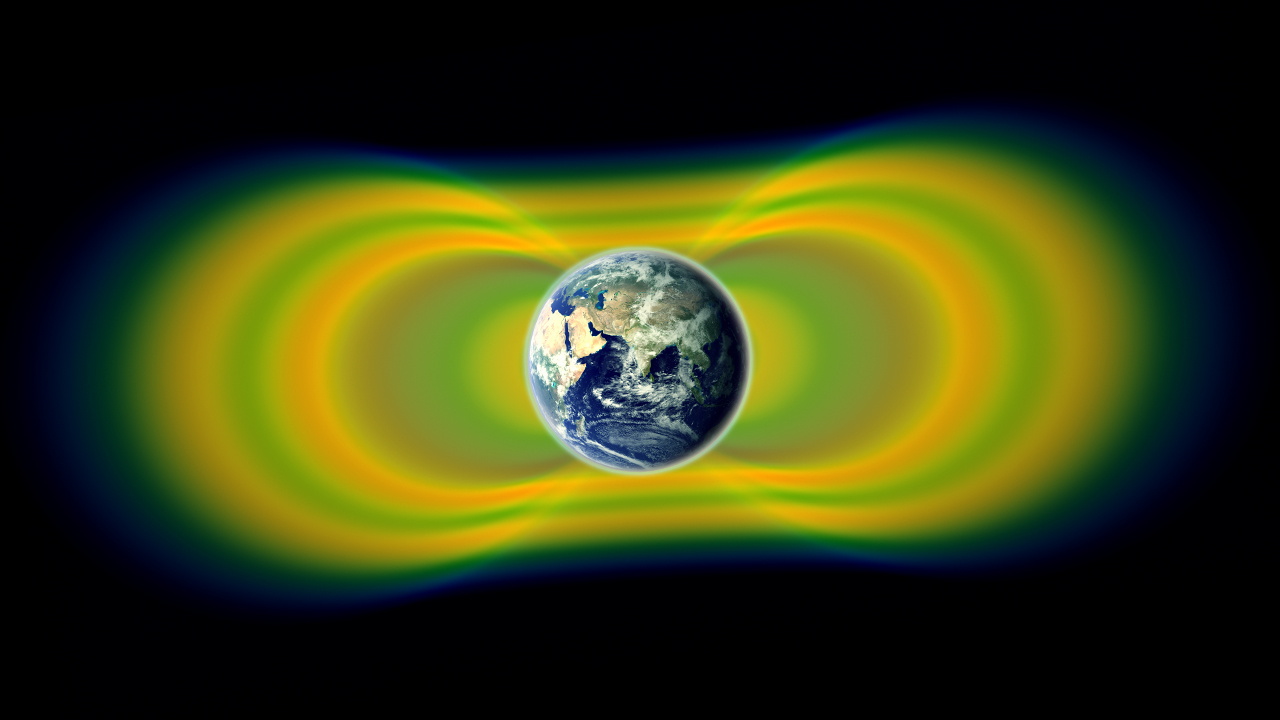
Two giant swaths of radiation, known as the Van Allen Belts, surrounding Earth were discovered in 1958. In 2012, observations from the Van Allen Probes showed that a third belt can sometimes appear. The radiation is shown here in yellow, with green representing the spaces between the belts.
Credit: NASA/Van Allen Probes/Goddard Space Flight Center

Earth is surrounded by giant donut-shaped swaths of magnetically trapped, highly energetic charged particles. These radiation belts were discovered in 1958 by the United States' first satellite, Explorer 1. The discovery was led by James Van Allen at the University of Iowa, which eventually caused the belts to be named after him.

Van Allen's experiment on Explorer 1, which launched Jan. 31, 1958, had a simple cosmic ray experiment consisting of a Geiger counter (a device that detects radiation) and a tape recorder. Follow-up experiments on three other missions in 1958 — Explorer 3, Explorer 4 and Pioneer 3 — established that there were two belts of radiation circling the Earth.

This simple picture of the radiation belts persisted for decades until 2012, when a pair of probes was launched to study them in detail. This was the first time that two spacecraft simultaneously studied the radiation belts, trading information with each other to build a bigger picture.

Part of the interest in the Van Allen belts comes from where they are located. It is known that the belts can swell when the sun becomes more active. Before the probes launched, scientists thought the inner belt was relatively stable, but when it did expand its influence extended over the orbit of the International Space Station and several satellites. The outer belt fluctuated more often.

The Van Allen Probes (formerly known as the Radiation Belt Storm probes)have several scientific goals, including discovering how the particles — ions and electrons — in the belts are accelerated and transported, how electrons are lost and how the belts change during geomagnetic storms. The mission was planned to last two years, but as of August 2016 the probes were still operating at double the expected mission lifetime.

Usually scientists take a few months to calibrate their instruments, but a team with the Relativistic Electron Proton Telescope asked that their instrument be turned on almost immediately (three days after launch). Their reasoning was they wanted to compare observations before another mission, SAMPEX (Solar, Anomalous, and Magnetospheric Particle Explorer), de-orbited and entered Earth's atmosphere.

"It was a lucky decision," NASA said in February 2013, noting that a solar storm had already caused the radiation belts to swell as soon as the instrument was turned on. "Then something happened no one had ever seen before: the particles settled into a new configuration, showing an extra, third belt extending out into space," the agency added. "Within mere days of launch, the Van Allen Probes showed scientists something that would require rewriting textbooks."

An artist's depiction of the two Van Allen probes orbiting Earth.
Credit: JHU/APL

Data gathered by the probes also showed that the radiation belts shield Earthfrom high-energy particles. "The barrier for the ultrafast electrons is a remarkable feature of the belts," study lead author Dan Baker, of the University of Colorado in Boulder, said in a statement. 

"We're able to study it for the first time, because we never had such accurate measurements of these high-energy electrons before." [Gallery: NASA's Van Allen Probes]

This new information helped scientists model the belts' changes. But there was more information to come. In January 2016, scientists revealed that the shape of the belts depends on what type of electron is being studied. This means the two belts are much more complex; depending on what is being observed, they can be a single belt, two separate belts or just an outer belt (with no inner belt at all.)

"The researchers found that the inner belt — the smaller belt in the classic picture of the belts — is much larger than the outer belt when observing electrons with low energies, while the outer belt is larger when observing electrons at higher energies," NASA wrote at the time. "At the very highest energies, the inner belt structure is missing completely. So, depending on what one focuses on, the radiation belts can appear to have very different structures simultaneously."

What is still poorly understood, however, is what happens when particles from the sun hit the belts during a geomagnetic storm. It is known that the number of electrons in the belts changes, either decreasing or increasing depending on the situation. Also, the belts eventually return to their normal shape after the storm passes. NASA said it isn't clear what kind of storm will cause a specific type of belt configuration. Also, the agency noted, any previous observations were done only with electrons at a few energy levels. More work needs to be done.

Luckily, scientists got the chance to observe a storm up close in March 2015, when one of the Van Allen probes happened to be situated inside the "right" spot in Earth's magnetic field to see an interplanetary shock. NASA describes such shocks as similar to when a tsunami is triggered by an earthquake; in this case, a coronal mass ejection of charged particles from the sun creates a shock in specific areas of the belts.

"The spacecraft measured a sudden pulse of electrons energized to extreme speeds — nearly as fast as the speed of light — as the shock slammed the outer radiation belt," NASA wrote at the time. "This population of electrons was short-lived, and their energy dissipated within minutes. But five days later, long after other processes from the storm had died down, the Van Allen probes detected an increased number of even higher energy electrons. Such an increase so much later is a testament to the unique energization processes following the storm."

The shape of the Van Allen belts can vary widely depending on how energetic the individual electrons are, and general conditions in the Earth’s magnetic environment. During geomagnetic storms (4), all three regions in the belts can balloon.
Credit: NASA GODDARD/DUBERSTEIN

The Van Allen Probes are specially radiation-hardened to withstand the intense environment of the belts. Some spacecraft, however, are more vulnerable — especially when a solar storm hits. At worst, spacecraft can short out due to an electrical overload. Communications can also be disrupted. Fortunately, sometimes instruments can be turned on or off on a spacecraft during a solar storm. 

Radiation, of course, also poses a human risk. Astronauts are subject to lifetime radiation limits from their time in space, to reduce any risk of cancer. Since only a few dozen people have spent six months or longer in space, however, it will take decades to understand the long-term effects of radiation on humans.

The astronauts on the ISS do not regularly spend time inside the belts, but from time to time solar storms expand the belts to the orbit of the space station. In the 1960s, several Apollo crews went through the Van Allen belts on their way to and from the moon. Their time in that radiation-intensive region, however, was very short, in part because the trajectory was designed to pass through the thinnest known parts. With more study, astronauts can be better protected for long-term stays in Earth orbit.

"We study radiation belts because they pose a hazard to spacecraft and astronauts," said David Sibeck, the Van Allen Probes mission scientist at NASA's Goddard Space Flight Center in Maryland, in an August 2016 NASA statement. "If you knew how bad the radiation could get, you would build a better spacecraft to accommodate that."

Additional resource

NASA: Van Allen Probes Mission Overview

{ http://www.space.com/ }

Hoe vind je dit bericht?
Geschreven door peter om 00:40 Stuur door

That recently detected 'alien signal' is actually just a terrestrial disturbance

The Allen Telescope Array in California. Credit: SETI Institute
That recently detected 'alien signal' is actually just a terrestrial disturbance

The call came from inside the house.

Researchers working with the Ratan-600 radio telescope in Russia have confirmed that the reported 'strange signal' that's been making headlines lately is nothing more than a terrestrial disturbance caused by a Soviet satellite.

The signal was originally detected back in May 2015, and was thought to be coming from the star HD 164595. The fact that it was so unusually strong hinted at the fact that something odd was going on here. But the only strange thing here is that the signal wasn't coming from space at all - it was coming from Earth.

"We indeed, discovered an unusual signal. However, an additional check showed that it was emanating from a Soviet military satellite, which had not been entered into any of the catalogues of celestial bodies," team member Alexander Ipatov, from the Russian Academy of Sciences, told the Russian news agency TASS.

In case you missed it, a few days ago, word of an intriguing signal started to make headlines across the world after popular astronomy writer Paul Gilster wrote about it on his blog Centauri Dreams.

The signal, which was supposedly detected last year by the Ratan-600 telescope in Russia, was extremely strong, with a 2.7 centimetre (1.06-inch) wavelength with an 11 GHz frequency, which is comparable to a digital TV signal.

The find was made all the more interesting by the fact that HD 164595 - the star the signal appeared to be coming from - is a lot like our Sun.

HD 164595 is only 1 percent lighter than the Sun, 100 million years younger, has a similar temperature, and is even composed of the same elements.

All of this added up to a whole lot of hype. So much so, that researchers from the Search for Extraterrestrial Intelligence (SETI) observed the area, which lies in the constellation Hercules some 94 light-years away, using the Allen Telescope Array, but they didn’t find anything interesting.

Now the researchers who originally found the signal have set the record straight by announcing that it was nothing more than a terrestrial disturbance.

"Last and this year, the telescope’s work has focused on searching for Sun-like stars," Ratan-600 researcher Yulia Sotnikova told TASS.

"There have been no scientific results within the framework of this research so far. Some time ago, in the spring of this year, an unusual signal was received but its analysis showed that it was most likely a terrestrial disturbance."

This means that the signal was coming from a Soviet satellite and somehow got mixed up in their findings, which would explain its unusual strength.

Right now, the team says they're going to be preparing an official statement thatwill be sent out shortly.

While the news is definitely a bummer for those of us who dream of finding intelligent life somewhere in the Universe, it’s pretty cool to see how the scientific community pulls together almost overnight when an intriguing signal is picked up.

Hopefully, with so many astronomical organisations working together around the world, if there are signals from intelligent life beaming out across the galaxy or beyond, we'll be equipped to find them. But today is not that day.

Hoe vind je dit bericht?
Geschreven door peter om 00:13 Stuur door

MOOISTE UFO OPNAME VAN HET JAAR!

MOOISTE UFO OPNAME VAN HET JAAR!

ru2.jpg

Heel vaak zijn de opnames die mensen maken van vreemde vliegende objecten in onze lucht vaag en onduidelijk. 

Maar soms komen er beelden tevoorschijn die thuis horen bij de mooiste opnames van het jaar zoals de hiernavolgende. 


De volgende UFO waarneming is gedaan door een man op 12 augustus 2016 in de plaats Bayonne in de Amerikaanse staat New Jersey. 

Er was net een felle bui geweest en de man stapte naar buiten om wat foto’s te nemen van de mooie wolkenluchten. 

Wanneer hij later de foto’s op zijn computer zet, ontdekt hij in één ervan een grijze streep.


xxx


xxx

Maar, wanneer je die grijze streep wat verder uitvergroot dan zie je iets dat misschien wel bij de mooiste UFO opnames van dit jaar hoort. 

Een prachtige retro UFO, de klassieke vliegende schotel, waarbij je zelfs de ramen ziet.


xxx

Zelden zie je opnames die zo duidelijk zijn als de bovenstaande. 

Scott Waring van Ufo Sightings Daily heeft de kleuren wat verbeterd en dan ontstaat het volgende.


xxx

Deze UFO in New Jersey lijkt heel veel op degene die Scott heeft ontdekt in 2012 op Google Earth. 

De afbeelding is genomen bij Kaap de Goede Hoop en laat ook dezelfde mooie retro vorm zien. Maar, na de publicatie van deze afbeelding duurde het niet lang voordat deze wasweg gepoetst door Google. 

UFO’s bestaan tenslotte niet, dus als ze wel ergens voorkomen, dan moeten we heel snel maatregelen nemen om ervoor te zorgen dat ze dan verdwijnen.


xxx

{ http://niburu.co/ }

Hoe vind je dit bericht? 1 stem
Geschreven door peter om 23:51 Stuur door

Interstellar Space Travel: 7 Futuristic Spacecraft To Explore the Cosmos

Interstellar Space Travel: 7 Futuristic Spacecraft To Explore the Cosmos

Hoe vind je dit bericht?
Geschreven door peter om 19:15 Stuur door

Engineers Are 3D Printing Coral Reefs to Help Save Our Oceans

Engineers Are 3D Printing Coral Reefs to Help Save Our Oceans

Bonaire VITB Underwater Images DSC_8658 
Group.jpg
3D printed reef unit after 8 months_Bahrain_Jul2013-1.JPG
BARTHOLOMEW COOKE
IN BRIEF

One island is turning to 3D printing to help preserve the region's fragile coral reefs. The island's Harbour Village Beach Club has teamed up with ocean preservationist Fabien Cousteau to bring the 3D printing technology to our waters.

3D Printing

3D Printing Coral Reefs in the Caribbean

STICK FOR LIFE

Some 3D printing trends may come and go, but this latest effort—much like Fred the tortoise’s new shell—is sure to stick for life. The trend we’re referring to is 3D-printed corals. 

Coral reefs, as we all learned in science class, are remarkably important. They contain the most diverse ecosystems on Earth, and they also protect coastlines from waves and tropical storms, among other things. Sadly, coral reefs are in danger of disappearing, thanks to the combination of diseases, and damage that is caused by climate change, pollution, and other human acitivies 

Such is the case in the Caribbean Island of Bonaire, which is turning to additive manufacturing for help to preserve the region’s fragile coral reefs. 

3D-PRINTED REEFS

The island’s Harbour Village Beach Club has teamed up with ocean preservationist Fabien Cousteau to bring the 3D printing technology to Bonaire’s coasts. Cousteau is the grandson of the late oceanographer Jacques Cousteau, who made scuba diving possible.  

For this project, the younger Cousteau will help the island plan and print pieces of artificial coral that will bear the same shape, texture, and even chemical makeup of organic corals to attract floating baby coral polyps and other species that rely on coral reefs for protection, including algae, crabs, and other fish species. 

“This technology is less labor-intensive than current coral restoration processes, creating a larger impact in a shorter amount of time,” Cousteau told the Caribbean Journal. 

This isn’t the first time that 3D printing has been used to save the threatened coral reefs. In 2012, Australian organization Reef Design Lab implanted the first artificial reef using low carbon footprint sandstone material in Bahrain’s Reef Arabia.  

“We can achieve a very ‘organic’ appearance, and produce far greater complexity, caves and tunnels compared to traditional moulding techniques—this can translate to greater biodiversity and biomass,” RDL said in its website. 

References: 
Hoe vind je dit bericht?
Geschreven door peter om 18:46 Stuur door

NASA deelt unieke foto's van Jupiter:

NASA deelt unieke foto's van Jupiter: "Dit hebben we nog nooit gezien" - HLN.be

Bron: NASA, Telegraph


View image on Twitter

First-ever images of Jupiter’s north pole by @NASAJuno! It's unlike anything seen before: http://go.nasa.gov/2clOkWP 

VIDEO De Amerikaanse ruimtevaartorganisatie NASA heeft een primeur te pakken. Ze kon voor het eerst de noordpool van de planeet Jupiter gedetailleerd op foto vastleggen. De afbeeldingen werden genomen door de ruimteverkenner Juno en dit weekend door de NASA vrijgegeven.

media_l_9025863.png Indrukwekkend stormweer op de noordpool van Jupiter.  © NASA/JPL-Caltech/SwRI/MSSS.   media_l_9025862.jpg Infraroodbeeld van de zuidpool van Jupiter. © NASA/JPL-Caltech/SwRI/MSSS.

"Het lijkt op niks dat we ooit eerder hebben gezien", zegt Scott Bolton van het Southwest Research Institute (Texas). Ook de zuidpool van de gasreus werd vereeuwigd, maar het is vooral de noordpool die de aandacht van de onderzoekers trekt. Ze kleurt immers blauwer dan de rest van het hemellichaam en het is er schijnbaar veel stormachtiger dan verwacht. 

De ruimtesonde maakte ook infraroodbeelden van de grootste planeet van ons zonnestelsel. Zo is op een van de foto's het morgenrood op de zuidpool te zien.

Juno stuurde eerder al foto's van Jupiter door naar de aarde, maar de afbeeldingen die de NASA onlangs op haar website plaatste, zijn veel scherper. 

De verkenner vloog vorige week 'dicht bij' de planeet op een afstand van circa 4.000 kilometer. Er volgen de komende maanden nog tientallen vluchten rond de gasreus om meer data te verzamelen. In 2018 is de missie afgelopen en zal Juno vergaan in de atmosfeer.

Lees ook

{  http://www.hln.be/ }

Hoe vind je dit bericht?
Geschreven door peter om 17:14 Stuur door

Inactieve vulkaan op dwergplaneet Ceres - HLN.be

Inactieve vulkaan op dwergplaneet Ceres - HLN.be

Bron: AP

media_xll_9020423.jpg

De inactieve vulkaan op Ceres © ap.

Wetenschappers denken op dwergplaneet Ceres, die ronddraait in een asteroïdengordel tussen Mars en Jupiter, een inactieve vulkaan te hebben ontdekt.

media_l_9020424.jpg © afp.

Ruimtesonde Dawn van de Amerikaanse ruimtevaartorganisatie NASA bestudeerde de berg op Ceres de afgelopen maanden. De vulkaan is half zo hoog als de Mount Everest. De laatste uitbarsting vond vermoedelijk honderden miljoenen jaren geleden plaats. 

"Het is onwijs cool en onverwacht", zei Christopher Russell van de University of California vandaag. Ceres stond ooit te boek als een volwaardige planeet, maar werd later gedegradeerd tot asteroïde. Tegenwoordig valt Ceres in de categorie dwergplaneet, net als Pluto. 

Ruimtesonde Dawn is de eerste die de dwergplaneet van dichtbij observeert. De sonde cirkelt als sinds maart 2015 rond Ceres.

Lees ook

{ http://www.hln.be/ }

Hoe vind je dit bericht?
Geschreven door peter om 17:01 Stuur door

Ufojagers spotten deze vreemde lichtgevende objecten aan internationaal ruimtestation - HLN.be

Ufojagers spotten deze vreemde lichtgevende objecten aan internationaal ruimtestation - HLN.be

Bron: Daily Mail, The Sun

Deze keer zijn ze er honderd procent zeker van dat ze het bewijs hebben dat we niet alleen zijn in het heelal. Ufospotters hebben op YouTube een filmpje gedeeld waarop het internationaal ruimtestation ISS te zien is. Op de beelden is plots twee keer een lichtgevend object waar te nemen dat passeert.

De beelden zouden afkomstig zijn van de NASA volgens StreetCap1, de ufojagers die het filmpje hebben gedeeld. Het ruimtestation is immers 24 uur per dag te volgen via een livefeed van de ruimtevaartorganisatie. Je kan de Russische Progress Capsule zien, die zich aan het ISS heeft vastgemaakt voor bevoorrading. Achter de capsule is tot twee keer toe een lichtbol waar te nemen. 

Volgens Scott Warring van de website UFO Sightings Daily gaat het om het ultieme bewijs dat buitenaardse wezens het ruimtestation in de gaten houden. Onder het filmpje - dat intussen al 15.000 keer werd bekeken in enkele dagen tijd - zijn nog meer enthousiaste commentaren te lezen. En af en toe een kritische noot van iemand die er niets van gelooft en de spotters een dokter aanraadt.

Lees ook

{  http://www.hln.be/ }

Hoe vind je dit bericht?
Geschreven door peter om 16:56 Stuur door

Meer van UFO'S of UAP'S, ASTRONOMIE, RUIMTEVAART, ARCHEOLOGIE, OUDHEIDKUNDE, SF-SNUFJES EN ANDERE ESOTERISCHE WETENSCHAPPEN - DE ALLERLAATSTE NIEUWTJES

↑ Terug naar de berichten