One thing is sure… if aliens came to Earth, we surely wouldn’t have the upper hand say scientists, who agree that an Alien species with such advanced technology could prove to be difficult to contain.

Are we ready for contact?


 [VIDEO] Would NASA be able to prevent extraterrestrial contamination on Earth?

Alien hunters and UFO enthusiasts get excited by the mere though of finding extraterrestrial life some day. However, there are hundreds of contamination risks associated with such space missions conducted by NASA and other space agencies around the world.
Sending astronauts to Mars or Jupiter in search of alien life sounds fancy. However, considering the variety of organisms with extreme capabilities that Earth harbour, there are huge chances that the astronauts may end up contaminating the environment of the celestial body in question.
According to Daily Galaxy, some form of microbial life from the Earth may be able to multiply and divide quickly in the hospitable environment of the other planets. As a result, the astronauts may notice a "false positive" for extraterrestrial life, which is actually Earth's own life form invading the other planet or moon.
That is, alien life from extraterrestrial world should not be able to reach back on Earth along with the samples collected by the astronauts. There is a huge possibility that alien life may reside themselves in the body of the astronauts returning back on Earth, and hence contaminate Earth's original life form.
The Outer Space Treaty of 1967 signed by different countries involved in space mission is major effort made in the direction of contamination prevention, according to National Geographic. It has a draft of guidelines that each space agency must follow to reduce extraterrestrial contamination, according to the type of mission that it is conducting.
NASA has also developed strong guidelines to make the best use of its existing anti-germ warfare. The components of a mission are assembles carefully in a closed room and thoroughly cleaned with alcohol. The parts are baked to kill all the spores. In addition, special care is taken to land the spacecraft in a location which is far away from the possibly "hospitable" surfaces.
However, it is not the only thing that concerns the research team. Cassie Conley, head of NASA's Office of Planetary Protection, believes that the other way around is also possible. Consley says that it is the responsibility of the American space agency to ensure that backward contamination is not a possibility.
UFO sightings, cases and close encounters with the first kind IMPORTANT POINTS TO REMEMBER WHEN HILLARY CLINTON ADDRESSES THE UFO/ET QUESTION AS PRESIDENT

When Daymond Steer of the Conway Sun asked Hillary about her husband’s comments on UFOs, she said, “I think we may have been” visited already, but “we don’t know for sure.” She also told Steer that her campaign chairman, John Podesta (also former councillor to Barack Obama and White House Chief of Staff for the Clinton Administration), has encouraged her to pursue the subject, stating that he “has made me personally pledge we are going to get the information out.”
Podesta has gone on record about this issue multiple times; at the end of his 2014 campaign he tweeted that his biggest regret was not being able to “secure the disclosure of UFO files.” You can read more about thathere.
He also wrote the forward to Leslie Kean’s 2010 New York Times bestseller, UFOs: Generals, Pilots, & Government Officials Go On The Record:
I’m skeptical about many things, including the notion that government always knows best, and that the people can’t be trusted with the truth. The time to pull the curtain back on this subject is long overdue. We have statements from the most credible sources – those in a position to know – about a fascinating phenomenon, the nature of which is yet to be determined.

The photo to your left has been circulating the internet for years and was just published by the New York Times. Pictured with Hillary is Laurence Rockefeller, who maintained an active interest in UFOs and has supported the work and investigations of various people in the field. (source).
The book Clinton is holding, titled Are We Alone?, was written by Paul Davies, a well-respected American physicist who has held professorships at various universities. Most of his research has related to quantum field theory. The book considers the ramifications of contact with intelligent extraterrestrials.
SETI scientist claims: If Aliens did visit us, they’d take control over everything
Are we ready for contact?
But are we ready to greet our cosmic neighbors? Not as different nations but as ONE species from planet Earth?
Many people believe that intelligent extraterrestrial beings are out there somewhere, and many firmly state that, the time when we actually meet them, we might be in for a surprise as it might not end up like in the famous movie E.T.
Jill Tarter, astronomer, and co-founder of the SETI Institute said that if aliens visit our planet, they could take control of everything thanks to their clearly superior technology. However, Tarter added that aliens capable of finding Earth may be co-operative…
“If they showed up on our doorstep, that means they have technologies that are considerably advanced with respect to ours.” “And because of that, they’re going to be the ones that set the rules,” Tarter said in an article published by TechCrunch.
However, she adds that an Alien civilizations capable of developing such sophisticated technology, which enables them to overcome the obstacle of vast interstellar distances. Would probably make them more benevolent than hostile, since by then they would have learned to behave peacefully in order to prevent their own annihilation.
This neutral-benevolent attitude of extraterrestrial visitors has already been proposed by scientists in different countries based on thorough analysis of extensive historical and modern documents.
SETI’s project ‘search for extraterrestrial intelligence’, currently continues its search for radio waves and optical signals in the universe that can indicate the presence of other civilizations. In this regard, in an exercise of sincerity, Dr. Tarter admitted: “Perhaps we have not yet invented the correct way to do this.”
Or perhaps we have to continue searching. Talking about Alien life and why we haven’t found it yet, Tarter explained: „if you set the search space equal to the size of the Earth’s oceans, we’ve only examined one glass of water from those oceans for intelligent life. We’ve only looked at one small part of a very large picture.“
Along the same lines, Dr. Nathalie Cabrol, a colleague of Tarter, said in September last year that an alien civilization might be trying to contact us, but humans could be “too primitive to see those signs.”
And as the great Carl Sagan once said… “The universe is a pretty big place. If it’s just us, seems like an awful waste of space.” ― Carl Sagan in Contact
But many other scientists have spoken out about the possible presence of Alien beings in the cosmos and their benevolent or hostile reactions when arriving at Earth.
One of the most famous quotes in modern times in regards to Alien visitations to Earth comes from the Great Professor Stephen Hawking who said that when Aliens arrive at earth, the outcome could be very similar to when Christopher Columbus et foot in the New World.
“If aliens visit us, the outcome would be much as when Columbus landed in America, which didn’t turn out well for the Native Americans.” – Stephen Hawking
An interesting statement was made last year when Astronaut John Grunsfeld spoke out about aliens suggesting that if extraterrestrial beings are out there, they already know we exist.
‘We put atmospheric signatures that guarantee someone with a large telescope 20 light years away could detect us,’ said Grunsfeld at the Astrobiology Science Conference in Chicago.
‘If there is life out there, intelligent life, they’ll know we’re here.’
Alien life on Mars did exist? European Space Agency reveals stunning details
Did alien life once exist here? According to reports, in the distant past ‘huge amounts’ of water passed through this area on Mars. Beginning at a higher elevation region and spilling into the northern plains, scientists say these features can be clearly seen at the lower right and top left of the image, respectively. Image credit: ESA/DLR/FU Berlin, CC BY-SA 3.0 IGO
Mawrth Vallis is one of the largest valleys on the red planet and experts claim it may have been HABITABLE up to 3.6 billion years ago.
According to reports, Mawrth Vallis on Mars once had MASSIVE amounts of water passing through the area, during a time when the red planet was eerily similar to Earth.
The European Space Agency has published new images of what many are calling a remarkable discovery of a swirling valley on Mars, which could potentially become one of the main landing sites for ExoMars 2020.
The new photographs of Mars captured by the Mars Express show us a region of over 205,000 square miles where once ancient water carved different shapes on the surface of the planet.
With a staggering 600 km in length and up to 2 km in depth, this valley is one of the most massive valleys on the planet.
Large amounts of water once passed through it from a higher region, part of which appears in the lower right corner of the photograph, flowing towards the plains of the northern parts, which are seen in the upper left corner of the image.

Among the most notorious figures, we find large amounts of phyllosilicates (eroded clay minerals) marked with a brighter color throughout the course of the valley.
But most importantly, Phyllosilicates on Mars tell us that in the distant past, liquid water existed on the planet in great amounts and that Mars may have been a habitable environment some 3,600 million years ago.
According to reports from the European Space Agency, remains of volcanic ash is visible in the form of dark cap rock and may have protected traces of ancient living organisms in the clay.
In order to come up with this fascinating image of Mars, scientists joined nine images taken by the high-resolution camera on board the Mars Express.
It is noteworthy to mention that everything about Mars has changed with recent discoveries. Earlier this year, scientists found that Mars once had more water than the Arctic Ocean and the oceans were present on the surface of Mars for a period of over 1.5 billion years, enough for life as we know it to develop.
The finding discovered that over the past 3.7 billion years, Mars lost around 57 percent of its water.
Sharon Wilson from the Smithsonian Institution in Washington said “We discovered valleys that carried water into lake basins. Several lake basins filled and overflowed, indicating there was a considerable amount of water on the landscape during this time.”
Massive temple discovered on Mars ‘identical’ to an ancient Japanese tomb
 NASA AND RUSSIA RECEIVED THREE DETAILED MESSAGES FROM ALIEN PLANET
 NEW EVIDENCE THAT THE SPHINX PREDATES THE ANCIENT EGYPTIAN CIVILIZATION
 Elon Musk reveals his interplanetary masterplan that will take man to Mars in 80 days


 Hillary Clinton's campaign chair thinks the U.S. should open its files on UFOsGESCHROKKEN ALIEN RENT NAAR RUIMTESCHIP EN RENT WEG ( VIDEO )

GESCHROKKEN ALIEN RENT NAAR RUIMTESCHIP EN RENT WEG ( VIDEO )
|
NAAR In het Joshua Tree National Park in Amerika heeft een bezoeker iets heel merkwaardigs gefilmd. De volgende opname is gemaakt in het Joshua Tree National Park in de Amerikaanse staat Californië. Het Joshua Tree National Park is een nationaal park in het zuiden van de staat Californië in de Verenigde Staten, ten oosten van het gebied tussen Los Angeles en San Diego (ten noorden van Palm Springs). De afmetingen zijn ongeveer 100 km van oost naar west, en 50 km van noord naar zuid. Volgens de getuige: We bevonden ons ongeveer een kwartier in het Joshua Tree National Park toen we bij een groepje bomen kwamen en stopten om deze te filmen. Ik begon met het filmen van het landschap en bewoog langzaam naar rechts, stopte en wilde weer terug naar links. Net voordat ik dat deed, zie je op de film een wolkje stof omhoog komen bij één van de bomen en even later zie je een klein object rechts weg schieten. Op de volgende foto zie je linksboven de plek waar de stofwolk werd waargenomen, rechts de uitvergroting van wat daar te zien was en linksonder de plek vanwaar het object even later wegschoot.
Op de twee afbeeldingen hieronder zie je het object met grote snelheid vertrekken.
De man die het heeft gefilmd, is driftig op zoek geweest naar verklaringen, maar heeft die nog niet kunnen vinden. |
West Virginia witness captures triangle UFO on video
A West Virginia witness at Barbour County reported watching and videotaping an object with four lights in a triangle shape, according to Case 79238 from the Mutual UFO Network (MUFON) witness reporting database.

Cropped and enlarged witness photo.
(Credit: MUFON)
The witness was outside at Stonewall Resort with three others at 6:18 a.m. on September 5, 2016, when the incident began.
“We were heading to the top of the hill to get our machinery out for the morning job,” the witness stated.“It was pretty dark out still so we sat there waiting for it to get a bit brighter out so we could see what we were doing.”

Cropped and enlarged still frame from witness video.
(Credit: MUFON)
The witness then noticed the object.
“I happened to look up at the stars like I do sometimes. I noticed a bright light moving in the sky. I pointed it out asking what the heck it was. One of our guys said it’s just an airplane. I disagreed. Airplanes have different lights. At the time it just looked like a solid light moving in a straight direction but shifting side-to-side as well.”
The witness was able to get some low level video of the object.
“I grabbed my phone and zoomed in as close as I could to get a video. My phone goes zoomed up to 4x, but it’s a cheap Android so the quality was bad. I decided to take a photo as well. There was another one some distance away you can see in the photo.”

Cropped and enlarged still frame from witness video.
(Credit: MUFON)
The witness then reviewed the photo and video at home.
I zoomed in on that photo and I was shocked. I showed my girlfriend as well. What was a single light was actually four lights in a triangle shape. The way they are facing doesn’t match the direction it moves.”
Barbour County is a county located in north-central West Virginia. Population 16,589. West Virginia State Director Fred Saluga is investigating. Please remember that most UFO sightings can be explained as something natural or man-made. The above quotes were edited for clarity. Please report UFO activity to MUFON.com.
Flying Triangle Seen By Dog Walker In UK In Sept 2016, Photos, UFO Sighting News.


 Strange white circling lights in the Derbyshire skies last night Sept 2016, Video, UFO Sighting News.


 UFO Causes Family In Devon, England To Get Excited, Sept 2016, Video, UFO Sighting News.

 Humanoid Robots to Flying Cars: 10 Coolest DARPA Projects

The U.S. Defense Advanced Research Projects Agency, or DARPA, has a reputation for working on some of the most cutting-edge, futuristic projects — many that could easily be mistaken for science fiction. The agency, which falls under the watch of the U.S. Department of Defense, is responsible for developing new technologies for the military.
From humanoid robots to flying armored cars, here are 10 of the coolest DARPA projects.

As their names suggest, WildCat and BigDog are four-legged, headless robots designed to walk, run and carry heavy loads through potentially dangerous terrain, much like deployed troops. DARPA awarded contracts to Boston Dynamics to develop WildCat and BigDog for use by the military.
BigDog, created in 2005, is 3 feet (0.91 meters) long, and stands 2.5 feet (0.76 m) tall. The robot, which is roughly the size of a small mule, is capable of hauling 400 pounds (181 kg) of cargo, and can navigate difficult terrain and inclines up to 35 degrees.
WildCat, however, is quicker and more agile. The robot can gallop up to 16 mph (25 km/h) on flat surfaces, and is part of a DARPA mission to develop robots that can assist human soldiers on a variety of ground missions.

Sometimes life imitates art, as is the case with DARPA's project to develop interfaces that enable soldiers to control and partner with semi-autonomous bipedal machines that, "act as the soldier's surrogate." Sound familiar? Hollywood director James Cameron explored the idea in his 2009 blockbuster hit "Avatar."
In its 2013 budget, DARPA allocated $7 million to its "Avatar Project," which could enable soldiers to control surrogate robots in dangerous combat situations.

To reduce the amount of "collateral damage" in war, particularly during battles fought in urban settings, DARPA is developing laser weapons that are small and efficient enough to be used in combat. These experimental laser weapons will be 10 times lighter than existing high-power laser systems currently in use, DARPA officials have said.
The lasers, developed for airplanes, may also be used for laser communications, target designation and airborne self-protection, agency officials added.

DARPA's Falcon Project was announced in 2003 as a joint program with the U.S. Air Force. The project aimed to develop a reusable, unmanned, rapid-strike hypersonic vehicle.
A prototype Hypersonic Technology Vehicle 2 (HTV-2) first flew in April 2010 and again in August 2011. The ultra-fast, arrow-shaped drone flew at blistering hypersonic speeds of Mach 20 (about 20 times the speed of sound), more than 22 times faster than commercial jetliners. During the flight, surface temperatures on the vehicle reached 3,500 degrees Fahrenheit (1,930 degrees Celsius), which is hotter than a blast furnace capable of melting steel.
During both test flights, operators lost contact with the HTV-2 prototypes. In July 2013, DARPA confirmed it would not conduct a third flight of the HTV-2, but research on the project will continue until summer 2014 to gain better understanding of hypersonic flight.

Imagine a militarized version of Chitty Chitty Bang Bang. This is the thrust of DARPA's Transformer project, which aims to develop a flying armored car. The four-person vehicle will be able to drive normally but also take to the skies to avoid road obstructions or other threats on the ground.
The vehicle is being designed to take off and land from the vertical position, and will be able to fly up to 250 nautical miles on a single tank of fuel. Eventually, these flying tanks may be used for strikes, raids, counterinsurgency operations, reconnaissance, medical evacuation and supply missions.

DARPA's Atlas project was revealed to the public on July 11, 2013. The bipedal humanoid robot stands 6-feet tall (1.8 m), and is designed to assist with a range of emergency services, including search and rescue operations. The U.S. Department of Defense is not interested in using the Atlas robot in combat situations, officials have said.
Atlas was developed by Boston Dynamics and was based on some of the company's earlier robot creations.

Advances in GPS technology revolutionized tracking and navigation, but what about areas where GPS is unavailable, or the signals are interrupted? To help soldiers find their way around areas of GPS blackout, DARPA researchers are developing a tiny navigation chip that is smaller than a penny.
The so-called timing & inertial measurement unit (TIMU) chip incorporates three gyroscopes, three accelerometers and a highly accurate master clock into a single miniaturized system that can provide precise information for navigation, including orientation, acceleration and time.
DARPA officials have said the navigation chips will not replace GPS, but rather are designed to work when GPS is unavailable or doesn't work.

The Boeing-built X-37 reusable space plane started as a NASA project in 1999, but was eventually transferred to DARPA in 2004 before the Air Force took control of the project two years later.
The unmanned X-37 Orbital Test Vehicle, which resembles a miniaturized version of the space shuttle, rides into orbit atop a rocket and returns to Earth and lands as a space plane. The X-37 launched on its first orbital mission in April 2010.
Previously, DARPA reported it was developing the X-37 to rendezvous and refuel older satellites or perform minor repairs in space using a robotic arm. Speculation mounted, however, that the X-37 was being used by DARPA and the Air Force as a vehicle for space-based weapons. In 2010, a high-ranking Air Force official involved with the project dismissed the rumors, and stressed that the X-37's main purpose is to test space technology.

Imagine if your brain could communicate with an external device, such as a thought-controlled mechanical arm or a device to restore sight. DARPA researchers are investigating potential communication pathways between the human brain and machines to build, assist, augment or repair human cognitive or sensory-motor functions.
Research on these so-called brain-machine interfaces began in the 1970s, and work by DARPA researchers is focused on neuroprosthetics that aim to restore damaged sight, hearing and movement. One of DARPA's brain-machine interface projects is Proto2, a thought-controlled prosthetic arm. Proto2 consists of a dexterous hand and fingers that can perform 25 joint motions.

DARPA-funded researchers created the world's smallest vacuum pump system that can be used for any electronics or sensors that require a vacuum. In 2008, DARPA's Chip-Scale Vacuum Micro Pumps (CSVMP) program set out to develop the smallest, most power-efficient pumps ever created.
The vacuum pumps could be used to build tiny chemical sensors, such as ultra-sensitive gas analyzers to detect chemical or biological attacks, or to design new sensors or instruments for micro-drones. The penny-size vacuum pumps were created by researchers at the University of Michigan, MIT and Honeywell International.
The 7 Silliest Time Travel Concepts in Science Fiction
Time travel has been a standard of science fiction since H.G. Wells' "The Time Machine" came out in 1895, but fictional people have been hopping through time and space for hundreds of years, from the Hindu sacred text the "Mahabharata" to the 12th-century medieval text De nugis curialium.
But just because people have been thinking about time travel for centuries now doesn't mean all of their accounts make sense. Here are the seven of the worst time travel concepts to be found in modern fiction. These explanations for time travel, given what scientists currently know, are total nonsense.
So science fiction that doesn't even try to explain its time travel, such as "A Connecticut Yankee in King Arthur's Court," or that brushes past explanation with non-answers like the infamous "wibbly wobbly timey-wimey" line in "Doctor Who" don't count.

The original "Star Trek" often walked the line between what writers call "hard science fiction" and "soft science fiction" — i.e. the difference between scrupulously researched hypotheses and techno-magic.
But perhaps the classic 1966 TV show's most egregious scientific misstep was in season 1 episode 21, "Tomorrow is Yesterday," when the Enterprise crew first traveled through time by slingshotting around the sun.
That's right, twice in the episode, the Enterprise travels hundreds of years through time by moving at an extremely high speed relative to a celestial body with a strong gravitational pull. That pull supposedly created a "time warp," thus "slingshotting" the ship into the past (in the beginning of the episode) or the future (at the end of the episode).
There is some method to this madness: The writers were clearly inspired by Einstein's theory of relativistic travel, which states that starships traveling at high speeds through space would experience time at a slower rate than on the planets they left behind, thus achieving a form of time travel into the future.
And the initial "slingshot" time travel into the past is achieved using the gravitational pull of a black star. There's a kernel of veracity buried here: Black hole singularities do distort the space-time around them, so theoretically if a ship were to get caught in its gravitational pull and then escape, it would have traveled into the future relative to its onboard timekeeping system.
But time travel into the past is a much different creature than time travel to the future, and if time itself can't escape from a black hole, how could a starship?
What's worse, the "slingshot effect" was a pivotal plot point in "Star Trek IV: The Voyage Home," the movie that effectively marked the end of the original "Star Trek" franchise.
(Editor's Note: this entry was updated to correct the episode in which slingshotting was first used.

The third in the "Planet of the Apes" series begins with the Earth being destroyed in a massive nuclear explosion. Three apes escape the destruction by restoring a spaceship and flying away from the doomed planet, but they're caught in a shock wave and end up going through a time warp — a catchall for time travel in science fiction — created by the explosion.
What the "Planet of the Apes" crew is talking about sounds more like a wormhole, which is a theoretical tunnel through space-time that could also be used to travel faster than light or, possibly, travel forward or back in time.
According to current understanding, creating a wormhole requires large amounts of a theoretical substance called dark matter. Dark matter has nothing to do with a nuclear explosion. Now, it's true that no one's ever blown up the Earth to see what would happen, so it's impossible to say for sure, but it's pretty safe to say that the titular escape in "Escape from the Planet of the Apes" has no scientific basis, and just amounts to yet another example of Hollywood solving all its plot problems with explosions.

This long-running British television show is infamous for playing fast and loose with time travel. But even for a show whose main character travels unrestricted through time and space, the beings known as Weeping Angels are kind of a stretch, albeit terrifyingly cool.
That whole thing about how they kill people by sending them back in time so they "live to death," and then feed off of the "potential energy" of all the things their victims would have done in their original time — that's ridiculous.
First of all, how would the act of sending someone back in time create energy? Take the idea of opening a traversable wormhole through time and space, a theory of time travel that appears to be supported by Einstein's General Relativity. Opening that wormhole would require an enormous amount of energy known as dark energy, or negative energy.
That aside, when a person goes into a traversable wormhole, there's no reason he or she would leave behind potential energy of what would have been. It's poetic, but scientifically speaking it doesn't make much sense, even for "Doctor Who."

In this sci-fi novel by Jack Finney, main character Simon Morley becomes a test subject in the U.S. military's time travel research, something that's not too far-fetched — the U.S. military was researching some wacky stuff in the 60s and 70s, including whether LSD could give people psychic powers and the chemical weapon known as the "gay bomb" that was supposed to make enemy troops suddenly and aggressively infatuated with each other.
In "Time and Again," the government's testing a hypothesis that if they can convince a person he has traveled through time, then that person will have traveled through that time. To that end, Morley is isolated and surrounded only with things that evoke New York City in 1882.
The experiment is successful: Morley actually travels to 1882 and back several times through the course of the book and even alters the course of history.
Thematically, the use of belief and self-hypnosis as a means of time travel makes for a good story. Scientifically, however, there isn't really much to say about this one except that, barring some extraordinary discovery that fundamentally changes the way we understand the laws of the universe, "Time and Again" has absolutely zero scientific support.

In this classic 80s movie, Doc Brown (Christopher Lloyd) turns a DeLorean car into a time machine by installing a flux capacitor, pumping 1.21 gigawatts of electricity through it, and then speeding the car up to 88 mph (140 km/h).
"Back to the Future" is a bit of a tricky one for this list, because the now iconic "flux capacitor" is the source of time travel, though there is no explanation on how the capacitor works.
A capacitor is a device that stores electricity by creating an electrical field between two charged but not touching metal plates. "Flux" refers to the flow of something through space and can be used to refer to time. So perhaps the flux capacitor is special because its wishbone shape means it has three metal plates?
Most theories of time travel also require the time machine to be traveling at extremely high velocities (as with the time dilation that occurs at relativistic speeds) or using a warp drive or wormhole to cut through space-time, thus moving from one place to another in an amount of time that seems like the vessel is moving faster than the speed of light.
In that context, why make the DeLorean's time travel cutoff point 88 mph? The writers chose "88," because the number "8" looks like an infinity symbol (∞) turned on its side, suggesting infinitely high speeds. [Now and Then: 10 Mind-Bending Time Travel Stories in Comics]

In this 2003 romantic novel by Audrey Niffenegger, a woman named Clare must endure not knowing when and where her time-hopping husband Henry is.
Narratively, "The Time Traveler's Wife" is a unique take on time travel as a literary trope, as well as a lovely allegory about the difficulty of maintaining a relationship over time.
But scientifically, the book's time travel is baseless. Henry's time-surfing is ascribed to a genetic disorder called "Chrono-Impairment," which is hardly explored beyond its establishment as the pseudoscientific premise for Clare and Henry's tragic romance.
It's probably safe to say that if and when scientists discover the key to time travel, they won't find it in human DNA.

You'd be hard-pressed to find a worse example of bogus time travel than the infamous "flying backwards around the Earth" scene in the 1978 "Superman" film starring Christopher Reeve and Margot Kidder.
In the movie, Superman reverses Lois Lane's death by flying counter-clockwise around the Earth so fast that he reverses the earth's spin and therefore rewinds time. [Superman's 10 Strangest Powers]
This is insane for several reasons, the most significant being Earth's spin has nothing to do with the passage of time.
But let's say Superman were capable of influencing the Earth's spin, which moves at a speed of over 1,000 mph (1,600 km/h) at the equator. If the Earth were suddenly to stop spinning, let alone spin in the reverse direction, all objects on the surface would suddenly jolt forward.
In the movie, Lois was in California when Superman spun the Earth backward, not at the equator, so she'd be thrown forward at a rate of less than 1,000 mph — maybe only 500 or 600 mph. That'd still be enough to kill her all over again before Superman could get to her.
If your friends are talking about UFOs, you're more likely to spot one
Suppose your friend tells you about a recent UFO sighting in your area. That night you notice an unusual slow-moving light in the sky. Ordinarily, you’d dismiss it as a human aircraft, but tonight you wonder if it’s extraterrestrial. A week later you discover an odd, circular patch of dead grass in your yard — shaped something like a “flying saucer.” The next night you swear you hear strange humming noises outside and soft “alien-like” footsteps below your bedroom window. More and more, these events seem linked to UFOs.
Experts call this apophenia, and, simply put, it’s the human tendency to make connections or see patterns where none exist.
Humans are wired to spot patterns in our environment. Our ancestors used this skill to glean information about the seasons, animal migrations, weather phenomena and the location of natural resources that helped them survive.
Unfortunately, our pattern-recognition machinery sometimes turns up connections that aren’t there. From an evolutionary perspective it makes sense that we’d occasionally get it wrong. After all, it’s better that our minds continually detect clues (even random or unrelated clues) than fail to see them altogether. Not recognizing where predators typically hide, for example, can get you eaten. So periodic “false positives” are the price we pay for security, an unfortunate but necessary by-product of our need to survive and find meaning in a chaotic world.

Connecting the dots about where dangerous predators hide and learning to spot them helped our ancestors survive. (Photo:Jonathan P/flickr)
Our brain’s ability to discern meaningful patterns has continued to be an important survival skill in the modern world. And thankfully, most of our false positives are relatively harmless. For example, there’s a type of apophenia called pareidolia, which is when you spy a lamb in the clouds or an old man in the moon or the face of Jesus on a piece of toast.
Of course, glimpsing nonexistent patterns can also lead you down a dark path. One example is latching onto supernatural or magical explanations for phenomena that don’t seem explainable via science, terrifying yourself and others.
Then there’s the gambler’s fallacy — the belief that if something happens a lot then things will soon balance out so it happens less. Or vice versa. Take a coin toss. If you get five heads in a row, you may believe you’re more likely to get tails next time. But your chance of getting heads (using a fair coin) is exactly the same each time — 50/50.
Or how about the “hot hand fallacy,” the tendency to believe that previous success means you’re on a roll? This type of cognitive misfire is especially dangerous if you believe your good luck at the roulette wheel or picking stocks means you can’t lose in the future.
In science, apophenia may cause researchers seeking a big discovery to glom onto evidence of order that doesn't exist or to ignore findings that don’t support their hypothesis. According to one study, 24-40 percent of published research on strategic management might not reach the same conclusions if repeated. The peril lies in trumpeting results that aren’t true — for instance, that a new drug eradicates cancer or that vaccines cause autism. The result may be that you choose to undergo an ineffective treatment instead of opting for something proven or shun preventive therapies that could save lives later on.
A related tendency is noticing selective facts and concocting an entire belief system. For example, someone may think a three-week cold spell means global warming isn’t real, or begin trafficking in conspiracy theories, which can range from the fairly benign claim that Elvis faked his own death to delusional Holocaust denial.

Pareidolia is a type of apophenia that causes us to see faces in rocks, shapes in the clouds and George Washington’s image on a grilled cheese sandwich. (Photo: Joshua Tree National Park/flickr)
Psychological research suggests that people suffering from schizophrenia, bipolar disorder and post-traumatic stress disorder (PTSD) are more likely to see patterns in random designs and find significance in coincidence.
Other research indicates that apophenia may also be related to over-activation of the brain’s right hemisphere (the seat of creativity and artistic senses), and may be more common in people with higher dopamine levels, a brain chemical that stimulates you to seek out pleasurable activities, improves memory, boosts motivation and helps you focus.
Uncovering patterns that others don’t see may be more common in those suffering from mental illness, but it doesn’t always stoke dangerous delusional thinking. This brain “glitch” might also be the fuel behind creativity, imagination and visionary flights of fancy. Think of a poet’s whimsical metaphors or artistic symbolism in a painting. Or how about epiphanies, which bring sudden intuitive insights about the world’s interconnectedness? As many have long believed, mental illness and creativity really do seem to share a common brain pathway.
Do the patterns that creative types and dreamers see really exist? Maybe only for them, at least initially, but when shared with others, they often provide new perceptions, usher in scientific discoveries and bring greater wisdom. Apophenia only treads on precarious ground when we pick and choose the patterns we notice and fail to connect all the dots, or act out destructively based on our perceptions.
You’re more likely to “stumble upon” counterproductive non-existent patterns when you wish something were true or it serves a narrative you want to tell — like you’re on a lucky streak or your favorite celebrity didn’t die or the research theory you staked your career on isn’t wrong. Connecting all the dots requires keeping an open mind, looking at something from all sides and being willing to accept new information or evidence as it comes along. A little skeptical scrutiny and broad-mindedness goes a long way in keeping apophenia out of the danger zone.


 Dream Chaser Space Plane to Fly United Nations Mission in 2021
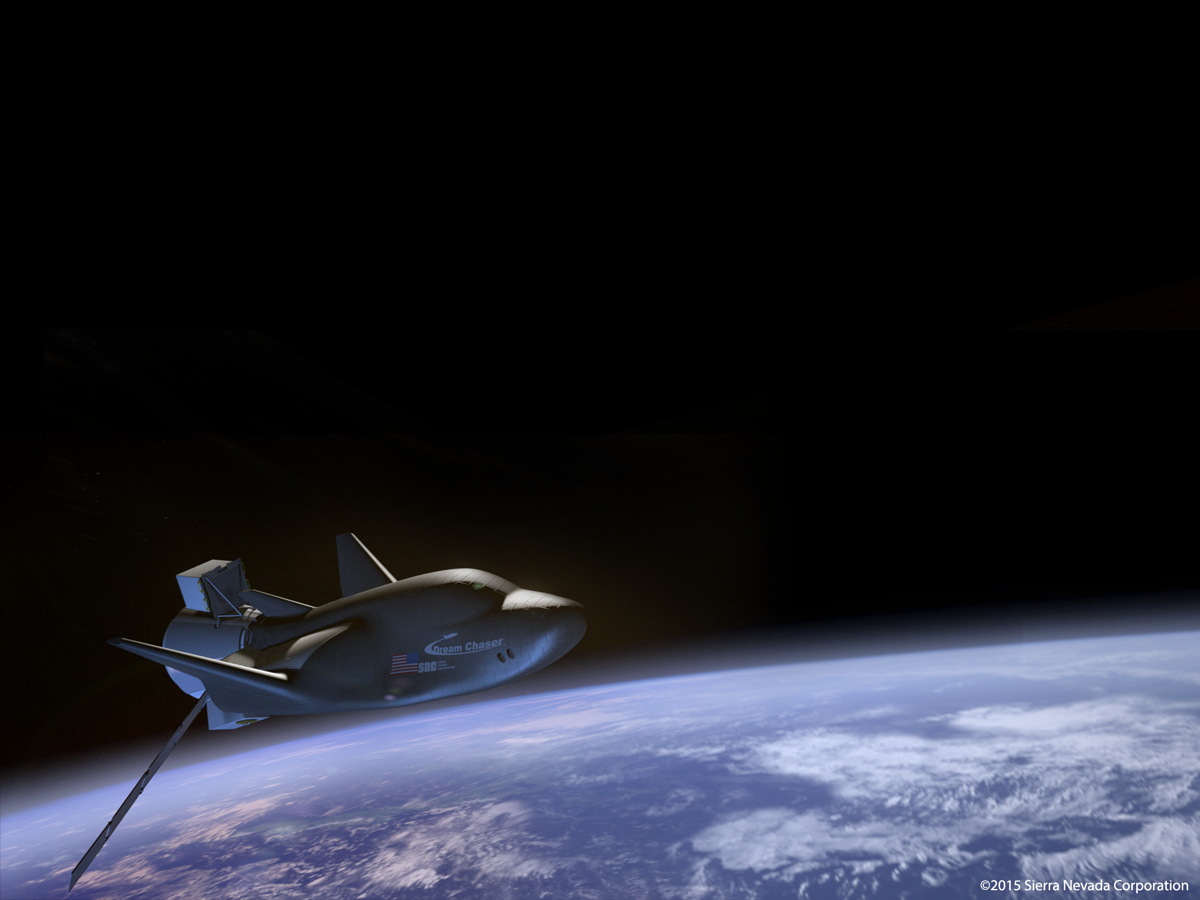
A private space plane is set to fly the United Nations' first-ever space mission five years from now.
Sierra Nevada Corporation (SNC) and the United Nations Office for Outer Space Affairs (UNOOSA) are teaming up to launch a two-week robotic mission to low-Earth orbit in 2021 using the company's Dream Chaser spacecraft, representatives of both organizations announced Tuesday (Sept. 27).
"One of UNOOSA's core responsibilities is to promote international cooperation in the peaceful use of outer space," UNOOSA Director Simonetta Di Pippo said in a statement.
"I am proud to say that one of the ways UNOOSA will achieve this, in cooperation with our partner SNC, is by dedicating an entire microgravity mission to United Nations member states, many of which do not have the infrastructure or financial backing to have a stand-alone space program," she added.

The 2021 mission is targeted primarily at developing nations, but any U.N. member states can apply to put a payload on board. Nations whose experiments are chosen will be asked to foot part of the mission's total bill, though poorer countries will likely receive a price break, Sierra Nevada representatives said. UNOOSA and Sierra Nevada are also looking for sponsors to help fund the mission.
Over the next year, the two organizations will hash out details of the mission, which "will provide United Nations member states with the ability to access space in a cost-effective and collaborative manner within a few short years," Di Pippo said. "The possibilities are endless."
The 30-foot-long (9 meters) Dream Chaser looks like a much smaller version of NASA's now-retired space shuttle orbiter. Like the space shuttle, Dream Chaser launches vertically, lands horizontally on a runway and is reusable.
Dream Chaser can carry up to seven passengers, but it's also a cargo-hauling craft; indeed, NASA recently selected the uncrewed version of Dream Chaser to provide resupply and trash-disposal services to the International Space Station.
Follow Mike Wall on Twitter @michaeldwall and Google+. Follow us@Spacedotcom, Facebook or Google+. Originally published on Space.com.
Most remarkable UFO sightings in September 20161st September 2016; Falcon 9 Space X rocket explosion – Florida, United States
3rd September 2016; strange UFO activity – Henderson, Nevada
5th September 2016; unknown lights in formation – Wycombe, UK
7th September 2016; orange orb – Marysville in California
16t September 2016; flying disc filmed by police – Bristol Channel, UK
19th September 2016; UFO fleet – Louisville, Kentucky
25th September 2016; strange object flshing – Las Vegas, Nevada
27th September 2016; unknown lights in the sky – Lake Michigan, Illinois


