Giant Triangle UFO Partly Buried Under The Moons Dust, NASA Source, UFO Sighting News.

Giant Triangle UFO Partly Buried Under The Moons Dust, NASA Source, UFO Sighting News.
UFO Hovering Over NYC On Nov 1, 2016, Video, UFO Sighting News.


UFO Hiding In Cloud Flying Low Over City In California, Oct 29, 2016, UFO Sighting News.
UFO Orb Seen Over Brazil F1 Race Track During Trials, Oct 30, 2016, UFO Sighting News.
NASA’s New Asteroid Alert Just Warned Us About A Close Call
NASA recently deployed a new early-warning system to identify asteroids passing dangerously close to Earth, and it looks like the system is working exactly as it should. The program, named Scout, already alerted astronomers to a potential close encounter Earth experienced with a somewhat scary-sized asteroid on Sunday night.
Scout, currently in development down at NASA’s Jet Propulsion Laboratory in Pasadena, California, works by aggregating and analyzing data from a number of different telescopes. When it identifies a near-Earth Object (NEO), it both calculates the risk of impact and collects subsequent data gathered by other telescopes.
A handful of such objects are tracked pretty much every night. Sunday’s asteroid was never on a trajectory to actually crash into the Earth, but it did pass within about 300,000 miles and measured somewhere between around 16 and 80 feet across — which made it the kind of too-close-for-comfort object Scout was designed to alert us to. A companion program called Sentry is tasked with tracking larger ones. Asteroids measuring around 450 feet across are the ones approaching the size capable of destroying a major city, and astronomers hope that Sentry will one day be able to identify around 90 percent of those larger threats.
Of course, Scout and Sentry can only warn us about NEO’s on potentially dangerous trajectories — they can’t actually break them up or move them. Kind of like those weird LifeLock commercials that joke about monitoring the problem without being able to fix them, these kinds of programs still leave it up to us to develop a solution. Astronomer Ed Lu told NPR that the key to being able to divert NEO’s is early detection, at least a decade or two. When they’re that many billions of miles away, they can be “nudged” off course little by little.
NASA’s already on the case, working in conjunction with other major space science entities like the European Space Agency, Observatoire de la Côte d´Azur (OCA), and the Johns Hopkins University Applied Physics Laboratory (JHU/APL). The collaboration, known as the Asteroid Impact and Deflection Assessment (AIDA) Mission, is at the forefront of a potentially life-saving maneuver called the kinetic impact technique. This basically involves a spacecraft smashing into the worrisome asteroid in question, pushing it a fraction of a percent off its orbit. The idea is that by the time it reaches Earth, that gap will have widened significantly enough to keep it at a safe distance.
Photos via NASA
Meet the Nightmare Machine: An AI That Creates Your Worst Fears

The artificial intelligence (AI) currently being developed is largely benevolent. It can mimic the way humans think, complete menial and repetitive tasks, and more. But that doesn’t prevent people from being afraid of AI, thinking it will take away jobs or eventually turn Terminator into a documentary.
Somebody thought AI wasn’t scary enough, and did something to change that. Researchers from MIT and Australia’s CSIRO have created AI that actively warps pictures into scary nightmare fuel.
Nightmare Machine
Aptly named the Nightmare Machine, the algorithm started like any nightmare would, rather benignly. The researchers fed their algorithm 200,000 faces, for it to recognize and generate a normal face.
But they then fed it just one picture of a zombie, and changed the code so the zombie face would have more weight in the images generated. Soon after, the algorithm was generating nightmare fuel like crazy.
Creating sleepless nights is not the main reason for the Nightmare Machine. It has a higher purpose: to tell machines how to comfort us. When it learns what images or things scare humans, AI can then be taught to do the opposite, and generate behavior that makes us feel safe.
“Just like a child, or an adult, by learning behavior that upsets humans, a machine can then be trained to avoid that behavior,” says Manuel Cebrian Ramos, of the CSIRO, in a statement. “So the same technology we are using in this silly project could actually be used to comfort, to invite humans to co-operate with machines.”
In fact, he believes that this is the best way to create benign AI, as opposed hard wiring rules. “Instead of [Asimov’s] top-down rules, which are always going to have loopholes, it’s better for a machine to learn bottom up,” says Cebrian.
Essentially, if machines can help us understand them, then it’s going to be easier to work with them. “If we perceive them as alien, as too different from us, then we will fight them, and I don’t like that, I like co-operation,” he says.
Blue Origin Will Take Humans to the Edge of Space in 2017

Credit: Blue Origin
It might seem as though Elon Musk and SpaceX have the market cornered on commercial space travel, but other companies are steadily coming out of the woodwork, ready to give Musk a run for his (insane amounts of) money.
Treading lightly is Sir Richard Branson’s Virgin Galactic, fresh from a crash two years ago. Now, Virgin has revealed its newest rocket, SpaceShipTwo, and has been conducting more tests for its systems.
Perhaps even more ambitious, however, are the plans of Jeff Bezos, founder of Blue Origin. After a successful “in-flight escape test,” Blue Origin President Rob Meyerson has revealed that the company plans to fly test astronauts by next year, in anticipation of full-fledged space tourists by 2018.
“We’re still on track for flying people — our test astronauts — by the end of 2017, and then starting commercial flights in 2018,” said Meyerson.
The New Shepard vehicle consists of a rocket and a capsule. During the test, the capsule used its escape motor to separate from the booster. Everything worked well, Meyerson said, describing it as a “picture-perfect test.” The capsule came back to Earth softly under parachutes, as expected.
As a bonus (and a complete surprise) the rocket was able to land its booster, showing that it’s not just SpaceX who’s working on reusable rockets. Now, we wait to find out how much a ticket to space will run us.
AMAZING daytime UFO filmed over Rochester, New York 17-Aug-2016
Mass UFO Sighting In Arizonian Skies Revitalizes Phoenix Lights Incident

Social media went abuzz after the sighting of a mysterious UFO with strange lights streaking across the skies above the East Valley. Hundreds of residents in Phoenix, Arizona claimed to have seen the strange object on Tuesday, October 5.
Several witnesses posted photos and videos of the UFO to social media. The UFO appeared in the sky above Queen Creek area of the East Valley between 6 p.m. and 6:45 p.m., several residents said.
There were also reports of the sighting of a UFO with three lights in the town of Gilbert in the southeast of Phoenix. The UFO was observed moving southward over the valley. One witness managed to get a video of the unusual aerial object moving across the sky.
Several sighting reports also came from Globe, Gila County, around 70 miles from Phoenix.
Another witness claimed to have seen unusual lights in the sky close to Superstition Mountain in the east of Phoenix. The witness reportedly saw three or four strange lights flashing on and off.
The sightings created some debates on the nature of the lights. Most witnesses agreed it was a UFO but not all of them think it was extraterrestrial aircraft. Some believe it must have been a man-made aircraft, but others insisted it must have been an alien craft because it did not look like any plane.
For many Phoenix residents, the latest unidentified flying object sighting was reminiscent of the Phoenix Lights incident on March 13, 1997.
Watch Viral Video Of Charlotte UFO Sighting

A man from Charlotte believes he caught his UFO sighting on video. The footage has become viral since it was posted to YouTube.
Chris Hulbert claimed to have shot the video from the outside of the Le Meridien hotel in uptown Charlotte. The video shows a large number of flashing lights like fireflies up in the air.
Hulbert, who claims he’s a professional driver, was waiting outside the parking lot of the hotel when he noticed the lights. He then grabbed his cellphone to record the incident.
Hulbert said in the video that they are moving like fireflies, but high up in the air. He described the lights as moving very strangely and looking like strobe lights, which later forming a pattern.
Hulbert stated that the lights made a triangle formation and could be the original form before moving around.
The video has been viewed over 500,000 times since being posted on October 15.
Director of the National UFO Reporting Center, Peter Davenport, is being intrigued by the lights because they cannot be explained. Davenport said that he has been monitoring UFO sightingsfor more than 22 years and he noticed that Carolina skies have been experiencing an increase in sightings within the last 53 months, particularly in South Carolina. He revealed that they already received around 30,000 to 40,000 reports of sightings similar to the latest one in Charlotte.
Medieval Painting Shows A UFO Over Count Dracula’s Homeland

A work of art in the Monastery Church in Sighisoara, Transylvania could show evidence of alien UFO visitation hundreds of years ago. The medieval painting shows a large flying saucer with a beam of light above of what looks like a church building.
According to the book “UFOs over Romania,” by Dan D. Farcas (Amazon link), the work could be done before 1534, but experts have yet to determine when it was exactly done and who created it.
Mr. Farcas, 76, who has a doctorate in computers and maths, said there are possibilities that images in these paintings do depict a UFO.
Images in paintings depicting something that would be described today as a UFO have been found in centuries-old paintings. Some researchers suspect they may be evidence aliens have visited Earth throughout history.
The UFO sighting near Dracula’s castle is also featured in the book. It involves a couple who claimed to have seen a large flying disc out of a lake when they toured the ruins of Poenari or popularly known as Dracula’s Castle. The pair said the mysterious object then flew north over mountains towards Transylvania.
The book also notes the case of police sergeant Marian Mancu and voluntary guard Maricel Rusu. They reportedly saw strange flashing lights in the village of Certesti, Romania at around 12:30 a.m. on July 8, 1996.
Mr. Mancu said they saw a flashing red and blue lights from an object that hovered half a meter from the ground. Allegedly, the object eventually landed, and they saw three aliens got out.
He described them as white-faced aliens with big heads, pointed ears, and covered in gray scales.
THE CHRONOVISOR - THE VATICAN HAS A SECRET DEVICE TO LOOK INTO THE FUTURE AND PAST
Russische wetenschapper: “De nieuwe Kleine IJstijd is al begonnen”

Een Russische wetenschapper claimt dat eind vorig jaar een nieuwe Kleine IJstijd is begonnen. De komende decennia zal het flink afkoelen, zo zegt hij.
De nieuwe Kleine IJstijd begon eind 2015, na de piek van zonnecyclus 24, schrijft dr. Habibullo Abdussamatov van de Russische Academie van Wetenschappen in zijn nieuwe studie.
Hij verwacht dat het vanaf 2060 sterk gaat afkoelen op aarde. Zijn werk, dat tegenwicht moet bieden aan het beeld dat CO2 de belangrijkste oorzaak is van global warming, is vertaald in het Engels door geoloog Don Easterbrook.
Als gevolg van afnemende zonneactiviteit zal de temperatuur boven Noord-Amerika en Europa dalen.
De afzwakking van de Golfstroom maakt West-Europa en oostelijke delen van de Verenigde Staten en Canada een stuk kouder, aldus Abdussamatov.
Hij voorspelde eerder al dat afnemende zonneactiviteit de komende 30 jaar zou leiden tot een nieuwe Kleine IJstijd.
Britse oceanografen schreven enkele jaren geleden in vakblad Nature dat Europa vier tot acht graden kouder zal worden door het afzwakken van de Golfstroom.
Al enige tijd waarschuwen wetenschappers dat de afnemende zonneactiviteit de komende jaren zorgt voor lagere temperaturen.
Dat beeld wordt tegengesproken door veel wetenschappers die broeikasgassen zoals CO2 zien als de oorzaak van de opwarming.
[Daily Caller]
Supermoon November 2016: When, Where & How to See It
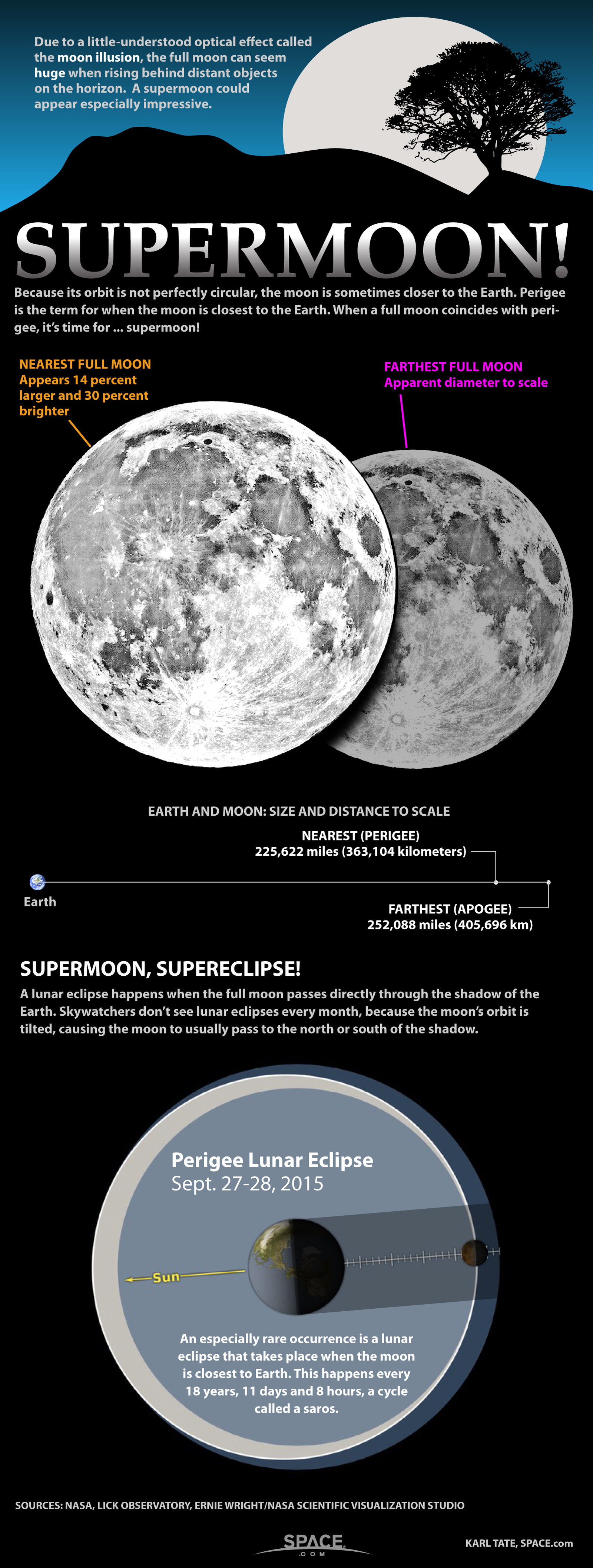
This year, the full moons of October, November and December all take place when the moon is at its closest point of approach in its orbit around Earth — a so-called supermoon.

October's supermoon occurred on Oct. 16. The next supermoon will be November's full Beaver Moon, which is expected to reach the peak of its full phase on the morning of Nov. 14, at 8:52 a.m. EST (1352 GMT).
This full moon will be not only the closest and brightest supermoon of 2016 but also the largest since 1948, Bob Berman, an astronomer at the Slooh Community Observatory, told Space.com. What's more, the full moon won't come this close to Earth again until Nov. 25, 2034, according to a statement from NASA. [Full Moon: Why Does It Happen? (Video)]
A full moon occurs each month when the sun, Earth and moon line up, with the moon on the side of the Earth opposite to the sun. The term "supermoon" is used to describe a full moon at its perigee — the point in the moon's orbit when it is closest to Earth, causing it to appear up to 14 percent bigger and 30 percent brighter in the sky, NASA officials said in the statement.

November's full moon is also called the Beaver Moon because it arrives at the time of year (in the Northern Hemisphere) when hunters would set traps before the waters froze over, to ensure they had enough warm furs for the winter.
The Beaver Moon follows the full Hunter's Moon of October and the full Harvest Moon of September — both of which are also named for seasonal changes that marked times when people would begin to prepare for the colder months ahead. November's full moon also has been referred to as the full Frost Moon, according to The Old Farmer's Almanac.
The Slooh Community Observatory will offer a live broadcast for November's full moon on Nov. 13 at 7:00 p.m. EST (0000 GMT on Nov. 14). You can also watch it live on Space.com, courtesy of Slooh.
To round out the trifecta of supermoons for 2016, December will see its full Cold Moon peak on Dec. 13 at 7:05 p.m. EST (0005 GMT on Dec. 14).
"The supermoon of December 14 is remarkable for a different reason: It's going to wipe out the view of the Geminid meteor shower," NASA officials said in the statement. "Bright moonlight will reduce the visibility of faint meteors five- to ten-fold, transforming the usually fantastic Geminids into an astronomical footnote. Sky watchers will be lucky to see a dozen Geminids per hour when the shower peaks."
Editor's note: If you snap an awesome photo of the moon that you'd like to share with Space.com and our news partners for a potential story or gallery, send images and comments to managing editor Tariq Malik at spacephotos@space.com.
Follow Samantha Mathewson @Sam_Ashley13. Follow us @Spacedotcom,Facebook and Google+. Original article on Space.com.
Mis ‘m niet: Grootste supermaan van de eeuw in november

De volle maan op 14 november 2016 wordt niet alleen de grootste en helderste supermaan van het jaar, maar ook de grootste van de eeuw.
De maan komt pas op 25 november 2034 weer zo dicht bij de aarde, weet de Amerikaanse ruimtevaartorganisatie NASA.
Als de volle maan op het dichtstbijzijnde punt van onze planeet staat in de ellipsvormige baan die de maan rond de aarde maakt, dan spreken we van een supermaan.
Het jaar 2016 eindigt met drie van zulke verschijningen achter elkaar. De supermaan is tot 14 procent groter en tot 30 procent helderder dan een gewone volle maan.
Het ene punt in de baan van de maan om de aarde, het perigeum, staat op 14 november ongeveer 48.000 kilometer dichter bij de aarde dan het andere punt, het apogeum.
Op 14 december gebeurt er ook iets speciaals. Het licht van de supermaan zal dan het zicht op het anders fantastische natuurfenomeen van de Geminiden-meteorenzwerm verstoren. Maar we krijgen er wel een supermaan voor in de plaats.
Wie de bijzondere maan wil zien, kan het beste een plek met weinig licht opzoeken en hopen op niet al te veel wolken.
*In een eerdere versie van dit artikel stond de afstand tot de maan onjuist vermeld.
[Space]
FASCINERENDE UFO BOVEN BERG OP HAWAII

Nog steeds is voor veel mensen de klassieke vliegende schotel vorm, ook wel retro UFO genoemd, de mooiste die er bestaan.
Ook nu is weer een dergelijk exemplaar vastgelegd boven een afgelegen berg op Hawaii.
De waarneming van de getuige vond plaats op 23 oktober 2016 in Waikane op Hawaii. De zaak is in onderzoek bij Mufon onder nummer 79999.
De getuige vertelt hoe tijdens de lunchpauze foto’s nam van Kaneoha Bay. Hij had zijn camera ingesteld op “meerdere opnames”, wat betekent dat wanneer hij zijn vinger op de opnameknop houdt de camera achter elkaar door een aantal foto’s neemt, zonder dat er zelfs een seconde tussen zit.
Met deze optie ingesteld nam hij foto’s van de bergen. Toen hij ze later bekeek, viel hem op dat er één bij was die anders was dan de andere.
De getuige verklaarde verder:
Eerst dacht ik dat het misschien een vuiltje op de lens was, maar toen ik goed keek, zag ik een UFO! Nu geloof ik niet in die stereotype UFO’s, maar hier schrok ik zo van dat ik het toch maar meldt, voor het geval dat.
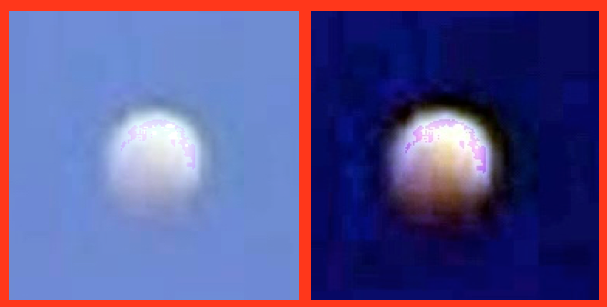
Het niet geïdentificeerde object dat ik zag was een schijf, een soort rugbybal met een geel/oranje kleur. Wanneer ik inzoom met mijn camera lijkt er zelfs een soort koepel op te zitten.
Toen ik in de gaten kreeg dat hier geen sprake was van een vuiltje op de lens, begon ik een vreemd gevoel te krijgen.


Volgens de bij ons inmiddels bekende ufoloog Scott Waring zie je dit soort UFO2016-11-01’s vaak in de buurt van bergen in afgelegen gebieden omdat er dan weinig kans is dat ze daar worden gezien en omdat ze vaak in de buurt van bergen hun ondergrondse basis hebben.
Op de laatste van de twee volgende afbeeldingen is door Scott wat contrast toegevoegd om het object wat beter zichtbaar te maken.


New Zealand disc UFO witness says video ‘hacked’

A New Zealand witness at Coromandel reported watching and videotaping a large, disc-shaped UFO emitting smaller objects, and reports someone “hacked” the video after it was emailed to multiple locations, according to testimony in Case 78924 from the Mutual UFO Network (MUFON) witness reporting database.
Witness illustration 1.
(Credit: MUFON)
The witness stepped outside on a bright, windless night about 9:10 p.m. on September 1, 2016.
“I noticed this very big bright, glowing ball,” the witness stated. “Huge compared with stars. Ran and got my camcorder. Filmed it for approximately 17 minutes. The mother ship was opening a platform and smaller craft were taking off at all angles, plus also exiting from below. There were definitely six smaller craft, maybe seven. There also was a red orb beneath, some distance of which one of the smaller ships attached itself to – approximately two miles.”
Witness illustration 2. (Credit: MUFON)
Witness illustration 3.
(Credit: MUFON)
The witness states there was some “amazing footage” collected.
“However, I downloaded this to my laptop in four different places in case I lost some and sent the vid to family and friends. However, nobody received it. Yesterday approximately four days later I checked the video. Some bastard had hacked it. The video was now 5-6 mins long. It got a quick showing of one smaller craft, of which they missed. The sounds are of the city with cars trucks etc. going past. Also,later on, it has sounds of gale force winds. The cam recorder also had been hacked. I will send to you what’s left of it. Now I tried to send, but the file is too big, plus what’s to say these bastards aren’t going to steal it again. What’s not to say you guys aren’t one of them. So if you want the movie, you will have to find someway of getting it. I do not trust Drop Box. I’ve drawn some pictures for you.”
Witness illustration 4.
(Credit: MUFON)
Witness illustration 5.
(Credit: MUFON)
The Coromandel Peninsula on the North Island of New Zealand extends 85 kilometres north from the western end of the Bay of Plenty, forming a natural barrier to protect the Hauraki Gulf and the Firth of Thames in the west from the Pacific Ocean to the east. At its broadest point, it is 40 kilometres wide. Almost the entire population lies on the narrow strips along the Hauraki Gulf and Bay of Plenty coasts. In fine weather the peninsula is clearly visible from Auckland, the country’s biggest city, which lies on the far shore of the Hauraki Gulf, 55 kilometres to the west. The peninsula is part of the local government areas of Thames-Coromandel District and the Waikato Region.
Waikawau Bay on Coromandel Peninsula.
(Credit: Wikimedia Commons)
New Zealand National Director Roger Stankovic is investigating. Please remember that most UFO sightings can be explained as something natural or man-made. The above quotes were edited for clarity. Please report UFO activity to MUFON.com.
Guy Asks UFOs To Come Closer...And They Did, Nov 1, 2016, Video, UFO Sighting News.
Mysterious Star Pulses May Be Alien Signals, Study Claims

Strange pulses of cosmic light might be signals from hundreds of different alien civilizations — or just the latest false alarm in the tortuous search for ET.
This month, astrophysicists Ermanno Borra and Eric Trottier, both from Laval University in Quebec, announced that they had spotted mysterious light signals coming from 234 different stars in our Milky Way galaxy. These pulses match the profile of signals that Borra, in a 2012 paper, predicted intelligent aliens might use to get our attention, the authors wrote.
"We find that the detected signals have exactly the shape of an ETI [extraterrestrial intelligence] signal predicted in the previous publication and are therefore in agreement with this hypothesis," the duo wrote in the paper, which was published online Oct. 14 in the journal Publications of the Astronomical Society of the Pacific. [13 Ways to Hunt Intelligent Aliens]
"The fact that they are only found in a very small fraction of stars within a narrow spectral range centered near the spectral type of the sun is also in agreement with the ETI hypothesis," the researchers added in the study. (Borra and Trottier looked at the spectra of 2.5 million stars studied by the Sloan Digital Sky Survey, which uses a telescope in New Mexico.)
But don't get too excited: Borra and Trottier said that additional observations are needed to confirm this hypothesis, and outside astronomers are even more emphatic on this point. Indeed, a healthy dose of skepticism is warranted, said Seth Shostak, a senior astronomer at the SETI (Search for Extraterrestrial Intelligence) Institute in Mountain View, California.
For example, it seems unlikely that 234 separate alien societies would be sending out such similar signals more or less simultaneously, Shostak said.
"It would be like expecting us to send the same signals as the Abyssinians — it doesn't make a whole lot of sense," he told Space.com. "If I were a betting guy, I'd bet this is an artifact of the way they processed their data."
Shostak also said that he knew of six different reviewers who had recommended against publishing the paper, at least without significant revision. However, he did stress that Publications of the Astronomical Society of the Pacific is a reputable journal.
The astronomers behind Breakthrough Listen, a $100 million project that's scanning the heavens for SETI signals over the next 10 years, also urged skepticism.
"The international SETI community has established a 0-to-10 scale for quantifying detections of phenomena that may indicate the existence of advanced life beyond the Earth called the 'Rio Scale,'" team members of Breakthrough Listen, whose science program is headquartered at the Berkeley SETI Research Center (BSRC) at the University of California, Berkeley, said in a statement. "The BSRC team assesses the Borra-Trottier result to currently be a 0 or 1 (None/Insignificant) on this scale."
But skepticism is not the same thing as dismissal. Shostak thinks the stars singled out by Borra and Trottier are worthy of follow-up investigation, as does Breakthrough Listen. Indeed, the latter organization plans to study several of these stars using the 7.9-foot (2.4 meters) Automated Planet Finder optical telescope at Lick Observatory in California, team members said in the same statement.
The long history of SETI false alarms — including a detection that generated buzz this past August, but was soon traced to a Russian satellite — shouldn't deter scientists from checking out intriguing candidates, Shostak stressed.
"You can't get too cynical," he said. "You don't want to throw the baby out with the bathwater."
Follow Mike Wall on Twitter @michaeldwall and Google+. Follow us@Spacedotcom, Facebook or Google+. Originally published on Space.com.

Our Galactic Arm May Have a Longer Reach Than We Thought
The sun's galactic neighborhood just became a bit more significant. New research reveals that the sun's branch of the Milky Way may be several times longer than previously measured, which would make it a significant contender in the structure of the galaxy.
Spiral galaxies like the Milky Way contain several massive structures known as arms, which unwind from the galaxy's center. The sun's neighborhood is called the Orion Arm, though scientists often refer to it as the Local Arm. Despite its name, it is classified as a spur — a collection of dust and gas that lies between the more massive arms.
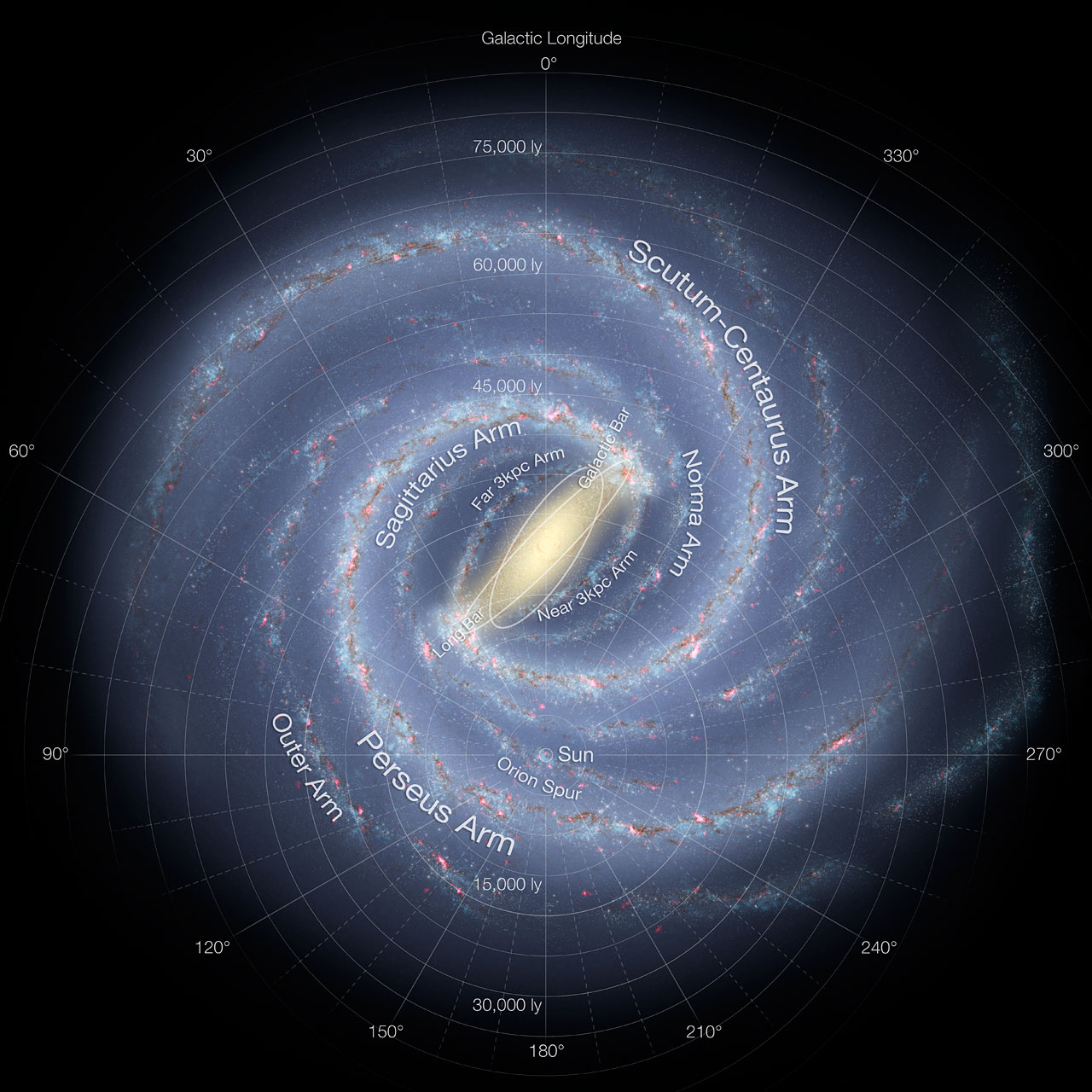
"Our study reveals that the Local Arm is not only a tiny spur of the Milky Way. In includes a prominent major arm nearly extending to the Perseus Arm and a long spur branching between the Local and Sagittarius Arms," astronomer Ye Xu of the Chinese Academy of Sciences told Space.com by email. Xu led a team that identified eight new features in the Orion Arm and determined that it is much longer than scientists have previously estimated, Xu said. [Our Milky Way Galaxy: A Traveler's Guide (Infographic)]
With their gently unfurling arms and ongoing star formation, spiral galaxies are some of the most beautiful star collections in the universe. But it is far easier to calculate the characteristics of distant galaxies than it is to understand the features of our own Milky Way.
"Determining the structure of the Milky Way has been a long-standing problem for astronomers because we are inside of it," Xu said. "While astronomers agree that our galaxy has a spiral structure, there are disagreements on how many arms it has and on their specific location."
Mark Reid, a researcher at the Harvard-Smithsonian Center for Astrophysics in Cambridge, Massachusetts who was not involved in the study, compares the Milky Way to a dinner plate with an interesting design on its face. While the pattern is easy to spot from above, it can be difficult to interpret when the plate is edge-on.
"All of the structures are projected on top of each other, and without accurate distances to these structures, it is impossible to infer the design," Reid told Space.com by email.
To measure how far parts of the arm sit from the sun, scientists search for telltale signals in star-forming regions. As gas enters galactic arms, gravitational forces squeeze the gas to produce newborn stars. In other galaxies, blobs of bluish light that are produced by the birth of stars trace out spiral arms.
In the Milky Way, star-forming regions are more challenging to map. As part of the new research, the scientists identified bright spots of radio emission known as masers, whose shift in light researchers can measure to identify their movement and distance from Earth. Masers can be made up of clouds of gas that contain trace amounts of molecules such as water and methyl alcohol.
Reid compared the microwave emissions produced by masers to the spots of red light streaming from a hand-held laser.
"All they need is a source of energy — analogous to the battery in a laser pointer — and long path-lengths to amplify the emission," Reid said. "In star-forming regions, the more massive and very young stars provide the energy."
Using the National Radio Astronomy Observatory's Very Long Baseline Array (VLBA), a suite of 10 telescopes operating in Socorro, New Mexico, the scientists identified and measured eight new masers in the Orion Arm, setting its new length at about 25,000 light-years long. (A light-year is the distance light travels in a year.) Although measurements of the arm vary, Xu’s team set the distance as being just over 16,000 light-years in 2013.
"This characterization of the Local Arm will change the image of the Milky Way," Xu said.
The new research, which was published in the journal Science Advances in September, reveals the Milky Way as more complex than scientists have previously estimated. The galaxy is typically classified as a grand-design spiral, which Reid said is often very symmetrical, often boasting only two arms.
"The Milky Way, while probably a 'pretty galaxy,' has significant irregularities," Reid said. "Based on our observations, it is clear that there are four major spiral arms and some non-symmetric structures like the Local Arm."
Further studies are needed to determine how irregular the Milky Way might be: "Without a complete map of the Milky Way, however, it is not clear how symmetric the four arms are," Reid said.
Instruments like the VLBA, located in the northern hemisphere, are limited in their ability to study the Milky Way. According to Reid, they can only map a bit more than half of the galaxy.
"We need more observations, particularly from the Southern Hemisphere, so that we can map the entire Milky Way," Reid said.
Follow Nola Taylor Redd on Twitter @NolaTRedd or Google+. Follow us at @Spacedotcom, Facebook or Google+. Originally published on Space.com.