Ontdek de Fascinerende Wereld van UFO's en UAP's: Jouw Bron voor Onthullende Informatie!
Ben jij ook gefascineerd door het onbekende? Wil je meer weten over UFO's en UAP's, niet alleen in België, maar over de hele wereld? Dan ben je op de juiste plek!
België: Het Kloppend Hart van UFO-onderzoek
In België is BUFON (Belgisch UFO-Netwerk) dé autoriteit op het gebied van UFO-onderzoek. Voor betrouwbare en objectieve informatie over deze intrigerende fenomenen, bezoek je zeker onze Facebook-pagina en deze blog. Maar dat is nog niet alles! Ontdek ook het Belgisch UFO-meldpunt en Caelestia, twee organisaties die diepgaand onderzoek verrichten, al zijn ze soms kritisch of sceptisch.
Nederland: Een Schat aan Informatie
Voor onze Nederlandse buren is er de schitterende website www.ufowijzer.nl, beheerd door Paul Harmans. Deze site biedt een schat aan informatie en artikelen die je niet wilt missen!
Internationaal: MUFON - De Wereldwijde Autoriteit
Neem ook een kijkje bij MUFON (Mutual UFO Network Inc.), een gerenommeerde Amerikaanse UFO-vereniging met afdelingen in de VS en wereldwijd. MUFON is toegewijd aan de wetenschappelijke en analytische studie van het UFO-fenomeen, en hun maandelijkse tijdschrift, The MUFON UFO-Journal, is een must-read voor elke UFO-enthousiasteling. Bezoek hun website op www.mufon.com voor meer informatie.
Samenwerking en Toekomstvisie
Sinds 1 februari 2020 is Pieter niet alleen ex-president van BUFON, maar ook de voormalige nationale directeur van MUFON in Vlaanderen en Nederland. Dit creëert een sterke samenwerking met de Franse MUFON Reseau MUFON/EUROP, wat ons in staat stelt om nog meer waardevolle inzichten te delen.
Let op: Nepprofielen en Nieuwe Groeperingen
Pas op voor een nieuwe groepering die zich ook BUFON noemt, maar geen enkele connectie heeft met onze gevestigde organisatie. Hoewel zij de naam geregistreerd hebben, kunnen ze het rijke verleden en de expertise van onze groep niet evenaren. We wensen hen veel succes, maar we blijven de autoriteit in UFO-onderzoek!
Blijf Op De Hoogte!
Wil jij de laatste nieuwtjes over UFO's, ruimtevaart, archeologie, en meer? Volg ons dan en duik samen met ons in de fascinerende wereld van het onbekende! Sluit je aan bij de gemeenschap van nieuwsgierige geesten die net als jij verlangen naar antwoorden en avonturen in de sterren!
Heb je vragen of wil je meer weten? Aarzel dan niet om contact met ons op te nemen! Samen ontrafelen we het mysterie van de lucht en daarbuiten.
Maandag 21 november 2016
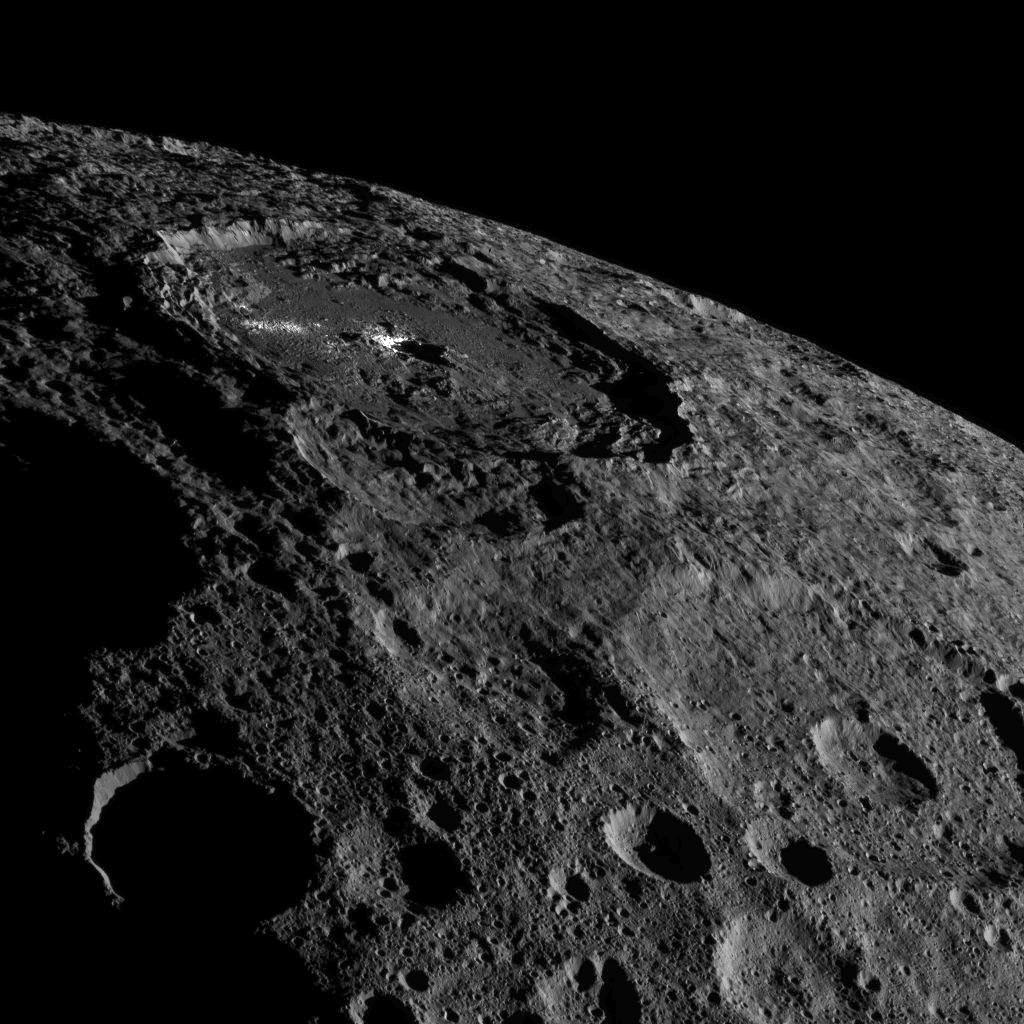
White Structure On Dwarf Planet Ceres Comes Into Focus...Its A Giant Base! Nov 2016, UFO Sighting News.
White Structure On Dwarf Planet Ceres Comes Into Focus...Its A Giant Base! Nov 2016, UFO Sighting News.
Date of discovery: Nov 21, 2016, photo taken Nov 15, 2016
This is the dwarf planet Ceres and this photo was released by NASA just this week, so its as fresh as it gets. I noticed they had a great shot of the white spots on Ceres, so I decided to have a go at it.
I only added shadow to the photo to bring it into focus. The white ceramic-like surface of the building is difficult to see unless its darker...so I made it darker.
As you can see, the largest of the white spots came into focus and is really a massive building complex. There is a tall main part of the building that is like a mountain at its center. Around that building, there are a lot of small vining out buildings surrounding it.
This is what NASA didn't want you to see.
As I have said before, there are three main types of buildings on planets, moons and asteroids. The black non-reflective chaotic structures...appear to be grown instead of made. The smaller white ceramic bright white structures, clearly not grown, but made. And then the smallest of all the buildings, the grey metal structures which are often seen surrounding the edges of the tall black buildings.
Ceres is controlled by a species that only uses the white ceramic structures...which means one main species is in control of it. Its my guess that the Tall White alien species who were given a small part of Nellis AFB to live, also are the inventors of this white ceramic material used for many structures. It just makes sense.
UFO Fleet Easily Seen On Moons Horizon With Camera, Nov 2016, Video, UFO Sighting News.
Date of sighting: Nov 13, 2016 Location of sighting: Earths moon Its been known by a lot of astronomers that if the edge of the moon is observers well enough, you will see fleets of UFOs in orbit move around the moons horizon. These objects are clearly in orbit around the moon and may be there to protect the moon from humanity. We haven't been back to the moon since the Apollo missions, and there is no intention of going back. Many Apollo astronauts have stated that they saw UFOs near on and near the moon, so maybe these objects are a form of protection from future Apollo missions landing on the moon. It may be owned by a species thats not so friendly about sharing. The video was recorded by Geril Vigil of Youtube, but brought to my attention by Mister Enigma of Youtube. Scott C. Waring
In all due respect, what is looking at video wave form's telling us about the case. I was hoping to see the Barbell UFO's ?!!
Case 74282 - Witness full video - Ontario, Canada
Published on Apr 4, 2016
We previously uploaded a video overview of this Case 74282 that showed interview highlights and an introduction by MUFON Director of Research Robert Powell. This is the full interview from this case where three men on a hunting trip in Ontario, Canada, have a close encounter with a barbell-shaped UFO. Witness interviews and CGI of the object created by Witness #1. Case investigated by Indiana MUFON State Section Director Philip Leech. Listen to MUFON UFO Traffic Report radio show with Host Race Hobbs for the case overview with Guests Philip Leech and Robert Powell that ran on March 1, 2016; KGRAradio.com - 7-9 p.m. ET - which is in podcast download form now.
Case 74282 - Witness summary video - Ontario, Canada
Published on Mar 1, 2016
Join MUFON Director of Research Robert Powell as he offers an overview on Case 74282 where three men on a hunting trip in Ontario, Canada, have a close encounter with a barbell-shaped UFO. Witness interviews and CGI of the object created by Witness #1. Case investigated by Indiana MUFON State Section Director Philip Leech. Listen to MUFON UFO Traffic Report radio show with Host Race Hobbs for the case overview with Guests Philip Leech and Robert Powell on March 1, 2016; KGRAradio.com - 7-9 p.m. ET, or listen in from the podcast at a later date.
Permissions to show this video are on file with the Mutual UFO Network (MUFON).
Een enorm cluster met meer dan duizenden sterrenstelsels die elk weer miljarden sterren bevatten. Je zou zeggen dat je zoiets niet zomaar over het hoofd ziet. Toch is dit supercluster pas net ontdekt door een internationale onderzoeksgroep van astronomen.
Het nieuw ontdekte Vela Supercluster (VSC) is een enorme verzameling van duizenden sterrenstelsels met op hun beurt weer miljarden sterren. Ook op de afbeelding staat de Shapley Supercluster (SC), de Grote Magelhaense Wolk (LMC), de Kleine Magelhaense Wolk (SMC) en de Grote Aantrekker (GA). Onze Melkweg is dwars over de foto heen geprojecteerd. Beeld: Thomas Jarrett (University of Cape Town)
De wetenschappers uit Zuid-Afrika, Polen, Australië, Duitsland en Nederland ontdekten in eerste instantie acht kleine clusters in het sterrenbeeld Vela met de Southern African Large Telescope. Toen ze deze beter wilden bekijken met de Anglo-Australian Telescope in Australië, vonden ze duizenden andere sterrenstelsels die samen een gigantische structuur vormen. Dit is het nieuw ontdekte Vela Supercluster.
Verborgen structuur
Ons zonnestelsel behoort tot de Melkweg, die zelf deel uitmaakt van de Lokale groep. Die bestaat uit tientallen sterrenstelsels. Deze groep behoort weer tot Canes Venaticiwolk die een tiental van die groepen bevat. Tenslotte vormt de Canes Venatici wolk samen met het nog veel grotere Virgocluster de Lokale Supercluster. Die bevat meer dan tienduizend sterrenstelsels. Superclusters behoren tot de grootste en zwaarste bekende structuren van het heelal.
‘Toen ik de metingen zag binnenkomen, kon ik eerst niet geloven dat zo’n grote structuur tot nu toe verborgen kon blijven’, zegt onderzoeksleider Renée Kraan-Korteweg van de universiteit van Kaapstad in een persbericht. Het Vela Supercluster bleef zo lang verborgen doordat het schuil ging achter stofwolken en wolken van sterren uit de Melkweg.
Supercluster en de Melkweg
Het Vela Supercluster staat op 800 miljoen lichtjaar afstand. Dat is zelfs voor sterrenkundige begrippen behoorlijke ver weg. Toch kan het invloed hebben op de beweging van de Melkweg waar ons zonnestelsel zich in bevindt. Dat komt doordat het zo enorm groot en zwaar is.
De bevindingen van de onderzoeksgroep verschijnen binnenkort in het wetenschappelijke blad Monthly Notices of the Royal Astronomical Society Letters.
Mitchell has gone on record about his controversial belief in extraterrestrial UFOs, and of a possible government cover-up. Dr. Herman Oberth, the father of astronautics and rocketry stated, “The Earth is being visited by aliens.” Edgar stated, “Recently, I appeared on television in New York with the Astronaut Dr. Brian O’Leary who feels as I do that we must research the subject of UFOs with greater emphasis.” Astronaut Neil Armstrong, Tom Stafford, Gene Cernan and Buzz Aldrin have talked privately to friends, but all agree there is somebody out there. Gordon Cooper’s article entitled “Aliens Are Here” tells about his letter to the United Nations that stated in part, “I do believe UFOs exist and that the truly unexplained ones are from some other technically advanced civilization.” .
Edgar told me, “He signed a contract with NASA not to reveal anything he saw regarding aliens and UFOs. However, all of his friends had seen them.” Edgar stated, “After my space flight, I was contacted by descendants of the original Roswell observers where he grew up, including the person who delivered the child-sized coffins to the Air Force to contain alien bodies. Another was one of the children of the deputy sheriff who was patrolling traffic around the site. They all seemed credible with their stories that the bodies found were alien.”
. Edgar felt, “White Sands was a testing ground for atomic weapons – and that’s what the extraterrestrials were interested in. “They wanted to know about our military capabilities of the nuclear bomb wing at Roswell. My own experience talking to people has made it clear the ETs had been attempting to keep us from going to nuclear war and help create peace on Earth.” He said, “I have spoken to many Air Force officers who worked at these silos during the Cold War,” he continued. “They told me UFOs were frequently seen overhead and often disabled their missiles. ”Other officers from bases on the Pacific coast told me their [test] missiles were frequently shot down by alien spacecraft. “There was a lot of activity in those days.” . Ben Rich, Former CEO of Lockheed Martin Skunk Works stated, “Everything you can imagine we already know how to do, but these technologies are so locked up in black projects it would take an act of God to ever get them out to benefit humanity. We can even take ET home.”
It is conceivable that humans could someday discover aliens. We scour the cosmos looking for their radio signals, and though we’re not capable of interstellar space travel, it is remotely possible that we could find what we’re looking for at any moment.
Hey guys, what exactly would we do if Aliens arrived either on Earth or parked in our Orbit.
You may be aware that many people believe that we have actually had these sort of visitations in the distant past and those type of encounters sparked religion and the idea to worship gods who descend from the Heavens.
Most of you think it is a wild idea but the evidence for this theory is absolutely everywhere around the Earth, in fact, it appears this was on an epic scale thousands of years ago.
Anyway guys, with the release of the new film ‘arrival’, this is sure to spark the imagination of many, are we in fact being slowly prepped for disclosure? We wonder if Mr Trump would answer that question if asked, he tells it like it is after all, RIGHT?
These are our 6 Scenarios of how Humanity would react if Aliens made contact or landed on Earth. Just wait until you hear this.
At 6) – Panic! Retaliate first.
How exactly would we strike at an Alien race that has spanned the cosmos to get to Earth?
Maybe this would be our undoing, if China or Russia or worst still, North Korea, decided to fire a Nuclear weapon at the interstellar travellers mothership, would the Aliens already be prepared for that scenario?
Of course they would, but the question is, Would they then show us how powerful they are in turn? How would they interpret our actions? Would they be understanding or feel in danger? Do they even have emotions the same as we do?
Panic-ing is just about the worst thing we could do in this scenario.
There would surely be anarchy in most countries anyway and it would possibly be our own people who would need to be brought under control before we could establish anything else.
In at 5) – Communication
Attempting to communicate with the ETs is of course the natural thing to do, but would there be a global effort to do this? Would each region try to set up their own methods of communication? How confusing could that get?
Just think of how many languages there are on this Planet, How exactly would we do it? You would think that the Aliens would have a universal way of communicating with each other, so we earthlings would have to establish if we use imagery, sign, speech and what one of our languages to use the communication in.
It could get very confusing very quickly.
And at 4 on our list) – Alien Invasion
OK so they arrive and it is the War of the Worlds scenario. Are we ready?
Do we use biological weapons on the aliens, do we release a Plague on Earth to kill an Alien invasion force that is far superior than all the Army’s combined and risk killing ourselves anyway?
Surely Guerrilla tactics would not work? Would they? What other option would we have?
We would have to let most humans on Earth die in order for the Human race to survive as a whole. The Human race would have to go underground and pick of an invading force one by one.
Only the strongest would survive.
Number 3) – Technological advancement of the Human race in exchange for Earths resources
We often wonder how ancient Humans on Earth managed to transport and build megastructures on Earth thousands of years ago? Could it be that the Aliens are actually regular visitors to our World at 10 thousand year intervals?
They could be stopping of to stock up on valuable resources in exchange for technology, but just like in the distant past, the technology gets broken and we eventually lose the knowledge or abandon it.
And who gets the trading agreement? All Human kind? How would that work?
So in short, we would need to establish long term goals for technological advancement with the visiting beings.
At 2) – We are the Aliens
Imagine that for a second, What if Noah’s ark was in fact some sort of massive Space ship to cradle all life in, until the Earth was safe enough to inhabit again after the great Cataclysm of 12 thousand years ago, we all know there was a great flood that spanned the Earth, surely a huge Ocean going vessel could not have withstood such an event.
If the Ark was indeed a Space Ship with life from our Planet locked in hibernation in Space for thousands of years, what would we make of that when it arrived home? Imagine what we could learn?
What great secrets we could uncover about all the massive Ancient Structures still here on Earth from a forgotten Civilization that apparently abandoned their dwellings thousands of years ago.
We have got you thinking now, Right.
We know that is a crazy theory guys but it just might be crazy enough to be true.
And number 1 our list) – We do nothing because we don’t recognize Alien Life
In a 1967 episode of Star Trek, Captain Kirk and crew investigated the mysterious murders of miners on the planet Janus VI. The killer, it turned out, was a rock monster called the Horta. But the Enterprise’s sensors hadn’t registered any signs of life in the creature. The Horta was a silicon-based life-form, rather than carbon-based like living things on Earth.
Recognizing life from different worlds isn’t likely to be simple, especially if the recipe for life elsewhere doesn’t use familiar ingredients. There may even be things alive on Earth that have been overlooked because they don’t fit standard definitions of life.
Does that not blow your mind or what,
And of course we already may have already had Alien contact, Remember the WOW signal?
What do you guys think would happen in the event of Alien life forms making their presence known publicly on Earth?
Will they Protect us or Destroy us? Would they want to collaborate or just trade briefly for our resources? Would we even recognize them?
BIN NOTE: If by now you haven’t figured out that Facebook and Google are in cahoots with the corrupt government, then I feel for you, but for those who are well aware of the issues it’s high time you switched over to Seen.life. It is a website that is similar to Facebook but without all the censorship.
MILITARY FIGHTER FIRES ON AN ALIEN CRAFT
APRIL 11- 1980 ………… LA JOYA AIRFORCE BASE PERU
New information has been released by Oscar Santa Maria Huertas, a commander of the Peruvian Air Force, regarding the incident that took place at 07:15 hours on 11 April, 1980, when he was orderd to fly his aircraft – a Sukhoi SU-22, the most technologically advanced fighter at the time – to knock a UFO out of the sky.
It was “a completely spherical object, it’s upper section resembled a cream-colored porcelain, with a round, broad, metallic-grey base, like that of an ashtray.” The anomalous flying object flew at “great speed and was 10 meters in diameter, making it a very easy target to bring down.” This was recorded due to the fact that the flying object was passing over the La Joya military base in Arequipa, in the southern reaches of the Andean country, and the shooting it down was essential to keep it from gathering intelligence.
Within the geopolitical context, Peru had acquired the most advanced military technology from the Soviet Union, and keeping secret the nature of what they had acquired, and where it was kept, was essential. It is important to remember that the military governments of the time armed themselves to such a degree that it was said they were about to go to war against Chile at any moment to recover lost territory.
That morning, Santa María boarded a Sukhoi SU-22 loaded with 140 rounds to fire against the strange flying object. He pursued it and only fired 64 rounds, creating a huge wall of fire. He was startled to see that the object had not suffered any damage whatsoever. . Oscar Santa María said that the effect produced by this weaponry was devastating, and there was no chance of the object emerging unscathed, but the situation was completely different. Not only he had not damaged the intruder, but the object appeared to have acquired an intelligence that allowed it to move freely and escape.
At some point during the pursuit, which lasted around 25 minutes, he felt the UFO somehow “knew” the maneuvers the warplane would engage in. “It was an odd sensation. When I reached a certain altitude to get it in my sights and fire, the object disrupted the operation and settled at the same altitude and right beside my pane.” Upon being asked why he had been chosen, he said “he was the best among the combat pilots” and his superior, of course, wanted the object blown out of the sky as soon as possible and efficiently.
Oscar says he came within 100 meters of the object. “I didn’t notice that it was spinning. It didn’t have windows or rivets, either. What startled me most is that it had no means of propulsion like any other aircraft.” While this went on, Santa María says the military radar units could pick up his jet, but not the UFO. However, ground personnel could see it from the ground, looking like a large luminous object in the sky.
Nearly 460 crewmen were ordered to their stations to repel the mysterious object. Nearly thirteen hundred people were on hand, all of them watching the maneuvers between the interceptor and the UFO. In other words, a total of 1800 people at the base witnessed the incident. At the end of the incident, and lacking fuel to continue pursuit, Oscar returned to base. To date, it is known that the department in charge of investigating the subject of UFOs in Peru, a division of the Aerospace Interest Office, classified it as case 0007 in its new stage of investigation.
The Most Interesting Science News Articles of the Week
By Live Science Staff
Kaikaifilu hervei was as long as a five-story building is tall. See the human for scale.
Credit: Otero, R.A. et al, Cretaceous Research. 2016.
Each week we uncover the most interesting and informative articles around, here are 10 of the coolest stories in Science this week.
Mysterious Unidentified Object Crashes in Myanmar: A strange metal object that looks like it may have come from an aircraft or rocket launcher has landed in Myanmar. [Full Story]
It's Just a Phase: The Supermoon Won't Drive You Mad: The moon holds a mystical place in the history of human culture, so it's no wonder that many myths exist. [Full Story]
New Record! Robot Solves Rubik's Cube in Less Than a Second: It achieved the best time in the approximately 30 years that have passed since the cube was invented. [Full Story]
What Will a Trump Presidency Mean for Science? President-elect Donald Trump is likely to affect science when he comes into office next year, with the potential to change everything from climate change action and the Keystone pipeline to sex education and fetal tissue research. [Full Story]
Diver Finds Long-Lost Nuke While Hunting Sea Cucumbers:A diver hunting for sea cucumbers in British Columbia, Canada, came across what may be the United States' first lost nuclear weapon, or 'broken arrow.' [Full Story]
Oldest Beer Brewed from Shipwreck's 220-Year-Old Yeast Microbes: Yeast microbes from the world's oldest bottle of beer — a 220-year-old bottle found in one of Australia's earliest shipwrecks — are being used to create a new, modern beer with the characteristic taste of the 18th-century brew. [Full Story]
3 More States Legalize Recreational Use of Marijuana: How the Map Looks Now: Voters in California, Massachusetts and Nevada decided yesterday (Nov. 8) to legalize the recreational use of marijuana in their states. [Full Report]
Newfound Ancient 'Sea Monster' Is Largest Yet from Antarctica:About 66 million years ago, an ancient sea monster the height of a five-story office building once gnashed its sharp teeth as it swam around the dark waters of Antarctica, a new study finds. [Full Story]
Breast Cancer: The First Sign Isn't Always a Lump: Women with breast cancer that shows up with symptoms other than a breast lump delay seeing a doctor. [Full Story]
Stranger Pings: Weird Noise Coming from Arctic Seafloor: The Canadian Department of National Defence was informed of the strange noises and investigated the ping's origin, to no avail. [Full Story]
NASA Probe Snaps Stunning New Pics of Dwarf Planet Ceres
By Jesse Emspak, Space.com Contributor
The strange bright spots of Occator Crater on the dwarf planet Ceres are unmistakable in this spectacular photo by NASA's Dawn spacecraft taken on Oct. 17, 2016 and released on Nov. 18 as Dawn moves into a higher orbit.
Credit: NASA/JPL-Caltech/UCLA/MPS/DLR/IDA
NASA's Dawn probe is snapping stunning new views of the dwarf planet Ceres as the spacecraft pushes ever higher above the small world.
In one image, Ceres' huge Occator Crater shows its central bright region, the brightest on Ceres. The crater itself is 57 miles wide (92 kilometers), and 2.5 miles deep (4 km). That makes it 77 times larger than the Barringer Crater in Arizona. Dawn took the picture when it was about 920 miles (1,480 km) above the surface, in early October. [Check out more amazing Ceres photos by Dawn]
Planetary scientists think the bright spots might be from briny material bubbling up during geologic activity; the liquid would sublimate away leaving the salts behind. Another asteroid slamming into Ceres could also cause upwelling, which is what some think happened at Occator Crater.
Scientists also released an image that gives an idea of what Ceres would look like if humans could see it with their own eyes, close up.
This image of Ceres as seen by NASA's Dawn spacecraft shows how the dwarf planet would appear to human eyes. This image, released Nov. 18, 2016, was created using images from Dawn captured in 2015 that were then color adjusted by scientists at the German Aerospace Center in Berlin.
Credit: NASA/JPL-Caltech/UCLA/MPS/DLR/IDA
Dawn's new orbit will be 4,500 miles (7,242 km) from Ceres. NASA is sending the probe to higher altitudes where it can make additional measurements. For example, the spacecraft will use its gamma ray and neutron spectrometer to look at the cosmic rays that suffuse the space around the asteroid, to compare them with readings closer in. The background "noise" can then be separated from the signal, allowing more scrutiny of Ceres' composition.
Ceres started working its way to the new orbit on Nov. 4. While the primary mission was completed in July, NASA extended the mission as the probe was still functioning.
NASA's Dawn spacecraft launched in 2007 and first journeyed to Vesta, entering orbit in July 2011. In September 2012 it left orbit to go to Ceres, where it arrived in March 2015.
Supermoon and Pluto's Secretive Heart: Week's Top Space Stories
By Calla Cofield, Space.com Staff Writer
Saturn's strange hexagon-shaped vortex and bands of swirling clouds are captured in this stunning new photo from NASA's Cassini spacecraft.
Credit: NASA/JPL-Caltech/Space Science Institute
Skywatchers captured stunning images of the supermoon, Pluto may have a hidden ocean, and crowdfunding aids the search for life in Earth's stellar neighborhood. Here are our favorite space stories of the week.
Spectacular supermoon photos
Skywatchers around the world snapped amazing photographs of Monday's supermoon (a full moon that takes place at the natural satellite's closest point to Earth in the lunar orbit). This is the closest full moon until 2034. [Full Story: 'Supermoon' Photos: The Closest Full Moon Until 2034 in Pictures]
In the new movie "Arrival," an alien species makes first contact with humans, and like many science fiction stories, the movie features aliens that are biological creatures. But experts we talked to said it's more likely that aliens advanced enough to accomplish interstellar travel will have shed their biological bodies in favor of robotic ones. (We also asked some scientists whether humans are ready for contact with an intelligent alien civilization.) [Full Story: Electronic E.T.: Intelligent Aliens Are Likely Machines]
Rocket engine burns blue
The RL10 rocket engine that will power NASA's Space Launch System (SLS) rocket is undergoing testing, and a photo released by NASA captures the brilliant blue flame erupting out of the engine during a test. [Full Story: Awesome NASA Megarocket Engine Test Burns Blue (Photo)]
Avoiding asteroid Armageddon
A group of planetary scientists and space experts is pushing for the European Space Agency (ESA) and NASA to pursue a program that could save Earth from a major asteroid impact. ESA is set to decide in the near future whether to invest in a program to build a spacecraft that could nudge a threatening asteroid off course. [Full Story: Space Scientists Rally Support for 2020 Asteroid-Deflection Mission]
Looking for life nearby
Project Blue is an initiative that aims to look for habitable planets around the star system nearest to Earth's sun. Leaders of the initiative launched a crowdfunding campaign this week to lay the groundwork for the space-based telescope they hope to launch in 2019. [Full Story: 'Project Blue' Space Telescope Launches Crowdfunding Campaign]
Pluto's underground ocean
Pluto's "heart" — a large, smooth section of the dwarf planet's surface — may have moved relative to Pluto's axis. That shift indicates there may be an ocean sloshing around beneath the dwarf planet's icy surface. [Full Story: Pluto's Wandering Heart Hints at Subsurface Ocean]
A space-waste challenge
NASA has put out a call for innovators to submit designs for a spacesuit with built-in waste-disposal systems that would allow astronauts to remain in their suits for hours at a time. Right now, astronauts wear diapers during spacewalks or while traveling to and from space. [Full Story: Space Poop Challenge: NASA Calls for Better Spacesuit Potty Systems]
Chinese astronauts back on Earth
Two Chinese astronauts returned safety to Earth on Friday (Nov. 18) after spending a month in space. Their trip into orbit set a new record for the Chinese human spaceflight program, and set the stage for the country's plans to build its own large space station. [Full Story: China's Shenzhou 11 Crew Lands on Earth After Month-Long Space Lab Mission]
New map of the Milky Way
The European Gaia space observatory released a brand-new virtual map of the Milky Way galaxy. The spacecraft was launched in 2010 to map the location of the stars in the Milky Way at unprecedented precision. [Full Story: See a Virtual Milky Way Map from Europe's Gaia Spacecraft]
Documenting a death-defying dive
A new documentary "14 Minutes from Earth" tells the story of Alan Eustace's record-breaking, death-defying sky dive from an altitude of more than 25 miles (40 kilometers) above the surface of the Earth. [Full Story: '14 Minutes from Earth' Highlights Perils of Death-Defying Skydive]
NASA brings Mars to the Super Bowl
Houston will host the 2017 Super Bowl, and NASA is getting in on the action. The space agency, along with various spaceflight companies, will host a Mars-themed exhibit in Houston leading up to the game. The attraction will feature, among other things, a drop tower that takes riders on a virtual trip to Mars. [Full Story: NASA-Inspired 'Future Flight' Ride to 'Drop' Super Bowl Fans on Trip to Mars]
The controversial NASA study of the EmDrive (which was previously leaked) has finally been released, and it shows that EmDrive may work.
There are various ways that the study could prove to be erroneous, but the peer-review process will allow other scientists to seek to confirm or debunk the findings.
A CONTENTIOUS TECHNOLOGY
Documents were leaked earlier this month about NASA’s study of a proposed EmDrive. It generated the usual host of reactions, ranging from “it totally works” hype to outright dismissal. It’s rare for a piece of technology to inspire such polarizing reactions; however, these reactions are rather understandable.
The EmDrive, otherwise known as a radio frequency resonant cavity thruster, makes use of microwaves that are bounced around inside an asymmetrical-shaped cavity. To break this down a bit more, the claim is, you bounce microwaves back and forth inside a truncated cone, and the result will be a thrust toward the narrow end of the cone.
That seems simple enough, yes? After all, you are just converting kinetic energy into another form of energy. Well, here is the kicker: The total momentum increases as the device begins to move. That is like placing yourself inside a box, pushing on the side, and generating thrust.
In short, it provides thrust without the need for a propellant, which at face value, violates Newton’s Third Law of Motion. This means that, based on the current laws of physics, it’s not supposed to work. Yet, that leaked paper from NASA was just peer-reviewed and published; its results suggest that it does work, barring other possible explanations.
The relation of thrust to power for the EM Drive.
Credit: Smith, et al.
Commenting on the work, astrophysicist Brian Koberlein states, “I’ve been pretty critical of this experiment from the get go, and I remain highly skeptical. However, even as a skeptic I have to admit the work is valid research. This is how science is done if you want to get it right. Do experiments, submit them to peer review, get feedback, and reevaluate.”
In a paper published in the Journal of Propulsion and Power, Scientists from NASA Johnson Space Center constructed their own EmDrive and tested it in near-vacuum. Their results show that the system was able to produce a thrust-to-power ratio of 1.2 ± 0.1 millinewtons per kilowatt (mN/kW).
Experimental setup of the EmDrive. Credit: White, et al.
A CHANCE TO EXPLORE THE TECH FURTHER
It should be noted, though, that a peer-reviewed paper means that the methodology is sound, but the results (the conclusions) could still be invalid. Indeed, the authors of the paper do list some error sources for their results, error sources which could potentially invalidate their findings—like a thermal expansion of the device that could lead to a false positive.
Still, having a peer-reviewed paper on EmDrives is a significant development, as it is now open for more scientists to test the device and explain how it can (or could) produce thrust. As Koberlein states, “It doesn’t guarantee that the results are valid, as we’ve seen with other peer-reviewed research such as BICEP2. But this milestone shouldn’t be downplayed either. With this new paper we now have a clear overview of the experimental setup and its results. This is a big step toward determining whether the effect is real or an odd set of secondary effects.”
So it seems that it may be a little early to assert that we have figured out how EmDrive really works. As Koberlein concludes, “The biggest challenge they still have is that these results are so extraordinarily small that lots of things can explain them. They aren’t there yet, though.”
Will the EmDrive be just a glorified microwave oven or the next step in interstellar travel? For now, we just have to wait and see. But, we should take the next few developments on this technology with both an open mind and a healthy bit of skepticism.
Divergent 3D has shown off the Blade Supercar, the first-ever 3D-printed sports car capable of reaching 97 km (60 mph) in 2.2 seconds.
The car is made from a more sustainable approach to materials that, if widely adopted, could help alleviate the carbon footprint of automakers.
LEGO BLOCK “SUPERCAR”
At the Los Angeles Auto Show, automaker Divergent 3D showed off their 3D-printed Blade Supercar. The 635 kilogram (1,400 pound) car is made of a combination of aluminum and carbon fiber; accelerates to 97 kilometers per hour (60 miles per hour) in 2.2 seconds with its 700 hp engine; and can use either gasoline or compressed natural gas asfuel.
Jon Lloyd
The Blade Supercar debuted last year in June, heralding the company’s radical, environmentally-sustainable approach to manufacturing. Divergent calls the manufacturing approach NODE, where they 3D print aluminum nodes joined together by carbon fiber tubing.
The process, which is similar to using Lego blocks, requires less capital and uses up fewer materials. The ease of assembly means that even semi-skilled workers can run the process.
As an added bonus, Divergent 3D’s cars are 90 percent lighter and more durable than cars built with traditional techniques.
Divergent 3D's printed supercar greets visitors in the atrium of the LA Convention Center at the LA Auto Show.
The rear of the Blade 3D printed supercar Wednesday Nov. 16, 2016 at the LA Auto Show.
MANUFACTURING THE FUTURE CAR
Divergent 3D aims to manufacture competitive automobiles while radicalizing the usual car manufacturing process that can be taxing on the environment.
Making a car can be just as polluting as driving one. Metals, rubbers, plastics, paints, and more are extracted from nature and synthesized through a long process where resources are shipped from all across the world. As The Guardian reported in 2010, producing a medium-sized car like a Ford Mondeo could generate more than 17,000 kilograms (17 tonnes) of carbon dioxide equivalent.
But more industries today are taking a global shift into sustainability. Divergent, together with its partner companies, are helping take the lead in changing auto manufacturing for the better.
A Self-Piloting Human Transport Drone Flew Untethered for the First Time
Urban Aeronautics
Urban Aeronautics Cormorant
Formerly known as the "Air Mule," this is a flying taxi, or maybe a future unmanned ambulance.
Tactical Robotics
IN BRIEF
The autonomous aerial vehicle (UAV) prototype AirMule has completed its first completely untethered flight, but its control system made a handful of incorrect decisions.
Tactical Robotics, the makers of the AirMule, envisions UAVs landing and taking off from rugged terrain that human pilots can't handle.
Below is some additional technical information related to the recent flight and also in general--the challenge of NOE (Nap of the Earth) flight:
As tech companies, car manufacturers, and governments like France usher in a self-driving transit ecosystem, handing the keys over to computers seems to make more sense.
Israeli firm Tactical Robotics wants to take self-piloting tech to the air. AirMule, an autonomous vertical take off and landing (VTOL) prototype capable of carrying people and supplies, has just demonstrated its first fully untethered autonomous flight along a preplanned route.
The unmanned aerial vehicle (UAV) — now known as Comorant — uses internal rotor blades and rear horizontal thrust ducted fans to take off. It also has two laser altimeters, a radar altimeter, inertial sensors, and an electro-optic payload camera as sensors to guide its flight decisions.
That doesn’t mean the whole flight was smooth sailing. On three occasions, the robot’s flight management system (FMS) had to take over the autonomous flight control system (FCS) because the tech made incorrect decisions. And two times the FCS misjudged altitude due to inaccurate laser altimeter readings, causing the transport to land early.
“While the FCS was ‘learning’ to fly the aircraft through the various pattern maneuvers, the FMS was continuously monitoring the level of safety, and making judgements regarding if and when to intervene,” Tactical Robotics said in a press release.
More R&D is clearly in order. But the manufacturers say the UAV will one day be able to land and take off vertically from rough terrain human pilots can’t handle. They envision the drones carrying supplies and soldiers to battlefields and war zones.
The psychic powers of Nina Kulagina are just too crazy (video)
Born Ninel Sergeyevna Kulagina on July 30, 1926 in Leningrad, Nina was very much an average, tough Russian woman. She was loyal to her country, joining the tank regiment of the Red Army during World War II when she was only 14. After the war, she married and became a housewife, living what anyone would describe as an average life until she began to test if the psychic abilities of her mother might have rubbed off on her.
It was during Nina’s private attempts at developing these psychic abilities that she seemingly unlocked something within her. The most well-known of these alleged abilities was psychokinesis (PK), or the moving of objects with the mind. Nina could move a wide variety of items including clock pendulums, crystal bowls, matches, cigarettes, compass needles, bread loaves, salt shakers, and many other small objects (often placed in Plexiglass boxes to show there were no strings attached). She first became aware of this ability when things would move whenever she would get angry. And aside from her famous stopping of a frog’s heart, Nina performed another fascinating feat: she separated an egg. That might not sound so amazing until you know that the egg was floating in a salt water tank two meters away from her. And she brought the yolk and white back together again when instructed to do so.
At the First Moscow International Conference of Parapsychology in 1968, footage of Nina seemingly moving objects with her mind was finally shown to the public. But with the scientific community catching wind of Nina’s astounding feats came the heavy hand of scrutiny. Skeptics including James Randi have long maintained that none of Nina’s apparent psychic abilities were anything more than common trickery and sleight of hand illusions. Just like Uri Gellar, Nina’s publicized experiments were never under ideal laboratory conditions. She was seen at home or in hotel rooms, without experts in trickery on hand. It’s been claimed that Nina had magnets implanted into her body to manipulate objects; other telekinetic claims could have employed the use of thin wires or mirrors. Yet in the USSR, laboratory experiments were performed on Nina (under the pseudonym Nelya Mikhailova) by several researchers, including Czech psychical researcher Dr. Zdenek Rejdak, psychologist B. Blazek, physicist V. F. Shvetz, Dr. J.S. Zvierev, physiologist L.L. Vasiliev, and the aforementioned Dr. Sergeyev. Dr. Rejdak published a report of his experiments (titled ‘Nina Kulagina’s Mind over Matter’) in the June 1971 issue of Psychic Magazine.
It has been argued that Nina was shown off by the USSR in an effort to make it seem like they were making huge leaps in telekinesis when in fact it was all fakery. But even though the Cold War has long since ended, Russia has continued to keep many of its secrets under lock and key. If Nina was such a glowing success, where are the scientific reports? Might they still be housed somewhere in a storage room never to see the light of day? As is the case with so many things, just because we haven’t seen something doesn’t mean it doesn’t exist.
Near the end of her life, Nina seems to have lost the abilities she became so famous for. Her exertion in manifesting these powers was blamed for a near-fatal heart attack in the late 1970s. Sharp pain in her spine, dizziness, blood sugar irregularities, failing eyesight, and many other health concerns plagued her. With deteriorating health, Nina stepped away from the endless scientific testing, conducting very limited experiments in labs up until her death in 1990. And so, the full truth died with her. Whether or not she ever possessed remarkable abilities, perhaps faking it when her powers disappeared later in life, is a matter of speculation.
What do you think? Was Nina Kulagina a deliberate fraud, a Cold War pawn, or genuine enigma?
RIGHT NOW YOU ARE BEING PREPARED FOR WORLD WIDE UFO DISCLOSURE 2016
Everyone knows something about aliens, some believe in their existence, others do not. It seems, however, that their existence is confirmed, and the more they communicate and have contracts with different organizations and countries.
Pope or Vladimir Putin confirmed the existence of these unearthly beings, but have not even told all about it.
"There's still time to provide widespread public is not an information consumer. That information is like a supermarket somewhere in a shop window and someone comes and organizes. For the general public that's just drops. Says Pope something, then someone else says. slowly desesensibilizează man and prepares to receive the higher dose of information. the Americans already have desecritizat documents relating to aliens, contracts with them.
Russian special services presented overwhelming evidence not only of the existence of extraterrestrial intelligence, but also about the fact that America is ruled by a race of aliens since the middle of last century.
UK MAKES SHOCKING DISCLOSURE ABOUT THE EXISTENCE OF UFOS
"The aliens really exist," said Alan Turner, aged 64, retired service commander RAF (Royal Air Force) in the UK. The Englishman says that in 1971 witnessed the emergence of a whole fleet UFO but that, so far, the British Ministry of Defense forbade them to talk about this, announcing several British publications.
Former commander led radar system of the RAF for 29 years and decided to break the silence after several years in which I was forbidden to talk about "so-called" state secrets.
"Aliens exist. All radars military vessels have been observed since more than three decades ago. Time since 1971, though, the most terrible of all. 35 unidentified flying objects appeared on radar army, objects of identical size flying at altitudes between 1,000 meters and 12,000 meters. We did not have explained what they were, nor why disappeared from the screen for a few seconds to appear in the same place. All present knew that it's not a convoy of military aircraft and there are more than 30 witnesses who could support my statements, "mentions Alan Turner.
The phenomenon recorded in 1971 that mysterious evening has not been made public so far and is part of the UK UFO files to be declassified. Alan Turner was awarded several times, the last time in 1984, and was retired from the army in 1995. His statements were deemed "outstanding" by most British journalists.
"It would be the greatest proof of arrogance to imagine that we are the only intelligent beings in the universe", he wanted to conclude the same Alan Turner.
CIA DISCLOSED THE TRUTH ABOUT UFOs that flew over the sky in the 50s and 60s US US
Central Intelligence Agency (CIA) announced on Twitter that is responsible for at least half of the appearances of "UFOs" in the 50s and 60s."Reports of unusual activity in the sky '50s? We were "the company said. The document is attached to a message CIA declassified a report about testing a U-2 spy plane at altitudes of 18,000 meters.
Half of the cases of UFO apparitions were actually times when the aircraft was tested at high altitude. Specifically, people at that time would have thought that such an experiment is possible, and put everything on account of unidentified flying objects.
FBI remaining unnamed sources had stated recently, according to US media, that since the '40s, thousands of UFO had landed on American soil, and there are documents to that effect. Because the American public does not find out by visiting extraterrestrials after reporting, the President acquainted, and then immediately paperwork and evidence were burned.
Soviet Ministry of Defense has been working on a secret project to create a being with superhuman powers, paranormal, with the help of aliens.
Alexei Savin, a lieutenant general in the reserves, was the "chosen" to bring this history to light. Savin worked in the Soviet Ministry of Defense, is a graduate of the Academy of Natural Sciences. He said some journalists from Pravda that paranormal activities had entered straight in the Soviet army and KGB in 1983, when Secretary of Defense then allowed the training of soldiers for missions paranormal, such as identifying military targets by means extrasensory prediction accidents, rapid healing of wounded soldiers etc. In December 1989 (exactly when Gorbachev bothered to replace communist regimes totalitarian some with a human face), was founded Special Unit 10003, by order of the Chief of Staff, General Mikhail Moiseev, having only ten officers paranormal, the best of those trained . They managed to contact an extraterrestrial civilization after there were several UFO sightings in the area of training of Vladimirovka.
Vasili Ieremenko Major General and Professor Emeritus of the Academy of Security, Defense and Law Enforcement, was the first who addressed the press on the subject. In Soviet times, it was a KGB officer and oversee aerospace technology. "I learned how to call these UFOs in Vladimirovka. It was enough to make massive movements of troops and transport equipment. In such cases, appeared 100%. After six months of testing were drawn three conclusions: that modern science can not identify this phenomenon, as might have been sophisticated equipment reconnaissance belonging to the US or Japan and, three, that could be an impact of a civilization alien, "said Ieremenko. General Alexei Savin comes Ieremenko completes his testimony. Namely that "encouraging" UFO experiment was part of the special unit 10003. The first experiments were aimed at finding ways to improve brain activity in certain circumstances. The Scientific Council concerning this program was headed by academician Natalia Bektereva who, until her death, was the scientific director of the Research Institute of the human brain. "In the research we concluded that the man is an energy-information system that captures information from outside cognoscibility" says General Savin. To identify these "external sources", were created three groups, one of the researchers, soldiers second and third ... women! This third group made the most discoveries in the field, developing special psychics. Bosses urged to contact extraterrestrial civilizations. "And I did it. We have developed a method based on brain activity. Rather, we managed to bring the brain to a certain frequency, which allowed him to be on the same wavelength with an extraterrestrial civilization, "said Savin.
You can watch the video to see more discoveries and statements about the fact that we are not alone in the universe.
GOVERNMENTS ANNOUNCE: WE ARE NOT ALONE IN THE UNIVERSE. GET READY!
We are not alone in the universe, there are others than us!
Many questions are rising after a shock statements of what the Apollo 14 astronaut claims that aliens have contacted humankind several times, but Governments have to hide this for over 60 years.
A few US Presidents have made statements about the subject of UFO's and aliens, most notably the comments by Jimmy Carter and Ronald Reagan. During its electoral campaign in 1976, Carter admitted that he had seen a UFO in 1969 when he was Governor of the weather in Georgia.
"If I am President, I will end up doing so every information, relating to the UFO phenomenon, to become accessible to the public and scientists."
Carter, a Bachelor's degree in nuclear physics, has encountered opposition in his attempts to reopen investigations and it is likely that he may have changed his mind after reading the informative report on the subject. If aliens visit Earth, many are asking, why not landing on the lawn in front of the White House and not get in touch directly with the President? Of course, not have landed on the lawn of the White House, but there are signs that some Presidents have done this contact.
Famous people from all over the world believe that we are not alone in the universe. They believe in the existence of aliens and UFOs. Among them stood Stephen Hawking, Ronald Reagan, Jimmy Carter, Mikhail Gorbachev or Richard Nixon even Bill Clinton or Obama, Dmitry Mendevev made certain statements.
Those who believe in the phenomenon UFOs come from diverse backgrounds, from former Presidents of the United States up to scientists, singers or actors, according to the International Business Times.
You can watch the video to see more discoveries and statements about the fact that we are not alone in the universe.
VIDEO: NASA-sondes leggen mysterieuze bol vast bij de zon
Zonnesondes van de NASA lijken een gigantisch ongeïdentificeerd object te hebben vastgelegd dat langs onze ster scheert. Dat schrijft onder meer de Daily Mirror.
YouTube-kanaal UFOMania plaatste beelden die zijn gemaakt door de STEREO-sondes op internet. De beelden tonen een grote bol die de zon lijkt te passeren.
UFOMania bekeek ook andere beelden die in oktober en november zijn gemaakt door de ruimtesondes, maar daarop is de vreemde bol niet te zien.
Groot succes
De STEREO-toestellen werden in 2006 gelanceerd en begonnen rond de zon te cirkelen. Op die manier konden wetenschappen onze zon en de zonneuitbarstingen vanuit alle hoeken bestuderen.
Dankzij STEREO-A en STEREO-B kreeg de NASA indrukwekkende 3D-beelden binnen van de zon en alle zonneactiviteit.
De missie ter waarde van 550 miljoen dollar moest in 2008 worden afgerond, maar werd verlengd wegens groot succes.
Niets te vrezen
UFO-jager Pamela Johnson uit Mexico deelde de beelden op Facebook en claimde dat de zon op het object reageerde.
Ze zei verder dat het gaat om een ruimtetuig dat deel uitmaakt van de ‘Blue Spheres’ (blauwe bollen) en dat er ‘niets te vrezen is’.
This huge object is captured on NASA'S SECCHI STEREO HI1 satellite today. Our Sun is casting the Light that is coming in from the left side of the frame. This satellite's archives showed the Sun began reacting to this object on November 15th and there are several frames missing on the 15th and 16th. Wow! Front and Center. I have added an image from November 11th showing only solar wind and passing planets so you can see what a normal view looks like. One of the lastest GaiaPortal posts comes to mind, "Astro-glances compel the masses to action". I have just consulted my Divining Rods and they indicate this is one of the Blue Spheres and not to fear. <3 https://stereo-ssc.nascom.nasa.gov/cgi-bin/images
Wetenschappelijke experts hebben nog niet op de beelden gereageerd.
UFO Escorts General Akar Of Turkey And Turkish News Records It! Nov 19, 2016, Video, UFO Sighting
News.
Above is added sharpness to photo, below is untouched original.
Date of sighting: Nov 19, 2016 Location of sighting: Turkey This week a UFO was recorded following a military helicopter carrying a four star Turkish general named Hulusi Akar. Akar is the highest rinking military officer in the Turkish military. The UFO was noticed by the news agencies and they got into a discussion about what the UFO could be and why aliens would want to follow the most powerful military officer in the country. If aliens are following Akars helicopter transport, then it stands to reason that general Akar is about to make a monumental decision in Turkish history. A decision that will impact all of history, and alien wanted to see his behavior and thoughts (yes they record your thoughts) for the days before he makes this massive decision, good or bad. This way, aliens can mathematically determine the odds of us being able to change our own fate, or be forced down a path that fate has set out for us. Scott C. Waring
FEEL FREE TO REPOST ANY PHOTOS, VIDEOS, WORDS OR INFO ON MY SITE TO SHARE WITH OTHERS. PERMISSION IS GRANTED. SCW
Swarm Of Orbs In Canadian Home Caught On Security Cam, Oct 28, 2016, Video, UFO Sighting News.
Date of sighting: Oct 28, 2016 Location of sighting: Canada I watched this in full screen and slowed down the motion to 25% and wow, it just blew my mind. I really didn't think I was going to see real orb entities, but these are real. There is no mistaking them. There is an entire swarm of these beings moving about the house and in orb form. Extraordinary catch. Scott C. Waring Eyewitness states:
Please watch in 720p More orb activity, it never stops . Thanks for watching! The time & date stamp is wrong, this was filmed October 28th, 2016.
Meer van UFO'S of UAP'S, ASTRONOMIE, RUIMTEVAART, ARCHEOLOGIE, OUDHEIDKUNDE, SF-SNUFJES EN ANDERE ESOTERISCHE WETENSCHAPPEN - DE ALLERLAATSTE NIEUWTJES


 White Structure On Dwarf Planet Ceres Comes Into Focus...Its A Giant Base! Nov 2016, UFO Sighting News.