A 466 Million Year Old Collision is Pelting Earth with Space Confetti
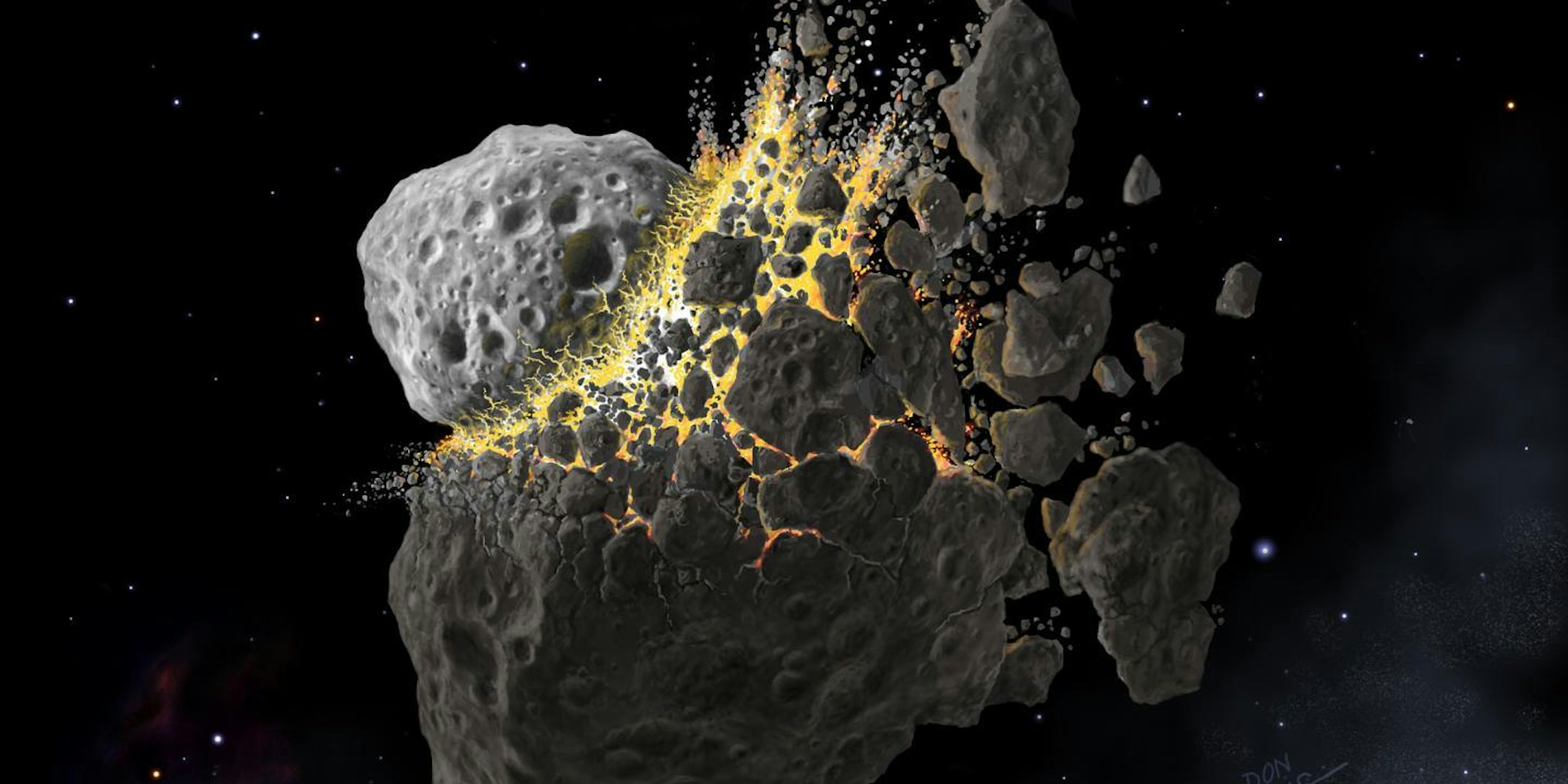
About 466 million years ago, before dinosaurs ruled the Earth, a giant collision broke an asteroid into pieces. These pieces were hurled to Earth as meteorites and transformed the meteorite landscape to what it is today.
In a study published Monday in Nature Astronomy, researchers found that many types of meteorites that are currently hit Earth only on rare occasions used to slam into the planet much more frequently.
“Looking at the kinds of meteorites that have fallen to Earth in the last hundred million years doesn’t give you a full picture,” lead author Philipp Heck of the Field Museum in Chicago said in a press release. “It would be like looking outside on a snowy winter day and concluding that every day is snowy, even though it’s not snowy in the summer.”
The giant collision at the center of this study happened during the Middle Ordovician period, which ranges from 458 to 470 million years ago. (Dinosaurs started appearing on Earth 230 million years ago, and one theory says their extinction was caused by an asteroid hitting Earth.)
By studying meteorites, scientists can better understand how the solar system developed. Since the meteorites and micrometeorites from over 466 million years ago are different from the ones that have fallen since then, most meteorites we see today are fragments of this collision.
The research team analyzed micrometeorites from about 467 million years ago that they found in a river valley in northwestern Russia. They then dissolved the rocks in acid so that only chromite crystals remained. These crystals remain unchanged, even after hundreds of millions of years. Using these crystals, scientists can find out what the original meteorite was made of.
“The conventional view is that the Solar System has been very stable over the past 500 million years,” coauthor Birger Schmitz of Sweden’s Lund University said in a press release. “So it is quite surprising that the meteorite flux at 467 million years ago was so different from the present.”
They also found micrometeorites from Vesta, an asteroid that experienced a collision over a billion years ago, causing a 500-km crater to form and filling the inner main asteroid belt with fragments.
Back then, up to 34 percent of meteorites before the collision are primitive achondrites, a type of meteorite. In contrast, only 0.45 percent of meteorites today are this kind.
Going forward, the team plans to study meteorites for other periods in the Earth’s geological past.
“Knowing more about the different kinds of meteorites that have fallen over time gives us a better understanding of how the Asteroid Belt evolved and how different collisions happened,” Heck said.
Photos via Don Davis, Southwest Research Institute.
RELATED ARTICLES



 The inflatable Cycler spacecraft concept that could take...
 Apple is bringing its iPhone 'Night Shift' mode to the Mac...
 The terrifying 'crypt keeper' wasp that turns its host into...
 Has your phone been infected? Virus hidden in Google Play...