White Alien Base Found On Planet Mercury, March 2017, Photos, UFO Sighting News.

White Alien Base Found On Planet Mercury, March 2017, Photos, UFO Sighting News.
UFOs Far Above Mountain In Las Vegas On Video, March 2017, UFO Sighting News.
Searching For Extraterrestrial Life: Are They Actually Present In Our Deep Biosphere? Clues Have Been Found
Every Earth life relies either directly or indirectly on sunlight and an atmosphere with oxygen. But during the late 1970's, biologists have discovered Riftia pachyptila, chemosynthetic tube worms, that were living around black smoker vents at the bottom of the Pacific Ocean which was not far from the Galapagos Islands, which was also the birthplace of Darwin's theory of evolution by natural selection.
According to an article coming from Scientific American, during the early 1990's Bacillus infernus, a bacterium was discovered just 10,000 feet beneath a farmer's field located in Virginia, where it has been living for over 200 million years. Since then, entire ecosystems have been slowly uncovered that was residing miles beneath the surface and has sustained indefinitely by nothing more than the decaying of radiogenic thorium, uranium, and potassium.
With all of this life flourishing in underneath the Earth's very surface, any science junkie can't help but look at the images of ancient Martian surfaces and wonder if life has also existed beneath its frozen, desiccated surface. According to Portal to the Universe, more than a hundred years ago, American Businessman Percival Lowell believed that he could see evidence of an extraterrestrial civilization that previously lived on the surface of Mars, but that illusion, along with his scientific credibility, was dispelled within fifteen years of his discovery.
In 1901 H. G. Wells, who was a contemporary of Lowell, has also published The First Men in the Moon, in which he constructed an imaginary and fantastically-sophisticated society of insect-like creatures, called Selenites, that were living beneath the lunar surface. Since then, the entire concept of extraterrestrial life has figured frequently in science fiction novels and movies (e.g. Star Trek movies, etc.).
Until now, the search for Extraterrestrial life is still ongoing. Whether it be in novels, or on theories and assumptions that scientists and researchers made, people are constantly looking if a human actually has a companion in this universe.
'NASA dimmed the feed': 'Megaship' spotted by space station
NASA has been accused of dimming their live satellite feed after footage of a “megaship” was captured by an International Space Station.
A long 'cigar-shaped' UFO is seen hovering above the Earth's horizon with two bright reflective-objects sitting just below.
Whether it was an intergalactic spaceship full of extraterrestrial aliens, a reflection from a star or just a smudge on the camera lens, conspiracy theorists were always going to have a field day.
"I have monitored hundreds, likely thousands of hours of ISS live feed footage and I've seen UFOs, I've seen ice crystals, I've seen space debris and I've seen light reflections,” one UFO hunter posted.
'What we're seeing here looks like none of those. And it would appear that shortly after these objects come into view, NASA, either purposely, or the UFOs do it on their own, but the objects quickly dim out."
The bizarre cigar-shaped UFO and reflective orbs have caused a stir amongst UFO conspiracy theorists.
Source: NASA
“The dimming at the end was sudden and my guess is they [NASA] turned down the brightness a little,” another added.
It’s the second time in just months that NASA has been accused of altering vision after they completely shut down one live space station feed as a UFO began approaching.
A self-proclaimed alien hunter caused a stir when he declared that it had to be aliens because “nothing human can fly that high".
“I've been watching it [the live feed] for years but never seen any UFOs on it before,” UK resident John Craddick said.
"I was showing a friend how it worked at around 11.30pm when the feed cut out, and 35 seconds after it came back on, this object appeared.
Former President Bush Won’t Tell Jimmy Kimmel ‘Nuthin’ About UFOs
When former President George W. Bush appeared on “Jimmy Kimmel Live” on Thursday, to promote his book, “Portraits of Courage,” Kimmel didn’t waste any time trying to get Bush to admit that he may have looked for and seen alleged secret government files on UFOs.
Kimmel began the “interrogation” by asking Bush “a question that’s very important to me and very important to the country. When you were in office, did you go through the secret files ― the UFO documents, because if I was president, that would be the first thing I did.”
Even before Kimmel finished asking the question, Bush immediately replied, “Maybe.” Then, he told Kimmel, “You know, it’s funny. My daughters asked the very same question.” When Kimmel asked if Bush would be allowed to tell his daughters what was in those files, the former commander-in-chief said “No.”
“Now that you’re out of office, you can do anything you want, right?” Kimmel pressed.
“True, yeah,” Bush said, adding, “But I’m not telling you.”
Kimmel: “You’re not telling me what? Are you not telling me that you looked at them?”
Bush: “I’m not telling you nuthin’!”
The brief UFO secret files portion of the conversation ended when Kimmel asked Bush if there were really great secrets that the former president knows that he can’t share with people. Bush confirmed it and indicated he would never divulge those secrets at any future point in his life.
This was hardly the first time that Kimmel has gone digging for UFO-alien revelations with presidential personalities on his show.
In 2014, President Bill Clinton told Kimmel that when he was the leader of the free world, he tried unsuccessfully to investigate what the government was hiding regarding UFOs. When Kimmel asked if he would have told the public had he found evidence of real aliens, Clinton smiled and said “Yeah.”
Then, in 2015, during a visit to Kimmel’s talk show, President Barack Obama ― in tongue-in-cheek fashion ― said “the aliens won’t let [disclosure] happen. You’d reveal all their secrets, and they exercise strict control over us. I can’t reveal anything.”
During Hillary Clinton’s 2016 bid for the White House, she made several comments throughout the year about her intent ― should she be elected president ― to make government UFO files available to the public.
“If there is something there, unless it’s a threat to national security, I think we ought to share it with the public,” she told Kimmel.
In the latest interview with America’s 43rd president, while it was obvious that Bush and Kimmel treated the UFO subject in a very lighthearted, friendly way, the former president never actually suggested there were no UFO files to be unearthed.
Kimmel’s determination to raise the UFO issue to previous occupants of the White House seems to leave one relevant interview target on the TV host’s radar: the current president of the United States.
Now that would be something to watch.
The Most Amazing Space Stories This Week!
A bold lunar goal, a near-miss at Mars, antimatter gets weird(er) and a mission to the sun — it's Space.com's best news stories of the week.
Shoot for the moon
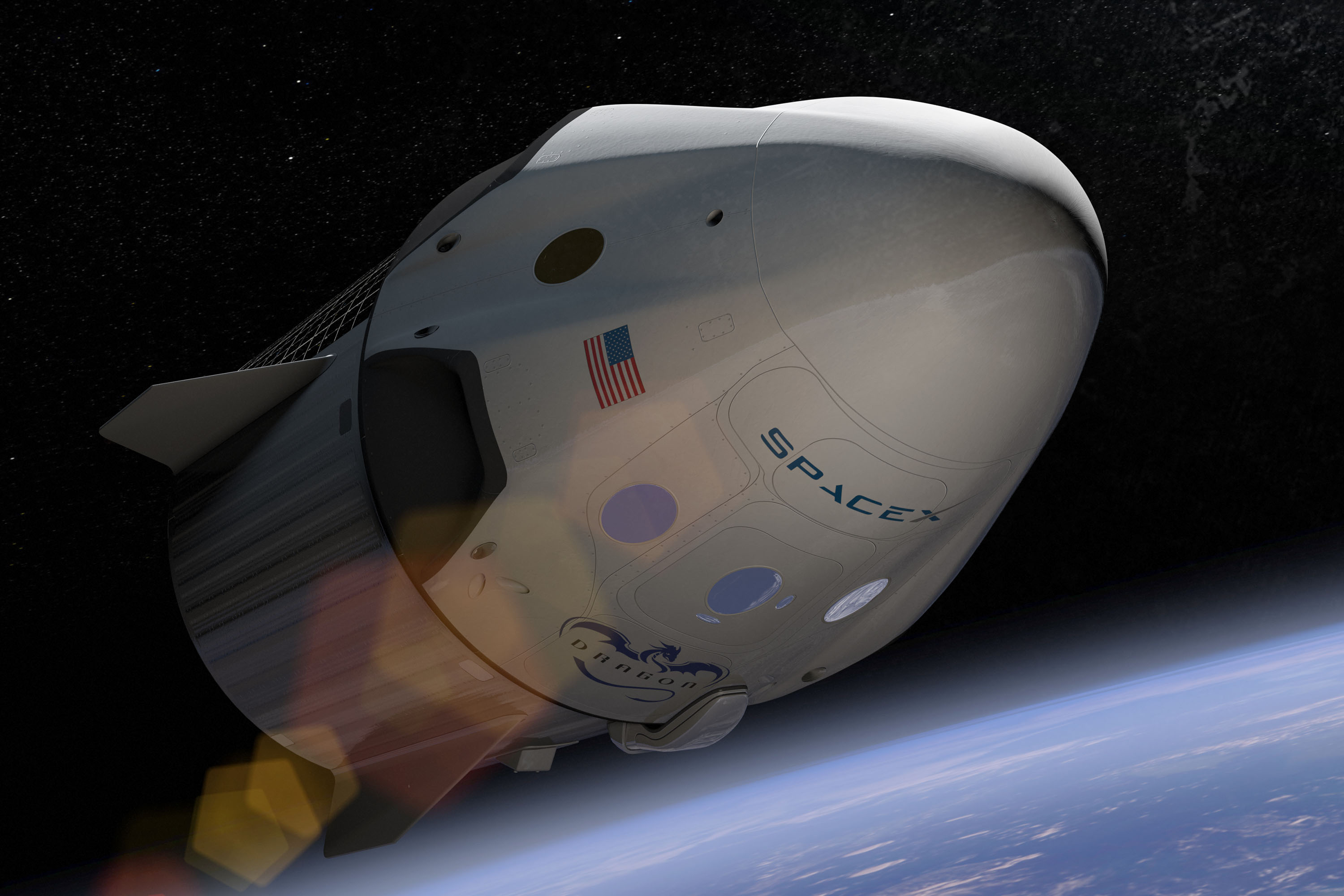
SpaceX founder and CEO Elon Musk announced Monday (Feb. 27) that his spaceflight company would carry two paying customers to the moon and back in late 2018, the first such visit since the Apollo era. The passengers would ride a Dragon spacecraft propelled by a Falcon Heavy rocket, and they'd loop past the moon and into deep space before returning to Earth. [Full Story: SpaceX to Fly Passengers On Private Trip Around the Moon in 2018]
Plus: SpaceX Could Beat NASA Back to the Moon
Ring in the sky
Skywatchers in parts of South America and Africa witnessed a spectacular "ring of fire" eclipse last weekend, where the moon blocked all of the sun but a thin, bright ring of light. [Full Story: Moon Blocks (Most of) the Sun in 'Ring of Fire' Solar Eclipse]
See also: Moon's Shadow on Earth from 'Ring of Fire' Eclipse Seen from Space
Pluto's raw materials
The New Horizons probe flew by Pluto in 2015, and early studies suggest that the dwarf planet is more complicated than thought — in fact, it possesses possible organics, water and energy, which researchers consider the necessary ingredients for life. [Full Story: Does Pluto Have The Ingredients For Life?]
A Martian dodge
The Mars-orbiting MAVEN spacecraft changed course to avoid a projected collision with the strange Martian moon Phobos. The slight adjustment means the atmosphere-sniffing probe will safely pass by the moon March 6. [Full Story: NASA Spacecraft Avoids Collision with Martian Moon Phobos]
Keep shining on
A nearby massive star explosion first observed in 1987 continues to put out bright shockwaves in the sky, visible 30 years later. Researchers released images and time-lapse videos documenting its evolution. [Full Story: Historic Supernova Explosion Still Shines Bright After 30 Years]
An antimatter mystery
Matter and antimatter should look the same. For the first time, physicists have experimental evidence that they don't. [Full Story: First Solid Sign that Matter Doesn't Behave Like Antimatter]
Tatooine possibilities
Like the "Star Wars" world Tatooine with two suns, planets can orbit systems with multiple stars. New evidence of far-off shattered asteroids suggest that such systems can host rocky planets, not just gas ones — a much more suitable home for Luke Skywalker. [Full Story: Real Tatooines? Evidence Found of Rocky Planet Formation Around Double Star]
Eyes in the sky
An American satellite launched on a classified reconnaissance mission from Vandenberg Air Force Base in California. The satellite will be operated by the U.S. National Reconnaissance Office, and its original launch date was December — it was delayed by a series of wildfires and an issue with the Atlas V rocket's upper stage. [Full Story: New American Spy Satellite Launches on Classified Mission]
Robot to the sun
NASA will soon launch a robotic mission to the sun. The 2018 Solar Probe Plus mission will travel within 4 million miles of the blazing star to examine its surprisingly-cool surface and the origin of the solar wind's speed, among other stellar mysteries. [Full Story: Could a Spacecraft Fly to the Sun?]
Probing the cosmos — by balloon
As it landed, the high-flying BLAST balloon telescope was unexpectedly dragged about 125 miles (200 kilometers) across Antarctica, trailing components along the way, until it was lost and unrecoverable in a crevasse field. But the hard drive flew off, and they got the data. [Full Story: Where Are All the Baby Stars? High-Flying Balloon Telescope Could Find Out]
Email Sarah Lewin at slewin@space.com or follow her @SarahExplains. Follow us @Spacedotcom, Facebook and Google+.
Closer to Contact: The New Tech That’s Helping Us Hunt for Aliens
In 1960, the renowned astronomer Frank Drake turned the radio telescope at the Green Bank Observatory in West Virginia toward two nearby stars in hopes of discovering some indication of intelligent alien life. Although Drake was unsuccessful in this venture, his effort did mark the beginning of the Search for Extraterrestrial Intelligence (SETI), a global scientific effort to determine whether or not we're alone in the universe.
SETI has come a long way since its humble beginnings over half a century ago, and nowhere is this more apparent than in the technology that is being deployed in the hunt for life beyond Earth. Today, astronomers are using telescopes more powerful than Drake could've ever imagined, and astrobiologists are commandeering rovers that are collecting samples on the Martian surface, a region of the solar system that wouldn't be explored for almost 15 years after Drake's original SETI experiment.
According to Eric Korpela, the director of UC Berkeley's SETI@home project, one of the biggest leaps forward in SETI tech has been in the telescope department. He cited the ALMA Array, the Square Kilometer Array and the Allen Telescope Array as just a few of the examples of the new generation of telescopes that are making the possibility of contact seem closer than ever before.
"The common theme in all these telescopes is that they're arrays," said Korpela. "That's a big change from the way SETI has done most of its work in the past, which was with fairly large, single-dish telescopes that point at a single spot in the sky. The arrays that are coming online have the capability to point at multiple spots on the sky simultaneously and have much higher spatial resolution, meaning you're just focusing tightly in on a single star, rather than surveying a large area."
The reason these telescope arrays represent an advance over their predecessors is because they are able to leverage a relatively new surveying technique called interferometry. In essence, this technique combines the radio signals being received at each of the smaller telescopes so that it provides a really find-detailed version of a single signal.
But even with these new radio telescope arrays coming online, SETI hasn't abandoned its roots in single dish telescopes—it's merely changed the way it's putting them to use. Case in point is SETI@home, a distributed computing initiative launched in 1999 that has enlisted the help of tens of thousands of people around the world in the search for alien life.
"Maybe 5 to 10 percent of stars have an Earth-like planet in orbit that is also in the habitable zone"
Every day, the SETI researchers at UC Berkeley receive dozens of gigabytes worth of radio signal data collected from the Arecibo telescope in Puerto Rico and the Green Bank telescope in West Virginia. Filtering through all this cosmic noise for some small indication of an intelligent signal is a big task, even with state of the art computing technology—there's simply too much to look through. But by linking together the processing power from individual laptops and PCs all around the world, the task has become infinitely more manageable. It also means that anyone can help look for aliens while they sleep.
At the same time, advances in optical telescope technologies have also revealed a universe overflowing with potentially habitable planets orbiting other stars, which are known as exoplanets. The first exoplanet discovery occurred in 1995 and several thousand others have been discovered since then, although most of these were far larger than Earth and unlikely to support life.
It wasn't until 2014 that the Kepler Space Telescope, launched into space in 2009 with the largest camera ever put on a spacecraft, discovered the first Earth-like planet in the habitable region (where liquid water is possible) of another star. In the three years since, well over a dozen other potentially earth-like exoplanets have been discovered, each of which could potentially host extraterrestrial life. The most recent Earth-like exoplanet discovery occurred last month, when NASA announced that seven potentially habitable planets had been discovered in the Trappist-1 star system, the most ever found to be orbiting a single star. Now, according to Korpela, "we can estimate that maybe 5 to 10 percent of stars have an Earth-like planet in orbit that is also in the habitable zone."
SETI astronomers like Korpela are looking at stars and planets that are dozens, if not hundreds of light years away. But a little bit closer to home, astrobiologists are also looking for extraterrestrial life in our own solar system—albeit of the non-intelligent sort.
The tools of choice for these alien hunters are not telescopes, but the new generation of rovers and planetary probes that are on the hunt for microbial life on the planets and moons in our solar system. The leading candidates in this respect are Mars, Saturn's moons Enceladus, and Jupiter's moon Europa because each has water on its surface.
With the exception of Mars, there has yet to be any missions launched to these destinations in search of life. The first mission to Mars in search of life was the Viking missions in the 1970s, but the most recent was a joint mission between the European Space Agency and Roscosmos called ExoMars, which consists of two phases. In the first phase, the Trace Gas Orbiter (which just arrive at Mars last October) will examine the constituency of the Martian atmosphere. Although the atmosphere of Mars is dominated by carbon dioxide, the presence of trace amounts of other gases, such as methane or water vapor, could point to the possibility of life on the surface of the Red Planet. The second part of the mission will see a rover touchdown on Mars in 2021 and will use a 6-foot long drill to sample water beneath the surface of the planet.
As for Enceladus and Europa, they remain enticing destinations for future exobiology-oriented missions.
Just last month, NASA put forward a proposal for a lander on Europa, which is bound by a 10-15 mile thick icy crust that researchers think may hide an ocean of liquid water beneath its surface that is twice as large as the oceans on Earth combined. In the early 2020s, NASA plans to launch an orbiter to Jupiter, which will perform 45 close fly-bys of the moon equipped with instruments capable of measuring the thickness of the ice crust, determining whether there is liquid water beneath its surface, as well as the saltiness and temperature of this water. But NASA doesn't plan to stop there. It's most recent proposal calls for a lander that would be lowered to the moon's surface using a "sky crane" (parachutes would be unnecessary since the moon has no atmosphere) and then proceed to collect samples from the top few centimeters of the moon's surface.
As for Enceladus, NASA's plan to visit this icy moon isssss much less well-defined. In 2015, following a flyby of the moon by the Cassini spacecraft which took photos of water-rich plumes erupting from Enceladus' surface, a scientist from Cornell University proposed the Enceladus Life Finder (ELF) which would make its primary mission sampling these plumes to determine their chemical makeup. A second proposal to fly through the plumes called Life Investigation for Enceladus (LIFE) was also made, differing from insofar as the samples collected by the craft would be returned to Earth for analysis.
As of the time of this writing, neither ELF nor LIFE has advanced beyond the initial mission proposal. But in any case, there has never been a busier or more promising time to be hunting for life beyond Earth, a development which is largely due to the awesome new technologies being developed by space agencies and researchers around the world.
{ www.Motherboard }

BRIGHTEST ‘SPOT’ ON CERES IS LIKELY A CRYOVOLCANO

The bright regions on the dwarf planet Ceres have been some of the most talked about features in planetary science in recent years. While data from the Dawn spacecraft has shown these bright areas are salt deposits (alas, not lights of an alien city), the question remained of how these salts reached the surface.
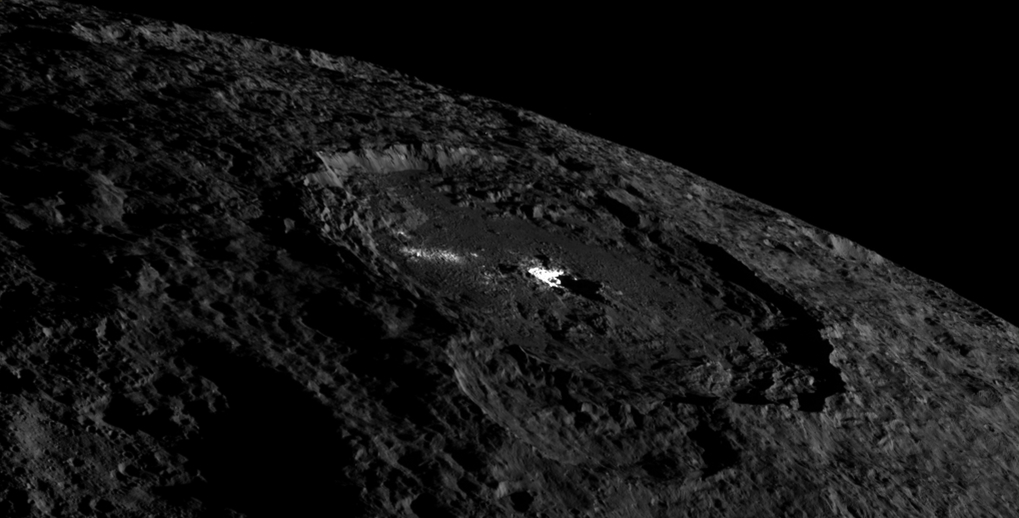
Researchers with the Dawn mission say they have now thoroughly investigated the complex geological structures in Occator crater, the region with the brightest regions on Ceres. The scientists conclude that a bright dome-like feature called Cerealia Facula is the remnant of a cryovolcano — an ice volcano — that repeatedly and relatively recently spewed salty ice from within Ceres up to the surface.
“The age and appearance of the material surrounding the bright dome indicate that Cerealia Facula was formed by a recurring, eruptive process, which also hurled material into more outward regions of the central pit,” said Andreas Nathues, a Dawn scientist from the Max Planck Institute for Solar System Research. “A single eruptive event is rather unlikely.”
The bright central spots near the center of Occator Crater are shown in enhanced color in this view from NASA’s Dawn spacecraft. The view was produced by combining the highest resolution images taken in February 2016 (at image scales 115 feet (35 meters) per pixel of 35 meters with color images obtained in September 2015 at a lower resolution. Click for a highest-res view.
Credit: NASA/JPL-Caltech/UCLA/MPS/DLR/IDA/PSI
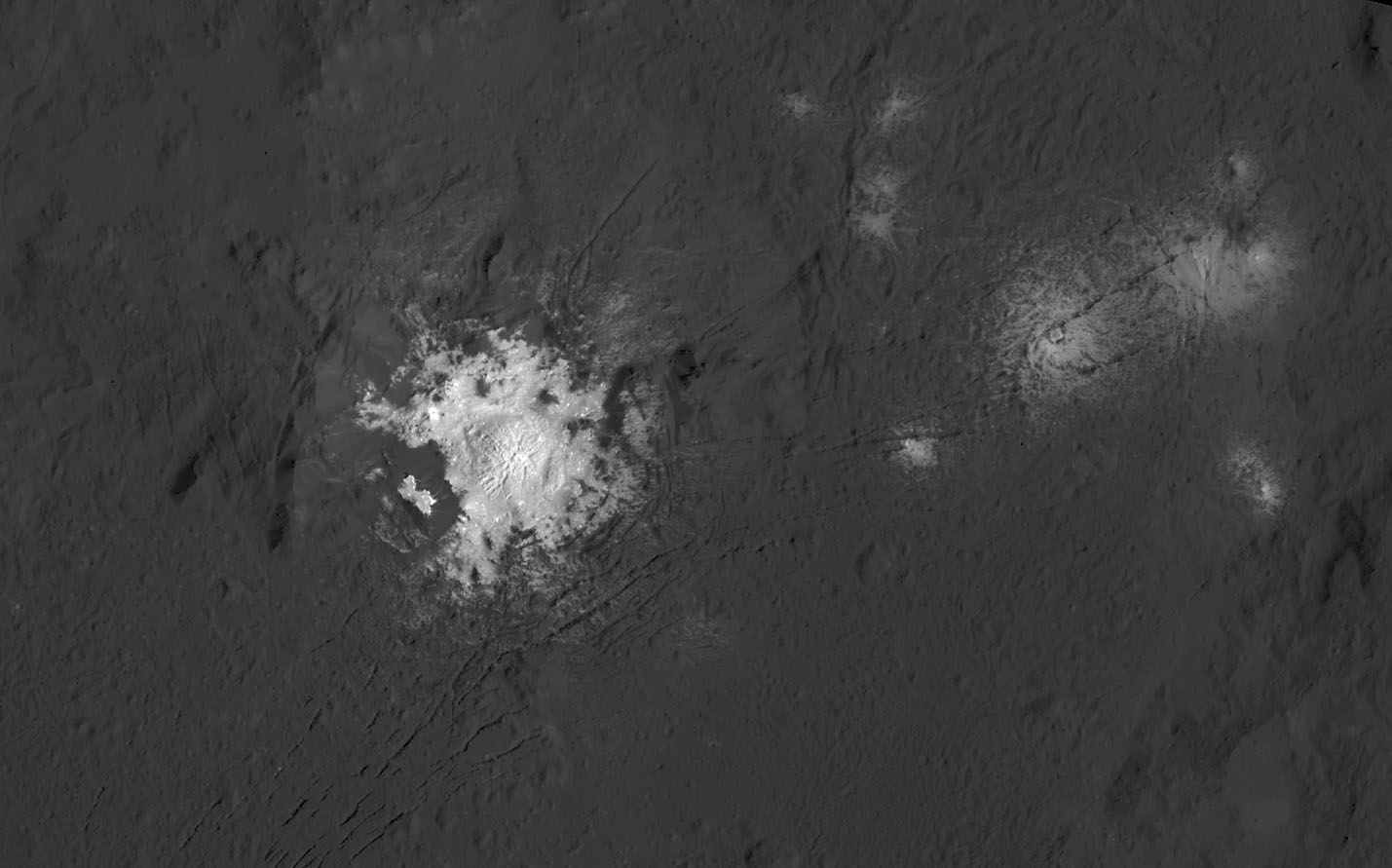
Occator crater located in the northern hemisphere of Ceres measures 92 kilometers (57 miles) in diameter. In its center is a pit with a diameter of about 11 kilometers (7 miles). On some parts of its edges, jagged mountains and steep slopes rise up to 750 meters (820 yards) high. Within the pit a bright dome formed. It has a diameter of 3 km (1.8 miles), is 400 meters (437 yards) high, with prominent fractures.
In analyzing images from Dawn’s Framing Camera, Nathues and his team deduced that the central pit is a remnant of a former central mountain, formed from the impact that created Occator Crater about 34 million years ago. But with a method for estimating the age of a planet’s surface – called crater counting — the science team could determine the dome of bright material is only about four million years old.
This suggests, the team said, that Occator crater has been the scene of eruptive outbursts of subsurface brine over a long period and until almost recently.
Jupiter’s moons Callisto and Ganymede show similar types of domes, and researchers interpret them as signs of cryovolcanism. While Ceres is too far from the Sun to be warm enough for regular volcanic activity, it very likely has harbored cryovolcanic activity, and it may even be active today.
This 3d-anaglyph for the first time shows a part of Occator crater in a combination of anaglyphe and false-color image.
Credit: NASA/JPL-Caltech/UCLA/MPS/DLR/IDA
Images from the Hubble Space Telescope taken more than a decade ago hinted at the bright spots in Occator Crater, but as the Dawn spacecraft approached Ceres in 2015, new images showed the bright areas almost shining like “cosmic beacons, like interplanetary lighthouses drawing us forth,” as described by Marc Rayman, the chief engineer and mission director for Dawn, in an interview with me last year.
Dawn scientist had previously determined the bright areas were salts left over from subsurface briny water that had made its way to the surface, and in the vacuum of space, the water sublimated away, leaving behind the dissolved salts. These salts were determined to be sodium carbonate and ammonium chloride.
This view of the whole Occator crater shows the brightly colored pit in its center and the cryovolcanic dome. The jagged mountains on the edge of the pit throw their shadows on parts of the pit. This image was taken from a distance of 1478 kilometers above the surface and has a resolution of 158 meters per pixel.
Credit: NASA/JPL-Caltech/UCLA/MPS/DLR/IDA
But don’t call these bright areas “spots,” said Rayman. “Some of these bright areas are miles across,” he said, “and just as if you were standing on salt flats on Earth that were several thousand acres, you wouldn’t say, ‘I’m standing on a spot.’ You are standing on a big area. But just to see the distribution of this material in the Dawn images shows there is something complex going on there.”
It is currently unknown if the region in Occator Crater is active, but there are hints it is, at least at a low level.
In 2014 the Herschel spacecraft detected water vapor above Occator, and images from Dawn’s cameras of the crater show a ‘haze’ when imaged at certain angles, and this has been explained as the sublimation of water.
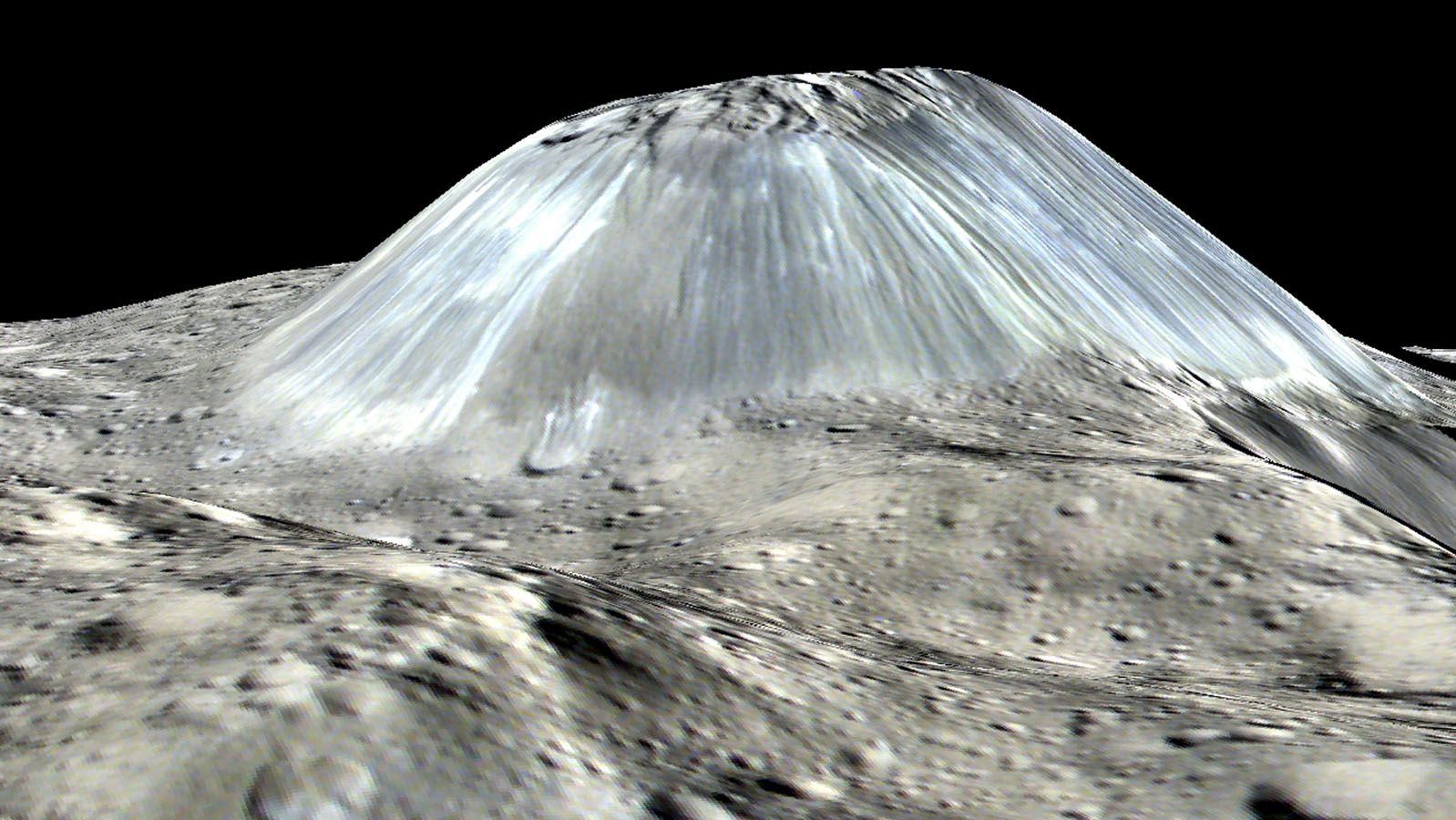
Dawn scientists are also studying the large volcanic feature on Ceres, Ahuna Mons, to determine if it could be a cryovolcano, and will continue to study other bright areas on Ceres, as well.
Ceres’ lonely mountain, Ahuna Mons, is seen in this simulated perspective view. The elevation has been exaggerated by a factor of two. Image
Credit: NASA/JPL-Caltech/UCLA/MPS/DLR/IDA/PSI
Further Reading:
Ask physicist Brian Cox about aliens on his live TV show exploring space/https%3A%2F%2Fblueprint-api-production.s3.amazonaws.com%2Fuploads%2Fcard%2Fimage%2F405490%2Fa86d20d8-63ba-44b2-9452-b23454e592d5.jpg)
/https%3A%2F%2Fblueprint-api-production.s3.amazonaws.com%2Fuploads%2Fcard%2Fimage%2F405490%2Fa86d20d8-63ba-44b2-9452-b23454e592d5.jpg)
You may remember physicist Brian Cox from such hits as "patiently explaining climate change to a diehard denier" and "taking on the government to protect the BBC."
He's an international treasure, in other words, and Australia's ABC network has given him a brand new space show. As thanks, presumably.
Stargazing Live will see Cox along with non-scientist (but excellent person) Julia Zemiro exploring the wonders of space and the cosmos, including taking live questions from the folks at home.
The show will broadcast for three nights from April 4 to 6 from the Siding Spring Observatory in rural New South Wales.
Brian Cox.
IMAGE: ABC
Episodes will look at the Milky Way, the planets and of course, aliens. As well as a cast of astrophysicists and astronomers, the show will explore Indigenous knowledge of the stars with guest Michael Anderson, a Lawman of the Euahlayi nation and treasured activist.
Each show will also be followed by a space-version of Gogglebox — 30 minutes where Cox and Zemiro will answer questions asked over social media from the audience in a segment called Stargazing Live: Back To Earth.
It's worth tuning in. After all, SpaceX intends to send two as yet unnamed people in a loop around the moon in 2018. It could be you next time (if you've got that kind of cash), so best study up.
µ
Bizarre 3D images show what aliens might REALLY look like to survive in harsh environments on distant planets

Is this what aliens really look like?
(Photo: Steve Grice/Sketchfab)
Scientists have revealed a series of incredible images showing what aliens might really look like.
From armoured plates, to translucent skin and claws, the illustrations are a world away from the green, bulging-eyed illustrations of aliens we are used to.
Backed by research of red dwarf solar systems, Dr Brian Choo, from the School of Biological Sciences at Flinders University in Australia, created the images alongside graphic artist Steve Grice.
They paired the conditions in red dwarf solar systems with particular features needed by plants and animals to survive.
In a stunning glimpse at the weird and wonderful shapes, sizes and colours of the creatures, their illustrations and interactive research, published on Sketchfab , depict strange ground-dwelling aliens.
While humanity has developed within the Sun's solar system, smaller red dwarf systems may shine a light on what life is like beyond earth.


Last week astronomers detected no less than seven Earth-sized worlds orbiting a cool dwarf star known as TRAPPIST-1, located in the constellation Aquarius.
While located in the 'habitable zone', life forms would develop entirely different from our own.
Dr Choo, a specialist in how species are affected by environmental factors, suggested alien life could need armoured plates and thick skin as protection from harsh sun or winds.
And with the majority of the world's plants remaining close to the ground and growing between rock and cracks, any creature would need a mouth suitable for gathering such nutrients.
With red dwarfs emitting far less radiation and light than our own sun, some life forms may even develop transparent skin, better at capturing as much light as possible.
Speaking about one armour-skinned creature, Dr Choo said: "This odd creature grazes on low growing lichen-like vegetation and digs for buried tubers.
"The low-slung body and armoured carapace permit it to forage during the blistering windstorms that scour the surface.
"The paddle like tail and vestigial fins betray an aquatic larval stage in the cool lakes at the edg of the melting dark-zone glaciers."
Alien spots' on Ceres may have been caused by massive ice volcanoes erupting, researchers find
A mysterious dome containing the brightest material on Ceres may once have been the site of ‘eruptive outbursts’ from ice volcanoes.
In a new study, researchers found that these bright spots have only existed for about four million years – making them roughly 30 million years younger than the crater in which they’re found.
The distribution and nature of this unusually bright material suggests it was formed by recurring events, making Ceres the closest object to the sun with evidence of cryovolcanic activity.

A mysterious dome containing the brightest material on Ceres may once have been the site of ‘eruptive outbursts’ of cryovolcanic activity. In a new study, researchers found that these bright spots have only existed for about four million years
NASA’s Dawn space probe has been studying Ceres for almost two years.
In that time, scientists have noted the presence of strange spots of bright material at the center of the Occator crater, consisting mainly of mineral salts.
Now, researchers with the Max Planck Institute for Solar System Research have investigated the structures inside the crater – including fractures, avalanches, and even smaller craters – to reveal new insight on the planet’s activity.
The 92-kilometer-wide Occator crater contains a massive pit with a bright dome, which ‘contains the brightest material on Ceres,’ says MPS scientist Thomas Platz.
Infrared spectrometer VIR data on the region, called Cerealia Facula, show it is rich in salts known as carbonates.
And, other bright spots that sit further out in the crater contain a mixture of carbonates and dark surrounding material.
The researchers say the central pit, which has a rocky, jagged ridge, is likely the remnant of a former mountain.
This is thought to have formed from the impact that created the Occator Crater roughly 34 million years ago, and later collapsed.
But, the dome of bright material is about 30 million years younger, they say.
The researchers dated the features based on how ‘perforated’ the surfaces were.
It’s thought that younger craters are less perforated.
‘The age and appearance of the material surrounding the bright dome indicate that Cerealia Facula was formed by a recurring, eruptive process, which also hurled material into more outward regions of the central pit,’ says Andreas Nathues, Framing Camera Lead Investigator.
‘A single eruptive event is rather unlikely.’

The 92-kilometer-wide Occator crater contains a massive pit with a bright dome, which ‘contains the brightest material on Ceres,’ says MPS scientist Thomas Platz. Infrared spectrometer VIR data on the region show it is rich in salts known as carbonates
Other objects, like Jupiter’s moons Callisto and Ganymede, have similar domes, which are thought to be volcanic deposits, indicating cryovolcanic activity.
And, they say a similar process could be at work on Ceres.
‘The large impact that tore the giant Occator crater into the surface of the dwarf planet must have originally started everything and triggered the later cryovolcanic activity,’ says Nathues.
After the impact, they say, the subsurface brine was pushed upward.
And, with lower pressure, water and dissolved gasses such as methane and carbon dioxide were able to escape through the forming system of vents.
The solution was then able to erupt through fractures at the surface.

The researchers say the central pit is likely the remnant of a former mountain. This is thought to have formed from the impact that created the Occator Crater roughly 34 million years ago, and later collapsed. But, the dome of bright material is about 30 million years younger
According to the researchers, the salts deposited in this process likely created the bright dome seen today.
Images of the Occator crater captured from about 14,000 kilometers away show variations in brightness on a diurnal rhythm, supporting the new theory.
‘The nature of the light scattering at the bottom of Occator differs fundamentally from that at other parts of the Ceres surface,’ MPS research Guneshwar Singh Thangjam says.
‘The most likely explanation is that near the crater floor an optically thin, semi-transparent haze is formed.’
This haze, the researchers say, could be the result of sublimating water streaming out from fractures in the floor when the crater is exposed to sunlight.
Giant UFO spotted near NASA's International Space Station? [VIDEO]
‘Megaschip’ vastgelegd bij ruimtestation ISS waarna NASA ‘het beeld donkerder maakt’

Kort nadat een bizar ‘megaschip’ bij het internationale ruimtestation ISS verscheen, maakte NASA het beeld donkerder, zo claimen complottheoretici.
Zij zeggen dat de beelden mogelijk bewerkt zijn door het Amerikaanse ruimteagentschap om objecten te laten ‘verdwijnen’, schrijft de Daily Mirror.
In het filmpje, dat op YouTube is geplaatst door Streetcap1, zijn een lange ‘sigaarvormige’ UFO en nog twee objecten te zien boven de aarde.
“Het beeld wordt tegen het eind plotseling donkerder,” zei hij. “Ik denk dat de NASA de helderheid enigszins verlaagde.”
UFO-jager Tyler Glockner van SecureTeam10 zei: “Er zijn hier zeker ongewone objecten te zien. Er is onder meer een hele lange sigaarvormige UFO te zien. Het is ongeïdentificeerd, we weten niet wat het is.”
“Ik heb honderden, zo niet duizenden uren livestream van het ISS bekeken en ik heb UFO’s, ijskristallen, ruimtepuin en reflecties gezien,” vervolgde hij.
“Kort nadat de objecten in beeld verschijnen wordt het beeld plotseling donkerder. Ofwel de NASA doet dit doelbewust, ofwel de UFO’s doen dit zelf.”
“Mogelijk heeft de NASA het beeld donkerder gemaakt door te knoeien met het contrast of de belichting zodat de objecten uit beeld verdwijnen,” klonk het.
[Mirror]
U.S. AIR FORCE COLONEL BLOWS WHISTLE ON EXTRATERRESTRIAL INVOLVEMENT WITH APOLLO 13
Kolonel: “Ruimteschip schoot Apollo 13 te hulp en begeleidde bemanning terug naar aarde”

Kolonel Ross Dedrickson moest in de jaren vijftig waken over de veiligheid van kernwapens. In die tijd kwamen er veel meldingen binnen van UFO’s die boven diverse nucleaire installaties werden gezien.
“Deze UFO’s waren buitengewoon geïnteresseerd in onze installaties,” zei hij.
Dedrickson heeft naar eigen zeggen vaak UFO’s gezien en was getuige van de onbekende objecten die in juli 1952 over het Capitool vlogen.
De kolonel zei verder dat er meerdere nucleaire wapens in de ruimte zijn gebracht, die vervolgens door buitenaardsen zijn vernietigd. “Dit werd bewust stilgehouden.”
“Eind jaren zeventig probeerden we een kernbom te laten exploderen op de maan,” zei Dedrickson. “De buitenaardsen hebben dit voorkomen.”
“Kort na mijn pensioen benoemde Space Command een incident dat ik later kon bevestigen,” zei hij. “Een ruimteschip schoot Apollo 13 te hulp en begeleidde de bemanning naar de maan en terug naar aarde.”
“Tot twee keer toe overwogen ze om de bemanning over te brengen naar hun ruimteschip,” vervolgde hij. “Maar ze keerden uiteindelijk veilig terug op aarde.”
Twee dagen na de lancering van Apollo 13 ontplofte een zuurstoftank, met als gevolg dat in een paar uur de hele zuurstofvoorraad verloren was gegaan.
Commandant Jim Lovell sprak toen de historische woorden: “Houston, we’ve had a problem.”
[Collective-evolution]
4000 jaar oud bouwwerk met mysterieuze rotskunst gevonden in Israël

In Boven-Galilea in Israël is een 4000 jaar oud stenen bouwwerk gevonden dat is voorzien van mysterieuze rotskunst. Dat schrijft de Jerusalem Post.
Volgens de Israëlische autoriteit voor oudheden is het bouwwerk uit de bronstijd ontdekt door professor Gonen Sharon van het Tel-Hai College.
“Wat dit hunebed zo uniek maakt zijn de enorme afmetingen, de structuur eromheen en de decoraties die in het plafond zijn gegraveerd,” aldus de autoriteit.
Archeologen hebben een studie over de vondst gepubliceerd in het tijdschrift PLOS ONE.
Hunebedden of dolmens worden over de hele wereld gevonden, van Ierland tot Korea. In het Midden-Oosten liggen er ook vele duizenden, van Turkije tot Jemen.
Graveringen (Gonen Sharon)
Hoewel ze vaak worden gevonden in Israël, is het mysterie rond de leeftijd en het doel van de hunebedden nog altijd niet opgelost.
In het plafond zijn 15 graveringen ontdekt die bestaan uit een rechte lijn die naar het centrum van een boog gaat.
Dergelijke vormen zijn nooit eerder aangetroffen in het Midden-Oosten en om die reden zijn ze in mysterie gehuld.
Met behulp van een 3D-scan konden de archeologen graveringen ontwaren die met het blote oog niet te zien zijn.
De ruimte waarin de graveringen zijn gevonden is groot, twee bij drie meter, en de steen die er bovenop ligt is ook enorm en weegt tenminste 50 ton.
“Dit is één van de grootste stenen die ooit in het Midden-Oosten is gebruikt voor de bouw van een hunebed,” aldus professor Lior Grossman.
Het hunebed wordt omringd door een grafheuvel met een doorsnee van 20 meter. De stenen waar die grafheuvel uit bestaat wegen tot wel 400 ton.
De staande stenen van Stonehenge wegen ter vergelijking ‘slechts’ 25 ton.
[Jerusalem Post]
Diamond UFO Passes Over Freeway In Orlando, Florida On Jan 27, 2017, UFO Sighting News.
Giant Books Are Proof That Giant Alien Species Once Existed On Earth, March 2017, UFO Sighting News.
Google Earth Deletes UFO Following Two Jets Over China, March 2017, Video, UFO Sighting News.