Two Harvard University scientists are suggesting that mysterious fast radio bursts, detected in faraway galaxies, may be evidence of aliens traveling through the cosmos.
FRBs are extremely bright flashes of radio waves that last for only a thousandth of a second and are detected by earthbound telescopes. Since the first one was observed 10 years ago, 17 have actually been reported, although scientists think there are thousands of them a day.
At first, Abraham “Avi” Loeb said, he took a conservative approach to explaining them.
“It looked like the simplest explanation would be flares from stars in the Milky Way galaxy,” said Loeb, a theoretical astrophysicist and chair of Harvard’s astronomy department.
But then “one of the FRBs was localized to reside in a small galaxy at a distance of about a billion light-years away,” Loeb told The Huffington Post. (One light-year is about 6 trillion miles.)
Essentially, that means these FRBs are coming from the edge of the universe and must be brighter than anything else we know.
In a new paper published in The Astrophysical Journal Letters this month, Loeb and Harvard physicist Manasvi Lingam say they decided to “examine the possibility that fast radio bursts originate from the activity of extragalactic civilizations.”
“Since there are many more galaxies out there than the Milky Way, it makes sense statistically that one would detect such phenomena outside the Milky Way more often rather than inside it,” Lingam told HuffPost.
While Loeb and Lingam don’t claim that FRBs definitely originate from aliens, they speculate that such phenomena could be the result of other civilizations using gigantic radio transmitters to hopscotch from one galaxy to another.
An almost planet-sized, solar-powered radio transmitter could generate enough energy to propel an interstellar light sail (like the one illustrated above), they suggest. These sails, in turn, might be sufficient to push “about 20 times the largest cruise ships on Earth.” FRBs would be the leakage from such transmitters.
“Our upper bound on the number of such civilizations is 10,000 in a typical galaxy,” Lingam said. “But I’d like to reiterate that this is the maximal value. In all probability, the real value is likely to be much lower.”
Nobody on Earth has detected any interstellar light sails yet. What large radio telescopes, like the Arecibo Observatory in Puerto Rico or the Parkes Observatory in Australia, have picked up are very fast, bright flashes of energy.
For us to detect these bursts so many light-years away, Loeb said, they’d need a very bright source.
“So what we are considering in our scenario is a very narrow beam of radiation pushing on a sail, and that requires roughly the amount of energy intercepted by the Earth [from] sunlight. That’s the kind of power you need ― the energy falling on the Earth from the sun,” he said.
Loeb chairs the advisory committee for the Starshot project, which seeks to send a spaceship to Alpha Centauri, a star system over four light-years from Earth. The idea would be to aim powerful laser beams from Earth at thin sails carrying more than 1,000 probes. It’s not the same as the radio waves possibly used by aliens, but then humans are still taking baby steps into space.
“I can imagine [aliens] doing what we are just starting to do now,” Loeb said.
The Harvard scientist is well aware that talking about aliens, even hypothetically, can start some eye-rolling. But he doesn’t share that bias.
“We shouldn’t be guided by prejudice when we think about what may be out there,” said Loeb. “Many people tend to think they know the truth. They think that we are special, that maybe there is nothing out there.
“I think we should just observe and whenever we see something unusual, we should think, contemplate the possibility that it could be artificial. And there is nothing bad about that ― it’s a learning experience.”
Indeed, it’s probably the essence of being a theoretical astrophysicist.
“The whole principle of science is that you collect data that can falsify an idea that you have or prove it right,” Loeb said.
Lingam acknowledges that their hypothesis is still a tad speculative.
“We have suggested a potential means of distinguishing between ‘natural’ and ‘artificial’ origin of FRBs by taking a closer look at the signals, and looking for certain distinguishable patterns,” he said.
But don’t expect a quick answer on the aliens question. “With more data expected to emerge in the coming decades, I believe that our hypothesis will be testable,” Lingam said.
NASA's Kepler Mission Discovers Planet
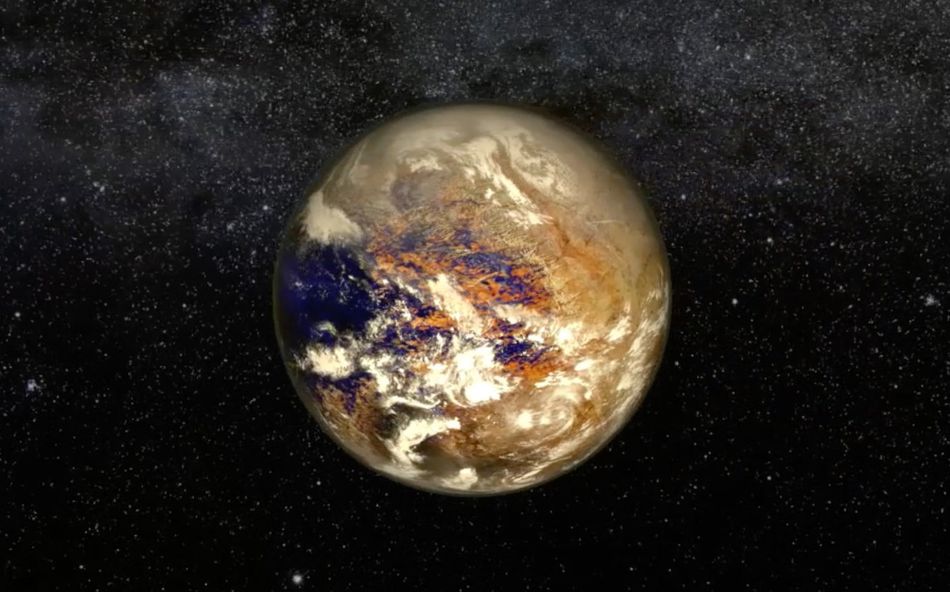
In this handout illustration made available on December 5, 2011 by NASA, the Kepler-22b, a planet known to comfortably circle in the habitable zone of a sun-like star is digitally illustrated. For the first time NASA's Kepler mission has confirmed a planet to orbit in a star's habitable zone; the region around a star, where liquid water, a requirement for life on Earth, could persist. The planet is 2.4 times the size of Earth, making it the smallest yet found to orbit in the middle of the habit. Clouds could exist in this earth's atmosphere, as the artist's interpretive illustration depicts. (Photo Illustration by Ames/JPL-Caltech/NASA via Getty Images)

NASA's Kepler Mission Discovers Planet
In this handout illustration made available on December 5, 2011 by NASA, a diagram compares our own solar system to Kepler-22, a star system containing the first 'habitable zone' planet discovered by NASA's Kepler mission. The habitable zone of a sun-like star and is about 2.4 times the size of Earth. (Photo Illustration by Ames/JPL-Caltech/NASA via Getty Images)
Extrasolar Planet HD 209458 b, Osiris
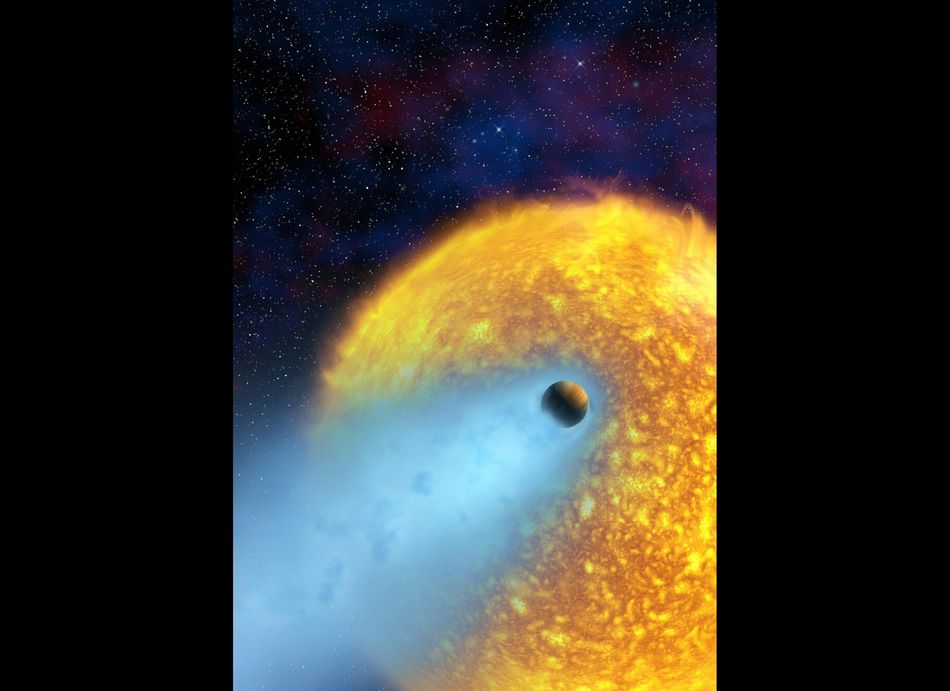
Artist's conception released by NASA of extrasolar planet HD 209458 b, also known as Osiris, orbiting its star in the constellation Pegasus, some 150 light years from Earth's solar system. Scientists have used an infrared spectrum -- the first ever obtained for an extrasolar planet -- to analyze Osiris' atmosphere, which is said to contain dust but no water. The planet's surface temperature is more than 700 Celsius (1330 Fahrenheit).'

Planet & Its Parent Star
Picture released 04 October 2006 by the European Space Agency shows an artist's impression of a Jupiter-sized planet passing in front of its parent star. Such events are called transits. When the planet transits the star, the star's apparent brightness drops by a few percent for a short period. Through this technique, astronomers can use the Hubble Space Telescope to search for planets across the galaxy by measuring periodic changes in a star's luminosity. The first class of exoplanets found by this technique are the so-called 'hot Jupiters,' which are so close to their stars they complete an orbit within days, or even hours. A seam of stars at the centre of the Milky Way has shown astronomers that an entirely new class of planets closely orbiting distant suns is waiting to be explored, according to a paper published 04 October 2006. An international team of astronomers, using a camera aboard NASA's Hubble telescope, delved into a zone of the Milky Way known as the 'galactic bulge', thus called because it is rich in stars and in the gas and dust which go to make up stars and planets. The finding opens up a new area of investigation for space scientists probing extrasolar planets - planets that orbit stars other than our own. AFP PHOTO NASA/ESA/K. SAHU (STScI) AND THE SWEEPS SCIENCE TEAM

Hot Jupiter
Picture released 04 October 2006 by the European Space Agency shows an artist's impression of a unique type of exoplanet discovered with the Hubble Space Telescope. This image presents a purely speculative view of what such a 'hot Jupiter' (word dedicated to planets so close to their stars with such short orbital periods) might look like. A seam of stars at the centre of the Milky Way has shown astronomers that an entirely new class of planets closely orbiting distant suns is waiting to be explored, according to a paper published 04 October 2006. An international team of astronomers, using a camera aboard NASA's Hubble telescope, delved into a zone of the Milky Way known as the 'galactic bulge', thus called because it is rich in stars and in the gas and dust which go to make up stars and planets. The finding opens up a new area of investigation for space scientists probing extrasolar planets - planets that orbit stars other than our own. AFP PHOTO NASA/ESA/K. SAHU (STScI) AND THE SWEEPS SCIENCE TEAM


 Someone called Durango Police to report a UFO dropping people off