Crop Circle Found At Hill Top In Wiltshire This Week, UFO Landing Mark, April 24, 2017, Video, UFO Sighting News.
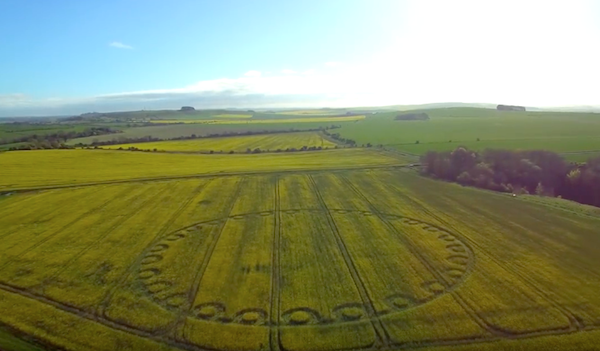
Crop Circle Found At Hill Top In Wiltshire This Week, UFO Landing Mark, April 24, 2017, Video, UFO Sighting News.
'Giant Hurricane' on Saturn: 1st Images Back from Cassini's Epic Ring DiveNASA's Cassini spacecraft dove between Saturn and its rings yesterday (April 26), snapping the closest-ever views of Saturn's atmosphere. The raw images, which began to stream back early this morning, indicating the probe had survived its journey, show intricate structures and a dark, swirling storm-like feature (which NASA called a "giant hurricane").
The spacecraft came within about 1,900 miles (3,000 kilometers) of Saturn's cloud tops and within 200 miles (300 km) of the rings' innermost visible edge during the plunge, NASA officials said in a statement. Because Cassini scientists and engineers didn't know what to expect of the gap — although it looked clear, unknown dust and debris could have proved harmful — the spacecraft was turned so its 13-foot-wide (4 meter) antenna acted as a shield as it dove, collecting data all the while. Only 20 hours after the pass was it scheduled to turn back toward Earth. "Our closest look ever at #Saturn’s atmosphere and giant hurricane," NASA officials wrote in a Twitter post. During a Facebook Live event, researchers later confirmed that the dark storm was the center of the vortex at its pole, stretching 2,000 km across, or almost 1,500 miles.
The spacecraft flew through the ring plane at 77,000 mph (124,000 kph) relative to the planet, and at that speed tiny particles could have posed a large threat to its sensitive instruments without the shielding. The rest of Cassini's unprocessed photos from the crossing are available online, along with more than 380,000 images documenting the spacecraft's journey, starting months before it arrived at Saturn in 2004. [Photos: Most Powerful Storms of the Solar System]
"No spacecraft has ever been this close to Saturn before," Earl Maize, Cassini project manager and a researcher at NASA's Jet Propulsion Laboratory in California, said in the statement. "We could only rely on predictions, based on our experience with Saturn's other rings, of what we thought this gap between the rings and Saturn would be like."
"I am delighted to report that Cassini shot through the gap just as we planned and has come out the other side in excellent shape," he added.
Saturn's atmosphere is relatively cool and mostly made of hydrogen, and the pressure at Saturn's cloud tops is about the same as Earth's pressure at sea level, NASA said. It hosts layers of clouds and that huge, spinning hexagon-shaped storm on its north pole, as well as more temporary storms that streak across the planet's surface. (One was nearly as wide as Earth.) It also hosts winds among the fastest in the solar system — NASA's Voyager missions, which passed Saturn in 1980 and 1981, measured winds at more than 1,100 mph (1,800 kph).
Many mysteries of Saturn remain to be determined: the exact length of its day and internal structure, as well as the exact composition and age of its rings, could become clear over the course of Cassini's explorations.
Cassini will complete 21 more dives before its Grand Finale plunge and burn-up in Saturn's atmosphere Sept. 15 — its next dive is May 2. Because each of the dives takes a slightly different path, engineers will be ready to shield the spacecraft again if needed. But ideally, it will be smooth sailing for the spacecraft until its ultimate atmosphere dive, collecting photos of the unexplored regions all the while.
Email Sarah Lewin at slewin@space.com or follow her @SarahExplains.
Follow us @Spacedotcom, Facebook and Google+. Original article on Space.com.
IJzige planeet ontdekt die ongeveer net zo zwaar is als onze aarde
Caroline Kraaijvanger

Nog nooit zagen we Saturnus' atmosfeer van zo dichtbij!
Caroline Kraaijvanger

Deze rups verorbert plastic tasjes (en nog snel ook!)
Caroline Kraaijvanger

ALIEN IMPLANT REMOVALS: BEFORE AND AFTER EFFECTS
Evidence of advanced ancient civilizations on Earth—over 100,000 years ago?
.png)


Trump Orders Complete Disclosure of UFO Data Kept by CIA In Area 51

Nieuwe foto van mysterieus lichtfenomeen in Hessdalen. Is dit bewijs dat Noorwegen wordt bezocht door UFO’s?

Wetenschappers, UFO-jagers en andere enthousiastelingen zijn al jaren gefascineerd door het mysterieuze Licht van Hessdalen in Noorwegen.
Op een conferentie in Wenen is nu een foto onthuld die in september 2015 door wetenschappers van het Østfold University College in Hessdalen is gemaakt.
Ze wachtten twee jaar met het naar buiten brengen van de foto en kozen er bewust voor om het beeld te presenteren tijdens een wetenschappelijke bijeenkomst.
Ze willen op deze manier laten zien dat het fenomeen echt bestaat en onderzoekswaardig is.
Op de foto is een lichtbol met een doorsnee van ongeveer 1,5 meter te zien op 30 meter hoogte. Het object bevindt zich op ongeveer 100 meter van de camera. De bol verlicht bovendien het aardoppervlak.
Onderzoekers spreken in het geval van Hessdalen overigens niet van een UFO, maar HP (Hessdalen Phenomenon) of UAP (Unidentified Aerial Phenomenon).
Het object is diverse keren op dezelfde plaats vastgelegd. Dat kan ons helpen begrijpen hoe deze lichtbollen ontstaan, aldus Bjorn Gitle Hauge en Anna-Lena Kjoriksen van het Østfold University College.
Ze hopen dat meer wetenschappers geïnteresseerd zullen raken in het fenomeen zodat ze het mysterie achter deze bollen verder kunnen ontrafelen.
Toen de wetenschappers, die de camera’s vanuit een tent in de gaten hielden, naar buiten renden was de lichtbol alweer verdwenen.
De bol verscheen niet op de volgende foto, die vijf seconden later was genomen.
De onderzoekers zijn er 95 procent zeker van dat het hier gaat om een foto van het Licht van Hessdalen. Ze hebben uitgesloten dat het gaat om een parhelium of een reflectie.
Ze proberen nu te achterhalen wat het dan wel is.
Het spookachtige lichtverschijnsel wordt al sinds 1941 gezien in Hessdalen. Een piek in het aantal meldingen lag tussen 1981 en 1984.
[NRK Trondelag]
Witness describes disappearing object at tree top level

A California witness driving in an “extremely rural” area of Imperial County reported a late-night encounter with an object moving along at the tree top level, according to testimony in Case 82810 from the Mutual UFO Network (MUFON) witness reporting database.
The witness was driving in rural Imperial County, CA, when the object was seen.
(Credit: Google)
The witness was searching for a specific area at 2:30 a.m. when the incident occurred.
“I pulled to the side of a two-lane, paved road to check my GPS mapping,” the witness stated.“I observed two white lights traveling in a slow and seemingly aimless manor to my west between 10 and 30 degrees above the ground. The distance was hard to judge due to the darkness and terrain, however, my best estimate would be less than a mile.”
The witness got out of his vehicle and leaned against the front fender to smoke a cigarette.
“I watched curiously as the lights drifted and floated silently in the sky. I got back into my car and drove up the road approximately 100 yards in order to see if I might get a better perspective. Upon exiting my vehicle, the lights appeared a little closer, however, I still heard no sound coming from the direction of the lights.”
The object was observed at the tree top level. Pictured: Imperial County, CA.
(Credit: Google)
Then the lights disappeared.
“Approximately 30 seconds later the lights simply disappeared. No bright flashes. No speeding off into the distance. They just vanished from my view. Puzzled, but not concerned, I stamped out my cigarette and got back into my car.”
But the witness was quickly startled again.
“Before I had a chance to start the engine, a man seemingly appeared out of nowhere behind the driver’s left rear of my car. I was quite startled by his sudden appearance, but for some reason I wasn’t frightened. He was dressed in dark clothing and I remember his shoes were noisy, like hard soles on gravel. Being startled as I was, I quickly said to him, ‘holy (deleted) dude, you just scared the crap out of me.’ He didn’t bend down to my window. He just stood there. Then he asked in a very casual manor if I needed directions. I told him that I was good and that I was just watching the lights. He didn’t say anything else. He just turned around and walked away as if he was returning his car.”
The object eventually vanished from view and the witness had an odd encounter with a man walking along the isolated roadway. Pictured: Imperial County, CA.
(Credit: Google)
The witness tried to see where the man would go.
“I tried to watch in my mirror to see where he had pulled off the road, but there wasn’t anything like a vehicle that I could see, and he was no longer in sight. I started my car and drove off very confused about what had just happened. I have purposely omitted some details that I feel may seem like the ramblings of a crazy UFO nut or may put me in peril.”
The witness reports that the object’s lowest altitude was at the tree top level and that it appeared to be more than 500 feet away, but less than one mile away.
Imperial County, Texas, has a population of 174,528. California MUFON Field Investigator Linda Fletchtner is investigating. Please remember that most UFO sightings can be explained as something natural or man-made. The above quotes were edited for clarity. Please report UFO activity to MUFON.com.
Another Google Co-Founder Is Building a Secret Aircraft/cdn0.vox-cdn.com/uploads/chorus_image/image/54449891/152766137.0.jpg)

While Larry Page was busy bringing his “flying car” to reality, another Google co-founder, Sergey Brin, was apparently on a similar path, trying to create a vehicle that will take to the skies as well.
However, unlike Page’s land/air hybrid vehicle, the Kitty Hawk Flyer, which could be introduced into the market as early as this year, Brin’s project is a giant airship resembling a zeppelin that’s currently housed at the NASA Ames Research Center. According to a report by Bloomberg, the project was spurred after Brin saw old photos of the USS Macon, an old airship built by the US Navy.
This particular prototype could have been created as part of a potential business venture — which would be timely, given that we’re at the cusp of airborne vehicles and flying taxi fleets becoming a reality. Or, it could be simply a passion project for Brin, who apparently has a long-standing fascination with airships. We just don’t know yet.
News of this project has piqued the curiosity of many. New airship technology could potentially help cut delivery and transport costs, given that it can accommodate massive amounts of cargo and be more fuel efficient. But whatever his intentions are for this project, Brin certainly has a few experienced friends he can tap for advice.
Impossible Physics: Meet NASA’s Design for a Warp Drive Ship


Before we jump into this, you should know that a number of scientists are currently researching the feasibility of warp drive (and EMdrive and a number of other modes of faster than light travel); however, most think that such forms of space travel simply aren’t viable, thanks to the fundamental physics of our universe.
So although part of this article is simply, “Oh my gosh, look at this amazing design,” that’s not the entire point. To that end, let’s take a moment to break this all down a bit so we have an understanding of what exactly is being proposed in relation to warp drive, and why it is met with such skepticism, before we get a bit too carried away…
Alcubierre warp drive via Anderson Institute
In 1994, physicist Miguel Alcubierre proposed a new kind of technology that would allow us to travel 10 times faster than the speed of light without actually breaking the speed of light. That seems a little contradictory, doesn’t it? After all, we’ve been told time and again that light is the universal speed limit – nothing in the cosmos can travel faster than it (much less 10 times faster).
And herein lies the key to the Alcubierre drive: When you use it, you aren’t actually moving through space.
This technology would not actually propel the ship to speeds exceeding light; instead, it uses the deformation of spacetime permitted by General Relativity to warp the universe around the vessel. Essentially, when the drive is activated the spacetime behind expands, while in the front it contracts. In this respect, the path taken becomes a time-like free-fall.
Alcubierre’s ideas have lead to a number of interesting thought experiments in quantum field theory; however, as mentioned above, most scientists think that the technology will never actually work. When you think about it, that kind of makes sense. Obviously, warping space requires a lot of mass and energy, and ensuring that the space where you are located isn’t warped is tricky business. Indeed, the proposition was mostly just a thought experiment when it was first proposed – not something Alcubierre thought was actually viable technology.
As physicist Sean Carroll notes:
In short, it requires negative energy densities, which can’t be strictly disproven but are probably unrealistic; the total amount of energy is likely to be equivalent to the mass-energy of an astrophysical body; and the gravitational fields produced would likely rip any ship to shreds. My personal estimate of the likelihood we will ever be able to build a “warp drive” is much less than 1%. And the chances it will happen in the next hundred years I would put at less than 0.01%.
[Reference: Jalopnik]
That said, scientists will likely be producing papers addressing these ideas for some time. We’ll continue to cover them as they come out (and though things may look painfully dismal for this technology, who knows what the future may hold).
But on to the design…
In 2010, NASA physicist Harold White revealed that he and a team were working on a design for this faster-than-light ship, and this is the most recent design of what such a ship might actually look like. As you can see in the image, the ship rests between two enormous rings, which create the warp bubble.
Image via Mark Rademaker
Artist Mark Rademaker worked on the project with White. In the release, Rademaker asserts that he spent over 1,600 hours working on the design. The ship is called the IXS Enterprise, and it is meant to fit the concept for a Faster Than Light ship. Mike Okuda also brought input, and designed the Ship’s insignia.
To give you some idea of just how awesome warp technology would be: A trip to the nearest star (Proxima Centauri), which rests some four light-years from Earth, would ordinarily take over 17,000 years. However, with the Alcubierre drive, it would take a little under five months. For those of us who have a mental breakdown on 10 hour plane flights, 5 months might still seem like quite a bit of travel time. But when we are talking about the vast cosmic distances between Earth and Proxima Centauri, a 5 month trip would be an achievement of monumental proportions (keep in mind, it took Curiosity 8 months just to reach Mars).
See more images of the design here.
Two Brothers Photograph the Moment a UFO Descends Upon City Hall

Almost 100 years ago, two bothers immortalized the moment when a ‘flying disk’ descended over their city to admire the vivid Christmas lights. Their image remains one of the first photographic evidence of a UFO appearing over an urbanized area.
In 1937, Leonard Lamoureaux, age 21 was on leave from the army when he decided to visit Vancouver City Hall in order to take a few photos of the brilliant Christmas light display. Accompanying him was his brother Wilfred.
After they found a good spot to take the photos, a sudden “bright blue light” descending from the sky puzzled them both. It became larger and larger as it zoomed into their line of sight, and after a while the two brothers managed to see the source of the blinding light.
Leonardo depicted the bizarre sighting as “two saucers” with open ends, facing each other and glowing bright blue. After the UFO got relatively close to the city hall, it started to slowly move horizontally across the sky until it reached the top of the flagpole. From there, the luminous craft hovered for a moment in front of the two astounded brothers, and fortunately that was enough for Leonardo to immortalize the moment using his camera.
After that brief moment, the bright UFO took off rapidly without making any specific engine sound, as the two described. They were shocked because of what they’ve seen, and couldn’t explain what actually happened there.
WE’VE NEVER SEEN ANYTHING FLY SO FAST.
Although Leonard Lamoureux and his brother Wilfred passed away some time ago, their unique UFO episode still lives on through Leonard’s daughter, Debra DeCamillis who still resides in the Vancouver Lower Mainland area.
The negative has been lost due to the passing of time, thus leading some skeptics into believing that what the picture reveals is nothing more than a watermark defect caused by the development of the print. However, Leonard’s daughter contradicts the nonbelievers by telling about her father who seemed so excited every time he told others about this unusual event:
“I know for a fact there was no bubbles on the film, or watermarks because I was fascinated by negatives as a child and saw that negative many times. On the rest of the pictures there was nothing but pictures of lights, so I know it had no bubbles or watermarks on it.”
She provided additional details regarding this UFO encounter, all the information originating from her father’s tales of the event:
“The camera was on a tripod of sorts because Dad was trying to take sequential shots of the courthouse to capture all the lights. But he was not using a timed exposure, his camera was not sophisticated enough. He did say that he could actually see the bubble or tail as he called it that the object was encapsulated in.”
The detailed description of the sighting along with the disputed picture offers amazing proof of the UFO phenomenon seen almost one hundred years ago in a time when CGI and Photoshop were nothing but wild ideas.
Another notable thing is the remarkable likeliness between the object from this photo and another seen in a fresco from 1350. The objects from both images show similar characteristics, while at the same time fitting the description of present-day alien crafts and UFO reports.
Could there be indeed a link between these two appearances? If so, could this connection extend to religion, since both objects appear in a religious and holy environment? Is it possible that extraterrestrials beings were involved (and maybe still be) in religious affairs, thus explaining the miraculous deeds of different saints or prophets throughout history?
Source ewao.com
BRITISH COP WITNESSES TALL WHITE ALIENS INSPECTING FRESH CROP CIRCLE

According to a story circulating in the UFO and alien conspiracy theory blogosphere, a British Police Sergeant had an encounter with Tall White Aliens on July 6, 2009. The aliens were allegedly inspecting a freshly-made crop circle in a field in Wiltshire, England, when the police officer, who was off-duty at the time, encountered them.
The mystery of the incident was reportedly compounded by the refusal of Wiltshire Police to comment when contacted by local UFO and paranormal investigators. A police spokesperson reportedly said the authorities could not comment on the incident because it was a “personal matter,” according to the paranormal blog Tales from Out There.
“The police officer was apparently off duty when this happened so we have no comment to make because it is a personal not a police matter.”
The unnamed Wiltshire Police officer was driving past a field when he saw strange-looking men walking in the field. He had a “strange feeling” about the appearance of the “men” from afar, so he stopped his car to investigate, Express reports.
As he walked towards the field, he saw three tall men with long blond hair, all more than six feet tall. The men were walking slowly in the middle of the field as if they were searching for something or inspecting the crop. Because the men were dressed in white overalls, he thought they could be forensic officers investigating an incident in the field.
When he reached the side of the field, he heard a crackling sound similar to the “sound of static electricity.” The strange sound seemed to be running through the field and the crop moved in ripples with the crackling noise.
He raised his voice to draw the men’s attention, but they ignored him and refused to look up. But as soon as he entered the field, they looked up and appeared agitated.
And as he approached, they suddenly took to their heels.
The strange men, according to the officer, “ran faster than any man he had ever seen.”
“I’m no slouch but they were moving so fast. I looked away for a second and when I looked back they were gone.”
The crackling noise continued spreading around on the field as the strange-looking men ran away. The officer noticed they ran with an odd gait.
Unnerved by the strange encounter, he hurried back to his car and drove back to Marlborough in Wiltshire.
“I then got scared,” he said. “The noise was still around but I got an uneasy feeling and headed for the car.”
He reported the incident to his superiors but they did not take his story seriously. He continued to have an uneasy feeling all day, with a pounding headache.
“For the rest of the day I had a pounding headache I couldn’t shift,” he said.
The witness heard a sound like static electricity passing through the field
[Image via Shutterstock]
Determined to get to the bottom of the mystery, he contacted Andrew Russell, a local crop circle expert. Russell investigated the incident with the help of a colleague identified as Colin Andrews.
“At first he thought they were forensic officers as they were dressed in white coveralls,” Russell wrote in a report summarizing the officer’s experience. “He stopped his car and approached the field.”
“The figures seemed to be inspecting the crop,” he continued. “When he got to the edge of the field he heard what he believed to be a sound not dissimilar to static electricity.”
“This crackling noise seemed to be running through the field and the crop was moving gently, close to where the noise was,” he added.
“He shouted to the figures who, at first, ignored him… When he tried to enter the field they looked up and began running.”
The investigators said they were convinced the officer’s account was truthful.
“I am quite convinced the officer had an experience that day and one that we have not fully explored,” Russell wrote.
According to Russell, the witness’s description of the tall men matches the appearance of Tall White Aliens. The crop circle experts concluded after investigations that the aliens were inspecting crop circle created a few days before.
Who made the crop circle remains a mystery. Russell could only guess the crop circle carried a coded message that the Tall White Aliens were trying to decode at the time the police officer saw them.
When the investigators contacted the Wiltshire police, the authorities refused to comment. They insisted the incident was a “personal matter” and that the police authorities were not investigating the strange claims.
The incredible story sparked discussion on Scott C. Waring’s UFO Sightings Daily blog.
According to Waring, the police officer’s claim that the strange men moved oddly could be explained by the structure of the legs of Tall White Aliens. Tall White Alien legs below the knees have a shape similar to a dog’s, Waring claimed.
“The police officer says that they moved oddly, which they do, because the shape of their leg (from the knee down) actually goes opposite direction from ours,” the alien hunter commented.
But, according to Waring, Tall Whites are able to mingle with humans unnoticed because they use advanced technology to disguise their appearance.
“Some kind of holo-emitter makes [their feet] appear human like, but they still cannot mask their odd walk,” Waring wrote.
Alien conspiracy theorists claim that Tall White Aliens concluded a trade agreement with the U.S. government in the 1950s. The treaty required the U.S. government to provide certain mineral resources the aliens needed in exchange for access to advanced aerospace technology needed to run Pentagon black projects.
It is claimed that a community of Tall White Alien scientists, engineers, and technicians live in an underground base at the Nellis Air Force Base, a few miles outside Las Vegas.
[Image via Shutterstock]
Source www.inquisitr.com
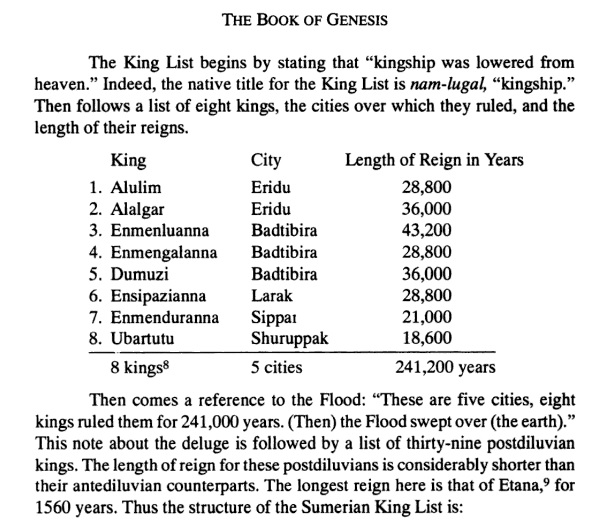
Ancient Texts Reveal: Earth Was Ruled For 241.000 Years By 8 Kings Who Came From Heaven
Yesterday I watched “The Arrival” – the story and representation of the movie baffled me so much, that I had to make some digging throughout the internet.
Listed in 2 books on Google, the “Ancient Writings to Sacred Texts: The Old Testament and Apocrypha” and “The Book of Genesis“, say that 8 Immortal Kings ruled The Earth for 241,200 years, although that wasn’t enough of a proof for me, so I kept digging.
From the “Book of Genesis“
A dozen copies of a mysterious text referred to as the Sumerian King Lists – “an ancient stone tablet originally recorded in the Sumerian language, listing kings of Sumer (ancient southern Iraq) from Sumerian and neighboring dynasties, their supposed reign lengths, and the locations of the kingship” – have been uncovered over the years by archaeologists in regions as disparate as ancient Babylon, Susa, and Assyria.
They are all believed to be copies of a single original manuscript which is thought to have been written during the Third Dynasty of Ur by most historians, although some believe it might have been written even earlier.
The best-preserved example of this ancient text is called the Weld-Blundell Prism and is on public display in the Ashmolean Museum.
The Sumerian King Lists have shocked historians ever since they were uncovered by modern human beings.
The text describes a fascinating period in history when beings referred to as gods ruled over humankind of tens of thousands of years.
Each of these kings met their end during the Great Flood which devastated the population of the world. After the flood, the text claims that another ‘kingship was lowered from heaven’ and that these beings took up control of the people of Earth once again.
New Planet Discoveries Signal a Shift in the Hunt for Alien Life

An illustration shows what the landscape might look like from the surface of Proxima b, currently the closest known exoplanet that is potentially habitable.
PHOTO ILLUSTRATION BY ESO, M. KORNMESSEROur galaxy is positively stuffed with alien worlds.
That exoplanets swarm the Milky Way, and that a good fraction of them are small, rocky, and temperate like the planet we live on, means the search for life beyond Earth is moving past the question of whether these worlds are common and on to the more profound question of whether those faraway worlds also host life.
“We’re no longer wondering if rocky planets are in the habitable zones of stars,” the University of Arizona’s Olivier Guyon said during last week’sBreakthrough Discuss conference, hosted by the Breakthrough Initiatives. “As far as we can tell, they’re everywhere. We’re transitioning into life-finding. We have a lot of work ahead of us.”
Tantalizingly, some of those worlds circle the stars nearest the sun, and they are in orbits that make it likely that liquid water dampens their surfaces. Scientists are not even close to nailing down which characteristics tell us that, yes, a planet is indeed habitable, or to parsing all the ways in which life might write its signatures, whether biological or technological.
Still, some of the most intriguing planets are relatively nearby, which makes them obvious targets in the search for life—as well as possible destinations for the first wave of dedicated interstellar spacecraft.
The sun’s neighborhood is filled with small, dim red stars called M dwarfs. Though they’re the most common type of star in the galaxy, these dwarfs weren’t always considered good places to search for habitable planets—that’s only become a trend over the last couple of years. Now, based on data from several surveys, we know that one out of every four M dwarfs has a planet that’s the same size and temperature as Earth, says Caltech’sCourtney Dressing.
Take the star just next door, a red dwarf 4.24 light-years away called Proxima Centauri. It has a planet.
Actually, there’s at least one planet around that small star. At the Breakthrough meeting, Guillem Anglada-Escude, of Queen Mary University of London, pointed to two other intriguing signals in his team’s data. Neither of the other two signals can be confirmed as the fingerprint of a planet right now, but the team hopes more observations will reveal an answer.

This Hubble picture shows Alpha Centauri A and Alpha Centauri B, the brightest members of the stellar trio collectively known as Alpha Centauri, the closest star system to our own. The third star, Proxima Centauri, is fainter but is the closest to Earth of the three.
PHOTOGRAPH BY ESA/HUBBLE & NASASlightly farther afield, another candidate world orbits a dim, cool star six light-years from the sun. Named after astronomer E.E. Barnard, this next-nearest star has been the hypothetical host of planets for decades, ever since Dutch astronomer Peter van de Kamp erroneously announced in the 1960s that at least one gas giant lived there.
If the freshly detected world is really there, it’s more massive than Earth and is likely too cool to be considered habitable. But planets don’t usually form in isolation, so it does offer hope for future finds around Barnard’s star.
“We will be hunting for warm planets in the summer, but there is not such a clear candidate for a warm planet yet,” Anglada-Escude said.
And Luyten’s star, a red dwarf 12.3 light-years from the sun, hosts not one but two confirmed planets, one of which is in a habitable orbit. There are a handful of other stars within 30 light-years or so that could have worlds of their own. That so many potentially habitable exoplanets are hanging out nearby “builds up the case for developing direct-imaging techniques leading to characterization,” Anglada-Escude says.
“I think there’s a good chance that a planet that has life on it orbits one of the nearby M dwarfs we’ve already heard about today,” Dressing said, referring to the planets around Proxima Centauri and two small, more distant stars called TRAPPIST-1 and LHS 1140 that have captured recent headlines.
In other words, it’s no longer enough to know that these planets are there. It’s time to get to know them.
The best worlds to scrutinize for signs of life—for the foreseeable future, at least—will need to orbit close enough to Earth for telescopes to get a good look, and be positioned so that they cross their host star’s face from our perspective. That way, light from the star can filter through any potential atmosphere and allow us to read its contents.
That’s one of many tasks NASA’s Transiting Exoplanet Survey Satelliteand the James Webb Space Telescope, among other projects, are gearing up to do over the next decade. If all goes to plan, TESS will find more planets worth staring at, and JWST will use its powerful eye to peer through any distant atmospheres, looking for molecules that might betray the presence of life.
At the Breakthrough meeting, Cornell University’s Lisa Kaltenegger and others proposed that something like a mix of methane and oxygen-containing gases such as ozone could herald the discovery of extraterrestrial life—if they were found wafting through the air curled around a rocky, temperate planet. But even that isn’t a slam-dunk. Proving life was truly responsible for those gases promises to be a controversial, Herculean task.
Plus, there are plenty of unfamiliar ways for life to find a foothold, using alien metabolisms that produce unexpected signatures. Kaltenegger and Cornell’s Jack O’Malley-James suggested last year that life-forms on Proxima’s planet, for example, could have evolved to use their star’s predominantly UV light by generating fluorescent proteins, and that telescopes on Earth could be tasked with looking for fluorescent biosignatures.
Recognizing life in all its possible biological forms isn’t just a question that’s plaguing exoplanet experts—it’s something scientists searching for life in the icy oceans of the outer solar system are also grappling with.
“We have one data point for life: That’s our own planet,” Kaltenegger says. “So for now, we’ll use what we know from the Earth. If we get a second data point, which I hope we do, I think all our priorities are going to change.”
Then there’s the question of techno-signatures, which could take the form of alien radio transmissions, pulsed laser beams, waste heat generated by advanced civilizations, bizarre blips in stellar brightness, or even the disappearance of host stars entirely. In other words, scientists searching for manifestations of advanced civilizations ought to expect the unexpected and search for the weird, though proving a technological origin rather than a funky astrophysical one, will also be quite difficult.
“We really do need to embrace this idea that it may be little gray boxes, not little green men, that we end up detecting,” said the SETI Institute’s Jill Tarter.
Merely finding life, no matter how far-flung or bizarre, doesn’t necessarily tell us how it sprouted, and whether the process was any different from the origins of life on Earth. That is an even tougher and more nagging question, says NASA astrobiologist Chris McKay.
Proving a second origin—and therefore making a more profound commentary on the fundamental prevalence of life—can be done from afar, McKay said, although it’s just on the hairy edge of possibility.
Astronomers could look for the “handedness” of alien biomolecules and see if it matches what we have on Earth. Here, the molecules that build our proteins are asymmetric and assume what scientists refer to as a left-handed chirality—meaning they’re mirror images of hypothetical right-handed forms, and they twist light in a particular direction.
There’s no easy answer for why or when lefties ended up dominating Earth’s amino acids (this is a subject of great debate), but biochemists generally think single-handedness is crucial for efficient molecular engines.
Finding evidence for right-handed molecules in the gases of an exoplanet, or in the plumes of an icy moon in this solar system, would be strong (though not necessarily iron-clad) evidence for a second origin, McKay says.
The next big leap in exploring questions about alien worlds is to visit one up close, and that’s where the Breakthrough Starshot project comes into play. If the team succeeds, humanity will propel a nano-sized spacecraft to the Alpha Centauri system in the next several decades and capture the first images of an exoplanet from within its own system.
It’s a lot to hope for, but answering one of the stickiest, most profound questions humanity can ask will necessarily demand perseverance, patience, and fearlessness. And perhaps one day, the answer to whether we’re alone in the cosmos will be as definitive as whether other planets are spinning in the sky.

Nadia Drake is a science journalist who writes the National Geographic blog No Place Like Home.
Aliens exist and they’re ‘a lot smarter’ than us: Ridley Scott
Paging Ellen Ripley!
“Alien” director Ridley Scott believes aliens actually exist — and that they’re coming for us.
“I believe in superior beings,” the filmmaker said Thursday, while promoting the sixth installment in the sci-fi horror franchise, “Alien: Covenant.”
“I think it is certainly likely,” he told the Agence France-Presse. “An expert I was talking to at NASA said to me, ‘Have you ever looked in the sky at night? You mean to tell me we are it?’ That’s ridiculous.
“The experts have now put a number on it having assessed what is out there,” Scott added. “They say that there are between 100 and 200 entities that could be having a similar evolution to us right now. So when you see a big thing in the sky, run for it.”
The veteran director was one of the first to make space scary with 1979’s “Alien,” which became a hit with both fans and critics, spawning prequels, books, toys and video games.
His “Xenomorph” and “chestburster” aliens have terrified moviegoers for nearly four decades — wreaking havoc on the film’s main character, Ripley, played by Sigourney Weaver while leaving loads of bodies in their wake.
Scott said Thursday he believes real-life extra-terrestials would also not be ones to mess with.
“They are a lot smarter than we are,” he explained. “If you are stupid enough to challenge them you will be taken out in three seconds.”
But Scott claimed he would have nothing to worry about.
“Nothing scares me,” he joked. “I have a 9mm (pistol).”
“Alien: Covenant” will open nationwide on May 19.
Alien Life On TRAPPIST-1: Planets Close Enough For Travel
There are aliens out there says director Ridley Scott

"Alien" creator Ridley Scott said Thursday that he was convinced that there are aliens out there -- and one day they will come for us.
The veteran director said he believed in higher beings as he prepared to release the sixth episode of the sci-fi horror series, "Alien: Covenant", next month.
"I believe in superior beings. I think it is certainly likely. An expert I was talking to at NASA said to me, 'Have you ever looked in the sky at night? You mean to tell me we are it?' That's ridiculous.
"The experts have now put a number on it having assessed what is out there. They say that there are between 100 and 200 entities that could be having a similar evolution to us right now.
"So when you see a big thing in the sky, run for it," he joked.
"Because they are a lot smarter than we are, and if you are stupid enough to challenge them you will be taken out in three seconds."
"Alien: Covenant" the second of the prequel films, is set in 2104 on board a spaceship carrying 2,000 cryogenically frozen colonists to a distant planet when they chance upon an uncharted paradise.
But their voyage soon turns into a gory nightmare that makes "Alien'"s original "chestbuster" scene seem tame in comparison.
- 'Hideous beyond belief' -
The "neomorph" aliens in the new film are based on the goblin shark "which has a jaw which hinges in two ways. It's scary, hideous beyond belief actually," Scott said.
The 79-year-old British-born director -- who was also the brains behind "Blade Runner" -- said he never tired or scaring people out of their skins.

"When I did the first 'Alien' I had to get a sense of responsibility because the reaction to the kitchen ("chestbuser") scene with John Hurt was beyond anything I expected -- and it was not good," he told AFP.
"But the film was very successful because people are perverse."
He said he could not believe the terror he had created when he went to see people watching the film. "Everybody was half underneath the seat watching by the time you get to the kitchen scene. There was a woman underneath the seat with her husband holding her. I said this is not healthy."
Scott, however, claimed that he was unshockable.
"Nothing scares me. I have a 9mm (pistol)," he said.
"If there is a problem I tend to close down into calm. When you walk in in the morning on a film and 600 people turn and all look at you, that is scary," he said.
"Alien: Covenant" has a religious subtext, the director insisted.
He said he was "agnostic", but this did not stop him making a film about Moses, "Exodus: Gods and Kings", in 2014.
"Either religion is the greatest trick played on mankind. Or it is not, and that poses some great questions, and this film is a great context for those," he said.
Scott, who was knighted in 2003, is about to make a film about the Battle of Britain during World War II, when the Royal Air Force fought off the German Luftwaffe.
"Alien: Covenant" opens across the world from May 10.