Naar de inhoud

UFO'S of UAP'S, ASTRONOMIE, RUIMTEVAART, ARCHEOLOGIE, OUDHEIDKUNDE, SF-SNUFJES EN ANDERE ESOTERISCHE WETENSCHAPPEN - DE ALLERLAATSTE NIEUWTJES

UFO's of UAP'S in België en de rest van de wereld
akke.beakke.be
Ontdek de Fascinerende Wereld van UFO's en UAP's: Jouw Bron voor Onthullende Informatie! Ben jij ook gefascineerd door het onbekende? Wil je meer weten over UFO's en UAP's, niet alleen in België, maar over de hele wereld? Dan ben je op de juiste plek! België: Het Kloppend Hart van UFO-onderzoek In België is BUFON (Belgisch UFO-Netwerk) dé autoriteit op het gebied van UFO-onderzoek. Voor betrouwbare en objectieve informatie over deze intrigerende fenomenen, bezoek je zeker onze Facebook-pagina en deze blog. Maar dat is nog niet alles! Ontdek ook het Belgisch UFO-meldpunt en Caelestia, twee organisaties die diepgaand onderzoek verrichten, al zijn ze soms kritisch of sceptisch. Nederland: Een Schat aan Informatie Voor onze Nederlandse buren is er de schitterende website www.ufowijzer.nl, beheerd door Paul Harmans. Deze site biedt een schat aan informatie en artikelen die je niet wilt missen! Internationaal: MUFON - De Wereldwijde Autoriteit Neem ook een kijkje bij MUFON (Mutual UFO Network Inc.), een gerenommeerde Amerikaanse UFO-vereniging met afdelingen in de VS en wereldwijd. MUFON is toegewijd aan de wetenschappelijke en analytische studie van het UFO-fenomeen, en hun maandelijkse tijdschrift, The MUFON UFO-Journal, is een must-read voor elke UFO-enthousiasteling. Bezoek hun website op www.mufon.com voor meer informatie. Samenwerking en Toekomstvisie Sinds 1 februari 2020 is Pieter niet alleen ex-president van BUFON, maar ook de voormalige nationale directeur van MUFON in Vlaanderen en Nederland. Dit creëert een sterke samenwerking met de Franse MUFON Reseau MUFON/EUROP, wat ons in staat stelt om nog meer waardevolle inzichten te delen. Let op: Nepprofielen en Nieuwe Groeperingen Pas op voor een nieuwe groepering die zich ook BUFON noemt, maar geen enkele connectie heeft met onze gevestigde organisatie. Hoewel zij de naam geregistreerd hebben, kunnen ze het rijke verleden en de expertise van onze groep niet evenaren. We wensen hen veel succes, maar we blijven de autoriteit in UFO-onderzoek! Blijf Op De Hoogte! Wil jij de laatste nieuwtjes over UFO's, ruimtevaart, archeologie, en meer? Volg ons dan en duik samen met ons in de fascinerende wereld van het onbekende! Sluit je aan bij de gemeenschap van nieuwsgierige geesten die net als jij verlangen naar antwoorden en avonturen in de sterren! Heb je vragen of wil je meer weten? Aarzel dan niet om contact met ons op te nemen! Samen ontrafelen we het mysterie van de lucht en daarbuiten.

Atmosphere that could support alien life found on Earth-sized planet

 Atmosphere that could support alien life found on Earth-sized planet

Atmosphere that could support alien life found on Earth-sized planet
Trappist-1 and nearby planets could hold the key to alien life (Picture: Getty)

Scientists are getting excited at the prospect of finding alien life on a recently discovered Earth-sized planet.

The planet, LHS 1140b, is one of seven orbiting a star named Trappist-1.

prc_40204187.jpg?crop=180px%2C0px%2C842px%2C630px&resize=150%2C113&quality=80&strip=all&ssl=1&w=100&h=75Soon you'll be able to watch Netflix across Europe as EU bans geographical restrictions

It has immediately been pushed to the front of the queue in the quest to find alien life – because it lies in the ‘Goldilocks’ zone.

This is an area from a star where the surface temperature is not too hot, or too cold, but just right.

This means water could flow in liquid form, rather than as ice or vapour, allowing life to flourish.

Atmosphere that could support alien life found on Earth-sized planet
There are three planets in the ‘Goldilocks’ zone (Picture: Getty)

Astronomers studying the rocky world believe its atmosphere could have supported the world for billions of years.

Jason Dittmann of the Harvard Smithsonian Center for Astrophysics said: ‘This is the most exciting exoplanet I’ve seen in decades.

‘We could hardly hope for a better target to perform one of the biggest quests in science – searching for evidence of life beyond Earth.’

Further studies are set to take place on the planet, which is 39 light years from Earth.

All seven of Trappist-1’s planets are considered potential candidates for having water in some form, but the chances are highest for three located in the Goldilocks zone.

Xavier Bonfils, an astronomer at the Observatory of the Sciences of the Universe in Grenoble, France, said LHS 1140b now ‘joins Trappist-1 at the head of the rankings’.

He said: ‘We are very excited by this discovery. It’s a super opportunity.’

{  http://metro.co.uk/ }

Hoe vind je dit bericht?
Geschreven door peter om 00:22 Stuur door

Atmosphere discovery makes Trappist-1 exoplanet priority in hunt for alien life

Atmosphere discovery makes Trappist-1 exoplanet priority in hunt for alien life

An atmosphere that could have enveloped it for billions of years and possible liquid water make planet most likely home for life, say scientists

An artist’s impression the surface of Trappist-1f. Astronomers originally thought this might be the most habitable planet, but its neighbour, Trappist-1g, appears to be the most likely home for life.
 An artist’s impression the surface of Trappist-1f. Astronomers originally thought this might be the most habitable planet, but its neighbour, Trappist-1g, appears to be the most likely home for life.
Illustration: Nasa/JPL-Caltech/T. Pyle (IPAC) / HANDOUT/EPA

An Earth-sized world that swings around a star in the constellation of Aquarius has become a priority in the search for extraterrestrial life after scientists found that an atmosphere could have enveloped the planet for billions of years.

The planet is one of seven circling a small and feeble star called Trappist-1 which astronomers reported in a wave of excitement in February this year. The rocky world lies in the habitable zone around its parent star, where temperatures should allow for free-running water, but that would count for little if the planet has no atmosphere.

“Since the discovery of the seven planets there has been a great deal of interest in using telescopes such as the upcoming James Webb Space Telescope to determine whether these planets have atmospheres, and if so, what their composition is like,” said Manasvi Lingam at Harvard University. “It is fair to say that the presence of an atmosphere is perceived as one of the requirements for the habitability of a planet.”

If Earth serves as a good example, the evolution of complex and ultimately intelligent life calls for an atmosphere that not only contains the right blend of gases, but which persists for hundreds of millions, or preferably billions, of years.

With Nasa’s James Webb Space Telescope not due to launch until late 2018, the scientists turned to computer models to find out whether the Trappist-1 planets could have long-lived atmospheres. From details of the Trappist-1 system, which lies 39 light years distant, they worked out the intensity of the stellar wind – the rush of high energy particles streaming out of the star – and the effect it would have on the seven orbiting planets.

The sixth planet, Trappist-1g, appears to be the most likely home for life in the Trappist-1 system.
The Astronomers have used computer models to determine whether the seven Trappist-1 exoplanets could have long-lived atmospheres, thought to be a requirement for complex life. Illustration: NASA/PA

Atmospheres that exist around planets soon after they form can gradually be stripped away if they are battered by a strong stellar wind from their parent star. The model showed that the stellar wind from Trappist-1 was much faster and far more dense than the solar wind that reaches Earth. On Trappist-1b, the first planet from the star, the stellar wind was 1,000 to 10,000 times stronger than the solar wind that strikes Earth.

The intensity of the solar wind destroyed the atmospheres of the inner Trappist-1 planets within millions of years. But planets further out fared better, their atmospheres surviving for billions of years, the models found. According to the scientists, while the seventh planet around the star is considered too cold for liquid water to exist on the surface, the sixth planet, Trappist-1g, appears to be the most likely home for life in the Trappist-1 system.

In a report submitted to a leading journal, the scientists write: “The outer planets of the Trappist-1 system, which are expected to retain their atmospheres for longer periods, may therefore support more complex biospheres eventually.”

Amaury Triaud, an exoplanet researcher at Cambridge University who helped discover the Trappist-1 planets said: “The work is quite optimistic that the planets could retain an atmosphere, which is nice to hear. It prepares us for what we might or might not see. Maybe we’ll find atmospheres that are denser and denser for the outer planets.”

“Having too much of an atmosphere containing a lot of hydrogen would be detrimental for life, but if you strip everything down to the surface, it’s also no longer habitable. The moon is the same distance from the sun as the Earth and it has absolutely no signs of life,” he added.

Astronomers have now detected about 3,600 planets beyond the solar system. The Trappist-1 planets orbit incredibly close to their parent, an ultracool dwarf star the size of Jupiter that shines 2,000 times less brightly than the sun. Mercury, the innermost planet in our solar system, is six times farther from the sun than the outermost seventh planet is from Trappist-1.

All seven of the planets have Earth-like dimensions, ranging from 25% smaller to 10% larger than our home planet. Most, if not all, will be “tidally locked”, meaning they show only one face to their star. Such worlds would be defined by stark divisions, with one half in constant daylight, and the other in permanent darkness.

“We don’t really know how life started,” Triaud said. “Some people say life was born at the bottom of the ocean. If that is the case and there is a lot of water on the Trappist-1 planets, then it’s good news: it doesn’t matter which side it is on, because at the bottom of the ocean you have no light at all.

“But if life is born on the surface then the UV irradiation the planets receive is important. It drives chemical reactions to begin with, but it can become an issue for DNA mutations, and whether they were on the day or the night side would matter. There really are a lot of elements,” he said.

{ https://www.theguardian.com/international }

Hoe vind je dit bericht?
Geschreven door peter om 00:13 Stuur door

UFO hunters spot ‘flying disc’ near International Space Station

UFO hunters spot ‘flying disc’ near International Space Station

A mysterious object appeared to have hovered past the International Space Station, according to new video footage from UFO researchers.

SecureTeam 10, who in recent days has posted videos about a supposed alien tank and a cigar-shaped disc over Paris, claims that a disc-shaped object whizzed past the ISS “at a very high rate of speed.”

NASA, which did not respond specifically to the latest video, has often said the objects are “distortions in a lens” and do not signify the presence of extraterrestrial life.

Tyler Glockner, the voice heard on the video from SecureTeam 10, said the object in the video moved “as if it knew the camera was watching.”

FILED UNDER ALIENS ,  INTERNATIONAL SPACE STATION ,  UFOS
Hoe vind je dit bericht?
Geschreven door peter om 23:51 Stuur door

A New Look at Proxima b's Potential Climate Offers Hope for Future Colonists

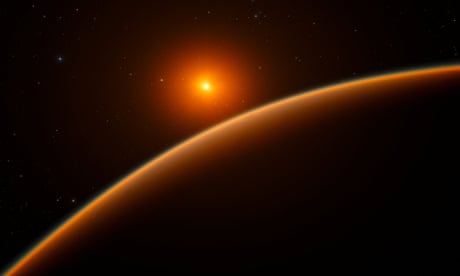
Artist’s rendition of the surface of Proxima b, our nearest neighboring exoplanet. Image: ESO/M. Kornmesser

Ever since astronomers announced the discovery of an Earth-sized exoplanet less than five light years down the cosmic street, the question on every good space cadet’s mind has been whether or not we can colonize it. We’re not going to know if Proxima b is habitable until we can point some very powerful telescopes at it, which won’t happen until next year. But until then, scientists are playing around with models—and one such modeling effort recently came to some promising conclusions.

If Proxima b has an Earth-like atmosphere, researchers found, it might just be a comfortable place to live. A (probably) rocky planet located a measly 25 trillion miles away, Proxima b lies squarely in the “habitable zone” of its star—a tempestuous red dwarf called Proxima Centauri—meaning it might be able to support liquid water, and even life. The latter is still a big question mark, but as we wait for more data, a UK-based team of scientists is trying to figure out whether Proxima b might have the stable climate and reasonable temperatures necessary for life.

So the researchers turned to the Met Office Unified Model, one of the foremost models for studying the climate here on Earth. The team modified this model for extraterrestrial forecasting by considering two potential atmospheres: an Earth-like one rich in nitrogen and oxygen, and a simple nitrogen atmosphere containing trace amounts of CO2. Then they ran their simulations considering a few hypothetical orbits for Proxima b, including one in which the planet is tidally locked, with a permanent dayside and a permanent nightside, and an orbit similar to that of Mercury. The researchers also considered differences in the star’s light output, which produces more infrared and less visible light than our Sun.

Overall, the findings published this week in Astronomy and Astrophysics were promising. In both tidally locked and Mercury-like orbits, the planet’s hypothetical climate featured stable surface temperatures conducive to liquid water, supporting and extending the results of previous studies. Although not all parts of Proxima b were habitable in all simulations (the night side in the tidally locked scenario hovered around a nice, balmy -200 degrees Fahrenheit), the models pointed to enough warmish regions to make our neighboring exoplanet a very acceptable interstellar vacation spot.

Caveats abound, however. First and foremost, these models assume Proxima bhas an atmosphere, which might not be the case at all. In fact, as another recent modeling study demonstrated, planets in tight orbits around red dwarf stars might be getting lashed by an insane number of high-energy solar flares, stripping their atmospheres faster than they can be replenished. No atmosphere, no rivers, lakes or oceans, no life as we know it.

The model has other limitations, too—for instance, it didn’t consider what the surface of Proxima b is like at all. As we know from studying Earth’s climate, the mixture of land, water, and ice coating a planet has an enormous impact on its temperature.

Avi Loeb, chair of Harvard’s astronomy department and an advisor for Breakthrough Starshot, an effort to send an interstellar probe to the Alpha Centauri system (which includes Proxima Centauri), called the study’s results “encouraging” but agreed that the results are “predicated on an atmosphere being present which remains to be seen.” The way forward, Loeb told Gizmodo, is to figure out whether Proxima b actually has an atmosphere by observing it, and if so, to figure out what it’s made of.

Both questions require more powerful telescopes than our current state of the art, but the technology is on its way. In the meantime, studies like this inject hope in the quest to find habitable worlds beyond Earth, serving to inspire scientists and motivate further investigations. Maybe we’ll even make that interstellar voyage to settle the matter once and for all.

[Astronomy and Astrophysics]

{ http://gizmodo.com/ }

Hoe vind je dit bericht?
Geschreven door peter om 23:39 Stuur door

CNY UFO Researcher & Writer Crunches Data, has New Discoveries on (possible) Visits

CNY UFO Researcher & Writer Crunches Data, has New Discoveries on (possible) Visits

Cover Art on UFO Sightings Desk Reference, a composite drawing by Susann Snyder based on reported UFO shapes seen by people who made reports. The new book by Cheryl Costa and Linda Miller Costa is drawing media and researcher attention
CREDIT SUSANN SNYDER

We’ve all gazed into the sky to look at the moon, maybe a shooting star, and possibly something we couldn’t quite explain.  Cheryl Costa has been following U-F-O sightings for years and writes a column for the New Times and a blog.  In 2015 She and her wife Linda Miller Costa cast an eye on actual reports

“We figured let’s crunch the data for New York and it suddenly started revealing patterns that none of the UFO researchers in New York had ever seen before.” 

And then they decided to check out the entire nation…using that big data approach.

“I started downloading the National UFO Reporting Center databases for all 50 states.”

You might notice she’s not trying to convince you.

ufo_nys_sightings.png
(CLICK TO ENLARGE) -- Yearly data shows reports of UFO sightings increased over the past 15 years.
CREDIT COSTA AND COSTA "UFO SIGHTINGS DESK REFERENCE"

“We couldn’t set out to prove alien life exists.  But people have been telling us for a number of years, ‘UFO sightings, they’ve been on the decline since the 1980s.’  Well, we set out to prove that wrong.”

Her book, UFO Sightings Desk Reference 2001-2015, has break downs of the reported sightings from every state, down to the county level.  The information came from the national organizations that collect sighting reports, the Mutual UFO Network (MUFON) and the National UFO Reporting Center (NUFORC). 

What they found – 121-thousand reported sightings from 2000 to 2015 …5200-plus in New York, and on the increase. 

SIGHTINGS BY-THE-NUMBERS FOR NEW YORK STATE AND LOCAL COUNTIES

  • 5141 - Total reported sightings in New York State 2001-2015
  • 161 - Total reported sightings in Onondaga County 2001-2015
  • 105 - Total reported sightings in Oneida County 2001-2015
  • 31 - Total reported sightings in Onondaga County 2001-2015
  • 554 - Total reported sightings in Suffolk County 2001-2015 (most in state)
  • 657- Number of reports seeing a Circle Shape (highest shape frequency in state reports)

But Costa says the data revealed other findings…like clusters around the Saint Lawrence and Hudson rivers.

“Those two waterways alone, on a first appearance, it doesn’t look that way, but when you add them up, they are 51% of New York State’s sightings and people have always been saying these things hang out around water for some reason.”

ufo_shapes_onon_cnty.png
Frequency of shapes people reported seeing in Onondaga County.
CREDIT COSTA AND COSTA "UFO SIGHTINGS DESK REFERENCE"

I talked with Cheryl up on Onondaga Hill, thinking less light pollution = more sightings.  But she said the bulk come from urban areas.

“It raises the question, ‘Are we seeing more UFOs in the city because there’s more people there to see them, or is it because there’s more people there and the UFOs are studying the people.”

Costa emphasizes her book UFO Sightings Desk Reference – mostly charts and graphs of data, state by state – down to county level – does not prove existence.  That’s a job, she says for scientists, academics, maybe government, even though the Air force stopped investigating reports in 1968.  The book does group sightings by form, a disc, cigar-shaped …and Costa says the truth is in the shapes and the 6-7 percent that can’t be explained away.

Hoe vind je dit bericht?
Geschreven door peter om 23:29 Stuur door

Central Coast UFO group funding mystery: Federal minister calls for urgent review

A UFO group on the Central Coast says “anything’s possible” when it comes to the possibility of aliens checking out life on Earth.

Central Coast UFO group funding mystery: Federal minister calls for urgent review

Hoe vind je dit bericht?
Geschreven door peter om 23:13 Stuur door

Watch the Bright Dwarf Planet Ceres Spin in New Video

Watch the Bright Dwarf Planet Ceres Spin in New Video

 
The dwarf planet Ceres shines and spins in a new video from NASA's Dawn spacecraft.

Ceres appears especially bright because Dawn captured the imagery while the dwarf planet was at "opposition" — that is, when the spacecraft was directly between Ceres and the sun.

"Based on data from ground-based telescopes and spacecraft that previously viewed planetary bodies at opposition, scientists correctly predicted that Ceres would appear brighter from this opposition configuration," NASA officials wrote in a description of the new video, which was released Tuesday (May 16). [More NASA photos of the dwarf planet Ceres]

"This increase in brightness, or 'surge,' relates the size of the grains of material on the surface, as well as the porosity of those materials," they added.

Dawn took the photos that make up the video on April 29, from a distance of about 12,000 miles (19,300 kilometers). Mission team members shifted the spacecraft into a special orbit to view the 56-mile-wide (90 km) Occator Crater from this opposition perspective, NASA officials said. 

Occator stands out clearly in the video: It harbors the brightest of Ceres' mysterious bright spots, which scientists think reveal the presence of some type of salt on the body's surface.

The dwarf planet Ceres spins in this series of photos captured by NASA's Dawn spacecraft on April 29, 2017, when the probe was between Ceres and the sun.
Credit: NASA/JPL-Caltech/UCLA/MPS/DLR/IDA

The $467 million Dawn mission launched in September 2007 to study Vesta and Ceres, the two largest objects in the main asteroid belt between Mars and Jupiter. Dawn circled Vesta from July 2011 through September 2012 and reached Ceres in March 2015. In the process, it became the first spacecraft ever to orbit two different bodies beyond the Earth-moon system.

"Dawn's observations of Ceres during its more than two years there cover a broader range of illumination angles than almost any body in the solar system," NASA officials wrote in the same statement. "This provides scientists with an opportunity to gain new insights into the surface properties. They are currently analyzing the new data."

Last month, Dawn lost the third of its four orientation-maintaining reaction wheels. But the failure has not unduly affected the probe or its mission, NASA officials said; Dawn's handlers are used to orienting the spacecraft with its hydrazine thrusters and will continue to do so into the future.

Follow Mike Wall on Twitter @michaeldwall and Google+. Follow us @Spacedotcom, Facebook or Google+. Originally published on Space.com.

EDITOR'S RECOMMENDATIONS

{ http://www.space.com/ }

Hoe vind je dit bericht?
Geschreven door peter om 22:56 Stuur door

How Do Scientists Search for Extraterrestrial Life?

How Do Scientists Search for Extraterrestrial Life?

The James Webb Space Telescope, expected to launch in 2018, will offer views of distant galaxies in unprecedented detail, and could reveal undiscovered Earth-like planets.
Credit: Northrop Grumman

Human civilizations dating back thousands of years left behind structures and records documenting their studies of the stars as they sought to chart the seasons, help travelers find their way and interpret the world around them. Stargazers among the ancient Greeks, Maya, Egyptians, Middle Easterners and Asians likely also pondered if there were other planets like ours among those distant points of light — and if so, what might live there.

Over the last century, science-fiction storytellers have used books, movies, comics and television to speculate at great length about contact with creatures from other worlds — to our benefit and our detriment. These creatures have been imagined as sometimes benevolent and sometimes bloodthirsty, and they have come in a wide range of shapes and sizes — from inquisitive "little green men" to human-parasitizing, chest-bursting Xenomorphs in the "Alien" movie franchise.

Present-day astronomers have likewise been probing this question, using sophisticated equipment to listen farther and peer deeper into the universe than ever before, to find evidence of our cosmic neighbors. From detecting unexplained radio signals to investigating the atmospheres and liquid water on distant worlds — how are scientists searching for signs of extraterrestrial life? [Greetings, Earthlings! 8 Ways Aliens Could Contact Us]

For an alien-seeking scientist, "life" means any living form — including microbes, astronomer Mercedes López-Morales, at the Harvard-Smithsonian Center for Astrophysics in Cambridge, Massachusetts, told Live Science.

But even the smallest microbe living on a distant exoplanet — a planet orbiting a star other than our sun — could still broadcast a chemical signal that would be visible to sensitive telescopes, in the form of atmospheric gases that probably wouldn't be there in the absence of life, López-Morales explained.

"Life affects the atmosphere of a planet," she said. "You have gases that are only there because they are constantly being replenished by something — otherwise, they would react with other gases and disappear. For that gas or that molecule to be in the atmosphere of a planet, it must have some mechanism that is continuously producing it," López-Morales said.

One of the atmospheric gases astronomers are searching for in exoplanets is oxygen, which is plentiful in Earth's atmosphere because it is continuously being replaced by plants through photosynthesis.

However, the presence of unusual atmospheric gases doesn't necessarily mean that something living is generating them, López-Morales added.

"Sulfur molecules, for example, could come from active volcanoes," she explained. "For oxygen, there are at least two or three ways to produce it that involve irradiation in the ultraviolet light coming from stars. But we know that oxygen appeared on Earth because life appeared on Earth," she said.

An artist's concept imagines the surface of the exoplanet TRAPPIST-1f, located in the TRAPPIST-1 system in the constellation Aquarius, where liquid water could harbor extraterrestrial life.
Credit: NASA/JPL-Caltech/T-Pyle (IPAC)

Of course, even if these chemical signatures can be detected, there's no way to tell what forms of life are producing the signal, Sara Seager, an astrophysicist and planetary scientist at MIT, told Live Science in an email.

And what type of exoplanet is a good candidate for life? Our familiarity with our own world nudges efforts toward those that resemble Earth — "a rocky planet with a thin atmosphere with surface water," Seager said.

"Right now, we can tell — for some planets — if they are rocky, based on planet size and planet mass, which gives average density. But we can't yet tell if a planet has liquid water," she said. [A Field Guide to Alien Planets]

What else makes an exoplanet a promising candidate? "Anything close by," López-Morales told Live Science. For an astronomer, that means less than 30 light-years away, which would enable humans to actually visit the world where life was detected, she said. (One light-year is about 5.9 trillion miles, or 9.5 trillion kilometers.)

"Eventually, I hope humans will have the technology to get that far, within a reasonable number of years. So for us, the holy grail is to find something within 30 light-years of Earth," she said.

Scientists are also investigating worlds within our own solar system — such as the Saturn moons Titan and Enceladus — which are close enough to be visited by probes that can collect samples and capture images. Several NASA missions are also looking closely at Mars, which once had abundant liquid water on its surface, and where brackish water still flows today, researchers announced in 2015.


This May 11, 2016, self-portrait of NASA's Curiosity Mars rover shows the vehicle at the "Okoruso" drilling site on lower Mount Sharp's "Naukluft Plateau." Scientists want to send Curiosity higher on Mount Sharp, to look for evidence of liquid water.
Credit: NASA/JPL-Caltech/MSSS

"Humans are creatures that want to know — where we came from, where we're going, how we appeared on Earth," López-Morales said. "Our research might start providing answers to that." [FAQ: Significance of Liquid Water on Mars]

But scientists aren't just looking for signs of extraterrestrial life — they're also listening for them.

For more than two decades, SETI, the Search for Extraterrestrial Intelligence Institute, has conducted research to understand the origins of life in the universe, and to detect and analyze evidence of life emanating from places other than Earth. This effort includes investigations of microbial life within our solar system, such as on the surface of Mars or under the icy crust of Jupiter's moon Europa. SETI scientists are also monitoring the universe for signals in light or radio wavelengths that originate far away and could be signs of technologically advanced alien life, SETI explains on its website.

At SETI, astronomers use the Allen Telescope Array (ATA) of 42 radio antennas to "listen" for signals over a range of radio frequencies, tuned to "hear" the regions around 20,000 red dwarf stars (a broad term describing stars smaller than our sun and in a certain spectral range) that are closest to Earth, Seth Shostak, a senior astronomer at the SETI Institute, told Live Science.

The radio astronomy facility at Owens Valley Observatory in Owens Valley California, which has been used by the SETI program.
Credit: Harun Mehmedinovic and Gavin Heffernan

Investigating red dwarf stars for life-supporting worlds is a relatively recent development at SETI. In the past, stars that were more like our own sun — a yellow dwarf — were thought to be the most likely candidates to host planets harboring life. But over the last few decades, astronomers have determined that many red dwarf stars host planets that could be at the right distance from the star to be habitable, according to Shostak.

"That's something we didn't know when we started," he said.

And SETI radio-signal monitoring is accelerating, as telescopes become more sensitive and technological developments increase the number of radio channels and locations in the sky that can be studied at once, Shostak explained.

"Until now, the total number of star systems that have been looked at carefully over a wide range of the radio dial is measured in the thousands. In the next 20 years, with new technology, you could increase that number to maybe a million," he said. [4 Places Where Alien Life May Lurk in the Solar System]

Shostak also reviews images of alleged alien spacecraft sent to him by hopeful photographers, he told Live Science. A photographer himself, Shostak said that he invariably identifies all the purported "UFO" sightings as tricks of the light or internal reflections in the camera lens — much to the dismay of the observers.

"That never makes them happy," he said.

But even among astronomers, unusual observations can sometimes turn the conversation toward the likelihood of alien technology.

In 2015, when scientists discovered the star KIC 8462852 — also known as Tabby's Star, located more than 1,400 light-years from Earth — they were puzzled by repeated and significant dips in its brightness that took place over several years. During the dips, the star dimmed by as much as 22 percent, far more than could be caused by an orbiting planet passing in front of the star, Shostak said.

In short, the star was "really weird," Tabetha Boyajian, lead author of a study about the star and a researcher at Yale University, told the Atlantic in October of that year.

One possible explanation suggested by some experts was an "alien megastructure," an enormous array orbiting KIC 8462852, built by a hypothetical alien civilization advanced enough to possess technology capable of drawing power from a star. Such a construct could — in theory — periodically block visible light and make the star appear dramatically dimmer when seen from Earth, Space.com reported in 2015.

However, there is no data to actively support this hypothesis. In fact, on all fronts, evidence of any extraterrestrial presence — within our own solar system or beyond its boundaries — remains elusive. But scientists seeking life on other worlds are undaunted by the ongoing challenge, Shostak told Live Science.

"The search should continue, simply because it's a very interesting question," he said.

"Is Earth special? Is it the only place around with intelligent life? That would be remarkable — but it's just as remarkable to find you're not the only kid on the block. That's something that would change our view of ourselves forever," he said.

Original article on Live Science.

{http://www.livescience.com }

Hoe vind je dit bericht?
Geschreven door peter om 22:33 Stuur door

The Search for Life on Mars Is About to Get Weird

The Search for Life on Mars Is About to Get Weird

The Search for Life on Mars Is About to Get Weird
This recent self-portrait from NASA’s Curiosity rover shows the robot shortly after it retrieved a sample of dark sand from shifting dunes along the flank of a Martian hillside.
Credit: NASA/JPL-Caltech/MSSS

MESA, Arizona — Since the dawn of the space age NASA and other agencies have spent billions of dollars to reconnoiter Mars — assailing it with spacecraft flybys, photo-snapping orbiters and landers nose-diving onto its surface. The odds are good, many scientists say, for the Red Planet being an extraterrestrial address for alien life — good enough to sustain decades' worth of landing very expensive robots to ping it with radar, zap it with lasers, trundle across its terrain and scoop up its dirt. Yet against all odds (and researchers' hopes for a watershed discovery), Mars remains a poker-faced world that holds its cards tight. No convincing signs of life have emerged. But astrobiologists continue to, quite literally, chip away at finding the truth.

As the search becomes more heated (some would say more desperate), scientists are entertaining an ever-increasing number of possible explanations for Martian biology as a no-show. For example, could there be a "cover up" whereby the harsh Martian environment somehow obliterates all biosignatures—all signs of past or present life? Or perhaps life there is just so alien its biosignatures are simply unrecognizable to us, hidden in plain view.

Of course, the perplexing quest to find life on Mars may have a simple solution: It's not there, and never was. But as the proceedings of this year's Astrobiology Science Conference held here in April made clear, life-seeking scientists are not giving up yet. Instead, they are getting more creative, proposing new strategies and technologies to shape the next generation of Mars exploration.

A SLUMBERING BIOSPHERE?

Talk about looking for Martians and you inevitably talk about water, the almost-magical liquid that sustains all life on Earth and seems to have served as an indispensable kick-starter for biology in our planet's deepest past. "It all started out with ‘follow the water;' not necessarily ‘follow the life'…but ‘follow one of the basic requirements for living systems,'" says Arizona State University geologist Jack Farmer, referring to NASA's oft-repeated mantra for Martian exploration. "There are many indications of water on Mars in the past, perhaps reservoirs of water in the near subsurface as well," he says. "But what is the quality of that water? Is it really salty—too salty for life?"

Without liquid water, Farmer points out, one would naively think organisms cannot function. The reality may be more complex: on Earth, some resilient organisms such as tardigrades can enter a profound, almost indefinite state of hibernation when deprived of moisture, preserving their desiccated tissues but neither growing nor reproducing. It is possible, Farmer says, that Martian microbes could spend most of their time as inert spores "waiting for something good to happen," only springing to life given the right and very rare conditions. Certain varieties of Earthly "extremophiles"—microbes that live at extremes of temperature, pressure, salinity and so on—exhibit similar behavior.

Farmer says there is as yet no general consensus about the best way to go about life detection on the Red Planet. This is due in no small part to the runaway pace of progress in biotechnology, which has led to innovations such as chemistry labs shrunken down to fit on a computer chip. These technologies "have been revolutionizing the medical field, and have now started to enter into concepts for life detection on Mars," he explains. Things move so fast that today's best technology for finding Martian biology may be tomorrow's laughably obsolete dead-end.

But no matter how sophisticated a lab on a chip might be, it won't deliver results if it is not sent to the right place. Farmer suspects that seriously seeking traces of life requires deep drilling on Mars. "I basically think we're going to have to gain access to the subsurface and look for the fossil record," he explains. But discovering a clear, unambiguous fossil biosignature on Mars would also raise a red flag. "We probably would approach the future of Mars exploration—particularly accessing habitable zones of liquid water in the deep subsurface—more cautiously, because life could still be there. So planetary protection would be taken very seriously," he says. ("Planetary protection" is the term scientists commonly use for precautions to minimize the chance of biological contamination between worlds. Think of it not so much in terms of bug-eyed aliens running rampant on Earth but of billion-dollar robots finding "Martians" that prove to only be hardy bacterial hitchhikers imported from our own world).

THE MARTIAN UNDERGROUND

Like-minded about deep diving on Mars is Penelope Boston, director of the NASA Astrobiology Institute at the agency's Ames Research Center. "That's my bias," she says. "Given Mars' current state, with all the challenging surface manifestations of dryness, radiation and little atmosphere, the best hope for life still extant on Mars is subsurface." The subsurface, she says, might also offer better chances of preserving past life—that is, of fossils, even if only of single-celled organisms.

The planet's depths hold the potential for harboring liquid water under certain circumstances, Boston thinks. But how far down might that water be? "I suspect it's pretty far…and how we get to it, that's a whole other kettle of fish," she says. Over the years scientists have estimated the average depth of the planet's possible liquid reservoirs as anywhere between tens of meters to kilometers. Then again, recent observations from orbiters have revealed mysterious dark streaks that seasonally flow down the sunlit sides of some Martian hillsides and craters. These "recurring slope lineae" could conceivably be brines of liquid water fed by aquifers very close to the surface, some researchers say.

Such lingering uncertainties emerge from the indirect and scattered nature of our studies of Mars, and ensure that any argument for life there is based solely on circumstantial information, Boston notes. "Each individual piece of evidence is, on its own merits, weak," she says. Only by amassing a diverse suite of independent measurements can a well-built case for life on Mars be made, she says: "In my opinion, we can't make that strong case unless we push to do all of those measurements on exactly the same precise spot. We don't do that because it's very difficult, but it's something to aspire to." Despite decades of sending costly hardware to Mars, Boston believes that what is still missing is a sense of harmony between instruments, allowing them to work together to support a search for alien life. "I think that the precise requirements of a really robust claim of life at the microscopic scale require us to push on further," she notes.

Attendees at the astrobiology meeting in Arizona showcased an assortment of high-tech devices for next-generation exploration, ranging from microfluidic "life analyzers" and integrated nucleic acid extractors for studying "Martian metagenomics" to exquisitely sensitive, miniaturized organic chemistry labs for spotting tantalizing carbon compounds and minerals at microscopic scales. Missing from the mix, however, was any solid consensus on how these and other tools could all work together to provide a slam-dunk detection of life on Mars.

WHAT'S THE WEATHER?

Some scientists contend a new kind of focus is sorely needed. Perhaps the pathway to finding any Martians lurking in the planet's nooks and crannies is to learn where exactly on Mars those potentially life-nurturing niches exist, and how they change over the course of days, months and years rather than over eons of geologic time. That is, to find homes for extant life on Mars today, researchers should probably not just be studying the planet's long-term climate but also its day-to-day weather.

"Right now we're sort of shifting gears. Once you've found out that a planet is habitable, then the next question is, ‘Was there life?'—so it's a completely different ball game," says Nathalie Cabrol, director of the Carl Sagan Center at the SETI Institute. "On Mars you cannot look for life with the tools that have been looking for habitability of that planet," she argues. "We should be looking for habitats and not habitable environments. You are dealing on Mars with what I call extremophile extreme environments on steroids," she says, "and you don't look for microbial life with telescopes from Mars orbit."

Cabrol advocates making an unprecedentedly robust, high-resolution study of environmental variability on Mars by peppering its surface with weather stations. Sooner or later telltale signs of the possible whereabouts of extant life may emerge from the resulting torrents of data. "Today's environment on that planet is a reflection of something in the past," she says, and planting numbers of automated stations on Mars does not need to be expensive. "This is of interest not only to astrobiology but to human exploration. The first thing you want to know is what the weather is like," she says, adding, "Right now we're not equipped to do this and I'm not saying it's going to be easy to look for extant life. I'm not saying what we're doing now is wrong. Whatever we put on the ground we are learning. But there is variability on Mars. You go up or down one meter, things change. Habitats at a microscopic level can happen at the scale of a slope. It can happen at the scale of a rock!"

MIGHT WE BE MARTIANS?

"I think Mars offers us the highest chance of finding life" somewhere beyond Earth, says Dirk Schulze-Makuch, a planetary scientist at Technical University of Berlin in Germany. But, like Boston and others, he maintains confirmation of life will only come from multiple "layers of proof" that have to be consistent with one another. "We really need at least four different kinds of methods," he says. "My point is that there's no slam-dunk. We need several instruments. You have to build a case, and right now we can do better…unless the biosignature through a microscope is waving hello." The trouble, he adds, is that too-stringent planetary protection rules may preclude getting the evidence necessary for that proof. "We have the technology to go to places where there could be life," he says. "But we can't go to certain areas on Mars, like recurring slope lineae or…under patches of ice. It seems to be ridiculous."

Indeed, Schulze-Makuch speculates planetary protection may be a lost cause for Mars—or at least a misguided endeavor. It may even be that any Martian microbes are actually Earth's long-lost cousins. Or, conversely, Mars rather than Earth is really the sole site of biogenesis in our solar system. Both scenarios are possible, considering that single-celled organisms can likely survive world-shattering impacts and the subsequent interplanetary voyages if embedded in ejected shards of rock that could fall elsewhere as meteorites. Innumerable impacts of this scale battered the solar system billions of years ago, potentially blasting biological material between neighboring worlds. On balance, Schulze-Makuch says, "the chances are higher that we are Martians."

This article was first published at ScientificAmerican.com. © ScientificAmerican.com. All rights reserved.

Follow Scientific American on Twitter @SciAm and @SciamBlogs. Visit ScientificAmerican.com for the latest in science, health and technology news.

Hoe vind je dit bericht?
Geschreven door peter om 22:15 Stuur door

What the Higgs Is Going on with Mass?

What the Higgs Is Going on with Mass?

What the Higgs Is Going on with Mass?
Simulation showing the production of the Higgs boson in the collision of two protons at the Large Hadron Collider. The Higgs boson quickly decays into four muons, which are a type of heavy electron that is not absorbed by the detector. The tracks of the muons are shown in yellow.
Credit: Lucas Taylor/CMS

Paul Sutter is an astrophysicist at The Ohio State Universityand the chief scientist at COSI Science Center. Sutter is also host of Ask aSpaceman, RealSpace and COSI Science Now. 

I'm sure by now we've all heard the refrain: "The Higgs boson creates mass." And if you haven't heard it, well, now you have. This simple statement seems to pack a wallop of a concept: that every pound and gram of your body, down at the submicroscopic scale, is due to this invisible Higgs goo that fills up the universe.

Hence the nickname "The God Particle," which has frustratingly entered the public consciousness. Without the Higgs, there wouldn't be mass. Without the Higgs, all the physics that we know and love would come screeching to a halt, particles flying off at the speed of light, hardly ever having the chance to interact. [What Is the 'God Particle'? Higgs Boson Explained (Video)]

Or not.

The Higgs boson does indeed play a role in mass, but it's much less significant than you might think. Zooming in on you, we find that your body is made of organs, which are made of tissues, which are made of cells, which are made of molecules, which are made of atoms. Atoms have a nucleus surrounded by a cloud of electrons, and those electrons are incredibly wimpy — so insignificant that for most mass calculations they can simply be ignored.

Digging into the atomic nucleus, we find protons and neutrons, the meat and potatoes of the atom. But they too are made of even-smaller components — the quarks. Each proton and neutron is composed of a triplet of quarks tightly bound together by gluons, the carriers of the strong nuclear force. 

And here's where it gets really weird. If you added up the masses of the three quarks that comprise each proton or neutron, you would only end up with around 1 percent of the total mass. 

That's right. The total mass of all the fundamental parts of you (electrons and quarks) is just a laughably tiny part of your weight. Instead, most of the blame for tipping the scales is the energy of the interactions between your parts. Those gluons holding the protons and neutrons together are massless, but the very fact that they're doing their job — that is, gluing — gives rise to a binding energy.

It costs energy to rip apart a proton or neutron, and since we live in a universe where E=mc2, energy is mass (the c for the speed of light just tells us how much energy is in a bit of mass; the fundamental concept in that famous relation is that mass and energy are totally equivalent). 

Hence, most of your mass is really the binding energy of your protons and neutrons. And none of that has anything to do with the Higgs boson.

But the impressive-sounding statements about the fundamental connection between the Higgs and mass aren't all subatomic smoke and mirrors. The Higgs does play a (small) role here: It's the explanation for the mass of your parts, the electrons and quarks themselves. Even though they aren't very heavy, they're not entirely massless, and they can thank the Higgs for that.

And the nature of that mass-making interaction? Often, the Higgs field is likened to a rich and creamy soup, or maybe a dense and heavy fog, or even a vat of thick and goopy honey. Whatever the poor choice of metaphorical words, the analogy is clear: the Higgs field permeates the cosmos, impeding the free travel of carefree electrons and quarks.[Watch: The Mystery of Mass]

I'm not the biggest fan of these viscous comparisons. They make it seem like movement is the key to the relationship between the Higgs and particle mass. As if the only way that an electron can acquire mass is by traveling through the murkiness of the Higgs field around us.

To me, metaphors like this fall far short of describing the true nature of the relationship. Instead, when metaphors fail, it's best to retreat to the safety of the mathematics. After all, the game of physics is to use mathematics to describe the workings of the universe; it's in the math that relationships are described and discovered. Descriptions of those relationships using a natural language are always going to come up a little bit short.

When it comes to the Higgs and electrons, the mathematics is very clear. When we allow for the existence of a universe-filling Higgs field, that field has certain properties, based on the work that field has to do to split the weak nuclear force from its electromagnetic sibling. And we're free to ask: Given such-and-such field with such-and-such list of properties, does it interact with anything else?

And indeed it does: The Higgs field interacts with the electron field, the quark fields and all the other lepton fields. And it interacts with those other fields in a very specific place in the mathematical formulas that physicists use to describe their nature and evolution: The Higgs pops up in the exact spot where we usually put the mass of the particle.

So there it is. Let the math speak for itself for once in its life. The mass of an electron — or the mass of a quark or any other lepton — is its interaction with the Higgs field. No syrup, no sticky paper, no buzzing flies. No metaphors, analogies, or similes. Just a plain, bare, naked statement of dumbfounding fact.

What is the mass of an electron? It's the interaction between an electron and the Higgs field. And that's all there is to it.

Learn more by listening to the episode "Why is the Higgs boson important? (Part 2)" on the Ask a Spaceman podcast, available on iTunes and on the web at http://www.askaspaceman.com. Thanks to Jamie R., James S., @croftandi, Peter S., Lorraine C for the questions that led to this piece! Ask your own question on Twitter using #AskASpaceman or by following Paul @PaulMattSutter and facebook.com/PaulMattSutter.

Follow us @Spacedotcom, Facebook or Google+. Originally published on Space.com.

{ http://www.livescience.com/ }

Hoe vind je dit bericht?
Geschreven door peter om 22:06 Stuur door

AMAZING! British Bus Driver In Exmouth Videotapes Triangular UFO

AMAZING! British Bus Driver In Exmouth Videotapes Triangular UFO

triangle-ufo-uk

Three lights in triangular formation were reportedly spotted and recorded on video slowly crossing across the sky above Exmouth in East Devon, England. The British witness, who is a bus driver, noticed the strange lights at 9:41 p.m. on April 17, 2017, while on a break.

The unnamed witness was talking on the phone to his best man for the upcoming wedding while walking near the leisure center where their bus stopped. When he happened to look over in the river, the witness then saw the three lights forming a triangular formation while rotating on its axis and wobbling slightly.

He then felt that the triangular object was unusual. The witness told his mate that he would call back and started recording the lights using his phone. However, the witness was having a difficult time focusing on the formation due to the street lights. To get a better view, the witness decided to go closer to the river.

The witness managed to record almost a 3-minute video initially. He also took seven pictures and another 41-second video. He filed a report to MUFON along with the video of the incident and some pictures. MUFON filed the report as Case 832412 and can be accessed in their witness reporting database. The case is still under investigation led by British MUFON field investigator Karl Webb.

Hoe vind je dit bericht?
Geschreven door peter om 21:23 Stuur door

Parallelle universa blijven spectaculair fenomeen. Welke bewijzen hebben astronomen gevonden?

Parallelle universa blijven spectaculair fenomeen. Welke bewijzen hebben astronomen gevonden?

Parallelle universa blijven spectaculair fenomeen. Welke bewijzen hebben astronomen gevonden?

Zijn er nog andere universa naast het onze? Dat is goed mogelijk, blijkt uit recent onderzoek waarover The Guardian schrijft.

Onderzoekers van de Britse Royal Astronomical Society (RAS) hebben een mogelijke aanwijzing gevonden voor het bestaan van een multiversum.

Het multiversum is een kosmos waarin ontelbaar veel universa bestaan. Deze bevinden zich in hogere dimensies die onze zintuigen niet rechtstreeks kunnen waarnemen.

Cold spot

Volgens steeds meer astronomen en kosmologen kan het multiversum raadselachtige waarnemingen verklaren. Elk parallel universum bevat in theorie een andere versie van de realiteit.

De onderzoekers hebben een studie gepubliceerd over de zogeheten ‘cold spot’, een gebied in de kosmische achtergrondstraling waar de temperatuur iets lager is.

De cold spot is in 2004 ontdekt met behulp van de WMAP-satelliet van de NASA en stelt wetenschappers voor een groot raadsel.

Buitengewoon lastig

Het is wiskundig gezien buitengewoon lastig om deze koude plek aan de hand van de inflatietheorie te verklaren. Ook is het uitgesloten dat de koude plek een optische illusie is.

Mogelijk is dus het eerste bewijs voor het multiversum gevonden. Als er inderdaad een multiversum is, zullen wetenschappers wellicht nooit kunnen verklaren waarom ons universum is zoals het is.

Observatiebegrenzing

Ons universum stuit immers op een zekere observatiebegrenzing, ongeveer 14 miljard lichtjaren van ons verwijderd.

Alles daarachter beweegt zich sneller weg van ons dan de snelheid van het licht.

[Guardian] 

Hoe vind je dit bericht?
Geschreven door peter om 21:08 Stuur door

Amerika wilde atoombom op maan gooien. Werden ze tegengehouden door aliens?

Amerika wilde atoombom op maan gooien. Werden ze tegengehouden door aliens?

Amerika wilde atoombom op maan gooien. Werden ze tegengehouden door aliens?

In de jaren vijftig moest kolonel Ross Dedrickson waken over de veiligheid van Amerikaanse kernwapens.

Tussen 1950 en 1958 werkte hij voor de Amerikaanse atoomenergiecommissie. Hij was onder meer gestationeerd in Nevada, Hawaï en Albuquerque. In 1964 ging hij met pensioen.

In die tijd kwamen er veel meldingen binnen van UFO’s die boven diverse nucleaire installaties werden gezien.

Bewust stilgehouden

“Deze UFO’s waren buitengewoon geïnteresseerd in onze installaties,” zei hij.

Dedrickson heeft naar eigen zeggen vaak UFO’s gezien en was getuige van de onbekende objecten die in juli 1952 over het Capitool vlogen.

De kolonel zei verder dat er meerdere nucleaire wapens in de ruimte zijn gebracht, die vervolgens door buitenaardsen zijn vernietigd. “Dit werd bewust stilgehouden.”

Geheim plan

“Eind jaren zeventig probeerden we een kernbom te laten exploderen op de maan,” zei Dedrickson. “De buitenaardsen hebben dit voorkomen.”

Het is inmiddels bekend dat de Amerikaanse luchtmacht in de jaren vijftig een geheim plan had ontwikkeld om op de maan een atoombom tot ontploffing te brengen.

Project A119

Dit plan heette Project A119. Doel van het onderzoek was onder andere de zichtbaarheid van de explosie vast te stellen en de gevolgen voor het maanoppervlak.

Officieel heeft de luchtmacht het project in januari 1959 stopgezet, maar volgens Dedrickson is dat niet het geval geweest en is het toch doorgezet.

[Collective-evolution] 
Hoe vind je dit bericht?
Geschreven door peter om 21:03 Stuur door

64 bizarre mogelijke alien megastructuren ontdekt. Lees wat deze astronoom over supercivilisaties zegt

64 bizarre mogelijke alien megastructuren ontdekt. Lees wat deze astronoom over supercivilisaties zegt

64 bizarre mogelijke alien megastructuren ontdekt. Lees wat deze astronoom over supercivilisaties zegt

Twee jaar geleden werd door astronomen een ‘buitenaardse megastructuur’ gespot rond een verre ster.

Een wetenschapper zegt nu dat deze megastructuren relatief eenvoudig te vinden zijn, mits experts op de juiste plek zoeken.

Hij zegt dat astronomen hun aandacht moeten richten op 64 pulsars in het heelal waar hij een buitenaardse megastructuur verwacht.

Dunne schijven

Professor Zaza Osmanov van de Vrije Universiteit van Tbilisi in Georgië stelt dat dergelijke structuren makkelijk te spotten zijn met de huidige technologie.

In een paper schrijft hij dat de buitenaardse megastructuren waarschijnlijk gevormd zijn als dunne schijven in plaats van bollen.

Als zijn theorie klopt, kan een zogeheten Dysonbol in de bewoonbare zone rond een ster bestaan.

Bijna alle energie

Vervolgens is zo’n Dysonbol makkelijk te vinden met behulp van infraroodtelescopen, aldus de professor.

Een Dysonbol of Dysonschil is een megastructuur die bestaat uit een systeem van rond een ster draaiende satellieten en die bijna alle energie van deze ster zou opvangen.

Hij roept astronomen in zijn paper, dat op de preprintserver arXiv staat, op om hun aandacht op de 64 pulsars te richten.

Extreem krachtig

Mochten we zo’n buitenaardse megastructuur vinden, kan deze extreem krachtig zijn, merkt Osmanov op.

Een superbeschaving die op zo’n megastructuur leeft zou sterk genoeg kunnen zijn om de mensheid weg te vagen.

In 2015 werd een ster ontdekt, Tabby’s ster geheten, die periodieke helderheidsdipjes vertoont.

Sommigen suggereerden dat dit vreemde gedrag werd veroorzaakt door de rotatie van een buitenaardse megastructuur.

[MailOnline] 
Hoe vind je dit bericht?
Geschreven door peter om 21:00 Stuur door

OP VERSCHILLENDE PLAATSEN KLASSIEKE RETRO UFO'S GESPOT

OP VERSCHILLENDE PLAATSEN KLASSIEKE RETRO UFO'S GESPOT

Iedereen is zo langzamerhand behoorlijk huiverig geworden voor Youtube filmpjes met daarop de meest fantastische UFO’s die dikwijls compleet nep blijken te zijn. 

Misschien is het daarom een idee om voor echt UFO onderzoek een beetje terug te gaan naar de basics en dan kom je ook de meest interessante dingen tegen. 


Vandaag een aantal interessante UFO waarnemingen van de afgelopen dagen waar voor de verandering eens geen gebruik wordt gemaakt van de steeds onbetrouwbaarder wordende Youtube video’s. 

De volgende waarneming gebeurde op 15 mei 2017 in Los Angeles, waarbij de getuige het volgende verklaart: 

“Ik liep naar buiten naar mijn garage en zag deze vreemde lichten aan de hemel. Ik holde naar binnen om mijn telefoon te pakken en toen ik terugkwam hadden de lichten niet bewogen. Ik nam een foto en stuurde deze door naar een vriend. 

Toen ik weer naar boven keek, waren de lichten weg. Ze verdwenen niet langzaam, maar waren van het ene op het andere moment verdwenen. Ik worstel nog steeds met een mogelijke verklaring hiervoor. Ik ben een wetenschappelijk denker en ik geloof dat er een logische verklaring voor is en dat het niets te maken heeft met buitenaardsen.

Xxx

Interessante van bovenstaande waarneming is dat deze is gedaan met het blote oog, voordat er een foto werd genomen. Er kan dus geen sprake zijn van reflecties of mankementen aan de camera. Het zijn ook geen lichtstralen die afkomstig zijn van de aarde omdat in deze duisternis en bewolking je de straal zou moeten zien.

Wat deze lichten zijn is vooralsnog volkomen onduidelijk. De volgende opname is op 3 mei gemaakt in Indiana in Amerika en hier hebben we wel een geval van iemand die niets zag met het blote oog, maar wel toen hij later zijn foto’s bekeek. 

Op de volgende foto zie je aan de rechterkant duidelijk iets wat er eigenlijk niet hoort.


Xxx

Wat uitvergroot lijkt het op een klassieke of retro UFO. Een solide object dat zelfs het zonlicht weerkaatst.

Xxx

De volgende is ook een interessante en deze waarneming is op 16 mei gedaan in de plaats Bekode in India. 

Het verhaal is dat een Indiase jongeman samen met zijn neef boven op een heuvel klom waar ze verschillende foto’s namen met een Samsung Galaxy S3. 

Aangezien ze een foto van hen beiden wilden, zetten ze de Samsung tegen een stuk rots en stelden de timer in. 

Toen ze later door de foto’s keken, zagen ze op de opname die met een timer van hen beiden was genomen een object wat er niet op thuis hoorde.

Xxx

Iets vergroot krijgen ontstaat dit beeld:

Xxx

Verder uitvergroot, toont zich een klassieke retro UFO net als in de foto uit Indiana. 


Xxx

Wat aan de bovenstaande waarneming bijzonder is, is dat de twee jongens gingen eten nadat ze het zelfportret hadden gemaakt en dat de Samsung opeens vanzelf foto’s begon te nemen. 

Zelf vermoeden ze nu dat dit komt door de elektro magnetische werking van de UFO. 

Hoe dan ook, bovenstaande beelden tonen aan dat alledaagse mensen de meest bijzondere opnames kunnen maken als ze een klein beetje geluk hebben en dat er veel meer boven onze hoofden gebeurt dan de meeste mensen vermoeden.

{ http://www.niburu.co/ }

Hoe vind je dit bericht?
Geschreven door peter om 20:54 Stuur door

SECRET SPACE PROGRAM UPDATE: TR-3B PATENT NOW IN PUBLIC DOMAIN

SECRET SPACE PROGRAM UPDATE: TR-3B PATENT NOW IN PUBLIC DOMAIN

We just discovered a patent that shows the wicked triangular spacecraft known in the UFO realm as the TR-3B.

Research confirms that the inventor, John St. Clair, has also developed and patented a new type of propulsion system.

This new system is named as "rotating electrostatic propulsion system". Below are excerpts and the links to the patents of the TR-3B and the electrostatic propulsion system.

TRIANGULAR SPACECRAFT  

Triangular spacecraft

US 20060145019 A1

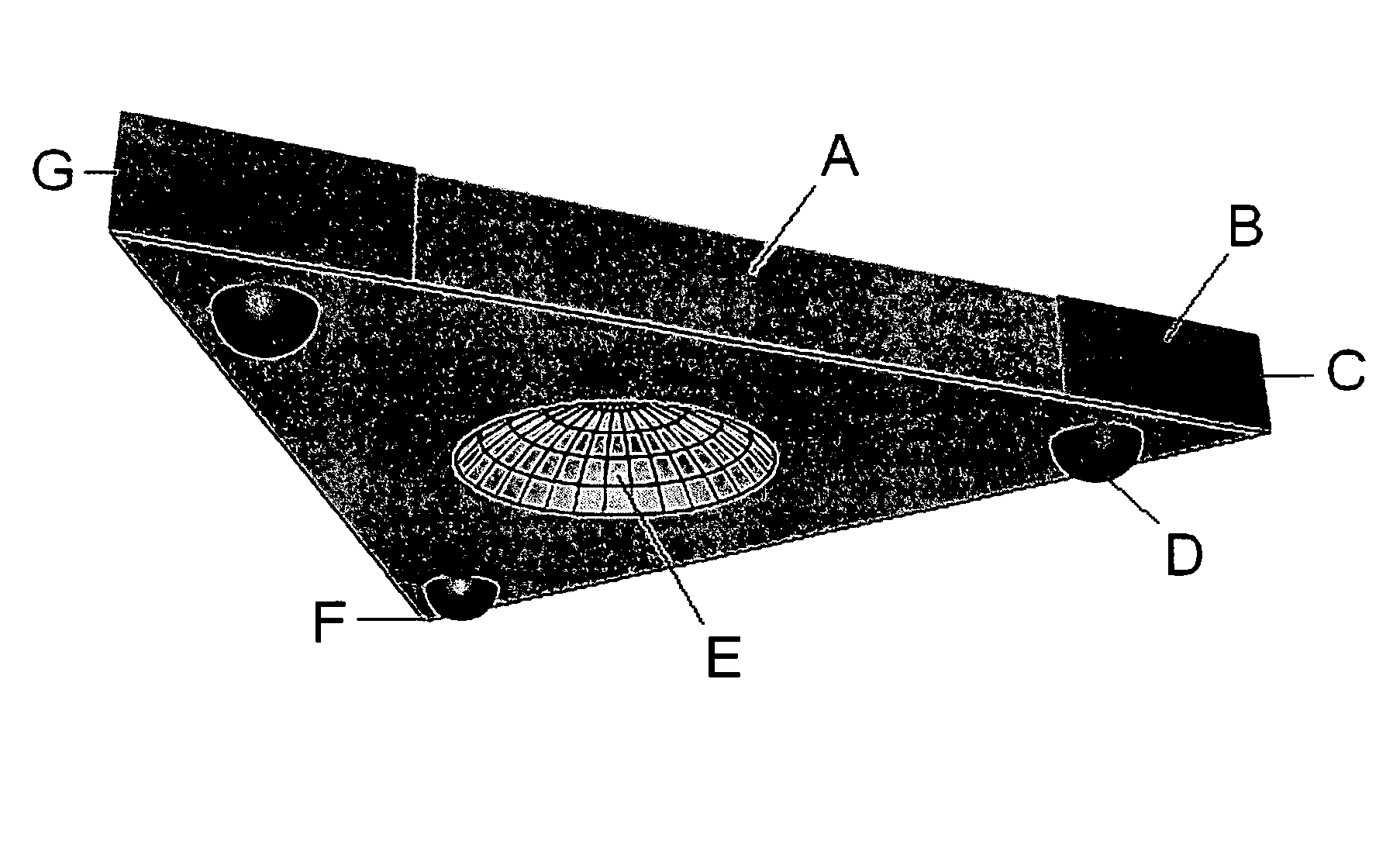
A spacecraft having a triangular hull with vertical electrostatic line charges on each corner that produce a horizontal electric field parallel to the sides of the hull. This field, interacting with a plane wave emitted by antennas on the side of the hull, generates a force per volume combining both lift and propulsion. 

https://www.google.com/patents/US20060145019?pageId=111028569981762970673

ROTATING ELECTROSTATIC PROPULSION SYSTEM


Rotating electrostatic propulsion system

US 20030209637

A1 This invention relates to a spacecraft propulsion system utilizing thrusters comprised of a motor-driven electrostatically charged cylinder rotating within an electrostatically charged annular ring for the purpose of creating a spacetime curvature stress-energy tension in the horizontal direction. The thrusters are augmented by magnetic vortex generators, either embedded in the cylinders or located above each thruster, for the purpose of increasing the permittivity of space by permeating each thruster with low density hyperspace energy generated by a wormhole created between our space and hyperspace. A combination of three thrusters mounted on the underside of the hull of the spacecraft provide thrust and yaw motion control.  

https://www.google.com/patents/US20030209637?dq=ininventor:%22John+St.+Clair%22&hl=en&sa=X&ved=0ahUKEwig04SQ3fLTAhWEwlQKHTwcAKQQ6

WHAT IS THE TR-3B?

The TR-3B is Code named Astra. The tactical reconnaissance TR-3B first operational flight was in the early 90s. The triangular shaped nuclear powered aerospace platform was developed under the Top Secret, Aurora Program with SDI and black budget monies. At least 3 of the billion dollar plus TR-3Bs were flying by 1994. The Aurora is the most classified aerospace development program in existence. The TR-3B is the most exotic vehicle created by the Aurora Program. It is funded and operationally tasked by the National Reconnaissance Office, the NSA, and the CIA. The TR-3B flying triangle is not fiction and was built with technology available in the mid 80s. Not every UFO spotted is one of theirs.

The TR-3B vehicles outer coating is reactive to electrical Radar stimulation and can change reflectiveness, radar absorptiveness, and color. This polymer skin, when used in conjunction with the TR-3Bs Electronic Counter Measures and, ECCM, can make the vehicle look like a small aircraft, or a flying cylinder–or even trick radar receivers into falsely detecting a variety of aircraft, no aircraft, or several aircraft at various locations. A circular, plasma filled accelerator ring called the Magnetic Field Disrupter, surrounds the rotatable crew compartment and is far ahead of any imaginable technology.

VIDEOS FOOTAGE OF THE TR-3B


RELATED ARTICLES

{ http://www.disclose.tv/ }

Hoe vind je dit bericht?
Geschreven door peter om 20:35 Stuur door

ZERO POINT ENERGY: THE POWER SOURCE BEHIND THE SECRET SPACE PROGRAM

ZERO POINT ENERGY: THE POWER SOURCE BEHIND THE SECRET SPACE PROGRAM

Meet Mark McCandlish, a military aeronautical illustrator that has worked on many classified projects for the government. This all started ever since he was born, as his own father is a United Air Force veteran, working 25 years.

Mark himself is renowned in his field of conceptualization and illustration of military aeronautical machines, over his long career spanning 30 years.  

Working on projects such as these has allowed him to come across strange phenomena that have led him to discover the science behind the first UFO he spotted way back in the winter of 1966. Ever since then, he has also had a dozen more sightings, which has caused his firm belief that interstellar fight that does not violate the current laws of physic and gravity is definitely possible.

MARK MCCANDLISH, ILLUSTRATOR OF THE FUTURE

 Mr. McCandlish came under fire for conceptualizing and illustrating a project he was not supposed to know about. Since then, he has been an active activist that the government is harboring secrets, they very same ones, that he has always been looking for. He asked the question that has since lingered in the air of much conspiracists: Is there a secret space program?

Mr. McCandlish claims that something called the Zero Point Energy exists on our planet. It is the power source that is fueling the Secret Space Program and is the main purpose of the Breakaway Civilization.

This theory involves how back-engineering off-world technology has allowed powerful corporations to take control of governments, allowing them world dominion. This allowed these corporations to develop its own secret space program and develop a break-away civilization that has its very own different set of objectives.

THE SECRET SPACE PROGRAM

One will never know just how many secrets a government can be harboring. Are we truly in control? Nobody knows the real answer to that, only the puppet master does. In the meantime, one can hope that the truth about extraterrestrials with fully proven evidence can be discovered and released to the world.

RELATED ARTICLES

{ http://www.disclose.tv/ }

Hoe vind je dit bericht?
Geschreven door peter om 20:01 Stuur door

Russian UFO hunter claims satellite pictures show a 1,900ft alien spaceship crash landed in Antarctica 'millions of years ago'

Russian UFO hunter claims satellite pictures show a 1,900ft alien spaceship crash landed in Antarctica 'millions of years ago'

  • Valentin Degteryov from Nizhny Tagil claimed the object was a UFO wreckage
  • Google Earth images show unusual shape in planet's most southerly continent
  • He shared a video of his findings online, which has had more than 230,000 views
  • Many comments are skeptical, saying it's just the rocky top of a barren mountain 

A Russian man claims to have found evidence of a giant alien spaceship that crash landed in Antarctica.

He posted images of the alleged UFO wreckage which he spotted while analysing Google Earth pictures of the planet's most southerly continent.

Valentin Degteryov from Nizhny Tagil claimed the unusual object is some 1,900 feet in length, and a video he posted has attracted hundreds of thousands of hits.

The object (circled) claimed by Valentin Degteryov from Nizhny Tagil to be an alien spaceship

The object (circled) claimed by Valentin Degteryov from Nizhny Tagil to be an alien spaceship

The Google Earth images of what the UFO hunter believes proves the existence of alien life

The Google Earth images of what the UFO hunter believes proves the existence of alien life

Many people were skeptical about the images, saying the shape was the peak of a mountain

Many people were skeptical about the images, saying the shape was the peak of a mountain

However, many of the comments are skeptical.

Many say plausibly that the images show a rocky outcrop on a barren mountain.

UFO hunter Degteryov claimed the supposed alien wreckage became visible due to melting ice in Antarctica.

A video he posted claimed: 'The huge spaceship in Antarctica.

'Millions years ago in Antarctica the huge spaceship has crashed.

'He has fallen to the big mountain. Its length is 600 meters. He became visible after ice has descended.'

{ http://www.dailymail.co.uk/ }

Hoe vind je dit bericht?
Geschreven door peter om 19:11 Stuur door

AMATEUR ASTRONOMERS JUST FOUND OBJECTS IN SPACE THAT COULD LEAD TO THE BIGGEST DISCOVERY OF OUR SOLAR SYSTEM IN OVER 150 YEARS

AMATEUR ASTRONOMERS JUST FOUND OBJECTS IN SPACE THAT COULD LEAD TO THE BIGGEST DISCOVERY OF OUR SOLAR SYSTEM IN OVER 150 YEARS

60,000 people recently got together to make history. Their goal? Observe planet nine for the first time. Planet Nine is a theoretical planet that is thought to exist beyond Pluto, but no one has seen it yet. Participants worked using data from Siding Spring’s SkyMapper telescope. Brad Tucker had has the leading role, by ANU Researcher, and team agreed with one of the four possibilities regardless of whether. The scientific value of the project was certainly verified.

AMATEUR ASTRONOMERS JUST FOUND OBJECTS IN SPACE THAT COULD LEAD TO THE BIGGEST DISCOVERY OF OUR SOLAR SYSTEM IN OVER 150 YEARS

Other researchers agree with the ANU team’s sentiment: astronomer Mike Brown of Caltech tweeted his support for the project.For one, it is probably 1,000 times fainter than Pluto. The task for researchers, then, is to sift through old data and make new observations. Learn more in the video below:

Source www.physics-astronomy.com

{ http://alien-ufo-sightings.com/ }

Hoe vind je dit bericht?
Geschreven door peter om 01:43 Stuur door

New Harvard theory: Aliens have star-powered spaceships

New Harvard theory: Aliens have star-powered spaceships

A couple of scientists from the well-respected Harvard-Smithsonian Centre for Astrophysics recently wrote an astrophysics paper that is so awesome, it will make you want to read an astrophysics paper. The scientists have been puzzling over some weirdly strong radio wave bursts in space, and they’ve come up with an explanation: aliens.

“An artificial origin is worth contemplating and checking,” said Avi Loeb, an Israeli-American professor who worked on the study.

It all started when an astrophysicist was combing through the archives in Australia’s Parkes Observatory, and he noticed a mysterious spurt of radio activity. It was short but intense. Really intense. Like, 500 million times the power of the sun intense.

Space is full of weird light, so that’s no big deal, right? Wrong, apparently. Scientists have been trying to figure out what the burst could be for 10 years, and they still don’t know. Some think it’s a massive, particularly weird star that collapsed into its core. Or maybe it’s a solar flare that somehow managed to travel across the known universe. Or …

Yep. Aliens. At least, that’s what the Harvard-Smithsonian scientists are proposing. You can start freaking out now.

Here’s the theory: There’s a faraway alien civilization that uses artificial beams to power spaceships with light sails. They harness energy from a star and cool their beam machine with planet-sized buckets of water.

Cool, right? We’re not talking about boring, single-celled aliens here. We’re talking about an advanced civilization, way more advanced than, you know, us. Our sail-related ships are limited to the kind that stay in water.

“Deciding what’s likely ahead of time limits the possibilities,” said Loeb, an alumnus of Hebrew University in Jerusalem. “It’s worth putting ideas out there and letting the data be the judge.”

It’s still a theory, but we at From the Grapevine are definitely rooting for it. Discovering alien life would mean a total change in how we view reality. Plus, we could do so much cool stuff with aliens. Like discover new things about the universe and have alien romances.

{http://alien-ufo-sightings.com/ }

Hoe vind je dit bericht?
Geschreven door peter om 01:36 Stuur door

Meer van UFO'S of UAP'S, ASTRONOMIE, RUIMTEVAART, ARCHEOLOGIE, OUDHEIDKUNDE, SF-SNUFJES EN ANDERE ESOTERISCHE WETENSCHAPPEN - DE ALLERLAATSTE NIEUWTJES

↑ Terug naar de berichten