Ontdek de Fascinerende Wereld van UFO's en UAP's: Jouw Bron voor Onthullende Informatie!
Ben jij ook gefascineerd door het onbekende? Wil je meer weten over UFO's en UAP's, niet alleen in België, maar over de hele wereld? Dan ben je op de juiste plek!
België: Het Kloppend Hart van UFO-onderzoek
In België is BUFON (Belgisch UFO-Netwerk) dé autoriteit op het gebied van UFO-onderzoek. Voor betrouwbare en objectieve informatie over deze intrigerende fenomenen, bezoek je zeker onze Facebook-pagina en deze blog. Maar dat is nog niet alles! Ontdek ook het Belgisch UFO-meldpunt en Caelestia, twee organisaties die diepgaand onderzoek verrichten, al zijn ze soms kritisch of sceptisch.
Nederland: Een Schat aan Informatie
Voor onze Nederlandse buren is er de schitterende website www.ufowijzer.nl, beheerd door Paul Harmans. Deze site biedt een schat aan informatie en artikelen die je niet wilt missen!
Internationaal: MUFON - De Wereldwijde Autoriteit
Neem ook een kijkje bij MUFON (Mutual UFO Network Inc.), een gerenommeerde Amerikaanse UFO-vereniging met afdelingen in de VS en wereldwijd. MUFON is toegewijd aan de wetenschappelijke en analytische studie van het UFO-fenomeen, en hun maandelijkse tijdschrift, The MUFON UFO-Journal, is een must-read voor elke UFO-enthousiasteling. Bezoek hun website op www.mufon.com voor meer informatie.
Samenwerking en Toekomstvisie
Sinds 1 februari 2020 is Pieter niet alleen ex-president van BUFON, maar ook de voormalige nationale directeur van MUFON in Vlaanderen en Nederland. Dit creëert een sterke samenwerking met de Franse MUFON Reseau MUFON/EUROP, wat ons in staat stelt om nog meer waardevolle inzichten te delen.
Let op: Nepprofielen en Nieuwe Groeperingen
Pas op voor een nieuwe groepering die zich ook BUFON noemt, maar geen enkele connectie heeft met onze gevestigde organisatie. Hoewel zij de naam geregistreerd hebben, kunnen ze het rijke verleden en de expertise van onze groep niet evenaren. We wensen hen veel succes, maar we blijven de autoriteit in UFO-onderzoek!
Blijf Op De Hoogte!
Wil jij de laatste nieuwtjes over UFO's, ruimtevaart, archeologie, en meer? Volg ons dan en duik samen met ons in de fascinerende wereld van het onbekende! Sluit je aan bij de gemeenschap van nieuwsgierige geesten die net als jij verlangen naar antwoorden en avonturen in de sterren!
Heb je vragen of wil je meer weten? Aarzel dan niet om contact met ons op te nemen! Samen ontrafelen we het mysterie van de lucht en daarbuiten.
Dinsdag 17 oktober 2017
The View points out the shocking similarity between Kellyanne Conway and ‘nutty’ UFO-abducted candidate
The View points out the shocking similarity between Kellyanne Conway and ‘nutty’ UFO-abducted candidate
Bettina Rodriguez Aguilera is running for the seat currently held by retiring Rep. Ileana Ros-Lehtinen (R-FL) and she explained that she has telepathy due to her extraterrestrial encounters.
“Why is this any different than Kellyanne Conway saying her microwave is spying on her?” asked ABC’s “The View” co-host Joy Behar.
Co-Host Sunny Hostin admitted, with some trepidation, that she believes in life outside of the Earth as well as UFOs. Meghan McCain agreed, recalling the mystery of the Phoenix Lights, which were seen 20 years ago this year. According to accounts, a series of lights appeared in formation over Arizona’s capital city. She admitted it scared her half to death as a child. The hosts all agreed that there could be aliens “out there.”
“They could be but then I feel like I couldn’t vote for her because she sounds very nutty,” Hostin said. “They’re all at area 51, I’m telling you. They’re all there!”
“This could be [Donald] Trump’s next running mate, that’s all I’m saying,” Behar joked.
“I’m conflicted, if that’s what you say happened to you, I’m going to take your word for it,” Whoopi Goldberg said.
“But would you vote for her?!” Behar exclaimed.
“Well, there are a lot of worse people out there!” Goldberg retorted.
If you listen closely, you may hear motorcycles approaching from the distance. Or maybe it sounds more like bees swarming. Perhaps it just sounds like a sci-fi background tone, meant to build tension. Whatever you think two neutron stars sound like as they spiral closer and closer together, though, it’s hard to deny that that final bloop isn’t startling — and even a bit silly.
This is perhaps the most exciting discovery yet from the international collaboration between the U.S.-based Laser Interferometer Gravitational-Wave Observatory — LIGO — and the Italian Virgo observatory.
The two merging neutron stars produced lots of energy, but they didn't make any sound.
And even though this colossal merger didn’t make any sound, we can listen to a simulation of what it sounded like. It may seem strange that two ultra-dense neutron stars — each the size of our sun or larger — merging 130 million light-years away didn’t make noise. In the process, these merging stars produced massive amounts of gamma radiation and even created elements like gold and platnum.
But, perhaps most importantly, they also produced ripples in spacetime. These ripples, which we know as gravitational waves, occur at various frequencies, which scientists can translate into sound. Without further ado, here’s what this merger “sounded” .
As you can see, the previous merger measured by LIGO and Virgo were much briefer. The reason for this is the fact that this merger involved neutron stars, not black holes.
“While earlier detections of the black holes that we’ve made … only lasted for us a couple of seconds, or much less, this neutron star in-spiral lasted for over a minute,” LIGO spokesperson David Shoemaker told reporters on Monday. Inversereported on how this affects the merger:
The reason for this longer detection is that neutron stars, the smallest, densest stars known to exist, are much lighter than black holes. Whereas the merging black holes that created earlier gravitational wave detections were many times larger than the sun — the first detection in 2015 involved black holes of 29 and 36 solar masses — the neutron stars involved in this latest detection were only about the mass of the sun or maybe twice the mass of the sun.
So as the neutron stars spiraled in toward one another, they emitted high-frequency gravitational waves that fell within the range that Earth-based detectors could record.
“The result is that we can see the system for some 1,500 complete cycles of these two objects around each other,” said Shoemaker.
And that final bloop? That’s when the stars finally merged. By converting the frequency of gravitational waves into audio, the astronomers created what could potentially be the sickest hip-hop beats of all time.
If you liked this article, check out this video on what would happen if an asteroid hit the middle of the ocean.
Metallosphaera sedula. Credit: University of Vienna
Scientists around Tetyana Milojevic from the Faculty of Chemistry at the University of Vienna are in search of unique biosignatures, which are left on synthetic extraterrestrial minerals by microbial activity. The biochemist and astrobiologist investigates these signatures at her own miniaturized "Mars farm" where she can observe interactions between the archaeon Metallosphaera sedula and Mars-like rocks. These microbes are capable of oxidizing and integrating metals into their metabolism. The original research was currently published in the journal Frontiers in Microbiology.
At the Department of Biophysical Chemistry at the University of Vienna, Tetyana Milojevic and her team have been operating a miniaturized "Mars farm" in order to simulate ancient and probably extinct microbial life – based on gases and synthetically produced Martian regolith of diverse composition. The team investigates interactions between Metallosphaera sedula, a microbe that inhabits extreme environments, and different minerals which contain nutrients in form of metals. Metallosphaera sedula is a chemolithotroph, means being capable of metabolizing inorganic substances like iron, sulphur and uranium as well.
To satisfy microbial nutritional fitness, the research team uses mineral mixtures that mimic the Martian regolith composition from different locations and historical periods of Mars: "JSC 1A" is mainly composed of palagonite – a rock that was created by lava; "P-MRS" is rich in hydrated phyllosilicates; the sulfate containing "S-MRS," emerging from acidic times on Mars and the highly porous "MRS07/52" that consists of silicate and iron compounds and simulates sediments of the Martian surface.
Synthetic Martian Regolith. Credit: University of Vienna
"We were able to show that due to its metal oxidizing metabolic activity, when given an access to these Martian regolith simulants, M. sedula actively colonizes them, releases soluble metal ions into the leachate solution and alters their mineral surface leaving behind specific signatures of life, a 'fingerprint," so to say," explains Milojevic. The observed metabolic activity of M. sedula coupled to the release of free soluble metals can certainly pave the way to extraterrestrial biomining, a technique which extracts metals from ores, launching the biologically assisted exploitation of raw materials from asteroids, meteors and other celestial bodies.
Using electron microscopy tools combined with analytical spectroscopy techniques, the researchers were able to examine the surface of bioprocessed Martian regolith simulants in detail. Cooperation with the workgroup of chemist Veronika Somoza from the Department of Physiological Chemistry was valuable to achieve these results. "The obtained results expand our knowledge of biogeochemical processes of possible life beyond earth, and provide specific indications for detection of biosignatures on extraterrestrial material – a step further to prove potential extra-terrestrial life," says Tetyana Milojevic.
More information: Denise Kölbl et al. Exploring Fingerprints of the Extreme Thermoacidophile Metallosphaera sedula Grown on Synthetic Martian Regolith Materials as the Sole Energy Sources, Frontiers in Microbiology (2017). DOI: 10.3389/fmicb.2017.01918
BOULDER, Colo. — No, aliens are not invading Boulder, but excellent cloud formations may be.
Dozens of eagle-eyed cloud hawks spotted a formation over the foothills that was interpreted by many to be spaceship-shaped.
According to experts, the cloud can be clearly identified as an Altocumulus lenticularis — more commonly known as a lenticular cloud.
The clouds, according to Denver7 Chief First Alert Meteorologist Mike Nelson, are formed when wind flows from west to east over the mountains. Moisture from the air drops as air falls rapidly into the foothills, leading to the interesting formation.
Some scientists suggest the cloud formations can be attributed to many unexplained sightings of unidentified flying objects (UFOs). The cloud spotted over Boulder — while conveniently shaped — was easily identified in the morning light.
When spotting a lenticular cloud, especially during the weekend, you might notice few planes nearby. They tend to avoid the turbulence, although glider pilots sometimes seek out the cloud formation for the swift air current, which can help them achieve speed and altitude gains.
Some of these replicants even work in space. In the original "Blade Runner" (1982), a replicant named Roy Batty (Rutger Hauer) briefly talks about his experiences working off of planet Earth. The 1968 Philip K. Dick novel on which the movie was based, "Do Androids Dream of Electric Sheep?", also mentions androids being used for space labor.
While replicants are still far in the future, NASA and other space agencies already use humanoid robots to help do work in space. (Japanese officials hoped to put a humanoid on the moon in 2015, but that hasn't happened yet.) There are many other versions of space robots exploring our solar system — including rovers, satellites and space probes — but here are some examples of the humanoid robots that are doing work in space.
1. Robonaut (NASA)
Photo Credit: NASA
Although Robonaut 1 was never meant to fly in space, NASA tested the technology on the ground before launching its successor, Robonaut 2, in 2011. Robonaut was created in collaboration with the Defense Advanced Research Projects Agency (DARPA), a branch of the U.S. military that invests in far-flung technology projects.
Robonaut 2 has been on the International Space Station since 2011. Its goal is to take over some of the tedious tasks that astronauts do on the station, such as flipping switches and turning levers. It has even tested out telemedicine, clinical health care from a distance via telecommunication. An upgraded version of the robot could also be used for spacewalking in the future.
The Robonaut 2 currently at the space station has special climbing manipulators (legs)to cling on to surfaces, and has been upgraded with better processors and sensors than those on Robonaut 1. While Robonaut 2 undergoes testing in space, ground crews at NASA's Johnson Space Center in Houston are working on another project called the Active Response Gravity Offload System, which is developing a robust robotics research platform for space by working with similar robots on Earth.
2. Valkyrie (NASA)
Photo Credit: Bill Stafford/NASA
Valkyrie (also known as R5), which was developed in just nine months, was originally a competitor in the DARPA Robotics Challenge in 2011. The robot had to perform functions such as picking up debris, operating a vehicle or cutting through a wall. The initial goal of the project was to assist with disaster response and search-and-rescue operations.
RoboSimian is more like an ape than a human, but however you classify it, it's a powerful machine. The robot can map its environment in 3D using lidar technology. It's extremely flexible, and can go over tough terrain and undertake tasks that require dexterity. RoboSimian competed in the finals of the DARPA Robotics Challenge in 2015.
RoboSimian's extreme dexterity could also be useful in disaster recovery efforts, NASA said at the time. With four limbs, the robot can support itself easily on uneven surfaces and climb on ladders, stair treads or railings. The robot's ability to see in 3D, coupled with its enhanced mobility, reduces its risk of falling over — a common problem for two-legged robots. [NASA JPL's RoboSimian Robot in Images]
4. Kirobo (Japan Aerospace Exploration Agency)
Photo Credit: Kiyoshi Ota/Bloomberg via Getty
Japan's Kirobo was an adorable mini-astronaut robot that launched to the International Space Station in 2013 aboard the HTV-4 cargo ship. Standing only 13 inches (34 centimeters) tall, the robot was used to test human-robot interaction in space as a part of the Kibo Robot Project.
Kirobo and its Earth-bound twin, Mirata, were built at the University of Tokyo's Research Center for Advanced Science and Technology. In addition to talking, they could recognize voices, faces and emotions. [Photos: Meet Kirobo, Japan's 1st Talking Space Robot]
5. Dextre (Canadian Space Agency)
Photo Credit: JSC/NASA
Admittedly, Dextre doesn't really look all that human – it's a little gangly with limbs bent at odd angles. But the robot does a lot of valuable work on the exterior of the International Space Station. The two-armed robot is also known as the Special Purpose Dexterous Manipulator.
Since its launch in 2008, Dextre has participated in robotic satellite refueling tests, which could help extend the lifespan of satellites in the future. The robot is also "on call" for routine maintenance on the orbiting complex, such as replacing cameras or batteries, according to the Canadian Space Agency.
The long-term goal of Dextre is to reduce the need for astronauts to do spacewalks, which are some of the riskiest activities astronauts undertake. Having Dextre on board also reduces the time astronauts spend on repairs, since operators on the ground can control it remotely.
6. AILA (German Research Center for Artificial Intelligence)
Photo Credit: Carsten Koall/AFP/Getty
Germany's Aila robot is intended to improve artificial intelligence in space. Controllers can move Aila using a custom mouse or Microsoft Kinect technology (which was used for the Xbox 360 and Xbox One video game consoles.)
The robot can mimic human motions by recording what humans do, analyzing the movements in small segments and then building upon the library of information to make new moves. This type of learning might be useful for future robotic work inside and outside the space station, on the moon and even on Mars.
Aila was unveiled in 2010 and has received funding through multiple projects since then. The German Research Center for Artificial Intelligence maintains a page about Aila on its website.
The day when a UFO outflew a fleet of Soviet Supersonic MiG 21 Jets
In 1975, a mysterious object looked like a bright ball, clearly visible, perhaps 10 times brighter than the brightest star in the sky. The UFO changed color incessantly and when it was approached by supersonic fighters, the object DISAPPEARED. The super fast MiGs could not get any closer to the UFO, let alone catch up with it.
It was in 1975 when General Zvonimir Jurjevic commander of the 172nd Yugoslavian Air Force and Air Defense witnessed what he described as otherworldly spacecraft.
In January on 1975, the pilots of his squadron would meet with a UFO, face to face, for the first time ever as the enigmatic flying object burst into the sky, appearing in front of the fighter jets.
“The object looked like a bright ball, clearly visible, perhaps 10 times brighter than the brightest star at that time. The UFO changed color incessantly: white, yellow, light red, orange, and so on,” said Jurjevic during a news interview.
Mysteriously, the UFO appeared exactly 50 minutes into a flight every single time without fail, according to General Jurjevic. During that same month, the UFO appeared every day, always 50 minutes from takeoff. The pilots even deliberately delayed their take-off time, to test out the phenomenon, but that didn’t help as the UFO appeared, once again 50 minutes after take-off.
One day, more precisely on January 25, 1975, General Jurjevic decided to go after the UFO.
Exactly 50 minutes after the takeoff, the unidentified flying object appeared over the skies of the city of Cetinje.
As soon as the MiG fighter Jets started chasing it, the UFO changed course towards the city of Budva and disappeared in the sky.
This UFO was repeated for several days and Jurjevic communicated each incident to Belgrade.
One day, however, the general came up with a different strategy, to try to intercept the UFO once and for all.
Two aircraft were to take off, and two more fighter jets were to follow later, but taking off from a different airfield hoping to encircle the mystery craft. Pilots maintained radio silence during the entire flight.
Speaking to Sputnik News, General Jurjevic explained to Sputnik News: “I only just stabilized the flight somewhere over Cetinje, when suddenly the object flashed over Budva, and Lieutenant Machec saw it above Niksic.
“I ordered Machec to stay in place, and took a course parallel to the Adriatic coast, where I tried to establish at what distance the object was: it turned out that it was at about 10 kilometers.
“However, it did not allow me to get any closer to it. I reduced the speed — the distance was the same. I increased the speed – it was still the same ten kilometers.”
Two supersonic Soviet MiG-21s arrived from Belgrade, attempting to hunt down the unidentified flying object but without any luck.
Approaching it was literally impossible.
Suddenly, the craft fled at 1700 kilometers per hour; then out of nowhere, the UFO appeared tailing the pursuing planes; the super fast MiGs could not get any closer to the UFO, let alone catch up with it.
Curiously, as reported by Sputnik News, the radar station on the Prevlaka peninsula could not “see” the object, however, when the two supersonic Soviet MiG-21s arrived from Belgrade, Yugoslav radars managed to record a strange signal in the sky.
The mysterious encounter of the skies of former Yugoslavia remains one of the greatest mysteries in Ufology.
Out-of-control Chinese space station is hurtling towards Earth
The Tiangong-1 Chinese space station, with a weight of around 8-and-a-half-tons, has accelerated its descent to Earth and is expected to crash in a few months, according to The Guardian.
In 2016, Chinese officials admitted that they had lost control of Tiangong-1.
Since then, China’s space agency has notified the UN that it expects the station to fall between October 2017 and April 2018.
Since then, the orbit of the station has been lower and lower as it drastically approaches our Atmosphere.
In recent weeks the station has entered denser layers of the atmosphere and began to fall faster.
Last week, the director of the manned space engineering office, Wu Ping, confirmed at a press conference that the unmanned station will fall sometime in the second half of 2017. “Based on our calculations and analysis, most parts of the space lab will burn during the fall, “she added, saying that it is unlikely to affect aviation activities or cause damage to the ground.
According to the astrophysicist of Harvard University (Massachusetts, USA), Jonathan McDowell, currently, the closest point to Earth in the orbit of Tiangong-1 is “below 300 kilometers.”
Although a large part of the space lab is expected to burn in the atmosphere, McDowell believes some parts of up to 100 kilograms in weight may reach the surface of the planet.
He adds that it is impossible to calculate the precise location where the impact will occur.
The Tiangong-1 — or “heavenly palace” — space station was launched in 2011 and was used for both manned and unmanned missions.
In addition, China’s first female astronaut, Liu Yang, visited the space station in 2012.
According to space archaeology expert Alice Gorman, from Flinders University, while China will be able to monitor its descent, it won’t be able to control where the station will crash.
Acceding to Dr. Gorman, Tiangong-1 is traveling at high speed — estimated at about 27,000 kilometers per hour — and will burn up when it re-enters Earth’s atmosphere.
“When it hits the atmosphere it will start to slow down and heat up, due to friction and atmospheric compression. As it heats, it will break up into burning fragments,” she added.
Experts note that it’s very unlikely that anyone will be harmed by the crash of the space station, or that anyone would see it at all, as scientists say it’s most likely that the 8-tone space station’s remains will drop somewhere into the sea. However, it’s still possible that it would crash somewhere near people.
Surid, aka Enoch: the REAL Pyramid builder? Ancient texts reveal jaw-dropping details
What if the Great Pyramid of Giza predates the Egyptian civilization? And what if Khufu was not the one who commissioned it?
On the West bank of the River Nile stands one of the most impressive and oldest wonders of the ancient world, the Great Pyramid of Giza.
Believed to have been built as a tomb to house the remains of Pharaoh Khufu, modern archeologists maintain the structure was built around 2500BC.
However, numerous authors argue that the dating of the Pyramid—and its true purpose—are completely wrong.
The Great Pyramid of Giza is one of the most marvelous and incredible monuments on the surface of the planet. Curiously, it is also the most sophisticated one, when it comes to design, engineering, and mathematics.
The Great Pyramid of Giza is a massive structure composed of approximately 2,300,000 stone blocks that weigh from 2 to 30 tons each and there are even some blocks that weigh over 50 tons. It’s huge. In fact, the ancient builders used so much stone to build the Great Pyramid of Giza that you could build a wall around the planet by using stone from the pyramid.
Mindboggling right?
But many other enigmas surround what is considered the most magnificent structure ever built.
The great Pyramid’s outer mantle was built of 144,000 casing stones, all of them highly polished and flat to an accuracy of 1/100th of an inch, about 100 inches thick and weighing approx. 15 tons each. It is sad that the casing stones that once covered the Great Pyramid of Giza were so bright that they reflected the sun’s light making the Pyramid shine like a jewel.
And while there are really fascinating details about the Great Pyramid of Giza which you can read about here, this time we focus more on what’s INSIDE the structure rather than what’s on the outside.
So, how do we know that the Pyramid was built around 2,500 BC, and that it was built, by Pharaoh Khufu?
Well, it turns out that the dating of the pyramid and its association with are based solely on the evidence found in 1837 by British explorer Richard Howard Vyse.
Not the most subtle Egyptologist and researcher, Howard Vyse and John Shae Perring worked with gunpowder forcing their way into several monuments, including the burial chamber of the pyramid of Menkaure.
The only evidence inside the Pyramid linking Khufu to the structure was uncovered by Vyse.
But there are a lot of things to ake into consideration there. Since stone cannot be carbon-dated, and no other inscriptions, except for the Pharaoh’s official monogram, were found inside the pyramid or anywhere else for that matter, the date has stood unchallenged for centuries. But, if Khufu was in fact the builder of the Pyramid—the most magnificent ancient structure on Earth—wouldn’t He have made sure that his name was forever associated with the Pyramid, by inscribing it on various places?
But not all is as it seems apparently. Not long ago new evidence surfaced that suggests that the discovery made by Colonel Vyse was in fact one of the greatest hoaxes in history, leading many authors to question everything related to Khufu and the Pyramid.
There are authors and researchers who have dared to go against mainstream history and suggest that Vyse may have forged the name of Khufu himself.
As it turns out, in 2014, two University of Dresden archaeology students apparently someone managed smuggled a sample of the paint used in the King Khufu markings and brought it back to Europe in order to analyze it in a laboratory.
The results revealed a shocking truth.
While the sample the two “archaeologists” brought back was too small for radiocarbon dating, technicians manage to determine that the pigment was not painted onto the original limestone blocks when the pyramid was built, but it was placed there on a later plaster repair.
What does this mean? Well simply put, it suggests that the cartouche was not original to the pyramid construction, but that it was in fact added at a much later date, giving rise to a conspiracy that Vyse fabricated the entire ‘discovery’.
But why on Earth would someone like Vyse—who obviously had a passion for the history of Ancient Egypt—do something like that?
Money talks now, and apparently it did the same hundreds of years ago. During his expedition to Egypt, Colonel Vyse spent a FORTUNE, nearly $1.3 million on to uncover the truth behind the Great Pyramid of Giza.
Many experts have suggested that Vyse may have kickstarted an early conspiracy and in his desperation to find something no one had found before, he decided to forge the cartouche of Khufu onto the chamber wall, thereby establishing an inaccurate date for the structure—which today is widely accepted by historians and Egyptologists such as Selim Hassan, Zahi Hawass, Jaromir Malek, Professor Rosalie David or Bill Manley, or major museums such as the British Museum and the Egyptian Museum, all of whom accept that Khufu was the builder of the pyramid and by implication that Vyse’s cartouche is authentic.
Furthermore, Zecharia Sitchin accuses Vyse in his book The Stairway to Heaven of perpetrating the forgery because of Vyse’s “determination to obtain a major find as time and money were running out”.
The Great Sphinx and The Great Pyramid
This is a rare image of the Sphinx taken from a hot air balloon, in the early 19th century. This is before excavation and restoration.
So, if Khufu did not build the Pyramid, what about the Sphinx, when was the Sphinx carved and who commissioned it?
To understand more about te Sphinx we must look at the Inventory Stela, unearthed by archaeologists in 1858 which details several things but most importantly, it presents a list of 22 divine statues owned by a Temple of Isis, and goes on to claim that the temple existed since before the time of Khufu (c. 2580 BC).
The credibility of the Inventory Stela is viewed by Historians and Egyptologists with great caution.
So if the Sphinx existed since before the time of Khufu… who commissioned it then?
It get’s interesting.
According to an Arabian writer by the name of Ibrahim al-Maqrizi, the Great Pyramid was not constructed by Khufu, the Great Pyramid was constructed long before the Great Flood by a king with the name of Surid Ibn Salhouk, Surid for short, but we will get to that in a minute.
Interestingly, fourth-century Roman historian Ammianus Marcellinus wrote that Inscriptions which the ancient asserted were engraved on the walls of certain underground galleries, constructed in the interior of certain pyramids, were intended to preserve ancient wisdom from being lost in the flood.
Getting back to the Pyramid, Arab scholars ascribed the Egyptian Pyramids and temples to an ANTEDILUVIAN AGE, writes Alan F. Alford in his book: Pyramid of Secrets— The Architecture of the Great Pyramid Reconsidered in the Light of Creational Mythology. Furthermore, the author notes that One popular tradition, drawing on Coptic and Hermetic lore, asserted that the builder of the Pyramids and Temples had been “the first Hermes” or “Hermes of Hermes”, otherwise known as Hermes Trismegistus on account of his threefold qualities od prophet, kind, and a wise man.
A second popular tradition, drawing on old Arab lore, maintained that the builder of the Pyramids was an antediluvian king by the name of Surid Ibn Salhouk. In the 13th century writes Alfard, it was suggested by one writer that the Pyramids had been built by a pre-Adamite race—inhabtants of an earlier Earth. These ideas eventually became merged to the extent hat “Surid” was identified as Hermes.
Arab writers named King Surid as the one who, having learned of the coming flood in a dream, erected the Pyramids as vaults to protect antediluvian books and artifacts.
Among the reporters of this particular legend are the astrologer Abumasar Balkhi, historian Abd al-Hokm, al-Masudi, and Ibrahim al-Maqrizi as mentioned earlier, all suggesting that Surid was Hermes or Enoch.
Hermes Trismegistus was either a contemporary of Moses, or the third in a line of men named Hermes, i.e. Enoch, Noah, and the Egyptian priest-king who is known to us as Hermes Trismegistus on account of being the greatest priest, philosopher, and king.
Staniland Wake writes in the Origin and Significance of the Great Pyramid that Masoudi who died in the year 967 A.D., professes to relate the Coptic tradition, which says, “that Surid Ben Shaluk Ben Sermuni Ben Termidun Ben Tedresan Ben Sal, one of the kings of Egypt before the Flood, built the two great pyramids; and notwithstanding they were subsequently named after a person called Shed-dad Ben Ad, that they were not built by the Adites, who could not conquer Egypt, on account of the powers which the Egyptians possessed by means of enchantment; that the reason for building the Pyramids was the following dream, which happened to Surid three hundred years previous to the Flood.
Masoudi describes the guardians assigned by the king to each pyramid.
“The guardian of the eastern pyramid was an idol of speckled granite, standing upright, with a weapon like a spear in his hand; a serpent was wreathed round his head, which seized upon and strangled whoever approached, by twisting round his neck, when it again returned to its former position upon the idol. . . . When everything was finished, he caused the Pyramids to be haunted with living spirits; and offered up sacrifices to prevent the intrusion of strangers, and of all persons excepting those who by their conduct were worthy of admission.”
The author then says, that, according to the Coptic account, the following passage was inscribed, in Arabic, upon the Pyramids: “I, Surid the King, have built these Pyramids, and have finished them in sixty-one years. Let him, who comes after me, and imagines himself a king like me, attempt to destroy them in six hundred. To destroy is easier than to build. I have clothed them with silk: let him try to cover them with mats.”
As noted by Wake, Surid may be the same as Suphis or Cheops, as in a papyrus said to have been found in the monastery of Abou-Hormeis, Surid is said to have been buried in the Eastern (Great) Pyramid, his brother Haukith in the western, and his nephew Karwars in the smaller pyramid. (Vyse, “Operations,” etc., vol. ii. p. 332.)—Surid appears to be given in the list of Manetho, under the name of Sôris, as the first king of the fourth dynasty. This king is, however, treated by M. Lenormant as non-historical. (Sec List of the Kings of Egypt, “Histoire Ancienne de l’Orient,” tom. ii. p. 430), and he refers to Khoufou (Suphis) the tablet at the mouth of the ancient mine at Sinai, which English Egyptologists ascribe to Soris (Shuré). The name of this king is also said to have been found in the tombs near Ghizeh, and in the quarry marks of the northern pyramid of Abou-Seir, which is, therefore, thought to be his tomb. (Sir J. G. ‘Wilkinson, in Rawlinson’s “Herodotus,” vol. ii. p. 344, 346).
Gravitational waves -- and light -- seen in neutron star collision
ByWILLIAM HARWOODCBS NEWS
On Aug. 17, gravity waves rippled through the solar system, slightly squeezing and stretching the space Earth occupies, the result of a catastrophic collision of two compact-but-massive neutron stars, producing a so-called "kilonova" explosion that seeded the local environment with a flood of heavy elements ranging from gold and platinum to uranium and beyond, scientists said Monday.
The two city-size neutron stars, one with 1.6 times the mass of the sun and the other with about 1.1 times the mass of the sun, were formed in supernova explosions about two billion years after the big bang in a galaxy 130 million light years from Earth.
Circling each other in a decaying orbit, the neutron stars finally crashed together at nearly the speed of light, radiating gravitational waves and a torrent of electromagnetic radiation that reached Earth at roughly the same moment 130 million years after the fact.
It was the first time the source of a gravitational wave event could be linked to a visible counterpart, allowing scientists to study the aftermath of the collision across the entire electromagnetic spectrum, from high-energy gamma radiation to X-rays, visible light, infrared and radio.
"What this means to me is equivalent to the transition from looking at a black-and-white picture of a volcano to sitting in a 3D IMAX movie that shows the explosion of Mt. Vesuvius," Laura Cadonati, a Georgia Tech researcher and LIGO spokeswoman, told reporters at a National Science Foundation news conference.
Before-and-after images from Carnegie's Swope Supernova Survey telescope show the sudden burst of light from colliding neutron stars, left, and the object's dimming in the wake of the merger, right.
TONY PIRO/CARNEGIE INSTITUTION FOR SCIENCE
"The combined information of gravitational waves and light is bigger than the sum of its parts," she said. "From the combined information we're learning new things about physics, about the universe, about the elements we're made of."
An astronomical gold mine of sorts. Literally.
Theorists have long speculated that neutron star mergers could generate the enormous energies needed to synthesize elements heavier than iron. Supernova explosions also create heavy elements, but they alone cannot explain the observed abundances of gold, platinum, uranium and other heavy elements.
Analysis of light from the Aug. 17 kilonova event indicates the neutron star collision in a galaxy known as NGC 4883 did, in fact, seed the local environment with a flood of heavy elements.
The combined observations "revealed details that we've never seen before in any astronomical event, the direct fingerprints of the heaviest elements in the periodic table -- gold, platinum, and other elements," said Edo Berger, a Harvard University astronomer who led a team of observers.
An artist's impression of two neutron stars merging in a cataclysmic collision, generating an explosive burst of light and gravity waves, squeezing and compressing space itself as they radiate away. On Aug. 17, astronomers detected both gravity waves and visible light from the merger of two neutron stars.
ROBIN DIENEL/CARNEGIE INSTITUTION FOR SCIENCE
"From the properties of the visible and infrared light, we conclude the total mass of heavy elements produced in this one single event is 16,000 times the mass of the Earth," he said. "Of this material, we estimate that about 10 times the mass of the Earth is in gold and platinum alone. So imagine this as you gaze at your jewelry or invest in gold futures."
This time around, the gravity waves were followed in seconds by detection of high-energy gamma rays by NASA's Fermi Space Telescope. It was the first direct confirmation that gravitational radiation travels at the speed of light.
Within the next few hours, more than 70 observatories around the world, along with seven space-based instruments, were on the look out for an optical counterpart.
Astronomers with the Carnegie Institution for Science and the University of California at Santa Cruz were the first to pinpoint the collision using the 1-meter Swope Telescope at the Cerro Las Campanas observatory in Chile. They spotted a brilliant blue "star" in the galaxy NGC 4883 in the constellation Hydra.
On August 17, 2017, LIGO detected gravitational waves from a neutron star collision. Within 12 hours, observatories had identified the source of the event within the galaxy NGC 4993, shown in this Hubble Space Telescope image, and located an associated stellar flare called a kilonova (box). Inset: Hubble observed the kilonova fade over the course of six days.
NASA AND ESA
Along with visible light, astronomers quickly detected infrared radiation, ultraviolet emissions, X-rays and radio waves as the object faded from blue to red, all expected signals from a cataclysmic event like the merger of two neutron stars.
"We finally now know what happens when an unstoppable force meets and immovable object," said Andy Howell, a University of California-Santa Barbara astronomer. "And the answer is a kilonova."
Tony Piro, leader of the Carnegie team, said in a statement "the ability to study the same event with both gravitational waves and light is a real revolution in astronomy. We can now study the universe with two completely different probes, which teach us things we could never know with only one or the other."
LIGO has detected multiple black hole mergers, but black holes are, by definition, black, they do not generate light and cannot be directly seen. Astronomers predicted neutron star collisions would be visible if astronomers knew where to look.
The combination of LIGO's gravity wave detection and Fermi's detection of gamma rays narrowed the search and paved the way for the Swope telescope and others to find the cosmic needle in an equally cosmic haystack.
"We saw a bright blue source of light in a nearby galaxy, the first time the glowing debris from a neutron star merger had ever been observed," Carnegie astronomer Josh Simon said in a statement. "It was definitely a thrilling moment."
A closeup look at SS17a.
TONY PIRO/CARNEGIE INSTITUTION FOR SCIENCE
Simon and Carnegie astronomer Ben Shappee then used spectrographs mounted on the observatory's huge 6.5-meter Magellan telescopes to analyze the light.
"As we followed the glow of the explosion over the next few weeks, it showed some key characteristics of the radioactive decay of these heavy elements," said Maria Drout, a Carnegie researcher who helped guide the search. "This strongly suggests that these elements were synthesized following the merger, solving a 70-year-old mystery."
One yet-to-be-answered question: what sort of body was left after the two neutron stars merged?
"There are some signs, some observations that have been made that suggest it should be a black hole," said David Shoemaker, LIGO's lead spokesman. "But in terms of its mass and all of the gravitational wave data, it could be either one of the heaviest neutron stars that's ever been seen or one of the very lightest black holes that's ever been seen."
Eleonora Torja at NASA's Goddard Space Flight Center believes the X-ray data shows a black hole is the most likely result.
"Very likely, the collision of two neutron stars resulted in a new black hole," she said. "And this black hole ejected a high-speed jet of energy and matter. This jet was carrying the same amount of energy that our sun radiates over millions of years, and it was expanding at close to the speed of light."
Neutron stars represent one of three possible outcomes when stars grow old, exhaust their nuclear fuel and either fade away or explode.
Stars like the sun remain stable, in a state of hydrostatic equilibrium, by balancing the outward pressure generated by nuclear fusion in the core with the inward pull of gravity. When a star runs out of nuclear fuel, fusion in the core stops, gravity takes over, the core collapses and the star's outer layers are blown away into space.
For stars like the sun -- and more than 90 percent of the stars in the Milky Way -- core collapse is halted by a quantum effect known as electron degeneracy pressure, produced when electrons are squeezed as closely together as allowed in normal matter. The result is a white dwarf, a slowly cooling stellar remnant with up to 1.44 times the sun's mass packed into a body the size of a small planet.
For larger stars, electron degeneracy is not enough to halt the core's collapse when it runs out of fuel. Instead, gravity squeezes the core to the point where electrons merge with protons to form a neutron star, a bizarre city-size body just a few miles across with a mass of two to three times that of the sun.
"Neutron stars are the hardest things in the universe, harder than a cue ball, harder than diamond, and we really wanted to see what would happen if you smashed two of them together at near the speed of light," said Howell.
"Neutron stars are like a giant atomic nucleus, only one 10 miles in diameter and composed entirely of neutrons. So this is like a cosmic scale atom smasher at energies far beyond what humans will ever be capable of building."
For collapsing stars with even more massive cores, gravity overcomes even the neutron degeneracy pressure that otherwise would create a neutron star. The doomed sun becomes a black hole with many times the mass of the sun concentrated in what amounts to an invisible gravitational sinkhole.
Envisioning black holes
Gravitational wave astronomy offers a powerful new way to study such high-energy events.
Einstein predicted the existence of gravitational waves in 1916 in his general theory of relativity. The equations indicated that massive bodies under acceleration, like two merging black holes, neutron stars or the collapsing cores of huge stars in the death throes of supernova explosions, would radiate gravitational energy in the form of waves distorting the fabric of spacetime.
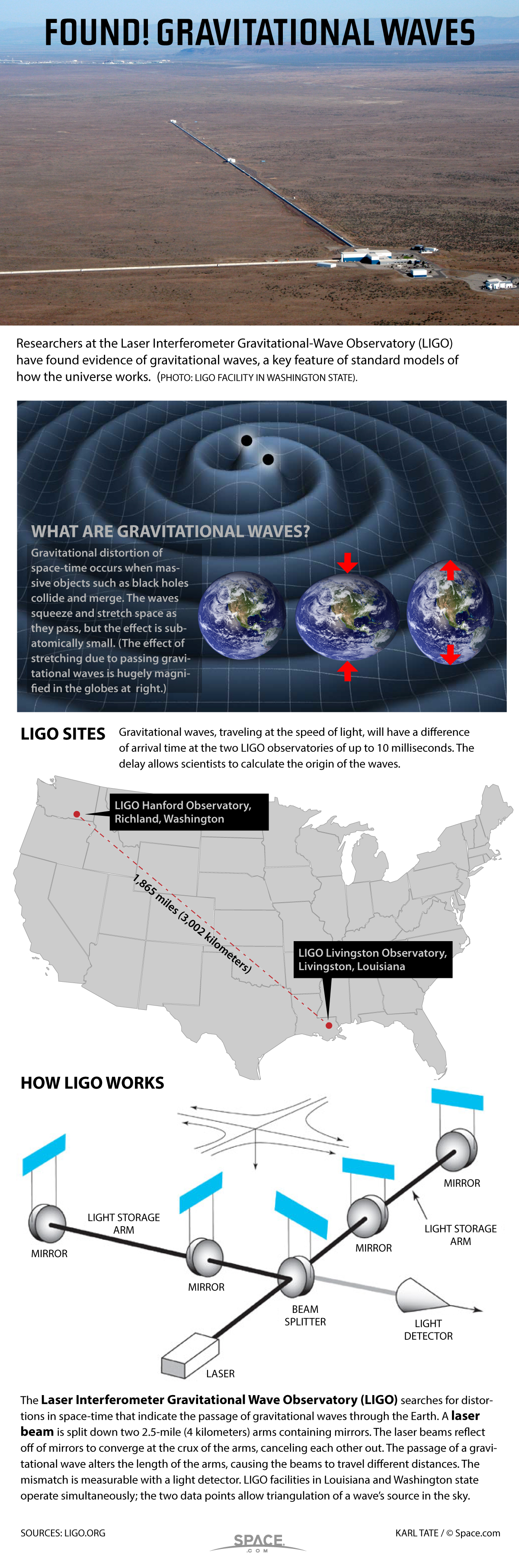
The LIGO observatory features two stations, one in Washington and the other in Louisiana, that each feature a pair of 2.5-mile-long vacuum tubes arranged in an L shape in which precisely tuned laser beams flash back and forth between multiple mirrors. A gravitational wave stretches space in one direction and compress it in a perpendicular direction.
The effects on local space are infinitesimal, making detection a high-technology challenge and a feat Einstein could never have imagined. The LIGO equipment is sensitive enough to measure changes in the distance traveled by the laser beams to less than the width of a proton.
On Sept. 14, 2015, LIGO recorded gravitational radiation for the first time. Analyzing the data, scientists realized they had the tell-tale signature of two black holes merging. The discovery was announced the following February.
Gravitational Waves Detected from Neutron-Star Crashes: The Discovery Explained
By Charles Q. Choi, Space.com Contributor
For the first time, scientists have detected ripples in the fabric of space and time — known as gravitational waves — from a colliding pair of dead stars called neutron stars. This is the first time astronomers have witnessed two neutron stars merging, and these new findings may help solve the decades-old mystery of how many of the universe's heavy elements were created. Here's an explainer on why the discovery is so groundbreaking for our understanding of the universe
What are gravitational waves?
The existence of gravitational waves was first predicted by Albert Einstein in 1916. According to Einstein's theory of general relativity, gravity results from how mass warps the fabric of space and time. When any object with mass moves, it should generate gravitational waves that travel at the speed of light, stretching and squeezing space-time along the way.
Gravitational waves are extraordinarily weak, making them extremely difficult to detect, and even Einstein was uncertain whether they really existed. A century later, in 2016, researchers successfully detected the first direct evidence of gravitational waves, using the Laser Interferometer Gravitational-Wave Observatory (LIGO). This work earned three scientists the 2017 Nobel Prize in physics in October 2017.
LIGO uses a pair of detectors in the United States — one in Livingston, Louisiana, and the other in Hanford, Washington — to sense the warping that gravitational waves cause as they move through matter. Each detector is shaped like a gigantic L, with legs about 2.5 miles (4 kilometers) long. The legs of each detector are normally the same length, so laser beams take the same time to travel down each. However, if gravitational waves pass through Earth — and they make the detector legs expand and contract by as much as one-ten-thousandth the diameter of a proton — these space-time distortions allow each detector's instruments to detect the split-second differences in time it would take for the laser beams to zip down one leg of the detector versus the other.
Because LIGO's detectors are separated by about 1,865 miles (3,000 km), it can take up to 10 milliseconds for a gravitational wave to cross from one detector to the other. Scientists can use this difference in arrival times to gauge where the gravitational waves come from. As more gravitational-wave detectors come online — such as the Virgo facility near Pisa, Italy — researchers can do a better job of pinpointing the sources of gravitational waves.
The easiest gravitational waves for LIGO to detect are the most powerful ones, which are released when extraordinarily massive objects collide with one another. All of the gravitational waves that LIGO and other detectors previously discovered were from the mergers of black holes. Now, for the first time, scientists have detected gravitational waves from merging neutron stars, using LIGO and Virgo.
What are neutron stars?
Neutron stars, like black holes, are remnants of stars that perished in catastrophic explosions known as supernovas. When a star goes supernova, its material collapses to form a dense core. If this core is massive enough, it may form a black hole, which has such a powerful gravitational pull that not even light can escape. A less massive core will form a neutron star, so named because its gravitational pull is strong enough to crush protons together with electrons to form neutrons.
Although neutron stars are typically small, with diameters of about 12 miles (19 kilometers) or so, they are so dense that a neutron star's mass may be about the same as that of the sun. A teaspoon of neutron-star material has a mass of about a billion tons, making neutron stars the densest objects in the universe besides black holes.
The discovery: Gravitational waves from neutron stars
On Aug. 17, advanced LIGO and advanced Virgo (the current upgraded versions of both observatories) detected a gravitational-wave signal possessing an extraordinary amount of energy — "something like a billion times the energy of the luminosity of the Milky Way," said Mansi Kasliwal, of the California Institute of Technology in Pasadena. Kasliwal is principal investigator of Global Relay of Observatories Watching Transients Happen (GROWTH), an international collaboration focused on cosmic transient events such as neutron-star mergers.
"Its energy was enough to outshine the 100 billion stars in our galaxy by about a billion-fold for the 50 or so seconds it took place," said Kasliwal, one of many scientists who took part in this discovery.
This event is the first time scientists have witnessed two neutron stars merging. One main clue that the signal came from such a merger was its duration, the longest gravitational-wave signal detected to date, Kasliwal said.
Black holes are denser than neutron stars, so the signals from their mergers are relatively brief. "Previously detected black-hole mergers lasted for a second, maybe two seconds," Kasliwal told Space.com. "This latest event lasted nearly a whole minute."
There was another main clue that this new signal came from a neutron-star merger: the masses of the objects generating these gravitational waves. The frequency of gravitational waves depends on the mass of the objects that generates them — the higher the frequency, the lower the mass, Kasliwal said. The two merging objects that generated this new signal were about 1.3 and 1.5 times the mass of the sun, respectively, which is typical of neutron stars, Kasliwal said. In comparison, "the first black-hole merger that LIGO detectedinvolves black holes each about 30 times the mass of the sun," Kasliwal said.
As powerful as this new signal was, it was also much less powerful than ones seen from black-hole mergers. This neutron-star merger converted about 0.025 times the mass of the sun into energy, "which is a stupendous amount of energy," Kasliwal said. However, the first black-hole merger LIGO detected converted three solar masses into energy, "which outshone everything we had ever seen until then," Kasliwal said.
So far, LIGO has detected four black-hole mergers and one neutron-star merger. Some researchers had predicted neutron-star mergers would be more common than black-hole mergers, whereas others had predicted the opposite, Kasliwal said. She explained that while neutron-star mergers are more common in any given volume, black-hole mergers are more energetic "and so can get detected from much farther out."
The light from colliding neutron stars
Together, advanced LIGO and advanced Virgo narrowed down the location of this new event, named GW170817, to a 28 square-degree patch of sky. (In comparison, the full moon as seen from Earth covers about 0.2 square degrees of sky.)
By working quickly, astronomers used both conventional and gravitational-wave observatories to watch the same event: the first-ever detection of light from a gravitational-wave source. In contrast, black-hole mergers are not expected to produce any light, which means conventional telescopes cannot detect them.
The scientists employed a variety of telescopes to analyze the radio waves, infrared waves, visible light, ultraviolet light, X-rays and gamma-ray burst from the neutron-star merger for weeks. The Swope Telescope at Las Campanas Observatory in Chile successfully pinpointed GW170817 to a galaxy called NGC 4993, located in the constellation Hydra, about 130 million light-years from Earth.
This is the first time scientists have linked a gravitational-wave event with a known galaxy. They dubbed the source of this event Swope Supernova Survey 2017a (SSS17a).
"Using LIGO and Virgo, we found there were only 49 galaxies that could have possibly been the home of this merger, and by prioritizing our search for this merger by how massive the galaxies were — which helped us estimate how many stars there were in each galaxy, and thus the chances they might have merging neutron stars — we found the merger in the third galaxy on our list," Kasliwal said.
Debris from the merger
SSS17a quickly faded and changed from bluer to redder light — a sign that its debris expanded rapidly at speeds close to the speed of light and cooled as it went. The researchers said the merging neutron stars generated a "kilonova," an explosion 1,000 times stronger than a typical star explosion, called a nova.
"We think the merger ejected about 10,000 Earth masses of material," Kasliwal said.
The researchers estimated the merger generated a jet of material that shot outward at nearly the speed of light, moving down a path tilted about 30 degrees away from the line of sight from Earth. All of the light that the researchers detected came from a cocoon of material surrounding this jet. They estimated that about 30 percent of future neutron-star mergers will generate bright gamma-rays detectable from Earth.
The spectrum of light from the matter ejected from the merger revealed that this material was loaded with newly synthesized elements. These new findings confirmed 70 years of research suggesting that neutron-star mergers are powerful enough to synthesize heavy elements such as gold, platinum and lead.
Scientists had known where lighter elements were synthesized — most hydrogen and helium came from the Big Bang, and elements up to iron on the periodic table are mostly forged in the cores of stars. However, the origin of half of the elements heavier than iron has been uncertain. These new findings provided the first concrete proof that such mergers are the birthplaces of half of the universe's elements that are heavier than iron, Kasliwal said.
It remains uncertain what the product of this merger was. "It's about 2.7 solar masses, so it lies in the 'mass gap' between neutron stars and black holes. The most massive neutron stars found to date are about two solar masses, and the least massive black holes seen are five solar masses," Kasliwal said. "It's either the most massive neutron star ever seen, or the lowest mass black hole ever seen, or maybe it's a supermassive neutron star that will collapse to form a black hole. This is new territory."
The scientists detailed their findings in a collection of papers in the journals Science, Nature, The Astrophysical Journal and other journals.
Amerikaanse politica zegt te zijn meegenomen door aliens. Dit is hoe ze eruitzagen
Een Amerikaanse politica die volgend jaar hoopt congreslid te worden, heeft geclaimd dat ze is ontvoerd door aliens.
Bettina Rodriguez Aguilera (59), die eerder in het stadsbestuur van Miami zat, zei dat ze op 7-jarige leeftijd is meegenomen door buitenaardse wezens.
Haar schoonzoon, Jarrod Agen, is plaatsvervangend stafchef van Mike Pence, de vicepresident van de VS.
Contact
“Ik heb rechtstreeks contact gehad,” zei ze in 2009 in een interview met het Spaanstalige America Teve.
“Er waren drie mensen, die er een beetje uitzagen zoals jij,” zei ze tegen de blonde presentatrice van de tv-show.
Ze vertelde verder dat de aliens leken op het standbeeld Christus de Verlosser in de Braziliaanse stad Rio de Janeiro.
Twee vrouwen en een man
In een interview dat in 2011 op YouTube is verschenen ging ze dieper in op de ontmoeting. Ze zei dat er twee vrouwen en een man waren.
Rodriguez Aguilera zei dat ‘naar boven’ ging, het ruimteschip in. “Ik ging naar binnen,” zei ze. “Er waren enkele ronde stoelen en kwartskristallen waarmee het schip werd bestuurd.”
Ze vloog rond in het ruimteschip en kreeg onder meer te horen dat Afrika het energetische centrum van de aarde was.
Prehistorische schedels
Ze vertelden haar ook dat het eiland Malta was omringd door prehistorische schedels, anders dan moderne mensen.
De politica zei dat Coral Castle een piramide was buiten Egypte en dat de aliens Isis hadden genoemd.
“Het is erg moeilijk om uit te leggen,” zei ze toen de presentatrice vroeg wat ze precies bedoelde.
Dapper
“Ze vertelden me dat ze later zouden terugkeren, als ik ouder zou zijn,” vervolgde ze. Dat gebeurde volgens haar toen ze 17 jaar oud was.
De Venezolaanse journalist Luis Sosa bedankte haar en vond het dapper dat ze zich hierover durfde uit te spreken.
“Veel mensen praten niet over dit soort onderwerpen,” zei hij.
Onbekende vliegende objecten
Rodriguez Aguilera vertelde aan de Miami Herald dat ze gelooft in intelligent leven buiten ons sterrenstelsel.
“Al jaren hebben mensen, waaronder presidenten als Ronald Reagan en Jimmy Carter en astronauten, openlijk gezegd dat ze onbekende vliegende objecten hebben gezien,” zei ze.
First Detection of Gravitational Waves from Neutron-Star Crash Marks New Era of Astronomy
By Mike Wall, Space.com Senior Writer
A new era of astronomy has begun.
For the first time ever, scientists have spotted both gravitational waves and light coming from the same cosmic event — in this case, the cataclysmic merger of two superdense stellar corpses known as neutron stars.
The landmark discovery initiates the field of "multimessenger astrophysics," which promises to reveal exciting new insights about the cosmos, researchers said. The find also provides the first solid evidence that neutron-star smashups are the source of much of the universe's gold, platinum and other heavy elements. [Gravitational Waves from Neutron Stars: The Discovery Explained]
"This is a transformation in the way that we're going to do astronomy," O'Shaughnessy, who's based at the Rochester Institute of Technology's Center for Computational Relativity and Gravitation, told Space.com. "It's fantastic."
An artist’s illustration of merging neutron stars.
Credit: Robin Dienel; Carnegie Institution for Science
A new type of detection
Gravitational waves are ripples in the fabric of space-time generated by the acceleration of massive cosmic objects. These ripples move at the speed of light, but they're much more penetrating; they don't get scattered or absorbed the way light does.
Albert Einstein first predicted the existence of gravitational waves in his theory of general relativity, which was published in 1916. But it took a century for astronomers to detect them directly. That milestone came in September 2015, when LIGO saw gravitational waves emitted by two merging black holes. [How Gravitational Waves Work (Infographic)]
That initial find won three project co-founders the 2017 Nobel Prize in physics. The LIGO team soon followed it up with three other discoveries, all of which also traced back to colliding black holes.
The fifth gravitational-wave detection — which was announced today (Oct. 16) at news conferences around the world, and in a raft of papers in multiple scientific journals — is something altogether new. On Aug. 17, 2017, LIGO's two detectors, which are located in Louisiana and Washington state, picked up a signal that lasted about 100 seconds — far longer than the fraction-of-a-second "chirps" spawned by merging black holes.
" IT immediately appeared to us the source was likely to be neutron stars, the other coveted source we were hoping to see — and promising the world we would see," David Shoemaker, a spokesman for the LIGO Scientific Collaboration and a senior research scientist at the Massachusetts Institute of Technology's Kavli Institute for Astrophysics and Space Research, said in a statement. [How to Detect Gravitational Waves: LIGO Simply Explained (Video)]
Indeed, calculations by the LIGO team suggest that each of the colliding objects harbors between 1.1 and 1.6 times the mass of the sun, putting both objects in neutron-star territory in terms of mass. (Each of the merging black holes responsible for the other detected signals contained dozens of solar masses.)
Neutron stars, the collapsed remnants of massive stars that have died in supernova explosions, are some of the most exotic objects in the universe.
"They are as close as you can get to a black hole without actually being a black hole," theoretical astrophysicist Tony Piro, of the Observatories of the Carnegie Institution for Science in Pasadena, California, said in a different statement. "Just one teaspoon of a neutron star weighs as much as all the people on Earth combined."
Right: An image taken on Aug. 17, 2017, with the Swope Telescope at the Las Campanas Observatory in Chile shows the light source generated by a neutron-star merger in the galaxy NGC 4993. Left: In this photo taken on April 28, 2017, with the Hubble Space Telescope, the neutron star merger has not occurred and the light source, known as SSS17a, is not visible.
Credit: D.A. Coulter, et al.
A team effort
The Virgo gravitational-wave detector near Pisa, Italy, also picked up a signal from the Aug. 17 event, which was dubbed GW170817 (for the date of its occurrence). And NASA's Fermi Gamma-ray Space Telescope spotted a burst of gamma-rays — the highest-energy form of light — at about the same time, coming from the same general location. [A Video Guide to the Discovery]
All of this information allowed researchers to trace the signal's source to a small patch of the southern sky. Discovery team members passed this information on to colleagues around the world, asking them to search that patch with ground- and space-based telescopes.
This teamwork soon bore fruit. Just hours after the gravitational-wave detection, Piro and his colleagues spotted a matching optical light source about 130 million light-years from Earth, using a telescope at Las Campanas Observatory in Chile.
"We saw a bright-blue source of light in a nearby galaxy — the first time the glowing debris from a neutron star merger had ever been observed," team member Josh Simon, also of the Carnegie Observatories, said in a statement. "It was definitely a thrilling moment."
Then, about an hour later, researchers using the Gemini South telescope, also in Chile, spotted that same source in infrared light. Other teams using a variety of instruments soon studied the source across the electromagnetic spectrum, from radio to X-ray wavelengths.
This work revealed that some of the observed light was the radioactive glow of heavy elements such as gold and uranium, which were produced when the two neutron stars collided.
That's a big deal. Scientists already knew the provenance of lighter elements — most hydrogen and helium was generated during the Big Bang, and other elements all the way up to iron are created by nuclear fusion processes inside stars — but the origin of the heavy stuff was not well understood. [The Big Bang to Now: 10 Easy Steps]
"We've shown that the heaviest elements in the periodic table, whose origin was shrouded in mystery until today, are made in the mergers of neutron stars," Edo Berger, of the Harvard-Smithsonian Center for Astrophysics (CfA) in Cambridge, Massachusetts, said in a statement. Berger leads a team that studied the event using the Dark Energy Camera at the Cerro Tololo Inter-American Observatory in Chile.
"Each merger can produce more than an Earth's mass of precious metals like gold and platinum and many of the rare elements found in our cellphones," Berger said in a statement.
Indeed, GW170817 likely produced about 10 Earth masses' worth of gold and uranium, researchers said.
Much more to come
The in-depth investigation of GW170817 has revealed other important insights.
For example, this work demonstrated that gravitational waves do indeed move at the speed of light, as theory predicts. (The Fermi space telescope detected the gamma-ray burst just 2 seconds after the gravitational-wave signal ended.) And astronomers now know a little more about neutron stars.
"There are some types of things that neutron stars could be made of that we're sure they're not made of, because they didn't squish that much" during the merger, O'Shaughnessy said.
But GW170817 is just the beginning. For instance, such "multimessenger" observations provide another way to calibrate distances to celestial objects, said the CfA's Avi Loeb, who also chairs Harvard University's astronomy department.
Such measurements could, in theory, help scientists finally nail down the rate of the universe's expansion. Estimates of this value, known as the Hubble Constant, vary depending on whether they were calculated using observations of supernova explosions or the cosmic microwave background (the ancient light left over from the Big Bang), said Loeb, who was not involved in the newly announced discovery.
"Here's another path that is open that was not available before," he told Space.com.
Many other such paths are likely to open, O'Shaughnessy stressed, and where they may lead is anyone's guess.
"I think probably the most exciting thing of all is really that it's the beginning," O'Shaughnessy said of the new discovery. "It resets the board for what astronomy is going to look like in the years to come, now that we have multiple ways of simultaneously probing a transient and violent universe."
Ex-policeman still says he was abducted by aliens after 37 years
Joe Roberts for Metro.co.uk
Alan’s abduction made national headlines in 1980
(Picture: Cascade/Getty)
A former policeman is still claiming he was abducted by aliens while out on patrol, some 37 years later.
Alan Godfrey’s ‘close encounter’ made him famous in 1980, but it also led to the demise of his career as a copper.
In his tell-all book, the 70-year-old alleges his superiors tried to silence him and get him sectioned.
‘This is the story of secret forces and cover-ups plus terrifying attempts to destroy a brave officer’s career,’ he boldly claims. The ‘abduction’ on November 28, 1980, attracted national headlines. He was even interviewed by Frank Bough on BBC Breakfast.
Alan draws an impression of the UFO he saw while out on patrol
(Picture: Cascade)
Alan says his fame came at a price. He says his superiors banned him from Todmorden police station, effectively ending his nine-year career with West Yorkshire police.
It all came after Alan began investigating a case of missing cows, when he saw a very strange sight – a UFO hovering over his patrol car.
Alan tried to call for help but his radio was dead so he jotted down a sketch of it on his notepad. He experienced 30 minutes of ‘missing time’ and later underwent hypnosis in a bid to retrieve his memories.
And to his horror he says he remembered seeing several small beings and a tall man with a beard performing medical tests on him.
Alan wants his grandchildren to know the truth about that fateful night
(Picture: Cascade)
He said: ‘Someone was determined to stop at nothing to undermine my efforts to tell the truth. It turned into a nightmare and cost me dear but speaking about it is the right thing to do.’
Alan said he has kept quiet about things that happened to him during his time with the police force and the strange events that later unfolded.
After taking ill a year ago, he decided to write down his experiences so his grandchildren could know the truth.
‘This book tells it like it is – everything that occurred but which someone did not want you to read,’ he said.
Alan said the UFO was the size of a double decker bus and seemed to be rotating, then suddenly the object vanished and he was 30 yards further down the road.
The case of Alan’s ‘missing 30 minutes’ is one of the most famous ‘alien abductions’ this side of the pond
(Picture: Getty)
‘When you see something like that out of nowhere and you feel strange sensations and hear messages coming into your head then you know this is not just a routine police patrol.’
He drove back to the scene and discovered the road was dry despite it having rained. A bus travelling on the road stopped and the driver got out and noticed the same thing.
Alan said it got much weirder after that when images of strange beings and medical experiments and much more started to reappear.
Alan’s book is called Who or What Were They? as he is still trying to come to terms with what happened.
VIDEO A mysterious 'UFO' has been captured on video circling over a remote country town. Source: SWNS
A baffled British couple has revealed eerie photos of what they claim is a UFO flying over the Cape Verde coast.
The couple, who do not wish to be named, claim they spotted the metallic blue shape when looking back over holiday snaps the next day and had no idea it was there at the time.
“It's just so very strange,” the man said.
"I remember on the day it was so beautiful and we were taking pictures of the scenery.
"I was just looking back through my photos after the holiday and I looked at this one, pointed at the object in the centre, and said 'what on earth is that?’.
The British couple were on a tour in Africa when they took this photo.
Photo: Caters News
"I suppose it looks like a black dot in the background. We just couldn't figure out what it was exactly."
The woman says she had no idea the 'UFO' was in the sky at the time because when she was there she was too busy looking out into the sea, and there were no obvious signs of overhead aircraft.
"What's strange is that I didn't see it at the time because it looked like there were no planes in the sky," she says.
"It was a clear day and it must have been very quick because I didn't notice anything flying in the air at the time.
In a bid to get answers on and identify the mystery object, she has employed the help of a UFOspecialist in an effort to get to the truth.
"Some people have suggested that it might be a fly or a drone but I just don't know what it is,” she says.
"I'd just like to speak to some people to get some answers. There weren't any planes in the sky or any helicopters so. It's just so unusual.
"Nobody has been able to tell me what it was. I'm really keen to get it out there to see what people's views are.”
The unidentified object, spotted while the pair were sightseeing on the island of Sal, has a similar shape to a Lockheed SR-71 Jet. The Lockheed 'Blackbird' was a Cold War-era jet but was retired in the 1990s.
The object can be likened to a cold-war fighter jet.
Photo: Caters News
Many conspiracy theorists believe the supersonic knowhow that the 'world's fastest jet' used came from alien technology hidden by the US government.
UFO expert Philip Mantle acknowledges it bears an uncanny resemblance to the Blackbird but says the image remains open to speculation.
"Even though it looks like a 'Blackbird Jet' those aircraft were taken out of service long ago and replaced by more up to date stealth technology,” Philip says.
"But it could have been somebody playing on the beach with a drone or it could have been a tourist aircraft of some kind.
"If I'm honest it looks like either a bug of some sort or simply a piece of air borne debris.
“My experience down the years has taught me that people put forward such photos and say that they observed nothing unusual at the time.
"Then it almost always turns out to have a perfectly rational explanation.”
astronomy.swin.edu.auEen grafische weergave van een kilonova
WETENSCHAP & PLANEETWetenschappers hebben ontdekt hoe goud en platina zijn ontstaan. De edele metalen werden uitgespuwd na een botsing tussen twee dode sterren. Voor het eerst heeft de Hubble Ruimtetelescoop ook rimpelingen in zwaartekrachtgolven waargenomen. Dat meldt het Europese Ruimtevaartagentschap ESA.
“Het is de grootste vuurwerkshow in het universum”, zegt een enthousiaste David Reitze van het Califorina Institute of Technology aan de NY Times. Een theorie die al heel lang geleden werd voorspeld, is eindelijk waargenomen. Dankzij een ‘kilonova’ werden goud en platinum de ruimte in gespuwd.
Een kilonova is de botsing van neuronensterren, de gekrompen kernen van dode sterren. Die botsing stuurt een hoge pieptoon naar de aarde, maar ook een rimpeling van zwaartekrachtgolven, zo blijkt. En die rimpeling kon de Hubble onlangs waarnemen.
Het bestaan van zwaartekrachtgolven werd vorig jaar bewezen toen het wetenschappers het geluid van een botsing van twee zwarte gaten konden registreren. Het leverde hen dit jaar de Nobelprijs voor de fysica op. Maar Albert Einstein voorspelde in 1916 al het bestaan van zwaartekrachtgolven. Hij dacht toen al dat die rimpeling het gevolg kon zijn van een botsing van hemellichamen.
Een botsing tussen twee zwarte gaten brengt niets meer voort dan geluid, maar uit een botsing van dode sterren ontstaat heel wat meer. Niet alleen radiogolven en röntgenstralen worden uitgespuwd, maar ook edele metalen, waaronder goud, platinum, zilver en uranium.
Nieuw tijdperk van astronomie ingeluid. Sterrenkundigen zijn lyrisch over deze unieke waarneming
Groot nieuws op het gebied van zwaartekrachtgolven. Voor het eerst hebben astronomen een kosmische gebeurtenis waargenomen met zwaartekrachtgolven én licht.
Deze uitzonderlijke combinatie kwam vrij bij de botsing van twee neutronensterren. De waarneming leert onder andere dat bij zo’n botsing veel goud en platina vrijkomt.
Neutronensterren zijn restanten van geëxplodeerde sterren en hebben een diameter van ongeveer 10 kilometer. Bij een samensmelting komt veel energie en licht vrij, samen met zwaartekrachtgolven.
Niet verwacht
Zwaartekrachtgolven zijn golven in de ruimtetijd. Ze ontstaan bij heftige kosmische gebeurtenissen, zoals het versmelten van zwarte gaten of bij de explosie van een grote ster.
De afgelopen jaren zochten wetenschappers met speciale instrumenten naar deze golven. Ze hadden niet verwacht een versmelting van neutronensterren waar te zullen nemen.
De botsing tussen de twee neutronensterren gebeurde 130 miljoen jaar geleden. Nu pas bereikten het licht en de zwaartekrachtgolven van de kosmische explosie onze planeet.
100 keer
Het signaal duurde ongeveer 100 seconden en daarna kwam een grote hoeveelheid goud vrij. Waarschijnlijk is de hoeveelheid goud die gevormd werd groter dan 100 keer de massa van de aarde.
Volgens de onderzoekers staan ons waarschijnlijk nog meer belangrijke ontdekkingen te wachten op het gebied van zwaartekrachtgolven.
Nieuw tijdperk
“Er zijn maar weinig gelegenheden waarbij je als wetenschapper de kans hebt om getuige te zijn van de start van een nieuw tijdperk,” zei hoofdonderzoeker Elena Pian. “Dit is zo’n kans!”
Telescopen blijven de gevonden locatie voorlopig volgen om zoveel mogelijk gegevens te verzamelen over de samensmelting.
With a build-up worthy of Tom DeLonge, the European Southern Observatory (ESO) teased both the scientific and general public for weeks with promises that it was about to make an announcement that would change astronomy as we know it. The wait was over on October 16th. Was it worth the hype?
“For the first time ever, astronomers have observed both gravitational waves and light (electromagnetic radiation) from the same event, thanks to a global collaborative effort and the quick reactions of both ESO’s facilities and others around the world.”
Whoa! Whoa? What does this mean? On August 17, the Fermi Gamma-ray Space Telescope detected a seemingly normal gamma-ray burst from an unidentified source. Almost simultaneously, the Laser Interferometer Gravitational Wave Observatory (LIGO) in Washington State got an alert signaling it had received a gravitational wave signal. (It was later learned that the LIGO detector in Louisiana received the same signal but didn’t report it due to an error.)
Artist’s impression of neutron stars about to collide.
(ESO)
The short burst of gamma rays was also detected by ESA’s INTErnational Gamma Ray Astrophysics Laboratory (INTEGRAL). That and the other signals helped pinpoint the source of all of the observations — a collision of neutron stars that resulted in a black hole. At that point, thanks to the astronomers’ grapevine, the news was picked up by observatories around the world and about 70 of them aimed their telescopes at the coordinates given and began picking up light, signals and photons of various wavelengths for weeks.
Composite of images of the kilonova
(ESO)
“There are rare occasions when a scientist has the chance to witness a new era at its beginning, This is one such time!”
Elena Pian, an astronomer with INAF, Italy, describes the feeling she and fellow astronomers and scientists had while observing this common phenomenon on their own specialized telescopes. What they all had seen for the first time was a kilonova – a supernova caused by neutron star collision. While one had been detected in 2013 by the Hubble telescope, this was the first time so many were able to observe it and to confirm the theories that such an event can cause both light waves and gravitational waves.
Artist’s impression of the kilonova
(ESO)
“The data we have so far are an amazingly close match to theory. It is a triumph for the theorists, a confirmation that the LIGO–VIRGO events are absolutely real, and an achievement for ESO to have gathered such an astonishing data set on the kilonova.”
As astronomer Stefano Covino describes it in the press release, the sound of backslapping after witnessing the kilonova must have been deafening (and painful). Another scientist and author of one of the papers detailing the discovery, Andrew Levan, described the importance of how the European Southern Observatory (ESO) managed to pull so many telescopes and instruments together so quickly.
“We have entered a new era of multi-messenger astronomy!”
Another artist’s impression of the collision
(NSF/LIGO/Sonoma State University/A. Simonnet)
What next? After the astronomers sober up from the celebrations, they will begin studying the volumes of data collected and attempt to resolve some anomalies, like why the collision didn’t cause a black hole immediately and why were the gamma-rays less intense than expected. Many of the telescopes are now undergoing sensitivity upgrades so they can respond even more quickly and collect even more data when the grapevine lights up again.
In the meantime, ‘Kilonova’ would make a great name for a metal band.
NASA Spacecraft captured Ancient Mining Machine on Asteroid Eros?
Eros is an elongated peanut-shaped .asteroid and the first discovered and second-largest near-Earth object with a mean-diameter of approximately 16.8 kilometers and named after the Greek God of Love, Eros.
Eros was one of the first asteroids visited by a spacecraft, the first one orbited, and the first one soft-landed on.
NASA spacecraft NEAR Shoemaker visited Eros first with a 1998 flyby and entered orbit around 2000, and on February 12, 2001, at the end of its mission, it landed on the asteroid's surface using its maneuvering jets.
The above particular image of Eros, taken from the NEAR Shoemaker spacecraft on May 1, 2000, at an orbital altitude of 53 kilometers (33 miles), shows, according to NASA, a large rectangular boulder which is 45 meters across.
But is it really a boulder or could it be a sort of ancient mining machine?
Given the fact that data from the spacecraft collected on Eros in December 1998 suggests that it could contain 20,000 billion kilograms of aluminum and similar amounts of metals that are rare on Earth, such as gold and platinum, it is not unlikely that the so-called boulder is an mining machine that has been used by an advanced alien civilization for the extraction of all these valuable metals.
UFO Spotted Augusta, Georgia: A Fact Finding Mission
There are some prominent politicians and celebrities connected to the UFO subject in one way or another. Having witnessed a lot of UFO stories over the years, some people can appreciate their need to weigh a statement they might consider. In other words, they are carefully scrutinising the balances before speaking or writing the incidents for public consumption.
A resident of Georgia took a brief look at the sky during a football game between the Lincoln County Red Devils and the Grovetown Warriors. That night, he saw in the sky something that immediately captured his attention. Moving from west to east at a very slow pace was a wedge-shaped unidentified object that has a triangular shaped light configuration. Such object is visible from the stands. The witness wants to remain anonymous to avoid controversy. He tried to use his mobile phone to record the incident, but his phone became malfunctioned. So, he borrowed whose friend’s mobile phone who had joined him in the game that night.
Later on, the witness forwarded the photo to Donnie Brooke, who is a member of the Georgia Chapter of MUFON. Brooke said the witness told him via phone that he saw a “humongous” object.
Brooke said it would not be possible to make a direct connection between the army base and Grovetown sighting, but noted that Fort Gordon is a place of the U.S. Army Cyber Center of Excellence. A Chief Investigator Paul Jones told the Baltimore Post-Examiner that he is not surprised to hear of a possible sighting in Grovetown since the Augusta area is full of interesting cases.
According to Brooke, it is common for people to see unidentified objects flying in the sky but fail to report them to any agency or local authorities because they are scared of what others will think. The witness to whom Brooke is personally acquainted with is sure on the sightings, but just do not want to appear his name in the press.
Filmmaker Believes Alien Implant Topic Is Not So Crazy
The subject of alien abduction and the related phenomenon of alien implants often get ridiculed. However, paranormal documentary filmmaker Jeremy Corbell believes alien implants deserve a serious examination. Many find it hard to swallow the claims that aliens snatched people and return them without their knowledge. In addition to the claims, aliens allegedly put implants inside the abduction victims.
Corbell initially thought that documenting a surgery to remove an alien implant was way outside of his scope of knowledge or interest. It seemed too wild for him to put his mind around. However, Corbell decided to do it after his friends asked him to do so.
One of the main characters in the documentary film is paediatric surgeon Roger Leir, who is also an alien implant specialist.
Incidentally, Leir believed the idea of removing a suspected alien implant was ridiculous, but when he removed the object, he saw something he had not seen before. He started to think that the topic was fascinating. He then removed or help the removal of dozens of objects before passing away in 2014.
Corbell said that Lier died while he was putting together his documentary. However, Corbell revealed that it was not Leir that convinced him the implant phenomenon might be real. According to Corbell, it was the patient that changed his opinion.
Corbell referred the man as patient 17, who he described as an average guy of above average height – six foot nine.
The patient, according to Corbell, is a very down to earth person. Corbell revealed that experts had interpreted the data of the extraordinary object from test results as being made off-world. He is convinced that this thing is bizarre but admits more testing has to be done.
Meer van UFO'S of UAP'S, ASTRONOMIE, RUIMTEVAART, ARCHEOLOGIE, OUDHEIDKUNDE, SF-SNUFJES EN ANDERE ESOTERISCHE WETENSCHAPPEN - DE ALLERLAATSTE NIEUWTJES


 The View points out the shocking similarity between Kellyanne Conway and ‘nutty’ UFO-abducted candidate