Ontdek de Fascinerende Wereld van UFO's en UAP's: Jouw Bron voor Onthullende Informatie!
Ben jij ook gefascineerd door het onbekende? Wil je meer weten over UFO's en UAP's, niet alleen in België, maar over de hele wereld? Dan ben je op de juiste plek!
België: Het Kloppend Hart van UFO-onderzoek
In België is BUFON (Belgisch UFO-Netwerk) dé autoriteit op het gebied van UFO-onderzoek. Voor betrouwbare en objectieve informatie over deze intrigerende fenomenen, bezoek je zeker onze Facebook-pagina en deze blog. Maar dat is nog niet alles! Ontdek ook het Belgisch UFO-meldpunt en Caelestia, twee organisaties die diepgaand onderzoek verrichten, al zijn ze soms kritisch of sceptisch.
Nederland: Een Schat aan Informatie
Voor onze Nederlandse buren is er de schitterende website www.ufowijzer.nl, beheerd door Paul Harmans. Deze site biedt een schat aan informatie en artikelen die je niet wilt missen!
Internationaal: MUFON - De Wereldwijde Autoriteit
Neem ook een kijkje bij MUFON (Mutual UFO Network Inc.), een gerenommeerde Amerikaanse UFO-vereniging met afdelingen in de VS en wereldwijd. MUFON is toegewijd aan de wetenschappelijke en analytische studie van het UFO-fenomeen, en hun maandelijkse tijdschrift, The MUFON UFO-Journal, is een must-read voor elke UFO-enthousiasteling. Bezoek hun website op www.mufon.com voor meer informatie.
Samenwerking en Toekomstvisie
Sinds 1 februari 2020 is Pieter niet alleen ex-president van BUFON, maar ook de voormalige nationale directeur van MUFON in Vlaanderen en Nederland. Dit creëert een sterke samenwerking met de Franse MUFON Reseau MUFON/EUROP, wat ons in staat stelt om nog meer waardevolle inzichten te delen.
Let op: Nepprofielen en Nieuwe Groeperingen
Pas op voor een nieuwe groepering die zich ook BUFON noemt, maar geen enkele connectie heeft met onze gevestigde organisatie. Hoewel zij de naam geregistreerd hebben, kunnen ze het rijke verleden en de expertise van onze groep niet evenaren. We wensen hen veel succes, maar we blijven de autoriteit in UFO-onderzoek!
Blijf Op De Hoogte!
Wil jij de laatste nieuwtjes over UFO's, ruimtevaart, archeologie, en meer? Volg ons dan en duik samen met ons in de fascinerende wereld van het onbekende! Sluit je aan bij de gemeenschap van nieuwsgierige geesten die net als jij verlangen naar antwoorden en avonturen in de sterren!
Heb je vragen of wil je meer weten? Aarzel dan niet om contact met ons op te nemen! Samen ontrafelen we het mysterie van de lucht en daarbuiten.
Zaterdag 25 november 2017
Black Disk Spotted During Flight to Gibraltar
Black Disk Spotted During Flight to Gibraltar
Our next story takes us on a flight from Great Britain to Gibraltar. The event took place back on April 4th of this year. The witness to this event, who also submitted the media, says he was taking cloud photos through the aircraft window when he captured a flying black disk in two of the four photos he shot. In the video, you can clearly see the shape of a disk as was described by the shooter. The object looks like it moved from one photo to the next, but that could be movement of the aircraft as well. The witness says he looked through the window again after taking the photos and there was nothing there. The object had disappeared. The only evidence he had are the two photos.
UFO Hunters Are Closely Monitoring the UFO Sighting Incident Over California
A UFO in the skies apparently above California is being featured in a video uploaded to YouTube channel SuspectSky.
According to the uploader, the video was shot in Rowland Heights, just east of Los Angeles, California. It seemingly shows a small white craft being followed by a larger flying object.
The clip titled “Large Black UFO with Another Leading Object Seen in California” shows the two objects moving over the mountain range. The incident reportedly took place on October 24.
The man behind the camera was apparently taking the footage while driving. He says in the video that if it is an airplane, it is moving very quickly.
He adds that after seeing the UFO, he had to make a U-turn to come back and see it. In his description, the UFO looked like a cigar shape at first, but it eventually looked like a saucer.
Some viewers of the video were convinced it is an unidentified flying object of extraterrestrial origin.
One person wrote that the smaller object in front of the black one is not right and it looks like a UFO.
Another one added the white object might have been a regular passenger plane, but the black one might have been a UFO as it is too fat to be a plane.
However, others have more plausible explanations.
One person said that the scene only involves a plane pulling an advertisement behind it. The commenter added that nothing is suspicious or suspect about it.
Others believed it could be a Chinook helicopter as it appears to have double blades.
Google Maps ALIEN proof? ‘UFO’ spotted on street view - what is behind mystery?
GOOGLE MAPS street view captures all sorts of unusual sights, and alien hunters are just one group who comb the images for clues of extraterrestrial life.
Some think it is an antenna that forms part of a nearby remote-controlled wind farm
Many were quick to claim it was a “triangle UFO” which had been captured hovering above Earth.
However, there may be a less spooky explanation for the shape.
Some think it is an antenna that forms part of a nearby remote-controlled wind farm.
With three sets of wires forming the triangle shape, and a tower in the middle, the antenna likely receives and transmits control signals.
Google Earth
Google Maps alien proof? 'UFO' sighting has some speculating over mystery
Google Earth
Google Maps alien proof? The mysterious shape has baffled those who have seen it
This is not the only unexplained sighting on Google Maps. The tool appeared to have uncovered a UFO landing site - but it was found to be something else instead.
Eagle-eyed viewers have also spotted something very confusing in Poland.
Many thought it could confirm that aliens exist.
Spotted in Krakow, Poland, a huge base with round domed huts appears next to a road.
GoogleEarth
Google Maps alien proof? The unexplained triangle is located in Australia
Some think it may be a UFO landing pad, confirming that aliens do exist.
On closer inspection, it is revealed that it isn’t actually anything to do with aliens at all.
It is instead the Alvernia Studios, used for films, as well as features for video games and music projects.
Whilst no well-known UK films have emerged from the studios, some include US thriller Arbitrage, with Richard Gere and Susan Sarandon, as well as comedy Vamps, with Alicia Silverstone and Krysten Ritter.
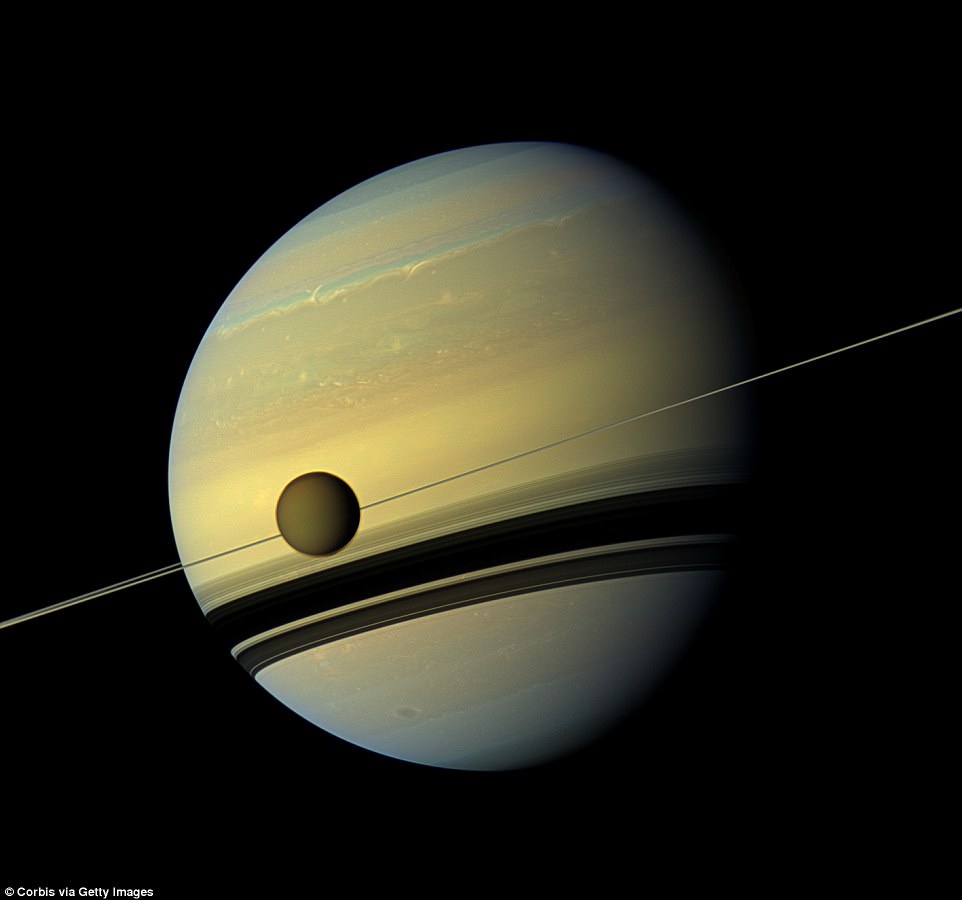
After more than 13 years at Saturn, and with its fate sealed, NASA's Cassini spacecraft bid farewell to the Saturnian system by firing the shutters of its wide-angle camera and capturing this last, full mosaic of Saturn and its rings two days before the spacecraft's dramatic plunge into the planet's atmosphere.
In a fitting farewell to the planet that had been its home for over 13 years, the Cassini spacecraft took one last, lingering look at Saturn and its splendid rings during the final leg of its journey and snapped a series of images that has been assembled into a new mosaic.
Cassini’s wide-angle camera acquired 42 red, green and blue images, covering the planet and its main rings from one end to the other, on Sept. 13, 2017. Imaging scientists stitched these frames together to make a natural color view. The scene also includes the moons Prometheus, Pandora, Janus, Epimetheus, Mimas and Enceladus.
There is much to remember and celebrate in marking the end of the mission. Cassini's exploration of Saturn and its environs was deep, comprehensive and historic.
"Cassini’s scientific bounty has been truly spectacular -- a vast array of new results leading to new insights and surprises, from the tiniest of ring particles to the opening of new landscapes on Titan and Enceladus, to the deep interior of Saturn itself," said Robert West, Cassini's deputy imaging team leader at NASA's Jet Propulsion Laboratory in Pasadena, California.
Annotated version of the farewell photo taken by NASA's Cassini spacecraft on Sept. 13, 2017.
NASA / JPL-Caltech / Space Science Institute.
The Cassini imaging team had been planning this special farewell view of Saturn for years. For some, when the end finally came, it was a difficult goodbye.
"It was all too easy to get used to receiving new images from the Saturn system on a daily basis, seeing new sights, watching things change," said Elizabeth Turtle, an imaging team associate at the Johns Hopkins University Applied Physics Laboratory, Laurel, Maryland. "It was hard to say goodbye, but how lucky we were to be able to see it all through Cassini's eyes!"
NASA’s Voyager 1 probe captured this image of Saturn and its rings on Nov. 16, 1980, four days after closest approach to Saturn, from a distance of 3.3 million miles (5.3 million kilometers). This viewing geometry, which shows Saturn as a crescent, is never achieved from Earth.
Credit: NASA/JPL/USGS
For others, Cassini's farewell to Saturn is reminiscent of another parting from long ago.
"For 37 years, Voyager 1's last view of Saturn has been, for me, one of the most evocative images ever taken in the exploration of the solar system," said Carolyn Porco, former Voyager imaging team member and Cassini's imaging team leader at the Space Science Institute in Boulder, Colorado. "In a similar vein, this 'Farewell to Saturn' will forevermore serve as a reminder of the dramatic conclusion to that wondrous time humankind spent in intimate study of our Sun's most iconic planetary system."
The team carefully planned every aspect of its termination, to expend every last bit of its propellant and crash the spacecraft into Saturn itself – where it would burn up in the atmosphere, and ensure it didn’t accidentally contaminate the ‘pristine’ moons Enceladus and Titan, which have shown potential to support microbial life
Launched in 1997, the Cassini spacecraft orbited Saturn from 2004 to 2017. The mission made numerous dramatic discoveries, including the surprising geologic activity on Saturn's moon Enceladus and liquid methane seas on Saturn's largest moon, Titan. Cassini ended its journey with a dramatic plunge into Saturn's atmosphere on Sept. 15, 2017, returning unique science data until it lost contact with Earth.
The Cassini-Huygens mission is a cooperative project of NASA, ESA (European Space Agency) and the Italian Space Agency. NASA's Jet Propulsion Laboratory, a division of Caltech in Pasadena, manages the mission for NASA's Science Mission Directorate, Washington. The Cassini orbiter and its two onboard cameras were designed, developed and assembled at JPL. The imaging team consists of scientists from the U.S., England, France, and Germany. The imaging operations center and team leader are based at the Space Science Institute in Boulder, Colorado.
Met deze foto neemt ruimtesonde Cassini afscheid van Saturnus
Caroline Kraaijvanger
Een laatste blik op de gasreus en zijn ringen.
Na dertien jaar rond Saturnus te hebben gecirkeld, moest Cassini op 15 september afscheid nemen van de machtige planeet, zijn ringen en talloze manen. Op die dag boorde de sonde zich met ware doodsverachting in de dikke atmosfeer van Saturnus: een avontuur dat Cassini niet na kon vertellen.
Nog één keer Maar op de valreep van deze prachtige missie wierp Cassini – op 13 september – nog één laatste blik op Saturnus en zijn ringenstelsel. En terwijl Cassini de ogen nog één keer op de gasreus richtte, maakte deze meerdere foto’s. Die foto’s heeft NASA nu aan elkaar geplakt. En het resultaat is een prachtige mozaïek die Saturnus in zijn volle glorie openbaart.
Afbeelding: NASA / JPL-Caltech / Space Science Institute.
Naast de gasreus en zijn ringen zijn op de foto ook enkele manen te zien: Prometheus, Pandora, Janus, Epimetheus, Enceladus en Mimas.
Ook enkele manen van Saturnus schitteren op de nieuwe foto. Klik voor een vergroting.
Afbeelding: NASA / JPL-Caltech / Space Science Institute.
Afscheid De foto is adembenemend. Maar doet tegelijkertijd ook een beetje pijn. Want het zal nog een hele tijd duren voor we de gasreus weer van zo dichtbij kunnen bewonderen (op dit moment zijn er nog geen plannen voor een vervolgmissie naar Saturnus). “Het was heel gemakkelijk om gewend te raken aan het feit dat we dagelijks nieuwe beelden van Saturnus konden ontvangen, nieuwe inzichten verkregen en konden zien hoe dingen veranderden,” vertelt onderzoeker Elizabeth Turtle. “Het was moeilijk om afscheid te nemen.”
Tegelijkertijd herinnert deze afscheidsfoto ons ook aan al die dingen die we – dankzij Cassini – over Saturnus en zijn omgeving te weten zijn gekomen. Onderzoeker Robert West wijst erop dat de missie resulteerde “in een breed scala aan nieuwe bevindingen die weer leiden tot nieuwe inzichten en verrassingen“.
Over Cassini Cassini werd in 1997 gelanceerd en draaide tussen 2004 en 2017 rond Saturnus. In die periode ontdekte de sonde onder meer geologische activiteit op de maan Enceladus en met methaan gevulde meren op Titan. Ook dook de sonde herhaaldelijk in het gat tussen Saturnus en zijn ringen – een primeur – om meer over de gasreus en de ringen te weten te komen. Het resulteerde onder meer in fantastische close-upfoto’s van de kleine maantjes die Saturnus rijk is. Halverwege september gaf NASA de sonde na bijna twintig jaar trouwe dienst opdracht om zich in de atmosfeer van Saturnus te boren. Een heel bewuste keuze: de brandstof van Cassini was op aan het raken en NASA wilde voorkomen dat de sonde stuurloos zou raken en op één van de potentieel leefbare manen van Saturnus zou crashen.
acquired November 12, 2017download large image (8 MB, JPG, 4753x3169)
NASA’s Operation IceBridge—the airborne mission flown annually over both polar regions to map the ice—is now in its ninth year making flights over Antarctica. A few flights during the 2017 campaign took scientists and instruments over the newly reshaped Larsen C ice shelf.
“It takes a long time to process the data from IceBridge instruments that show changes to the ice, and many of these changes are small,” said Nathan Kurtz, IceBridge project scientist. “That’s why we have instruments on the plane, so that we can detect smaller changes than we can see with our eyes.”
But occasionally, big changes are observed. “One of the biggest changes is the calving of an iceberg from the Larsen C ice shelf,” Kurtz said. “We observed the crack across the shelf during the campaign last year; it has since broken through and produced a huge iceberg.”
The iceberg from Larsen C, named A-68A, was photographed during a flight on November 12, 2017. John Sonntag, IceBridge mission scientist, shot the photo from a window of the P-3 research plane. The flight aimed to get a better understanding the Larsen system as a whole, and scientists made gravity measurements to “see” the shape of the seafloor and bedrock below the ice. Read more in this blog post.
acquired November 12, 2017download large image (950 KB, JPEG, 5760x3840)
The second image is a photograph acquired by the Digital Mapping System (DMS) during the same flight. The DMS is essentially a downward-looking digital camera pointed out a window on the belly of the aircraft. This image shows part of the giant iceberg’s edge (the side closest to the shelf) and open water.
Estimates indicate that the edges of the shelf and iceberg tower about 30 meters above the surface of the sea. Some mélange appears attached to the iceberg, and blocks of ice have fallen away giving the berg’s edge giving it an angular appearance.
NASA photographs courtesy of NASA/John Sonntag (top) and IceBridge Digital Mapping System (bottom). Story by Kathryn Hansen.
Bijna een eeuw geleden voorspelden wetenschappers al dat de sterke elektrische velden in onweerswolken dienst deden als een soort deeltjesversnellers. Ze zouden elektronen – die tijdens een onweersbui razendsnel van wolken naar het aardoppervlak of andere wolken schieten – versnellen. En – zo stelden onderzoekers in 1925 – daarbij ontstonden nucleaire reacties. Het bleef lang bij een hypothese. Tot nu. Want Japanse onderzoekers komen nu met overtuigend observationeel bewijs dat tijdens onweersbuien nucleaire reacties plaatsvinden en radioactieve isotopen worden geproduceerd. Ook blijken er positronen – de antideeltjes van elektronen – te ontstaan.
Japan “We wisten al dat onweersbuien en bliksem gammastraling voortbrachten,” stelt onderzoeker Teruaki Enoto. En aangenomen werd dat die gammastraling de interactie aan zou gaan met deeltjes die van nature in de atmosfeer voorkomen. Om die hypothese te kunnen bevestigen, togen de onderzoekers naar de westkust van Japan: “ideaal voor het observeren van krachtige bliksemschichten en onweersbuien”. Ze zetten er apparatuur neer waarmee gammastraling gedetecteerd kon worden en wachtten af.
Drie pulsen En op 6 februari 2017 was het raak. Kort na een blikseminslag vingen de detectoren drie pulsen gammastraling op. De eerste duurde minder dan 1 milliseconde. De tweede puls bestond uit een nagloed van die gammastraling en hield ook maar even stand. De derde puls hield ongeveer één minuut aan. “We wisten dat de eerste puls het resultaat was van de blikseminslag,” vertelt Enoto. “Door onze analyse en berekeningen konden we uiteindelijk ook de oorsprong van de tweede en derde puls vaststellen.”
Radioactieve isotopen: dat klinkt een beetje eng. Maar moet je ze vrezen? Waarschijnlijk niet. Zo moet je bijvoorbeeld bedenken dat ze maar kort standhouden (ze worden al snel afgebroken).
De nagloed De nagloed blijkt bijvoorbeeld veroorzaakt te worden door een nucleaire reactie. We spreken van een nucleaire reactie als er veranderingen ontstaan in de atoomkern. In dit geval ontstaan er veranderingen in de kernen van stikstofatomen. De gammastraling die de bliksem heeft voortgebracht, is energierijk genoeg om stabiele stikstofatomen van een neutron te ontdoen. Je blijft dan zitten met stikstof-13: een onstabiele radioactieve isotoop (zie kader). Daarnaast zijn er neutronen vrijgekomen. Die worden weer geabsorbeerd door andere deeltjes in de atmosfeer en dat veroorzaakt de nagloed die de onderzoekers hebben gezien.
Antideeltjes Dan de derde puls: die ontstaat door de afbraak van de radioactieve isotopen. Daarbij komen positronen (de antideeltjes van elektronen) vrij, die botsen vervolgens met elektronen, waarbij de deeltjes en antideeltjes elkaar vernietigen en dat brengt weer gammastraling voort. “We hebben het idee dat antimaterie iets is dat alleen in sciencefiction bestaat,” stelt Enoto. “Wie had gedacht dat het op een stormachtige dag recht boven onze hoofden passeert?”
Het zijn bijzondere ontdekkingen. Met name het feit dat de bliksem radioactieve isotopen voortbrengt, is uniek. Tot voor kort dachten we namelijk dat die maar op één natuurlijke wijze op aarde gegenereerd konden worden: door de interactie tussen atmosferische deeltjes en kosmische straling.
NASA onthult prachtige timelapse van onze levende planeet
Vivian Lammerse
Een kijk op onze aarde zoals je die nog nooit eerder zag.
Sinds 1997 observeren de satellieten van NASA continu vanuit de ruimte het land- en oceaanleven op onze aardbol. En nu, twintig jaar na het begin van deze waarnemingen, deelt NASA een prachtige animatie waarin de veranderingen op onze planeet over twee decennia worden samengevat tot een paar boeiende minuten.
Visualisatie De visualisatie is gemaakt met gegevens van verschillende satellieten en instrumenten die de veranderingen op onze aardbol in kleur in kaart brengen. Op het land verschijnt vegetatie van bruin (weinig vegetatie) naar donkergroen (veel vegetatie) en op het oppervlak van de oceaan wordt fytoplankton – kleine organismen die water en koolstofdioxide omzetten in suiker en zuurstof – aangegeven op een schaal van paars (laag) naar geel (hoog).
De ademhaling van onze planeet.
Afbeelding: NASA
Data De video geeft een goed beeld van hoe ecosystemen reageren op veranderende milieuomstandigheden. Zo is te zien dat het Arctische gebied snel opwarmt. De toendra van West-Alaska en Quebec worden steeds groener naarmate de begroeiing zich steeds meer naar het noorden uitbreidt. Daarnaast kunnen wetenschappers dankzij de data de groei van planten tijdens natte en droge seizoenen volgen in Afrika, en kunnen de gevolgen van bosbranden goed worden vastgesteld.
De video laat op een beeldende manier vanuit de ruimte zien wat onze aarde zo uniek maakt: leven. En velen hadden deze aanschouwing van onze aarde zestig jaar geleden niet voor mogelijk gehouden. Veel mensen dachten namelijk dat stofdeeltjes en andere aerosolen in de atmosfeer het licht zouden weerkaatsen waardoor continenten en oceanen niet goed zichtbaar zouden zijn. Maar de ruimtemissies van Gemini en Apollo bewezen het tegendeel. Astronauten gebruikten gespecialiseerde camera’s om foto’s van de aarde te maken die de schoonheid en complexiteit van onze levende planeet laten zien. En nu doet deze video daar nog een schepje bovenop.
'Eerste' interstellaire planetoïde `Oumuamua is donkerrood en langwerpig
Tim Kraaijvanger
Eindelijk is er meer bekend over de eerste interstellaire planetoïde die ooit is gevonden in ons zonnestelsel. Het object werd vorige maand ontdekt met de Pan-STARRS 1-telescoop op Hawaï.
De planetoïde was midden oktober zo’n dertig miljoen kilometer van de aarde verwijderd. De snelheid bedroeg op dat moment 26 kilometer per seconde. Vooral de omloopbaan van het object viel op. Astronomen kijken namelijk naar de excentriciteit van de omloopbaan. Dat is de mate waarin een baan afwijkt van een cirkel. De baan van C/2017 U1 PANSTARRS bleek een excentriciteit van 1,2 te hebben, waardoor het een hyperbool is. Dit betekent dat het onmogelijk is dat het object om de zon draait en dus van buiten het zonnestelsel komt.
Verschillende telescopen hebben kort na de ontdekking ingezoomd op het vreemde hemellichaam, waaronder ook ESO’s Very Large Telescope. Uit deze observaties blijkt dat het object donker, roodachtig en langwerpig is. Daarnaast bestaat de interstellaire planetoïde voornamelijk uit gesteenten of metalen. Het onderzoekspaper verschijnt in het wetenschappelijke vakblad Nature en is hier online te lezen. Een artistieke impressie van de planetoïde is bovenaan dit artikel te zien.
Een gecombineerde foto van verschillende telescopen met in het midden onze interstellaire bezoeker: `Oumuamua.
Credit: ESO/K. Meech et al.
De planetoïde heet `Oumuamua. `Oumuamua draait iedere 7,3 uur om zijn as en daarbij wordt het object tot tien keer zo helder. Dit betekent dat de interstellaire bezoeker een ongewone vorm heeft. “Hij is ongeveer tien keer zo lang als breed”, zegt wetenschapper Karen Meech. “Daarnaast hebben we ontdekt dat het object een donkerrode kleur heeft, vergelijkbaar met de objecten in het buitengebied van ons zonnestelsel.” Waarschijnlijk is het oppervlak van `Oumuamua rood geworden door kosmische straling.
Hier is de lichtkromme van `Oumuamua goed te zien. De planetoïde bereikte vorige maand een schijnbare magnitude van 22. In vergelijking: Hydra – een klein maantje van Pluto – heeft een maximum helderheid van +22,9.
Verder blijkt uit het onderzoek dat `Oumuamua minstens 400 meter lang is. Uit baanberekeningen blijkt dat de planetoïde uit de richting van de ster Vega kwam en momenteel als een ongeleid projectiel door de Melkweg schiet. Waarschijnlijk zwierf het object al honderden miljoenen jaren alleen door ons sterrenstelsel voordat hij per toeval op ons zonnestelsel stuitte.
Wetenschappers denken dat het binnenste deel van ons zonnestelsel ieder jaar één interstellaire gast ontvangt. Vaak zijn deze objecten zo zwak, dat ze onopgemerkt het grensgebied oversteken. Dankzij een telescoop als Pan-STARRS is het eindelijk mogelijk om veel gerichter op zoek te gaan naar deze bezoekers. “Nu we weten dat we de eerste interstellaire rots hebben ontdekt, bereiden we ons voor op de volgende”, concludeert wetenschapper Olivier Hainaut van ESO.
Interstellair stof leverde mogelijk kleine aliens af in onze atmosfeer
Caroline Kraaijvanger
En op vergelijkbare wijze reizen kleine aardbewoners mogelijk as we speak naar andere planeten.
De atmosfeer van onze aarde wordt continu bekogeld door interstellair stof: snel bewegende stofdeeltjes, afkomstig uit het gebied tussen de sterren. En die stofdeeltjes kunnen biologische deeltjes hoog in de atmosfeer van de aarde wel eens het zetje geven dat zij nodig hebben om los te komen van de aarde en in de ruimte rond te gaan zweven. Tot die conclusie komt onderzoeker Arjun Berera indit nieuwe paper.
Botsing Zijn berekeningen wijzen uit dat interstellair stof een snelheid van wel 70 kilometer per seconde kan hebben. Wanneer dat stof hoog in onze atmosfeer (op zo’n 150 kilometer boven het aardoppervlak) op een deeltje botst, kan zo’n deeltje door de botsing voldoende snelheid verkrijgen om aan de zwaartekracht van de aarde te ontsnappen en in de ruimte te belanden. Uiteindelijk zou zo’n ronddolend deeltje ook andere – verre – planeten kunnen bereiken.
“HET IDEE DAT ORGANISMEN DOOR BOTSINGEN MET RUIMTESTOF ENORME AFSTANDEN TUSSEN PLANETEN ZOUDEN KUNNEN OVERBRUGGEN, ROEPT INTERESSANTE IDEEËN OP OVER HOE HET LEVEN OP EN DE ATMOSFEER VAN PLANETEN ZIJN ONTSTAAN”
Beerdiertjes Zo zouden planeten deeltjes die in hun hoge atmosfeer voorkomen, kunnen uitwisselen, aldus Berera. En niet alleen eenvoudige deeltjes: ook levensvormen. Hij wijst erop dat sommige bacteriën, planten, maar ook de robuuste beerdiertjes in de ruimte kunnen overleven. Dus het is mogelijk dat dergelijke organismen – als zij hoog in de aardse atmosfeer voorkomen – in botsing komen met het snel bewegende ruimtestof en koers zetten richting andere planeten.
Interessant “Het idee dat organismen door botsingen met ruimtestof enorme afstanden tussen planeten zouden kunnen overbruggen, roept interessante ideeën op over hoe het leven op en de atmosfeer van planeten zijn ontstaan,” aldus Berera. Hij wijst erop dat stromen snel ruimtestof in alle planetaire systemen te vinden zijn. En dus wellicht een grote rol spelen in het verspreiden van leven. Zo zou het leven op aarde ontstaan kunnen zijn doordat biologische deeltjes door ruimtestof zijn meegevoerd en in onze atmosfeer zijn beland. En op vergelijkbare wijze kunnen deeltjes uit onze atmosfeer naar andere planeten zijn gereisd.
Het is een tamelijk revolutionair idee. Het suggereert namelijk dat planetoïde-inslagen niet de enige manier zijn waarop leven van de ene naar de andere planeet kan reizen.
NASA fotografeert een dertig meter hoge muur van ijs
Caroline Kraaijvanger
Voor wie zich even piepklein wil voelen op deze vrijdag.
Op deze prachtige foto zien we de enorme ijsberg die in juli loskwam van de Larsen C-ijsplaat. De foto is gemaakt door onderzoeker John Sonntag. Hij kiekte de ijsberg vanuit het raampje van een vliegtuig dat ingezet wordt tijdens Operation Icebridge (zie kader).
Afbeelding: NASA / John Sonntag.
Te zien is hoe de rand van de ijsberg boven het omringende water uittorent. De muur van ijs is naar schatting zo’n 30 meter hoog.
Tijdens NASA’s Operation IceBridge wordt in vliegtuigjes over de polen gevlogen om het (zee-)ijs in kaart te brengen en eventuele veranderingen (die op satellietbeelden niet of lastig te zien zijn) te detecteren. De vliegtuigjes kiezen elk jaar het luchtruim en het onderzoeksproject loopt inmiddels al negen jaar.
Hieronder zien we die muur van ijs nog eens vanuit een ander perspectief. Deze foto is gemaakt door een camera die onderaan het vliegtuigje hing. We zien hier een deel van de rand van de ijsberg die zich het dichtst bij de ijsplaat bevindt. Wat opvalt, is dat de rand wat gekarteld is. Dat komt volgens NASA doordat er blokken ijs van de rand zijn afgebroken.
Afbeelding: IceBridge Digital Mapping System.
In juli verloor de Larsen C-ijsplaat in één klap tien procent van zijn massa toen een ijsberg ter grootte van de provincie Gelderland loskwam. De ijsberg viel al spoedig in twee stukken uiteen: een heel grote ijsberg (A-68A genoemd en te zien op deze foto’s) en een wat kleinere ijsberg (A-68B). Het gebeurt regelmatig dat ijsplaten zoals Larsen-C ijsbergen kwijtraken, maar nog niet eerder zijn onderzoekers er getuige van geweest dat zo’n grote ijsberg afkalfde. Zowel de ijsbergen als de Larsen C-ijsplaat worden dan ook nauwlettend in de gaten gehouden: onderzoekers zijn heel benieuwd wat de ijsberg gaat doen en of de Larsen C-ijsplaat stabiel blijft of verder afbrokkelt.
Klimaatverandering? Is het loskomen van deze ijsberg het resultaat van klimaatverandering? Waarschijnlijk niet. Onderzoekers blijven benadrukken dat het loskomen van ijsbergen een natuurlijk proces is en er geen aanwijzingen zijn dat het loskomen van de ijsberg het resultaat is van opwarming. De ijsberg draagt ook niet direct bij aan het stijgen van de zeespiegel, omdat de Larsen C-ijsplaat waar deze deel van uitmaakte reeds op het water rustte. Indirect kan het loskomen van de ijsberg echter wel leiden tot een hogere zeespiegel. Als de Larsen C-ijsplaat door de geboorte van deze ijsberg verder afbrokkelt, zal deze steeds minder tegenwicht geven aan de gletsjers erachter, waardoor deze gemakkelijker in zee kunnen glijden en meer ijs in zee dumpen. Overigens is de zeespiegelstijging in dit doemscenario niet heel indrukwekkend: zelfs als alle gletsjers die de Larsen C-ijsplaat voeden in zee zouden verdwijnen, zou dat leiden tot een minimale zeespiegelstijging van ongeveer 1 centimeter.
A new version of Atlas, designed to operate outdoors and inside buildings. It is specialized for mobile manipulation. It is electrically powered and hydraulically actuated. It uses sensors in its body and legs to balance and LIDAR and stereo sensors in its head to avoid obstacles, assess the terrain, help with navigation and manipulate objects. This version of Atlas is about 5' 9" tall (about a head shorter than the DRC Atlas) and weighs 180 lbs.
-
$50,000 humanoid robot built from scratch in Hong Kong
Like innumerable children with imaginations fired by animated films, Hong Kong product and graphic designer Ricky Ma grew up watching cartoons featuring the adventures of robots, and dreamed of building his own one day.
Unlike most, however, Ma has realised his childhood dream at the age of 42, by successfully constructing a life-sized robot from scratch on the balcony of his home.
The fruit of his labours of a year-and-a-half, and a budget of more than $50,000, is a female robot prototype he calls the Mark 1, modelled after a Hollywood star whose name he wants to keep under wraps. It responds to a set of programmed verbal commands spoken into a microphone.
The blue he drew on his artistic rendition of Kepler-186f was too blue—too suggestive of an exoplanet with abundant water. “Too inviting,” he says. “The public might think we discovered another Earth.”
Not quite the statement NASA wanted to send, even though Kepler-186f sure seemed like Earth—about the same size, probably rocky, and yes—possibly holding water.
“But we didn’t want to say that,” says Pyle. “We’re very careful with our messaging. We might imply something that’s not accurate.”
So the deep blue became sky blue—softer, more pastel, less definitive—and the green had to go. Green might translate as trees, flowers, grass. “People interpret green as plant life,” he says. “We try to avoid green.”
Credit: NASA / Ames / SETI Institute / JPL-Caltech / T. Pyle
Exoplanet Kepler-186f, 490 light years from Earth.
Drawing that fine line between scientific precision and artistic inspiration is the daily predicament faced by Pyle and his colleague Robert Hurt at their Caltech office in Pasadena, California.
Pyle, a multimedia producer, and Hurt, a visualization scientist, collaborate to create the stunning and ethereal exoplanet images, viewed worldwide by millions via media—television, newspapers, billboards, apps, video games, and online.
“We’re sort of the Yin and Yang,” says Hurt, who has a Ph.D. in astronomy. “I come from the science side, he comes from the art side, and we speak enough of the same language to find the right balance.”
When designing a planet (with off-the-shelf software), the two invariably have little to go on; no detailed photograph of an alien exoworld exists.
But they do know the planet’s size, distance from the host star, whether it’s rocky or gaseous, and perhaps the approximate temperature. “Relatively small pieces of information,” says Hurt. “Beyond that there’s a tremendous amount of science speculation.”
Too much creative overreach, and NASA researchers let them know. “It’s rare we nail it the first time out,” says Pyle, a former visual effects animator for Nickelodeon (Invader Zim,SpongeBob SquarePants). “Almost always we get a change request.”
Often the change seems like minutiae. Just before NASA announced the discovery of the seven TRAPPIST-1 planets last February, Pyle encountered an objection to one of his renderings: “It was about the shape of the icebergs. The scientists said those shapes implied an atmospheric model of rain that would not exist. So I had to come up with a different shape.”
Credit: NASA / JPL-Caltech / R. Hurt
Exoplanet KELT-9b, a hot gas giant orbiting its star.
Credit: NASA / JPL-Caltech / T. Pyle
Artist's conception of the surface of TRAPPIST-1f.
Neither artist minds the input—and the astronomers, says Pyle, are happy to help. “I think we encountered more resistance years ago than we do now. There’s no real resistance now. Scientists understand how important public communication is.”
Indeed, one of NASA's goals with the space art is coverage—media attention. And facts alone aren’t always enough.
“The quickest way to get a press release ignored is to send it out as a bunch of words on paper, with no illustrations at all,” says Hurt.
Certainly, the lay public won’t care about the shape of icebergs; they only want to see an enchanting otherworldly image. Even so, Pyle says the process is intimidating. “When people think of those planets, they now think of our specific artwork,” he says. “A huge responsibility goes with that. Like, we better get it right.”
Credit: NASA / JPL-Caltech / R. Hurt
Abstract of the TRAPPIST-1 system.
Friend me on Facebook. Follow me on Twitter @BillRford. Find "Little Green Men," my Columbia University prize-winning thesis, now an Amazon Kindle Single, here.
The Buzludzha monument near Kazanluk, Bulgaria looks like a UFO that’s been decaying for centuries, but it’s actually only 36 years old.
Have little green men from outer space been taking an increased interest in our planet over the past twelve months?
UFO sightings near you." data-reactid="32" style="text-align: justify;">A new UFO Stalker map on the MUFON website – which hosts thousands upon thousands of sightings from the general public – lets you see UFO sightings near you.
recent sightings in British areas such as Lisburn in Northern Ireland and Aberdeenshire, with the site claiming that sightings are up 12% since 2016." data-reactid="33" style="text-align: justify;">The UFO Stalker map shows off recent sightings in British areas such as Lisburn in Northern Ireland and Aberdeenshire, with the site claiming that sightings are up 12% since 2016.
Earlier this year, authors Cheryl Costa and Linda Miller Costa analysed sightings reported to UFO groups such as Mufon and Nuforc.
And contrary to popular myth, UFO sightings are not dying off – in fact, the opposite is true, at least in North America, where sightings rose to 11,868 nationwide in 2015 from 3,479 in 2001.
New map shows where UFOs have been spotted near you, as sightings triple
Nigel Watson, author of the UFO Investigations Manual, said, ‘UFO Stalker is a brilliant visual guide to the location of UFO sightings, and shows the sheer scale of this phenomena throughout the country over the last few years.
‘For UFO researchers it can help them identify UFO hot spots, trends and patterns of activity. This is useful for those trying to establish if UFOs follow specific flightpaths, particularly for those who think UFOs are related to geomagnetic and seismic activity.
‘This theory tries to prove that UFOs, especially strange lights or luminous objects, are caused by teutonic strains in the Earth’s crust. The maps could also help show if UFOs follow so-called Ley Lines that criss-cross the planet, or if they cluster around military sites.
‘The downside of such a map is the quality of the sightings in its data base, these should be carefullyfiltered if anyone really wants to establish geomagnetic or other links with UFO activity. Clusters of sightings might for example be caused by increased media activity in an area, or a bright meteor or other mundane phenomena could also trigger a wave of UFO sightings.’
‘Nonetheless, this is a handy way of presenting UFO data and is very helpful in helping pin down the weird things seen in our skies.’
The Sherbrooke stones: Evidence of Africans visiting America 2,500 years ago?
Located in the Museum of the Seminary of Sherbrooke are a set of mysterious stones that, according to many who have researched them, could offer conclusive evidence that neither the Vikings, nor Columbus traveled to America first, but a culture from Northern Africa, and 2,500 years ago.
The stones inscriptions allegedly tell the story of northern African explorers who traveled to the American continent some 2,500 years ago.
The stones, which are located at the museum since 1910 are believed to have been discovered in the early 19th century. One of the stones was found 100 miles east of Montreal, in a field near Bromptonville, five miles north of Sherbrooke, while the other one was discovered on a hill overlooking Sherbrooke.
So, did African explorers reach the American continent thousands of years ago?
According to the inscriptions of the two stones made of limestone, the answer is a profound yes.
The two stones are approximately 22 by 32 inches.
The man who supposedly delivered the inscriptions on the stones was Professor Thomas Lee, an archaeologist from the University of Laval.
According to a newspaper slip, Professor Lee argues the inscriptions on the stones were written in an ancient Libyan script.
“The Libyans would have been operating, in my opinion, out of Carthage, which was a Phoenician city at the time,” Professor Lee is quoted in the newspaper.
According to Professor Lee, the ancient African expedition most likely reached the area after successfully sailing up the Sint. Francis River.
The inscriptions written in stone were deciphered by Howard Barraclough Fell, a professor of invertebrate zoology at the Harvard Museum of Comparative Zoology.
Despite the fact that Fell’s primary professional research included starfish and sea urchins, he is best known for his controversial work in New World epigraphy, arguing that various inscriptions in the Americas are best explained by extensive pre-Columbian contact with Old World civilizations.
Professor Fell’s work was—unsurprisingly—rejected by most mainstream scholars who firmly reject the notion that African explorers arrived in the American continent around 2,500 years ago.
According to Fell’s translation of the stones, they read: “Expedition that crossed in the service of Lord Hiram to conquer territory.” While the other of the pair discovered together bears the inscription: “Record by Hata, who attained this limit on the river, moored his ship and engraved this rock.”
Researchers argue that the text carved on the stone is called Boustrophedon, in which “you read the first line left to right and the next line right to left.”
Professor Fell is quoted saying that “barabarous lands at the end of the world” is probably a description of the Americas. Fell argues that the people who left the stones behind most likely made two more expeditions, one towards the Yucatan Peninsula. Professor Fell is quoted in the newspaper saying: One stone found there “gives the area its name”.
Evidence of trans-oceanic voyages?
Interestingly, there are many ‘controversial’ pieces of evidence that suggest ancient cultures from America and Africa were interconnected, thousands of years ago.
For example, it is well known that a researcher called Dr. Svetla Balabanova discovered traces of Coca and Tobacco in ancient Egyptian mummies. Curiously, there is no evidence of coca or tobacco cultivation in Africa, Europe or Asia before the time of Christopher Columbus.
The Fawn Hood Mummy
Another curious discovery was made some 200 years ago when miners discovered a strange mummy in one of the largest cave systems in America: The Mammoth Cave. Inside it, miners found an extremely well-preserved mummy with red hair prepared and embalmed in an eerily similar way as the ancient Egyptians. After examining the mummy in the late 1800’s, the Smithsonian Institute ‘lost’ the mummy.
Take 2 minutes to watch this stunning NASA timelapse showing sea salt, dust, and smoke flowing around Earth during 2017’s active hurricane season.
Tracking the aerosols carried on the winds let scientists see the currents in our atmosphere. This way-cool visualization, by the NASA Goddard Media Studios, follows sea salt, dust, and smoke from July 31 to November 1, 2017, showing how these particles are transported across the globe. Check out the hurricanes!
This visualization is a result of combining NASA satellite data with sophisticated mathematical models that describe the underlying physical processes.
UFO hunter who 'found alien buildings on Mercury' says 'Men in Black' tried to silence him
A UFO hunter behind one of the most popular conspiracy theory websites has made astonishing allegations so-called "Men in Black" have been trying to take him offline, in a bid to quash the "evidence of alien life" he claims to produce.
Scott C Waring made the staggering claim in an article on his conspiracy theory website ufosightingsdaily.com which also claim to reveal evidence of alien buildings on the surface of Mercury.
The Men in Black myth began in the 1950s, when some UFO witnesses across the US, who spoke out about their sightings, claimed to be visited by shadowy anonymous Government officials dressed in black suits and dark sunglasses, who warned them to stay quiet or something bad might happen.
The conspiracy theory emerged against the backdrop of claims the government is involved in a major cover up over the existence of aliens, because it fears public knowledge of this would lead to the breakdown of religion and the rule of law.
Mr Waring claimed in a post the US government had teamed up with search engines to try and cause harm to his website, suggesting he may have been hacked.
In the post entitled "Site Is Being Attacked By US Gov To Stop The Public From Viewing This Evidence," he said: "For some time I have had this site taken offline due to Google working with the US government to hide certain information from the public.
MEN IN BLACK: UFO hunter Scott C Waring claims his website has been hacked.
"Some people are reporting spam warnings, others are reporting 404 errors.
"There is no way in hell that this will stop me from doing what I do.
"So, to Google and the US Government, I say get the f**k out of my way and off my site!
"I am sick and tired of all the reports and warnings I have been getting."
Getty*Scott C Waring
He used the same post to announce the discovery of what he claimed was evidence of alienbuildings on the surface of Mercury that he found in NASA space probe images taken from above.
Mr Waring said: "Below are close up structures on planet Mercury.
"As you see they are deep under the surface and reach above the surface.
"The difference in lighting tells you these objects are there. Any professional photographer could tell you this.
NASA
ALIEN HOMES? For some reason Scott C waring feels these look like buildings on Mercury.
For some time I have had this site taken offline due to Google working with the US government to hide certain information from the public.
Scott C Waring
"Yet, the public has been programmed since birth to believe that aliens don't exist, that NASA tells them all the truth.
"I am here to say they are lying to you all. Take a look for yourselves."
This is despite temperatures on Mercury reaching a blazing 800 degrees Fahrenheit (430 degrees Celcius) by day, and a freezing -290 degrees Farenheit (-180 degrees Celcius) at night due to outs lack of atmosphere.
Mr Waring has made a series of outlandish claims about finding evidence on planets in the solar system, mainly Mars.
There, he claims to have seen in NASA images evidence of a menagerie of earth-like animals, fossils, ruined buildings, and even live alien beings.
Sceptical debunkers say these are the result of pareidolia, a phenomenon when the brain tricks the eyes into seeing familiar objects or faces in patters like clouds or the surface of a rock, combined with Mr Waring's over active imagination.
NASA denies yet finding any evidence of even the most simplistic forms of life in our solar system.
The US government claims to have no interest in UFO3s and denies frustrating the work of alien truth seekers.
BOOK REVIEW: Passport to Magonia: From Folklore to Flying Saucers by Jacques Vallee (Daily Grail Publishing) 2014/ 1969
Having further familiarized myself with the 50-plus year old writings of John A. Keel these past few months, finally getting down and reading long-loved cult classics like Operation Trojan Horse (1970) and The Mothman Prophecies (1975), the repeated references to the works of French-American scientist and ufologist Jacques Vallee – a contemporary, and friend, of the late John A. Keel – finally convinced me that Vallee’s own classic, Passport to Magonia, was required reading.
Why? Because Keel, in his entertaining and entirely readable way, helped pull away the masks of the manipulative pranksters (“ultraterrestrials”) of the Superspectrum, essentially reporting that these entities have taken on different guises over the millennia –and that they have always shared our planet, despite humanity not knowing who they really are or where they live.
They are here. It’s just they are the ones who decide when they appear before human beings and in what form. Most commonly, in the Middle Ages, they were seen as the fairies and elves of ancient folklore, and so forth.
But with time came change and the “costumes” and methods also changed, as we entered the age of the airplane and the “Space Age,” with the increased appearance of “craft,” allegedly piloted by “aliens” who are here to help mankind and steer us to a New Age, or so we are told.
And so it is interesting how both Keel and Vallee both tapped into the idea that took them from believing the extraterrestrial angle regarding aliens and UFOs to promoting the interdimensional idea, which dismisses the theory that the "visitors" are travelers from another planet.
On the day I began reading Passport to Magonia (Nov. 16th), I later learned that I was reading the book on the 40th anniversary of the release of the Steven Spielberg-directed film Close Encounters of the Third Kind. In this film, a French scientist character named Lacombe (played by Francois Truffaut) was directly inspired by Vallee.
In any event, Passport to Magonia ("Magonia" being a mythological "cloud realm" populated by the entities so often encountered during modern cases of UFO sightings or in antiquity) highlights the idea, as Vallee writes in the preface, that "investigators (into UFOs) have never recognized the fact that belief identical to those held today have recurred throughout recorded history and under forms best adapted to the believer's country, race, and social regime."
Vallee also admits that when he wrote the manuscript for Passport to Magonia in the late 1960's, he "entirely forgot that I was a scientist by profession," confessing that he felt science was not pursuing questions that human beings have in their hearts. And as a scientist, he opted to delve into the lengthy history of folklore, from around the world, and in Europe and the Americas in particular, noting the large number of strange beings, aerial craft ("cloudships") and other odd events that perplexed man and woman alike over the centuries.
And what better way to interfere with the destiny of human beings as we become more technologically advanced. The forces that are appearing in various forms (short beings, tall beings, male or female, with masks, gas masks, helmets, long hair, no hair, big eyes, small eyes, mouth movement or telepathy ...) over the years seem to understand that, as Vallee writes, "(h)uman actions are based on imagination, belief, and faith, not on objective observation ..." Yes, we are human and fallible.
Continuing, Vallee writes: "Even science, which claims its methods and theories are rationally developed, is really shaped by emotion and fancy, or by fear. And to control human imagination is to shape mankind's collective destiny, provided the source of this control is not identifiable by the public." Indeed!
From the fairies, "wee folk" "Gentry," "Good People," and dwarves that haunted to European countryside to today's seemingly solid "flying saucers," Vallee makes valid arguments that the phenomenon, over the centuries, are one and the same, as the book's cover seems to indicate.
But the cases are utterly fascinating - and shocking! Some involve pleasurable sex with alien women, as in the case of Brazlian famer Antonio Villas-Boas, back in 1957.
And going back to 17th century Scotland and the research of a Reverend Kirk, of Aberfoyle, he wrote a manuscript at the time titled The Secret Commonwealth of the Elves, Fauns and Fairies. Kirk offered up 16 bullet points about these "Elementals" who have "chameleon-like bodies" and have "fluid" bodies that allow them to appear and vanish at will. Sounds like many of the latter-day UFO sightings from folks who say they saw a craft one second and the next second it was gone.
The strange 1896-97 airship scare was particularly baffling, with Vallee recounting the case of a train engineer working near Texarkana, Arkansas (near Homan in Miller County) and while out hunting in May 1897, encountered an "airship" and a pilot, with whom he conversed. Was this a human? Was it something else? People all over the country, particularly in the middle of the country, were seeing these airships.
So, what happened to the First Fourth Norfolk, a British regiment fighting in what is now western Turkey in 1915? These men marched into a strange cloud at ground level and hundreds of British soldiers "disappeared" as the cloud lifted and the soldiers had vanished. The Turks told the British government they did not have these men as prisoners of war, not even knowing of their existence.
Then there is the curous case of Private First Class Gerry Irwin, a Nike nuclear missile technician stationed at Fort Bliss, Texas, near El Paso. On Feb. 28, 1959, Irwin was driving between Nampa, Idaho and Fort Bliss when passing near Cedar City, Utah, he thought he saw a plane crash nearby. Going to investigate, Irwin would lose track of time and later be found unconscious.
Irwin was soon hospitalized and was found to be in decent health, and later discharged from the hospital at Fort Bliss. But life would not be the same for Irwin, as Vallee tells us the doomed man fell unconscious on an El Paso street and later felt compelled to take a bus to Cedar City, where the initial event had taken place, and find his jacket, which was still on a bush where he had left it.
Writes Vallee: "There was a pencil in a buttonhole with a piece of paper wound tightly around it. He took the paer and burned it. Then he seemed to come out of a trance." Irwin was perplexed as to why he was back in Utah. More psychological examinations were ordered, but by summer, it seemed Irwin had other plans, as he would soon disappear.
"On August 1," writes Vallee, "(Irwin) failed to report for duty. One month later he was listed as a deserter. He was never seen again."
Where did Private Irwin go? Is this the whole story?
It seems as though the entities that are bedeviling humanity seem to have a particular interest in folks serving in the military. And the Irwin case, we must note, took place during those early, volatile years of the Cold War, when nuclear war was considered a real threat.
And while Passport to Magonia is only 160 pages or so, there is a lengthy appendix to go over, followed by Vallee's collection of "UFO landings" over a century's time, from 1868 to 1968. One of the more interesting cases - and there are many! - were on Aug. 2 and Aug. 3, 1965 here in Oklahoma City. On Aug 2, "five children saw a brilliant, round object without wings, close to the ground int he 600 block of NW 63rd Street, which, even today, is an open area with railroad tracks crossing it. The following day, on Aug. 3rd, "a young man saw an object rise from (Lake Hefner)." The distance between the two locations is several miles.
Passport to Magonia has earned its rightful place as an essential tome covering the more occult and folkloric angles in these ongoing mysteries that continue to perplex us to this day.
Unencumbered by a physical body and its many vital needs for survival such as oxygen, can souls or ghosts travel, apart from the seven astral worlds, to other planets? Can a soul be reborn on another planet? The UK Mirror recently carried a fascinating article headlined : “ ‘Genius’ Russian boy can remember previous life on Mars in astounding detail”. Steve Robson wrote that “…The curious case of Boriska Kipriyanovich, now aged 20, continues to startle experts… From an early age, he began telling experts about his previous life on Mars. Boris believes he lived among an alien civilisation that was ravaged by war and then a nuclear catastrophe. The Martians were seven feet tall and breathed carbon dioxide, he said.
“He claims he was a Martian pilot and travelled to earth where he was “reborn” in 1996.The human race has much more knowledge to unlock, and the Great Sphinx in Egypt holds the key, he says. “The human life will change when the Sphinx is opened, it has an opening mechanism somewhere behind the ear; I do not remember exactly,” claims Boriska… Boriska is said to have displayed much higher than average intelligence from young age and was reading, writing and speaking by just 18 months.”
Over the years, three different categories of “explanations” have covered strange happenings: supernatural or paranormal, the time-warp theory, and extraterrestrial. Does the case of Boriska Kipriyanovich fall in the extraterrestrial category or does it fall somewhere in between the paranormal—since it was a non-earthling born on earth—and the extraterrestrial categories? Incidentally, when I was travelling through remote villages in the Garhwal Himalayas, a village woman had narrated in minute detail a very interesting encounter with an alien who had a green skin. Curiously, a few months after this encounter she gave birth to a queer looking baby with green skin. News of the happening spread fast even from such a remote area and photographs of the “green baby” were taken but unfortunately, the baby died before it could be “scientifically” examined. However, after hearing the accounts scientists dismissed them as those of “gullible” people.
Yet significantly, the majority of worldwide sightings of Unidentified Flying Objects or UFOs and often their occupants have not come from illiterate, gullible people or people of unsound mind or prone to hallucinations. Many unimpeachable accounts of sightings are on record. Jimmy Carter, the former US President was quoted by the “National Enquirer” as saying, “I am convinced that UFO’s exist because I’ve seen one… It was a very peculiar aberration but about 20 people saw it… It was the darndest thing I’ve ever seen. It was big; it was very bright; it changed colours; and it was about the size of the moon…”
I for one would much rather believe documented accounts by such personalities of repute and many others like Nicholas Roerich, the famous Russian painter with such close connections with India, Sir Francis Chichester, the well known flier, sailor and navigator, than what scientists would have one believe. One of the most fascinating sightings of UFO occupants took place in Brazil. Jose C. Higgins, a member of a survey crew, was left to face three alien entities after other crew members fled. “One of them”, said Higgins, “used a stick to make eight holes in the ground that suggested a solar system with seven planets. The entity pointed to the outer one as being their home and called it Torque…”, later interpreted by UFO enthusiasts to denote that they came from Uranus.
The majority of scientists, including the well-known astronomer and writer Carl Sagan have been skeptical about UFOs and the existence of extraterrestrial beings. After all, they argue, it would require not only highly advanced technology to conquer time and space and travel to earth but a high level of not just intelligence but evolution and development as well. In any case, why would such advanced beings want to visit us—clearly primitive by comparison—on earth? Even if they do so and travel at the speed of light—186,000 miles per second—it would take several hundred or thousand years in planetary time to visit us and return to their planet.
Now, as to why they would want to visit us, who are we to decide on their reasons? On earth, don’t so called “advanced” people visit so called “primitive” tribes or communities, often spending long periods with them documenting their way of life? Talk of several hundred or thousand years in planetary time is no doubt based on presently known “scientific” calculations, but we all know that time is relative. Moreover, nobody has been able to measure the speed at which our thoughts or mind travels. In less than a second, your mind can be in London, New York, Tokyo, etc. etc, Mars, Uranus, Neptune, etc., etc.
Of course, the mind is not a metallic spaceship but then the scientists are assuming that interstellar travellers, if they exist, must have conquered time and space. To illustrate a point, remember that ancient time—mythical or otherwise—when Icarus tried to fly with wings of wax? The human race at that point would have been astounded to hear about the supersonic Concorde. Yet the supersonic possibility existed even then, has existed all along, but the means to recognise it and harness it was not known.
Similarly, spirit guides and reliable personal accounts—too long to enumerate here—have confirmed that it is possible though not commonplace for certain souls to travel to other planets. It is known that souls and ghosts can cross time and space in a jiffy but for most people a lot still remains in the realm of the unknown. In fact, who really knows how many unrecognised and unharnessed possibilities exist upon earth, in the universe and beyond? An excerpt from the Song of Creation is particularly thought provoking in this context: “Who verily knows and who can here declare it, whence it was born and whence this creation comes? / The gods are later than this world’s production. Who knows, then, whence it first came into being?/ He, the first origin of this creation, whether he formed it all or did not form it, / Whose eye controls this world in highest heaven, he verily knows it, or perhaps he knows not.”
Meer van UFO'S of UAP'S, ASTRONOMIE, RUIMTEVAART, ARCHEOLOGIE, OUDHEIDKUNDE, SF-SNUFJES EN ANDERE ESOTERISCHE WETENSCHAPPEN - DE ALLERLAATSTE NIEUWTJES


 Black Disk Spotted During Flight to Gibraltar