Reasons to Believe- PART II
How seriously should you take those recent reports of UFOs? Ask the Pentagon. Or read this primer for the SETI-curious.
By David Wallace-Wells, James D. Walsh, Neel Patel, Clint Rainey,Katie Heaney, Eric Benson, and Tim Urban
Which space-besotted billionaire will be the first to make contact?
Robert Bigelow
As a child, Bigelow watched the government test atomic bombs from his bedroom window and he and his classmates could see the mushroom clouds bloom over the Mojave Desert from their school playground. To some, such memories are the stuff of dystopic Cold War hellscapes, but Bigelow remembers them as an epiphany. Even back then, Bigelow knew he wasn’t going to be a scientist (he was lousy at math), so he resolved himself to make as much money as possible in the hopes that he could one day fund his own space program. He went on to make at least $1 billion with Budget Suites of America, long-term motel rentals around the Southwest. He now runs Bigelow Aerospace, which holds contracts with NASA and was a primary contractor for the Department of Defense’s Advanced Aerospace Threat Identification Program.
Elon Musk
Musk is hell-bent on using his $21 billion to colonize Mars. His company SpaceX has been trying desperately to reduce the cost of space travel in the hopes of beginning a million-person colonization of Mars. “If [we’re not in] a simulation, then maybe we’re in a lab and there’s some advanced alien civilization that’s just watching how we develop, out of curiosity, like mold in a petri dish,” says Musk.
Paul Allen
When Congress cut off funding for NASA’s hunt for aliens in 1993, Allen gave millions to the SETI Institute; in 2009, the Allen Telescope Array started searching the cosmos. Allen has given an additional $30 million to the project, a sum that bought him a guarantee that if the array detects an extraterrestrial communiqué, Allen will be the first nonscientist to know.
Yuri Milner
Last year, Milner — named after a Russian cosmonaut — announced a plan to send spaceships to Saturn’s moon Enceladus in search of alien life. Milner is also funding Breakthrough Listen, a ten-year project to use a telescope in West Virginia to search for messages from intelligent life, and Breakthrough Starshot, in conjunction with Mark Zuckerberg and the late Stephen Hawking.
Jeff Bezos
His company Blue Origin is competing with Elon Musk’s SpaceX to launch reusable rockets (and comically rich tourists) into space. While Musk played himself in a cameo in Iron Man 2, Bezos appeared as an alien Starfleet official in 2016’s Star Trek Beyond. (It was not a speaking role.)
“Why do I feel so much like Sigourney Weaver?” Bezos said last March as he piloted a giant manned robot at Amazon’s MARs conference.
Franklin Antonio
Antonio cofounded Qualcomm, a mobile tech company, in the mid-’80s. He’s also the company’s chief scientist and has given millions to SETI research. Last year Antonio gave $30 million to the University of California San Diego’s school of engineering and followed that donation up with a contribution to Roy Moore’s failed senate campaign.
You see a lot more as a test pilot than as a farmer in Iowa.
Nick Pope
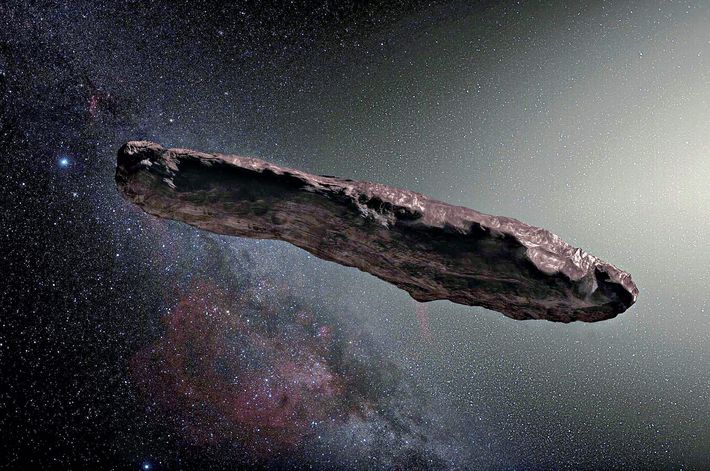
“Know that there are people who watch our skies to protect the sleeping masses,” Britain’s former chief UFO investigator warns in his memoir. “But also know that not all potential intruders into our airspace have two wings, a fuselage, and a tail, and not all show up on our radar.” Pope’s ominous counsel follows time he spent in the ’90s inspecting thousands of paranormal incidents from crop circles to purported bedside abductions. He took that job certain this kind of stuff “only happened to weirdos,” but unexplainable sightings soon convinced him that “there is a war going on” with aliens. Worse, the U.K. Defense Ministry cut his old UFO desk’s funding in 2009, so whatever’s out there “could attack at any time,” Pope believes. Earthlings’ diminished odds have gotten him more fatalistic lately, too: After scientists suggested ‘Oumuamua — a bizarre-shaped asteroid that’s the first interstellar object to pass through our solar system — might be an alien spaceship, he argued in December we “probably wouldn’t survive an alien invasion” anyway, because if they find us, it’s clear who has the upper hand.
Paul Hellyer
Canada’s Defense minister during the Cold War, now 94, believes that at least 80 species of aliens have been visiting Earth for millennia. One group is called the Tall Whites (because they can reach basketball-goal height) or Nordic Blondes (because they look like they’re “from Denmark or somewhere”). Unfortunately, the others may include ecoterrorists: “We’re doing all sorts of things which are not what good stewards of their homes should be doing,” he told media in 2014. “They don’t like that, and they’ve made it very clear.” Hellyer adds that many technological “breakthroughs” were aped from these extraterrestrials. Microchips and fiber optics, for instance, were taken off crashed alien vehicles and reverse-engineered. The aliens have a special technology that would solve climate change as well, he claims, but the Illuminati are hiding it because it would devastate oil interests.
Philip Corso
Corso’s military career was long and illustrious, from rebuilding Rome’s government after World War II as an Army Intelligence captain to having worked the Pentagon’s foreign-technology desk in the ’60s. He doesn’t appear to have said a word publicly about aliens until 1997, when Simon & Schuster published The Day After Roswell — with a foreword by Strom Thurmond — just 13 months before Corso died. It was his tell-all outlining a decades-long Roswell cover-up while plugging his own clandestine exploits, which he claimed involved reverse-engineering technology found on alien spacecrafts. This is how the world got lasers, particle beams, microchips, even Kevlar, Corso said. Skeptics argue that regular Earth people’s R&D behind technology like lasers is impossibly well documented.
Barry Goldwater
Had he won election in 1964, one of his White House’s first acts might have been releasing top-secret UFO files. He harbored a lifelong fascination with the truth about extraterrestrial contact, much of it stemming from his desire to “find out what was in” the mysterious Hangar 18 at Wright-Patterson Air Force Base, home to the Air Force’s Project Blue Book. In the ’80s, it surfaced he’d spent decades corresponding with UFO investigators and harassing the military for access to the hangar’s so-called Blue Room, where conspiracy theorists believe alien bodies from Roswell are preserved. (“Not only can’t you get into it,” his friend General Curtis LeMay supposedly snapped in 1975, “but don’t you ever mention it to me again.” Goldwater claims he didn’t.) After retiring in 1987, the senator toldLarry King the Earth is “one of several billion planets in this universe. I can’t believe that God or whoever is in charge would put thinking bodies on only one planet.”
Roscoe Hillenkoetter
After he’d served as the first CIA director (he’d been appointed by President Truman), Hillenkoetter retired from a distinguished Navy career in 1957 and took a gig at a brand-new private research group called the National Investigations Committee on Aerial Phenomena. Its chief purpose was pressuring the government to disclose what it knew about UFOs, via investigations like Project Blue Book. Hillenkoetter went after the intelligence community, writing angry open letters that said things like: “It is time for the truth to be brought out in open congressional hearings.” When he pointed out in 1960 that the Air Force had investigated 6,312 UFO reports to date, but was seemingly trying “to hide the facts,” the military reminded Americans that “no physical evidence, not even a minute fragment of a so-called flying saucer, has ever been found.”
Of course, another theory popped up in the ’80s — that Hillenkoetter had helped run a secret committee all along of politicians, military officers, and scientists called the Majestic 12. Ufologists claimed this cabal was formed in 1947, once Truman started panicking over what to do with all the alien spacecrafts the government kept finding. The group’s existence is based on government files that allegedly materialized in 1984. The FBI denied their authenticity entirely, but they and the Majestic 12 remain popular grist for conspiracy theories, having figured in Blink-182’s song “Aliens Exist” and even one of Twin Peaks’s side plots.
Dennis Kucinich
Kucinich’s 2008 presidential campaign didn’t suffer from his admission, made during a live TV debate, that, back in 1982, he’d seen a UFO at friend Shirley MacLaine’s Washington State home. (He was polling around 4 percent at the time.) But the current candidate for Ohio governor got mocked plenty; one joke among Beltway insiders was he wanted the “little green vote.”
Staff were prepped to deny the encounter when reporters asked about the passage in MacLaine’s 2007 New Age self-help book, Sage-ing While Age-ing, that revealed Kucinich didn’t just see a UFO but had also felt “a connection in his heart and heard directions in his mind.” The other witnesses — a Juilliard-trained trumpeter working as MacLaine’s bodyguard and his model girlfriend — also report having seen a trio of triangle-shaped aircrafts flying in tight formation. Her house was 50 miles from Mt. Rainier, a “saucer magnet” for UFO buffs because of all the nearby sightings, including America’s very first “flying saucer” in 1947. Kucinich had the community’s full support, even if he spent years playing coy.
It helped that in Congress he did things like trying to ban space-based weapons. A 2001 bill he authored himself prohibited America from using “radiation, electromagnetic, psychotronic, sonic, laser, or other energies” for the purposes of “information war, mood management, or mind control of such populations.” It explicitly singled out “chemtrails,” a term for jet condensation trails when conspiracy theorists believe they’re being used for biological warfare. In 2008, however, he only confirmed he’d seen a UFO, then pointed out, accurately, to moderator Tim Russert that “more people in this country have seen UFOs than I think approve of George Bush’s presidency.”
John Podesta
When WikiLeaks published the Hillary Clinton emails, a weird number of Podesta’s mentioned aliens and involved contact with believers like Tom DeLonge and astronaut Edgar Mitchell. As Bill Clinton’s deputy chief of staff, he was known as an X-Files fanatic who’d “call the Air Force and ask them what’s going on in Area 51.” In 2014, he spent 13 months advising President Obama — and what was his “biggest failure”? According to him, failing to get government files declassified on the 1965 Kecksburg, Pennsylvania, UFO incident.
Then during Bush’s term, he began publicly crusading for NASA to release UFO documents to journalist Leslie Kean, the person ultimately behind the Times’ Pentagon exposé.
Podesta has kept his personal ET beliefs under wraps, but in Kean’s best seller UFOs: Generals, Pilots, and Government Officials Go on the Record, he gamely wrote a foreword that argues: “It’s time to find out what the truth really is … The American people — and people around the world — want to know, and they can handle the truth.”
Pavel and Marina Popovich
This husband-wife duo was one part world-renowned cosmonaut (Pavel) and one part the Soviet Union’s most celebrated female pilot (Marina). They held among their titles that of sixth human in orbit, first Soviet female to break the sound barrier, and holder of more than 100 aviation world records. Once their illustrious flying careers ended, both became ufologists. Pavel headed up Russia’s UFO association and claimed to have seen an unidentified aircraft zip past his airplane on a trip home from Washington, D.C., with a group of scientists. People onboard said it was triangular, brightly lit, and rocketed by at 1,000 miles per hour.
Marina one-upped him, though — she claimed to have seen multiple UFOs and a “Bigfoot creature” — and after they divorced, she became the acclaimed expert, not Pavel. She began preaching a UFO glasnost of sorts under Gorbachev, claiming the Soviet government had pieces of five spaceships in its possession and reports of 14,000 UFO sightings, yet for decades researchers were “either fired or put in psychiatric hospitals.” Her eventual book, simply called UFO Glasnost, spoke candidly about how Leonardo da Vinci, Jules Verne, and Ray Bradbury were alien mediums and Gorbachev had the markings of an extraterrestrial emissary because “he’s an epoch-making phenomenon.”
—Clint Rainey
In January, Stephen Wolfram — a computer-scientist philosopher and the author of a “universal” programming language that informed the alien communication in the movie Arrival — wrote an exceedingly long blog post about how best to communicate with aliens.
Tim Urban: You created a language you think we might be able to use to communicate with aliens. So what exactly is it that we would want to say to the rest of the universe if we had the chance?
Stephen Wolfram: I think the main difficulty is the definitional one. You talk about alien life, you talk about intelligence; what are those things abstractly?
We know the specific example that we have historically been exposed to: life on Earth, human intelligence. The question is, when you generalize away from that, what do you get to? One of the things that I’m fond of quoting is the statement “The weather has a mind of its own.” What does this mean? What is the abstract kind of thing that’s like the mind? It’s the ability to do sophisticated computation. That’s something that exists in the weather, just as it exists in our brains, just as it exists in lots of living systems. And then, what’s different between the weather and its sort-of-mindlike thing and our human intelligence? The fundamental answer to that is our human intelligence has its particular cultural, civilizational history and the weather doesn’t.
TU: So is it that history that we’d want to communicate?
SW: Yes, I think the thing to realize is that we in our civilization have followed a particular path. There are an infinite number of possible paths that we could’ve followed. To any other intelligence, our path would be quite mysterious.
TU: Right, so we actually have unique information to communicate. You could have the most sophisticated species, and we can still tell them something they don’t know about our history.
SW: I’m particularly amused by Elon Musk’s car going into space. That is so extremely aligned with the notion of grave goods from ancient Egypt, where you’re taking things from your everyday life to be buried with you. It’s charming.
Here, just a small sampling of the classics.
Barney and Betty Hill’s Abduction
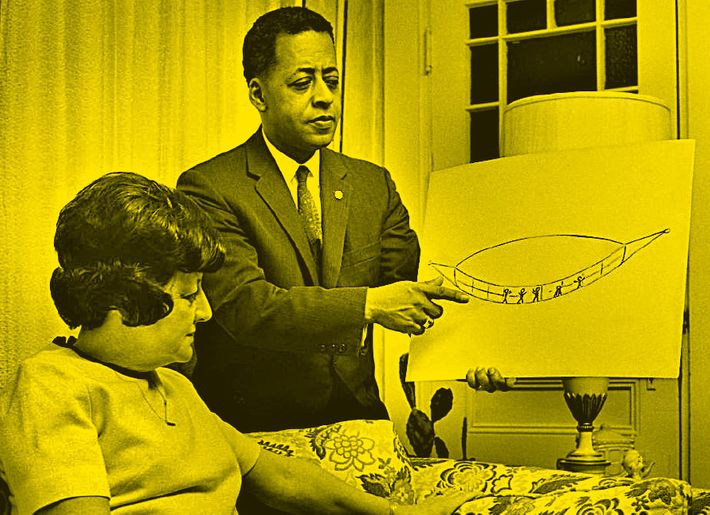
The Hills (above) claimed that in 1961 a bright light swooped over their car on a New Hampshire road and that they woke up a few hours later and the car had been “magnetized.” With regressive hypnosis, both were able to recall being abducted and probed by the little gray men, which soon became the de facto alien description. (The Hills’ captors were, interestingly, very similar to Selenites — the five-foot moon inhabitants H.G. Wells invented for The First Men in the Moon.) Betty astonished authorities when she began drawing a map of the constellation the creatures claimed to be from. Initially it looked like nonsense, until a few scientists noticed its resemblance to Zeta Reticuli, a system inside the constellation Reticulum largely unknown in that year. Their case generated widespread publicity, partly because they were a mixed-race couple in the ’60s, and turned into the flagship example of a “close encounter,” though not until years after the fact (skeptics argue the delayed report is a sign it’s a hoax). The hype ultimately culminated in The UFO Incident, a 1975 made-for-TV movie starring James Earl Jones and Estelle Parsons.
Antonio Villas-Boas’s Seduction
In 1957, small aliens with huge heads allegedly came for Villas-Boas, a young Brazilian farmer. Villas-Boas was forced inside their vessel, where the creatures took blood samples from, of all places, his chin, and rubbed in some sort of gel. Soon after, a blonde female with big, almond-shaped eyes joined him. She began rubbing his body, then initiated sex. After they were done, she left quickly, which gave Villas-Boas the impression that he was being used to better the aliens’ “stock.” He didn’t react well, as he suddenly felt exploited as “a good stallion” by these foreign chin-fetishists.
Weird as it was, Boas’s encounter, with its probing and forced sex, became the archetypal alien abduction. Reportedly skittish at first, he eventually told his story to João Martins, the writer behind popular magazine O Cruzeiro’s “Flying Saucers’ Terrible Mission” series. Doctors confirmed Boas had suffered radiation poisoning, but Martins ultimately soured on Boas’s story, for one because his spaceship sketch bore remarkable similarities to the Soviet Union’s Sputnik. He turned out all right, though: He got a law degree, had four kids, and died believing his children had a half-sibling living in space.
The “Wow!” Signal
In 1977, Ohio State’s Big Ear radio telescope intercepted a 72-second burst of sound that bore signs of having come from interstellar space, which could be a sign of extraterrestrial communication. The anomaly measured 1,420 megahertz, a frequency in the “water hole,” the term for a radio-emission range thought ideal for intergalactic messages because it’s unusually quiet. Jerry Ehman, the astronomer who spotted it, was so excited that he scribbled a giant “Wow!” on his printout. Astronomy’s explanations for the bizarre phenomenon include secret spy satellites and a passing comet nobody knew about in 1977. But many admit nothing explains it adequately, and even if the signal doesn’t prove aliens exist, it’s still a “tug on the cosmic fishing line.” To date, it remains the best evidence of alien communication ever obtained.
Foo Fighters
In the middle of World War II, things took a mysterious turn for Air Force pilots flying overnight missions. They reported seeing lights chasing their aircraft. The number varied (sometimes it was one; other times ten), and so did the colors (red, orange, and green). But the unidentified objects shared in common that they moved very fast, up to 200 miles per hour, yet could dart on a dime. These pilots — among the world’s best — admitted the objects generally flew circles around them. Their lore grew among the squadrons. In 1944, a crew flying along the Rhine in Germany described seeing “eight to ten bright orange lights” whiz by “at high speed.” Neither ground control nor their own planes caught anything on radar, and when one pilot turned toward the lights, they reportedly “disappeared.”
They called their mystery air companions “foo fighters,” an inside joke based on a phrase the comic-book character Smokey Stover used to declare (“Where there’s foo, there’s fire”). The term flying saucer hadn’t caught on yet, or else it would’ve sufficed. Some witnesses assumed they were tracer fire, reflections from ice crystals, or high-tech weaponry developed by the Nazis, while the government had a boring explanation as always: They were “electrostatic (similar to St. Elmo’s fire) or electromagnetic phenomena,” though which one and wherefrom were “never defined.”
Kecksburg UFO Crash
In 1965, an intense fireball streaked over southern Canada and Detroit and dropped debris over Ohio, Michigan, and Pennsylvania. Officially, it was declared a midsize meteor, but eyewitnesses in the small Pennsylvania town of Kecksburg claimed they’d found an acorn-shaped object about the size of a VW Beetle in the woods that was festooned with hieroglyphics. Newspaper reporters on the ground said the military conducted a “close inspection” of the crash site, and despite the official line being that the search yielded “absolutely nothing,” conspiracists maintain the object was packed onto an Army flatbed truck and that the whole thing was a Roswell-level cover-up. Leslie Kean’s Coalition for the Freedom of Information managed to secure some of the government’s files but reportedly not anything enlightening.
However, a second explanation surfaced in the early aughts: It was Die Glocke, purportedly a top-secret weapon Nazis developed that let them time-travel. By dumb Back to the Future–esque luck, it had come to rural Pennsylvania in the year 1965. These proponents argue Nazi SS officer Hans Kammler was navigating the device when it crash-landed in Kecksburg, allowing him to escape Allied troops in the days before VE Day and successfully integrate into postwar U.S. society.
Kenneth Arnold’s “Flying Saucer”
Kenneth Arnold, a respected pilot, claimed in 1947 he’d seen nine mostly flat objects whip past Mount Rainier at speeds he timed at 1,760 miles per hour. “They were shaped like saucers,” he reportedly explained, “and were so thin I could barely see them.” A neologism was born.
Arnold he demanded military personnel explain what the contraptions were, if they knew, since he’d dismissed any possibility of them being guided missiles or new types of jets. His best guess? “From another planet.” Dozens of others came forward with similar sightings, from as far away as Oklahoma and Arizona. But Arnold didn’t enjoy his newfound celebrity. He said people had started shrieking in cafés when they saw him and fleeing. He described the situation to reporters as “out of hand” and regretted having people “look at me as a combination of Einstein, Flash Gordon, and screwball.”
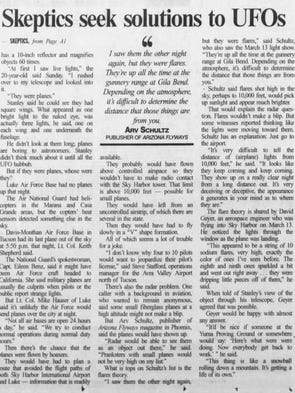
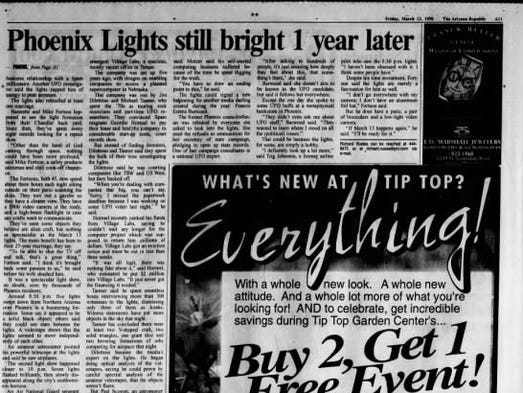
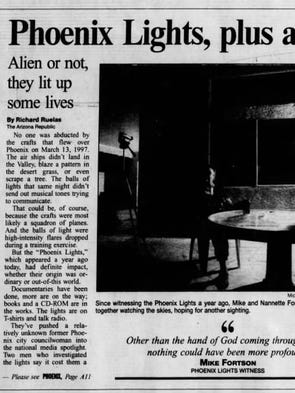
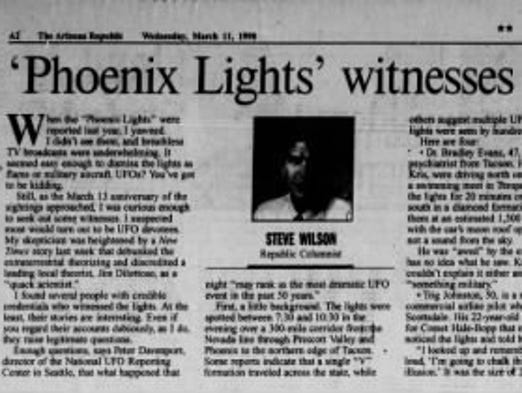
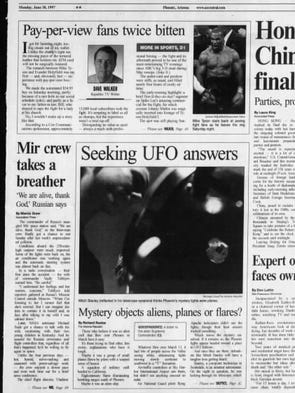
Phoenix Lights
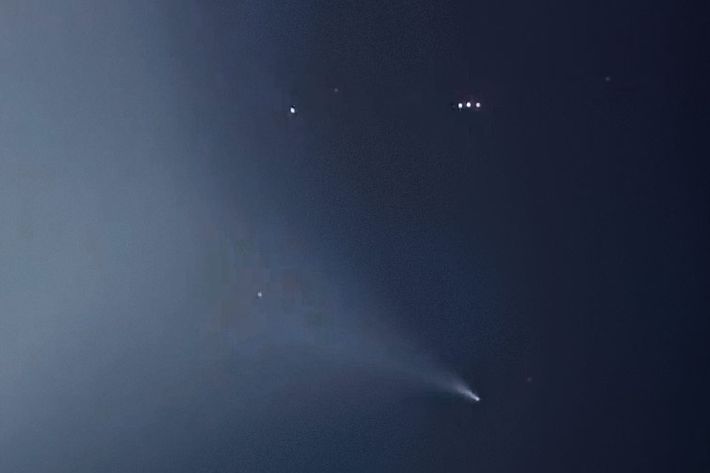
On March 13, 1997, thousands of people in southern Arizona say they saw weird lights move across the night sky in a flying V. Most of their reports came in between 7 and 10:30 p.m. along a 300-mile stretch from Phoenix, through Tucson, and to the Mexico border. A majority of people spied the pattern passing overhead (it was supposedly several football fields long), but the Air Force also sent a team of A-10 Warthogs from nearby Barry Goldwater Range on a training exercise that same night, and, as luck would have it, those planes dropped some stationary flares just outside Phoenix, considerably complicating any UFO conspiracies with a second set of strange bright lights.
Witnesses claim to have watched the first set of lights — the low-altitude wedge formation — coast by with their binoculars; they say the lights were red, had a singular white one at the V’s tip, seemed engineless, and even banked southeast at one point. Actor Kurt Russell now claims he saw them while up in a private plane near the Phoenix airport, but air-traffic control told him the radar was clear. Governor Fife Symington reportedly witnessed the V-shaped as well. At the time he felt sure it wasn’t aliens, but his mind changed in 2007, after retiring from politics: He told media that as a pilot, he knows “just about every machine that flies,” and these lights definitely weren’t terrestrial.
The “Warminster Thing”
Warminster’s long, controversial association with UFOs began in the English town on Christmas Day in 1964, when a local woman heard a “crackling sound” rip over her head. Other so-called sonic attacks plagued scores of others in town around the same time. Townspeople had no clue what was behind them, so they began blaming the “Thing.” Additional reports of inexplicable lights in the sky made it clear the “Thing” might have hailed from outer space.
Travis Walton’s Abduction
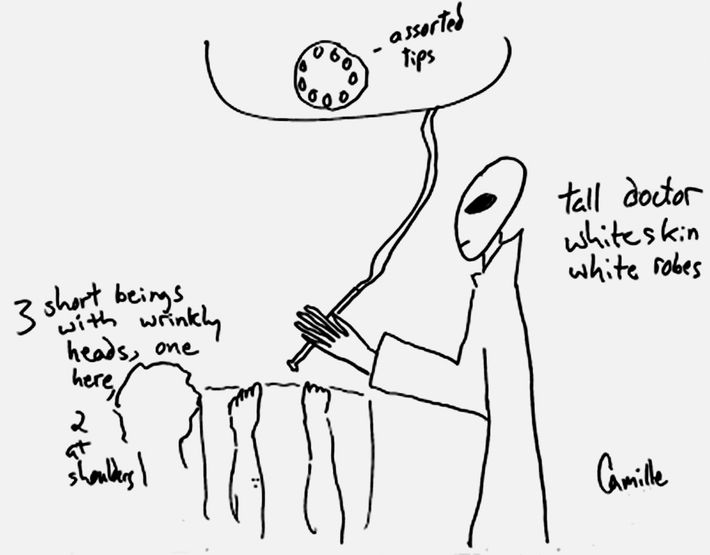
In 1975, a team of loggers claimed their 22-year-old co-worker Travis Walton disappeared for five days after a glowing disc in the Arizona woods zapped him with a “bluish ray.” Intrigued, he’d reportedly wandered underneath the hovering object, and it abducted him. He claims he awoke on a table in a sterile-looking room surrounded by three “well-developed fetuses” wearing tan robes. He tried to flee, passed out, then regained consciousness only once the aliens had ditched him on the Arizona roadside.
The story received loads of publicity — authorities thought Walton had been murdered, and seven eyewitnesses corroborating a single close encounter was unheard of. The National Enquirer ultimately paid the group $5,000 for the story, after they passed polygraphs and Walton agreed to be interviewed by the tabloid’s “prestigious” hypnotist. In 1993, Paramount released Fire in the Sky, a movie it said was based on “the most famous case of UFO abduction ever recorded.” Skeptics have shot holes in what they assume was a hoax and note that James Earl Jones’s NBC movie The UFO Incident had aired two weeks before Walton’s own UFO incident. The encounter has a cult following to this day, though, enough that a first edition of Walton’s 1978 memoir The Walton Experience now fetches hundreds of dollars online.
The Battle of Los Angeles
On February 25, 1942, reports filtered in of a glowing object floating over Culver City. Air-raid sirens sounded; the Army proceeded to pepper it with 1,400 anti-aircraft shells. Eventually it disappeared from view, but not before a citywide blackout was ordered, shell fragments got lodged in surrounding buildings, and five civilians died. The Navy later explained it had been a weather balloon. But ufologists suspected an alien spacecraft, which would explain why an hour’s worth of heavy artillery had failed to eliminate a single weather balloon.
Steven Spielberg would mercilessly satirize the incident in 1941, a “comedy spectacular.” But ufologists immediately suspected an alien spacecraft, which would explain why an hours’ worth of heavy artillery had failed to eliminate a single weather balloon. Conspiracists site a famous L.A. Times photo as extra proof; it seemingly caught searchlights trained on a very un-balloon-like object getting barraged with shells. The next day’s Times ran an editorial on page A1 (“Information, Please”) demanding the Army and Navy release more info, “if only to clarify their own conflicting statements about it.”
—C.R.


 Why do comets emit X-rays? Mystery solved















 @MikeWehner
)