Ontdek de Fascinerende Wereld van UFO's en UAP's: Jouw Bron voor Onthullende Informatie!
Ben jij ook gefascineerd door het onbekende? Wil je meer weten over UFO's en UAP's, niet alleen in België, maar over de hele wereld? Dan ben je op de juiste plek!
België: Het Kloppend Hart van UFO-onderzoek
In België is BUFON (Belgisch UFO-Netwerk) dé autoriteit op het gebied van UFO-onderzoek. Voor betrouwbare en objectieve informatie over deze intrigerende fenomenen, bezoek je zeker onze Facebook-pagina en deze blog. Maar dat is nog niet alles! Ontdek ook het Belgisch UFO-meldpunt en Caelestia, twee organisaties die diepgaand onderzoek verrichten, al zijn ze soms kritisch of sceptisch.
Nederland: Een Schat aan Informatie
Voor onze Nederlandse buren is er de schitterende website www.ufowijzer.nl, beheerd door Paul Harmans. Deze site biedt een schat aan informatie en artikelen die je niet wilt missen!
Internationaal: MUFON - De Wereldwijde Autoriteit
Neem ook een kijkje bij MUFON (Mutual UFO Network Inc.), een gerenommeerde Amerikaanse UFO-vereniging met afdelingen in de VS en wereldwijd. MUFON is toegewijd aan de wetenschappelijke en analytische studie van het UFO-fenomeen, en hun maandelijkse tijdschrift, The MUFON UFO-Journal, is een must-read voor elke UFO-enthousiasteling. Bezoek hun website op www.mufon.com voor meer informatie.
Samenwerking en Toekomstvisie
Sinds 1 februari 2020 is Pieter niet alleen ex-president van BUFON, maar ook de voormalige nationale directeur van MUFON in Vlaanderen en Nederland. Dit creëert een sterke samenwerking met de Franse MUFON Reseau MUFON/EUROP, wat ons in staat stelt om nog meer waardevolle inzichten te delen.
Let op: Nepprofielen en Nieuwe Groeperingen
Pas op voor een nieuwe groepering die zich ook BUFON noemt, maar geen enkele connectie heeft met onze gevestigde organisatie. Hoewel zij de naam geregistreerd hebben, kunnen ze het rijke verleden en de expertise van onze groep niet evenaren. We wensen hen veel succes, maar we blijven de autoriteit in UFO-onderzoek!
Blijf Op De Hoogte!
Wil jij de laatste nieuwtjes over UFO's, ruimtevaart, archeologie, en meer? Volg ons dan en duik samen met ons in de fascinerende wereld van het onbekende! Sluit je aan bij de gemeenschap van nieuwsgierige geesten die net als jij verlangen naar antwoorden en avonturen in de sterren!
Heb je vragen of wil je meer weten? Aarzel dan niet om contact met ons op te nemen! Samen ontrafelen we het mysterie van de lucht en daarbuiten.
Donderdag 17 mei 2018
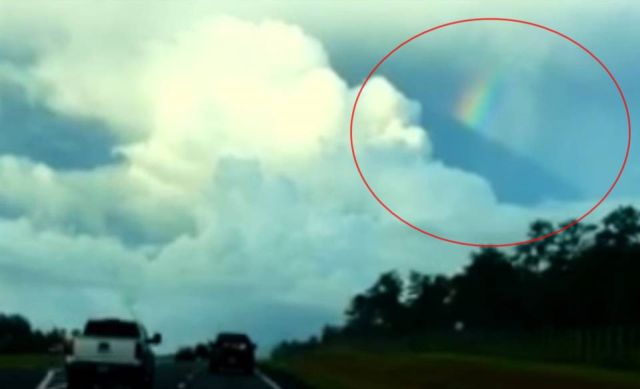
Man records rare dark straight line blocking a rainbow
Man records rare dark straight line blocking a rainbow
So many strange things are happening in the sky; on May 17, 2018 a man sees a strange bank of clouds in the sky and begins recording while driving.
It looks like a dark straight line blocking a rainbow but could it be a cloud shadow or there is something between the cloud and the rainbow that blocks the rainbow.
UFO Search: US Congress Proposes Millions Of Funds To Find ETs with AI
The US House of Representatives has proposed to aid NASA’s search for signs of life in the cold depths of space, amounting around £7.3million ($10million).
The search of “technosignitures” from potentially developed and intelligent species will likely get two years of funding.
It would include the search for radio waves, which an intelligent alien civilisation could be intentionally blasting into space as what humans have been doing in modern times.
In 25 years of the search for extraterrestrial intelligence (SETI), it is the first time the Congress is planning to give it proper funds.
However, the bill is far from a done deal, warned the renowned astronomer and former director of SETI Institute Dr Jill Tarter.
She said that it is not an appropriation bill but an authorisation bill. She explained that if ever it passes, it is up to the appropriators whether they provide any SETI funding in their bill or not. However, she added that if they do provide, that would be something big.
Detection of artificially created radio waves has generally been the focus of the search for advanced life outside our solar system.
However, a brand new approach in the search for extraterrestrials could be born with a revision of mission statement of SETI.
SETI could use Artificial Intelligence (AI) to scan the noise to avoid misleading and false positive signals.
Dr Tarter pointed out that UFO hunters usually look for signs of technology and intelligence in space that are the same with humanity.
But she argued the technosignatures search is a limited approach because ET language, technology and intelligence appear in all forms and shapes.
NASA started the SETI programme to build the instruments needed to scan the space for signs of ET life.
However, Nevada Senator Richard Bryan shut down the SETI initiative a year later.
Now, the Congress bill promises a new chapter for SETI, according to Dr Tarter.
She stated that the bill would be a sea-change in Congressional attitude it if passes since Senator Bryan terminated the SETI program of NASA in 1993, which was the High-Resolution Microwave Survey.
SETI would be able to build new instrumentation and collect data globally with the sizeable budget.
Dr Tarter added that proper funding would attract the best in the field from different parts of the world and commit to the long-term search that might be necessary for success.
The Longest Lunar Eclipse Of The Century Is About To Happen
Prepare yourselves sky gazers.
The longest lunar eclipse of the 21st century will take place on July 27, 2018, when the shadow of Earth will completely cover the moon for 1 hour and 43 minutes.
In addition to being eclipsed, the Moon will also turn red reflecting the sun’s rays, creating a truly spectacular view.
In the last century, only four total lunar eclipses had a period totality—the time where the moon is completely eclipsed—that rivaled this summer’s event.
This included a lunar eclipse on June 15, 2011, that lasted 100 minutes, one on July 16, 2000, which lasted 107 minutes, an eclipse in July 1982 that lasted 107 minutes and one in July 1935 that lasted 101 minutes, Space.com writes.
Because these events took place in the 20th century, the eclipse of July will be the longest lunar eclipse of the present century.
However, not everyone will be able to witness the phenomenon, and those who won’t be able to witness this magical phenomenon at its best are the residents of North and South America, IFLSciencereported.
The eclipse will be more visible to people living in Africa, the Middle East, India, Australia and some areas of Europe.
A total lunar eclipse occurs when the Moon passes through the shadow of the Earth, known as the umbra.
The Moon will go almost right through Earth’s umbra.
Wikimedia Commons
This happens when the Sun, the Earth and th Moon are aligned.
It is like a total solar eclipse, but this time it is our planet that eclipses the Sun, and since the Earth is much bigger than the Moon, it becomes completely engulfed in its shadow.
During the total lunar eclipse, the Moon not only darkens.
In July, we will witness it turning red because of the refracted sunlight on the surface of the Earth. It is similar to when red sunsets appear in our sky.
The lunar eclipse of July 27, 2018, will be particularly long because the Moon will pass through the center of the umbra, which means that it will remain in the shadow for a longer period of time.
When the Moon passes only on the side of the umbra, the eclipse lasts shorter.
However, there are a number of other factors that have to be taken into consideration.
For example, the position of the Earth in its orbit also plays an important role.
According to Earthsky, this July 27 the Earth will be at its furthest point from the Sun, known as the apogee, which means that it casts a larger shadow. And on the same date, the Moon will be at the most distant point in its monthly orbit around Earth, known as the lunar apogee.
The combination of these rare space events will allow us to observe this unusual phenomenon in a stunning way.
Astronaut Screams At The Sight Of A UFO When Approaching The ISS
It is very intriguing to note the automatic, conditioned reaction of the fellow astronaut who immediately calmed her with an apparent sense of urgency before she could even fully let out a scream.
Italy's first female astronaut, Samantha Cristoforetti can be heard shouting over the comms from her Soyuz spacecraft during docking maneuvers with the International Space Station. What was the cause of her alarm?
Would or even could NASA tell us if they think E.T.'s may be monitoring our world? Wouldn't they have to withhold such information, if it were true as a matter of national and international security in fact?
That’s still not exactly easy, but it is less complicated than asking a probe to fly all the way to Europa, safely land, burrow through a miles-thick crust of rock-hard ice, and then get to work being an extraterrestrial ocean explorer
It’s also possible—and perhaps more likely—that any plumes come from a lake or some other reservoir trapped in the ice. But that still means an orbiting spacecraft, like the Europa Clipper mission that’s tentatively scheduled to launch in the early 2020s, could sample a plume and get a glimpse of what lies beneath the moon’s ruddy, crisscrossed rind.
“It’s unlikely that one of these plumes is going to throw a fish into space that’s going to whack into Europa Clipper,” saysCynthia Phillips of NASA’s Jet Propulsion Laboratory. “It’s more likely to come from pockets of liquid that are closer to the surface – so, not free ocean samples, but free subsurface samples.”
IN BLOOM
For years, planetary scientists have argued over whether Europa might be spitting water into space, as Saturn’s moon Enceladus does.
An image of the icy plumes spouting from Saturn's moon Enceladus, as seen by NASA's Cassini spacecraft
PHOTOGRAPH BY NASA/JPL/SPACE SCIENCE INSTITUTE
In late 2013, tantalizing images from the Hubble Space Telescope revealed possible125-mile-high plumes of water vapor erupting from a region in the moon’s southern hemisphere. At the time, though, scientists were skeptical, as the plumes were at the very limit of Hubble’s ability to see. Follow-up observations revealed nothing.
But in 2016, andagain in 2017, scientists reported that more Hubble imagespointed to the presence of a plume, though something less dramatically exuberant than the geysers of Enceladus, which fly so high that they create a ring around Saturn. Even so, Europa’s eruptions could be equally as dense as its cousin’s, and easily visible by an orbiting spacecraft.
That’s when the University of Michigan’sXianzhe Jia and colleagues decided to revisit those archival data and see what kinds of nuggets they could find.
“I was asking myself, Why didn’t we start looking at this earlier? Why wait so long? The data is there, publicly available for almost 20 years,” Jia says.
SOMETHING IN THE WAY
Europa’s gravity is strong enough that any erupted water vapor would hug the moon quite closely, and Galileo only swung low enough to detect such an eruption twice, most notably in December 1997. During that pass, the spacecraft took about five minutes to traverse Europa’s face.
Jia and his colleagues pulled observations from the spacecraft’s magnetometer, which measures magnetic fields, and from a second instrument that measures the density of charged particles. In the sequence of numbers produced by those two instruments, they immediately spotted something unusual: Anomalous blips, lasting about three minutes, centered around Galileo’s closest approach to the moon.
If a plume were erupting, Jia says, the erupted water vapor and dust particles would be affected by magnetic fields, which is what the spacecraft detected. And the density of charged particles surrounding the spacecraft would change as the spacecraft entered, flew through, and then exited the plume.
“We saw very peculiar changes in the magnetic signal, something I don’t think has been explained in the past,” Jia says. “We also pulled out the plasma wave data from Galileo, and surprisingly, around the same time, the plasma wave showed anomalous emissions. So when you put those two together, that indicated that something very special had happened during that interval.”
In other words, the spacecraft had flown through a localized plume maybe 620 miles wide somewhere near the moon’s equator. But Jia and his team wanted to make sure. So they simulated the observations such a spacecraft would make if it flew through a plume of the size and density spotted by Hubble. The Galileo observations matched the simulation almost perfectly.
Now, with two spacecraft and several independent instruments reporting similar findings, it’s harder to deny that Europa is venting water vapor into space.
“If you look at any one piece of evidence by itself, it’s not very convincing,” McGrath says. “But when you start bringing in completely independent sets of observations and they all seem to be telling us the same thing, it’s sort of like, yeah. That’s what is starting to convince people.“
COME AS YOU ARE
As exciting as the Galileo data are, they don’t necessarily prove the existence of continual plumes. Instead, Phillips says, the observation is another clue that can be added to a body of evidence suggesting that Europa does—at least occasionally—vent water into space.
SOLAR SYSTEM 101How many planets are in the solar system? How did it form in the Milky Way galaxy? Learn facts about the solar system's genesis, plus its planets, moons, and asteroids.
“I think it tells you there’s probably more plumes than we can see right now, because the odds that we’d happen to fly through the only one that exists are pretty low,” McGrath says.
What does this mean for the Clipper spacecraft? Turns out, the team designing the probe has already planned to include a suite of instruments capable of tasting a plume, should the spacecraft fly through. What it finds will be anyone’s guess.
“Even with our wildest imagination, we always see stuff that we totally did not expect,” McGrath says. “We’ll surely see something we totally don’t expect at Europa.”
NASA Grants Fund 5-Year Missions to Help Seek Out Alien Life
By Chelsea Gohd, Space.com Staff Writer
NASA's Astrobiology Institute has selected three teams for five-year grants to be used in studying life in the universe.
Credit: NASA
The NASA Astrobiology Institute (NAI) has awarded five-year grants to three research teams who will hunt for life in the universe.
"Is there life on Mars?" David Bowie's famous line lies at the center of modern astrobiology research. In an initiative to investigate the possibility of life in the cosmos, not just on Mars, interdisciplinary teams chosen by NASA will each receive approximately $8 million and five years to complete their work.
NASA has several missions that will provide data in the search for life, with "NASA's Transiting Exoplanet Survey Satellite on its way to discover new worlds around our nearest stellar neighbors, Cassini's discovery of the ingredients necessary for life in [the Saturn moon]Enceladus' plumes, and with Europa Clipper [set to explore the moon of Jupiter] and Mars 2020 on the horizon," NASA Chief Scientist Jim Green said in a statement. [How Do You Spot an Alien Planet from Earth? (Infographic)]
Green said he is confident that these teams will "provide the critical interdisciplinary expertise needed to help interpret data from these missions and future astrobiology-focused missions."
The teams that will complete this exciting new research are:
Evolution of Nanomachines in Geospheres and Microbial Ancestors (ENIGMA)
Hailing from Rutgers University in New Brunswick, New Jersey, the ENIGMA team, led by Paul Falkowski, a professor in the Department of Marine and Coastal Sciences, will investigate how proteins once evolved to spark the first life on Earth. This team will study prebiotic molecules and enzymes common with number of microbial species to accomplish this immense task.
The Astrobiology Center for Isotopologue Research (ACIR)
Led by Kate Freeman, a professor in the Department of Geosciences at the College of Earth and Mineral Sciences at Pennsylvania State University (PSU), ACIR — a team from PSU, University Park— will study the origins of organic compounds using both observational and computational resources in its research.
NASA's Jet Propulsion Laboratory (JPL)
The research team at JPL will address potential habitable environments and signs of life on Titan, Saturn's largest moon. Led by Rosaly Lopes, a Manager for Planetary Science and Senior Research Scientist at JPL, the team will use data from the Cassini-Huygens mission.
"We are delighted to welcome these three new NAI teams into the institute family and look forward to the important work that they will accomplish over the time of their awards," said NAI Director Penelope Boston in the statement.
The discovery of extraterrestrial life would forever change our relationship with the universe. These grants will play a critical role in searching for answers to the fundamental questions of life's origins, NASA officials said in the statement.
Aliens May Well Exist in a Parallel Universe, New Studies Find
By Brandon Specktor, Senior Writer
Could alien life exist in a parallel universe? Computer simulations from two new studies suggest the idea might not be out of this world.
Credit: Shutterstock
Should the search for alien life in our universe come up empty-handed, it might be worth checking in on a neighboring universe instead.
According to a new pair of studies in the journal Monthly Notices of the Royal Astronomical Society, there’s a decent chance that life-fostering planets could exist in a parallel universe — even if that universe were being torn apart by dark energy.
The idea that our universe is just one of many, perhaps infinite, other universes is known as the multiverse theory. Scientists have previously thought that such parallel universes, if they exist, would have to meet an extremely strict set of criteria to allow for the formation of stars, galaxies and life-fostering planets like those seen in our own universe. [5 Reasons We May Live in a Multiverse]
In the new study, researchers ran a massive computer simulation to build new universes under various starting conditions. They found that the conditions for life might be a little broader than previously thought — especially when it comes to the mysterious pull of dark energy.
Dark energy
Dark energy is a mysterious, invisible force thought to exist in the empty spaces of our universe. You could think about it as the archnemesis of gravity; while gravity pulls matter closer together, dark energy flings it apart — and dark energy is winning this cosmic tug-of-war handily.
Not only is our universe expanding, thanks to the constant, invisible push of dark energy, but the rate of that expansion is also getting faster and faster every day. It's thought that, as more empty space appears in the universe, even more dark energy appears to fill it. (Dark energy is not the same as dark matter, which is an abundant, invisible form of matter thought to be responsible for some very weird gravitational phenomenaaround space.)
Scientists don't know exactly what dark energy is or how it works; some think it's an intrinsic property of space — what Einstein called the cosmological constant — while others attribute it to a fundamental force called quintessence, with dynamic rules all its own. Others don't even agree that it exists. But whatever it is, everyone can agree that there's a whole lot of it: According to the best current estimates, nearly 70 percent of the mass-energy of our universe may be made of dark energy.
This quantity, for whatever reason, is in the right range to allow galaxies to grow and foster life. It is thought that if we lived in a universe with too much dark energy, space might expand faster than galaxies could possibly form. Too little dark energy, and runaway gravity could cause every galaxy to collapse in on itself before life ever had a chance to appear.
But the question of how much dark energy is "too much" or "too little" is a topic for debate — and it's this issue of quantity that the authors of the new studies hoped to narrow down.
Life finds a way
Across several experiments, an international team of researchers from England, Australia and the Netherlands used a program called Evolution and Assembly of Galaxies and their Environmentsto simulate the birth, life and eventual death of various hypothetical universes. In each simulation, the researchers adjusted the amount of dark energy present in that universe, ranging from none to several hundred times the amount in our own universe.
The good news: Even in universes with 300 times as much dark energy as ours, life found a way.
"Our simulations showed that the accelerated expansion driven by dark energy has hardly any impact on the birth of stars, and hence places for life to arise," study co-author Pascal Elahi, a research fellow at the University of Western Australia, said in a statement. "Even increasing dark energy many hundreds of times might not be enough to make a dead universe."
That's good news for fans of extraterrestrial life and the multiverse theory. But a bigger question remains: If galaxies could still thrive on so much dark energy, why did our universe get handed such a seemingly small amount?
"I think we should be looking for a new law of physics to explain this strange property of our Universe," co-author Richard Bower, a professor at Durham University's Institute for Computational Cosmology, said in the statement.
Of course, finding new laws of physics is easier said than done. Scientists won't give up easily — but perhaps, to hedge their bets, they should also look for a parallel universe where some intelligent life has already done it for them.
The History Of The Ancient Roman Empire Written Down In The Arctic
Without a reason of doubt, the ancient Roman empire left its mark in history.
“We found that lead pollution in Greenland very closely tracked known plagues, wars, social unrest and imperial expansions during European antiquity.”
From majestic roads, sanitation, to education systems, the ancient Roman Empire made sure it would remain forever in the history books.
Now, researchers exploring Arctic Ice sheets have found traces of the rise and fall of the Roman empire embedded in ice.
Experts have managed to track the Roman Empire’s economic ups and downs, due to the empire’s increased coin-making production, which experts found preserved for centuries after their collapse, in Greenland’s Ice Sheet.
Scientists say that most of the lead emissions of the period are linked to the massive production of silver.
As experts explain, pollution from the lead mines of the ancient Roman empire that boomed during the expansion of the empire drifted all the way to the ice sheets of Greenland. It is believed that lead emissions were preserved thanks to falling snow, which computed in layers and layers of ice.
Speaking about the discovery Joe McConnell, a hydrologist at the Desert Research Institute said:
“Our record of sub-annually resolved, accurately dated measurements in the ice core starts in 1100 BC during the late Iron Age and extends through antiquity and late antiquity to the early Middle Ages in Europe – a period that included the rise and fall of the Greek and Roman civilizations.”
“We found that lead pollution in Greenland very closely tracked known plagues, wars, social unrest and imperial expansions during European antiquity.” These ancient traces have now been identified by experts, surviving thousands of years after the fall of the Roman empire.
Ice Cores extracted by scientists in Greenland have offered an unprecedented and unique vision of the past, allowing experts to go back in time, and understand how pollution left behind by the empire through thousands of years influenced not only Europe but the Arctic ice Sheet as well.
“We found that lead pollution in Greenland very closely tracked known plagues, wars, social unrest and imperial expansions during European antiquity,” said Professor McConnell.
Researchers from different fields participated in the study. From experts in hydrology, ice-core specialists, to economic historians, experts gathered to find never-before-seen details about the Roman Empire.
The new study offers a historical record that includes more than 21,000 lead and other chemical measurements.
Experts found that lead pollution emissions began rising around 900 BC, as the ancient Phoenicians began expanding their prosperous trading routes into the Mediterranean. Furthermore, lead emissions are believed to have increased due to mining activity by the ancient Carthaginians and Romans, mostly in the Iberian Peninsula, reaching its zenith during the Roman Empire.
Experts have linked lead emissions to significant historical events.
Researchers found that lead emissions reached an all-time low during the last 80 years of the Roman Republic, known historically as the Crisis of the Roman Republic.
“The nearly four-fold higher lead emissions during the first two centuries of the Roman Empire compared to the last decades of the Roman Republic indicate substantial economic growth under Imperial rule,” said coauthor Andrew Wilson, Professor of the Archaeology of the Roman Empire at Oxford.
As noted by the Independent, “the new study carried out by Dr. McConnell and his team used state-of-the-art simulations of lead pollution’s transport in the atmosphere to work out the scale on which mining and smelting operations in Europe were taking place.”
Furthermore, scientists also discovered how lead emissions varied during wars and political unrest, particularly during the Roman Republic. Experts also found how lead emissions took sharp dives when two notable plagues struck the Roman Empire during the 2nd and 3rd centuries.
Space is a dirty place, so the ISS needs some lasers to blast it clean, researchers propose.
The International Space Station. Image credits NASA.
If you’re a fan of Sci-Fi, we’re in luck — an international group of scientists wants to see our most burning desire made real. They propose to install a laser defense system aboard the International Space Station (ISS) to blast at litter in the near-Earth orbit.
My kinda cleaning
The idea of ‘arming’ the ISS with laser batteries isn’t new but we’re just now getting to a place where we can develop systems compact and reliable enough to be practical aboard the station. To jump-start development, an international team of researchers from France, Italy, Japan, and Russia is pooling their efforts, according to Boris Shustov, member of the Russian Academy of Sciences (RAS).
The system they’re considering would consist of orbital lasers aboard the ISS. It should be effective against the most common type of space debris around Earth — pieces that only measure a few centimeters.
The idea was first proposed by Japanese researchers back in 2015. The original project draft envisioned lasers using 10,000 optical fiber channels and would draw all of the ISS’s electrical output to work at full capacity, according to the team. That, understandably, isn’t a particularly attractive defensive system. The new project aims to provide the same power output by using 100 “thin rods” in lieu of the optical fibers. This would reduce the overall energy drain to only 5% of the ISS’s output — a twenty-fold decrease.
This version of the laser system would allow the ISS to fire laser bursts for 10 seconds, up to a range of 10 kilometers (6.2 miles), with a recharge time of 200 seconds, according to Russian media. The whole system would weigh about 500 kilograms (1,100 pounds).
It’s a small price to pay, considering the benefits such a system would provide. The ISS still has to make routine adjustments to its orbit to avoid collisions with pieces of man-made junk. These bits are parts of former rockets or spacecraft that have been broken up into small pieces through mutual collisions over the years, or from the effects of space radiation.
They’re quite small, going very fast, and can have disastrous consequences to the ISS’s structural integrity should they hit. There’s also a lot of them. NASA is currently tracking about 17,000 pieces about the size of your fist and half a million pieces roughly the size of a marble. According to their estimates, there are over 200 million pieces over one millimeter in size still floating in Earth’s orbit at speeds in excess of 17,500 mph (over 28.100 km/h).
An impact with any single one of those fragments could jeopardize the ISS and its crew.
Are octopuses aliens? New study argues ‘frozen eggs’ came from space. Source: Getty
More
It suggests “life was seeded here on Earth by life-bearing comets” as soon as it became possible for life forms to survive – and that octopuses arrived in a similar way about 270 million years ago.
The idea of alien life spreading like “seeds” through space isn’t new – the theory is known as Panspermia.
But the authors point to new DNA evidence about octopuses.
The first full genome sequence of octopus DNA in 2015 showed that octopuses are totally different from all other animals – and their genome shows a striking level of complexity with 33,000 protein-coding genes identified, more than in a human.
View photos
An artist’s illustration of a massive asteroid impact on earth. Some single-celled organisms may be able to survive extreme impacts such as these, scientists say. Source: Yahoo UK
More
The paper says, “The genome of the Octopus shows a staggering level of complexity with 33,000 protein-coding genes more than is present in Homo sapiens.
“It is plausible then to suggest they seem to be borrowed from a far distant ‘future’ in terms of terrestrial evolution, or more realistically from the cosmos at large.
“One plausible explanation, in our view, is that the new genes are likely new } extraterrestrial imports to Earth – most plausibly as an already coherent group of functioning genes within [say] cryopreserved and matrix protected fertilized Octopus eggs.”
33 wetenschappers suggereren dat octopussen uit de ruimte komen. Zijn we allemaal aliens?
Octopussen zijn mogelijk via kometen naar de aarde gekomen, zo stellen 33 wetenschappers in een nieuw onderzoek dat is gepubliceerd in het tijdschrift Progress in Biophysics and Molecular Biology.
Het onderzoek suggereert dat kometen verantwoordelijk zijn voor het ontstaan van leven op aarde en dat octopussen zo’n 270 miljoen jaar geleden naar onze planeet zijn gekomen.
Deze theorie staat bekend als panspermie, dat het leven verspreid in het heelal voorkomt en niet op de aarde zelf is ontstaan.
Totaal anders
Volgens de wetenschappers bewijst het DNA van octopussen dat ze niet op aarde zijn geëvolueerd.
In 2015 bleek dat het DNA van octopussen totaal anders is dan dat van andere dieren. Er werden maar liefst 33.000 verschillende eiwitten geïdentificeerd in het DNA van de octopus, veel meer dan mensen hebben.
De octopus is zelfs niet te vergelijken met andere weekdieren in de zee door zijn acht poten, het grote brein en het hoge IQ waardoor hij zelf problemen kan oplossen.
Geïmporteerd
“Het is aannemelijk dat die eiwitten zijn ontleend aan een verre ‘toekomst’ in termen van aardse evolutie, of realistischer: aan de kosmos,” klinkt het.
“Een aannemelijke verklaring is dat de nieuwe genen zijn geïmporteerd naar de aarde in de vorm van bevroren octopus-eitjes,” aldus de wetenschappers.
Pentagon deed onderzoek naar warp drive, manipulatie van extra dimensies en antizwaartekracht. Deze documenten bewijzen het
Het Pentagon blijkt erg geïnteresseerd te zijn in zaken die grenzen aan sciencefiction en zelfs het paranormale. Denk daarbij aan de warp drive, het manipuleren van extra dimensies, donkere energie en exotische vormen van ruimtereizen.
De documenten zijn boven water gehaald door het I-Team van journalist George Knapp van Channel 8 News, dat al tientallen jaren onderzoek doet naar de link tussen de overheid en UFO’s.
De Amerikaanse militaire inlichtingendienst DIA liet onder meer onderzoek doen naar een manier van aandrijving die sneller reizen dan het licht mogelijk moest maken.
Extra dimensies
Daarnaast werd onderzoek gedaan naar antizwaartekracht en ‘gebieden waar de ruimtetijd was veranderd’. Het gaat daarbij om het manipuleren van de ruimtetijd van het vacuüm van de ruimte.
Tijdens een tweede studie werd gekeken naar donkere energie en extra dimensies.
“Het idee dat met behulp van een voldoende geavanceerde technologie de controle kan worden verkregen over de hogere dimensies is aanlokkelijk, en moet zeker nader worden onderzocht,” klonk het.
Geen verklaring
“Deze studies zitten bomvol informatie,” citeerde Channel 8 senator Harry Reid, die de financiering van de onderzoeken regelde.
“We hebben in de afgelopen decennia geleerd dat er veel dingen gebeuren waar geen verklaring voor is,” zei hij. “Nu wel.”
Veel verder
De documenten laten zien dat de Amerikaanse overheid veel verder ging dan het interpreteren en documenteren van UFO-waarnemingen.
Je kunt je nu afvragen wat ze nog meer hebben onderzocht (en wat nog niet naar buiten is gebracht).
NIEUWE WETENSCHAPPELIJK ONDERZOEK ZEGT: OCTOPUS BUITENAARDS ( VIDEO )
Misschien herinneren mensen zich nog wel Paul, de octopus die in 2010 grote bekendheid kreeg vanwege zijn gave om voetbalwedstrijden te kunnen voorspellen.
En dat is misschien helemaal niet zo vreemd, want een nieuw wetenschappelijk onderzoekt stelt dat de octopus een buitenaardse oorsprong heeft.
Wanneer je naar een octopus kijkt dan zie je een wezen dat er vreemd uitziet en in niets lijkt op welk ander dier op deze planeet.
Een nieuw wetenschappelijk onderzoek stelt dat de octopus miljoenen jaren geleden als een bevroren ei naar de aarde is gekomen door middel van kometen. (Redactie: Dat lijkt de standaard verklaring voor fenomenen die niet te verklaren zijn voor wetenschappers.)
Het onderzoek is uitgevoerd door 33 wetenschappers die de resultaten hebben gepubliceerd in het zogenaamde peer-reviewed journal Progress in Biophysics and Molecular Biology.
Zij komen tot de conclusie dat leven hier op aarde is ontstaan door wat zij noemen “levendragende” kometen. Dit gebeurde op een moment dat de atmosfeer op aarde geschikt was om leven te kunnen herbergen en dat was zo’n 270 miljoen jaar geleden, volgens hen.
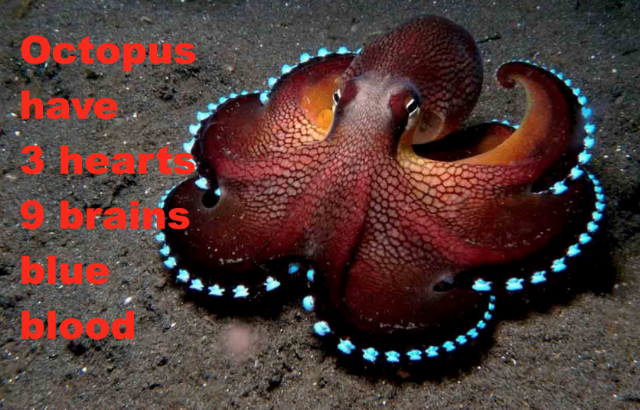
Een van de levensvormen die zo van buiten de aarde op onze planeet terecht is gekomen, zou de octopus zijn, een dier met 3 harten, 9 stel hersenen en blauw bloed.
Ook het DNA van een octopus is heel bijzonder omdat onderzoek dat in 2015 werd uitgevoerd, aantoont dat dit compleet verschillend is van andere dieren. De genen van een octopus zijn zeer gecompliceerd en het DNA van de octopus bevat 33.000 proteïne gecodeerde genen, meer dan in het DNA van een mens.
De wetenschappers gaan dan verder met te stellen dat het heel goed mogelijk is dat de octopus afkomstig is uit de toekomst, van een sterrenstelsel waar men qua ontwikkeling al veel verder is dan op aarde.
Het dier beschikt in ieder geval over een buitenaardse intelligentie zo te zien:
Misschien toch iets om over na te denken de eerstvolgende keer dat je naar een sushi restaurant gaat.
Scot Waring heeft een beter idee: In plaats van deze dieren te eten, moeten we een manier zien te vinden om met hen te communiceren. De navolgende video is werkelijk fascinerend en een aanrader om te bekijken.
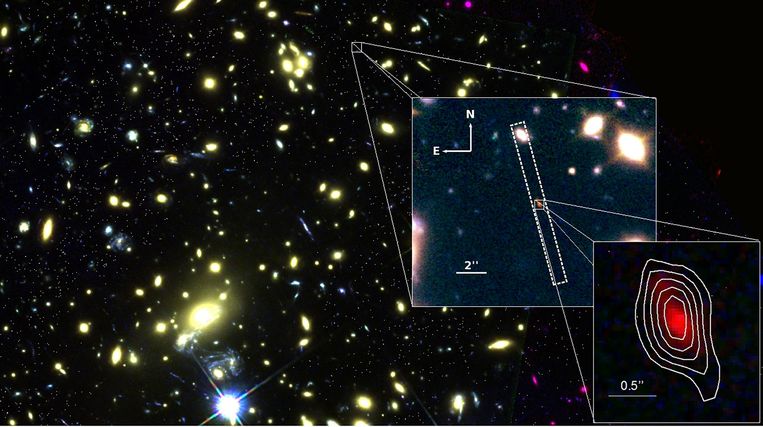
WETENSCHAP & PLANEETHet heelal was nog maar 250 miljoen jaar jong toen er al sterren werden gevormd. Dat hebben wetenschappers vastgesteld aan de hand van een ver verwijderd sterrenstelsel. Volgens een mededeling van de Europese Zuidelijke Sterrenwacht ESO werd ook nog nooit zo ver van ons vandaan zuurstof gedetecteerd.
Astronomen loerden met de ALMA-telescoop naar het verre sterrenstelsel MACS1149-JD1. Daarbij ontdekten ze een zeer zwakke gloed, afkomstig van geïoniseerd zuurstof in het stelsel.
Tegen de tijd dat ALMA het infrarode licht had gedetecteerd, was de golflengte ervan door de uitdijing van het heelal met meer dan een factor tien uitgerekt. Daaruit leidden de wetenschappers af dat de gloed 13,3 miljard jaar geleden, oftewel 500 miljoen jaar na de Oerknal, werd uitgezonden. En daarmee is het de verste zuurstof die ooit met een telescoop werd gedetecteerd.
De afstand tot het sterrenstelsel zoals die uit deze waarneming afgeleid werd, komt overeen met de afstand op basis van de zuurstofdetectie. Dat maakt MACS1149-JD1 tot het verste sterrenstelsel waarvan de afstand nauwkeurig bekend is, zegt de ESO.
Tot een hele tijd na de Big Bang was er geen zuurstof in het heelal. Dat element is pas gevormd bij de fusieprocessen zoals die in de eerste sterren plaatsvonden. Het kwam vrij toen de sterren op explosieve wijze stierven. De detectie van zuurstof in MACS1149-JD1 geeft aan dat deze eerdere generaties van sterren slechts 500 miljoen jaar na de Oerknal al gevormd waren en hun zuurstof hadden uitgestoten. (lees hieronder verder)
AFPGalaxy MACS1149-JD1 is 13,28 miljard lichtjaren van ons verwijderd.
Om het precieze tijdstip van de stervorming te achterhalen reconstrueerde het team wetenschappers de vroege geschiedenis van MACS1149-JD1 met behulp van infraroodgegevens die met de Amerikaans-Europese Hubble Ruimtetelescoop en de Spitzer-ruimtetelescoop van de NASA zijn verzameld. Daarbij ontdekten de astronomen dat de waargenomen helderheid van het sterrenstelsel goed wordt verklaard door een model waarbij de stervorming slechts 250 miljoen jaar na het ontstaan van het heelal is begonnen.
Geboorte
“Met deze nieuwe waarnemingen van MACS1149-JD1 is de directe waarneming van de geboorte van het sterlicht een stapje dichterbij gekomen. Omdat wij allemaal uit bewerkte stermaterie bestaan, zijn we daarmee ook dichter bij onze eigen oorsprong gekomen”, zo citeert de ESO Richard Ellis van het University College Londen (UCL).
When former The Simpsons guest star Stephen Hawking passed in March, he left behind a lifetime worth of invaluable contributions to the world of theoretical astrophysics. Aside from his distinguished life’s work, Hawking left behind his last unpublished paper which simplifies the mind-bending concept of the multiverse by reaching the conclusion that there exists a finite number of universes and they all share the same laws of physics. How did Hawking reach this conclusion? For one, he performed decades of careful mathematical calculations, of course. Yet an odd detail from his memorial service set to be held in June could suggest Hawking had help from the future.
When the first details about Hawking’s memorial service were made public, tens of thousands of people from over 50 countries applied for admission. At the service, Hawking’s ashes will be interred between the remains of Sir Isaac Newton and Charles Darwin. While filling out the ballot for the service, one applicant noticed that the birth date field on the application allows any date can be chosen up to December 31, 2038. Are the service’s organizers expecting visitors from the future?
Wormholes have long been suggested as a possible means of traveling through time.
When asked about the odd date choices, a spokesman for the Stephen Hawking Foundation said they are leaving the possibility of time travelers open just in case:
We cannot exclude the possibility of time travel as it has not been disproven to our satisfaction. All things are possible until proven otherwise. But so far we have had applications from all round the world, and we do mean round – there are no flat-Earthers here.
This isn’t the first time a Hawking-related event invited time travelers from a future time. Hawking hosted a “time traveler party” complete with champagne and hors d’ouvres in 2009, hoping someone from the future might show up. Unfortunately, no one did, causing Hawking to remark that this was evidence time travel was not possible. But why would a true time traveler want to put herself under public scrutiny like that? If they’re here, they’re certainly blending in the best they can. Except Elon Musk – that guy’s way too obvious.
Another staple plot device of science fiction may soon be crossing the line into science. Researchers at UCLA have successfully transferred memory from one creature’s brain to another. Is this the solution to finding out where a criminal hid the money?
This revolutionary discovery appears in the current edition of the journal eNeuro. UCLA neurobiologist David Glanzman did not accept the commonly held belief that memories are stored in brain synapses and decided to look for an alternative memory storage locker. He speculated that one existed in RNA (ribonucleic acid), the messenger service for DNA inside cells. To test this theory, Glanzman used electrical shocks to train Aplysia californica to respond defensively when jolted in a certain area.
Aplysia what? OK, the test subjects in this experiment were California sea hares, the giant foot-long hermaphrodite marine snails found along the US Pacific coast. What do giant snails have to remember besides where they parked their shells? Actually, Aplysia californica are favorite lab subjects of neuroscientists because, while their bodies are slow, their brains are quite fast. And with only about 20,000 neurons in them (humans have 100 billion), sea hare brains are easy to study and map.
Aplysia californica sea hare
After training one set of snails to respond when shocked in their siphon (the water intake tube snails use for locomotion, feeding, respiration, and reproduction) and setting up a control group with their siphons wired but not receiving shocks, Glanzman’s team extracted RNA from their brains and injected them into other snails. When tested, the snails receiving RNA from the trained donors had the same reflexive responses while those getting control group RNA did not.
“If memories were stored at synapses, there is no way our experiment would have worked.”
Snail anatomy
That’s important because synapses are not permanent while some memories are. Or at least they are until a person has Alzheimer’s disease, post-traumatic stress disorder or other brain problems. While he doesn’t explain how in the study nor the press release from UCLA, Glanzman believes that this RNA transfer can revive lost memories or those that have been shut down by disease.
Of course, it’s a long way from snails to humans (in most cases) and there are still many neuroscientists who are sticking with the ‘memory resides in synapses’ side. But Glanzman’s research is a start. His next step is to identify which specific types of RNA can be used to perform successful memory transfers.
Until then, remember this – Shocked In The Siphon would be a great name for a band.
UFOs seem to be attracted to volcanoes like flies to potato salad that’s been sitting in the hot sun all afternoon, so it was only a matter of time before one was spotted over Kilauea on Hawaii’s Big Island as it grows and spreads its lava outward. The wait is over as an individual has posted a photo of what he claims is a UFO over the volcano. Is it a spacecraft emerging, a drone observing or a bug bugging out before things get worse?
Pedro Ramirez is a self-described ufologist (per his Facebook page) from Mexico City. He posted his image of the alleged UFO over Kilauea on that page and in a video (of the still photo) on YouTube and it has since been picked up by various news and UFO sites like C. UFO M (Centro Ufologico Mediterraneo). He identifies the location where the photo was taken as the Punalu’u beach Black Sand Beach and the photographer was facing towards Kilauea, which is seen in the background with an “oval UFO” above it. In this case, the “photographer” was not Ramirez but a Google vehicle taking pictures for Google Maps.
Without even looking at the UFO under magnification, that’s where the story begins to fall apart. The Google Maps photo had to have been taken long before Kilauea’s latest eruption last week. This could have been months or even years ago. That means there’s no photographer to question about the date, time, speed, was it witnessed or found later, and other pertinent information. All that can be ascertained from the first glance at the photo is that it doesn’t seem to be a rock expelled from the volcano.
So, what is it? Ramirez says in the video post that the object stays solid under magnification (magnified photos are in the video) so he believes it’s solid. That’s quite a leap. That fact that it appears to be an oval with nothing sticking out of it moves speculation away from a drone or a bird, but doesn’t rule out the infamous speck of dirt on the lens. It’s also unclear from the photo if the UFO was moving or stationary.
Ramirez’s claim of “a wave of reports of unidentified objects have arrived from the Island” may be true, but the Google photo doesn’t appear to be one of them. Unfortunately, other photos or videos haven’t seemed to surface yet so his is getting all of the attention and scrutiny. The theory that UFOs seen at volcanoes are aliens in spacecraft observing, possibly protecting or potentially refueling might apply at Kilauea, but the idea that volcanoes are doorways for ships to enter underground bases may not hold up here since Kilauea is a flattened ‘shield’ volcano and the openings are more like fissures than wide lava mouths.
With just a Google Maps photo to go on, the needle on this one is leaning towards drone, dirt or camera anomaly. Let’s hope this doesn’t make fire goddess Pele angry.
UFO disguised as cloud filmed over Vero Beach Florida
On May 15, 2018 Sunny3 films the clouds over Vero Beach Florida when suddenly a partial cloaked object becomes visible, despite all the clouds moving in the opposite direction, the object flies towards Sunny 3.
Then the object went into a cloud and she couldn’t see it anymore, realizing after the fact that it might have been something and should have stayed focused on it.
I have always wondered about octopus. Are they aliens? An animal that can change colors instantly to hide itself in the background. An animal with 3 hearts, 9 brains and blue blood! I always figured it was alien and unable to communicate with us. Instead, humans catch them and eat them. They are incredibly intelligent, we just need to find a form of communication to speak to them. Scott C. Waring News states:
A controversial science paper has argued just that, suggesting that octopuses may have arrived on our planet as frozen eggs carried here in comets. The paper, by 33 scientists (some with reputations as mavericks) is published in the peer-reviewed journal Progress in Biophysics and Molecular Biology, Cosmos magazine reports. It suggests that ‘life was seeded here on Earth by life-bearing comets’ as soon as it became possible for life forms to survive – and that octopuses arrived in a similar way about 270 million years ago. The idea of alien life spreading like ‘seeds’ through space isn’t new – the theory is known as ‘Panspermia’. But the authors point to new DNA evidence about octopuses. The first full genome sequence of octopus DNA in 2015 showed that octopuses are totally different from all other animals – and their genome shows a striking level of complexity with 33,000 protein-coding genes identified, more than in a human. The paper says, ‘The genome of the Octopus shows a staggering level of complexity with 33,000 protein-coding genes more than is present in Homo sapiens.
This strange craft was seen and recorded in the sky above Medford, Oregon.
Witness report:
At the Medford airport. Looked up it was hovering and then flew a straight path hovered and 90 degree change in flight path. Me and 4 other guys were sitting outside at work watching a thunderstorm pass by. One guy said what is that. We looked up and saw a black cylinder hovering above us to the NW about 1000 to 2000 feet. It hovered there for a minute or so. I ran and grab my phone and started to video record it. It flew in a level path to the NNE, I am guessing about 1/2 mile and came to a hover while maintaining the same altitude. Hovered for a second ( when I zoomed in on the video recording I noticed a flash of red on top. Very faint.). Then did a 90 degree turn and flew to the NW. Once on the NW path you could see it accelerate while maintaining the same altitude, and it flew out of my sight. I recorded it for 3 minuets. It was black and did not make any sound that I could hear. There was an airplane running on the ground so I could not hear much. It was a great siting and I am glad I was able to record it. I was very excited to witness this amazing sight. I am a firm believer and believe we are not alone. I am a helicopter pilot and know about flight. I was very excited to share this experience with my friends and colleagues. I even shared it with my wife (who is not a believer) and she couldn’t explain it. Always keep your eyes up!
Meer van UFO'S of UAP'S, ASTRONOMIE, RUIMTEVAART, ARCHEOLOGIE, OUDHEIDKUNDE, SF-SNUFJES EN ANDERE ESOTERISCHE WETENSCHAPPEN - DE ALLERLAATSTE NIEUWTJES


 Man records rare dark straight line blocking a rainbow