By PETER HOWELL
Movie Critic


 Opportunity emerges from Mars dust

We still haven’t heard from the Opportunity rover on Mars, which went silent in June when a dust storm engulfed it. Now, at least, the dust has cleared, and we can see the rover!
View larger. | The HiRISE camera aboard NASA’s Mars Reconnaissance Orbiter (MRO) captured this image on September 20, 2018. The object centered in the square is the Opportunity rover, now visible again for the 1st time since a dust storm swept over it a little more than 100 days ago.
Image via NASA/JPL-Caltech/Univ. of Arizona.
NASA said on September 25, 2018, that it still hasn’t heard from its Opportunity rover on Mars, which had been going strong on the red planet since landing there in early 2004.
But, NASA announced:
… at least we can see it again.
A high-resolution camera (HiRISE) aboard NASA’s Mars Reconnaissance Orbiter captured a small object on the slopes of Mars’ Perseverance Valley. That object is Opportunity, which was descending into this valley on Mars when a dust storm swept over the region a little more than 100 days ago. NASA said:
The storm was one of several that stirred up enough dust to enshroud most of the red planet and block sunlight from reaching the surface. The lack of sunlight caused the solar-powered Opportunity to go into hibernation.
The rover’s team at NASA’s Jet Propulsion Laboratory in Pasadena, California, hasn’t heard from it since. On September 11, JPL began increasing the frequency of commands it beams to the 14-year-old rover.
The tau — a measurement of how much sunlight reaches the surface — over Opportunity was estimated to be a little higher than 10 during some points during the dust storm. The tau has steadily fallen in the last several months. On Thursday, September 20, when this image was taken, tau was estimated to be about 1.3 by MRO’s Mars Color Imager camera.
This image was produced from about 166 miles (267 km) above the Martian surface. The white box marks a 154-foot-wide (47-meter-wide) area centered on the rover.
| Image via Cassini during a Titan flyby in 2009. Bright spots near Titan’s equator around the time of its equinox have been interpreted as dust storms. Read the story here. |
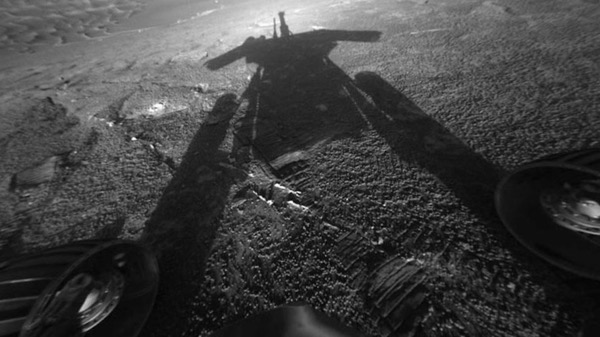
Opportunity caught its own shadow on Mars on July 26, 2008. Read more about this image.
Bottom line: An image of the Opportunity rover on Mars, which has not been heard from since dust engulfed it in June, 2018. Updates on Opportunity can be found here.
Via NASA/JPL-Caltech
UFOs Around the World: New Zealand
Over the next several weeks, I’ll be conducting interviews with leading UFO researchers from countries around the world in an effort to paint a picture of global UFOlogy today.
This week, our global UFO trek takes us to New Zealand, and to Suzy Hansen, an author, researcher, experiencer, and former professional educationist. Suzy is the author of The Dual Soul Connection: The Alien Agenda for Human Advancement, with contributions by Dr. Rudy Schild, Emeritus Professor of Astrophysics, Harvard/Smithsonian Center for Astrophysics, Cambridge, USA.

Suzy is also the founding Director of the UFOCUS NZ Research Network (NZ UFO sightings), and coordinator of Communicator Link (advocacy & support for experiencers/abductees). She was instrumental in lobbying for the release of the NZ MoD UFO Files in 2010/11. She has been lecturing internationally for more than 20 years and has featured in numerous interviews, articles and documentaries.
RG: Who have been the defining figures in New Zealand UFOlogy over the past 70 years (for better or for worse), and why?
SH: The most active and prominent researchers in my opinion were Fred and Phyllis Dickeson, Harold Fulton, Harvey Cooke (all gone now), and currently, the Dickeson’s son Bryan and I guess—myself!
The Dickesons were former NZ air force personnel who worked tirelessly to publicise UFO sighting investigation data. They established nationwide discussion groups and published the UFO magazines Satcu and Xenolog. They also hosted well-known UFO personalities to NZ, including author Erich von Daniken and contactee George Adamski.
Bryan Dickeson investigated UFO sightings throughout the ‘70s and ‘80s, and spoke at early New Zealand UFO conferences. He is also a trained regression therapist and investigated New Zealand’s first publicised abduction experience. Bryan now resides in Australia and has contributed significantly to Australia’s UFO research too. He has recently digitised some 6,500 New Zealand UFO sightings from his parents’ research material, which will soon be available to the public on UFOCUS NZ’s website.
The late Harold Fulton was also ex-air force and investigated some of New Zealand’s most significant UFO events along with the other researchers I have mentioned. His focus was on aviation sightings and his data was meticulous and scientific.
The late Harvey Cooke was perhaps the “Mr Personality” of UFO research here, and, although he never had a UFO sighting himself, his passion and enthusiasm for the subject was endless. Harvey contributed significantly through TV and radio interviews, organising conferences, and he ran one of the world’s longest-standing UFO groups for 55 years. His memory for names and dates was legendary.
RG: What do you consider to be the most compelling NZ UFO incident on record, and why?
SH: Without a doubt, the Kaikoura Lights sightings of 1978/79 are the most renowned NZ sightings. The two main sightings that occurred in December 1978/79 were captured on film, seen visually by pilots and a film crew onboard one of the flights, and appeared on Wellington Airport radar and the radar of the two Argosy aircraft involved. These anomalous lights were observed by many members of the public as well over a period of weeks.

One of the objects filmed during the Kaikoura Lights incident of 1978/79.
The Kaikoura Lights events effectively divided New Zealand society, as scientific groups and governmental departments carried out an attempted whitewash of the main sightings, attributing ever more ludicrous explanations to the events: it was Venus! It was the lights of squid boats reflected off the bottom of clouds! It was the streetlights of townships reflecting off the breasts of mutton birds flying south! The radar was faulty! (Not true).
In 2007 I was made aware of a piece of 16 mm television news footage by former a TV1 cameraman who had kept the reel concealed for years. It was digitised, and he told me it could settle the debate and silence skeptics for good, because it revealed a large light that split into two lights, both of which disappeared at speed in different directions. The footage was taken at the Clarence River mouth, where many sightings took place near Kaikoura. Unfortunately however, the footage was sold for a five figure sum to a documentary company in the States and has never been revealed to the public.
Dr. Bruce Maccabee, US optical data analyst, carried out an analysis of the film crew’s footage, and considers the Kaikoura sightings to be in the top 10 worldwide.
RG: What is the NZ government’s official stance on UFOs? When was the last time it issued a statement on the subject?
SH: The New Zealand government has generally refrained from making official statements about the UFO subject, with the exception of the Kaikoura Lights sightings, which attracted the attention of Sir Robert Muldoon, Prime Minister at the time. However the MOD UFO files released in 2010/11 revealed that as a result of investigations into the Kaikoura Lights, a number of governmental departments were involved in researching the event, including the Department of Scientific and Industrial Research (DSIR), Civil Aviation, Air Traffic Control, the Joint Intelligence Bureau, the Commissioner of Police, the Director of the New Zealand Meteorological Service, the Ministry of Transport, the Ministry of Foreign Affairs and Trade (MFAT), and the Director of Carter Observatory. Brief statements were made by government departments at this time in 1978/79. Any other official statements concerning the UFO topic have been made by the New Zealand Defence Force, the most recent being when the files were released.

‘The Beehive’ in Wellington, NZ, home to the executive wing of the NZ parliament.
RG: Does the NZ Ministry of Defence have an official UFO investigations unit?
SH: In September 1985, Wing Commander S. B. White, on behalf of Air Vice Marshal Ewan Jamieson, stated that New Zealand’s Ministry of defence has always claimed that it is not specifically charged with any formal responsibility for investigating UFOs, and neither is any other governmental Department, but that the Ministry does however take an active interest in all such reports and, within the limitations of its resources, conducts investigations as necessary.
However, the MOD UFO files revealed that although they did not have a funded UFO investigation unit, an official investigative committee was formed in the early-1970s and was disbanded in 1976. The members of this group included representatives of the Intelligence Service, the RNZAF, the Department of Scientific and Industrial Research, the Meteorological Service, Air Traffic Control, the Ministry of Transport and Carter Observatory. The outcome of their investigations suggested that they decided the UFO problem was a scientific matter rather than a threat to defence.

UFOCUS NZ’s archives contain a number of significant sighting events that witnesses state were investigated by the Air Force on behalf of the Ministry of Defence, including witness interviews, investigation of ground markings and other physical details, and photographs of specific areas. The witnesses state they were told by the air force representative that if they went to the media or spoke publicly about the investigations, the Air Force would deny all knowledge of it. Some witnesses report feeling intimidated.
RG: Has the NZ government shown more or less transparency on the UFO subject than the US, Australian, and British governments?
SH: Officially, the New Zealand government has refrained from involvement in UFO related matters, instead leaving such statements to the Defence Forces, on behalf of the Ministry of Defence.
In a letter to me dated 28 April 2009, the New Zealand Chief of Defence Force, Lt Gen Jerry Maeparae stated, “in the longer term, recognising the ongoing public interest in this topic, I should like to see a summary of information held about UFO sightings produced, in much the same way as that which is produced by the United Kingdom’s Ministry of Defence. Given existing constraints however I cannot predict when that objective may be achieved.”

In December 2009, following a further several months of lobbying, I received a follow-up letter from Lt Gen Mateparae, which stated, “I am pleased to be able to inform you that two NZ DEF officers have become that the task of assessing classified files in relation to this topic, with a view of the classification.”
New Zealand is a small country with a population of less than 5 million with limited resources to investigate UFO sightings, and I believe, as evidenced by the Chief of Defence Force’s letters, that the New Zealand Government and Ministry of Defence have largely taken their lead from the US, Australia, and British governments in terms of limited transparency and information. It is important to note that the MOD files released in 2010/11 consisted of only the air force UFO files. There still exist unreleased Navy and Army files, and restricted intelligence files.
RG: Does NZ have a national UFO investigations organisation today, and how many smaller NZ UFO groups are you aware of?
SH: In 2000, after 25 years of independent UFO research, I established the UFO Focus New Zealand Research Network(UFOCUS NZ), a nationwide UFO reporting and investigation network. At present we have a staff of seven investigators throughout the country who gather UFO related information and investigate sightings in their areas. Our staff over the years has included to air-traffic controllers, a pilot, a scientist, and an astronomer. We have a particular interest in aviation sightings, as New Zealand has a rich history of aviation-related UFO sightings, with a number of pilots and air traffic controllers who have been willing to go public on their sightings. As a result of this, in December 2013, we signed a written agreement of cooperation with a Chilean aviation/military UFO investigation group to share data and sighting reports pertaining to aviation sightings, and sightings that occur around the time of seismic/volcanic activity. As previously mentioned, on behalf of UFOCUS NZ, I was instrumental in lobbying the New Zealand Chief of Defence Forces for the release of the New Zealand Air Force MOD UFO files in 2010/11.
From the 1950s through to the mid-90s there were a number of UFO groups throughout New Zealand, formed by some of the early veteran UFO researchers I have mentioned who liked UFOCUS NZ, actively investigated sighting reports. Throughout the ’60s and ’70s there were a significant number of UFO sightings in New Zealand, coinciding with the times of known UFO flaps worldwide. Today, UFOCUS NZ is the only active UFO sighting investigation and research group in New Zealand.
RG: What are the most active regions of NZ for UFO sighting reports (hotspots)?
SH: We receive UFO sighting reports from all around New Zealand, and of course the population distribution plays a part in how many reports we may receive from certain areas. New Zealand is a largely rural society, with large areas that are sparsely populated.

Rural New Zealand.
Having said that, there are certain areas from which we have regularly received reports over the years, including the Central North Island volcanic plateau, the mysterious dome Valley north of Auckland, and the Kaipara Harbour where well-known New Zealand pilot and author Bruce Cathie observed a USO as he flew his DC3 transport plane over the harbour back in 1965. A significant number of UFO sightings were reported beginning just 10 days before the massive Christchurch earthquake in 2011, and continuing through to several weeks after the after-shocks had settled down.
However, the most prolific UFO sightings occurred in the Gisborne/East Cape area of the North island during what came to be known as the ‘Gisborne UFO flap’ of 1977 to 1980, and of course the Kaikoura Light sightings of 1978/79, which occurred over the northern end of the South Island.
Along with aviation sightings, UFOCUS NZ has a particular interest in sightings that occur around the time of seismic and volcanic activity in our country, which have been significant.
RG: Have you personally had any UFO sightings?
SH: Yes, I have had a number of UFO sightings, some of which I have documented in my book, The Dual Soul Connection. At age 8, in 1962, my family and I observed a long bright orange cigar-shaped light over a series of hills some 20 km away. We watched the light for one and a half hours, during which time it flared and pulsed in the sky before eventually moving off south. It was sighted by hundreds of people that night, and was reported in our national newspaper. This event changed my life and I developed an intense interest in space, stars, and even aviation. My mind was blown by the fact that this was not a natural phenomenon or aircraft, therefore “something” had to be flying it!

Suzy Hansen and her book, ‘The Dual Soul Connection.’
In 1975 I was a young 20-year-old teacher working in the Hawkes Bay region of New Zealand. While driving home to the city from a rural farming area my friend and I observed an unusual light in the sky which at first we thought was a helicopter or agricultural aircraft. However, the light suddenly “switched off” and reappeared over the hills adjacent to us, before repeating sequence two more times. After a few seconds the light disappeared and, having stopped the car to watch, we felt we could continue our journey; but the light reappeared behind us. It approached our car at speed, a massive light wider than the road, and the last I recall is being blinded by the brilliant light, deafened by a loud noise, and feeling the car lifting off the road before I must have lost consciousness. My next memory is of the car hitting the road again, but now it was no longer in late afternoon sunshine, but in complete darkness. We had lost 90 minutes of time. This incident catapulted me headlong into UFO site investigation and contact research.
From 1978 to 1986 I lived in the Gisborne/East Cape area of the North Island during the time of the Gisborne UFO flap. While fishing at a remote beach on the Cape I observe a large green ball of light rise out of the water and fly over the nearby hills. On another occasion I saw a matte black egg-shaped object flying over a range of hills, and other witnesses reported the same object.
RG: How long have you been involved in the UFO subject; roughly how many cases have you personally investigated; and what conclusions, if any, have you drawn about the underlying nature of UFO phenomena?
SH: This is my 44th year of research into the UFO and contact phenomena, and there is no sign of the workload lessening, or my interest waning. I have investigated hundreds of sightings and talked with hundreds of witnesses and contactees/abductees/experiencers in New Zealand and worldwide—thousands if you count my internet interviews. Of those sightings investigated, some twenty three or so were in-depth investigations involving sightings of actual craft, and, in some cases, entities/occupants associated with the craft. Now, some people may doubt the validity of those cases, but it is interesting that the witnesses were scientists, medical workers, emergency staff, pilots, along with farmers and truck drivers, who we consider credible witnesses who know their environments well. These are not the kind of people to hoax events or seek notoriety. It is through talking with these high calibre witnesses that one understands the enormity of the subject, the importance of critical thinking in investigation, the potential impact of possible contact in our future, and the extent to which these events changed the witnesses’ lives and worldviews forever.

My own sightings and experiences have led me to recognise there is a long-term agenda at play where UFO sightings are concerned. Although many sightings may be brief and random, those that are more in-depth, as I have described above, confirm my thoughts that just as many sightings and contacts are “by design,” meaning they occurred for a reason or purpose controlled by the occupants of the UFOs and this is evident in the way the events effect many witnesses, and in the prior sightings or paranormal incidents they often divulge to an investigator in the course of interviews. Of course, not all sightings are welcomed by witnesses, but there is much to be learned scientifically, socially, psychologically etc. from their descriptions.
Science is now validating the physics behind the descriptions UFO witnesses and experiencers have recounted for decades, and of course we now know there are plenty of habitable planets out there with similar attributes to Earth. I think it is only a matter of time until we truly understand why we have been observing “intruders” in our planetary airspace for decades, if not centuries and beyond. It could be that “disclosure” will occur under someone else’s timeline and control, not our own. As theoretical physicist Michio Kaku has said, we are not yet a united planetary civilisation, let alone an intergalactic civilisation prepared to meet our cosmic neighbours.
RG: How can NZ UFOlogy better itself?
SH: Well we are constantly working on this, and we continue to remain open-minded, but utilise critical thinking in investigations and research. Don’t be afraid to approach scientists and professionals for assistance and advice, and defer to greater knowledge (UFOCUS NZ utilises the skills of a number of professionals in our investigations). We should always do our homework. Keep abreast of worldwide research and network widely. Keep lobbying the MOD for further UFO files. And maintain a public profile.
For more information about New Zealand UFO research, visit: UFOCUS NZ. Suzy Hansen’s book describing her own personal UFO experiences is available here.
The Skull Asteroid Comes Back For Another Scary Halloween Pass
Take one space object with a reflectivity number just slightly higher than charcoal. Notice that it arrived close enough to wake up the rarely-alert asteroid warning system workers on October 31st, the date of a popular worldwide holiday. Stare at pictures of its dark surface long enough to conjure up an image that relates to the holiday. Throw in comments from astronomers that it’s “dead.” Stir it all together in a witch’s kettle and you have the Halloween Death Comet, a skull-ish Near Earth Object discovered days before Halloween in 2015 and returning just days after Halloween this year. Should we eat all of our candy quickly before the Death Comet destroys us the planet?
Do you really need a wild excuse like that to eat all of the candy quickly?

Asteroid 2015 TB145’s distance from Earth in 2015
Asteroid 2015 TB145 was discovered on Oct. 10, 2015 by the University of Hawaii’s Pan-STARRS-1 (Panoramic Survey Telescope and Rapid Response System). Before its eerie pareidolic skull image was visible, 2015 TB145 was considered to be dangerous NEO because of its size (between 2,050 feet and 2,297 feet or .6 km to .7 km) and its projected close pass to the Earth — 300,000 miles (480.000) or just slightly beyond the orbit of the moon at 1.3 lunar distances. We’re still here, so The Great Pumpkin (NASA’s Halloweenish nickname before its scarier face was seen) didn’t get close enough for a hit. What about this time?
“Although this approach shall not be so favourable, we will be able to obtain new data which could help improve our knowledge of this mass and other similar masses that come close to our planet.”

That’s astronomer-speak for “close enough to justify our funding but not enough to cause a panic.” Pablo Santos-Sanz from the Institute of Astrophysics of Andalusia (IAA-CSIC) and other astronomers think the more interesting aspect of the asteroid is the fact that it’s NOT an asteroid. Vishnu Reddy, a research scientist at the Planetary Science Institute, Tucson, Arizona, explains why.
“We found that the object reflects about six percent of the light it receives from the sun. That is similar to fresh asphalt, and while here on Earth we think that is pretty dark, it is brighter than a typical comet which reflects only 3 to 5 percent of the light. That suggests it could be cometary in origin — but as there is no coma evident, the conclusion is it is a dead comet.”

Comet with coma
“Coma” is that blurry aura seen around comets as they make their tight turn around the Sun. No coma means no more ice – the definition of a dead comet killed by the Sun – but better conditions for imagining the dead comet looks like a revolving skull glaring with its dead eyes at us Earthlings as it passes. (See how easy pareidolia is?)
2015 TB145 or the Death Skull Halloween Comet Asteroid Great Pumpkin will be closest to Earth on November 11th. It’s a safe bet that you will have no more candy to gorge on by then.
Unmarked Black Helicopter Above Chicago Sparks Conspiracy Theories
Unmarked black helicopters hold a special place in UFO and conspiracy lore. Since the 1960s, mysterious helicopters lacking any identifying markings or color have been reported near the sites of UFO sightings, alien abduction claims, men in black, and even cattle mutilations. There are all sorts of conspiracy theories about the origins of these unidentified aircraft including that they belong to various agencies of some secret shadow government or the UN, that they are demonic in nature, or that they might be shapeshifters.

Of course, US law enforcement agencies such as the DEA, U.S. Marshals, and FBI are known to use black helicopters for surveillance and transportation, so there could be some truth behind alleged black helicopter sightings. There usually is some truth to all conspiracy theories, however small it may be. To add fuel to the black helicopter conspiracy theory fire, an unmarked black helicopter recently appeared flying low over Chicago rooftops, thoroughly freaking out confused Chicagoans below. The helicopter was seen dropping soldiers and equipment onto a roof before flying away.

According to aviation sleuth Tyler Rogoway writing at The War Zone, “the UH-60M Black Hawk photographed and filmed all over Chicago does not appear to belong to the United States Army. The configuration of its antennas is unique and it does not have any Army titles or serials on it.” Rogoway points outthat over the last several years, the Department of Defense has transferred many of its Black Hawk helicopters to other federal agencies, so it’s likely this was some sort of drill or training operation conducted by a federal agency.
However, the Chicago Police Department, Illinois Military Department, and National Guard have all been tight-lipped on the matter and have not given any information about who might have been conducting these exercises or for what purpose. Naturally, that has left the mind of the collective internet to wander to the most conspiratorial It’s perfectly possible – and probable – that this was a drill to offer special forces the opportunity to train in a real urban environment.

Of course, there’s also the chance, however small, that something stranger or perhaps more nefarious just went down in Chicago in broad daylight and plenty of witnesses got it on camera. Given the ubiquity of cameras today, it’s likely harder for Them to hide or disavow operations in public places. If there is a Them, that is.
We all know there is. They don’t even try to hide it anymore. Still, without any more knowledge, all we’re left to do is sit on the internet and spin theories about what we all just saw.
The almighty tussle over whether we should talk to aliens or not Examining the decline: Another look at the data on UFO sighting reports


I have previously reported that UFO sighting reports have been on a steep decline for three years. 2018 is continuing this steep dropoff.
I have previously reported that UFO sighting reports have been on a steep decline for three years. 2018 is continuing this steep dropoff.
Please note that I said “UFO sighting reports” and not sightings. I’ve been getting considerable mail that sightings are still up in North America and in Europe. It just seems that folks aren’t showing an enthusiasm for reporting their recent sightings. One UFO researcher commented, “We see so many, who has time to report them all!”
After my last report about the decline, I observed two things. One was a volume of mansplaining why this decline is occurring. The other was a host of copycat articles being posted, some with the most absurd numbers.
The numbers in this article are a snapshot as of Sept. 20. Keep in mind that people do report sightings years after the event. So a sample I take today might be off by 50 or 100 for a particular year, if I sample three to six months from now.
I’ve come to understand that the UFO sighting report databases are, in a sense, living documents and seem to have a creeping growth. If we were studying farm reports or the census from a particular year, the numbers, for the most part, are solid with a small margin of error. So please keep this in mind when I do a year-end report because the numbers may be slightly different.

Let’s look at an eight-year snapshot of National UFO Reporting Center data. Note that 2017 is displaying a seven-year low for UFO sighting reports. The decline from 2014 to 2015 was 1,788 reports. The decrease from 2015 to 2016 was 1,231 reports. Interestingly, the shrinkage from 2016 to 2017 was only 680 reports. Ordinarily, one might assume that the UFO sighting report deterioration might be leveling out to an average baseline.
Yet if we examine the first eight months of the past six years, including 2018, except for a spike in 2014, we generally see a steady downward trend. Where it will all settle out is anybody’s guess.

But let’s consider some of the possible reasons that have been offered by many readers. Some blamed the announcement of Space Force; sorry, the declines in reports started four years before the announcement.
Others blamed too many people with their heads down and focused on their pads and phones. Maybe.
Quite a few people suggested that the ETs may have run out of interest (or perhaps galactic grant funding) to continue their studies here on Earth. Still others expressed boredom with reporting UFO sightings, especially since Disclosure seems to be stalled. The mood was “Why bother?”
Some suggested that there’s a general apathy in the country given our chaotic political situation. Finally, there are many who wonder if the falloff in UFO sighting reports is the calm before a storm. Who knows?
Where have all the UFOs gone? Blame the movies
Sightings of unidentified flying objects have declined worldwide. This news, reported last week by The Guardian newspaper, should alarm and sadden anyone who has ever gazed in wonder at the sky above.
Two major websites for UFO reports — the National UFO Reporting Center and the Mutual UFO Network — have both registered a steep drop in global sightings. The decline began in 2014, a peak year for UFOs, and by last year the total number of sightings had reached just 55 per cent of the 2014 tally.
What is behind the decline in UFO sightings?
In an age of wild claims churned out by politicians, media and advertisers, perhaps people don’t care as much any more
This month, the two major online sites for reporting UFOs – the National UFO Reporting Center and the Mutual UFO Network – both documented steep drops in worldwide sightings. The declines started around 2014, when reports were at a peak. They have since reduced drastically to 55% of that year’s combined total, many UFO interest groups have folded, and numerous previously classified government documents have been disclosed.
Do these declines reveal that UFO interest is becoming a blip on the human cultural radar? Perhaps UFO and alien lore is seeming more like a reflection of human culture, tied to the space age, motivated by conquering new existential frontiers.
It might not be a coincidence that the term UFO (unidentified flying object) and some of the phenomena that surrounds it – abductions and impossible technologies – are relatively recent. Before the 1940s, reports of sightings of objects in the sky were extremely rare. Centuries of recorded history give no clear indication of any such activity. Then, at the predawn of the space-age, around the time of the Roswell conspiracy, UFO culture was born, giving rise to everything from Space Invaders to The X-Files.
Possible answers as to why sightings are decreasing are varied. A key factor, however, may be that more people simply don’t care any more. As we are accustomed to being inundated with wild claims churned out by politicians, media and advertisers, the next report of a UFO is no more believed than the long-range weather forecast.
Before home video, photographs were the staple of UFO evidence. Video evidence, during the height of the 1990s UFO mania, was regarded by many as even more substantial. Amateur footage of glowing objects in the sky, as mysterious as they seemed real, made the cut for appearing on television – they were meant to be taken seriously and they fed an audience hungry for amazement, helped by a healthy dose of conspiracy theorising.
According to the cultural historian Stuart Walton, “Belief in UFOs is definitely in a state of decline, along with much else that could be classed as paranormal. Part of the reason is that the technology for providing documentary evidence of such matters is now widely available to everybody with a smartphone, and such purported evidence as there is on YouTube looks extremely threadbare.”
He adds: “It isn't so much that belief can exist without proof; it's that it must emphatically avoid proof to remain belief. We are in the process, paradoxically, of proving a negative hypothesis with UFOs: there never was any such thing.”
Indeed, indisputable evidence of intelligent life coming to Earth could be the greatest news of all time. Yet, after thousands of anecdotal, photo, and video reports have accrued over decades, what are we to conclude? With the greatest balance of scepticism and “wanting to believe”, all that can confidently be asserted is that some objects, appearing in the sky on film or video, seem unidentifiable.
Furthermore, government disclosure of its own video footage isn’t helping to maintain belief. Joseph Baker, sociology professor at Tennessee State University, says: “It’s actually better for UFOs when ufologists can claim that ‘the powers that be know everything and are hiding it from us’ rather than seeing that the government appears to have basically the same info about UFOs as the public: namely grainy, inconclusive visual evidence.”
Perhaps though, the declines in reported sightings may signify only an end to current trends in ufology. After all, from the 1940s aliens were originally characterised as saviours who could help humans transcend the cold-war paranoia of nuclear annihilation; especially marked at the time, after two world wars. But after events like Watergate and the Vietnam war fuelled distrust in government, UFOs came to be viewed more as a possible threat, and some came to believe their existence was verified in secret military documents.
Sharon Hill, a researcher on the paranormal and pseudoscience, says: “The ideas about UFOs and aliens continue to evolve as we project our social and cultural ideas on them. Since we have no single easy explanation for all these claims regarding the decline in sightings, the future vision of ufology seems rather open-ended. I don't think it's dead, just changing.”
UFO Case: Japanese Airlines JAL1628 (November 17, 1986)

by John Greenewald, Jr.
The following is a description of the event, as archived by Wikipedia, to give a bit of background the case:
Japan Air Lines flight 1628 was a UFO incident that occurred on November 17, 1986 involving a Japanese Boeing 747-200F cargo aircraft. The aircraft was en route from Paris to Narita International Airport, near Tokyo, with a cargo of Beaujolais wine. On the Reykjavík to Anchorage section of the flight, at 17:11 over eastern Alaska, the crew first witnessed two unidentified objects to their left. These abruptly rose from below and closed in to escort their aircraft. Each had two rectangular arrays of what appeared to be glowing nozzles or thrusters, though their bodies remained obscured by darkness. When closest, the aircraft’s cabin was lit up and the captain could feel their heat on his face. These two craft departed before a third, much larger disk-shaped object started trailing them. Anchorage Air Traffic Control obliged and requested an oncoming United Airlines flight to confirm the unidentified traffic, but when it and a military craft sighted JAL 1628 at about 17:51, no other craft could be distinguished. The sighting lasted 50 minutes.
I first filed a Freedom of Information Act (FOIA) request for documents from the FAA back in 2001. Throughout the processing, they determined that I was a “commercial” requester, and they were going to charge me excessive fees for the search and duplication of responsive records, which totaled a little more than 100 pages. This was one of hundreds of examples of game play by our U.S. Government and Military agencies while processing my FOIA requests. When you file, you fit into one of three “fee categories.” The basic definition of categories is commercial, non-commercial, or all other.
What you pay for the request and records is dependent on which category you fit into. Commercial is the most expensive, wherein you pay for everything; search, document review and duplication. Their search fees can range from $45-$85 an hour, so if they want to send you a large bill, they certainly can! After a telephone conversation with Jean Mahoney on June 5, 2001, I was told I could withdraw my request and the documents would be sent to me free of charge. Although I do not have record of it since it was sent on a crashed computer which lost its data, I know I sent an email withdrawing my request in hopes to receive the package.
The package never came. Unfortunately, I received a letter in the mail that stated:
“On June 5, 2001, I contacted you to by telephone and discussed the fees for search, review, and duplication of documents pertaining to your May 9, 2001, request for UFO sightings in or around Alaska between 1981 and 1988. We have determined that you would be considered a commercial requester and would be charged for all search, review, and duplication of the records. I advised you that approximately 107 pages of documents could be made available to you outside of the FOlA without fees. These documents do not include radar tracking data and simulated radar data for JL1628. It was agreed that you would withdraw your request by either fax (907-271-2800) or E-Mail (jean.Mahoney@faa.gov) and l would forward the 107 pages to you on receipt of your withdrawal.
As of this date, I have not received your withdrawal. If I have not heard from you by July 12, 2001, we will consider your request cancelled. In addition, all documents pertaining to this UFO citing [sic] will be destroyed in 30 days from the date of this letter.”
This is the letter in 2009, reiterating their 2001 destruction of documents.
Due to irrelevant circumstances, I did not read this letter until the thirty day deadline had come and gone. Of course, I feared the worst; that the documents were destroyed. They were — each page according to them. In a later request in 2009, when I attempted to rekindle the search for records, I was told again, that the records were destroyed. I have told this story many times, as this is a really unfortunate state of events that resulted in the loss of valuable history.
Fast forward more than 17 years after my initial request. I believe I found the records. I discovered them in Record Group 237: Records of the Federal Aviation Administration, 1922 – 2008.Holding National Archives Identifier number 733667, and local identifier number 1203, I found more than 1,500 pages regarding the JAL1628 UFO encounter. I believe, but this is only a guess as of the writing of this article, that the FAA must have transferred a copy to the National Archives, but either did not keep a record of the transfer (which they should have) or they attempted to mislead me that the records had been destroyed, when in fact, they were not. Plus, this is more than 1,400 pages than the FAA’s original estimate, and more than 1,200 pages archived by NICAP’s original JAL1628 files.
I believe based on the folder they were discovered in, the time frame of the documents and the contents within, the below contain the records I sought in 2001, but was told they were destroyed.
In a bizarre twist to this story, I offer you the complete set of 1,569 pages, titled by their official file designation headers, listed in the order they were found.
The following records were scanned at a very high resolution size for clarity.
 jal1628.zip [656.7MB])
 Statement of course for records (NTIS) and Content of Package [8 Pages, 5.8MB] FAA Form 8020-5, Aircraft Incident Record, Brief Summary Statement [3 Pages, 3MB] Klass and Haines inquires and responses [40 Pages, 35.4MB] FAA Form 3112, Inspection and Surveillance Record, Inspector Jack Wright [5 Pages, 4.2MB] FAA form 1600-32-1 Notes of interviews with 3 crew members by Ron Mickle and James Derry [5 Pages, 6.13MB] Written Statement by Capt. Terauchi [In Japanese] [18 Pages, 17.2MB] Written Statement by Capt. Terauchi [English translation by Sakoyo Mimoto] [13 Pages, 11MB] Transcript: Interview with Capt. Terauchi by Dick Gordon, 1/2/87 [19 Pages, 11MB] Transcript of interview with First Officer Tamefugi by Peter Beckner 1/5/87 [23 Pages, 14.7MB] Transcript of interview with Flight Engineer Tsukuba by Pete Beckner 1/15/87 [6 Pages, 4.1MB] Modified Package for FAA Managers [121 Pages, 94.5MB] Chronology of Events [4 Pages, 2.9MB] Flight Path Chart [17 Pages, 17MB] Selected portions of voice transcripts of JAL 1628 and controllers [9 Pages, 7.1MB] Transcript of Communications between air traffic control and JAL 1628 [24 Pages, 13.6MB] FAA form 7230-4 Daily record of Facility Operations, Anchorage Air Route Traffic Control Center [3 Pages, 5.5MB] FAA form 7230-10 Position logs [2 Pages, 2.3MB] Personnel Statement (Air Traffic Control Specialists) [16 Pages, 11.9MB] Anchorage Air Route Traffic Control Center computer printout of continuous data recordings (RADAR tracking) [178 Pages, 7.21MB] Color photos of simulated radar data [18 Pages, 25.8MB] Color photos of simulated radar data with captions [5 Pages, 5.25MB] Black and white photos of simulated radar data [13 Pages, 7.1MB] Explanation of split beacon target [4 Pages, 3.7MB] News releases, FAA public affairs [9 Pages, 7.8MB] Record of Communication with FAA administrator, and with U.S. Air Force [6 Pages, 4.5MB] Cassette tapes of interviews (Audio not digitized) [4 Pages, 4.76MB] ATC transcripts; flight path chart; personnel statements [13 Pages, 14.3MB] ATC Transcript; interview with crew; personnel statement; news release [8 Pages, 6.3MB] News media contacts to FAA [43 Pages, 46.3MB] News clippings [50 Pages, 4.61MB] Miscellaneous [17 Pages, 15.8MB] Letters about UFO (folder 1) [88 Pages, 38.3MB] Letters about UFO (folder 2) [59 Pages, 27MB] Letters about UFO (folder 3) [81 Pages, 31.1MB] Letters about UFO (folder 4) [136 Pages, 81.6MB] Letters about UFO (folder 5) [86 Pages, 39.6MB] Letters about UFO (folder 6 and 7) [147 Pages, 52.8MB] Letters about UFO (folder 8 and 9) [144 Pages, 64.9MB] Letters about UFO (folder 10) [96 Pages, 35.6MB]
Original Letters Stating Records Destroyed
FAA Letters of Correspondence along with ASIAS report [6 Pages, 1.56MB]
Chase Kloetzke – Mutual UFO Network Director of Investigations – Sept. 25, 2018

Open Minds UFO Radio: Chase Kloetzke is the Director of Investigations for the Mutual UFO Network (MUFON), the largest civilian UFO investigation organization. Chase is in charge of trained field investigators throughout the United States and a several other countries. As of June 30, 2018, MUFON has already received over 3600 reports. Chase was a Master Trainer/Master Instructor with the Department of Defense, has a Bio-mechanical Engineering accreditation, has received certification as a Private investigator, certified in international forensic and evidence collection and holds a Certified Professional Evidence Specialist (CPES) certification with the International Association for Property and Evidence, Inc. She uses her skills to ensure MUFON investigations adhere to professional law enforcement and scientific standards.
In this interview we discuss Chase’s approach to UFO investigations, recently becoming a certified lobbyist, and a unique opportunity she will soon have briefing lawmakers on the serious study of UFOs using recent findings.
Find out more about Chase at ChaseKloetzke.com
And Bohic Ruz Explorer Society
Support me on Patreon: www.patreon.com/alejandrotrojas
When Dozens of Korean War GIs Claimed a UFO Made Them Sick
During the Korean War, many UFO sightings were reported.
Mary Evans/Everett
In May 1951, one year into the Korean War, PFC Francis P. Wall and his regiment found themselves stationed near Chorwon, about 60 miles north of Seoul. As they were preparing to bombard a nearby village with artillery, all of a sudden, the soldiers saw a strange sight up in the hills—like “a jack-o-lantern come wafting down across the mountain.”
What happened after—the pulsing, “attacking” light, the lingering debilitating symptoms—would mystify many for decades to come.
As the GIs watched, the craft made its way down into the village, where the artillery air bursts were starting to explode. “We further noticed that this object would get right into...the center of an airburst of artillery and yet remain unharmed,” Wall later told John P. Timmerman of the Center for UFO Studies in a 1987 interview. Suddenly, the object turned, Wall said. And whereas at first, it had glowed orange, now it was a pulsating blue-green brilliant light. He asked his company commander for permission to fire at the object with armor-piercing bullets from an M-I rifle. As the bullets hit the body of the craft, he recalled, they made a metallic “ding.” The object started behaving still more erratically, shunting from side to side as its lights flashed on and off.
Wall’s recollections of what happened next are stranger still. “We were attacked,” he said, “swept by some form of a ray that was emitted in pulses, in waves that you could visually see only when it was aiming directly at you. That is to say, like a searchlight sweeps around and the segments of light...you would see it coming at you.”
He remembered a burning, tingling sensation sweeping over his body, as if he were being penetrated. The men rushed into underground bunkers and peeped through the windows, watching as the craft hovered above them and then shot off, at a 45-degree angle. “It's that quick,” he said. “It was there and was gone.”
Three days after the incident, the entire company of men was evacuated by ambulance, with special roads cut to haul out those too weak to walk. When they finally received medical treatment, they were found to have dysentery and an extremely high white- blood- cell count. “To me,” says Richard F. Haines, a UFO researcher and former NASA scientist, “they had symptoms that sounded like the effects of radiation.”
Was it an experimental new Soviet weapon?
In the wake of the Korean War, which ended in July 1953, dozens of men have reported seeing similar unidentified flying objects over the course of the 37-month conflict. The craft often resembled flying saucers. According to unofficial reports, as many as 42 were corroborated by additional witness reports—an average of more than one a month in just over three years.
At first, according to Korean war historian Paul M. Edwards, many researchers believed that the sightings were Soviet experiments, based on German technology and foreign research in anti-gravity. “These were supposedly so large they could carry 50 tons of weight and were powered by electromagnetic propulsion,” he writes in Unusual Footnotes to the Korean War. “What was being sighted, it was suggested, were discs the Russians were testing over the Korean skies.” But in the years since the fall of the Soviet UnionIron Curtain came down, a number of Soviet reports of sighting UFOs over Korea have trickled in, discrediting these theories.
Why were there so many UFO sightings throughout the Korean war? Were they the product of thousands of exhausted men under incredible stress—or a sign of something more mysterious? From 1952 until 1986, the United States Air Force ran Project Blue Book, a systematic study into unidentified flying objects and their potential threat to national security. When it was shuttered, in December 1969, the Air Force announced they had found nothing of note, and terminated all activity under the auspices of the study.
But many believe that the project ended abortively, and that there was more work to be done—leading to similar interviews with witnesses and other investigations being done by dozens of volunteers for decades after the project ended. Haines is one of them. He describes himself as a scientist with an open mind, rather than someone with something to prove. “I don't believe in them, I don't not believe in them,” he says. “I'm trying to let the data convince me one way or the other, which is the scientific approach.” But, he says, it’s striking how many accounts there are of similar sightings in the Korean War and other conflicts.

An aerial view of the Korean DMZ in the Chorwon District, where Francis P. Wall saw the UFO.
Yann Arthus-Bertrand/Getty Images
Other explanations?
In the early years of the Cold War, it was often theorized that these crafts might be Soviet or Chinese vessels, with technology unknown to American troops. Haines believes this theory has been conclusively disproved.
“If they were,” he says, “they would have been building those crafts for use in later wars like the Vietnam War, for instance.” The Soviet UFO sightings Edwards describes make it similarly unlikely—as do the impossibly high-tech specifications of some of the sightings. In Wall’s case, for instance, he described a kind of force field taking effect a while after he began shooting, where his bullets simply ricocheted away from the craft.
Haines, for his part, believes the rash of sightings across the Korean war might suggest that something in the universe is especially interested in how human beings behave in the throng of military action. “We tend to be very creative to fight a war,” Haines says, listing off the various sciences and technologies that might come into play in military action. “If you were interested in how another country or another race of people fought their wars, you’d want to collect information on that, wouldn’t you?” He trails off. “That’s one possible explanation. There may be others.”
But the vast majority of UFO sightings—as much as 80 percent—are later found to be totally ordinary phenomena, like clouds or human crafts, rather than anything otherworldly. In Wall’s case, precisely what he saw that day has never been conclusively proven or disproven. Without the testimony of other men in Wall’s regiment, it’s hard to ascertain whether they too had the same strange experience—, even if it can be corroborated that many did get very ill.
Why such long-lasting after-effects?
In the years following the war, Wall lost contact with many of the men in his regiment. After the experience, he remembered his company agreeing that they would not file a report, “because they'd lock every one of us up, and think we were crazy,” he told Timmerman. What made him choose to make a testimony, however, was the lasting after-effects of his illness, including permanent weight loss from 180 pounds to 138, stomach problems and periods of disorientation and memory loss after returning to the United States.
He retired in 1969, at the age of just 42, his daughter Renae Denny says, and spent 30 years out of work, struggling with the after-effects of the war. “Back then they didn’t know the name of it, but I guess you could say it was a form of PTSD,” she says. Over the years, he would tell and retell the tale of his strange UFO sighting. “The story was always the same,” says Denny. “It never changed through the years.” But there was other fallout: He was especially affected by the sounds of airplanes and once knocked his mother and sister to the ground after mistaking them for enemy troops. “I guess he would have flashbacks,” she says.
Wall’s recollections of the UFO sighting were consistent and acute. But whether what he remembered actually happened is harder to prove. Fighting conditions were almost intolerably stressful, and it’s entirely possible that he may have experienced some kind of hallucination, brought on by the terror of the situation, where he regularly feared for his life. It might also have been a moment of feverish delirium: Even the raised white-blood cell count that surprised army doctors, and Haines, is consistent with many of the bacterial infections which might also cause severe dysentery—as are hallucinations. In a later interview with Haines, Wall described how he had discussed what he saw with some 25 other men—but none ever came forward or could later be traced.
In 2002, British researchers demonstrated a link between UFO sightings and Cold War hysteria—and pointed out how the number of sightings had nosedived as radar improved. “That cannot be a coincidence,” David Clarke told the Guardian. “Those early confirmations were just a product of a primitive radar system.” The flurry of UFO sightings Haines describes may have been the dual effect of these two threats: a potentially world-destroying war on the horizon, and the incredible pressure of being in the military.
Wall had experiences in those years in Korea that would scar him until his death in 1999. One night, Denny says, he managed to make his way through a pitch-dark minefield, praying for his life as he went. Others who made the same journey were not so fortunate. “When he went in [to the war],” she says, “he was happy-go-lucky, just a totally different person to when he came out.”
Whether the UFO sightings that Wall and so many other men reported were a product of this personality-altering trauma, or the effects of something requiring much greater investigation, remains a mystery.
VIDEO: UFO Researchers Discuss Close Encounters Movie at Devils TowerUFO researchers and UFO and Close Encounters of the Third Kind enthusiasts gathered in Hulett, Wyoming for the Devils Tower UFO Rendezvous last weekend. Held near the iconic natural phenomenon made famous from the Steven Spielberg movie, lectures discussed UFO research and the latest UFO news. OpenMinds.tv interviewed several of the speakers on their thoughts on the Close Encounters movie.
Read more about the Devils Tower UFO Rendezvous: devilstoweruforendezvous.com
Links to more information about the researchers in the video:
Marc D’Antonio – Watch his SkyTour Livestream
Micha Hanks – The Gralien Report: gralienreport.com
Lee Speigel – leespeigel.com
David Marler – davidmarlerufo.com
Get David’s book Triangular UFOs: An Estimate of the Situation https://amzn.to/2NsbbmD
Help keep the UFO info coming: Support me on Patreon: www.patreon.com/alejandrotrojas
Did an Alien Contact Japanese Fishermen in 1803?
On Feb. 22, 1803, a strange boat washed ashore in Japan. It was something the fishermen there had never seen before — a disc-shaped vessel, with windows on top and metal bands below. Inside they found strange writing etched into the walls, unusual fabrics they likened to bedsheets or carpet, and a passenger, a young, beautiful woman clutching a square box. She had red hair and pale pink skin, and she wore fine clothes, also made from strange fabric.
She spoke an unfamiliar language and refused to reveal the contents of the box she held. Could she have been an alien of some kind? Did these humble Japanese fishermen witness a close encounter? The hosts of Stuff They Don't Want You To Know, Matt Frederick and Ben Bowlin, examine the evidence in the podcast Utsuro-Bune: Ancient Japanese UFOs.
The legend of the story is known as the utsuro-bune, or "hollow ship." The fishermen at the time theorized that the woman was a princess from a foreign land, exiled for a torrid affair with a peasant. Perhaps she carried the head of her deceased lover in the box, and protected it so carefully for that reason. Ultimately the fishermen decided to put her back in her ship and set her adrift to meet her destiny.
Over time, some have suggested the fishermen encountered an alien, not a woman. The boat obviously wasn't a UFO, because it didn't fly, but it could have been a USO, or unidentified submarine object. The most compelling evidence is the ship itself. In the texts describing the incident, the men likened the ship to a rice pot or an incense burner. The metal bands and hard glass windows were nothing the fishermen had seen before. And the writing on the ship has been compared to similar alien symbols found on the hulls of crafts from Roswell, New Mexicoand the Rendlesham Forest incident.
There are more plausible explanations behind the encounter, however. Others suggest the woman was Russian and coming to persuade the Japanese to trade with them — or even to spyon them. The incident occurred during the Edo period when Japan's borders were strictly controlled, and the country traded only with China and the Netherlands. That isolation could also account for why the ship looked so unfamiliar to the fishermen. Round ships were not uncommon at the time, but the metal and glass encasings were.
The simplest explanation is that a round log-boat was covered with a dome to make it more seaworthy. But what about the writing on the ship, and the mysterious box the young woman carried? Could there really have been more to the story than meets the eye? Listen to the podcast to see what Matt and Ben think and then decide for yourself.
Moon Is Stepping Stone, Not Alternative to Mars, NASA Says
"The glory of the moon is that it's only a three-day journey home," Bridenstine added. "So, we can prove all of the technologies, we can reduce all of the risks, we can try all of the different maturations that are necessary to live and work on another world. And we can do it all at the moon, where, if there is a problem, if there is an emergency, we know that we can get people home."
He cited NASA's Apollo 13 mission in 1970, which famously managed to make it safely back to Earth despite experiencing a serious problem on the way to the moon.
Far from delaying a crewed Mars mission, which NASA aims to execute in the 2030s, the current and near-future moon work should "accelerate our path to get to Mars," Bridenstine said.
This reassurance is in keeping with the language of Space Policy Directive 1(SPD 1), which has spurred much of the moon work. SPD 1, which President Donald Trump signed in December of 2017, instructs NASA to return astronauts to the moon as part of a sustainable exploration program that will eventually bring more-distant destinations, such as Mars, within reach.
And about the current moon work: NASA plans to begin building a small space station in lunar orbit in 2022. This outpost, called the Lunar Orbital Platform-Gateway, could be ready to accommodate astronauts by 2026, NASA officials have said.
NASA Video Appears To Show A Gigantic Object Coming Out Of The Sun
A NASA video shows a gigantic shape emerging from the sun. The event was spotted on helioviewer.org, a website launched by NASA and the European Space Agency (ESA) to give regular people access to images and data from the sun. Archived images go back as far as 15 years.
The video clearly depicts a massive object exiting the sun and moving away quickly. It is shaped like a butterfly and manages to maintain a consistent structure as it moves away from the sun. Whilst some have speculated that it a normal solar ejection of some sort, such as a flare, it does not seem to match any known patterns consistent with a flare or any other usual solar activity.


The object is expansive, estimated to be as much as 100 times the size of Earth. The video has led some to suggest that the sun itself may, in fact, be a portal between dimensions and realities, or perhaps just our own reality and it acts as a “Stargate”. This idea was introduced by a man named Corey Goode. He claims to have been working on classified and secret space programs for many years, and that those programs have been in operation for even longer than his employment- such as the Warden Space Program thought to have begun in the 1980’s.
Darren Perks, an investigative researcher with Huffington post was informed by the Department of Defence that “Solar Warden” was indeed a program but had been shut down. Other theorists have pointed to the findings of Gary Mckinnon who gained access to Air Force Space Command and believes he read information suggesting an extraterrestrial presence in “Solar Warden”.
Whatever the explanation behind the strange butterfly emission is, the video itself is real. Perhaps in the future, more light will be shed on its origin and if it has any connection to alien life outside our solar system.
READ NEXT
Wow! Asteroid Ryugu's Rubbly Surface Pops in Best-Ever Photo

The $150 million Hayabusa2 mission launched in December 2014 and arrived in orbit around Ryugu in late June of this year. The orbiter also carries another bantam hopper known as MINERVA-II2, an "optional" rover that might be deployed sometime next year. And the mothership will drop down to the surface itself in 2019, snagging samples that will come to Earth in a return capsule in December 2020.
The various data gathered at Ryugu, and analyses of the returned sample, should help researchers better understand the early solar system and the role that carbon-rich rocks like Ryugu may have played in helping life get started on Earth, mission officials have said.
NASA has its own asteroid-sampling mission underway, with many of the same goals. The OSIRIS-REx spacecraft is scheduled to arrive in orbit around the near-Earth asteroid Bennu on Dec. 31 and return samples of the rock to Earth in September of 2023.
And about all those acronyms: MINERVA stands for "Micro Nano Experimental Robot Vehicle for Asteroid"; MASCOT for "Mobile Asteroid Surface Scout"; and OSIRIS-REx for "Origins, Spectral Interpretation, Resource Identification, Security-Regolith Explorer."

WOW!! Check out these new photos fresh from the Minerva-II1A rover that just landed on Ryugu!! #Ryugu #Minerva #Rover #Hayabusa2 #Asteroid #Japan #JAXA #Robots #AsteroidLanding #Amazing #Surface #Successful #Spacecraft #Space #SpaceX @JAXA_en @haya2e_jaxa


 Mysterious Cosmic Rays Shooting from the Ground in Antarctica Could Break Physics

There’s something strange happening beneath the surface of Antarctica and it’s got nothing to do with Nazi UFOs. Rather, researchers are arguing that a decade-old experiment may have furnished the first evidence of a new type of particle that has evaded detection by some of the most sophisticated particle accelerators for years. If they turn out to be correct, it would change physics as we know it.
In 2006, NASA-affiliated researchers launched Antarctic Impulsive Transient Antenna (ANITA), a balloon experiment meant to observe high energy particles that shower the Earth from space, also known as cosmic rays. During ANITA’s flight, however, its instruments observed something that physicists couldn’t explain. In addition to detecting cosmic rays from space, ANITA also detected cosmic rays shooting fromthe ground as the high altitude balloon drifted over the Antarctic ice sheet.
Physicists have long known that high energy particles can penetrate deep into Earth, but none of the particles predicted by the Standard Model—the most accurate model of physics that has ever existed—should be able to pass all the way through the planet.
On Tuesday, a group of researchers led by the Pennsylvania State University physicist Derek Fox posted a new theory of these upward-shooting cosmic rays to arXivthat suggests they could be evidence of a particle that lies beyond the Standard Model. If Fox and his colleagues are correct, it would be the first evidence of a particle beyond the Standard Model of physics, the most accurate description of the universe humans have ever known.
The first ANITA mission launched from the McMurdo base in Antarctica in December 2006. The experiment flew to an altitude of about 120,000 feet where it spent a month drifting over Antarctica. It was equipped with sensors designed to detect pulses of radiation produced when ultra high energy neutrinos—a nearly massless particle with no electric charge—interact with the Antarctic ice sheet.
In the early 60s, the Soviet physicist Gurgen Askaryan theorized that when a high energy particle interacted with a dense dielectric medium—a type of insulating material that doesn’t conduct electricity—it would produce a shower of secondary charged particles whose radiation can be detected by standard radio antennas. This interaction, now known as the Askaryan effect, allows physicists to detect particles that hardly interact with normal matter (like neutrinos) by observing their secondary effects.
The goal of the ANITA mission was to use an array of antennas to detect the Askaryan radiation produced from high energy neutrinos interacting with the Antarctic ice sheet. Unlike photons, neutrinos don’t lose their energy as they propagate through the universe. This means that they can carry information from beyond the photon horizon (the limit that photon sources are still detectable from Earth) and provide a window onto the farthest reaches of the universe.
Furthermore, some models of physics that are “Beyond the Standard Model” predict the existence of incredibly small extra dimensions. Some of these theories predict that when cosmic rays interact with ice this produces micro black holes that open into these dimensions, which could be detected via the Askaryan effect.
Although the first ANITA mission didn’t detect any evidence of micro black holes, it did detect the Askaryan effect, the first time this had ever been observed from neutrino interactions with ice. Yet the researchers working on ANITA also got more than they bargained for when they also detected cosmic rays that appeared to be shooting out of the Antarctic ice sheet.
The first ANITA mission detected two “upward-pointing cosmic ray-like events” during its month-long sojourn above Antarctica. Unlike the cosmic rays that come from space and are reflected off the Antarctic ice sheet, which produce vertically polarized pulses of radiation, the two anomalous cosmic rays had nearly horizontal planes of polarization. This suggested that they either didn’t originate in space—or if they did, the radiation was produced by particles that had traveled all the way through Earth. In either case, this type of cosmic ray had never been observed before.
A second mission ANITA mission in 2009 as well as a third mission in 2014 detected another strange upward-pointing cosmic ray. The source of these cosmic rays remain a mystery, but a number of theories have been proposed. Some physicists think these upward-pointing cosmic rays are evidence of the decay of dark matter that exists in the Earth’s interior. Others have suggested that these cosmic rays can be explained with sterile neutrinos, a type of high energy particle that hardly ever interacts with ordinary matter.
At first, physicists attempted to explain these strange events as the result of a type of particle called a tau-neutrino decaying as it passed through Earth. This would produce an elementary charged particle called a tau-lepton, which would produce the type of signature observed by the ANITA balloons.
There was just one problem. ANITA observed the particles coming in at extreme angles—27 degrees and 35 degrees—that aren’t permitted within the Standard Model of physics. This suggested that either the Standard Model would have to undergo “significant” revisions to account for the observation—or, as Derek Fox and his colleagues recently suggested, ANITA may have observed the first evidence of a supersymmetric particle.

The Standard Model of physics was cobbled together over the course of the past century and currently serves as the most accurate model of the physical universe ever created. It describes most of the fundamental forces and classifies elementary particles.
Although the Standard Model has proven remarkably successful for making experimental predictions over the last few decades, it’s not able to explain everything. Some phenomena, such as gravity, the accelerating expansion of the universe, and neutrino oscillations are not incorporated in the model.
These deficiencies in the model have led some physicist to begin thinking about physics beyond the Standard Model (BSM). You may have heard of some of these exotic theories, such as string theory or M-theory, but so far there isn’t much evidence to support one theoretical version of BSM physics over another.
According to the paper posted to arXiv this week, however, there are strong reasons to believe that the anomalous cosmic rays seen by ANITA could be evidence of a BSM particle.
This theory relies on a version of BSM physics called supersymmetry. Unlike string theory, which is a so-called “theory of everything” that overhauls the Standard Model, supersymmetry merely extends the Standard Model by adding a new class of massive particles into the mix.
“We argue that if the ANITA events are correctly interpreted then they require some beyond the Standard Model particle,” Fox told me on the phone. “The likely properties of the particle seem consistent in at least some ways with the predicted properties of the stau in some supersymmetric models.”
In supersymmetry, each of the elementary particles in the Standard Model has a heavier “superpartner.” Thus, leptons are matched with sleptons, electrons with selectrons, quarks with squarks, and so on. None of these theoretical supersymmetric particles, or sparticles, have been produced in a lab so far, which may be because the particles require too much energy to be made by contemporary particle accelerators such as the Large Hadron Collider. Thus some physicists hope to detect them by looking to astrophysical sources, which can produce the requisite amounts of energy to produce these more massive particles.
In the case of the upward-pointing cosmic rays, Fox and his colleagues argue that they are consistent with some of the predicted characteristics of the “stau,” the supersymmetric partner of the tau, which cannot be explained using the Standard Model of physics. The supersymmetric models predict that as a stau passes through Earth from space, it decays into a tau lepton and an as yet undetected lowest-mass supersymmetric particle before emerging on the other side of Earth—where the tau lepton could be registered by instruments like ANITA.
To arrive at this conclusion, Fox and his colleagues first demonstrated that the events observed by ANITA are not interpretable within the Standard Model. In the first place, the trajectories of the particles are “highly improbable” under the Standard Model. As Fox and his colleagues argue, to produce these trajectories using the Standard Model would require neutrino fluxes, or the number of neutrinos hitting a certain area in a certain amount of time, “well in excess” of those that have been cataloged by various cosmic ray observatories. Furthermore, they argued that the steepness of the angles of the cosmic rays are also highly improbable within the Standard Model.

Earlier this year, a team of researchers from Ohio State University’s Center for Cosmology and Astrophysics posted a paper to arxiv in which they detailed simulations of staus passing through the Earth to see if they would produce the same sort of signatures observed by ANITA when emerging on the other side. In particular, the researchers were interested in seeing whether simulations of high energy neutrinos interacting with nuclei in the Earth to create staus would reproduce the steep-angled particle trajectories detected by ANITA.
“Any proposed model for new physics would need to explain why such steep events are observed in the absence of a larger number of events near the horizon, and this turns out to be quite difficult to do,” Amy Connolly, the physicist at Ohio State University who led the research, told me in an email. “Our simulations found that even ultra-high energy neutrinos capable of propagating 10,000 km through the earth still do not give a preference for steep events. You still would expect even more such events from near the horizon.”
Nevertheless, Connolly and her colleagues argued that searching for staus with ANITA is a promising new research direction, but she cautioned against jumping to conclusions about the significance of the anomalous events seen by ANITA.
“Anytime an experiment has observed only two events of interest, there is a possibility that as more data is taken, the anomalous events may be found to be a background not previously anticipated,” Connolly told me. “Although it is exciting that ANITA can be sensitive to beyond the Standard Model physics, we must exercise caution and carry on assuming that the most likely possibility is that these events are an as yet unexplained background.”
This was a conclusion echoed by Fox, who said that it is difficult to make strong claims about anomalous events based on data from only one location. If what ANITA detected was actually evidence of a supersymmetric particle, researchers would expect to see similar signatures at other neutrino laboratories. Fox said this is why most physicists were hesitant to make any claims about the anomalous events when they were first published in 2016.

“If it was confirmed that this was evidence of a beyond the Standard Model particle then there would’ve been a lot of physicists working through the consequences right away,” Fox said. “That’s not what happened. It doesn’t feel right for a lot of people and some of them prefer to be more conservative and wait for confirmation from other facilities.”
Fox and his colleagues took the first step in this direction by examining observations from the IceCube Neutrino Observatory in the Arctic to see if similar phenomena was hidden among the available observational data. After adjusting for differences in the IceCube detection system and ANITA, Fox and his colleagues identified three distinct events among the data that were analogous to the upward-pointing cosmic rays observed in Antarctica.
For now, Fox and his colleagues’ theory is just one interpretation of the ANITA data among many, and more data analysis needs to be done. The researchers are hopeful that the data from the fourth and latest ANITA mission, which launched in 2016 and is now in its data analysis phase, might reveal more examples of these upward-pointing cosmic rays.
Even more tantalizing is the data from a decade of continuous observations at IceCube, which has registered far more neutrino events than all the ANITA observations combined and thus may have several upward-pointing cosmic ray events hidden among the data.
“The stau is a particle that physicists have been searching for since they first turned on the Large Hadron Collider,” Fox said. “ They’ve been looking for it, but they just haven’t seen it. What makes this so exciting is that it potentially forges a direct connection between cosmic rays and the LHC.”
2010 UFO SIGHTINGS, 2018 DISCLOSURE REVEALS TRASH BAGS TO BLAME
BY
In 2010 a rash of UFO sightings across Somerset County, New Jersey swamped 911 and mystified locals. The incident remained mysterious for years—another unexplained mass sighting atop the pile of anecdotal evidence cited in defense of the UFO worldview, in which extraterrestrial or extra dimensional craft visit the Earth, for reasons unknown (though people have a lot of theories). But, unlike so many sightings with presumably mundane explanations, the truth of the Somerset UFO has finally been revealed.
In a Reddit thread titled “8 Years ago I caused a UFO panic” a New Jersey resident described how he and a friend, on summer break from college and bored, crafted the UFO out of trash bags.
Inspired by a high school science class “Solar Balloon,” a trash bag balloon floats thanks to the sun warming the air inside the trash bag above the temperature of the ambient air, the duo had ambitions. They scoured area Walmarts and dollar stores for the thinnest black plastic trash bags they could find. “We took a number of them, cut off the bottom ends, and taped them together into a huge balloon which we filled up with a leaf blower,” the UFO designer described on Reddit.
After half an hour, their first balloon began to float and was soon out of reach. They built another and “got funny looks from cars driving by,” until their second attempt was dashed against a tree.
It was only years later that the amateur hot air balloonist stumbled across an article by reporter Stephen Stirling, writing for NJ.com, and discovered their first effort, the runaway balloon, had caused the UFO flap.
 Stephen Stirling ✔@SStirling
8 years ago I wrote a story about a UFO sighting in Somerset County. Tonight, the kid that unwittingly caused it came clean on Reddit. Amazing. https://www.reddit.com/r/confession/comments/9cptbm/8_years_ago_i_caused_a_ufo_panic/ …
8 years ago I caused a UFO panic • r/confession
One college summer break 8 years ago my friends and I were bored. We remembered a demonstration from a high school science class of a "Solar...
reddit.com
“We didn’t mean to let it go,” the balloon’s creator, who prefers to remain anonymous, toldNewsweek. “This wasn’t intentional and we didn’t realize anything had even become of it until years later.”
If put to scrutiny, the vast majority of UFO sightings turn out to have mundane explanations. Even extraordinary cases, like the 2014 footage of a UFO filmed by the Chilean Navy, can be explained, in that case citizen investigators linked the UFO to local flight patterns. But various efforts to systematize UFO sightings—including the United States Air Force’s multi-decade program, Project Blue Book—can only begin to account for the idiosyncratic. Blue Book concluded the vast majority of sightings were aircraft, balloons or astronomical phenomena, such as the planet Venus. A further ten percent were deemed likely hoaxes or “crackpot” cases. Still, about 22% of sightings researched by Project Blue Book remain unidentified. How many of these can be pinned on the bored and the playful?
NASA geeft nieuwe wending aan speurtocht naar buitenaards leven - HLN.be
Bron: NASA, ScienceAlert, GeekWire
In april lanceerde NASA met TESS de krachtigste telescoop totnogtoe die zal worden ingeschakeld voor de zoektocht naar leefbare planeten buiten ons zonnestelsel. Ook voor de James Webb Space Telescope die in 2021 de Hubble moet vervangen zijn de verwachtingen hooggespannen. Daarnaast werkt ook het Europese agentschap ESA aan de nieuwe ruimtetelescoop CHEOPS en het ruimteobservatorium PLATO, Verwacht wordt dan ook dat het aantal nieuwe ontdekkingen nog verder in een stroomversnelling zal geraken.
Momenteel zijn er al 3.779 gekende planeten in ons heelal en de voorbije tien jaar werden nog duizenden andere kandidaten ontdekt. Het is dan ook een logische vraag of er op een van deze planeten (intelligent) leven bestaat.
NASA zal zich daarom in de toekomst concentreren op de speurtocht naar ‘technosignaturen’: signalen die het bewijs kunnen zijn van een geavanceerde buitenaardse samenleving. “Technosignaturen zoals bijvoorbeeld radio- of lasergolven, tekenen van massieve bouwwerken of een atmosfeer vol vervuilende chemicaliën kunnen wijzen op intelligent leven”, licht het agentschap toe in een mededeling.
Om de zoektocht naar technosignaturen op te drijven, organiseert NASA vanaf vandaag tot en met woensdag een Technosignatures Workshop in Houston. Daar worden de meest veelbelovende onderzoeksdomeinen in de kijker gezet en geven experts toelichting bij de zoektocht naar exoplaneten, artificiële radiosignalen en andere mogelijk aanwijzingen voor technologisch leven in het universum.
Thomas Zurbuchen, adjunct-bestuurder van NASA’s Science Mission Directorate, deelde gisteren via Twitter al mee verheugd te zijn over de nieuwe onderzoeksplannen van het agentschap.

 Thomas Zurbuchen ✔@Dr_ThomasZ
I’m excited to announce that #NASA is taking the 1st steps to explore ways to search for life advanced enough to create technosignatures: signs or signals, which if observed, would let us infer the existence of technological life elsewhere in the universe: https://go.nasa.gov/2DvXIFN
“Over twaalf jaar wonen er mensen op de maan” - HLN.be
Uit plannen die de NASA presenteerde aan het Amerikaanse congres, blijkt dat de ruimtevaartorganisatie vanaf volgend jaar de eerste stappen gaat zetten voor het stichten van een maankolonie door voorraden te sturen. In 2020 vliegen er verkenningsrobots richting de maan, om te zoeken naar bruikbare grondstoffen en te beginnen met de kolonie. Vervolgens gaat het nieuwe ruimtestation The Gateway de ruimte in, dat als uitvalsbasis zal dienen. Rond 2030 kunnen mensen vervolgens landen op de maan.
Door het verblijf op de maan hoopt NASA te ontdekken of het voor mensen mogelijk is ver van de aarde te overleven. Daarmee kan het de eerste stap zijn voor bemande kolonies op Mars, een lang gekoesterde wens van onder anderen Elon Musk. NASA weet al wel dat de straling op de maan zo sterk is, dat er speciale kleding nodig is om er te kunnen overleven. Om die reden komen er nieuwe ruimtepakken die beschermen tegen die straling.7
De nieuwe missie naar de maan moet ook meer duidelijkheid brengen over de oorsprong en het functioneren van ons zonnestelsel. Armstrong en Aldrin liepen tijdens hun bezoek in 1969 slechts twee uur rond om een aantal metingen te doen en maanstenen te verzamelen. Ook de bezoeken in 1971 en 1972 waren slechts van korte duur. De nieuwe missie kan dus een pak nieuwe informatie opleveren.