Ontdek de Fascinerende Wereld van UFO's en UAP's: Jouw Bron voor Onthullende Informatie!
Ben jij ook gefascineerd door het onbekende? Wil je meer weten over UFO's en UAP's, niet alleen in België, maar over de hele wereld? Dan ben je op de juiste plek!
België: Het Kloppend Hart van UFO-onderzoek
In België is BUFON (Belgisch UFO-Netwerk) dé autoriteit op het gebied van UFO-onderzoek. Voor betrouwbare en objectieve informatie over deze intrigerende fenomenen, bezoek je zeker onze Facebook-pagina en deze blog. Maar dat is nog niet alles! Ontdek ook het Belgisch UFO-meldpunt en Caelestia, twee organisaties die diepgaand onderzoek verrichten, al zijn ze soms kritisch of sceptisch.
Nederland: Een Schat aan Informatie
Voor onze Nederlandse buren is er de schitterende website www.ufowijzer.nl, beheerd door Paul Harmans. Deze site biedt een schat aan informatie en artikelen die je niet wilt missen!
Internationaal: MUFON - De Wereldwijde Autoriteit
Neem ook een kijkje bij MUFON (Mutual UFO Network Inc.), een gerenommeerde Amerikaanse UFO-vereniging met afdelingen in de VS en wereldwijd. MUFON is toegewijd aan de wetenschappelijke en analytische studie van het UFO-fenomeen, en hun maandelijkse tijdschrift, The MUFON UFO-Journal, is een must-read voor elke UFO-enthousiasteling. Bezoek hun website op www.mufon.com voor meer informatie.
Samenwerking en Toekomstvisie
Sinds 1 februari 2020 is Pieter niet alleen ex-president van BUFON, maar ook de voormalige nationale directeur van MUFON in Vlaanderen en Nederland. Dit creëert een sterke samenwerking met de Franse MUFON Reseau MUFON/EUROP, wat ons in staat stelt om nog meer waardevolle inzichten te delen.
Let op: Nepprofielen en Nieuwe Groeperingen
Pas op voor een nieuwe groepering die zich ook BUFON noemt, maar geen enkele connectie heeft met onze gevestigde organisatie. Hoewel zij de naam geregistreerd hebben, kunnen ze het rijke verleden en de expertise van onze groep niet evenaren. We wensen hen veel succes, maar we blijven de autoriteit in UFO-onderzoek!
Blijf Op De Hoogte!
Wil jij de laatste nieuwtjes over UFO's, ruimtevaart, archeologie, en meer? Volg ons dan en duik samen met ons in de fascinerende wereld van het onbekende! Sluit je aan bij de gemeenschap van nieuwsgierige geesten die net als jij verlangen naar antwoorden en avonturen in de sterren!
Heb je vragen of wil je meer weten? Aarzel dan niet om contact met ons op te nemen! Samen ontrafelen we het mysterie van de lucht en daarbuiten.
Maandag 15 oktober 2018
Back hole
Back hole "all seeing eye" opens up over France
This "thing" has formed in the sky over France live on the Saint-Pol de Léon webcam, yesterday:
Are Aliens in their UFOs paraphysical extradimensional entities?
Are Aliens in their UFOs paraphysical extradimensional entities? –
– by Norio Hayakawa,
Personally I believe this to be the case, even though it seems impossible to prove this by science as we understand it.
Therefore this is simply in the realm of personal belief.
I happen to believe in the existence of what I describe as paraphysical extradimensional sentient entities who are capable of temporarily materializing and dematerializing at will to a pre-selected observer or a group of observers (i.e, the “experiencers”) for reasons yet unknown, simply presenting to them as a physical extraterrestrial phenomenon and visitation.
Some people describe them as “interdimensional”, i.e., denoting their ability to interact between their dimension and ours. I like to use the term “extradimensional”, i.e., simply denoting their origin as from outside our physical dimension.
Some researchers point out that these entities with their “UFOs” seem to be able to affect our physical parameters (such as radar, etc.).
However, I personally believe that their intrusion into our physical realm is limited to a very brief period of time (such as a few seconds or a few minutes at a time).
In other words, I am talking about their inability to survive in our physical dimension, except for a very brief period of time.
What are their intentions?
Are some of them benevolent by nature?
Are some of them malevolent?
I have proposed all of the above because, as much as we like to believe, the UFO phenomenon does not seem to represent any conclusive evidence whatsoever of actual physical ET visitations.
So far, there is not a single, physical, tangible, solid as well as credible documentary evidence whatsoever that we have ever been visited by physical extraterrestrial biological entities in any physical extraterrestrial spacecraft of any kind.
The big question is “Are we the only sentient, intelligent physical biological entities in this entire universe?”
Unfortunately, we just do not know yet – – and this is the best answer we can give for right now.
The bottom line is that, so far, we have not come up with any concrete evidence whatsoever that there are intelligent, sentient, physical extraterrestrial biological entities commonly known as “Aliens” anywhere.
But is “life” limited to just physical, sentient, intelligent biological existence in this humongous universe?
Maybe there could be countless number of sentient, paraphysical entities of extradimensional origin in this huge cosmos – – that could include both the benevolent and the malevolent kinds.
Scientists Have Created Shape Shifting Liquid Metal That Can Be Programmed
This metal can be applied to many operations in the future, including soft robotics and even flexible computer displays.
By Danielle De La Bastide
In a terrifying breakthrough similar to the metal morphing villain in Terminator 2, scientists at the University of Sussex and Swansea University have discovered a way to apply electrical charges to liquid metal and coax it into 3D shapes such as letters and even a heart.
This discovery has been called an “extremely promising” new kind of material that can be programmed to alter its shape.
Yutaka Tokuda, the Research Associate, working on this project at the University of Sussex, says: “This is a new class of programmable materials in a liquid state which can dynamically transform from a simple droplet shape to many other complex geometry in a controllable manner.
“While this work is in its early stages, the compelling evidence of detailed 2D control of liquid metals excites us to explore more potential applications in computer graphics, smart electronics, soft robotics and flexible displays.”
The scientists used electric fields to shape the liquid; these areas are created by a computer meaning that both the position and form of the liquid metal can be manipulated dynamically.
Professor Sriram Subramanian, head of the INTERACT Lab at the University of Sussex, said: “Liquid metals are an extremely promising class of materials for deformable applications; their unique properties include voltage-controlled surface tension, high liquid-state conductivity and liquid-solid phase transition at room temperature.
One of the long-term visions of us and many other researchers is to change the physical shape, appearance, and functionality of any object through digital control to create intelligent, dexterous and useful objects that exceed the functionality of any current display or robot.”
The research was presented last month at the ACM Interactive Surfaces and Spaces 2017 conference in Brighton.
Carnegie Mellon Metal Alloy
This development is not the only one to emerge within the science community, research engineers at Carnegie Mellon University have created a new metal alloy that exists in a liquid state at room temperature and can capacitate liquid metal transistors, flexible circuitry and perhaps even self-repairing circuits in the far-flung future.
Created at the Soft Machines Lab at Carnegie Mellon by researchers Carmel Majidi, Michael Dickey, and James Wissman, this alloy is the result of a marrying of indium and gallium. It would only take two drops of this liquid metal to form or break a circuit thereby opening or closing an entry, similar to a traditional transistor.Better yet, it only requires a voltage of 1 - 10 volts.
Electronic Blood
These molten metals or “electronic blood” are set to completely change computing for upcoming generations. IBM has also been developing its own form of electric sustenance since 2013, REPCOOL, or Redox flow electrochemistry for power delivery and cooling, is a project modeled after the structure and power supply of the brain, where our blood capillary system both cools and supplies energy to this vital organ. With electronic blood, the researchers believe the same effect can be applied to overheated computers.
"Compared to today's top computers, however, the human brain is roughly 10,000 times denser and 10,000 times more energy-efficient. The research team believes that their approach could reduce the size of a computer with a performance of 1 petaflop/s from the dimensions of a school classroom to that of an average PC, or in other words to a volume of about 10 liters," said Dr. Bruno Michel from IBM Research.
The first applications of this Electronic Blood should take place in 2030.
An Amateur Astronomer Accidentally Caught The First-Ever Photo of an Exploding Star
"It's like winning the cosmic lottery."
MICHELLE STARR
Even with all the photos that have been taken of space, there are still new things to be seen.
And you don't always need to be a scientist to find them.
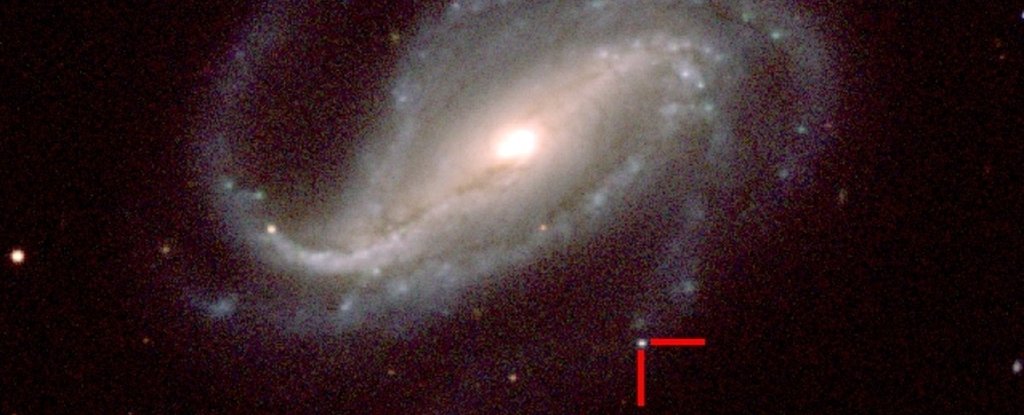
The first blooming light of a star that went supernova has been photographed for the first time - by an amateur astronomer testing a new camera.
Victor Buso from Rosario, Argentina has become the first person to ever capture the optical (or visible) light before and after the "shock breakout" of an exploding star.
This is the point right when the star explodes - when the supersonic shockwave from the star's core breaks out of the surface of the star, causing the gas there to heat and brighten very quickly.
In other words, that's the very, very first burst of light from a supernova.
They're super-difficult to capture, because the exact timing of a supernova is impossible to predict, and the shock breakout lasts such a short duration of time.
Astronomers have been chasing the phenomenon for years.
"It's like winning the cosmic lottery," said Alex Filippenko of UC Berkeley, who led a team following up observations of the supernova in the months that followed.
Indeed, obtaining the photographs involved a concatenation of lucky circumstances for Buso.
He was testing his camera on 20 September 2016, mounted on a 40-centimetre (16-inch) telescope.
To do this, he picked spiral galaxy NGC 613, located at a distance of about 80 million light-years away in the southern constellation Sculptor - a nice target because it was directly overhead.
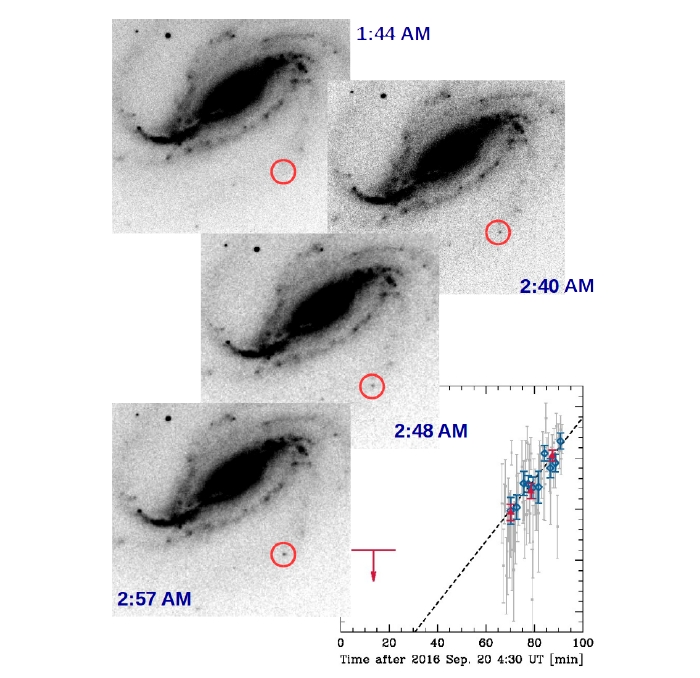
Over the course of about one and a half hours, he took pictures of the galaxy at 20 seconds of exposure time, to avoid saturation by nearby city lights. During the first 20 minutes, the photos all appeared the same.
But then Buso noticed something - a single brightening point of light at the end of one of the spiral galaxy's arms.
It wasn't long before astronomers learned of the find, and realised that Buso had captured something extraordinary.
Negatives of Buso's photographs showing the supernova brightening over time.
(Víctor Buso images; Melina Bersten data)
According to the researchers, the chances of such a discovery are one in 10 million - maybe even one in 100 million.
"Buso's data are exceptional," Filippenko said. "This is an outstanding example of a partnership between amateur and professional astronomers."
The research team used the Lick and Keck observatories to monitor the supernova, since named SN 2016gkg, for two months following Buso's discovery.
Spectral data revealed it to be a Type IIb supernova - a massive star that has already lost most of its mass prior to exploding.
The team calculated that SN 2016gkg started at around 20 times the mass of our Sun and lost three quarters of its mass, possibly to a companion star.
By the time it went supernova, it had shrunk down to around 5 solar masses.
The long-sought visual data will help astronomers find out more information about a star's structure just before it explodes, as well as information about the explosion itself.
"Professional astronomers have long been searching for such an event," Filippenko said.
"Observations of stars in the first moments they begin exploding provide information that cannot be directly obtained in any other way."
The research has been published in Nature, with Buso as one of the co-authors.
A space capsule carrying 2 passengers failed during launch, Apollo 7 celebrated its 50th anniversary and 2 missions are getting ready for upcoming target arrivals. These are just some of the top stories this week from Space.com.
Photo Credit: Bill Ingalls/NASA
1. Crew capsule fails during launch
A Russian Soyuz rocket was beginning its journey to the International Space Station when the spacecraft failed during its ascent on Thursday (Oct. 11). The passengers — Russian cosmonaut Aleksey Ovchinin and US astronaut Nick Hague — are in good condition after the malfunction sent the capsule falling back to Earth in a steep re-entry.
A spacecraft at the end of our solar system fired its engines briefly on Oct. 3 to speed up towards Ultima Thule, an object found far away in the Kuiper Belt. This is the first maneuver by NASA's New Horizons mission in which it used its own photos to make small path corrections to help arrive at the distant target.
The 50th anniversary of the first crewed Apollo flight happened on Thursday (Oct. 11). In addition to providing a crucial milestone for the program and the subsequent moon landing months later, Apollo 7 was also the first time humans broadcast live footage from space.
Researchers now say that the largest body in the asteroid belt — a dwarf planet named Ceres — experienced "true polar wander." In this phenomenon, the surface of a celestial body drifts over what lies beneath it, because the outer and inner parts of the dwarf planet spin at different rates.
Expert scientists came together to reflect on the field of astrobiology and published a paper on Wednesday (Oct. 10) with recommendations for NASA. The National Academies of Sciences, Engineering and Medicine gathered the panel together, and among many other things, their report emphasized a key challenge: identifying biosignatures, or the chemical changes that characterize life.
SpaceX made its first rocket landing on the West Coast this week. A Falcon 9 rocket launched from California's Vandenberg Air Force Base on Oct. 7 and brought an Argentine satellite into orbit.
NASA's OSIRIS-REx mission is scheduled to arrive at its target, asteroid Bennu, this December. The spacecraft performed a slowdown maneuver on Oct. 1 to reach it, and should be travelling at one-third of its previous speed as a result.
NASA released a statement on Oct. 8 saying that it expects the Hubble Space Telescope to start working again soon. Last weekend the space agency announced the probe was in safe-mode because of a failure in one of the telescope's steering mechanisms.
The two-stage Space Launch System megarocket is slated to perform a lot of future exploration for NASA. But a new report said the project is behind schedule and several billion dollars over budget.
The U.S. Air Force recently awarded a total of about $2 billion to 3 aerospace companies: Blue Origin, United Launch Alliance and Northrop Grumman Innovation Systems. The contracts are in place to bring about competitive launch system prototypes that would support the transport of national security payloads.
Here's What the Failed Soyuz Rocket Launch Looked Like to an Astronaut in Space
By Meghan Bartels, Space.com Senior Writer
Current International Space Station Cmdr. Alexander Gerst expected to be welcoming two additional crewmembers to the orbiting laboratory Thursday (Oct. 11) — but instead, he found himself photographing their failed launch.
NASA astronaut Nick Hague and Russian cosmonaut Alexey Ovchinin launched aboard a Soyuz rocket at about 4:47 a.m. EDT (0847 GMT) from Baikonur Cosmodrome in Kazakhstan. But just a couple of minutes after liftoff, a failure in the rocket's booster triggered a ballistic re-entry for the pair of would-be space travelers. Investigations into the Soyuz launch failure will be performed by NASA and the Russian space agency Roscosmos. [In Photos: The Harrowing Soyuz Launch Abort in Pictures]
European Space Agency astronaut Alexander Gerst captured this incredible view of a failed crew launch to the International Space Station on Oct. 11, 2018.
Credit: A. Gerst/ESA/NASA
The astronauts landed safely and were picked up by a search-and-rescue team that was deployed as part of standard launch procedure.
Although the dramatic launch barely made it to space before the capsule tumbled back to Earth, it was certainly visible from space. Gerst was able to spot the rocket's climb from on board its hoped-for destination, capturing a majestic streak of white piercing Earth's atmosphere.
European Space Agency astronaut Alexander Gerst photographed the space station's view of a failed crew launch on Oct. 11, 2018.
Credit: A. Gerst/ESA/NASA
"Glad our friends are fine," Gerst wrote in a statement accompanying the image. "Thanks to the rescue force of over 1,000 search-and-rescue professionals! Today showed again what an amazing vehicle the Soyuz is to be able to save the crew from such a failure. Spaceflight is hard. And we must keep trying for the benefit of humankind."
An image of the failed Oct. 11, 2018, launch from the ground near Baikonur Cosmodrome in Kazakhstan.
Credit: Bill Ingalls/NASA
Gerst and his colleagues on the space station were alerted to the launch failure and the safe landing of Hague and Ovchinin in a call from mission control management on the ground. Their schedule was adjusted because they didn't need to help new crewmembers acclimate to the station.
The three astronauts currently in orbit are due to return to Earth and be replaced by a new trio of astronauts in December. However, it's not yet clear how schedules will be adjusted to reflect Thursday's failed launch to ensure continuous staffing of the orbiting laboratory.
You’ll never guess what scientists call the moons of moons — well, you probably would. It’s submoons, but NewScientist’s Leah Carey has a better idea: moonmoons.
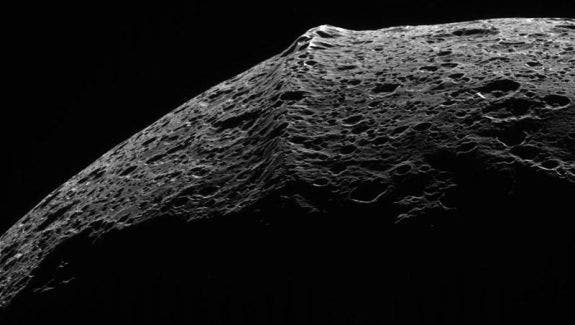
Saturn’s moon Iapetus might, in theory, have its own submoon.
Moonmoons
We know that moons orbit planets, planets orbit stars, stars orbit the center of the galaxy, and even galaxies sometimes orbit each other. But are moons also orbited by something, and if yes, then what do you call these objects?
In a new analysis published in arXiv, Juna Kollmeier at Carnegie Observatories in Pasadena, California, and Sean Raymond at the University of Bordeaux,
“Each of the giant planets within the Solar System has large moons but none of these moons have their own moons (which we call submoons).”
The problem with (ahem) ‘submoons’ is that we’ve never seen one. There doesn’t seem to be one in the solar system, or at least we haven’t seen it yet.
“In all known planetary systems, natural satellites occur in a restricted dynamical phase space: planets orbit stars and moons orbit planets. It is natural to ask, can submoons orbit moons? If so, why don’t any of the known moons of the Solar System have their own submoons?”
But this, Kollmeier and Raymond argue, doesn’t mean that they don’t exist.
Could Earth's moon have its own moon? Science says: in theory.
Credit: NASA/JPL/Space Science Institute
Goldilocks moons
The biggest problem with such objects would be the moon’s planet. Moons are much smaller than their host planets, and therefore they have a much much smaller gravitational pull. If the moon would be too close to the planet, it would risk losing its submoon to the planet’s tidal force; if it would be too far, it might simply not be able to hold its submoon, which could shoot off in space.
So the conditions have to be just right, but they are possible, according to the researchers’ calculations. In theory, the Earth’s moon could have its own submoon, as could Saturn’s moons Titan and Iapetus and Jupiter’s moon Callisto. Except they don’t. So we might have to wait a bit before we can validate the theory.
But if we do identify submoons, it would do much more than just fulfill a stellar curiosity — it could help us learn more about how these systems, and the host planets, form in the first place.
“[..] the absence of submoons around known moons and exomoons where submoons can survive provides important clues to the formation mechanisms and histories of these systems. Further studies of the potential formation mechanisms, long-term dynamical survival, and detectability of submoons is encouraged.”
Regarding the name for these hypothesized objects, researchers would like to stick to ‘submoons’ — but that doesn’t mean they don’t like the alternatives. Taking to Twitter, Kollmeier says she’s also happy with some alternatives, including moonmoon. So as far as I’m concerned, moonmoons are now a thing.
Juna A. Kollmeier@thejunaverse
If you ask me, they are "Submoons" (hence the title of our article!!!) But the internet has brought forth a wide variety of names and associated joy and for this, I'm delighted: Moonlet, Moonmoon, Moonito, Moonette, Moonlet, Grandmoon, Metamoon...#letsasklevi
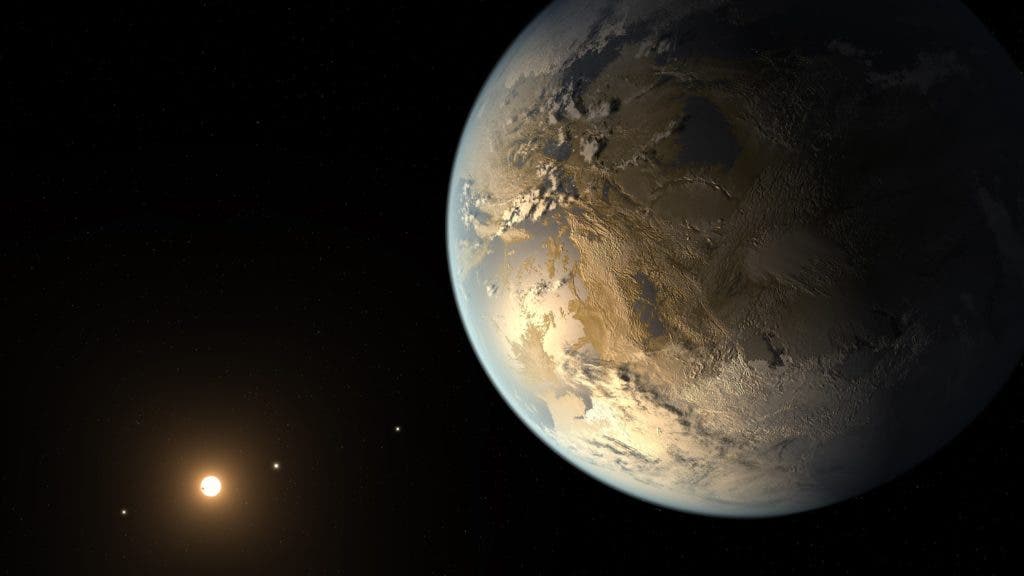
An artist conception of what the system around Kepler-186f could look like.
Credit: NASA AMES/SETI INSTITUTE/JPL-CALTECH.
Although we’ve yet to find life outside planet Earth, astrobiology has certainly come a long way in the past decade alone. Our once crude assumptions are now more finessed and, thanks to the Kepler Space Telescope, we now know of thousands of exoplanets, some potentially habitable and only a couple light-years away. Bearing recent developments in mind, a new congressionally mandated report from the National Academies of Sciences, Engineering, and Medicine outlines some of the key steps NASA needs to take in order to bring alien hunting to the next level.
A plan to hunt alien life
The 196-page report starts by making a point of the fact that recent scientific advances have provided opportunities to strengthen the role of astrobiology in NASA. For instance, NASA’s Curiosity rover and Mars Reconnaissance Orbiter (MRO) have found evidence of organic molecules, atmospheric methane, briny surface water, and even an underground Martian lake filled with liquid water. Elsewhere, on Saturn’s moons Enceladus and Europa, scientists found evidence of plumes that shoot up hundreds of miles and which contain water and other organic compounds. In fact, it’s Europa — and not Mars — that is the most promising place where scientists think we’ll find life outside our planet.
It was also recently that biologists found strange Earth lifeforms which live deep underwater or underground, with no direct contact with the sun’s energy input. This means that life may be less capricious than once thought.
The committee that authored the new report, which is chaired by the University of Toronto’s Barbara Sherwood Lollar, claims that we need to expand our search for biosignatures. To this aim, they propose compiling a more “sophisticated catalog and framework will be important to enhance our ability to detect both life that might be similar to terrestrial life, and potential life that differs from life as we know it.”
In particular, the authors of the report call for NASA to focus on exploring the possibility of finding life below the surface of a planet or moon. They also recommend that NASA seeks to deploy better technologies, such as powerful telescopes and starlight-blocking instruments capable of more complex probing of alien planets.
But accurately finding and interpreting biosignatures will be a challenge. For instance, many biosignatures can be produced by abiotic chemical reactions. Methane is often touted as an important byproduct of biological activity, but it could very well be produced by non-biological processes.
The James Webb Space Telescope (artist's concept above) will be one of the primary instruments scientists use to continue the search for planets outside our solar system.
Credits: NASA
The report is also careful to mention how such an ambitious mission is actually a planetary goal. NASA needs to build or strengthen collaborations with other institutions and private organizations, the authors note.
Along with a similar survey of exoplanets released last month, the new report will be included into two decadal surveys covering astronomy, astrophysics, and planetary sciences. These decadal surveys ought to form the backbone of NASA’s decision-making process about which missions to pursue or prioritize.
Stephen Hawking warned superhumans would use gene editing to take over.
The late physicist Stephen Hawking’s last writings predict that a breed of superhumans will take over, having used genetic engineering to surpass their fellow beings.
In Brief Answers to the Big Questions, to be published on Oct. 16 and excerpted today in the UK’s Sunday Times (paywall), Hawking pulls no punches on subjects like machines taking over, the biggest threat to Earth, and the possibilities of intelligent life in space.
Artificial Intelligence
Hawking delivers a grave warning on the importance of regulating AI, noting that “in the future AI could develop a will of its own, a will that is in conflict with ours.” A possible arms race over autonomous-weapons should be stopped before it can start, he writes, asking what would happen if a crash similar to the 2010 stock market Flash Crash happened with weapons. He continues:
In short, the advent of super-intelligent AI would be either the best or the worst thing ever to happen to humanity. The real risk with AI isn’t malice, but competence. A super-intelligent AI will be extremely good at accomplishing its goals, and if those goals aren’t aligned with ours we’re in trouble. You’re probably not an evil ant-hater who steps on ants out of malice, but if you’re in charge of a hydroelectric green-energy project and there’s an anthill in the region to be flooded, too bad for the ants. Let’s not place humanity in the position of those ants.
Earth’s bleak future, gene editing, and superhumans
The bad news: At some point in the next 1,000 years, nuclear war or environmental calamity will “cripple Earth.” However, by then, “our ingenious race will have found a way to slip the surly bonds of Earth and will therefore survive the disaster.” The Earth’s other species probably won’t make it, though.
The humans who do escape Earth will probably be new “superhumans” who have used gene editing technology like CRISPR to outpace others. They’ll do so by defying laws against genetic engineering, improving their memories, disease resistance, and life expectancy, he says
Hawking seems curiously enthusiastic about this final point, writing, “There is no time to wait for Darwinian evolution to make us more intelligent and better natured.”
Once such superhumans appear, there are going to be significant political problems with the unimproved humans, who won’t be able to compete. Presumably, they will die out, or become unimportant. Instead, there will be a race of self-designing beings who are improving themselves at an ever-increasing rate. If the human race manages to redesign itself, it will probably spread out and colonise other planets and stars.
Intelligent life in space
Hawking acknowledges there are various explanations for why intelligent life hasn’t been found or has not visited Earth. His predictions here aren’t so bold, but his preferred explanation is that humans have “overlooked” forms of intelligent life that are out there.
Does God exist?
No, Hawking says.
The question is, is the way the universe began chosen by God for reasons we can’t understand, or was it determined by a law of science? I believe the second. If you like, you can call the laws of science “God”, but it wouldn’t be a personal God that you would meet and put questions to.
The biggest threats to Earth
Threat number one one is an asteroid collision, like the one that killed the dinosaurs. However, “we have no defense” against that, Hawking writes. More immediately: climate change. “A rise in ocean temperature would melt the ice caps and cause the release of large amounts of carbon dioxide,” Hawking writes. “Both effects could make our climate like that of Venus with a temperature of 250C.”
The best idea humanity could implement
Nuclear fusion power. That would give us clean energy with no pollution or global warming.
RUSSISCHE LANCERING VAN DE SOYUZ RAKET GESABOTEERD?
Afgelopen donderdag ging het mis met de lancering van een Soyuz raket richting ISS ruimtestation.
Dat is opvallend, want er zijn sinds 1983 geen ongelukken meer geweest met de meest betrouwbare raket ter wereld.
Enkele dagen geleden zagen we de lancering van een Russische Soyuz raket richting ISS ruimtestation die misging waardoor de astronauten een noodlanding op aarde moesten maken.
We schreven over dat voorval in het kader van een ijkpunt dat door remote viewer Ed Dames is genoemd in de aanloop naar de Killshot c.q. komst Nibiru.
Echter, er zit misschien nog een heel ander aspect aan deze zaak. Op de laatste dag van augustus schreven wij onder andere het volgende:
Het internationale ruimtestation ISS is geraakt door een kleine meteoriet, die de nodige schade heeft veroorzaakt. Volgens NASA werd er door een lek lucht weggezogen en de instantie is druk bezig om dit euvel te herstellen. Er zou geen onmiddellijk gevaar zijn.
Hoe zoiets er in de praktijk uit ziet is te zien op de volgende afbeelding, waarop zichtbaar is dat op een bepaald moment alle vijf parkeerplaatsen bij het ISS bezet waren.
Het is de aan het ISS gekoppelde Soyuz module waar de problemen door zijn ontstaan. Volgens de Russische techneuten is er een scheurtje in het schip ontstaan van ongeveer 1,5 mm door de inslag van wat men noemt een micro meteoriet.
Hierdoor wordt lucht en zuurstof vanuit de ISS gezogen, iets dat natuurlijk niet te lang moet duren. Op dit moment bevinden zich zes astronauten aan boord van het ISS en is men druk bezig met het uitwerken van plannen om het probleem op te lossen.
Enkele dagen later kwamen de Russen met de mededeling dat het er veel op leek dat het gaatje in de capsule van de Soyuz niet was veroorzaakt door een meteoriet, maar dat het een geboord gat zou zijn.
We zijn nu bijna zes weken verder en enkele dagen geleden kwamen de Russen inderdaad tot de conclusie dat het geen meteoriet was, geen fabricagefout, maar wel degelijk een met opzet geboord gat.
Dmitry Rogozin, hoofd van de Russische NASA, Roskosmos, vertelde dat een onderzoekscommissie tot die conclusie was gekomen. Dit was de eerste stap van het onderzoek en er zal nu een tweede commissie worden benoemd om uit te zoeken wie dat gat heeft geboord. Eerdere suggesties waren dat dit door één van de bemanningsleden zou zijn gedaan om een zieke collega op die manier terug te krijgen naar de aarde. De bemanning ontkent dit en noemt het verhaal beschamend.
In ieder geval, gaten hebben niet de gewoonte om zichzelf te boren en dus zal ergens iemand dit hebben gedaan.
Dan hebben we enkele dagen geleden de lancering van een Soyuz raket die hopeloos fout gaat. En dat is vreemd, want deze Soyuz raket is de meest betrouwbare raket op aarde en al sinds 1967. Er zijn in totaal 139 lanceringen geweest, waarbij het twee keer is fout gegaan bij lanceringen. Eén keer in 1975 en één keer in 1983. Daarnaast zijn er twee dodelijke ongelukken geweest tijdens terugkeer in de dampkring en die vonden plaats in 1969 en 1971. Sinds 1983 is er niets meer misgegaan met een Soyuz raket tot afgelopen week en dit vlak nadat Rosmoscos heeft vastgesteld dat er met opzet een gat is geboord in de Soyuz capsule van een vorige missie.
Toeval? Of is er iets of iemand in de weer om de Russische ruimtevaart te boycotten?
Rond dezelfde tijd dat er een gat verschijnt in de Soyuz module, verschijn er toevallig dit bericht:
Rusland zal vanaf 2019 geen Amerikaanse astronauten meer meenemen naar het International Space Station (ISS). Dat heeft de vicepremier van Rusland Yury Borisov laten weten.
Uiteraard weten wij ook niet wie erachter zit en met welke motieven, maar het lijken teveel toevalligheden op een rij.
Mochten er lezers zijn met slimme ideeën, laat het ons weten.
Is president Kennedy het zwijgen opgelegd? Wat hij wist over aliens en het mysterieuze Majestic 12
Werd John F. Kennedy vermoord vanwege zijn interesse in buitenaards leven? Een geheime memo van de Amerikaanse CIA maakt duidelijk dat de president 10 dagen voor zijn dood om inzage vroeg in UFO-documenten.
In een brief geadresseerd aan de CIA-baas vroeg Kennedy om vertrouwelijke documenten over UFO’s en het bestaan van aliens.
De memo is één van de twee brieven aan de Amerikaanse spionagedienst waarin Kennedy om opheldering vraagt.
Veel meer
De interesse van de president in UFO’s en aliens, zo kort voor zijn dood, strookt met complottheorieën over de moord.
Verhalen dat Kennedy omgelegd zou zijn uit angst dat hij achter de waarheid zou komen over het bestaan van aliens, werden bevestigd na het uitlekken van de geheime stukken.
Schrijver William Lester kreeg de documenten voor een boek dat hij heeft geschreven over Kennedy’s interesse in UFO’s.
De brieven voeden de theorieën dat de CIA veel meer over het bestaan van UFO’s weet dan zij ons wil doen geloven.
Duizenden stukjes
Kennedy had bovendien gezegd dat hij ‘de CIA in duizenden stukjes wilde versplinteren en deze door de wind laten wegblazen’.
James Forrestal was een belangrijke mentor van president Kennedy. In 1947 werd Forrestal de eerste Amerikaanse minister van Defensie.
Hij was van mening dat de Amerikanen op de hoogte moesten worden gebracht van het bestaan van buitenaards leven en aanverwante technologieën.
Forrestal moest onder president Truman zijn ontslag indienen omdat hij zijn informatie had gedeeld met verschillende hooggeplaatste functionarissen, waaronder toenmalig congreslid Kennedy.
Direct gevaar
Nadat hij in 1960 de presidentsverkiezingen won, hoorde Kennedy van Eisenhower dat het geheimzinnige agentschap Majestic 12 zijn eigen weg was ingeslagen.
Eisenhower waarschuwde Kennedy dat Majestic 12 een direct gevaar vormde voor de Amerikaanse vrijheden en de democratie.
Dezelfde krachten die de dood van Forrestal orkestreerden, dwarsboomden Kennedy waar ze maar konden.
Kennedy wilde de CIA dwingen geheime informatie over UFO’s te delen met andere overheden, maar dat zou hij nooit voor elkaar krijgen.
Er is iets gaande in de ruimte en wat het ook is, wij mogen het niet weten.
Na de sluiting van zonne-observatorium kortgeleden en het uitschakelen van de webcams bij anders observatoria, worden nu belangrijke ruimtetelescopen in een slaapstand gezet.
Er is de laatste tijd iets bijzonders gaande in de ruimte, want er zijn zoveel “toevallige” gebeurtenissen dat het absoluut geen toeval meer kan zijn. Waar het alle kenmerken van heeft is dat er iets heel bijzonders gaande is in de ruimte en dat er alles aan wordt gedaan om dingen aldaar verborgen te houden.
We hebben enige tijd geleden de onverwachte sluiting meegemaakt van het Sunspot zonne-observatorium in Amerika. Van de ene op de andere dag werd dit gesloten na een inval van de FBI met veel bombarie.
Daarnaast werden ook ongeveer gelijktijdig een fiks aantal webcams van andere observatoria wereldwijd afgesloten, zonder opgaaf van redenen.
Tot op de dag van vandaag is er geen bevredigende verklaring gekomen voor het sluiten van het Sunspot observatorium en de sluiting van al die webcams.
Er zijn ook nog een aantal merkwaardige voorvallen geweest met een paar van de NASA ruimtelescopen.
Zoals met de Hubble ruimtetelescoop die opeens moest worden afgesloten.
De ruimtetelescoop Hubble (Hubble Space Telescope, HST) bestaat uit een aantal precisie-instrumenten voor astronomische waarnemingen. Hij is genoemd naar de Amerikaanse astronoom Edwin Hubble en draait sinds de lancering door NASA op 24 april 1990 als een kunstmaan rond de aarde. De Hubble wordt gebruikt voor optische waarnemingen. De telescoop bezit ook een infraroodcamera. Voor observaties in het röntgengolflengtegebied wordt gebruikgemaakt van het Chandra X-Ray Observatory.
Op 8 oktober kwam het bericht van NASA dat er problemen zouden zijn met de Hubble telescoop en dat deze in een soort slaapstand ging waardoor er geen beelden meer beschikbaar kwamen. De reden dat de telescoop niet meer functioneerde zou worden veroorzaakt door een kapotte gyroscoop.
Het tweede bovengenoemde telescoop platform, Chandra X-Ray Observatory, heeft eveneens problemen en moest ook plotsklaps worden afgesloten. Dit werd afgelopen vrijdag medegedeeld door NASA, alhoewel dit systeem sinds woensdag al niet meer werkt. Hier komen ze helemaal met een vage reden, namelijk een “system complication”.
Dan wordt door sommigen ook nog de crash met de Soyuz erbij gehaald en het feit dat er problemen zijn met de communicatie van de NASA rovers op Mars, maar het feit dat belangrijke telescopen uit de lucht worden gehaald is eigenlijk veel meer sinister.
Dit zijn de ogen waarmee in de ruimte wordt gekeken, net zoals het observatorium dat door de FBI werd gesloten en de webcams van de andere observatoria die plotseling niet meer werken.
Wat bevindt zich daar in de ruimte waardoor opeens al deze paniekmaatregelen worden genomen.
Alles wat met de ruimte te maken heeft en waarmee dingen gezien kunnen worden, worden in grote haast geblokkeerd. In dat kader zijn de volgende foto's die vanmorgen vroeg door een lezer in Kaatsheuvel zijn genomen, heel interessant (dank!).
EEN WOLK IN EEN WOLKENLOZE LUCHT VALT OP ( VIDEO )
µWanneer buitenaardsen de aarde bezoeken weten ze dat de mens niet erg oplettend is/een beperkt waarnemingsspectrum heeft en daar maken ze handig gebruik van.
Voor buitenaardsen is de meeste geschikte manier om een beetje anoniem over de aarde te surfen om zich voor te doen als een wolk. De meeste mensen lopen tenslotte met hun neus richting grond of met hun ogen vastgeplakt aan het scherm van hun mobiele apparaten waardoor ze toch weinig of niets opmerken van wat er zich boven hun hoofden afspeelt.
Wanneer men wél naar de lucht zou kijken, dan bestaat de kans dat ze dingen ziet zoals het volgende.
Een volkomen wolkeloze hemel met daarin toch één wolk. Een wolk die de vorm heeft van een UFO, die daar op dat moment niet thuishoort.
Andere keren vermommen ze zich niet als een wolk, maar verstoppen ze zich achter bestaande wolken en gaat het soms mis zoals te zien is op de volgende opname die enkele dagen geleden is gemaakt op het eiland Martinique.
Een enorm ruimteschip dat even zichtbaar wordt achter de wolken.
Dan krijgen we het volgende bericht van een lezer (dank!):
Dit is een foto die we gemaakt hebben op 6 oktober 2018 om 10:20 uur in de buurt van Leer; Duitsland.
Dit lijken toch wel verdacht veel op ufo's vermomd als wolk.
En inderdaad, als je goed kijkt, dan zie je drie UFO’s die eruit zien als een wolk en wederom in een lucht waarin die wolken niet thuishoren.
Daarnaast hebben de wolken voor buitenaardse bezoekers nog een functie en wel die van een soort dimensieportaal van waar ze aankomen of vertrekken.
Nog steeds een prachtig voorbeeld daarvan werd gefilmd in 2014 toen enkele mensen ’s avonds hun camera hadden opgesteld in Mexico om daar opnames te maken van een komende maansverduistering.
Dit voorval vond plaats afgelopen 7 oktober en een dag later gebeurt het volgende in Mexico.
Enkele weken geleden, op 8 oktober, is er een maansverduistering in Mexico. Een aantal mensen staat klaar met een mobiele telefoon om hier opnames van te maken, totdat ze een vreemde wolk waarnemen. Dat is vreemd want verder is de lucht onbewolkt.
Het is ook geen gewone wolk, het is klaarblijkelijk een onweerswolk want de bliksemflitsen schieten er doorheen en uit.
Dan, ineens, zie je rechts een sigaarvormige UFO in beeld komen die met een fenomenale snelheid op de wolk afschiet.
Minder dan een seconde later is hij in de wolk verdwenen en komt tegen alle natuurwetten in niet aan de andere kant tevoorschijn.
Volgens de op onze aarde bekende en geldende natuurwetten kan dit niet. Een object wat met een dergelijke hoge snelheid komt aanvliegen kan niet binnen zo'n relatief kleine wolk tot stilstand worden gebracht. En toch gebeurt het; kijk en val niet van je stoel.
Daarom, ruk je ogen los van het smart-scherm en kijk naar boven, je weet nooit wat voor onverwachte dingen zich daar voor kunnen doen.
Super-Fast Stars in the Milky Way May Be Visitors from Beyond
By Doris Elin Salazar, Space.com Contributor
The positions and reconstructed orbits of 20 high-velocity stars, superimposed on top of an illustration of our galaxy, the Milky Way. Researchers identified these stars using data from the second release of ESA's Gaia mission. The seven stars in red are shooting away from the galaxy and might be traveling fast enough to someday escape its gravity. But the 13 stars seen in orange represent those that might be racing toward the Milky Way. They could be stars from another galaxy.
Credit: ESA (artist's impression and composition); Marchetti et al. 2018 (star positions and trajectories); NASA/ESA/Hubble (background galaxies); CC BY-SA 3.0 IGO
The cosmic "merry-go-round" that is our rotating Milky Way galaxy may not be the reason stars are whizzing by and seemingly flying off at high speeds.
A team of astronomers noticed something interesting when they were sifting through the recently published second data release from the Gaia mission. The European Space Agency (ESA) launched the Gaia spacecraft in 2013, and the new data release includes observations made between July 25, 2014, and May 23, 2016, according to ESA.
The data offers the positions of nearly 1.7 billion stars, and their motions can tell astronomers a lot about what our galaxy used to be like. Stars travel at different speeds and the very fastest are called hypervelocity stars. Using a level of precision that sometimes "equates to Earthbound observers being able to spot a Euro coin lying on the surface of the moon," ESA officials said in a statement describing the mission, Gaia is able to gather observations about these hypervelocity stars.
The European Space Agency released a new map from the Gaia spacecraft of nearly 1.7 billion stars, giving the best-ever view of the Milky Way and neighboring galaxies in color.
Credit: ESA/Gaia/DPAC
Researchers thought the black hole at the center of the Milky Way was responsible for flinging out these stars. They thought the stars originated from the center of the galaxy, and that this black-hole interaction caused their high-speed journeys toward an exit of the Milky Way.
"Of the seven million Gaia stars with full 3D velocity measurements, we found twenty that could be traveling fast enough to eventually escape from the Milky Way," said Elena Maria Rossi, one of the authors of the new study, which was detailed in a recent statement by the Royal Astronomical Society in the U.K.
Or, they could be "intergalactic interlopers."
"Rather than flying away from the Galactic centre, most of the high-velocity stars we spotted seem to be racing towards it," co-author Tommaso Marchetti said in the statement. "These could be stars from another galaxy, zooming right through the Milky Way."
"Stars can be accelerated to high velocities when they interact with a supermassive black hole," Rossi added. "So the presence of these stars might be a sign of such black holes in nearby galaxies. But the stars may also have once been part of a binary system, flung towards the Milky Way when their companion star exploded as a supernova."
Rossi said studying these hypervelocity stars will answer questions about how nearby galaxies behave.
To find out where they come from — some potential origins include the Large Magellanic Cloud or the Milky Way's halo — new data will be needed. Royal Astronomical Society officials said at least two more Gaia data releases are scheduled in the 2020s.
The study detailing these findings was published Sept. 20 in the journal Monthly Notices of the Royal Astronomical Society.
These Spheres Are Tiny Homes And Take Just A Day To Install
An engineer who used to work at Rolls-Royce has designed stunning Conker style living pods that cost only $24,000 to build and which can be installed in only one day. The UK engineer believes that the pods might be a solution to one of the biggest issues in the United Kingdom, housing availability.
Conker Living Pods Might be the Solution to Affordable Housing
More and more young people are struggling to find affordable housing, while those who have managed to obtain a mortgage struggle to meet the monthly repayments each month. University students are often the people who are hit the most with regards to finding affordable housing. Jag Virdie came up with one solution, living pod homes.
Living pods are not something news, we have heard about them before, but typically they are very small and cubicle like. However, the living pods do not have this issue, and they are aesthetically pleasing. Virdie used a quote from Henry Royce when he said, “Take the best that exists and make it better. When it does not exist, design it.”
The Living Pod is 3.9 Meters in Diameter
This is just what Virdie did with the Conker style living pods. He designed a living pod that takes on the appearance of a Conker or football. The living pod is constructed from material made in Britain and it is 3.9 meters in diameter along with being 10 square meters in area. The pods offer waterproofing against the inclement weather along with having a heat-retention system that is efficient. The living pods can be customized to the needs of the buyer plus they are fast and easy to install, taking just one day.
Virdie said:
"Our mission is to change the way buildings are designed today, by disrupting the norm, challenging construction practices at their core."
Living Pods Can Link Together to Make Bigger Homes
The living pods can also be linked together so people can make them as large as they need to include additional bathrooms, kitchens or studies. The idea for the design came from an idea that Virdie had when building a tree house for his own children. With him having extensive experience in designing cars for Rolls-Royce this put him in good stead for designing a pod house.
Purchasing the living pod house is very simple, first register interest, check the location, then go onto customizing the Conker home you require. In the future, this may well be the solution for governments to use to do away with homelessness.
The Missing Link: Scientists Discover Fish With 'Feet'
The oceans are so vast that many parts have yet to be explored. Deep down there are creaturesand fish that have not yet been discovered or which are rarely captured on film. This applies to the Mona Canyon located just off the coast of Puerto Rico when the NOAA Okeanos exploration came across a fish with legs that was walking on the ocean floor.
Species of Angler Fish
The researchers found a deep sea fish with the name of the Pink Frogmouth, which is rarely seen, also given the name of the Sea Toad. This is an anglerfish using fins that have been modified and turned into fins allowing the fish to walk around the seafloor. Scientists believe that the fish has been living on the bottom of the sea for so long that the front along with the back fins have adapted into feet so that the fish could get around on the bottom of the sea floor more easily.
The Pink Frogmouth Can Also Swim in the Ocean
A video was captured showing the Pink Frogmouth fish walking along the bottom of the ocean floor and it one of the strangest things to witness. As fish generally swim about in the ocean this fish with its downturned mouth looks almost alien as it shuffles along on the ocean floor. The fish walks using two smallish fins at the back and front. However, it does enjoy the best of both worlds as it also has larger fins situated in the middle of its body allowing it to swim just as any other fish swims around the ocean.
The Pink Frogmouth fish usually lives in a depth range of between 200 and 978 meters. The fish has been spotted living in the Atlantic along with the Mediterranean Oceans where it dines on shrimp. The Pink Frogmouth fish looks like something straight out of a horror movie. It now only needs to develop further to allow it to breathe on land and it could walk right up out of the ocean.
The United States Space Force is a newly proposed military branch that President Donald Trump announced during a meeting of the National Space Council on June 18, 2018. If the proposal is enacted, it will become the sixth armed forces branch, joining the Navy, Army, Marine Corps, Air Force and Coast Guard.
Trump's announcement took many by surprise, especially in the Pentagon. Some saw the sudden proposal as a strategy to compel Congress and the Department of Defense into supporting a military branch focused solely on space. Others saw it as answering the need to address the growing rivalry and presence of China and Russia in space.
"It is not merely enough that we have American presence in space," Trump said during his public proposal. "We must have American dominance in space."
Vice President Mike Pence officially unveiled the plans for the U.S. Space Force a short two months later on Aug. 9, 2018.
So, what is the Space Force?
As much as it sounds like the Space Force will be astronaut soldiers wielding blaster rifles, the reality is much more mundane. Rather than deploying soldiers in space, the Space Force will focus on national security and preserving the satellites and vehicles that are dedicated to international communications and observation.
Immediately following Pence's announcement in August, the Pentagon released a report that detailed some of the Department of Defense's immediate actions for creating the Space Force:
Establish a Space Development Agency – This is an agency tasked with developing and testing new and improved national-security capabilities and technology in space.
Establish a Space Operations Force – This force will be a collection of space experts from throughout the military who will provide needed expertise to combat commanders and anyone else throughout the Space Force.
Create a United States Space Command – Led by a four-star general or flag officer, the new space command would direct and improve operations for space war fighting.
These three components would later be united to become the final Space Force.
Why is a Space Force needed?
Russia and China are the U.S.'s two greatest space competitors and also potential military threats. And both have demonstrated formidable space capabilities.
In 2007, for example, China launched a missile that climbed skyward for 500 miles until it impacted one of the country's own defunct weather satellites, which rained down in thousands of pieces. In a similar unnerving event in 2014, a piece of supposed Russian space junk called Object 2014-E28 turned out to be an autonomous robot of sorts that was capable of docking onto satellites.
During his August 2018 address, Pence said that China was investing in hypersonic missiles capable of evading U.S. detection. And both Russia and China had integrated anti-satellite attacks as part of their wartime protocols.
Given that the U.S. government and military rely heavily on satellites for forecasting weather, collecting high-resolution images for intelligence and directing missiles with GPS satellites, the threat became obvious.
Does something like this already exist?
China, Russia and the United States have military sectors already dedicated to space. Russia revived the Russian Space Forces in 2015 as a branch of the Russian Aerospace Forces. In the same year, China established the People's Liberation Army Strategic Support Force as the space and cyberwarfare branch of the People's Liberation Army.
The U.S. has the Air Force Space Command, which is integrated into the U.S. Air Force. But many have argued that an independent branch should be established to focus exclusively on space. "Whether it's a Space Force or something else, it is absolutely critical to have someone who thinks about this day and night," Terry Virts, a retired NASA astronaut and former Air Force fighter pilot, told SpaceNews.
Representative Mike Rogers, R-Ala., first made such a proposal. He called it the U.S. Space Corps during the 2016 Space Symposium in Colorado Springs, Colorado.
The proposal was eventually included as an amendment to the House of Representatives 2018 National Defense Authorization Act, which spelled out the Department of Defense's budget and policies for the 2018 fiscal year. The House passed the bill with the amendment, but members of the Senate viewed the amendment with skepticism and ultimately vetoed it.
Trump then commandeered the debate in June 2018 and announced the administration would form the U.S. Space Force.
What's next?
Many details remain uncertain, such as how much a new military branch would cost and whether Congress would ever fund it.
"It's hard to see a scenario where the Space Force doesn't need a bunch of additional money to not only fund the reorganization but also all the new programs and capabilities," Brian Weeden, a space policy expert at Secure World Foundation in Washington, D.C., told Politico.
The White House pushed for Congress to invest an initial $8 billion in national security space systems over the next five years. But creating an entirely new branch of the military is expected to cost much more. A leaked memo from the Air Force in mid-September shows estimates of it requiring as much as $13 billion in its first five years.
Because the program would also draw resources and a necessary 13,000 personnel away from other military branches, some fear it would weaken the U.S. military overall.
The Pentagon, nevertheless, immediately got to work on laying out the proposal. Less than two months later, in early August 2018, Pence announcedthat the new branch would be established as soon as 2020.
Planet Earth: Facts About Its Orbit, Atmosphere & Size
By Charles Q. Choi, Space.com Contributor
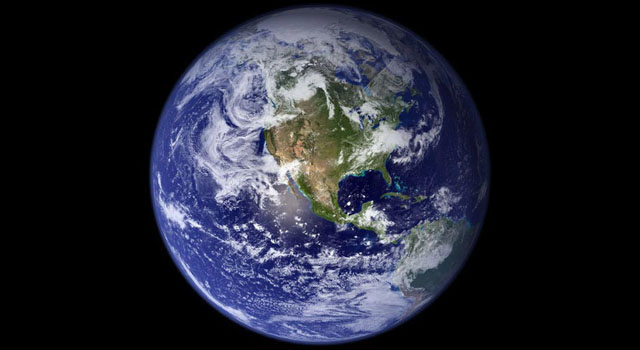
Credit: NASA
Earth, our home, is the third planet from the sun. It's the only planet known to have an atmosphere containing free oxygen, oceans of water on its surface and, of course, life.
Earth is the fifth largest of the planets in the solar system. It's smaller than the four gas giants —Jupiter, Saturn, Uranus and Neptune — but larger than the three other rocky planets, Mercury, Mars and Venus.
Earth has a diameter of roughly 8,000 miles (13,000 kilometers) and is round because gravity pulls matter into a ball. But, it's not perfectly round. Earth is really an "oblate spheroid," because its spin causes it to be squashed at its poles and swollen at the equator.
Water covers roughly 71 percent of Earth's surface, and most of that is in the oceans. About a fifth of Earth's atmosphere consists of oxygen, produced by plants. While scientists have been studying our planet for centuries, much has been learned in recent decades by studying pictures of Earth from space.
Earth's orbit
While Earth orbits the sun, the planet is simultaneously spinning on an imaginary line called an axis that runs from the North Pole to the South Pole. It takes Earth 23.934 hours to complete a rotation on its axis and 365.26 days to complete an orbit around the sun.
Earth's axis of rotation is tilted in relation to the ecliptic plane, an imaginary surface through the planet's orbit around the sun. This means the Northern and Southern hemispheres will sometimes point toward or away from the sun depending on the time of year, and this changes the amount of light the hemispheres receive, resulting in the seasons.
Earth's orbit is not a perfect circle, but rather an oval-shaped ellipse, similar to the orbits of all the other planets. Our planet is a bit closer to the sun in early January and farther away in July, although this variation has a much smaller effect than the heating and cooling caused by the tilt of Earth's axis. Earth happens to lie within the so-called "Goldilocks zone" around the sun, where temperatures are just right to maintain liquid water on our planet's surface.
Statistics about Earth's orbit, according to NASA:
Average distance from the sun: 92,956,050 miles (149,598,262 km)
Perihelion (closest approach to the sun): 91,402,640 miles (147,098,291 km)
Aphelion (farthest distance from the sun): 94,509,460 miles (152,098,233 km)
Length of solar day (single rotation on its axis): 23.934 hours
Length of year (single revolution around the sun): 365.26 days
Equatorial inclination to orbit: 23.4393 degrees
Earth's formation and evolution
Scientists think Earth was formed at roughly the same time as the sun and other planets some 4.6 billion years ago, when the solar system coalesced from a giant, rotating cloud of gas and dust known as the solar nebula. As the nebula collapsed because of its gravity, it spun faster and flattened into a disk. Most of the material was pulled toward the center to form the sun.
"It was thought that because of these asteroids and comets flying around colliding with Earth, conditions on early Earth may have been hellish," Simone Marchi, a planetary scientist at the Southwest Research Institute in Boulder, Colorado, previously told Space.com. But in recent years, new analyses of minerals trapped within ancient microscopic crystals suggests that there was liquid water already present on Earth during its first 500 million years, Marchi said.
Radioactive materials in the rock and increasing pressure deep within the Earth generated enough heat to melt the planet's interior, causing some chemicals to rise to the surface and form water, while others became the gases of the atmosphere. Recent evidence suggests that Earth's crust and oceans may have formed within about 200 million years after the planet took shape.
Internal structure
Earth's core is about 4,400 miles (7,100 km) wide, slightly larger than half the Earth's diameter and about the same size as Mars' diameter. The outermost 1,400 miles (2,250 km) of the core are liquid, while the inner core is solid; it's about four-fifths as big as Earth's moon, at some 1,600 miles (2,600 km) in diameter. The core is responsible for the planet's magnetic field, which helps to deflect harmful charged particles shot from the sun.
Above the core is Earth's mantle, which is about 1,800 miles (2,900 km) thick. The mantle is not completely stiff but can flow slowly. Earth's crust floats on the mantle much as a piece of wood floats on water. The slow motion of rock in the mantle shuffles continents around and causes earthquakes, volcanoes and the formation of mountain ranges.
Above the mantle, Earth has two kinds of crust. The dry land of the continents consists mostly of granite and other light silicate minerals, while the ocean floors are made up mostly of a dark, dense volcanic rock called basalt. Continental crust averages some 25 miles (40 km) thick, although it can be thinner or thicker in some areas. Oceanic crust is usually only about 5 miles (8 km) thick. Water fills in low areas of the basalt crust to form the world's oceans.
Earth gets warmer toward its core. At the bottom of the continental crust, temperatures reach about 1,800 degrees Fahrenheit (1,000 degrees Celsius), increasing about 3 degrees F per mile (1 degree C per km) below the crust. Geologists think the temperature of Earth's outer core is about 6,700 to 7,800 degrees F (3,700 to 4,300 degrees C) and that the inner core may reach 12,600 degrees F (7,000 degrees C) — hotter than the surface of the sun.
Magnetic field
Earth's magnetic field is generated by currents flowing in Earth's outer core. The magnetic poles are always on the move, with the magnetic North Poleaccelerating its northward motion to 24 miles (40 km) annually since tracking began in the 1830s. It will likely exit North America and reach Siberia in a matter of decades.
Earth's magnetic field is changing in other ways, too. Globally, the magnetic field has weakened 10 percent since the 19th century, according to NASA. These changes are mild compared to what Earth's magnetic field has done in the past. A few times every million years or so, the field completely flips, with the North and the South poles swapping places. The magnetic field can take anywhere from 100 to 3,000 years to complete the flip.
The strength of Earth's magnetic field decreased by about 90 percent when a field reversal occurred in ancient past, according to Andrew Roberts, a professor at the Australian National University. The drop makes the planet more vulnerable to solar storms and radiation, which can could significantly damage satellites and communication and electrical infrastructure.
"Hopefully, such an event is a long way in the future and we can develop future technologies to avoid huge damage," Roberts said in a statement.
When charged particles from the sun get trapped in Earth's magnetic field, they smash into air molecules above the magnetic poles, causing them to glow. This phenomenon is known as the aurorae, the northern and southern lights.
Earth's atmosphere
Earth's atmosphere is roughly 78 percent nitrogen and 21 percent oxygen, with trace amounts of water, argon, carbon dioxide and other gases. Nowhere else in the solar system is there an atmosphere loaded with free oxygen, which is vital to one of the other unique features of Earth: life.
Air surrounds Earth and becomes thinner farther from the surface. Roughly 100 miles (160 km) above Earth, the air is so thin that satellites can zip through the atmosphere with little resistance. Still, traces of atmosphere can be found as high as 370 miles (600 km) above the planet's surface.
The lowest layer of the atmosphere is known as the troposphere, which is constantly in motion and why we have weather. Sunlight heats the planet's surface, causing warm air to rise into the troposphere. This air expands and cools as air pressure decreases, and because this cool air is denser than its surroundings, it then sinks and gets warmed by the Earth again.
Above the troposphere, some 30 miles (48 km) above the Earth's surface, is the stratosphere. The still air of the stratosphere contains the ozone layer, which was created when ultraviolet light caused trios of oxygen atoms to bind together into ozone molecules. Ozone prevents most of the sun's harmful ultraviolet radiation from reaching Earth's surface, where it can damage and mutate life.
Water vapor, carbon dioxide and other gases in the atmosphere trap heat from the sun, warming Earth. Without this so-called "greenhouse effect," Earth would probably be too cold for life to exist, although a runaway greenhouse effect led to the hellish conditions now seen on Venus.
Earth-orbiting satellites have shown that the upper atmosphere actually expands during the day and contracts at night due to heating and cooling.
Chemical composition
Oxygen is the most abundant element in rocks in Earth's crust, composing roughly 47 percent of the weight of all rock. The second most abundant element is silicon, at 27 percent, followed by aluminum, at 8 percent; iron, at 5 percent; calcium, at 4 percent; and sodium, potassium and magnesium, at about 2 percent each.
Earth's core consists mostly of iron and nickel and potentially smaller amounts of lighter elements, such as sulfur and oxygen. The mantle is made of iron and magnesium-rich silicate rocks. (The combination of silicon and oxygen is known as silica, and minerals that contain silica are known as silicate minerals.)
Earth's moon
Earth's moon is 2,159 miles (3,474 km) wide, about one-fourth of Earth's diameter. Our planet has one moon, while Mercury and Venus have none and all the other planets in our solar system have two or more.
The leading explanation for how Earth's moon formed is that a giant impact knocked the raw ingredients for the moon off the primitive, molten Earth and into orbit. Scientists have suggested that the object that hit the planet had roughly 10 percent the mass of Earth, about the size of Mars.
Life on Earth
Earth is the only planet in the universe known to possess life. The planet boasts several million species of life, living in habitats ranging from the bottom of the deepest ocean to a few miles into the atmosphere. And scientists think far more species remain to be discovered.
Researchers suspect that other candidates for hosting life in our solar system — such as Saturn's moon Titan or Jupiter's moon Europa — could house primitive living creatures. Scientists have yet to precisely nail down exactly how our primitive ancestors first showed up on Earth. One solution suggests that life first evolved on the nearby planet Mars, once a habitable planet, then traveled to Earth on meteorites hurled from the Red Planet by impacts from other space rocks.
"It's lucky that we ended up here, nevertheless, as certainly Earth has been the better of the two planets for sustaining life," biochemist Steven Benner, of the Westheimer Institute for Science and Technology in Florida, told Space.com. "If our hypothetical Martian ancestors had remained on Mars, there might not have been a story to tell."
Mysterious moon swirls have finally been explained
"This was the final piece in the puzzle of understanding the magnetism that underlies these lunar swirls."
by Chelsea Gohd, Space.com
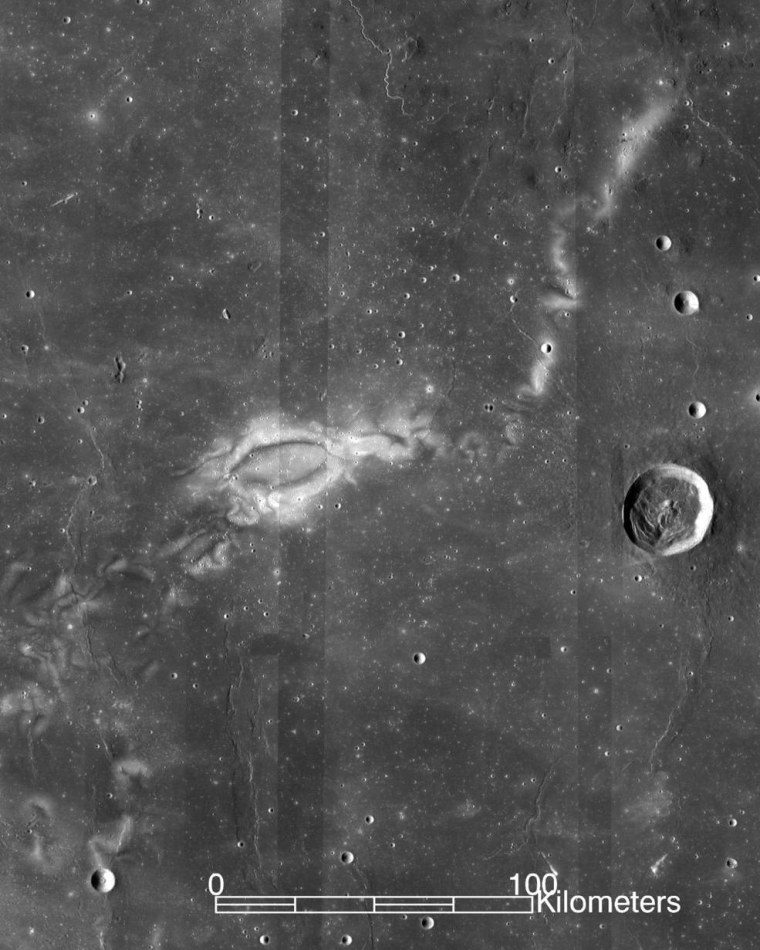
Light and dark markings swirl over the moon, looking like cream swirled into coffee or clouds against a slate gray sky. These lunar swirls may result from ancient, magnetic lava just below the moon's surface, according to one new study.
A joint study between researchers at Rutgers University and the University of California, Berkeley, pointed to the moon'sinternally generated magnetic fieldand past volcanic activity to explain the lunar swirls.
An image of the Reiner Gamma lunar swirl from NASA's Lunar Reconnaissance Orbiter.NASA LRO WAC science team
Researchers have known for some time that lunar swirls share space with localized magnetic fields and that when those fields deflect particles from solar wind, parts of the moon's surface weather more slowly than other parts. "But the cause of those magnetic fields, and thus of the swirls themselves, had long been a mystery," Sonia Tikoo, co-author of the study and a researcher at Rutgers University-New Brunswick's Department of Earth and Planetary Sciences, said in a statement. "To solve it, we had to find out what kind of geological feature could produce these magnetic fields — and why their magnetism is so powerful."
The researchers developed mathematical models for these localized fields, or "geological magnets" as they're described in the statement. These models showed that each lunar swirl must exist above a narrow, magnetic object located just below the lunar surface.
Even stranger, researchers think that these subsurface magnetic objects are ancient, long, narrow lava tubes formed by flowing lava or lava dikes, which are vertical sheets of magma in the crust of a moon or planet. Past experiments have shown that, when heated above 1,112 degrees Fahrenheit (600 degrees Celsius) in a zero-oxygen environment, certain minerals in moon rocks break down and release metallic iron, making the rocks extremely magnetic.
So, when the moon was erupting lava over 3 billion years ago, these magnetic lava tubes or lava dikes were likely created and became highly magnetic as they cooled down, according to the statement.
"No one had thought about this reaction in terms of explaining these unusually strong magnetic features on the moon," Tikoo said in the statement, referring to the lava becoming magnetic moon rock under the surface and causing lunar swirls. "This was the final piece in the puzzle of understanding the magnetism that underlies these lunar swirls."
This study was published July 26 in the Journal of Geophysical Research: Planets.
'Definitely Not Aliens': These Photos of SpaceX's Night Rocket Launch and Landing Are Amazing!
By Mike Wall, Space.com Senior Writer
Los Angeles Mayor Eric Garcetti captured this shot of the Falcon 9 plume over the lights of LA on Oct. 7, 2018.
Credit: Office of the Mayor/Eric Garcetti
All rocket launches are spectacular, but SpaceX took things to another level over the weekend.
On Sunday night (Oct. 7), a SpaceX Falcon 9 rocket successfully launched the SAOCOM 1A Earth-observation satellite from Vandenberg Air Force Base on California's Central Coast. And the two-stage booster's first stage landed back at Vandenberg less than 8 minutes after liftoff, pulling off SpaceX's first-ever terra-firma touchdown on California soil.
The plume generated by the Falcon 9 launch from California’s Vandenberg Air Force Base on Oct. 7, 2018, looked like something NASA’s Hubble Space Telescope might spy in the vast distances between the stars. Photo by Los Angeles Mayor Eric Garcetti.
Credit: Office of the Mayor/Eric Garcetti
"Nope, definitely not aliens. What you're looking at is the first launch and landing of the @SpaceX Falcon 9 rocket on the West Coast. The rocket took off from Vandenberg Air Force Base at 7:21 p.m. and landed safely back on Earth," Los Angeles Mayor Eric Garcetti tweeted Sunday night, along with an amazing photo of the Falcon 9 cloud hanging over the city.
Skywatcher Doug Macmillan captured this shot of the plume created by the SpaceX Falcon 9 rocket that launched Argentina’s SAOCOM-1A radar-imaging satellite from California’s Vandenberg Air Force Station on Oct. 7, 2018. Macmillan was in Del Cerro Park in the Palos Verdes Peninsula, which is near Los Angeles.
Credit: Doug Macmillan
Another photo posted by Garcetti captured the pulses of the first stage's small reaction-control thrusters, which etched a big Wi-Fi symbol in the sky. Those thrusters were firing to keep the booster on course for its historic touchdown. (SpaceX has now pulled off 30 first-stage landings, but all the previous ones had occurred at Florida's Cape Canaveral Air Force Station or on robotic "drone ships" stationed in the Atlantic or Pacific oceans.)
The pulses fired by the Falcon 9 first stage’s small reaction-control thrusters as the booster headed back to Earth carved a Wi-Fi symbol into the sky, as captured in this shot by Los Angeles Mayor Eric Garcetti.
Credit: Office of the Mayor/Eric Garcetti
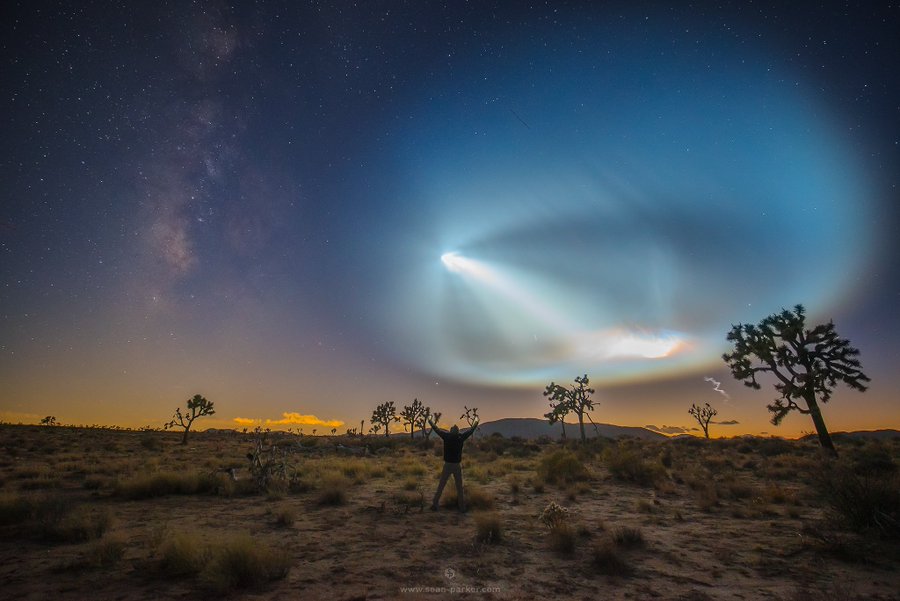
Astrophotographer Sean Parker viewed the launch from Joshua Tree National Park in southeastern California and was suitably excited by the sky show.
"That was pretty FN awesome, @elonmusk @SpaceX #falcon9," Parker tweeted yesterday (Oct. 8), along with a photo of himself exulting in the desert beneath the glowing cloud.
This photo captures all of the SpaceX action on Oct. 7, 2018: A Falcon 9 rocket launching the SAOCOM-1A satellite from California’s Vandenberg Air Force Station; the plume created by the liftoff; and the Falcon 9’s first stage coming back to land at Vandenberg (short orange arc at right).
Credit: SpaceX
And then there are the close-up views of the launch and landing, which SpaceX snapped. These photos are spectacular in a different way, highlighting power and precision rather than abstract and ephemeral beauty. But they are spectacular nonetheless.
A SpaceX Falcon 9 rocket launches Argentina’s SAOCOM-1A radar-imaging satellite from California’s Vandenberg Air Force Station on Oct. 7, 2018. The rocket’s first stage came back to Earth for a landing at Vandenberg less than 8 minutes after liftoff.
Credit: SpaceX
SAOCOM 1A, by the way, was developed by Argentina's national space agency. The satellite will observe Earth in radar light from its perch about 385 miles (620 kilometers) above the planet, primarily to measure soil-moisture levels. This information will aid predictions of crop yields and also help planners and emergency-management officials monitor disasters such as floods and fires.
The first stage of a SpaceX Falcon 9 rocket made history with this landing at Landing Zone 4 at California’s Vandenberg Air Force Station on Oct. 7, 2018. The touchdown marked SpaceX's first-ever West Coast landing of a Falcon 9 rocket.
Credit: SpaceX
SAOCOM 1A has a twin, SAOCOM 1B, which will make similar observations. SAOCOM 1B will also launch aboard a Falcon 9, perhaps as early as next year.
Mike Wall's book about the search for alien life, "Out There," will be published on Nov. 13. Follow him on Twitter @michaeldwall.
Meer van UFO'S of UAP'S, ASTRONOMIE, RUIMTEVAART, ARCHEOLOGIE, OUDHEIDKUNDE, SF-SNUFJES EN ANDERE ESOTERISCHE WETENSCHAPPEN - DE ALLERLAATSTE NIEUWTJES


 Back hole