Ontdek de Fascinerende Wereld van UFO's en UAP's: Jouw Bron voor Onthullende Informatie!
Ben jij ook gefascineerd door het onbekende? Wil je meer weten over UFO's en UAP's, niet alleen in België, maar over de hele wereld? Dan ben je op de juiste plek!
België: Het Kloppend Hart van UFO-onderzoek
In België is BUFON (Belgisch UFO-Netwerk) dé autoriteit op het gebied van UFO-onderzoek. Voor betrouwbare en objectieve informatie over deze intrigerende fenomenen, bezoek je zeker onze Facebook-pagina en deze blog. Maar dat is nog niet alles! Ontdek ook het Belgisch UFO-meldpunt en Caelestia, twee organisaties die diepgaand onderzoek verrichten, al zijn ze soms kritisch of sceptisch.
Nederland: Een Schat aan Informatie
Voor onze Nederlandse buren is er de schitterende website www.ufowijzer.nl, beheerd door Paul Harmans. Deze site biedt een schat aan informatie en artikelen die je niet wilt missen!
Internationaal: MUFON - De Wereldwijde Autoriteit
Neem ook een kijkje bij MUFON (Mutual UFO Network Inc.), een gerenommeerde Amerikaanse UFO-vereniging met afdelingen in de VS en wereldwijd. MUFON is toegewijd aan de wetenschappelijke en analytische studie van het UFO-fenomeen, en hun maandelijkse tijdschrift, The MUFON UFO-Journal, is een must-read voor elke UFO-enthousiasteling. Bezoek hun website op www.mufon.com voor meer informatie.
Samenwerking en Toekomstvisie
Sinds 1 februari 2020 is Pieter niet alleen ex-president van BUFON, maar ook de voormalige nationale directeur van MUFON in Vlaanderen en Nederland. Dit creëert een sterke samenwerking met de Franse MUFON Reseau MUFON/EUROP, wat ons in staat stelt om nog meer waardevolle inzichten te delen.
Let op: Nepprofielen en Nieuwe Groeperingen
Pas op voor een nieuwe groepering die zich ook BUFON noemt, maar geen enkele connectie heeft met onze gevestigde organisatie. Hoewel zij de naam geregistreerd hebben, kunnen ze het rijke verleden en de expertise van onze groep niet evenaren. We wensen hen veel succes, maar we blijven de autoriteit in UFO-onderzoek!
Blijf Op De Hoogte!
Wil jij de laatste nieuwtjes over UFO's, ruimtevaart, archeologie, en meer? Volg ons dan en duik samen met ons in de fascinerende wereld van het onbekende! Sluit je aan bij de gemeenschap van nieuwsgierige geesten die net als jij verlangen naar antwoorden en avonturen in de sterren!
Heb je vragen of wil je meer weten? Aarzel dan niet om contact met ons op te nemen! Samen ontrafelen we het mysterie van de lucht en daarbuiten.
Dinsdag 6 november 2018
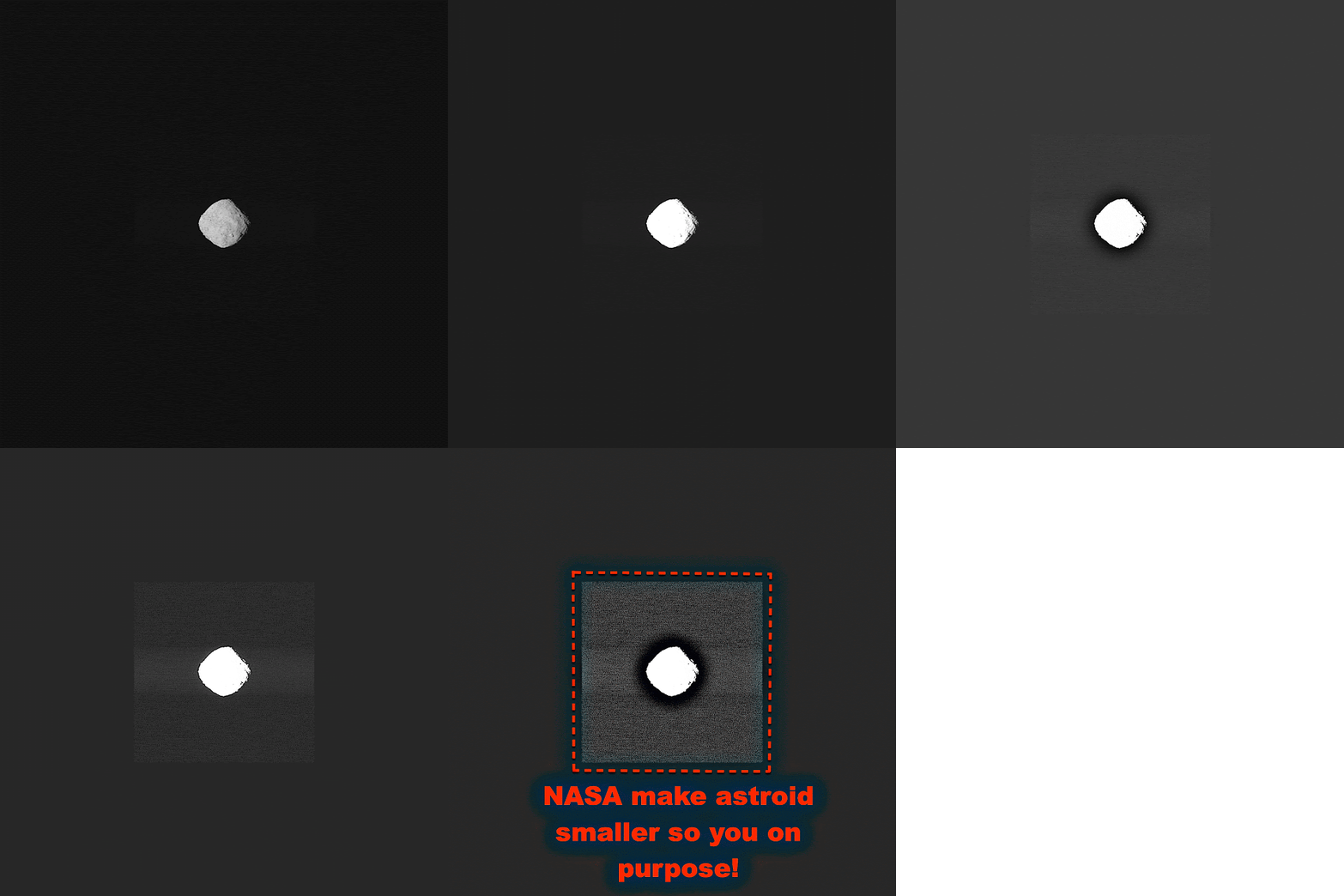
NASA Makes Asteroid Bennu Photo Smaller! Also Pyramid and base, Nov 2018, UFO Sighting News.
NASA Makes Asteroid Bennu Photo Smaller! Also Pyramid and base, Nov 2018, UFO Sighting News.
I found some strange things in this new HD photo of Asteroid Bennu. First off, NASA deliberately made the asteroid look farther away, smaller so the public could not see the details. I show this in the above gif. Just add light and focus and we clearly see the actual photo is much smaller! They lied to us! Are you surprised, because if you are, then you its because you don't visit my site enough.
Second I found a pyramid that has a triangle shadow.
Third, near the edge of the asteroid is a square structure with window or entrance openings along its sides.
Fourth there is a tall structure in the upper right side of the asteroid.
So...why did NASA want to make asteroid Bennu look smaller and farther away than it really was? Because they didn't want the public to know that alien structures exist on it.
Scott C. Waring-Taiwan
PS, Please share this post...to help support me and my work. Thanks, SCW
Grey Metallic UFO Hovers Over Trees In Florida Baffling Eyewitnesses, Nov 3, Video, UFO Sighting News.
Date of sighting: Nov 3, 2018
Location of sighting: Florida, USA
Source: MUFON #96128 This awesome video was submitted by Youtuber UFO Institute. The video shows a military helicopter and a strange grey metallic object. The UFO does hover in place and seems unafraid that people can see it. Although I wonder if the eyewitness tried to get closer or not. Excellent video. Scott C. Waring
Eyewitness states:
White cloud turning into gray black object milliary helicopter super quiet flies by seconds afterwards. White cloud turning and moving fast turning rising then slowly moving down then disappears after military helicopter fly's by very quiet.
Something weird appears in the sky over Nebraska during thunderstorm
The video below shows something weird in the sky during a thunderstorm over Nebraska.
A black object stays relatively motionless in the sky when it suddenly shooting up into the sky.
Since the military has technology way ahead of our time, it is possible that they are testing a new flying device in the storm or could it be a UFO charging its batteries?
It is very odd, does anyone have a decent explanation?
One of the best UFO sighting filmed lately! Flying saucer over Rosarito, Mexico 31-Oct-2018
This amazing UFO video of a disc-shapd UFO was filmed over Rosarito in Baja California, Mexico. This was filmed on 31st October 2018.
Witness report:
Today October 28, 2018 I witness 5 UFOs hovering over Rosarito, Baja California MX. At around 4:23am I was driving back to San Diego, California with my grandmother. We were having a normal conversation when she suddenly went mute and all she could do was point at the sky. I look up and see 5 of these things hovering over homes and the beach. I pulled over and immediately went live on instagram to avoid speculations of video editing and such.
The world was shocked when a video shows the alleged government pathologists’ gruesome autopsy of an alien in 1995. The said pathologists are seen wearing protective suits in the film.
The former magician and film-maker behind it revealed how the Alien Autopsy film fooled people around the world and inspired a classic film starring Ant and Dec.
Spyros Melaris said they used a foam body filled with cow and lamb organs from a local butcher to show an alien body being examined in 1947.
Melaris told in an interview that he considered using raspberry jelly for the brain, but it was too dark as he filmed in a north London flat in 1995. To fool experts at Kodak, he spliced his film footage onto a 1947 Pathe newsreel. A documentary about the film aired three times on Fox, and 11.7 million people viewed it.
Channel 4 brought in a company with deep pockets that could provide the broadcaster with a stronger future to privatised the effort, said the Culture Secretary John Whittingdale.
Melaris said that while the entire film was made up, they hung it on little elements of truth.
They associated the body with the Roswell crash incident. Ray Santilli claimed to have obtained the film from a cameraman who worked at Roswell.
Melaris sourced the outfits and medical instruments of the 1940s surgeons from prop providers in the US and UK.
His brother and then-girlfriend played as government pathologists dissecting the pale, potbellied corpse of the alien being in the Camden apartment.
Santilli admitted it was fake in 2006 but said that it was a staged reconstruction of a real extraterrestrial dissection film he had been shown in 1992.
Melaris said that it was a giggle and it wasn’t supposed to last 22 years as it was supposed to last only a week or 10 days.
Melaris said that it took him years to realise that the financer of the film Ray Santilli had made millions from it. He is now planning to write his own book telling all about the film.
The 1950s, 60s, and 70s were perhaps the golden age of UFO sightings in the United States. Futuristic advances in technology, thought-provoking science fiction, deep government distrust, and copious psychedelic drugs all combined to produce widespread visions of otherworldly airborne objects.
But this wasn't the first time that thousands of Americans were astonished by strange events in the sky. Between the 1880s and early 1900s, Americans from California to Boston were convinced they saw "airships" and flying "machines" buzzing the skies. Mind you, many of these accounts came out well before the Wright brothers flew the world's first powered aircraft over a distance of just 120 feet. Some airship sightings described great dirigibles with passengers onboard. Others simply reported moving lights in the night sky. One even told of an alien craft more than 150-feet long, completely featureless apart from its rudder.
Some journalists and newspapers were skeptical, but many more published the accounts uncritically to captivated readers. In the winter of 1909, during what can only be described as an "outbreak" of airship sightings in New England, tens of thousands of people claimed to see all manner of flying objects performing feats no aircraft of the day came close to accomplishing.
"It all began on 12 December, when prominent Worcester businessman Wallace Tillinghast told a Boston Herald reporter he had invented the world's first reliable heavier-than-air flying machine," Stephen Whalen and Robert E. Bartholomew recounted in the New England Quarterly.
Over the ensuing weeks, airship sightings flooded in, which newspapers gleefully reported with little skepticism. The reports in turn prompted even more sightings. It was a chain reaction of delusions.
"The great airship episode peaked in a frenzy on Christmas Eve," Whalen and Bartholomew described. "On that night there were thirty-three separate reports, spreading from Massachusetts southward to Rhode Island and Connecticut, northward to Vermont and Maine, and as far west as New York. In Boston, 'thousands upon thousands of people... stood on sidewalks, street corners and squares... hoping for a glimpse of the flying machine.'"
But just days later, sanity returned. Astronomers debunked a number of reports, explaining that the airship lights people thought they saw were really stars, meteors, or planets. Journalists also uncovered that many accounts were simply lies.
"Newspaper editors, drawing on the popular theories of French psychologist Gustave Le Bon, began to attribute the sightings to individual primitive impulses activated in emotional, group situations and producing a form of temporary irrationality or madness," Whalen and Bartholomew wrote.
Le Bon was absolutely right.
"We now know that all these incidents were hoaxes and mass delusions," Yale neurologist Steven Novella wrote in his recent book The Skeptics' Guide to the Universe. "There were no airships. Drawings of the alleged 'aeroplanes' by eyewitnesses resemble quaint notions of contraptions with flapping wings, not the planes that were eventually developed."
Notice also how all of the sightings were affected by culture and the technologies of the day. In the late 1800s, Americans were hearing of inventors feverishly working to create flying machines. Thus, they saw airships. One of the few reported alien spacecraft supposedly had a rudder, which would have been useless for space travel! Years later, influenced by science fiction and the nuclear age, Americans saw flying saucers, instead.
"What these and many other similar incidents reflect is the constructed and unreliable nature of perception, memory, and belief. They are the products of expectation, cultural influence, and psychology," Novella wrote.
This post was inspired by the recently-released book The Skeptics' Guide to the Universe, by Steven Novella, Cara Santa Maria, Jay Novella, Bob Novella, and Evan Bernstein. Those uninitiated to scientific and skeptical thinking will find Skeptics' Guide to be an engaging and in-depth introduction, while current practitioners will get their BS detectors honed and feel their love for rationality reinvigorated. Both groups will undoubtedly return to the Guide again and again to help navigate a world increasingly ignorant to fact.
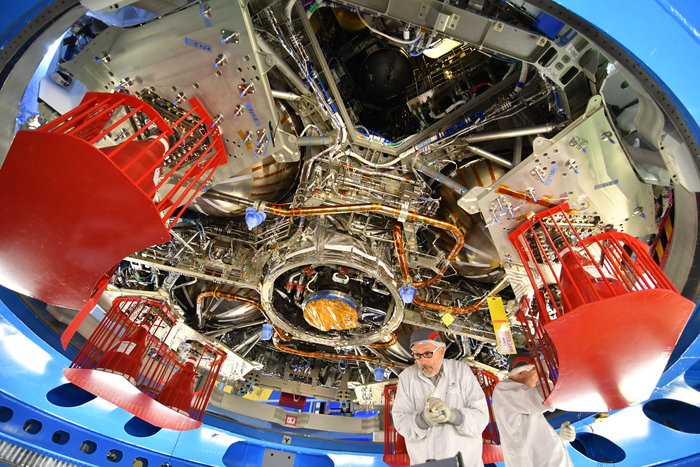
The European Service Module – eventually to be used to power and propel NASA’s Orion spacecraft in the 1st manned moon mission since the 1970s – leaves Europe today and arrives in the U.S. tomorrow.
NASA’s Orion spacecraft – built to carry humans – is one step closer to its first mission to fly around the moon and back, the European Space Agency (ESA) said on October 30, 2018. It said its European Service Module – which will be used to power and propel the Orion spacecraft – will be shipped this week from Bremen, Germany, to the United States on an Antonov An-124 aircraft. It’ll depart in the early hours of November 5 and arrive at Kennedy Space Center in Florida on November 6. The ESM, designed in Italy and Germany, is a crucial European component of NASA’s ambitious Space Launch System or SLS; the Orion spacecraft part of SLS is designed to take astronauts back to the moon for the first time since the 1970s.
The European Service Module will hold fuel in large tanks, as well as water, oxygen and nitrogen for the astronauts, while radiators and heat exchangers will help keep the module at comfortable temperatures.
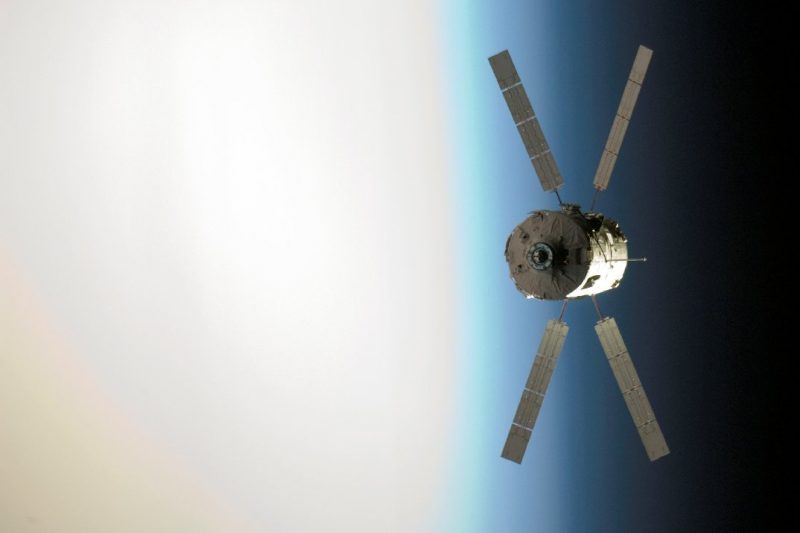
The module itself resembles ESA’s Automated Transfer Vehicle, which has been used to bring supplies to the International Space Station. The structure is the backbone of the entire vehicle, something like a car chassis. Three types of engines will help propel Orion during its excursions, and can turn the spacecraft in all directions. The module will be built by Airbus Defence and Space, and many other companies across Europe will also supply components.
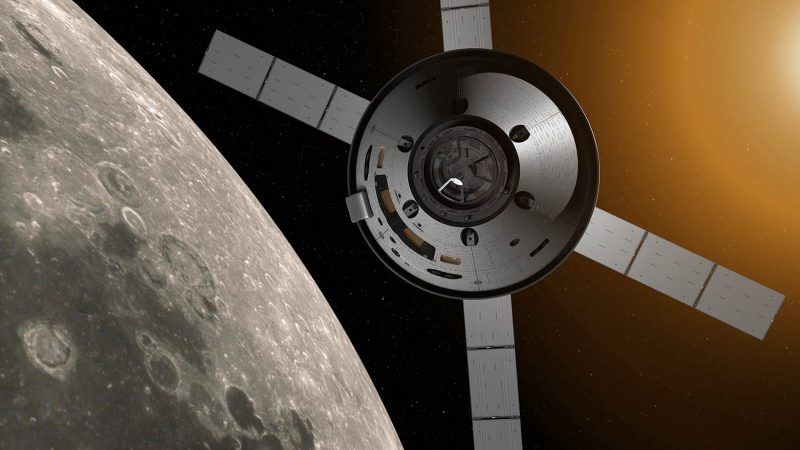
The European Service Module is an integral part of the Orion spacecraft, depicted here. Orion is designed to take astronauts back to the moon for the 1st time since the Apollo missions of the 1970s.
Image via NASA.
This is the first time that a European-built system will serve as a critical element to power an American spacecraft; this is thanks largely to ESA’s existing Automated Transfer Vehicle program, mentioned above.
So what happens next?
At Kennedy Space Center, the European Service Module will be connected to the Orion crew module and its adapter in preparation for Exploration Mission-1. This mission is planned as an initial test flight without astronauts that will travel farther into space than any human-rated spacecraft has ever ventured before. This mission is expected to launch sometime in 2020.
A second European Service Module, similar to the first, is also now being developed. This one will be able to take a human crew on a trip around the moon. All of this activity is leading up to launches with components of the Gateway – a planned human-tended outpost in lunar orbit, designed to be used for both human and robotic exploration of the moon.
Orion is similar in design to ESA’s Automated Transfer Vehicle, which takes supplies to the International Space Station.
Orion is the crewed capsule part of NASA’s Space Launch System, which, when completed, will be the most powerful rocket ever built. It will be able to take astronauts back to the moon, and more advanced versions of SLS will be capable of taking astronauts deeper into space, including to Mars. As outlined on the mission website:
After the first flight, the next step is to start sending people on bold missions to the moon and beyond. As SLS evolves over future missions to unprecedented accommodation of payload mass and volume and unrivaled performance, the rocket will allow NASA to send missions to deep space and reach distant destinations faster than ever before. On its second mission carrying Orion and astronauts, Exploration Mission-2, SLS will send Orion and its crew farther than people have traveled before around 250,000 miles from Earth, 10,000 miles beyond the moon.
SLS and Orion are America’s space vehicles and the foundation for missions carrying explorers to deep space. This new era of discovery requires all of humanity, including international and commercial partners, to help make these ventures possible and sustainable. Partners can help provide routine delivery of supplies and equipment needed to live and work on the moon and in deep space. SLS and Orion are planned to fly once or twice a year and will focus on dependable, safe flights for humans and large cargo.
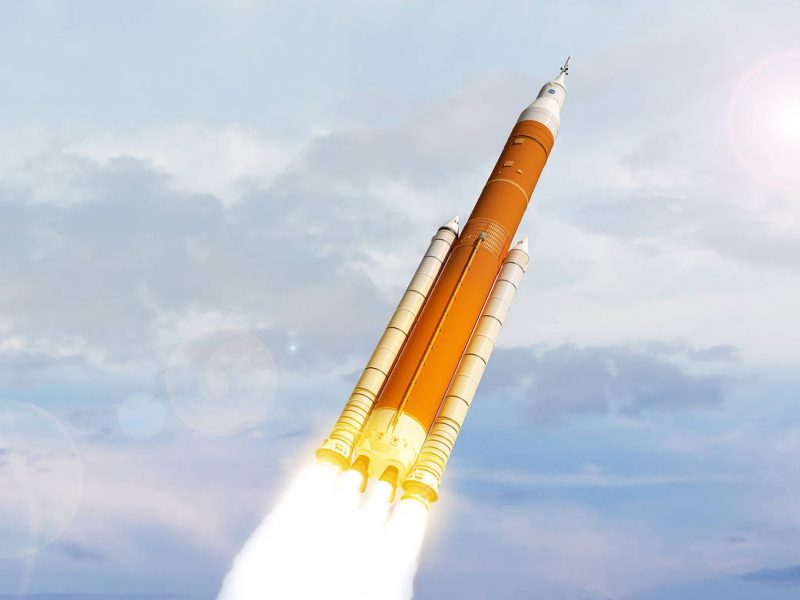
Once operational, SLS will be the most powerful rocket ever built, and will be able to take a crewed Orion to the moon and beyond
. Image via NASA.
Bottom line: The delivery of the European Service Module is another step toward the first launch of NASA’s Orion spacecraft – part of the Space Launch System – which is designed to take astronauts back to the moon for the first time in several decades. Human missions back to the moon are still some ways off, but the first launch of Orion will be a significant step closer.
Released in 2011 and said to have been taken by the KGB these images and details are strikingly similiar to the reports from the 1947 Roswell UFO crash.
‘Oumuamua Was Alien ‘Reconnaissance Mission' Harvard Researchers Suggest
The mysterious interstellar object known as Oumuamua has a lot of uncertainty around it in the scientific community. The latest theory has suggested a new possible origin. This origin refers to Oumuamua being part of a reconnaissance mission that was started by an alien civilization looking to explore other galaxies.
This latest theory comes from a recently published study by a couple of astronomers from the Harvard Smithsonian Center for Astrophysics.
Data from the Pan-STARRS-1 survey in September of 2017 revealed that Oumuamua gained speed. This was surprising, as scientists predicted the mysterious rock would be slowing down. Researchers at the time claimed this increased speed was due to the outgassing, which is the release of gas trapped or frozen in the interior of the rock.
This explanation was faulty, according to astronomers Shmuel Bialy and Abraham Loeb. Bialy and Loeb argued that outgassing could not be correct because Oumuamua would have gone into a spin if this was the case. With no spin observed, Bialy and Loeb explain the increased speed of Oumuamua away from the sun as the result of the force the sunlight exerts on its surface. Loeb explained that this will make the object lighter in weight for its surface area and allows the object to act like a light sail.
Loeb and Bialy explain the origin could be natural or artificial. It would be natural in the interstellar medium or proto-planetary disks. It would be artificial if it was to act as a probe sent for a reconnaissance mission into the inner region of the solar system.
So, it is possible that Oumuamua is actually from an alien civilization. Bialy and Loeb explain that the reason for considering the reconnaissance mission possibility is the assumption that Oumuamua following a random orbit requires the production of a certain number of objects per star in our galaxy. Loeb explains this number represents a higher abundance than expected, unless Oumuamua is a targeted probe and not part of a random population of objects.
This new theory requires much more study, which will be difficult since Oumuamua is no longer in our solar system and too far away at the present time for more observation.
An MIT study proposes that laser technology on Earth could emit a beacon strong enough to attract attention from as far as 20,000 light years away. Credit: MIT News
If extraterrestrial intelligence exists somewhere in our galaxy, a new MIT study proposes that laser technology on Earth could, in principle, be fashioned into something of a planetary porch light—a beacon strong enough to attract attention from as far as 20,000 light years away.
The research, which author James Clark calls a "feasibility study," appears today in the Astrophysical Journal. The findings suggest that if a high-powered 1- to 2-megawatt laser were focused through a massive 30- to 45-meter telescope and aimed out into space, the combination would produce a beam of infrared radiation strong enough to stand out from the sun's energy.
Such a signal could be detectable by alien astronomers performing a cursory survey of our section of the Milky Way—especially if those astronomers live in nearby systems, such as around Proxima Centauri, the nearest star to Earth, or TRAPPIST-1, a star about 40 light-years away that hosts seven exoplanets, three of which are potentially habitable. If the signal is spotted from either of these nearby systems, the study finds, the same megawatt laser could be used to send a brief message in the form of pulses similar to Morse code.
"If we were to successfully close a handshake and start to communicate, we could flash a message, at a data rate of about a few hundred bits per second, which would get there in just a few years," says Clark, a graduate student in MIT's Department of Aeronautics and Astronautics and author of the study.
The notion of such an alien-attracting beacon may seem far-fetched, but Clark says the feat can be realized with a combination of technologies that exist now and that could be developed in the near term.
"This would be a challenging project but not an impossible one," Clark says. "The kinds of lasers and telescopes that are being built today can produce a detectable signal, so that an astronomer could take one look at our star and immediately see something unusual about its spectrum. I don't know if intelligent creatures around the sun would be their first guess, but it would certainly attract further attention."
Standing up to the sun
Clark started looking into the possibility of a planetary beacon as part of a final project for 16.343 (Spacecraft, and Aircraft Sensors and Instrumentation), a course taught by Clark's advisor, Associate Professor Kerri Cahoy.
"I wanted to see if I could take the kinds of telescopes and lasers that we're building today, and make a detectable beacon out of them," Clark says.
He started with a simple conceptual design involving a large infrared laser and a telescope through which to further focus the laser's intensity. His aim was to produce an infrared signal that was at least 10 times greater than the sun's natural variation of infrared emissions. Such an intense signal, he reasoned, would be enough to stand out against the sun's own infrared signal, in any "cursory survey by an extraterrestrial intelligence."
He analyzed combinations of lasers and telescopes of various wattage and size, and found that a 2-megawatt laser, pointed through a 30-meter telescope, could produce a signal strong enough to be easily detectable by astronomers in Proxima Centauri b, a planet that orbits our closest star, 4 light-years away. Similarly, a 1-megawatt laser, directed through a 45-meter telescope, would generate a clear signal in any survey conducted by astronomers within the TRAPPIST-1 planetary system, about 40 light-years away. Either setup, he estimated, could produce a generally detectable signal from up to 20,000 light-years away.
Both scenarios would require laser and telescope technology that has either already been developed, or is within practical reach. For instance, Clark calculated that the required laser power of 1 to 2 megawatts is equivalent to that of the U.S. Air Force's Airborne Laser, a now-defunct megawatt laser that was meant to fly aboard a military jet for the purpose of shooting ballistic missiles out of the sky. He also found that while a 30-meter telescope considerably dwarfs any existing observatory on Earth today, there are plans to build such massive telescopes in the near future, including the 24-meter Giant Magellan Telescope and the 39-meter European Extremely Large Telescope, both of which are currently under construction in Chile.
Clark envisions that, like these massive observatories, a laser beacon should be built atop a mountain, to minimize the amount of atmosphere the laser would have to penetrate before beaming out into space.
He acknowledges that a megawatt laser would come with some safety issues. Such a beam would produce a flux density of about 800 watts of power per square meter, which is approaching that of the sun, which generates about 1,300 watts per square meter. While the beam wouldn't be visible, it could still damage people's vision if they were to look directly at it. The beam could also potentially scramble any cameras aboard spacecraft that happen to pass through it.
"If you wanted to build this thing on the far side of the moon where no one's living or orbiting much, then that could be a safer place for it," Clark says. "In general, this was a feasibility study. Whether or not this is a good idea, that's a discussion for future work."
Taking E.T.'s call
Having established that a planetary beacon is technically feasible, Clark then flipped the problem and looked at whether today's imaging techniques would be able to detect such an infrared beacon if it were produced by astronomers elsewhere in the galaxy. He found that, while a telescope 1 meter or larger would be capable of spotting such a beacon, it would have to point in the signal's exact direction to see it.
"It is vanishingly unlikely that a telescope survey would actually observe an extraterrestrial laser, unless we restrict our survey to the very nearest stars," Clark says.
He hopes the study will encourage the development of infrared imaging techniques, not only to spot any laser beacons that might be produced by alien astronomers, but also to identify gases in a distant planet's atmosphere that might be indications of life.
"With current survey methods and instruments, it is unlikely that we would actually be lucky enough to image a beacon flash, assuming that extraterrestrials exist and are making them," Clark says. "However, as the infrared spectra of exoplanets are studied for traces of gases that indicate the viability of life, and as full-sky surveys attain greater coverage and become more rapid, we can be more certain that, if E.T. is phoning, we will detect it."
More information: Optical detection of lasers with near-term technology at interstellar distances, Astrophysical Journal (2018). DOI: 10.3847/1538-4357/aae380
For Close-Knit Planets, Sharing Life Could Be Easy
By Starre Vartan, Astrobiology Magazine
An artist's impression of the TRAPPIST-1 planetary system.
Credit: SETI Institute
How could life be shared between planets in close proximity to one another? This question has received a greater insight thanks to new analytics based on previously known and new calculations.
The findingsfrom this new research are helping scientists understand how likely life would be on a given planet in such tight-knit systems if that world shows signs of habitability.
This approach began with a blasphemous-at-the-time idea: that life exists throughout the universe and can travel without supernatural interference. Anaxagoras, a 5th-century B.C. Greek philosopher, called this concept "panspermia." Kelvin, Helmholtz and Arrhenius advanced the idea in the 19th and 20th centuries by examining how life could be carried to and from Earth. In 2009, Stephen Hawking went beyond our solar system with the idea when he suggested that "life could spread from planet to planet or from stellar system to stellar system, carried on meteors." [5 Bold Claims of Alien Life]
Dimitri Veras, an astrophysicist at the University of Warwick in England and lead author of a recent paper on the subject, said, "Within the last century, [panspermia] has been focused on life transport within the solar system, including Earth."
The TRAPPIST-1 solar system, which is 39 light-years from Earth and includes seven planets packed into an orbit smaller than Mercury's, changes this Earth-centric idea. This system's sun is an ultracool red dwarf. So, even though the seven nearby planets orbit closely, they are possibly all still in the habitable zone, to varying degrees depending upon the makeup of their atmospheres. That makes this system a perfect model for exploring the idea of panspermia, per Hawking, anywhere in the universe.
The orbits of the planets of the TRAPPIST-1 system are tightly arranged, especially when compared to the worlds in our solar system or even the moons of Jupiter. That increases the chances that life could be shared between them.
Credit: NASA/JPL-Caltech
Three stages
But back to our solar system, where the "foundation for panspermia-related processes has been established," Veras' paper said. That includes evidence that life can survive the three stages of traveling from one planet to another: initial ejection, the journey through space between planets and impact onto a new planet. Each stage presents challenges to the survival of life.
Veras wanted to create an analytical system to quantify each of these parts to create a better understanding of the probability of the whole process occurring.
He had some information to start with: Microbes can survive ejection from a planet with life on it, as per previous studies, and even a voyage through interplanetary space, if shielded from the radiation and cold. Less is known about how well a microbe that endured space travel could survive impact on a new planet, which would be necessary for life to complete the voyage from one planet to another.
Because impact includes more unknowns than ejection and transit between planets, Veras had less-detailed information to work with in this area of his calculations.
"The physics of re-entry features complexities that are not present with the ejection and voyage phases through space," he said. "For example, frictional heating during re-entry can lead to the formation of a fusion crust [the outer layer of the meteorite that melts and ablates during atmospheric entry] on the surface of the meteorite."
To figure out how to calculate the tricky physics of atmospheric entry onto a new planet, Veras turned to some already-available math. He told Astrobiology Magazine that "Equations regarding the physics of impact have already been established and used for solar system applications, [so] we converted those for use in a general extrasolar system."
To understand the probability of ejected material traveling from one planet to another, Veras combined his equations into analytics. This way, he could figure out the whole system of panspermia, not just parts of it.
"Usually, the dynamics of panspermia is studied with numerical simulations. However, these can be slow to run and must be tailored to an individual system," Veras said. "Alternatively, analytics are much faster to use and are general enough to be applicable to a wide variety of systems." [Exoplanet Discovery: The 7 Earth-Size Planets of TRAPPIST-1 in Pictures]
Sharing life
These days, scientists know of an observable multiplanet system, TRAPPIST-1, with more than one world in the habitable zone. So, astrobiologists can use Veras' analytics to understand the probability of life being shared between planets in these extrasolar locales.
The closeness of the planets in this new system means that the chance that they can share material is high. If life began on one of the planets, can Veras' analytics tell us whether that life may have traveled to another given planet, thanks to panspermia? His equations are not meant to do that, he said. Veras said that they are "not exact" but instead "provide a sufficiently good approximation." Rather, their aim is to give astrobiologists another tool with which to assess new planetary systems.
Amaya Moro-Martin, an astronomer at the Space Telescope Science Institute in Maryland who has published a paper on the probability of panspermiabetween different planetary systems, said Veras' analytics are "An impressive piece of work." This analytic approach "takes into account a wide range of physical processes that are involved in panspermia," Moro-Martin said.
Looking forward, Moro-Martin said Veras' work will be useful for when new exoplanet systems are discovered. "The framework that it establishes will help others assess whether, from the dynamical point of view, panspermia could have been feasible, given the system characteristics," said Moro-Martin, who was not involved in the Veras-led study.
Astrobiologists need to ensure that they are not limiting life to what's already known; aliens could look very different from what we expect, Moro-Martin said.
"The difficulty here is that the experiments that test survival against the hazards of outer space and atmospheric entry will be based on the organisms we are familiar with, and we have no clue what extrasolar organisms might be like," said Moro-Martin, "which opens a fascinating world of possibilities."
Nearly three years since NASA's Dawn mission arrived at Ceres, the spacecraft has run out of fuel. Is it time to start thinking about sending another mission to the dwarf planet?
The $467 million Dawn spacecraft launched in 2007 on a mission to study the two largest objects in the asteroid belt, Vesta and Ceres. After studying the asteroid Vesta from orbit for about a year, it moved on to Ceres, the smallest dwarf planet in the solar system and the largest space rock orbiting in the asteroid belt.
While in orbit at Ceres, Dawn discovered that the dwarf planet sports hundreds of weird bright spots, contains plenty of water ice and has organic molecules (the basic building blocks for life) on its surface. By the mission's end, however, scientists were still left with some big questions about Ceres and what it can teach us about the possibilities of life beyond Earth — questions that could be answered with a follow-up trip to the surface. [Photos: Asteroid Vesta and NASA's Dawn Spacecraft]
One of the last images of Ceres from NASA's Dawn spacecraft shows bright spots in Occator Crater. Dawn captured this view on Sept. 1, 2018, from an altitude of 2,340 miles (3,370 kilometers) above the dwarf planet's surface.
Credit: NASA/JPL-Caltech/UCLA/MPS/DLR/IDA
"I think the kinds of questions that we are going to be left with will probably require going down to the surface, because there's only so much you can tell from orbit," Paul Schenk, a participating scientist for the Dawn mission with the Universities Space Research Association at the Lunar and Planetary Institute in Houston, told Space.com.
Specifically, Schenk said he would like to see a mission sent to explore Occator Crater, a 57-mile-wide (92 kilometers) crater containing the biggest and brightest of Ceres' spots. Like the other bright spots on Ceres, Occator Crater contains salty deposits that were left behind when briny water sprayed up from underground and then froze on the surface. This discovery by the Dawn mission revealed that the interior of Ceres is warmer than scientists previously thought. In the case of Occator Crater, a recent impact was likely the source of that heat, Schenk said.
This image from NASA's Dawn spacecraft shows the bright spot in Occator Crater on Ceres. This region is officially known as Cerealia Facula.
Credit: NASA/JPL-Caltech/UCLA/MPS/DLR/IDA/PSI
The most prevalent mineral at Occator Crater is sodium carbonate, which also happens to be prevalent in places on Earth that show hydrothermal activity — places like Yellowstone National Park "where certain types of bacteria are known to thrive," Schenk said. However, he said that it's "rather unlikely" that microbial life exists on Ceres, because the heat generated from impacts doesn't last long enough for life to evolve. "The impact generates enough heat to melt the ice and create the groundwaters that can then circulate in a central area," he said, but "the zone of heat contracts until the water goes away and freezes up" over the course of tens of thousands to a few million years. Here on Earth, the earliest forms of life arose 700 million years after the Earth formed.
Regardless of whether Ceres is capable of hosting life — a possibility that scientists have neither ruled out nor confirmed at this point — the hydrothermal processes seen on the dwarf planet could help scientists understand similar processes on other bodies in the solar system, like Jupiter's moon Europa or Saturn's moon Enceladus — two of the top contenders for hosting possible life beyond Earth. Features resembling dried-up hydrothermal vents on Mars could also have sustained life sometime in the planet's history. Like the bacteria that live in deep-sea hydrothermal vents on Earth, organisms living in similar geological features on other world don't need sunlight to survive. Instead, they would rely on geothermal energy, like hydrothermal vents and plate tectonics.
A full-color image from NASA's Dawn spacecraft shows how the dwarf planet Ceres would appear to the human eye.
Credit: NASA/JPL-Caltech/UCLA/MPS/DLR/IDA
In the case of Ceres, getting hit with other large space rocks appears to be the source of its geothermal energy. "Hydrothermal reactions with the water are clearly bringing up minerals to the surface," Schenk said. "In order to understand how that process works on other planets, including Mars, going back and understanding that chemistry and that physics — the physical process of what actually happens, how those materials delivered to the surface and what reactions are taking take place — are going to be important to understanding hydrothermal processes throughout the solar system. We have a lot of that information here on Earth, but the chemistry of Earth's crust is very different than it is on Ceres."
Landing and roving on Ceres
Because Occator Crater holds some tantalizing clues about the conditions necessary for life to arise on other worlds, scientists are hoping to send a lander to further explore Ceres' most fascinating feature, Schenk said. Ideally, any future missions would involve a small rover like the ones that landed on the asteroid Ryugu in September.
"It would have to be able to take some instruments that can tell you some diagnostic information about the composition, so it would have to survive the landing, and it probably would need to be able to move around to get to the specific site of interest, because you have to land safely but then you have to go to the area that's interesting, which could be complicated," Schenk said. (For example, Japan's Hayabusa2 mission to Ryugu has had a difficult time finding a safe landing site on the asteroid's surprisingly rocky surface.)
While Dawn could only study Ceres from orbit, reaching a closest altitude of 22 miles (35 km), a spacecraft on the surface could learn more about the dwarf planet's composition by scooping a sample and analyzing it in situ, or inside the spacecraft itself. Dawn used spectrometers to determine what elements are on the dwarf planet's surface, but those measurements are "dominated by those materials that are spectrally active, those that reveal absorption bands at particular wavelengths," and carbonaceous materials don't show up well in those measurements, Schenk said. "Carbonaceous materials often are pretty bland, so we probably have to go down to the surface to find it."
Scientists have been working on preliminary plans for the next mission to Ceres since as early as 2008, or seven years before Dawn would become the first spacecraft to visit the dwarf planet. A proposed mission called the Ceres Polar Lander would send an orbiter-lander combo to Ceres, dropping the lander at its north pole to search for clues about life. The mission would use the same kind of soft-landing techniques NASA has used to land spacecraft on Mars.
A team of researchers with the European aerospace manufacturing company Thales Alenia Space and the University of Nantes in France presented the Ceres Polar Lander mission concept at the European Planetary Science Congress in 2008.
When the Ceres Polar Lander was first proposed, scientists thought that Ceres' north pole would be the most interesting place to study. However, this was long before Dawn discovered Occator Crater, which is now arguably the most interesting place on Ceres.
Currently, no space agencies have plans to send another mission to Ceres, but that could change now that the Dawn mission has ended. Any proposed NASA missions will have to go through a lengthy review process before they can be selected to go to Ceres, but in the meantime, scientists have plenty of data from Dawn to sift through, Schenk said. "We're only starting to understand Ceres … it's going to take a while to figure out what we're actually seeing."
Email Hanneke Weitering at hweitering@space.com or follow her @hannekescience.
It forms at speeds of more than 1,000 mph (1,600 km/h), it lies deep beneath our feet, it could destroy hopes for alien life, and — finally — scientists understand how it works.
Back in March, researchers writing in the journal Science revealed that they have found the first evidence for this ice, called "Ice VII." Scientists had predicted its existence beforehand. Under the right conditions, it was believed, ice could form in a pool of water without a layer of heat at the leading edge of its growing surface. That — along with super-intense pressures and temperatures — would allow the ice to form without most of the usual brakes that slow its growth, Science Alert reported. It would also have a different crystal structure, or arrangement of atoms. Now, scientists say they've found that elusive ice for the first time in the frozen-water cores of diamonds that bubbled up from deep inside the Earth.
The diamonds, which contained Ice VII, had come from a point inside the planet known as the mantle's "transition zone," between 255 miles and 410 miles (410 and 660 kilometers) deep. (The mantle is the rocky layer between Earth's crust and core). And they knew that it had a crystal structure very different from the sort of ice that forms in clouds or lakes or in your freezer. [9 Strange, Scientific Excuses for Why We Haven't Found Alien Life Yet]
But they didn't know precisely how it formed, or what caused it to form that way.
New research, published Oct. 10 in the journal Physical Review Letters, found that there are particular combinations of temperature and pressure at which Ice VII forms. The mysterious Ice VII begins to form at 20,700 times Earth's atmospheric pressure at sea level and 40.7 degrees Fahrenheit (4.9 degrees Celsius), and the pressure/temperature combinations get only more intense from there.
This could pose problems for the hunt for alien life, Physics Central reported. Pressure spikes — say, from meteor impacts — could cause the explosive formation of Ice VII on watery planets otherwise suited to alien life. But the mass formation of this cubic ice at ripping speeds would likely prevent any such life from forming or surviving. On worlds where this happens, life could get snuffed out before it really began.
Starman has put a lot of miles on his Tesla Roadster in the last nine months.
The red electric car and its spacesuit-clad mannequin driver, which launched on the maiden mission of SpaceX's huge Falcon Heavy rocket in February, have made it beyond the orbit of Mars, company representatives said Friday night (Nov. 2).
The second sentence of that tweet, of course, is a nod to the late, great writer Douglas Adams. "The Restaurant at the End of the Universe" is the second novel in Adams' five-part "Hitchhiker's Guide to the Galaxy" series.
SpaceX's Starman mannequin is seen inside Elon Musk's red Tesla Roadster with Earth in the background, shortly after launch on Feb. 6, 2018. As of Nov. 2, the duo were beyond the orbit of Mars.
Credit: SpaceX
Like many of us, SpaceX founder and CEO Elon Musk is a big "Hitchhiker's Guide" fan, as Starman's Roadster shows. The car's entertainment display was programmed to read "Don't Panic!" — the phrase that adorns the cover of the eponymous electronic guidebook in Adams' beloved series.
"Starman" is a cultural reference as well; it's the title of a1972 song by David Bowie. And Musk said before launch that the Roadster would play Bowie's 1969 hit "Space Oddity" at full blast during its deep-space trek (though Starman cannot hear the famous tune in the airless void). Ultimately, Musk opted for Bowie's "Life on Mars" as parting music for Starman and the Tesla.
Diagram showing the orbit and current location (as of Nov. 2, 2018) of the dummy Starman and his Tesla Roadster, which SpaceX launched on the first flight of its Falcon Heavy rocket in February 2018.
Credit: SpaceX via Twitter
Musk has said that he launched the Roadster and Starman because the duo is a lot more fun than the typical inert-mass dummy payload (pun intended; sorry). Launching a satellite or other valuable spacecraft wasn't an option, given the risks inherent in maiden flights. (Musk also runs Tesla, so publicity was probably a factor as well.)
Starman and his ride — which once belonged to Musk — won't stay beyond Mars forever. As you can see in the diagram, the pair will loop back on their heliocentric orbit, eventually coming about as close to the sun as Earth does.
The Roadster and Starman will come within a few hundred thousand kilometers of our planet in 2091, according to an orbit-modeling study. The authors of that study determined that the car will slam into either Venus or Earth, likely within the next few tens of millions of years. They give the space car a 6 percent chance of hitting Earth in the next 1 million years, and a 2.5 percent chance of smacking Venus in that span. [In Photos: SpaceX's 1st Falcon Heavy Rocket Test Launch Success!]
You can track the space mannequin and cosmic Tesla at whereisroadster.com, a website created by Ben Pearson, founder of Old Ham Media.
The Falcon Heavy's second mission, which will launch the Saudi Arabian communications satellite Arabsat-6A to geostationary orbit, is scheduled for January 2019.
Mike Wall's book about the search for alien life, "Out There," will be published on Nov. 13 by Grand Central Publishing.
Waar zitten ‘Starman’ en zijn Tesla eigenlijk? Mars voorbij - HLN.be
AFP
WETENSCHAP & PLANEET Er zweeft een auto in de ruimte, weet u nog? Het is intussen ook al even geleden dat ‘Starman’ aan zijn grootse ruimteavontuur begon in zijn rode Tesla Roadster. Waar hij nu ergens zit? Voorbij Mars, zo blijkt.
6 februari 2018. Ruimtevaartbedrijf SpaceX lanceert met succes de Falcon Heavy, de krachtigste raket ter wereld. Aan boord, dummy ‘Starman’ in een rode Tesla Roadster, waar SpaceX-oprichter Elon Musk voordien mee rondtoerde. Geestige omkaderingen voor een onvergetelijke ruimtereis alom: denk aan een Don’t Panic-bordje op het dashboard en muziek van David Bowie die uit de speakers knalt. Een stunt van formaat én volgens Musk het ultieme startschot van ooit ruimtetoerisme naar de maan en Mars.
Fans konden heel even de ruimtetocht van Starman live volgen en zagen de dummy bevreemdend sereen in zijn elektrische cabrio door de ruimte zweven, met onze aardbol op de achtergrond. Maar sinds 14 februari was hij niet langer zichtbaar en verdween hij in de duisternis. Klaar voor een lange baan rond de zon.
Uit een update van SpaceX over de locatie van de meest veelbesproken raketballast ooit, blijkt dat Starman intussen voorbij Mars is gevlogen. “Volgende halte, het restaurant aan het einde van het universum”, grapt het ruimtevaartbedrijf in een tweet. Niet toevallig (naast de Don’t Panic-grap) een nieuwe knipoog naar de befaamde ‘Hitchhiker’s Guide to the Galaxy’-boekenserie van auteur Douglas Adams, waar Elon Musk grote fan van is.
AFP
99.000 keer ‘(Is There) Life on Mars’
In de ruimte is de Tesla Roadster alvast de snelste auto ooit, met een snelheid van ongeveer 42.000 kilometer per uur. Hij heeft nu al ver genoeg gereisd om alle wegen op aarde 16,4 keer te hebben gereden, schrijft fansite whereisroadster.com. Als de batterij aan boord nog werkt, heeft Starman ook al bijna 74.000 keer het nummer ‘Space Oddity’ beluisterd en meer dan 99.000 keer ‘(Is There) Life on Mars’, hoewel daar in het luchtledige van de ruimte niet veel van te horen zal zijn.
Op 8 november zal hij dit jaar ongeveer zijn verste punt tegenover de zon bereiken (249 miljoen kilometer), op 21 februari 2019 het verste punt tegenover de aarde (365 miljoen kilometer). Dan brengt zijn baan hem opnieuw dichter bij zijn thuisplaneet. Op 5 november 2020 nadert hij ‘dicht’ bij de aarde (51 miljoen kilometer). Voor een echte nabije passage is het waarschijnlijk wachten tot 2091. Dan is de Tesla vermoedelijk enkele honderdduizenden kilometers verwijderd van de aarde. Als het niet tot een ongeval komt of er zich geen ander probleem voordoet, blijft Starman nog vele jaren eenzaam rond de zon toeren, mogelijks miljoenen jaren. Volgens een studie zouden zijn restanten uiteindelijk kunnen crashen op Venus of op de aarde.
Oumuamua: Harvard researchers suggest strange interstellar object may be alien light sail
ASTRONOMERS have spotted something really odd. And a professor suggests it was an alien solar sail sent in search for life.
Jamie Seidel
Hawking, Billionaire Announce Spaceflight to Alpha Centauri
IT WAS our first known interstellar visitor when it was detected flashing past the Sun in October last year. Dubbed ‘Oumuamua’ — Hawaiian for messenger — it was quickly determined to be not of this solar system.
Its trajectory had been traced. And the track it was on could not have possibly been an orbit around our Sun. So it must have come from deep space.
Follow-up observations after the Pan-STAARS-1 telescope in Hawaii announced its discovery revealed the object to be odd.
It was elongated. It was about a kilometre long. It was a strange reddish colour. And it appeared to have properties that belong to both comets and asteroids.
Naturally enough, some speculated it could be an alien spacecraft. SETI (the Search for Extraterrestrial Intelligence) was interested enough to turn one of its electronic ears in its direction.
It found nothing. There were no observable omissions from the tumbling interstellar visitor.
And, as Oumuamua was moving so fast as to already whip it into the outer reaches of our Solar System, interest waned.
There just wasn’t much more we could do to check it out.
now, a new study by two Harvard Smithsonian Center for Astrophysics astronomers has postulated that it may, after all, have been an alien object.
Professor Loeb is a committee member of the Breakthrough Starshot committee — a project announced by the late astrophysicist Stephen Hawking and funded by Russian billionaire Yuri Milner that seeks to speed up our search for extraterrestrial intelligence.
Any examination of the unusual nature of Oumuamua must include “the possibility that it might be a lightsail of artificial origin,” he writes
An artist’s depiction of the IKAROS space probe with solar sail in flight.
Oumuamua was found to have a high density. Normally, this would indicate it was an object made of rock and metal.
This seemed to be supported as it skimmed past the Sun. No comet-like clouds of gas spun out as a tail in the solar wind.
But a spectral analysis — where light is broken down into its components to identify the chemicals influencing its colours — indicated it was much icier than expected.
After passing the Sun, it actually sped up. It should, by all accounts, have slowed down …
Unless it was a comet, venting gas from the warmer face closest to the Sun. This could give it the boost needed to increase its velocity.
So, where was that comet-like tail?
It’s still not been found.
The Harvard astronomers also point out that any such ‘outgassing’ would have quickly changed the nature of Oumuamua’s spin.
This also was not observed.
With these anomalies, Bialy and Loeb suggest there is only one other viable alternative: that it is a mechanical light sail, designed to use starlight to propel it through space.
“The first artificial relic might have just been discovered over the past year when the Pan STARRS sky survey identified the first interstellar object in the solar system, ‘Oumuamua,” Professor Loeb writes.
“We explain the excess acceleration of `Oumuamua away from the Sun as the result of the force that the Sunlight exerts on its surface,” they write. “For this force to explain measured excess acceleration, the object needs to be extremely thin, of order a fraction of a millimetre in thickness but tens of meters in size. This makes the object lightweight for its surface area and allows it to act as a light-sail. Its origin could be either natural (in the interstellar medium or proto-planetary disks) or artificial (as a probe sent for a reconnaissance mission into the inner region of the Solar System).”
This handout photo released by the European Southern Observatory on November 20, 2017 shows an artist's impression of the first interstellar asteroid: Oumuamua.
Picture: AFPSource:AFP
RETROENGINEERING OUMUAMUA
The Harvard astronomers attempted to compute the probable shape, size and mass any such interstellar light-sail would need.
It would need to survive the intense cold and extreme radiation of deep space. It would also need to be structurally rigid enough to cope with the stresses of its spin.
Their calculations state it could be achieved by an incredibly thin — just a fraction of a millimetre — thick sheet of metal.
“For a thin sheet this requires a width of ≈ 0.3−0.9 mm,” the study reads. “We find that although extremely thin, such an object would survive an interstellar travel over Galactic distances of about 5 kpc, withstanding collisions with gas and dust-grains as well as stresses from rotation and tidal forces.”
Professor Loeb states similar lightsails have already been designed and built here — such as the Japanese IKAROS and his own Starshot Initiative.
Why would such an alien ship be here?
Bialy and Loeb speculate it could be flotsam — a jettisoned solar sail floating at the whim of the interstellar winds. That would explain the lack of transmissions, they say.
“This opportunity establishes a potential foundation for a new frontier of space archaeology, namely the study of relics from past civilisations in space,” Loeb recently wrote in Scientific American.
“Finding evidence for space junk of artificial origin would provide an affirmative answer to the age-old question “Are we alone?” This would have a dramatic impact on our culture and add a new cosmic perspective to the significance of human activity.”
Equally, Loeb said, Oumuamua could be a space probe.
“The alternative is to imagine that `Oumuamua was on a reconnaissance mission,” he told Universe Today. He said the objects path was simply too convenient.
It passed within 0.25 AU (Astronomical Units, the distance of the Earth from the Sun) of the Sun which avoided the worst of its solar radiation. It then crossed within just 0.15AU of Earth.
Both astronomers concede we simply know too little about Oumuamua to reliably guess its nature. But, at the very least, for it to have the observed characteristics it has it must be an entirely new type of material or object.
EmDrive: US military research group DARPA want space drive that needs no fuel
A SIMPLE copper cone appears to pull propulsion out of nowhere. Now the US is betting $1.4m on this “impossible” space drive.
Jamie Seidel
Breakthrough Technology
EVERY action has an equal and opposite reaction. Or it should. It’s how rockets work: they accelerate forward by burning fuel and ejecting exhaust in the opposite direction. Now, 20 years after its was first demonstrated, the US military is interested in a drive that generates thrust from nowhere.
If it works.
Something else may be at play.
Many physicists believe it is a simple — but minuscule — error.
It’s an error that has been consistently reduced since the Shawyer EmDrive was first run in 1998.
It’s tiny. And every time someone applies new checks and balances to the process, it seems to get tinier.
But, it’s still there.
Tests by the worlds most advanced propulsion engineers, including NASA, still end up producing measurable thrust.
And, in the frictionless environment of space, that thrust accumulates. Over time, even the pressure equivalent to that of a piece of paper on your hand can accelerate a vehicle to interplanetary speeds.
It’s a prospect that has the US Defence Advanced Research Projects Agency (DARPA) sinking a speculative $1.4 million into the idea.
“Given the number and diversity of claims about EmDrive and other exotic physics, my opinion then and now is that DARPA should invest modest sums to experimentally assess such claims, albeit only where credible experimental evidence exists,” former DARPA researcher Jess Sponable told Popular Mechanics.
The EM drive positioned inside a vacuum chamber for testing.
Picture: NASA/EagleworksSource:Supplied
PURSUING THE IMPOSSIBLE
It’s just a cone of copper. One end is sealed. The other is opened.
It’s then pumped full of microwaves — generated from an electrical source that could include simple solar arrays.
Microwaves do produce pressure. Just not much of it.
The idea goes that the microwaves striking the closed end of the copper cone produce pressure — in essence giving it a ‘push’. Those that go out the back produce none.
This is where physicists have a problem.
They argue this is exactly the same as someone trying to push a car by leaning on the steering while sitting in the driver’s seat.
To get thrust, basic physics means there must be a reaction to drive the process.
Problem is, the copper cone experiment is producing a measurable force.
“The DARPA mission is to embrace and advance transformational change in the US military, but … we must strive to beat the other guy to the punch line and ensure there will never again be another Sputnik moment,” Sponable told Popular Mechanics, referring to the success of the Soviet Union in getting the first satellite into space.
This illustration made available by NASA depicts the Dawn spacecraft orbiting the dwarf planet Ceres. If it was able to suck fuel from the void of space, it would not have been forced to shut down as it did this month.
Picture: NASASource:AP
NASCENT LIGHT MATTER INTERACTIONS
The science is entirely speculative. And utterly unfounded.
But DARPA has kicked off an initiative it calls NLM (Nascent light matter interactions).
It’s re-examining the properties of electromagnetic and light waves.
Specifically, it wants to test the highly theoretical proposal that it can interact with spontaneous quantum ‘bubbles’ that pop in and out of existence.
Known as Unruh radiation, it is speculated this could be the unaccounted for ‘fuel’ that provides the EmDrive’s thrust.
Called Quantised Inertia, it’s a radical concept. It would also go against existing theories of the nature of dark energy and dark matter. But these remain highly speculative, too.
Most physicists believe the ‘thrust’ being recorded by the EmDrive is an unaccounted for external influence — such as the impact of the Earth’s magnetic field on the copper making up the cone.
So DARPA will attempt to recreate this thrust through a new kind of experiment.
Instead of microwaves and copper, they will fire lasers through a loop to see how they interact. And another test will bounce lasers off assymetric mirrors.
Theoretically, these should produce the same effect as the EmDrive.
If successful, the results would be revolutionary.
Satellites would not need to carry heavy fuel into orbit. Instead, they could coast around at will. Rockets could launch much larger space probes, as these probes also won’t need to carry their own energy source.
It would also make interplanetary travel much easier.
Mostly, it would gut modern physics. Einstein’s theories of general relativity and special relativity would have to be revisited. As would Newton’s third law.
IT WAS a normal Monday morning in February 1989 when Alec Newald set off on a three-hour drive to Auckland from Rotorua in New Zealand’s volcanic heart.
However, what the 70-year-old Kiwi claims to have experienced on that journey changed his perception of the universe forever.
Mr Newald says he was taken by extraterrestrials to an advanced civilisation and stayed there for 10 days.
After passing through a winding, foggy mountain route, he arrived in Auckland feeling tired and confused.
However, he was even more confused to learn that Monday was now Thursday — 10 days later — and he had no idea how he had lost those days.
Mr Newald said he spent 10 days in the alien world.
Picture: Alec NewaldSource:Supplied
Authoring a book called Co-Evolution and talking to global UFO media outlets since his experience in 1989, the Kiwi has set out what he experienced.
Speaking on American UFO and paranormal radio show As You Wish talk radio, he recalled the moment he was “plucked” from that winding mountain road.
“I was like what the hell is going on here?” he said. “I was driving the car and it felt like a tonne of bricks had landed on me, like someone had poured cement on me. I felt like I was pushed into the seat of that car.
“I was paralysed, I couldn’t turn the wheel or apply the brakes or do anything.”
He says he was zooming down the road at 100km/h towards a cliff face at the time and he braced for the impact.
Then he said he woke in a “cavernous” space filled with flashing neon blue lights. He was convinced he was dead, as he believed he was in spirit form and he was experiencing the afterlife.
He claims to have never even thought about UFOs before that point and to have never taken drugs.
“I’m just like a wispy ghost with no form at all,” he said. “I found I could manoeuvre myself by moving my consciousness forward or sideways.”
Mr Newald says he woke in spirit form and guided by extraterrestrials.
Picture: Alec NewaldSource:Supplied
The Kiwi said UFOs couldn’t have been further from his mind before 1989.
Picture: YouTubeSource:Supplied
Surrounded by other “spirit forms”, it was then that he claims to have felt a “tap on the shoulder”.
Here’s how Mr Newald describes what happened next in his book.
“Looking up, I realised we were being approached by three aliens, the tallest of them looking like my escort from earlier on,” he wrote.
“The second one was just a little shorter and was male as far as I could tell. The third was smaller, much smaller, and walked ahead of the other two.
“He, for want of a better word was slightly built with a roundish head and rather unusual, squinty eyes which were well spaced and placed rather lower down than are our own.
“He had a very small mouth, but I did not notice any ears or much of a nose. His physical appearance, however, was of almost no consequence, for I was immediately struck with an almost overpowering feeling of his presence.
“I cannot say it was hypnotic, if anything, the opposite. It was as if his energy was being projected and absorbed by my body.”
As he moved further, he claims to have seen physical objects emerging which looked like buildings and the entities which guided him there started to take physical form.
He claims they then told him to step into a machine, which would “build a body for him” and he saw his body forming beneath him.
On As You Wish talk radio he said the aliens were trying to reconstruct themselves so they could exist on earth.
As if his alleged experience was not strange enough, he started receiving visits from officials wanting to know more about his experiences and especially about the capabilities of this extraterrestrial race once he was back on earth.
Ahead of his Sydney talk, he told extraterrestrial enthusiasts UFO Research (NSW) Incorporated the experience was a “very hard pill to swallow” and one which has dominated his life ever since.
“Try absorbing that and continue to live your life as if nothing has changed,” Mr Newald said.
“Perhaps an even bigger surprise was, with the exception of a few, the more I tried to share this information the harder my life became.
“I was ostracised by people you might have expected support from. In fact, even before I tried to share any of the things I’d learnt, my life started to become more than difficult. It became impossible to continue on as before.”
Ik bracht 10 dagen door bij een buitenaardse beschaving. Dit is wat er gebeurde
De Nieuw-Zeelander Alec Newald zegt dat hij werd meegenomen door aliens en 10 dagen doorbracht bij een buitenaardse beschaving, zo meldt nieuwssite News.com.au.
We schrijven februari 1989. Newald is op weg van Rotorua naar Auckland. Wat er tijdens die reis gebeurde zou zijn kijk op het universum voor altijd veranderen.
Eenmaal aangekomen in Auckland voelde hij zich moe en verward. Hij kwam tot de ontdekking dat het geen maandag meer was, maar donderdag; 10 dagen later.
Verstrekkende gevolgen
Hij had geen idee wat er in de afgelopen 10 dagen was gebeurd.
Langzaam maar zeker kwamen de herinneringen terug. Newald zegt dat zijn ervaringen met vriendelijke aliens verstrekkende gevolgen hebben voor alle mensen op aarde.
Tijdens een uitzending van de Amerikaanse radioshow ‘As You Wish’ sprak hij over het moment dat hij van de weg werd geplukt.
“Ik reed in mijn auto en opeens voelde het alsof er een enorme lading bakstenen op me neerkwam, alsof iemand cement op me had gegoten,” zei hij. “Het voelde alsof ik in de stoel werd gedrukt.”
Verlamd
“Ik was verlamd en kon niet aan het stuur draaien of op de rem trappen,” vervolgde hij.
Hij werd wakker in een ruimte met blauwe knipperende lichten. Hij was ervan overtuigd dat hij dood was en in het hiernamaals was aanbeland.
“Plotseling tikte er iemand op mijn schouder,” klonk het. “Ik keek op en werd benaderd door drie aliens.”
Ze hadden volgens hem een rond hoofd, samengeknepen ogen en een hele kleine mond. Hij kon geen oren of neuzen zien.
Machine
Hij zag fysieke voorwerpen ontstaan, die leken op gebouwen en de entiteiten die hem begeleidden.
De aliens vroegen hem om in een machine te stappen, die ‘een lichaam voor hem zou bouwen’.
Newald zei dat hij na deze vreemde ervaring bezoek kreeg van functionarissen die meer wilden weten over het incident, met name over dit buitenaardse ras.
Verstoten
Hij zei dat hij het allemaal moeilijk kon geloven, omdat hij nog nooit had nagedacht over UFO’s.
“Probeer dan maar eens te doen alsof er niks gebeurd is,” zei Newald.
Hoe meer informatie hij begon te delen over zijn ervaring, hoe meer hij werd verstoten door zijn omgeving.
“Perhaps an even bigger surprise was, with the exception of a few, the more I tried to share this information the harder my life became. I was ostracised by people you might have expected support from. In-fact, even before I tried to share any of the things, I’d learnt my life started to become more than difficult. It became impossible to continue on as before.”
And yet, he keeps on trying to tell the world about his experience of being abducted by aliens and living amongst them for ten days before being dropped back in New Zealand, struggling to remember what he saw so he could tell the world – a different experience that he found far worse than his abduction. The abductee is Alec Newald and he was recently in the news as he shared his story once again, 30 years later, to an audience in Australia.
“I was driving the car and it felt like a tonne of bricks had landed on me, like someone had poured cement on me. I felt like I was pushed into the seat of that car.”
In an interview prior to his talk to the UFOR (UFO Research) group in West Ryde, New South Wales, Newald recounts how in February 1989 he was spared from what would certainly have been a fatal drive off of a cliff by aliens who transported him to their world where he found himself in what he describes as a spirit form with others in the same condition. Newald says he assumed he was dead and in the afterlife until he was approached by small beings – four-feet tall, large round heads, squinty eyes – with one as the obvious leader.
“Welcome”, he said. “I am the designated Guardian of this section. Anything that you feel you might need to make your stay with us more pleasant, ask and I shall do my best to supply it. The suit you have been given will make it possible for you to understand us, and us you”.
On his website and in his book, “Coevolution: The True Story of a Man Taken for Ten Days to an Extraterrestrial Civilization,” he describes being given a body and watching as the ship he was on descended into a huge city with various buildings that were pyramid-shaped, tubular or round. He was given a tour in a floating car described as “a stealth fighter cockpit without wings” controlled by “part mind power, part magnetic repulsion.” Newald says he was given more technical and historical information (including how these aliens affected the evolution of the planet and humans) during his stay, which lasted until he suddenly found himself back in Auckland 10 days later, confused and struggling to figure out what happened.
Newald claims he knew something big had happened to him because “some governmental agency knew about his “off world” experience, and wanted to get as much information out of him as humanly possible.” He says he was visited by “two New Zealand DSIR (Department of Scientific and Industrial Research) scientists” who knew more about him than he expected … enough to convince him they were not from the DSIR. He claims to have been threatened and his flats were broken into.
Newald wrote his book to share his story and his interpretation of these experiences and has periodically tried to tell it in public, only to be “ostracized.” Some complaints are that it’s too brief and his accounts are less of a first-hand memory than an interpretation of what he thinks happened. Now Newald is back again. The world and its desire for disclosure on UFOs and aliens has changed. However, his message has not.
“In relating the details of my own experience, I hope I can somehow convey to you that the unknown need not to be something to be feared. Personally, I am looking forward to whatever the future has to offer the human race.”
A good message, whether you believe the rest of Alec Newald’s account of a 10-day alien abduction or not.
Meer van UFO'S of UAP'S, ASTRONOMIE, RUIMTEVAART, ARCHEOLOGIE, OUDHEIDKUNDE, SF-SNUFJES EN ANDERE ESOTERISCHE WETENSCHAPPEN - DE ALLERLAATSTE NIEUWTJES


 NASA Makes Asteroid Bennu Photo Smaller! Also Pyramid and base, Nov 2018, UFO Sighting News.