Come and join the premiere.
Chat with me and others on the subject of UFO's Aliens and mainstream media.
click the link and set the reminder.
WATCH NEXT


 Winston Salem NC Triangle UFO Sighting Reported

At 6 am today (10-23-2018) to have a cigarette and a minute or two later directly above me was a UFO Triangle 100 ft wide 50 ft length.
I stepped out on the balcony just after 6 am today (10-23-2018) to have a cigarette and a minute or two later directly above me was a UFO that had to be at least 100 foot in width and 50 or more feet in length, 50 feet or less above me just over the tree tops moving 10 to 15 mph in a straight line going East heading towards the city of Winston-Salem, NC. with 4 huge tail lights flashing/strobes bright yellow-orange and red, (multi-colored) randomly without a pattern and one flashing bright red light on top, bright as LED lights and just as it was getting out of sight another one going North but 100 to 150 feet higher and directly above me came and moving about 20 to 25 mph, I was watching this UFO and to the right of me looking North-East I saw another UFO heading towards the first one that was now out of sight going 20-25 mph heading South-East and as I was following that UFO another UFO heading South but much higher in the air about 300-400 feet and just above a thin cloud appeared.
I called using 411 the Winston-Salem Police non emergency number and was connected and gave the same account I"m telling you at approximately at 6:15 am and asked them if they could tell me if the Military was doing Drone exercises but they said they would make a report and have someone call back.
At 6:30 am give or take a officer called me back and all she told me was she didn't see anything and wouldn't answer my question if the Military was in the area. The first UFO Sighting did have a hard to describe very slight sound which I can mimic if I had to but I tried to record it with my iPad and it doesn't come out good, I've attached photos (taken within a hour afterwards, it was dark at the time but the sky had lightened up) I took them from my perspective and sketched on them (poorly) what I saw and I hope it gives you a good idea of what I seen. I'm regretting not thinking to grab my iPad and take a video but I was in complete awe of what I was seeing but I'll now be out in the morning ready and waiting to see if t! hey come back.
There was a man walking South on the sidewalk and I tried to get his attention so he could witness it too but he didn't respond to me and also in the distance there was a lady walking 4 small dogs that were freaking out when this happened and she was yelling at them and trying to calm them down. I've have never seen anything like this and so close to me that would make me want to file a report, I just want to know if what I saw could be Military Drones. Thank-you for providing a way for me to share my experience and I'm hoping you can provide some information regarding this experience.
UFO Sighting Report
source nuforc.org
Photo Render
Mysteries of the Human Body
Throughout human history we have strove and endeavored to push out past the horizon and the limits of what we can see, to go out into the world and indeed the universe to explore new realms in our innate, insatiable quest for discovery. We have gone out past the hills or mountains in the distance, over the vast sea that sprawls out as far as we can see, into the thickest jungles and down into the deepest, darkest abysses of our oceans. We have gone out past the blue skies above, launching out into space to our moon and the planets beyond, and one day we may go even further still, into the corners of our observable universe and beyond to who knows what. Yet, for all of the mysteries that lie out there in the seas and wildernesses of our planet and beyond our world, it is interesting to think that some of the more baffling frontiers lie not out beyond us, but rather within us, and the human body is in many ways just as unexplored and misunderstood as any far away realm.
Some of the puzzling mysteries of the human body are everyday things that we take for granted, and which no one really gives much thought to. Take yawning for instance, you have probably done this countless times today, hopefully not too much while reading this article, whether it be because you are tired, bored, or just because the person next to you did it. But have you ever thought about “why” we yawn? Or why it should be contagious? There are lots of ideas for why we yawn, such as that it regulates the temperature of our brains, or helps us shift from one condition to another, such as from sleep to wakefulness or alertness to boredom, or maybe it just gives us a physiological boost, but the fact is we don’t really know. Making it all more mysterious is the fact that yawning seems to be infectious, as you have no doubt already surmised from your own experiences, but why should this be? The closest we have to an answer for any of this is that it is some ingrained social bonding trait, a subconscious show of empathy, of which neuroscientist and professor of psychology, Robert Provine, has said in a statement to Healthline:
Yawning may be a primitive form of empathy that binds tribal members together and coordinates their physiology, such as synchronizing arousal and bedtimes. Diminished contagion, whether from yawning or laughing, may be a novel measure of social disorders as in autism or schizophrenia.

That is a rather unromantic and coldly scientific way of saying that yawing brings us together. It is interesting to note that contagious yawning is seen mostly only in social animals such as dogs, lions, chimpanzees, and humans. However, again we just don’t know, and yawning, one of our most common behaviors, remains little understood. Another contagious behavior that we do all of the time is laughing, which if you are lucky you have also done many times today already. Laughter, and its ability to infect others around us with its mirth, is also actually a rather mysterious trait, with no real concrete commonly accepted reason for why we should do it or why it should spread to others. The most widely accepted theory is that, like yawning, it is a sort of social behavior. In this case, it is likely an evolutionary trait designed to specify that we are playing and not engaging in threatening behavior or feeling threatened. In this way, our laughter puts others of our group at ease and they too laugh to show others around them that there is no immediate danger. The social angle helps explain why we laugh far less when we are alone, but the true reason for laughter and its contagious nature remains murky. It doesn’t, however, explain why some people laugh at some things while others don’t, or why in some cultures laughing is actually sometimes a sign of discomfort or even alarm.
So we have these behaviors and reactions so far of when we are sleepy, bored, or conversely happy and amused, so what usually happens when you are embarrassed? Do you blush? Well a lot of people do, and if so, there is another mystery we still don’t have an answer to, made all the more intriguing by the fact that humans are the only animals that do it. We know the “how” part of the equation. Blushing is basically caused by blood vessels dilating in reaction to the adrenaline stirred up by stress, and this allows the adrenaline to flow through your system faster and more smoothly. In the face, this results in that redness we call blushing, but this redness shows up nowhere else on the body. This stress can be caused by embarrassment, but it can also be caused by positive emotions such as being thrilled or receiving a compliment.
This we know, but more confusing is the “why” of it all. Why should only our faces turn red in these situations? What possible purpose or advantage could our faces turning red have, and why does it happen even in positive situations such as meeting the man or woman of your dreams? It is so baffling that Charles Darwin himself once said of it, “Blushing is the most peculiar and the most human of all expressions.” Again, there are many ideas for why we might blush, but no definitive answers. One of the main theories is that blushing serves as a social nonverbal form of apology, meaning that when you do something you know was a mistake or wrong you subconciously visibly blush to show others that you realize it and are sorry about it, visually representing your regret and remorse for all to see. This has actually been tested, and studies have shown that people who blush are indeed more likely to be forgiven than those who don’t. However, like the others we have looked at so far, nobody really knows for sure.

Another thing many of you might take for granted and do every day is write, throw a ball, or use a fork or knife with either your right or left hand. For most people it is just one of those “just because” things, yet the fact that we have a dominant hand at all, as well as why most people should have that be the right hand, have long been a baffling mystery of the human body. Wouldn’t it make more evolutionary sense for us to be able to use both hands equally? Yes, it would, and although a small percentage people are ambidextrous (able to use both hands equally), scientists can’t seem to agree on why this isn’t the case for everyone, or why it should 7 to 9 times out of 10 be the right hand that is favored, no matter the culture or country.
One idea is that because of our advanced speech capabilities there are more brain resources dedicated to the complex wiring of the speech producing region of our brains, which is also linked to motor skills and which usually sits on the left hemisphere, but not always. However, many right-handed people have been found to have speech centers on the right hemisphere and many left-handed people have speech centers on the left as well, making this an unreliable indicator at best. There is also the fact that animals without the complex speech wiring and fine motor skills of humans have also been shown to have preferred dominant appendages as well. In the end, it is not fully understood, and it is difficult to study as many societies take naturally left-handed people and force them into right-handedness, making it difficult to get a fix on. The subject of the nature of handedness continues to be debated and discussed, and we are no closer to an answer.
Other mysteries of the human body have more to do with our actual anatomy and the make-up of our bodies. Some of these are external and you can see them right now. For instance, look at your hands and you’ll see that not only do you have fingerprints, but you may also know that their particular patterns of whorls and ridges are completely unique to you and you alone. Have you ever thought about why that should be, or indeed why you should have fingerprints in the first place? If you have been paying attention so far you can probably see where this is going. That’s right, we don’t know.

“Whoa, whoa, wait!” you might be thinking right about now. “They are for gripping things, right?” you may be asking. Well, here’s the thing about that, while indeed it was long thought that this was the purpose of fingerprints, that the ridges create friction, this has since been seen as more and more doubtful. In the June 12, 2009 issue of the Journal of Experimental Biologya report was published by Peter Warman, from the University of Manchester in England, that showed that fingerprints don’t seem to improve grip at all, and actually may even make our grip worse. It was found that considering that our skin behaves almost like rubber when producing friction with an object, we need more of the skin in contact with the object to get a better grip. In our case, those fingerprints of ours actually make sure that we have less of our skin in contact than we would if we didn’t have fingerprints, worsening the grip, although they are still seen as perhaps helping to grasp rougher surfaces. Other theories for why we have fingerprints include that they help drain water from our fingers to keep our grip dry, that they could have a role to play in helping to prevent blisters, or that they somehow increase touch sensitivity, but at the moment those unique prints of yours are an evolutionary mystery.
Moving within the body we come to other inscrutable mysteries. Probably the one most people will immediately think of is the appendix, a seemingly pointless organ that is apparently only good for getting infected and having to be removed. Indeed, many of you reading this right now are probably without an appendix and also without any ill effects, and indeed even the word itself “appendix” in common usage denotes something that is sort of tacked on as an afterthought. One would think that after all of these years we would by now have discovered just what it is supposed to do, but actually no. All we have are ideas, such that it is a vestigial remnant of an organ that helped our ancestors digest food, that it helps develop the immune system of fetuses, or even that it plays an important role in attracting and providing a living environment for the “good bacteria” in your gut, but we are basically just as perplexed by this anomaly of the human body as we always have been.
The very blood that runs through our veins also holds mysteries. All human beings can be classified into different blood types, which have different enzymes that determine the types of sugars that stick to blood cells, and the main four types are classified as A, B, O, and AB. The differences between these types is such that for blood infusions it is a necessity that donors with compatible types be found. Yet why human beings should have different blood types in the first place has long remained an enigma. The closest we have come to an answer is that certain blood types and their antigens may be more useful for fighting off pathogens found in particular geographical areas of the world or that they have evolved for some other function, but there is no definitive reason and they are a mystery.

There is also the question of the very make-up of our bodies. It is no mystery that much of our body is made up of foreign agents, such as microbes, which compose around 1-3 per cent of our total body weight. This we know, and we even know the functions of some of the bacteria living in our bodies, such as helping with digestion, aiding healing, fighting infection, or keeping our skin clean, but there are vast numbers of these microbes that coexist with us and make up our bodies whose purposes we have no idea of. The fact that we have no clue what many of the microbes that make up so much of our bodies do is a sobering thought, and making it even more mysterious still is that among all of the bacteria permeating our bodies there are also quite a few viruses permanently floating about, even in healthy people, and it is a total mystery as to what function they are serving or why this should be.
Perhaps the biggest human body mystery of all, and the one we take for granted most, is the one that sits up in your head, the brain. It is a vast, supremely complex network of trillions and trillions of neural connections, a mind-boggling web that somehow runs and regulates our bodies, facilitates our mental functions, and bestows us with consciousness and self-awareness. How can this be? The full extent of the human brain and its workings are still little understood, and the most perplexing mystery of all is how this blob of jelly in our skulls gives us consciousness, spirituality, appreciation, self-awareness, love, art, literature, and everything else that makes us human. Neuroscientists still don’t know, and one neuroscientist, V.S. Ramachandran, has famously and eloquently summed it all up:
Any single brain, including yours, is made up of atoms that were forged in the hearts of countless, far-flung stars billions of years ago. These particles drifted for eons and light-years until gravity and chance brought them together here, now. These atoms now form a conglomerate — your brain — that can not only ponder the very stars that gave it birth but can also think about its own ability to think and wonder about its own ability to wonder. With the arrival of humans, it has been said, the universe has suddenly become conscious of itself. This, truly, is the greatest mystery of all.

It is spooky and profound to contemplate, indeed. Here we have looked at a selection of some of the baffling mysteries of the human body that, while they may be things that you take for granted every day, are nevertheless just as unknown, uncharted, and indeed impenetrable as the deepest unexplored sea, jungle, or the faraway landscape of some alien planet. Such aspects of our bodies and indeed who we are may one day be more fully understood, just as we will discover more of our universe as we continue our inexorable drive of exploration, but for now they remain strange frontiers that lie not out over the horizon or out past the stars, but right here with us now.
Sinister Visitors: “Both were no more than silhouettes”
A couple of days ago, I wrote an article on a strange MIB-themed case from the 1960s that Robert Goerman investigated. The article began as follows: “Born on March 3, 1952, Robert A. Goerman is a native of New Kensington, Pennsylvania. As an investigative scholar of unknown and unexplained phenomena, he has been fortunate enough to have his writings featured in national magazines and serve as source material for many books and popular television shows such as Unsolved Mysteries, The Unexplained, History’s Mysteries, Animal X, MonsterQuest, and Dark Matters: Twisted But True. Founded in June of 2012, his Nonhuman Research Agency explores encounters with mysterious strangers, beings, and creatures and studies interspecific relationships. Robert offers his very own insights into the Men in Black mystery, based upon his firsthand investigations of a very weird case from the 1960s that is steeped in menace of the black-colored kind. It is a case that has led Robert to some thought-provoking theories concerning the nature and actions of the MIB, too.”
Robert has generously given me permission to use the accounts he has sent me. The following from Robert demonstrates just how downright weird the MIB phenomenon really is. It’s an account that is focused on an MIB experience he had in the dream state. Interestingly, I receive from people a lot of very graphic, dream-based experiences with the Men in Black. It’s a situation which has led some witnesses/victims to suspect the MIB can literally “invade” their dreams and turn them into downright nightmares.
Over to Robert:
“Before you continue reading, let me preface this post by confessing that the MiB ‘visit’ was merely a dream shard. I would never even publish my experience if not for its curious physical aftermath. It is also necessary to point out that I have resided at my present residence for much of my life. This was my childhood home. It was inherited upon the passing of my parents. The bedroom that I now occupy as an adult was at one time shared for many years with my younger brother. There was barely enough room for two twin beds and a tiny writing nook where I documented my early research on a vintage Smith-Corona typewriter.

“The dream that I had shortly after midnight on Monday, July 18, 2016 found me seated at my writing nook as a young man (1969 or 1970) at night. I was typing a report about the Men in Black and uttered to myself that these scenarios echoed the MIB cases reported by Brad Steiger. My desk lamp was the only light source in the room. Movement off to my left caught my attention and I turned my head. Two Men in Black, wearing the classic fedoras, stood not six feet away, between the twin beds, blocking any hope at escape. The closest one was about my height. His companion was a head taller. Both were no more than silhouettes. There were no details. Escape was the last thing on my mind.
“I remember saying, ‘I have been looking forward to this,’ jumping up, and grabbing the shorter MIB by his arms between the elbows and shoulders. (Anecdotal information suggests that the MIB hate being touched by humans. I knew this.) BIG MISTAKE. It was like grabbing a high voltage tornado! In fact, the MIB became a whirling blur of time and space. My left arm was being ripped from its socket. I screamed that high-pitched scream that only excruciating pain can create. Pain beyond pain. Folks that have experienced certain traumatic accidents know exactly what I mean.

“Hearing my cries for help, my wife awakened me. I snapped fully awake to the horror that the pain in my left arm and shoulder was quite real. (My firsthand relationship with pain comes from the agony of a herniated disc that required spinal surgery and too many kidney stones.) I understand pain. This was real pain. Maybe not quite as extreme as those two previous examples… but still, as real as it gets. It took a healthy dose of Ibuprofen and the gentle working of the tender arm and shoulder to make things tolerable. Traces of soreness lasted most of the day. It is what it is.”
Weird Norfolk: Close Encounters of the Third Kind in Norfolk’s skies
Stacia Briggs and Siofra Connor
The image captured by Glen Webster on his camcorder in the sky over Norwich. Date: 11 Nov 1995.
Picture: EDP Library
More cynical readers might put the sudden spate of UFO sightings in the Norfolk town down to early celebrations for Bonfire Night, but those who saw the strange lights or gliding objects in the sky know that earthly pyrotechnics can’t explain what they witnessed. The first account of something strange in the sky was on November 2. Computer engineer Nick Colman was driving home from work when he saw a bright light tracking his car as he approached Aylsham – just hours later, a man telephoned police at Great Yarmouth, reporting a suspected UFO at Freethorpe.
Worried Nick, who was working for a computer company on the Sweetbriar Industrial Estate and was 30 at the time, watched as the light appeared in his rear view mirror and moved round to the side of his car before shooting up into the sky in front of him.
“At first I thought it might have just been a halogen lamp but when it started moving to the side of the car, where there was no road, I knew it wasn’t. It couldn’t have been a helicopter because it was too low to the ground and I have never known a helicopter shoot up so fast,” he said.

“I told about 20 people about it later that night and then I read about the sighting in Freethorpe. Someone told me if could have been a reflection in my windows but I was smoking a cigarette so my window was wound down.”
A man called Great Yarmouth police in the early hours of the next day, reporting a blue and white flashing disc over fields at Freethorpe. A police spokesman later told the Norwich Evening News that there had been no more reported sightings of the strange lights.
But there had been another sighting, a day after Mr Colman’s, this time in Appleyard Crescent in Norwich at around 8.15pm.
Painter and decorator Glenn Webster captured the extraterrestrial visitor on camera: in the video, a shape-shifting black object can be seen moving swiftly from side-to-side before spinning rapidly and zooming off into the Norfolk night.
Looking slightly like an axe-head (although the ‘bites’ out of the disc were later found to be caused by the camera’s zoom lens shutter), the strange-looking object excited some of the country’s top UFO experts.
So stunned was Mr Webster, 32, by what he saw that he tripped and fell while filming. His video clearly shows the shape first appearing in the sky over Norwich as a huge bright light zig-zagging from side to side. As Mr Webster ran outside to get a better shot of the object it zoomed off towards Yarmouth.
“I was stunned when I first saw it and reached for my camcorder. When I zoomed in on the shape I couldn’t believe it. I moved forward and tripped over my hi-fi. The object made no sound and I gasped when I saw it shoot towards the moon,” he said.
“I have always been a bit sceptical about this type of thing but this was simply amazing.”
The video was watched by Ian Simmons, British contributing editor of the Fortean Times, the journal of strange phenomena, who said: “the object doesn’t behave like anything we know about. It appears to be something which could well be extra-terrestrial.
“Originally I thought it sounded like the shape the afterburner of a jet fighter makes, but after watching the video, that can be ruled out. It’s too clearly
defined a shape and too large. Many other UFO sightings can be put down to views of the planet Venus, but that can also be ruled out in this case. This falls into the category of a very mysterious light, or shape. Many of the famous UFO sightings show a solid object.”
Norfolk UFO Society chairman Alex Clark said at the time: “Based on descriptions given so far, I have never heard of an object like this before. After watching the film we could decide to hand the tape over to the British UFO Research Association which has computer technology to make accurate assessments of size, colour and heat patterns.”
A spokesman for the Ministry of Defence told the Norwich Evening News in 1995: “The MoD does not normally investigate unless there is a Services interest. We are not aware of any evidence that this is a matter of defence concern.”
Local residents spotted UFO on same day pilots reported flying object sighting in Ireland
As the Irish Aviation Authority is investigating the unusual sightings of bright lights and UFOs reported by three commercial aircraft pilots, fresh reports of UFO sightings on the same day have now surfaced online. Popular conspiracy theory website 'Disclose.tv' has recently released an eerie clip that shows two bright lights hovering in the skies, and they claim that these visuals were shot in Northern Ireland, on the same day pilots spotted high-speeding bizarre objects.

In their website post titled 'Actual Footage Of The Ireland UFO Encounter', Disclose.tv reveals that the new sighting does correspond with one pilot's comment that there were two objects speeding in the skies.
"Dash-cam footage was uploaded by dash-cam by Sandy Laverty in Coleraine. Looks like a bolide to me. It does correspond with the one pilot's comment that there were two objects. However, that could be a coincidence," wrote Disclose.tv on their website.
The video soon went viral, and it has already racked up more than 18,500 views. As the video became popular, conspiracy theorists soon jumped to the conclusion that alien life is a reality, and made it clear that extraterrestrial beings from advanced civilizations used to visit earth to monitor our activities.
It was on November 09 that a British pilot initially spotted a flying object and contacted Shannon Air Traffic Control to know whether there are any military exercises going on. The air traffic control soon informed the pilot that there were no such activities in and around the area.
As per the testimonial from the British pilot, the object spotted in the skies initially come up along the left side of the aircraft before it rapidly moved to the North at a very high acceleration. The pilot also revealed that the UFO spotted in the skies had bright lights on its body.
Another pilot who witnessed this sighting revealed that the UFO was travelling at twice the speed of the sound.
However, some experts argue that the objects spotted by the pilots could be a meteor or asteroid. But adamant conspiracy theorists believe that a meteor will never change its trajectory like the object did while trailing the aircraft.
The truth is out there: was Kerry UFO really a meteor?Huge Alien Disclosure: Researcher Has Discovered How UFOs Are Coming to Earth (Video) Mainstream Fake news and UFOs

Come and join the premiere.
Chat with me and others on the subject of UFO's Aliens and mainstream media.
click the link and set the reminder.
'Space Age record' for cold temperatures in a matter of months, NASA warns
NASA scientists warn that the absence of sunspots could result in record-breaking cold temperatures above Earth in just a few months
An alarming new trend in the atmosphere could mean a significant drop in the temperature of the thermosphere, and it could happen sooner than anyone might have previously predicted.
Using NASA’s TIMED satellite, which measures changes in Earth’s atmosphere, scientists have determined that the atmosphere is losing heat energy. In a Space Weather feature, Dr. Mlynczak explained to Dr. Tony Philips how this development high above earth’s surface on the edge of space could bring record cold temperatures.
The usual sunspots seem to have disappeared for the majority of this year, leading to these massive losses of heat energy and causing the thermosphere to cool and shrink.

The SABER instrument installed on the TIMED satellite monitors infrared emissions from carbon dioxide and nitric oxide. Both substances are crucial in maintaining the overall balance of energy. Part of the SABER instrument is the Thermosphere Climate Index (TCI), created by a group of researchers lead by Dr. Mlynczak, which shows the number of heat trapping molecules such as carbon dioxide and nitric oxide being released into space. The current measurement of 33 billion watts of infrared power from nitric oxide is ten times less than what is considered normal during more active solar cycle phases. This frighteningly low number could lead to the record setting cold temperatures in a ‘matter of months’, according to Dr. Mlynczak.
Solar activity cycles generally last for approximately eleven years, and the prolonged inactivity of the past year, as evidenced by the lack of sunspots, could send temperatures plummeting in the thermosphere, which is a layer of gases located 60 to 180 miles (100 to 300 kilometres) above the planet’s surface.
Scientists do not yet understand the full implications for sunspots, but they occur in areas of strong magnetic activity as part of the eleven year solar cycle.

The particles in Earth’s atmosphere are agitated by the ultra-violet radiation given off by sunspots, which then causes those particles to heat up. With the absence of sunspots for the majority of this year resulting in a lack of agitation, this is what is causing the upper atmosphere to lose heat energy. Research seems to indicate that while there may be significant changes happening far above the Earth, it is unlikely to have much effect on the weather experienced on the planet’s surface. The absence of sunspots will not result in climate change.
During the Solar Minimum phase of the eleven year activity cycle the ultraviolet output of the sun drops substantially and Earth’s upper atmosphere reacts accordingly, says Dr. Martin Mlynczak.
The Solar Minimum phase also leads to an increase in the amount of space junk that can be allowed to accumulate in low Earth orbit.
Another effect is increased solar winds, which can be the cause of more lightning and abnormal cloud formation due to the alteration of the chemistry of the Earth’s upper atmosphere.

Air travel may also be affected as increased solar wind can increase the amount of radiation that is able to penetrate aircraft. Passengers traveling on long-haul flights may be exposed to doses of radiation equal to that of a dental x-ray. This also poses an additional risk for flight crews who spend many hours in the air.
Additionally, Solar Minimum may increase the effects of space weather and lead to the disruption of navigation technology and communications.
Early this year, cameras on board NASA 's Solar Dynamics Observatory (SDO) satellite captured images of the sun’s surface which showed an unusual stillness amid the lack of sunspot activity in the magnetic field.
The predicted Solar Minimum low point was originally said to be coming in 2019 or 2020, according to calculations by NASA, but now researchers say the sunspots are disappearing at much faster rate than anticipated and that the current solar cycle may end sooner than thought.
Why does the lack of sunspots create disruptions for Earth?
Inactivity in the sun’s magnetic field leads to a decrease, or even cessation, of sunspot activity. Throughout the average eleven year solar cycle there are periods known as Solar Maximum, with more activity, and Solar Minimum, with little to no activity.
While sunspots and solar flares decrease during the Minimum, long lived phenomena such as coronal holes, are expected to increase. Coronal holes occur when the star’s magnetic field opens up into space, creating fast moving solar winds. As the sun’s magnetic field becomes less active solar winds become more prevalent and begin to bombard the Earth. Coronal holes allow charged particles to find their way into the solar system, hitting the atmosphere of the planet.
This results in complications such as magnetic storms, impacts satellite operations, causes power grid fluctuations, and can also affect the migration pattern of animals.
With all of these potential problems that can be caused by the drop in solar activity, people need to be aware and cautious.
WATCH NEXT
Amerikaans ruimtevaartbedrijf SpaceX mag 12.000 satellieten in de ruimte brengen - HLN.be
Bron: Belga
Ter vergelijking: sinds de Sovjetrussische Spoetnik in 1957 heeft de mensheid iets meer dan achtduizend objecten de ruimte ingeschoten, zo berekende het Ruimtevaartbureau van de Verenigde Naties. Het telt er nu nog 4.880, maar volgens het Amerikaanse leger zijn er minder dan 2.000 nog actief. De constellatie van SpaceX zal het aantal meervoudig opdrijven. En dan zijn er nog concurrerende projecten van andere bedrijven zoals OneWeb dat 900 satellieten voorziet.
De federale communicatiecommissie FCC liet weten dat zij de lancering van 7.518 kunstmanen door SpaceX heeft goedgekeurd, na in maart al het licht op groen voor 4.425 andere stuks te hebben gezet. Hiervan is nog geen enkel exemplaar gelanceerd. Het bedrijf van Elon Musk heeft zes jaar tijd om de helft van het pakket in de ruimte te brengen en negen jaar voor het geheel.
SpaceX wil die satellieten in een zeer lage baan opereren: een hoogte tussen 335 en 346 km, of onder de baan van het Internationaal Ruimtestation dat op ongeveer 400 km hoogte rond onze planeet wentelt. Probleem is dat een zo lage baan aanhouden moeilijk is en dat kleine satellieten een korte levensduur, enkele jaren, hebben. De FCC liet nog andere bedrijven toe honderden kunstmanen te lanceren: Kepler (140), Telesat (117) en LeoSat (78).
Bekijk ook:
‘Lancering SpaceX-satelliet kleurt lucht in Californië’
Could this be Atlantis? Ancient ruins flooded off the Spanish coast are the lost city declare UK satellite experts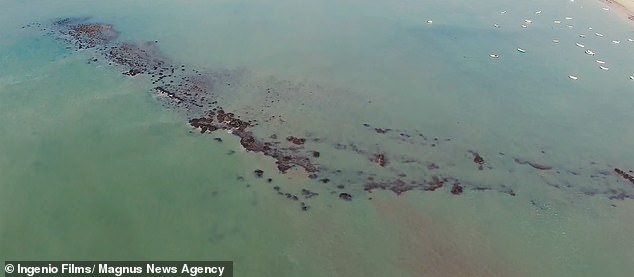
The location of the lost city of Atlantis may finally have been discovered, according to one team of historians.
Ancient ruins examined using satellite imagery provide evidence that the city's huge harbour walls once stood in southern Spain, the experts say.
Many of the sites studied by the team were already known to archaeologists, and are thought to have been constructed by the ancient Romans and Greeks.
Now researchers at private satellite imaging firm Merlin Burrows claim to have found evidence that the sites were in fact built by a mysterious ancient people known as the Atlanteans.
Atlantis was recorded in the writings of Greek philosopher Plato, who in 400 BC described an advanced island civilisation that ruled a vast maritime empire, some 9,000 years before his own era.
The city of Atlantis at the centre of this empire was described as having an enormous harbour wall, huge entrance pillars, a temple to the god Poseidon and massive circular pieces of land carved out by the Atlanteans to live on.
It is thought a cataclysmic natural disaster, such as a tsunami or volcanic event, eventually wiped out the Atlanteans, consigning their legacy to legend.
Scientists are yet to find conclusive evidence that Atlantis existed. Many scholars believe Plato invented the story as a way to present his philosophical theories.
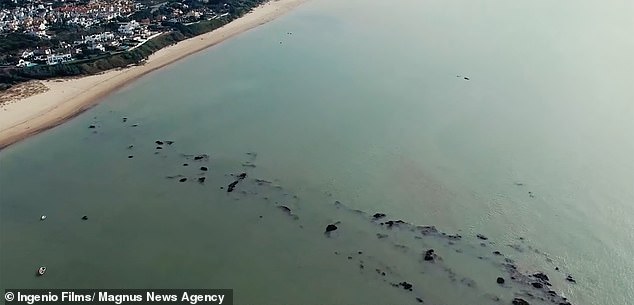
Picture shows what UK firm believes are the remnants of the harbour wall of Atlantis which was said to five-and-a-half miles long. Plato wrote that this wall was '50 stadia long' which would make it around five-and-a-half miles (9 km) in length
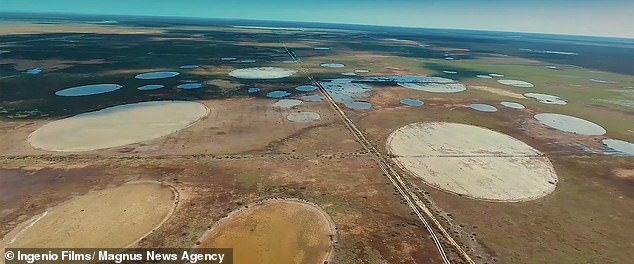
Image shows formations inside the Doñana National Park, Andalucia, Spain. They may be evidence of islands depicted by Plato in his story of Atlantis. The philosopher described how buildings were propped up on a mixture of natural and man made island structures
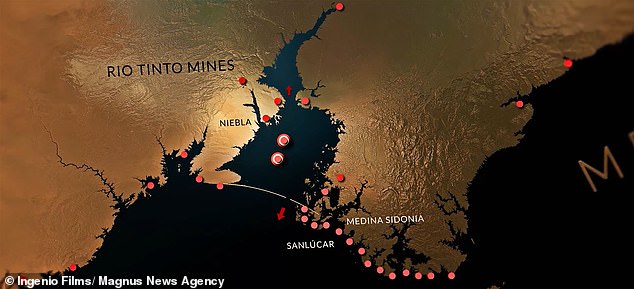
Pictured are a selection of the sites studied by the team at Merlin Burrows, a satellite imaging company based in Yorkshire. The white line shows where researchers believe the harbour wall described by Plato was built
Experts at Merlin Burrows believe the flooded ruins of the legendary city are off the coast of southern Spain.
The location is somewhere north of the city of Cadiz, Andalucía, centred around the Doñana National Park, which the historians believe was once a vast inland sea.
And they claim that south and north of the park there is further evidence of the ancient civilisation, with 15 other settlements dotted along the coastline.
Most of these settlements are believed to be of Roman or Greek origin by archaeologists, as each civilisation once occupied the area.
But now using unique satellite investigation techniques, aerial photography and ground observations of the site, British experts believe they have found all the features of Atlantis Plato described and evidence of how they were destroyed.
Although some scholars believe Atlantis to be a myth, Merlin Burrows claim their discoveries will once and for all prove the lost civilisation existed.
Maritime historian Tim Akers, head of research at Merlin Burrows, said not only had they discovered Atlantis, but also found the people were incredibly advanced.
He said 'laboratory analysis' of material recovered from Spain showed evidence of a type of cement not seen before, as well as ancient advanced metallurgy.
A greenish blue patina has been found covering some of the ruins which tests have shown is an ancient combination of metals.
He said: 'Plato describes in detail a patina on the buildings and structures of the cities and temples making up this complex.
'We have filmed clear evidence and have collected samples which have been scientifically tested in a lab in Modena, Italy, which is used to test ancient Roman finds.
'The results of the tests prove the age of the finds are older than Roman or Greek, and that they were more advanced.'
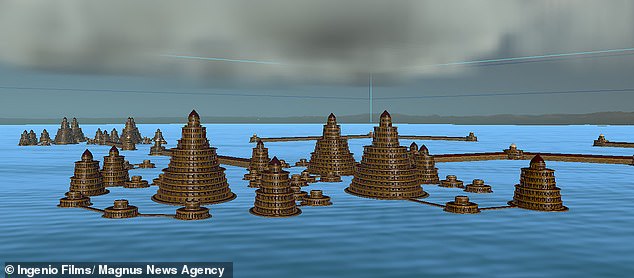
This image shows a computer mock-up of what the team believes the city of Atlantis would have looked like. Buildings were constructed on island platforms dotted throughout a stretch of inland sea that has since filled with sediment at what is now Doñana National Park in Spain
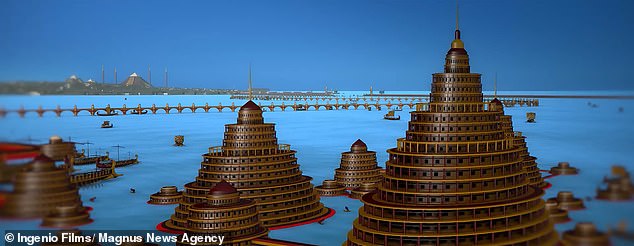
The city of Atlantis was described by Plato as having, among other features, an enormous harbour wall and huge entrance pillars. It had a temple to the god Poseidon and massive circular pieces of land carved out by the Atlanteans to live on
Aerial images of the site where Merlin Burrows believes Atlantis once stood show what they think is evidence of a harbour wall – an incredible 75 metres (245 ft) thick.
Plato wrote that this wall was '50 stadia long' which would make it around five-and-a-half miles in length.
Satellite images show what Merlin Burrows claim is evidence still visible today of sand dunes where this massive wall was destroyed by a huge influx of water.
The same water which eventually filled the inland sea with sediment and destroyed Atlantis.
Tim said: 'The site is spread over 100 miles from the Atlantic to the Mediterranean, as to age as yet we have been unable to give a fixed date for the beginning, but its end was at the last Ice Age around 10,000 years ago.
'At the centre of the line of coastal cities was one gigantic inland sea 65 miles long, filled with multiple islands, some natural, others man-made.
'The main complex consists of two distinct individual multi-Island platforms.
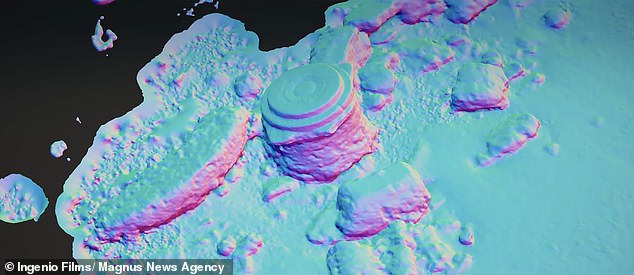
This radar scan from Merlin Burrows shows what they claim is a foundation that once help up a building of Atlantis. It was discovered on a beach in southern Spain
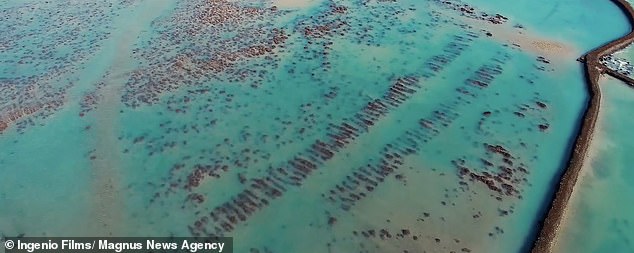
Image shows an aerial of some of the ancient structures which litter the western Andalucian coastline. Romans, Greeks both are recorded as settling there. However, British historians believe that many of the ruins were in fact part of the city of Atlantis
'And one is offset from the other so that anyone on those islands can see every island in the complex.
'It is unique, nowhere in our world is there anything resembling this, and the structures match exactly Plato's dimensions with no deviation. It is absolutely spot on.
'Investigations in Doñana lead to the conclusion that there have been two natural disasters (tsunamis) that caused the islands and dry areas to sink, one of which happened around 1500 BC and the other 200AD. There is also evidence of a tsunami event in the Bible.'
Merlin Burrows have now recorded a documentary film about their mission to reveal Atlantis called 'Atlantica'.
In the film the team visit sites they believe still show clues to the past people that once lived there, right up to the naming of the ancient town in the region Medina-Sidonia.
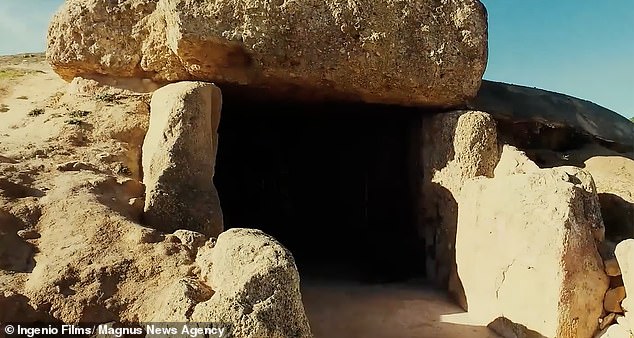
Pictured is the Dolmen of Menga, an incredible 5,500 year old burial tomb built into a mountain near the team's Atlantica site. They suggest the tomb may have formed a part of the ancient city of Atlantis
Aerial images of the site where Merlin Burrows believes Atlantis once stood show what they think is evidence of a harbour wall (pictured), which was an 75 metres (245 ft) thick
The settlement is believed to be the oldest city in Europe and its name means City of Sidon – the word Sidon which could be linked to Poseidon.
Tim said much of what Merlin Burrows have found today with their technology is thanks to Plato's original descriptions.
He said: 'Plato describes the location exactly and all we did was follow in his footsteps the way ancient seafarers would have travelled to the cities.
'We explain why, people have misunderstood the circles of Atlantis and why no one had seen these stunning complexes before.
'The site has both Tartessian, Greek, Phoenician, and Roman additions and our scans show multiple occupations over time till there final and ultimate destruction.
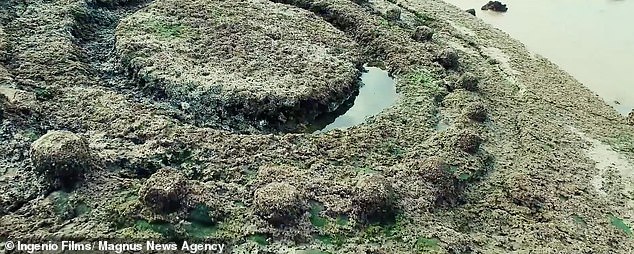
This image shows detail on a stone object on a beach north of Cadiz, Andalucia, Southern Spain. Merlin Burrows claims this structure dates back to the time of Atlantis and is not a later Greek or Roman artefact, as many archaeologists believe
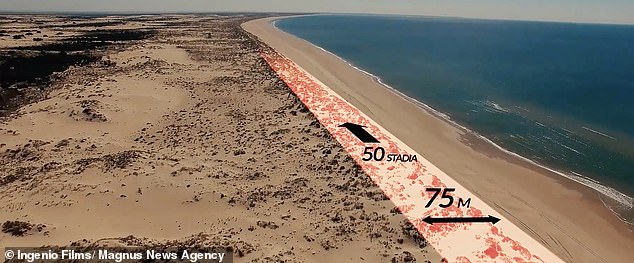
Picture shows a beach north of Cadiz, Andalucia, Southern Spain. Merlin Burrows, a British satellite firm believes the beach hides the once massive harbour wall of Atlantis
'We only present the facts and try not to delve into speculation. What is unique in our presentation is all of this material has never been seen before.'
Now Merlin Burrows hope recognition of both their discovery and distribution of the film will help protect the region for future generations and secure funding for further study.
Tim said: 'To understand Atlantis is to understand the ways of ancient life as it was at the peak of human life on earth.
'We would hope that the people in southern Spain would benefit from the knowledge of their ancient past.
'That all the sites are protected, and in some cases moved, so we can all enjoy them in the future. Also, that the regions would benefit from the tourism both in work and other opportunities.
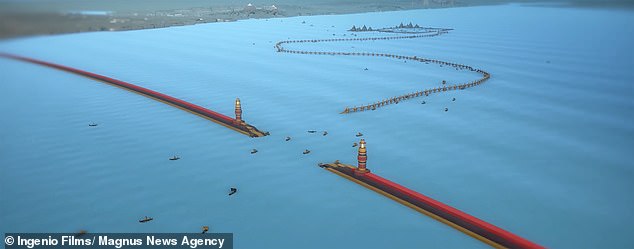
This computer generated image shows what the massive 75 metre wide, five-and-a-half-miles-long harbour wall that some believe protected Atlantis may have appeared
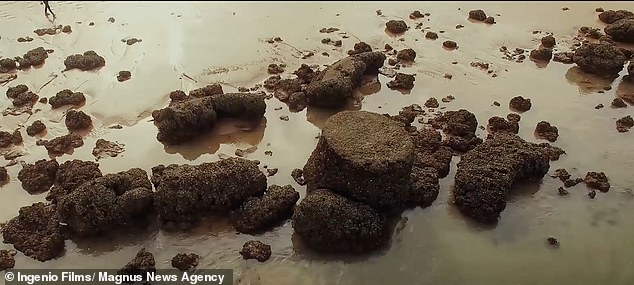
This image shows ancient structures on a beach near Cadiz, Andalucia, Southern Spain. The team believes these are from Atlantis, and not later Roman or Greek additions, which is currently the accepted origin by most archaeologists
'New museums and scientific study centres would enhance the economy and open active debates to the early origins of man.'
Documentary filmmaker Michael Donnellan has produced the film 'Atlantica' about Merlin Burrows discovery.
Michael, who has studied classical Greek and Minoan archeology, travelled to Southern Spain to film what Tim and the team of satellite historians had found.
He said: 'Finding and filming Atlantis has been life changing. Talk about a purpose.
'All my skillsets and passions have come together in the creation of this series of films. The discovery of Atlantis is monumental.
'Suddenly we know, not think, but know that humanity, in an advanced stage of development, existed, so long ago.
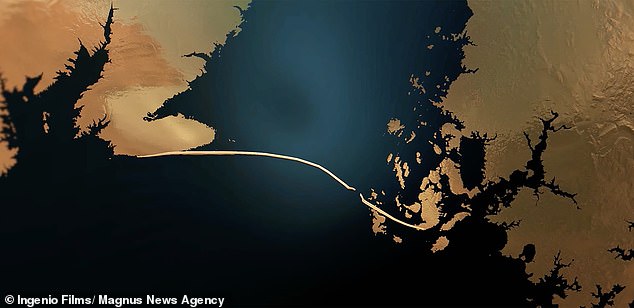
Pictured is a topographical scan of the area of the harbour wall remnants from Merlin Burrows. They claim the wall once guarded the entrace to a vast inland sea which today covers most of the area of Doñana National Park
'And had existed undisturbed for many thousands of years prior to its destruction.
'The imagination boggles when considering their capabilities. We have a lot we can learn from this civilization, to help move our own into a better future.'
Michael said that tests at the Modena Materials Analysis Laboratory in Italy on material taken from the site had revealed amazing results.
He said: 'The harbour wall seems to have had a coating that prevented barnacle growth, like modern Teflon.
'That requires highly advanced construction technologies and knowledge of chemistry.
'We've received overwhelming excitement about our discovery of Atlantis, including a great deal of feedback from our colleagues in academic circles as well.

Image shows Head of Research Tim Akers (left) and CEO Bruce Blackburn (right) from Merlin Burrows, in Harrogate, North Yorkshire
'It is for this reason we continue to include every science available to us, in order to verify all our finds are genuine, and to satisfy every angle we can.'
Material gathered from the Atlantis site, from the habour wall and from the pillars found on the beach, has been tested in Italy at a laboratory used to dealing with Roman finds.
Dr Giacomo Falanga, from the Modena Centro Prove, a chemical testing laboratory in Modena, Italy, said samples from the site included a variety of material.
He said: 'These structures contain binders, like calcite. The presence of mica, potassium, and other trace minerals show proof of artificial mixing of materials, so the samples we have tested are made from an ancient, prehistoric concrete.'
Andrea Carpi, a space materials engineer from the laboratory, said: 'We can confirm with certainty that the samples analysed were the creation of an ancient civilisation with advanced construction methods, which makes me believe that we're talking about a civilisation with very advanced technology.'

The location is somewhere north of the city of Cadiz, Andalucía, centred around the Doñana National Park, which the historians believe was once a vast inland sea
Satellieten spotten oude ruïnes voor de kust van Spanje. Is dit de verloren stad Atlantis?
De locatie van de verloren stad Atlantis is ontdekt, zo beweert althans een team historici.
Oude ruïnes die zijn geanalyseerd aan de hand van satellietbeelden bewijzen dat enorme havenmuren van een verloren stad voor de kust van Spanje ooit in Zuid-Spanje stonden, aldus de experts.
Onderzoekers van de firma Merlin Burrows claimen bewijs te hebben gevonden dat de ruïnes overblijfselen zijn van een stad die is gebouwd door een mysterieus volk, genaamd de Atlantiërs.
De Griekse filosoof Plato omschreef Atlantis als een hoogontwikkelde eilandbeschaving die zo’n 10.000 jaar geleden heerste over een enorm zeerijk.
De stad Atlantis zou hebben bestaan uit een enorme havenmuur, een tempel van Poseidon en verschillende concentrische ringen.
Experts van Merlin Burrows geloven dat de ruïnes voor de kust van Zuid-Spanje restanten zijn van de legendarische stad.
De ruïnes bevinden zich in de buurt van de stad Cadiz in Andalusië, waar volgens de historici ooit een binnenzee was.
Ze claimen dat ten zuiden en noorden van het nabijgelegen nationaal park Donana meer bewijzen zijn te vinden van een oude beschaving.
Zo zijn langs de kust resten gevonden van 15 andere nederzettingen.
Merlin Burrows zegt definitief te zullen bewijzen dat de verloren stad heeft bestaan.
Historicus Tim Akers van Merlin Burrows zei dat tijdens een analyse van het materiaal uit Spanje sporen zijn gevonden van een onbekende soort cement en hoogwaardige metaalbewerking.
Onze resultaten laten zien dat de stad ouder is dan de Romeinen of de Grieken en dat de beschaving die er leefde geavanceerder was, aldus Akers.
[Daily Mail]Exploring Sophia’s multiple intelligencesSophia The Robot, Hanson Robotics Limited's David Hanson, and SingularityNET's Ben Goertzel at RISE 2018.
Have you ever heard that a robot has many different intelligences? This session with Ben Goertzel and David Hanson will show that they can be as broadly intelligent as humans.
An Interview With AI Robot Sophia
Piers Morgan FLIRTS with a robot called Sophia
The Dangers of Artificial Intelligence - Robot Sophia makes fun of Elon Musk - A.I. 2018
My Greatest Weakness is Curiosity | Sophia the Robot at Brain Bar
Scary things said by AI robot Sophia
Top 10 Scary WARNINGS From The Past
Top 10 Scary Things Robots Have Said - Part 2
Top 15 Scariest Things Said By Online Bots
Top 10 Scary Things Robots Have Done
Be Aware! Xinhua's first English Artificial Intelligence Anchor makes debut!

 Angel Gabriel was the UFO seen at Jerusalem, over Dome of Rock temple seen by over 10,000 tourists, Jan 28, 2011, UFO Sighting News.

 Glowing ring UFO recorded over New South Wales, UK on Nov 2018, Video, UFO Sighting News.

 UFO Caught on Video in Northern Ireland Three Minutes before Pilots Sighting, UFO Sighting News.


 Giant UFO Sighted Over Salinas, California ( November 14, 2018 ) UFO Sighting News.


 Satellietbedrijf denkt ruïnes van Atlantis gevonden te hebben: voor de kust van Spanje - HLN.be

Bron: Daily Mail, The Sun
Het eilandenrijk Atlantis werd voor het eerst beschreven door de Griekse filosoof Plato. Hij had het over een vergevorderde beschaving, die heerste over een maritiem rijk, zo’n 11.000 jaar geleden. De hoofdstad zou gigantische havenmuren gehad hebben met grote zuilen, een tempel die gewijd was aan de zeegod Poseidon en cirkelvormige stukken land, waarop de bewoners leefden. Het rijk zou ten onder gegaan zijn door een enorme natuurramp, zoals een vulkaanuitbarsting of tsunami.
Bewijsmateriaal voor het bestaan van de beschaving werd tot nu toe niet gevonden en heel wat wetenschappers geloven dan ook dat de stad een hersenspinsel was van Plato, waarmee hij zijn filosofische theorieën probeerde uit te leggen. Daar denkt Merlin Burrows anders over.
Volgens het bedrijf liggen de ruïnes van de beschaving voor de Spaanse kust, ten noorden van de stad Cadiz. In de buurt van nationaal park Doñana, waarvan wetenschappers denken dat het ooit een binnenzee was. En het beweert dat er ook ten noorden en ten zuiden van het park bewijsmateriaal te vinden is van de oude beschaving, in de vorm van resten van 15 andere nederzettingen in zee. (lees hieronder verder)
 Merlin Burrows@BruceMerlinB
Check out the short film on this piece by the Sun #INGENIO - #MERLINBURROWS - #ATLANTIShttps://bit.ly/2K83Qnf
Ancient flooded ruins off Spanish coast are lost city of Atlantis, satellite experts claim
Ancient flooded ruins off the Spanish coast are the lost city of Atlantis, a UK team of satellite historians claim. Antiquity specialists Merlin Burrows believe the ruins of the legendary civiliza…
thesun.co.uk
De experts gebruikten satellietbeelden, luchtfotografie en grondobservaties om hun vaststellingen te doen en vonden naar eigen zeggen opmerkelijke parallellen met het verhaal van Plato. Volgens Tim Akers – een maritiem geschiedkundige die de onderzoeksafdeling bij Merlin Burrows leidt – zouden de bewoners bovendien erg ontwikkeld geweest zijn. Zo werd een type cement gevonden dat nooit eerder werd gezien en werden er geavanceerde metalen gebruikt. Sommige ruïnes waren bedekt met een turquoise legering, zoals die beschreven werd door de Griekse filosoof.
Stalen van het materiaal werden getest in een gespecialiseerd laboratorium in het Italiaanse Modena, het Modena Centro Prove, dat vooral Romeinse resten onderzoekt. “Ze bleken ouder dan de bekende Griekse en Romeinse resten en verder ontwikkeld”, aldus Akers.
“De stalen bestonden uit oud, prehistorisch beton”, aldus dr. Giacomo Falanga van het Modena Centro Prove. Zijn collega Andrea Carpi voegt toe: “De stalen werden met zekerheid gemaakt door een eeuwenoude beschaving met geavanceerde bouwmethodes. Het doet me geloven dat we het over een beschaving hebben die technologisch ver ontwikkeld was.”
Volgens Merlin Burrows is op luchtbeelden ook bewijs te zien van een havenmuur die 75 meter dik was. Volgens Plato strekte die zich uit over een afstand van 8,8 kilometer. Op satellietbeelden zijn duinen te zien op de plaats waar de muur vernietigd zou zijn door het water. Hetzelfde water dat de binnenzee vulde met sediment en een einde maakte aan Atlantis.
“De hele site strekt zich uit over een oppervlakte van 160 kilometer, van de Atlantische Oceaan tot de Middellandse Zee”, aldus Akers. “Ongeveer in het midden van al die nederzettingen was een gigantische binnenzee van 100 kilometer lang, waarin verscheidene eilanden lagen. Sommige waren natuurlijk, andere door de mens gemaakt. Het hoofdcomplex bestond uit twee platformen van waaruit je de hele eilandengroep kon zien. We weten niet wanneer de beschaving gesticht werd, maar vermoeden dat ze verdween op het einde van de laatste ijstijd, zo’n 10.000 jaar geleden.”
Volgens Akers is er nergens ter wereld iets soortgelijks te vinden en komen de structuren in dimensie exact overeen met wat Plato schreef. Twee tsunami’s – eentje in 1500 voor Christus en eentje in 200 na Christus – zouden de laatste resten van de eilanden verzwolgen hebben.
Het bedrijf liet intussen een documentaire filmen over de ontdekking – Atlantica – die later uitkomt. Er werd al een trailer online gezet. Met het project hoopt Merlin Burrows het gebied te beschermen voor de toekomst en fondsen te verzamelen voor verder onderzoek.
Hidden Crater Under Greenland May Explain Sudden Climate Change
Those looking to bolster their argument that not all climate change is manmade may have received an early Christmas gift – researchers have found a massive hidden asteroid impact crate under Greenland whose age coincides with the beginning of a previously unexplained cooling period about 12.000 years ago. Does this change everything?
“The crater is exceptionally well-preserved, and that is surprising, because glacier ice is an incredibly efficient erosive agent that would have quickly removed traces of the impact. But that means the crater must be rather young from a geological perspective.”
In a press release announcing the study “A large impact crater beneath Hiawatha Glacier in northwest Greenland” published in the current edition of Science Advances, co-author Professor Kurt H. Kjær from the Center for GeoGenetics at the Natural History Museum of Denmark describes how researchers first found signs pointing to the existence of the crater under Greenland’s ice sheet in July 2015. It was not far from where a 20-ton iron meteorite had been discovered, but that wasn’t enough to connect the dots.

Is any part of Greenland not covered by glaciers?
A German research plane from the Alfred Wegener Institute flew over the Hiawatha Glacier and, using a new ice radar system, was able to better image the depression and added to the evidence, exciting NASA glaciologist Joseph MacGregor. (Pictures here.)
“A distinctly circular rim, central uplift, disturbed and undisturbed ice layering, and basal debris. It’s all there.”
Surface expeditions in 2016 and 2017 collected samples of sediment washed out from under the depression and found the missing link.
“Some of the quartz sand washed from the crater had planar deformation features indicative of a violent impact, and this is conclusive evidence that the depression beneath the Hiawatha Glacier is a meteorite crater.”
The crater measures more than 31 km (19.25 miles) in diameter, which puts the size of the iron meteorite at 1 km (.6 miles) wide and puts the impact in the top 25 of Earth impact craters, making it a good candidate for causing ecological disasters. Ice layers show it’s at least 12000 years old and rock erosion samples say it’s no more than 3 million years old.
It’s the more recent date that has scientists linking the event to the Younger Dryas period – a sudden unexplained cooling during a time of global warming after the last ice age. Occurring about 12,900 to 11,700 years ago, geological records in the Northern Hemisphere indicate a swift drop in temperatures of 2 to 6 degrees Celsius (3.6 to 10.8 degrees Fahrenheit), increases in glacier ice and cold waters in the Atlantic and general drier conditions. While the cooling was widespread, a few areas, southeastern North America for one, had a slight warming. The Younger Dryas coincided with a number of human cultures shifting from hunting and nomadic life to agriculture and settlements. In North America, the Clovis culture declined and a number of animal species went extinct.

All of these things could certainly have been caused by a meteor impact of catastrophic size. Is that the answer to the cause of the Younger Dryas that scientists have been searching for?
“The next step in the investigation will be to confidently date the impact. This will be a challenge, because it will probably require recovering material that melted during the impact from the bottom of the structure, but this is crucial if we are to understand how the Hiawatha impact affected life on Earth.”
Sounds like Kjær is making his plans for next summer. Pack a parka, professor!
 World's hottest chilli which 'can bring a grown man to...
 Face ID fails for iPhone: Users take to social media to...
 Secret of the northern lights is revealed: Scientists follow...
 Google wants to put a virtual assistant in every room of the...

