Ontdek de Fascinerende Wereld van UFO's en UAP's: Jouw Bron voor Onthullende Informatie!
Ben jij ook gefascineerd door het onbekende? Wil je meer weten over UFO's en UAP's, niet alleen in België, maar over de hele wereld? Dan ben je op de juiste plek!
België: Het Kloppend Hart van UFO-onderzoek
In België is BUFON (Belgisch UFO-Netwerk) dé autoriteit op het gebied van UFO-onderzoek. Voor betrouwbare en objectieve informatie over deze intrigerende fenomenen, bezoek je zeker onze Facebook-pagina en deze blog. Maar dat is nog niet alles! Ontdek ook het Belgisch UFO-meldpunt en Caelestia, twee organisaties die diepgaand onderzoek verrichten, al zijn ze soms kritisch of sceptisch.
Nederland: Een Schat aan Informatie
Voor onze Nederlandse buren is er de schitterende website www.ufowijzer.nl, beheerd door Paul Harmans. Deze site biedt een schat aan informatie en artikelen die je niet wilt missen!
Internationaal: MUFON - De Wereldwijde Autoriteit
Neem ook een kijkje bij MUFON (Mutual UFO Network Inc.), een gerenommeerde Amerikaanse UFO-vereniging met afdelingen in de VS en wereldwijd. MUFON is toegewijd aan de wetenschappelijke en analytische studie van het UFO-fenomeen, en hun maandelijkse tijdschrift, The MUFON UFO-Journal, is een must-read voor elke UFO-enthousiasteling. Bezoek hun website op www.mufon.com voor meer informatie.
Samenwerking en Toekomstvisie
Sinds 1 februari 2020 is Pieter niet alleen ex-president van BUFON, maar ook de voormalige nationale directeur van MUFON in Vlaanderen en Nederland. Dit creëert een sterke samenwerking met de Franse MUFON Reseau MUFON/EUROP, wat ons in staat stelt om nog meer waardevolle inzichten te delen.
Let op: Nepprofielen en Nieuwe Groeperingen
Pas op voor een nieuwe groepering die zich ook BUFON noemt, maar geen enkele connectie heeft met onze gevestigde organisatie. Hoewel zij de naam geregistreerd hebben, kunnen ze het rijke verleden en de expertise van onze groep niet evenaren. We wensen hen veel succes, maar we blijven de autoriteit in UFO-onderzoek!
Blijf Op De Hoogte!
Wil jij de laatste nieuwtjes over UFO's, ruimtevaart, archeologie, en meer? Volg ons dan en duik samen met ons in de fascinerende wereld van het onbekende! Sluit je aan bij de gemeenschap van nieuwsgierige geesten die net als jij verlangen naar antwoorden en avonturen in de sterren!
Heb je vragen of wil je meer weten? Aarzel dan niet om contact met ons op te nemen! Samen ontrafelen we het mysterie van de lucht en daarbuiten.
Zondag 6 januari 2019
DRIE RIVIEREN KLEUREN ROOD
DRIE RIVIEREN KLEUREN ROOD
Terwijl een groot deel van de Krakatau vulkaan in zee verdwijnt, kleuren ineens op drie verschillende plekken rivieren rood.
In Indonesië zijn zeker 222 mensen omgekomen en 843 anderen gewond geraakt doordat eilanden in de Straat van Sunda en kustgebieden van West-Java en Zuid-Sumatra door een tsunami zijn getroffen.
Uitgaand publiek en mensen op de stranden werden volkomen verrast toen even voor 21.30 uur lokale tijd een muur van water op hen afkwam en alles wat hij tegenkwam zo'n 15 tot 20 meter meesleurde of vernielde. Wie kon wegkomen, vluchtte naar hoger gelegen gebied.
Een woordvoerder van rampenbestrijdingsdienst BNPB vermoedt dat de tsunami is veroorzaakt door ondergrondse aardverschuivingen na een uitbarsting zaterdag van de vulkaan Anak Krakatau, in de Straat van Sunda.
Zoals we regelmatig schrijven lijkt het er veel op dat we ons in wat men noemt de eindtijd bevinden. Steeds vaker komen profetieën vanuit verschillende religieuze overtuigingen uit, zoals we onlangs zagen met het groen worden van Saoedi Arabië.
Toevalligerwijze kwamen we de volgende zin tegen op een website die zich vanuit een bijbels perspectief met de eindtijd en de daarbij behorende teken bezighoudt:
Een reusachtige vulkaan stort in de zee met als gevolg dat 1/3 deel van de zee in bloed verandert.
We hebben nu een reusachtige vulkaan die in ieder geval voor een groot deel in de zee verdwijnt, maar geen zee die in bloed verandert.
Het eerste bloedgekleurde water deed zich voor in de Oost Afrikaanse republiek Malawi, waar verbaasde inwoners ’s morgens een bloedrood riviertje zagen stromen. Het betreft hier de Linthipe rivier in Dedza.
Niemand weet met enige zekerheid waar de rode kleur vandaan komt, alhoewel geologen heel snel zijn met te zeggen dat komt door een lokale mijn. En er zijn er ook die zeggen dat het algen zijn.
De tweede rood gekleurde rivier deed zich voor in Indonesië, in de provincie Papua. Ook hier was men sprakeloos en werd er geen verklaring voor gevonden.
Ook het derde geval deed zich voor in Indonesië, waar enkele weken geleden de Logawa Banyumas rivier op Java eveneens bloedrood kleurde. Ook hier geen enkele concrete aanwijzing over wat dit zou kunnen veroorzaken.
Einde-tijds-verschijnselen of een toevallige samenloop van omstandigheden?
Modern people have recently become reacquainted with the practice of flaying, at least conceptually. That’s due, in no small part, to A Song of Ice and Fire and its television adaptation “Game of Thrones” being the hottest pop-culture phenomenon this side of Tatooine for almost a decade. What all that blood and boiled leather does to a society’s collective psyche is anyone’s guess, but its probably nothing we can’t handle. People have done horrible things to each other for a very long time, and long before Roose Bolton and his flayed man sigil were but a twinkle in George R.R. Martin’s eye, there was a Mesoamerican god called Xipe Totec—”Our Lord the Flayed.” Mexican archaeologists have recently made the first discovery of a temple to Xipe Totec, and reader beware, it ain’t for the faint of heart.
Xipe Totec was a fertility and agriculture god who symbolized the cycle of death and rebirth. He also invented war. The Flayed Lord was depicted as having flayed his own skin as a sacrifice to feed his people, as well as wearing the skins of human sacrifices. Despite the incredibly grim imagery, Xipe Totec wasn’t a villain as far as gods go. Worship of Xipe Totec predates the Aztec civilization, but, like many other gods and religious practices, he was assimilated after Aztec conquest. The recently discovered temple, which archaeologists believe to be the first temple to Xipe Totec ever found, was built by the Popoloca Indians in the central Mexican state of Puebla between A.D. 1000 and 1260.
Statue of Xipe Totec, the Flayed Lord
Inside the temple archaeologists found art depicting the Flayed Lord as well as a few relics of ceremonial practices. These relics include two enormous clay heads with the most terrifying grinning faces ever dug out of the ground and a statue of Xipe Totec depicting him wearing the skin of a human sacrifice. Religious ceremonies devoted to Xipe Totec were conducted by priests who wore the actual skins of human sacrifices, and the two clay heads were used to plug the pits where the flayed skins were kept. Remember, you were warned.
Whether or not the actual flaying was done at this site is a different matter. Speaking to the Associated Press, University of Florida archaeologist Susan Gillespie(who was not involed with the project) said:
“[A] singular temple to this deity (whatever his name in Popoloca) does not necessarily indicate that this was the place of sacrifice. The Aztec practice was to perform the sacrificial death in one or more places, but to ritually store the skins in another, after they had been worn by living humans for some days. So it could be that this is the temple where they were kept, making it all the more sacred.”
Drawing of an Aztec temple.
And all the more disturbing. Regardless of the exactly who flayed who and where, archaeologists say this is a major discovery. The team who made the discovery plan to continue excavating the site and expect to find more depictions of the Flayed Lord. Maybe we’ll be desensitized enough by then to read about it with a full stomach.
Following the launch of rockets, satellites and, eventually, people into outer space, it became commonplace to hear that humankind had entered the “Space Age.” While true, the innocence of our early space explorations seems to pale compared to what we are achieving today: remotely-operated probes are now reporting back to us with images of objects further from Earth than we once might have dreamed, and the further we push the boundaries of space with our explorations, the smaller our little world seems to feel.
Such innovation has fueled the aspirations of those like Elon Musk, who remains among a vocal contingent of technologists and futurists who aspire to reach the stars. For people like Musk, colonizing other worlds may not just be an eventuality for humankind, with our desire for the exploration of other worlds; our survival may even depend on it.
Others aren’t so convinced. One vocal opponent of this “other worlds, or else” mentality has been science popularizer Bill Nye, who argues that not only is the prospect of colonizing planets like Mars in the near future unrealistic, but it may be impossible.
“This whole idea of terraforming Mars, as respectful as I can be, are you guys high?” Nye told USA Today late last year. “People disagree with me on this, and the reason they disagree is because they’re wrong.”
However, while Mars seems a bit far off, perhaps there are nearer orbital bodies in space that might qualify. With news of China’s recent exploration of the Moon’s far side with its Chang’e-4 probe, some are now asking whether a moon base could be in our future.
Following the big announcement about the Chang’e-4 Lunar Lander, LA Times reports that “Chinese scientists have already declared China’s ambitions to establish a manned moon base andto send nuclear-powered rockets into space in future decades to colonize and exploit space.”
China’s intentions, according to a previous statement to the media, is now to “set the rules of the game in outer space,” establishing a new precedent for space exploration, and perhaps an all-new meaning behind the idea of the “space age.”
They’re wasting no time, either. Subsisting on a steady diet of carrots, potatoes, and yes, mealworms (for protein) along with other high-energy vegetables, a group of eight volunteers concluded a year-long experiment in bio-regenerative living at the astronautics facilities at Beihang University in May. The study, which also became a record-breaking experiment in sustained living in an enclosed system (recycling food, air, water… everything, essentially) was aimed at innovating long-term occupation in a lunar environment.
The Chinese aren’t the only ones making plans for moon bases and long-term lunar occupation. Last year, NASA announced its own plans for a moon base, which will serve not only as a base for future lunar studies but as a stopover for future space travelers on their way to Mars.
NASA is building a plan for Americans to orbit the Moon starting in 2023, and land astronauts on the surface no later than the late 2020s. This will be the first chance for the majority of people alive today to witness a Moon landing – a moment when, in awe and wonder, the world holds its breath. However, America will not stop there.
A key component of establishing the first permanent American presence and infrastructure on and around the Moon is the Gateway, a lunar orbiting platform to host astronauts farther from Earth than ever before.
On the Gateway, America and its partners will prepare to transit deep space, testing new technologies and systems as we build the infrastructure to support missions to the surface of the Moon and prepare for the epochal mission to Mars.
With both China and the U.S. expressing renewed aspirations for lunar bases, it seems we’re looking at more than just a new kind of 21st century “Space Age”: we’re in the midst of an all-new space race, too, and have been for a while, it seems (although the moon base idea isn’t really anything new, as these documents declassified in 2014 show).
“By the late 2020s,” NASA’s press release from Sept. 26, 2018 reports, “a lunar lander capable of transporting crews and cargo will begin trips to the surface of the Moon.”
“The sustainable, long-term lunar surface activities enabled by these efforts, in tandem with the Gateway, will expand and diversify over time, taking advantage of the Moon and near space for scientific exploration in the broadest sense.”
Broad indeed… and no longer just “to the moon and back.” Try, to the moon, and beyond!
The plane passenger on board of the commercial airliner 'Flying Swoop Airlines' flying from Hamilton to Abbotsford on November 30, 2018 was about halfway through he flight when he spotted a huge cigar-shaped object in the distance.
He states that the window was facing north, so we are looking at the Arctic, Nunavut, and Alberta.
The passenger was able to film the UFO that seems to be parked at high altitude.
This is the incredible moment an object flew across New Zealand and lit up the sky, as experts claim it's a meteorite.
Residents scattered across the country's North Island reported sightings of bright lights zooming through the sky at 9pm.
Many were unsure whether the falling object was a piece of space junk re-entering the earth's atmosphere, or a possible meteorite.
Many were unsure whether the falling object was a piece of space junk re-entering the earth's atmosphere, or a possible meteorite
President of the Auckland Astronomical Society Bill Thomas told the NZ Herald he found it more likely the object was a meteorite.
'There's a visible sort of tail, whereas a satellite [is] like a point of light moving across the sky ... bright [meteorites] like that one as not that common in the one place, but they're common worldwide.'
New Zealand Police posted an alert saying they're aware of the meteor: 'Rest assured, we have confirmed with our Paranormal Division, and it is nothing to be concerned about.'
People around the country managed to catch a glimpse of the mysterious object, with many managing to capture it on camera.
Graham Billings was enjoying dinner at an Italian restaurant when he saw the light fly across the sky.
'It was definitely a meteor. I wondered what it was for a bit but we can still see the smoke trail,' Mr Billings said.
In Whangamata, Jen Maloney and her friends saw the object light up the sky twice, once at 8.55pm and another one 15 minutes later.
This is the incredible moment an object flew across New Zealand and lit up the sky, as experts claim it's a meteorite
Ms Maloney described the light show as green, beautiful and dramatic, leaving a 'singe' smell afterwords.
One couple were in Auckland discussing the dangers of the use of drones when they looked up to the sky and thought they spotted one.
What May and Brian Seager actually saw was the meteorite whizzing through the sky above them.
'It was a bright light and then it went green and left like a vapour trail. It was going way too fast [to be a drone] and it looked like it broke up into two pieces afterwards.'
More than 400 kilometres south, Steve Bloor saw a dazzling display in Napier.
Mr Bloor said when he saw the object - that he first believed to be a jet plane - it exploded into millions of pieces, like fireworks.
Residents scattered across the country's North Island reported sightings of bright lights zooming through the sky at 9pm
This image provided by NASA shows a 'Blue Marble' image of the Earth on Jan. 24, 2012.
NASA via AP
By Seth Shostak
How special are we? A recent research paper suggests that terrestrial-style biology may be rare, and Earth may be among the first examples of a planet able to sustain life in the cosmos. Even as the new kids on the block, humans are seemingly one of the precious few instances of intelligence to arise in the universe since the Big Bang did its thing.
Harvard Astronomer Avi Loeb and his colleagues in the U.K. have argued that the halcyon days for life are still to come. It’s not even morning in the universe; it’s pre-dawn. Biology may erupt like weeds on an untold number of worlds, but if so, the infestation will take place tens of billions of years in the future.
Why’s that? And what’s wrong with life sprouting up today?
Obviously nothing. After all, you’re reading this — you, the distant descendant of a small collection of molecules that stumbled on a method for building nearly exact replicas of itself nearly four billion years ago. No scientist is yet sure if this molecular sleight-of-hand is just some sort of highly unlikely event, although opinions abound.
The new argument that primetime for an inhabited universe is still to come springs from astronomy, not biology. Loeb et al.’s proposition begins with the belief that life requires a few essential ingredients: a world that’s amenable to easy chemistry, including liquid water, thick atmosphere — you know the drill. As best we can tell, there’s no shortage of such Goldilocks orbs — there may be tens of billions of Earth-like planets in our galaxy, and that’s not even counting habitable moons.
An abundance of real estate is essential for this growth, yes. But so is time. Rustling up life, especially of the intelligent variety, might take billions of years.
The argument is straightforward: The longer you wait, the more examples of biology you’ll have. But stars like our Sun can’t wait too long: there’s a relatively short opportunity to strut and fret. In 10 billion years, they’ve run through their easily accessible fuel, and are headed out the door.
An artist's impression shows an earth-like planet around the red dwarf Gliese 581, which is 20.5 light-years away in the constellation Libra.ESO via Getty Images
But consider red dwarf stars, the runts of the universe. Their masses are considerably less than Sol’s, which means they burn more slowly. The consequence? Red dwarfs with one-tenth the mass of the Sun have lifespans that are up to a thousand times longer.
All else being equal, that would give red dwarfs a thousand times the probability of eventually using its energy to host a world with life. Clearly, it’s most probable that this life would arise not when these stars are still young — which they all are now — but instead during their long adulthood. In other words, the red dwarfs are just getting started, and their biologically fecund years are still ahead.
And here’s an additional fillip: Red dwarfs are as plentiful as bad drivers, comprising three-fourths of all stars. So not only are they individually a thousand times more likely to become winners in the biology lottery, there are a lot more of them buying tickets.
Loeb argues that, looking back on creation ten trillion years from now when the curtain is falling on the universe-as-we-know-it, you’d have to say that the overwhelming majority of life arose around red dwarf stars – and on average, trillions of years after Earth was over and done.
A reconstruction of an early human at the Museum of Natural History in New York.Kike Calvo / AP
So among inhabited planets it sounds as if Earth beat the rush. From the standpoint of future cosmic civilizations, we are the ancient aliens.
But is that so remarkable? Maybe not. Consider being a citizen of Rome during its Empire. There were about 200 million people in the world then. If you were particularly insightful, it might occur to you that the future human population could be much greater — indeed, there's now 35 times as many people as strolled the world at the time of Jesus.
So that would make Romans special, right? There was a far greater probability that they’d be born after the Renaissance then in the time of the Caesars.
However, while interesting, that’s not to say the Romans were by any means the first humans or even the first to be somewhat civilized. There were 10,000 generations of Homo sapiens before them, and neither they nor the Romans would appreciate being dismissed by the claim that “the best was yet to come.”
The galactic hordes may still be ahead, but that’s little reason to wait before trying to find some cosmic company. Are you willing to wait 500 billion years before learning whether anyone’s out there? That's more patience than I have.
Seth Shostak is the Senior Astronomer at the SETI Institute, in Mountain View, California. He writes frequently on astronomy and other topics, and hosts the SETI Institute’s weekly radio show, “Big Picture Science.”
For more of the breakthroughs changing our lives, follow NBC MACH.
Mystery event that saw mountain crash into river 'may have been UFO attack'
A MYSTERIOUS “blitzkrieg” which led to the side of a mountain crashing into a Siberian river was either a UFO attack or a giant meteorite strike, according to a majority of Russians.
The claims about the incident – known as the Bureya Bliztkrieg – come amid a new report which said a “reliable” witness saw a “huge green-coloured body with a very long tail” streaking vertically downwards in the night sky on December 15.
Hunters who first reached the scene - alerted by a sudden and inexplicable change in the flow of the river - reported ‘hot rocks’ on which they could warm their hands
The bizarre event, which took place last month, is under Russian scientific scrutiny after the water flow into a hydro-electric power reservoir was cut due to a massive landfall, creating a 525ft mound which was visible from space rising from the bed of Bureya River in the far east of Russia.
Describing the event one witness said: “It was if as if the mountain had moved.”
BIZARRE: Some people think the incident was a UFO attack (Pic: The Siberian Times)
STRANGE: Satellite image of the Bureya river site - Other people thought it was a meteorite (Pic: The Siberian Times)
Now a poll of the strange event in the Khabarovsk region revealed that a many people thought it was an attack from space.
A total of 27% or people polled said it was a meteorite and 33% thought it was a UFO attack.
The remaining 40% claimed the Bureya Blitzkrieg was caused by a giant landslide.
People who first reached the site of the incident reported hot rocks which they could warm their hands on and a smell “like hydrogen sulphide” and thought the rock fall was caused by a meteorite similar to one which devastated Russia’s Chelyabinsk region 2013.
“I insist it was a meteorite,” said the district government chief of the remote part of the Khabarovsk region where the accident took place, Alex Maslov.
LANDSLIDE: One witness said he saw a 'huge green-coloured body with a very long tail' (Pic: The Siberian Times)
New footage and pictures of the bizarre phenomenon show trees being uprooted or yanked apart with trunks thrown as far as 100ft and large blocks of ice thrown from the river onto the land.
Reports also say an “invisible force” made it seem as if the chunks of ice had flown onto the land.
Alexey Dyundin, 46, a local businessman, was driving through the neighbouring Yakutia region when he witnessed the event which he took to be a meteor strike.
He said: “We saw a huge green-coloured body with a spectacularly bright and very long tail, falling almost vertically at about an 80 degrees angle.
“We saw it right in front of us, falling east to south. It all happened within three or four seconds.”
MYSTERIOUS: One witness said 'it was if the mountain had moved' (Pic: The Siberian Times)
The businessman said he thought the fall was too fast to be a rocket from a space launch coming back to earth- something he had previously seen.
He added: “It was definitely not a rocket stage. They fall much more slowly and they do have a glow when they fall.
“But nothing like the bright green glow we saw. The green glow comes when meteorites contain a lot of iron.
“Our first reaction was, well, hard to publish.
‘“We were so stunned we just exclaimed 'What the **** was that?’ at each other.”
Dyundin said he only realised how significant the sighting was a week later when he saw reports of the Bureya River rockfall.
But data from the European satellite Sentinel suggests the changing face of the river happened between December 9 and December 12- The Siberian Times revealed.
The report said this does not discount the meteorite attack as responsible for the incidents but means that a “space object” as witnessed by Dyundin.
Tourists are now starting to visit the scene of the carnage according to local reports.
Pictures from the site at the Bureya river
Startling new footage shows how a ‘mountain moved’, trees were ‘beheaded’, and blocks of river ice ‘flew’ onto the land
What were the mysterious 'Ravana Rocks' In Sigiriya used for?
According to the Ancient local folk stories .i heard, the palace was defended by various lines of defense mechanisms. Among those defense mechanisms, reflectors take a special place. These reflectors were used to reflect sun rays to the enemy.
According to the folk stories, if someone tried to look directly at the palace they had a chance of ending up blind. The palace even has a wall situated near the main rock named as the "Kedapath Pawura" which stands for "the mirror wall".
So I highly anticipate theses reflectors were a line of defense mechanism to protect the mighty king Rawana's Palace
A New Study Suggests There Could Have Been Intelligent Life on Earth Before Humans
Looking for aliens across deep space is great, but have we looked hard enough in our own terrestrial backyard—here on Earth?
The artist Surian Soosay offers a playful depiction of 'the Silurian Hypothesis'
One author of the new study, leading climatologist Gavin Schmidt, wrote a work of fiction to explore its findings. Read 'Under the Sun', which we published at Terraform alongside the following piece.
The human yearning to connect with other intelligent life-forms runs deep, and it has become the driving force behind a dazzling range of scientific pursuits. From the SETI Institute’s radio sweeps of the sky, to the discovery of liquid water on neighboring worlds, to the thousands of exoplanets detected over the past two decades, there have been major gains in chasing one of the ultimate cosmic mysteries—whether or not we are alone in the universe.
But in our rush to search for life by peering into deep space, have we overlooked the merits of looking for it in deep time? Earth is the only planet that we’re absolutely certain can support a technologically advanced species, yet little thought has been lent to the possibility that during its 4.5 billion year lifespan, our own world might have produced more than one industrialized civilization.
Outside of some science fiction stories and a speculative paper by Penn State astronomer Jason Wright, little serious thought has been afforded to the possibility that we humans are not the first species to build an advanced civilization in the solar system’s history.
“It actually hasn’t been explored that much,” climatologist Gavin Schmidt, director of the NASA Goddard Institute for Space Studies in New York, told me over the phone. “It never gets brought up as a potential thing that you want to look for.”
Published this month in the International Journal of Astrobiology, the work outlines what kind of signature a technologically adept species might leave behind. Schmidt and Frank use the projected footprint of the Anthropocene, the current era in which human activity is influencing planetary processes like climate and biodiversity, as a guide for what we might expect from other civilizations.
“There’s lots of things that are going well for [human civilization], but there’s a big price that’s being paid in the ecology and biology,” Schmidt told me. He emphasized that many of these consequences can seem to be “out of sight, out of mind” due to conveniences like sewage infrastructure and garbage relocation. But when considered in totality, anthropogenic activities really add up, and impact the geological record. “All of the waste and footprint is being hidden from us, but it isn’t hidden from the planet,” he said.
It’s unlikely that any massive telltale structures would remain preserved through tens of millions of years of geological activity—that holds true for both human civilization and any potential “Silurian” precursors on Earth.
Instead, Schmidt and Frank propose searching for more subtle signals, such as byproducts of fossil fuel consumption, mass extinction events, plastic pollution, synthetic materials, disrupted sedimentation from agricultural development or deforestation, and radioactive isotopes potentially caused by nuclear detonations.
“You really have to dive into a lot of different fields and pull together exactly what you might see,” Schmidt said. “It involves chemistry, sedimentology, geology, and all these other things. It’s really fascinating.”
In his spare time, Schmidt also wrote a short story called “Under the Sun,” which Motherboard is publishing alongside this article in Terraform, and which dramatizes some of its key ideas. The story follows Stella, an environmental scientist who stumbles on evidence of past intelligent life in sediments from dating from the Paleocene–Eocene Thermal Maximum (PETM). This warming period occurred approximately 55 million years ago, when “something triggered a massive shift in the global carbon cycle” and “all the environmental indicators went haywire.”
Stella’s fascination with the PETM reflects Schmidt’s own ruminations about this mysterious period of climate change, when average global temperatures were about 8°C Celsius higher than they are today. Some 15 years ago, he was discussing the geological impact of the PETM with colleagues, when he realized it would be somewhat analogous to the predicted aftermath of the Anthropocene.
In “Under the Sun,” that connection between the PETM and the Anthropocene is made explicit—it’s the nuclear fingerprint that gives Stella and her colleagues their Eureka moment. Despite the thrill of this discovery, the story hints at the ominous consequences of detecting radioactive fallout from a past society, even as nuclear sabre-rattling continues unchecked in human civilization.
In this way, Schmidt’s paper and his short story both relate the Silurian hypothesis to the Drake equation, which is a probabilistic approach to estimating the number of intelligent civilizations in the Milky Way, developed by astronomer Frank Drake.
One of the equation’s key variables is the length of time that civilizations are capable of transmitting detectable signals. A proposed reason that we have not achieved contact with an alien species is that this “length of time” variable may be extremely short—either because technologically advanced civilizations self-destruct, or because they learn to live sustainably on their home worlds.
“It might be the detectable period of a civilization is much shorter than its actual longevity, because you can’t last a long time doing the kinds of stuff that we’ve been doing,” Schmidt explained. “You either stop, because you’ve messed it all up, or you learn not to do it. Either way, the burst of activity, wastefulness, and massive footprints is actually a very short amount of time.”
“Maybe it’s happened a billion times in the universe,” he added, “but if it only lasted 200 years every time, then you’d never see it.”
The same logic holds for any previous civilizations that may have flourished on Earth, only to either collapse in ruin or scale down on activities that threaten their lifespan. There are definitely some not-so-subtle lessons that humans can take from this forked path which is, after all, an industrial version of the age-old evolutionary mantra—adapt or die.
That, for Schmidt and Frank, is one of the core themes of the Silurian hypothesis. If we can mull over the possibility that we are not the first Earthlings to have produced a technologically advanced civilization, perhaps we can better appreciate the precariousness of our current situation.
“Our thinking about our place in the universe has been this progressive distancing of ourselves from the study,” Schmidt told me, citing outdated beliefs like the geocentric model of the universe. “It’s like a stepwise retreat from a total self-centered view, and [the Silurian hypothesis] is really just one extra way of doing that.”
“We do need to be objective and open to all sorts of possibilities,” he added, “if we’re going to be able to see what the universe actually has to offer us.”
SHOCK as world-renowned scientist says humans are on the brink of making ALIEN CONTACT
HUMANS are on the brink of contacting alien life, with one of the most respected physicists in the world “sticking his neck out” and predicting it could be within this century, it has been revealed.
Michio Kaku thinks humans will detect aliens before 2100
American theoretical physicist, futurist, and populariser of science, Michio Kaku, thinks humans will detect aliens before 2100 by listening to radio communications, but he does not know if we will be able to talk back to them.
Speaking on an “ask me anything” question and answer session on social media platform Reddit, the futurist answered a Redditor who asked, "Dr Kaku, if we make contact with alien civilisations, then what? And how will we talk to them?"
Dr Kaku replied: “Let me stick my neck out.
“I personally feel that within this century, we will make contact with an alien civilisation, by listening in on their radio communications.
“But talking to them will be difficult, since they could be tens of light years away.
“So, in the meantime, we must decipher their language to understand their level of technology. Are they Type I, II, or III???
“And what are their intentions? Are they expansive and aggressive, or peaceful?”
Types of civilisations represent the three categories in the “Kardashev scale”.
The scale measures a civilisation’s technological advancement based on the amount of energy they are able to use for communication.
Humans are not yet a Type I civilisation because they have not reached a stage of being able to use every ounce of energy on their home planet - which includes solar, thermal, oceanic and more.
Mr Kaku added: "Another possibility is that they land on the White House lawn and announce their existence.
"But I think that is unlikely since we would be like forest animals to them, i.e. not worth communicating with."
Dr Kaku is not the first renowned scientist to predict that humanity will make contact with alien life.
Stephen Hawking recently said that he is "more convinced than ever that we are not alone" and added that humanity should stop reaching out to aliens before it is too late.
GETTY
Dr Kaku is not the first renowned scientist to predict that humanity will make contact with aliens
He added: "One day we might receive a signal from a planet like Gliese 832c, but we should be wary of answering back.
"Meeting an advanced civilisation could be like Native Americans encountering Columbus.
“That didn't turn out so well.”
Dr Hawking is involved in the Breakthrough Listen project, which will scan planets around the nearest million stars for signs of life within radio signals.
GETTY
Stephen Hawking recently said that he is 'more convinced than ever that we are not alone'
Senior astronomer at the Search for Extra-Terrestrial Intelligence (SETI) Institute, Seth Shostak, has placed a wager that we will find signs of alien life within 20 years.
According to the Drake equation, based on the sheer volume of stars in space it is highly unlikely that we are the only life in the universe.
Scientists are currently focussed on radio waves, which Shostak, Hawking, and Kaku all predict will be where alien contact will come through.
Radiowaves stand out from the naturally occurring background noise in the Universe, which typically extends across a much wider frequency range.
Tempel Mexicaanse vruchtbaarheidsgod blootgelegd waar gruwelijke rituelen plaatsvonden: hogepriesters vilden menselijke offers en trokken hun huid aan - HLN.be
REUTERSEen van de twee stenen hoofden die werd ontdekt.
WETENSCHAPIn Mexico hebben archeologen voor het eerst een duizend jaar oude tempel en offerplaats gewijd aan de vruchtbaarheidsgod Xipe Totec ontdekt. Om hun “Gevilde Heer” te eren, offerden de inheemse volkeren een keer per jaar menselijke offers die voor de tempel gevild werden, waarna hogepriesters zich in de huid van de slachtoffers kleedden.
Tijdens het jaarlijkse ‘feest’ Tlacaxipehualiztli, letterlijk vertaald ‘de huid van de gevilden dragen’, offerden de inheemse inwoners gevangenen om zo in de gunst van Xipe Totec te komen, zo noteerden de Spaanse overheersers die honderden jaren geleden op de Azteekse stammen stootten bij hun verkenning van het Mexicaanse binnenland. De gevangenen werden gedood in een soort gladiatorengevecht of met pijlen doorboord. Daarna werden ze gevild en hogepriesters trokken hun huid aan als symbool van wedergeboorte. Het hart werd uit het lichaam gesneden en eveneens geofferd.
Met de ontdekking van de tempel is er nu ook voor het eerst tastbaar bewijs van dat gruwelijke verhaal. De tempel werd blootgelegd op de site Ndachjian-Tehuacán in de centrale deelstaat Puebla. Ze bestaat uit twee offeraltaren en drie sculpturen: twee 70 centimeter grote en 200 kilogram zware stenen hoofden en een 80 centimeter grote torso. Ze moeten het huidloze lichaam van Xipe Totec voorstellen. De torso heeft bijvoorbeeld twee handen aan de linkerarm: een van de god zelf en een van de gevilde slachtoffers. In de buik zit een gat waar waarschijnlijk een groene steen zat.
De tempel werd waarschijnlijk gebruikt tussen het jaar 1000 en 1250 door de Popoloca-stam. Die groep werd later door de Azteken overwonnen, die hun rijk over Mexico uitbreidden tot de Spanjaarden arriveerden. Ook de Azteken bleven Xipe Totec aanbidden.
REUTERS
REUTERS
De ontdekte sculptuur van de torso is ongeveer 80 centimeter groot, heeft twee handen aan zijn linkerarm ene en gat in zijn buik.
REUTERS
REUTERS
De archeologische site van Ndachjian-Tehuacan in Puebla.
After China’s Chang’e 4 probe landed on the dark side of the moon, many people focused on the pictures of its rover roving off to search for grass, lunatics and paperboys. However, back on the lander, an experiment got underway that involves both life existing on the moon and growing food to sustain it. Three guesses as to what kind of food it will grow … Matt Damon, you need to recuse yourself on this one.
“The container will send potatoes, arabidopsis seeds and silkworm eggs to the surface of the Moon. The eggs will hatch into silkworms, which can produce carbon dioxide, while the potatoes and seeds emit oxygen through photosynthesis. Together, they can establish a simple ecosystem on the Moon.”
People’s Daily Online described what Zhang Yuanxun, chief designer of the container, put inside it before sending the package to the moon. While the term “dark side” has been replaced somewhat by “far side,” most people still don’t know that the remote non-Earth-facing side of the moon gets sunlight in quantities that are more than enough to grow potatoes and flowers. (Arabidopsis is a flowering plant related to mustard and cabbage – is this a Chinese experiment or an Irish dinner?) The main challenge for the seeds and worms will be heat, so the mini biosphere is insulated and has a battery-operated heat generator and light pipes.
Silkworms
The experiment was developed by students at Chongqing University and 28 other universities in China who will be anxiously awaiting the results. Will they have to wait until the next manned flight to find out?
“The biosphere package also contains water, air and nutrients, which will hopefully allow the seeds and eggs to briefly flourish in their protective capsule on the lunar surface. A tiny camera and data transmission system will allow researchers to see when and if the seeds blossom.”
Get the pan ready … I found ’em!
The key word there is “briefly.” Just how long will those worms be eating the plants while generating fertilizer and carbon dioxide to stimulate more growth? Will there be enough potatoes to feed Matt Damon? Enough silkworms to all him to weave clothing? Hardly. The container is only 18 cm (5 inches) long. Will that be enough of both to prove to moon residents that there’s life on Earth? Better yet, will they be alive long enough for China to call it a “colony” and lay claim to owning the far side of the moon? The official statement of China’s Communist Party, quoted by the Washington Post, says no.
“Unlike mankind’s mania in the past, the Chinese people ultimately harbor the dream of shared human destiny and practices open cooperation. We choose to go to the back of the moon not because of the unique glory it brings, but because this difficult step of destiny is also a forward step for human civilization!”
Will the world accept that?
Will the lunar silkworms? Will they tire of potatoes and cabbage and send the probe back to Earth for Chinese takeout?
Super Wolf Blood Moon Harbinger Prophecy January 21 2019
Many people stick to predictions, but do we believe predictions or is it just the uncertainty what the future will bring that people are starting to believe in predictions?
There are many self-proclaimed prophets but there are a few who have indeed made correct predictions, like Edgar Cayes and the blind woman Baba Vanga.
Known as the 'Nostradamus of the Balkans,' Baba Vanga passed away in 1996 at age 85, but more than two decades later her recorded prophecies continue to stir the imagination.
Said to have accurately foreseen such events as 9/11 and the 2004 tsunami in Indonesia, a news report informs that her predictions for 2019 include:
A new devastating tsunami in Asia A giant meteorite hitting Russia An economic collapse for the European Union An assassination attempt on Vladimir Putin A baffling illness for Donald Trump occurring in the forthcoming year.
The year begins with January's full moon which is set to be very special indeed as four lunar spectacles combine to give the night sky a red hue.
Could it be that the first full blood moon which starts on Jan. 20-21 is a harbinger for the things to come this year?
The following video provides more information about the wolf blood moon including the expectations for 2019.
Giant UFO Seen In Night Vision Over Netherlands, Dec 2018, Video, UFO Sighting News.
Date of sighting: Summer of 2018, but uploaded Dec 2018. Location of sighting: Groenio, Netherlands A person was recording with a 3rd generation night vision scope when he noticed a strange cloud. The cloud is rectangle in shape and has four sharp ninety degree corners. He mistakenly identifies it as a partial chem trail, but that is highly unlikely due to the immense size and shape of this object. Night vision scopes see in infrared and any cloaked craft would become visible using this scope. If you remember past military infrared video tracking of UFOs, then you know this to be true already. That my friends, is a UFO. Scott C. Waring Eyewitness states:
In July of this year during sky watching I noticed a single cloud in the night sky ...maybe nothing special but it was a little strange because there were no other clouds except that one...I guess a Chemtrail ..... decide for yourself 😁👍....and in December I tested my Bushnell Equinox during a meteor shower.
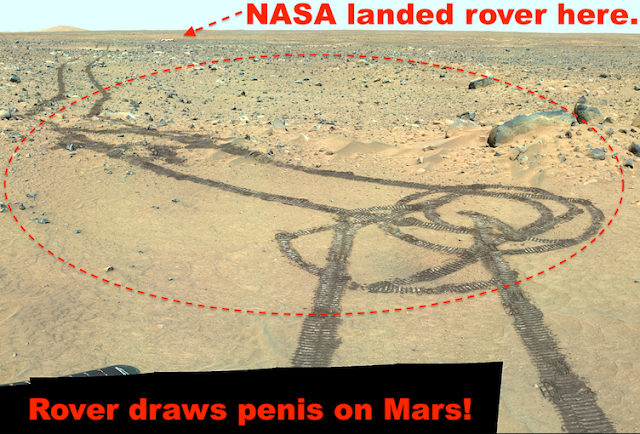
Imagine this...you are responsible for landing the Mars Spirit rover on the planet. You succeed and drive the Spirit rover out onto the Mars surface. After getting about 50 meters you notice that you can see your wheel marks in a long trail behind you...so you do what first pops into your head, draw a giant penis! Now we know what the Mars rover driver was thinking about during his/her mission. He or she was thinking about some penis. Its the first Mars art ever made by humans. Its also the first Mars porn made by humans. I wonder if NASA will try to preserve this site so that all humanity can remember this great achievement for thousands of years to come?
I also found many there ancient artefacts from faces to strange structures.
NASA put these photos in FAULSE color, which is a deep brown/red. So I put them back into natural normal color, which is a click of a button on my photo program. I prefer the real colors over the fake. What you see here on my site is the real color. Click the link to see the dark false color.
Kid In India Records Glowing UFO Over City,Dec 28, 2018, Video, UFO Sighting News
Date of sighting: Dec 28, 2018 Location of sighting: India This possible UFO was seen on Dec 28, 2018 during a overcast night in India. When the smog of the city blocks out the sky at night, no stars can be seen during such a time. So this rules out stars. The object does not have red or blue flashing lights...which most drones have. Also the object is holding position, trying to confuse the eyewitnesses by appearing like a star. Remember what I told you in other posts, aliens are prize themselves on being more intelligent than humanity. They literally believe they can fly as close as they want and not get caught...but with todays cheap video cameras and cell phone cameras...humanity is proving them wrong. Also, someone should download this video, I estimate that there is a 90% chance the person will panic within a week when people say its a UFO and will take down the video. It happened a lot over the years. This looks to be just a kid and kids worry a lot about posting the wrong kind of videos getting the wrong kind of attention. Scott C. Waring
UFO Glowing And Pulsating Over The Black Sea, Bulgaria On Jan 4, 2019, Video, UFO Sighting News.
Date of sighting: January 4, 2019
Location of sighting: Black Sea, Burgas, Bulgaria
This is one of the most irritating UFOs seen around the world. The UFO hovers over neighbourhoods and appears like a star, but is clearly very close, within half a mile away from the eyewitnesses most the time.
I myself was eyewitness to such a UFO one evening over my apartments and recorded it, just 24 hours after the same UFO was seen on TV news in parts of China. The video I uploaded has since disappeared...I'm searching, but strangely enough...its just gone from my channel??? Very odd, will continue searching for it.
What I am saying is that aliens are highly skilled in the art of trickery and deception. They are required by their laws to not interrupt in our way of life or change how things will go in the future, so instead they try to play mind games with eyewitnesses by having their UFOs fly within a few hundred meters of the ground and make clouds around it to hide the craft, or they will fly low over a neighbourhood trying to move very slowly to look like a star, but is clearly too big and too bright to be a star and too small to be the moon. Aliens are extremely intelligent, and they take too much pride in that fact. But in some areas we are better at...like creativity, passion and empathy.
Scott C. Waring
Eyewitness states:
Fast UFO big spaceship with changing type, trajectory , shape , sizes , color and very dynamic flexi - pulsations ; Location -- in the international space area over Black Sea -- about BULGARIA ; Time -- 03.10. 2018. // 00 : 06AM ; Documentary raw video report № 42 -- Bu. Sh. -- 1636 -- 100N ; Position -- from stationary camera with resolution - 2K ; Photographer -- Rosen Zheynov.
When browsing through Google Sky, one conspiracy theorists believes he spotted a mega-alien base. Google Sky is a free map programme from the search giants which allows users to browse the stars. However, one user got more than they bargained for when they discovered what they believe is an alien base.
Among the stars at the coordinates 03 57 08.63, -07 11 26.2 appeared a massive blue object.
One alien hunter was keen to point out that this is “100 percent proof” of the existence of aliens.
It is also evidence that extraterrestrials are super advanced and have the ability to colonise the entire universe.
Writing on his blog UFO Sightings Daily, prominent conspiracy theorist Scott C Waring said: “Google Earth map is famous for many UFO and alien base discoveries over the years.
Alien PROOF? Huge ‘ET BASE’ discovered using Google Sky (circled)
(Image: UFO SIGHTINGS DAILY)
“However a lesser known feature of the free map program is that it allows you to see the stars in the sky. When you search using the star map, some strange objects will be found.
“This Giant Blue alien base is visible on Google sky map and its dimensions and size indicate that its bigger than Earth and its geometric pattern is not possible for that size in nature.
“This is an artificially created object of immense size.
“This is 100 percent proof that aliens not only exist in the universe, but are so advanced that the size of their ships are more enormous than anyone ever thought possible.”
“This is 100 percent proof of aliens"
(Image: UFO SIGHTINGS DAILY)
This is not the first time an ‘alien base’ has been found using one of Google’s programmes.
In September, 2018, conspiracy theorists were sent into a frenzy when a massive structure was spotted on the moon using Google’s search tool Google Moon.
In a video uploaded to YouTube by Argentinian Marcelo Irazusta, the man-made-looking structure seems to be an anomaly on the surface on the moon.
The supposed Moon Base
(Image: GOOGLE MOON)
A description from Mr Irazusta alongside the video reads: “A strange elevation of hundreds of meters in the middle of a plain of the Moon is a mystery that must be revealed.
“Everything seems to indicate that it could be a non-natural structure. It is really awesome.”
However, sceptics and NASA say the pyramid and other similar findings are just the effects of pareidolia – a psychological phenomenon when the brain tricks the eyes into seeing familiar objects or shapes in patterns or textures such as a rock surface.
Aliens are coming to Belgium as UFO sightings soar in 2018
Brussels, which hosts the main institutions of the EU and the Nato HQ, has seen a spike in UFO sightings. Stock picture
James Crisp
UFO sightings over Belgium surged last year with the public reporting higher numbers of possible alien spaceships than in 2017.
Belgium recorded 255 reports of UFOs in 2018, an increase on the 171 witnessed the previous year.
Sightings were up across the whole country, with increases in Wallonia, Flanders and Brussels.
The mayor of the leafy Brussels suburb of Wezembeek-Oppem made news last summer when he claimed to have spotted a UFO.
Belgium has regularly punched above its weight when it comes to UFO sightings. Even in 2017, a relatively fallow year, it outscored Norway, Finland and Denmark and recorded only a handful fewer sightings than its much larger neighbour France.
Patrick Ferryn, president of Cobeps, the Francophone Belgian committee for the study of space phenomena, said: "We don't know why the numbers have increased. It was a hot summer and it may be simply that when the weather is good and the skies are clear, people look at the skies more often."
UFO sightings over the supposedly boring country of Belgium surged last year with astonished Belgians reporting higher numbers of possible alien spaceships than in 2017.
Belgium recorded 255 reports of UFOs in 2018, an increase on the 171 witnessed in 2017. Sightings were up across the whole country, peaking in October, with increases in the French-speaking region of Wallonia, Dutch-speaking Flanders and Brussels.
179 sightings were reported in more prosperous Flanders, compared to 76 in more rural Wallonia. Brussels is the country’s third federal region and the mayor of the leafy suburb of Wezembeek-Oppem made news last summer when he claimed to have spotted a UFO.
Belgian UFO investigators told the Telegraph that the 2018 figures were a return to the form shown over the last five years.
Despite being smaller than Switzerland, Belgium has regularly punched above its weight when it comes to UFO sightings. Even in 2017, a relatively fallow year, it outscored Norway, Finland and Denmark and recorded only a handful fewer sightings than its much larger neighbour France.
From November 1989 to April 1990, Belgian UFO spotters enjoyed their golden age. The Belgian UFO Wave involved multiple reports of triangular shaped craft in Belgian skies over an extended period, including one which was chased by F-16 fighter jets.
Patrick Ferryn, president of Cobeps, the francophone Belgian committee for the study of space phenomena, said, “You must know that most of these sightings will have the most banal explanation but there is a residue, which we simply can’t explain. And of those, there may be two or three where we may have questions over where they came from."
“We don’t know why the numbers have increased this year. It was a hot summer and it may be simply that when the weather is good and the skies are clear, people look at the skies more often,” he added.
Out of the 76 sightings in Wallonia, 14 were explained, 12 "probably explained" and 28 were impossible to evaluate because there was too little information. There were “reasonable doubts” about eight sightings, although the witness accounts lacked important information.
14 were still under investigation by Cobeps, which last reported an inexplicable UFO sighting in 2015, when there were 317 sightings across the country.
In 2018 the majority of sighting were explained away as being planes, balloons, meteors and satellites. The culpable satellite normally turned out to be the International Space Station.
Between 2010 and 2016, more than half of Belgian UFOs turned out to be Chinese lanterns, a decorative candle powered hot air balloon.
“Surprisingly drones have still not had an impact,” said Mr Ferryn, “Ever since the first drones went on the shelves we have been waiting to be submerged with reports of a galactic invasion of drones – but it still has not happened.”
Mr Ferryn said there was simply no comparison with the famous Belgian UFO Wave, which has been dismissed by some as a mass delusion. There is no video or photographic evidence of the craft despite the many sightings.
“This is definitely not a new wave of the Belgian wave of UFOs,” he said, “Then the quantity of sightings was higher, more frequent and concentrated on one region of Belgium and all the descriptions were similar rather than the very different descriptions of last year.”
Meer van UFO'S of UAP'S, ASTRONOMIE, RUIMTEVAART, ARCHEOLOGIE, OUDHEIDKUNDE, SF-SNUFJES EN ANDERE ESOTERISCHE WETENSCHAPPEN - DE ALLERLAATSTE NIEUWTJES


 DRIE RIVIEREN KLEUREN ROOD


 Mystery object with the words 'Falcon' baffles beach-goers...
 An alien time capsule, a Maori canoe and a Rastafarian...