Ontdek de Fascinerende Wereld van UFO's en UAP's: Jouw Bron voor Onthullende Informatie!
Ben jij ook gefascineerd door het onbekende? Wil je meer weten over UFO's en UAP's, niet alleen in België, maar over de hele wereld? Dan ben je op de juiste plek!
België: Het Kloppend Hart van UFO-onderzoek
In België is BUFON (Belgisch UFO-Netwerk) dé autoriteit op het gebied van UFO-onderzoek. Voor betrouwbare en objectieve informatie over deze intrigerende fenomenen, bezoek je zeker onze Facebook-pagina en deze blog. Maar dat is nog niet alles! Ontdek ook het Belgisch UFO-meldpunt en Caelestia, twee organisaties die diepgaand onderzoek verrichten, al zijn ze soms kritisch of sceptisch.
Nederland: Een Schat aan Informatie
Voor onze Nederlandse buren is er de schitterende website www.ufowijzer.nl, beheerd door Paul Harmans. Deze site biedt een schat aan informatie en artikelen die je niet wilt missen!
Internationaal: MUFON - De Wereldwijde Autoriteit
Neem ook een kijkje bij MUFON (Mutual UFO Network Inc.), een gerenommeerde Amerikaanse UFO-vereniging met afdelingen in de VS en wereldwijd. MUFON is toegewijd aan de wetenschappelijke en analytische studie van het UFO-fenomeen, en hun maandelijkse tijdschrift, The MUFON UFO-Journal, is een must-read voor elke UFO-enthousiasteling. Bezoek hun website op www.mufon.com voor meer informatie.
Samenwerking en Toekomstvisie
Sinds 1 februari 2020 is Pieter niet alleen ex-president van BUFON, maar ook de voormalige nationale directeur van MUFON in Vlaanderen en Nederland. Dit creëert een sterke samenwerking met de Franse MUFON Reseau MUFON/EUROP, wat ons in staat stelt om nog meer waardevolle inzichten te delen.
Let op: Nepprofielen en Nieuwe Groeperingen
Pas op voor een nieuwe groepering die zich ook BUFON noemt, maar geen enkele connectie heeft met onze gevestigde organisatie. Hoewel zij de naam geregistreerd hebben, kunnen ze het rijke verleden en de expertise van onze groep niet evenaren. We wensen hen veel succes, maar we blijven de autoriteit in UFO-onderzoek!
Blijf Op De Hoogte!
Wil jij de laatste nieuwtjes over UFO's, ruimtevaart, archeologie, en meer? Volg ons dan en duik samen met ons in de fascinerende wereld van het onbekende! Sluit je aan bij de gemeenschap van nieuwsgierige geesten die net als jij verlangen naar antwoorden en avonturen in de sterren!
Heb je vragen of wil je meer weten? Aarzel dan niet om contact met ons op te nemen! Samen ontrafelen we het mysterie van de lucht en daarbuiten.
Maandag 7 januari 2019
Black Knight an alien satellite
Black Knight an alien satellite
The first premiere of 2019 don't forget to hit that reminder button. Hope you guys have had a good week, I look forward to seeing you all in the chat.
There is one item in orbit that is said to have an origin different from all of the other objects up above us. This spacecraft or satellite has come to be known as the Black Knight and its existence has been covered up by NASA for over 60+ plus years. Something that makes this UFO different from the man-made space objects is its ability to change its orbit. Moving around the planet in a non-set pattern a retrograde orbit. This has led many to speculate that this object is alien in origin and that it monitors the planet. This is where things become even more interesting as the Black knight has said to have been observing the earth for around 13000 years
NASA’s Planetary Defence Spacecraft is Set To Undergo it's First Real World Test
NASA, The National Aeronautics and SpaceAdministration, has put forward its plans to begin real-worldtesting of its brand new planetary defense system in the next couple of years which is a huge leap in the right direction for NASA, defense, and overall, planet earth.
Asteroids still pose a major threat to humans and all life on earth. Even just a moderately sized asteroid could lead to apocalyptic like events and end many many lives. As most people will agree, it was asteroids that killed all the dinosaurs. If they can completely eradicate an entire species much larger and arguably more powerful than humans, then we should be very very worried.
The new test is nicknamed the Double Asteroid Redirection Test, or DART for short. What will happen is, the DART spacecraft will be sent on a mission directly on a collision course with a non-threatening asteroid called Didymos. Then NASA will be able to test the ability of the spacecraft at redirecting the direction of the celestial object, just as if it were heading for earth and needed to be stopped.
Fourteen Arecibo radar images of the near-Earth asteroid (65803) Didymos and its moonlet.
The size of Didymos is the same as any other asteroid that poses quite a common threat to earth which is what makes this experiment so useful. The asteroid is approximately 800 meters across, and its secondary body or “moonlet” has a 150-meter size.
Around 11 million kilometers from Earth, DART will deliberately crash into Didymos’ moonlet at a speed of around 6 km/s. Accuracy will be ensured by using the sophisticated navigation software onboard the DART spacecraft. This will be the first example of the kinetic impact technique to change the motion of an asteroid in space. The propulsion system used will be the NASA Evolutionary Xenon Thruster - Commerical (NEXT-C), which will be an efficient way of reaching the target on schedule.
When is this happening?
NASA is expecting to launch the DART spacecraft in late December 2020 and through May 2021, with impact expected in October 2022, which isn't that long away now.
I think this is very exciting news and am glad NASA is undertaking such tests and measures to ensure the safety and continuity of the human race.
UFO’s have been witnessed in the skies above us for a very long time! Following World War 2 and the Roswell event, there can be no denying that fact that many people across the planet started seeing UFO’s. Even way before WW2 UFO’s have been reported throughout most of recorded history.
It is official that there are many records of UFOs in the early 1900’s and throughout much of the 18th and 19th centuries. But On top of that, there are many recorded events from thousands and thousands of years ago which, when looked at from a modern day perspective, sound very much like today’s UFO sightings.
This confirms that if even a very small percentage of these early records are accurate, then it would appear that UFOs, have had an interest in human beings since the beginning of time.
Here are ten such recorded UFO incidents:
10. Torch In The Sky 343 BC
According to writings by Diodorus Siculus Timoleon, while he was traveling from Corinth to Sicily around 343 BC, several bright lights, or lampas, would guide his journey. Although it was seen as a sign of help from the heavens, when looked at from a modern perspective, it could be regarded as a UFO sighting. According to the text, “All through the night he was preceded by a torch blazing in the sky up to the moment when the squadron made harbor in Italy.” Interestingly, Timoleon also claimed to have been foretold of “fame and glory” during this guidance, suggesting that some kind of interaction beyond a simple sighting had taken place, possibly telepathic communication—again, something often claimed in modern-day UFO encounters.Many historians have claimed the sighting to be nothing more than a comet or even a meteor shower. However, there are no such events on record, and furthermore, the lights were visible constantly and in a fixed direction right up until the squadron arrived on the shores of home, not how you would expect a comet or meteor to behave.
9. The Second Punic War Sightings 218–201 BC
There were many sightings of strange aerial phenomenon during the Second Punic War between 218 and 201 BC. Rome’s Annales maximi would tell of several of them.In 218 BC, there were reports of ships which gleamed in the sky coming out of the clouds. Two years later in 216 BC came a similar sighting of “gleaming round shields” traveling through the air. Each of the descriptions given of these two sightings can easily be imagined as the common UFOs described in the modern era. Many such sightings took place during times of war, which is a point carried over into modern conflicts. Many researchers believe the chaos created in conflict acts as a conduit for increased UFO activity. These sightings are also quite often seen by multiple witnesses. Both of these details are the backdrop to our next entries.
8. Three Moons Sighting 122 BC
Over the skies of Ariminium, Italy, in around 122 BC, there were several sightings of “three moons” appearing in the sky together. Furthermore, these objects were visible during the daylight hours as well as night.In Book II of his Natural History, Pliny would be one person who recorded the event, stating, “Three moons have appeared at once in the consulship of Gnaeus Domitius and Gaius Fannius.” Another writing of the three moons appears in Book I of Roman History, which says, “At Ariminium bright light like the day blazed out at night,” and that “three moons became visible” in many parts of the country.Whether this was a sighting of an intelligently guided craft or not is up for debate. Some mainstream historians have postulated that the sightings were an atmospheric phenomenon. Whether this would be something that writers at the time would have felt the need to record is also a matter of opinion.
7. The Roman Army 74 BC
As the Roman army progressed toward a clash with the army of King Mithridates VI in what is now modern-day Turkey, both sides would witness something completely out of the ordinary. The account, which took place in 74 BC, was chronicled by the historian Plutarch. (Note, however, that Plutarch was not alive during 74 BC.) Plutarch stated that despite the perfectly fine and pleasant weather, a sudden boom announced itself over the area, and a flash spread across the sky. He then wrote that “a huge, flame-like body was seen to fall between the two armies.”Furthermore, Plutarch would provide a solid and detailed description of the object. He stated it to be the shape of a wine jar and the color of molten silver. The object landed in between the two armies, stopping their advancements. Each army, both fascinated and scared of the mysterious craft before them, began to retreat, temporarily halting the conflict.
6. The Hanging Comet 12 BC
There is actually very little known about this particular incident, but it is worth including here simply because of the bizarre nature of it at a time when very few things should have been in the sky at all. In 12 BC, a strange “comet-like” object simply hovered over Rome for several days. It then “melted” into what was described as flashes that looked similar to torches. The account, as brief as it is, doesn’t mention any kind of sound or loud noise, so it is unlikely to have been a sudden explosion. Might it be that the craft was a mother ship of some kind, which dispersed smaller, probe-like craft after surveying the area as it hovered?It is perhaps also worth noting here that any accounts in Roman history arguably should be taken slightly more seriously than others. The reason for this is that Roman historians and recorders of current events had to go through strict procedures to ensure their reports were credible and accurate, and only then could the account be entered into the official record.
5. Chariots In The Clouds AD 75
Perhaps one of the best-recorded ancient sightings was that by Josephus in AD 75. According to his account, a mysterious and unnerving spectacle occurred over the skies of Judea. Josephus claimed, “Chariots and troops of soldiers in their Armour were seen running about among the clouds.” He would state the encounter to be “a miraculous phenomenon, passing belief.
”What is also interesting about the recording of this particular sighting is the awareness of Josephus that he might not be believed. Fortunately, there were other witnesses to the event, as Josephus writes that it would likely have been “deemed a fable were it not for the narratives of eyewitnesses” who had seen it, too.Furthermore, the events had taken place around the entire country as “armed battalions hurtling through the clouds” were witnessed over every city. Also, “great noise” rained down from above, causing “quakes” on the ground. Roman historian Tacitus mentioned the event in his writings, stating, “In the sky appeared a vision of armies in conflict, of glittering armour.” As crazy as it sounds, it would appear that what is being described is an aerial conflict.
4. Sighting Of Pope Pius I AD 150ghting By The Bro
Although there are doubts due to the fact of him being the only witness, the brother of Pope Pius I is said to have seen a UFO around AD 150 in Via Campana, Italy. The sighting took place in the middle of the afternoon, which, according to the witness, was a bright, sunny day. Out of nowhere, an object, described by the brother as “a beast,” descended downward. It was in the shape and color of “a piece of pottery” and had a top of multiple colors which shot out “fiery rays.”The object landed on the ground, causing clouds of dust to appear. When they had a cleared, “a maiden clad in white” was visible near the object.Nothing more is told, although modern UFO researchers have documented many claims of “angelic aliens” dressed all in white. Might this have been one of them?
3. Angel Hair Incident AD 196
Angel Hair is a chalk-like, silvery substance which sometimes rains down to the ground following UFO sightings. There are many accounts of this on record throughout the 20th century. There are also several accounts from ancient times. “Rains of chalk” were reported in Cales in 214 BC. A similar incident occurred in Rome in 98 BC.Perhaps the best of these ancient angel hair events is recorded by Cassius Dio, who wrote in AD 196 of “a fine rain resembling silver” which fell all over the city of Rome despite there not being a cloud in the sky and the day being bright. Cassius Dio writes that he himself didn’t witness it falling but came upon it on the ground shortly after. Using three bronze coins, he collected some of this mysterious residue for study. According to his report, the substance remained for three days but had disappeared by the fourth day.
2. Flaming Shield AD 776
At a time when a great part of modern-day Europe was known as Francia (or Kingdom of the Franks), Sigiburg in what is now modern-day Dortmund was being attacked by battalions of Saxon soldiers. As this attack progressed, however, a bizarre object appeared in the skies overhead. It was “the likeness of two large flaming shields reddish in color” and appeared to remain “floating” in the skies above them. So frightened was the advancing Saxon army that they immediately turned around, giving up their siege of Sigiburg and retreating away to safety.The account is recorded in detail in the Annales Laurissenses maiores—Latin annals which record much of the history of the region from AD 741 AD to 829. Although the author is ultimately unknown, it is widely believed that writers of the time would record events as they happened, which were then compiled at a later date into the finished work.
1. Magonia AD 816
Another recording of a bizarre aerial sighting from Francia occurred in AD 816 in what is now modern-day Lyon and was written about by Agobard of Lyon in his book De Grandine et Tonitruis. Agobard would write of his experience with Magonia, a realm in the clouds where “aerial sailors” and their airborne ships reside and sometimes come from. It is an interesting claim. According to the writings, three men and a woman had fallen to the ground from these aerial ships and were set upon by the townsfolk until Agobard intervened and prevented their certain deaths. It doesn’t state what happened to the four aerial sailors after this, however.The mythical Magonia and its origins are said to go back to Agobard’s writings. In more modern times, respected UFO researcher Jacques Vallee explored the subject in his book, Passport to Magonia, which looked at alleged UFO accounts in the distant past.
U.I.P SUMMARY
The aliens have been watching us for a very very long time, but why are they here and why are the watching us and where do they come from? Hopefully soon we will one day get the answers to all of these questions, but in the meantime we just have to keep our eyes to the skies above us people!
Pentagon Report CONFIRMS Warship UFO Encounter Was ‘No known aircraft in the world’
In what appears to be a rather important piece of Disclosure, US defence chiefs now reportedly commissioned a 13-page report into a UFO encounter off the coast of San Francisco.
Aircraft carrier USS Nimitz and vessels in her carrier strike group played cat-and-mouse with the UFO for some six days back in November 2004. And even more startling was the confirmation that destroyer USS Princeton reported encountered the craft on “several occasions” as F-18s warplanes were dispatched the investigate the UFO.
The Pentagon report details the “Tic Tac” was believed to be around 46feet long, look “solid white, smooth with no edges” and incapable of being detected by the most advanced gear in the US Navy.
Footage of the UFO encounter with USS Nimitz was previously leaked, with the pilot Commander David Fravor saying it was “not from this world”.
The leaked Pentagon report has revealed new details about the UFO encounter that shocked Navy fighter pilots above the Pacific.
The 2009 report does not bear any date or agency logo, but four officials confirmed that it was written as part of a Pentagon program with input from multiple agencies, KLAS reported.
The Las Vegas news station obtained the unclassified report while visiting Washington, DC for a debriefing arranged by former Senator Harry Reid.
The report reveals stunning new first-hand accounts of the November 14, 2004 encounter, which was documented in video that emerged in December of last year.
The incident unfolded as the Nimitz carrier group was conducting training exercises off the coast of southern California and Mexico ahead of a deployment to the Arabian Sea.
Beginning around November 10, the USS Princeton, a Ticonderoga-class guided missile cruiser, made multiple radar contacts with what the report calls an Anomalous Aerial Vehicle (AAV).
The senior chief fire controlman on the Princeton, which was equipped with ultra-advanced AN/SPY-1 multifunctional phased-array radar, reported that the AAV appeared from above 60,000 feet – the radar’s scan ceiling – and descended ‘very rapidly’ to about 50 feet above the surface of the ocean.
They would hover for a short time and then depart at high velocities and turn rates demonstrating advanced capabilities, the senior chief said.
The senior chief, who had 17 years of experience in fire control on cruisers, said he never obtained an accurate track on the AAV, because they exhibited speed consistent with a ballistic missile, but the radar was set to air intercept mode rather than ballistic missile tracking mode.
Then on November 14, the Princeton again detected an AAV around 11am and called it in two F/A-18 Hornets that happened to be returning to the USS Nimitz from a training exercise.
An E-2C Hawkeye surveillance plane was also operating in the area and attempted a radar contact on the AAV, but made only intermittent contact as was unable to gain a track.
An E-2C Hawkeye surveillance plane (like the one seen above) was also operating in the area and attempted a radar contact on the AAV, but made only intermittent contact
On November 14, the Princeton again detected an AAV around 11am and called it in two F/A-18 Hornets that happened to be returning to the USS Nimitz (pictured) from a training exercise
The skies were clear and blue with unlimited visibility that day, and the sea was calm, according to the report.
The first fighter jet to investigate, a USMC single-seat F/A-18C, flew within five to 10 nautical miles of the AAV’s location, but could not see it. Instead, he reported seeing a circular disturbance in the water about 50 to 100 meters in diameter. It reminded the pilot of something rapidly submerging in the ocean, like a submarine.
The report hypothesizes that ‘it is possible that the disturbance was being caused by an AAV but that the AAV was “cloaked” or invisible to the human eye.’
The Marine pilot was called off after the controller asked a plane carrying ordnance to respond, which he was not. When he returned to the USS Nimitz, his intelligence officer asked him if he’d seen the ‘supersonic Tic Tac’.
The next jet to respond was a Navy F/A-18F piloted by Cmdr. David Fravor and Lt. Cmdr. Jim Slaight, who made visual contact with the AAV that they have since publicly discussed, corroborating the report.
Fravor also spotted a disturbance in the water, almost as if it were boiling. But this time, hovering above the disturbance was a strange object.
The object was shaped like an elongated egg or a “Tic Tac”, according to Fravor, and was ‘holding like a Harrier’, the jump jet that can take off vertically.
Slaight, whose name is redacted from the report, described it as ‘solid white, smooth, with no edges. It was uniformly colored with no nacelles, pylons or wings.’
He described the exterior of the object as ‘like it had a white candy-coated shell, almost like a white board.’
When Fravor attempted to make a close pass of the object to attempt visual recognition, the object appeared to react, realigning its axis to point at the approaching plane. The AAV then ascended quickly and departed at supersonic speed.
When Fravor and Slaight returned to the Nimitz, the sailors in the intelligence center donned tin-foil hats to greet them, asking eagerly about their ‘UFO flight’.
Later in the day, another plane made the video that has since been released, according to the report.
Around 3pm, another Navy F/A-18F tracked a remarkable object on FLIR, which Fravor’s plane had not been equipped with.
The pilot said he couldn’t confirm whether he had tracked the same object seen by Fravor and Slaight, because he never made visual contact, only tracked it through FLIR.
The report notes that the USS Louisville nuclear fast-attack submarine was operating in the area, and detected no unusual undersea activity over the duration of the incidents.
The incident was filed in a regular training mission report and it is unclear if it was reported up the chain of command, the report finds.
The aircrews involved made and kept a copy of the FLIR recording, but were subjected to a ‘high level of ridicule’ over the incident, the report found.
Whatever the AAV was, the report stresses that it was ‘no known aircraft or air vehicle currently in the inventory of the United States or any foreign nation.’
Former Senator Reid, now recovering following cancer surgery, and others have urged Congress to create a new Pentagon program to study similar incidents as a matter of national security.
Another highly classified version of the leaked report was also written, but it is unlikely to ever be released.
Please see below the six conclusions coming from the compelling report:
The ‘Anomalous Aerial Vehicle’ was of unknown origin and represented technology not currently in the possession of the U.S. or any other nation.
It featured broadband RF stealth making the use of radar against it largely ineffective.
The craft manifested extreme performance but did not have lifting structures or control surfaces required for traditional flight.
It showed that it has some kind of advanced propulsion capability making it able to go instantly from hovering to very high speed and to make very abrupt course changes.
It was able to ‘cloak’ itself, becoming invisible visually to the naked eye.
Possibly capable of operating undersea without being detected by the most advanced sub-surface sensors.
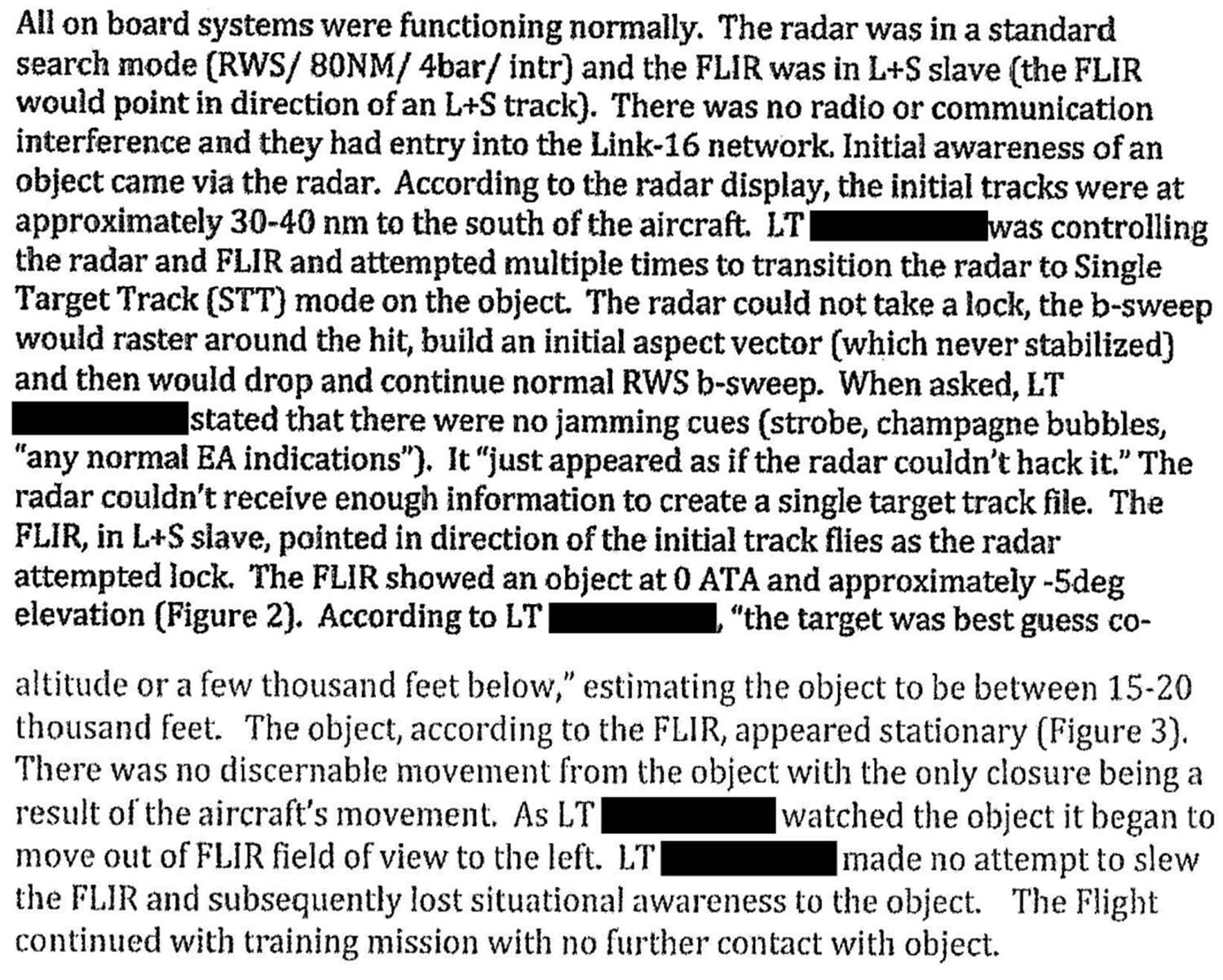
Please see below a snippet of the report that describes the crew’s attempts to track the target in technical detail:
This story appears to be a very important missing part of the disclosure jigsaw!
U.I.P SUMMARY
This story just gets deeper and deeper and when US military personnel start talking about witnessing UFO’s you kind of have to listen up and listen!
Could it be that this is the first of many UFO reports from the US Military?
The object itself is pretty incredible looking to say the least and it is not just the way it looks which is alarming people, it’s also the fact the the UFO moved in ways which the US have NEVER witnessed before!
It appears that the US Government is well and truly now setting the scene for something rather incredible! Perhaps the push for the TRUTH is now working and the Elite are now buckling – watch this space!
Scientists Find the 'Missing' Dark Matter from the Early Universe
By Mara Johnson-Groh, Live Science Contributor
Credit: Shutterstock
Dark matter, it seems, has been clinging to galaxies for a very long time. Most galaxies that existed 10 billion years ago had about as much dark matter as galaxies do today, contradicting earlier studies that suggested less dark matter lurked around galaxies in the early universe.
"Dark matter was similarly abundant in star-forming galaxies in the distant past as it is in the present day," said Alfred Tiley, an astronomer at Durham University in England and lead author on the new study. The research was recently submitted to the journal Monthly Notices of the Royal Astronomical Society and published Nov. 16 in the preprint journal arXiv. "It wasn't a complete surprise, but in reality, we didn't know whether the observational reality would align with expectations from theory." [The 11 Biggest Unanswered Questions About Dark Matter]
Dark matter makes up approximately 85 percent of the total mass in our known universe, but the mysterious substance does not interact with light, leaving scientists in the dark about the its precise nature. So, instead of viewing it, astronomers must rely on dark matter's gravitational pull on the normal matter, called baryonic matter, that makes up the stars, nebulas and planets we see in the night sky, as well as all the trees, rocks and people on Earth.
Dark matter tends to clump into halos around galaxies; astronomers discovered this by measuring how fast galaxies rotate. According to Newton's law of gravity, stars on the outskirts of a galaxy should rotate much more slowly than those at the center. But in the 1960s, astronomers found speedy suburban stars on the fringe of the Milky Way that hinted at extra matter hiding out beyond those stars' galactic orbits.
Studies have since measured thousands of rotation rates across the universe, confirming the presence of these dark matter halos.
In the new study, researchers used data from two surveys of 1,500 star-forming galaxies to calculate rotation rates for galaxies going back 10 billion years. Precisely measuring galactic rotation far in the cosmic past is difficult, because these ancient galaxies are incredibly distant and faint. So, the scientists estimated an average by clumping the galaxies by distance and then combining their light.
"Our estimate of the amount of dark matter in galaxies is an average for the whole population at each epoch," Tiley told Live Science. "The amount of dark matter within individual galaxies might vary significantly."
Accounting for galaxy mass and density, the researchers found nearly equivalent amounts of dark matter for galaxies that existed long ago in our cosmic past as for galaxies in our local universe.
But not everyone is entirely convinced. The findings contradict previous studies that found that galaxies in the early universe had less dark matter than younger galaxies do. Those studies looked at much more massive individual galaxies and used a different model to infer the amount of dark matter.
"[The new research] uses only one of the four independent approaches we had used to come to our conclusion," Reinhard Genzel, lead author of one of the previous studies and an astronomer at the Max Planck Institute for Extraterrestrial Physics in Garching, Germany, told Live Science.
Tiley found that his team's results were highly dependant on the model they used. Ultimately, he chose to use a model that he and his colleagues found to be more representative of the low-mass galaxies scientists believe predominated at the early epoch.
Computer simulations suggest that very high-mass galaxies, like those studied by Genzel, are rare in the distant universe. "It appears [their] results apply to very massive galaxies at this distant epoch but may not be representative of galaxies with comparatively lower stellar masses, like those that we studied in our work," Tiley told Live Science.
The new results match what would be expected from the prevailing "lambda cold dark" matter model describing our universe. This model explains how the universe is structured and why it is expanding at an ever faster rate.
A new analysis of African dust reveals the Sahara swung between green and desert conditions every 20,000 years, in sync with changes in the Earth’s tilt.
Credit: Massachusetts Institute of Technology
Few places on this planet are as inhospitable as the Sahara desert. This is why it’s so intriguing to learn that the Sahara, and most of North Africa for that matter,used to be a lush regionfilled with a diversity of plants and wild animals. What’s more, this transition occurred relatively recently, in the order of thousands of years, judging from fossils and even rock paintings made by artists who lived in now abandoned settlements.
Now, MIT researchers claim that the region may be swinging between desert and lush conditions every approximately 20,000 years due to changes in the Earth’s axial tilt.
Tadrart Acacus desert in western Libya, part of the Sahara.
Credit: Wikimedia Commons.
Each year, tons and tons of Saharan dust are swept by northeastern winds into the Atlantic Ocean forming thick sediment deposits on the ocean floor. By analyzing these dust layers, it’s possible to infer many qualities about the climate they originate from. For instance, thick dust layers indicate arid times, whereas thinner layers are a sign of a wetter climate.
Some of the sediment core samples retrieved off the coast of West Africa can trace back Sahara’s climate history over millions of years. Previously, such analyses suggested that the Sahara oscillated between wet and dry climates every 100,000 years or so — something which scientists had pinned down to ice age cycles. Thick layers of dust seemed to coincide with periods when the Earth was more covered in ice, wheres less dusty layers corresponded to interglacial periods.
This correlation, however, does not bode well with our present understanding of the Saharan climate, which ought to be mainly driven by the region’s monsoon season. A periodic change in precipitation is determined by the tilt of the planet’s axis, which exposes some regions of Earth to more sunlight than others.
“We were puzzled by the fact that this 20,000-year beat of local summer insolation seems like it should be the dominant thing controlling monsoon strength, and yet in dust records you see ice age cycles of 100,000 years,” David McGee, an associate professor in MIT’s Department of Earth, Atmospheric and Planetary Sciences, said in a statement.
McGee and colleagues devised a new technique which reinterprets the values of Saharan dust cores deposited over the last 240,000 years. The new method hinges on the measurement of the concentration of a rare isotope of thorium.
Thorium is produced in the ocean when small amounts of radioactive uranium dissolve in seawater, then quickly attaches itself to sinking sediments, i.e. Saharan dust. This way, it’s possible to infer how much dust was accumulating during a particular era by studying the concentration of thorium in a particular sediment layer. The slow accumulation of sediment is associated with a higher concentration of thorium, and vice-versa.
Using thorium as their proxy for dust deposition (and, hence, Sahara’s historical climate), the MIT research team found that some peaks of dust in the cores may be false positives due to carbonate dissolution. With the confounding effect removed, the researchers found that the Sahara shifted from wet to dry climates every 20,000 years, in sync with monsoon activity and the planet’s periodic tilting of its axis.
This time series could be useful not only for understanding the history of the Sahara Desert (or luxurious plains, alternatively) but also that of our species. Humans emerged out of multiple hotspots in Africa and migrated towards the Middle East, and from there to Europe, Asia, and the rest of the world. These migrations may have been facilitated by the Sahara’s periodical mood swings.
“We can now produce a record that sees through the biases of these older records, and so doing, tells a different story,” McGee says. “We’ve assumed that ice ages have been the key thing in making the Sahara dry versus wet. Now we show that it’s primarily these cyclic changes in Earth’s orbit that have driven wet versus dry periods. It seems like such an impenetrable, inhospitable landscape, and yet it’s come and gone many times, and shifted between grasslands and a much wetter environment, and back to dry climates, even over the last quarter million years.”
That being said, the Sahara is also influenced by the global climate. According to a 2018 study, human-induced climate change contributed to a 10% expansion of the Sahara desert’s surface over the past hundred years.
And, of course, some of you might be wondering: when will the Sahara’s climate revert back to lush conditions? Scientists believe that up until 10,000-11,000 years ago, the Sahara looked more like today’s African savannah. This means that we still have another 10,000 years before North Africa becomes a giant oasis again.
The Big Bang didn’t just result in our familiar universe, according to a mind-bending new theory — it also generated a second “anti-universe” that extended backwards in time, like a mirror image of our own.
A new story in Physics World explores the new theory, which was proposed by a trio of Canadian physicists who say that it could explain the existence of dark matter.
Anti-Universe
The new theory, which is laid out in a recent paper in the journal Physical Review of Letters, aims to preserve a rule of physics called CPT symmetry. In the anti-universe before the Big Bang, it suggests, time ran backwards and the cosmos were made of antimatter instead of matter.
This new theory is compelling, according to a news release about the new theory, because it would mean that the universe is filled with “very massive sterile neutrinos” that could explain dark matter, a mysterious material that is believed to make up much of the universe.
New Particle
By the researchers’ own admission, according to Physics World, many details of the new theory still need to be hammered out. But co-author Neil Turok, of the Perimetery Institute for Theoretical Physics in Ontario, argued in an interview with the publication that the new theory is a strong one because it relies only on known particles and fields, instead of assuming that new ones will be discovered in the future.
“There is this frame of mind that you explain a new phenomenon by inventing a new particle or field,” he told Physics World. “I think that may turn out to be misguided.”
Mysterious Disappearances of Submarines After UFO Activity
There are many strange facts surrounding a number of missing submarines like the four submarines lost in 1968; The INS Dakar - Israelo, the USN Scorpion U.S., the S-647 Minery -French and the K-129 - Sovjet.
Joseph was on duty on an Ocean Station patrol on the Coast Guard Cutter Mellon. It was during this patrol that they had a number of unique UFO sightings that included radar and visual verification by a number of witnesses.
Three objects passed over the ship traveling at 3500 mph having approached the ship from the direction of where the sub was lost.
Flying time of note from OSV to that site at that speed recorded and verified was approximately 10 minutes. It is highly possible that the UFO phenomenon, and what could have been a very dangerous “rogue” operation gone array, possibly leading to what could have been one of the most significant event.
Even thought this may only be anecdotal data it may help penetrate the veil of secrecy and mystery surrounding submarines.
NASA TREMBLES: CHINESE SPACE MISSION REVEALED THAT THE US NEVER STEPPED ON THE MOON (2019)
Conspiracy experts have always believed that the US government, desperate to beat the Russians in the space race, recreated the lunar landing with Armstrong and Buzz Aldrin at the head of the mission filmed on a secret set.
But now other new evidence would prove the conspiracy theory, on Saturday the unmanned China probe, Chang’e 3, made a successful landing on the moon, according to Chinese state media.
WHO LIES? BROWN LUNAR SOIL? According to Chinese state television, the Chang’e-3 landed successfully on the Moon after a 13-day trip from Earth. The landing craft brought with it a solar-powered robotic robot called Jade Rabbit or Yutu in Mandarin Chinese, which would emerge several hours later to begin exploring the Sinus Iridum, or Rainbow Bay, a relatively smooth plain formed by solidified lava.
But the controversy arose after the National Space Administration of China published the first photographs of the lunar soil, which is apparently not grayish in color, is brown.
The conspirators claim that the surface of the moon is actually light brown with scattered rocks, obviously lighter in color. Many people say that maybe this is the first time we can really have a close and independent view of the lunar surface in its original color.
CONSPIRATORS They have ventured to say that earlier this month, NASA asked China to postpone its mission to the Moon. NASA said they were seriously concerned about the final objectives of the moon mission of the Chinese leaders.
Recently, the Russian portal “Vesti” reported that China’s goal was to turn the Moon into a “Death Star”, a place where large-scale ballistic tests will be conducted with a take-off zone for space exploration ships.
This project coincides with the statements of Chinese President Xi Jinping, who declared that China should establish itself as a space superpower.
The latest images offered by the National Space Administration of China (CNSA) clearly show the assembly held by the United States to show the world that they were the only ones able to reach the lunar soil, but on the other hand, others believe that it is another landing fake of the moon like the rover “Curuosity”.
As we always say, everyone draws their own conclusions.
WHAT DID HE KNOW? George Bush Sr took UFO secrets to the grave – because ‘Americans couldn’t handle the truth’, lobbyist claims
American UFO lobbyist Steve Bassett said Bush Sr could have ended the UFO "cover up" - but decided not to
EXCLUSIVE
By Emma Parry, Digital US Correspondent
FORMER US president George Bush Sr knew UFOs were real but took his secrets to the grave because the American people "could not handle the truth", a lobbyist has claimed.
The 41st President of the United States, who died last month aged 94, was a former director of the Central Intelligence Agency and was briefed daily by spooks while in the White House.
REX FEATURES
George Bush Sr was briefed on all of America's UFO secrets , according to expert
And according to UFO researchers he would have been the "ideal" president to disclose the truth about UFOs as he was so well informed.
But he kept all his UFO knowledge a secret right up until he died at his home in Houston, Texas.
Steve Bassett, an American UFO lobbyist, told Sun Online Bush knew the truth about extra terrestrial life and could have ended the UFO cover-up.
He said: "The consensus among researchers is George H. W. Bush would have been briefed on the extra-terrestrial presence to whatever extent he so desired.
GETTY
Bush did not believe people could "handle" the truth about UFOs
"There is no clear evidence George H. W. Bush wanted 'Disclosure'. That said, it is my view the military/intelligence complex would have been quite comfortable with 'Disclosure' taking place during a second term of President George H. W. Bush.
"He would have been the ideal 'Disclosure' President from their perspective. The Cold War was over and the door was now open to end a very expensive and complex truth embargo."
While director of the CIA, Bush is said to have even blocked former president Jimmy Carter's attempts to obtain UFO information during an alleged briefing on November 19, 1976.
Bush told the president-elect he didn't have the need to know but if he wanted information he should ask the Congressional Research Service (CRS) to prepare a briefing for the new administration.
STEVE BASSETT
Steve Bassett is the only registered UFO lobbyist on the alien disclosure subject in the US
Carter had pledged he would disclose to US citizens what the government knew about UFOs if elected after witnessing a strange light while governor of Georgia in 1969.
Bassett, the executive director of UFO campaign group Paradigm Research Group, thinks Bush rebuffed Carter as he knew some UFOs were extra-terrestrial in origin.
He said: "We do know the newly elected President Carter approached CIA Director Bush regarding a study the White House wished to initiate regarding the extra-terrestrial issue.
"Bush declined to cooperate and referred him to another agency. This may have guaranteed he would not be able to stay on as CIA Director - or not.
"Carter fired him shortly thereafter. One might ask, 'If there was no truth to the extra-terrestrial hypothesis, why would Bush disrespect a presidential request?'"
REX FEATURES
Bush Sr was the former director of the CIA
While campaigning with his son Jeb Bush in the 1980s, Bush was asked about UFOs by a journalist. He replied: "Americans can't handle the truth."
Bush was also quizzed by UFO researcher Charles Huffer during a presidential rally trip to Rogers, Arkansas, in 1988 during which he asked Bush: "Will you tell the people the truth about UFOs?"
Bush replied: "Yeah. if we can find it, what it is. We are really interested." When pressed further Bush replied: "I know some. I know a fair amount."
Bush also supported space exploration, and was once quoted in a speech as saying: "We will travel to neighbouring stars, to new worlds, to discover the unknown."
GETTY
Bush believed Americans "could not handle the truth about UFOs"
Bassett, who organised the Citizens Hearings in 2012 - which saw dozens of military, government and intelligence officers give evidence about UFOs to six former members of Congress - believes Bush was also aware of the infamous Roswell UFO crash in July 1947.
He added: "It is my view Bush was quite knowledgeable about the history of the extra-terrestrial presence to the extent he required. Did that include the July 1947 Roswell events? Almost certainly yes."
Last year Bush's son George appeared on Jimmy Kimmel Live show to plug his autobiography but remained tight-lipped when asked about UFOs.
Kimmel said: "This is a question I think is very important to me and very important to the country.
"When you were in office - and I don't know when this ever or if it happened - did you go through the secret files, the UFO documents? Because if I was president that would be the first thing I did."
But instead of laughing off the question or branding Kimmel a crackpot, the former US leader replied: "Maybe."
GETTY
Bush would have known about the infamous Roswell incident, according to Bassett
He then went on to reveal his daughters Barbara and Jenna asked him the same question when he served as the 43rd President of the United States but he couldn't tell them anything.
Bush was one of three former presidents and presidential hopeful Hillary Clinton, to go on Kimmel to discuss the UFO topic.
Barack Obama, Hillary and Bill Clinton have all previously spoken out about UFOs on the show.
Hillary vowed to launch a probe if she made it to the White House but she was pipped by Donald Trump.
And Hillary’s campaign manager John Podesta, Bill’s former Chief of Staff, has called for the lid to be lifted on UFOs.
In 2015, he tweeted his biggest regret after leaving his job as President Obama’s advisor was “once again not securing the #disclosure of the UFO files.”
President Trump recently announced plans to launch a US Space Force by 2020 - some insiders believe it is in response to a hostile alien threat.
La Chapada Diamantina au Brésil - Formidable zone pour observer les ovnis
Pour l'écrivain et ufologue Hélio Nunes de Camargo c’est une certitude. Des êtres extraterrestres ont bel et bien implanté des bases sur notre planète et plus particulièrement dans la région de la Chapada Diamantina.
Il ne fait aucun doute à ses yeux que cette région héberge l’une d’entre elle (ce parc naturel du Brésil d’une superficie de 1520 km² est situé dans l'environnement de la chapada Diamantina, dans l'État de Bahia à environ 400 km de Salvador, la capitale d'État).
Hélio Nunes de Camargo qui connait bien cette zone a récemment publié un ouvrage intitulé "UFO in the Chapada".
Il aborde dans ce livre plusieurs sujets en relation avec l'ufologie brésilienne dont celui traitant du crash d’un ovni au dessus de Bahia ayant conduit selon de nombreux témoins à l’intervention de l’armée et à la capture d’un être extraterrestre.
Cet ouvrage est étayé de nombreuses photographies dont celle figurant ci-dessous qui est issue de la collection personnelle d’un guide touristique dénommé Adilson Almeida Silva et provenant de la colline de Pai Inácio située à proximité de la ville de Palmeiras.
Hélio Nunes de Camargo explique avoir lui-même rencontré de façon très rapprochée des extraterrestres.
A titre d’exemple, il indique en avoir observé de nuit sur une route reliant la zone de Lençóis au BR-242 un gris. Le lendemain, d’autres témoignages du même ordre ont été réalisés.
Selon lui ces êtres extraterrestres viennent dans cette région compte tenu de la valeur représentée par les minerais rares que l’on y trouve. Ces éléments qui sont uniques s’avèrent à ses yeux indispensables pour mener certains projets impliquant de nouvelles technologies de pointe.
Comme en attestent les dessins rupestres qui figurent dans de nombreuses grottes de la région, visiblement ces êtres semblent connaitre cette région depuis très longtemps. Certaines peintures très déroutantes sont datées de plus de 8 000 ans.
Ufologues amateurs ou non, si vous vous rendez prochainement au Brésil et que vous pouvez visiter cette région ouvrez bien les yeux, vous pourriez être récompensés.
Gigantic 'object' spotted towering over Earth from ISS – before NASA live feed is CUT
A BIZARRE blue object has been spotted hovering over Earth on a NASA live feed from the International Space Station – before the footage was mysteriously cut.
In a video posted online, a mysterious object seems to appear above the planet.
The glowing object – which appears blueish in hue with a white centre – can be seen in the background of NASA’s live feed.
As the camera zooms in, the alarming size of it becomes clearer as it towers over the planet.
But NASA’s feed is promptly cut short, reading: “Please stand by.
“The High Definition Earth Viewing experiment is either switching cameras, or we are experiencing a temporary loss of signal with the International Space Station.”
Unsurprisingly, the unexpected cut left conspiracy theorists up in arms.
One stunned viewer wrote: “That was a weird looking blob next to the space station?”
WHAT IS THAT? A strange blue object is spotted on the ISS feed
(Pic: YOUTUBE/JOETHAI)
Another added: "NASA is lying."
A third argued the object could be a “space ice ball”, with viewers noticing the object looked like “a drop of water in zero gravity”.
But this is by no means the first time the ISS feed has picked up on something strange in the earth’s atmosphere.
Earlier this year, viewers noticed a white object floating across the International Space Station’s live feed.
It is not just space where UFOs have been seen in recent months.
In an exclusive pre-release look at Blaze's new Ancient Alien series, conspiracists claimed the fabled Ark of the Covenant held extraterrestrial powers.
Of all of the unsettling denizens of the paranormal that could pop out of the darkness, one of the odder has to be the pale face of a humanoid creature beyond description, eluding all attempts to categorize it. These gaunt, hunched over specters seem to haunt the fringe of reports of the mysterious and supernatural, and I have covered them before here to some extent. Yet there are countless such reports coming from people from all walks of life and from all over. Here is a selection of various reports of spectral, deathly pale beings that are humanoid to some extent, but most certainly not human, circling out past the boundaries of the truly odd.
One witness brings us the story of an anonymous Reddit poster who says he had a very spooky encounter in 2006 in rural Arkansas, in the United States. He claims that this happened when he was only 12 years old, and that he had lived in a modest house nestled on around an acre of land out in the boondocks, surrounded by dim woods and its only tendril to the outside world an unpaved dirt road meandering off through the trees. Making the whole scene even spookier is the alleged fact that there was a big old abandoned slaughterhouse somewhere back in the wooded area, as well as the remnants of some burned down house owned by anonymous parties long since gone. Whether this had anything to do with what was to come or not, the witness describes the whole area as rather “mystical and special,” as well as “odd in general,” and that his encounter would happen one evening when he went out to lie down on the outside trampoline after an argument with his parents. It was just him and that big sky with a full moon framed within it, and he says of what happened next:
So I’m laying on the trampoline, and other than the moon there isn’t any light aside from the porch light which is a ways behind me. All of the sudden I vaguely see something move. Its coming from the lot across from the dirt road, and its coming towards me. We had a Boston terrier at the time and at first I figured it was him. But as it got closer I knew that’s not what it was.
It was sickly pale. It walked on all fours with its hands but seemed to be able to walk upright. Its kind of galloping towards me on all fours and its a little bit aways at this point but getting closer. The light bounced off of its skin and it almost seemed to look wet. Its gait and color is pretty clear to me but I don’t remember anything distinct about its face except that it just seems to be whitewashed to me. It’s happening so fast and now it is right near me still running and then I can’t see it. It’s under the trampoline. And then I feel it, I feel it PUSH up on the trampoline. I didn’t even bother to look back as I ran to the house. I don’t remember my thought process at all past that point but my mom has told me that I came in the house hollering and absolutely terrified.
I’ve thought about this consistently over the years and as I’ve gotten older have seen stories of similar creatures. I used to describe it as looking like Gollum from the LOTR. I think of the creature kind of fondly in a way. It would never have occurred to me at the time but it almost had a playful vibe to it, and it makes me sad to think that it’s just some lonely but semi-intelligent creature. Maybe a grotesque experiment or some off-kilter evolutionary line. I don’t think that’s impossible. I guess I like to let my imagination run wild with it though. I will always be curious about this and the place in general.
It is hard to know how much stock to put into Reddit reports, but there sure are a lot along the same lines. Another poster at Reddit /r/paranormal gives his own freaky encounter, for which he even supplies photographic evidence. This supposedly happened in 2012, at an undisclosed location at a close-knit friendly barn community in a rural area of the United States, surrounded by dim woods laced with small, scenic trails. The witness says that his two horses were kept on the property, which was near his home and which he would visit ever day to care for and ride around through the peaceful scenery. One evening he had a startling experience as he rode one of the horses, of which he would say:
One evening, around 5pm, I was sitting on her, letting her stand when she started snorting and backing up. I looked up and saw this white/grey creature crawling out of the woods towards us. It had a very small round head, it’s eyes were just pits. It had a very small mouth, not much detail there. It’s arms were very long and thin, fingers also like that. Its rib cage was very pronounced and defined, and it’s legs were long and lanky.
Its movements were very jerky, not smooth and fluid. It slowly jerked out to us, when my horse turned and bolted out of the arena. She’s a dead broke, calm, well manners horse who never spooked before this. Stubborn old mare, but not spooky. She would not go back into the arena that night. I walked her around the barn yard, staying near the main barn, put her up, and ran out to peek into the arena, to find nothing except some “foot prints” where I saw the thing.
This would not be the end of the sightings of this odd creature, as the witness says it would lurk around the dark periphery of the property all through that summer, often peeking around the gate that led out into the woods. On one occasion he saw it running along the other side of the fence, keeping up with him and the horse. It was eerie to be sure, and the witness continues:
I continued seeing it, mainly in the woods, but it was always around. Summer 2013, the barn shut down when the owner died. We moved the horses to a friends place for the time being, and I didn’t see it there. Late summer/fall 2013, I found a new barn. Woods directly behind the barn and arena. This place had lights and was much newer. About a month later, when I was getting ready to leave I heard something in the woods, I looked down the barn aisle into the woods and saw the creature running down the road into the woods. I saw it much less frequently for a while, until later in fall 2014 I began seeing it in the back pastures woods, it darted in and out of the tree line. I saw a second one sitting in a neighbors yard, it would sit in the same spot every day and watch me ride.
Started taking pictures, which are very poor and crappy, and sent them to a friend who claimed he and some others have seen it. Kept seeing it occasionally, but from a much greater distance than at the first barn. I went with this barn owner to another farm to get some stuff, when I saw a very very large version of this creature run out from the woods, right behind a tree I was 10 feet from, while I was alone by the trailer.
Last November, I house sat for the barn owners. I went out around 2am to fill water troughs and enjoy the full moon and cool night. I was sitting in the back pasture when 3 of the creatures began coming from the woods, one came up to the trees near the trough where I was, the other two were walking along the tree line. The horses were silently munching their hay, pretty far from where the creatures were. I messaged the guy from earlier and told him what was going on. Since that incident, I haven’t really seen them. Last summer, I did see one outside my house staring into the windows. A few weeks ago, one was outside my bedroom windows tapping and making a strange faint shrieking sound.
Supposed photo taken of the entity
Unfortunately the pictures don’t really seem conclusive at all, and we are left to wonder just what was going on here, if anything at all. Another Reddit poster gave his own report of a strange occurrence at a rural country house when he was 15 years old. At the time he was apparently in his bedroom on a very dark night, and was about to close the blinds to the window when he caught a glimpse of a “pure white almost glowing man/thing” glaring at him from next to a nearby pine tree. He would describe what happened as follows:
It was crouched down kind of in a spider-man pose and I believe it had larger black eyes. Not like something you see from the greys but it was a feature that stood out to me. It was very muscular, I distinctly remember seeing well defined arm muscles, it seemed just very muscular in general. It wasn’t too thin it was just strong looking. I don’t know how tall it was because it was crouched down looking up at me. I don’t remember if it’s head appeared larger than an average humans head, but I remember it was very bald.
When I saw this creature I screamed for my mom, she came to the window and saw something that startled her too and ran downstairs to our back porch and yelled “who’s out there! Come out!” I remember standing behind my mother nervous with fear. We went back to my room and looked out the window and it was gone. I have this weird feeling that someday I’ll see it again. I’m not sure why, I just feel it.
A very similar report was posted on The National Cryptid Society, and was given by a witness in the Midwest United States. The report again concerns pale, humanoid things wandering about the dark outside of windows in the middle of nowhere, and the witness says:
When I was in 6th grade, I looked out the living room window and saw a white reflection. My mom grabbed a flashlight and looked out the window, she could see some white animal crawling around on the ground in the clearing by our house. It was approximately raccoon-sized, but white and apparently able to get 3′ up to the window. The next morning, before sunrise, I was letting my dog outside. He ran out the garage door and began barking and growling (completely out of character for him). I stepped around the door frame and saw an approximately 5′ tall pale being with two huge, glowing eyes and some form of round glowing item where a mouth or neck might be. My sixth grade self screamed, turned, and ran back inside, leaving my mother and dog out to fend for themselves.
By the time my mom figured out what happened and I calmed down enough to come back out, the thing was gone. To this day, I’m terrified of the woods surrounding their house at night. When I visit, I leave before sunset or have someone walk me to my car. It has been over 15 years. I would also like to add that I don’t believe in “aliens” or “ghosts” or anything, but I have no clue what these things were.
What are these things and what do they want? Was this a ghost, an alien, some sort of unidentified animal, or what? Our next account was provided to the site Phantoms and Monsters, and supposedly happened at Big Bear Lake, California, in 2017. The witness claims she had just checked into a Best Western motel in the area at just after midnight, and was going to her car to get her luggage when she had the fright of her life. According to the witness, it was very dark and was cold and snowy, with her just wanting to get her stuff and get in out of the cold. She says:
It had been snowing and was extremely dark, my car was facing a country road. When I hit the unlock button on my car, the parking and interior lights came on. This allowed me to see two eyes reflecting in the middle of the road, about 10-15 ft from me. At first, I thought it was a deer, I have lived in Colorado and I’m accustomed to seeing wildlife.
I instantly stopped and remained still as I didn’t want to scare off the what I thought was a deer. As my eyes glanced downwards, I noticed it wasn’t a deer, it looked like a white, hairless naked man on all fours. It was at least four feet in height, on all fours. Probably around 15 ft if it stood up. There was a brief moment as our eyes made contact. It then, as quickly as I have ever seen any animal, turned around, ran as fast as a cheetah away from me and then, straight up a tree. I was frozen in disbelief. I said out loud to myself, “you have to be flipping kidding me”. Just as I was going to convince myself that this couldn’t possibly be happening, it leapt from tree top to tree top and I could see it’s full outline as it did so.
The speed and strength it had is like nothing I’ve ever heard of before. The creature was definitely solid, it appeared as if it was coming toward me, possibly hunting me? I don’t know what stopped it. Was it the lights that went on? It had no visible genitalia. it had a very human like qualities. None of this makes sense to me, the speed, agility of the creature and there shouldn’t be anyway that the treetops should have been able to hold the weight of the creature. It appeared to be flashing like a TV going in and out of reception as it sprinted up the tree. It also didn’t appear to disrupt the foliage as it did so.
Besides hanging out in the shadows and woods of rural properties, similar pale humanoids have been encountered on roads as well, where the lane lines come flickering out of the gloom to go racing back into the night. In a report to the July 15, 2016 episode of Coast To Coast AM, a caller named “Nate” gave his experience while driving along a desolate road in rural Illinois. He says that he is a truck driver, a profession that has numerous brushes with the paranormal, and on this night he was heading east on I-80 through Illinois. He would tell Coast to Coast:
I had stayed the night, well, the afternoon in Des Moines to get some sleep and I got a fresh eight hours of sleep and I had just got on the road. It was about dusk and the sun was just about to set and I was driving and I seen a figure just ahead of me on I-80 and it was right on the side of the road. When I say right on the side of the road, I don’t mean in the grass. Its toes were right on the white line. I slowed down a little bit to kind of see what was going on there and maybe avoid it. When I got about fifty yards from it. I got down to about 50 miles per hour and I could see it clear. I had my brights on and everything. It was a man. Well, it looked like a man about maybe 5’9 or 5’10. Couldn’t have been more than a hundred pounds soaking wet. And when I got up to him he looked at me and George I kid you not, he had no eyes, no mouth, no nostrils. There was no orifice on his face. He was pale white. No hair. No features whatsoever. There was a… It looked like a skeleton with bleached white skin. He was just kind of standing there looking right at me. I slowed down and as soon as I seen his face, he looked up at me, boy, I flipped the hammer down from Illinois all the way to Chicago. I never looked back. My blood ran cold. My hair stood up. I was one of the most disturbing things I’ve ever seen in my life.
Another such account was reported on Reddit by a witness who says his frightening encounter happened on Christmas Night of 2007, at a lakeside community in rural upstate New York. The festivities had worn down and at around 8 PM the witness took off in his car to a friend’s house. The place was only about a 10-minute drive away and the night was clear, so there would have been no reason to suspect that anything would happen in such a quiet and peaceful place, but things would quickly take a turn into the weird. He would say of his harrowing encounter:
As I drove, I noticed what looked like someone walking up ahead on the opposite side of the road, coming in my direction. Mind you, I was still going about 20 mph the whole time, so it was probably less than a minute by the time the “walker” came into clear view. I got a quick scan of it from my windshield before my car and it were exactly parallel.
It was not a person. It stood on two long legs, with long arms hanging down from its shoulders. It was strong looking. Lean, muscular, but not beefy in stature. It looked thin at the same time. It stood at least 7 foot tall. It was light coloured: not sure whether it was white, tan, yellow or greyish. It didn’t appear to have fur but there was some texture to the skin- it wasn’t smooth. There appeared to be something coming down off its back. I don’t know what this was. All I can recall about it’s face is the small features it had but the mouth and jaw were notably large. And it had pointed things atop its head- 2 things going straight upward with something mingled between the two things. That’s what I got from a quick scan and from my observation of it as it neared my car and my car neared it.
As my car became parallel to it within a split second, I went from looking out my windshield to looking at it from my drivers side window. In that moment, it’s face quickly peered down at me and all I remember was the mouth opened wide. Out came a remarkable scream that I’ll never forget. Gives me the chills just thinking about it. It consisted of a high-pitched shrill/shriek, enveloped by a deep guttural growl. Both sounds happened simultaneously in that scream.
I kept driving all the while. This was all happening so fast that I didn’t even have a chance to be scared or shocked or anything. I continued driving and went past my friends house and drove home. Called him to tell him what happened and that I just needed to get back. I was probably running on adrenaline to get back home. Later on, I was in total shock after it sunk in. Had my drivers side window been opened fully, it would have touched me, or worse, taken me. I’m certain of it.
Another account from Phantoms and Monsters tells the story of a witness in Canada, who had at the time spent the evening laughing and talking with friends until the wee hours of the morning. At 4:45 AM he decided it was time to head home, and got into his truck to begin the 45 minute drive back to his place. In between his friend’s town and his own there was reportedly a pitch black forested area that took around 10 minutes to drive through, and after almost hitting a deer on his way in he decided to slow down and take his time getting through this tangle of trees. He would say of the series of bizarre events that would follow:
As I approached the exit of the forest there is a left curve in the road and an adjacent dirt road with a white wooden fence lining it going up a hill to what I would imagine would lead to someones property/home. As I was making the turn I seen something in my headlights (Brights) at the edge of the fence. It was a tall pale milky white creature with a bald head. It’s eyes reflected back. Clothes-less . It’s arms and legs just as white as its bald head. I seen it for a second or two as it made a move to dive behind the fence.
I braked and backed up slowly and pointed my lights at the fence looking for any kind of movement. I was parked on the highway which was abandoned at 5 am. My heart was racing and I didn’t know why. I must have sat there for a minute before I calmed down, didn’t see any movement and decided I better not go and investigate or maybe I’d become a missing person and continued my journey home. So the only description I have of this “thing” is tall,pale, bald, and human like features, but no noticeable hair or eyebrows.
Such entities leave us wondering just what any of these people could have possibly seen. Are these ghosts, aliens, demons, or just the products of addled, tired minds? There are numerous encounters that cover a wide spectrum of such pale, humanoid beings, and as I have said I have covered such reports before, so are these related and what could we be dealing with here? Considering the very unearthly undertones of such reports, one might be inclined to think that this must surely be aliens. After all, how could something so innately bizarre as these pale, crouched monsters be anything of this world? One possible explanation for the pure outlandishness of these stories is that they are some sort of inter-dimensional entities or trickster spirits, that for whatever reasons find themselves here for unfathomable purposes and agendas. It was an idea championed by such esteemed paranormal researchers as Jacques Vallee and John Keel, and Keel himself would once say of such bizarre beings that seem to defy any conventional classification:
One basic fact should be obvious from the foregoing – these entities and things are not necessarily from some other planet. They are actually closely tied to the human race, are a part of our immediate environment in some unfathomable fashion, and to a very large extent are primarily concerned with misleading us, misinforming us, and playing games with us.
Is that what this is? Are there entities from beyond the fringe of the odd that are paying us a visit to taunt and manipulate us to inscrutable ends? How else can we explain these totally otherworldly reports and their crouched, pale denizens of our nightmares? How else can we possibly fit any of these accounts into our reality? Unless, of course, they are just pure fabrications? It is difficult to say what the case may be, as these are eyewitness accounts beyond the scope of out ability to verify or corroborate, but if they are in any sense real, then they leave a lot to question, and flitter about out in the domain of the truly strange.
I have a lot of fun searching for structures in NASA, ESA and JAXA photos. I feel a real high every time I discover a new alien structure. The more clear and focused the structure, the bigger the high. Who needs drugs when you got such an amazing reality all around you? No-one can hide the truth 100%...and here is the proof of that. I have discovered a long black structure in a crater on planet Mercury. This structure is non reflective black...stealth black probably so it wont reflect radar and so it wont stand out.
You see, even aliens have enemies...they are not hiding the structures from humanity, they are hiding them from other alien species that may target them. Yes...even advanced alien species have problems with one another. Call it cultural or racial discrimination, but its there. They are not perfect, and many have not conquered their own desires yet...having not learned how to control many of their emotions.
The Dark World Of Secret Projects And Strange Experiments
Anyone in UFO or conspiracy circles will be aware of an ever-growing tide of secret projects and disturbing experiments connected to apparently unanswerable sections of the world’s intelligence services. And what’s more, for the most part, these experiments take place on the population without their knowledge. At least those are some of the theories. And for a large proportion of them, there is growing evidence of their grim reality.
Many of these, worryingly or not, revolves around the MKUltra programs, mind control, and low-frequency programming and psycho electronic weapons. And while these notions sound bizarre and bordering on lunacy to many people, they are genuine operations, taking place in the shadows of the world’s governments. How far they go, and to what level control occurs is surely the real question.
In fact, it is perhaps the experiments and secret research into such notions as mind control that should worry us the most. As we have asked before, in this ultra-covert environment, how do we truly know our thoughts are our own? Before we move on to some of these secret operations, check out the short video below. It features just five such experiments performed in secret.
Bluebird And Artichoke – Initial Mind Control Programs
The immediate forerunner to the MKUltra mind control programs, not counting the research undertaken by scientists under the Third Reich in the early-1940s, were Projects Bluebird and Artichoke respectively. These were essentially the same project under a different name, likely for extra security reasons. By the time they morphed into MKUltra they were largely “black budget programs” of varying natures. We have written before of the work of Jose Delgado who looked to stimulate certain parts of the brain as an alternative to lobotomies. We also mentioned that his work was likely “hijacked” and used for purposes not intended by him.
It would appear at least some of those methods would morph into these initial mind control projects. Beginning in 1950, many of the experiments were on young children, some as young as eleven-years-old. Electrodes would often insert directly into the brain. Their behavior was then subject to influence and control through remote transmitters. These children were often “prepared” for these dark experiments by the daily administering of LSD. These dosings would continue for several months at a time and had been happening since the children were seven or eight years of age. On several occasions, and to ensure secrecy, the children were those of high-ranking military officers.
The intelligence services (the CIA in this case) would often utilize the services of prostitutes in order to expand their experiments. They would have them give LSD to their unknowing clients. The CIA would then apprehend these clients and begin a program of memory wiping by use of electric shock treatment. How many, if any, of these unfortunate citizens went on to carry out activities against their will is very much open for debate.
Influencing “Dream States” And Remote Viewing
At some time in 1977, Project Dreamscan went into operation, and while much more futuristic in nature, was really a natural progression from the mind control experiments of the fifties and sixties. As you might imagine there is very little on record about it. However, it would seem to use people with the ability to remote view or leave one’s body at will. These individuals would then “enter the target’s mind in a dream state”. It is not clear if “the target” is mentally incapacitated in some way, or whether this intrusion in to someone’s subconscious takes place regardless of the person’s mental state.
The use of remote viewing, however, is certainly one that the CIA have spent considerable time and research on. This would suggest more than a passing interest in the phenomenon. Perhaps the most outspoken of those who claim to have been employed by intelligence agencies in such a way is Ingo Swann. He would have involvement in several remote viewing projects which would include seeing “bases on the moon”, as well as venturing out as far Jupiter in 1973. What is interesting about the experiment, and indeed Swann’s authenticity was his claim that the gas giant contained a ring around it. This was unknown at the time and confirmation would come by the Pioneer 10 probe shortly after.
Another apparent remote viewing experiment came to light in February 2017. This appeared to show a remote viewer, under coordinates given to them by the CIA, witnessing an intelligent civilization on Mars over a million years ago. What’s more, it would appear this civilization escaped their ruined planet and came to Earth. This session also suggests the ability to traverse time when leaving one’s body – at least on this occasion.
Project Stargate
It was largely throughout the 1970s during the Cold War that remote viewing was at its peak in terms of importance to the intelligence agencies. Many remote viewers received orders to key on targets behind the Iron Curtain. Whether it was disinformation or not, the reasons the US intelligence agencies had a sudden interest in remote viewing came from information that the Soviet Union engaged in such intelligence gathering programs.
The US intelligence services would call this “psychotronic research” and would, it would seem, treat it very seriously. Although intelligence services were more than skeptical of the notion of remote viewing, their information of the Soviets’ increased spending on the subject convinced them they had made some kind of “breakthrough” – which maybe they had. The US intelligence remote viewing projects (such as those with Ingo Swann) went under various names. Collectively, however, they were known as Project Stargate.
It wasn’t purely for spying and information that the projects went ahead, though. While some remote viewers would dedicate their efforts to keeping an out-of-body-eye on the activities of the Soviets, others would perform research on how to “develop-and-train” people to remote view. Essentially, they were looking at ways to weaponize it, and prepare those who could remote view for “psychic warfare”. By the early-1980s, using the talents of Swann and fellow remote viewer, Harold Puthoff, a system was in place that would “allow anyone to be trained to produce accurate, detailed target data”.
Some reports state that the US government would “loan out” their remote viewers on occasion to other regimes. However, by the mid-1990s, the program would cease operations, allegedly due to a sudden drop off in accurate results. Some, though, believe this allowed the project to operate under the protection of black budgets.
Weaponized Side-Effects
Project Rainbow appears to be another secret program that intelligence agencies looked to turn into a weapon off the back of completely different intentions. It was originally designed to influence the weather and, according to some researchers, ran from 1948 to 1968. However, quite unintentionally, was the realization that side-effects from the program could work in mind control experiments.
Perhaps another project that developed from the experimentation of electromagnetic forces used in weather control was The Sleeping Beauty Project. Whether this ever went into action in the field is debatable, but the research certainly took place. The US intelligence services were looking to use “mind-altering electromagnetic weaponry” to achieve “battlefield superiority” by disorientating their enemy. Furthermore, said enemy would likely have no idea what was happening to them, which would only serve to increase the disorientation. And fear.
Another side-effect that underwent significant research in order to weaponize it on the battlefield was the “state of artificial paralysis” alien abductees would report. And perhaps more importantly, how it was “mentally induced”. According to some research, Project Mindwreaker was secretly commissioned in 1987. Its purpose was to “imitate this phenomenon” and turn it into an advanced weapon. Some rumors even state that it is not merely a case of imitating the phenomenon. Some believe it involves the utilization of extraterrestrial technology for their own ends.
The video below looks at black budget projects and how they tie in with the alien and UFO conspiracy.
An Intense Need For Control
Perhaps we should expect, given the apparent tight secrecy around such projects, that very little “solid” evidence exists to back-up a lot of the claims. At least in their entirety. One overriding notion that runs through many of these secretive projects and programs, though, is the desire for control. And what’s more, this control is not just for an enemy. It would appear there is a desire by governments to control their own citizens too.
Such action would suggest that claims of a “world elite” or a “shadow government” are very much on the money. When we remind ourselves of the mysterious death of Frank Olson, those claims become even darker.
Olson was a biochemist who, in 1953, was working on the LSD experiments for the US government. Olson, at least according to his family, opposed the work of the intelligence agencies once he discovered their intentions. The US government had always denied this was the case. According to the official record, Olson, under the influence of LSD, would throw himself from a New York hotel window. However, upon the exhumation of his body almost forty years later as part of a reinvestigation into his death, significant damage would come to light regarding his skull. It appeared as though he was unconscious from a blow to the head and then thrown from the window. Regardless of the medical examiner’s findings, a judge would dismiss the case.
Perhaps we could forget this incident. If it wasn’t for the sudden “accidental death” of one-time CIA director, William Colby. He would drown only days after a subpoena by the courts regarding the death of Frank Olson.
This diagram suggests how the Kuiper Belt object 2014 MU69, nicknamed Ultima Thule, could have formed.
Credit: James Tuttle Keane/NASA/JHUAPL/SwRI
A close view of an ultra-distant fossil is helping to answer questions about the formation of planets throughout the universe.
NASA's New Horizons probe buzzed the outer solar-system object early on New Year's morning, making the first flyby of such a primitive object. Because 2014 MU69 has remained virtually untouched since the birth of the solar system 4.5 billion years ago, it can reveal new details about that era. Already the first puzzling photos are helping to prove models of the early solar system.
New Horizons' first target, Pluto, serves as a gatekeeper to the Kuiper Belt, the band of icy rocks that encircles the solar system. MU69 lies within the most densely populated region of the belt, among other cold classical objects that have not been disturbed since their birth billions of years ago. [New Horizons' Flyby of Ultima Thule: Full Coverage]
"We picked a cold classical object for a very specific region, because that's where the evidence was heading," Alan Stern, the New Horizons principal investigator and a planetary scientist at the Southwest Research Institute (SwRI) in Colorado, told Space.com. Stern said that a mission like New Horizons was the most direct way to get information about the dawn of the solar system.
New Horizons delivered. The newest images released yesterday ( Jan. 2) reveal a snowman-shaped object with two lobes, one roughly three times the size of the other. During a news conference, mission scientists said that the only way for such an object to form was by coming together at very slow speeds — less than 1 mile or kilometer an hour.
"If you collided with another car at those speeds, you may not even bother to fill out the insurance forms," Jeff Moore, New Horizons co-investigator from NASA's Ames Research Center in California, told the crowd.
These slow formation speeds help to validate a recently proposed model of solar system formation known as pebble accretion. Under that model, the gas and dust left over from the formation of the sun slowly comes together as tiny objects, pulled by gravity.
"It's incredibly satisfying to see that confirmed by the data," Stern told Space.com.
"Big physics"
Artist’s impression of the New Horizons spacecraft encountering Ultima Thule.Photograph: AFP/Getty Images
This first color photo of the Kuiper Belt object Ultima Thule reveals the object's red color as seen by NASA's New Horizons spacecraft from a distance of 85,000 miles (137,000 kilometers) during a Jan. 1, 2019 flyby. From left to right: an enhanced color image, a higher-resolution black and white image, and an overlay that combines both into a more detailed view.
Credit: NASA/Johns Hopkins University Applied Physics Laboratory/Southwest Research Institute
Trying to understand how planets form is a challenge. We can't rewind the process in our own solar system, so scientists peer at the asteroids and Kuiper Belt objects (KBOs) that were left behind after the planets formed. Objects like these probably started out as bits of gas and dust that were pulled together by gravity, in tiny clumps referred to as pebbles. Unlike the pebbles in your driveway, however, the pebbles of the solar system can be as large as giant boulders; the idea is that they are smaller than the planetary embryos known as planetesimals.
Peering into other planetary systems can help scientists understand this period in solar system history some, but not a lot. The cloud of gas and dust that births new worlds also hides them, concealing them in a shroud of material.
So researchers mostly rely on models, computer programs that work to simulate the process of planet formation. By looking at the results of planetary systems, researchers can get an idea of the limits behind their formation.
In 2012, a pair of researchers from Sweden proposed the pebble accretion model, in contrast to contemporary theories suggesting gas and dust gathered together to create kilometer-size objects. The model was imperfect, and in 2015, theorist Harold Levison of SwRI suggested some refinements. The theory described how as the objects grew from centimeter-size pebbles, their gravitational fields would push and pull at one another. The nudges would have knocked some embryos out of the gas and dust, separating them from the material they needed to grow larger, while those that remained in the disk gorged on pebbles to grow into planets.
The most recent images of MU69, which the team has nicknamed Ultima Thule, seem to prove the pebble accretion theory, Levison said. The two small objects on the KBO bumped at slow speeds that suggest a relatively calm period of accretion, when pieces of material are piling onto one another, rather than a fast and dangerous birth. Levison, who is not a member of the New Horizons team, is the principal investigator for an upcoming mission to one of the asteroids around Jupiter.
"The big news is the accretion story," Cathy Olkin, New Horizons' deputy project scientist at SwRI, told Space.com. That picture of how solar system objects formed is supported by the fact that the object's two distinct lobes are joined by a narrow neck rather than a thick, unwieldy one.
The surface features of Kuiper Belt object Ultima Thule (2014 MU69) are coming into focus in these images taken by NASA's New Horizons spacecraft during its historic flyby on Jan. 1, 2019. These images, released Jan. 2, were taken a day earlier from a distance of 18,000 miles (28,000 kilometers) with a scale of 730 feet (140 meters) per pixels. Credit: NASA/Johns Hopkins University Applied Physics Laboratory/Southwest Research Institute
Pebble accretion might also help explain why MU69 has no apparent satellites, despite the fact that the team anticipated finding large rocks or moons in orbit in the years and months leading up to the flyby.
"It's really astounding that we don't see anything in orbit," Stern said.
According to Levison, if MU69's bilobed shape was formed by pebble accretion, the process would have ejected smaller leftovers that didn't accrete onto the KBO fairly quickly, leaving no satellites for New Horizons to spot.
Of course, it's still possible that newer, better resolved images that will be sent to Earth in the coming days may reveal such satellites.
The preliminary findings, however, seem to make MU69 a smoking gun for pebble accretion, providing an observational match to what was last week only a theory. That find alone has important scientific implications, and the rest of the information New Horizons will unveil over the next two years will surely shed even more light on the process.
"This is big physics, [as if it were] a particle detector and we just now found the Standard Model," Stern said with a large grin, referring to the theory of fundamental particles and how they interact.
"I think we should be nominated as a mission for a Nobel Prize," he said.
HELSINKI, Finland — China's Chang'e-4 spacecraft madethe first ever soft-landing on the far side of the moonWednesday (Jan. 2) in a mission investigating the history of the solar system and paving the way for future exploration.
The 1,200-kilogram dry massChang'e-4 lander touched downat 177.6 degrees east longitude and 45.5 degrees south within Von Kármán crater at 9:26 p.m. Eastern, according to an announcement from the China National Space Administration (CNSA).
The spacecraft began its descent at 9:15 p.m. from a perilune of 15 kilometers with a burn of its single main variable thruster before entering approach, hazard avoidance and slow descent phases, with a descent camera returning images of the approaching surface. [China's Chang'e 4 Moon Far Side Mission in Pictures]
The lander and the companion 140-kilogram rover, which is expected to be deployed within the coming hours, will work toward science goals including analyzing the lunar surface and subsurface composition, assessing the radiation environment and its interaction with the regolith and low frequency radio astronomy, as well as returning high-resolution images from terrain and panoramic cameras.
The first image of the moon's far side taken by China's Chang'e 4 probe, which touched down on Jan. 2, 2019 (Jan. 3 Beijing time).
Credit: CNSA
The 186-kilometer-diameter Von Kármán crater containing the landing site is situated within the 2,500-kilometer-wide South Pole-Aitken (SPA) basin, which is one of the oldest and largest impact craters in the solar system.
The basin could contain exposed material from the moon's upper mantle and promises clues to the history and development of the solar system. A sample return from the SPA basin has been noted as a priority in past U.S. Planetary Science Decadal Surveys.
The mission launched Dec. 8 and had been in lunar orbit since Dec. 12, where it tested communications and refined its orbit in preparation for a landing timed to follow sunrise over the target site, allowing the mainly solar-powered craft to begin operations immediately.
A view of the surface of Von Kármán crater from the Chang'e-4 lander descent camera.
Credit: CNSA/CLEP
Chang'e-4 is the repurposed backup spacecraft to the Chang'e-3 mission, which landed on Mare Imbrium on the near side in December 2013, making China only the third country to soft-land on the moon.
While the Chang'e-3 rover, on which the Chang'e-4 is based, traveled just 114 meters before being rendered immobile on Mare Imbrium in early 2014, officials with the China Academy of Space Technology (CAST), the spacecraft's manufacturer, have stated that the issue has been identified and addressed and that the new rover has been upgraded for greater reliability and longevity.
The landing comes ahead a wave of renewed interest in lunar exploration, with NASA, ESA, Russia, India and private companies working on a range of missions.
The China Aerospace Science and Technology Corporation (CASC) also announced Wednesday that it plans to launch the Chang'e-5 near side sample return mission with the second of two planned Long March 5 heavy-lift rocket launches in 2019.
Far side communications and landing challenges
A render of the Chang'e-4 rover on the lunar surface, released Aug. 15, 2018.
Credit: CASC
Targeting the far side of the moon, which due to tidal locking never faces the earth, required the prior launch of a relay satellite to the second Earth-moon Lagrange point some 65,000-85,000 kilometers beyond the moon to facilitate communications.
Named Queqiao ('Magpie bridge' from Chinese mythology), the satellite has been in a halo orbit around this gravitationally stable libration point since June, from which has constant line-of-sight with both the terrestrial tracking stations—situated in China, Namibia and Argentina—and the lunar far side.
Apollo 17 Crew member and geologist Harrison Schmitt had recommended the final mission of NASA crewed landing program target the Tsiolkovskiy crater on the far side using a relay satellite, but the suggestion was rejected on grounds of risk and cost.
The more rugged and variable lunar far side topography and near absence of dark, basaltic plains or maria, demanded upgrades to the Chang'e-4 guidance, navigation and control systems, a much smaller landing footprint and more vertical and accurate powered descent than the predecessor mission.
The landing will also assist in the execution of the country's future lunar exploration plans, including sample returns and polar landings in preparation for a potential human outpost.
Ian Crawford, professor of planetary science and astrobiology at Birkbeck, University of London, told SpaceNews ahead of the event that a safe landing would be a "fantastic achievement."
"This will give valuable information on the composition of the far side crust and, conceivably, the upper mantle…The radio astronomy experiments are also of great interest, which may lay a foundation for the development of lunar far side radio astronomy," Crawford said.
Chang'e-4 science goals
Robert F. Wimmer-Schweingruber of the University of Kiel, Germany, which led the development of the Lunar Lander Neutrons and Dosimetry (LND) experiment, told SpaceNews that LND can, "help us understand the radiation which lunar soils and rocks are exposed to and to detect sub-surface water."
China's Chang'e series of lunar probes are part of a series leading up to ultimately returning samples of moon rock to the Earth.
"Its main purpose, however, is to prepare for human exploration of the moon by measuring the radiation to which astronauts will be exposed," says Wimmer-Schweingruber, and specifically the neutron dose rate on the surface of the moon.
LND is one of four international payloads involved in the Chang'e-4 mission, along with the Advanced Small Analyzer for Neutrals (ASAN) from Sweden aboard the rover, the Netherlands-China Low-Frequency Explorer (NCLE) on Queqiao and a small camera on the Longjiang-2 microsatellite.
James Head, a planetary scientist at Brown University in Providence, Rhode Island, told SpaceNews in December that the Lunar Penetrating Radar (LPR), an instrument also aboard the Chang'e-3 rover, will provide images of the structure of the lunar soil layers and any subsurface lava flow units.
The Visible and Near-Infrared Imaging Spectrometer (VNIS), likewise installed on the mobile rover, will allow analysis of the mineralogy of the floor of Von Kármán crater and ejecta delivered by later, nearby impacts, according to Head.
The Low Frequency Spectrometer (LFS) payload on the Chang'e-4 lander will make astronomical observations in low frequency bands in a unique radio-quiet environment free of interference from the earth.
Another payload included in the mission through an outreach initiative is a small biosphere containing Arabidopsis and potato seeds along with silkworm cocoons, designed and developed in collaboration with 28 Chinese universities.
The experiment will be a pioneering test of photosynthesis and respiration in the one-sixth Earth gravity lunar environment, with a possible live steam to the 3-kilogram, 0.8-liter capacity cannister.
Anna-Lisa Paul, space biologist and research at University of Florida-Gainesville, told SpaceNews that the experiment will be unique, despite awealth of experiments that have grown plants and invertebrates in habitats on the Space Shuttle, the International Space Station, MIR, Skylab and others.
"We already know that plants, including Arabidopsis and potato, and silkworms do just fine in the microgravity of the spaceflight environments, so a climate-controlled biosphere on the surface of the moon will probably be reasonably benign, yet it is huge from the perspective that it has not been done."
This story was provided by SpaceNews, dedicated to covering all aspects of the space industry.
An artist's depiction of NASA's DART mission to nudge an asteroid off course.
Credit: NASA/JHUAPL
Humans are preparing to punch the solar system — but in self-defense, not anger.
It's all part of a NASA mission in development called the Double Asteroid Redirection Test, orDART. Unlike most spacecraft the agency has launched to date, DART isn't about gathering scientific data and learning more about how the universe works. Instead, it's NASA's firstplanetary-defense mission.
"That's one of the big differences, is a lot of the science-driven missions seem to be focused on understanding the past of the solar system, the early solar system, how it all formed," Nancy Chabot, a planetary scientist at Johns Hopkins University's Applied Physics Laboratory and project scientist for DART, told Space.com earlier this month at the annual meeting of the American Geophysical Union. "Planetary defense is really about the present solar system and what are we going to do in the present." [The Greatest Asteroid Encounters of All Time!]
Specifically, planetary defense is about largish asteroids that could theoretically collide with Earth, and what humans could do to protect ourselves. Slam into an asteroid hard enough while it's sufficiently far away from Earth, and you can bump it off course.
But if you've never slammed into an asteroid before, it's difficult to know precisely the best way to do it. And that's where DART comes in. Its target isn't a threat to Earth, but by studying it carefully and then colliding with it, Chabot and the rest of the DART team will create the data humans will need if they ever want to redirect a truly threatening asteroid.
It's a very different type of mission from the other asteroid visits that have drawn headlines this year, such as those of NASA's OSIRIS-REx and Japan's Hayabusa2, which each made strides toward tapping near-Earth asteroids to collect samples to bring home. Scientists hope those samples will help them understand the solar system's earliest days.
This NASA graphic shows how the Double Asteroid Rendezvous Test (DART) will crash into a moonlet of the asteroid Didymos in 2022.
Credit: NASA
DART's target Didymos was chosen based on very different criteria. It's a binary asteroid, which means DART can slam into the smaller object of the pair. But scientists can gather robust data about the bodies and their locations from Earth, which will help them track where to target the car-size spacecraft as well as how much the collision knocked the object off course.
"It's interesting, because it's a space mission, but the telescopes are such a huge, important part of the mission succeeding," Chabot said. "We have to know where this moon is in order to impact it, to make this maximum deflection. We kind of take for granted that we know where everything is at all times. We understand where the system is as a whole, but specifically where that moon's gonna be [requires tracking] because we want to try to hit it head-on."
These 14 radar images show the near-Earth asteroid Didymos (65803) and its moonlet as seen by the Arecibo Observatory radio telescope in Puerto Rico in November 2003.
Credit: NASA
Then, there's the impact itself, with the spacecraft slamming itself into the space rock at a speed of nearly 13,500 mph (6 kilometers per second). If the mission launches as currently planned in June 2021, that collision will come in October 2022.
And while ground telescopes will track how the tango of Didymos' two parts changes after the impact, scientists may be able to rely on two eyewitnesses as well. [7 Great Movies Featuring Earth-Threatening Asteroids]
The first is a cubesat, called Light Italian Cubesat for Imaging of Asteroids, which the Italian space agency has proposed to send with DART. The second is a European Space Agency mission called Hera, which it is considering launching in time for it to arrive at Didymos in 2026. That spacecraft would be able to study the binary asteroid in more detail and measure the crater DART creates.
A simulation of what asteroid Didymos and its moonlet Didymoon may look like.
Credit: NASA
Chabot said that so far, people seem excited and on board with the idea of hurling a spacecraft into an asteroid, just in case we ever need to do it for real. But she also said that we can learn only so much from the experiment, and that if an asteroid really does loom, we'll need a heads-up — so continuing to observe and identify asteroids is crucial.
"To do something like this, we'd also need a really long warning time; the idea of a kinetic impactor is definitely not like [the movie] 'Armageddon,' where you go up at the last hour and you know, save the Earth," Chabot said. "This is something that you would do five, 10, 15, 20 years in advance — gently nudge the asteroid so it just sails merrily on its way and doesn't impact the Earth."
Meer van UFO'S of UAP'S, ASTRONOMIE, RUIMTEVAART, ARCHEOLOGIE, OUDHEIDKUNDE, SF-SNUFJES EN ANDERE ESOTERISCHE WETENSCHAPPEN - DE ALLERLAATSTE NIEUWTJES


 Black Knight an alien satellite