Alien Ship Found In Moon Crater Looks Like Flyable Condition, Feb 2019, NASA Link, UFO Sighting News.

Alien Ship Found In Moon Crater Looks Like Flyable Condition, Feb 2019, NASA Link, UFO Sighting News.
Airplane passenger Records UFO over Phoenix, Arizona, VIDEO, Feb 2019, UFO Sighting News.
Why Is Nikola Tesla Literally Erased From History Books?

Did Nikola Tesla’s Strange Obsession With UFOs, Antigravity and Aliens get him banned from History books? Did these crazy ideas get him banned from history? It seems that whenever someone talks about Nikola Tesla they wonder how did he go unnoticed in history books? Why was his legacy pushed out of society? And why is literally erased from history?
WHY IS HIS LEGACY PUSHED OUT OF SOCIETY?
Tesla was a man far ahead of his time, and his countless inventions are evidence that this man was, in fact, the most incredible inventor to ever live on Earth. If it weren’t for this man, things like smart phones, radio, remote controlled devices, etc… would be something completely unknown to us.
But a part of these ‘conventional’ intentions, Tesla had quite a few that seem to have come straight out of a science fiction movie script. UFO’s, Antigravity and Alien beings were anything but unfamiliar for Tesla who even claimed to have contacted beings not from Earth while working on one of his projects.
My brain is only a receiver, in the Universe, there is a core from which “We” obtain knowledge, strength, and inspiration. I have not penetrated into the secrets of this core, but I know it exists. – Nikola Tesla
Tesla was onto great things, technologies that most scientists today cannot even imagine. In 1928, Tesla registered yet another patent: number 1,655,144: A flying machine that resembled both a helicopter and an airplane. Before his death, Tesla had developed the blueprints for the propulsion system of his aircraft. He called it “SPACE DRIVE” or the anti-electromagnetic field propulsion system. Interestingly, according to William R. Lyne in “Occult Ether Physics”, in a conference that Tesla had prepared for the Migrant Welfare Institute on May 12, 1938, he spoke about the Dynamic Theory of Gravity. Tesla had discovered the secrets for creating the perfect vehicle that could get people into space, was relatively cheap to build, and had a propulsion system that did not use fuel. Tesla had discovered a way to harness unlimited energy which he claims was located everywhere around us. It was our job to harness this energy, and Tesla knew how to do it.
“I have worked out in all details and hope to give to the world very soon. It explains the causes of this force and the motions of heavenly bodies under its influence so satisfactorily that it will put an end to idle speculation and false conceptions, as that of curved space. Only the existence of a Weld of force can account for the motions of the bodies as observed, and its assumption dispenses with space curvature. All literature on this subject is futile and destined to oblivion. So are all attempts to explain the workings of the universe without recognizing the existence of the ether and the indispensable function it plays in the phenomena.”
Tesla discovered that the electrostatic emission surface of a conductor will always concentrate where the surface is curved, or where it has an edge. While steeper the curve, or corner, the higher the concentration of electron emission is. Tesla also noted that an electrostatic charge will flow over the surface of a conductor rather than penetrate it. This is referred to as the Faraday Effect or skin effect discovered by Michael Faraday.
This also explains the principles of the Faraday cage, which is used in high voltage research laboratories to protect humans and the electro-sensitive equipment from damage.
According to UFO reports, the inside of these “vehicles” is composed of circular channels or columns which go through the center of the craft. These serve, as a superstructure for the rest of the disk-shaped object and carry a high voltage and a high-frequency coil. It is believed to be a resonant transformer which gives electrostatic and electromagnetic load to the craft and its polarity. The coil inside the craft is what we know today as a Tesla Coil invented by Nikola Tesla in 1891.
Nikola Tesla said: “There is a difference between progress and technology, progress benefits mankind. Technology does not necessarily do that.”
One night, when he was alone in the laboratory, Tesla observed what he cautiously referred to as electrical actions which definitely appeared to be intelligent signals. The changes were taking place periodically and with such a clear suggestion of number and order that they could not be traced to any cause then known to him.
This incident was the first of many in which Tesla intercepted what he felt were intelligent signals from space. At the time, it was surmised by prominent scientists that Mars would be a likely haven for intelligent life in our solar system, and Tesla at first thought these signals may be originating from the red planet.
While in Colorado Springs, Tesla intercepted strange radio signals that spread through the media incredibly fast. Tesla observed unusual signals from his receiver; Tesla concluded that these signals might actually be signals that have originated somewhere in space. He mentioned these signals in a letter to reporter Julian Hawthorne at the Philadelphia North American on 8 December 1899 and in a December 1900 letter about possible discoveries in the new century to the Red Cross Society where he referred to messages “from another world” that read “1… 2… 3…”.
But Tesla was not the only one who was able to intercept these mysterious signals. Guglielmo Marconi, 1st Marquis of Marconi, was an Italian inventor and electrical engineer, known for his pioneering work on long-distance radio transmission and for his development of Marconi’s law and a radio telegraph system. Guglielmo Marconi also intercepted signals originating from space a few years after Tesla; researchers have since claimed that Tesla and Marconi intercepted the same signals.
The methods used in the design of the flying saucer matched the descriptions of those who claimed to have seen a from the UFO inside: with a discoidal capacitor with sufficient size to provide enough thrust to fly, while other small capacitors allowed to control the direction of the flying saucer, to which he added a gyroscopic stabilization system and an electric “drive” control. And if all of that isn’t enough, Tesla had more; the interior of the ship was equipped with flat screens and external video cameras for the pilot’s blind spots.
Tesla’s UFO has eyes, and these were made of electro-optical lenses, arranged in quadrants, allowing the pilot to see everything. Screens and monitors are placed on a console where the browser can observe all areas around the vehicle, and Tesla’s incredible invention included magnifying lenses, which could have been used without changing positions. Basically, it is an incredibly well-designed aircraft, one that we could actually manage to build today. Or have we already built it? What happened to this invention? Why are we not flying into space with Tesla’s incredible invention?
Third Snowy Pyramid Recently Discovered in Antarctica Could Rewrite History (Video)

Third Snowy Pyramid Recently Discovered in Antarctica Could Rewrite History (Video)
Though not everyone is willing to admit it, our planet is full of relics and monuments that prove Earth was once populated by extremely advanced civilizations. Point in case: the third ice-covered pyramid discovered in Antarctica!
Ever since the service was released, Google Earth been a boon not just for conspiracy theorists but also for anyone looking to uncover clues about what lies hidden beyond sight. If you need a good vantage point, you need good eyes and altitude. Satellites have both.
The latest in a group of three snow-covered pyramids was recently discovered through Google Earth satellite imagery and in a few days, the finding has taken the alternative history communities by storm. Two of the pyramids can be found approximately 10 miles inland while the third rests near the coastline.

The implications of this discovery are complex and if accepted, it could turn the scientific world on its head. No history book ever mentioned an Antarctic civilization with the skills and technology necessary to erect enormous pyramids. There is one apparent reason behind this situation and by the looks of it, it would suggest tech-savvy civilizations existed on Earth a long time before our own emerged.
Antarctica is now a frozen wasteland but it wasn’t always like this. It got to its current position through plate tectonics, inching closer to the geographic South Pole year after year. Millions of years ago, Antarctica’s climate was much warmer because its position was closer to the equator. This is established fact backed up by several accepted discoveries, not some wild speculation.
Some years ago, the British Antarctic Survey (BAS) uncovered evidence that the antarctic climate was much different in the distant past.
Go back 100 million years ago,” BAS’s Dr. Vanessa Bowman said “and Antarctica was covered in lush rainforests similar to those that exist in New Zealand today.”
Another expedition –led by NASA and involving 11 other scientific organizations– discovered out-of-place microbial life forms in the depths of Antarctica’s Lake Vida, trapped under a sheet of ice 65 feet thick. The microbial colonies had been prospering in isolation for millions of years and scientists believe they are the descendants of microorganisms that lived in a much warmer climate. Who knows what other enigmas lay buried in ice, hopelessly waiting to be revealed.

The resemblance is unsettling.
Even with today’s technology, building structures as massive as the pyramids of Antarctica would be nearly impossible. There are simply too many problems relating to manpower and the logistics required for such a project. If building these mysterious monuments were to be a viable venture, it must have taken place in the past, when Antarctica was a favorable place for human life.
And this opens up a king-sized can of worms. The continent was habitable only in the very distant past, but mainstream science says the wheel wasn’t invented until some 6,000 years ago. At the same time, anatomically-modern humans are said to have mastered fire only 125,000 years ago. So where do these controversial pyramids fit in? Are they evidence of an ancient advanced civilization or do we need to stretch our imagination even further and regard them as proof of time travel? The mind boggles when we remain attached to our outdated beliefs.
Proponents of alternative history and fans of the ancient aliens hypothesis have no problem in accepting the parallel reality generated by such discoveries. It’s not hard to see and accept that we aren’t the first and though it may seem this way, we probably won’t be the last.
Thousands of years after they were built, we are still fascinated by the Egyptian pyramids. The monuments left behind by their society have stood the test of time and in more than one way, they’ve granted their builders immortality. Keeping that in mind, what could be said about pyramids that are millions of years old? Does that put our own lives into perspective and make us see the bigger picture?
Or do we recoil in egotistic dismissal?
Source: https://ufoholic.com
The Milky Way’s outer disk may actually be warped and twisted
BY
For thousands of years, humans thought that Earth was at the center of the universe. It was only in recent centuries that it became an established scientific fact that Earth orbits the sun, and later that the solar system — along with hundreds of billions of other stars — orbits a common galactic center. Until very recently, it has been very difficult for scientists to visualize what the Milky Way looks like given that we are embedded inside it.
Artist impression of a warped Milky Way.
Credit: CHEN Xiaodian.
Thanks to observation, reconstruction, and comparison to other galaxies, researchers have a fairly accurate idea of what our galaxy looks like. If you were to travel outside the galaxy and look down upon it from above, what you’d see is a barred spiral galaxy with two spiral arms called Scutum–Centaurus and Carina–Sagittarius. But, the spiral disk is anything but stable, new research from China shows. The new study found that the farther away you travel from the galactic core, this disk becomes increasingly warped and twisted.
The Milky Way’s S-like appearance at its edges is due to the fact that gravity becomes weaker the farther you are from the galaxy’s inner regions. Since hydrogen atoms in the far outer disk are no longer confined to a thin plane, they get warped.
There were many challenges in this study. One of them is establishing distances from the sun to the Milky Way’s outer disk when you don’t know what the disk actually looks like yet. The research team at the National Astronomical Observatories of Chinese Academy of Sciences (NAOC), led by Chen Xiaodian, had to employ a new catalog of variable stars known as classical Cepheids. Such stars are hot and massive – five to twenty times the mass of our sun and up to 100,000 times as bright. They also pulsate radially for days to months at a time — and this period of pulsation can be combined with the Cepheid’s brightness to reliably establish its distance from the sun.
A 3D distribution of the classical Cepheids in the Milky Way’s warped disk.
Credit: CHEN Xiaodian.
Because they are so bright, Cepheids can be clearly seen millions of light years away and can be easily distinguished from other bright stars in their vicinity, making them indispensable tools in any astronomers’ kit. For instance, it’s thanks to Cepheids that Edwin Hubble and Milton L. Humason were able to prove that the Universe is in a state of expansion. Now, Cepheids have proven their worth once more, establishing an important physical characteristic of the Milky Way’s disk.
“Somewhat to our surprise, we found that in 3D our collection of 1339 Cepheid stars and the Milky Way’s gas disk follow each other closely. This offers new insights into the formation of our home galaxy,” says Prof. Richard de Grijs from Macquarie University in Sydney, Australia, and senior co-author of the paper. “Perhaps more importantly, in the Milky Way’s outer regions, we found that the S-like stellar disk is warped in a progressively twisted spiral pattern.”
The same twisted spiral patterns have been seen before in more than a dozen other galaxies. Combined with these observations, the study’s results suggest that the likely culprit for the Milky Way’s warped spiral pattern is torque from the massive inner disk.
“This new morphology provides a crucial updated map for studies of our galaxy’s stellar motions and the origins of the Milky Way’s disk,” says Dr. DENG Licai, senior researcher at NAOC and co-author of the study published in Nature Astronomy.
We snappen steeds minder van hoe planeten ontstaan (en drie andere lessen na de ontdekking van vierduizend planeten)Bijna vierduizend planeten zijn er al ontdekt en ruimtesonde Tess is net begonnen aan een nieuwe zoektocht. Al die werelden leveren voorzichtige inzichten op over hoe de aarde ontstond en of we alleen zijn in de kosmos. De belangrijkste lessen.
Een planeet zo heet dat hij letterlijk verdampt. Stevige werelden van harde rots. Plekken waar je net als in sciencefictionklassieker Star Wars aan de hemel niet één, maar twee ‘zonnen’ ziet. Zware superaardes, verstopt achter dikke sluiers van gas. En stelsels zo propvol planeten dat leven er van de ene naar de andere bol zou kunnen liften.
De buitenaardse plekken die astronomen de afgelopen jaren hebben ontdekt zijn gevarieerd en, bovenal, talrijk. Eeuwenlang, tot begin jaren negentig, kenden we er maar acht (of negen, als je het Pluto-fans vraagt): Venus, Aarde, Jupiter, enzovoort. De planeten die draaien om onze eigen zon. Maar sinds de ontdekking van de eerste planeet om een ándere ster gaat het hard. Duizenden van die zogeheten exoplaneten kennen we inmiddels, een definitief bewijs dat het heelal krioelt van de exotische werelden. De inzichten uit die hausse aan vondsten helpen bij het zoeken naar antwoorden op de grote levensvragen. Vragen als: waar komen we vandaan? En: hoe is de aarde ontstaan?
Bovendien zijn er tientallen werelden ontdekt in de zogeheten ‘leefbare zone’ rond hun moederster, de afstand waarop oppervlaktewater vloeibaar is en leven wellicht mogelijk. Dat voedt de hoop dat we ook op de grootste van de grote vragen antwoord krijgen: de vraag of we eenzaam door een kille kosmos dobberen, of dat leven ook elders in dit heelal wortel heeft geschoten.
Nu de belangrijkste exoplaneetjager van onze tijd – ruimtetelescoop Kepler – definitief met pensioen is gegaan en zijn opvolger (ruimtesonde Tess) net begonnen is met een nieuwe zoektocht, blijkt dat de inzichten die al die nieuwe werelden ons gaven verrassender zijn dan gedacht. Een overzicht van de belangrijkste lessen van, door en over planeten.

Beeld Vilain & Gai
Het gaat er behoorlijk braaf aan toe in dat zonnestelsel van ons. Acht planeten, overzichtelijk gerangschikt. Rotsachtige werelden als Mars en de aarde staan vlak bij de zon, gasreuzen als Jupiter en Uranus zweven verderop in de kosmische leegte. Stuk voor stuk draaien die planeten keurige, vrijwel cirkelvormige banen. Af en toe kletst ergens met grote vaart een verdwaald stuk ruimtesteen op een planeet, maar verder is het hier goed toeven. Een kosmisch bedevaartsoord waarin de mensheid rustig tot wasdom kon komen.
Nee, dan de rest van het heelal. Dat zit tjokvol extreme werelden. Neem nu planeet Kelt-9b, een reusachtige gasplaneet die zó dicht op een loeihete ster zit dat hij letterlijk aan het verdampen is. Of kijk naar Wasp-12b, een gasmonster grofweg tweemaal zo groot als Jupiter. Die wordt door de gigantische zwaartekracht van zijn ster uitgerekt tot een soort planetair mega-ei. Al net zo gezellig gaat het eraan toe op PSR B1257+12 A (en B en C, overigens), planeten die draaien om een pulsar, een extreme ster die de oppervlakten van zijn metgezellen dag in dag uit bekogelt met een stralingsdosis die een mens direct tot stof zou reduceren. En dan hebben we het nog niet gehad over HD 189733b, waar het – nee, echt – gesmolten glas regent. Van opzij. Dan kun je toch beter op aarde zitten.
Planeten zoals Kelt-9b en HD 189733b zijn gasreuzen die in tegenstelling tot bijvoorbeeld Jupiter niet in de uiterwaarden van een planeetstelsel bivakkeren, maar vlak bij hun moederster. Met alle gevolgen van dien.
En dat soort hete Jupiters zijn lang niet de enige nieuwe planeetsoort die astronomen de afgelopen jaren ontdekten. ‘De belangrijkste les die we hebben geleerd, is dat de diversiteit aan planeten in de kosmos enorm is’, zegt exoplaneetonderzoeker Ignas Snellen van de Universiteit Leiden.
Zo bestudeer je de atmosfeer van een exoplaneet
Zonder leven op aarde, had onze atmosfeer nooit vol zuurstof gezeten. Op zoek naar aanwijzingen voor buitenaards leven, willen astronomen graag de atmosfeer van exoplaneten in kaart brengen. De chemische samenstelling daarvan, levert mogelijk een eerste voorzichtige aanwijzing dat zo'n planeet iets van leven bevat.
Wanneer een planeet voor zijn ster langs beweegt, krijgen astronomen de kans dat te meten. Licht dat vanaf de ster naar aarde komt, beweegt dan eerst door die atmosfeer. Onderweg absorberen bepaalde stoffen in de atmosfeer specifieke golflengten van het licht. Aan de hand van het licht dat overblijft, kun je dan concluderen wat de samenstelling van die atmosfeer precies moest zijn.
Kijk maar naar de zogeheten superaardes: rotsachtige werelden die een slag groter zijn dan onze eigen planeet en die in ons eigen zonnestelsel nergens te bekennen zijn. Of sub-Neptunussen, grofweg even groot als superaardes, maar dan met een fikse toef gas om hun stenen kern. ‘Vroeger dachten we dat planeten met weinig massa automatisch rotsplaneten worden en dat zwaardere planeten met hun sterkere zwaartekracht gas aantrekken en dus onherroepelijk gasreuzen worden’, zegt Snellen. ‘Dat blijkt niet zo te zijn. Er zitten vele subtiele schakeringen tussen.’
Al die nieuwe planeettypen suggereren bovenal dat het zonnestelsel niet de gouden standaard is waar we hem jarenlang voor hielden, een blauwdruk op basis waarvan we andere planeetsystemen kunnen begrijpen. Astronomen hebben zelfs nog nergens een stelsel gevonden dat op het onze lijkt. ‘Collega’s speculeren hardop dat het zonnestelsel heel zeldzaam is’, zegt Snellen. ‘Dat vind ik erg voorbarig.’
Ook astronoom Carsten Dominik, verbonden aan de Universiteit van Amsterdam, vindt het ‘te vroeg’ om te concluderen dat het zonnestelsel een uitzondering is. ‘We kunnen een planeetstelsel als ons zonnestelsel nu nog niet zo makkelijk detecteren’, zegt hij. ‘Onze gegevens zijn dus vertekend.’
Planeten dichter bij hun ster zijn nu nog gemakkelijker te vinden, onder andere doordat ze vaker voor hun ster langskruisen. Dat veroorzaakt geregeld terugkerende dipjes in de lichtsterkte van de ster, die astronomen door hun telescopen kunnen zien – alsof even een vuurvliegje voor een zaklamp langs vliegt en zo een fractie van het licht blokkeert.
Binnenkort komt daar dankzij de zogeheten Gaia-missie verandering in. Die levert astronomen een gedetailleerde 3D-kaart van ons thuissterrenstelsel, de Melkweg. Daarin kun je van miljoenen sterren de positie en snelheid vinden. Zo kunnen astronomen sterren ontdekken die flink wiebelen doordat een planeet er met zijn zwaartekracht aan trekt. ‘Dat wiebelen is in de Gaia-gegevens beter te zien wanneer zo’n planeet verder weg staat’, zegt Snellen.
Wel duurt het nog even voordat we de eerste verre planeet op die manier vinden. De meeste doen minimaal een jaar of tien over een rondje om hun moederster. ‘Gaia is nu pas twee jaar aan het meten’, zegt Dominik. ‘We moeten dus nog even geduld hebben.’
En zelfs dan is zoeken naar een exacte kopie van het zonnestelsel vermoedelijk een kansloze missie, zegt Snellen. ‘Een man van in de 40, zoals ik, is niet zeldzaam. Maar als ik op zoek ga naar een exacte kopie, met precies dezelfde oogkleur, lengte, gewicht, enzovoort – dan wordt het ineens heel lastig.’ Net als de mens is ieder planeetstelsel waarschijnlijk uniek.
Lang dachten we dat kosmische kolossen zoals het zonnestelsel vredige plekken waren, waarin alles rustig verliep. Planeten ontstaan op de plek waarop we ze in het zonnestelsel vinden: grote gasreuzen ver weg, kleine rotsplaneten dichtbij. En daarna blijven ze daar de rest van hun leven staan.
Dat beeld staat sinds de vondst van duizenden exoplaneten op z’n kop. Boosdoeners zijn de ‘hete Jupiters’: grote gasreuzen die zo dicht bij hun moederster staan dat ze er bijna op schoot zitten. En dat betekent dat grote planeten dicht bij hun ster kunnen ontstaan óf dat ze na geboorte alsnog heen en weer kunnen schuiven.
Zo’n planetaire puberteit, waarin jonge planeten tegendraads aan de wandel gaan, staat sinds kort in de boeken. Dat zware planeten ver weg ontstaan, lijkt namelijk onontkoombaar: verder weg is meer ‘spul’ beschikbaar. Net zoals een grammofoonplaat aan de buitenkant de meeste vierkante centimeters vinyl heeft. Verder weg is het ook kouder, zodat je gratis waterijs en bevroren CO2 als extra bouwblokjes krijgt. En je wint daar dan ook nog eens gemakkelijker het wedstrijdje gravitationeel touwtrekken met de ster. Terwijl de ster het stof met zijn zwaartekracht stevig in de schijf trekt, wil een beginnende planeet het er juist uit zuigen om een bolletje te maken. Dat win je makkelijker op een afstandje.
Hoewel zware planeten die dichter op een ster ontstaan niet uitgesloten zijn – ‘daarvoor zien we in computersimulaties wel opties’ – is dat dus vermoedelijk zeldzaam. Dominik: ‘Het zal véél vaker gebeuren dat een zware planeet verder weg ontstaat en daarna naar binnen beweegt.’
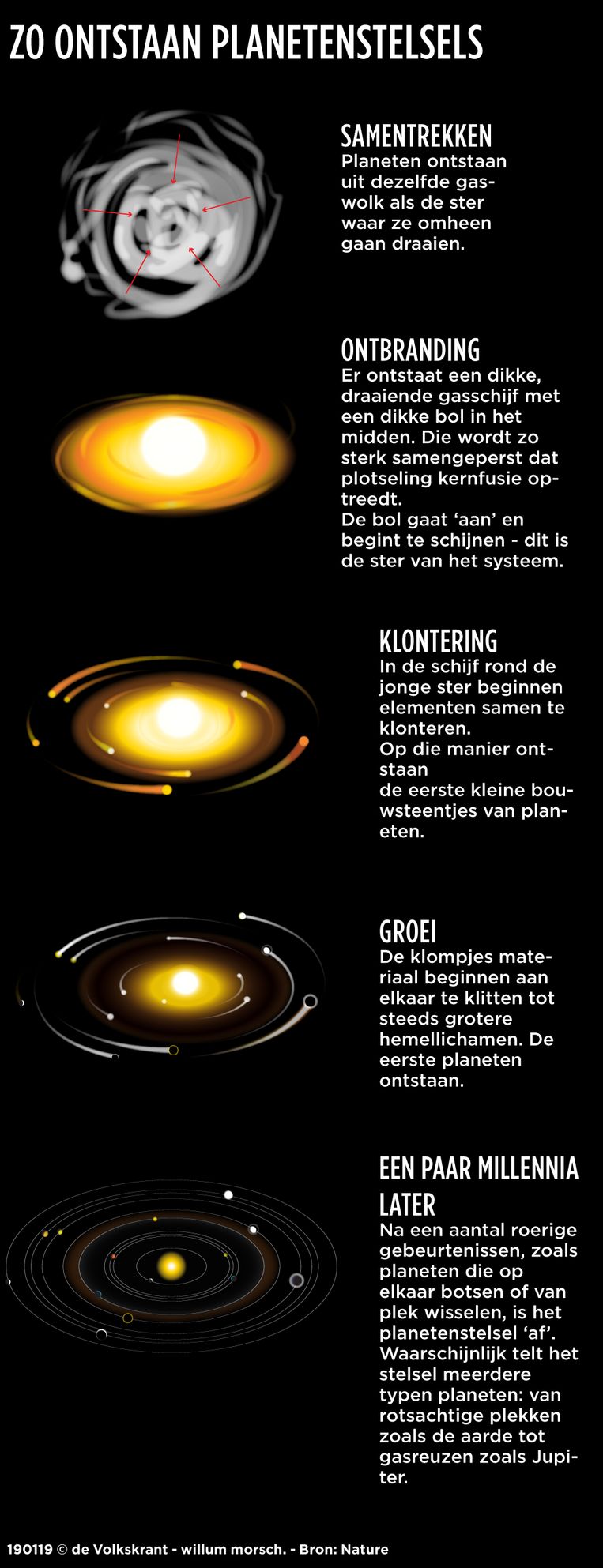
Dat bewegen van planeten, ‘migreren’ zeggen astronomen, heeft ook in ons zonnestelsel plaatsgevonden. Geïnspireerd door wat ze in verre planeetstelsels zagen, besloten astronomen onze lokale geschiedenis te simuleren. Al snel bleek dat de grote gasreuzen in het jonge zonnestelsel driftig heen en weer schoven, al keerden ze hier uiteindelijk weer terug naar hun oorspronkelijke deel van het stelsel.
Ook in andere planeetstelsels zien astronomen de sporen van dat chaotische geschuif. Snellen: ‘Hete Jupiters draaien vaak de verkeerde kant op, in vergelijking met andere planeten. Gasreuzen die iets verder weg staan, maar nog steeds relatief dicht op de ster zitten, hebben juist elliptische banen. Dat moet wel het gevolg zijn van het geweld waarmee ze ooit naar binnen zijn geschoven.’
Het lijkt erop dat dergelijke verplaatsingen vaste prik zijn in de chaos van jonge sterrenstelsels. Die planetaire puberteit duurt meestal tien à honderd miljoen jaar. Op een plek als het zonnestelsel, dat met zijn vijf miljard jaar al eventjes mee gaat, is alles inmiddels rustig. ‘Een stelsel dat continu zo chaotisch blijft als in het begin, trekt zichzelf namelijk onherroepelijk aan stukken’, zegt Dominik. Ook bij planeetstelsels komt stabiliteit dus met de jaren.
Astronomen verbonden aan de European Southern Observatory legden afgelopen september een bommetje onder ons beeld van hoe planeten ontstaan. Ze bekeken honderden stofschijven waarin planeten ontstaan met radiotelescoop Alma en zagen tot hun schrik dat er véél te weinig materiaal in zat om planeten te maken, zo schreven ze in het vakblad Astronomy & Astrophysics. ‘We moeten onze theorieën over planeetvorming herzien’, zei de Nederlandse astronoom Gijs Mulders (University of Chicago), niet bij het onderzoek betrokken, vervolgens tegen het vakblad Science.
Jarenlang gingen astronomen ervan uit dat werelden zoals de aarde, Jupiter, Kelt-9b en HD 189733b ontstonden in stofschijven waar ronddwarrelende stofkorreltjes en andere kleine deeltjes onder invloed van zwaartekracht aan elkaar plakten. Als een soort rollende sneeuwbal voegt steeds meer kosmisch ‘spul’ zich bij de vormende planeet, waardoor hij uiteindelijk kan uitgroeien tot planetaire proporties. Alleen staat die sneeuwbaltheorie door de recente waarnemingen nu plots op losse schroeven: het is lastig grote ballen draaien als je maar een klein beetje sneeuw hebt.
‘Gelukkig zijn er wel uitwegen’, zegt Ignas Snellen, die het artikel ‘heel belangrijk’ noemt. De auteurs beschreven die overigens zelf al in hun vakartikel. Allereerst zouden planeetkernen sneller kunnen groeien dan gedacht. Radiotelescoop Alma, een verzameling van 66 samenwerkende schotels in de Atacamawoestijn in Chili, is vooral goed in het zien van klein stof. Grotere korrels vanaf grofweg een centimeter ontsnappen daardoor aan zijn aandacht. ‘Dan denk je dus dat er te weinig materiaal is’, zegt Snellen. Het kan daarnaast ook nog dat het stof en gas in de schijven steeds wordt aangevuld, vanuit een nog onbekend reservoir, zodat je er bij één momentopname steevast te weinig aantreft. ‘Over dit soort ideeën wordt de komende tijd veel gediscussieerd, totdat we snappen hoe het zit. Zo werkt dat in onze wereld.’
Het artikel past bovendien in een trend, zegt Snellen. ‘Hoe meer waarnemingen we doen, hoe minder we begrijpen van hoe planeten zich vormen’, zegt hij. De stortvloed aan gegevens over exoplaneten en metingen aan de stofschijven waarin ze ontstaan maakt de vraagtekens almaar groter. En dat terwijl het vraagstuk zo cruciaal is: hoe planeten ontstaan, en welke materialen daarbij een rol spelen, raakt direct aan hoe onze eigen planeet, de aarde, werd gevormd. En waar de basisbouwstenen van het leven vandaan komen.
Zo ontdek je verre planeten
Zelfs de sterkste telescoop kan van een exotische wereld, draaiend om een verre ster, geen directe foto maken. Ze staan te ver weg en zijn relatief klein. En dan hangen ze ook nog eens in de buurt van een ster, een helder lichtbaken dat je het zicht ontneemt. Alsof je een vuurvliegje probeert te zien terwijl je recht in een bouwlamp kijkt.
Wie toch verre planeten wil ontdekken heeft dus een handige truc nodig. Astronomen hebben er een aantal, waarvan twee het populairst zijn. Bij de eerste speuren ze naar de regelmatige afname in de helderheid van het licht van een ster die wordt veroorzaakt wanneer een planeet voorlangs trekt. Een tweede optie is om sterren te zoeken die een beetje wiebelen. Dat komt vaak doordat een planeet er met zijn zwaartekracht aan trekt. De snelheidsverandering in de beweging van de ster die zo ontstaat kun je - via een omweg - meten. Op die manier betrap je, indirect, een planeet.
Een van de grootste raadsels waar astronomen mee worstelen is waarom planeten het vormingsproces überhaupt overleven. Nadat stofdeeltjes zijn samengeklonterd tot grotere objecten, bereiken ze rond een paar millimeter een kritische grens. ‘Vanaf dan zouden ze door interactie met de rest van de stofschijf moeten afremmen en in de ster moeten vallen’, zegt Snellen. Pas als ze een stuk groter geworden zijn - bollen met een diameter van een meter of tien - zijn de jonge planeten de stofschijf de baas. Snellen: ‘Maar daar tussenin snappen we er dus niet zoveel van.’
Ideeën zijn er wel. ‘We denken dat kleine deeltjes zich gaan gedragen als een soort peloton bij het wielrennen’, zegt Carsten Dominik. ‘Op die manier hebben ze minder last van het gas eromheen.’ Alleen is het daarvoor dan wel weer noodzakelijk dat er voldoende korreltjes voorhanden zijn, dat de dichtheid van de schijf hoog genoeg is. Of dat het geval is bij de stofschijven die astronomen tot nog toe hebben gezien, is nog een open vraag.
Voorlopig snappen astronomen nog niet waar al het materiaal voor de aarde (en andere planeten) vandaan komt én waarom ons thuis in zijn tienerjaren niet plotseling de zon in is gekukeld. Dat maakt ons bestaan tot een prachtig raadsel dat naar verwachting nog wel even op een oplossing moet wachten.
‘Ik zal je één ding vertellen over het heelal’, zegt astronoom Ellie Arroway in een beroemd geworden scène uit sciencefictionfilm Contact (1997). ‘Het heelal is een behoorlijk grote plek. Het is groter dan iemand ooit gedroomd heeft. Dus als wij alleen zijn… dan voelt dat als vreselijke ruimteverspilling. Toch?’
Het is grofweg die redenering die alien-optimisten bezigen wanneer ze stellen dat het onvoorstelbaar lijkt dat de aarde in dit uitgestrekte heelal – dat naar verwachting gevuld is met miljarden en miljarden planeten – de enige plek zou zijn waar leven voorkomt. En dat idee heeft, sinds de meting van de eerste exoplaneet, alleen maar aan kracht gewonnen.
‘Toch hebben we uit het exoplaneetonderzoek strikt gesproken nog niets nieuws geleerd over het bestaan van buitenaards leven’, zegt Ignas Snellen. ‘Of nou ja… we weten natuurlijk wél dat rotsachtige planeten zoals de aarde op veel plekken voorkomen.’
Snellen vermoedt zelfs dat het de meest voorkomende planeetsoort in het heelal is, al zijn deze met de huidige methoden nog lastig te vinden. ‘Maar wanneer het technisch wel kan, vinden we ze eigenlijk altijd ook’, zegt hij.
Neem bijvoorbeeld Proxima b, de rotsachtige planeet die rond Proxima Centauri draait, de ster het dichtst bij de zon, op een afstand die vloeibaar water mogelijk maakt. Of, een stukje verderop, de rotsachtige superaarde die astronomen in november ontdekten rond de Ster van Barnard. Het zijn plekken waar leven overigens niet erg waarschijnlijk is. Zo is het op de planeet van Barnard zo’n 170 graden onder nul. Terwijl potentieel leven op Proxima b dankzij heftige steruitbarstingen continu wordt bestookt met naar aardse begrippen dodelijke straling.
Iets hoopvoller is het zogeheten Trappist-systeem, waar drie planeten in de leefbare zone draaien, de afstand waarop vloeibaar water mogelijk is. ‘Daar zou leven dus kunnen bestaan’, zegt Carsten Dominik. ‘Althans: als die planeten bijvoorbeeld een atmosfeer hebben.’
Kijk puur naar de astronomische feiten en je kunt bijna niet anders dan optimistisch zijn. Dominik: ‘We hebben tot nog toe geen enkele showstopper gezien die zegt dat leven minder vaak zou voorkomen dan gedacht.’ Planeten komen voldoende voor, naar verwachting óók om vriendelijkere sterren dan Proxima Centauri. Van die planeten zal een fractie vloeibaar water hebben. En daarvan zal een fractie naar verwachting leven bevatten. ‘Hier op aarde is het leven binnen een paar honderd miljoen jaar ontstaan’, zegt Snellen. ‘Waarom zou dat dan elders niet net zo gaan?
Naar dat leven zijn astronomen als Snellen en Dominik daarom hard op zoek. Het zou zelfs kunnen dat het in de buurt zit. Voor een bevestiging is het wel wachten op de volgende generatie telescopen. De geplande opvolger van Nasa’s ruimtetelescoop Hubble, de James Webb Space Telescope, kan bijvoorbeeld kijken of de planeten rond Trappist een atmosfeer hebben. En de Extremely Large Telescope, die ESO nu in Chili bouwt, kan speuren naar water op Proxima b.
Als leven echter zeldzamer is – zelfs als het bijvoorbeeld ‘slechts’ een op de duizend keer voorkomt – dan moeten we voorlopig geduld hebben. ‘Of je moet andere technieken gebruiken waarmee je nu al veel verder het heelal in kunt kijken’, zegt Dominik. ‘Dan wordt het toch speuren of je radiosignalen van intelligente beschavingen kunt opvangen.’
Die missie heeft tot nog toe geen succes gehad, al is dat ook weer niet zo vreemd. Het heelal is, zoals Ellie Arroway in Contact zei, nu eenmaal best wel groot. Je moet dan ook niet vreemd opkijken als het zoeken naar een planeet met leven in die kosmische hooiberg wat langer duurt dan gehoopt.
Deze topastronoom van Harvard denkt dat hij een ruimteschip heeft gezien - HLN.beGeorge van Hal
Bron: de Volkskrant
Avi Loeb gelooft er wel in. Op 19 oktober 2017 kreeg de mensheid voor het eerst bezoek van aliens. Op dezelfde dag dat in Florence een bezoeker van de Santa Croce-basiliek dodelijk wordt getroffen door een vallend stuk steen, en in Nederland presentator Frits Bom overlijdt, krijgt een telescoop op Hawaï een bizar voorwerp in zijn vizier. Een lang ding, zo’n honderd tot duizend meter. Niet bolvormig, zoals we gewend zijn van de kometen en asteroïden die door het zonnestelsel zoeven, maar langgerekt. Een kosmische scherf of, zo fluistert men op internet al snel: een soort ruimteschip.
Het voorwerp krijgt de Hawaïaanse naam ’Oumuamua, grof vertaald: boodschapper van ver. Journalisten en bloggers noemen hem vanwege zijn vorm liefkozend ‘kosmische komkommer’ of ‘ruimtesigaar’. Maar het opvallendst is de naam die hij van astronomen krijgt: Interstellar 1, de allereerste in een nieuwe categorie, een bezoeker van buiten ons zonnestelsel.
’Ik denk dat ’Oumuamua gemaakt is door een buitenaardse beschaving.’ Aan het woord is geen complotdenker of ufo-gelovige – Loeb is hoofd van de sterrenkunde-afdeling van Harvard, een van ’s werelds meest prestigieuze universiteiten. Daarnaast is hij directeur van het interdisciplinaire Black Hole Initiative en baas van het instituut voor theorie en berekening aan het Harvard-Smithsonian Institute for Astrophysics.
Een mooi cv, maar Loeb staat ook bekend om zijn uitgesproken ideeën en grote interesse in intelligent buitenaards leven. Zo vroeg hij zich in 2017 hardop af of de mysterieuze snelle radioflitsen die zijn collega’s in de ruimte waarnemen signalen zouden kunnen zijn van aliens. Ook zit hij in de adviesraad van het Breakthrough Starshot-project van de Russische miljardair Yuri Milner, dat met kleine ruimteschepen naar Proxima Centauri, de ster die het dichtst bij de zon staat, wil vliegen. Op die manier hopen ze op planeet Proxima Centauri b te ontdekken of daar buitenaards leven zit.
Dat juist hij in ’Oumuamua de invloed van buitenaardsen herkent, past dus in een patroon. ’Ik heb meerdere onderzoeken over ’Oumuamua gepubliceerd. Daaruit bleken allerlei vreemde feiten’, zegt Loeb. Zo zag hij hoe de helderheid van het object aan de hemel gedurende acht uur geregeld met een factor tien tot dertig veranderde. Dat betekent dat het voorwerp niet rond is, zegt hij, maar het hoeft ook geen langgerekte sigaar te zijn zoals iedereen lijkt te denken. ‘Onze analyse laat zien dat het meer op een pannekoek lijkt die om z’n lengteas draait.’
Een platte pannekoek van buiten het zonnestelsel… heeft u het soms over een vliegende schotel?
’Ik geloof niet in ufo’s, maar ik denk wel dat ’Oumuamua een overblijfsel is van een buitenaardse beschaving. We ontdekten een rare afwijking in zijn baanbeweging, eentje die je niet kunt verklaren door de aantrekkingskracht van de zon. Dat zie je wel vaker bij een komeet, wanneer het ijs op het oppervlak verdampt. Dan krijg je een soort raket-effect. Maar ’Oumuamua is geen komeet. Hij heeft niet de kenmerkende staart van een komeet en ruimtetelescoop Spitzer vond in de buurt van het object niet de koolstofmoleculen die je bij een komeet zou verwachten.
’De vraag is dus: waar kreeg hij dat extra zetje dan door? Het enige dat ik kan bedenken is stralingsdruk. ’Oumuamua kan een lichtzeil zijn. Net zoals een zeil op een boot vooruit wordt geduwd door deeltjes in de lucht, krijgt een lichtzeil vaart wanneer lichtdeeltjes erop botsen. Die technologie hebben we op aarde ook, maar staat hier nog in de kinderschoenen. Het kan dus best dat een buitenaardse beschaving, die meer tijd heeft gehad om die technologie te ontwikkelen, ’Oumuamua heeft gemaakt.’
Dat is niet iets dat je snel uit de mond van een wetenschapper verwacht…
’Het is natuurlijk nog speculatie. Maar het zou goed kunnen kloppen. Sommige collega’s zeggen: o, maar voor elk van deze vreemde eigenschappen kunnen we wel een excuus vinden of een ingewikkelde verklaring. Mij doet dat denken aan de volgende analogie: stel dat je een mobiele telefoon meeneemt naar een holbewoner. Die zal denken dat de telefoon een soort gekke steen is. Net zo zijn wij vanuit het verleden gewend om te denken in termen van kometen, asteroïden – stenen uit de ruimte, dus. We zijn vooringenomen.
’Maar in de wetenschap moeten we juist naar het bewijs kijken, zonder vooroordelen. Het is daarom jammer dat we niet meer meetgegevens hebben. Gelukkig verwachten we dat de geplande opvolger van de telescoop die ’Oumuamua vond, daarin veel kan betekenen. Die moet over drie jaar operationeel zijn en kan meer interstellaire voorwerpen ontdekken.’
Moeten astronomen er bij alles rekening mee houden dat het gebouwd kan zijn door aliens?
‘Ja, zolang dat logisch is op basis van het bewijs. Wat mij betreft is het bestaan van buitenaardse beschavingen helemaal geen speculatie. Het is een logische extrapolatie, gebaseerd op twee feiten. Allereerst het feit dat wij bestaan. En ten tweede het feit dat in de Melkweg veel planeten zijn met condities die vergelijkbaar zijn met die op aarde. We denken dat ongeveer een kwart van de sterren een planeet heeft zoals de aarde, met de mogelijkheid van vloeibaar water. Dat zijn in totaal miljarden planeten. Als je dan steeds weer de dobbelsteen gooit, is de kans heel klein dat het maar één keer raak was, dat wij alleen zijn in de kosmos.’
Toch voelt praten over complete beschavingen van intelligente buitenaardse wezens wel heel speculatief.
’Het bestaan van buitenaards leven is een hypothese als alle andere. We moeten daarover oordelen op basis van meetgegevens en feiten. Dat zou mainstreamastronomie moeten zijn. Maar in ons vakgebied heerst een taboe op dit onderwerp. Het doet mensen denken aan sciencefiction, roept het beeld op van ufo’s. Dat zou niets moeten uitmaken.
’Het is ook een beetje scheef. In de snaartheorie (een wiskundig bolwerk dat natuurkundigen optuigden in de hoop alle natuurkunde in één enkele beschrijving te vangen, red.) heeft men het bijvoorbeeld over het bestaan van meer dimensies of zelfs parallelle werkelijkheden. Daar is werkelijk geen enkel bewijs voor en tóch is het mainstream geworden. Voor het bestaan van buitenaardse beschavingen is maar een kleine extrapolatie nodig. En daar mag je het in serieus gezelschap dan ineens niet over hebben. Dat is toch compleet belachelijk?
‘Ik denk dat we hier vooral te maken hebben met een sociologisch effect. Niet met iets dat gebaseerd is op feiten. Men heeft oogkleppen op.’
Zien ze door die oogkleppen nog meer over het hoofd?
’Jaren terug schreef ik al vakartikelen over mogelijke aanwijzingen voor het bestaan van buitenaardse beschavingen – technologische handtekeningen waar we te weinig naar zoeken. Zo liet ik zien dat wanneer je een stad als Tokio verplaatst naar de rand van het zonnestelsel, je hem met ruimtetelescoop Hubble nog gewoon kunt zien.
‘Ik vroeg vervolgens aan een astronoom die veel objecten aan de rand van het zonnestelsel had ontdekt, of hij weleens had gekeken of die voorwerpen kunstmatig licht uitzenden. Hij zei: nee, waarom zou ik dat moeten doen? Het is toch duidelijk dat ze alleen zonlicht weerkaatsen? Zo vooringenomen zijn sommige astronomen dus in de praktijk.’$
Bent u niet bang voor reputatieschade doordat u zoveel praat over aliens?
‘Ik ben niet bang voor de publieke opinie. Als iets klopt, zullen mensen dat uiteindelijk inzien. Ik ben directeur van twee instituten en hoofd van de afdeling sterrenkunde. In mijn instituten heerst een gezonde, open en wetenschappelijke sfeer, waar mensen risico’s mogen nemen. Toen ik jonger was en minder baanzekerheid had, werkten dit soort ideeën me soms wel een beetje tegen. Dat probeer ik jonge onderzoekers te besparen.’
In de wetenschap moet je een hypothese ook kunnen weerleggen. Kunnen we bewijzen dat er géén buitenaardse beschavingen bestaan?
’Nee. Deze zoektocht gaat eeuwig door. Als je op zoek gaat naar signalen zijn er zó veel mogelijkheden. Zelfs als je alleen kijkt naar elektromagnetische straling, zoals radiosignalen of licht, dan kunnen die net als de zenders op je radio allerlei frequenties hebben. Ook zenden ze misschien maar kort uit, zodat je het net mist. Wil je daarvoor compenseren, dan moet je steeds op een andere manier zoeken. We kunnen dus nog wel even doorgaan, ook als het bewijs uitblijft.
’Belangrijk is wel dat je alles kunt blijven toetsen aan waarnemingen. Natuurkunde is een dialoog met de natuur, geen monoloog. Zoals bij ’Oumuamua: ik kan mijn vermoeden dat het een buitenaards apparaat is nog niet sluitend bewijzen, maar we weten hoe we aan meer meetgegevens moeten komen.’
Als we uiteindelijk intelligent buitenaards leven vinden… wat dan?
‘Dan hebben we de belangrijkste ontdekking uit de geschiedenis van de mensheid gedaan. Belangrijker dan de eerste mens die een rondje om de aarde vloog. Belangrijker dan de ontdekking van Amerika. Het zou ons ineens op een kosmisch podium plaatsen, laten zien dat we allemaal voor hetzelfde team spelen. Dat we onze verschillen zo snel mogelijk moeten overstijgen. Ik wil dat tijdens mijn leven graag nog meemaken.’
Nu we bijna vierduizend planeten hebben ontdekt, hebben we vooral geleerd dat we blij moeten zijn dat we niet op een planeet wonen waar het van opzij gesmolten glas regent. We maken een tour langs de meest extreme en bijzondere bestemmingen in de kosmos.
“Maan vormde zich uit materiaal van de aarde” - HLN.beBron: NASA
De wetenschapper, Kevin Righter van NASA’s Johnson Space Center in Houston, baseert zich op experimentele proeven en analyses van stalen die de Apollomissies bijna 50 jaar geleden meebrachten naar onze planeet. Na de enorme clash zo’n 4,5 miljard jaar geleden tussen de toen nog jonge aarde met een hemellichaam ongeveer zo groot als Mars werd de maan gevormd. Maar niet uit materiaal van Theia, dat door de impact in een baan rond de aarde zou zijn geslingerd, wél uit materiaal van de aarde zelf.
De studie simuleerde het proces van de maanvorming met behulp van veertien vluchtige, metaalminnende elementen die gevonden werden in monsters van de Apollomissies. Uit de simulatie kwam een “sterke” correlatie naar voren tussen negen van de veertien gebruikte elementen van de aarde en die van een gesimuleerde maan gemaakt uit materiaal van de aarde. Hetzelfde gold niet voor een maan gemaakt uit het vermeende ruimtegesteente Theia, met de omvang van Mars ongeveer.
Er is nog aanvullend onderzoek nodig om de hypothese van Righter te bevestigen, maar zijn studie vult alvast enkele gaten die er al sinds de jaren 70 in de wetenschappelijke data hierover zijn.
Unlikely Dinosaur Fossil Found In Antarctica

Antarctica is a place with so much ice and snow that they seem to go on forever. Animals, such as seals and penguins, have adapted to the freezing cold temperatures. However, millions of years ago, it wasn’t the blistering cold and icy continent that it’s known for today. Around 250 million years ago, Antarctica was full of forests and rivers with various species wildlife living there, including reptiles. As a matter of fact, the temperature on the continent hardly ever dipped below the freezing mark.
In addition to the nice weather and vast wildlife that thrived on the continent millions of years ago, a new species has been discovered that once lived there. Researchers uncovered the fossil of an iguana-sized reptile that was an early relative of the Antarctic dinosaurs. During a 2010-2011 expedition, the incomplete skeleton was taken from Graphite Peak in the Transantarctic Mountains. The fossil contained parts of its skull, backbone, and limbs.
The small creature was said to have been a carnivore that ate bugs, amphibians, and other early mammal relatives. It has been named Antarctanax shackletoni which translates to “Antarctic king” (for Antarctanax) and in honor of the Antarctic explorer named Ernest Shackleton (for shackletoni).
Dr. Brandon Peecook, who is the lead author of a study on the discovery as well as a paleontologist at Field Museum, said, “Antarctanax shackletoni was an archosaur, an early relative of crocodiles and dinosaurs.” He went on to say, “On its own, it just looks a little like a lizard, but evolutionarily, it’s one of the first members of that big group. It tells us how dinosaurs and their closest relatives evolved and spread.”
Approximately two million years prior to the Antarctanax shackletoni roaming Antarctica, the Earth suffered a huge mass extinction which killed off 90% of all animals on the planet. After the mass extinction, archosaurs (which included dinosaurs) experienced a lot of growth around the planet. Dr. Peecook explained, “Before the mass extinction, archosaurs were only found around the equator, but after it, they were everywhere.” This would indicate that Antarctica was an area where evolution and diversity happened quite fast following the end-Permian mass extinction.


The fossil as it was discovered.
While the exploration of the continent of Antarctica is still in its early stages, it’s very possible that more new and unique creatures will be discovered from millions of years ago. In relation to the process involved with exploring the continent, Dr. Peecook explained, “Antarctica is one of those places on Earth, like the bottom of the sea, where we’re still in the very early stages of exploration. Antarctanax is our little part of discovering the history of Antarctica.”
Iran is disappearing underground: While Tehran is sinking, giant sinkholes swallow parts of western Iran
Tehran is sinking… And now gigantic holes as deep as 60 meters (197 feet) are appearing in western Iran. And that’s not because of missiles or meteors… No, no! They are the result of excessive water pumping.
A few weeks ago, new satellite measurements showed that Tehran was sinking about 10 inches (25 centimeters) per year.

Giant holes form in Iran due to excessive water pumping.
Pic via Youtube video

These gigantic holes in Iran were not caused by missiles or meteors.
Pic via Youtube video
A side effect of such impressive subsidence is the sudden appearance of giant cracks and sinkholes in some areas that may end up with some parts of Iran completely disappearing from world maps.

Ground collapse in western Iran.
Pic via Youtube video

Huge cracks in desertic western Iran.
Pic via Youtube video
The same sinkhole phenomenon is observed around the shrinking Dead Sea, leaving huge craters and cracks in its wake, now forming at a rate of nearly one-two a day.
Pill-Shaped UFO Seen Pulsating In The Skies Above NC

A UFO appearing in the sky just outside Greensboro, North Carolina was captured on video, which was also posted on social media. Moments after it made available online, the UFO sighting video has sparked an ongoing debate with many claiming to have seen the same random flashing object.
The 5-minute video, which was posted on Saturday, shows a pill-shaped object soaring through the sky and making a series of flashes.
The video, which is magnified and slowed down, has been viewed thousands of times and several YouTube channels devoted to UFOs and unsolved mysterious picked it up.
It is credited to YouTube username SpaceBret, also known as Bret Jones, who reveals in the video that the strange object was spotted on January 25 while he was trying to record birds outside Greensboro on video.
He claims that he noticed a mysterious flashing light in the sky close to an airplane. The UFO was moving slowly across the sky, slightly slower than the planes flying around, according to uploader Jones, who did not think he captured it at all.
He decided later to magnify and slow down the footage by 900 percent, which appears to reveal a glinting pill shaped object producing flashes from its two ends.
When Bret saw it, it just blew him away because it wasn’t what he expected at all. And until now, he does not have an idea of what it is.
One person has suggested that it is a Mylar balloon with string or WiFi extender antenna balloon because, at one point in the video, it looks like the UFO has a tether.
However, Jones does not agree with the suggestion as it cannot explain the flashing and vanishing. He also believes that the tether might be some kind of fuel ejected from the object.
Several people claim to have seen the same UFO. Julia Hejnar posted on YouTube that she saw the same object in Winston Salem in the late afternoon of the 25th. She said that the object also blinked out.
Another viewer SkyHound said that he had seen the flash at night for the past year now. He explained that he clearly knows the difference between helicopter, planes, meteorites, iridium flares, satellites, etc. but this is different. He added that the object appears to flash extremely bright with no pattern and it even occasionally fades out into a dull red light.
Kuiper Belt Object "Ultima Thule" Does Not Behave Like An Asteroid, Scientists Are Confused
A 13th Century Manuscript About Merlin Has Been Found


Left to right: Leah Tether, Laura Chuhan Campbell, Michael Richardson, and Benjamin Pohl with the books in Bristol Central Library’s Rare Books Room. The team of experts investigating further if the pieces hold any secret about the legends of Arthur, Merlin, and the Holy Grail.
If you’ve seen any of the many movies about King Arthur and the Knights of the Round Table, you probably think you know the basics of the story … until you see another one. Throw in Monty Python and the whole legend and/or possible true account starts to get blurry. While the battles and loves of the Arthurian mortals are somewhat believable, the tales of the magician/wizard Merlin stretch the credibility of the stories. Now, some newly discovered manuscript pages dating back to the 13th century add a little more detail to the wizard who all future movie wizards are based on.
“These fragments of the Story of Merlin are a wonderfully exciting find, which may have implications for the study not just of this text but also of other related and later texts that have shaped our modern understanding of the Arthurian legend.”

"How Arthur by the means of Merlin got Excalibur, his sword of the Lady of the Lake", illustration for Le Morte Darthur.
(Lagad Zoltec / Public Domain )
Dr. Leah Tether is the President of the International Arthurian Society (British Branch) in the Bristol University Department of English and a leading scholar in the field, which explains why she was the person Michael Richardson, a colleague from the university’s Special Collections Library, called when he found seven odd parchment fragments among the pages of the works of the French scholar and reformer Jean Gerson which were printed in Strasbourg, France between 1494 and 1502. According to the Bristol University press release, Richardson recognized the name “Merlin” on the fragments and took them immediately to Tether.
The Gerson books, while published in the late 15th century, were not bound until the 16th century when they somehow were transferred from Strasbourg to Bristol. It’s believed the older pages were considered to be waste paper and were being reused as “pastedowns” – the sheets stuck to the inside of the covers used to connect the pages to the binding. That could explain why the pages are in fragments and an eighth is missing.
Tether recognized the pages as belonging to a 13th century Old French sequence of texts known as the Vulgate Cycle or Lancelot-Grail Cycle. The seven pages or leaves are continuous and come from a section of the Estoire de Merlin narrative known as the ‘Suite Vulgate de Merlin’ (Vulgate Continuation of Merlin). They recount the narrative of the Battle of Trèbes in which Merlin gives a speech to motivate the knights and then leads them into battle using a special sword belonging to Sir Kay (Cai), a superhuman knight whose sword radiated heat from his hands (or breathed fire) and whose inflicted wounds would not heal. They defeat the forces of King Claudas and then stay in the kingdom of Benoic where Merlin interprets dreams and falls in love briefly with a woman named Viviane before rejoining Arthur.
The fragments add some meaty details to this tale and some differ from previously discovered accounts. A number of names of the battle leaders have been changed and the wounds King Claudas suffered are different. Otherwise, it’s similar enough that Tether recognizes it as an important early account of the part Merlin played in the Arthurian legend.
“There are many more differences, too, but because of the damage to the fragments, it will take time to decipher their contents properly, perhaps even requiring the use of infra-red technology. We are all very excited to discover more about the fragments and what new information they might hold.”

During the 12th century, Arthur's character began to be marginalized by the accretion of "Arthurian" side-stories such as that of Tristan and Iseult, by John William Waterhouse.
(Luca Z. / Public Domain )
What more will they find? The truth about whether Merlin really was a cambion – the child of a human mother and an incubus father? Was he really killed by the Lady of the Lake? The location of the Holy Grail? Details on the Knights who say “Ni!”? The real story of the Rabbit of Caerbannog?
Why did Merlin break up with Viviane … or did she dump him for a younger wizard?
Metamaterials Not From Earth
Astronomers spot mysterious long 'trash bag' object floating above Earth
The unidentified object comes close to the Earth but swoops around to go further away than the Moon
Sightings with no rational explanations

Remember the Malaysian Airlines plane MH370 which disappeared but left behind a mystery that has still not been solved? In a 2014 poll on the MH370 disappearance, five per cent of American respondents said they believed it had been affected by “alien activities”’. For many people, MH370’s inexplicable disappearance brought to mind one of the most famous and perhaps saddest mystery cases which grabbed worldwide media attention—that of Frederick Valentich, a young Australian pilot. Significantly, it was this case in particular which is credited with starting off a whole series of visual, radar, and filmed recordings of unidentified, unexplained flying objects or UFOs.
Fifty minutes after he had taken off on a solo flight across Bass Strait to King Island in a Cessna 182 aircraft, Frederick Valentich radioed, “It’s approaching from due east of me… It seems to be playing some sort of game. Flying at speed I cannot estimate…It is flying past. It has a long shape… coming for me right now… It has a green light and sort of metallic light on the outside…” Frederick was reporting to the Melbourne air flight service controller after he radioed a request for confirmation of a large craft with “four bright lights” and was informed that there were no reported aircraft in the area. “…. The thing is orbiting on top of me… Proceeding King Island…Unknown aircraft now hovering on top of me…” and Frederick signed off. A loud metallic sound was heard at ground reception for 17 seconds and then communications went dead. No sign of either Frederick Valentich or his plane was ever found, and the mystery, like that of MH370, remains unsolved to this day.
More recently, just a few weeks ago, the International Business Times carried a report with an intriguing headline: “Mountain collapses in Russia: Conspiracy theorists put forward UFO crash possibilities”. Russian president Vladimir Putin, said the report, has apparently asked soldiers to investigate a creepy incident where a mountain in Siberia collapsed completely due to unknown reasons… popular conspiracy theory YouTube channel ‘Secureteam10’ run by UFO researcher Tyler Glockner has suggested that the unexpected collapse of the mountain might be due to a UFO crash.
The video uploaded by Secureteam10 soon went viral, and quickly racked up more than 4,00,000 views, according to the IBT report. After watching the videos, most of the people claimed that the mountain collapse could be the result of an alien space ship crash. Some other people claimed that these events could be the aftermath of earth’s magnetic pole shift. However, Express.co.uk reported that Alexey Maslov, head of Verkhnebureinsky district where the incident happened said: “We are trying to find the explanation for this incident. I insist that it was a meteorite.” This incident stirred yet again the age old, undying debate between known, explainable physical phenomena and the phenomena of unexplained strange happenings. Such extraordinary occurrences often tend to fall between the supernatural and extraterrestrial theories as a possible key to the mystery.
The extraterrestrial “explanation” category is exceptionally fascinating. While the earliest “strange” sightings, believed to be more than 47,000 years old, seem to be carved on a granite mountain and rocks on an island in Hunan Province in China, one of the first written accounts of a strange sighting in the sky is part of an Egyptian papyrus—more than 3,400 years old—belonging to the period of Pharaoh Thutmose III, who ruled around 1504 to 1450 B.C.! Just like the references in the Mahabharata, excerpts from the ancient Egyptian account are worth reading. As I’ve written earlier, such sightings “with no single rational explanation” and often made by people of unimpeachable integrity in different parts of the world—Nicholas Roerich, the famous Russian painter with such close connections with India, Sir Francis Chichester, the well known flier, sailor and navigator, Jimmy Carter, former President of the USA—to name a few personalities of recent times—have continued down the centuries, right up to our present times.
Significantly, the majority of sightings has not come from illiterate, gullible people or people of unsound mind or prone to hallucinations. Experienced Air Force and private airline pilots, air traffic controllers, Captains of ships on the sea, professors, policemen, and other highly qualified, highly respected personages are amongst the witnesses. There have been single sightings but more of sightings by several people at the same time and sometimes even hundreds or thousands of people watched.
UFOs have been photographed quite extensively and the photographs subjected to thorough scrutiny for “fraud” but were almost always found to be genuine. Jimmy Carter, the former U.S. President sighted a UFO on January 6, 1969, when he was Governor of Georgia. The former President was quoted by the “National Enquirer” as saying, “I am convinced that UFOs exist because I’ve seen one…It was a very peculiar aberration but about 20 people saw it… It was big; it was very bright; it changed colours; and it was about the size of the moon. We watched it for 10 minutes, but none of us could figure out what it was…”
Some UFO witnesses have described personal contact with ‘occupants’ of strange crafts and even reported being detained. The book Real Aliens, Space Beings, and Creatures from Other Worlds by Brad and Sherry Steiger provides very informative reading. But as author and paranormal researcher Stephen Wagner rightly questions, “To account for the sheer number and variety of aliens and craft reported over the decades, the Earth would have to be visited by dozens of races from dozens of planets outside our solar system. Is this likely? What are these creatures and where do they really come from? Other dimensions? Our own imaginations and subconscious? …science has so far brought us knowledge of only the thinnest surface of our true reality. I suspect that the answers and explanations are, for the present, beyond our understanding…”
And whether they are physical, psychological, interdimensional, or something else in nature, emphasises Wagner, they cannot and should not be ignored… they should be reported, explored, and examined—objectively—to the fullest extent possible. How else, he asks, are we going to get to the bottom of it all? And that should include the numerous documented but not often reported UFO sightings in India as well.
Project Blue Book Episode 4 Review: Operation Paperclip


The latest episode of History’s Project Blue Book takes the furthest deviation yet from the facts of the real Project Blue Book program. However, it is very entertaining and it mixes in real conspiracy theories expertly in a manner that is intelligent and makes the viewers think.
I have been reviewing the show for Den of Geek, and my review of the latest episode can be found here:
Project Blue Book episode 4 takes a nosedive into the rabbit hole, but the wild storylines follow real conspiracy and UFO mythologies that are popular on the web. It also presents an intriguing alternate theory to the idea that UFOs have anything to do with aliens at all.
Take an odd part of history, add a bit of conspiracy mythology, then sprinkle with magic Hollywood dust and up sprouts a huge, beautiful tree of fantasy. That would sum up my feelings on “Operation Paperclip.” I am a student of history, so I relish in historical accuracy. However, I am also a sci-fi buff, and this latest episode frustrated the history buff in me while exciting my sci-fi side.
Let’s get into it. The show begins with Hynek on an airplane. The first mystery presented was that the passenger cabin of the aircraft looked more like a train with curtains over the windows and seats that faced one another. However, in a tweet, show creator and writer David O’Leary wrote: “Yes, these old 1950s planes really did have train-like booths that faced each other. And lots more leg room!” Score one for historical accuracy! Granted, it’s one of the few points that I will award in this category for this particular episode.
Hynek then sees a UFO flying around the airplane. We are lead to believe Hynek is experiencing this sighting, but then he wakes from a dream. He was dreaming about his most recent UFO case - a sighting by the passengers and crew of a commercial aircraft near Huntsville, Alabama.
Quinn feels certain he knows who is responsible for this UFO incident and he is not very happy about it. Quinn explains that after World War II, German scientists were snatched up by the U.S. as part of Operation Paperclip. He says Huntsville was set up to house German scientists working on rocket technology, led by Werner von Braun. Having fought in World War II, Quinn is with the situation.
Hynek and Quinn travel to Huntsville to find out what the Germans are up to. Quinn is convinced that the UFO that buzzed the airplane was a rocket built by the former German scientists, who he believes were not concerned with endangering the lives of the passengers.
Security denies Hynek and Quinn access to the base, but Quinn crashes through the barricades anyway. This does allow them an audience with Von Braun but also lands Quinn a suspension. Von Braun says he is familiar with Hynek’s work, shows them a secret rocket launch and offers Hynek a job. He admits it was one of his rockets that buzzed the airplane, but Hynek doesn’t believe him.
To make a long story short, after leaving, Hyenk and Quinn break into the base again. This time they sneak around and find a body floating in a suspended animation container. It looks like an alien. The base alarms sound, so the two race off, only to be caught. Von Braun tells them what they saw was a monkey that had been sent into space and was undergoing testing as to the effects of space on its body. Hynek tells him he is suspicious of their project because the rocket explanation for the UFO sighting did not fit the witness testimony. There is something von Braun is hiding.
At the end of the show, we see what that is. After Quinn and Hynek have left, General Harding, Quin’s boss, shows up to join von Braun on a tarmac. A large saucer-shaped object is then wheeled out of a hangar, and a pilot in a flight suit is put into the craft. This pilot is complaining he doesn’t want to do this, but he seems drugged and unable to struggle. The craft looks like human technology, but when it is started up, a weird field surrounds it, then it disappears.
The show is mostly full on science fiction with modern UFO and conspiracy mythologies expertly weaved into the story. The visuals are also stunning. It all makes for a fun and exciting show.
Project Blue Book, the TV show, is getting more exciting, and maybe that is due to its divergence from reality. Many feel the show does not need to move away from the real Project Blue Book investigations to be exciting, and that may be the case. I know first hand proving that to a producer is near impossible. However, I find this particular journey into conspiratorial sci-fi is intelligent in that it is expertly incorporating the UFO and conspiracy mythologies while making the viewers think about alternate explanations to the UFO mystery.
Huntsville is a city built by rockets. It is the home of NASA’s Marshall Space Center, but before NASA was created, the military had been testing missiles in the area since World War II. After the war ended, rocket testing continued. Operation Paperclip was real, and Werner von Braun was a real rocket scientist brought to the U.S. The U.S. first brought the German rocket scientists to Fort Bliss, Texas, but in the ‘50s, von Braun and his team were moved to Huntsville.
Von Braun’s popularity was primarily due to his involvement in the development of the V-2 rocket. This rocket terrified the allies during the war because it was the first ballistic missile. While the space program was a real thing, the real importance to the military was the development of bigger and better rockets. Especially with the prospect that a ballistic missile would be the ideal delivery system for the newly developed atom bomb.
In UFO circles, there have been many rumors about von Braun. From the belief that he had to be in the know regarding alleged crashes of alien spacecraft such as Roswell, to a rumor that he knew the government was faking emergencies to distract the public and that one day a UFO scare would be used for that purpose.
The Nazi’s also have a UFO history according to many conspiracy theories. It is believed they communicated with aliens and were able to develop technologies based off of alien technology. You can even find pictures online of saucer-shaped craft with Nazi symbols and guns mounted on them. It is rumored that the Nazi’s tried to mount weapons on alien spacecraft and it disrupted the propulsion systems and would not work. There are also rumors that the Germans were developing anti-gravity. In particular, a bell-shaped craft creatively named The Bell. The propulsion system consisted of two cylinders filled with a mercury-like substance that spun in opposite directions.
read more: Aliens in America: A History of UFO Storytelling
The way the craft disappeared at the end of Project Blue Bookis reminiscent of another conspiracy theory, one known as the Philadelphia Experiment. This mythology was first brought forth in a UFO book, although the author did not find the story credible. Despite the author’s opinion, this theory has a wide following. The story was that the U.S. developed technology that could render a ship invisible. Allegedly in 1943, the USS Eldridge, a 300 ft long Navy destroyer, was used to experiment with the technology. When the invisibility machine was enabled, the ship disappeared. When it reappeared crewmen reported feeling sick, and some were killed by somehow being embedded into the steal of the vessel.
In reality, the Germans were undoubtedly ahead of their time. At the time, technology such as jet propulsion and rockets were very advanced, and the Germans were way ahead of the U.S. in these areas. They even had a jet shaped like a stealth bomber that did partially inspire some of the stealth bomber’s characteristics. However, beyond rumors, there is no evidence they developed anti-gravity or canoodled with aliens.
The end of this Project Blue Bookepisode seems to suggest UFO sightings are actually due to experimental aircraft. The CIA has suggested this as well. In a CIA report regarding the development of aircraft at Area 51, there is a section titled “U-2s, UFOs, and Operation Blue Book.” In this section, they claim that many UFO reports were due to unwitting civilians spotting test flights of the U-2 spy plane. The report claims, “This, in turn, led to the Air Force’s Operation Blue Book.” The problem with the last statement is that the U.S. Air Force began investigating UFO sightings in 1947 with Project Sign and Project Blue Book began in 1952. The U.S. did not conduct test flights of the U-2 until the mid to late 50s. It is highly likely U-2 test flights did cause UFO reports, but it is not possible for the U-2 test flights to have caused the creation of Project Blue Book.
Une mission spatiale secrète aurait été envoyée vers le vaisseau extraterrestre Oumuamua !Une mission spatiale secrète aurait été envoyée vers le vaisseau extraterrestre Oumuamua !
Dans cette vidéo : Alors que les astronomes débattent de l'hypothèse de l'engin spatial Oumuamua, un initié et lanceur d'alerte affirme qu'une mission spatiale secrète a été envoyée pour l'explorer... ▼▼Suite ci-dessous▼▼
Autre vidéo à voir :
➨ Corey Goode révèle des documents secrets de la DIA sur des technologies avancées :
➨ Source : www.exopolitics.org
How Titan cooked its atmosphere
Saturn’s largest moon Titan has a thick nitrogen atmosphere – unique among all the moons in the solar system. A new study suggests Titan’s atmosphere originated from organics being “cooked” in its interior.

Saturn’s large moon Titan, with its smaller moon Mimas in the foreground, as seen by the Cassini spacecraft in 2013. Titan’s atmosphere is thick and hazy, and mostly nitrogen, like Earth’s. Where did the nitrogen come from? Image via NASA/JPL-Caltech/Space Science Institute.
Titan is Saturn’s largest moon and, in many ways, seems more like a planet than a moon. It is eerily Earth-like, yet a very different world from Earth, with extreme cold and rivers, lakes and seas of liquid methane/ethane. Also, Titan is the only moon in the solar system that has a thick atmosphere, and, in that way, too, it’s reminiscent of the major planets in our solar system. Titan’s atmosphere is composed primarily of nitrogen, like Earth’s. Just how Titan’s atmosphere developed has been one of the long-standing mysteries of this bizarre world.
A new peer-reviewed study sheds some light on this question. The study was published online in The Astrophysical Journal on January 22, 2019. The study – from the Southwest Research Institute (SwRI) – suggests that the nitrogen in Titan’s atmosphere originated from the “cooking” of organic material in the interior of the moon. Kelly Miller, a research scientist in SwRI’s Space Science and Engineering Division and lead author of the study, provided some background:
Titan is a very interesting moon because it has this very thick atmosphere, which makes it unique among moons in our solar system. It is also the only body in the solar system, other than Earth, that has large quantities of liquid on the surface. Titan, however, has liquid hydrocarbons instead of water.
A lot of organic chemistry is no doubt happening on Titan, so it’s an undeniable source of curiosity.
The main theory about Titan’s atmosphere has been that ammonia ice from comets was converted, by impacts or photochemistry, into nitrogen to form Titan’s atmosphere. While that may still be an important process, it neglects the effects of what we now know is a very substantial portion of comets: complex organic material.

Artist’s concept of the Huygens probe descending through Titan’s thick atmosphere before landing, in 2005.
Image via NASA.
Miller’s study was inspired by a mission to a very different object – comet 67P/Churyumov-Gerasimenko – studied in detail by the European Space Agency’s Rosetta spacecraft. It turned out that the composition of the comet was about 1/2 ice, 1/4 rock and 1/4 organic material. The comet’s composition could be significant in terms of figuring out how Titan’s atmosphere came to be, according to Miller:
Comets and primitive bodies in the outer solar system are really interesting because they’re thought to be leftover building blocks of the solar system. Those small bodies could be incorporated into larger bodies, like Titan, and the dense, organic-rich rocky material could be found in its core.

Titan as seen by Cassini’s radar, showing methane clouds in the atmosphere.
Image via NASA/JPL-Caltech.
How exactly does all this apply to Titan? Miller compared thermal models of Titan’s interior to data from organic material in meteorites. The idea was to see how much gaseous material could be produced from meteorite impacts into Titan when it was first forming.
The result was that about half of the moon’s nitrogen and perhaps also most of its methane could be accounted for in this scenario. The organics would be “cooked” into Titan as it was forming a few billion years ago.
While primarily nitrogen, Titan’s atmosphere also contains about 5 percent methane, which can form organic compounds. Those organics are all over Titan today – both in the atmosphere (as haze) and coating the surface (including massive “dunes” of organic material).

Structure of Titan’s atmosphere, which is composed primarily of nitrogen and methane.
Image via Anthony J. Colozza.
But Titan’s atmospheric methane supply still needs to be replenished somehow since the gas breaks down over time, and scientists are still not sure how that happens. On Earth, most methane comes from biology, but on Titan – given the extreme conditions – it is more likely to be primordial methane left over from when the moon first formed, similar to that found in the atmospheres of the ice giants Uranus and Neptune.
Some scientists, however, do think that primitive life of some kind is possible on Titan, perhaps in its methane/ethane lakes and seas or in the subsurface water ocean.
Bottom line: Titan’s thick nitrogen atmosphere is unique among moons in the solar system. The nitrogen may have been “cooked” inside Titan.
Small asteroid disintegrates over Cuba in daylight
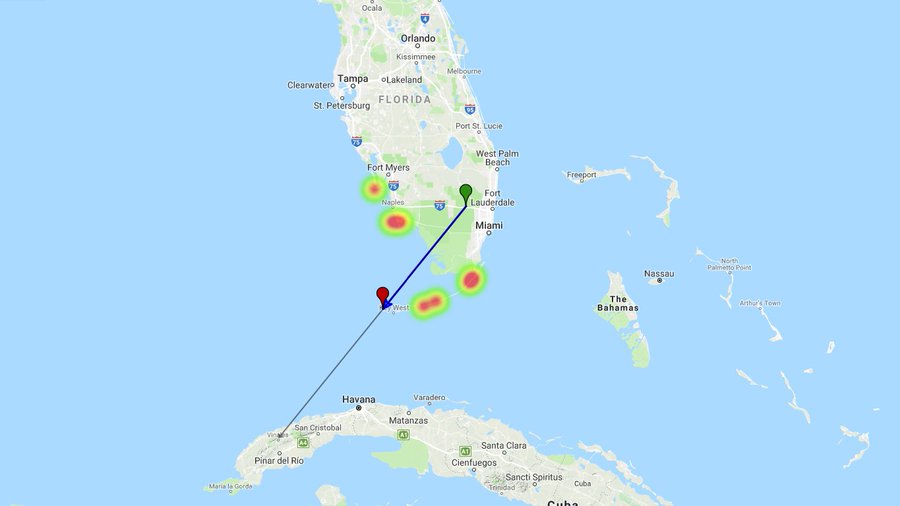
The space rock traveled over West Palm Beach, above the Florida Keys, and then to Viñales, a town in Pinar del Río, Cuba. It left a smoke trail seen by many. Images and video here.

The daylight meteor seen in Cuba on February 1 left a long smoke trail.
Image via Hatzel Vela
Several meteorites have been found in western Cuba after a huge meteor was seen by many – in broad daylight – on Friday, February 1, 2019. People in southern Florida also saw the meteor, as this space rock traveled over West Palm Beach, above the Florida Keys, and then to Viñales, a town in Pinar del Río, Cuba.
The event occurred at around 1:16 – 1:17 p.m. EST on Friday, February 1, 2019. Residents of Viñales, Cuba saw a very long smoke trail that lasted more than one minute, while the meteor itself was described as extremely bright, with amyellow-orange color, and lasted more than at least four seconds.
Several Cuban residents reported finding black rocks showing the characteristic fusion crust seen in ordinary chondrite meteorites.

One of several stony meteorites found in Cuba on February 1, 2019, shortly after the huge meteor was seen across the skies.
Image via Hatzel Vela.
Astronomers estimate that the space rock that disintegrated over Cuba was at least a few meters in diameter – likely, van-sized – before entering Earth’s atmosphere. That’s a lot smaller than the house-sized asteroid that entered Earth’s atmosphere over Chelyabinsk, Russia – also in February- in 2013. The shock wave from the Chelyabinsk event broke windows in six Russian cities and sent some 1,500 people to seek medical treatment, mostly from flying glass.
One of the witnesses of the Cuba meteor was Juan Alberto Pérez Pozo, who, immediately after seeing the amazing meteor, started recording the smoke trail and was able to capture the huge sonic boom at 0:46 on this video:
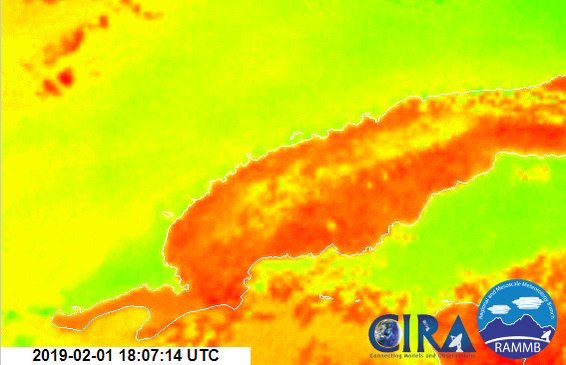
Meteorological satellites also recorded the event:
The bright yellow-orange color seen in the meteor suggests the space rock probably contained sodium. A similar composition was also seen in the Chelyabinsk meteorites, which were later recovered in a lake.
Reports indicate the sonic boom of the Cuba meteor also shattered windows, much as the Chelyabinsk meteor did; however, the Cuba event was at a smaller scale.
A web cam in Fort Myers, Florida, captured the meteor as it was descending towards Cuba:
This map shows the trajectory of the huge meteor:

Trajectory of the huge meteor seen from Florida and Cuba.
Illustration by Google Earth / Eddie Irizarry
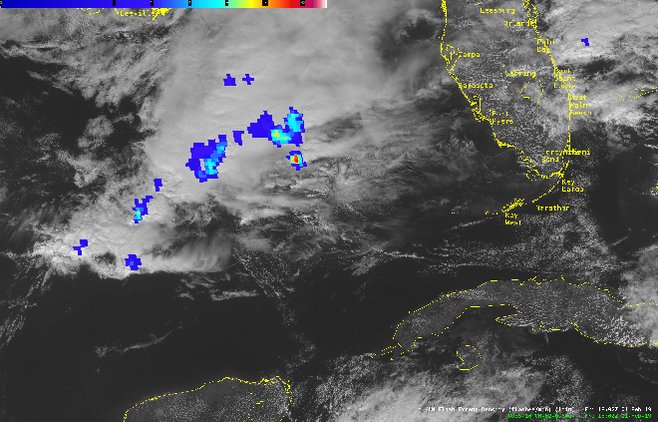
Here’s another view of the meteor’s flash, seen from a satellite:
Other small asteroids passed very close to Earth in the past few weeks, including asteroid 2019 BZ3, a 23-foot (7-meter) space rock that came at just 0.1 or 10 percent of the Earth-moon distance, on January 27, 2019.
Good-sized meteors do strike Earth’s atmosphere frequently. Fortunately, Earth’s atmosphere causes most of these space rocks to disintegrate. According to astronomers who study asteroids, Earth is in no imminent danger of collision with any large, dangerous asteroid.
Bottom line: A small space rock exploded in midair over Cuba, and pieces of it (meteorites) have been found.