See the Evolution of SpaceX's Rockets in Pictures
SpaceX's Rockets

SpaceX
SpaceX began in 2002, when its founder, Elon Musk, took the first steps in his grand ambition to send a mission to Mars. More than 15 years later, the company is way beyond the space startup stage.
The Hawthorne, California-based company regularly reuses rockets, sends cargo missions to the International Space Station with the uncrewed Dragon spacecraft and will fly astronauts for NASA in the future. In 2018, SpaceX launched the massive Falcon Heavy and has plans for an even larger rocket to reach Mars: the Big Falcon Rocket (BFR).
Read more about SpaceX's history of rockets and spacecraft development in the following slideshow.
Falcon 1
SpaceX
The Falcon 1 was the first rocket manufactured by SpaceX. It had a proposed capacity to carry 670 kilograms (1,480 lbs.) to low Earth orbit, and it flew between 2006 and 2009. After three launch failures, Falcon 1 sent a dummy payload to space on Sept. 29, 2008. Its fifth and final launch, on July 14, 2009, sent RazakSAT, a Malaysian Earth-observation satellite, into orbit. Falcon 1 rockets launched from Omelek Island, part of the Kwajalein Atoll in the Pacific Ocean. And in case you're wondering, Musk named the Falcon rockets after the Millennium Falcon ship from "Star Wars."
Developing Falcon 9
SpaceX
SpaceX quickly received interest from several companies looking for a heavier-lift rocket. The company had considered developing an intermediary rocket called the Falcon 5, but instead skipped ahead and began work on the Falcon 9. This rocket can send a payload to low Earth orbit weighing up to 28,991 lbs. (13,150 kg). It is a two-stage rocket. SpaceX first advertised plans for the Falcon 9 in 2005 and sent the debut Falcon 9 aloft on June 7, 2010, from Cape Canaveral Air Force Station in Florida. Early customers of the rocket included Bigelow Aerospace; Avanti Communications; and MacDonald, Dettwiler and Associates.
Ground landings
SpaceX
SpaceX's first successful Falcon 9 landing in Landing Zone 1, on Dec. 21, 2015, was hailed as a milestone for rocket reusability. However, the company still tried to improve on that achievement. SpaceX experienced a mix of successful and failed ocean landings in 2014 and 2015. [SpaceX's Epic Falcon 9 Rocket Landing in Pictures]
In 2015, SpaceX was also trying to land on drone ships in the ocean. While these landings kept ending with failure, Musk would post the videos and pictures on his Twitter feed, acknowledging mistakes made, and the company would work on improving for the next flight.
Dragon dreams
SpaceX
SpaceX kept the first 18 months of the Dragon cargo ship's development under wraps. Then, in March 2006, the company officially made Dragon public when the company submitted a proposal for NASA's Commercial Orbital Transportation Services (COTS) demonstration program. The ultimate goal was to develop a private spacecraft to ferry cargo to the International Space Station.
After Spacex hit several milestones, NASA selected SpaceX's Dragon in December 2008 to be one of the companies providing commercial resupply services to the space station. SpaceX's contract value at that time was a minimum of $1.6 billion, with options to extend to $3.1 billion; the company has since received a new contract for cargo launch services. Musk has confirmed that he named Dragon after "Puff the Magic Dragon."
Early Dragon flights
SpaceX
Dragon made a successful maiden flight on Dec. 8, 2010, from Cape Canaveral Air Force Station. Then, on May 22, 2012, Dragon launched for an important test: an attempt to berth the spacecraft with the International Space Station. Dragon made it to the station safely on May 25 of that year, despite experiencing some problems with a laser system that was supposed to judge the craft's distance to the orbiting complex. The milestone prompted worldwide acclaim. It was the first time a private spacecraft docked with the space station. SpaceX has since upgraded its uncrewed Dragon cargo ships to be reusable for at least two flights.
Grasshopper
Chris Thompson/SpaceX
Grasshopper was a rocket prototype flown at SpaceX's McGregor, Texas, proving grounds to give the company more experience in landing boosters vertically. While Grasshopper did not get as much media attention as SpaceX's other programs, it was key to furthering the development of Falcon 9's reusable first stage. The Grasshopper rocket made eight test flights between 2012 and 2013, with the final flight seeing Grasshopper soar to 2,440 feet (744 meters). The Grasshopper program was then retired so SpaceX could focus more resources on Falcon 9's development.
Falcon 9 Reusable Development Vehicle
SpaceX
SpaceX announced the Falcon 9 Reusable Development Vehicle in 2012, which was based on the first stage of the Falcon 9. The company made five flights of this system at the SpaceX McGregor site between April and August 2014, with the maximum altitude on some flights exceeding 3,280 feet (1,000 m). The last booster, which launched on Aug. 22, 2014, exploded due to a blocked sensor.
SpaceX's first rocket landing pad
SpaceX
This picture shows Landing Zone 1, a ground landing zone for the Falcon 9's first stage at Cape Canaveral Air Force Station. This is where SpaceX made the first of its controlled ground landings, on Dec. 21, 2015. The company built the pad on land leased from the U.S. Air Force on Cape Canaveral Air Force Station. (Landing Zone 1 is on land that used to host Launch Complex 13.) This landing was extra-sweet because the previous Falcon 9 flight, in June 2015, ended catastrophically with an explosion.
Reusing rockets
SpaceX
Right from the beginning of Falcon 9's history, SpaceX was interested in reusing the first stage of the rocket to save on launch costs. Early tests of the landing were unsuccessful, however. SpaceX made attempts on the first, second and sixth launches of the Falcon 9 to control the booster's landing, but in each case, the stage slammed down into the ocean. SpaceX finally achieved a controlled ocean landing on Falcon 9's ninth launch (the fourth controlled-landing attempt), on April 18, 2014. This was an important stepping stone in the path to eventual reusability.
Drone-ship landing
SpaceX
The persistence exhibited by Musk and his employees finally paid off on April 8, 2016, when a Falcon 9 first stage touched down softly on a drone ship called "Of Course I Still Love You" in the Atlantic Ocean. The Dragon spacecraft that this Falcon 9 carried aloft also had a milestone flight, delivering an inflatable module — the Bigelow Expandable Activity Module — to the International Space Station.
SpaceX's success rate with drone landings improved drastically after the April 2016 flight, although some boosters still missed the mark from time to time. The company's Falcon 9 flight success rate is also strong; its last failure, in September 2016, saw a rocket explode on the launch pad before taking off. SpaceX has a second drone ship, "Just Read the Instructions," which is used for Pacific Ocean landings after launches from Vandenberg Air Force Station in California. Both ships are named for fictional starships in the science fiction books of Iain M. Banks.
Falcon Heavy's maiden flight
SpaceX
The Falcon Heavy rocket, a heavy-lift version of the Falcon series, had a successful debut flight on Feb. 6, 2018, launching from NASA's Pad 39A at the Kennedy Space Center in Florida. The rocket successfully launched a Tesla car into space. (Musk is also the CEO of Tesla Motors.) The Falcon Heavy is 230 feet tall (70 m) and can lift nearly 141,000 lbs. (64 metric tons) of payload to low Earth orbit. This is twice what its closest competitor, the United Launch Alliance's Delta IV Heavy, can hoist into orbit.
Falcon Heavy's rocket landing ballet
SpaceX
This picture shows Falcon Heavy's twin side boosters landing successfully after the rocket's maiden flight, on Feb. 6, 2018. While the booster stages touched down safely at Landing Zones 1 and 2 at Cape Canaveral Air Force Station, near the Kennedy Space Center, the rocket's core stage hit the ocean at high speed. The rocket stage carrying the Tesla car underwent one last burn to send the car toward the orbit of Mars. However, as Space.com sister site Live Science reported, radiation could destroy the car within a year.
Riding inside the Dragon
SpaceX
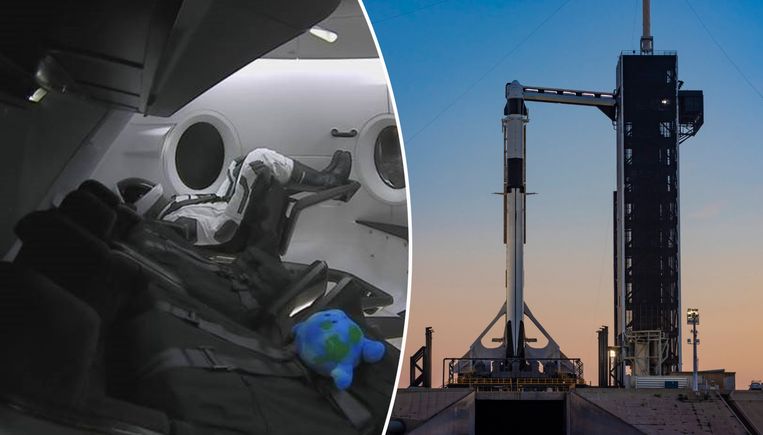
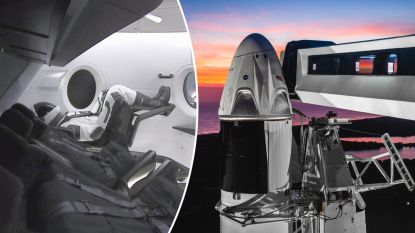
While launching commercial missions, SpaceX also began developing a human-rated version of the Dragon spacecraft to bring astronauts to the International Space Station. The company received a contract in 2014 valued at a maximum of $2.6 billion for these launch services. In September 2015, SpaceX showed the world the inside of the crew quarters. The minimalist design has white walls, black bucket seats, several flat-panel displays and four windows for passengers to see outside.
Crew Dragon vs. cargo
SpaceX
SpaceX intended that the crew and cargo versions of Dragon be very similar, in order to speed up development of the crewed ship. "This commonality simplifies the human-rating process, allowing systems critical to crew and space station safety to be fully tested on unmanned cargo flights.," SpaceX stated.
Crew Dragon flight tests
Ben Cooper/SpaceX
SpaceX is hard at work on developing the crewed Dragon for two commercial crew test-flights, which will fly no earlier than late 2018. NASA is trying to wean itself off dependence on the Russian Soyuz vehicle that currently ferries all astronauts to the International Space Station. Each astronaut seat on the Soyuz costs NASA millions of dollars. Also, the agency tries to use U.S. launch services for launch when possible. The last crewed launch from U.S. soil took place in 2011, during the last flight of the space shuttle program.
More Falcon Heavy flights
SpaceX
Falcon Heavy launches are sold for about $90 million apiece, compared with $62 million for Falcon 9 launches. SpaceX plans to launch two more Falcon Heavy missions in 2018: one carrying the Arabsat 6A communications satellite and the other hoisting Space Test Program 2 for the U.S. Air Force (along with the Planetary Society's LightSail 2).
The Falcon 9 Block 5
Elon Musk/Instagram
In May 2018, SpaceX unveiled the fifth and final version of the company's Falcon 9 rocket: the Block 5 booster. Designed for maximum reusability (the target is at least 10 flights), this booster will launch astronauts into space on Dragon capsules for NASA. The first Falcon 9 Block 5 rocket was built to launch Bangabandhu-1, the first communications satellite for the country of Bangladesh.
Starship and Super Heavy
SpaceX
Starship and Super Heavy make up a futuristic system intended for Mars exploration. In its Red Planet configurations, the BFR will be 348 feet (106 m) tall (including the spaceship) and capable of bringing 150 tons (136 metric tons) to low Earth orbit. Each rocket will carry about 100 people, and the rocket will be fully reusable. Musk said he plans to use this rocket in fleets, bringing hundreds or thousands of passengers at a time to Mars. In the 2020s, Musk plans to halt all Falcon lines except for BFR, which would perform all sorts of missions. Destinations would range from Mars to the International Space Station to orbits that would launch satellites near Earth.
{ https://www.space.com/ }


 Self-folding drone could speed up search and rescue missions










 Creepy video captures the world first moment a tarantula the...
 Stalactites, a conch graveyard and toxic chemicals:...
 One tonne Soviet probe could crash to Earth THIS YEAR after...


 Senior citizens fight loneliness by finding companionship in...
 Neanderthals did NOT have hunched backs: New study on...
 Major security flaws in 4G and 5G networks lets anyone...
 Where water flowed on Mars billions of years ago: Stunning...