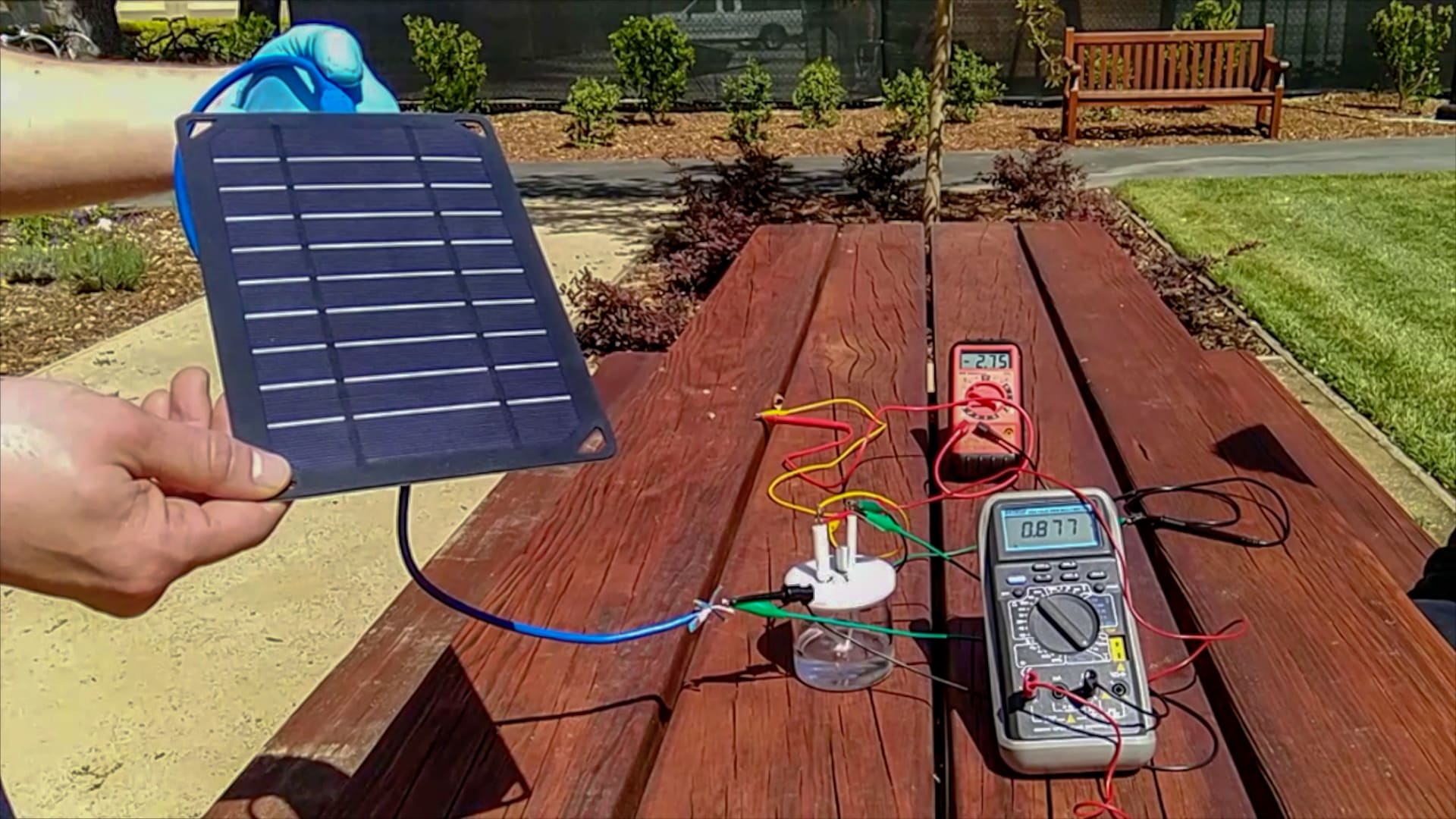
A team of scientists at Stanford have figured out a way to make hydrogen fuel out of saltwater. The discovery could open up the world's oceans as a potential source of energy. Researchers view electrolysis, or the act of splitting water into hydrogen and gas, as a promising new source of renewable energy. But it comes with many roadblocks; a major one being that only purified water can be used in electrolysis. Seawater tends to corrode water-splitting systems.
Zondag 24 maart 2019
 Friday Futures: the sea as fuel, DNA as a computer

Friday Futures: the sea as fuel, DNA as a computer
Welcome to Friday Futures, our weekly guide to the latest visions of The Future from around the web. This week: the sea could be the best source of fuel; levitation by light; AI and science; DNA as a computer; DNA regenerates limbs.
1. The oceans could be the real source of renewable fuel
The ocean may soon be a valuable source of renewable energy.
A team of scientists at Stanford have figured out a way to make hydrogen fuel out of saltwater. The discovery could open up the world’s oceans as a potential source of energy.
Stanford University
Unfortunately, purified water is in itself a scarce resource. Which is why Stanford chemistry professor Hongjie Dai and her team sought out to discover a way to keep salt water from breaking down devices used for water-splitting. "We barely have enough water for our current needs in California," said Dai in a press release.
The Stanford team layered nickel-iron hydroxide and nickel sulfide on top of a nickel foam core, essentially creating a barrier that would slow down the decay of the underlying metal. By acting as a conductor, the nickel foam transports energy from the power source and the nickel-iron hydroxide sparks the electrolysis. What happens without the nickel coating? The water-splitting device lasts roughly 12 hours, unable to withstand seawater corrosion. But with the nickel layer, the device can keep going for more than a thousand hours.
We're still far away from harnessing ocean water as a new renewable energy source. The new discovery hasn't been attempted outside of Stanford's research labs. But scientists are hoping it will pave the way for increased use of hydrogen fuel.
Source:
2. Can we levitate objects using light alone?
Researchers at the California Institute of Technology (Caltech) say they’ve found a way to levitate and propel objects using only light — though, for the time being, the work remains theoretical.

Scientists say their new "levitation" tech could send a spacecraft to the nearest star in just 20 years.
Light Levitation
Researchers at the California Institute of Technology (Caltech) say they’ve found a way to levitate and propel objects using only light — though, for the time being, the work remains theoretical.
They hope the technique could be used for “trajectory control of ultra-light spacecraft and even laser-propelled light sails for space exploration,” according to a paper published in the journal Nature Photonics Monday. That means no fuel needed — just a powerful laser fired at a spacecraft from back on Earth.
Optical Tweezers
The Caltech scientists devised the so-called “photonic levitation and propulsion” system by designing a complex pattern that could be etched into an object’s surface. The way the concentrated light beam reflected from the etching causes the object to “self-stabilize,” they say, as it attempts to stay inside the focused laser beam.
The first breakthrough that laid the groundwork for the new research were the development of “optical tweezers” — scientific instruments that use a powerful laser beam to attract or push away microscopic objects. The big downside: they can only manipulate tiny objects at only microscopic distances.
Ognjen Ilic, post-doctoral scholar and first author of the new study, puts the tweezer concept and its limitations in much simpler terms: “One can levitate a ping pong ball using a steady stream of air from a hair dryer,” he said in a statement. “But it wouldn’t work if the ping pong ball were too big, or if it were too far away from the hair dryer, and so on.”
From Micrometers To Meters
In the paper, the Caltech researchers argue that their light manipulation theoretically could work with an object of any size, from micrometers to spaceship size.
Though the theory is still untested in the real world, the researchers say that if it pans out, it could send a spacecraft to the nearest star outside our solar system in just 20 years.
“There is an audaciously interesting application to use this technique as a means for propulsion of a new generation of spacecraft,” said Harry Atwater, professor at the Caltech Division of Engineering and Applied Science. “We’re a long way from actually doing that, but we are in the process of testing out the principles.”
READ MORE: Levitating objects with light [Caltech]
More on light levitation: Japanese Researchers Unveil Tiny, Floating “Firefly” Light
3. What is the relationship between 5G and space?
4. AI is becoming really good at science
The Square Kilometer Array, a radio telescope slated to switch on in the mid-2020s, will generate about as much data traffic each year as the entire internet.
5. DNA molecules can be programmed as computers
Computer scientists at Caltech have designed DNA molecules that can carry out reprogrammable computations, for the first time creating so-called algorithmic self-assembly in which the same “hardware” can be configured to run different “software.”
6. And can regenerate limbs, maybe
Harvard researchers say they’ve identified a “DNA switch” enabling animals to regrow entire portions of their bodies — a finding that, with a few important caveats, could pave the way to helping human lost limb regeneration.
7. An explanation of CRISPR that makes sense!
8. And of course, the dating app based on the contents of your fridge
The first time John Stonehill was invited back to his girlfriend’s house, he headed straight for the refrigerator. It was stainless steel with a water and ice dispenser.
(Compiled by Alex Leslie, edited by John C. Tanner)
Geschreven door peter om 16:55
Stuur door