Naar de inhoud

UFO'S of UAP'S, ASTRONOMIE, RUIMTEVAART, ARCHEOLOGIE, OUDHEIDKUNDE, SF-SNUFJES EN ANDERE ESOTERISCHE WETENSCHAPPEN - DE ALLERLAATSTE NIEUWTJES

UFO's of UAP'S in België en de rest van de wereld
akke.beakke.be
Ontdek de Fascinerende Wereld van UFO's en UAP's: Jouw Bron voor Onthullende Informatie! Ben jij ook gefascineerd door het onbekende? Wil je meer weten over UFO's en UAP's, niet alleen in België, maar over de hele wereld? Dan ben je op de juiste plek! België: Het Kloppend Hart van UFO-onderzoek In België is BUFON (Belgisch UFO-Netwerk) dé autoriteit op het gebied van UFO-onderzoek. Voor betrouwbare en objectieve informatie over deze intrigerende fenomenen, bezoek je zeker onze Facebook-pagina en deze blog. Maar dat is nog niet alles! Ontdek ook het Belgisch UFO-meldpunt en Caelestia, twee organisaties die diepgaand onderzoek verrichten, al zijn ze soms kritisch of sceptisch. Nederland: Een Schat aan Informatie Voor onze Nederlandse buren is er de schitterende website www.ufowijzer.nl, beheerd door Paul Harmans. Deze site biedt een schat aan informatie en artikelen die je niet wilt missen! Internationaal: MUFON - De Wereldwijde Autoriteit Neem ook een kijkje bij MUFON (Mutual UFO Network Inc.), een gerenommeerde Amerikaanse UFO-vereniging met afdelingen in de VS en wereldwijd. MUFON is toegewijd aan de wetenschappelijke en analytische studie van het UFO-fenomeen, en hun maandelijkse tijdschrift, The MUFON UFO-Journal, is een must-read voor elke UFO-enthousiasteling. Bezoek hun website op www.mufon.com voor meer informatie. Samenwerking en Toekomstvisie Sinds 1 februari 2020 is Pieter niet alleen ex-president van BUFON, maar ook de voormalige nationale directeur van MUFON in Vlaanderen en Nederland. Dit creëert een sterke samenwerking met de Franse MUFON Reseau MUFON/EUROP, wat ons in staat stelt om nog meer waardevolle inzichten te delen. Let op: Nepprofielen en Nieuwe Groeperingen Pas op voor een nieuwe groepering die zich ook BUFON noemt, maar geen enkele connectie heeft met onze gevestigde organisatie. Hoewel zij de naam geregistreerd hebben, kunnen ze het rijke verleden en de expertise van onze groep niet evenaren. We wensen hen veel succes, maar we blijven de autoriteit in UFO-onderzoek! Blijf Op De Hoogte! Wil jij de laatste nieuwtjes over UFO's, ruimtevaart, archeologie, en meer? Volg ons dan en duik samen met ons in de fascinerende wereld van het onbekende! Sluit je aan bij de gemeenschap van nieuwsgierige geesten die net als jij verlangen naar antwoorden en avonturen in de sterren! Heb je vragen of wil je meer weten? Aarzel dan niet om contact met ons op te nemen! Samen ontrafelen we het mysterie van de lucht en daarbuiten.

New Theory Explains Ball Lightning As ‘Bubbles of Light’

Ball lightning

New Theory Explains Ball Lightning As ‘Bubbles of Light’

One of the often-cited explanations for alleged UFO sightings is ball lightning, a rare natural phenomenon which remains somewhat of an unsolved mystery despite centuries of reports and several attempts by scientists to explain it. The unexplained electrical phenomenon appears as luminous orbs ranging from pea-sized to several meters across that can last up to several seconds. Reports of ball lightning are often connected to thunderstorms, but not always. There are numerous reports of ball lightning floating straight through walls, dancing around ship masts, traveling down electrical lines, or even inside submarines. 

It’s generally accepted that ball lightning is some unknown type of electrical discharge that can form under certain specific circumstances, but its true nature remains somewhat of a mystery. The latest scientific study to take a stab at the ball lightning phenomenon was published this month in Optik, a scientific journal devoted to the research of optics, light, and electrons. In this current research, Vladimir Torchigin from the Russian Academy of Sciences claims that ball lightning isn’t lightning at all, but instead a “bubble of light” trapped inside a thin sphere of air.

As it turns out, whenever any particle absorbs and emits electromagnetic radiation, it ‘jiggles’ slightly from the force. This latest research claims that whenever traditional lightning strikes, it can cause air molecules to jiggle in just the right way to trap photons in a rotating pressurized sphere of air if just the right conditions are met. According to the study, the “intensity of the rotating light is more than a billion times greater than that of the light propagating in a straight line,” leading to ball lightning’s incredible luminosity.

Torchigin seems pretty confident that he’s finally solved the ball lightning mystery, writing that “we have shown that the behavior of a light bubble and ball lightning are the same, and there are no mysteries in the behavior of ball lightning. The question of the nature of ball lightning resolved.” Has the mystery actually been solved?

Whether or not it has, I’m all for this research – think about it: if we can learn the mechanism by which ball lightning is created, we could theoretically find ways to create it for ourselves. Remember that weird story about Russia’s secret “dome of light” weapon? Sounds pretty familiar. Could we harness these “bubbles of light” to create our own ball lightning?

{ https://mysteriousuniverse.org/ }

Hoe vind je dit bericht?
Geschreven door peter om 16:32 Stuur door

UFOs have come out of the fringe and into the mainstream

eGFSaQDc?format=jpg&name=small

UFOs have come out of the fringe and into the mainstream

You’d have to be living on another planet not to have heard one of the biggest news stories in recent times: After years of denial, it turns out that the US government has a secret program, researching and investigating UFOs.

The conspiracy theorists were right all along.

The story broke in December 2017 and generated unprecedented mainstream media coverage of the UFO phenomenon, which continues to this day, as the story continues to unfold. This coverage includes The Post’s new docu-series “The Basement Office,” which delves into this story as part of a wider investigation of the UFO mystery.

The Pentagon’s secret UFO program was called AATIP — Advanced Aerospace Threat Identification Program. The title cleverly blurred the lines between next-generation aviation threats and the phenomena they were really studying. Maybe as an unintended consequence, but perhaps by design, the cryptic title also kept the program hidden from the numerous people who make Freedom of Information Act requests about “UFOs.” AATIP was set up in 2007, largely on the initiative of the then-Senate majority leader, Harry Reid. When AATIP’s existence was revealed, Reid tweeted: “The truth is out there. Seriously.”

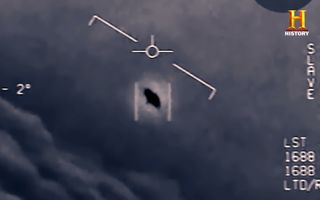
Related revelations and developments came thick and fast. Details were released of multiple events where UFOs have been tracked on radar and chased by military jets, including a November 2004 incident where the USS Nimitz carrier strike group was buzzed by multiple UFOs. Videos of three of these spectacular midair encounters have been made public, though many more have yet to be released. The Senate Armed Services Committee investigated the USS Nimitz incident last year and interviewed some of the pilots and radar operators. Also last year, the Defense Intelligence Agency briefed Congress on AATIP’s work.

In a Jan. 9, 2018, letter to John McCain — copied to other senior congressional figures and to key committees — the DIA disclosed that they had researched anti-gravity, warp drives, wormholes and other theoretical physics concepts needed for interstellar travel, as part of an effort to understand what they termed “foreign advanced aerospace weapon threats.” It raised the question “How foreign is foreign?” — did they mean Russia, China, or somewhere considerably farther afield?

In April of this year, the Navy announced they would issue new guidance to pilots who encountered UFOs, following a recent upsurge in “incursions” by “unidentified aircraft.” Then, just last week, The Post secured a stunning admission from the DOD that AATIP investigated “unidentified aerial phenomena” — a phrase they had previously been very careful to avoid. This bombshell revelation was the final proof that this had never been about Russian or Chinese aircraft, missiles and drones. Unidentified aerial phenomena (UAP) is the accepted government, military and intelligence community term for what the public calls UFOs.

When I worked on this issue for the UK’s Ministry of Defence, we used “UAP” in our internal policy discussions, thus avoiding the pop-culture baggage that came with the term “UFO” and reframing the discussion as a defense and national security issue. That’s how those of us who have looked at the phenomenon from within government view it.

UFOs have finally come out of the fringe and into the mainstream. Multiple stories have appeared in major media outlets. There is congressional interest. Pilots, radar operators and intelligence officers involved in these encounters and investigations are going on the record, calling for action. It’s difficult to avoid the conclusion that there’s a bigger picture here. The pace of events is picking up, and we seem to be building up to something. Something is happening. Something new. Something big.

Nick Pope worked for the UK Ministry of Defence for 21 years. From 1991 to 1994, he was posted to a division where his duties included researching and investigating unidentified aerial phenomena.

Hoe vind je dit bericht?
Geschreven door peter om 01:42 Stuur door

'Fleet of UFOs' Followed US Aircraft, Navy Pilot Says

'Fleet of UFOs' Followed US Aircraft, Navy Pilot Says

Hoe vind je dit bericht?
Geschreven door peter om 01:35 Stuur door

US and Japan to Cooperate on Return to the Moon

US and Japan to Cooperate on Return to the Moon

Hoe vind je dit bericht?
Geschreven door peter om 01:19 Stuur door

Astronomen ontdekken “verboden planeet” die drie keer groter is dan de Aarde: “Een unieke vondst”

Astronomen ontdekken “verboden planeet” die drie keer groter is dan de Aarde: “Een unieke vondst”

door mrra | Bron: EXOPLANET EU, METEO WEB

Astronomen ontdekken “verboden planeet” die drie keer groter is dan de Aarde: “Een unieke vondst”

De “verboden planeet”.

FOTO: UNIVERSITY OF WARWICK

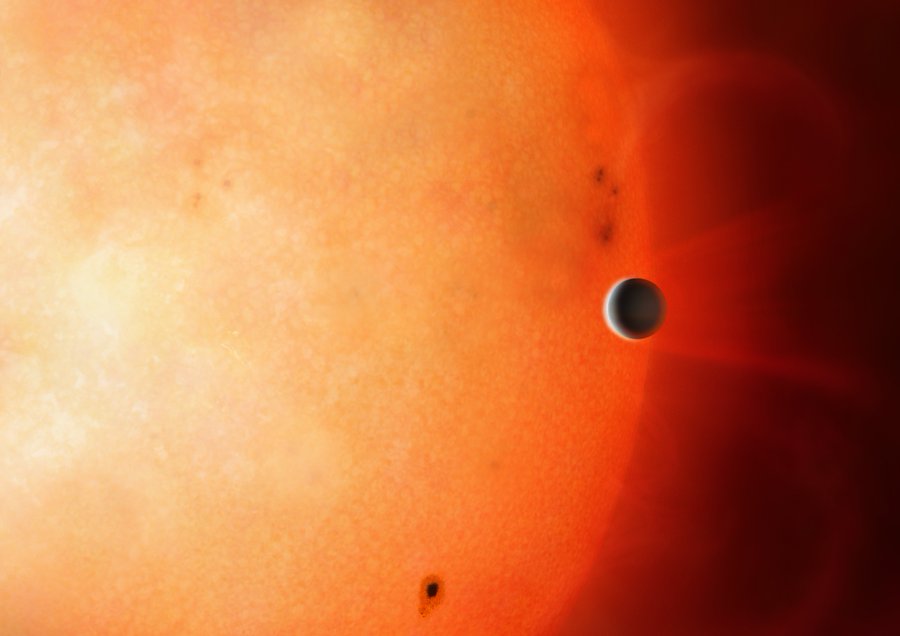
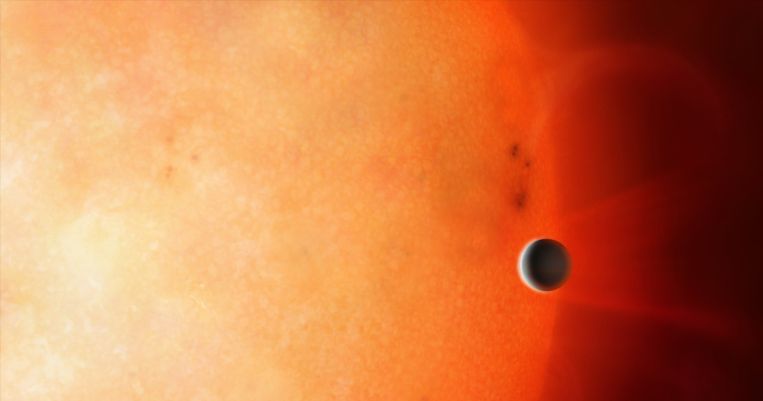
Wetenschappers hebben een planeet ontdekt, die ruim drie keer zo groot is als de Aarde. Niet alleen de grootte van het gevaarte is opmerkelijk, maar ook de locatie. Astronomen ontdekten het hemellichaam immers in de zogenaamde Neptunuswoestijn van de ruimte, een plaats waarvan gedacht werd dat er geen planeet in kon bestaan. Vandaar krijgt de planeet nu de titel: ‘de verboden planeet’.

De verboden planeet is drie keer groter dan onze planeet. Opmerkelijk natuurlijk, maar het hemellichaam is wel nog altijd twintig procent kleiner dan Neptunus. De temperatuur kan oplopen tot maar liefst 1.000 graden Celsius, wat dan weer bijzonder is. De verboden planeet is immers warmer dan Mercurius.

Neptunuswoestijn met NGTS-4b

NGTS-4b, het klinkt wat minder poëtisch dan “verboden planeet”, maar onder die naam beschrijven wetenschappers de eerste exoplaneet die in de Neptunuswoestijn is ontdekt. In die regio naast een ster kunnen normaal geen planeten bestaan. De straling is daar immers zo sterk dat al het gas rond de planeet meteen zou verdampen en er enkel nog een steenachtige kern overblijft. Maar deze planeet kon die gasachtige atmosfeer wel degelijk behouden, wat het zo uniek maakt.

De hamvraag is dan ook duidelijk, zo schrijft wetenschapper Richard West, de auteur van de studie rond de verboden planeet. “Hoe komt het dat de planeet kon overleven?” Daar zijn verschillende pistes voor. Ofwel is de verboden planeet daar “net” gearriveerd in het laatste miljoen jaar, ofwel is de atmosfeer van die planeet zo groot dat ze nog steeds aan het verdampen is.

Ontdekt vanuit woestijn

De planeet werd ontdekt in een woestijn, maar ook vanuit een woestijn. Een internationaal team van astronomen plaatste NGTS – het Next-Generation Transit Survey Telescopes-system – immers in de Atacamawoestijn in Chili. Die telescopen kijken naar vlekjes tegen de achtergrond van de zon. Als een vlek beweegt op meerdere beelden dan kan er sprake zijn van een planeet.

De “verboden planeet” is nooit eerder ontdekt omdat die in verhouding relatief klein is. “De meeste telescopen zien immers enkel vlekken die één procent van het licht van de zon “dimmen”. Maar de NGTS-4b blokkeert maar 0,2 procent van de zon. Dat maakt deze vondst zo uniek”, concludeert West. Zijn team blijft nu zoeken, om te kijken of de Neptunuswoestijn mogelijk minder “droog” is dan verwacht.

Next Gen Transits@NextGenTransits

The shallowest transit ever discovered from a ground-based wide-field survey: NGTS-4b https://warwick.ac.uk/newsandevents/pressreleases/the_forbidden_planet … pic.twitter.com/46Gtw8FIFl

Afbeelding weergeven op Twitter
Andere Tweets van Next Gen Transits bekijken

{ https://www.nieuwsblad.be/ }

Hoe vind je dit bericht?
Geschreven door peter om 00:54 Stuur door

Curiosity Rover finds clay cache on Mars — potential sign of water

Curiosity Rover finds clay cache on Mars — potential sign of water

 BY MIHAI ANDREI

Curiosity’s drilling instrument has gathered two samples from a Martian soil unit geologists called the “clay-bearing” unit. Worthy of its name, the unit turned out to contain a substantial amount of clay — a mineral typically formed in the presence of water.

The rover snapped this selfie after gathering the samples. To the lower-left of the rover are its two recent drill holes, at targets called “Aberlady” and “Kilmarie.”

Image credits: NASA/JPL-Caltech/MSSS.

Although the Curiosity Rover was expected to run for two years, it’s still providing valuable information now, seven years after its landing in 2012. The rover is currently located on the side of lower Mount Sharp, in an area that drew the attention of NASA scientists even before Curiosity landed on Mars because it seemed to contain quite a lot of clay. Prosaically, they called it the “clay-bearing unit“.

However, prosaic or not, the name was very accurate. Curiosity harvested two small drills in the area, using its CheMin instrument (Chemistry and Mineralogy) to confirm that the unit has the highest amounts of clay minerals ever found on Mars.

This animation shows the initial proposed route for NASA’s Curiosity rover on Mount Sharp on Mars. The annotated version of the map labels different regions that scientists working with the rover would like to explore in the coming years.

Image credits:

NASA/JPL-Caltech/ESA/Universityof Arizona/JHUAPL/MSSS/USGS Astrogeology Science Center.

This strongly suggests that this area on Mount Sharp contained significant amounts of water. Clays typically form over long periods of time, through a process of weathering and accumulation of diluted solvents. Judging by the appearance and chemistry of this clay (which also includes very small amounts of hematite, an iron oxide that was abundant in the vicinity of the clay-bearing unit), it seems that these rocks formed as layers of mud in ancient lakes.

It’s not the first time Curiosity has found traces of ancient water on Mars. Time and time again, the rover has confirmed that water once flowed on Mars, sparking a heated debate about the possibility of microbial life on the Red Planet. Unfortunately, Curiosity is not well-equipped to look for signs of life so for now, that will remain a matter of speculation.

NASA’s Curiosity Mars rover imaged these drifting clouds on May 17, 2019,

Image credits: NASA/JPL-Caltech.

After the analysis, the rover took a well-deserved rest, taking advantage of the moment using its black-and-white Navigation Cameras (Navcams) to snap images of drifting Martian clouds. NASA believes these are likely water-ice clouds — so Curiosity is not only finding water beneath the ground — it’s also finding it in the sky.

{ https://www.zmescience.com/ }

Hoe vind je dit bericht?
Geschreven door peter om 00:42 Stuur door

Newly Discovered Planet Is So Hot That It Shouldn’t Exist

Exoplanet-2-999x540.jpg

Newly Discovered Planet Is So Hot That It Shouldn’t Exist

A recently discovered gaseous planet called NGTS-4B – or better known as the “Forbidden Planet” – is almost the same size as Neptune (20% smaller than Neptune and three times the size of Earth) and is around 920 light years away from Earth. There’s one major problem with this planet: it shouldn’t exist.

Located in a region of space called the “celestial desert”, the planet has a surface temperature of 1,000 degrees Celsius (or 1,832 degrees Fahrenheit). With a temperature that hot, the atmosphere on the planet should have evaporated since it’s so close to its star. But incredibly it still exists and it orbits around its star every 1.3 days.

(Not NGTS-4B)

It’s also the first exoplanet to have been discovered in the Neptunian Desert, which is an area close a star where no Neptune-size planets have ever been located. Being that close to its star, the planet’s gaseous atmosphere should be completely evaporated; leaving it with nothing more than a rocky core, but NGTS-4B still contains its gassy atmosphere.

It was first discovered when telescopes that were run by the University of Warwick noticed the planet when it passed in front of its star as the brightness of the star dimmed by 0.2 percent. Researchers are baffled as to why the planet remains in existence being so close to its star. They do, however, have some theories, such as the planet ended up in its current position within the last million or so years; or that the planet was once much bigger than it currently is and it’s continuously getting smaller as the atmosphere is evaporating.

(Not NGTS-4B)

Dr. Richard West, who works in the Department of Physics at the University of Warwick, said, “This planet must be tough – it is right in the zone where we expected Neptune-sized planets could not survive,” adding, “It is truly remarkable that we found a transiting planet via a star dimming by less than 0.2 percent – this has never been done before by telescopes on the ground, and it was great to find after working on this project for a year.”

This incredible discovery has researchers looking for more possible Neptune-sized planets surviving so close to their host star. “We are now scouring out data to see if we can see any more planets in the Neptune Desert – perhaps the desert is greener than was once thought,” West stated

{ https://mysteriousuniverse.org/ }

Hoe vind je dit bericht?
Geschreven door peter om 00:28 Stuur door

Icy volcanoes on Pluto may have spewed organic-rich water

Icy volcanoes on Pluto may have spewed organic-rich water

The dwarf planet has short-lived ammonia on its icy surface

HIDDEN DEPTHS  Pluto sports pimple-like peaks and jagged cracks across its surface, especially to the west of heart-shaped Sputnik Planitia. Some of those cracks could be cryovolcanoes that spewed liquid water onto the surface.

Z.L. DOYLE/SWRI/JHU-APL/NASA

Red ice found on Pluto suggests the dwarf planet recently spewed fountains of water into space. And it hints at complex — and possibly organic — chemistry in Pluto’s salty subsurface sea, researchers report May 29 in Science Advances.

“This was a huge surprise to all of us about Pluto,” says planetary scientist Dale Cruikshank of the NASA Ames Research Center in Moffett Field, Calif. “It means there are lots of surprises waiting to be uncovered in that part of the solar system.”

Cruikshank and colleagues analyzed the wavelengths of light, which can act as signatures of chemical compounds, in images of Pluto’s surface taken when the New Horizons spacecraft flew past the dwarf planet in July 2015 (SN: 12/26/15, p. 16). Those images previously had revealed a variety of ices overlaying a bedrock of water ice, which at Pluto’s frigid temperatures is so hard that it can sculpt mountains.

In the new analysis, the researchers found signs of ammonia where that water ice was exposed. Ammonia is a fragile molecule that can be broken down by ultraviolet sunlight and cosmic rays in just 400,000 to a billion years. “If you find it at all, it suggests that it has been put there fairly recently,” Cruikshank says. “There is really no limit [to how recently], as far as I can see in the geology.”

The ammonia-rich water ice is clustered around a large crack in the dwarf planet’s surface called Virgil Fossa, west of Pluto’s large heart-shaped feature. That crack is probably a fissure, from which liquid water once erupted in a cryovolcano, the team reports.

Watery window

The jagged red crack called Virgil Fossa, shown in this 2015 image (left) cutting across the surface of Pluto, could represent a volcano that violently sprayed ammonia and organic-rich water recently. In the colored image (right), the red, yellow, orange and purple pixels correspond to higher concentrations of ammonia in water ice.

Virgil Fossa
C.M. DALLE ORE ET AL/SCIENCE ADVANCES 2019

Previous observations had suggested Pluto could hide a watery ocean beneath its icy crust (SN Online: 9/23/16). But “there’s a big difference between seeing evidence of liquid ocean from various surface features, and seeing parts of the ocean, the liquid, actually come out onto the surface,” says planetary scientist Steven Desch of Arizona State University in Tempe, who was not involved in the new discovery.

Seeing evidence for a cryovolcano on Pluto is vindicating, Desch says. “We have thought for a long time that these [small, icy] planets, Pluto included, should have cryovolcanic activity,” he says. “It’s kind of a mystery why we don’t see more indications of it.”

Ammonia is an excellent antifreeze that can lower water’s freezing point by 100 degrees Celsius, Desch says. If Pluto’s subsurface ocean contains ammonia, that could explain how the water remains liquid so far from the sun.

Some scientists are still waiting for more evidence of cryovolcanism, though. "I’d love to believe this,” says Marc Neveu, an astrobiologist at NASA Goddard Space Flight Center in Greenbelt, Md., who was not involved in the study. “But the images are still a little bit too blurry to really make this a slam dunk." Barring getting better pictures, scientists could use a combination of New Horizons data and laboratory studies to analyze the ammonia and organics in the mix to figure out how those molecules might have formed in a space environment.

Evidence suggests Pluto’s eruption, or eruptions — the researchers can’t tell if it was a one-time event or not — spread ammoniated ice as far as 200 kilometers from the fissure, Cruikshank says. That means the eruption would have shot water at about 300 meters per second up into the atmosphere, where it froze midair before falling back to the surface across a wide swath.

“It would have been a violent thing,” Cruikshank says, not unlike his experience standing 50 meters from an erupting geyser in Yellowstone National Park one winter. “I was completely coated with frozen ice.”

The ice observations on Pluto revealed another surprise: a red material that Cruikshank’s team thinks represents complex organic material. The team had seen organic molecules on Pluto before and thought the molecules were formed on the surface or in the atmosphere. This is the first suggestion that the subsurface ocean could contain organic molecules, too.

Irradiating ice rich in ammonia and organics in the lab can create molecules that are important to life, including the nucleobases that make up DNA and RNA, Cruikshank and colleagues noted in the journal Astrobiology in March. That doesn’t necessarily mean life got a start on Pluto, but it could mean that the chemical precursors to life can happen in surprisingly inhospitable environments.

"It’s telling you pretty much that you don’t need to be around a star for interesting things to happen,” the NASA astrobiologist Neveu says. “If it happens deep inside Pluto, in the dark, with a very cold surface ... this prebiotic, prelife chemistry can happen anywhere."

Citations
Further Reading

Hoe vind je dit bericht?
Geschreven door peter om 00:00 Stuur door

Flying Saucers, the Men in Black, and Mysterious Cars

vintage-2304485_1920-999x540.jpg

Flying Saucers, the Men in Black, and Mysterious Cars

For years – or perhaps even for centuries – the Men in Black have been elusive, fear-inducing figures who hover with disturbing regularity upon the enigmatic fringes of the UFO subject. They nurture and weave their very own unique brand of terror and intimidation. Like true specters from the outer edge, the MIB appear from the murky darkness, and roam the countryside provoking paranoia and fear in their notorious wake, before returning to that same shrouded realm from which they originally oozed. Very often traveling in groups of three, this definitive trinity of evil seemingly appears and disappears at will. They are very often seen driving 1950s-style black Cadillac’s. Particularly strange is the fact that most of the witnesses say that the cars of the Men in Black vanish almost impossibly quickly. It’s almost as if the vehicles of the MIB are beamed aboard UFOs. Maybe, that’s not too far from the truth.

As bizarre as it might sound, there are a number of reports on record of black cars (A) entering and exiting UFOs late at night; and (B) of apparent aliens exiting UFOs and getting in cars. Yep, I know: it’s really weird. Back in 2009, longtime Ufologist Tim Beckley shared just such a story with me. Tim said: “I remember one incident where I was lecturing and a gentleman – a professor at the college where I was lecturing – came up to me  and told this story about how he was driving outside of a town in Michigan. It was rather late at night,  and he saw these lights in the woods. He pulled over, and there was no other traffic coming in either direction, but there was already another car parked at the edge of the road.”

Tim continued: “He described seeing some sort of ship in the distance – a UFO. A group of human-like aliens got out of the UFO, walked to the car – which was a Cadillac, or something like that. He watched them and could see they looked human. They just got in the car and drove off. But then, a couple of weeks later, he sees one of the same guys in a supermarket. These reports sound farfetched, but there’s so many of them of what seem to be aliens being able to move among us.”

Moving on, there’s the very odd tale of a man named Michael Wilcox. On the night of March 6, 1961, Wilcox had an encounter of the creepy car kind. At the time, Wilcox was living in South Miami, Florida. His home backed onto an eight-acre tomato field. At around 10:15 P.M., Wilcox saw to his amazement, through the window of his living-room, a huge object hanging low in the night sky. He described it as looking “like a Navy blimp.” He added that, “…but it was larger than any blimp I had ever seen.” Wilcox raced outside and watched with amazement as a large doorway on the craft slowly began to open. When the doorway was open to its fullest, three small, circular objects exited the craft and shot away into the darkness. But, that was only the start of things. Matters were about to get really strange.

According to Wilcox, one-by-one three black-colored Ford Galaxie cars were lowered from the UFO to the ground by “a hydraulic”-like elevator. Yes, you did read that right! When the three cars were safely on the ground, a rectangular-shaped object exited the UFO and landed in the field, adjacent to the cars. Then, something amazing happened, as Wilcox noted: Four groups of four people walked out of that same rectangular-shaped craft “and entered each car.” Wilcox looked on dumbfounded, as the cars – one after another – raced out of the field and onto the nearby road! He quickly lost sight of them as they hit South Miami’s 136th Street. The amazing encounter was over.

There’s absolutely no doubt at all that cases like the ones I have detailed above are not just controversial but way beyond controversial. Nevertheless, such accounts – of mysterious cars, of MIB, and of vanishing vehicles abound. Here’s one example and here’s another. Given that I’ve written four books on the MIB and one on the Women in Black, maybe my next book should be titled Cars in Black…


{ https://mysteriousuniverse.org/ }

Hoe vind je dit bericht?
Geschreven door peter om 23:56 Stuur door

North Carolina’s Mysterious Brown Mountain Lights Caught on Camera

Brown Mountain Lights

North Carolina’s Mysterious Brown Mountain Lights Caught on Camera

One of my home state’s most well-known unexplained phenomena was caught on camera recently by a group of researchers from Appalachian State University. The team has two cameras set up in the mountains near Morganton, North Carolina trained on Brown Mountain. For over a century, witnesses have reported strange orbs or streaks of light darting among the hills of the Pisgah National Forest around Brown Mountain, but scientists have yet to produce a definitive explanation for the phenomenon. Will we ever solve the mystery of the Brown Mountain Lights?

The Brown Mountain Lights have been covered by North Carolina newspapers for decades, and one of the earliest accounts of the Brown Mountain Lights was published in the Charlotte Daily Observer in 1913. This most recent documented took place earlier this year when one of the cameras set up by an Appalachian State research team caught a few unidentified lights on camera. See the footage for yourself.

Brown Mountain Lights

A picture of the lights from 1962.

While the video certainly shows a few ambiguous streaks of light, it sure does look a lot like the “rod” phenomenon which occurs when cameras capture insects flying faster than their frame rate. The result is that tiny insects can appear like massive flying rods, which themselves have been the source of several studies and paranormal claims. The fact that they are caused by flying insects is still disputed by some.

Were these alleged Brown Mountain Lights merely insects? Even the video’s author notes that they are “likely lightning bugs but it’s winter.” The video was taken months before lightning bug season in North Carolina, but that doesn’t mean another insect couldn’t have reflected light from traffic in the distance. In his YouTube description of the footage, Appalachian State astronomer Dr. Daniel Caton claims the lights were captured on two different cameras, but that the second camera’s footage is unusable “due to camera quitting after a storm.” It’s always the camera, isn’t it?

Brown Mountain

Brown Mountain

While many simple explanations for the Brown Mountain Lights have been put forward over the years, they are still considered a mysterious phenomenon and are somewhat rare. A few friends of mine claim to have seen them inadvertently while camping, but then there are those who have looked for them for years and have never witnessed the lights. Still, reports and studies of other similar unexplained Earth lights around the world lend legitimacy to reports of the Brown Mountain Lights.

In Norway’s Hessdalen valley for instance, witnesses have for decades reported strange orbs of light of various colors that appear both by day and night. Possible explanations include piezoelectric discharge due to underground conductive crystals rubbing together, some unknown type of chemical combustion which can occur under extremely specific conditions, or even by ionization of air and dust caused by deposits of radioactive elements underground.

Brown Mountain

Unexplained illumination photographed over Table Rock, North Carolina

(image by Bill Fox).

What could be causing these strange, seemingly natural Earth lights? Are they indeed a natural phenomenon? It’ll take a lot more than one blurry YouTube video to get to the bottom of this mystery.

{ https://mysteriousuniverse.org/ }

Hoe vind je dit bericht?
Geschreven door peter om 23:46 Stuur door

Astronomers say exploding stars might have forced our ancestors to walk upright

Astronomers say exploding stars might have forced our ancestors to walk upright

BY TIBI PUIU

Credit: Pixabay.

Credit: Pixabay.

One of the most distinguishable human features is our upright mode of locomotion, which is unique among mammals. Scientists have proposed many ideas that might explain the circumstances that enabled our species to evolve as bipeds. Perhaps the most ‘out there’ theory proposed thus far comes from astronomers at the University of Kansas who claim that human bipedalism might have been triggered by giant cosmic explosions. But before you laugh, read on because, wild as it may sound, this theory has some interesting evidence backing it up.

Some time ago, scientists reported that ancient seabeds contain a layer of iron-60 isotopes. These rare isotopes cannot be made on Earth, which means their origin must be extraterrestrial, most likely the result of a supernova —  a transient astronomical event that occurs during the last stellar evolutionary stages of massive star’s life. Because iron-60 has a known half-life, it is relatively easy to accurately date when the supernovae’s cosmic rays reached our planet.

Scientists traced the isotopic signatures to two major events: one 6.5 to 8.7 million years ago (300 light-years away from Earth) and the second 1.7 to 3.2 million years ago (163 light-years). That’s around the time of Homo habilis, the upright human ancestor nicknamed “handyman” because of their ability to master stone tool technology.

Based on this information, Adrian Melott and colleagues at the University of Kansas hypothesized what kind of changes these cosmic rays might have caused on Earth. One of the first things that should have happened was a dramatic increase in the rate of ionization of the lower atmosphere.

Ionization is the process by which an atom or molecule acquires a negative or positive charge by gaining or losing electrons. In this case, the cosmic rays knocked off electrons from molecules in the atmosphere. According to Melott, the supernova events would have increased ionization in the atmosphere by 50-fold. With so many free electrons in the atmosphere, cloud-to-ground lightning would have been much easier to occur, increasing the odds of forest fires.

“The bottom mile or so of atmosphere gets affected in ways it normally never does,” Melott said. “When high-energy cosmic rays hit atoms and molecules in the atmosphere, they knock electrons out of them — so these electrons are running around loose instead of bound to atoms. Ordinarily, in the lightning process, there’s a buildup of voltage between clouds or the clouds and the ground — but current can’t flow because not enough electrons are around to carry it. So, it has to build up high voltage before electrons start moving. Once they’re moving, electrons knock more electrons out of more atoms, and it builds to a lightning bolt. But with this ionization, that process can get started a lot more easily, so there would be a lot more lightning bolts.”

In time, savannas replaced torched forests in northeast Africa. Now, walking was far more advantageous for our ancestors than climbing trees. The upsurge in global wildfires is supported by the discovery of carbon deposits found in soils that correspond with the timing of the cosmic-ray bombardment.

“It is thought there was already some tendency for hominins to walk on two legs, even before this event,” said Melott, professorof physics & astronomy at the University of Kansas. “But they were mainly adapted for climbing around in trees. After this conversion to savanna, they would much more often have to walk from one tree to another across the grassland, and so they become better at walking upright. They could see over the tops of grass and watch for predators. It’s thought this conversion to savanna contributed to bipedalism as it became more and more dominant in human ancestors.”

That’s quite a great deal of speculation but the evidence suggests that such a scenario might have been possible — however improbable as it may sound. What about something like happening in the future? Slim chance, say the researchers who point to the fact that the nearest supernova candidate is now 652 light-years away from Earth. Instead, Melott says we should be cautious about a more immediate threat — solar flares.

“Betelgeuse is too far away to have effects anywhere near this strong,” Melott said. “So, don’t worry about this. Worry about solar proton events. That’s the danger for us with our technology — a solar flare that knocks out electrical power. Just imagine months without electricity.”

{ https://www.zmescience.com/ }

Hoe vind je dit bericht?
Geschreven door peter om 23:38 Stuur door

Pluto’s volcanoes might spew out liquid water, new study finds

Pluto’s volcanoes might spew out liquid water, new study finds

BY MIHAI ANDREI

Pluto’s volcanoes appear to have spewed out ammonia-rich watery fountains into space, hinting at a complex (and quite possibly, organic) chemistry of Pluto’s subsurface sea.

“This was a huge surprise to all of us about Pluto,” says planetary scientist Dale Cruikshank of the NASA Ames Research Center in Moffett Field, Calif. “It means there are lots of surprises waiting to be uncovered in that part of the solar system.”

Pluto just got a lot more interesting.

Image credits: Z.L. Doyle/SWRI/JHU-APL/NASA.

Before the New Horizons mission, our understanding of Pluto was very limited. The interplanetary space probe whooshed by the planetoid, offering an unprecedented view of Pluto’s surface and that of its satellites, showing that the entire planetary system is much more complex than previously anticipated. This sparked a renewed interest for studying Pluto — and data from New Horizons keeps coming in.

Now, a new analysis of spectral images obtained with the New Horizons spacecraft indicates the presence of ammonia on Pluto’s surface. These spectral data (essentially different wavelengths of light) can reveal the chemical signature of different substances. Cruikshank and his colleagues analyzed the images and found a variety of ice on top of a bedrock of water ice — Pluto’s surface temperature is about minus 390 degrees Fahrenheit (minus 270 degrees Celsius), which is cold enough to form mountains from water ice. It’s not this water that was surprising — researchers have suspected for a while that Pluto’s dense core surrounded by a mantle of water ice, and they’ve also known that Pluto’s surface hosts mountains of water ice.

Instead, it’s the ammonia that was surprising.

Ammonia isn’t able to survive for a long time on the surface of a body like Pluto. Without an atmosphere to protect it, ammonia is destroyed with relative ease, in as many as 400,000 years (which, at a planetary scale, is the blink of an eye). So the presence of ammonia suggests that Pluto has a young or renewed surface.

“If you find it at all, it suggests that it has been put there fairly recently,” Cruikshank says. “There is really no limit [to how recently], as far as I can see in the geology.”

A section of Virgil Fossae. Arrows point to topographic features that are muted in form by an apparent mantling by material ejected in a cryovolcanic event within the fossa main channel. Below, the same region shown with water ice distribution: darker shade of blue indicates greater concentration. It’s stunning that we can see features on Pluto in such detail.

Image credit: NASA, Johns Hopkins University, Southwest Research Institute

This isn’t the only possibility though. Ammonia might also survive in a more durable chemical form such as a hydrated or an ammoniated salt, which are much more resilient. However, the location of the newly-discovered ammonia signatures is also intriguing: it appears to be clustered around a geological feature called Virgil Fossae — essentially a large ditch-like feature, probably a fissure associated with ice volcanism (also called cryovolcanism).

Ammonia is also an excellent antifreeze, researchers write. In sufficient quantities, ammonia can lower water’s freezing point by 100 degrees Celsius. If Pluto’s subsurface mantle ocean contains ammonia, that would help explain how the water remains liquid despite sub-freezing temperatures. A recent study also shed more light on Pluto’s liquid water, suggesting that it is kept in place by a thin layer of gas.

The observations revealed another surprise: a red material that Cruikshank’s team thinks represents complex organic material. This is consistent with the existence of ammonia molecules and could suggest that Pluto’s ocean also has organic molecules. This was not confirmed, and even if this is the case, it doesn’t mean that Pluto can host life — it merely suggests that the chemical precursors to life can emerge even in such inhospitable places.

Distribution of red-tinted water ice exhibiting the spectral signature of ammonia in Virgil Fossae and surrounding terrain.
(B) is an image illustrating the uniquely bright red coloring of Virgil Fossa, while (C) showcases the geographical distribution of water ice and ammonia.

Image credit: NASA, Johns Hopkins University, Southwest Research Institute.

Not everyone is convinced, however.

Marc Neveu, an astrobiologist at NASA Goddard Space Flight Center in Greenbelt, Md., who was not involved in the study, says that the quality of these images is not sufficient to draw a definite conclusion. Also, without a direct chemical analysis, it’s very difficult to assess the exact chemistry of Pluto’s surface.

Also, there’s no indication so far as to whether this was a singular eruption or a regular phenomenon. Ammoniated ice was spread as far as 200 kilometers from the fissure, but this could have been produced by a singular eruption. If this was the case, the eruption would have shot water at speeds of over 300 meters per second (1080 km/h), with the water freezing midair before falling down around Virgil Fossae.

At any rate, the Virgil Fossae complex is part of a tectonic system, which seems to include some form of cryovolcanism. Researchers make a good case for supporting this idea, suggesting that these eruptions also bring ammonia from Pluto’s mantle up to the surface. While the case isn’t settled yet, it’s yet another indication of how intriguing Pluto’s geology really is.

{ https://www.zmescience.com/ }

Hoe vind je dit bericht?
Geschreven door peter om 23:19 Stuur door

Wetenschappers ontdekken ‘verboden planeet’ - HLN.be

Wetenschappers ontdekken ‘verboden planeet’ - HLN.be

Bron: CNN

Wetenschappers ontdekten een exoplaneet in de ‘Neptunuswoestijn’.


 University of Warwick Wetenschappers ontdekten een exoplaneet in de ‘Neptunuswoestijn’.
 Wetenschappers hebben een planeet ontdekt die maar liefst drie keer groter is dan onze planeet. Merkwaardig: de planeet werd ontdekt in de zogenoemde ‘Neptunuswoestijn’, een plek waarvan de astronomen dachten dat het onmogelijk was. De unieke vondst kreeg bijgevolg de naam ‘verboden planeet’. Dat staat te lezen in het wetenschappelijke vakblad ‘Monthly Notices of the Royal Astronomical Society’. 

De ‘verboden planeet’ is ook bekend als NGTS-4b. Deze exoplaneet is drie keer groter dan onze planeet en ongeveer twintig procent kleiner dan Neptunus. De temperatuur kan er oplopen tot maar liefst 1000 graden Celsius, dat is zelfs warmer dan de planeet Mercurius. 

Lees ook

Het is de eerste exoplaneet die werd gevonden in de ‘Neptunuswoestijn’. “Dit is een zone vlak bij de ster, waar normaal geen planeten van de grootte van Neptunus te vinden zijn”, zo verduidelijkt onderzoeker Richard West van de Universiteit van Warwick. De straling is er namelijk zo sterk dat al het gas rond zo’n planeet onmiddellijk verdampt, waarna er enkel nog een steenachtige kern aanwezig is. Opvallend genoeg kan de ‘verboden planeet’  toch een gasachtige atmosfeer behouden. 

Verklaringen

Hoe kan de NGTS-4B overleven in de ‘Neptunuswoestijn’, zo luidt de hamvraag van de onderzoekers. Het wetenschappelijke team geeft enkele mogelijke verklaringen. Het is mogelijk dat de planeet slechts recent - in de laatste miljoen jaar - in de ‘Neptunuswoestijn’ arriveerde. Een tweede optie is dat de planeet erg groot was en dat de atmosfeer op dit moment nog steeds aan het verdampen is. 

De ‘verboden planeet’ werd gevonden met behulp van het Next-Generation Transit Survey Telescopes-systeem (NGTS). De telescopen staan opgesteld in de Atacamawoestijn in Chili, waar onderzoekers kijken naar vlekjes tegen de achtergrond van de zon. Als een vlekje beweegt over verschillende foto’s, wijst dat erop dat het een planeet(achtige) is. NGTS-4b is zo klein dat andere telescopen deze planeet waarschijnlijk niet hadden opgespoord. 

“We zijn nu aan het bekijken of er zich nog meer planeten in de Neptunuswoestijn bevinden,” zegt West. “Misschien is die woestijn wel groener dan we dachten.”

{  https://www.hln.be/ }

Hoe vind je dit bericht?
Geschreven door peter om 20:57 Stuur door

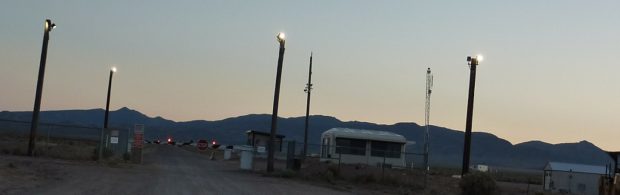
Paging Agent Mulder: UFO Hunter Spies New Underground Base Near Area 51 (VIDEO)

Paging Agent Mulder: UFO Hunter Spies New Underground Base Near Area 51 (VIDEO)

Area 51

The conspiracy buff also directed his attention toward the two fields located near the suspected underground facility, speculating that these crops might be part of some genetic research programme.

While the US Air Force facility known as Area 51 has already become the staple of conspiracy theories regarding extraterrestrial spacecraft and alien lifeforms, famous UFO hunter Scott C. Waring now claims that a new underground installation is being constructed in the vicinity.

According to Waring, who had apparently stumbled upon this discovery while studying satellite maps, the new facility is located 55 miles to the north-east of Area 51's perimeter.

He also took note of two fields located near the base, speculating that these crops may be "grown for genetic research".

"They are altering the genetics of the plants for unknown reason. This worries me…because if they are doing genetic research…then why do they need an underground base to do the research? Unless of course it includes other research that could endanger the public", Waring pondered.

One YouTuber, however, claimed that Waring’s discovery is merely “an artwork allegedly being made by a single artist” who has been given continuous grants to build these mounds for years.

In response, Waring argued that no artist would be allowed to do their art inside Area 51, dubbing this sort of explanation as an “expert way to cover it up, by leaving calling it something different”.

{ https://sputniknews.com/ }

Hoe vind je dit bericht?
Geschreven door peter om 20:46 Stuur door

UFO-jager spot nieuwe ondergrondse basis bij Area 51. Bekijk de beelden

UFO-jager spot nieuwe ondergrondse basis bij Area 51. Bekijk de beelden

UFO-jager spot nieuwe ondergrondse basis bij Area 51. Bekijk de beelden

In de buurt van Area 51 zou een ondergrondse installatie worden gebouwd. Dat zegt althans UFO-jager Scott C. Waring, meldt het Russische persbureau Sputnik.

Waring deed de ontdekking toen hij satellietfoto’s aan het bestuderen was. De nieuwe installatie bevindt zich naar verluidt op zo’n 88 kilometer ten noordoosten van Area 51.

Hij ontdekte ook twee velden nabij de basis en speculeerde dat daar mogelijk gewassen geteeld worden voor ‘genetisch onderzoek’.

Gevaar

“Ze passen het DNA van de planten om onbekende redenen aan,” zei hij. “Dit maakt me bezorgd.”

“Als ze genetisch onderzoek doen, waarom hebben ze dan een ondergrondse basis nodig voor hun onderzoek?” vroeg hij.

Tenzij het natuurlijk gaat om onderzoek dat een gevaar zou kunnen vormen voor de volksgezondheid, aldus Waring.

Toegang

Volgens één iemand waren de velden een ‘kunstwerk gemaakt door één enkele kunstenaar’.

Waring reageerde dat geen enkele kunstenaar ooit toegang zal krijgen tot Area 51 om daar kunstwerken te maken.

Bekijk het filmpje hieronder:

[Sputniknews]
© Copyright (c) NineForNews.nl
Hoe vind je dit bericht?
Geschreven door peter om 20:39 Stuur door

Antarctica Alien Base 2 Miles Below the Ice

Antarctica Alien Base 2 Miles Below the Ice

What is under the ice of Antarctica? Many mysterious reports have been coming out of Antarctica in the last couple of years, centred around a strange “anomalies” recently detected on the perpetually frozen Continent.

Something extraordinary, must be going on down for all these world leaders visiting the place. One things for sure, the strangeness surrounding Antarctica seems to be about more than protecting the penguins..

{ https://beforeitsnews.com/v3/ }

Hoe vind je dit bericht?
Geschreven door peter om 20:28 Stuur door

We Went to the Moon but We Found Things There That Can't Be Explained

We Went to the Moon but We Found Things There That Can't Be Explained

There’s a lot of evidence around that there are alien bases on the far side of the Moon. Even some unretouched fresh NASA photos show some items that don’t look exactly like rocks.

There is more to the moon than it just being a satellite of the Earth. Mike Bara has done a lot of research concerning ancient civilizations on the moon.

What Bara has done here is greatly expand on the already extensive amount of discussion about non-naturally-occurring structures photographed on the Lunar surface.

{ https://beforeitsnews.com/v3/ }

Hoe vind je dit bericht?
Geschreven door peter om 20:20 Stuur door

The Great Mystery Quake of the Midwest

31754-earthquake-facebook.800w.tn_-999x540.jpg

The Great Mystery Quake of the Midwest

There are certain areas in the world that are prone to earthquakes. California, Japan, and other regions sitting on fault lines all run the risk of these geological upheavals, and the people who live in these areas are well aware of it, living in a constant haze of fear in the back of their minds that one may strike at any moment. Yet there have been other areas of the world that do not face such anxiety, where earthquakes should really be one of the least of their worries, but despite this there have been anomalous quakes that have come and gone on to become baffling mysteries. Such is the case of a series of earthquakes that hit the Midwest region of the United States in the 19th century, which were not only odd that they happened at all, but also rather weird in that they are some of the most powerful quakes the country, and indeed the world, has ever seen.

The morning of December 16, 1811 probably started much as any other day in the central Mississippi Valley of the United States, yet at approximately 2:15 AM the entire region was jolted and viciously rocked by a powerful tremor which would later be determined to have originated at an epicenter in northeast Arkansas. Considering that this was the Midwest of the United States, probably the last thing that was on anyone’s mind was that they would be struck by an earthquake, and not only was it unusual, but it was exceptionally potent, measuring a magnitude of 7.5 to 7.9, causing massive damage, and felt as far away as New York City, Boston, Ohio, Massachusetts, Montreal, and Washington D.C. Even more terrifying still was that this was just the beginning, with a 7.4 magnitude aftershock striking later that same day, and unfortunately more was to come.

Over the next few months the region would be hit by more earthquakes measuring between magnitude 7 and 8, as well as countless aftershocks, until by March of 1812 the region had been terrorized by thousands of powerful temblors. Two of the earthquakes after the initial one were just as intense as the first, if not more so, such as a magnitude 7.8 quake on January 23, 1812, and the third major quake on February 7, 1812, which was estimated as being as much as a massive magnitude 8.8, all interspersed by countless aftershocks that all caused havoc, capsized boats, leveled forests, and even reshaped the landscape by forming islands, new waterfalls, massive sand boils, geysers, numerous deep fissures said to have even swallowed people alive, and creating Reelfoot Lake. What would go on to become the New Madrid Earthquakes, named after the Mississippi River town of New Madrid, would be felt to some degree over an area of around 1 million square miles fanning out from the central Midwest, and making it all even more frightening were some of the odd phenomena surrounding them.

A commonly reported phenomenon during the quakes was the presence of a loud roaring noise, like thunder or explosions, which was reported by countless locals and which made it all the more ominous. There were also reported the presence of dark clouds in the sky and a sort of foul smelling smog that descended upon the land to make breathing difficult and obscure vision, as well as the smell of sulphur and mysterious flashes of light in the sky, likely the result of a phenomenon known as seismoluminescence. Also rather unusual is that there were reports from boatmen of the Mississippi River actually flowing in the opposite direction at the time of the original quake and for up to several hours after. One rather frightening report of all of this mayhem was given by an eyewitness who illustrated the chaos:

On the 16th of December, 1811, about two o’clock, a.m., we were visited by a violent shock of an earthquake, accompanied by a very awful noise resembling loud but distant thunder, but more hoarse and vibrating, which was followed in a few minutes by the complete saturation of the atmosphere, with sulphurious vapor, causing total darkness. The screams of the affrighted inhabitants running to and fro, not knowing where to go, or what to do—the cries of the fowls and beasts of every species—the cracking of trees falling, and the roaring of the Mississippi— the current of which was retrograde for a few minutes, owing as is supposed, to an irruption in its bed— formed a scene truly horrible.

It must have seemed like the ends of days, and of course considering all of these strange phenomena and the fact that the Midwest region had never experienced anything like this before, there were immediately dire omens about what it all meant. Many highly religious people believed it to be a sign from God, and stated that many of the details could be found in Bible scripture. Native tribes of the area also had their theories that it was tied to their angry great spirits, and it did not go unnoticed that a comet not seen since the time of Ramses II in Egypt had arrived in the previous months and was at its brightest during the earthquakes, making it believed to have been some sort of portent to disaster.

Although the sparsely inhabited nature of the region at the time meant that the death toll was kept to a minimum, the New Madrid earthquakes were, and still are, considered to be the most powerful and most prolonged earthquakes to hit the United States east of the Rocky Mountains in recorded history, which is quite odd and surprising for an area of the United States not known for its earthquakes, and which does not lie on the edge of any of the earth’s 15 tectonic plates. Despite all of the more supernatural explanations that have popped up in the wake of the quakes, there is likely a more scientific explanation, but it is poorly understood, made even more difficult because the region has had so few earthquakes in its history as a basis of comparison.

What is now called the New Madrid Seismic Zone is a bit of an anomaly to say the least. In most cases, earthquakes occur along the edges of Earth’s tectonic plates, where friction between two of the plates sliding against or pushing or pulling each other causes the tremors, but that is not the case for the New Madrid earthquakes since they originated practically right in the center of one of these plates. There have been all manner of hypotheses for why this zone should cause these powerful quakes, such as that it is the result of magma pushing up from beneath the earth, a weakened crust in the area, the result of the release of stress at the surface from the retreat of glaciers, local changes to the mantle flow, and others.

One of the most popular recent theories is that the quakes were caused by a spider web of fissures underground called the Reelfoot Rift, formed 700 million and 540 million years ago when the ancient supercontinent of Rodinia broke apart and split, creating a system of fissures and weakened, fractures crust deep in the earth that is possibly prone to earthquakes, although not in the traditional sense. Despite all of these theories, no one is still really sure why these powerful quakes should hit the region, and research is ongoing. One seismologist at the University of Memphis in Tennessee, Christine Powell, has said of it all:

Here, in the center of a plate, we don’t have a theory that we can attribute the earthquakes to. So in order to understand why they’re occurring, you have to think outside the box.

Whatever the reasons for the New Madrid Earthquakes may be, it was certainly not a one-time freak occurrence. Ever since these earthquakes the region has been consistently hit with numerous temblors, to the tune of about 4,000 mild to moderate quakes since 1974, and it is thought that there is a 25 to 45% chance of a magnitude 6 or greater earthquake in the area within the next 50 years, which would be devastating to the now highly populated area. In the end we are left with quite the geological mystery. How is it that not only was there a strong series of earthquakes, but also some of the most relentless and intense the country has ever seen, right out in the middle of nowhere where no earthquake should have been in the first place? It is tetament to the fact that there are still mysteries of our planet we do not fully understand, and until we do we can only wait and see if there will be another repeat of that 1811 catastrophe.

{ https://mysteriousuniverse.org/ }

Hoe vind je dit bericht?
Geschreven door peter om 18:22 Stuur door

A Cosmic Explosion May Have Forced Ancient Humans Into Walking Upright

evolution-1295256_1280-999x540.png

A Cosmic Explosion May Have Forced Ancient Humans Into Walking Upright

Anyone who has spent any time surfing the Internet has at one time or another seen a picture (cute or otherwise) of a meerkat suddenly standing up when it hears something. There was a time in history when this was not the case and some brave or confused meerkat probably accidentally discovered the maneuver and its benefits. Most people assume the same thing happened with the first ancient human who carefully leaned against a tree or cave wall and fell forward while moving his or her legs in order to stay upright. According to a new study, this assumption is wrong. A new paper uses geology to propose that there was a supernova bombing Earth with cosmic energy a few million years ago that caused constant worldwide lightning strikes which burned down the forests of trees out ancestors were hanging out in and forced them to the grassy ground where they learned how to stand and run from the fires and lightning. Plausible? Could this have caused the first upright meerkat brigade too?

“The observation is that there’s a lot more charcoal and soot in the world starting a few million years ago. It’s all over the place, and nobody has any explanation for why it would have happened all over the world in different climate zones. This could be an explanation.”

Professor Adrian L. Melott of the Department of Physics and Astronomy at the University of Kansas co-authored the paper, “From Cosmic Explosions to Terrestrial Fires?” published this week in the Journal of Geology. He explains in a press releasehow he and co-author Brian Thomas of the Department of Physics and Astronomy at Washburn University in Kansas built their theory on some known facts. For example, it is accepted that a layer of iron-60 deposits lining the world’s sea beds came from a very near supernovae explosion only about 163 light years away during the overlap of the Pliocene Epoch and Ice Age. That roughly coincides with the appearance of Lucy, owner of the earliest bipedal hominin species (Australopithecus afarensis) fossils ever found. Why is the iron-60 significant?

“We contend it would increase the ionization of the lower atmosphere by 50-fold. Usually, you don’t get lower-atmosphere ionization because cosmic rays don’t penetrate that far, but the more energetic ones from supernovae come right down to the surface — so there would be a lot of electrons being knocked out of the atmosphere.”

Electrons in motion is the cause of lightning bolts, but this 50-fold increase means there were a LOT of lightning bolts as a result of this atmospheric ionization and they were striking all around the world, resulting in massive fires that forced Lucy and her relatives to jump/climb/fall to the ground. Lucy died from the fall but we’re living proof that some of her kin didn’t and they eventually got tired of bloody knees and palms.

“After this conversion to savanna, they would much more often have to walk from one tree to another across the grassland, and so they become better at walking upright. They could see over the tops of grass and watch for predators. It’s thought this conversion to savanna contributed to bipedalism as it became more and more dominant in human ancestors.”

This definitely sounds plausible. Unfortunately, it causes modern humans to wonder if this catastrophic supernova-caused cosmic bombardment could happen again … perhaps from Betelgeuse, which is only 652 light years from Earth. Fortunately, Melott says that’s not likely. Unfortunately, he thinks we have bigger things to be concerned with.

“Worry about solar proton events. That’s the danger for us with our technology — a solar flare that knocks out electrical power. Just imagine months without electricity.”

Maybe we should learn how to climb trees again?

{ https://mysteriousuniverse.org/ }

Hoe vind je dit bericht?
Geschreven door peter om 18:11 Stuur door

NASA Discovers Water and Organic Molecules on ‘Snowman World’ Ultima Thule

De bronafbeelding bekijken

NASA Discovers Water and Organic Molecules on ‘Snowman World’ Ultima Thule

The NASA New Horizon team has finally published the first study of the data it gathered on Ultima Thule, the strange, distant binary object consisting of two conjoined pancake-shaped lobes which resemble a half-melted snowman. Ultima Thule lies four billion miles away from Earth in the Kuiper belt, the ring of rocky and icy asteroids just past Neptune. NASA’s New Horizon spacecraft has been studying Ultima Thule since late 2018, and the mission marks the first ever study of a planetesimal, a half-formed object leftover from the era of planetary formation. 

Ultima Thule gets its name from a Latin term which refers to the most distant place beyond the borders of the known world – but unfortunately that same term was used by the Nazis to refer to the mythical homeland of the Aryan race in all of that weird Nazi mythology. Whoops. Despite the somewhat controversial name, the object offers astronomers the chance to study a truly unique and mysterious object right here in our own Solar System, just a few billion miles away. We’re practically neighbors!

Ultima Thule

Ultima Thule

Ultima Thule is about 22 miles long and has two distinctly differently shaped lobes, or bodies, joined at a central ‘neck.’ Just how the two objects came to be conjoined in such a way is a mystery, but it likely happened as many other planetesimals were crashing together on their way to becoming a planet. For some reason, these two bodies didn’t make the final cut and were likely ejected from that burgeoning planet’s gravity and left adrift in the cold blackness of space some time in the cosmic past.

“We’re looking into the well-preserved remnants of the ancient past,” said New Horizons Principal Investigator and rock star astronomer Alan Stern in a press release. “There is no doubt that the discoveries made about Ultima Thule are going to advance theories of solar system formation.”

Composite image of Ultima Thule

Composite image of Ultima Thule

In their new publication in Science, the New Horizons team disclosed some of their initial findings about Ultima Thule and discussed the features they are continuing to study. Already, they have discovered that Ultima Thule is a rocky, reddish object lined with hills, pits, and craters and the reddish color is believed to come from methanol, water ice, and organic molecules on Ultima Thule’s surface, a rare discovery if confirmed. NASA will continue its flyby of Ultima Thule until 2020.

According to one version of the panspermia hypothesis, organic molecules hitching rides on objects like Ultima Thule could be the ‘seed’ which spreads life throughout the universe. Could the molecules lurking on Ultima Thule hold the keys to life itself? All it takes a few nuggets of carbon, a few chunks of hydrogen, throw some oxygen in there, mix in a pinch of nitrogen, add calcium and phosphorus to taste, crash it all into a volatile oxygen-rich planet, wait a few billion years and boom: Big Macs, Facebook, and Boeing 737s. The universe is a weird place.  

Where will Ultima Thule ultimately end up? Will their reality TV be as miserable as ours?

{ https://mysteriousuniverse.org/ }

Hoe vind je dit bericht?
Geschreven door peter om 18:03 Stuur door

Meer van UFO'S of UAP'S, ASTRONOMIE, RUIMTEVAART, ARCHEOLOGIE, OUDHEIDKUNDE, SF-SNUFJES EN ANDERE ESOTERISCHE WETENSCHAPPEN - DE ALLERLAATSTE NIEUWTJES

↑ Terug naar de berichten