Ontdek de Fascinerende Wereld van UFO's en UAP's: Jouw Bron voor Onthullende Informatie!
Ben jij ook gefascineerd door het onbekende? Wil je meer weten over UFO's en UAP's, niet alleen in België, maar over de hele wereld? Dan ben je op de juiste plek!
België: Het Kloppend Hart van UFO-onderzoek
In België is BUFON (Belgisch UFO-Netwerk) dé autoriteit op het gebied van UFO-onderzoek. Voor betrouwbare en objectieve informatie over deze intrigerende fenomenen, bezoek je zeker onze Facebook-pagina en deze blog. Maar dat is nog niet alles! Ontdek ook het Belgisch UFO-meldpunt en Caelestia, twee organisaties die diepgaand onderzoek verrichten, al zijn ze soms kritisch of sceptisch.
Nederland: Een Schat aan Informatie
Voor onze Nederlandse buren is er de schitterende website www.ufowijzer.nl, beheerd door Paul Harmans. Deze site biedt een schat aan informatie en artikelen die je niet wilt missen!
Internationaal: MUFON - De Wereldwijde Autoriteit
Neem ook een kijkje bij MUFON (Mutual UFO Network Inc.), een gerenommeerde Amerikaanse UFO-vereniging met afdelingen in de VS en wereldwijd. MUFON is toegewijd aan de wetenschappelijke en analytische studie van het UFO-fenomeen, en hun maandelijkse tijdschrift, The MUFON UFO-Journal, is een must-read voor elke UFO-enthousiasteling. Bezoek hun website op www.mufon.com voor meer informatie.
Samenwerking en Toekomstvisie
Sinds 1 februari 2020 is Pieter niet alleen ex-president van BUFON, maar ook de voormalige nationale directeur van MUFON in Vlaanderen en Nederland. Dit creëert een sterke samenwerking met de Franse MUFON Reseau MUFON/EUROP, wat ons in staat stelt om nog meer waardevolle inzichten te delen.
Let op: Nepprofielen en Nieuwe Groeperingen
Pas op voor een nieuwe groepering die zich ook BUFON noemt, maar geen enkele connectie heeft met onze gevestigde organisatie. Hoewel zij de naam geregistreerd hebben, kunnen ze het rijke verleden en de expertise van onze groep niet evenaren. We wensen hen veel succes, maar we blijven de autoriteit in UFO-onderzoek!
Blijf Op De Hoogte!
Wil jij de laatste nieuwtjes over UFO's, ruimtevaart, archeologie, en meer? Volg ons dan en duik samen met ons in de fascinerende wereld van het onbekende! Sluit je aan bij de gemeenschap van nieuwsgierige geesten die net als jij verlangen naar antwoorden en avonturen in de sterren!
Heb je vragen of wil je meer weten? Aarzel dan niet om contact met ons op te nemen! Samen ontrafelen we het mysterie van de lucht en daarbuiten.
Woensdag 4 september 2019
Two Black UFOs Found Landed In Craters On Mars, UFO Sighting News.
Two Black UFOs Found Landed In Craters On Mars, UFO Sighting News.
I found two interesting structures today in a Mars gigapan photo. The two structures appear to be ships that landed at the center of craters. You can see the black shinyness of the objects. One is very round and dome like the other is less thick and more turtle shell shaped. I believe both are ships that can leave at any time. By landing in the craters, astronomers and others who record them will assume that they are mere shadows. But as you see, they are real objects hiding in the craters.
We have accomplished a lot in our (relatively) short time on Earth. We’ve sent humans to the Moon and to live in space, developed massive and sophisticated telescopes to see the farthest reaches of the cosmos, and even rocketed rovers to Mars and probes to the edge of our solar system. However, a number of organizations have taken humanity’s voyage into the final frontier a step farther. NASA, the European Space Agency, and the research collective behind the Search for Extraterrestrial Intelligence (SETI) have been working tirelessly to find out if we are alone, once and for all.
Already, a number of projects exist that scan the stars for signs of intelligent life. And despite the fact that many of them have been looking to the skies for decades, we have yet to make contact. And that’s a bit of a problem.
The Paradox That Started It All
To put it mildly, our solar system is very old. In fact, scientists are still figuring out just how old — clues gathered from meteorites suggest it is almost 5 billion years old, and surrounding star systems are likely billions of years older. While interstellar travel still seems to be a distant dream, new technology is born every year that allows us to scan the skies for signals from civilizations in the most distant corners of the cosmos. The number of known alien worlds and star systems discovered through these technologies continues to rise, but our creative methods of listening to space have not yet revealed anything that resembles extraterrestrial communications or civilizations.
Given the size and age of our universe, it seems like we should have made contact. We, of course, have not.
In the early 20th century, physicist Enrico Fermi asked himself a now-famous question: Given the scope of our universe, why haven’t we found intelligent extraterrestrial life yet (or why haven’t they found us)? This is sometimes called the Fermi Paradox or the Great Silence. Scientists have floated many possible answers in the century since Fermi first asked this question. Here are some of the most plausiblereasons why he haven’t made first contact.
Basic probability asserts that alien life must exist. Since we haven’t made contact yet, one theory goes, there must be something barring life from interstellar travel or, at least, barring it from communicating with other alien species. This barrier is known as the “Great Filter,” and it is a force or event that stops a civilization from getting to the aforementioned point of interstellar travel or communication.
If the theory holds true, there are two primary reasons that we haven’t made contact: Because societies kill themselves off before they reach a state advanced enough to explore the stars or interstellar travel is simply not possible on a technological scale. Neither option is particularly pleasing.
And according to the experts behind the work, the filter event is of equal or greater probability than the existence of alien life itself. This is the point argued by Robin Hanson, a research associate at the Future of Humanity Institute at Oxford University, in his discussion of the topic.
No alien civilizations have substantially colonized our solar system or systems nearby. Thus among the billion trillion stars in our past universe, none has reached the level of technology and growth that we may soon reach. This one data point implies that a Great Filter stands between ordinary dead matter and advanced exploding lasting life.
Since we have not been able to detect alien life (or leave the solar system much, for that matter), how far are we from being caught up in some event that would bar us from ever finding aliens? “The easier it was for life to evolve to our stage, the bleaker our future chances probably are,” Hanson writes. In other words, the more life there is in the cosmos, the greater the likeliness that we are about to reach a cataclysmic, life-ending event or reach the cosmic limits of technological advancement.
2. Do Not Disturb The Aliens
Another hypothesis asserts that alien civilizations certainly exist, but they’re simply inactive. That’s the “aestivation hypothesis” (aestivation refers to an organism’s state of prolonged inactivity, similar to a bear hibernating or a frog that buries itself in sand during hot weather), which was put forth by researchers from Oxford’s Future of Humanity Institute and the Astronomical Observatory of Belgrade.
The theory, published in a paper in the Journal of the British Interplanetary Society in 2017, states that aliens may be “hibernating” until the environmental conditions are just right to become active and build their super society. The researchers argue that the laws of thermodynamics directly limit computation, as computing technologies need to be cooled in order to function. This makes it exceedingly difficult to create advanced technologies, as keeping them cool at scale quickly becomes prohibitively difficult. So the aliens are falling into a dormant until, to be blunt, the universe cools.
But distilling the development of a civilization to the kinds of conditions that our current, and somewhat imperfect, models can predict could be reductive. What if intelligent extraterrestrial life has found a way around the thermodynamic conditions that limit its ability to compute? “What if there are other forms of value that can be generated?” the study authors write. If they’re wrong about the relationship between thermodynamics and technology, the aestivation hypothesis would be moot. In this case, perhaps one of the other ideas here holds true.
According to the “Gaian Bottleneck” hypothesis, life needs particular environmental conditions to develop, and they’re not so common. Astrobiologists at the Australian National University penned their explanation to the Fermi Paradox in 2016.
Extinction is “the cosmic default for most life that has ever emerged on the surfaces of wet rocky planets in the Universe,” the researchers wrote. That’s because a planet has to be actually inhabited for it to be habitable, because organisms change the concentration of greenhouse gases in the atmosphere. A Catch-22 emerges: no life without habitability, no habitability without life.
For alien life to persist, the researchers write, it must hang on: “like trying to ride a wild bull. Most life falls off.” Life can only take place with the presence of an unlikely feedback loop. In this case, Earth is the exception to the rule.
4. Trapped In Deep Oceans
In 2015, after nearly a decade in transit, NASA’s New Horizons spacecraft became the first to do a close flyby of Pluto. It offered humanity its first look at its icy surface and raised questions about the possibility of subsurface oceans of water, and lots of methane and nitrogen. These questions put Pluto on a short but growing list of worlds with buried oceans trapped under a thick crust of ice and rock (some of the other worlds are Saturn’s moons Enceladus and Titan, as well as Jupiter’s moons Europa, Callisto, and Ganymede).
Those oceans figure prominently into another theory of where life might be lurking, one that Alan Stern, the principal investigator for New Horizons, touches on. Since buried oceans form a much more stable ecosystem than flowing surface streams, changes such as altering tides and dissipationtake place over a longer time period. A hard outer shell protects hypothetical life in the oceans from a harsh climate and a lethal mix of gases on the surface. “Impacts and solar flares, and nearby supernovae, and what orbit you’re in, and whether you have a magnetosphere, and whether there’s a poisonous atmosphere — none of those things matter,” Stern told Space.com.
Any intelligent alien life that forms in these deep oceans would have to overcome a big hurdle to reach inhabitants of other worlds: drilling through that thick, protective crust. All that work would only get them to the surface — sending signals to other planets become even more unlikely.
For the past eighty years or so, we’ve been listening for signs of extraterrestrial life with radio technology. The Allen Telescope Array, situated 470 km (290 miles) northeast of San Francisco, is one of the biggest — since 2007, 42 dishes have stood at the ready to scan the skies regularly in the hope of receiving radio signals from extraterrestrial life.
But what if extraterrestrial life doesn’t operate on those frequencies? Attempts at contact could simply be passing us by simply because we don’t comprehend the right wavelengths.
Instead of using telescope arrays and scanning the skies for radio signals, Duncan Forgan at the University of St. Andrews in Scotland suggests creating a galactic communications network. The same way we blink our high beams to send a signal to other drivers, we could use the shadow that Earth creates when it passes in front of the Sun to send a message to our fellow inhabitants of the universe. Forgan suggests that we build powerful lasers that contain those encoded messages, which are sent out as we pass in front of the Sun.
“If you want to communicate with someone on the other side of the galactic centre, there’s lots of stuff in the way – dust, stars, a big black hole – so you can take the long way around using the network,” Forgan tells New Scientist. Rather than letting intergalactic messages get lost in the vastness of space, civilizations in different galaxies could agree to use this “galactic communications network” to ensure their messages get to their intended recipients – a unified system to cut through the chatter.
6. We Are Being Impatient
We’ve only been actively reaching out for alien life for about a century — a mere blip in the long history of the solar system and of the universe overall. Evan Solomonides, an astrophysics and mathematics undergrad and researcherat Cornell University, suggests that it could take a while — about 1,500 years from now, to be precise — before we hear from any extraterrestrials.
In a paper submitted to the American Astronomical Society, Solomonides examines the probability of finding life. “We predict that under 1 percent of the galaxy has been reached at all thus far, and we do not anticipate to be reached until approximately half of the stars/planets have been reached.” Solomonides believes that we will have explore around half of the Milky Way galaxy before we hear anything, which will take a while since we’ve barely explored our own galactic neighborhood.
Solomonides is careful to note that the 1,500 years is not a deadline. “This is not to say that we must be reached by then or else we are, in fact, alone. We simply claim that it is somewhat unlikely that we will not hear anything before that time.”
Editor’s Note:This article was updated to correct the names of Saturn and Jupiter’s moons.
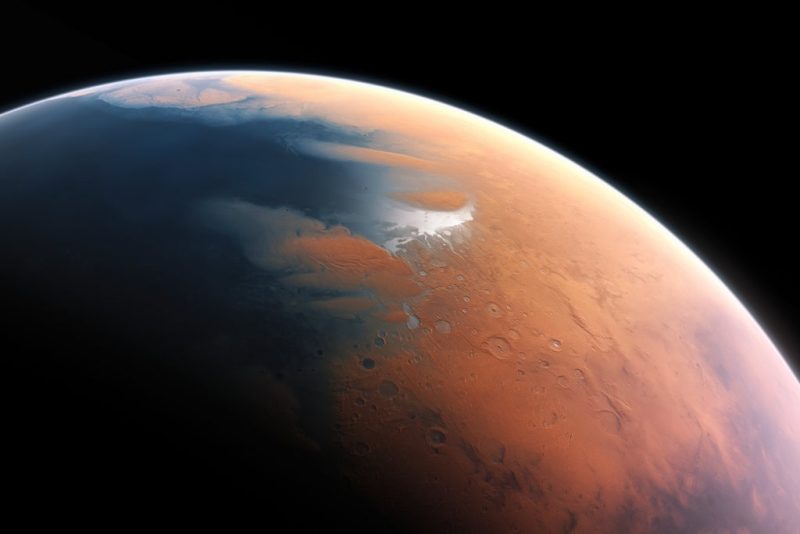
It’s likely Mars was once a water world with rivers, lakes and maybe even an ocean. New research lends support to the possibility that an asteroid slammed into Mars’ ocean 3.5 billion years ago, creating a vast tsunami.
Artist’s concept showing a proposed Mars ocean, some 4 billion years ago. According to some researchers, the young planet Mars then would have had enough water to cover its entire surface in a liquid layer about 500 feet (140 meters) deep. But it’s more likely the liquid would have pooled to form an ocean occupying almost half of Mars’s northern hemisphere, in some regions reaching depths greater than a mile (1.6 km).
It’s now commonly accepted among scientists that Mars used to be a lot wetter than it is today, a few billion years ago. As well as rivers and lakes, there has been growing evidence for a former ocean in the northern hemisphere. Now,new research is lending support to the possibility that an asteroid slammed into that ocean 3.5 billion years ago, creating a mega-tsunami 1,000 feet (309 meters) high!
The new peer-reviewed findings, from Francois Costard, a scientist at the French National Centre for Scientific Research (CNRS), were first published in the Journal of Geophysical Research Planets on June 26, 2019.
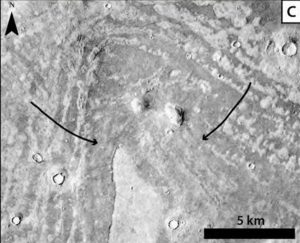
Costard has advocated his theory since 2017 to explain some unusual surface features called Thumbprint Terrain – concentric ridges that look like those in a thumbprint – in Mars’ Arabia Terra region. A very similar theory had also been suggested by two other groups of astronomers back in 2016. In their scenario, the asteroid impact caused not one but twotsunamis.
Part of the Thumbprint Terrain in the Arabia Terra region of Mars, that might have been created by a mega-tsunami 3.5 billion years ago.
Now, Costard thinks he has found the impact crater that the asteroid created. He attempted to trace back the direction that the tsunami would have originated from, away from the Thumbprint Terrain. He narrowed down the possible impact location to 10 craters, before focusing on Lomonosov Crater. The shape of the crater indicates it was under water at the time, and it’s the right age (about 3 billion years old) and size (75 miles – 120 km – in diameter). From the new paper:
We attribute its broad and shallow rim, in part, to an impact into a shallow ocean as well as its subsequent erosion from the collapsing transient water cavity. The likely marine formation of the Lomonosov crater, and the apparent agreement in its age with that of the Thumbprint Terrain unit strongly suggests that it was the source crater of the tsunami. These results have implications for the stability of a late northern ocean on Mars.
If the tsunami scenario is correct, it has implications for the potential habitability of ancient Mars, since that means the northern ocean was still around 3.5 billion years ago. Until now, it has been thought that the planet lost most of its water closer to 3.7 billion years ago. That would allow an extra couple hundred million years in which life could have started. Alexis Rodriguez, a Mars geomorphologist at the Planetary Science Institute (PSI) in Tucson, Arizona, noted that the ocean sediments:
… may be a window into the subsurface habitability of Mars.
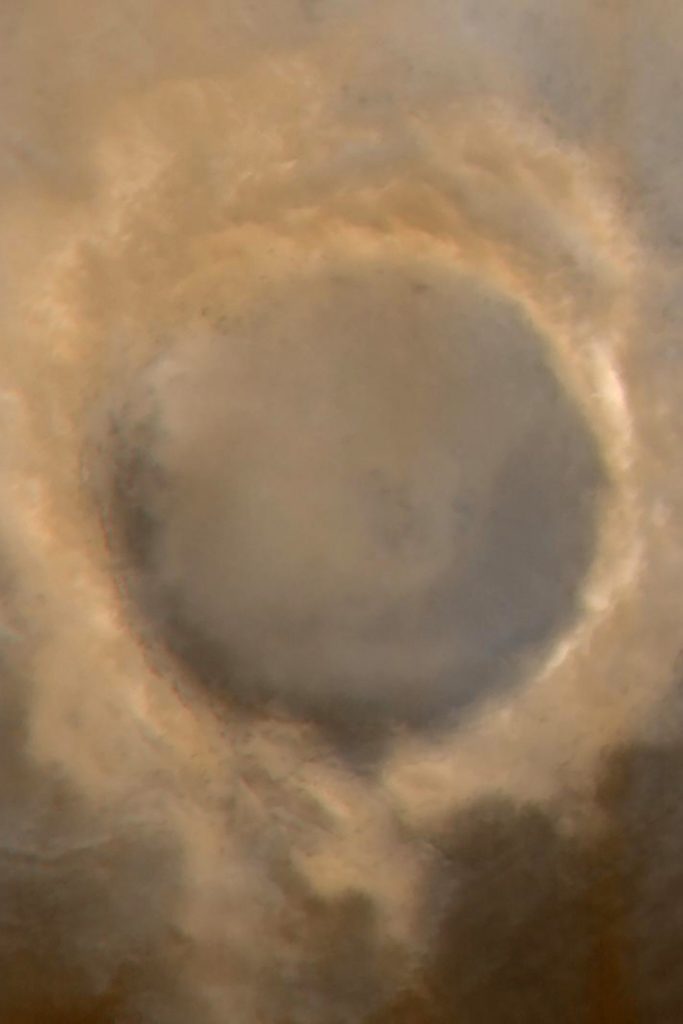
Orbital view of Lomonosov Crater, as seen by NASA’s Mars Global Surveyor spacecraft. This crater may have been formed by the asteroid impact that caused the tsunami(s) in the ancient ocean.
There’s still a lot we don’t know about water on ancient Mars and the climate conditions that allowed it to exist on Mars’ surface, something it does not do today. As Paul Byrne, a planetary geologist at North Carolina State University, said:
It’s fair to say that we don’t yet fully understand the history of Mars’s climate, and certainly, the climate models we use will continue to be improved.
While evidence for the possible ocean has grown, it’s still not absolutely definitive. But if the findings regarding the Thumbprint Terrain are accurate, that would be pretty compelling evidence for the ocean. After all, how could you have a tsunami without an ocean?
Even if there was no ocean, though, Mars was still plenty wet, with rain, groundwater, aquifers, rivers and lakes. Early Mars was a lot more like Earth in many ways, but then the planet lost most of its atmosphere – for reasons still being investigated and debated – and the water dried up.
There have been recent findings that suggest liquid water aquifers still exist deep underground, and the Recurring Slope Lineae (RSL) features on some slopes near the equator may be evidence for trickles of briny water on the surface, but otherwise most of Mars’ current water is in the form of ice, at the poles and underground. Landers and rovers have also seen frost, snow and clouds (both water and carbon dioxide types), and orbiters have photographed fog in canyons and craters. But compared to a few billion years ago, Mars is much drier now, and colder, than it used to be. So we can only imagine what it would have been like to be able to stand there and watch the asteroid plummet into that Martian ocean.
Bottom line: Evidence for a possible ancient ocean in Mars’ northern hemisphere has grown in recent years, and now additional evidence suggests that a massive asteroid impact created a mega-tsunami about 3.5 billion years ago.
It's stressful to hang out near the king of the solar system, and Jupiter's moon Iobears the scars of that close relationship on its surface, which is pockmarked by a host of volcanoes.
Those volcanoes form because the planet's massive gravity stretches the interior of Io in a process called tidal heating that melts rock into liquid magma, which eventually builds up enough pressure to burst to the surface. A new study examines three decades of observations of the ebb and flow of thelargest of those volcanoes, which scientists call Loki Patera, looking for patterns that might tie the volcano's schedule of activity to Io's orbit around Jupiter.
"Some people are expecting Io's volcanoes to do something like this and it's not too surprising," lead author Katherine de Kleer, a planetary scientist at the California Institute of Technology, told Space.com. "But then there are other people who think that volcanoes are so complicated that they wouldn't necessarily follow these orbital trends."
De Kleer and her colleagues started by pinning down the details of Io's orbit, which takes about 1.77 Earth days. That's too fast for scientists to develop a nuanced understanding of the orbit's impacts using Earth-based telescopes, which can only observe when Io is in their line of sight.
But there are other, much slower cycles — on the scale of hundreds of days — that are embedded within that orbit, as other moons pull at Io. Those cycles could also influence the tidal heating that the moon experiences.
"It's been this interesting search for patterns in the volcanic activity; tidal heating should produce volcanism that follows specific patterns," de Kleer said. "So you should have volcanoes that are occurring at specific places on the surface and not at other places, and you might expect them to show specific patterns in time also."
To try to make sense of the volcano, the study authors gathered all the observations they could find of Loki over the past three decades. For much of that timeline, scientists' data was sporadic at best, but in 2013, de Kleer and her colleagues made a concerted effort to maximize observations of Loki.
The result is the most detailed look scientists have ever had of the volcano's activity. "It's the dataset which is the most impressive thing," Julie Rathbun, a planetary scientist at the Planetary Science Institute who wasn't involved in the new research but who also studies Loki, told Space.com. "It's really hard to get all the data we want from the ground."
The other factor that de Kleer and her colleagues focused on, the details of Io's orbit around Jupiter, was less challenging to study. But it's not the sort of factor volcanologists might turn to first if they've been inspired primarily by volcanoes closer to home, which aren't strongly affected by any tidal heating.
"A lot of the geology is based on terrestrial geology and there's not a lot of things on Earth that are driven by tides, so it's not something I think people, especially when studying volcanoes, are used to looking for," Rathbun said. "When studying planets and moons, tides and periodicity are among the most obvious things to measure, they're the easiest things to measure."
A Voyager 1 image shows a plume rising from Loki Patera.
(Image credit: NASA/JPL/USGS)
De Kleer and her colleagues were inspired by cycles scientists have noticed in plumes streaming off one of Saturn’s moons, Enceladus, which seem to brighten and dim in conjunction with that moon's orbit.
They found two cycles in Loki's activity that might be influenced by tidal heating: one lasting 454 days and the other 480 days. Both of those numbers are close to cycles in which Io's orbit is tweaked by the influences of its neighbors.
And realistically, that sort of cycle might make more sense in a volcano than a cycle tied directly to an orbital period as fast as Io's. "Those are the timescales that a volcano can actually evolve on," de Kleer said. She and her colleagues think one potential explanation for what's happening at Loki is that the plumbing of the volcano can't respond to tidal heating at the speed of the 1.77-day orbital cycle, leaving only slower cycles to affect the volcano.
Understanding how Loki works isn't just about understanding one massive planet's one weirdo moon. Earth and Io are the only worlds in our solar system where it's easy to study volcanoes, and Earth's aren't strongly influenced by tidal heating, but scientists believe that phenomenon is a vitally important one in the bigger picture of planetary science, in our solar system and beyond.
"This kind of global-scale tidally driven geophysics is just not something that you have on Earth," de Kleer said. "[Io] is kind of this alien world where we have these processes that you're not able to study on Earth, and if we can study them on Io we can broaden our idea of geophysics more generally so that it's less Earth-centric and encompasses more worlds."
De Kleer and her colleagues are hoping to continue regularly checking on Loki in order to sort out how Io's orbital cycles are governing its activity. They calculated out when the volcano could rumble based on each timeline, and within a few years, they're hoping to gather enough data to pin down a better understanding of Loki's dynamics.
"It's going to be a lot of fun when we get close to the predicted times that the brightenings should occur," de Kleer said. "We can watch and we notice right away in the images when Loki starts to brighten, and that's always fun."
The research is described in a paper published May 8 in the journal Geophysical Research Letters.
One small piece of the Mars methane mystery may have just been solved.
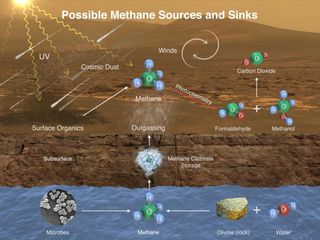
NASA's Curiosity rover has spotted multiple surges of methane in Mars' air over the past few years — most recently in June, when levels of the gas inside the Red Planet's Gale Crater spiked to 21 parts per billion per unit volume (ppbv).
That's far higher than background methane levels on Gale's floor, which Curiosity has determined range seasonally from 0.24 ppbv to 0.65 ppbv.
Scientists don't know what's producing this methane, or where exactly it's coming from. But they're keen to find out, because the gas is a possible sign of life. More than 90% of the methane in Earth's air, for example, was produced by microbes and other organisms.
A recent study may help researchers narrow the hunt. Scientists estimated the methane content of typical Red Planet rocks by analyzing Mars meteorites and native basalt and sedimentary rocks here on Earth — stand-ins for their Martian counterparts.
The team then calculated how much of this methane could be liberated by scouring winds, the dominant form of erosion on modern Mars. (The Red Planet hasn't hosted stable bodies of surface water for more than 3 billion years.)
The researchers determined that, for wind erosion to produce detectable levels of methane in the Martian air, the scoured rocks would have to contain as much methane as the most hydrocarbon-rich shale here on Earth. That's a very unlikely scenario, study team members said.
"What's important about this [finding] is that it strengthens the argument that the methane must be coming from a different source," co-author Jon Telling, a geochemist at Newcastle University in England, said in a statement. "Whether or not that's biological, we still don't know."
Indeed, methane can be produced abiotically as well — by reactions involving hot water and certain types of rock, for example. And it's unclear if the methane detected by Curiosity (and Europe's Mars Express orbiter, which confirmed one of the surges the rover found) is modern or ancient. However it was originally generated, the gas could have been trapped underground for billions of years before bubbling up to the surface.
The cause of the methane spikes is "still an open question," study lead author Emmal Safi, a postdoctoral researcher in the School of Natural and Environmental Sciences at Newcastle University, said in the same statement.
"Our paper is just a little part of a much bigger story," she added. "Ultimately, what we're trying to discover is if there's the possibility of life existing on planets other than our own, either living now or maybe life in the past that is now preserved as fossils or chemical signatures."
The recent paper was published in June in the journal Scientific Reports.
Mike Wall's book about the search for alien life, "Out There" (Grand Central Publishing, 2018; illustrated byKarl Tate), is out now. Follow him on Twitter @michaeldwall. Follow us on Twitter@Spacedotcom orFacebook.
IMAGES ALTERED BY AUTHOR. IMAGES: NASA & DEPARTMENT OF ENERGY
As far as we can tell, Mars is a desolate-looking desert, with no obvious life. Sure, there may still be microbes there, but I think it's safe to say that there is not an advanced civilization living on the Red Planet. But was it always that way? Did Mars once host a bustling civilization, one that perhaps was capable of nuclear warfare? Let's check in with some conspiracy theorists to find out.
"There are literally hundreds of building ruins in a few of NASA's panoramic images. What has happened on Mars? Was it a Nuclear WAR, or perhaps Asteroid hits? The fact of the matter is, that there are many pockets of living humanoids all over Mars," he wrote on a YouTube video showcasing some of these "building ruins."
Let's just put this out there. This is one of the fringiest of fringe conspiracy theories out there. Andrew is probably just a wee bit off his rocker, but he didn't randomly make up the idea that there was civilization on Mars and that it could have died in a nuclear WAR.
A SEPARATE CONSPIRACY THEORIST BELIEVES THE MARTIAN HOLOCAUST AND THE ARK OF THE COVENANT ARE RELATED.
For that, let's take a look at an excerpt from Did Spacemen Colonize the Earth?, a book published by Robin Collyns in 1976. Earlier in the following passage, Collyns argues that there certainly were nuclear explosions on Mars.
"It is difficult to imagine a nuclear explosion on Mars that was not deliberately caused," Collyns writes. "It is very likely that the explosion was made for some constructional purpose. Thus, the [nuclear observations] can serve as one of the proofs in the favor of existence of rational life on mars."
Pseudoscience and wild conjecture are fun, but John Brandenburg, a plasma physicist who got his degree from UC Davis and who has seemingly had a relatively normal, distinguished career for a scientist, has staked his reputation on his theory that Martian life was, perhaps purposefully, destroyed with nukes.
BRANDENBURG'S APPEARANCE ON SUPREME MASTER TELEVISION SCREENGRAB: SUPREME MASTER TELEVISION
In an oddly disconcerting interview with "Supreme Master Television," a thoroughly bizarre station run by the Supreme Master Ching Hai International Association cult, Brandenburg notes that Mars had two ancient humanoid civilizations, called Cydonia and Utopia, which had a level of technology similar to that of the ancient Egyptians.
What happened to those Martians? Nukes, he says.
"Two great disasters happened on Mars," he told Supreme Master TV, pointing to Utopia on a map. "One here, and then an asteroid impact happened here, and Cydonia was right in between them. That's puzzling. Why would so many bad things happen in one area of mars that just so happened to have archaeology on it?"
That was back in 2011. Since then, Brandenburg has decided that both disasters were nukes, and possibly "natural" nuclear explosions that could have been caused by some cosmic weirdness like an asteroid hitting radioactive material or something like that. Today, however, he has upped the ante.
This weekend, he's going to present new research at a meeting of the American Physical Society that he says proves that there were indeed nuclear explosions on Mars and that they are consistent with nuclear bomb "airbursts," meaning that there's no possible way these were natural. He said in a statement emailed to me that the evidence he's found is "consistent with mixed fusion-fission explosions."
Here's his case, set to be published in the Journal of Cosmology and Astrophysics, a journal that just published a study about the Big Bang being a hologram:
"The high concentration of Xenon-129 atmosphere, the evidence from Krypton-80 and the detected pattern of excess abundance of Uranium and Thorium on Mars surface, relative to Mars meteorites, first seen by the Russians and now confirmed by the Mars Odyssey Spacecraft Gamma Ray Spectrometer, mean that the surface of Mars was apparently the site of massive radiological events, which created large amounts of signature isotopes and covered the surface with a thin layer of radioactive debris enriched in certain elements relative to its subsurface rocks. This pattern of phenomenon can be explained as due to two large anomalous nuclear explosions on Mars in the past."
So, there's the theory. Reading that, it's possible, until you get to the last line, to think that hey, here's a scientist who thinks something weird happened on Mars—the idea of there being a naturally occurring nuclear explosion on a planet that has radioactive elements on it hasn't been completely ruled out by NASA, after all.
But then, well, he is presenting published, quasi-scientific research suggesting that these were anomalous and not natural. If that's not clear enough, maybe the description and title of his upcoming book Death on Mars: The Discovery of a Planetary Nuclear Massacre will drive it home.
Or we can just read the conclusion to his paper, a preprint version of which he shared with me.
"Given the large amount of nuclear isotopes in Mars atmosphere resembling those from hydrogen bomb tests on Earth, Mars may present an example of civilization wiped out by a nuclear attack from space," he wrote.
"It is possible the Fermi Paradox means that our interstellar neighborhood contains forces hostile to young, noisy, civilizations such as ourselves," he added. "Such hostile forces could range from things as alien as AI (Artificial Intelligence) 'with a grudge' against flesh and blood, as in the movie Terminator, all the way to things as sadly familiar to us as a mindless humanoid bureaucrat like Governor Tarkin in Star Wars, eager to destroy planet Alderann as an example to other worlds."
It is of course worth noting that no high profile scientists have given any credence at all to this theory.
To gauge whether Brandenburg's thoughts have gained any traction with conspiracy theorists, I hunted around for their reactions to his earlier work. Here's what I came across:
"Having seen the evidence presented by Dr. Brandenburg, I feel certain that we need to actively plan for a possible defense against whoever perpetrated the assault on Mars. In fact, as U.S. Space Command has access to all the data that he (and this family) have, as well as all the other pertinent data that exists out there, I'd be amazed to learn that our preparations have not been underway for a very long time."
"There are other possibilities as well. Consider a very high tech civilization where a few folks mis-applied high energy technology and it got out of hand, causing a sever explosion and catastrophe a couple of million years ago. Perhaps a similar thing occurred on earth about 13,000 ya resulting in a cataclysmic event sinking Atlantis and energetically causing the Bermuda Triangle (and other anomalies) to activate. It may not have been "nuclear" and may not have been used in warfare."
"I believe that after a nuclear war broke out on Mars. The surviving Martian race emigrated to the Earth, building the Pyramids and Sphinx to represent the features on mars so that when we were intelligent enough we might discover that there was once a thriving powerful E.T race on mars."
So, there you have it. Were ancient Martians blown up by other aliens? Almost certainly not, but if we are similarly destroyed, at least one dude will be able to say "told you so."
Japan Just Landed a Spacecraft on an Asteroid, And The Photos Are Nuts
MORGAN MCFALL-JOHNSEN, BUSINESS INSIDER
The life of an asteroid is lonely. The rocks spend eons drifting through the cold vacuum of space.
But on Wednesday, the asteroid Ryugu welcomed a special visitor: Japan's Hayabusa-2 probe successfully landed on the asteroid's surface at 21:06 ET (01:06 UTC on Thursday).
The Japan Aerospace Exploration Agency (JAXA) launched Hayabusa-2 into space in December 2014. Its mission: explore and collect samples from Ryugu, a primitive asteroid half-a-mile in diameter that orbits the sun at a distance up to 131 million miles (211 million kilometers).
The probe reached its destination in June 2018, then got to work making observations, measuring the asteroid's gravity, and rehearsing to touch down.
It blasted the asteroid with a copper plate and a box of explosives in April in order to loosen rocks and expose material under the surface, then successfully landed on Ryugu last night to gather up the rock and soil debris.
The spacecraft captured the images below as it left the asteroid's surface.
"First photo was taken at 10:06:32 JST (on-board time) and you can see the gravel flying upwards. Second shot was at 10:08:53 where the darker region near the centre is due to touchdown," JAXA tweeted.
(JAXA)
Ancient rock samples
Asteroids are made of rock and metal, and they take all kinds of quirky shapes, ranging in size from pebbles to 600-mile megaliths. Most of them hang out in the asteroid belt between Mars and Jupiter, though Ryugu's orbit sometimes takes it between Mars and Earth.
Some asteroids date back to the dawn of our solar system 4.5 billion years ago, when materials leftover from the formation of planets coalesced into these chunks of rock. In that sense, asteroids can serve as time capsules: What scientists find in those primitive rocks could tell us a lot about the solar system's history.
Ryugu is a C-type asteroid, which means it's rich with organic carbon molecules, water, and possibly amino acids. Amino acids form the building blocks for protein and were essential to the evolution of life on Earth. Some theories posit that an asteroid first brought amino acids here, gifting our planet with the seeds of life, though that's still debated.
About three-quarters of our solar system's asteroids are C-type. Hayabusa-2 aims to be the first mission to bring samples from such an asteroid back to Earth.
The probe initially landed on Ryugu in February and collected shallow samples from just below the surface, but mission managers decided to gather some deeper rock samples as well, since that material hasn't been exposed to harsh weathering from space.
To accomplish that, the probe had to lift back off the asteroid, then blast a 10-meter crater into the surface in order to access to the rock beneath.
So in April, Hayabusa-2 released and detonated a box of explosives in space that shot a copper plate into the asteroid.
Wednesday's landing then made a splash in all that freed-up material.
"These images were taken before and after touchdown by the small monitor camera (CAM-H). The first is 4 seconds before touchdown, the second is at touchdown itself and the third is 4 seconds after touchdown. In the third image, you can see the amount of rocks that rise," JAXA tweeted.
After it touched down, Hayabusa-2 then collected a new set of samples and left Ryugu's surface. At the end of this year, it will begin the 5.5 million-mile (9 million-kilometer) journey home.
The agency's OSIRIS-REx mission reached a much smaller C-type asteroid, Bennu, in August 2018. But the probe didn't land on Bennu's surface; instead, it's been orbiting at a record-breakingly close distance.
The plan is for OSIRIS-REx to approach Bennu's surface in July 2020, but the spacecraft will only make contact for about five seconds. During that quick instant, it will blow nitrogen gas to stir up dust and pebbles and collect the samples. If all goes according to plan, it will return that material to Earth in 2023.
The asteroid's surface has turned out to be rougher than expected, however, and debris flying off the space rock can pose a threat to the orbiting spacecraft. So NASA is still choosing its sampling site.
But Bennu has already made a significant finding: In December, before it entered orbit around Bennu, the probe discovered that the asteroid harbored ingredients for water (oxygen and hydrogen atoms bonded together).
Though Bennu is too small to host liquid water, it's possible that water could have once existed on its parent asteroid, which Bennu broke away from between 700 million and 2 billion years ago.
Though NASA's asteroid-exploration mission will collect a larger quantity of sample material than Japan's, the JAXA team hopes that comparing the samples from two different sites on the same asteroid will yield novel information about how long-term space exposure changes asteroids over time.
Both Bennu and Ryugu could also teach scientists a lot about the history of the solar system and potentially – if they contain organic materials – about the origins of life on Earth.
On June 5-6, 2012, NASA's Solar Dynamics Observatory collected images of one of the rarest predictable solar events: the transit of Venus across the face of the Sun.
This article was originally published at The Conversation. The publication contributed the article to Space.com's Expert Voices: Op-Ed & Insights.
Just next door, cosmologically speaking, is a planet almost exactly like Earth. It's about the same size, is made of about the same stuff and formed around the same star.
To an alien astronomer light years away, observing the solar system through a telescope, it would be virtually indistinguishable from our own planet. But to know the surface conditions of Venus – the temperature of a self-cleaning oven, and an atmosphere saturated with carbon dioxide with sulfuric acid clouds – is to know that it's anything but Earth-like.
So how is it that two planets so similar in position, formation and composition can end up so different? That's a question that preoccupies an ever-growing number of planetary scientists, and motivates numerous proposed Venus exploration efforts. If scientists can understand why Venus turned out the way it did, we'll have a better understanding of whether an Earth-like planet is the rule – or the exception.
I'm a planetary scientist, and I'm fascinated by how other worlds came to be. I'm particularly interested in Venus, because it offers us a glimpse of a world that once might not have been so different from our own.
A once-blue Venus?
The current scientific view of Venus holds that, at some point in the past, the planet had much more water than its bone-dry atmosphere suggests today – perhaps even oceans. But as the Sun grew hotter and brighter (a natural consequence of aging), surface temperatures rose on Venus, eventually vaporizing any oceans and seas.
With ever more water vapor in the atmosphere, the planet entered a runaway greenhouse condition from which it couldn't recover. Whether Earth-style plate tectonics (where the outer layer of the planet is broken into large, mobile pieces) ever operated on Venus is unknown. Water is critical for plate tectonics to operate, and a runaway greenhouse effect would effectively shut down that process had it operated there.
But the ending of plate tectonics wouldn't have spelled the end of geological activity: The planet's considerable internal heat continued to produce magma, which poured out as voluminous lava flows and resurfaced most of the planet. Indeed, the average surface age of Venus is around 700 million years – very old, certainly, but much younger than the multi-billion-year-old surfaces of Mars, Mercury or the Moon.
The exploration of Planet 2
The Venus-as-a-wet-world view is just a hypothesis: Planetary scientists don't know what caused Venus to differ so much from Earth, nor even if the two planets really did start off with the same conditions. Humans know less about Venus than we do about the other inner solar system planets, largely because the planet poses several unique challenges to its exploration.
For example, radar is needed to pierce the opaque, sulfuric acid clouds and see the surface. That's a lot trickier than the readily visible surfaces of the Moon or Mercury. And the high surface temperature – 470 degrees Celsius (880 degrees Fahrenheit) – means that conventional electronics don't last more than a few hours. That's a far cry from Mars, where rovers can operate for more than a decade. In part because of the heat, acidity and obscured surface, then, Venus hasn't enjoyed a sustained program of exploration over the past couple of decades.
That said, there have been two dedicated Venus missions in the 21st century: the European Space Agency's Venus Express, which operated from 2006 to 2014, and the Japan Aerospace Exploration Agency's Akatsuki spacecraftcurrently in orbit .
Humans haven't always ignored Venus. It was once the darling of planetary exploration: between the 1960s and 1980s, some 35 missions were dispatched to the second planet. The NASA Mariner 2 mission was the first spacecraft to successfully carry out a planetary encounter when it flew past Venus in 1962. The first images returned from the surface of another world were sent from the Soviet Venera 9 lander after it touched down in 1975. And the Venera 13 landerwas the first spacecraft to return sounds from the surface of another world. But the last mission NASA launched to Venus was Magellan in 1989. That spacecraft imaged almost the entire surface with radar before its planned demise in the planet's atmosphere in 1994.
The Magellan mission was launched from Atlantis' cargo bay on May 4, 1982. The spacecraft's high gain antenna is visible at the top of the image.
(Image credit: NASA)
Back to Venus?
In the last few years, several NASA Venus missions have been proposed. The most recent planetary mission that NASA chose is a nuclear-powered craft called Dragonfly, destined for Saturn's moon Titan. However, one proposal to measure the composition of the Venus surface was selected for further technology development.
Some 30 years after NASA set course for our hellish neighbor, the future of Venus exploration looks promising. But a single mission – a radar orbiter or even a long-lived lander – won't solve all the outstanding mysteries.
Rather, a sustained program of exploration is needed to bring our knowledge of Venus to where we understand it as well as Mars or the Moon. That will take time and money, but I believe it's worth it. If we can understand why and when Venus came to be the way it is, we'll have a better grasp of how an Earth-size world can evolve when it's close to its star. And, under an ever-brightening Sun, Venus may even help us understand the fate of Earth itself.
Follow all of the Expert Voices issues and debates — and become part of the discussion — on Facebook and Twitter. The views expressed are those of the author and do not necessarily reflect the views of the publisher.
One of the key determinants of which worlds can host life may lie in the motion of their oceans.
Right now, calculating that motion is a challenge. After all, scientists can't just dip their toes in the water. But new research pulls together information about four of the most intriguing ocean worldsto inform models of what their subsurface oceans might be doing.
"These oceans are really interesting in and of themselves," Krista Soderlund, an expert on planetary fluid dynamics at the University of Texas at Austin and author of the new research, told Space.com. "You often are first drawn to a satellite by what it looks like on its surface, but I think that what is going on beneath the surface is just as exciting and interesting."
And according to her new calculations, there is indeed plenty going on beneath the surface of the solar system's icy moons. Soderlund focused on Jupiter's moons Europa and Ganymede and on Saturn's moons Enceladus and Titan.
In each case, she tried to understand how factors like the world's rotation rate, the thickness of its ice shell and the density of its seawater might affect how much water moves around the hidden oceans.
Her calculations suggest that the oceans on Enceladus and perhaps Titan could host currents in alternating bands and particularly strong heat flow near the poles. Europa, on the other hand, because its spin is less of a factor, seemed to sport the most noticeable heat flow near its equator. (Scientists don't know enough about Ganymede to quite settle on a specific ocean current model.)
Predicting such activity inside icy moons is a promising indicator for those who wonder whether such oceans could be home to life. "When we think about ocean dynamics, it's really important for habitability," Alyssa Rhoden, a scientist at the Southwest Research Institute focused on ice shells, told Space.com. Rhoden wasn't involved in the new research but is co-leading a new network for ocean worlds research. "It gives us a sense of how much that swirling and whirling is going on and how you get nutrients from one place to another place, how you move energy from one place to another place."
More swirling and whirling means better odds that the ingredients of life can actually collide. But despite the work Soderlund has put into trying to understand these hidden oceans, the result is still an echo of what could be happening on these worlds.
It's the universal challenge of modeling as a scientific approach: a model will never be quite as intricate or comprehensive as reality. "All of our models are wrong, they're all wrong," Rhoden said. "Because we can't actually model everything."
A visualization of ocean surface currents on Earth.
(Image credit: NASA's Goddard Space Flight Center)
But getting more data about these moons and their hidden oceans will fine-tune these models, Rhoden said, and that doesn't necessarily require directly sampling the oceans — although needless to say, scientists would love to do that.
Long before such feats are possible, a different mission, scientists can turn to NASA's Europa Clipper and the European Space Agency's Jupiter Icy Moons Explorer (JUICE), both scheduled to launch in the 2020s.
Soderlund is on the team behind one of Europa Clipper's instruments, the Radar for Europa Assessment and Sounding: Ocean to Near-Surface device, or REASON. Because an ocean's dynamics affect the ice shell above it, REASON data should help scientists vet some of their hypotheses about Europa's ocean activity, she said.
If her prediction that heat flow is strongest in Europa's ocean at the equator is correct, for example, the moon's ice shell should be thinner there. It's an approach that turns the massive annoyance of an ice sheet blocking a direct view of your research subject into a tool and recognizes the ways these strange oceans must be connected to their surroundings — just as is true here on Earth.
"The fact that we're predicting they have strong ocean currents in itself is pretty exciting, since then it's not just a really passive body of water, it actually has some really cool, intriguing and fun characteristics," Soderlund said. "It's kind of like our own Earth's ocean in that respect, where there's just a lot going on."
The research was described in a paper published on July 29 in the journal Geophysical Research Letters.
Video – 3D bioprinter patches up wounds using a patient’s own skin cells
While the advent of 3D printers is commonly thought of as a revolution for manufacturing, it could have huge benefits for medicine as well. To help patch up large wounds that might normally require a skin graft, researchers at Wake Forest Institute for Regenerative Medicine (WFIRM) have developed a new bioprinter that can print dual layers of a patient’s own skin directly into a wound.
The idea of 3D printing skin has been in development for a few years. In 2014, a prototype machine was unveiled that could print large sheets of human skin that could then be cut to size and grafted onto a patient. The tech evolved over the years into more detailed machines and eventually a handheld device that works like a tape dispenser for skin.
The new machine looks like a cross between those last two. It’s much larger than the handheld device, but it’s still relatively portable in a hospital setting. The machine can be wheeled to a bedside, and a patient lies underneath the printer nozzle while it goes to work.
Like earlier devices, the new printer uses an “ink” made up of a patient’s own cells, to minimize the risk of rejection. First a small biopsy of healthy skin is taken, and from that two types of skin cells can be isolated: fibroblasts, the cells that help build the structure to heal wounds, and keratinocytes, which are the main cells found in the outermost layer of skin.
Larger amounts of these cells are grown from the biopsy sample, then mixed into a hydrogel to form the bioprinter ink. And here’s where it differs from previous bioprinters – rather than just applying the new skin over the injury, the new machine first uses a 3D laser scanner to build a picture of the topology of the wound. Using that image, the device then fills in the deepest parts with the fibroblasts, before layering keratinocytes over the top.
That technique mimics the natural structure of skin cells, allowing the injury to heal faster. The team demonstrated that it works using mouse models, observing that new skin began to form outward from the center of the wound. Notably, it only worked when the ink was made using the patient’s own cells – in other experiments the tissue was rejected by the body.
“If you deliver the patient’s own cells, they do actively contribute to wound healing by organizing up front to start the healing process much faster,” says James Yoo, co-author of the paper. “While there are other types of wound healing products available to treat wounds and help them close, those products don’t actually contribute directly to the creation of skin.”
The researchers say that the next steps involve conducting clinical trials in humans. Eventually, the new device could be put to work treating burn victims, patients with diabetic ulcers and other large wounds that have trouble healing on their own.
TRUMP TWEET ACCIDENTALLY REVEALS SECRETS ABOUT US SPY SATELLITES
DONALD TRUMP VIA TWITTER
VICTOR TANGERMANN
Classified Tweet
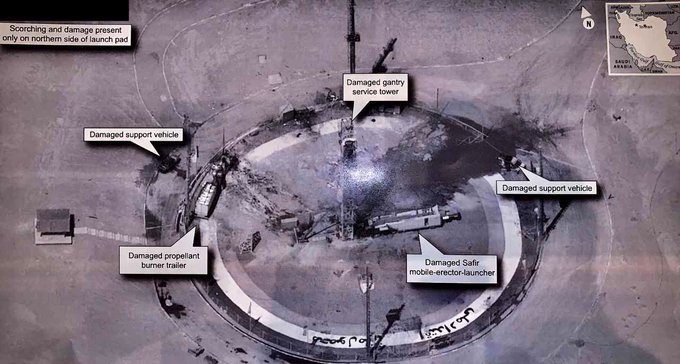
In recent tweet, U.S. President Donald Trump included a smartphone picture of Iran’s Semnan Launch Site One — a location where U.S. authorities believe a rocket failure took place.
Donald J. Trump✔@realDonaldTrump
The United States of America was not involved in the catastrophic accident during final launch preparations for the Safir SLV Launch at Semnan Launch Site One in Iran. I wish Iran best wishes and good luck in determining what happened at Site One.
But astronomy experts managed to glean much more from the simple image. By analyzing the angle at which the image was taken, they apparently figured out which spy satellite took it and when.
Dutch astronomer and asteroid tracker Marco Langbroek suggests the image could’ve been taken by USA 224 — an extremely secretive recon satellite which cost around two billion dollars — a day before Trump tweeted the image.
I measured the semi-major and semi-minor axes of the ellipse (the obliguely viewed circular platform). The viewing angle is then derived by minor=major*cos(angle) --> so find the matching angle. That yielded nominal 43.97 deg. That value matches 09:44:23 UT and azimuth 194.7.
Dr Marco Langbroek@Marco_Langbroek
So the position of the satellite at 09:44:23 was taken, and in STK I let the viewq from the satellite point towards the launch platform. That yielded this. It is a very good match so there is no doubt in my mind that it is an image taken by USA 224.
The suspected KH-11-type optical imaging satellite launched in 2011, but has been visible to amateur astronomers and trackers since then.
“They’re super bright in the sky and are easy to find,” Michael Thompson, a graduate student in astrodynamics at Purdue University, told NPR.
Oh Doubt
But the extremely high resolution of the image has some astronomers puzzled. Calculations put the resolution at an estimated 10 centimeters per pixel, while the newest commercial satellites take images at only 30, according to Quartz.
“The level of detail in the image is incredible,” wrote Langbroek in a blog post. “These are high resolution optical satellites that resemble the Hubble Space Telescope, but look down to Earth instead of to the heavens.”
New Delhi: A huge asteroid will eventually hit humanity and there will be no way out, SpaceX CEO Elon Musk has predicted. A monster asteroid called Apophis, named after an Egyptian “God of Chaos”, will come dangerously close to the Earth, about 19,000 miles (31,000 km) above the surface.
“Great name! Wouldn’t worry about this particular one, but a big rock will hit Earth eventually & we currently have no defence,” Musk tweeted late on Monday. On April 13, 2029, a speck of light will streak across the sky, getting brighter and faster.
At one point it will travel more than the width of the full Moon within a minute and it will get as bright as stars. But it won’t be a satellite or an aeroplane — it will be a 1,100-foot-wide, near-Earth asteroid called “Apophis” that will potentially cruise harmlessly by Earth.
“The Apophis close approach in 2029 will be an incredible opportunity for science,” said Marina Brozovic, a radar scientist at NASA’s Jet Propulsion Laboratory (JPL) in Pasadena, California, who works on radar observations of near-Earth objects (NEOs).
“We’ll observe the asteroid with both optical and radar telescopes. With radar observations, we might be able to see surface details that are only a few meters in size,” she added.
It’s rare for an asteroid of this size to pass by the Earth so close. Although scientists have spotted small asteroids, on the order of 5-10 meters, flying by Earth at a similar distance, asteroids the size of Apophis are far fewer in number and so do not pass this close to Earth as often.
The asteroid, looking like a moving star-like point of light, will first become visible to the naked eye in the night sky over the Southern Hemisphere, flying above Earth from the east coast to the west coast of Australia.
It will then cross the Indian Ocean, and by the afternoon in the eastern US, it will have crossed the equator, still moving west, above Africa. “Current calculations show that Apophis still has a small chance of impacting Earth, less than 1 in 100,000 many decades from now, but future measurements of its position can be expected to rule out any possible impacts,” said NASA recently.
Apophis is a representative of about 2,000 currently known Potentially Hazardous Asteroids (PHAs). “It is possible that there will be some surface changes, like small avalanches,” Davide Farnocchia, an astronomer at JPL, said in the blog post.
DIERENDe massa-extinctie aan het eind van het Krijt - 65 miljoen jaar geleden - ging de wetenschapsboeken in als het uitsterven van de dinosauriërs en is daarom de bekendste. Maar nog veel vroeger vond er ook al een massa-uitsterving plaats, die veel groter was. Twee miljard jaar geleden stierf tot 99,5 procent van alle leven op aarde, zo blijkt uit een nieuwe studie gepubliceerd in PNAS.
Het internationaal team van wetenschappers onderzocht gesteenten in Hudson Bay in Canada die miljarden jaren geleden zouden zijn gevormd. Ze keken naar bariet, een mineraal dat informatie bevat over hoeveel zuurstof er op dat moment in de atmosfeer was. Zo ontdekten ze dat er 2,05 miljard jaar geleden een zware terugval van leven was. Die viel samen met het einde van de periode van oxidatie (GOE of Great Oxygenation Event), waarbij er eerst een enorme toename van zuurstof was 2,4 miljard jaar geleden, gevolgd door een dramatische dip van het zuurstofniveau.
“Meer dan 100 tot 200 miljoen jaar vóór dit uitstervingsevent was er heel veel leven op de planeet, maar na dit evenement viel een groot deel daarvan weg”, zei co-auteur Peter Crockford aan Newsweek. “Maar in plaats van een herstel, zoals bij recentere massa-uitstervingen, bleef de hoeveelheid leven op de planeet of de grootte van de biosfeer klein gedurende het volgende miljard jaar van de geschiedenis van de aarde - ongeveer van twee miljard tot een miljard jaar geleden.”
Crockford schat dat twee miljard jaar geleden tussen de 80 en 99,5 procent van het leven op onze planeet stierf. Ter vergelijking: bij de massa-uitsterving van de dinosauriërs verdween ongeveer driekwart van het leven op aarde, terwijl de Great Dying-gebeurtenis of Perm-Trias-massa-extinctie - de grootste bekende massa-uitsterving ooit - de ondergang betekende van ongeveer 70 procent van alle aardse leven en 96 procent van het zeeleven.
Crockford vindt overigens het woord ‘uitsterven’ niet geschikt voor het bewuste evenement, “omdat we waarschijnlijk nooit zullen weten welke soorten uitsterven, als dat al het geval was”. Op een blog over het artikel schreef hij: “Maar het lijkt er wel op dat er sowieso een dramatische vermindering van het leven op de planeet was”.
Volgens Crockford kunnen de bevindingen inzicht geven in hoe de aarde in de toekomst zal veranderen. Hij vermoedt ook dat er nog heel wat massa-extincties geweest zijn die we nu nog niet kennen.
ESAIllustratie van het aantal satellieten rond de aarde. Het formaat van de satellieten is hier overigens te groot afgebeeld in verhouding tot de afmetingen van de aardbol.
WETENSCHAP & PLANEETDe Europese ruimtevaartorganisatie ESA heeft gisteren een koerscorrectie uitgevoerd met aardobservatiesatelliet Aeolus. De manoeuvre was nodig om een botsing met een Starlink-satelliet van SpaceX te voorkomen.
Wetenschappers van ESA voerden de correctie met de hand uit. “De manoeuvre vond een halve omloop voor de potentiële botsing plaats”, schreef ESA op Twitter. “Dit was de eerste keer dat we een botsingscorrectie moesten uitvoeren om niet op een ‘megasterrenbeeld’ te botsen.”
ESA Operations✔@esaoperations
For the first time ever, ESA has performed a 'collision avoidance manoeuvre' to protect one of its satellites from colliding with a 'mega constellation'#SpaceTraffic
On Monday, the European Space Agency (ESA) tweeted that it had to perform a “collision avoidance” maneuver to avoid a crash with one of SpaceX’s Starlink satellites.
SpaceX knew about the potential collision, Holger Krag, head of the ESA’s Space Debris Office,told Forbes — but refused to do anything about it and wouldn’t say why.
According to the Forbes story, the U.S. military noticed that one of SpaceX’s Starlink satellites had a 1 in 1,000 chance of colliding with the ESA’s Aeolus Earth observation satellite.
The Pentagon informed both agencies of the potential collision, and although the ESA’s satellite had been occupying the region for nine months longer than the Starlink satellite, SpaceX told the ESA via email that it didn’t plan to take any action to prevent the collision and didn’t offer any explanation as to why.
This prompted the ESA to perform the avoidance maneuver, which it does regularly to avoid collisions with dead satellites or space junk — but rarely to avoid active satellites and never before to prevent a collision with a mega constellation of them. But the fracas raises the possibility that similar maneuvers might become more regular in the future.
While SpaceX’s Starlink mega constellation currently consists of fewer than 60 satellites, it could eventually launch upwards of 12,000 as part of its plan to deliver broadband internet to the entire globe — and that could dramatically increase the risk of collisions.
“We are not upset by them saying [they wouldn’t move],” Krag told Forbes. “My concern is how often will we have such events in the future? These are just two satellites. Now they will add several thousand, and they will also be disposed and end up at various altitudes. And there’s no rule or law on how to react, it’s all goodwill.”
To prepare for a future in which potential Starlink crashes are far more common, the ESA is now exploring the use of artificial intelligence to automate its collision avoidance systems, tweeting that such a system is “becoming necessary to protect our space infrastructure.”
According to Engadget, the Starlink satellites are already equipped with automated collision avoidance systems, so perhaps SpaceX’s decision to do nothing was part of a plan to see if those systems would work as intended, by automatically adjusting the satellite’s path without SpaceX manually intervening.
That could explain why SpaceX didn’t provide the ESA with a reason for its inaction — it’s hard to imagine the agency would’ve been OK with SpaceX risking the ESA’s $560 million satellite in order to test its own AI.
Asteroid warning: Space rock comparable to dinosaur killer is heading Earth’s way
A MASSIVE asteroid comparable to the massive space rock which brought the dinosaurs’ reign on Earth to an end is hurtling towards Earth, and scientists have confirmed it is “potentially hazardous”.
The asteroid known as 1990 MU is currently completing another orbit of the Sun, and in 2027 it could come perilously close to Earth. Asteroid 1990 MU is between 4-9 kilometres in diameter and on June 6 2027, it is set to come within 0.03 AU - astronomical unit. One AU is the distance between the Earth and the Sun, so coming within just 0.03 AU is perilously close.
For reference, Mars – the planet which humans are hoping to reach – is around 0.5 AU.
The asteroid is classed as a potentially hazardous asteroid, which according to NASA has the “potential to make threatening close approaches to the Earth.”
According to data from NASA, 2019 OK was large – an estimated 187 to 427 ft (57 to 130) wide – and hurtling fast along a path bringing it within only 45,000 miles (73,000km) of Earth when it flew by in recent weeks.
This was less than one-fifth of the distance to the Moon and what the Royal Institution of Australia’s Professor Alan Duffy described as “uncomfortably close.”
Asteroid warning: Space rock comparable to dinosaur killer is heading Earth’s way
(Image: GETTY)
An asteroid strike 66 million years ago put an end to the dinosaurs
(Image: GETTY)
That asteroid would have been big enough to wipe out a city, so 1990 MU could be truly devastating.
Asteroid 1990 MU is up to nine kilometres in diameter, which puts it in the same ball-park as the space rock which put an end to the dinosaurs.
That space rock is believed to have been between 10-15 kilometres wide and came crashing into what is now Mexico 66 million years ago marking the beginning of the end of the dinosaurs.
Research from the University of Glasgow has found up to three quarters of life on Earth was wiped out from the asteroid, with the dinosaurs dying out within a few centuries.
The space rock caused a cloud of dust to fill the air which blocked out the sun, leading to drastic and sudden climate change that ultimately created major food shortages across Earth, leading to the death of bigger animals, and allowing smaller creatures, such as mammals, to thrive in their absence.
Now, a comparable asteroid is heading Earth’s way.
While the asteroid will be close within the next decade, it will be even closer in 2058, when it comes within 0.02 AU - less than three million kilometres.
Scientists estimate that a life-ending asteroid, such as the one which put an end to the dinosaur’s reign, would collide with Earth every 100 million years or so.
But asteroids can strike at any moment and there is always a very slim chance a massive civilisation-ending space rock could hit sooner.
For that reason, many claim global authorities should have a plan in place – but it seems they do not.
NASA employee Robert Frost, who works as an instructor and flight controller for the space agency according to his bio on Q+A website Quora, said the best thing governments could do is tell the public to “hunker down”, as there would be little which can be done to prepare for the inevitable.
Mr Frost was writing in response to the question: “If it were discovered that an asteroid was going to wipe humanity out, say in 2 months, how would the governments of the world respond?”
The value of asteroids
(Image: EXPRESS)
He said: “That’s a tough one. Movies tell us they would keep it secret. There’s a lot of sense to that. Mass panic can be more dangerous than the actual event.
“But my experience working in government is that the government really isn’t good at keeping anything secret unless it begins within a secretive part of the culture, like the military.
“Something like this would likely be first discovered by someone that couldn’t spell ‘security clearance’. It would be evident to astronomers all over the world.
“Feeling helpless, the government would likely just tell us to ‘hunker down’ and duct tape our window seams.
“Then the Democrats would blame it on the Republicans for ignoring global warming and the Republicans would blame it on the Democrats for not praying in school.”
Asteroid Alert: NASA, ESA To Team Up To Save Humans By Crashing Spaceship Into THIS Massive Space Rock
These days a large number of asteroids are hovering all around the Earth and we might get hit too sooner or later. However, in a bid to save our planet and humans as well, NASA is stepping-up plans to deliberately crash a spaceship into an asteroid when it joins forces with the European Space Agency (ESA) next week.
NASA & asteroids
(File Photo)
HIGHLIGHTS
Asteroids are small, rocky objects that orbit the Sun.
Space rocks can bring tsunamis, shock waves and flattening winds that could be catastrophic.
NASA and ESA are stepping-up plans to deliberately crash a spaceship into an asteroid.
Asteroids approach towards the Earthdue to the gravitational forces that affect them. Asteroids are small, rocky objects that orbit the Sun and these space rocks can bring tsunamis, shock waves and flattening winds that could be catastrophic. It is said that Earth will reach to its end one day and one of the possible reason for this could be an asteroid. No one knows what our future will be. These days a large number of asteroids are hovering all around the Earth and we might get hit too sooner or later. However, in a bid to save our planet and humans as well, NASA is stepping-up plans to deliberately crash a spaceship into anasteroid when it joins forces with the European Space Agency (ESA) next week.
According to a report published by Daily Star, scientists from NASA and ESA have planned to test whether it is possible to deflect the orbit of potentially-deadly asteroids. It is worth mentioning here that the mission will launch in 2022 and involves two spacecraft, one to smash into the space rock and the other to measure the results of the collision.
Experts will meet in Italy to fine-tune the plan. So far, it involves crashing NASA spacecraft DART — or Double Asteroid Impact Test — into the asteroid. Then ESA's Hera will survey DART's crash site and analyse the direction of the asteroid's new path, Daily Star reported.
Queen guitarist and astrophysicist Brian May explained how the mission would be conducted using the might of NASA, the European Space Agency (ESA) and other asteroid specialists.
“HERA is going to show us no one has ever seen before. This ESA mission will be humanities first-ever spacecraft to visit a double asteroid, Didymos. “This asteroid is typical of the thousands that pose an impact risk to our planet.” express.co.uk quoted Brian May as saying.
“Imagine a mountain in the sky with another rock about the size of the great pyramid swinging around it, that is Didymos. Just the seemingly tiny moon would be big enough to destroy a city if it were to collide with the Earth. But we are going to find out if it is possible to deflect it,” Brian May added.
He further said, “HERA is led by a multinational team of scientists and engineers. Right now all we have is many years and theories but HERA will revolutionise our understanding of asteroids and how to protect ourselves from them. Then ESA comes in, HERA will map the impact crater left by DART and measure the mass of the asteroid.”
“Knowing this mass is key to determining what is inside and knowing for certain whether we would be able to deflect it. Next come our briefcase-sized CubeSats, if you think of HERA like an aeroplane, cubists will operate more like drones,” Brian concluded.
According to a report published by spacetelescope.org, there are more than 7 lakh asteroids that have been found in space. Asteroids are mainly found in an area called the ‘main belt’, between the orbits of Mars and Jupiter.
A portion of a trail near the Hockomock Swamp in Easton.(MASS DOT)
Some residents of what’s been called “America’s Bermuda Triangle” have poked fun at the mention of paranormal activity or monster sightings in their South Shore communities.
Others have gone on record and sworn by what they’ve witnessed or encountered, be it strange lights in the sky, hairy creatures in the swamp, or a spirit in disheveled clothes lingering on the side of the road and waiting to hitch a ride.
While people’s opinions vary about the unexplained phenomena, on this they seem to agree: News that a major network could be making a series based on the legends of “The Bridgewater Triangle” — an approximately 200-square-mile region of Southeastern Massachusetts that has long been linked to the supernatural and macabre — is exciting, to say the least.
In an exclusive last week, Deadline.com reported that FX has acquired a short story titled “The Bridgewater Triangle” and plans to develop it into a television show.
Details are as thin as a spectral being for now. But Noah Hawley, the force behind the television series “Fargo,” and his company 26 Keys Productions, are reportedly executive producing what’s being described as an “apocalyptic horror thriller.”
The show would center on three siblings who must unite and confront a confluence of paranormal events, Deadline.com reported.
A spokesperson for FX confirmed in an e-mail to the Globe that the information in the Deadline story is correct but said the network has “no further information at this time.”
“The Bridgewater Triangle” refers to an area bordered by the points of Abington, Freetown, and Rehoboth. More than a dozen other municipalities fall within its mystical bounds.
The name for the uncanny zone was first coined by famed cryptozoologist Loren Coleman more than 40 years ago and is a play on the mysterious section of the Atlantic Ocean where boats and airplanes have reportedly vanished, known as the Bermuda Triangle.
Coleman, founder and director of the International Cryptozoology Museum, in Portland, Maine, said while going to school full time in the 1970s, he began investigating “creature reports” from the area.
He later mapped out where the strange activities had been reported. Eventually, he connected the dots and realized all of the alleged sightings — UFOs, birdlike creatures, large snakes, man-beasts — were entrapped by the space.
“It was very obviously a triangle,” Coleman said. “I was just putting all of the pieces of data together, and that’s why I came up with the word ‘Bridgewater Triangle,’ just to give a handle to people that want to read about it, or wanted to talk about it.”
The name later appeared more officially in his 1983 book, “Mysterious America.”
The Hockomock Swamp, part of a network of wetlands, creeks, rivers, and ponds that span thousands of acres, is perhaps the most infamous part of the triangle.
According to Globe archives, the Wampanoag tribe gave the spot, which falls within Bridgewater, Easton, Norton, Raynham, Taunton, and West Bridgewater, its name, meaning “place where spirits dwell.”
The habitat has been called the “beating heart” of the triangle and is rich with history. According to the Massachusetts Historical Commission, “the archaeological sites in the vicinity of this wetland complex are known to span a period of 9,000 years.”
Stories about Hockomock’s “inhabitants” have thrived for generations and include sightings of “vicious, giant dogs with red eyes seen ravenously sinking their fangs into the throats of ponies; a flying creature that resembled a pterodactyl, the dinosaur that could fly; Native-American ghosts paddling canoes; and glowing somethings hovering above the trees,” the Globe reported in a 2005 story about the swamp.
Reports of a Bigfoot-like creature wandering the thickets and brambles have also been a constant theme throughout the years.
The announcement that a show will probably cast a spotlight on the Bridgewater Triangle has people who live within it — as well as those who have spent time researching or exploring it — looking forward to seeing how its myths and legends could come alive on the small screen.
“I’ve certainly heard about the FX show,” Marilee Kenney Hunt, Bridgewater’s town clerk, said in an e-mail to the Globe, “and shared the news with family members across the country.”
In a private Facebook group called “Bridgewater Residents,” which boasts 18,000 members, people expressed interest in being part of the project if filming takes place in the state.
“If ANYONE sees a casting call for this, PLEASE let me know,” one person wrote on the page recently.
Another said, “Put me in coach.”
When a Globe reporter posted in the group, asking whether there’s talk in town about the series, more than 100 comments followed, with a handful of people offering to tell their own stories.
Filmmaker Aaron Cadieux, who wrote and codirected a 2013 documentary with local actor Manny Famolarecalled “The Bridgewater Triangle,” said he’s hopeful about the series.
“This will raise the national profile of the Bridgewater Triangle,” he said in a telephone interview. “We were surprised, but very pleasantly surprised [by the news].”
While the duo’s 90-minute film has no direct affiliation with the story FX apparently acquired, Cadieux offered up their expertise on the subject matter, if needed.
“We would be happy to talk to them or consult with them in any way that we can. It’s just exciting,” he said. “Selfishly, I hope people will find their way to our documentary.”
Coleman, the cryptozoologist, said he hasn’t been in contact with FX either, but he’d also be willing to talk about his ties to the region and the title he coined.
“That would be fun,” he said. “It’s something that if they do a good job writing it or acting in it, I’d watch it — because I came up with the name.”
Tv-serie in de maak over ‘Amerikaanse Bermudadriehoek’. Dit is een ware hotspot van paranormale activiteit
In het zuidoosten van de Amerikaanse staat Massachusetts vinden al jaren vele vreemde gebeurtenissen plaats.
Soms wordt dit gebied ook wel de ‘Amerikaanse Bermudadriehoek’ genoemd, waarbij Abington, Rehoboth en Freetown de drie punten van de driehoek vormen.
Er zijn talloze gevallen van onverklaarbare, paranormale fenomenen gemeld.
UFO-meldingen
Zo zijn er mensen die Bigfoot, enorme slangen en zelfs prehistorische reptielen hebben gezien in het gebied.
De regio staat ook bekend om de vele UFO-meldingen. Ook worden er lichtbollen gezien.
Verder waren er naar verluidt geesten rond en zijn er gevallen van veeverminking gemeld.
Sinistere praktijken
Bovendien wordt het gebied in verband gebracht met rituele moorden, dieroffers en andere sinistere praktijken.
Momenteel wordt er gewerkt aan een tv-serie over deze zogeheten Bridgewater Triangle. De serie zou gemaakt worden door Noah Hawley, bekend van de serie Fargo.
Onder de aandacht
“Hierdoor zal de Bridgewater Triangle eens goed onder de aandacht worden gebracht,” zei filmmaker Aaron Cadieux, die eerder een documentaire over de regio maakte.
From Gaia “Randy Cramer’s life experiences are either incredible or absurd. He reports that he spent 20 years as a Marine in the U.S. Secret Space Program (SSP). His tour of duty took him first to an elaborate, secret, fully-equipped base on the moon.
Then, he went to Mars where he spent 17 years at a military base. After a major loss of human lives during a battle between the military forces and native people of Mars, he was deployed back to the moon where he spent his final three years as a military pilot.
He tells his story with vivid and captivating detail. Randy Cramer: Space Traveler and Mars Colonist Randy Cramer, who initially told his story under the pseudonym “Captain Kaye,” says he was only four years old when he began training for the SSP through a program called Project Moon Shadow.
He was one of approximately 300 girls and boys who were “covertly drafted” to participate in the program. Girls comprised only 20 percent of the group, a male/female ratio that remained consistent during his entire 20 years with the SSP. Cramer recalls that during his childhood, he would be taken from his bed at night.
Even though he would be gone for days or even weeks, he would be returned to his bed and travel back in time to when he was taken. He would wake up as though no time had passed, feeling like he had just had a really, really long dream.”
Meer van UFO'S of UAP'S, ASTRONOMIE, RUIMTEVAART, ARCHEOLOGIE, OUDHEIDKUNDE, SF-SNUFJES EN ANDERE ESOTERISCHE WETENSCHAPPEN - DE ALLERLAATSTE NIEUWTJES


 Two Black UFOs Found Landed In Craters On Mars, UFO Sighting News.