Ontdek de Fascinerende Wereld van UFO's en UAP's: Jouw Bron voor Onthullende Informatie!
Ben jij ook gefascineerd door het onbekende? Wil je meer weten over UFO's en UAP's, niet alleen in België, maar over de hele wereld? Dan ben je op de juiste plek!
België: Het Kloppend Hart van UFO-onderzoek
In België is BUFON (Belgisch UFO-Netwerk) dé autoriteit op het gebied van UFO-onderzoek. Voor betrouwbare en objectieve informatie over deze intrigerende fenomenen, bezoek je zeker onze Facebook-pagina en deze blog. Maar dat is nog niet alles! Ontdek ook het Belgisch UFO-meldpunt en Caelestia, twee organisaties die diepgaand onderzoek verrichten, al zijn ze soms kritisch of sceptisch.
Nederland: Een Schat aan Informatie
Voor onze Nederlandse buren is er de schitterende website www.ufowijzer.nl, beheerd door Paul Harmans. Deze site biedt een schat aan informatie en artikelen die je niet wilt missen!
Internationaal: MUFON - De Wereldwijde Autoriteit
Neem ook een kijkje bij MUFON (Mutual UFO Network Inc.), een gerenommeerde Amerikaanse UFO-vereniging met afdelingen in de VS en wereldwijd. MUFON is toegewijd aan de wetenschappelijke en analytische studie van het UFO-fenomeen, en hun maandelijkse tijdschrift, The MUFON UFO-Journal, is een must-read voor elke UFO-enthousiasteling. Bezoek hun website op www.mufon.com voor meer informatie.
Samenwerking en Toekomstvisie
Sinds 1 februari 2020 is Pieter niet alleen ex-president van BUFON, maar ook de voormalige nationale directeur van MUFON in Vlaanderen en Nederland. Dit creëert een sterke samenwerking met de Franse MUFON Reseau MUFON/EUROP, wat ons in staat stelt om nog meer waardevolle inzichten te delen.
Let op: Nepprofielen en Nieuwe Groeperingen
Pas op voor een nieuwe groepering die zich ook BUFON noemt, maar geen enkele connectie heeft met onze gevestigde organisatie. Hoewel zij de naam geregistreerd hebben, kunnen ze het rijke verleden en de expertise van onze groep niet evenaren. We wensen hen veel succes, maar we blijven de autoriteit in UFO-onderzoek!
Blijf Op De Hoogte!
Wil jij de laatste nieuwtjes over UFO's, ruimtevaart, archeologie, en meer? Volg ons dan en duik samen met ons in de fascinerende wereld van het onbekende! Sluit je aan bij de gemeenschap van nieuwsgierige geesten die net als jij verlangen naar antwoorden en avonturen in de sterren!
Heb je vragen of wil je meer weten? Aarzel dan niet om contact met ons op te nemen! Samen ontrafelen we het mysterie van de lucht en daarbuiten.
Zondag 22 september 2019
Inner Earth Civilizations Exist: the Science and Evidence of Habitable Underground Civilizations
Inner Earth Civilizations Exist: the Science and Evidence of Habitable Underground Civilizations
Stillness in the Storm Editor: Why did we post this?
The preceding information discusses a scientific discovery that might provide evidence for the existence of large caverns within the earth capable of human habitation. Several alleged insiders and whistleblowers claimed that there are indeed advanced civilizations below the surface of the earth. While concrete evidence of such locations have yet to emerge, the preceding article offers evidence for existence of the so-called inner earth. The fact that this question of inner earth remains difficult to confirm means it is an excellent tool for exercising the discerning mind, which is an essential skill for the development of a truly wise and sovereign individual.
Venus Could Have Supported Life for Billions of Years
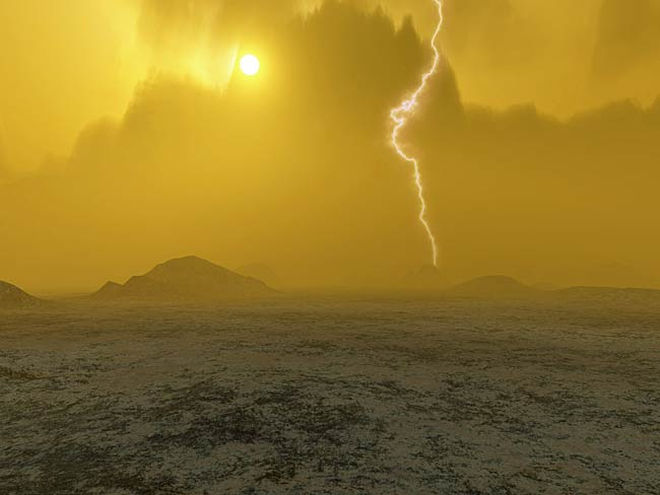
In 1978, NASA’sPioneer Venus (aka. Pioneer 12) mission reached Venus (“Earth’s Sister”) and found indications that Venus may have once had oceans on its surface. Since then, several missions have been sent to Venus and gathered data on its surface and atmosphere. From this, a picture has emerged of how Venus made the transition from being an “Earth-like” planet to the hot and hellish place it is today.
It all started about 700 million years ago when a massive resurfacing event triggered a runaway Greenhouse Effect that caused Venus’s atmosphere to become incredibly dense and hot. This means that for 2 to 3 billion years after Venus formed, the planet could have maintained a habitable environment. According to a recent study, that would have been long enough for life to have emerged on “Earth’s Sister”.
The study was presented yesterday (Sept. 20th) at the 2019 Joint Meeting of the European Planetary Science Congress (EPSC-DPS), which took place from Sept. 15th to 20th in Geneva, Switzerland. It was here that Michael Way and Anthony Del Genio of the NASA Goddard Institute for Space Science (GISS) shared a new take on Venus’s climatic history, which could have implications in the search for habitable exoplanets.
For the sake of their study, Dr. Way and Dr. Del Genio created a series of five simulations that considered what the environment of Venus would be like based on different levels of water coverage. This consisted of adapting a 3D general circulation model that took into account changing atmospheric compositions and the gradual increase in solar radiation as the Sun became warmer over the course of its lifetime.
In three of the five scenarios, Way and Del Genio assumed that the topography of Venus was much as the same as it is today, the ocean ranged from a minimum depth of 10 m (~30 ft) to a maximum of about 310 m (~1000 ft) and a small amount of water was locked in the soil. They also considered a scenario with Earth’s topography and a 310-meter ocean, and another where Venus was entirely covered in an ocean 158 m (~500ft).
In the end, all five simulations indicated the same thing: that Venus would have been able to maintain stable temperatures – from a low of 20 °C (68 °F) to a high of 50 °C (122 °F) – for about three billion years. Were it not for a series of event that caused 80% of the planet’s surface to be resurfaced (which led to the outgassing of CO² contained within the crust), it might even be habitable today. As Way explained it:
“Our hypothesis is that Venus may have had a stable climate for billions of years. It is possible that the near-global resurfacing event is responsible for its transformation from an Earth-like climate to the hellish hot-house we see today.
A land-ocean pattern like that above was used in a climate model to show how storm clouds could have shielded ancient Venus from strong sunlight and made the planet habitable. Credits: NASA
It all started about 4.2 billion years ago, a few hundred million years after Venus formed and had just finished a period of rapid cooling. At this point, assuming Venus underwent a similar process as Earth, it’s atmosphere would have been dominated by carbon dioxide. This would have slowly been absorbed by silicate rocks to form carbonates that were then locked into the planet’s crust.
By about 715 million years ago, according to Way and Del Genio’s study, the atmosphere would have been similar to what Earth’s is like today – composed predominantly of nitrogen gas with trace amounts of CO² and methane. These conditions could have remained stable up until present times were it not for a massive outgassing event.
The cause of this remains a mystery; however, scientists believe it was due to a geological event that caused 80% of the planet to resurface. This could have involved large amounts of magma bubbling up and releasing massive amounts of CO² into the atmosphere. The magma would have then solidified before reaching the surface, thus creating a barrier that prevented the CO² from being reabsorbed. As Way explained:
“Something happened on Venus where a huge amount of gas was released into the atmosphere and couldn’t be re-absorbed by the rocks. On Earth we have some examples of large-scale outgassing, for instance the creation of the Siberian Traps 500 million years ago which is linked to a mass extinction, but nothing on this scale. It completely transformed Venus.”
Artist’s conception of a terraformed Venus, showing a surface largely covered in oceans. Credit: Wikipedia Commons/Ittiz
This would explain how Venus’ atmosphere was thickened to the point where it was over 90 times as dense as Earth’s (92 bar compared to 1 bar). Combined with the high concentrations of CO², this would have led to a runaway Greenhouse Effect that would explain how the planet became the hellish place we know today, where surface temperatures average 462 °C (864 °F).
This flies in the face of conventional notions of habitability, which state that Venus’ orbit places it beyond the inner edge of our Sun’s habitable zone (HZ). Within this “Venus Zone”, according to conventional wisdom, a planet absorbs too much solar radiation to ever be able to maintain liquid water on its surface. But as Way indicated, their simulations all indicated otherwise:
“Venus currently has almost twice the solar radiation that we have at Earth. However, in all the scenarios we have modelled, we have found that Venus could still support surface temperatures amenable for liquid water.”
These findings are in line with a similar study that Way and Del Genio conducted in 2016 with colleagues from the NASA Goddard Space Flight Center, the Planetary Science Institute (PSI), Uppsala University and Columbia University. For this study, their team created a suite of 3D climate simulations using data from the Magellan mission that examined how the presence of an ocean on ancient Venus would affect its habitability.
From this, they determined that if Venus had a rotational period slower than about 16 Earth days, its climate would have remained habitable until 715 million years ago. However, there are still two major unknowns that need to be addressed before scientists can say with confidence that Venus was habitable until very recently.
The planet Venus, as imaged by the Magellan 10 mission. Credit: NASA/JPL
First, scientists will need to determine how quickly Venus cooled and if it was able to condense liquid water on its surface in the first place. Second, it remains unknown whether the global resurfacing event that led to Venus’ transition was a single event or merely part of a series that had been taking place for billions of years.
“We need more missions to study Venus and get a more detailed understanding of its history and evolution,” said Way. “However, our models show that there is a real possibility that Venus could have been habitable and radically different from the Venus we see today. This opens up all kinds of implications for exoplanets found in what is called the ‘Venus Zone’, which may in fact host liquid water and temperate climates.”
Think of it… had Venus not undergone a massive resurfacing event (or a series of them), humanity would have only needed to look next-door for proof of extra-terrestrial life. For that matter, had Mars not lost its magnetosphere 4.2 billion years ago, it could have produced life of its own that would still be around today. Our one Solar System could have had not one, but three life-bearing planets (neighboring at that)!
These findings are likely to be encouraging for those who believe that Venus should be terraformed someday. Knowing that the planet once had a stable climate, and could maintain it despite its orbit, effectively means that any ecological engineering we do there would stick.
That means that Venus could someday be made into a balmy world that’s mostly covered with oceans with few large continents and extensive archipelagos. Sound like any pl }ace you know?
This beautiful view from ESA’s Mars Express stretches from the bright, cloud-covered north pole of Mars to the contrasting hues of the northern hemisphere and the cratered terrain in the south.
Mars Express has been orbiting Mars since 2003. The spacecraft has sent back myriad breathtaking images of our planetary neighbour in the past decade and a half, captured by the probe’s on-board High Resolution Stereo Camera – and this image is no different.
The spacecraft imaged this slice across the planet’s surface in June 2019, when the camera took several global views. Visible at the top of the frame is Mars’ ethereal north pole: this is permanently covered by a cap of frozen water and carbon dioxide, which thickens in the northern martian winter and thins in the summer.
The northern polar cap is seen here encircled by bright, eye-catching clouds, tendrils of which snake downwards from the polar region to obscure some of the planet’s northern hemisphere. As this image shows, this patch of Mars is a mix of different tones and colours – a reflection of the different chemical and physical characteristics of the material that makes up the surface. Mars’ two hemispheres are very different in a number of ways.
Most notably, the northern hemisphere sits several kilometres lower than the southern, and the two are separated by a distinctive, rugged boundary formed of canyons, cliffs and scarps, fractures, valleys, flat-topped mounds known as mesas, and many other features. The northern hemisphere is also characterised by low-lying plains that are largely unmarked by impact craters and thus thought to be relatively young, while the southern hemisphere is ancient, showing signs of intense cratering.
This separation can be seen here, and is shown especially clearly in the accompanying topographic context map.
The dark and dusty young plains of the northern hemisphere sit just below the white northern cap; these meet and merge with a prominent escarpment that slices across the planet, creating a dark scar on the tan-coloured surface. Below this, in tones ranging from rusty orange to pale butterscotch, are the southern highlands, featuring more craters than it is possible to count.
Topographic context
Two main regions are shown here: Arabia Terra (towards the upper left) and Terra Sabaea (to the middle and lower right, forming the main bulk of the highlands visible in this slice).
The light region stretching out of frame to the bottom right is Hellas Planitia, a plain that is home to the Hellas basin: one of the largest basins identified on Mars – and, in fact, in the Solar System – at 2300 km across.
The split between Mars’ two hemispheres is known as the martian dichotomy, and remains one of the greatest mysteries about the planet.
Was it formed due to geological processes within Mars’ mantle? Did the planet’s crust once comprise various moving tectonic plates, as we see on Earth, that pushed against one another to form the dichotomy? Could it have been created by one or more colossal past impacts – or by another process entirely?
Terra Sabaea and Arabia Terra in context
Observations of the boundary zone between the two hemispheres show that this region has been altered over time by wind and water, including by glaciers. Mars is thought to have seen various bursts of glacial activity over the years, where deposits of ice – sometimes hidden beneath layers of soil or dust – form viscous flows that slowly move across the surface, altering it as they go.
Mars Express was recently joined at Mars by the ESA-Roscosmos ExoMars Trace Gas Orbiter (TGO), which arrived in 2016 and has since been analysing the martian atmosphere and mapping the planet’s surface. Mars Express and the TGO will soon welcome the ExoMars Rosalind Franklin rover and its accompanying surface science platform, which are scheduled for launch in July of 2020.
This growing fleet will continue ESA’s long-standing presence at Mars, and further our understanding of the planet and its many remaining scientific mysteries – including the martian dichotomy.
An amateur astronomer says our solar system may have another visitor from deep space.
According to an announcement from the Minor Planet Center, an object spotted at the end of August by amateur astronomer, Gennady Borisov, in Crimea, is likely the second known interstellar object to make a pit stop in our corner of the galaxy.
Astronomers say the object, preliminarily dubbed C/2019 Q4, appears to be a comet given what they have identified as a tail streaking behind the interstellar visitor while it moves through space.
Estimates on C/2019 Q4 project that the object could remain within our solar system for between six months to a full year, meaning astronomers may be able to get a particularly good look at its features, on its brightness
On Thursday, the center released an official 'circular' -- a document detailing information on the object's orbit -- which highlighted the apparent comet's eccentric pattern.
'Based on the available observations, the orbit solution for this object has converged to the hyperbolic elements shown below, which would indicate an interstellar origin.' reads document.
While that hyperbolic pattern -- which differs from the elliptical shape of objects in our solar system -- shows that the object will likely leave our solar system for good, it also portends a longer stay and much more in-depth look than previous interstellar travelers.
Estimates on C/2019 Q4 project that the object could remain within our solar system for between six months to a full year, meaning astronomers may be able to get a particularly good look at its features, on its brightness.
On Thursday, the center released an official 'circular' -- a document detailing information on the object's orbit -- which highlighted the apparent comet's eccentric pattern. The faint object is circled above
'We don’t know how bright it’s going to be. That’s always an issue with comets, so you’ve got that unpredictability, combined with the fact that it is interstellar. And this is the first interstellar comet we’ve seen,' astronomy-software developer Bill Gray, told Forbes.
Previously, astronomers identified an asteroid-like rock known as Oumuamua, the first known interstellar object to pass through our solar system.
The mysterious cigar-shaped projectile, formally named object 1I/2017 U1, resembles both a comet and an asteroid, however, it doesn't conform to many of the other defining features usually associated with these objects, including its direction of spin and lack of a tail.
Previously, astronomers identified an asteroid-like rock known as Oumuamua, the first known interstellar object to pass through our solar system. An artist's impression of Oumuamua is pictured
Conversely, when astronomers spotted Oumuamua, they had just three weeks to observe it before it left our solar system.
Professional stargazer Robert Weryk first spotted the interstellar traveler in October, 2017 at the University of Hawaii's Haleakala Observatory.
Researchers had just weeks to collect as much data as possible before the strange visitor traveled beyond the reach of Earth's telescopes.
The object is now out of sight but could take up to 20,000 years before it leaves our solar system onto its next destination.
Interstellar objects like the ones recently discovered are particularly exciting for astronomers since they offer a rare, glimpse of what other parts of the galaxy may look like.
Astronomers will now be able to compare their findings on Oumuamua with the most recent specimen.
WHAT IS 'OUMUAMUA AND WHAT DO WE KNOW ABOUT IT?
A cigar-shaped asteroid named 'Oumuamua sailed past Earth at 97,200mph (156,428km/h) in October.
It was first spotted by a telescope in Hawaii on 19 October, and was observed 34 separate times in the following week.
It is named after the Hawaiian term for 'scout' or 'messenger' and passed the Earth at about 85 times the distance to the moon.
It was the first interstellar object seen in the solar system, and it baffled astronomers.
Initially, it was thought the object could be a comet.
However, it displays none of the classic behaviour expected of comets, such as a dusty, water-ice particle tail.
The asteroid is up to one-quarter mile (400 meters) long and highly-elongated - perhaps 10 times as long as it is wide.
That aspect ratio is greater than that of any asteroid or asteroid observed in our solar system to date.
But the asteroid's slightly red hue — specifically pale pink — and varying brightness are remarkably similar to objects in our own solar system.
Around the size of the Gherkin skyscraper in London, some astronomers were convinced it was piloted by aliens due to the vast distance the object traveled without being destroyed – and the closeness of its journey past the Earth.
Alien hunters at SETI – the Search for Extra-terrestrial Intelligence based at Berkeley University, California said there was a possibility the rock was ‘an alien artefact’.
But scientists from Queen’s University Belfast took a good look at the object and said it appears to be an asteroid, or ‘planetesimal’ as originally thought.
Researchers believe the cigar-shaped asteroid had a 'violent past', after looking at the light bouncing off its surface.
They aren't exactly sure when the violent collision took place, but they believe the lonely asteroid's tumbling will continue for at least a billion years.
A mysterious star whose repeated bouts of darkening might be due to "alien megastructures," according to some researchers' conjectures, may now have more than a dozen counterparts that display similarly mystifying behavior, a new study finds.
Further research into all of these stars might help solve the puzzle of their bewildering flickering, the study's author said.
In 2015, scientists noticed unusual fluctuations in the light from a star named KIC 8462852. This otherwise-normal F-type star, which is slightly larger and hotter than Earth's sun, sits about 1,480 light-years from Earth, in the constellation Cygnus.
When the researchers analyzed data from NASA's Kepler space telescope, astronomer Tabetha "Tabby" Boyajian, then at Yale University, and her colleagues found dozens of odd instances of KIC 8462852 dimming by up to 22%, with such dips lasting anywhere from a few days to a week. These events did not appear to follow any pattern and seemed far too substantial to be caused by planets or dust crossing the star's face.
These analyses of KIC 8462852 — now nicknamed "Boyajian's star" (formerly Tabby's star) after its discoverer — raised the possibility that astronomers had detected signs of intelligent alien life. Specifically, researchers have suggested that the star is surrounded by a Dyson sphere, a hypothetical megastructure that is built around a star to capture as much of its light as possible. Mathematician and physicist Freeman Dyson suggested that such megastructures could help power an advanced civilization. (Science fiction often depicts Dyson spheres as solid shells around stars, but the megastructures also could be globular swarms of giant solar panels.)
The megastructure hypothesis is near the bottom of most astronomers' lists these days when it comes to Boyajian's star, however; further analyses have pointed to more prosaic explanations, such as clouds of dust or comet fragments. Still, scientists have not yet nailed down the precise cause of the odd dimming. The answer remains elusive in part because Boyajian's star seemed unique; there were no known counterparts to provide additional clues that might help researchers solve this cosmic mystery.
Now, study author Edward Schmidt, an astrophysicist at the University of Nebraska-Lincoln, suggests that he may have discovered more than a dozen stars like Boyajian's star.
Schmidt looked for counterparts of Boyajian's star using software that searched for analogous dimming events from about 14 million objects with varying brightness monitored in the Northern Sky Variable Survey from April 1999 to March 2000. He then followed up on promising candidates by examining their long-term behavior, using data from the All-Sky Automated Survey for Supernovae, ruling out sources whose dimming could be caused by conventional explanations such as an eclipsing companion star or some intrinsic variability in brightness.
Schmidt identified 21 stars that showed possibly unusual dimming. These fell into two distinct categories: 15 were "slow dippers" that dimmed at rates similar to Boyajian's star, and six were "rapid dippers" that showed even more extreme variability in their dimming rates.
"The thing that surprised me the most were these stars that had so many dips, the ones I called 'rapid dippers,'" Schmidt told Space.com. "I expected more occasional dips like Boyajian's star."
Further analysis using data from the European Space Agency's Gaia space observatory found that these potential dippers tended to be either conventional "main-sequence" stars with about the same mass as the sun or red giant stars with about twice the sun's mass. The slow and rapid dippers are seen in both groups, which may suggest that they represent varying degrees of the same mechanism, Schmidt said.
Schmidt noted that the Northern Sky Variable Survey he searched for potential counterparts of Boyajian's star did not contain records of Boyajian's star itself darkening during the year of data in that catalog. This highlights how astronomers may easily miss stars that can darken in this manner if they look only at catalogs that monitor stars for relatively short intervals of time.
"We're obviously missing some of these stars because of the catalogs we have," Schmidt said. "By looking at more catalogs, we may get a better picture of what's going on, even though it won't be a complete picture."
Future research that combs through more catalogs of stellar activity may turn up even more analogues of Boyajian's star, he said.
"I intend to try and follow up on the rapid dippers," Schmidt said. "One thing I noticed about them is that at least one seemed to be slowing way down in its dipping rate over the five years of coverage we have of it. It'd be interesting to find out what happened in its past, which may help give a better idea of what's going on with these stars."
Schmidt detailed his findings July 18 in The Astrophysical Journal Letters.
Bigelow Aerospace publishes video what looks like an Orb and a Being inside a sealed room
On September 20, 2019 Bigelow Aerospace posted a strange video on their Twitter account showing a floating Orb and probably 'something' else and it's entitled "our small contribution"
When asked what the video is about, they responded "It is an orb recorded in a highly secure Bigelow Aerospace facility in Las Vegas. Absolutely nothing could get in or out of that particular structure but yet, something did…”
But something strange is going on with this video recorded in Bigelow's research and development facility in Las Vegas which is said to be the location for the storage of metal alloys and other materials recovered from unidentified aerial phenomena.
At first it is a grainy video something you don't expect from a recording made in 2011 except if the video was intentionally blurred to hide some details. Was the room a sealed one and why does that look like a prison table inside the room? Beside the floating Orb in the small room it is as if 'something' is sitting at the table.
Absolutely nothing could get in or out of that particular structure!
In his wonderful account of the rocket that never was (Project Orion: The True Story of the Atomic Spaceship, 2002), George Dyson discusses his father’s thoughts on taking the craft to the moons of Saturn. Freeman Dyson and other Orion colleagues wanted to land on a moon to pick up propellant, but thought the moons of Jupiter were trickier than Saturn’s because of the depth of the Jovian gravity well. Anyway, Enceladus was a kind of beacon, and it was there Dyson fixed his attention.
George Dyson quotes Freeman on the matter:
“We knew very little about the satellites in those days. Enceladus looked particularly good. It was known to have a density of .618, so it clearly had to be made of ice plus hydrocarbons, really light things; which were what you need both for biology and for propellant, so you could imagine growing your vegetables there. Five-one-thousandths g on Enceladus is a very gentle gravity, just enough so that you won’t jump off.”
As George noted, Enceladus was a long way from La Jolla, CA (where General Atomic had moved in 1958 to a 300-acre facility above the beaches near Torrey Pines), some 9 astronomical units, but the views would be spectacular. Imagine standing on Enceladus, where Saturn would appear vastly larger than Earth’s moon appears to us. Planet and rings would fill the sky, “changing phase from hour to hour, illuminated by the pale light of a distant sun.”
Image: Mosaic of the surface of Enceladus captured by Cassini on 9th October 2008 from an altitude of 25 kilometres.
Credit: NASA/JPL/Space Science Institute.
We now know just how prescient Freeman Dyson was about the virtues of Enceladus, armed with Cassini data about geysers and an internal ocean. I always keep an eye on further insights from Cassini about this intriguing moon, and notice that at the EPSC-DPS joint meeting in Geneva this week, a team of researchers under Alice Le Gall (LATMOS-UVSQ, Paris) has analyzed some 60 radar observations of Saturn’s inner moons taken by Cassini. The result: Previous reports from these data underestimated their radar brightness by a factor of two.
All of Saturn’s inner moons show high radar reflectivity, with Enceladus itself being twice as bright as Europa, which is the brightest of Jupiter’s satellites. Significant variation turns up among the moons of Saturn, with Enceladus having the highest radar albedo, Titan the lowest.
Image: This is Figure 1 from the precis of Dr. Le Gall’s presentation. Caption: Averaged 2.2-cm disk-integrated radar albedos of Saturn’s major satellites. The error bars show the dispersion of the dataset for each satellite.
Credit: Alice Le Gall.
What we’re witnessing among these inner moons is a fascinating interplay of material being pumped from the internal ocean of Enceladus into nearby space, affecting Tethys and Mimas. These three moons also interact with Saturn’s E-ring, which delivers water ice to their surfaces. The dazzling reflectivity that attracted the Orion team is largely the result of fresh water-ice particles from Enceladus, which acts as what Dr. Le Gall calls a ‘snow-cannon’ to coat all three surfaces. In other words, it snows on these worlds, in the sense that the particles fall back onto Enceladus and precipitate onto the surfaces of the other moons as well. Says Le Gall:
“The super-bright radar signals that we observe require a snow cover that is at least a few tens of centimetres thick. However, the composition alone cannot explain the extremely bright levels recorded. Radar waves can penetrate transparent ice down to [a] few meters and therefore have more opportunities to bounce off buried structures. The sub-surfaces of Saturn’s inner moons must contain highly efficient retro-reflectors that preferentially backscatter radar waves towards their source.”
Just what these ‘structures’ are is not known, though radar observations of Enceladus have shown subsurface features including pinnacles and ice blocks, along with fractured terrain. Le Gall’s team has developed models to test what specific shapes can act as effective reflectors, also testing whether enhanced reflection is a matter of random scattering events. This is a work in progress:
“So far, we don’t have a definitive answer,” adds Le Gall. “However, understanding these radar measurements better will give us a clearer picture of the evolution of these moons and their interaction with Saturn’s unique ring environment. This work could also be useful for future missions to land on the moons.”
The presentation is Le Gall et al., “Saturn’s inner moons: why are they so radar-bright?” in EPSC Abstracts Vol. 13, EPSC-DPS 2019-454-2, 2019 EPSC-DPS Joint Meeting 2019 (abstract).
Mysterious magnetic pulses & evidence of groundwater discovered on Mars
Mars may be hiding water deep beneath its surface, NASA’s InSight lander has discovered – and the planet’s magnetic field has a life of its own, pulsing at the stroke of midnight in a manner utterly unlike anything found on Earth.
There may be liquid water on Mars after all – dozens of miles inside the planet, according to magnetic measurements from the InSight lander, which has been exploring Mars since landing in November. The probe’s magnetometer seems to register an electrically conductive layer up to 62 miles beneath the surface, appearing similar to how water deep within the Earth appears using terrestrial magnetometers.
Unfortunately for would-be Martian colonists eager to find out whether there really is water down there, InSight can only drill 16 feet beneath the surface, leaving a potential oasis woefully out of reach.
In another intriguing discovery, the red planet’s magnetic field wiggles mysteriously at midnight, according to measurements from InSight’s magnetometer, which found that field to be 20 times stronger than what had been predicted based on previous orbital measurements. The pulses last as long as two hours.
Scientists suspect a protrusion in the weak magnetic envelope surrounding the planet is “plucking” the surface magnetic field to cause the eerily-timed pulsations, suggesting the anomaly aligns with InSight’s perch in Elysium Planitia every night at midnight, causing the magnetometer to go wild as if on a timer.
During a hearing of the space subcommittee of the U.S. House of Representatives' Science, Space and Technology Committee on Wednesday (Sept. 18), multiple representatives voiced concerns about the agency's progress toward the ambitious 2024 lunar-landing goal. And one of the key witnesses, Ken Bowersox, NASA's acting associate administrator for human exploration and operations, didn't exactly put their deadline doubts to rest.
When Rep. Bill Posey, R-Fla., asked how confident he was that NASA would meet the 2024 target, for example, Bowersox responded, "I wouldn't bet my oldest child's upcoming birthday present or anything like that."
The 2024 target is a good thing, Bowersox added, saying that aggressive goals help focus the agency's efforts and attention. But he stressed that meeting the deadline is not the agency's main objective.
"We're going to do our best to make it. But, like I said, what's important is that we launch when we're ready, that we have a successful mission when it launches," he said.
"And I'm not going to sit here and tell you that, just arbitrarily, we're going to make it," said Bowersox, a former NASA astronaut. "We have to have a lot of things come together to make it happen. We have to get our funding, we have to balance our resources with our requirements, and then we've got to execute it really well. And so, there's a lot of risk to making the date, but we want to try to do it."
NASA is doing this work via a lunar-exploration program called Artemis, which envisions using the moon as a steppingstone to the ultimate human-spaceflight destination: Mars.
If all goes according to plan, NASA will build a small moon-orbiting space station called the Gateway in the early 2020s. Gateway is key to the overall Artemis effort, because it will serve as a hub for surface missions. Landers, both crewed and uncrewed, will depart from the Gateway to the lunar surface and return to the ministation when their work on the ground is done. Astronauts will also operate moon rovers from this orbital perch, NASA officials have said.
The space agency aims to land two astronauts — including the first-ever female moonwalker — near the lunar south pole in 2024 and establish a sustainable, long-term presence on and around the moon by 2028.
This latter date was the original target for the first crewed lunar landing since the Apollo era. But in March, Vice President Mike Pence moved the timeline up four years.
"Urgency must be our watchword," Pence said at the time, invoking a space race with Russia and China. "The United States must remain first in space in this century as in the last, not just to propel our economy and secure our nation but, above all, because the rules and values of space, like every great frontier, will be written by those who have the courage to get there first and the commitment to stay."
NASA plans to achieve the Artemis goals using the Orion capsule and a huge rocket called the Space Launch System (SLS). Orion has flown once, on an uncrewed test mission to Earth orbit in 2014, but the oft-delayed SLS has yet to get off the ground.
The first flight of SLS, known as Artemis 1, will send an uncrewed Orion around the moon. That test mission is targeted for late 2020, Bowersox said. Artemis 2, scheduled for 2022, will launch four astronauts on a lunar flyby mission. Artemis 3 will deliver four astronauts to the Gateway in 2024; two of these pioneers will then make their way down to the lunar surface aboard a privately built lander.
Eddie Bernice Johnson, D-Texas, who chairs the House Science, Space and Technology Committee, voiced considerable skepticism that this plan will come together in time.
"It has been almost a decade since an American spacecraft sent astronauts into space at all. Yet the Administration's plan requires our astronauts to attempt a lunar landing on only the second crewed flight beyond low-Earth orbit after what by then will have been a 50-year hiatus, with no real plans for prior crewed preparatory flights in low-Earth orbit," Johnson wrote in her prepared statement for Wednesday's hearing, which was called "Developing Core Capabilities for Deep-Space Exploration: An Update on NASA's SLS, Orion and Exploration Ground Systems."
The paucity of crewed test flights is apparently an area of concern for Johnson, who noted that the 2024 lunar landing attempt will come as part of the first crewed mission to Gateway. And that surface mission might mark the first flights of the lander and the ascent vehicle that gets astronauts back up to the Gateway, she added.
"Rhetoric about American leadership in space and advancing the role of women in spaceflight is all well and good, but it is not a substitute for a well-planned, well-managed, well-funded, and well-executed exploration program," Johnson said in her written statement. "To date, Congress has not been given a credible basis for believing that the president’s Moon 2024 program satisfies any of those criteria. In short, if Congress is to support such a program, the Administration is going to have to do a lot more to provide such evidence."
Mike Wall's book about the search for alien life, "Out There" (Grand Central Publishing, 2018; illustrated byKarl Tate), is out now. Follow him on Twitter @michaeldwall. Follow us on Twitter@Spacedotcom orFacebook.
Aliens of all stripes are zeroing in on the secretive Area 51 this weekend.
Area 51 is the hush-hush U.S. Air Force military installation located at Groom Lake in southern Nevada.
The installation has been the focus of numerous conspiracies involving the base's extraterrestrial connection — a locale for captured flying saucers and surely an alien holding site.
The town of Rachel is an unincorporated portion of Lincoln County, Nevada. As the closest habitation to the Nellis Air Force Range and Area 51, the area has become a Mecca for inquisitive UFO believers.
The town is roughly three hours drive north of Las Vegas along Nevada Highway 375, also called the "Extraterrestrial Highway." Rachel is home base for Little A'Le'Inn that has been selling tickets for "ALIENSTOCK."
Be forewarned: There is no gas available in Rachel. Incoming alien hunters are urged to fill their tank in Alamo/Ash Springs from the east or Tonopah from the west.
Meanwhile, instead of storming a secretive government base, the Downtown Las Vegas Events Center is partnering with Collective Zoo and Bud Light to host an evening of top-secret entertainment on Thursday, September 19 with the Area 51 Celebration.
"The time has come to sit back, share a beer, and talk all things aliens," exclaims the associated website. "Come in peace, we have everything you need to make this celebration a blowout, including a classified lineup of music artists specially curated by Collective Zoo."
Matty Roberts, the man behind the virtual "Storm Area 51" movement has been abducted to host the alien-themed event in downtown Las Vegas.
Gate-crashing no-no
Overall, there's no telling how many are truly expected to populate the Area 51 festivities. As of this posting, it remains unclear what events may have been cancelled or are still planned in light of an alien free-for-all, even legal fights over events.
In the meantime, for those wishing to storm a highly-classified military base, UFO devotees are being warned that any gate-crashing is a no-no and will be deterred.
Leonard David is author of the recently released book, "Moon Rush: The New Space Race" published by National Geographic in May 2019. A longtime writer for Space.com, David has been reporting on the space industry for more than five decades. Follow us on Twitter @Spacedotcom or Facebook.
WETENSCHAP NASA heeft een gedetailleerde - en wondermooie - afbeelding van Mars vrijgegeven. Eerder deze week stuurde ook al de Europees-Russische ruimtesonde ExoMars een indrukwekkende foto van de rode planeet richting aarde.
Bovenste afbeelding werd genomen door NASA’s ruimtesonde Mars Reconnaissance Orbiter, en toont een deel van de Danielson-krater. Die heeft een diameter van 66 kilometer en werd “miljoenen of miljarden jaren geleden” gevormd, aldus de Amerikaanse ruimteorganisatie. De krater bestaat uit rotsen vermengd met zand (blauwe gebieden), die bevroren raakten. Bepaalde delen op de kraterbodem vielen makkelijker ten prooi aan erosie dan andere, wat dan weer de trapachtige, uitspringende structuur verklaart.
Ook de Europees-Russische sonde ExoMars stuurde deze week een gedetailleerde foto van de rode planeet naar de aarde. Daarop zijn duinen op de noordpool van Mars te zien. De witte kleur op onderstaande afbeelding wordt veroorzaakt door droogijs, de vaste vorm van koolstofdioxide. In de lente, wanneer de zon schijnt, barst het ijs en ontsnapt er gas uit de duinen. Donker zand wordt dan omhoog gestuwd, zoals op de afbeelding duidelijk te zien is.
Dark Disk Seen Passing Over Our Moon, Over 5km Long! UFO Sighting News.
Date of sighting:March 15, 2019, but reported today
Location of sighting: Earths moon
Source: MUFON #103464
An eyewitness caught a dark circular UFO with his camera. The cameras today often come with zooms of up to 200X so they even beat a lot of telescopes, especially for the convenience of getting photos or video. Dark circular objects have been recorded for the last decade passing over the surface of our moon. This is nothing new, but its should be a warning to the public...if NASA doesn't tell us about these unidentified flying objects on our moon...then NASA must be too frighted causing a panic in the public. Honestly...how would you feel emotionally if you heard on world news that NASA has spotted an alien craft that is 5km across near our moon? Yeah...it would cause a bit of worry.
Scott C. Waring
Eyewitness states:
Was taking pics of moon in succession. My last pic has dark looking object in the front of the bottom of the moon.
Dark Disk In Daytime Over Doolin, Ireland On Aug 19, 2019, UFO Sighting News.
Date of sighting: August 19, 2019 Location of sighting: Doolin, Ireland Source: MUFON #103466 The eyewitness took a photo of his car in Ireland on a hill, and when he got home he noticed a thick disk near the clouds. The disk is wider at its center and thiner at is ends. To top it off, the disk is tilted, which Area 51 scientist Bob Lazar said is necessary if a disk is moving. UFOs can be seen anywhere in the world, although some locations seem to have a higher change of seeing one than others. In a world where everyone is looking down at their phone, its no wonder why sightings are down this year...few people bother looking up at the sky. Scott C. Waring
'Storm area 51' raid brings crowds of ‘alien believers' to Nevada
For those who follow 'Storm Area 51' here is the latest news on this event... but what do you think is in Area 51?
According to RT-Ruptly - Live, visitors from around the country are trekking to the Alien Research Center in Hiko on the outskirts of the top-secret US military installation known as Area 51 in the Nevada Desert where the ‘Storm Area 51 Basecamp’ will take place Friday and Saturday.
The event, titled ‘Storm Area 51, They Can't Stop All of Us’, was called for on social media, with millions of people RSVPing. Organisers intend to raid Area 51 to “see them Aliens.”
Area 51 has long been a topic of fascination for conspiracy theorists and paranormal enthusiasts who believe it to be the location where the US government stores and hides alien bodies and UFOs.
Its existence was only acknowledged by the US government in 2013 after citizens filed a Freedom of Information Act request that called for the release of information regarding the government's activities in the area.
The 38,400-acre land area has been restricted to the public since 1958 and has armed guards patrolling the perimeter. It's also impossible to enter the airspace above without permission from air traffic control. The facility’s official name is Nevada Test and Training Range. It is a unit of the Nellis Air Force Base, located at Groom Lake, 120 miles (193 km) northwest of Las Vegas.
A mysterious star whose repeated bouts of darkening might be due to "alien megastructures," according to some researchers' conjectures, may now have more than a dozen counterparts that display similarly mystifying behavior, a new study finds.
Further research into all of these stars might help solve the puzzle of their bewildering flickering, the study's author said.
In 2015, scientists noticed unusual fluctuations in the light from a star named KIC 8462852. This otherwise-normal F-type star, which is slightly larger and hotter than Earth's sun, sits about 1,480 light-years from Earth, in the constellation Cygnus.
When the researchers analyzed data from NASA's Kepler space telescope, astronomer Tabetha "Tabby" Boyajian, then at Yale University, and her colleagues found dozens of odd instances of KIC 8462852 dimming by up to 22%, with such dips lasting anywhere from a few days to a week. These events did not appear to follow any pattern and seemed far too substantial to be caused by planets or dust crossing the star's face.
These analyses of KIC 8462852 — now nicknamed "Boyajian's star" (formerly Tabby's star) after its discoverer — raised the possibility that astronomers had detected signs of intelligent alien life. Specifically, researchers have suggested that the star is surrounded by a Dyson sphere, a hypothetical megastructure that is built around a star to capture as much of its light as possible. Mathematician and physicist Freeman Dyson suggested that such megastructures could help power an advanced civilization. (Science fiction often depicts Dyson spheres as solid shells around stars, but the megastructures also could be globular swarms of giant solar panels.)
The megastructure hypothesis is near the bottom of most astronomers' lists these days when it comes to Boyajian's star, however; further analyses have pointed to more prosaic explanations, such as clouds of dust or comet fragments. Still, scientists have not yet nailed down the precise cause of the odd dimming. The answer remains elusive in part because Boyajian's star seemed unique; there were no known counterparts to provide additional clues that might help researchers solve this cosmic mystery.
Now, study author Edward Schmidt, an astrophysicist at the University of Nebraska-Lincoln, suggests that he may have discovered more than a dozen stars like Boyajian's star.
Alien Megastructure Star Being Investigated By UC Berkeley | Video
-Schmidt looked for counterparts of Boyajian's star using software that searched for analogous dimming events from about 14 million objects with varying brightness monitored in the Northern Sky Variable Survey from April 1999 to March 2000. He then followed up on promising candidates by examining their long-term behavior, using data from the All-Sky Automated Survey for Supernovae, ruling out sources whose dimming could be caused by conventional explanations such as an eclipsing companion star or some intrinsic variability in brightness.
Schmidt identified 21 stars that showed possibly unusual dimming. These fell into two distinct categories: 15 were "slow dippers" that dimmed at rates similar to Boyajian's star, and six were "rapid dippers" that showed even more extreme variability in their dimming rates.
"The thing that surprised me the most were these stars that had so many dips, the ones I called 'rapid dippers,'" Schmidt told Space.com. "I expected more occasional dips like Boyajian's star."
Further analysis using data from the European Space Agency's Gaia space observatory found that these potential dippers tended to be either conventional "main-sequence" stars with about the same mass as the sun or red giant stars with about twice the sun's mass. The slow and rapid dippers are seen in both groups, which may suggest that they represent varying degrees of the same mechanism, Schmidt said.
Schmidt noted that the Northern Sky Variable Survey he searched for potential counterparts of Boyajian's star did not contain records of Boyajian's star itself darkening during the year of data in that catalog. This highlights how astronomers may easily miss stars that can darken in this manner if they look only at catalogs that monitor stars for relatively short intervals of time.
"We're obviously missing some of these stars because of the catalogs we have," Schmidt said. "By looking at more catalogs, we may get a better picture of what's going on, even though it won't be a complete picture."
Future research that combs through more catalogs of stellar activity may turn up even more analogues of Boyajian's star, he said.
"I intend to try and follow up on the rapid dippers," Schmidt said. "One thing I noticed about them is that at least one seemed to be slowing way down in its dipping rate over the five years of coverage we have of it. It'd be interesting to find out what happened in its past, which may help give a better idea of what's going on with these stars."
Schmidt detailed his findings July 18 in The Astrophysical Journal Letters.
Space Mysteries: If you travel through a black hole, where do you go?
So there you are, about to leap into a black hole. What could possibly await should — against all odds — you somehow survive? Where would you end up and what tantalising tales would you be able to regale if you managed to clamber your way back?
The simple answer to all of these questions is, as Professor Richard Massey explains, "Who knows?" As a Royal Society research fellow at the Institute for Computational Cosmology at Durham University, Massey is fully aware that the mysteries of black holes run deep. "Falling through an event horizon is literally passing beyond the veil — once someone falls past it, nobody could ever send a message back," he said. "They'd be ripped to pieces by the enormous gravity, so I doubt anyone falling through would get anywhere."
If that sounds like a disappointing — and painful — answer, then it is to be expected. Ever since Albert Einstein's general theory of relativity was considered to have predicted black holes by linking space-time with the action of gravity, it has been known that black holes result from the death of a massive star leaving behind a small, dense remnant core. Assuming this core has more than roughly three-times the mass of the sun, gravity would overwhelm to such a degree that it would fall in on itself into a single point, or singularity, understood to be the black hole's infinitely dense core.
The resulting uninhabitable black hole would have such a powerful gravitational pull that not even light could avoid it. So, should you then find yourself at the event horizon — the point at which light and matter can only pass inward, as proposed by the German astronomer Karl Schwarzschild — there is no escape. According to Massey, tidal forces would reduce your body into strands of atoms (or 'spaghettification', as it is also known) and the object would eventually end up crushed at the singularity. The idea that you could pop out somewhere — perhaps at the other side — seems utterly fantastical.
What about a wormhole?
Or is it? Over the years scientists have looked into the possibility that black holes could be wormholes to other galaxies. They may even be, as some have suggested, a path to another universe.
Such an idea has been floating around for some time: Einstein teamed up with Nathan Rosen to theorise bridges that connect two different points in space-time in 1935. But it gained some fresh ground in the 1980s when physicist Kip Thorne — one of the world's leading experts on the astrophysical implications of Einstein's general theory of relativity — raised a discussion about whether objects could physically travel through them.
"Reading Kip Thorne's popular book about wormholes is what first got me excited about physics as a child," Massey said. But it doesn't seem likely that wormholes exist.
Indeed, Thorne, who lent his expert advice to the production team for the Hollywood movie Interstellar, wrote: "We see no objects in our universe that could become wormholes as they age," in his book "The Science of Interstellar" (W.W. Norton and Company, 2014). Thorne told Space.com that journeys through these theoretical tunnels would most likely remain science fiction, and there is certainly no firm evidence that a black hole could allow for such a passage.
Artist's concept of a wormhole. If wormholes exist, they might lead to another universe. But, there's no evidence that wormholes are real or that a black hole would act like one.
(Image credit: Shutterstock)
But, the problem is that we can't get up close to see for ourselves. Why, we can't even take photographs of anything that takes place inside a black hole — if light cannot escape their immense gravity, then nothing can be snapped by a camera. As it stands, theory suggests that anything which goes beyond the event horizon is simply added to the black hole and, what's more, because time distorts close to this boundary, this will appear to take place incredibly slowly, so answers won't be quickly forthcoming.
"I think the standard story is that they lead to the end of time," said Douglas Finkbeiner, professor of astronomy and physics at Harvard University. "An observer far away will not see their astronaut friend fall into the black hole. They'll just get redder and fainter as they approach the event horizon [as a result of gravitational red shift]. But the friend falls right in, to a place beyond 'forever.' Whatever that means."
Maybe a black hole leads to a white hole
Certainly, if black holes do lead to another part of a galaxy or another universe, there would need to be something opposite to them on the other side. Could this be a white hole — a theory put forward by Russian cosmologist Igor Novikov in 1964? Novikov proposed that a black hole links to a white hole that exists in the past. Unlike a black hole, a white hole will allow light and matter to leave, but light and matter will not be able to enter.
Scientists have continued to explore the potential connection between black and white holes. In their 2014 study published in the journal Physical Review D, physicists Carlo Rovelli and Hal M. Haggard claimed that "there is a classic metric satisfying the Einstein equations outside a finite space-time region where matter collapses into a black hole and then emerges from a while hole." In other words, all of the material black holes have swallowed could be spewed out, and black holes may become white holes when they die.
Far from destroying the information that it absorbs, the collapse of a black hole would be halted. It would instead experience a quantum bounce, allowing information to escape. Should this be the case, it would shed some light on a proposal by former Cambridge University cosmologist and theoretical physicist Stephen Hawking who, in the 1970s, explored the possibility that black holes emit particles and radiation — thermal heat — as a result of quantum fluctuations.
The resulting uninhabitable black hole would have such a powerful gravitational pull that not even light could avoid it. So, should you then find yourself at the event horizon — the point at which light and matter can only pass inward, as proposed by the German astronomer Karl Schwarzschild — there is no escape. According to Massey, tidal forces would reduce your body into strands of atoms (or 'spaghettification', as it is also known) and the object would eventually end up crushed at the singularity. The idea that you could pop out somewhere — perhaps at the other side — seems utterly fantastical.declared he had made an error during a scientific conference in Dublin in 2004.
So, do we go back to the concept of black holes emitting preserved information and throwing it back out via a white hole? Maybe. In their 2013 study published in Physical Review Letters, Jorge Pullin at Louisiana State University and Rodolfo Gambini at the University of the Republic in Montevideo, Uruguay, applied loop quantum gravity to a black hole and found that gravity increased towards the core but reduced and plonked whatever was entering into another region of the universe. The results gave extra credence to the idea of black holes serving as a portal. In this study, singularity does not exist, and so it doesn't form an impenetrable barrier that ends up crushing whatever it encounters. It also means that information doesn't disappear.
Maybe black holes go nowhere
Yet physicists Ahmed Almheiri, Donald Marolf, Joseph Polchinski and James Sully still believed Hawking could have been on to something. They worked on a theory that became known as the AMPS firewall, or the black hole firewall hypothesis. By their calculations, quantum mechanics could feasibly turn the event horizon into a giant wall of fire and anything coming into contact would burn in an instant. In that sense, black holes lead nowhere because nothing could ever get inside.
This, however, violates Einstein's general theory of relativity. Someone crossing the event horizon shouldn't actually feel any great hardship because an object would be in free fall and, based on the equivalence principle, that object — or person — would not feel the extreme effects of gravity. It could follow the laws of physics present elsewhere in the universe, but even if it didn't go against Einstein's principle it would undermine quantum field theory or suggest information can be lost.
Artist's impression of a tidal disruption event which occurs when a star passes too close to a supermassive black hole.
(Image credit: All About Space magazine)
A black hole of uncertainty
Step forward Hawking once more. In 2014, he published a study in which he eschewed the existence of an event horizon — meaning there is nothing there to burn — saying gravitational collapse would produce an 'apparent horizon' instead.
This horizon would suspend light rays trying to move away from the core of the black hole, and would persist for a "period of time." In his rethinking, apparent horizons temporarily retain matter and energy before dissolving and releasing them later down the line. This explanation best fits with quantum theory — which says information can't be destroyed — and, if it was ever proven, it suggests that anything could escape from a black hole.
Hawking went as far as saying black holes may not even exist. "Black holes should be redefined as metastable bound states of the gravitational field," he wrote. There would be no singularity, and while the apparent field would move inwards due to gravity, it would never reach the center and be consolidated within a dense mass.
And yet anything which is emitted will not be in the form of the information swallowed. It would be impossible to figure out what went in by looking at what is coming out, which causes problems of its own — not least for, say, a human who found themselves in such an alarming position. They'd never feel the same again!
One thing's for sure, this particular mystery is going to swallow up many more scientific hours for a long time to come. Rovelli and Francesca Vidotto recently suggested that a component of dark matter could be formed by remnants of evaporated black holes, and Hawking's paper on black holes and 'soft hair' was released in 2018, and describes how zero-energy particles are left around the point of no return, the event horizon — an idea that suggests information is not lost but captured.
This flew in the face of the no-hair theorem which was expressed by physicist John Archibald Wheeler and worked on the basis that two black holes would be indistinguishable to an observer because none of the special particle physics pseudo-charges would be conserved. It's an idea that has got scientists talking, but there is some way to go before it's seen as the answer for where black holes lead. If only we could find a way to leap into one.
China's Yutu-2 moon rover captured this image from the edge of the small crater where it found a mysterious, gel-like material.
(Image credit: CNSA/CLEP)
China's lunar exploration program has released images that give us a glimpse of the mysterious material discovered on the far side of the moon.
Yutu-2, the lunar rover for China's Chang'e-4 mission, grabbed attention last month after its drive team spotted something unusual while roving close to a small crater. The Chinese-language science outreach publication Our Space, which announced the findings on Aug. 17, used the term "胶状物" (jiao zhuang wu), which can be translated as "gel-like." This notion sparked wide interest and speculation among lunar scientists.
Scientists have now gotten a look at that curious material, thanks to a post (Chinese) released over the weekend by Our Space via its WeChat social media account. Along with new images of the stuff on the moon, the post details how the Yutu-2 team carefully approached the crater in order to analyze the specimen, despite risks.
The clearest image shows two of the rover's six wheels and the contents of an approximately 7-foot-wide (2 meters) crater.
The compressed, black-and-white shot comes from an obstacle-avoidance camera on the rover. The green, rectangular area and red circle within are suspected to be related to the field of view of the Visible and Near-Infrared Spectrometer (VNIS) instrument, rather than the subject matter itself, according to some lunar scientists.
A cropped image showing the highlighted area with the crater.
(Image credit: CNSA/CLEP)
VNIS is one of Yutu-2's four science payloads. It detects light that is scattered or reflected off materials to reveal their chemical makeup. As VNIS has a small field of view, the drive team needed to carefully navigate Yutu-2 to make a detection without falling into the crater.
After obtaining the first set of data that VIRS collected at the crater in July, the Yutu-2 team deemed it to be unsatisfactory due to shadows, so the team members attempted a second approach and measurement during the following lunar day in August. According to Our Space, a satisfactory detection was made — but the results were not released.
An image showing Yutu-2's shadow and tracks from when it approached the crater.
(Image credit: CNSA/CLEP)
Clive Neal, a lunar scientist at the University of Notre Dame, told Space.com that while the image is not great, it may still give clues to the nature of the material.
Neal said that the material highlighted in the center of the crater resembles a sample of impact glass found during the Apollo 17 mission in 1972. Sample 70019 was collected by astronaut Harrison Schmitt, a trained geologist, from a fresh crater 10 feet (3 meters) in diameter, similar to that approached by Yutu-2.
The crater containing sample 70019, with the Apollo 17 lunar module in the background.
(Image credit: NASA)
Neal describes 70019 as being made of dark, coherent microbreccia — broken fragments of minerals cemented together — and black, shiny glass. "I think we have an example here of what Yutu-2 saw," Neal said.
High-speed impacts on the lunar surface melt and redistribute rock across the craters they make and can create glassy, igneous rocks and crystalline structures.
As for being unusual and "mysterious," as described by the initial Chinese account, "having craters looking like those from Yutu-2 and where 70019 was collected is to be expected," Neal said.
The initial observation that commanded the attention of the drive team was made from an image from Yutu-2's Panoramic Camera (PCAM). The Chang'e-3 mission's Yutu rover, which landed on the near side in 2013, returned impressive, high-resolution color images of the lunar landscape using its PCAM
The Yutu-2 team will have great images to work with, and these may suggest something different. However, images from the Chang'e-4 mission might be released publicly as long as one year after they have been taken.
An image from Mare Imbrium taken by the PCAM on Yutu-1.
(Image credit: CNSA/CLEP)
Dan Moriarty, NASA Postdoctoral Program Fellow at the Goddard Space Flight Center in Greenbelt, Maryland, agrees that it is hard to make a definitive assessment of the substance's chemical composition, given the poor image quality and overlying colored section in the Yutu-2 image.
Moriarty told Space.com that the outlined material appears somewhat brighter than surrounding materials, though the actual brightness is hard to confirm from the photographs. If so, the contrast could be due to the differing origins of the respective materials.
"Chang'e-4 landed in a mare basalt-filled crater, which is typically dark," Moriarty said. "Highlands crustal materials are typically brighter, so that would be a potential candidate."
"It will be very interesting to see what the spectrometer sees, and if any higher-resolution images become available," Moriarty notes.
Chang'e-3's Yutu rover carried an alpha particle X-ray spectrometer for analyzing chemical composition, mounted on a robotic arm, which would be very useful for identifying such specimens. Yutu-2 instead carries the new Advanced Small Analyzer for Neutrals (ASAN), a payload from Sweden for studying how solar winds interact with the lunar surface.
A stitched image from Yutu-2 looking back toward the Chang'e-4 lander during lunar day 7, in late June and early July 2019.
(Image credit: CNSA/CLEP)
The Chang'e-4 lander and Yutu-2 completed the ninth lunar day of their mission on Sept. 5, powering down around 24 hours ahead of local sunset. Lunar day 10 will begin around Sept. 22 for Yutu-2 and Sept. 23 for the lander. (On the moon, a day lasts about two weeks.)
Yutu-2 has been heading west of the Chang'e-4 landing site in the Von Kármán crater since the historic Jan. 2 lunar far side landing, covering 934 feet (285 meters) so far.
Geheimzinnige oermens herrijst op sciencefictionachtige manier uit DNA-monster
De Denisovamens moet vanaf een half miljoen jaar geleden hebben geleefd in Azië. Beeld EPA
Een volk van stevige, gedrongen mensen met lage voorhoofden, een grote ronde hersenpan en opvallende brede monden. Zó ongeveer moet het geheimzinnige, verdwenen oervolk van de Denisovamensen eruit hebben gezien. Aldus hun DNA.
Hoewel archeologen nog nooit een skelet van een Denisovamens hebben opgegraven, wisten Israëlische onderzoekers hun uiterlijk op sciencefictionachtige manier te bepalen, door het af te lezen uit hun DNA.
De Denisovamens moet vanaf ongeveer een half miljoen jaar geleden hebben geleefd in Azië, lang voordat de moderne mens er zijn intrede deed. Maar hoe ze eruitzagen weet niemand. Archeologen hebben van de mysterieuze menssoort alleen een vingerkootje, wat kiezen en tanden en een onderkaak teruggevonden – met als bonus dat men daaruit wel het DNA van de oermens heeft kunnen halen.
DNA waarmee bio-informaticus Lian Carmel en collega’s van de Hebreeuwse universiteit van Jeruzalem nu een ruw profiel van de Denisovamens hebben opgesteld, schrijven ze in vakblad Cell. Het team voorspelde hoe hun skelet er op 32 punten ongeveer moeten hebben uitgezien – uiteenlopend van subtiliteiten zoals de dikte van hun tandglazuur tot opvallender zaken zoals de breedte van de ribbenkast.
Al met al levert dat een menssoort op die van een afstandje nog het meeste lijkt op een neanderthaler: gespierde bonken met een plat voorhoofd, een brede borstkas, wijde heupen en dikke vingers. Tot je hem beter bekijkt: vooral opvallend is dat de Denisovamens een ongewoon hoofd heeft, veel breder dan dat van hedendaagse mensen.
Helemaal verdwenen is de Denisovamens overigens niet. Nog altijd lopen modern Aziaten en Polynesiërs rond met in hun systeem zo’n 6 procent Denisova-DNA. Onder meer een genetische aanpassing waardoor Tibetanen in de Himalaya op grote hoogte kunnen overleven, lijken we te hebben overgeërfd van de enigmatische voorouder.
Reconstructie van een Denisovameisje.Beeld Maayan Harel
Scholes UFO expert claims RAF Bentwaters encounter was aliens searching for nuclear weapons
Revelations from Gary Heseltine come 36 years after UFOs were spotted at a Suffolk RAF base
By Susie Beever / Breaking News Reporter
A police officer's report of a UFO sighting near Emley Moor TV mast on November 2 1986 and Gary Heseltine, pictured in 1989 while training at the Ashford Police Training School in Kent
A UFO expert has made a shocking revelation about a famous British extra-terrestrial encounter.
Gary Heseltine, from Scholes, Holmfirth, claims aliens who visited RAF Bentwater in Suffolk in 1980 were interested in a “secret stash” of nuclear weapons.
Dubbed as the “British Roswell”, the site was claimed to have been visited by UFOs over three nights that December.
Gary was at the airbase while making a documentary.
WATCH compilation of Sue Sill's UFO sightings below
Gary, who himself has served in the RAF, says witness Colonel Charles Halt told him at the scene that the UFO had “shone a beam on the weapons storage area (WSA)”, which “had more nuclear missiles than anywhere else in Europe”.
He claims he was told the secret while touring at the site for a documentary which was never finished.
Gary Heseltine with Colonel Charles Halt when they met shortly after the UFO incident at RAF Bentwaters
Gary, 56, said: “It was the year Russia invaded Poland who were threatening to break from the Soviet regime, and the US Middle East hostage crisis.
“It was a tense time which would explain why they had weapons.”
The claims have been backed up by Gary’s wife Lynn, who had joined the pair during filming.
Gary has now come forward with the theory after watching a documentary on UFO sightings at nuclear bases, suggesting other life forms may be interested in the weapons.
“It’s no coincidence that UFOs were turning up at that base”, Gary added.
Col Halt and the UK government have previously denied the base was holding deadly weapons.
UFO expert Gary Heseltine
The Colonel said: “My comment to Gary was, ‘it appears the beam was in or near the weapons storage area’.
“I never made such a statement about weapons to Gary. Those are his conclusions.”
Mysterieus object dat ons zonnestelsel nadert zou buitenaards ruimteschip kunnen zijn. Topwetenschapper doet opmerkelijke claim
mysterieus object dat zich in de richting van ons zonnestelsel begeeft, zou een buitenaards ruimteschip kunnen zijn. Dat heeft een wetenschapper gezegd in een interview met The Sun.
Verleden week kondigden Duitse wetenschappers aan dat ze een object hadden ontdekt dat onze kant op komt.
Het object, C/2019 Q4, lijkt uit een ander zonnestelsel afkomstig te zijn en vliegt in oktober langs Mars.
Niet uitsluiten
Er zijn al diverse pogingen ondernomen om C/2019 te bestuderen, maar wetenschappers hebben nog steeds geen idee wat het is.
Velen speculeren dat het gaat om een komeet.
Volgens astronoom Seth Shostak van het SETI Institute in Californië is dat nog niet zeker. “We kunnen niet uitsluiten dat het een interstellaire sonde is,” zei hij.
Oumuamua
Toch denkt hij dat uiteindelijk zal blijken dat het een komeet is.
Als blijkt dat C/2019 inderdaad uit een ander zonnestelsel komt, is het voor zover we weten de tweede keer dat een interstellaire bezoeker ons heeft bereikt.
De eerste, een sigaarvormig object genaamd Oumuamua, zoefde in 2017 langs de aarde.
Ruimteschip
Twee Harvard-wetenschappers claimden dat het een ruimteschip was.
Dr. Shostak zei tegen The Sun dat SETI C/2019 mogelijk binnenkort zal scannen.
“Ik heb aan ons SETI-team voorgesteld om dit nieuwe object te onderzoeken met de Allen Telescope Array,” zei hij.
Meer van UFO'S of UAP'S, ASTRONOMIE, RUIMTEVAART, ARCHEOLOGIE, OUDHEIDKUNDE, SF-SNUFJES EN ANDERE ESOTERISCHE WETENSCHAPPEN - DE ALLERLAATSTE NIEUWTJES


 Inner Earth Civilizations Exist: the Science and Evidence of Habitable Underground Civilizations




 First interstellar object to enter the solar system...
 Team behind the largest-ever search for alien life says it...
 Revealed: The stars that Voyager and Pioneer probes will...
 The first ever known deep space meteor to visit Earth from...