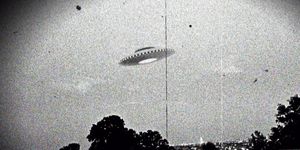
Scott C. Waring
Alien Structures On Venus Seen Close Up, UFO Sighting News.

Alien Structures On Venus Seen Close Up, UFO Sighting News.
Scott C. Waring
Alien Structures On Venus Seen Close Up, UFO Sighting News.
Sky-watcher captures two odd flashes next to the Orion Constellation
SEARCHING FOR ARTIFACTS OF ANCIENT TECHNOLOGICAL SPECIES IN OUR OWN SOLAR SYSTEM

Since its birth around a half century ago, SETI has largely focused on looking for alien civilisations beyond our own solar system, searching for radio signals from prominent or nearby stars. But what if there were earlier technological civilisations in our own solar system, or even here on Earth?
That’s the question explored in a new paper posted to arXiv.org (and soon to be published in the International Journal of Astrobiology), “Prior Indigenous Technological Species“, by astronomer Jason T. Wright.
SETI typically focuses on interstellar radio signals or other studies of objects beyond the Solar System, however an alternative search avenue has been appreciated for nearly as long: the search for alien artifacts within the Solar System. This has not only been a topic for science fiction (e.g. 2001: A Space Odyssey) but in the SETI literature. Indeed, the apparent lack of such artifacts has been used as evidence that humanity must be the only spacefaring civilization in the Galaxy (Hart, 1975). Despite Hart’s claim, we can hardly rule out such artifacts in the Solar System, as demonstrated by Freitas (1983a) and Haqq-Misra & Kopparapu (2012).
In these discussions it is assumed, implicitly or explicitly, that the origin of such artifacts would be not just extraterrestrial (Haqq-Misra & Kopparapu, 2012, refer to them as “Non-Terrestrial Artifacts” (NTAs)) but extrasolar. But if such technology were to be discovered, we should consider the possibility that its origin lies within the Solar System, and potentially on Earth.
After all, given that the bodies in the Solar System are at least five orders of magnitude closer than the nearest star system, and given that we know that not only are the ingredients of and conditions for life common in the Solar System, but that one of its planets is known to host complex life, it is perhaps more likely that their origin be local, than that an extraterrestrial species crossed interstellar space and deposited it here. At the very least, the relative probabilities of the two options is unclear.
In this paper, I discuss the possibility for such prior indigenous technological species; by this I mean species that are indigenous to the Solar System, produce technosignatures and/or were spacefaring, and are currently extinct or otherwise absent.
Wright notes that one of the great difficulties in finding evidence for previous technological civilisations in our solar system is simply the passage of time – old stuff disappears. “The Earth is quite efficient, on cosmic timescales, at destroying evidence of technology on its surface,” he notes. “Biodegredation can destroy organic material in a matter of weeks, and weathering and other forms of erosion will destroy most exposed rock and metals on a timescale of centuries to millennia, if human activity does not erase it faster.
Wright points out that, at the very longest, some “large and durable structures, in the right environments” – such as the Giza pyramids – might last for ‘just’ tens of thousands of years. Given complex life has existed on Earth for over 400 million years (40,000 sequential periods of 10,000 years), you see the problem in searching for ‘ancient aliens’. Not least, because, on timescales of hundreds of millions of years “plate tectonics will subduct almost all evidence for technology with the crust it sits upon, erasing it from the surface entirely.
Regardless of those difficulties, where should we look? Wright suggests that Venus – with a thinner atmosphere in the past – and Mars, once covered in water, would be good candidates. And he reminds us that search should also include Earth (though he disavows the topic of ‘ancient aliens’ on his blog). Furthermore, he notes, “while all geological records of prior indigenous technological species might be long destroyed, if the species were spacefaring there may be technological artifacts to be found throughout the Solar system.”
It’s a fascinating hypothetical topic, though it is worth pointing out that Jason Wright is not particularly happy about “all the wrong kind of attention” the paper has received “from the yellow press and the ufologists….it is mortifying…Now excuse me while I answer all these emails from Coast to Coast and ufologists sending me pictures of clouds.”
No doubt his frustration has arisen from the “astronomer says ancient aliens existed in our own solar system” headlines that the paper has generated, with many mis-judging what the words “may” and “is possible” mean, in terms of likelihood of ancient alien civilisations. As Wright says on his blog, he put his paper together…
…not because I think they exist, but because we’re at the point where it should be possible to say for sure that certain types of them didn’t. The end of the paper is all about the things we can do to start drawing some conclusions.
I recommend – as I have to SETI people before – that it might be worth engaging with the ufologists and Forteans, rather than dissing them, as they could be some of your staunchest advocates, even if there is some disagreement over assumptions and conclusions.
Paper:
You might also like:
These alien geysers spew life’s building blocks
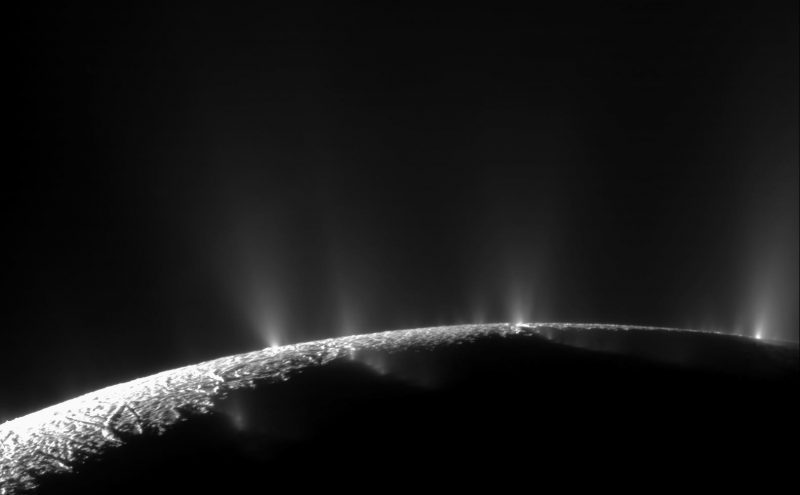
The Cassini mission to Saturn is over, but scientists still pore over its data. The newest discovery is of organic compounds – the ingredients of amino acids, the building blocks of life – in water vapor plumes from Saturn’s moon Enceladus.

The geysers of Saturn’s moon Enceladus. These great plumes of water vapor erupt through fractures in the ice crust at this moon’s south pole. The Cassini spacecraft analyzed the plumes and found water vapor, ice particles, salts, methane and a variety of complex and simple organic molecules. Scientists think they originate from the ocean below the moon’s icy surface.
Image via NASA/JPL-Caltech/Space Science Institute.
Is the subsurface ocean on Saturn’s moon Enceladus habitable? Could it be home to existing life forms? While we still don’t know the answer to the second question, evidence continues to build that this small moon’s ocean is habitable by earthly standards. On October 2, 2019, scientists announced another piece of the puzzle: the discovery of additional kinds of organic compounds that originate from Enceladus’ ocean, and were found by the Cassini spacecraft to be gushing out through geysers at the moon’s south pole. These compounds are the ingredients for amino acids, the building blocks of life on Earth.
The intriguing new peer-reviewed findings were published October 2, 2019, in the Monthly Notices of the Royal Astronomical Society.
The findings come from continued analysis of data from the Cassini mission at Saturn, which ended in 2017. The spacecraft had sampled water vapor in the huge geyser-like plumes that erupt from fractures called Tiger Stripes at the south pole of the moon. The results showed water vapor, ice grains, salts, methane and organic molecules of various sizes existing in the plumes.
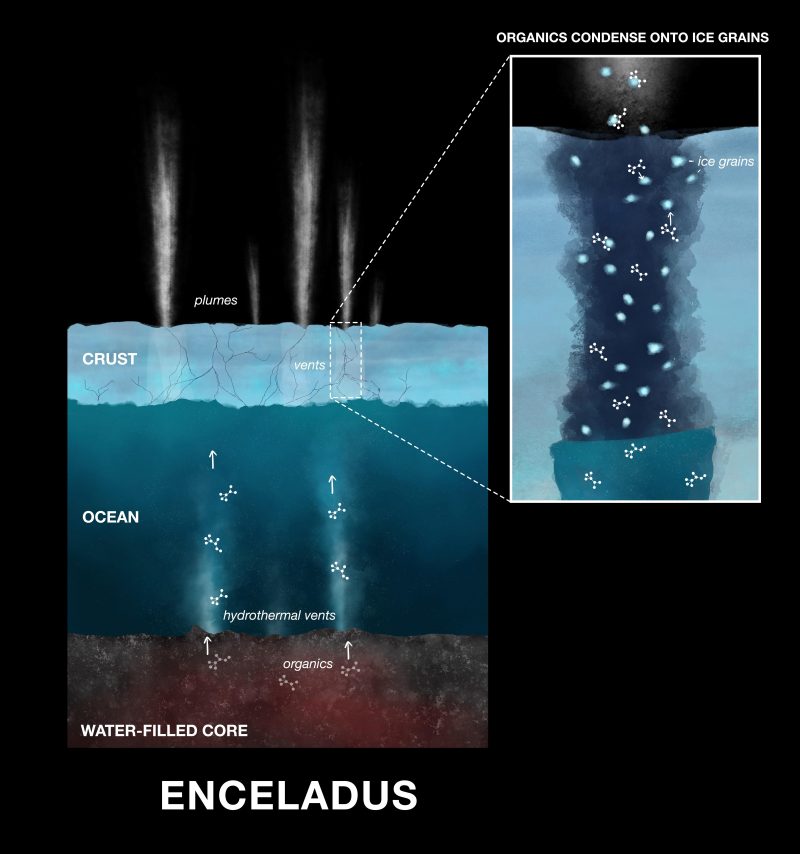
Illustration depicting how the organic compounds, originating from ocean bottom hydrothermal vents, are condensed onto ice grains in cracks in Enceladus’ crust. The ice grains and organics then get ejected into space by the water vapor plumes.
Image via NASA/JPL-Caltech.
Cassini also found evidence for active hydrothermal vents on the ocean floor, similar to ones seen on the ocean bottoms of Earth. The new organic compounds were found to be nitrogen- and oxygen-bearing, condensed onto the ice grains. On Earth, those same compounds are produced by hydrothermal vents, and are part of the chemical reactions that produce amino acids. Is the same thing happening on Enceladus? As Nozair Khawaja, at the Free University of Berlin, explained:
If the conditions are right, these molecules coming from the deep ocean of Enceladus could be on the same reaction pathway as we see here on Earth. We don’t yet know if amino acids are needed for life beyond Earth, but finding the molecules that form amino acids is an important piece of the puzzle.
The ice grains from Enceladus’ plumes also get injected into Saturn’s E ring. The new compounds were found on these ice grains by Cassini’s Cosmic Dust Analyzer (CDA). The composition of the organic material was determined by the CDA’s mass spectrometer.
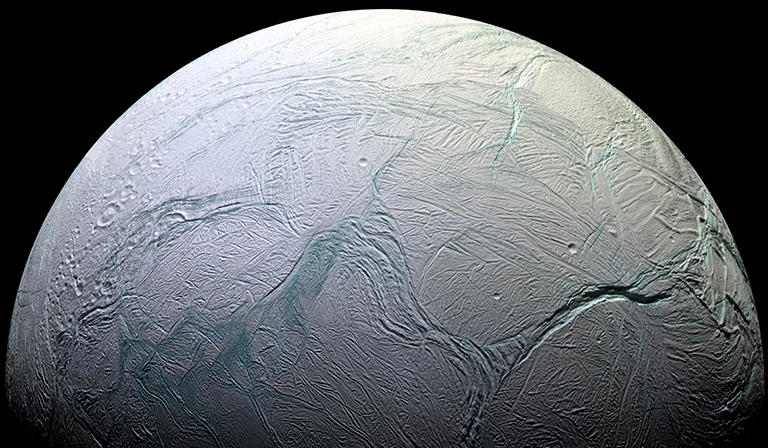
Enceladus as seen by the Cassini spacecraft. This small, icy moon has a global subsurface ocean that could possibly support life.
Image via NASA/JPL-Caltech/NASA Science.
So how did these and other organics get into space? First, they were dissolved in the subsurface ocean itself. They were then evaporated out of the water, condensing and freezing onto ice grains inside the fractures in the moon’s crust. As the plumes of water vapor from the ocean move upward through the fractures to the surface, they transport the ice grains and organics with them. After being injected into space, these grains can then be sampled and analyzed by spacecraft such as Cassini.
Cassini had already found found larger organic molecules in the plumes. These new compounds, however, although smaller, are tied directly to the hydrothermal processes that would create amino acids. According to co-author Jon Hillier:
Here we are finding smaller and soluble organic building blocks – potential precursors for amino acids and other ingredients required for life on Earth.
Another co-author, Frank Postberg, added:
This work shows that Enceladus’ ocean has reactive building blocks in abundance, and it’s another green light in the investigation of the habitability of Enceladus.
Another recent study showed that Enceladus’ ocean is also apparently just the right age to support life.
Diagram of the amino acid lysine, which has carbon atoms attached and is used in the biosynthesis of proteins. Amino acids are the building blocks of life as we know it, and now they have been discovered in Enceladus’ plumes.
Image via Wikipedia/CC BY 3.0.
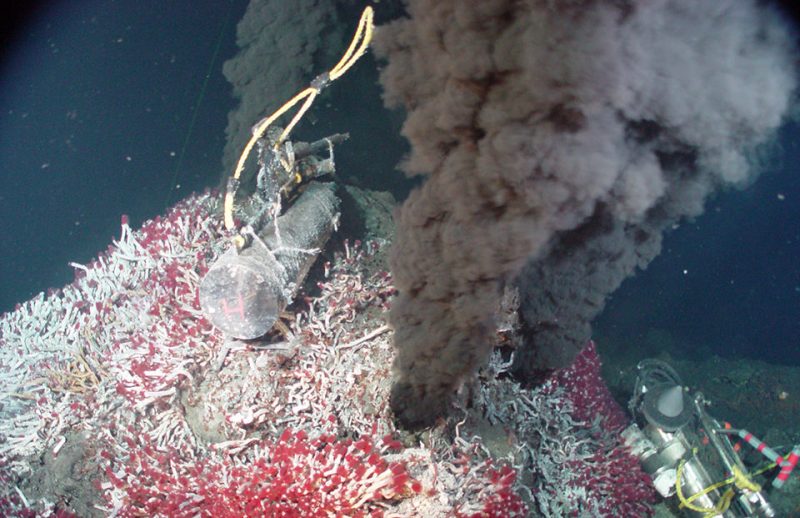
A “black smoker” hydrothermal vent on the ocean floor on Earth. Similar vents are thought to exist on the ocean floor of Enceladus as well, where the organic compounds most likely originate from.
Image via National Ocean Service (NOA).
The discovery of these smaller – but vital – organic compounds is another significant piece of the puzzle in understanding Enceladus’ possible habitability. Although completely frozen on the outside surface, on the inside, Enceladus is a most remarkable little world. Beneath the outer ice crust lies a global warm salty ocean, that, it appears, is not too different from oceans on Earth. The rocky bottom, including the hydrothermal vents, provides chemical nutrients just as it does on our planet. The environment is similar to that around hydrothermal vents – or “smokers” – on Earth’s ocean bottoms. The vents provide heat and nutrients, and at least on Earth, serve as an oasis for a multitude of life forms despite the surrounding colder waters and complete lack of sunlight.
These new findings make Enceladus and other ocean moons in the solar system, such as Europa and Titan, even more enticing targets in the search for life elsewhere in the solar system. Not that long ago, it was thought that Earth was the only world in our solar system with liquid water. Now we know of several moons in the outer solar system that do as well (and maybe even Pluto!), it’s just that the water is hidden below an outer layer of ice. We don’t know yet if any of those water worlds actually host any kind of life, but being able to study some of these alien oceans both now and with more advanced future missions is certainly one of the most exciting developments in planetary exploration.
Bottom line: Further analysis of material in Enceladus’ water vapor plumes has revealed the existence of additional organic compounds, the kind that are the ingredients of amino acids, the building blocks of life on Earth.
Source: Low-mass nitrogen-, oxygen-bearing, and aromatic compounds in Enceladean ice grains
Could Elon Musk's Starship Threaten Alien Life?
Leonardo da Vinci 'hid PROOF of aliens' in the Mona Lisa
Black Holes Stunt Growth of Dwarf Galaxies
![]()
Credit: SDSS
Dwarf galaxies hosting active galactic nuclei that have spatially extended outflows.
Dwarf galaxies are small galaxies that contain between 100 million to a few billion stars. In contrast, the Milky Way has 200-400 billion stars. Dwarf galaxies are the most abundant galaxy type in the universe and often orbit larger galaxies.
The team of three astronomers was surprised by the strength of the detected winds.
“We expected we would need observations with much higher resolution and sensitivity, and we had planned on obtaining these as a follow-up to our initial observations,” said Gabriela Canalizo, a professor of physics and astronomy at UC Riverside, who led the research team. “But we could see the signs strongly and clearly in the initial observations. The winds were stronger than we had anticipated.”
Canalizo explained that astronomers have suspected for the past couple of decades that supermassive black holes at the centers of large galaxies can have a profound influence on the way large galaxies grow and age.
“Our findings now indicate that their effect can be just as dramatic, if not more dramatic, in dwarf galaxies in the universe,” she said.
Study results appear in The Astrophysical Journal.
The researchers, who also include Laura V. Sales, an assistant professor of physics and astronomy; and Christina M. Manzano-King, a doctoral student in Canalizo’s lab, used a portion of the data from the Sloan Digital Sky Survey, which maps more than 35% of the sky, to identify 50 dwarf galaxies, 29 of which showed signs of being associated with black holes in their centers. Six of these 29 galaxies showed evidence of winds — specifically, high-velocity ionized gas outflows — emanating from their active black holes.
“Using the Keck telescopes in Hawaii, we were able to not only detect, but also measure specific properties of these winds, such as their kinematics, distribution, and power source — the first time this has been done,” Canalizo said. “We found some evidence that these winds may be changing the rate at which the galaxies are able to form stars.”

Credit: UCR/Stan Lim
From left to right: Laura Sales, Christina Manzano-King, and Gabriela Canalizo.
Manzano-King, the first author of the research paper, explained that many unanswered questions about galaxy evolution can be understood by studying dwarf galaxies.
“Larger galaxies often form when dwarf galaxies merge together,” she said. “Dwarf galaxies are, therefore, useful in understanding how galaxies evolve. Dwarf galaxies are small because after they formed, they somehow avoided merging with other galaxies. Thus, they serve as fossils by revealing what the environment of the early universe was like. Dwarf galaxies are the smallest galaxies in which we are directly seeing winds — gas flows up to 1,000 kilometers per second — for the first time.”
Manzano-King explained that as material falls into a black hole, it heats up due to friction and strong gravitational fields and releases radiative energy. This energy pushes ambient gas outward from the center of the galaxy into intergalactic space.
“What’s interesting is that these winds are being pushed out by active black holes in the six dwarf galaxies rather than by stellar processes such as supernovae,” she said. “Typically, winds driven by stellar processes are common in dwarf galaxies and constitute the dominant process for regulating the amount of gas available in dwarf galaxies for forming stars.”UC Riverside astronomers find large-scale winds associated with active black holes in small galaxies suppress star formation

Astronomers suspect that when wind emanating from a black hole is pushed out, it compresses the gas ahead of the wind, which can increase star formation. But if all the wind gets expelled from the galaxy’s center, gas becomes unavailable and star formation could decrease. The latter appears to be what is occurring in the six dwarf galaxies the researchers identified.
“In these six cases, the wind has a negative impact on star formation,” Sales said. “Theoretical models for the formation and evolution of galaxies have not included the impact of black holes in dwarf galaxies. We are seeing evidence, however, of a suppression of star formation in these galaxies. Our findings show that galaxy formation models must include black holes as important, if not dominant, regulators of star formation in dwarf galaxies.”
Next, the researchers plan to study the mass and momentum of gas outflows in dwarf galaxies.
“This would better inform theorists who rely on such data to build models,” Manzano-King said. “These models, in turn, teach observational astronomers just how the winds affect dwarf galaxies. We also plan to do a systematic search in a larger sample of the Sloan Digital Sky Survey to identify dwarf galaxies with outflows originating in active black holes.”
The research was funded by the National Science Foundation, NASA, and the Hellman Foundation. Data was obtained at the W. M. Keck Observatory, and made possible by financial support from the W. M. Keck Foundation.
Contacts and sources:
Source:
How Do the Strongest Magnets in the Universe Form?
The simulation marks the birth of a magnetic star such as Tau Scorpii. The image is a cut through the orbital plane where the colouring indicates the strength of the magnetic field and the light hatching reflects the direction of the magnetic field line.

Scientists from Heidelberg University, the Max Planck Society, the Heidelberg Institute for Theoretical Studies, and the University of Oxford were involved in the research. The results were published in “Nature”.
Over a decade ago, scientists suggested that strong magnetic fields are produced when two stars collide. “But until now, we weren’t able to test this hypothesis because we didn’t have the necessary computational tools,” says Dr Sebastian Ohlmann from the computing centre of the Max Planck Society in Garching near Munich. This time, the researchers used the AREPO code, a highly dynamic simulation code running on compute clusters of the Heidelberg Institute for Theoretical Studies (HITS), to explain the properties of Tau Scorpii (τ Sco), a magnetic star located 500 light years from Earth.
Already in 2016, Fabian Schneider and Philipp Podsiadlowski from the University of Oxford realised that τ Sco is a so-called blue straggler. Blue stragglers are the product of merged stars. “We assume that Tau Scorpii obtained its strong magnetic field during the merger process,” explains Prof. Dr Philipp Podsiadlowski. Through its computer simulations of τ Sco, the German-British research team has now demonstrated that strong turbulence during the merger of two stars can create such a field.
Credit: ESO/L. Calçada
Stellar mergers are relatively frequent: Scientists assume that about ten percent of all massive stars in the Milky Way are the products of such processes. This is in good agreement with the occurrence rate of magnetic massive stars, according to Dr Schneider. Astronomers think that these very stars could form magnetars when they explode in supernovae.
This may also happen to τ Sco when it explodes at the end of its life. The computer simulations suggest that the magnetic field generated would be sufficient to explain the exceptionally strong magnetic fields in magnetars. “Magnetars are thought to have the strongest magnetic fields in the Universe – up to one hundred million times stronger than the strongest magnetic field ever produced by humans,” says Prof. Dr Friedrich Röpke from HITS.
The research was funded by the Oxford Hintze Centre for Astrophysical Surveys and the Klaus Tschira Foundation (Heidelberg).
Contacts and sources:
Physicists Have Found a Way to 'Hear' Dark Matter
Physicists at Stockholm University and the Max Planck Institute for Physics have turned to plasmas in a proposal that could revolutionize the search for the elusive dark matter.
Dark matter is a mysterious substance that makes up 85% of the matter in the universe. Originally introduced to explain why the Strong Force (which holds together protons and neutrons) is the same backwards and forwards in time, the so called axion would provide a natural explanation for dark matter. Rather than discrete particles, axion dark matter would form a pervasive wave flowing throughout space.
The researchers propose a new instrument for searching dark matter axions using tunable plasmas.

Illustration: Alexander Millar/Stockholm University
The axion is one of the best explanations for dark matter but has only recently been the focus of large scale experimental effort. Due to this renaissance there has been a rush to come up with new ideas for how to look for the axion in all the areas where it could be hiding.
“Finding the axion is a bit like tuning a radio: you have to tune your antenna until you pick up the right frequency. Rather than music, experimentalists would be rewarded with ‘hearing’ the dark matter that the Earth is travelling through. Despite being well motivated, axions have been experimentally neglected during the three decades since they were named by coauthor Frank Wilczek,” says Dr. Alexander Millar, Postdoctor at the Department of Physics, Stockholm University, and author of the study.
The key insight of the research team’s new study is that inside a magnetic field axions would generate a small electric field that could be used to drive oscillations in the plasma. A plasma is a material where charged particles, such as electrons, can flow freely as a fluid. These oscillations amplify the signal, leading to a better “axion radio”. Unlike traditional experiments based on resonant cavities, there is almost no limit on how large these plasmas can be, thus giving a larger signal. The difference is somewhat like the difference between a walkie talkie and a radio broadcast tower.

The researchers propose a new instrument for searching dark matter axions using tunable plasmas. / Illustration: Alexander Millar/Stockholm University
EurekAlert | STOCKHOLM UNIVERSITY
“Without the cold plasma, axions cannot efficiently convert into light. The plasma plays a dual role, both creating an environment which allows for efficient conversion, and providing a resonant plasmon to collect the energy of the converted dark matter”, says Dr. Matthew Lawson, Postdoctor at the Department of Physics, Stockholm University, also author of the study.
“This is totally a new way to look for dark matter, and will help us search for one of the strongest dark matter candidates in areas that are just completely unexplored. Building a tuneable plasma would allow us to make much larger experiments than traditional techniques, giving much stronger signals at high frequencies”, says Dr. Alexander Millar.
To tune this “axion radio” the authors propose using something called a “wire metamaterial”, a system of wires thinner than hair that can be moved to change the characteristic frequency of the plasma. Inside a large, powerful magnet, similar to those used in Magnetic Resonance Imaging machines in hospitals, a wire metamaterial turns into a very sensitive axion radio.
Searching for dark matter with plasmas will not remain just an interesting idea. In close collaboration with the researchers, an experimental group at Berkeley has been doing research and development on the concept with the intent of building such an experiment in the near future.
“Plasma haloscopes are one of the few ideas that could search for axions in this parameter space. The fact that the experimental community has latched onto this idea so quickly is very exciting and promising for building a full scale experiment”, says Dr. Alexander Millar.
Contacts and sources:
Source:
The Milky Way Kidnapped Several Tiny Galaxies from Its Neighbor
For example, more than 50 discovered satellite galaxies orbit our own galaxy, the Milky Way. The largest of these is the Large Magellanic Cloud, or LMC, a large dwarf galaxy that resembles a faint cloud in the Southern Hemisphere night sky.
UC Riverside-led research shows our galaxy is undergoing a massive merger with its largest satellite galaxy, the Large Magellanic Cloud

The researchers made the discovery by using new data gathered by the Gaia space telescope on the motions of several nearby galaxies and contrasting this with state-of-the-art cosmological hydrodynamical simulations. The UC Riverside team used the positions in the sky and the predicted velocities of material, such as dark matter, accompanying the LMC, finding that at least four ultrafaint dwarfs and two classical dwarfs, Carina and Fornax, used to be satellites of the LMC. Through the ongoing merger process, however, the more massive Milky Way used its powerful gravitational field to tear apart the LMC and steal these satellites, the researchers report.
Laura Sales (right), an assistant professor of physics and astronomy at UC Riverside, is seen here with Ethan Jahn, her graduate student.

Credit: UCR/Sales group
“These results are an important confirmation of our cosmological models, which predict that small dwarf galaxies in the universe should also be surrounded by a population of smaller fainter galaxy companions,” said Laura Sales, an assistant professor of physics and astronomy, who led the research team. “This is the first time that we are able to map the hierarchy of structure formation to such faint and ultrafaint dwarfs.”
The findings have important implications for the total mass of the LMC and also on the formation of the Milky Way.
“If so many dwarfs came along with the LMC only recently, that means the properties of the Milky Way satellite population just 1 billion years ago were radically different, impacting our understanding of how the faintest galaxies form and evolve,” Sales said.
Study results appear in the November 2019 issue of the Monthly Notices of the Royal Astronomical Society.
Dwarf galaxies are small galaxies that contain anywhere from a few thousand to a few billion stars. The researchers used computer simulations from the Feedback In Realistic Environments project to show the LMC and galaxies similar to it host numerous tiny dwarf galaxies, many of which contain no stars at all — only dark matter, a type of matter scientists think constitutes the bulk of the universe’s mass.
“The high number of tiny dwarf galaxies seems to suggest the dark matter content of the LMC is quite large, meaning the Milky Way is undergoing the most massive merger in its history, with the LMC, its partner, bringing in as much as one third of the mass in the Milky Way’s dark matter halo — the halo of invisible material that surrounds our galaxy,” said Ethan Jahn, the first author of the paper and a graduate student in Sales’ research group.
Jahn explained that the number of tiny dwarf galaxies the LMC hosts may be higher than astronomers previously estimated, and that many of these tiny satellites have no stars.
“Small galaxies are hard to measure, and it’s possible that some already-known ultrafaint dwarf galaxies are in fact associated with the LMC,” he said. “It’s also possible that we will discover new ultrafaints that are associated with the LMC.”
Dwarf galaxies can either be satellites of larger galaxies, or they can be “isolated,” existing on their own and independent of any larger object. The LMC used to be isolated, Jahn explained, but it was captured by the gravity of the Milky Way and is now its satellite.
“The LMC hosted at least seven satellite galaxies of its own, including the Small Magellanic Cloud in the Southern Sky, prior to them being captured by the Milky Way,” he said.
Next, the team will study how the satellites of LMC-sized galaxies form their stars and how that relates to how much dark matter mass they have.
“It will be interesting to see if they form differently than satellites of Milky Way-like galaxies,” Jahn said.
Sales and Jahn were joined in the study Andrew Wetzel of UC Davis; Michael Boylan-Kolchin of the University of Texas at Austin; T. K. Chan of UC San Diego; Kareem El-Badry of UC Berkeley; and Alexandres Lazar and James S. Bullock of UC Irvine.
The research was supported by grants to Sales from NASA and the Hellman Foundation.
Contacts and sources:
Citation:
Source:
Ice on Lunar South Pole May Have More than One Source, Sugests Study
New research sheds light on the ages of ice deposits reported in the area of the Moon’s south pole — information that could help identify the sources of the deposits and help in planning future human exploration.
Shackleton Crater, the floor of which is permanently shadowed from the sun, appears to be home to deposits of water ice. A new study sheds light on how old these and other deposits on the Moon’s south pole might be.
A new study sheds light on how old these and other deposits on the Moon’s south pole might be. Shackleton crater is nearly coincident with the Moon’s south pole. Its interior receives almost no direct sunlight and is a perennial cold trap, making Shackleton a promising candidate location in which to seek sequestered volatiles.
![]()
Credit: NASA
The discovery of ice deposits in craters scattered across the Moon’s south pole has helped to renew interest in exploring the lunar surface, but no one is sure exactly when or how that ice got there. A new study published in the journal Icarus suggests that while a majority of those deposits are likely billions of years old, some may be much more recent.
Ariel Deutsch, a graduate student in Brown University’s Department of Earth, Environmental and Planetary Sciences and the study’s lead author, says that constraining the ages of the deposits is important both for basic science and for future lunar explorers who might make use of that ice for fuel and other purposes.
“The ages of these deposits can potentially tell us something about the origin of the ice, which helps us understand the sources and distribution of water in the inner solar system,” Deutsch said. “For exploration purposes, we need to understand the lateral and vertical distributions of these deposits to figure out how best to access them. These distributions evolve with time, so having an idea of the age is important.”
For the study, Deutsch worked with Jim Head, a professor at Brown, and Gregory Neumann from the NASA Goddard Space Flight Center. Using data from NASA’s Lunar Reconnaissance Orbiter, which has been orbiting the Moon since 2009, the researchers looked at the ages of the large craters in which evidence for south pole ice deposits was found. To date the craters, researchers count the number of smaller craters that have accrued inside the larger ones. Scientists have an approximate idea of the pace of impacts over time, so counting craters can help establish the ages of terrains.
The majority of the reported ice deposits are found within large craters formed about 3.1 billion years or longer ago, the study found. Since the ice can’t be any older than the crater, that puts an upper bound on the age of the ice. Just because the crater is old doesn’t mean that the ice within it is also that old too, the researchers say, but in this case there’s reason to believe the ice is indeed old. The deposits have a patchy distribution across crater floors, which suggests that the ice has been battered by micrometeorite impacts and other debris over a long period of time.
If those reported ice deposits are indeed ancient, that could have significant implications in terms of exploration and potential resource utilization, the researchers say.
“There have been models of bombardment through time showing that ice starts to concentrate with depth,” Deutsch said. “So if you have a surface layer that’s old, you’d expect more underneath.”
While the majority of ice was in the ancient craters, the researchers also found evidence for ice in smaller craters that, judging by their sharp, well-defined features, appear to be quite fresh. That suggests that some of the deposits on the south pole got there relatively recently.
“That was a surprise,” Deutsch said. “There hadn’t really been any observations of ice in younger cold traps before.”
If there are indeed deposits of different ages, the researchers say, that suggests they may also have different sources. Older ice could have been sourced from water-bearing comets and asteroids impacting the surface, or through volcanic activity that drew water from deep within the Moon. But there aren’t many big water-bearing impactors around in recent times, and volcanism is thought to have ceased on the Moon over a billion years ago. So more recent ice deposits would require different sources — perhaps bombardment from pea-sized micrometeorites or implantation by solar wind.
The best way to find out for sure, the researchers say, is to send spacecraft there to get some samples. And that appears to be on the horizon. NASA’s Artemis program aims to put humans on the Moon by 2024, and plans to fly numerous precursor missions with robotic spacecraft in the meantime. Head, a study co-author and Deutsch’s Ph.D. advisor, says studies like this one will help to shape those future missions.
“When we think about sending humans back to the Moon for long-term exploration, we need to know what resources are there that we can count on, and we currently don’t know,” Head said. “Studies like this one help us make predictions about where we need to go to answer those questions.”
Contacts and sources:
Citation:
Source:
UFO Caught In Three Photo Traveling Through Storm Clouds! Oct 2019, UFO Sighting News.
Alien Disk Passing Moon Caught By Astronomer Club, Oct 11, 2019, UFO Sighting News.
On October 11th, 2019 we attended an astronomy night.. we took some photos of the moon through a telescope and found an anomaly on the last photo. We took 3 photos and it only appears on the last.
Bigfoot Tracks Found In North Carolina, May Lead To Alien Base Underground! Video, UFO Sighting News.
China Shows Off UFO At Airshow, UFO Sighting News.
Date of display: Oct 10, 2019
Location of display: Tianjin, China
China has unveiled a new stealth helicopter that is in the shape of a UFO disk. The disk look very similar to a lot of UFOs seen around the world for decades, so it seems that China is taking its info for design directly from UFO reports. China is working hard at this airshow to reveal its newest aircraft in order to show off its military muscle. The disk is probably the generation 1 of its type, so China probably has a ten 10 or higher of this craft now...which means no more helicopter rotor, which was probably replaced by three actual alien craft anti propulsion generators. China is showing off its aircraft...but we all know its top secret craft are still being hidden from the public. Much like Americas TR3B secret military craft with alien propulsion systems installed...this kind of tech is capable of space travel at partial light speed.
Scott C. Waring-Taiwan
UFO Expert Says He Has ‘100% Proof’ That Aliens Currently Live In A ‘City’ On Our Moon
The secret history of Area 51, explained by an expert/cdn.vox-cdn.com/uploads/chorus_image/image/65271705/1163653976.jpg.0.jpg)
Annie Jacobsen spent years learning the secrets of Area 51. She told me some of them.
Navy Pilot Says ‘Dark Mass’ Made Torpedo Disappear
If it wasn’t a submarine, what the hell was it?
You might not know the name David Fravor, but you probably know what he saw … even if he’s still not sure what that was. Fravor is the retired U.S. Navy Commander who in 2017 told the New York Times that he spotted a Tic Tac-shaped UFO from the cockpit of his F/A-18F Super Hornet—“around 40 feet long and oval in shape”—100 miles off the coast of San Diego in 2004.
There’s video, of course, of Fravor’s now-legendary encounter, originally released for public viewing by The New York Times and To The Stars Academy of Arts & Science, a UFO research group from former Blink-182 member Tom DeLonge:
Back in the ‘90s, this pilot’s job was to fetch BQM aerial target drones and submarine telemetry torpedoes from the ocean. At the time, the pilot was flying a CH-53—“a big, heavy-lifter the Marine Corps uses for certain things,” Fravor told Rogan. “Off the East Coast they do a lot of shooting, at the time it was off Puerto Rico.”
“The helo drops a swimmer in the water, he hooks the whole thing up and they fly back,” Fravor said. “The first time they were out and they were going to pick up a BQM, he’s sitting in the front—in the CH-53 you can see down by your feet—and as he’s looking down, they’re 50 feet (15 metres) above the water, he sees this kind of dark mass coming up from the depths.”
As the pilot picked up the BQM, he was apparently at a loss for words. “He’s looking at this thing going, ‘What the hell is that?’ And then it just goes back down underwater. Once they pull the kid and the BQM out of the water, this object descends back into the depths.”
One dark mass coming up from the depths is weird enough. Two is officially cause for concern. A few months later, the helicopter pilot saw the exact same thing.
“He’s out picking up a torpedo, they hook the diver up on the winch, and as they’re lowering him down, he sees this big mass. He goes, ‘It’s not a submarine’. He’s seen submarines before. Once you’ve seen a submarine you can’t confuse it with something else. This big object, kind of circular, is coming up from the depths and he starts screaming through the intercom system to tell them to pull the diver up, and the diver’s only a few feet from the water.
“They reverse the winch and the diver’s thinking, ‘What the hell is going on?’ And all of a sudden he said the torpedo just got sucked down underwater, and the object just descended back down into the depths. They never recovered it.”
The helicopter pilot swears the torpedo didn’t sink, per Fravor—and that pilot even told the Times about the incident back in 2017, but the paper never reported it. We’re guessing the editors would reconsider today.
So … what was the dark mass if it wasn’t a submarine? A whale? The Loch Ness Monster? For now we can only speculate, at least until the next video leaks.
Source: News.com.au
Earth's Magnetic Poles Can Flip Much More Often Than Anyone Thought
A Cosmic Mystery: Why is the Milky Way Galaxy Getting Gassier?