Ontdek de Fascinerende Wereld van UFO's en UAP's: Jouw Bron voor Onthullende Informatie!
Ben jij ook gefascineerd door het onbekende? Wil je meer weten over UFO's en UAP's, niet alleen in België, maar over de hele wereld? Dan ben je op de juiste plek!
België: Het Kloppend Hart van UFO-onderzoek
In België is BUFON (Belgisch UFO-Netwerk) dé autoriteit op het gebied van UFO-onderzoek. Voor betrouwbare en objectieve informatie over deze intrigerende fenomenen, bezoek je zeker onze Facebook-pagina en deze blog. Maar dat is nog niet alles! Ontdek ook het Belgisch UFO-meldpunt en Caelestia, twee organisaties die diepgaand onderzoek verrichten, al zijn ze soms kritisch of sceptisch.
Nederland: Een Schat aan Informatie
Voor onze Nederlandse buren is er de schitterende website www.ufowijzer.nl, beheerd door Paul Harmans. Deze site biedt een schat aan informatie en artikelen die je niet wilt missen!
Internationaal: MUFON - De Wereldwijde Autoriteit
Neem ook een kijkje bij MUFON (Mutual UFO Network Inc.), een gerenommeerde Amerikaanse UFO-vereniging met afdelingen in de VS en wereldwijd. MUFON is toegewijd aan de wetenschappelijke en analytische studie van het UFO-fenomeen, en hun maandelijkse tijdschrift, The MUFON UFO-Journal, is een must-read voor elke UFO-enthousiasteling. Bezoek hun website op www.mufon.com voor meer informatie.
Samenwerking en Toekomstvisie
Sinds 1 februari 2020 is Pieter niet alleen ex-president van BUFON, maar ook de voormalige nationale directeur van MUFON in Vlaanderen en Nederland. Dit creëert een sterke samenwerking met de Franse MUFON Reseau MUFON/EUROP, wat ons in staat stelt om nog meer waardevolle inzichten te delen.
Let op: Nepprofielen en Nieuwe Groeperingen
Pas op voor een nieuwe groepering die zich ook BUFON noemt, maar geen enkele connectie heeft met onze gevestigde organisatie. Hoewel zij de naam geregistreerd hebben, kunnen ze het rijke verleden en de expertise van onze groep niet evenaren. We wensen hen veel succes, maar we blijven de autoriteit in UFO-onderzoek!
Blijf Op De Hoogte!
Wil jij de laatste nieuwtjes over UFO's, ruimtevaart, archeologie, en meer? Volg ons dan en duik samen met ons in de fascinerende wereld van het onbekende! Sluit je aan bij de gemeenschap van nieuwsgierige geesten die net als jij verlangen naar antwoorden en avonturen in de sterren!
Heb je vragen of wil je meer weten? Aarzel dan niet om contact met ons op te nemen! Samen ontrafelen we het mysterie van de lucht en daarbuiten.
Donderdag 28 november 2019
Men in Black: Demonically Possessed and Controlled?
Men in Black: Demonically Possessed and Controlled?
Last week I received a lengthy, rambling series of messages from a guy in Salt Lake City, Utah that – when I finally got around to copy-pasting and formatting it all – amounted to eleven pages in single-spaced Word. I won’t detail the whole story, since it would take an entire batch of articles to do that. Sam (which is his real name) is a twenty-something who has never seen a UFO, has never been abducted by ETs, and has never had a particular interest in the subjects of UFOs and alien life. For a while, however, he did dabble in the occult, which may very well have led to what occurred just a few months back. Here’s the story: Sam found himself in a very weird situation that began in late August of this year, and that he claims is still going on. On the first night of weirdness, he woke up, around 5:00 a.m. in a state of complete confusion on his bed, rather than in it. Sam had had an extremely strange “nightmare” of having been placed into a state of what he called “mind control” a couple of hours earlier, which would have put the time it all began around 3:00 a.m. In that same nightmare, Sam got out of bed, dressed, and exited his apartment. But that’s not all: when he dressed, it was not in his regular, casual clothes. Rather, it was in a black suit, which he put on without giving it a thought. I should stress he doesn’t own a black suit.
Sam cannot remember what happened after he left the apartment, that is until he arrived at the doorstep of an apartment only two blocks down from his. He recalled knocking on the door, which was opened by a woman with a blank look on her face – and who seemed to have no problems about letting a complete stranger into her home at what, by now, was around 4:00 a.m. Sam recalls entering the living-room, with the woman in front of him. He then warned her never to talk about a UFO encounter that she had just a few days earlier – a case that involved “missing time” but not an “abduction.” In his strange state, Sam could hear himself saying the threatening words, but it was as if “it wasn’t me saying it. It was coming from my mouth, but it wasn’t me.” Sam then left, walked back to his home, and went to bed. He fell asleep – and then woke up around 5:00 a.m., as described earlier. In the morning, the suit was nowhere in sight. All that was left were the vivid memories of that odd night of what Sam fully believes was a case of possession, rather than just a bad dream.
Sam claims that roughly the same scenario has now occurred on three occasions: he wakes in the early hours, dresses in a black suit (which is never still there when he wakes at his usual wake-up time of 7:00 a.m.), and then heads off to the home of the targeted individual, which, so far, is always the same woman. As with the first occasion, he cannot recall how he gets to the home of the person, although he recalls walking back. Oddly, even though he knows the woman lives nearby, he is never able to find her apartment when he is in a normal state during the day. It’s as if (he believes) that he’s being prevented from finding the location – that is, until he is required to make another late night threat. Then, he has no problem at all finding the site. It’s a result of all this undeniable weirdness that Sam chose to contact me, having done some online research and seen that I have written several books on the MIB and one on the Women in Black phenomenon. Sam believes that demons have control of him and that those same demons are behind the MIB phenomenon. In Sam’s world, those same demons use us – in a hypnotized state – to prevent people from getting too close to the truth of the UFO enigma – which is, in Sam’s view, demonic, too. And they do that by literally turning random people into MIBs, via temporary possession of people like Sam. He believes.
When I began to dig into the story deeply, I realized that it was very similar to one that Timothy Green Beckley had shared with me back in September 2010 (specifically on the 21st of the month). The story, in Tim’s own words, went as follows: “There was one case where I might have been threatened by a Man in Black. There was a publication I wrote for in the 1970s called Official UFO. They published their address in the magazine, so they did get a few crank visitors to the offices. One of these was a gentleman who claimed he was being stalked by the Men in Black.” As Tim also told me, he eventually got to meet a guy who would later turn out to be an alleged Man in Black. They had a degree of correspondence for a while, as well as a few face-to-face encounters. By the end of the 1970s, however, things started to get very menacing, as Tim told me.
The man in question made a number of disturbing calls to Tim’s home phone number. It was something that led Tim to contact the police. When the police tracked the strange character down, Tim finally got the lowdown on who, exactly, the man really was. It transpired he was a homeless character, spending his nights and days on Grand Central Terminal in Manhattan, New York City. There was a very good reason – beyond just the threats the guy made – why Tim was concerned. Tim explained to me that the man “…must have called fifty times and left crazy, threatening messages that would go on and on. I spoke with his parents, who were in Florida, and they said that although he wasn’t always like this, something came over him now and again.”
Tim had an intriguing theory, one that echoes the story told to me last week by Sam. Tim said: “With cases like this guy, where something came over him, and with the MIB, it’s like a possession, where a paranormal force takes possession of the person and they become the Man in Black, doing what the force wants them to do, but without their knowledge. Afterward, they might not even remember any of it. These people are living on the fringe of society; they are simple-minded people who can easily be controlled and influenced. Someone, say, who might be living in some rundown apartment, is taken over in a kind of trance, and then he becomes one of the Men in Black. He threatens someone, and then he goes back to his normal life after the possession ends, and he doesn’t remember it. But, while he is under the control of whatever is doing this, he’s not quite right. And, like a zombie, is the best way I can describe it.”
I have to say that all of this paints a very strange, even sinister, picture. Of course, the most likely scenario is that Sam was already aware that I had previously addressed this very same theory (in my 2011 book, The Real Men in Black) that the MIB might actually be regular people in the throes of possession and used by…well…something. The least likely scenario is that supernatural, demonic entities are using us as vessels, as a means to threaten witnesses to UFOs (and to paranormal phenomena, too). I personally go with the “most likely” angle. The fact is, though, that in most MIB encounters, the witnesses describe the Men in Black as acting very strange, as if they aren’t fully self-aware, and as if they are performing a role, but they don’t completely understand what that role is – beyond making that veiled threat to keep people quiet about their particular encounter of the UFO- or paranormal-based type.
A very common trope of science fiction and fantasy is that of time travel. There has always been an allure to the idea of traveling between two point in time, of making runs to the past or the future to right wrongs or just out of curiosity of ages long past or of eras yet to come. Yet, is any of it really possible at all? In recent times scientists have put much serious thought into the conundrum of time travel, and it seems that even now no one really knows, and that it is all highly speculative and a slave to the domain of scientific speculation. One prominent scientist who very much liked to think about such things was a world renowned scientist who not only entertained the idea, but also threw a party hoping to entertain visitors from the far future.
The question of whether time travel is possible or not was rather deeply pondered and speculated upon by the late, legendary physicist Stephen Hawking, who over the years changed his stance on the possibility of traveling through time. Officially he seemed to not think it was possible in the traditional sense of the word, publishing a paper in the journal Physical Review D in 1992 called Chronology Protection Conjecture, in which he argued that going back into time was not possible in our current understanding of the laws of physics. In his paper he would state:
It seems there is a chronology protection agency, which prevents the appearance of closed timelike curves and so makes the universe safe for historians.
Stephen Hawking
However, Hawking was a self-professed dreamer, and simply could not resist the allure of contemplating time travel, and indeed he was rather obsessed with time in general. What he came up with as the only possible way that time travel would be even remotely possible was through the use of what is called the 4th dimension. What this means is that while every object that we perceive is in three detectable dimensions, height, width, and depth, physicists often talk of a 4th dimension, which is that of time. Theoretically, all one needs to do is to create a tunnel through this 4th dimension and voila, time travel. Yet it is not as simple as this barebones explanation I have provided here may make it seem.
These theoretical tunnels through the 4th dimension are called “wormholes,” which Einstein predicted linked two separate places in time, and which are thought to hypothetically already exist on an incredibly minuscule scale, at a size even smaller than molecules or even atoms, an impossibly small scale called the “quantum foam.” These wormholes form tiny wrinkles and cracks in time itself, constantly blinking in or out of existence, expanding and shrinking, caught in an eternal state of flux. Considering this very unstable nature and the fact that these theoretical wormholes are only around a billion-trillion-trillionths of a centimeter across, they would not be much good for practically travelling through in their current state, and this is where Hawking’s hypothetical time machine comes into play.
By creating some device that could enlarge these wormholes by several orders of magnitude, it is thought that perhaps they could be enlarged and somehow stabilized to the point that a person could theoretically pass through one point and come out in places far away across the cosmos or even in another time. It is a concept already well explored in science fiction, but could it be a reality? However, ultimately Hawking has deemed time travel to the past impossible due to the paradoxes it would cause, because it would violate a fundamental law of the universe in that effect always happens after the cause. He says of this in his article How to Build a Time Machine:
Through the wormhole, the scientist can see himself as he was one minute ago. But what if our scientist uses the wormhole to shoot his earlier self? He’s now dead. So who fired the shot? It’s a paradox. It just doesn’t make sense. It’s the sort of situation that gives cosmologists nightmares. This kind of time machine would violate a fundamental rule that governs the entire universe – that causes happen before effects, and never the other way around. I believe things can’t make themselves impossible. If they could then there’d be nothing to stop the whole universe from descending into chaos. So I think something will always happen that prevents the paradox. Somehow there must be a reason why our scientist will never find himself in a situation where he could shoot himself.
There is also the matter of the unsteady nature of the wormhole itself. Hawking explains that such a wormhole would create a sort of potent “feedback” that would prevent it from working. He compares this to a speaker at a rock concert, when the sound goes into a loop through the microphone and out of the speaker to create that screeching sound that everyone hates, getting louder on each loop until it potentially destroys the sound system. He says the same thing would basically happen with a wormhole, of which he says:
The same thing will happen with a wormhole, only with radiation instead of sound. As soon as the wormhole expands, natural radiation will enter it, and end up in a loop. The feedback will become so strong it destroys the wormhole. So although tiny wormholes do exist, and it may be possible to inflate one some day, it won’t last long enough to be of use as a time machine. Any kind of time travel to the past through wormholes or any other method is probably impossible, otherwise paradoxes would occur. So sadly, it looks like time travel to the past is never going to happen. A disappointment for dinosaur hunters and a relief for historians.
Despite his assurance that time travel to the past is most likely impossible, ever the dreamer Hawking nevertheless created a rather eccentric and some might even say bonkers experiment. In 2009 he decided that he would throw an extravagant party for any time travelers out there, complete with expensive champagne, balloons, hors d’oeuvres, the works. Hawking actually went through with all this, sparing no expense to set everything up at Gonville & Caius College, Cambridge, but the catch was that he would not send out the invitations, which contained the time, day, and coordinates, until after the party, his rationale being that real time travelers would be able to receive the invitation and travel back to the party. Hawking would say of these invitations:
I’ve drawn up an invitation giving the exact coordinates in time and space. I am hoping copies of it, in one form or another, will be around for many thousands of years. Maybe one day someone living in the future will find the information on the invitation and use a wormhole time machine to come back to my party, proving that time travel will, one day, be possible.
One of the invitations to the time traveler party
On June 28, 2009, the champagne was set out, including an elaborate champagne pyramid, the food was put out, and Hawking got all dressed up in his finest evening attire. For as much as a publicity stunt that it seemed, he was actually going through with it. Hawking sat there at his lavish party under a giant banner reading “Time Travelers Welcome,” waiting for his guests to arrive, then waited some more, and then continued to wait. Not a single person came through those doors, putting all of that food and champagne to waste. He would later say:
I have experimental evidence that time travel is not possible. I gave a party for time-travelers, but I didn’t send out the invitations until after the party. I sat there a long time, but no one came. What a shame. I was hoping at least a future Miss Universe was going to step through the door.
Now of course Hawking was probably only half-serious about this “experiment,” and it is mostly seen as purely a publicity stunt, but that hasn’t stopped people from discussing why no time travelers arrived. Besides the obvious reason, being that time travel will never exist, there have been an array of other possible reasons as well. For instance, the invitations may not have survived long enough into the future for time travelers to have seen them or the invitations were simply just never found. Time travelers might not have known about the party in the first place. There is also the possibility that the time travelers simply did not want to go to the party, and it also makes sense in that they likely wouldn’t want their existence known so why announce it by showing up to a party thrown expressly for the purpose of proving they are real?
Whatever the reasons, interestingly when Hawking passed away on March 14, 2018, his family actually went ahead and made an open invitation for time travelers to come to the funeral. On the webpage for The Stephen Hawking Foundation there was held a raffle for tickets to the event, and curiously there is a section for applicants born between 2019 and 2038, meaning that people from the future could apply. So, will time travel ever be possible, and if it will be, then where is everyone? Is this purely the realm of science fiction or is there anything to it all? Whether time travel exists or ever will, there are ideas, and at least I hope that Mr. Hawking got some good champagne and food out of the deal.
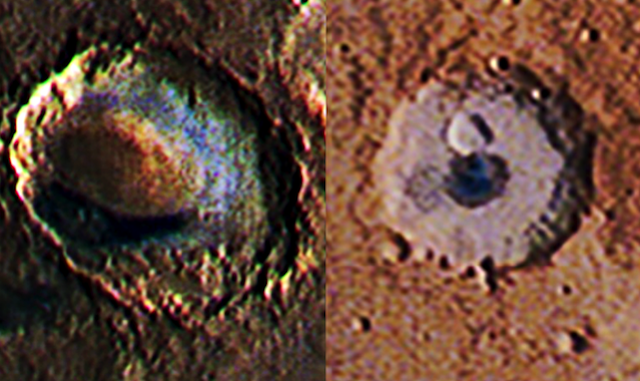
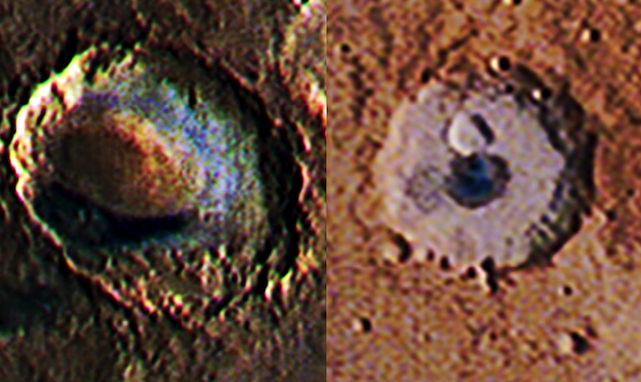
I found some structures in a Mars photo. One structure is a two tier black base that sits at the center of a crater. Another intesting object is a alien disk that has landed at a 25 degree angle in a crater. I made a video and hope you like it. Please remember to hit like and subscribe to my channel ET DATA BASE. This is absolute proof that aliens exist, yet NASA would never and has never addressed what these objects and others are. Thanks, Scott C. Waring - Taiwan
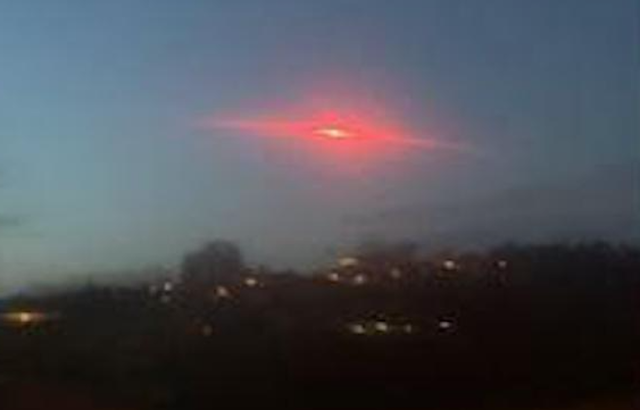
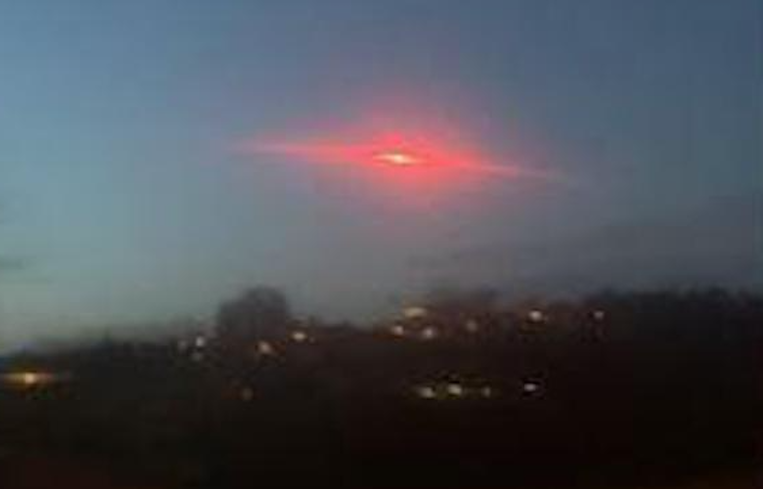
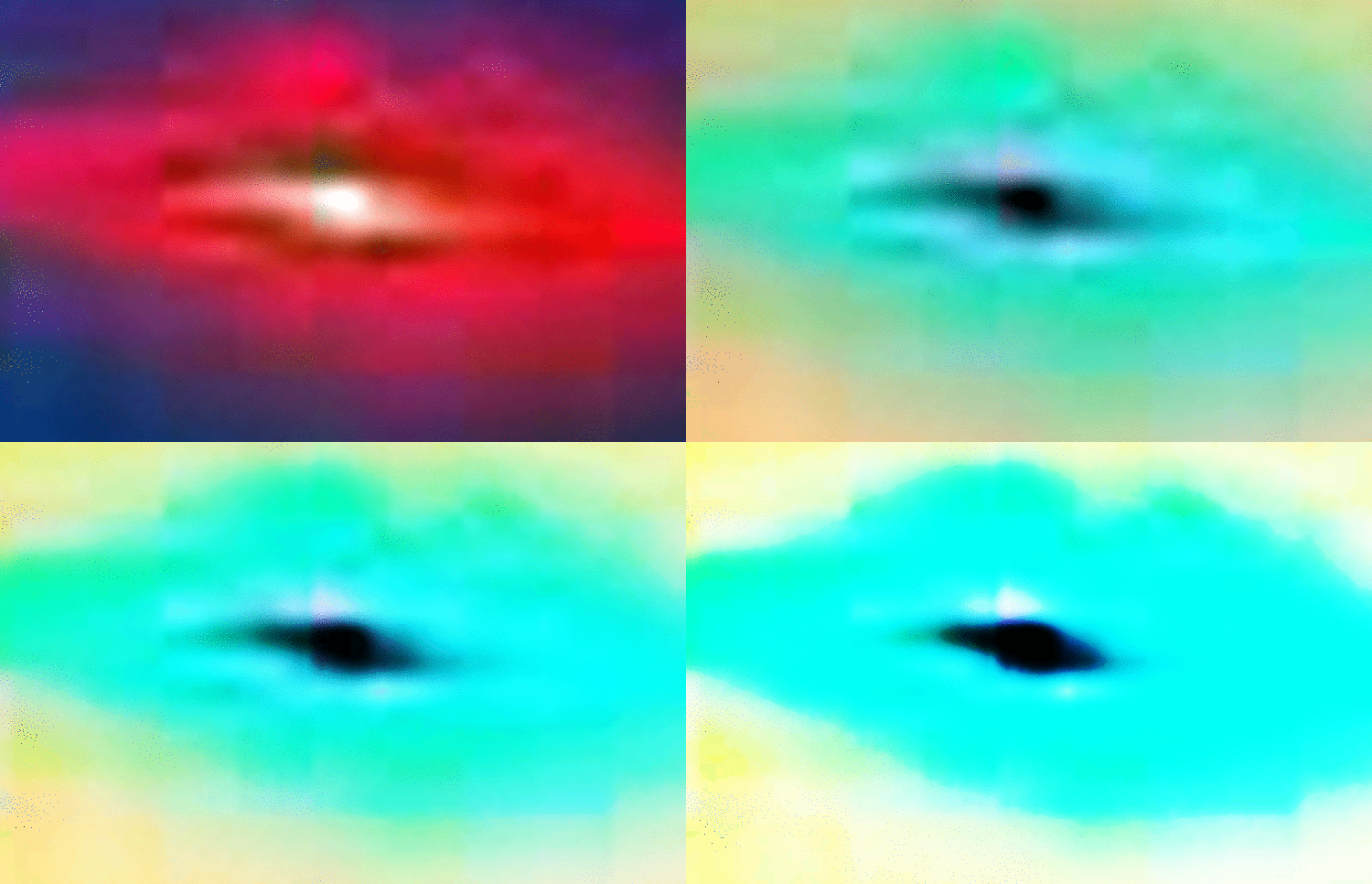
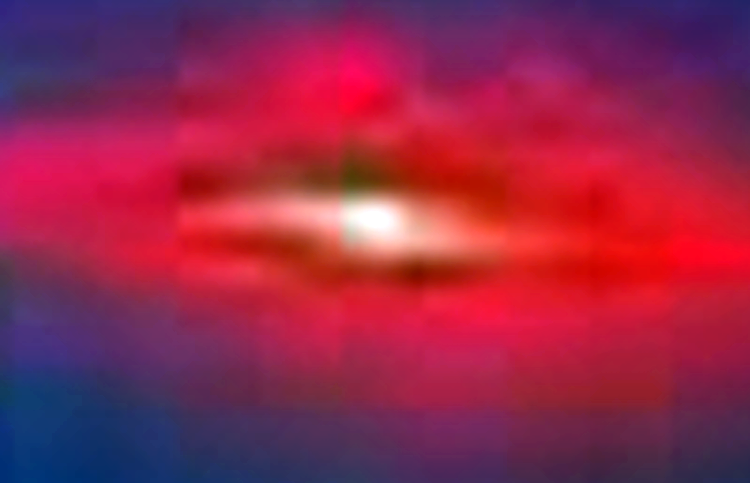
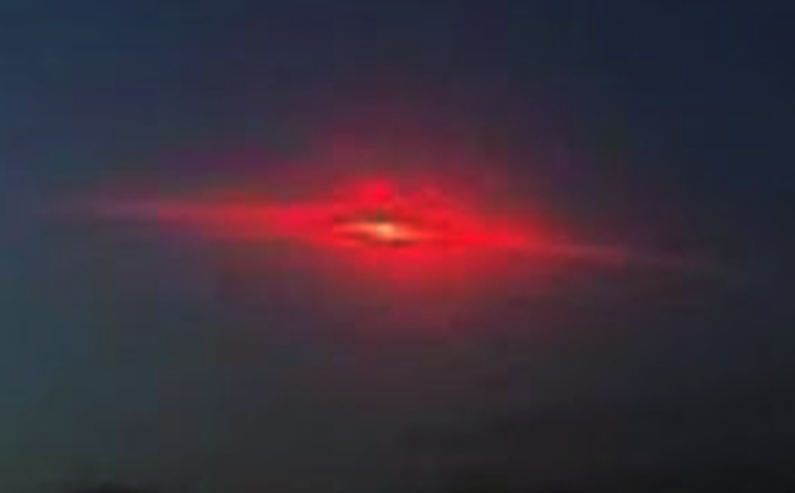
A bright red light was recorded over the city Bradford, UK two days ago. The light only lasted about a minute, but the eyewitness got a really great video of the event. Sadly the video released was reduced in quality since the uploader failed to enlarge it correctly, so its difficult to see any detail. However the screenshot above is from the original and as you can see, there is a disk-like object at its center. I believe that this object came from an underground base, transporting to its current location...and powered up...soon disappearing as it shot up and out of our atmosphere. I made a gif below to show the disk when I changed it to negative format and added contrast. The UFO then comes into focus. Scott C. Waring
What is this strange pulsing beam of light over Edmonton, Canada
The aliens are coming for a landing? A strange pulsing beam of light appeared in the sky over Edmonton, Alberta, Canada on November 29, 2019.
Tinkerbell Bear while driving home saw this really strange pulsing beam in the sky and said "I've never seen anything like it and it is so weird! Anyone know what it is or seen this before?"
According to cbc.ca - the Edmonton Fire Rescue Services determined that the beam of light is flaring and came from Imperial Oil's Strathcona refinery. Flares are used in refineries and petrochemical facilities to safely burn excess hydrocarbon gases that can't be recovered or recycled.
Below Tinkerbell's video of the weird beam of light. More images of the sky phenomenon, see cbc.ca
Flashing UFO ‘left bizarre landing marks and shut down nearby boat engines in terrifying encounter with two fishermen’ – The Sun
A UFO left strange landing marks on the ground and burnt the grass during a harrowing close encounter with two terrified fishermen in Brazil.
These photos, which have never been made public before, show the strange indentations in the soil and grass flattened in a circular formation.
Fishermen Fernando Beserra and Wilson da Silva Oliveira at the scene of the alleged landing
The strange landing marks and scorched grass that have puzzled UFO hunters
A drawing of what the UFO apparently looked like
Fishermen Fernando Beserra and Wilson da Silva Oliveira were gathering their nets when they saw the bright UFO land just a few metres away.
They thought it was a balloon at first, but when the speed of the object convinced them they were faced with something otherworldly.
According to the terrified witnesses, the UFO landed on an island called Ilha do Major, Soa Vicente, near São Paulo.
The UFO left marks on the ground and traces of radiation.
Fernando said: "When the light was over our heads, it changed direction and went to an a small island, where it landed.
"On the lower part of the UFO there was a number spinning lights.”
Wilson Oliveira added: “I almost died of fear. I hid in the bottom of the boat."
'BOAT ENGINE STOPPED WORKING'
The UFO had a yellowish hue and was so intense the two frightened fishermen tried to flee, but bizarrely they say their boat's engine stopped as the object passed over.
Fernando said: "We made about ten attempts until the engine started and then we left as fast as we could.
"We could see that the UFO had landed on a small island located between us and the mangroves of the Piaçabuçu river."
The fisherman also drew a map to show the exact 'landing spot'
After the scare, Fernando and Wilson made their way back home to tell their relatives.
At dawn the next day, the two fishermen returned to the scene and noticed a circular mark where they believed the UFO had landed.
It was a circle of 18ft in diameter, where the vegetation was dry, twisted and flattened in a clockwise direction.
Four marks from the object's rectangular support legs were also found, each measuring 10 by 15cm.
These markings were proportionately distributed and sank to a depth of 1.5cm into the soil.
It changed direction and went to an a small island, where it landed...on the lower part of the UFO there was a number spinning lights Fishermen Fernando Beserra
The fishermen returned home and reported their sighting to the newspaper "The Tribuna" in Santos.
Experts from the National Institute of Aerospace Phenomenab (INFA) immediately launched a probe and took plaster moulds of the landing marks.
Soil and vegetation samples were also taken as the investigators at INFA literally left no stone unturned.
The sighting on October 1 1995 was classified as being a Close Encounter of the Second kind, because of the following characteristics:
Mechanical effect, characterised by the marks left on the ground and by the crumpled
and broken vegetation at the same location
EM (electromagnetic) effects causing the boats engine to stop operating
Physiological effect on the witnesses, with both complaining of eye irritation and diarrhoea
Tests involving planting seeds in these soil samples curiously found in the soil samples taken within the burnt area the seeds germinated easily.
But those planted in the samples harvested outside the circle did not germinate and were attacked by fungi which has baffled the investigators.
Each landing gear would have weighed 25 kilos, although they believed the UFO was much heavier and that it may have not put all its weight into the soft ground.
It became clear to the researchers the marks were not from conventional helicopters or aircraft.
The Santos Military Air Base stated that it had no aircraft in the area at the time.
The vegetation was crumpled and scorched, according to a report
Brazil's leading investigator Thiago Thichetti, whose father was a pilot in the Brazilian air force, has been researching the UFO phenomenon for more than 22 years.
He has now written about the fascinating case in his new book "UFO Contacts in Brazil", published by British publisher Flying Disk Press.
He said: "The two witnesses have constantly stuck to their story and with the supporting physical markings left at the scene there is little doubt in what they had to say.
"The UFO investigators at INFA conducted a first class investigation and thanks to them we have clear photographs of the UFO landing area and UFO landing marks."
The site which allegedly bears the tell-tale signs of a landing
Huge UFO Scaring Away Fishermen and Leaving Landing Marks on the Ground
Newly released images show the mysterious marks and burnt grass left behind by an alleged UFO, which two fishermen claim to have observed while out on a late-night expedition.
In October 1995, more than two decades ago, Fernando Baserra and Wilson da Silvia Oliveira say they were on Ilha do Major island in Sao Paulo, Brazil gathering their nets when they spotted a disc-shaped UFO.
The pair say they initially thought it was a balloon, but it approached at speed they changed their mind and convinced it was an alien spaceship.
The intense light made the pair terrified. They ran away and jumped on their boat, just a few metres away the strange object landed moments later.
Wilson said he nearly died of fear as he hid in the bottom of the boat.
Fernando added he saw the UFO changed direction as the light was over their heads and went to a tiny island where it landed. He noticed several spinning lights on the lower part of the strange object.
The pair made around ten attempts until the engine started, and then they left as fast as they could.
They could see the UFO landed on a small island between them and the mangroves of the Piacabucu River.
Fernando and Wilson safely went back home after the scare and told their relatives about the incident but could not sleep despite taking a mild medication to help them calm down.
The duo claim they returned to the scene at dawn the next day and saw a circular mark 5.5 metres in diameter in the spot they thought the UFO had landed, where they noticed dry, twisted and flattened vegetation in a clockwise direction.
They found four marks from the rectangular support legs of the object, each measuring 10x15cm, distributed proportionately, and sank into the soil to a depth of 1.50cm.
A few days ago the white house reported that an airplane caused the Whitehouse to lock down and send up fighter jets to go investigate, but today they are changing their story. Now they say it was a unidentified flying objects seen on radar that appears to be blob shaped. Although visible on radar, to the naked eye it appears to be invisible, because no photos or eyewitnesses of this UFO have yet been reported. The US gov has scrambled to try to explain the situation saying its birds or a outdated radar system, and even saying its a creation by the weather system, they even said this huge object could be a tiny drone...they were really reaching. Clearly they have no idea what this object was...so it was unidentified...and it was flying and it was an object. This is absolutely a visit from alien craft. UFOs have been seen over Washington as far back as 1952 when for several weeks from July 12th until July 29. The objects in 1952 were first spotted on radar...just like he UFO this week. Then they saw on radar the movments of the craft were nothing like conventional craft, but moving around like nothin they had ever seen. Then an aircraft spotted one...saying it was like an orange ball of fire with a long trail, but others were white and tailless. They UFOs shot off after the pilot got too close. So you see...aliens have a high interest in the American President, the White House...I'm sure 1952 wasn't the first time that ever happened, and 2019 wont be the last. Aliens love seeing history being made first hand. Look at computers screens for them is not as real as...reality. Scott C. Waring-Taiwan
Several Navy officers who witnessed the now-famous Nimitz UFO encounter in 2004 say "unknown individuals" showed up after the event and made them turn over data recordings and videos, according to Popular Mechanics.
For several days in November 2004, a Navy missile cruiser sailing around 100 miles (160 kilometers) off the coast of southern California detected strange radar signals emanating from an object in the sky. The signals were erratic and didn't seem to match those given off by known aircraft. The Navy then deployed fighter jets to catch a closer glimpse of the strange object, and one succeeded in recording a blurry, black-and-white video that was, to the government's chagrin, publicly released in 2017along with two other videos of UFO sightings from years later.
Five Navy veterans recently spoke to Popular Mechanics about what they experienced at the time. The veterans were part of the Navy's Strike Carrier Group 11 and were sailing on the USS Princeton on a training mission prior to their upcoming deployment in the Arabian Sea.
The strange radar signals came from an object that would quickly change altitudes, sometimes lurking at 80,000 feet (24,000 meters) and other times hanging around at 30,000 feet (9,000 m), they told Popular Mechanics. The UFO (an "unidentified flying object," which doesn't necessarily belong to aliens) became known as "Tic Tac" because of its shape. Tic Tac gave off a phosphorus glow at night and would dart around in various directions, said one of the veterans, Gary Voorhis, who looked at the object through binoculars on the ship.
Voorhis recalled that sometime after the officers recorded these strange radio signals, two people showed up on a helicopter, and 20 minutes later, Voorhis' chain of command (a higher-up authority figure) told him to turn over the data recordings. His chain of command also told him to delete the recordings on the ship. "They even told me to erase everything that's in the shop — even the blank tapes," he told Popular Mechanics.
Similarly, Petty Officer Patrick "P.J." Hughes, who was an aviation technician, claimed that his commanding officer and two unknown men asked him to turn over the hard drives from the plane.
However, Cmdr. David Fravor, one of the pilots who got a close view of Tic Tac on a fighter jet, told a different story. In various past interviews, Fravor said the videotapes of the UFO disappeared — not because of any "men in suits" but because people had unintentionally recorded over them.
Fravor previously told The New York Times that he and Lt. Cmdr. Jim Slaight spotted the object, which was about 40 feet (12 m) long. As they descended in the fighter jet, the object ascended to meet them but then abruptly veered away and disappeared, he told the Times.
The details of what happened in 2004, both in the sky and down below, remain ambiguous. To learn more about what these Navy witnesses had to say, read Popular Mechanics' original feature.
The 1st-ever map showing the global geology of Saturn’s moon Titan reveals a dynamic world of dunes, lakes, plains, craters and other terrains.
View larger. | Labels point to several of Titan’s named surface features. The legend colors represent the broad types of geologic units found on Titan: plains (broad, relatively flat regions), labyrinth (tectonically disrupted regions often containing fluvial channels), hummocky (hilly, with some mountains), dunes (mostly linear dunes, produced by winds in Titan’s atmosphere), craters (formed by impacts) and lakes (regions now or previously filled with liquid methane or ethane). Titan is the only planetary body in our solar system other than Earth known to have stable liquid on its surface — methane and ethane.
Scientists have completed the first map showing the global geology of Saturn’s largest moon, Titan. The new map reveals a dynamic world of dunes, lakes, plains, craters and other terrains.
The map is based on radar and visible-light images from NASA’s Cassini mission, which orbited Saturn from 2004 to 2017.
Titan is the largest of planet Saturn’s 82 moons. Titan is the only planetary body in our solar system – other than Earth – known to have stable liquid on its surface. But on Titan the liquid that rains down from the clouds and fills lakes and seas isn’t water. It’s methane and ethane – hydrocarbons that we think of as gases but that behave as liquids on the frigid world of Titan.
NASA planetary geologist Rosaly Lopes is lead author of new research used to develop the map, published Monday (November 18, 2019) in the journal Nature Astronomy. Lopes said in a statement:
Titan has an active methane-based hydrologic cycle that has shaped a complex geologic landscape, making its surface one of most geologically diverse in the solar system.
Despite the different materials, temperatures and gravity fields between Earth and Titan, many surface features are similar between the two worlds and can be interpreted as being products of the same geologic processes. The map shows that the different geologic terrains have a clear distribution with latitude, globally, and that some terrains cover far more area than others.
The colorful globe of Saturn’s largest moon, Titan, passes in front of the planet and its rings in this true color snapshot from NASA’s Cassini spacecraft.
The researchers used data from the radar imager on the Cassini spacecraft, which did more than 120 flybys of Titan between 2004 and 2017. Lopes said:
This study is an example of using combined datasets and instruments. Although we did not have global coverage with synthetic aperture radar [SAR], we used data from other instruments and other modes from radar to correlate characteristics of the different terrain units so we could infer what the terrains are even in areas where we don’t have SAR coverage.
Planetary geologist David Williams of Arizona State University is a study co-author. He said:
The Cassini mission revealed that Titan is a geologically active world, where hydrocarbons like methane and ethane take the role that water has on Earth. These hydrocarbons rain down on the surface, flow in streams and rivers, accumulate in lakes and seas, and evaporate into the atmosphere. It’s quite an astounding world!
Bottom line: Map showing the global geology of Saturn’s largest moon Titan.
Washington (CNN)-A "slow-moving blob" that may have been a flock of birds triggered a lockdown of the White House and caused the US Capitol to be placed on "restrictive access" Tuesday morning.
Senior national security officials across the agencies convened to coordinate and monitor the situation after the mysterious "blob" was seen on radar at the Capitol Police command center flying just south of the National Mall, according to a law enforcement source.
Military aircraft were scrambled in response.
Initial assessments indicated that the "blob" was an unauthorized aircraft entering restrictive airspace, leading to the brief lockdown.
The airspace around Washington is more restricted than anywhere else in the country, according to the FAA, as "rules put in place after the 9/11 attacks establish 'national defense airspace' over the area and limit aircraft operations to those with an FAA and Transportation Security Administration authorization."
"Senior officials across the interagency are monitoring the situation on a national event conference call. NORAD aircraft are on site and responding. Plane is not considered hostile at this time," Pentagon spokesman Lt. Col. Chris Mitchell said during the early stages of the event.
But hours after the all clear was given, a defense official told CNN that a final determination had not yet been made as to what exactly caused the event.
There are currently three possible causes being analyzed, a US defense official confirmed to CNN: Birds, an atmospheric anomaly or a drone.
A US Capitol Police source also said it is "still not known" what happened other than there was "a big slow-moving blob of something" on radar that caused concern the object could be a drone.
US Coast Guard helicopters that arrived to intercept found no threat requiring further action, prompting law enforcement to search on the ground for a possible drone, the defense official said.
A White House official also told CNN that the lockdown was in response to a possible drone.
But two Capitol Police sources told CNN that the flying object may have just been a flock of birds, given how slowly it was moving and how it appeared on radar, then dissipated.
That theory has only been bolstered by the fact that military jets and helicopters scrambled in response reported that they saw nothing in the sky, according to a defense official.
A US official told CNN that the Federal Aviation Administration also did not see any aircraft on its radar.
However, air traffic control audio reviewed by CNN showed that the responding military aircraft, operated by a pilot going by the call sign "Blackjack," did report seeing a flock of birds while in the air.
Pilot: "And we, uh, almost just hit a flock of birds here at about one thousand three hundred."
Control: "Blackjack, you see the direction they're going?"
Pilot: "Yeah, they're going north, northwest."
"A trained radar operator should be able to differentiate between a flock of birds and an aircraft, but this mistake is actually a fairly common one," according to retired Air Force Col. Cedric Leighton.
"How the flock of birds appears on a radar screen can be very similar to the radar 'look' of a small aircraft. This happens sometimes with older radar systems," he added.
Tuesday's event highlights the need for radar images to be "enhanced by other sources of information that can either confirm or call into question the radar operator's -- or air traffic controller's -- interpretation of those blips on his or her screen," Leighton added.
The Capitol Police source said the US Capitol went to "Aircon yellow" at 8:27 a.m. when the object was first identified. AIRCON is the alert status triggered when an aircraft enters the restricted airspace in Washington without authorization.
It took 11 minutes before the object was in the range that caused the alert at the Capitol to go to aircon orange, indicating it was slow moving.
US Capitol Police spokeswoman Eva Malecki said on Tuesday that "access to Capitol Complex buildings was restricted for a short time" out of an "abundance of caution" and that the situation was cleared about 45 minutes after the report of a possible aircraft in restricted space.
This story has been updated with additional reporting.
CNN's Dave Brooks, Suzanne Malveaux and Chandelis Duster contributed to this report.
Mysterious VINCA Statuettes: Evidence of Extraterrestrial Contact?
Vinca statues seem to confirm that ancient people were visited by extra-terrestrials.
In almost every ancient culture to have been unearthed and sufficiently studied by archaeologists and historians, there is an amazing running theme. Each of these ancient civilizations reveals artifacts, texts, and monuments which seem indicate interaction with extra-terrestrial beings. One such prominent example is the Vinca civilization which existed in around 7000 BC and spread across several European countries including the Balkans and the North of Greece.
The Vinca people were highly advanced for the age that they lived in. Archaeologists have deduced that they developed a syllabic-alphabetic language and or linear writing system. This is remarkable considering that they managed to achieve this mark of a highly evolved society thousands of years before the great ancient civilizations of the Euphrates and Ancient Egypt. In fact, for many experts on the subject, they are a complete historical anomaly.
Recently, archaeologists investigating this mysterious ancient society have been carrying out extensive excavations of the land in the shadow of the Serbian city of Belgrade to find out more about the Vinca people. To their astonishment, they discovered no less than two thousand highly unusual figurines which are completely distinct to the art of the neighboring cultures in the region.
These figures have triangular shaped faces, almond shaped eyes and very slight mouths and noses. Some of the figurines almost appear to resemble animals such as grasshoppers and some depict hybrid humanoids which appear to be half-human and half-reptile.
The appearance of these figurines is striking. Many depictions of extra-terrestrials in ancient literature and art reference the same oval shaped heads, enormous almond eyes with dark pupils and small noses and mouths. The heads of the Vinca figurines are also considerably out of proportion to the slight proportions of the body. Once again, this is a common descriptive in ancient texts describing ‘gods’ that descended from the skies.
The appearance of these highly revealing figurines in conjunction with the remarkable advancement of the Vinca society has suggested to some people that these highly ancient people may well be have been in contact with extra-terrestrial beings. If the story of the Vinca people’s interaction with these aliens is similar to other cultures around the world, then it is likely that they worshiped these aliens as gods who brought them the illumination required to evolve their society to a more enlightened state.
Map showing the extent of the Vinča culture within Southeastern Europe. Image Credit: Wikipedia
The mysterious depictions of the Vinca Culture – Extraterrestrial beings?
‘Oumuamua – the weird object that entered our solar system in 2017 and quickly fled back toward interstellar space – might not be an asteroid or comet from a distant solar system, as many believed. It might instead be a “cosmic dust bunny.”
Artist’s concept of ‘Oumuamua, whose actual appearance is unknown. This illustration is based on the limited observations available. What was ‘Oumuamua? We know it entered our solar system – swept near our sun on September 9, 2017 – then headed back to interstellar space again. Astronomers are still trying to piece its story together.
When astronomers first spied ‘Oumuamua – in the fall of 2017 – they weren’t sure if it was one of our solar system’s asteroids or comets, or something else. It turned out to be an interstellar interloper, the first-known interstellar object. The astronomers watched it speed through the solar system, disappearing from view of even the largest earthly telescopes around January 2018 … as theories about its odd shape and behavior raged. Some said it was an unusually long asteroid. Others even proposed an extraterrestrial spacecraft, reminiscent of the one in Arthur C. Clarke’s famous sci-fi novel “Rendezvous with Rama.” The astronomers eventually settled on its being either an asteroid or comet from another solar system, albeit a weird one.
Now there’s a new idea. ‘Oumuamua might not be an interstellar asteroid or comet, but instead something never seen before: neither ice nor rock, but rather a very lightweight and “fluffy” conglomerate of dust and ice grains, sort of like a “cosmic dust bunny.” The new peer-reviewed research was published in The Astrophysical Journal Letters on November 11, 2019.
Popular Science published an article on this study on November 15. As explained by Charlie Wood at PopSci, the new study suggests ‘Oumuamua might be so porous that sunbeams could actually push it and give it its observed momentum.
When astronomers first spotted ‘Oumuamua, it was already on its way out of the solar system. There was limited time to observe it. But astronomers did notice something odd: the object was increasing slightly in speed. Comets could do that, as they lost ice and dust particles behind them in their tails. But ‘Oumuamua didn’t a tail.
What else could cause ‘Oumuamua to increase in speed? As Wood’s article in PopSciexplained:
One provocative paper suggested that pressure from sunlight itself was pushing the object away, as light particles have billiard ball-like momentum. But considering ‘Oumuamua’s assumed heft as an asteroid, it would need a giant flat surface to catch enough of the sun’s rays to get any kind of boost from the barrage of light particles.
This idea, though, led to the even wilder possibility. Perhaps ‘Oumuamua was artificial, something like a large flat light sail.
It was Amaya Moro-Martín – an astronomer at the Space Telescope Science Institute – who proposed ‘Oumuamua might be “fluffy.” It might be a lightweight conglomerate of dust and ice grains, known as a fractal aggregate: in essence, a dust fractal or “cosmic dust bunny.” The porous patterns in it would be repeated across different size scales, like a fractal. As co-author Eirik Flekkøy, a physicist at the University of Oslo, told PopSci:
It’s a completely new thing. I think if you hit this thing it would be a little bit like hitting a spider web.
Intrigued by Moro-Martín’s suggestion, Flekkøy and his colleagues set out to check whether the fractal aggregate hypothesis held up. They noticed that an observed slowing of ‘Oumuamua’s rotation supported the theory, because the speed of the slowing fit with a phenomenon where light can push harder on some parts of a surface—such as shinier parts—than it pushes on others. When the object cools after being heated up by the sun, the departure of heat exerts gentle pushes too. All these uneven nudges can add up to make a lumpy object spin faster or slower over time.
So if sunbeams could turn ‘Oumuamua, the researchers reasoned, perhaps they could speed it up too
This could explain the object’s slowing rotation and increase in speed, but would such a lightweight structure hold together?PopSci quoted Flekkøy as saying:
If this is such a filamentary, porous, fractal structure, would it survive? And the answer is fairly safely, yes.
Bottom line: ‘Oumuamua – the weird object that entered our solar system a few years ago – may not be an asteroid or comet at all, but rather a “cosmic dust bunny.”
The study offers new perspectives on the Fermi Paradox, which asks why we haven’t found signs of intelligent extraterrestrials in our galaxy.
There are plenty of scenarios in which aliens could exist but we haven’t heard from them, the study authors wrote. Aliens may have even visited Earth, they say, just not recently enough for us to have noticed.
The study suggests that aliens might wait for stars to move closer to one another before spreading across the galaxy
The Milky Way could be teeming with interstellar alien civilizations, according to a new study. We just don’t know about it because they haven’t paid us a visit in 10 million years.
The study, published last month in The Astronomical Journal, posits that intelligent extraterrestrial life could be taking its time to explore the galaxy, harnessing star systems’ movement to make star-hopping easier.
The work is a new response to a question known as the Fermi Paradox, which asks why we haven’t detected signs of extraterrestrial intelligence.
The paradox was first posed by physicist Enrico Fermi, who famously asked: “Where is everybody?”
The Gaia spacecraft maps the stars of the Milky Way.
Fermi was questioning the feasibility of travel between stars, but since then, his query has come to represent doubts about the very existence of extraterrestrials. Astrophysicist Michael Hart explored the question formally when he argued in a 1975 paper that there has been plenty of time for intelligent life to colonise the Milky Way in the 13.6 billion years since the galaxy first formed, yet we’ve heard nothing from them. Hart concluded that there must be no other advanced civilizations in our galaxy.
The new study offers a different perspective on the question: Maybe aliens are just taking their time and being strategic, the authors suggest.
“If you don’t account for motion of stars when you try to solve this problem, you’re basically left with one of two solutions,” Jonathan Carroll-Nellenback, a computational scientist and the study’s lead author, told Business Insider. “Either nobody leaves their planet, or we are in fact the only technological civilisation in the galaxy.”
Stars (and the planets around them) orbit the centre of the galaxy on different paths at different speeds. As they do, they occasionally pass each other, Carroll-Nellenback pointed out. So aliens could be waiting for their next destination to come closer to them, his study says.
In that case, civilizations would take longer to spread across the stars than Hart estimated. So they may not have reached us yet - or maybe they did, long before humans evolved.
Several antennas that are part of the Allen Telescope Array, radio telescopes that search for signals from alien life.
Researchers have sought to answer the Fermi Paradox in a number of ways – studies have investigated the possibility that all alien life forms in oceans below a planet’s surface, and posited that civilizations may get undone by their unsustainability before accomplishing any interstellar travel. There’s also the “zoo hypothesis,” which imagines that Milky Way societies have decided not to contact us for the same reasons that we have nature preserves or maintain protections for some uncontacted indigenous peoples.
A 2018 Oxford University study, meanwhile, suggested that there’s a roughly 2-in-5 chance we’re alone in our galaxy and a 1-in-3 chance we’re alone in the entire cosmos.
But the authors of the newest study point out that previous research hasn’t accounted for a crucial fact of our galaxy: It moves. Just as planets orbit stars, star systems orbit the galactic centre. Our solar system, for example, orbits the galaxy every 230 million years.
If civilizations arise in star systems far away from the others (like our own, which is in the backwaters of the galaxy), they could make the trip shorter by waiting until their orbital path brings them closer to a habitable star system, the study says. Then once settled in that new system, the aliens could wait again for an optimal travel distance to make another hop, and so on.
Proxima Centauri, the closest star to our sun, is 4.25 light-years away from Earth.
In this scenario, aliens aren’t jet-setting across the galaxy. They’re just waiting long enough for their star to get close to another star with a habitable planet.
“If long enough is a billion years, well then that’s one solution to the Fermi paradox,” Carroll-Nellenback said. “Habitable worlds are so rare that you have to wait longer than any civilisation is expected to last before another one comes in range.”
The Milky Way could be full of settled star systems
To explore the scenarios in which aliens could exist, the researchers used numerical models to simulate a civilisation’s spread across the galaxy. They factored in a variety of possibilities for a hypothetical civilisation’s proximity to new star systems, the range and speed of its interstellar probes, and the launch rate of those probes.
An illustration of NASA’s Voyager spacecraft drifting through space. Voyager 2 launched in 1977 and reached interstellar space in 2018.
The research team did not attempt to guess at aliens’ motivations or politics – a tendency that some astronomers view as a pitfall in other Fermi Paradox solutions.
“We tried to come up with a model that would involve the fewest assumptions about sociology that we could,” Carroll-Nellenback said.
Still, part of the problem with modelling the galactic spread of alien civilizations is that we’re only working with one data point: ourselves. So all our predictions are based on our own behaviour.
But even with this limitation, the researchers found that the Milky Way could be filled with settled star systems that we don’t know about. That still held true when they used conservative estimates of the speed and frequency of aliens’ interstellar travel.
“Every system could be habitable and could be settled, but they wouldn’t visit us because they’re not close enough,” Carroll-Nellenback said, though he added that just because that’s possible doesn’t make it likely.
Earth-like planets have varying sizes and compositions.
So far, we’ve detected about 4,000 planets outside our solar system and none have been shown to host life. But we haven’t looked that hard: There are at least 100 billion stars in the Milky Way, and even more planets. One recent study estimated that up to 10 billion of those planets could be Earth-like.
So the study authors wrote that concluding that none of those planets hold life would be like looking at a pool-sized amount of ocean water and finding no dolphins, then deciding that the entire ocean has no dolphins.
Aliens may have visited Earth in the past
Another key element in debates about alien life is what Hart called “Fact A”: There are no interstellar visitors on Earth now, and there is no evidence of past visits.
But that doesn’t mean they were never here, the authors of the new study say.
A group of protesters march in front of the General Accounting Office (GAO) in Washington, D.C. on March 29, 1995 to raise awareness about an examination being conducted by the GAO for documents about a weather balloon crash at Roswell, New Mexico in 1947. The protesters believed the balloon was a crashed UFO.
If an alien civilisation came to Earth millions of years ago (the Earth is 4.5 billion years old), there might be no remaining signs of their visit, the authors wrote. They pointed to previous researchsuggesting that we may not be able to detect evidence of past alien visits.
It’s even possible that aliens have passed near Earth since we’ve been here, but decided not to visit. The paper calls this the “Aurora effect,” named for Kim Stanley Robinson’s novel “Aurora.”
What’s more, aliens might not want to visit a planet that already has life, the authors said. To assume that they would, they added, would be a “naive projection” of a human tendency to equate expansion with conquest.
The study accounted for all of these considerations – the calculations assumed that alien civilizations would only settle a fraction of the habitable worlds they encountered. Still, the researchers said, if there are enough habitable worlds, aliens could easily have spread across the galaxy by now.
There’s still much more to learn
For now, the researchers don’t think we should get discouraged by any perceived silence from the universe.
“It doesn’t mean that we’re alone,” Carroll-Nellenback said. “It just means that habitable planets are probably rare and hard to get to.”
In the next few years, our ability to detect and observe other potentially habitable planets is expected to improve dramatically as new telescopes get built and launched into space.
NASA/Chris Gunn
The primary mirror of NASA’s James Webb Space Telescope consists of 18 hexagonal mirrors.
The Kepler telescope made leaps and bounds in the search for planets that might host life in our galaxy. In Earth’s orbit today, the Hubble Space Telescope and Transiting Exoplanet Survey Satellite (TESS) are continuing the search. NASA is also building the James Webb Space Telescope, which may be able to see as far through space and time as the Big Bang. It’s slated to launch in 2021.
Of course, what would really improve scientists’ ability to estimate the probability that we’re alone in the universe would be more data on the speed or ranges of interstellar probes. A better sense of how long hypothetical alien civilizations last would be useful, too.
“We’re in desperate need of some data points,” Carroll-Nellenback said.
Roughly 13.75 billion years ago, our universe came into existence. Very shortly thereafter, primordial light started shooting across the cosmos and spreading throughout the early universe. At this juncture, the universe itself was also expanding. The inflation of the universe slowed after the first initial burst, but since then, the rate of expansion has been steadily increasing due to the influence of dark energy.
Essentially, since its inception, the cosmos has been growing at an ever increasing rate. Cosmologists estimate that the oldest photons that we can observe have traveled a distance of 45-47 billion light-years since the Big Bang. That means that our observable universe is some 93 billion light-years wide (give or take a few light-years). These 93 some-odd billion light-years contain all of the quarks, quasars, stars, planets, nebulae, black holes…and everything else that we could possibly observe; however, the observable universe only contains the light that has had time to reach us.
" A lot more universe exists beyond what we are able to observe. "
How can the universe be 93 billion light-years across if it is only 13.8 billion years old? Light hasn’t had enough time to travel that far…? Ultimately, understanding this facet of physics is the key to understanding what lies beyond the edge of the observable universe and whether we could ever get there.
To break this down, according to special relativity, objects that are close together cannot move faster than the speed of light with respect to one another; however, there is no such law for objects that are extremely distant from one another when the space between them is, itself, expanding. In short, it’s not that objects are traveling faster than the speed of light, but that the space between objects is expanding, causing them to fly away from each other at amazing speeds.
Ultimately, this means that we could only reach the edge of the observable universe if we develop a method of transport that allows us to either 1) Travel faster than the speed of light (something which most physicists think is impossible) 2) Transcend spacetime (by using wormholes or warp drive, which most physicists also think is impossible).
According to the theory of cosmic inflation, the entire universe’s size is at least 10^23 times larger than the size of the observable universe.
Ultra Deep Field via Hubble/NASA
That’s a lot of universe that we are missing. So, what *exactly* are we missing? What is outside the observable universe? Unfortunately, since we can’t see it or measure it, we don’t know what lies beyond the bounds of the observable universe. However, we have several theories regarding what exists in the great unknown.
Encountering The Unknown
Despite its strangeness, this first idea is one of the easiest to digest. Astronomers think space outside of the observable universe might be an infinite expanse of what we see in the cosmos around us, distributed pretty much the same as it is in the observable universe. This seems logical. After all, it doesn’t make sense that one section of the universe would be different than what we see around us. And honestly, who can envision a universe that has an end—a huge brick wall lurking at its edge?
So, in some ways, infinity makes sense. But “infinity” means that, beyond the observable universe, you won’t just find more planets and stars and other forms of material…you will eventually find every possible thing. Every. Possible. Thing.
That means that, if this holds true and we follow it to its logical conclusion, somewhere out there, there is another person who is identical to you in every possible way, and there is also a you who is only slightly different from you in every possible way (one is an inch shorter; one got hit by a bus 5 years ago and died; one has a missing finger etc.). In fact, this “other you” may be reading this article right now; the only difference is that they just picked their nose while you didn’t (or did you?). This notion seems inconceivable. But then, infinity is rather inconceivable.
Another theory deals with something called “dark flow.” In 2008, astronomers discovered something very strange and unexpected—galactic clusters were all streaming in the same direction at immense speed, over two million miles per hour. One possible cause: Massive structures outside the observable universe exerting gravitational influence. As for the structures themselves, they could be literally anything: Amazingly huge accumulations of matter and energy (on scales we can hardly imagine) or even bizarre warps in space-time that are funneling gravitational forces from other universes. We simply don’t know what these massive objects could be. Notably, recent analyses have claimed to debunk the dark flow model, but this debunking is still being disputed.
Another option involves a universe of universes. Some believe that the whole of our universe could exist in a small “bubble” in the midst of a vast array of other bubbles. Theorists call this a “multiverse.” Interestingly, the idea asserts that these universes can come into contact with one another—gravity can flow between these parallel universes, and when they connect, a Big Bang like the one that created our universe may occur.
These ideas are just a few of the more popular hypotheses. There are a lot more out there but...
Extraterrestrial life could be more common than previously thought, new study says
Researchers believe there’s a specific type of star system very different from ours that provides a higher chance for intelligent life.
While some in the scientific community believe finding extraterrestrial life is “probably going to take a long time”, others believe aliens could be more prevalent than previously thought.
A new study suggests intelligent life is likely to inhabit a star system drastically different than ours. The researchers modelled a theoretical Earth into binary star systems – those with two stars – and found that 87 per cent of these “exo-Earths” should have their axis tilted similar to that of Earth, an important ingredient for intelligent life.
“Multiple star systems are common, and about 50 (per cent) of stars have binary companion stars. So, this study can be applied to a large number of solar systems,” said the study’s co-author, Gongjie Li, in a statement.
They probably won’t look like this, but scientists think aliens are more likely to exist in certain star systems.
Source:News Limited
These types of discoveries have been made in the past, including most recently LTT 1445 A b, a distant rocky exoplanet that has three stars. LTT 1445 A b is about 22 light-years from Earth. In 2016, NASA discovered a planet orbiting two stars in the OGLE-2007-BLG-349 system, 8,000 light-years away.
A light-year measures distance in space and equals 6 trillion miles.
The researchers compared Earth’s tilt to the tilt of Mars, noting the extreme variations between the two planets, and then looked at what Earth might be like if it were in the Alpha Centauri AB system, 4.4 light-years from Earth.
“Using numerical modelling in α Centauri AB, we show the following: there is a stark contrast between the planetary obliquity variations depending on the host star, planetary neighbours limit the possible spin states for Earth-like obliquity stability, and the presence of a moon can destabilise the obliquity, defying our Earth-based expectations,” the researchers added in the study.
“We simulated what it would be like around other binaries with multiple variations of the stars’ masses, orbital qualities and so on,” said Billy Quarles, the study’s principal investigator, in the statement. “The overall message was positive but not for our nearest neighbour.
The Alpha Centauri group is the closest ‘binary star system’, where the two stars orbit one another.
Picture: NASA/ESASource:Supplied
Going out further into deep space, the results became more promising, leading the researchers to believe it’s a possibility.
“In general, the separation between the stars is larger in binary systems, and then the second star has less of an effect on the model of Earth,” Prof Li added. “The planet’s own motion dynamics dominate other influences, and obliquity usually has a smaller variation. So, this is quite optimistic.”
The study has been published in the scientific journal Astrophysical Journal and was funded by NASA’s Exobiology Program.
A comprehensive study published in June found no evidence of extraterrestrial life among more than 1300 stars in proximity to Earth, a hunt that spanned more than three years.
A separate study published that month drastically cut the number of planets that could potentially host intelligent life, noting the definition for the “habitable zone” – the distance between a planet and star – “is likely limited relative to that for microbial life”.
In October, a former NASA scientist published a stunning op-ed, saying he is convinced the space agency “found evidence of life” on Mars in the 1970s. NASA has vehemently denied this claim.
This article originally appeared on Fox News and was reproduced with permission
NASA's Super Guppy transport plane, with the Orion crew capsule inside, on the ground at Mansfield Lahm Airport in Ohio on Nov. 24, 2019. Orion will undergo a series of tests at NASA’s Plum Brook Station.
NASA's Orion spacecraft just took a ride on one of the weirdest airplanes in the world.
Orion, which will help astronauts get to and from the moon and Mars, flew from Florida's Kennedy Space Center (KSC) to Ohio over the weekend aboard the Super Guppy, NASA's specialized oversized-transport plane.
The Super Guppy touched down at Mansfield Lahm Airport on Sunday (Nov. 24). Orion was removed from the plane and loaded onto a flatbed truck on Monday morning (Nov. 25), NASA officials said. The capsule is headed for NASA's Plum Brook Station, where it will undergo extensive testing inside the world's largest vacuum chamber.
The testing campaign will begin with a "thermal test," during which Orion's various systems will be powered on in a space-like environment.
"During this phase, the spacecraft will be subjected to extreme temperatures, ranging from minus 250 to 300 degrees Fahrenheit [minus 160 to 150 degrees Celsius], to replicate flying in and out of sunlight and shadow in space," NASA officials wrote in a statement. "The second phase is an electromagnetic interference and compatibility test, lasting about 14 days. This testing will ensure the spacecraft’s electronics work properly when operated at the same time."
After these tests are done, Orion will be ferried back to KSC, where technicians will begin integrating it with NASA's huge Space Launch System (SLS) rocket ahead of the Artemis 1 mission.
Artemis 1, which is targeted for November 2020, will send Orion on a three-week, uncrewed flight around the moon. That mission will be the first for the SLS and the second for Orion, which took a brief uncrewed jaunt to Earth orbit in December 2014. (That flight lifted off atop a United Launch Alliance Delta IV Heavy rocket.)
Artemis 1 will be a key milestone in NASA's Artemis program, which aims to put two astronauts down near the lunar south pole by 2024 and establish a long-term, sustainable human presence on and around the moon by 2028.
Accomplishing such goals will help NASA and its partners learn the skills needed to put boots on Mars, agency officials have said.
NASA Administrator Jim Bridenstine posted this photo on Twitter on Nov. 25, 2019, along with the following words: "Ohio welcomes NASA's Super Guppy carrying our newest Moon capsule! @NASA_Orion will be tested @NASAglenn's Plum Brook Station. The Orion spacecraft will launch on the #Artemis 1 mission and will travel 280,000 miles from Earth, thousands of miles beyond the Moon!" (Image credit: NASA/Jim Bridenstine via Twitter)-
NASA's Super Guppy transport plane waits to ferry the Orion capsule from Florida to Plum Brook Station in Ohio for testing. (Image credit: Kim Shiflett/NASA)
NASA's Orion capsule, wrapped up for transport, is guided toward the Super Guppy. (Image credit: NASA/Jim Bridenstine via Twitter)
Super Guppy opens wide for Orion. (Image credit: Kim Shiflett/NASA)
Super Guppy was designed to handle oversized loads such as Orion. (Image credit: Kim Shiflett/NASA)
The transport plane has been flying NASA cargo for more than five decades. (Image credit: NASA/Jim Bridenstine via Twitter)
This Orion capsule will fly Artemis 1, an uncrewed mission around the moon that's scheduled to launch in late 2020. (Image credit: Kim Shiflett/NASA)
The Super Guppy's cargo area is 111 feet long by 25 feet wide (34 by 7.6 meters). (Image credit: Kim Shiflett/NASA)
Orion slides right in. (Image credit: Kim Shiflett/NASA)
Another view. (Image credit: Kim Shiflett/NASA)
Room to spare! (Image credit: NASA/Jim Bridenstine via Twitter)
At Plum Brook Station, Orion will undergo extensive testing inside the world's largest vacuum chamber, showing how the capsule performs in a space-like environment. (Image credit: Kim Shiflett/NASA)
The Super Guppy has been hauling oversized NASA cargo for more than five decades. The plane's strange, bulbous shape makes perfect sense, given this role.
"Although there are other aircraft capable of carrying more weight than the Super Guppy, very few come close to its internal dimensions. Boasting an immense cargo area that is 25 feet in diameter and 111 feet long [7.6 by 34 meters], the Super Guppy can carry items that are virtually impossible to fit inside other cargo aircraft," NASA officials wrote in a description of the aircraft.
"The Super Guppy has a unique hinged nose that opens 110 degrees, permitting full frontal cargo loading," they added. "A control lock and disconnect system at the fuselage break allows the nose to be opened and closed without disrupting the flight or engine control rigging."
Mike Wall's book about the search for alien life, "Out There" (Grand Central Publishing, 2018; illustrated byKarl Tate), is out now. Follow him on Twitter @michaeldwall.
Despite the apparent shrinkage of clouds in Jupiter's Great Red Spot, the storm itself is still going strong, new research suggests.
Jupiter's Great Red Spot represents the most powerful storm in the solar system. While earlier studies have suggested that the storm has been shrinking since at least the 1800s, researchers from the University of California, Berkeley, argued today (Nov. 25) at a conference of the American Physical Society's Division of Fluid Dynamics that there is no evidence that the vortex that powers the cloud formation is changing.
"I don't think its fortunes were ever bad," Philip Marcus, a professor of fluid dynamics at the University of California, Berkeley, said in a statement released by the society. "It's more like Mark Twain's comment: The reports about [the storm's] death have been greatly exaggerated."
The Great Red Spot has been photographed by both professional and amateur astronomers. Photos captured in May and June 2019 revealed large red "flakes" spinning off from the storm, which fueled assumptions that the system is getting smaller.
However, observers don't see the storm directly, only the visible clouds above it, Marcus said. He and his colleagues suggest that the "flaking" observed around the storm is a natural consequence of storms interacting, rather than an indication that the Great Red Spot storm is itself weakening.
As a smaller storm spinning the opposite direction approaches the Great Red Spot, a point of stagnation form. Then, when a smaller storm spinning the same direction as the monster storm approaches, its clouds are shattered and flake away in a reddish extension like that observed on the east side of the storm this spring, said Marcus, whose research focuses on the fluid dynamics of vortices, waves, turbulence and hydrodynamic stability.
"These are very normal healthy activities for the Red Spot and its colleagues," Marcus said during a news conference held at the society's meeting.
In addition, Marcus said, he expects that the heating and cooling patterns around the vortex will continue to fuel the Great Red Spot.
"I think that unless something somewhat cataclysmic happens on Jupiter, it will last for the indefinite future, until the jet streams change, so I would say likely centuries," Marcus said in the news conference. "Of course, I probably just gave it the kiss of death and it'll probably fall apart next week but that's the way science works."
19 more galaxies mysteriously missing dark matter have been found
The newly found outliers defy ideas of how these star systems evolve
Most dwarf galaxies, like NGC 5477 seen in this image from the Hubble Space Telescope, have far more dark matter than normal everyday matter. But researchers recently found 19 dwarf galaxies that seem to be missing huge stores of dark matter.
A smattering of small galaxies appear to be missing a whole lot of dark matter.
Most of a typical galaxy is invisible. This elusive mass, known as dark matter, seems to be an indispensable ingredient for creating a galaxy — it’s the scaffolding that attracts normal matter — yet reveals itself only as an extra gravitational tug on gas and stars.
But now, researchers have found 19 dwarf galaxies — all much smaller than the Milky Way — that defy this common wisdom. These newly identified outliers have much less dark matter than expected. The finding, published November 25 in Nature Astronomy, more than quintuples the known population of dark-matter renegades, adding fuel to an already simmering mystery.
“We are not sure why and how these galaxies form,” says Qi Guo, an astrophysicist at the Chinese Academy of Sciences in Beijing. Typical dwarf galaxies concentrate dark matter far more than their larger cousins, she notes. Their smaller size leads to weaker gravity, which has trouble holding on to tenuous clouds of gas. That usually shifts the balance of mass in dwarf galaxies away from normal matter and toward dark matter.
“This new class of galaxy is straining our ability to explain all galaxies in one cohesive framework,” says Kyle Oman, an astrophysicist at Durham University in England who was not involved in this research.
In 2016, Oman and his colleagues identified two galaxies that appeared to be missing dark matter. In short order, two more oddballs turned up (SN: 3/28/18).
Guo and her colleagues wondered if these galaxies had more company. So using existing data from the Arecibo radio telescope in Puerto Rico, the team weighed dwarf galaxies by looking at how fast hydrogen whipped around each one. Higher speed means more total mass. The researchers then combined the mass of the hydrogen and of all the stars, inferred from starlight, to estimate how much of each galaxy’s mass is made up of normal matter.
For every galaxy, total mass added up to more than the mass of the gas and stars — not surprising, as that extra mass is the dark matter. But in about 6 percent of cases, there wasn’t as much extra mass as expected.
One oddball, designated AGC 213086, weighs in at around 14 billion suns. If it were typical, about 2 percent of its mass — nearly 280 million solar masses — would be gas and stars. Instead, its actual inventory of normal matter is about 3.8 billion solar masses, or about 27 percent of its total mass.
Of 324 dwarf galaxies analyzed, 19 appear to be missing similarly large stores of dark matter. Those 19 are all within about 500 million light-years of Earth, and five are in or near other groups of galaxies. In those cases, the researchers note, perhaps their galactic neighbors have somehow siphoned off their dark matter. But the remaining 14 are far from other galaxies. Either these oddballs were born different, or some internal machinations such as exploding stars have upset their balance of dark matter and everyday matter, or baryons.
It may not be a case of missing dark matter, says James Bullock, an astrophysicist at the University of California, Irvine. Instead, maybe these dwarf galaxies have clung to their normal matter — or even stolen some — and so “have too many baryons.” Either way, he says, “this is telling us something about the diversity of galaxy formation…. Exactly what that’s telling us, that’s the trick.”
NASA just showed us what a future moon lander might look like – CNET
This illustration shows what the midsize lander concept would look like on the moon.
NASA
NASA just gave us a peek at what a possible future moon lander might look like. The concept design the agency shared on Monday is essentially a space-faring delivery truck, meant to carry gear like rovers to the moon’s polar regions.
NASA doesn’t just want to send humans to the moon with its planned 2024 Artemis mission. The space agency wants to “establish a sustainable human presence on the Moon by 2028 to uncover new scientific discoveries, demonstrate new technological advancements, and lay the foundation for private companies to build a lunar economy.”
NASA unveils new next-generation spacesuits
The concept art highlights the lander’s utilitarian look. There’s a certainTesla Cybertruck-flairto the angular design topped with large solar panels.
NASA is working with commercial partners to eventually deliver science and technology payloads to the moon. The space agency hopes the lander reference design will give them some food for thought as they develop their own equipment.
While this concept is dedicated to a rover payload, designers could use some of the same ideas for future human landers or other types of lunar equipment deliveries.
Engineers, scientists and space fans will enjoy browsing through NASA’s technical paper (PDF) for all the details on the lander’s potential components. It’s a fascinating inside look at how a lunar-lander sausage is made.
Meer van UFO'S of UAP'S, ASTRONOMIE, RUIMTEVAART, ARCHEOLOGIE, OUDHEIDKUNDE, SF-SNUFJES EN ANDERE ESOTERISCHE WETENSCHAPPEN - DE ALLERLAATSTE NIEUWTJES


 Men in Black: Demonically Possessed and Controlled?