Will Humanity Achieve Interstellar Travel And Find Alien Life? - PART II
Live blog begins at 3:50 PM Pacific Time, with all timestamps below shown beginning from that starting point.
A representation of an alien invasion. This is not an actual extraterrestrial.
FLICKR USER PLAITS
4:00 PM: Aliens, on the other hand, are likely ubiquitous, based on what we know about the ingredients for life in the Universe, the workings of chemistry, and our measurements of exoplanets with the right conditions for life around other stars. We have literally billions and billions of potentially habitable planets in our galaxy alone, with similar conditions to early Earth. In many models, early Venus and Mars were similar to early Earth.
Are we supposed to believe that Earth, where life arose within the first ~3% of our planet's history, is somehow unique in that regard? Although winding up with something like human beings is a difficult proposition, winding up with no life at all, across billions and billions of other instances with similar initial conditions, seems far more unlikely, at least from a scientific perspective.
4:01 PM: Hooray for another on-time start, as Greg Dick, the executive director of Perimeter Institute, gets us started right on time with his introduction!
4:02 PM: Oh, before I forget, Bryan is Australian, so get ready for an accent, although his won't be the strongest Australian accent you hear by a long shot!
4:03 PM: And that's a pretty quick introduction! Here we go; curious what the scientific perspective holds, according to an astronomer/astrophysicist who isn't me!
4:05 PM: Spoilers: we don't have warp drive yet, and we haven't found the aliens yet. Love to hear this up-front, but I also love the optimism that he has that science can make pretty much all of our non-laws-of-physics-violating dreams come true. I think, at its best, this is the dream we all have for science.
4:07 PM: Bryan absolutely talks about an important aspect of being exposed to not just answers of what we do know, but what the frontiers of science are, what's unknown, at a young age. As a five year old, to discover that adults, parents, teachers, and even experts (libraries and encyclopedias) didn't know the answer to everything.
And that there are people who figure out the answers to those questions, and they're just ordinary people, and that he could be one of them.
Please note that this applies to everyone! You can do it, too, and you don't have to figure that out at age 5 to do it.
From inflation to the hot Big Bang, to the birth and death of stars, galaxies, and black holes, all... [+]
E. SIEGEL, WITH IMAGES DERIVED FROM ESA/PLANCK AND THE DOE/NASA/ NSF INTERAGENCY TASK FORCE ON CMB RESEARCH
4:10 PM: And this is a lot of fun, too: the fact that questions we didn't even know we needed to ask can be revealed by finding the answers to previous scientific questions. In the 1920s, we didn't know the Universe was expanding, but its discovery led to the idea of the Big Bang. In the 1960s, we didn't know that the Big Bang was true, but its confirmation led to questions about what came before it and what our Universe's ultimate fate would be.
And now, as you can see, we're talking about the mysteries of cosmic inflation and dark energy, which are where those frontiers now lie. And in any field, this is how it works: discovering an answer only reveals a deeper frontier that we haven't yet explored.
4:11 PM: I like Bryan's delineation between the difference between science and science fiction. Science is all about discovering and following the rules; science-fiction is about breaking those rules. I haven't explicitly thought about it in those terms, and I agree that this is pretty much how it usually works. I don't know that this is why I, personally, like or don't like various forms of science-fiction, but it's a new perspective to think about for me.
4:13 PM: We constantly have advancing technology, and science-fiction asks the question of how advancing technology will change our lives. He brings up the example of Westworld, which I like, but I really think he missed a golden opportunity to reference Black Mirror, which really highlights and elevates the dystopian aspects of our society in a new way in each episode.
An animation showing the path of the interstellar interloper now known as ʻOumuamua. The combination... [+]
NASA / JPL - CALTECH
4:15 PM: Alright, some science! Here we are, moving on to interstellar interloper 'Oumuamua, one of the things we've seen that wasn't particularly anticipated, even by science fiction. And yet, Bryan is correct to point out that Star Trek IV: The Voyage Home, had a cigar-shaped alien asteroid in our own solar system.
It's not, of course, telling us to save the whales, and it's not a space probe, but it's remarkable that science fiction had this idea before astronomers or any scientists knew it was coming.
The Event Horizon Telescope's first released image achieved resolutions of 22.5 microarcseconds,... [+]
EVENT HORIZON TELESCOPE COLLABORATION
4:18 PM: This one is a little bit less fair. When you're talking about older movies that talk about black holes, it's really unfair to talk about how "we knew what black holes would look like" in science-fiction, because black holes have been astrophysically theorized for decades, going back to the 60s, 50s, or even 1916 in the context of General Relativity, and even earlier (the late 18th century) in Newtonian gravity.
Sure, it's fascinating, but visualizations, based on a mix of science and artistic license, have been around for as long as we've even known enough about science to imagine what could realistically be. Also, side note, the "interstellar" black hole is probably not very likely to be what we see when we examine our realistic black holes in supreme accuracy; there's a lot of artistic license and some likely unphysical assumptions that were made for Insterstellar.
Artist’s illustration of two merging neutron stars. Binary neutron star systems inspiral and merge... [+]
NSF / LIGO / SONOMA STATE UNIVERSITY / A. SIMONNET
4:22 PM: I also don't quite think it's fair to say "well, we simulated and visualized this astrophysical event," and then "we observed it," and "that's an example of science outstripping science fiction.
Yes, it's true that the entire Universe shook... but not every scientific event, including one that involves planet Earth "shaking" by less than an atom's width, makes for particularly good science fiction. He said earlier, remember, that science fiction was about investigating the human condition. It's hard to see how a tiny, subtle effect like that would make for a good sci-fi story.
The hyperdrive from Star Wars appears to depict an ultra-relativistic motion through space,... [+]
JEDIMENTAT44 / FLICKR
4:25 PM: Okay, this is a pet peeve of mine. Do you know why things like rockets and space shuttles have the shapes they do? That elongated, narrow-cone shape you're familiar with? It's because of atmospheric drag.
If you're going to build your ship in space, and fly it only in space, you don't need to factor in aerodynamic considerations at all! You'd be much, much smarter to build a structure with a good volume-to-surface-area ratio: a sphere. The Death Star, not the Millennium Falcon or an X-Wing, is going to be much more practical for structures we build in space!
The NEXIS Ion Thruster, at Jet Propulsion Laboratories, is a prototype for a long-term thruster that... [+]
NASA / JPL
4:28 PM: Ion drives are real, and they're very cool. But if you want to power a journey across large distances in a reasonable amount of time, ion drives won't get you far at all. They can take you ~6 billion kilometers over 11 years, as Bryan said, and can do so pretty efficiently. But if you factor that distance over that time as a "mean acceleration," you get something truly atrocious: 100 nanometers/second^2.
You're... not going to go very far very fast. ~100,000 years to the nearest star, same as conventional fuel. I'll pass, thank you.
Normally, structures like IKAROS, shown here, are viewed as potential sails in space. However, if a... [+]
WIKIMEDIA COMMONS USER ANDRZEJ MIRECKI
4:30 PM: Hey, solar sails! Yes, if you accelerate with a solar sail, you can decelerate with a solar sail! The "fuel" is simply radiation provided by a star, so as long as you visit a star comparable to the Sun, you could decelerate the same way you accelerated.
Unfortunately, this technology is inferior to ion drives not only in terms of distance reached, but in terms of acceleration and control over your spacecraft. It's a nice idea, but it's an idea that's in its infancy, at best, despite being proposed more than 400 years ago by Johannes Kepler!
4:32 PM: 75 years?! That's... that's going to assume a very light payload and a very, very large and efficient over a distance of 1.8 kilometers. Can we do that for ~4 light years, or 20 trillion kilometers. That's... well, good luck is all I'll say.
The EmDrive device, as originally displayed by Roger Shawyer's company, SPR Limited.
SPR LIMITED
4:33 PM: Hey, don't be out of date, Bryan! The Em Drive was totally debunked a few years ago. Nice idea, but it's done.
Quantum teleportation, an effect (erroneously) touted as faster-than-light travel. In reality, no... [+]
AMERICAN PHYSICAL SOCIETY
4:36 PM: Remember, what "quantum teleportation" is doesn't involve teleporting a particle, it involves teleporting the quantum state of a particle. And Bryan gets that right, but this doesn't solve the problem of teleporting an inanimate object, much less a person.
4:38 PM: Yes, you need a lot of information to encode a human being. Remember that there are around ~10^28 atoms in the human body, and that means something like 10^29 or 10^30 quantum bits of information. As Bryan says, "I don't think we'll be teleporting anytime soon."
The travel time for a spacecraft to reach a destination if it accelerates at a constant rate of... [+]
P. FRAUNDORF AT WIKIPEDIA
4:40 PM: Hey, don't be mad at time dilation! Time dilation is what could get us to the stars in a human lifetime. If you wanted to go more than ~100 light-years, it would always take you more than ~100 years (a human lifetime, at the far end) to get there from the frame-of-reference of a person remaining on Earth.
But if you continue to accelerate at 1 g, or 9.8 m/s^2, you'll get to wherever you want to go in a much shorter timescale from your frame of reference, as you travel close to the speed of light. Time dilation rules!
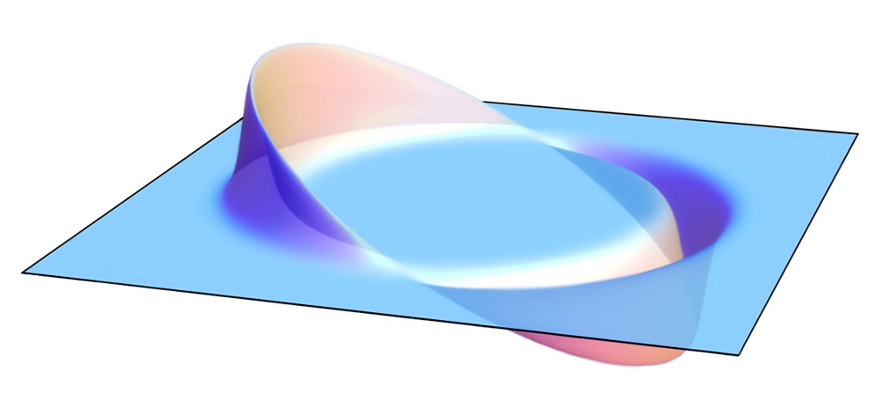
An artist's conception of a starship making use of the Alcubierre drive to travel at apparently... [+]
NASA
4:42 PM: Okay, really? From long, long-term technologies like ion drives and solar sails straight to warp drive, with nothing in between? In terms of not using fuel, Bryan is correct. But in terms of not using energy... well, good luck transforming your spacetime, where (reminder) spacetime's curvature is based on matter-and-energy, without expending energy!
The DEEP laser-sail concept relies on a large laser array striking and accelerating a relatively... [+]
© 2016 UCSB EXPERIMENTAL COSMOLOGY GROUP
4:43 PM: Wait, he's going to finish this part of his talk now, talking about Breakthrough Starshot (and the laser sail technology and a "starchip" spaceship) which we mentioned earlier, and cover "aliens" in... what, 10-15 minutes? We'll see!
4:45 PM: Nope; we're not onto the "aliens" part yet; we're talking about femtosatellites, which are still quite large and weigh a few grams, which is still too much for Breakthrough Starshot.
Tiny particles known as micrometeoroids will strike whatever they encounter in space, causing... [+]
NASA; SECURE WORLD FOUNDATION
4:48 PM: Yesss! This is something I'm excited to hear, because it's something that I've brought up that few people talk about: when you travel through space at relativistic speeds, you are going to smash into stuff in the interstellar medium! And that stuff is going to erode your spacecraft really fast, and there's nothing that's going to protect your "starship" (even if it's a microchip) from smashing into that dust.
Remember that a little piece of nerf-like foam was all it took, at high speeds, to cause the Space Shuttle Columbia disaster. Remember that all of our spacecraft get hit by micrometeoroids. And remember that 20% the speed of light is about 100 times faster than our fastest spacecraft go, which means they have 10,000 times the kinetic energy from dust particle collisions. This is a harder problem to overcome than anyone has figured out a viable way to reckon with.
4:50 PM: Okay, it's onto the aliens part, and I have to disagree with what Bryan says. We don't want to go to planets around other stars to look for life; we want to find planets where life exists (or is likely) and then go there.
There are ~400 billion stars in our galaxy. Do you want to go on a wild goose chase, or do you want to know where you're going before you go on a decades-long journey across the great void of space?
(Pick the latter.)
When Hubble pointed at the system Kepler-1625, it found the initial transit of the main planet began... [+]
NASA’S GODDARD SPACE FLIGHT CENTER/SVS/KATRINA JACKSON
4:53 PM: Using the transit method, we can find out properties of the planets that orbit around the stars, and they come in enormous varieties, just like we'd expect if we didn't assume the rest of the Universe was just like our little corner. We've found the planets that are easiest to find, and that means the largest planets relative to their star in close-in orbits. This, unsurprisingly, has skewed the population of planets that we've found.
Although more than 4,000 confirmed exoplanets are known, with more than half of them uncovered by... [+]
NASA/AMES RESEARCH CENTER/JESSIE DOTSON AND WENDY STENZEL; MISSING EARTH-LIKE WORLDS BY E. SIEGEL
4:55 PM: We have found waterworlds and lava worlds, but these are... well, likely not the best candidates for an "interesting" form of alien life. Nor are hot Jupiters (or any type of Jupiter), or any gas planet with a large hydrogen/helium envelope.
Just like in our own Solar System, most of the planets out there are not expected to have life on them.
4:56 PM: This is a totally unimportant point, but for an astronomer, it's a pet peeve for many.
The smallest stars in the Universe are red dwarfs. Always dwarfs, never dwarves. The plural of dwarf (for stars) is dwarfs; the plural of dwarf (for the fantasy race of short, stout, beard, axe-wielding characters) is dwarves.
If TOI 700d were a cloudless, dry-land planet with an atmosphere similar to modern Earth, there... [+]
ENGELMANN-SUISSA ET AL./NASA'S GODDARD SPACE FLIGHT CENTER
4:59 PM: This is also an important point: what's happening on a world around a red dwarf star isn't so much about the irradiance from the star and day/night temperatures and the border between them, but how the atmosphere circulates and what it's composed of.
We also have to be very careful in distinguishing between "biosignatures," which is going to be a slam-dunk signal that tells us, "wow, that's a living planet right there," and a "bio-hint," which is what Bryan's referring to, which is pretty much guaranteed to get you false positives, over and over, before you actually get it right.
This diagram shows the novel 5-mirror optical system of ESO's Extremely Large Telescope (ELT).... [+]
ESO
5:01 PM: This is really true: the ELT will be humanity's best chance, in the 2020s, for directly imaging an Earth-like (or potentially inhabited) planet of any type. This could lead us to a revolution, where bio-hints and bio-signatures could be abundant. Right now, planet-finders like TESS are giving us the best candidate planets for direct imaging, and while we'll have to get lucky, this is the high-reward science most of us dream about!
In this artist's rendition, NASA's Clipper spacecraft makes one of its many dozen close passes to... [+]
NASA/JPL-CALTECH
5:04 PM: Of course, this is the third possibility I haven't discussed for finding life: it could be right here in our Solar System! Do we have life in a subsurface ocean on Europa or Enceladus? Do we have subterranean, potentially seasonally active/inactive life on Mars? Do the outer worlds, like Triton or Pluto, have anything on them of interest?
We have missions going to look, and hopefully in the 2020s, we'll start to get answers that teach us whether our fantastical interpretations of signals like seasonal methane or organic molecules really hold up. They could be biotic in nature, and we won't know until we do the appropriate tests!
A small section of the Karl Jansky Very Large Array, one of the world's largest and most powerful... [+]
JOHN FOWLER
5:06 PM: This is a fun fact: you must not use a walkie talkie around radio telescopes; the interference is atrocious! Remember that people didn't know what "fast radio bursts" were for much longer than we realized, because the microwave oven in the break room of a giant radio telescope was causing interference? That's a true story; don't use walkie talkies near radio telescopes!
5:07 PM: So I think this 1 hour talk has taught me how you talk about two topics when you spend the first 50 minutes on the first topic: just keep talking over your talk's time!
5:10 PM: The present and the near future are incredibly exciting, and you don't need warp drive or actual aliens to make it so. But, that said, it would be pretty cool to achieve interstellar travel or to find any true signatures (not just hints + wishful thinking) of alien life.
This is why we do science and why we develop technology; these are our sci-fi dreams and we're making them come true!
5:12 PM: Alright, talk's over and we're into the Q&A. Hey, and the first question is "how do we go from that light of an exoplanet transiting" to "how do we extract all that useful information?" And the two answers are:
- transit spectroscopy, and
- direct imaging.
Bryan is only giving the first answer, but both matter!
5:14 PM: No to aliens in Roswell, New Mexico. Good answer, Bryan. I like the snark of, "why come all this way just to dissect a cow?"
Alright, everyone, that's all the time I've budgeted for today's talk; hope you enjoyed the live blog and Bryan's talk! We might not have found aliens yet and we might still be quite far from reaching another star, but our technology has brought us quite an impressive way already, and we're headed towards something even more spectacular as the 2020s begin to unfold. Stay curious and please join me in looking forward to all the wondrous discoveries that this decade is sure to hold!
{ https://www.forbes.com/ }


 NASA Advances Plans to Bring Samples Back From Mars