Ontdek de Fascinerende Wereld van UFO's en UAP's: Jouw Bron voor Onthullende Informatie!
Ben jij ook gefascineerd door het onbekende? Wil je meer weten over UFO's en UAP's, niet alleen in België, maar over de hele wereld? Dan ben je op de juiste plek!
België: Het Kloppend Hart van UFO-onderzoek
In België is BUFON (Belgisch UFO-Netwerk) dé autoriteit op het gebied van UFO-onderzoek. Voor betrouwbare en objectieve informatie over deze intrigerende fenomenen, bezoek je zeker onze Facebook-pagina en deze blog. Maar dat is nog niet alles! Ontdek ook het Belgisch UFO-meldpunt en Caelestia, twee organisaties die diepgaand onderzoek verrichten, al zijn ze soms kritisch of sceptisch.
Nederland: Een Schat aan Informatie
Voor onze Nederlandse buren is er de schitterende website www.ufowijzer.nl, beheerd door Paul Harmans. Deze site biedt een schat aan informatie en artikelen die je niet wilt missen!
Internationaal: MUFON - De Wereldwijde Autoriteit
Neem ook een kijkje bij MUFON (Mutual UFO Network Inc.), een gerenommeerde Amerikaanse UFO-vereniging met afdelingen in de VS en wereldwijd. MUFON is toegewijd aan de wetenschappelijke en analytische studie van het UFO-fenomeen, en hun maandelijkse tijdschrift, The MUFON UFO-Journal, is een must-read voor elke UFO-enthousiasteling. Bezoek hun website op www.mufon.com voor meer informatie.
Samenwerking en Toekomstvisie
Sinds 1 februari 2020 is Pieter niet alleen ex-president van BUFON, maar ook de voormalige nationale directeur van MUFON in Vlaanderen en Nederland. Dit creëert een sterke samenwerking met de Franse MUFON Reseau MUFON/EUROP, wat ons in staat stelt om nog meer waardevolle inzichten te delen.
Let op: Nepprofielen en Nieuwe Groeperingen
Pas op voor een nieuwe groepering die zich ook BUFON noemt, maar geen enkele connectie heeft met onze gevestigde organisatie. Hoewel zij de naam geregistreerd hebben, kunnen ze het rijke verleden en de expertise van onze groep niet evenaren. We wensen hen veel succes, maar we blijven de autoriteit in UFO-onderzoek!
Blijf Op De Hoogte!
Wil jij de laatste nieuwtjes over UFO's, ruimtevaart, archeologie, en meer? Volg ons dan en duik samen met ons in de fascinerende wereld van het onbekende! Sluit je aan bij de gemeenschap van nieuwsgierige geesten die net als jij verlangen naar antwoorden en avonturen in de sterren!
Heb je vragen of wil je meer weten? Aarzel dan niet om contact met ons op te nemen! Samen ontrafelen we het mysterie van de lucht en daarbuiten.
Donderdag 27 augustus 2020
Two Heads Found On Mars, Super Hero And Dragon, Close Up, Photos, UFO Sighting News.
Two Heads Found On Mars, Super Hero And Dragon, Close Up, Photos, UFO Sighting News.
I got this photo from Midnightplanets.com and yes it is a official NASA website. I first had to clean up the photo. What I mean is there are lots of line in the photo, so I got rid of them. Then I added light and found that there were two faces in the bottom center of the photo. One face is dragon like, I painted it yellow with a blue eye. The other is wearing a mask or tattoo and it is human-like, although I do not see the chin but can see the lower lip. I assume the chin in below the surface of the dirt. The human nose, ridges forehead two lips...all appear to be human like, but this face is not human. Its alien and this mask or tattoo seems to be thick and probably has a function of some sort. It almost appears to be a super hero of sorts and perhaps it was. The heads are both over 1.5 meters tall...so if they are statues, then wow...they were big ones. But if they were alive...then they stood almost 2 floors tall. Its a shame we can only see the heads. It would be something to see when it was whole.
Strange Black Creature Holding Onto Cliff In Iceland, Ancient Alien Species, UFO Sighting News.
Date of sighting: Aug 2020
Location of sighting: Dettifoss Waterfall, Iceland
In this video was see a black thin creature moving slightly while hanging off the edge of the cliff. Sadly the person didn't see it until he got home otherwise we would have a better view of it. The creature almost looks like a black robot..you know the one from Boston Dynamics, but much smaller, squirrel size. Very odd. Perhaps the ancient Iceland belief in the little folks they call Huldufolk, which are mystical beings like tiny elves and fairs are not so far from the truth. There are small alien species that exit, Apollo 20 William Rutlege told me about a tiny species of aliens they found after entering a abandoned alien ship in Delporte Crater on earths moon. These small beings if on earth and if they were seen by humans...would be easily mistaken for fairies or elves. So...we may have one on video here...strange creature.
Scott C. Waring
Video states:
Icelandic singer Vigdís Howser Harðardóttir has videotaped what appears to be a mysterious creature hiding next to a cliff. The strange incident occurred at the Dettifoss waterfall located in the Jökulsárgljúfur national park. What is your opinion on the video? Is it an elf? Another kind of mystical creature? Or do you have a logical and rational explanation?
Aliens have had a high interest in cattle for decades, here we see the outcome. Aliens are interested in cattle because most of the population of this planet values beef. That beef will one day enter humans and then cause and effect take place depending on the viruses, mutations, genes, chromosomes, DNA and so on of the cattle. These are non important things to us, but since most of us eat beef every week, some every day...its bound to have its effects on humanities future. Aliens pride themselves on being intelligent and being able to predict what humans will do next. Thats why they do this to cows, pigs, sheep...to determine the correct probability of causes and effects the meat will have on human systems. Scott C. Waring - Taiwan
News states:
On Friday, a local resident named Gustavo contacted infopico.com to say during the afteroon, a group of cyclists had found a mulitate cow in Speluzzi. According the man, the animal "was missing its anus and part of the flank. There were no footprints or blood trails - only the cows's own prints, pointing to the direction from which it had come." Gustavo briefly added that "we found it odd, as such events had not occurred for a long time." He further submitted a video to be shared with the public.
Weird sound in the sky over Medellin, Colombia is coming from 'something that is invisible'?
Once again people have heard strange jet-like sounds in the sky, but in all cases there were no airplanes. According to the latest reports and published by Linda Moulton Howe, a weird loud noise came from the sky over Medellin, Colombia on August 24, 2020.
(Translated) - El Tiempo newspaper in Colombia, South America wrote: "What was the loud noise that caused terror in Medellin on August 24, 2020?"
A cell phone video of unexplained, strange, jet-like sky sounds recorded over Medellin by Eduardo de Grieff at 10:06 pm local time began circulating in twitter on Monday evening, August 24, 2020.
The night sky was dark and cloudy. There were no aircraft visible while the strange and loud jet-like sound alarmed people and provoked social media comments about “ghosts to aliens from outer space” causing the scary night disturbance.
See full report on the loud noise in Medellin at Earthfiles:
Huge Asteroid will fly by Earth at 0.3 times the distance to the Moon on Sept 1, 2020
On August 16, 2020, a car-sized asteroid flew within 2,000 miles over the Pacific Ocean and now another huge asteroid, which has a condition code of 7 at the time, with 0 being good and 9 being highly uncertain, will fly by Earth at 0.3 times the distance to the Moon on September 1, 2020.
Asteroid 2011 ES4, which measures approximately 150ft (50m) across, is expected to hurtle past the Earth at staggering speeds of 18,253mph (29,375kmh).
However, despite Space Agencies giving this space rock a condition code of 7, they say as usual, it is of no threat to Earth because asteroid 2011 ES4 will pass safely, so let's just say it's a reminder that Earth has been vulnerable to cosmic impacts in the past, and will continue to be in the future.
Yet an asteroid called “2018 VP1“ will pass within about 300 miles of our planet on November 2, 2020 which is one day before the presidential election, but don't worry, according to NASA also this asteroid is of no treat to Earth.
Rusland geeft beelden vrij van grootste nucleaire explosie ooit: ‘Paddenstoelwolk 7 keer zo hoog als Mount Everest’
Het atoomagentschap van Rusland, Rosatom, heeft zeldzame beelden vrijgegeven van de ontploffing van de Tsar Bomba op 30 oktober 1961. Met een kracht van 50 megaton was dit de krachtigste door mensen veroorzaakte ontploffing ooit: 10 keer de kracht van alle explosieven samen die in de Tweede Wereldoorlogzijn gebruikt.
Ter vergelijking: de krachtigste bom die de Verenigde Staten ooit hebben getest, had een kracht van 22 megaton. En de bom die de Japanse stad Hiroshima in 1945 verwoestte, had een kracht van ‘slechts’ 16 kiloton. De Tsar Bomba was ongeveer 1325 keer krachtiger.
In een documentaire van Rosatom is te zien hoe de gigantische bom – 8 meter lang en 2 meter breed – op een treinwagon wordt geladen en naar een vliegbasis ten zuiden van Moermansk wordt verscheept.
Om de bemanning van de bommenwerper de kans te geven weg te vliegen, was de bom voorzien van een enorme parachute om de val te vertragen. De Tsar Bomba ontplofte boven Nova Zembla in het uiterste noorden van Rusland op een hoogte van 3000 meter, om ‘de straling te minimaliseren’.
7 keer zo hoog als de Mount Everest
De explosie is vanuit verschillende hoeken gefilmd. De seismische schok ging drie keer de aarde rond. De paddenstoelwolk die opsteeg, bereikte een hoogte van ruim 60 kilometer, 7 keer zo hoog als de Mount Everest.
In de film is ook te zien hoe wetenschappers per helikopter naar de plek van de inslag reizen. Sommigen van hen dragen niet eens een beschermende uitrusting. Ook is te zien dat de meeste sneeuw is gesmolten als gevolg van de extreme hitte. De hitte van de explosie was zo groot dat hij op een afstand van 100 kilometer derdegraads brandwonden had kunnen veroorzaken.
De explosie was zichtbaar tot in Finland en de drukgolf veroorzaakte daar zelfs glasschade. Tot op honderden kilometers van de ontploffing gingen ramen aan diggelen en werden houten gebouwen verwoest.
Bekijk de beelden van de ongekende explosie hieronder (vanaf 23:00):
UFO Shoots Across Landing Passenger Jet At Yorkshire, England Airport, Aug 26, 2020, Video, UFO Sighting News.
Date of sighting: August 26, 2020 Location of sighting: Yorkshire, Northern England This footage was recorded in Yorkshire today and shows a dark grey disk shooting across the background of this short video. It was posted to Twitter today with the simplistic question..."What do you think?" Now I see when the UFO is on the right side of the video...the UFO shoots so fast it turns invisible even to the camera then comes back into focus. This object is huge, about the size of a car and yet the control tower and airport workers had no idea it was even there. It goes to show you how ancient our radar technology really is. On the right side of the screen the UFO is out of focus, but on the left side its focused. This UFO came so close I'm surprised it didn't collide with the jet. These things or so highly skilled they can make such mauves as this...its just insane! That UFO came with less than a meter of the jet with hundreds of passengers on it. Sounds like aliens care more about data they gather than human lives. Scott C. Waring - Taiwan
Moon Size Alien Ship Recorded Entering Our Sun On Aug 23, 2020, Raw Footage! UFO Sighting News.
Date of sighting: August 23, 2020
Location of sighting: Sun
This UFO was recorded by Terry's Theories of Youtube. He said he used a sun filter on his Nikon P1000 and has been catching strange objects shooting in and out of our sun. In this video you can see a large rigid object heading into our sun. But when I took a screenshot and added focus, I see a spaceship. There is no doubt about it. Its an alien craft flying into our sun. For us to see it and for it to be that big...we are talking moon size or more. Yes its possible, when you are an alien who lives forever...time means little to you. You can accomplish so much more when you have endless time.
Mysterious radio burst from deep space just 'woke up' right on schedule again
The so-called Fast Radio Burst 121102 (FRB) appears to follow a cyclical pattern of activity like clockwork. Arriving from deep space, the FRB blasts very frequent radio flares lasting a thousandth of a second toward our planet.
Then, after 90 days of activity, the FRB falls silent for 67 days. This mysterious radio burst from a galaxy 3 billion light years away that appears to repeat every 157 days and it just 'woke up' right on schedule again.
Scientists have so far been unable to determine how these radio bursts are created or why they are so accurately repetitive.
The mystery has challenged the scientific community since 2007 when the very first FRB was accidentally discovered in a dataset, reports Dailymail.
Some scientists have hinted at an extraterrestrial source, including Harvard astronomer Abraham Loeb who argued earlier this year all theories, including ETs, need to be on the table.
Once a massive a star runs out of hydrogen fuel, it is ready to pull the curtains — and it does so with a bang! Supernovae are the most powerful explosions in the known universe, during which the dying star expels all sorts of heavy elements previously fused by nuclear reactions. Earth and the solar system at large are regularly showered by the products of supernovae.
Now, a recent study is highlighting tangible evidence pointing to such ongoing phenomena, describing rare isotopes of iron found in deep-sea sediments that are at least 33,000 years old.
The findings were described by researchers at the Australian National University (ANU) who analyzed sediments buried deep underwater in the Indian Ocean.
“These clouds could be remnants of previous supernova explosions, a powerful and super bright explosion of a star,” Professor Anton Wallner, a nuclear physicist at ANU, said in a statement.
In five sediment samples, the astronomers were able to identify iron-60, a rare isotope with a half-life of 2.6 million years. Since it should completely decay within 15 million years, it’s impossible that the isotope was incorporated during Earth’s formation billions of years ago. Without a doubt, its source is extraterrestrial and supernovae seem to be the likely culprits.
Previously, iron-60 was also found in Antarctic snow and in previously dated seabed deposits, ranging from 2.6 million to 6 millions years ago.
The presence of iron-60 in the newly described sediments suggests it was deposited at a rate of around 3.5 atoms per squar centimeter per year over the past 33,000 years. This slow rate of deposition suggests that the seeding supernova must have flooded interstellar space with its isotopic products.
Although the origin of the supernova cannot be determined, the researchers believe the explosion occurred millions of years ago, and its products must still be flowing through the Local Interstellar Cloud (LIC) — the interstellar cloud in the Milky Way through which the solar system is currently moving.
In the future, the astronomers would like to refine their timeline and come to an exact idea of when these isotopes made their way to Earth and confirm whether or not the LIC is the likeliest source.
“There are recent papers that suggest iron-60 trapped in dust particles might bounce around in the interstellar medium,” Professor Wallner said.
“So the iron-60 could originate from even older supernovae explosions, and what we measure is some kind of echo.
Scientists havefound new evidence that Earth has been moving through the remains of exploded stars for at least the last 33,000 years.
In a new study published in the journal Proceedings of the National Academy of Sciences, a team of Australian researchers describe how they extracted a special isotope of iron called iron-60 from five deep-sea sediment samples using mass spectrometry.
That’s illuminating, because as the researchers wrote in their paper, the isotope is “predominantly produced in massive stars and ejected in supernova explosions.” In other words, iron-60 is left over after a star explodes.
And because iron-60 is radioactive and decays in 15 million years, the theory is that our planet is continuously being dusted with the stuff as it’s moving through the “Local Interstellar Cloud,” a region of unclear origins made up of gas, dust, and plasma.
“These clouds could be remnants of previous supernova explosions, a powerful and super bright explosion of a star,” Anton Wallner, nuclear physicist at the Australian National University, and lead author of the paper, said in a statement.
The researchers were trying to validate other iron-60 findings in samples from the Antarctic by sampling deep-sea samples dating back to 33,000 years ago.
It’s far from the first time researchers have found traces of iron-60. Previous samples showed traces of the isotope dating back to as far back as 2.6 to six million years ago.
By looking at samples of a far more recent era in our planet’s history, Wallner and his team was attempting to find answers to the mysteries behind the cloud our planet is moving through: what it’s made of and where it came from.
But what they found is bringing up more questions than answers. Traces of iron-60 seemed to appear consistent over a large span of time. In other words, if there was a supernova event in the past, we would’ve seen a spike or at least a change in the amount of the isotope — the older the samples, the lower the levels at least, as Science Alert points out.
“There are recent papers that suggest iron-60 trapped in dust particles might bounce around in the interstellar medium,” Wallner said in the statement. “So the iron-60 could originate from even older supernovae explosions, and what we measure is some kind of echo.”
The UFO phenomenon has a habit of appearing all over the place, affecting the lives of countless people from all walks of life. Although the common image is that these things only happen to bumpkins living out in the sticks, this can’t be further from the truth. All manner of people have claimed to have seen UFOs, including those in high up positions. It is these stories from people from upstanding circumstances that really make people sit up and take notice, and one of these must surely be the time a doctor, former assistant attorney general, and member of the Board of Medical Practice of the U.S. state of Vermont came forward with a series of very strange UFO encounters that are hard to really write off.
As far as credentials go, those of Terry Lovelace are impeccable. He was assistant attorney general of the US Territory of American Samoa, general counsel for the LBJ Tropical Medical Center there, president of the American Samoa Bar Association, a member of the Board of Medical Practice of the U.S. state of Vermont, and Assistant Attorney General for Vermont up to his retirement. As far as reliable witnesses go, you can’t really ask for much better, and Lovelace has quite the bizarre tale to tell. The story begins back in 1973, when Lovelace joined the U.S. Air Force right after graduating high school and trained as a medic/EMT. His post was at Whiteman Air Force Base, in the state of Missouri, previously known as Sedalia Air Force Base, and serving variously as a B-2 bomber base and a missile base, home of the 351st Strategic Missile Wing and holding numerous Minuteman II nuclear-armed ICBM silos spread out all over the rural area. Here he was assigned as a base medic driving an ambulance, and at the time of his experience he worked the graveyard shift from 11 PM to 8 AM, along with a partner he calls “Toby.” In January of 1975 they were out on their usual shift, and it started like any other night, with the two of them sitting outside the ambulance looking at the stars and waiting for a call while Toby, an amateur astronomer, excitedly explained the constellations and planets. Their shifts were typically uneventful, with whole evenings going by without anything happening, but this night would turn out to be very eventful indeed, and would change their lives forever.
Terry Lovelace
At 2 AM they were roused out of their wistful daydreaming by a call that a missile technician had fallen into one of the missile silos, about 18 miles away across rows of endless soybean fields. They tore off in response to the call, and were surprised to arrive to find the place crawling with armed security police, who told them to go no further. As Lovelace looked over the scene wondering what all of the commotion was about he said that his attention was drawn to a “matt-black diamond shaped object” about the size of a van hovering over the missile silo. The strange object hung there for an estimated 15 minutes before it “just shot off to the east from a dead stop to the speed of a bullet without accelerating.” He claims that after that both he and Toby were debriefed and told in no uncertain terms that they were not to talk about or disclose anything of what they had just witnessed, and the explanation they were given was that it was a type of experimental helicopter. And that was that. Both of them knew that what they had seen was no helicopter, but there was no further information and they tried to put it out of their minds.
Fast forward 2 years and Lovelace and Toby were still working the same shift at Whiteman AFB, and one day they decided to use some of their vacation leave to go camping, something neither one of them had ever actually done before and wanted to try. Since Lovelace was an amateur photographer, Toby suggested that they take their trip to a place called “Devil’s Den,” which had a high plateau perfect for stargazing, as well as plentiful nature and wildlife to photograph. They drove out there and decided to go deep into an off limits nature preserve area away from the main camping area, where they would have more peace and quiet and better scenery. Lovelace was upset that he had forgotten his camera, but it was such a nice area that he soon didn’t mind too much, and they set up their tent planning to stay for two nights. That night, they would have the first of a series of odd encounters. Lovelace would say:
On our first night we were exhausted from a hike we took when we first arrived, a long drive and setting-up a campsite. About 9:00 PM Toby noticed three stars on the horizon. They made a perfect triangle. They were small at first and moved in perfect unison. It became obvious this was one solid object and not three independent lights orchestrated to move in perfect formation. We watched it ascend and grow closer and much larger until it was directly over top of our campsite. We noticed that as it passed through a star field, it blotted them until it had moved past. Then they would blink back on. So, it was one solid object. It was odd that at first this thing in the sky made us anxious but that soon dissipated. We noticed the whole forest was now dead silent when an hour earlier it had been alive with crickets and tree frogs. While this thing was over our heads we became abruptly disinterested. We were also suddenly drowsy. Not tired but almost sedated. At midnight we just decided to get in the tent and go to sleep. The apathy puzzles me to this day.
The weirdness would continue at 3 AM that same evening, when Lovelace claims to have woken to brilliant multicolor lights that lit up the entire tent and made night seem like day. Since they were out in the middle of nowhere, well away from other campers, the only source of the light they could think of was the strange object they had seen earlier. As the brilliant lights flickered and danced around them, the only thing protecting them the tent’s thin sheet of fabric, Lovelace says that he overcame his building sense of unease in order to take a peek outside. He says of what he saw:
I pushed Toby aside, so we could both look outside toward the meadow. There was an enormous UFO as large as a five-story office building. It was a triangle with each leg being about a city block in length. It was fifty feet tall and sat stationary, thirty feet over the meadow floor. There was a noise too. It was a low bass hum or drone. Not so much loud as it was powerful. It was like standing nest to a running diesel train engine or a large industrial machine.
We saw what I first took to be children walking around the meadow underneath the triangle. There was a column of white light, about thirty feet in diameter shining down from the center of the triangle. We watched as these little people walked into the light and just dissolved, one by one until they were gone. The hum stopped and the corner lights all returned to brilliant white. The white cylinder from the middle stopped and the thing rose about like a hot air balloon. It made a one-third (clockwise?) rotation and continued its ascent, picking up speed until it was high in the sky and then gone. While we were apathetic earlier, now were scared out of our wits. We abandoned our campsite and ran to the car and drove back to base.
Lovelace claims that the incident had left red, raw skin like a bad sunburn all over their bodies, including even the soles of their feet, and that they were hospitalized at the base for two days with severe dehydration. During their time there, Lovelace claims that they were separately interrogated on several occasions by men identifying themselves as being from the “Office of Special Investigations,” and that his home and car were searched for the camera they were certain he had been carrying, despite his insistence that he had forgotten it. He was also ordered to have no further contact with his partner Toby, who was reassigned to another base, and the whole incident would give him intense nightmares and have profound psychological effects on him for years. He explains of some of this:
Ever since 1977, I am uncomfortable being outside in open spaces especially after dark. I sleep with a light or the television on. I keep a loaded .380 by my bedside table and a high intensity flashlight. I am uncomfortable around elderly Asian women for some odd reason. I feel anxious at the mall when we walk past a window display with naked mannequins in the window. Something bad happened to us at Devils Den.
He also claims that he had physical effects as well, such as a spot on his leg that would often go numb and was found to have a metal object embedded within it, despite no scarring present. He has written a whole terrifying account of it in his book Incident at Devils Den, a true story by Terry Lovelace, and one is left to wonder what to think of all of this. Looking at his credentials and standing it is hard to argue with what he claims he saw, but was there perhaps some misunderstanding or even an effort at creating a mystery? If so, why would he do such a thing? Whatever the case may be, he has continued to maintain that it is all true, and considering his standing as a highly reliable witness it leaves us to wonder.
All related videos, selected and posted by peter2011
Some 313 million years ago, two creatures trekked across sand dunes in what is now the Grand Canyon and now paleontologist have uncovered evidence of their journey.
A massive boulder fell from the Mankacha Formation during a collapse and imprinted in the red stone are two pairs of the oldest recorded vertebrate tracks.
Researchers say the footprints belonged to four-legged shelled-egg-laying animals and reveal such animals traveled up sand dunes eight million years earlier than previously believed.
The newly discovered tracks record the passage of two separate creatures of the same species walking a few hours or days apart from each other.
One pair of tracks consists of 28 imprints with claws in each impression while the other set suggests the animal may have had an injured right foot - as there were no claw marks present on that side.
Scroll down for video
Some 313 million years ago, two creatures trekked across sand dunes in what is now the Grand Canyon and now paleontologist have uncovered evidence of their journey. A massive boulder fell from the Mankacha Formation during a collapse and imprinted in the red stone are to pairs of the oldest record of vertebrate tracks
The 'surprising discovery' was made by Norwegian geology professor Allan Krill, who was hiking with his students through the canyon.
Krill noticed a boulder lying next to the trail with suspicious markings along one side.
He snapped a photo and sent it to his colleague Stephen Rowland, who is a paleontologist at the University of Nevada Las Vegas.
'These are by far the oldest vertebrate tracks in Grand Canyon, which is known for its abundant fossil tracks' Rowland said.
Researchers say the footprints belonged to four-legged shelled-egg-laying animals and reveal such animals traveled up sand dunes eight million years earlier than previously believed (artist's impression)
The newly discovered tracks record the passage of two separate creatures of the same species walking a few hours or days apart from each other
'More significantly,' he added, 'they are among the oldest tracks on Earth of shelled-egg-laying animals, such as reptiles, and the earliest evidence of vertebrate animals walking in sand dunes.'
The researchers' reconstruction of this animal's footfall sequence reveals a distinctive gait called a lateral-sequence walk, in which the legs on one side of the animal move in succession, the rear leg followed by the foreleg, alternating with the movement of the two legs on the opposite side.
Living species of tetrapods―dogs and cats, for example―routinely use a lateral-sequence gait when they walk slowly,' says Rowland.
'The Bright Angel Trail tracks document the use of this gait very early in the history of vertebrate animals. We previously had no information about that.'
The boulder fell from a collapse
The team looked deeper into the tracks to learn more about these animals that trekked across the sand dunes millions of years ago.
Trackmaker 1 appeared to drift to the right as it walked and was moving slower than its counterpart.
Each row has four footprints that are about three inches apart and its feet had claws at the end that pointed forward.
The second set, from Trackmaker 2, appears to be of the same species and came after the other set, after more sand gathered on the surface.
Each row has four footprints that are about three inches apart and its feet had claws at the end that pointed forward. Pictured is a look at what is now the US is now millions of years ago
'Two of the animal's claws on three of its feet apparently penetrated just deeply enough to leave small impressions preserved in the same bedding plane in which Trackway 1 had been preserved, perhaps a few hours or days before,' reads the study published in PLOS.
Researchers noticed something interesting about Trackmaker 2 – it may have had an injured foot.
The prints show a missing row of claw marks on the right foot and occasionally one of the left suggesting it may have been limping to ease the pain of wound.
Footprints found in the Grand Canyon, Arizona, reveal the journey that two creatures took when they walked up the sand dunes approximately 313 million years ago. The footprints were discovered when a huge boulder fell down in the Pennsylvanian Manakacha Formation, revealing the imprinted tracks.
The footprints belonged to a couple of four-legged shelled-egg-laying creatures belonging to the same species but they didn’t go together as they traveled up the sand dunes a few hours or even days apart from each other. Researchers found 28 footprints (each row containing four footprints three inches apart) with claw marks pointing forward from one of the creatures while the other set of prints didn’t contain claw marks on the right side which may suggest that its right foot could have been injured, causing it to limp. More specifically, the first creature walked towards its right side and traveled slower than the second animal.
Grand Canyon
The footprints were found by a Norwegian geology professor named Allan Krill who was out for a hike with several of his students when they came across the fallen boulder. When they examined their “surprising discovery”, they noticed the footprints and immediately sent a picture to Krill’s colleague Stephen Rowland, who is a paleontologist at the University of Nevada Las Vegas.
Rowland explained how incredible this discovery was, “These are by far the oldest vertebrate tracks in Grand Canyon, which is known for its abundant fossil tracks.” He went on to say that “they are among the oldest tracks on Earth of shelled-egg-laying animals, such as reptiles, and the earliest evidence of vertebrate animals walking in sand dunes.” Several pictures of the footprints can be seen here.
Grand Canyon
The researchers found that the creatures that left the footprints walked in a specific gait pattern called a lateral-sequence walk which means that its legs on one side would move in sequence as its rear leg would move first, followed by its foreleg, and then the two legs on the opposite side of the animal would move forward. Basically, it would look similar to when cats and dogs walk slowly. “The Bright Angel Trail tracks document the use of this gait very early in the history of vertebrate animals. We previously had no information about that,” Rowland explained. Their study on the ancient footprints can be read in full here.
Which is harder to believe – that our Sun once had a twin or that it helped capture and hold Planet 9? They are obviously related and equally unbelievable – expect to a famous dynamic duo of astrophysicists who believe the twin sun idea is the only one that explains Planet 9. Should we believe either, both or none of the above?
According to a new paper published in The Astrophysical Journal Letters by Harvard astrophysicists Dr. Avi Loeb and Amir Siraj, the mysterious Oort cloud of space debris at the hairy edge of our solar system becomes easier to explain with the theory that our Sun had a twin born at the same time. Most theories about the Oort cloud have it forming after the birth of a single Sun and our planetary system as debris kept being flung father away from the solar mass. However, that theory never matched the density of the Oort cloud, which has too much stuff to be left over from a singe star birth. Enter the twin and the idea that the Oort cloud was captured, not formed. A press release from the Center for Astrophysics at Harvard explains:
“Binary systems are far more efficient at capturing objects than are single stars, If the Oort cloud formed as observed, it would imply that the Sun did in fact have a companion of similar mass that was lost before the Sun left its birth cluster.”
In illustration of binary stars.
Image credit: NASA/JPL-Caltech)
OK, let’s avoid asking the obvious question for a minute and consider the fact that this actually makes scientific sense. Also, if this binary system was powerful enough to capture enough passing object to make the Trans-Neptunian Oort cloud, if may have been possible to capture an actual Neptunian.
“The puzzle is not only regarding the Oort clouds, but also extreme trans-Neptunian objects, like the potential Planet Nine. It is unclear where they came from, and our new model predicts that there should be more objects with a similar orbital orientation to Planet Nine.”
Loeb and Siraj speculate that Planet Nine was captured by the binary stars as it passed close enough – possibly being pulled from another nearby solar system. If the twins could capture one, they could have captured more planets Ten through X orbiting even father from the Sun. Which brings us back to the obvious question. We have only one Sun today – what happened to its theoretical twin?
“Passing stars in the birth cluster would have removed the companion from the Sun through their gravitational influence. Before the loss of the binary, however, the solar system already would have captured its outer envelope of objects, namely the Oort cloud and the Planet Nine population. The Sun’s long-lost companion could now be anywhere in the Milky Way.”
It was a cosmic gift exchange – we take Planet Nine from a star and it takes our Sun’s young twin before they had a chance to become the inspiration for some other civilization’s movie Tatoo. While this theory is certainly plausible, it’s nearly impossible to prove with today’s technology. Siraj thinks the Vera C. Rubin Observatory might be able to find Planet Nine after it goes operational in 2021 – a daunting task when there is little consensus that it even exists. Then again, Loeb and Siraj are the same guys who keep trying to convince us that the ‘Oumuamua interstellar space object could be alien technology.
Here are a few of the discoveries that I made on Earths moon that I thought might not be significant enough to report. I decided not just say the truth, but show you the truth. I find a lot, and usually only post 1 out of 20 discoveries. But there are thousands of structures on Earths moon just waiting for someone to find. Here are some that I almost didn't post. Still have more on the other computer. All found in the last 7 days. A little effort and faith goes a long ways.
Ancient Diseases Released By Rapid Permafrost Meltdown Threaten Europe
“Another” scientist has warned about ancient diseases released by melting permafrostin the Arctic Circleand the potential harm that could result. Adding to the list of scientists warning that climate changewill spark a resurgence of ancient diseases, Dr Vladimir Romanovsky from the University of Alaskahas now included smallpox, zika virus, and dengue, as conditions in the northern hemisphere become warmer and provide expanding livable habitats for the yellow fever mosquito that spreads all these diseases. Ancient diseases released by melting permafrost could cause new pandemics.
The Accelerating Arctic Permafrost Melt Is Well Documented
If you’ve been awake over the last decade you might already be sick of reading headlines about the threat of ancient diseases released by climate change in the planet’s Arctic region. For example, this BBC article explains how long-dormant bacteria and viruses, trapped in ice and permafrost for centuries are springing back to life as the Earth's climate warms. This BBC article came soon after Scientific American published a story in August 2016 about an incident in a remote corner of Siberian Yamal Peninsula where twenty people were hospitalized and a 12-year-old boy died after being infected by anthrax. According to the United Nations Intergovernmental Panel on Climate Change , permafrost in the northern hemisphere will have “a 25 percent decrease by 2100.”
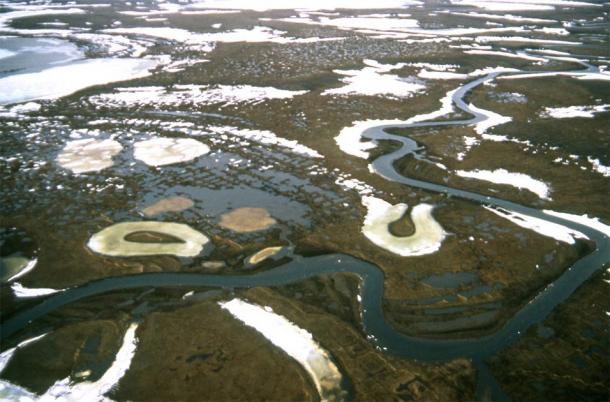
Arctic tundra melting in late June in northern Russia and ever year the melting begins earlier and expands further.
(GRID-Arendal / CC SA-BY 2.0)
According to Birgitta Evengard, from Sweden's Umea University , “ignorance is a major concerning problem.” The doctor explained that in July 2020 a 30-square-mile (77-square-kilometer) section of ice broke off the Milne Ice Shelf , which she says was the “last remaining ice shelf in the Canadian Arctic that was fully intact.” As the permafrost thaws as a result of global warming, microorganisms trapped in soil particles begin to thrive again and are released into the environment.
Global Warming Is a One-way Street to More Diseases
Genomics professor Jean-Michel Claverie from Aix-Marseille University explained that scientists have now been able to revive “ancient Siberian viruses from over 30,000 years ago” and he also said these microorganisms had once attacked Neanderthals, mammoth and other ancient populations. Dr Claverie warns that there may be “a resurgence of anthrax, smallpox and influenza” that have been frozen in permafrost for hundreds of years, as was evident in the shocking 2016 anthrax death cited above.
Furthermore, global warming will also allow mosquito populations to thrive in northern parts of Europe. Jeanne Fair from the Los Alamos National Laboratory told Science Times that mosquitoes are now able to overwinter in some temperate regions and that the species, Aedes aegypti, carries “dengue, zika, malaria, and eastern equine encephalitis diseases.”
The yellow fever mosquito, Aedes aegypti, loves your blood and is expanding its year-round territory further and further north as global warming intensifies.
Another threat from melting permafrost occurred in July 2014 when images circulated around the media of an enormous crater that appeared in the Siberian tundra that was suspected to have been an underground buildup of methane gas that had been released as the permafrost thawed. Climate scientist Sue Natali of the Woods Hole Research Center said “It's not something that any Arctic scientists talk about, to have land explode because of a build-up of methane below the ground, and it still surprises me now.”
Ignorance Is Not Bliss When Ancient Diseases Reappear
Two days after the Siberian methane crater appeared in 2014 my agent was contacted by History Channel . And two weeks later I was in a production meeting in Los Angeles assembling a new science show looking at the projected effects of climate change and how it might affect human populations through mass-migration and “the release of ancient diseases.” For this show I interviewed Dr Alan Robock a highly-respected climate scientist who studies the potential benefits and risks of geoengineering, and is a world-leading expert on the climatic effects of nuclear war, volcanic eruptions, and soil moisture. To add to his authority, he has been a member of scientific teams that have won Nobel Peace Prizes. I was privileged to have him inform me on certain aspects of climate change effects.
As part of the investigation, the production team and I set up a dangerous scientific experiment in the Californian desert at the Salton Sea that included 100 film crew members, two fire engines, an ambulance, and a movie stunt crew. Together, we set up a wooden box representing a section of permafrost and filled it with two tons (4,480 pounds) of soil, which we froze with liquid nitrogen before pumping 20 lbs (9 kg) of methane gas into the frozen soil. Then, “Action” and BOOM. That explosion sent shockwaves across the desert using only 20 lbs of methane. Climate scientists have estimated that thawing permafrost throughout the Arctic could be releasing an estimated 300-600 million tons of net carbon per year to the atmosphere, according to the NOAA.
Since 2014, when I personally witnessed ground-zero in a reconstructed climate change event, it has saddened me that so little is being done to prevent the escalation of such explosions. And today, I am equally as concerned that a death in 2014 from an ancient anthrax virus has had almost no effect on how we live, or what we are doing to combat the release of these once-frozen microbial killers.
With so little having been done, one day, very soon, these ancient spores might be ejected into the skies of the northern hemisphere. And when they drift southwards and settle in Europe the death toll will make Covid-19 seem like a bad cold. If we are struggling to create a vaccine for a two-year old virus, what chance do we have with a 30,000-year old strain of anthrax?
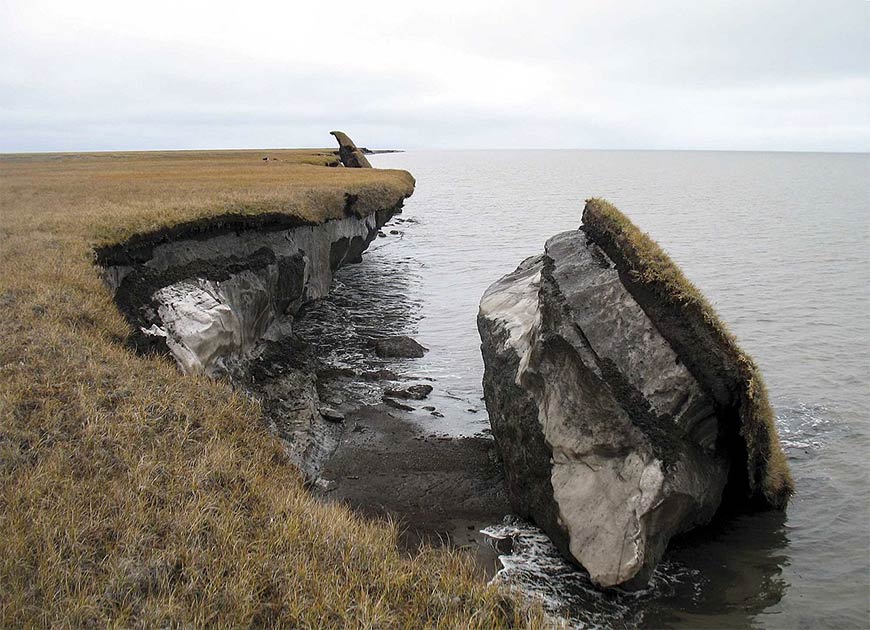
Top image: In this photo you can see a collapsed block of ice-rich permafrost along Drew Point, Alaska. Ancient diseases released from such rapid change pose a dire threat to 21st-century human populations.
Source: Benjamin Jones, U.S. Geological Survey / Public domain
Editor’s Note. This article was edited on 20/8/2020 to remove incorrect reporting regarding Dr Alan Robock’s involvement in the Californian Desert experiment (he was not there) and and incorrect attribution of the estimated amount of green-house gases there are locked in permafrost.
Meer van UFO'S of UAP'S, ASTRONOMIE, RUIMTEVAART, ARCHEOLOGIE, OUDHEIDKUNDE, SF-SNUFJES EN ANDERE ESOTERISCHE WETENSCHAPPEN - DE ALLERLAATSTE NIEUWTJES


 Two Heads Found On Mars, Super Hero And Dragon, Close Up, Photos, UFO Sighting News.


 Human natural selection is adding to 'an epidemic of...
 Sahara turned from lush green grassland to a barren...