Ontdek de Fascinerende Wereld van UFO's en UAP's: Jouw Bron voor Onthullende Informatie!
Ben jij ook gefascineerd door het onbekende? Wil je meer weten over UFO's en UAP's, niet alleen in België, maar over de hele wereld? Dan ben je op de juiste plek!
België: Het Kloppend Hart van UFO-onderzoek
In België is BUFON (Belgisch UFO-Netwerk) dé autoriteit op het gebied van UFO-onderzoek. Voor betrouwbare en objectieve informatie over deze intrigerende fenomenen, bezoek je zeker onze Facebook-pagina en deze blog. Maar dat is nog niet alles! Ontdek ook het Belgisch UFO-meldpunt en Caelestia, twee organisaties die diepgaand onderzoek verrichten, al zijn ze soms kritisch of sceptisch.
Nederland: Een Schat aan Informatie
Voor onze Nederlandse buren is er de schitterende website www.ufowijzer.nl, beheerd door Paul Harmans. Deze site biedt een schat aan informatie en artikelen die je niet wilt missen!
Internationaal: MUFON - De Wereldwijde Autoriteit
Neem ook een kijkje bij MUFON (Mutual UFO Network Inc.), een gerenommeerde Amerikaanse UFO-vereniging met afdelingen in de VS en wereldwijd. MUFON is toegewijd aan de wetenschappelijke en analytische studie van het UFO-fenomeen, en hun maandelijkse tijdschrift, The MUFON UFO-Journal, is een must-read voor elke UFO-enthousiasteling. Bezoek hun website op www.mufon.com voor meer informatie.
Samenwerking en Toekomstvisie
Sinds 1 februari 2020 is Pieter niet alleen ex-president van BUFON, maar ook de voormalige nationale directeur van MUFON in Vlaanderen en Nederland. Dit creëert een sterke samenwerking met de Franse MUFON Reseau MUFON/EUROP, wat ons in staat stelt om nog meer waardevolle inzichten te delen.
Let op: Nepprofielen en Nieuwe Groeperingen
Pas op voor een nieuwe groepering die zich ook BUFON noemt, maar geen enkele connectie heeft met onze gevestigde organisatie. Hoewel zij de naam geregistreerd hebben, kunnen ze het rijke verleden en de expertise van onze groep niet evenaren. We wensen hen veel succes, maar we blijven de autoriteit in UFO-onderzoek!
Blijf Op De Hoogte!
Wil jij de laatste nieuwtjes over UFO's, ruimtevaart, archeologie, en meer? Volg ons dan en duik samen met ons in de fascinerende wereld van het onbekende! Sluit je aan bij de gemeenschap van nieuwsgierige geesten die net als jij verlangen naar antwoorden en avonturen in de sterren!
Heb je vragen of wil je meer weten? Aarzel dan niet om contact met ons op te nemen! Samen ontrafelen we het mysterie van de lucht en daarbuiten.
Dinsdag 8 december 2020
White Orb Seen Over Singapore On Dec 7, 2020, UFO Sighting News.
White Orb Seen Over Singapore On Dec 7, 2020, UFO Sighting News.
Date of sighting: Dec 7, 2020 Location of sighting: Singapore
As you have seen over the last few years, white UFOs are the most common, but the closer you are to them, the more transparent they become. The white is less visible and you notice swirling mother of pearl colors. This one is not an orb, its a UFO with a pilot and all. Yes the ship has AI for functions and monitoring, but the pilot controls the it. Not surprising to see one over Singapore. It's one of the smallest and most powerful countries for its size. The country has tight control over Covid and is very modern compared to many larger countries.
Scott C. Waring - Taiwan
Eyewitness states:
While walking below the MRT tracks between Bukit Gombak MRT stations towards BBDC direction, I had noticed a white speck flying high up in the sky across my field of vision. It disappeared behind the clouds proving its a high flying object, usually with the naked eyes in daylight can spot the wings of most airplanes especially military & commercial planes. This looks like a white drone of some sort flying above the clouds, I suspect the future is already here & maybe this is some sort of drone with human passengers.
UFO Near Space Station On Live Cam, Dec 7, 2020, UFO Sighting News.
Date of sighting: Dec 6, 2020
Location of sighting: Space station
You all know I started the UFO watch over ten years ago on the space station live cam. I even organized people to protest NASA taking them down about 5 years ago and we won. But today I want to share with you something strange I caught while watching the live cam last night.
The object is golden in color and shaped unlike anything I have ever seen before. The UFO was not cloaked or invisible, but instead was hiding in the darkness not far from the space station. When the light over the earth began to hit the space station...the light also hit the UFO, causing it to become visible from the darkness below. I have explained that some aliens are extremely advanced and are equally lazy at manual labor...so they grow their ships...not all species but many. Biomechanical ships, living, but made to serve. The shape of this UFO off the bow of the space station makes me think it too...had been grown. This is 100% proof that aliens are watching humanity's activities in space...very closely...about 70 meters away to be exact.
UFO Cloaked In Cloud Flying Low Over Indonesia, Dec 1, 2020, Video, UFO Sighting News.
Date of sighting:Dec 1, 2020 Location of sighting: Indonesia
A person was lucky enough to catch a UFO cloaked in a cloud over Indonesia this week. The UFO was creating a cloud around it...which takes on the form of the UFO itself, but much larger. The cloud around it is about 75% larger than the UFO. The raw footage is only 14 seconds long, but really gives us some idea of what it looked like and how much in awe it leaves us all. This is 100% proof that aliens fly low over cities worldwide!
Date of sighting: Nov 28, 2020 Location of sighting: Turkey
A man in Turkey was looking up at the sky above his home and noticed some white UFOs moving around slowly. He recorded a few 25 seconds of footage of the confusing objects to show his family later, but then decided to share it on Youtube to get others opinions.
The object are cloud orbs. They are bigger than a soft ball, but smaller than a bowling ball. They are alien probes that look white far away, but up close the surface is smooth and slowly swirling colors like that of mother of pearl. (Yes once saw one 2 meters from me so yes...I know first hand.) They hide in clouds, however the video shows the sky is clear and blue, so there are no white clouds for the orbs to hide inside...and the blue makes it easy to see the white small spheres moving about. 100% proof that aliens exist.
Black Bell UFO Seen Over Winterthur, Switzerland, Hovering Sept 2020, Video, UFO Sighting News.
Date of sighting:Sept 2020 Location of sighting: Winterthur, Switzerland
Here is a black Bell shaped cylinder UFO hovering over the city of Winterthur, Switzerland last month. It's thiner on its top, giving it a bell shape. It was seen on Sept 2020, but reported at end of Nov. The object is standing upright and moving slowly across the area. What gets me is that compared to the apartments below it...this UFO is huge! It's about the size of a semi truck. The focus of the UFO is equal to that of the apartments below it, so I know its real. The black surface of the UFO is visible because of the light reflecting off it it. So we get some detail...or not...of its curved cylinder skin.
This looks similar to the old Kecksburg, Pennsylvania UFO incident from Dec 1965. The UFO was similar but wider on the bottom like a bell or acorn nut and slimly brown tint to it.
Strange bright objects seems to merge over Piotrków, Poland
Submitting on behalf of my friend, who's also a trainee pilot and his partner. Weird wedge/triangular object spotted by his partner first, who thought there's something burning, then thought its a moon, but excluded that possibility after observing moon on a different spot in the sky on December 7, 2020.
then reappeared again with its twin (actually, there were two of them at the same time for a brief moment) then the two objects seems to merge before flying away. Mufon.
Bright triangle-shaped was caught on tape in the sky above Piotrków, Poland on 7th December 2020.
Witness report:
Submitting on behalf of my friend, who’s also a trainee pilot and his partner. Object spotted by his partner first, who thought there’s something burning, then thought its a moon, but excluded that possibility after observing moon on a different spot in the sky. Object hovered for a long time, pulsating slightly. At some point blinked and disappeared. then reappeared again with its twin for a moment (there were two of them at the same time for a brief moment) and just disappeared for good after another 20 min or so of hovering there. Aerial map of the spot attached.
Jupiter is sometimes called a ‘failed star’ for good reason. The gas giant is the largest planet in the solar system by a large margin and is primarily composed of hydrogen and helium — just like the sun. But despite the fact it’s 318 times bigger than Earth, Jupiter isn’t massive enough for gravity to trigger nuclear fusion, which would have elevated it to stellar status.
Jupiter’s swirling, multicolored clouds wind through this color-enhanced close-up taken by Juno’s visible-light camera in 2018. Credit: f NASA/JPL-CALTECH/SwRI/MSSS.
The fifth planet from the sun has an atmosphere composed of about 90% hydrogen and about 10% helium, with trace amounts of other gases. These include water vapor, methane, hydrogen sulfide, neon, oxygen, phosphine, carbon, ethane, sulfur, and ammonia crystals, according to spectral analyses of the planet.
The atmosphere is not uniform with the gases being piled on top of one another, forming multiple layers extending downward, including a layer of supercritical hydrogen (the point where distinct liquid and gas phases do not exist).
These layers aren’t necessarily linked to Jupiter’s famous stripes. These are actually the result of a combination of a fast rotation of the planet and dramatic differences in temperature in various regions. Earth rotates once in 24 hours, whereas Jupiter rotates once in about 9.5 hours. However, the surface of Earth at the equator is rotating at about 1000 miles per hour, while Jupiter’s equatorial cloud-tops are moving nearly 28,000 miles per hour. Jupiter’s equator is also more intensely heated than at the poles. The physics responsible for Jupiter’s stripes is actually quite similar to that responsible for trade winds near the equator and jet streams near the poles on Earth.
But unlike Earth, Jupiter doesn’t have a solid surface, so a visitor traveling through the Jovian atmosphere in a spacecraft would simply plow through like a knife through the mist. However, for practical purposes, scientists consider Jupiter’s surface the geodesic line where the atmospheric pressure is equal to that of Earth at sea level — at this point, gravity is 2.5 times more powerful than on Earth.
However, this hypothetical spacecraft wouldn’t just end up on the other side of the planet if it kept zipping through in a straight line — at some point, it would crash into Jupiter’s core, estimated to be about 35,000 degrees Celsius (63,000 degrees Fahrenheit).
Does Jupiter have a solid core?
Scientists still aren’t sure what this core looks like since the dense and swirling clouds obstruct observations. But there are reasons to believe Jupiter has a dense rocky center enveloped in a layer of metallic hydrogen (a phase of hydrogen in which it behaves like an electrical conductor), with another layer of molecular hydrogen (regular H2, dihydrogen gas) on top.
The presence of a rocky core is also supported by models of planetary formation which show that a rocky core, or at the very least an icy one, would have been necessary at some point in the gas giant’s history.
According to a 1997 study, which performed gravitational measurements, Jupiter’s core could have a mass of 12 to 45 times the mass of planet Earth — that’s 4% to 14% of Jupiter’s total mass.
Another school of thought concerning Jupiter’s core suggests that the gas giant lacks a rocky core. Instead, when the planet formed billions of years ago, a pocket of gas simply collapsed in on itself, creating a more-or-less pure hydrogen-helium world.
But this latter hypothesis has since been dispelled by the Juno mission. Launched in August 2011, the spacecraft named after Jupiter’s wife in Roman mythology has revealed numerous secrets about Jupiter.
By measuring how the spacecraft’s velocity was ramped up or slowed down by the planet’s gravitational field, scientists could deduce how mass is distributed in Jupiter’s depths. Although there’s no way to peer through Jupiter’s swirling dense clouds, this clever method confirmed that Jupiter does indeed have a core, scientists wrote in the journalNature. What’s more, rather than being a compact ball, the analysis showed that the core is more like a fuzzy sphere spread across nearly half of Jupiter’s diameter.
Scientists don’t actually know why Jupiter has such an atypical core, but whatever the explanation may be, it’s telling of how the planet formed. One possible explanation is that early Jupiter was stirred up by the impact with another huge proto-planetary body. Another explanation would be that Jupiter changed orbit and added more planetesimals early in its history.
Nevertheless, this insight showed that we still don’t know much about giant gas planets. Besides overturning assumptions about Jupiter’s core, the Juno mission also showed that the strange clusters of cyclones raging around the planet’s north and south poles are more chaotic than previously thought. Another surprise was Jupiter’s magnetic field, which turned out to be twice as strong than scientists assumed.
As Juno continues its mission exploring Jupiter and its moons, NASA scientists hope to uncover strange new things about Jupiter.
We sent a signal to make contact with aliens on a distant ‘Super Earth’ — here’s what we said
Humanity’s first contact with aliens could be a breezy 24 years away. We sent a signal to an Earth-like planet that may host life – and we sent them a mixtape.
The project, called “Sónar Calling GJ 273b,” is a team effort led by the Sónar music festival in collaboration with METI (Messaging to Extra-Terrestrial Intelligence) International and the Institute of Space Studies of Catalonia in Spain. Following is a transcript of the video.
Humans just tried to contact intelligent aliens.
On Oct. 16, 17, and 18 a team of musicians and scientists sent a message to aliens. They sent the message via radio waves and transmitted it 9 different times. This helps ensure that all the information reaches its destination
What’s in the message?
Thirty-three musical pieces, each 10 seconds long, a tutorial on how humans keep time, and when we will be listening for a response.
The message is headed for a nearby exoplanet named GJ 273b. GJ 273b is what astronomers call a “Super Earth”. It’s slightly more massive than Earth and is within its star’s habitable zone. GJ 273b is a good candidate for alien life.
This is the first radio message of its kind designed for a direct response at a specific time. GJ 273b lives in another star system 12 light years away.
That means if intelligent life responds we could make first contact in just 24 years.
The last week a massive 'angelic UFO' has been spotted in the vicinity of our sun as well as several other unknown bright anomalies shooting past the sun at the speed of light.
The appearance of these strange space objects occurred before, during and after the sun fired off its biggest solar flare in more than 3 years.
NIEUWE KAART VAN DE ZUIDELIJKE NACHTELIJKE HEMEL ONTHULT MILJOENEN (!) NIEUWE STERRENSTELSELS
Vivian Lammerse
Dankzij de nieuwe hemelkaart ontwikkelen onderzoekers in recordtempo een soort ‘Google Maps’ van de ruimte, die vele eeuwenoude vragen over het heelal moet oplossen.
Onderzoekers hebben een nieuwe hemelkaart gemaakt die gebaseerd is op waarnemingen van de toonaangevende ASKAP-radiotelescoop. De telescoop kamde in recordbrekend tempo en in ongekend detail vrijwel de gehele zuidelijke hemel uit. Het leidde tot een prachtige nieuwe kaart van het heelal, waar bovendien een aantal heel interessante ontdekkingen uit rolt. Bijvoorbeeld de ontdekking van miljoenen nog nooit eerder waargenomen sterrenstelsels.
Meer over ASKAP ASKAP staat voor Australian Square Kilometre Array Pathfinder en is ontwikkeld en beheerd door het Australische nationale wetenschappelijke bureau CSIRO. Het belangrijkste kenmerk van de telescoop is het brede gezichtsveld; zo heeft de telescoop zicht op zo’n zes graden van de hemel, wat overeenkomt met twaalf keer de grootte van de maan. Hierdoor is ASKAP in staat om in verbazingwekkend detail panoramische foto’s van de nachtelijke hemel te maken. Maar de radiotelescoop is nog tot veel grotere dingen in staat. De meest opwindende ontdekking van ASKAP zijn namelijk de nog altijd raadselachtige snelle radioflitsen (FRB’s). Tot voor kort was de precieze locatie van snelle radioflitsen – dus waar ze zich precies aan de nachtelijke hemel bevonden – niet bekend. Maar ASKAP is erin geslaagd om hun precieze locatie te bepalen. Bovendien is de radiotelescoop ingezet in de zoektocht naar buitenaards leven. De telescoop luisterde naar talloze sterren in de hoop op een signaal van een buitenaardse beschaving te stuiten.
Met behulp van de ASKAP-telescoop observeerde de onderzoeksgroep 83 procent van de hemel. Dit resulteerde in een nieuwe hemelkaart die bestaat uit ‘slechts’ 903 verschillende afbeeldingen; aanzienlijk minder dan de vaak tienduizenden afbeeldingen die veel andere grote wereldtelescopen nodig hebben om een soortgelijke kaart te vervaardigen. De nieuwe hemelkaart onthult bovendien miljoenen sterren die allemaal verre sterrenstelsels vertegenwoordigen.
Recordtempo De radiotelescoop liet er overigens geen gras over groeien. Want door vijftien luttele minuten naar de nachtelijke hemel te turen, kan ASKAP een afbeelding vervaardigen waarin 3000 sterrenstelsels pronken. En in slechts 300 uur bracht de radiotelescoop zo’n drie miljoen sterrenstelsels in kaart; een recordtempo. “Van deze drie miljoen sterrenstelsels, zien we nu een miljoen sterrenstelsels voor het eerst,” vertelt onderzoeksleider David McConnell in een interview met Scientias.nl. “Deze nieuw gevonden sterrenstelsels zijn allemaal vrij zwak, vandaar dat ze ook nog niet in eerdere studies aan het licht zijn gebracht.” Met de nieuwe gegevens kunnen astronomen statistische analyses van grote populaties sterrenstelsels uitvoeren, vergelijkbaar met onderzoekers die informatie uit een nationale volkstelling halen. Daarnaast zijn astronomen met name geïnteresseerd in de meest afgelegen stelsels. “Deze kunnen waardevolle informatie opleveren over de jonge jaren van het heelal, toen de eerste sterrenstelsels geboren werden,” aldus McConnell.
Google Maps Dankzij de nieuwe kaart ontwikkelen astronomen eigenlijk een soort Google Maps van de ruimte, waarmee ze door het omvangrijke universum kunnen navigeren. “Net als landkaarten hebben astronomische hemelonderzoeken veel verschillende toepassingen,” legt McConnell uit. “Ze bieden nieuwe inzichten die gebruikt kunnen worden in statistische studies over bijvoorbeeld de populatie en distributie van bepaalde klasse hemellichamen. Maar het kan ook nieuwe informatie verschaffen over een bepaald object dat al bestudeerd wordt. Over het algemeen vullen studies zoals deze, eerdere onderzoeken die gebruik maakten van optisch licht of röntgenstraling aan. Veel astrofysisch onderzoek is gericht op de vorming, ontwikkeling en evolutie van sterrenstelsels. En veel sterrenstelsels – ook die op grote afstanden – hebben actieve centra die goed met radiotelescopen gedetecteerd kunnen worden. Daarom kunnen onderzoeken met radiotelescopen sterrenstelsels aan het licht brengen die anders gemakkelijk over het hoofd zouden worden gezien. Deze kunnen we vervolgens weer in meer detail bestuderen, om te begrijpen hoe sterrenstelsels zich in de loop van de tijd hebben ontwikkeld.”
Foto van een ASKAP-radiotelescoop.
Afbeelding: CSIRO/Cherney
In totaal genereerde de ASKAP-telescoop een slordige 13,5 exabyte (ofwel 13.500.000.000.000.000.000 bytes in het SI-prefix) aan onbewerkte gegevens. Dit onnoemelijk hoge aantal werd vervolgens met behulp van hardware en software die speciaal op maat zijn gemaakt, verwerkt. De ‘Galaxy’ supercomputer van het Pawsey Supercomputing Centre zette de gegevens om in 2D-radiobeelden met in totaal 70 miljard pixels. De uiteindelijke 903 afbeeldingen en ondersteundende informatie, zijn samen goed voor zo’n 26 terabyte (26.000.000.000.000 bytes) aan gegevens.
Vragen De onderzoekers hopen dat ze dankzij de nieuwe hemelkaart eeuwenoude vragen over het heelal kunnen oplossen. “Deze telling van het heelal zal door astronomen over de hele wereld gebruikt worden om het onbekende te verkennen,” stelt McConnell. “We kunnen alles bestuderen; van stervorming tot hoe sterrenstelsels en hun superzware zwarte gaten evolueren en een wisselwerking met elkaar aangaan.” Het betekent dat mogelijk al binnenkort grote mysteries over het universum ontraadseld kunnen worden.
Bovendien bewijzen de recordbrekende resultaten dat een volledige hemelkaart in slechts weken in plaats van jaren gemaakt kan worden. “Voor het eerst heeft ASKAP met een recordsnelheid een kaart van het heelal vervaardigd in meer detail dan ooit tevoren,” gaat McConnell verder. En dat is veelbelovend. Het onderzoek laat daarom zien dat we klaar zijn om een grote sprong voorwaarts te maken op het gebied van radioastronomie. “We verwachten in toekomstige onderzoeken nog tientallen miljoenen nieuwe sterrenstelsels boven tafel te krijgen,” besluit McConnell.
AARDE BLIJKT DICHTER BIJ ZWART GAT IN DE BUURT TE ZIJN DAN GEDACHT
Caroline Kraaijvanger
Wetenschappers stellen de afstand tot het zwarte gat in het hart van ons melkwegstelsel bij, van 27.700 lichtjaar naar 25.800 lichtjaar.
De nieuwe afstandsmeting is gelukkig niet te verklaren doordat onze planeet op het zwarte gat afstormt, maar het resultaat van nieuwe observaties. En die wijzen dus uit dat de afstand tot het hart van onze Melkweg – waarin het zwarte gat Sagittarius A* te vinden is – bijna 2000 lichtjaar kleiner is dan gedacht.
Sneller Daarnaast blijkt uit de observaties dat de aarde ook net ietsje sneller om het hart van de Melkweg heen cirkelt en wel met een snelheid van 227 kilometer per seconde. Eerder werd deze snelheid nog geschat op 220 kilometer per seconde.
VERA De nieuwste schattingen vloeien voort uit een vernieuwd model van onze Melkweg. Dat model is weer gebaseerd op de nieuwste observaties, onder meer van het Japanse onderzoeksproject VERA. Binnen dit project worden meerdere radiotelescopen in Japan ingezet om de positie en beweging van verschillende objecten in onze Melkweg vast te stellen. En op basis van die data kunnen onderzoekers zich weer een beeld vormen van de structuur van ons sterrenstelsel en de plek die wij daarin innemen. Iets wat nog niet zo eenvoudig is als je zelf in zo’n sterrenstelsel opgesloten zit.
Kaart Maar met behulp van nieuwe data en het nieuwe model zijn onderzoekers er dus toch in geslaagd om weer ietsje nauwkeuriger vast te stellen hoe onze Melkweg eruit ziet en waar wij precies in die Melkweg te vinden zijn. Ze maakten een kaart met daarop de positie en snelheid van verschillende objecten in onze Melkweg. Vervolgens hebben ze op basis van die kaart weer berekend waar het hart van onze Melkweg – oftewel het punt waar alles omheen draait – zich bevindt. En de kaart suggereert dat dat centrum – met daarin dus het superzware zwarte gat Sagittarius A* zich dichterbij bevindt dan gedacht. Waar de International Astronomical Union (IAU) de afstand eerder inschatte op 27.700 lichtjaar, hebben onderzoekers deze nu bijgesteld naar 25.800 jaar. En daarnaast blijkt het zonnestelsel en dus ook de aarde bovendien net iets sneller om het hart van de Melkweg heen te bewegen.
In de toekomst hopen astronomen van nog veel meer objecten in onze Melkweg de positie en snelheid te achterhalen. Ze richten zich daarbij met name ook op objecten die aanzienlijk dichter bij het zwarte gat in de buurt staan en onder meer meer kunnen onthullen over de beweging van onze Melkweg.
Gaia De Japanners zijn overigens niet de enigen die helder proberen te krijgen hoe ons eigen sterrenstelsel eruitziet. Zo heeft ESA in 2013 ruimtetelescoop Gaia gelanceerd. Deze telescoop is ontworpen om zeer nauwkeurig de positie, afstand en snelheid van meer dan 1 miljard sterren vast te stellen. De afgelopen jaren heeft de ruimtetelescoop al een schat aan informatie verzameld en onderzoekers in staat gesteld om een aantal interessante conclusies te trekken. Zo weten we inmiddels dat de Melkweg in het verleden met meerdere sterrenstelsels in botsing is gekomen en zich daarbij tienduizenden sterren uit andere sterrenstelsels heeft toegeëigend. Ook heeft Gaia onthuld dat onze Melkweg niet twee, maar vier armen telt en constant sterren uit andere nabije sterrenstelsels ‘steelt’. En Gaia heeft ons ongetwijfeld nog veel meer te vertellen; op 3 december wordt weer een enorme hoeveelheid data vrijgegeven waar astronomen zich in vast kunnen bijten.
The Hubble Space Telescope has captured never-before-seen images of the rapid fading of the Stingray Nebula. This nebula is a cloud in space, surrounding a dying star.
Here is the Stingray Nebula as seen by the Hubble Space Telescope in 1996 (left) and in 2016 (right). The Stingray is located in the direction of the southern constellation Ara. What’s causing it to fade so fast?
Image via NASA/ ESA/ B. Balick/ M. Guerrero/ G. Ramos-Larios.
Twenty years is a blip on a cosmic time scale. In outer space, most things take a very long time to happen. That’s why astronomers sounded surprised yesterday (December 3, 2020) when they announced that two images – acquired 20 years apart – show a distinct fading for a distant cloud in space, known as the Stingray Nebula, located some 18,000 light-years away. Images from 2016 show a nebula that has drastically faded, in contrast to images from 1996. Plus, shells of gas that surrounded this nebula’s central star have changed; they no longer appear as crisp as they once did.
The astronomers’ statement – posted at HubbleSite on December 3, 2020 – said:
Changes like this have never been captured at this clarity before … Lucky for us, it seems as if the Stingray Nebula [aka Hen 3-1357] was destined to stand out from the crowd since its beginnings. It was dubbed the youngest known planetary nebula in 1998 after Hubble caught a rare peek at the central star’s final stages of life.
Now, 20 years after its first snapshot, the Stingray Nebula is capturing the attention of astronomers again for a very different reason …
Images captured by Hubble in 2016, when compared to Hubble images taken in 1996, show a nebula that has drastically dimmed in brightness and changed shape. Bright blue fluorescent tendrils and filaments of gas toward the center of the nebula have all but disappeared, and the wavy edges that earned this nebula its aquatic-themed name are virtually gone. The young nebula no longer pops against the black velvet background of the vast universe.
The Stingray Nebula is a planetary nebula; in this case, the name has nothing to do with planets. These clouds in space came to be called planetary because they looked round, like little disks, through early telescopes. Today, we know there are dying stars at the centers of planetary nebulae. The nebula is a a shroud for the star, if you will. As it dies, the star puffs off its outer layers. Astronomers always knew these clouds were temporary. They just didn’t know they could fade so quickly in brightness, on such a human timescale. Team member Martín A. Guerrero of the Instituto de Astrofísica de Andalucía in Granada, Spain, said in the astronomers’ statement:
This is very, very dramatic, and very weird. What we’re witnessing is a nebula’s evolution in real time. In a span of years, we see variations in the nebula. We have not seen that before with the clarity we get with this view.
Researchers also discovered unprecedented changes in the light emitted by glowing nitrogen, hydrogen and oxygen being blasted off by the dying star at the center of the nebula, the astronomers said. They said:
The oxygen emission, in particular, dropped in brightness by a factor of nearly 1,000 between 1996 and 2016.
Astronomer Bruce Balick at the University of Washington has spent his career studying planetary nebulae. He is leader of the new research. He said:
Changes in nebulae have been seen before, but what we have here are changes in the fundamental structure of the nebula. In most studies, the nebula usually gets bigger. Here, it’s fundamentally changing its shape and getting fainter, and doing so on an unprecedented time scale. Moreover, to our surprise, it’s not growing any larger. Indeed, the once-bright inner elliptical ring seems to be shrinking as it fades.
The researchers believe the fading of the nebula doesn’t correlate with the nebula’s dissipating into space (as might be expected to happen, but over a much-longer timescale). Instead, they said the fading might be linked to the nebula’s central star, called SAO 244567. They said:
… the nebula’s rapid changes are a response to its central star, SAO 244567, expanding due to a temperature drop, and in turn emitting less ionizing radiation.
They said they didn’t know how long it would take for the nebula to fade to invisibility in earthly telescopes. At its present rates of fading, they estimate, the nebula will be barely detectable in 20 or 30 years.
Bottom line: Images taken 20 years apart show a dramatic fading for the Stingray Nebula, formerly known as the youngest planetary nebula.
China sends vessel “Fendouzhe”, or “Striver”, into earth’s deepest ocean trench. The vessel descended more than 10,000 meters (about 33,000 feet) into the Pacific Ocean’s Mariana Trench with three researchers on board.
After multiple dives, the vessel was finally able to land on the deepest known point of the trench. This point is known as the Challenger Deep.
Earlier this month, Fendouzhe set a national record of 10,909 meters for manned deep-sea diving. But it missed out on beating the world record for the deepest dive by an American explorer in 2019.
Video footage
China live-streamed footage of its new manned submersible parked at the bottom of Marina Trench. So the world witnessed the first live video from Challenger deep for the first time.
Video footage shot and relayed by deep-sea camera showed the green-and-white Chinese submersible moving through dark waters. The video showed the submersible surrounded by clouds of sediments as it gradually touches down the seabed.
Deep-sea resources
Fendouzhe is observing “the many species and the distribution of living things on the seabed” It has sonar “eyes” for classifying the different objects and robotic arms for collecting biological samples.
ALL RELATED VIDEOS, selected and posted by peter2011
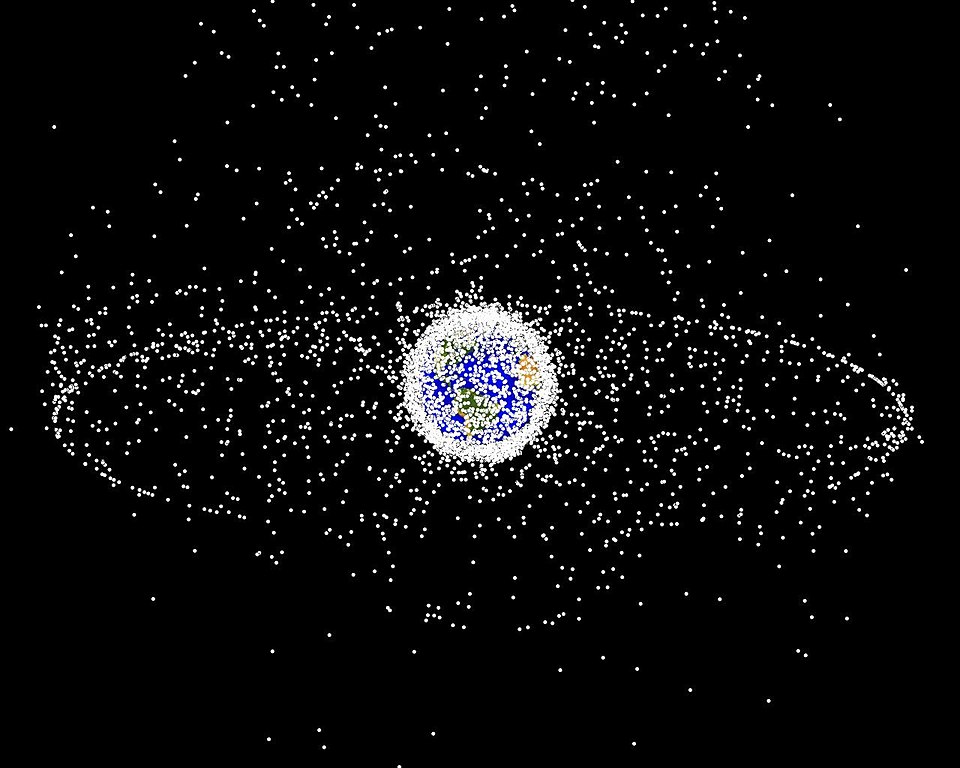
The amount of trash in Earth orbit is growing. Since the launch of the first Satellite in 1957, rocket parts, broken satellites, and micrometeoroids are added as space junk.
These man-made objects from dead satellites to errant nuts and bolts are zipping around Earth. These are putting our working satellites at risk.
Scientists are working on ways to combat this threat. Recently European Space Agency (ESA) has awarded a $103 million contract to Switzerland-based ClearSpace SA to remove this space debris. The ESA is going to provide expertise and money for this operation. However, all the engineering and design work will be performed by ClearSpace SA.
Artistic impression of ClearSpace -1 mission
ClearSpace SA’s first target is a VESPA (Vega Secondary Payload Adapter). In the year 2013, VESPA helped launch an ESA Vega rocket. This object was left in an approximately 801 km by 664 km-altitude gradual disposal orbit. Since then it is orbiting Earth. They are planning to launch their mission, dubbed ClearSpace-1, in 2025.
If ClearSpace-1 is successful, the company can design more efficient versions of the claw for capturing junk.
ALL RELATED VIDEOS, selected and posted by peter2011
Have the tools used to build ancient monuments been staring us in the face all along?
One main reason why we remain fascinated by ancient structures today is the mystery of how often massive stones were cut and fitted together with inexplicable precision. Using your own eyes, a definite flaw in the mainstream narrative becomes glaringly apparent.
Traditional explanations suggest that ordinary, primitive tools combined with extraordinary feats of human exertion made it all possible. There is no good explanation for why building techniques and designs share so many similarities across the planet as the big picture emerges.
Missing links
Apart from the mystery of construction, there is another missing link: What happened to the tools? Also, why don’t we see recorded information explaining these astounding construction methods?
Were these methods purposefully kept a secret, or have the answers been staring us in the face all along? Is the reason we haven’t found clear evidence of tools because one of the tools is ephemeral sound and vibrations? And, is another reason because we have misunderstood the tools used?
The ‘Sailing Stones of Egypt’
One ancient account from an ancient Arab historian and geographer suggests that the Egyptians used sound to transport huge blocks of stone. Known as the Herodotus of the Arabs, he recorded a centuries-old legend by 947 AD.
“When building the pyramids, their creators carefully positioned what was described as magical papyrus underneath the edges of the mighty stones that were to be used in the construction process. Then, one by one, the stones were struck by what was curiously, and rather enigmatically, described only as a rod of metal. Lo and behold, the stones then slowly began to rise into the air, and – like dutiful soldiers unquestioningly following orders – proceeded in slow, methodical, single-file fashion a number of feet above a paved pathway surrounded on both sides by similar, mysterious metal rods.”
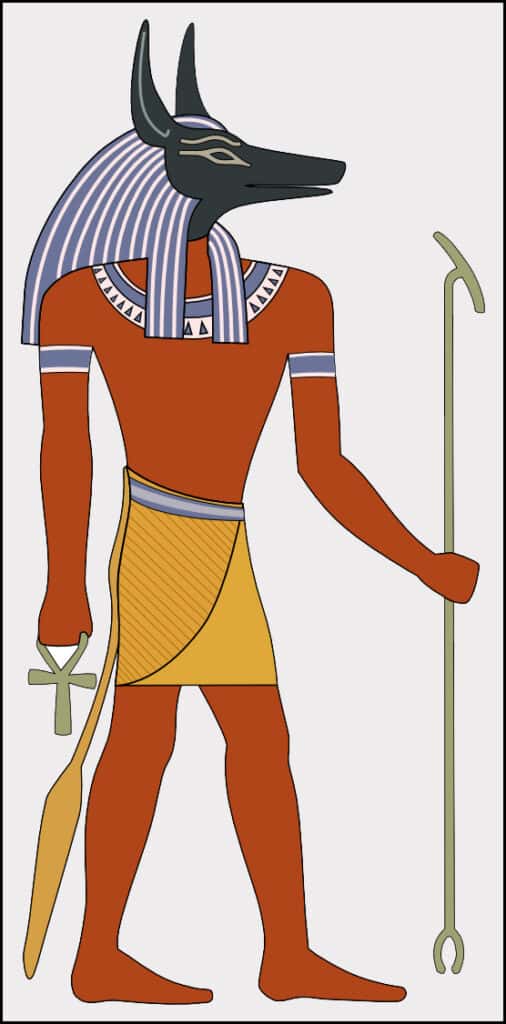
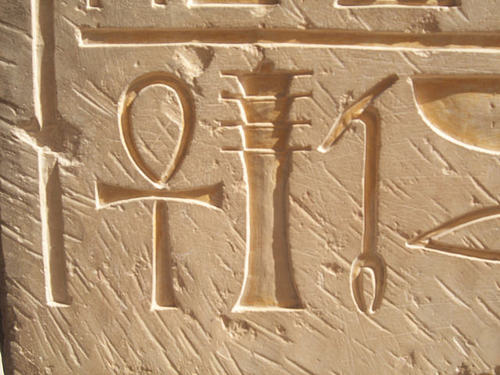
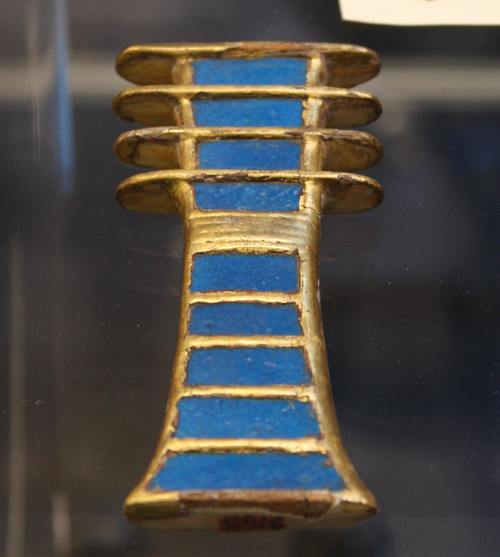
We’ve all seen Egyptian deities like Anubis, standing with a strange rod in his hand like the picture above. However, not many people know what that object is. It’s called a Was-sceptre, a staff with a forked base and topped with a pronged head shaped like a stylized canine or another animal. The rod is thin and perfectly straight and associated with other mysterious objects like the Ankh and the Djed. Were they merely symbolic, or could they have been tools of some kind?
“The three most important symbols, often appearing in all manner of Egyptian artwork from amulets to architecture, were the ankh, the djed, and the was scepter. These were frequently combined in inscriptions and often appear on sarcophagi together in a group or separately. In the case of each of these, the form represents the eternal value of the concept: the ankh represented life; the djed stability; the was power.”
In some depictions, Was-sceptres are seen upholding the roof of a shrine as Horus looks on. Similarly, the Djed is seen on temple lintels appearing to hold up the sky in the complex at Djoser in Saqqara.
A video from Ancient Architects explores this idea, showing examples of tuning forks used by the Egyptians. Narrator Matthew Sibson from the UK raises some fascinating ideas about how the Egyptians may have used objects like the Was-sceptre and tuning forks to cut through the hardest stones using the power of sound and vibrations. (see video below)
A depiction of tuning forks is seen on a statue of Isis and Anubis, each holding a rod. Between the deities, a carving shows two tuning forks that seem to be connected by wires. Beneath the forks, a rounded object with four prongs is centered, and it almost appears like an arrow points upward.
Screenshot via YouTube
In the video, Sibson brings up an interesting but unverified email on the website KeelyNet.com from 1997. The email suggests that Egyptologists have found ancient tuning forks and may have labeled them “anomalous” when they couldn’t imagine what their purpose was.
“Some years ago an American friend picked the lock of a door leading to an Egyptian museum store-room measuring approx 8 feet x ten feet. Inside she found ‘hundreds’ of what she described as ‘tuning forks.’
These ranged in size from approx 8 inches to approx 8 or 9 feet overall length and resembled catapults, but with a taut wire stretched between the tines of the ‘fork.’ She insists, incidentally, that these were definitely not non-ferrous, but ‘steel.’
These objects resembled a letter ‘U’ with a handle (a bit like a pitchfork) and, when the wire was plucked, they vibrated for a prolonged period.
It occurs to me to wonder if these devices might have had hardened tool bits attached to the bottom of their handles and if they might have been used for cutting or engraving stone, once they had been set vibrating.”
Although the email is only anecdotal evidence at best, it does seem to confirm the hieroglyph of tuning forks on the statue of Isis and Anubis, with wire stretched between the tines.
Next, we see a much older Sumerian Cylinder seal showing a figure holding what appears to be a tuning fork. As you see more, it seems that ancient people knew much more about the effects of sound and vibration than we currently understand.
Today, we are learning new ways to look at ancient structures. Archaeoaccoustics is revealing how sound played a vital role in the construction of sites all over the world. Meanwhile, the study of cymatics reveals how vibrations alter the geometry of matter in intricate and unexplainable ways. In addition, the mysteries of Quantum mechanics are unfurling as we find new particles and use artificial intelligence algorithms to discover how matter itself works.
Could we finally be reaching the stage where we will begin to understand exactly how the ancient people of the world created massive monuments worldwide?
Featured image: Was, Djed, Ankh from Old Egypt, public domain with screenshots via YouTube
Nabta Playa: The world's first astronomical site was built in Africa and is older than Stonehenge
This 7,000-year-old stone circle tracked the summer solstice and the arrival of the annual monsoon season. It's also the oldest known astronomical site on Earth.
The stone circle of Nabta Playa marks the summer solstice, a time that coincided with the arrival of monsoon rains in the Sahara Desert thousands of years ago.
Wikimedia Commons
For thousands of years, ancient societies all around the world erected massive stone circles, aligning them with the Sun and stars to mark the seasons. These early calendars foretold the coming of spring, summer, fall, and winter, helping civilizations track when to plant and harvest crops. They also served as ceremonial sites, both for celebration and sacrifice.
These megaliths — large, prehistoric monuments made of stone — may seem mysterious in our modern era, when many people lack a connection with, or even view of, the stars. Some even hold them up as supernatural, or divined by aliens. But many ancient societies kept time by tracking which constellations rose at sunset, like reading a giant, celestial clock. And others pinpointed the Sun’s location in the sky on the summer and winter solstice, the longest and shortest days of the year, or the spring and fall equinox.
Europe alone holds some 35,000 megaliths, including many astronomically-aligned stone circles, as well as tombs (or cromlechs) and other standing stones. These structures were mostly built between 6,500 and 4,500 years ago, largely along the Atlantic and Mediterranean coasts.
The most famous of these sites is Stonehenge, a monument in England that’s thought to be around 5,000 years old. Though still old, at that age, Stonehenge may have been one of the youngest such stone structures to be built in Europe.
The chronology and extreme similarities between these widespread European sites leads some researchers to think the regional tradition of constructing megaliths first emerged along the coast of France. It was then passed across the region, eventually reaching Great Britain.
But even these primitive sites are at least centuries younger than the world’s oldest known stone circle: Nabta Playa.
Located in Africa, Nabta Playa stands some 700 miles south of the Great Pyramid of Giza in Egypt. It was built more than 7,000 years ago, making Nabta Playa the oldest stone circle in the world — and possibly Earth’s oldest astronomical observatory. It was constructed by a cattle worshiping cult of nomadic people to mark the summer solstice and the arrival of the monsoons.
“Here is human beings’ first attempt to make some serious connection with the heavens," J. McKim Malville, a professor emeritus at the University of Colorado and archaeoastronomy expert, tells Astronomy.
"This was the dawn of observational astronomy," he adds. "What in the world did they think about it? Did they imagine these stars were gods? And what kinds of connections did they have with the stars and the stones?”
The statue of Ramses the Great at the Great Temple of Abu Simbel is moved during the construction of the Aswan Dam.
Wikimedia Commons
The Discovery of Nabta Playa
In the 1960s, Egypt was planning a major dam project along the Nile River that was going to flood important ancient archaeological sites. The United Nations Educational, Scientific and Cultural Organization (UNESCO), stepped in with funding to help relocate famous structures, as well as scour the area for new sites before they were lost forever.
But a prominent American archaeologist named Fred Wendorf saw another opportunity. He wanted to search for the ancient origins of Pharaonic Egypt, away from the Nile River.
“While everyone was looking at temples, [Wendorf] decided he would look at the desert,” says Malville. “He opened up the era of predynastic Egypt and the ancient kingdom.”
By luck, in 1973, a Bedouin — or nomadic Arab — guide named Eide Mariff came across a group of what looked like large, stone megaliths while crossing the Sahara. Mariff took Wendorf, who he had worked with since the 1960s, out to the site, which sits some 60 miles away from the Nile. However, Romuald Schild, Wendorf's longtime friend and collaborator, remembers the discovery story differently. He says the entire team was driving across this stretch of desert in 1973 when they stopped for a bathroom break. It was then that they spotted evidence of the megalithic remains.
At first Wendorf thought they were natural formations. But he soon realized that the site was once a large lakebed that would have destroyed any such rocks. He would return many times over the course of decades. Then, during excavations in the early 1990s, Wendorf and a team of excavators, including Polish archaeologist Romuald Schild, uncovered a circle of stones that seemed to be aligned with the stars in some mysterious way.
The approximate location of Nabta Playa.
Wikimedia Commons
The first astronomers
After seven years without being able to crack their mystery, Wendorf called in Malville, an expert on archaeoastronomy of the American Southwest.
Malville says he too was puzzled when he first looked at maps of the ancient site. He knew he had to travel there in person to get a sense of the place, as well as its creators and celestial significance.
They drove across the flat, sandy landscape until they reached a large sand dune beside a dry lake bed, where views stretched out to the horizon. There, they pitched their tents and set up camp. And while Malville sat in the sand beside the stones, he says he experienced “an epiphany.”
“I discovered that these stones were part of an alignment that radiated out from a major tumulus [burial mound],” Malville says. “A pile of these megaliths formed the covering of a tomb, and it turned out that every one of the megaliths that we found buried in sediment formed a line, like spokes in a wheel radiating out.”
The team had already performed radiocarbon dating on the site by taking samples from fire hearths and tamarisk roofing material found inside the stone circle.
“It was like a zen experience to see how this fit together,” he says. “Knowing the dates, I could calculate when these stones would have been in alignment with the brightest stars of the northern sky.”
Eide Mariff, a Bedouin guide and excavator who worked with archaeologists for decades in southern Egypt, works with a crew from his tribe to remove megalithic stones at Nabta Playa.
J. McKim Malville
He discovered that the stone circle once aligned to Arcturus, Sirius and Alpha Centauri. There were also stones that seemed to correspond to the constellation Orion. By tracing back Arcturus’ movements across the night sky, they proposed that the star would have matched up with Nabta Playa’s stone circle around 4800 B.C.
“That makes it the oldest astronomical site we've ever discovered,” Malville says. Their analysis was published in the journal Nature in 1998, drawing global headlines about a “Stonehenge in the Sahara.”
In the decades since then, archaeologists have continued to unravel the mystery of the ancient people of Nabta Playa, who used their summer home to observe the stars.
Reconstruction of the calendar circle at Nabta Playa.
Malville et al., 2007
Cattle cult
More than 10,000 years ago, Northern Africa shifted away from a cold, dry Ice Age climate that had persisted for tens of thousands of years. With the shift, African monsoons migrated north relatively quickly, filling up seasonal lakes, or playa, that provided short-lived oases for life.
For the nomadic people who lived in the area, these summer rains were likely sacred. During this era before agriculture had spread across the globe, these nomads survived primarily off of wild resources. But somewhere around the same time in the same region, people began domesticating goats, as well as an ancient kind of cattle called aurochs.
Cattle were a central part of Nabta Playa’s culture. When Wendorf’s team excavated the site's central tomb, they hoped to find human remains. Instead, they dug up cattle bones and an enormous rock seemingly carved into the shape of a cow.
An archaeological excavation found this cow-shaped megalithic rock sculpture buried at Nabta Playa in the Sahara Desert near the border of Egypt and Sudan. Scientists think the people who lived here worshiped a cow diety, a trend that appears later in Pharaonic Egypt.
J. McKim Malville
The people of Nabta Playa would travel across the often-featureless Sahara from seasonal lake to seasonal lake, bringing their livestock along to graze and drink.
“Their experience was rather similar to Polynesian navigators who had to sail from one place to another,” Malville says he suspects. “They used the stars to travel across the desert to locate small watering holes like Nabta Playa, which had water about four months of the year, probably, starting with the summer monsoon.”
There was no north star at the time, so the people navigated using bright stars and the circular motion of the heavens.
Wendorf himself had a powerful experience that cemented his belief in this idea. One day, while working at Nabta Playa, the team had lost track of time and had to drive back across the sand at night. Mariff, the Bedouin man who initially discovered Nabta Playa, took the wheel, navigating across the Sahara by sticking his head out the window to use the stars as his guide.
This kind of celestial navigation would have made Nabta Playa's stone circle a powerful symbol to the ancient nomadic people. The stones feet would have been covered by seasonal water, and would have been visible from the western lakeshore.
“You would watch the reflection of the stars off the dark waters of the lake, and you could see the stones partly submerged in the water, lining up with the reflection of the stars on the horizon,” he says.
A man holds up sorghum grains.
Abby Wendle/Wikimedia Commons
Ancient breadbasket
Practically speaking, the megaliths would have also helped the people of Nabta Playa time the rainy season, which only became more important as the society developed over thousands of years. The summer solstice would have coincided with the arrival of the annual monsoons. So tracking the Sun’s location could have tipped them off to the coming wet season.
The first strong evidence for people at Nabta Playa appears around the year 9000 BC. At the time, the Sahara was a wetter, more pleasant place to live. Eventually, there was enough water that people could even dig wells and build homes around them. One site excavated at Nabta Playa revealed rows of huts with hearths, storage pits, and wells that were spread out over several thousand square feet. The team of archaeologists called it a “well-organized village.”
But between 5000 B.C. and 3000 B.C., thousands of years after the stone circle was built at Nabta Playa, the region dried out again. Some researchers think this environmental stress could have forced the people of Nabta Playa to develop a complex society, which most scholars thought depended on the development of agriculture.
The ancient society studied the constellations and understood the movements of the night sky. They made sacrifices and worshiped gods. They made jewelry out of cow bones. They ground up pigments for body painting. Researchers even discovered fish carvings at the site that suggest the nomads traded as far away as the Red Sea. Finally, the stone slabs at the site — some of which stand nine feet tall — had to be dragged from more than a mile away.
However, this complex culture seems to have fallen somewhere in between nomadic and agrarian. In addition to the oldest astronomical site, Nabta Playa is also home to the oldest known remains of sorghum, a crop first domesticated in Africa that’s now one of the world’s most important foods, especially in the tropics.
Hundreds of sorghum seeds were found at Nabta Playa, and they appear to be more closely related to domestic sorghum than wild varieties. Millet, another crop critical to the global agricultural history, was also domesticated in the region. And excavations at Nabta Playa also turned up storage pits for grass seeds, tubers, legumes and fruits.
The nomadic people likely ate wild foods, but also planted some semi-domesticated crops along lakeshores at the beginning of each wet season. They then moved on after the harvest, Malville says.
The African sorghum and millet seeds domesticated in this area would eventually spread along a trade route stretching through the Red Sea and into India — where they arrived some 4,000 years ago and went on to play an important role in the development of numerous civilizations.
"Black genesis"
By that time, the people who first grew the seeds were gone. Some 1,500 years earlier, the region had dried out, becoming what is now Earth’s hottest desert, the Sahara. Here, many areas don't see rain for years.
That changing local climate forced the people of Nabta Playa to disperse. Some archaeologists think these people likely traveled south into Nubia, or modern day Sudan, as well as north into Egypt. And their migration would have taken place in the years just before the first pharaohs rose to power.
This timing had led some scholars to suggest the event sparked a “black genesis” for the cultural development in Egypt. However, the idea is controversial. Human remains at Nabta Playa seemed to be from people of both Central African and Mediterranean descent. However, some consider an ancient Egyptian cow goddess named Hathor, a goddess of fertility, to be the smoking gun for this origin story.
If these cattle-raising nomads did help establish the Nile Valley's first civilization, Wendorf once told Discover, "it could explain the religious significance that Egyptians attached to the cow and cattle in the Old Kingdom."
This idea has legitimate proponents, including Malville, who says that many Egypt scholars he’s talked to also like the idea of the Egyptian culture emerging out of Africa, rather than from the so-called “Fertile Crescent,” as others suggest. However, some conspiracy theorists have also run with the idea, adding a strange new layer. One theory — which has been debunked — suggested that the arms of Nabta Playa’s stone circle describe the distances to the stars they aligned with, and that the rock slab beneath the megalith is a map of our Milky Way galaxy.
For Malville, and Wendorf as well, who died in 2015, there’s no need to invent such stories for Nabta Playa to be fascinating. In many years spent exploring the Sahara, Wendorf and other archaeologists found a number of other stone circles, but they never again found anything remotely like Nabta Playa.
And now that there’s detailed photography of Earth’s entire surface, Malville says its only growing less likely that older or more complex astronomical sites are still hiding.
Stonehenge's enormous size and prominent modern location help make it the most famous of humanity's many stone circles.
Wikimedia Commons
New looks at the Neolithic
So why have so few people heard of Nabta Playa?
Gail Higginbottom, an archaeologist at University of Adelaide and expert on stone circles, saysthat Stonehenge still reigns supreme in the minds of Western Civilization. After all, its stones are so big that they were never buried, and it’s long been easily accessible. That means Europeans have known of nearby Stonehenge for much of its 5,000 year history. But one leading megalith researcher contacted for this story said they weren’t even familiar with Nabta Playa.
Malville agrees with Higginbottom. He says Nabta Playa might not get as much attention as Stonehenge because it is significantly smaller, and up until a few decades ago, it was buried in sand in a remote region of Africa.
Trends in research also come and go. Egyptian archaeology was en vogue throughout the 19th and the 20th centuries.
“People used to be obsessed with pyramids and the historic cultures in North Africa,” Higginbottom tells Astronomy. But that fascination has waned over time. “However," she adds, "I think this has had a big turn around in the last couple of decades with the Neolithic and earlier periods becoming more researched.”
Unfortunately, most of the popular coverage of Egyptian archaeology now fixates on pseudoscience and ancient aliens. And according to Malville, the extra attention Nabta Playa has gotten over the years hasn’t been good for the site, either.
After their study was published in 1998, tourists located the stone circle by plucking the latitude and longitude from the research paper. Soon, visitors were defacing the megaliths and standing up nearby stones that changed the site’s alignment.
“They ended up messing up the area, which had been pristine for 5,000 years,” Malville says.
In response, the government eventually moved all the stones — including the cow sculpture — to a museum in the region, where they’re remain on display for tourists to safely view.
ALL RELATED VIDEOS, selected and posted by peter2011
Astronomers were hit today (Dec. 3) with a huge wave of data from the European Space Agency'sGaia space observatory.
Those researchers can now explore the best-yet map of the Milky Way, with detailed information on the positions, distances and motion of 1.8 billion cosmic objects, to help us better understand our place in the universe.
"Gaia data is like a tsunami rolling through astrophysics," said Martin Barstow, head of the physics and astronomy department at the University of Leicester, who is part of Gaia's data processing team. He was speaking at a virtual news conference held today, at which another Gaia researcher, Giorgia Busso of the Leiden Observatory in the Netherlands, also told reporters that this data has produced "a revolution" in many fields of astrophysics, from the study of galactic dynamics like stellar evolution to the study of nearby objects like asteroids in the solar system.
Gaia launched in December 2013 to map the galaxy in unprecedented detail. The $1 billion spacecraft orbits the Lagrange-2, or L2, point, a spot about 1 million miles (1.5 million kilometers) away from Earth, where the gravitational forces between our planet and the sun are balanced and the view of the sky is unobstructed. Gaia can measure about 100,000 stars each minute, or 850 million objects each day, and can scan the whole sky about once every two months.
The latest trove of data improves upon the precision and scope of the two previous Gaia data sets, which were released in 2016 and 2018. For example, compared to the 2018 data, which included measurements for 1.7 billion objects, the 2020 data improves by a factor of two the accuracy of the data points for proper motion, or the apparent change in the position of a star as viewed from our solar system.
"It really gives us an insight into how the Milky Way lives," Nicholas Walton, an astronomer at the University of Cambridge who is part of Gaia's science team, said at the same science and news conference. "We're talking about billions of stars, which really gives us the ability to probe at a meaningful level the whole population of the Milky Way, similar to what you'd want to do with studying people."
Walton said the cosmic census would be like having trackers on every person in the U.K. to map their location and monitor their health. "If everyone's got a tracker, we could tell you if they're sweating or not. It's a bit like that with the stars here: We can tell you which ones are sweating, which ones are active, which ones are dormant, which ones are going to die, which ones are going to explode."
Data from Gaia has already been used across a wide range of applications over the past four years. The mission has helped researchers find the corpse of a galaxy that the Milky Way cannibalized 10 billion years ago, spot 20 hypervelocity stars unexpectedly zooming toward the galactic center, and identify about 1,000 nearby stars where hypothetical extraterrestrials would be able to see signs of life on Earth.
Closer to home, the spacecraft has allowed scientists to find previously unknown asteroids, and its precise data even allowed NASA to make a crucial, last-minute adjustment to the path of its New Horizons probe in 2018 to successfully swing past the icy rock Arrokoth, the most distant and primitive object in the solar system ever visited by a spacecraft.
So far, some 1,600 studies have been published based on Gaia data, Barstow said. More will surely result from today's newly released material, now available on ESA's website, and by the time the briefing for scientists and reporters ended, Walton said he expected a lot of scientists were already poring over it: "I think a lot of astronomers would have left this broadcast to go work on the data."
This image shows the paths of 40,000 stars located within 326 light-years of our solar system over the next 400,000 years based on measurements and projections from the European Space Agency's Gaia spacecraft. (Image credit: ESA/Gaia/DPAC; CC BY-SA 3.0 IGO. Acknowledgement: A. Brown, S. Jordan, T. Roegiers, X. Luri, E. Masana, T. Prusti and A. Moitinho.)
Some of the new Gaia data has already been used to make discoveries. One group of researchers led by scientists at the Dresden University of Technology measured how our solar system is accelerating inside the Milky Way, using as reference points Gaia's 1.6 million newly observed quasars, which are so far away they appear fixed in space, like galactic lighthouses.
The solar system was measured to be very slightly accelerating, as predicted by theorists, toward the galactic center. Busso said this barely perceptible acceleration only became observable in this newly released Gaia data because "the precision of the measurements increased hugely."
These super precise tests of the way masses are distributed and accelerated are essential for "probing the limits of fundamental physics," Gerry Gilmore, an astronomer at the University of Cambridge and a Gaia scientist, said during the event. Such measurements might help scientists understand the nature of the dark matter that we know is lurking throughout the universe.
"Even our own sun is moving so fast that our whole Milky Way would fly apart if it wasn't held together by the dark matter, and we've got no idea what the dark matter is," Gilmore said. "The hope is that by continuing experiments along the line that we're doing — and making them more precise, and doing them on different scales — we'll be able to see if there are different types of dark matter."
The third Gaia data set was set to be released in 2022, but the mission scientists decided to release preliminary data now so astronomers could use it sooner, with at least two more data sets to be released in the coming years. The spacecraft will operate until at least 2022, but its mission may be extended until 2025.
Follow uson Twitter @Spacedotcom and on Facebook.
ALL RELATED VIDEOS, selected and posted by peter2011
Astronomers in Australia have just mapped 83% of the observable universe, in just 300 hours.
This new sky survey, which Australia's national science agency (CSIRO) described in a statement as a "Google map of the universe", marks the completion of a big test for the Australian Square Kilometre Array Pathfinder (ASKAP) radio telescope –- a network of 36 antennas rooted in the remote Western Australia Outback. While astronomers have been using ASKAP to scour the sky for radio signatures (including mysteriousfast radio bursts) since 2012, the telescope's full array of antennas has never been used in a single sky survey –- until now.
By harnessing the telescope's full potential, researchers mapped roughly 3 million galaxies in the southern sky, according to a paper published Nov. 30 in the journalPublications of the Astronomical Society of Australia. As many as 1 million of these distant galaxies may be previously unknown to astronomy, the researchers wrote, and that's likely just the beginning. With the success of this first survey, CSIRO scientists are already planning even more in-depth observations in the coming years.
"For the first time, ASKAP has flexed its full muscles, building a map of the universe in greater detail than ever before, and at record speed," lead study author David McConnell, a CSIRO astronomer,said in a statement. "We expect to find tens of millions of new galaxies in future surveys."
Many all-sky surveys can take months, even years, to complete. CSIRO's new effort, which they've labeled the Rapid ASKAP Continuum Survey, only took a few weeks of stargazing. While each of the telescope's 36 receivers took vast, panoramic pictures of the sky, a dedicated network of supercomputers worked double-time to combine them. The resulting map, which covers 83% of the sky, is a combination of 903 individual images, each containing 70 billion pixels. (For comparison, the highest-definition cameras for sale snap a few hundred million pixels per image).
Each of these images will be made publicly available through CSIRO's Data Access Portal, as scientists analyze the results and plan for their next sky-charting adventures.
ARECIBO COLLAPSE: SCIENTISTS HOLD BACK THE TEARS AS AN ICON CRUMBLES
"It's heartbreaking."
JORGE SANTIAGO-ORTIZ HAD BEEN HOLDING BACK TEARS all Tuesday morning after hearing of the collapse of the instrument platform of the Arecibo Observatory.
"It's heartbreaking," Santiago-Ortiz tells Inverse. "It's really sad because it means so much."
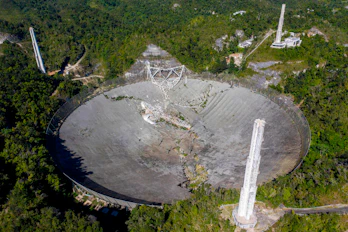
On Tuesday, the instrument platform of the 305-meter telescope at Arecibo Observatory fell after a cable snapped, at approximately 7:55 a.m. Atlantic Standard Time. The event caused damage to the dish and the surrounding facilities. It was the latest blow to the historic observatory, that has served as an essential lookout onto the skies for 57 years.
Santiago-Ortiz, a scientist in the field of gene therapy, grew up an hour's drive away from the observatory in Arecibo, Puerto Rico, and recalls going on a school field trip to visit the observatory when he was in middle school. The trip introduced him to local scientists and inspired him to go into the field of science himself.
"Growing up, I wasn't familiar with how science worked," Santiago-Ortiz says. "But to know that groundbreaking science was taking place less than an hour away from me made me believe I could become a scientist one day."
FOR MORE THAN 50 YEARS, the Arecibo Observatory has looked out into the cosmos in search of potentially hazardous asteroids, and potentially habitable planets. It's tracked strange radio phenomena and potentially hazardous space weather.
This aerial view shows the damage at the Arecibo Observatory after one of the main cables holding the receiver broke in Arecibo, Puerto Rico, on December 1, 2020. RICARDO ARDUENGO/AFP/Getty Images
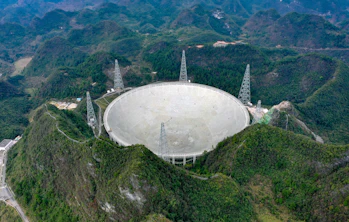
Constructed in 1963, the Arecibo Observatory was the world's largest telescope of its kind. Its reign only ended years later in 2016 when China built the FAST radio telescope:
Nestled in a rural, basin region in China’s Guizhou Province, the record-breaking telescope — the world’s largest single-dish radio telescope — has made China a leader in the hunt for alien life. The “Five-hundred-meter Aperture Spherical Telescope”, or FAST, is a 1,640 feet scientific marvel that nearly doubles the capabilities of Arecibo.Xinhua News Agency/Xinhua News Agency/Getty Images
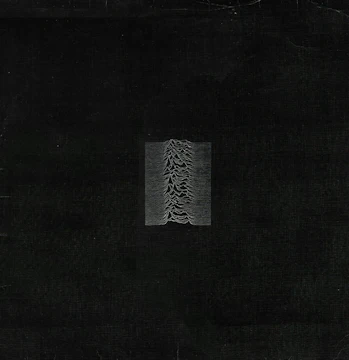
The radio telescope was also quite popular as it was featured in Carl Sagan's novel Contact, the 1995 Bond movie Goldeneye, and an image of pulse waves captured by Arecibo made the album cover for Joy Division's Unknown Pleasures.
The cover of 'Unknown Pleasures' the Joy Division album which uses the public domain image of pulse waves recorded by Arecibo.
Arecibo has a 1,000-foot long dish that spans over 20 acres in the municipality of Arecibo in Puerto Rico and its sheer size makes for more accurate, sensitive observations of the universe.
But the observatory will soon shut its cosmic wide eyes.
On November 19, the National Science Foundation (NSF) announced that they will begin plans to shut down the Arecibo Observatory after assessing damage caused to the telescope by an unfortunate incident.
The damage sustained by the radio telescope as a result of the cable snapping, and falling onto the domeUCF
An auxiliary cable that was designed to last another 15 to 20 years suddenly broke on August 10, and crashed into the radio telescope's reflector panels, tearing a 100-foot gash in the main dish. And the NSF later decided that they cannot repair the observatory without risk to construction workers and staff at the facility.
Unfortunately, the observatory would suffer another incident later on with the collapse of its platform, delivering one final blow to the telescope.
“We are saddened by this situation but thankful that no one was hurt,” NSF Director Sethuraman Panchanathan said in a statement. “Our focus is now on assessing the damage, finding ways to restore operations at other parts of the observatory, and working to continue supporting the scientific community, and the people of Puerto Rico.”
For Santiago-Ortiz, who had launched a petition to save the Arecibo Observatory, the loss for the community would be profound.
"I’m Puerto Rican and I care a lot about diversity and inclusion efforts," he says. "The observatory has played an important role in increasing representation for minorities in science and engineering."
On the scientific side, researchers will be left without a vital tool to observe the skies.
Anne Virkki, a research scientist at the Arecibo Observatory and serves as the leader of the Planetary Radar Science Group, has been using the telescope to observe 100 to 200 near-Earth objects a year and determine their chances of hitting Earth.
Vikki spoke with Inverse in August and said that all observations were down since there is no other facility that can be used for the same type of work.
"We [Arecibo] are the most powerful and sensitive planetary radar in the world," Virkki says. "We have some special capabilities, the images we can get are completely unparalleled, unless there’s a spacecraft sent to a specific target, we can get these very fine images of tens of objects every year."
As scientists mourn the loss of the Arecibo Observatory, there may still be an opportunity to rescue another observatory on the other side of the world.
THE KWASAN OBSERVATORY, established in 1929 as the second-oldest university observatory in Japan, is in need of funding in order to continue its operations as a key observer of the Sun.
Kyoto University has been planning to shut down the observatory's operations as it scales down on its budget in order to make room for new facilities to be built by scrapping older ones. However, the people behind the observatory have launched a campaign asking for funds to be donated to the Kwasan Observatory.
Meanwhile, those who remain attached to the Arecibo Observatory are still hopeful about its revival.
Santiago-Ortiz will begin advocating for the rebuilding of the observatory, with even more advanced technology, rather than just repairing it as is.
"I'm certainly hopeful," he says. "Just because of how much the observatory has meant for science and education."
ALL RELATED VIDEOS, selected and posted by peter2011
Meer van UFO'S of UAP'S, ASTRONOMIE, RUIMTEVAART, ARCHEOLOGIE, OUDHEIDKUNDE, SF-SNUFJES EN ANDERE ESOTERISCHE WETENSCHAPPEN - DE ALLERLAATSTE NIEUWTJES


 White Orb Seen Over Singapore On Dec 7, 2020, UFO Sighting News.