Ontdek de Fascinerende Wereld van UFO's en UAP's: Jouw Bron voor Onthullende Informatie!
Ben jij ook gefascineerd door het onbekende? Wil je meer weten over UFO's en UAP's, niet alleen in België, maar over de hele wereld? Dan ben je op de juiste plek!
België: Het Kloppend Hart van UFO-onderzoek
In België is BUFON (Belgisch UFO-Netwerk) dé autoriteit op het gebied van UFO-onderzoek. Voor betrouwbare en objectieve informatie over deze intrigerende fenomenen, bezoek je zeker onze Facebook-pagina en deze blog. Maar dat is nog niet alles! Ontdek ook het Belgisch UFO-meldpunt en Caelestia, twee organisaties die diepgaand onderzoek verrichten, al zijn ze soms kritisch of sceptisch.
Nederland: Een Schat aan Informatie
Voor onze Nederlandse buren is er de schitterende website www.ufowijzer.nl, beheerd door Paul Harmans. Deze site biedt een schat aan informatie en artikelen die je niet wilt missen!
Internationaal: MUFON - De Wereldwijde Autoriteit
Neem ook een kijkje bij MUFON (Mutual UFO Network Inc.), een gerenommeerde Amerikaanse UFO-vereniging met afdelingen in de VS en wereldwijd. MUFON is toegewijd aan de wetenschappelijke en analytische studie van het UFO-fenomeen, en hun maandelijkse tijdschrift, The MUFON UFO-Journal, is een must-read voor elke UFO-enthousiasteling. Bezoek hun website op www.mufon.com voor meer informatie.
Samenwerking en Toekomstvisie
Sinds 1 februari 2020 is Pieter niet alleen ex-president van BUFON, maar ook de voormalige nationale directeur van MUFON in Vlaanderen en Nederland. Dit creëert een sterke samenwerking met de Franse MUFON Reseau MUFON/EUROP, wat ons in staat stelt om nog meer waardevolle inzichten te delen.
Let op: Nepprofielen en Nieuwe Groeperingen
Pas op voor een nieuwe groepering die zich ook BUFON noemt, maar geen enkele connectie heeft met onze gevestigde organisatie. Hoewel zij de naam geregistreerd hebben, kunnen ze het rijke verleden en de expertise van onze groep niet evenaren. We wensen hen veel succes, maar we blijven de autoriteit in UFO-onderzoek!
Blijf Op De Hoogte!
Wil jij de laatste nieuwtjes over UFO's, ruimtevaart, archeologie, en meer? Volg ons dan en duik samen met ons in de fascinerende wereld van het onbekende! Sluit je aan bij de gemeenschap van nieuwsgierige geesten die net als jij verlangen naar antwoorden en avonturen in de sterren!
Heb je vragen of wil je meer weten? Aarzel dan niet om contact met ons op te nemen! Samen ontrafelen we het mysterie van de lucht en daarbuiten.
Vrijdag 25 december 2020
Scientists Discover Over 100,000 New Lunar Craters
Scientists Discover Over 100,000 New Lunar Craters
According to new data, our moon has a lot more craters than previously thought. In fact, a total of 109,956 newly discovered craters have been located in the low and middle latitude areas of the moon.
They were found by artificial intelligence that was given data obtained by Chinese lunar orbiters. The researchers uploaded the data with thousands of craters that have already been detected and trained the algorithm to locate new ones. They used data collected from the Chang’e 1 and Chang’e 2 lunar orbiters.
In an email to Live Science, Chen Yang, who is an associate professor of Earth sciences at Jilin University in China and the lead author of the study, stated, “It is the largest lunar crater database with automatic extraction for the mid and low-latitude regions of the moon.”
The majority of the craters were classified as being small to medium in size, ranging from 0.6 miles to 60 miles in diameter. As for the few large craters that were discovered, some of them had a diameter that measured as much as 341 miles.
As for when they were created, the algorithm that was used by the scientists was able to estimate that they occurred during all five of the moon’s lunar geological periods with some of them dating as far back as 4 billion years. The five lunar geological periods are the Copernican, Eratosthenian, Imbrian (Late and Early epochs), Nectarian, and Pre-Nectarian.
Yang described the craters as being like “fossils” that “record the history of the Solar System” from when meteors impacted the moon. Since the shape and size of the craters are all different and unique, with some of them overlapping and eroding as time goes on, detecting new ones is a very difficult process that requires a lot of time and patience.
Eventually, the team is planning to upload new data from the Chang’e 5 lander to their crater-spotting algorithm. They even want to use their technique to study other places in the Solar System like Mars. The researchers wrote in part, “This prediction will generally take minutes followed by a few hours of post-processing on standard computation hardware.” Their research was published in the journal Nature Communications where it can be read in full.
Several images of where the newly discovered lunar craters are located can be seen here.
New craters found from the pre-Nectarian System which are over 3.92 billion years old (Image credit: Chen Yang et al. /doi:10.1038/s41467-020-20215-y.)
New craters found from the Nectarian System, 3.92 - 3.85 billion years old (Image credit: Chen Yang et al. /doi:10.1038/s41467-020-20215-y.)
New craters found from from the Imbrian System, 3.85 - 3.2 billion years old (Image credit: Chen Yang et al. /doi:10.1038/s41467-020-20215-y.)
New craters found from the Eratosthenian System, 3.2 - 1.1 billion years old (Image credit: Chen Yang et al. /doi:10.1038/s41467-020-20215-y.)
New craters discovered from the Copernican System, younger than 1.1 billion years old
(Image credit: Chen Yang et al. /doi:10.1038/s41467-020-20215-y.)
President Eisenhower’s Meeting with ET’s at Edwards AFB
COAST TO COAST AM – Author and researcher Paul Blake Smith talked about his latest work examining the claim that President Eisenhower secretly met with aliens at an Air Force base. Smith also presented details of his investigation into the crash of a UFO just outside of Cape Girardeau, Missouri in 1941). In February 1954, President Dwight Eisenhower flew to Palm Springs, CA for a golfing trip (considered odd since it was so far from Washington DC).
While there, his whereabouts were not officially recorded for one evening, and according to a report of a witness, a pilot, who came forward in the 1980s, Eisenhower went to nearby Edwards AFB. Smith recounted the report: They stood at the edge of an open-air hangar, and on the runway were five spaceships– three circular, and two elongated.
Alien Contact Disclosure Revelations… from ‘Greys’ to ‘Blues’ to MIB
COAST TO COAST AM – Contactee and spiritual counselor Sev Tok began communications with what she believes to be the Greys starting at age ten. In the latter half, she spoke about the nature of her ET experiences, which have run the gamut from beautiful to terrifying. In some of her contacts, she explained, she is transported to a multi-dimensional or interdimensional location– one time, she sensed that she was actually on the Moon.
In two instances, her body had physical evidence of contact, with red “X” marks burned on her back. By coming to terms and being honest about these experiences, she was able to transform her life. . For more, check out Sev Tok’s YouTube channel, Alien Spirit TV.
Space Force Announces the Guardians! What Are They Guarding?
Space Force Announces the Guardians! What Are They Guarding?
Space Force aims to have about 2,500 members in space operations career fields by the end of calendar year 2020. It’s on track to have around 6,500 members by the end of the 2021 fiscal year on Sept. 30, 2021. On Dec. 20, Vice President Mike Pence announced that members of the Space Force will be known as guardians.
About The Marfoogle Network: Does your family think you are nuts? If so, then you probably belong here! The Marfoogle Network is a safe place to share your views and opinions about anything from the D**P State to aliens! Make yourself at home and meet like-minded friends.
Two huge cigar-shaped UFOs hovering above Orange County, CA 23-Dec-2020
These two huge & bright cigar-shaped unidentified flying objects were hovering in the sky above Orange County, a region in Southern California. This happened on early morning on 23rd December 2020.
Fluvial Mapping of Mars - 8 Trillion Pixel Image 18 Years in the Making
it took fifteen years of imaging and nearly three years of stitching the pieces together to create the largest image ever made, the 8-trillion-pixel mosaic of Mars’ surface. Now, the first study to utilize the image in its entirety provides unprecedented insight into the ancient river systems that once covered the expansive plains in the planet’s southern hemisphere. These three billion-year-old sedimentary rocks, like those in Earth’s geologic record, could prove valuable targets for future exploration of past climates and tectonics on Mars.(A) A suite of ridges on Mars (at –67.64°E, 43.37°S). To determine whether features are ridges or valleys, the researchers rely on lighting in the impact craters (depressions). Based on the craters, the light is coming from the top of the image. Because the fluvial ridges are casting shadows to the south, they can infer that the feature is sticking up from the surface—a ridge rather than a valley.
Image courtesy J. Dickson.
The work, published this month in Geology, complements existing research into Mars’ hydrologic history by mapping ancient fluvial (river) ridges, which are essentially the inverse of a riverbed. “If you have a river channel, that’s the erosion part of a river. So, by definition, there aren’t any deposits there for you to study,” Jay Dickson, lead author on the paper, explains. “You have rivers eroding rocks, so where did those rocks go? These ridges are the other half of the puzzle.” Using the mosaic, as opposed to more localized imagery, let the researchers solve that puzzle on a global scale.
Mars used to be a wet world, as evidenced by rock records of lakes, rivers, and glaciers. The river ridges were formed between 4 and 3 billion years ago, when large, flat-lying rivers deposited sediments in their channels (rather than only having the water cut away at the surface). Similar systems today can be found in places like southern Utah and Death Valley in the U.S., and the Atacama Desert in Chile. Over time, sediment built up in the channels; once the water dried up, those ridges were all that was left of some rivers.
(B) A similar “analogue” environment on Earth. Fluvial ridges similar to the ones on Mars are in California’s Amargosa river system, although with water still running through the system, it’s the active precursor to the ridges that are remnant on Mars.
Image courtesy J. Dickson.
The ridges are present only in the southern hemisphere, where some of Mars’ oldest and most rugged terrain is, but this pattern is likely a preservation artifact. “These ridges probably used to be all over the entire planet, but subsequent processes have buried them or eroded them away,” Dickson says. “The northern hemisphere is very smooth because it’s been resurfaced, primarily by lava flows.” Additionally, the southern highlands are “some of the flattest surfaces in the solar system,” says Woodward Fischer, who was involved in this work. That exceptional flatness made for good sedimentary deposition, allowing the creation of the records being studied today.
Whether or not a region has fluvial ridges is a basic observation that wasn’t possible until this high-resolution image of the planet’s surface was assembled. Each of the 8 trillion pixels represents 5 to 6 square meters, and coverage is nearly 100 percent, thanks to the “spectacular engineering” of NASA’s context camera that has allowed it to operate continuously for well over a decade. An earlier attempt to map these ridges was published in 2007 by Rebecca Williams, a co-author on the new study, but that work was limited by imagery coverage and quality.
“The first inventory of fluvial ridges using meter-scale images was conducted on data acquired between 1997 and 2006,” Williams says. “These image strips sampled the planet and provided tantalizing snapshots of the surface, but there was lingering uncertainty about missing fluvial ridges in the data gaps.”
The resolution and coverage of Mars’ surface in the mosaic has eliminated much of the team’s uncertainty, filling in gaps and providing context for the features. The mosaic allows researchers to explore questions at global scales, rather than being limited to patchier, localized studies and extrapolating results to the whole hemisphere. Much previous research on Mars hydrology has been limited to craters or single systems, where both the sediment source and destination are known. That’s useful, but more context is better in order to really understand a planet’s environmental history and to be more certain in how an individual feature formed.
In addition to identifying 18 new fluvial ridges, using the mosaic image allowed the team to re-examine features that had previously been identified as fluvial ridges. Upon closer inspection, some weren’t formed by rivers after all, but rather lava flows or glaciers. “If you only see a small part of [a ridge], you might have an idea of how it formed,” Dickson says. “But then you see it in a larger context—like, oh, it’s the flank of a volcano, it’s a lava flow. So now we can more confidently determine which are fluvial ridges, versus ridges formed by other processes.”
Now that we have a global understanding of the distribution of ancient rivers on Mars, future explorations—whether by rover or by astronauts—could use these rock records to investigate what past climates and tectonics were like. “One of the biggest breakthroughs in the last twenty years is the recognition that Mars has a sedimentary record, which means we’re not limited to studying the planet today,” Fischer says. “We can ask questions about its history.” And in doing so, he says, we learn not only about a single planet’s past, but also find “truths about how planets evolved… and why the Earth is habitable.”
As this study is only the first to use the full mosaic, Dickson looks forward to seeing how it gets put to use next. “We expect to see more and more studies, similar in scale to what we’re doing here, by other researchers around the world,” he says. “We hope that this ‘maiden voyage’ scientific study sets an example for the scale of science that can be done with a product this big.”
Contacts and sources:
Kea Giles / by Rebecca Dzombak Geological Society of America
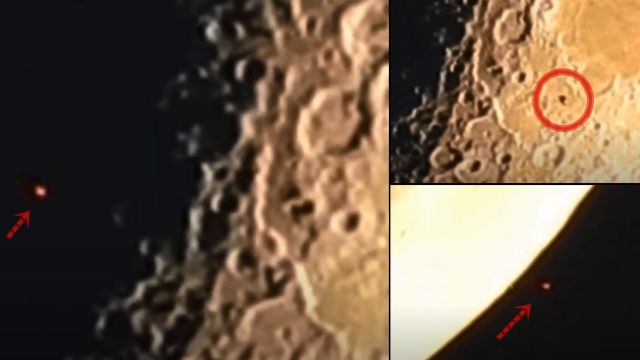
A sky-watcher was taking some evening shots of the moon with a Nikon P900 on December 20, 2020 at 4.52 pm when a large red UFO comes into view from the left side on which the UFO then crosses the moon until it disappears into space.
While crossing the moon the UFO casts its shadow on the lunar surface indicates that it is not something that flies close to the camera, but that it does indeed fly just above the surface of the moon.
The first clip is the close-up, and the second is the original version.
4 Mile Cross Under Ocean Near Macquarie Island, Google Earth Map, UFO Sighting News.
Date of discovery: Dec 23, 2020 Location of sighting: off Macquarie Island
I was using Google Earth Map and I found something really intersting off Macquarie Island. There is a huge cross structure under the ocean there and each line measures the same. It is 4 miles across end to end on both arms. Thats about 7km long! Also not far is another area...a huge 1.5 mile across rectangle opening below a 1 mile bridge on the ocean floor. This opening is for larger UFOs to come down and enter the tunnels to reach the underground base. Yes the base is not on the ocean floor, but more current bases have moved 4-6km below the floor. This way the bases are safe from human detection...however...I did discover the cross and entrance there...so I guess I'm breaking human stereotypes.
Blue UFO Over Bella Vista, Arkansas On Dec 22, 2020, UFO Sighting News.
Date of sighting: Dec 22, 2020 Location of sighting: Bella Vista, Arkansas, USA
Source: MUFON
Listen to the surprise in the voices of the man and woman as they watch some glowing purple lights in the sky in Arkansas two days ago. The lights change and it almost look like several round UFOs sit side by side with a line of about six or more. I have to admit the enlarged screenshot I made above really has me baffled. I use to work on B1 bombers on a high security Strategic Air Command Base...but have never ever seen anything like that. This is not made by humans.
US Military Jet Intercepts UFO Over George Town, Kentucky, USA On Dec 21, 2020.
Date of sighting: Dec 21, 2020 Location of sighting: George Town, Kentucky, USA
This is a great video of a military jet intercepting a UFO over Kentucky this week. The UFO is accelerating and leaving a contrail, however the UFO has no trail and is going the same speed. The UFO obviously did not fear the jet or it would have shot away. When enlarged it does look like thick disk, otherwise known as a tictac. 100% proof the US military intercepts UFOs but can do nothing to stop them.
Scott C. Waring - Taiwan
Eyewitness states:
Looked up to see a plane with vapour trail and under it a white object hover directly underneath it. It was going at exactly the same speed as the plane, maintained the same distance apart from the plane and the same direction for as long as I could see it. There was no noise but the plane was very high.
UFO Seen Over Cemetery Over Netishyn, Ukraine June 10, 2018, UFO Sighting News.
Date of sighting: June 10, 2018
Location of sighting: Netishyn, Ukraine
I thought this video was amazing and it demonstrated a lot of what I find in MAJESTIC and Project Blue Book reports. For instance the UFO appears white when far away. The UFO is silent although its clear its moving very fast. The UFO has a glow around it...almost like a fuzzy fog but probably due to the propulsion systems. This is a real UFO, even though its two years old, I have never seen it and needed to post it here for all to view.
Alien craft casts its shadow on the lunar surface while crossing the Moon
Asky-watcher was taking some evening shots of the moon with a Nikon P900 on December 20, 2020 at 4.52 pm when a large red UFO comes into view from the left side on which the UFO then crosses the moon until it disappears into space.
While crossing the moon the UFO casts its shadow on the lunar surface indicates that it is not something that flies close to the camera, but that it does indeed fly just above the surface of the moon.
The first clip is the close-up, and the second is the original version.
Weird blue pulsating spheres caught over Bella vista, Arkansas
3-4 pulsating blue spheres. One sphere, around 50 -100 feet ahead of the “main” spheres. It kept pulsating from one solid to 3-4.
The weird phenomenon in the sky that appeared in Bella Vista, Arkansas on December 22, 2020, raises many questions as witnesses have no idea what it may have been. Mufon.
What was that glowing object in the sky above Lake Elsinore?
In this screengrab from a video posted to Twitter, an object flies across the skies above Lake Elsinore on Tuesday night, Dec. 22, 2020.(Photo courtesy of Rachel Marry-Karmie)
That bright light in the sky over Lake Elsinore on Tuesday night, Dec. 22, wasn’t an asteroid or a local church trying to replicate the Star of Bethlehem before Christmas.
Nor was it a UFO or Santa’s sleigh.
The glowing object was part of a show from the local skydiving facility.
While many users on social media claimed it was aliens, Santa Claus or even swamp gas, Daniella Martin of Skydive Elsinore said the thrilling stunt was part of a “production show” over the lake after 5:30 p.m.
“We do all kinds of stuff here, sometimes even military stuff,” Martin said. “If you see anything that looks like a shooting star over the south part of the lake, over the airport, that’s us.”
Martin added that the divers jump into the night sky “with pyrotechnics” that look like sparklers.
Martin declined to give more information about the production, or who was behind it.
One Lake Elsinore resident posted on Twitter that she saw the skydivers from her backyard, and that it wasn’t the first time.
“At first I thought it was the start of a meteor shower, but the way it was moving, didn’t look like a meteor,” said Rachel Marry-Karmie, who witnessed the surprise light show from her neighborhood in the Tuscany Hills area.
Another video suggested it was the skydiving team from Red Bull, which has participated in recent nighttime dives — using pyrotechnics — during the winter solstice.
Lake Elsinore city officials said they received no calls. Neither Lake Elsinore police nor the Red Bull skydiving team could be reached for comment, but staff in nearby Wildomar confirmed in a social media post that it was “skydivers doing stunts” from Lake Elsinore’s drop zone for the Skydive Elsinore facility.
Last week, France gave the go-ahead for augmented soldiers, and some fear the super troopers could be the new norm in the recent future.
The French seek to improve “physical, cognitive, perceptive and psychological capacities,” and could allow for location tracking or connectivity with weapons systems and other soldiers. Among the ministry’s research were drugs to keep troops awake for long periods of time and combat stress, and even surgery to improve hearing.
The new species of augmented soldiers, dubbed “homo robocopus” could also have altered DNA to give them enhanced speed and strength as well as robotics.
Michael Clarke, visiting professor in war studies at Kings College London (KCL), told the Sun participating could be “using DNA as a farmer would in a herd of cattle.”
“We’ve reached the point now where we could potentially manipulate people’s DNA to breed into them extra strength, endurance and other things just as we do with animals,” Clarke said. “Just as we’ve done with standard cattle to give them more back, we can do that now very precisely with humans.”
Clarke added that the bio-race is being fueled internationally due to fears of China’s program.
“What they’re all thinking about is what might come up in 30 years’ time, given another 10 years development and experimentation,” Clarke told the paper. “The Chinese in 30 years’ time might have a cohort of people who are 20 years old who’ve got particular characteristics they might have tried to breed into them by manipulating DNA.”
Due to DNA manipulation, future soldiers could also be immune to disease and feelings.
A recent report by the International Society for Military Ethics in Europe obtained by the Sun, reveals a dystopic arena full of bionic men capable of fighting “all the time.”
“Enhanced soldiers would be reduced to bionic men, who run fast, do not need sleep, eat and drink very little, and can fight all the time,” the report states. “A new species is born: Homo robocopus.”
Sir Lawrence Freedman, Professor of war studies at KCL, told the Sun robotics are of more importance: “There are people going back into combat in ways they wouldn’t have been able to before because prosthetics have been improved. You can use Google glasses, there’s lots of things you can now do with a modern soldier that makes them much more effective than they were in the past. If you want people to act just according to orders going in to great danger, the other trend you can see that is pretty active at the moment is drones, autonomous vehicles and so on.”
While France claims it will abide by humanitarian law, French armed forces minister Florence Parly warned, “we have to be clear, not everyone has the same scruples as us and we have to prepare ourselves for such a future,” she said.
Here is some of the tech in progress to create “homo robocopus,” according to the Sun.
Brain microchips — France has been given the all-clear to develop microchips to enhance soldier brain power.
Bionic eyes — Being developed in Hong Kong, this gives users infrared and night vision.
Super hearing — The US’s Tactical Communication and Protective System are smart earbuds which boost soldiers’ hearing to be near superhuman.
Health implant — DARPA, the Pentagon’s research arm, is developing cyborg implants to monitor combat efficiency.
Enhanced limbs — A Devcom report revealed plans to equip US soldiers with enhanced limbs for increased strength.
Exoskeletonlegs — The US Army has tested an exoskeleton which can be attached to soldier’s legs and can increase their productivity by up to 27 times.
Synthetic blood — Respirocyte is a theoretical red blood cell that could help soldiers not get out of breath and stay underwater for hours.
Pain immunity — DARPA’s Persistence in Combat initiative would allow soldiers to have their pain suppressed for 30 days.
US Astronaut Saw 100s Of UFOs In Germany & Filmed UFO Landing In California, 1957
Space pioneer Leroy Gordon Cooper, who died in 2004, believed in the existence of aliens who had been traveling from other habitable places to Earth. Not only he believed in extraterrestrials but also claimed that he personally encountered UFOs and other inexplicable phenomena while flying in a fighter jet in Germany in the early 1950s.
Leroy Gordon Cooper Image via Wikipedia
Cooper was one of the seven astronauts of Project Mercury, the first human space program to get a man on the Moon before the Soviet Union. He traveled to space as part of the manned mission Mercury-Atlas 9, which took place in 1963. Then, in 1956, he set a new space endurance record by traveling 3.3 million miles aboard Gemini 5 to prove that astronauts could survive in space on a journey to Moon and back to Earth.
He left NASA in 1970 and spent the rest of his life studying unidentified flying objects. Cooper believed in the UFOs even before he got into the space programs. After his encounter with UFOs in Germany, he became a staunch supporter of the hypotheses of the existence of civilization outside Earth.
Cooper said in an interview that he saw a UFO the first time in his life in the early 1950s, when he was posted at Landstuhl Air Base, West Germany. He said that during that time, Russian MiG-15s often flew over to his base. So, once he was flying at 15,000 meters and saw strange vehicles that flew in formation much higher and faster than their aircraft. He claimed that they were discs shaped with metallic casing.
Gordon claimed to film UFO landing at Edwards Air Force Base in 1957
Then in 1957, when Cooper served as a test pilot at Edwards Air Force Base in California, he saw a flying saucer with a diameter of about 10 meters that hovered nearby and landed on the dried lake.
He said: “I had a camera crew filming the installation when they spotted a saucer. They filmed it as it flew overhead, then hovered, extended three legs as landing gear, and slowly came down to land on a dry lake bed.”
After that, Cooper sent the recordings to Washington and filed a report of the UFO encounter.
“After a while, a high-ranking officer said when the film was developed I was to put it in a pouch and send it to Washington.
He didn’t say anything about me not looking at the film. That’s what I did when it came back from the lab and it was all there just like the camera crew reported.”
The saucer was similar to the one he encountered in 1951.
“Basically the same planform vehicle they were double saucer lenticular. If you’re going to be going in and out of atmospheres like earth or other places might have you certainly need a little more aerodynamic type of vehicle. And the saucer has the capability of going through the air at tremendous rates of speed and handling the bow and trailing wave without making shockwave. So it can be very silent while traveling big rates of speed through the atmosphere.”
Gordon also believed in the crash of an alien spaceship in Roswell, New Mexico, in 1947, and the military found several aliens at the crash site.
“I had a good friend at Roswell, a fellow officer. He had to be careful about what he said. But it sure wasn’t a weather balloon, like the Air Force cover story. He made it clear to me what crashed was a craft of alien origin, and members of the crew were recovered.”
In one of his interviews, Cooper repeatedly argued that aliens who visit our planet on research missions are much more technically advanced than humans. The astronaut believed that the UN should carefully record all reports of UFOs, and was also confident that the governments of different countries were hiding data about extraterrestrial life.
In 2007, NLSI Interim Director David Morrison released a statement where he denied all the claims made by Gordon Cooper about UFOs and alien life. He said: “Sorry, but there is no compelling evidence for space aliens, and certainly not from NASA astronauts.”
Gordon was not the only person who believed in the existence of aliens and UFOs. Edgar Mitchell and Helen Sharman are two renowned astronauts who also believe in alien life outside Earth.
According to Edgar, aliens have contacted people several times, and UFOs had been visiting our planet for a long time.
“It’s been well covered up by all our governments for the last 60 years or so, but slowly it’s leaked out and some of us have been privileged to have been briefed on some of it.”
Helen Sharman, the first British Astronaut
On the other hand, Helen Sharman said: “Aliens exist, there’s no two ways about it.” She began her space career back in 1989, when she passed a difficult selection among other astronauts and confirmed her abilities, getting into one of the first joint projects in the UK and the USSR.
She added that aliens may not be like humans, while it is possible they are here living with humans but invisible to us.
A BRITISH archaeologist claims to have unearthed the childhood home of Jesus Christ beneath a convent in Israel.
Ken Dark, professor of archaeology and history at Reading University, believes he has a strong case after 14 years of fieldwork at the site in Nazareth.
Is this really where Jesus grew up with Mary and Joseph?
Credit: K.R.Dark
Professor Ken Dark believes he has made a good case for the site
Credit: K.R.Dark
Prof. Dark said he believes the identification of ruins beneath the Sisters of Nazareth Convent as the home of Jesus' foster father Joseph have been too quickly dismissed, reports The Times.
The expert claims his research at the location confirms that the convent stands over a 1st century house - which has a strong case for being Jesus' home.
It had been claimed since at least the 380s that the site is where Jesus grew up with Mary and Joseph until such claims were dismissed in the 1930s.
The house was cut into a limestone hillside and incorporates parts of a natural cave, so many features - such as a staircase - still survive.
Prof Dark started his research in 2006 at the site which he describes as "almost forgotten" by historians.
He published an article in 2015 based on his initial findings as he suggested the site was the childhood home of Jesus.
Fresh analysis has now dated the site back to the 1st century which helps to add weight to his claims.
In his book, The Sisters of Nazareth convent: A Roman-period, Byzantine and Crusader site in central Nazareth, he claims the style of house suggests it was owned by Joseph.
Joseph is commonly known as a carpenter, but in the original Greek texts he is described as a tekton.
It is profession which could also be a stonemason or builder, which would match up with the two storey house being hewn into the rock.
Prof Dark also found fragments of pottery at the site which were commonly used by Jewish families of the era.
His fieldwork also suggested there was a cave church was built directly adjacent to the house in the 4th cenutry.
And this is around the time Christianity was adopted as the state religion of the Roman Empire under emperor Constantine.
Further study unearthed a 5th century church built over both the house and the cave church.
It would have been the largest church in Nazareth and was an elaborately decorated cathedral with marble and mosaics.
This matches a 7th century description of the large Byzantine church that was said to have stood on the site of Jesus’s home
The search for historical evidence of Jesus Christ's life is one of the most enduring pursuits in archeologyCredit: Getty Images - Getty
Prof Dark explains the fact the church was even bigger than the nearby Church of the Annunciation shows the cave home's potential significance.
The Church of the Annunciation is where it is said the Archangel Gabriel visited Mary with news that she would give birth to the Son of God.
While he admits there is no concrete proof the house was where Jesus lived, he says there never good evidence for any archeological site to categorically make that claim.
"On the other hand, all the reasons to doubt that it might possibly have been, have gone — this is exciting stuff," he said.
He claims there is "absolutely no reason" why the location of Jesus' home could not have been passed down from the 1st to 4th century.
The expert said based on "oral tradition" this would explain the erection of the church and subsequent cathedral.
The house is built into a natural cave formation
Credit: K.R.Dark
The house is beneath the Sisters of Nazareth Convent
Credit: K.R.Dark
Prof Dark told MailOnline: "This suggests that displaying a house in this way was something really unusual and significant.
"It also begs the question of how did the church builders know these were first-century houses unless some tradition about them remained?
"None of this, of course, proves that the first-century house was that where Jesus was brought up, but it considerably strengthens the case since it was first reported in 2015."
The search for historical evidence of Jesus Christ's life is one of the most enduring pursuits in archeology as there is no definitive proof he ever existed.
"The reality is that we don’t have archaeological records for virtually anyone who lived in Jesus’s time and place," said Professor Bart D. Ehrman, author of Did Jesus Exist? The Historical Argument for Jesus of Nazareth, told History.
For some the Shroud of Turin - which is allegedly the burial cloth of Christ - is one most hotly debated pieces of "evidence" for the existence of Jesus.
Radiocarbon dating suggests the shroud actually dates to the 13th century, but many continue to profess its authenticity as they call for it to be looked at again by scientists.
It comes after a new sketch believed to by Leonardo Da Vinci of the face of Christ was discovered in Italy.
It’s been fairly easy for some to adopt a remote working model during the pandemic, but manufacturing and warehouse workers have had it rougher — some tasks just need people to be physically present in the workplace.
But now, one team is working on a solution for the traditional factory floor that could allow more workers to carry out their labor from home.
The proposed human-in-the-loop assembly system. The robot workspace can be manipulated remotely. Image credits: Columbia Engineering.
Columbia Engineering announced that researchers have won a grant to develop the project titled “FMRG: Adaptable and Scalable Robot Teleoperation for Human-in-the-Loop Assembly.” The project’s raw ingredients include machine perception, human-computer interaction, human-robot interaction, and machine learning.
They have come up with a “physical-scene-understanding algorithm” to convert visual observations via camera shots of a robot workspace into a virtual 3D-scene representation.
Handling 3D models
The system analyzes the robot worksite and can change it into a visual physical scene representation. Each object is represented by a 3D model that mimics its shape, size, and physical attributes. A human operator gets to specify the assembly goal by manipulating these virtual 3D models.
A reinforcement learning algorithm infers a planning policy, given the task goals and the robot configuration. Also, this algorithm can infer its probability of success and use it to determine when to request human assistance — otherwise, it carries out its work automatically.
The project is led by Shuran Song, an assistant professor of computer science at Columbia University. She said the system they envision will allow workers who are not trained roboticists to operate the robots and this pleases her.
“I am excited to see how this research could eventually provide greater job access to workers regardless of their geographical location or physical ability.”
Automation for the future
The team received $3.7m funding from the National Science Foundation (NSF). The NSF stated the award period starts from January 1 to an estimated end date of Dec. 31, 2025. The NSF award abstract reveals the positive impact such an effort could have on business and workers:
“The research will benefit both the manufacturing industry and the workforce by increasing access to manufacturing employment and improving working conditions and safety. By combining human-in-the-loop design with machine learning, this research can broaden the adoption of automation in manufacturing to new tasks. Beyond manufacturing, the research will also lower the entry barrier to using robotic systems for a wide range of real-world applications, such as assistive and service robots.”
The abstract said their team is collaborating with NYDesigns and LaGuardia Community College “to translate research results to industrial partners and develop training programs to educate and prepare the future manufacturing workforce.”
Song is directing the vision-based perception and machine learning algorithm designs for the physical-scene-understanding algorithms. Computer Science Professor Steven Feiner, Columbia University, is looking at the 3D and VR user interface. Matei Ciocarlie, associate professor of mechanical engineering, Columbia University, is building the robot learning and control algorithms. Before joining the faculty, Matei was a scientist at Willow Garage, and scientist at Google. Matei contributed to the development of the open-source Robot Operating System.
A takeaway:News of robots often results in hair-pulling remarks on a tradeoff that can result in lost jobs for humans. Here is a project that, once complete, has the potential to complement human capabilities by using robotics.
Nancy Cohen is a contributing author. Want to get involved like Nancy and send your story to ZME Science? Check out our contact and contribute page.
In the midst of all the crazy things that have happened in our pandemic year, it’s easy to lose track of other developments. But despite the hardship of the lockdowns and the pandemic itself, the world isn’t sitting still. We’ve seen some stunning advancements not related to the pandemic, including some very nifty gadgets. Here are just some of them.
Remember those unsettling robot dog videos trying to go down stairs and open doors? Spot is their leader. The robot by Boston Dynamics has been in development for a few years now, but it’s gone on sale in 2020, for the hefty sum of $74,500 — and this was also the year that Spot was really put to good use.
Spot is agile, robust, and can navigate rugged terrain with unprecedented mobility. Its software is downloadable and upgradeable (available on GitHub) if you’re up for the task, and are willing to pay the price of a luxury car to get the robot itself.
Spot isn’t exactly a companion (though he can also play that part, and he’s a pretty good dancer actually) — he’s more of a utility dog. From patrolling hazardous sites and abandoned buildings to monitoring construction sites and offshore oil rigs, Spot can be sent where it would be too dangerous for humans. Different companies (and even governments) are already putting the robot dog to good use. For instance, Spot is patrolling the parks of Singapore warning people to not stay too close to each other.
A little bit dystopian? Maybe. Useful? Definitely.
2. Drones taking to the oceans
The Geneinno T1 drone. Image credits: Geneinno.
Drones are as cool and useful as ever (and they’re actually becoming more and more present in science and environmental monitoring), but they’re not exactly a new gadget. Well, at least air drones. Underwater drones, however, are pretty new and interesting.
An underwater drone is a submarine in the same sense a ‘regular’ drone is a helicopter. Biologists have been using ROVs (Remotely Operated underwater Vehicles) for a few years to study corals, fish, and explore the subsurface — now, you can get your own version. Several companies are already working in the field, but US-based Geneinno seems to be one of the pioneers in the field, and their ROVs (or underwater drones, which just sounds better) are now available to the public.
3. The Lego Bugatti
Image credits: LEGO
Nowadays, you can build anything and everything from Lego — but few things are as awesome as the company’s Technic branch. You basically build your own, realistic and fancy model cars, from the likes of a Ferrari or a Lamborghini to a Jeep Wrangler or even a race plane.
The cars have accurate real-life functions, such as a gearbox and a steering wheel, connected just like the real thing (there’s even a Lego engine). This is not for the inexperienced builder and not for those without patience, but it can make for a stunning little home gadget. But if you’re looking to build your own Lego fancy car, this is as good as it gets in 2020.
What you see here, just slightly bigger than a coin, is a full-on computer — and it goes for about $25. The Raspberry Pi Foundation is already well-known to those interested in the Internet of Things (IoT) and gadgets, as well as those looking for cheap computing alternatives.
Raspberry Pi’s are small, single-board computers that can function either stand-alone, or as part of other applications (typically involving some form of sensors). The new mini version includes a 64-bit quad-core processor, graphics support, hardware decoder, HDMI ports, USB ports, a PCI interface, camera interfaces, at least a gigabyte of memory, flash storage, clock and battery backup, a wireless option, an ethernet option. If you’d like to start diving into the world of IoT or just getting started with some offbeat computing, this is definitely one of the best places to start — and it won’t break your budget either.
5. Futuristic AI fitness work-from-home mirrors
Image credits: Fuseproject.
Staying fit is never easy, especially in a year like this when we’ve had to deal with the pandemic and all the stress and uncertainty — while mostly staying home. But somehow, one feels that having a futuristic AI mirror assistant could help with that.
The new Forme by Fuseproject is a 43-inch screen with 4k resolution and stowable arms for resistance training. It’s your very own one-on-one personal assistant working out with you in the comfort of your home. You can do various types of resistance training, and the screen helps you see what your virtual trainer is doing and try to do the same thing (you can also see yourself and improve your form). You can opt for pre-recorded workouts or a specialized routine, but the machine’s AI also analyzes your workout schedule and progress and constantly tweaks and adapts for optimum performance.
6. The world’s first graphene headphones
Since its recent discovery, graphene has been touted as a wonder material with myriad applications ranging from renewable energy to spacesuits. While graphene has undoubtedly had an important impact on science, we, the profane consumers, are happy to see it make an impact on something more down to earth: music.
Ora headphones are the world’s first graphene headphones, supported by one of the very inventors of graphene, Nobel Laureate Konstantin Novoselov, and they’re one of the first graphene products to hit the shelves. The quality of the headphones shows in the sound quality, and the design is quite unique.
7. The Robot kitchen
Robots can already do many things, but if they can’t cook a good dinner, how good are they really? Well luckily, that’s no longer a problem — at least if you can spare a six figure sum for the fully automated Moley kitchen. The system features two robotic arms and an array of sensors and cameras that not only cook your meal but also wash everything after they’re done.
For now, the system can produce 30 dishes (all developed by top chefs), but the digital menu will soon be expanded to over 5,000 choices. It’s truly one robot worth sinking your teeth into.
8. A wearable sensor that tells you what’s in your blood
Image credits: Robson Rosa da Silva.
This noninvasive skin-adherent sensor printed on microbial nanocellulose is essentially a 1.5 by 0.5 cm thin sheet that can detect a range of biomarkers, from sodium and potassium to lactic acid and glucose. It can even be used to track the level fo atmospheric pollutants. In addition to medical uses, it could, for instance, be used when working out (to tell you when you should take it easy), or for detecting glucose and warning when you should lay off the cake.
To make things even better, the material is breathable and doesn’t include plastic. The Brazilian researchers who developed it are now looking to see what products would offer the best integration.
9. The Smart Garden 6
Let me guess — you’re still using plastic pots to grow plants in? That’s so 2019. This small, chique automated plant grower by the Finnish Design Shop lets you grow your own herbs and salads with minimum hassle.
Not only does it pump its own water from time to time (you just need to fill the tank), but it also has 18 high-end LED lights which ,according to the producer, “provide the best spectrums and intensity needed to create perfect germination and growth conditions for your greens”
Meer van UFO'S of UAP'S, ASTRONOMIE, RUIMTEVAART, ARCHEOLOGIE, OUDHEIDKUNDE, SF-SNUFJES EN ANDERE ESOTERISCHE WETENSCHAPPEN - DE ALLERLAATSTE NIEUWTJES


 Scientists Discover Over 100,000 New Lunar Craters