Virgin Orbit launches 10 satellites to orbit in landmark test flight
Virgin Orbit's name isn't purely aspirational anymore.
The California company's LauncherOne rocket reached orbit today (Jan. 17) on its second powered test flight, a mission called Launch Demo 2. And that's not all: The rocket also successfully deployed 10 tiny cubesats, which flew via NASA's Educational Launch of Nanosatellites program.
"Payloads successfully deployed into our target orbit! We are so, so proud to say that LauncherOne has now completed its first mission to space, carrying 9 cubesat missions into low Earth orbit for our friends @NASA. #LaunchDemo2," Virgin Orbit announced via Twitter today. (One of the nine missions featured two cubesats, so the total number of spacecraft lofted was 10.)
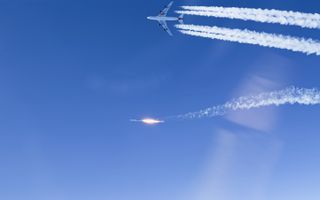
The 70-foot-long (21 meters), two-stage LauncherOne, which is capable of delivering up to 1,100 lbs. (500 kilograms) to orbit, took off from California's Mojave Air and Space Port today at about 1:50 p.m. EST (1850 GMT; 10:50 a.m. local California time). The rocket left the ground beneath the wing of its Boeing 747 carrier plane, known as Cosmic Girl.
This air-launch strategy — which Virgin Orbit's sister company Virgin Galactic also employs with its suborbital space plane, SpaceShipTwo — increases flexibility and responsiveness compared to traditional vertically launched rockets, Virgin Orbit representatives have said.
Pilots Kelly Latimer and Todd Ericson took Cosmic Girl southwest, cruising out over the Pacific Ocean toward a drop point about 50 miles (80 kilometers) south of the Channel Island. About an hour after liftoff, at an altitude of roughly 35,000 feet (10,700 m), LauncherOne separated from the plane, then lit up its first-stage NewtonThree engine to make its own way to space.
The NewtonThree aced its three-minute burn, notching a milestone that LauncherOne failed to achieve on its first orbital attempt, May 2020's Launch Demo mission. During that previous flight, a propellant line ruptured just after the first-stage burn began, bringing the test to an end.
But today, LauncherOne just kept on checking boxes. The rocket's upper stage separated successfully and fired its NewtonFour engine as planned, and LauncherOne slipped into orbit around our planet.

About 45 minutes after its first burn, the NewtonFour blazed up again, circularizing the upper stage's orbit. Shortly thereafter, the upper stage deployed the 10 tiny satellites, which were provided by eight different university groups and NASA's Ames Research Center in Silicon Valley.
This was a huge accomplishment for Virgin Orbit, which is now fully up and running.
"With this successful demonstration in the books, Virgin Orbit will officially transition into commercial service for its next mission. Virgin Orbit has subsequent launches booked by customers ranging from the U.S. Space Force and the U.K.'s Royal Air Force to commercial customers like Swarm Technologies, Italy’s SITAEL and Denmark’s GomSpace," Virgin Orbit representatives wrote in an emailed update after today's flight.
"The company's next few rockets are already well into integration at its Long Beach manufacturing facility," they added.
Virgin Orbit also commemorated the life of Eve Branson, the mother of the company's founder Sir Richard Branson, by flying her name to orbit on the rocket. Eve Branson died this month at age 96 from COVID-19.