Helicopter FLIR camera caught two UFOs over San Clemente Island, California

Helicopter FLIR camera caught two UFOs over San Clemente Island, California
AMAZING UFO FOOTAGE: Fast cigar UFO over Virginia, USA, 31-01-21

This UFO was caught on tape with GoPro Hero 8 Black 4K Nightlapse on 31st January 2021 at 0:35 am over Virginia Beach.
What do you think it is?
Best UFO Sightings in United States

Let’s check the best recent UFO sightings that were filmed all across the USA this year!
RELATED VIDEOS, selected and posted by peter2011
CIA Document Dump Reveals 70 Years Of US Government UFO Info

“What does the U.S. government really know about UFOs and for how long have they known it?” Ufologists and UFO experiencers have been asking these questions for decades, and it seems that answers are finally emerging. Based on the CIA’s recent release, on January 14, 2021, of nearly 3,000 pages of documents that detail a wealth of fascinating data about UFO behavior and capabilities , it seems they know a lot and have known a lot about this topic for quite some time. These freshly declassified US government UFO info documents (published in their entirety on The Black Vault ) reveal the truth about harrowing and awe-inspiring encounters between reliable witnesses and “unidentified aerial phenomena” of unknown origin that have been occurring since the 1950s. The recently-released US government UFO info includes multiple stories of up-close sightings of mysterious disks , glowing spheres, wingless cigar-shaped cylinders, and other anomalous flying objects by military and commercial pilots, in the United States and elsewhere around the world .
In many instances these objects were observed visually and on radar performing aerodynamically impossible (for conventional aircraft) maneuvers. Other times they emitted odd beams of light and other forms of strange illumination. The CIA files even reported close encounters between shocked military personnel and actual aliens , who were spotted emerging from landed UFOs.
These types of stories have circulated for years, and have frequently been discussed on radio programs, podcasts, YouTube videos, at UFO conferences, and in online forums frequented by paranormal enthusiasts. But now, for the first time, the government is adding its official seal of approval to such reports, giving them a legitimacy that they lacked when they were coming exclusively from anonymous “whistleblowers,” lien disclosure gadflies, mysterious ex-military insiders, and other questionable sources sporting dubious or non-existent credentials.

The CIA has long withheld detailed information about UFOs from the public but that changed on January 14, 2021, when nearly 2 million documents were released and published online.
( Dusan / Adobe Stock)
The January 2021 release of these new documents was apparently prompted by a special comment added to the recent $2.3 trillion COVID relief and government funding bill passed by Congress and signed into law by President Trump at the end of last December. In this comment, the Senate Intelligence Committee, headed by Senator Marco Rubio (R-FLA), instructed the Director of National Intelligence, the Secretary of Defense, and the heads of all other intelligence agencies to “submit a report within 180 days of the date of the enactment of the Act, to the congressional intelligence and armed services committees on unidentified aerial phenomena .”
Under the terms of the Intelligence Committee directive, the government UFO info report would have to address “observed airborne objects that have not been identified” and should include a “detailed analysis of unidentified phenomena data collected by geospatial intelligence, signals intelligence, human intelligence , and measurement and signals intelligence.”
In an added paragraph that seems like a nod to X-Files fans, the Intelligence Committee further ordered “a detailed analysis of data of the FBI, which was derived from investigations of intrusions of unidentified aerial phenomena data over restricted United States airspace … and an assessment of whether this unidentified aerial phenomena activity may be attributed to one or more foreign adversaries.”
It must be noted that this government UFO info directive says nothing about public disclosure. It only requests that reports be created and forwarded to the Senate Intelligence Committee for analysis. This makes the decision of the CIA to release this latest batch of documents to the public a matter of choice rather than law. No one required them to do it, but for reasons unknown they decided to do it anyway and several months before the June deadline that requires them to file a report with the Senate Intelligence Committee.
Curiously, this is the second occasion in the last year where an agency of the US government has deliberately chosen to release information that whets the public’s appetite for insider information about UFOs. In April 2020, the Department of Defense took the extraordinary step of declassifying three U.S. Navy videos that showed unidentified aerial objects performing their tricks for navy pilots.
These videos, which were recorded in 2004 in one case and 2015 in the other two instances, had already been leaked to the media in 2007 and 2017. It appears the Defense Department’s primary objective in releasing them officially was to confirm their anomalous nature .
In their statement accompanying the release, the Defense Department said it wanted to “clear up any misconceptions by the public on whether or not the footage that has been circulating was real.” They confirmed that “the authorized release of these unclassified videos does not reveal any sensitive capabilities or systems, and does not impinge on any subsequent investigations of military air space incursions by unidentified aerial phenomena.”
In other words, the United States Department of Defense wants its citizens to know that UFOs are real, that they aren’t secret military aircraft, and that investigations into their activities will continue if and when other encounters occur.
After decades of denial and obfuscation, it seems the US government is no longer interested in debunking UFOs or covering up the truth (whatever it might be) about their origin and nature.
Dutifully, mainstream media sources in the United States and the United Kingdom are following the government’s lead, and are now reporting UFO stories disclosed by official sources in a relatively straightforward manner, without the usual snide remarks, snarky tones, or tired and dismissive “explanations” that invoke swamp gas, ball lightning, weather balloons, or next-generation stealth aircraft.
Following this remarkable turn of events, it seems the old questions about “what do they know and for how long have they known it” have been rendered obsolete. In this current disclosure-oriented environment, what we should be asking instead is, “why are they doing this and why are they doing it now?”
By Nathan Falde
6 space missions to look forward to in 2021
Here are 4 of the space missions to keep an eye out for in 2021.

The James Webb space telescope’s gold-coated mirror undergoing cryogenic testing. After many delays, the new space telescope – Hubble’s successor – is currently scheduled to launch on October 31.
Image via Ball Aerospace/ Flickr/ The Conversation.
By Ian Whittaker, Nottingham Trent University and Gareth Dorrian, University of Birmingham
Space exploration achieved several notable firsts in 2020 despite the Covid-19 pandemic, including commercial human spaceflight and returning samples of an asteroid to Earth.
This year is shaping up to be just as interesting. Here are some of the missions to keep an eye out for.
1. Artemis 1
Artemis 1 is to be the first flight of the NASA-led, international Artemis program, whose goal was (originally) to return astronauts to the moon by 2024. Artemis-1, which is still scheduled for launch late this year, will consist of an uncrewed Orion spacecraft which will be sent on a three-week flight around the moon. It will reach a maximum distance from Earth of 280,000 miles (450,000 km), the farthest into space that any spacecraft that can transport humans will have ever flown.
Artemis 1 is designed to be launched into Earth orbit on the first NASA Space Launch System, which will be the most powerful rocket in operation. From Earth orbit, the Orion will be propelled onto a different path toward the moon by the rocket’s interim cryogenic propulsion stage. The Orion capsule will then travel to the moon under the power provided by a service module supplied by the European Space Agency (ESA).
The mission will provide engineers back on Earth with a chance to evaluate how the spacecraft performs in deep space and serve as a prelude to later crewed lunar missions. The launch of Artemis 1 is currently scheduled for late in 2021.
2. Mars missions
In February, Mars will receive a flotilla of terrestrial robotic guests from several countries. The United Arab Emirates’ Al Amal (Hope) spacecraft is the Arab world’s first interplanetary mission. It is scheduled to arrive in Mars orbit on February 9, where it will spend two years monitoring the Martian weather and disappearing atmosphere.
Arriving within a couple of weeks after Al Amal will be the China National Space Administration’s Tianwen-1, consisting of an orbiter and a surface rover. The spacecraft will enter Martian orbit for several months before deploying the rover to the surface. If it succeeds, China will become the third country to land anything on Mars. The mission has several objectives including mapping the mineral composition of the surface and searching for subsurface water deposits.
NASA’s Perseverance rover will land at Jezero Crater on February 18 and search for any signs of ancient life which may have been preserved in the clay deposits there. Critically, it will also store a cache of Martian surface samples on board as the first part in a highly ambitious international program to return samples of Mars to Earth.
3. Chandrayaan-3
In March 2021, the Indian Space Research Organization (ISRO) is planning to launch its third lunar mission: Chandrayaan-3. Chandrayaan-1 launched in 2008 and was one of the first major missions in the Indian space program. Comprising an orbiter and a surface penetrator probe, the mission was one of the first to confirm evidence of lunar water.
Unfortunately, contact with the satellite was lost less than a year later. Sadly, there was a similar mishap with its successor, Chandrayaan-2, which consisted of an orbiter, a lander (Vikram) and a lunar rover (Pragyan).
Artist’s concept of the the Chandrayaan-2 lunar mission from India.
Image via Raymond Cassel/ Shutterstock.
Chandrayaan-3 was announced a few months later. It will consist of only a lander and rover, as the previous mission’s orbiter is still functioning and providing data.
If all goes well the Chandrayaan-3 rover will touch down in the lunar south pole’s Aitken basin. It’s of particular interest as it is thought to host numerous deposits of subsurface water ice – a vital component for any future sustainable lunar habitation.
4. James Webb Space Telescope
The James Webb Space Telescope is the successor to the Hubble Space Telescope, but has had a rocky path to being launched. Initially planned for a 2007 launch, the Webb telescope is almost 14 years late and has cost roughly U.S. $10 billion (£7.4 billion) after apparent underestimates and overruns similar to those experienced by Hubble.
Whereas Hubble has provided some amazing views of the universe in visible and ultraviolet region of light, Webb is planning to focus observations in the infrared wavelength band. The reason for this is that when observing really distant objects there will probably be gas clouds in the way.
The galaxy NGC 2275 seen by Hubble.
Image via ESA/ Hubble/ NASA/ J. Lee and the PHANGS-HST Team.
These gas clouds block really small wavelengths of light, such as X-rays and ultraviolet light, while longer wavelengths like infrared, microwave and radio can get through more easily. So by observing in these longer wavelengths we should see more of the universe.
Webb also has a much bigger mirror of 21-foot (6.5-meter) diameter compared to Hubble’s 8-foot (2.4-meter) diameter mirror, essential for improving image resolution and seeing finer detail.
The primary mission of Webb is look at light from galaxies at the edge of the universe which can tell us about how the first stars, galaxies and planetary systems formed. Potentially this could include some information about the origin of life as well, as Webb is planning on imaging exoplanet atmospheres in high detail, searching for the building blocks of life. Do they exist on other planets, and if so, how did they get there?
We are also likely to be treated to some stunning images similar to those produced by Hubble. Webb is currently scheduled to launch on an Ariane 5 rocket on October 31.
ALL RELATED VIDEOS, selected and posted by peter2011. Enjoy those videos!
Powerful cosmic eruptions traced to brilliant 'magnetar' in nearby galaxy By Charles Q. ChoiAstronomers may have captured the first good look at giant flares from the strongest magnets in the universe.
The likely cause of these giant flares? Starquakes trillions of trillions of times stronger than any earthquakes, scientists reported at the 237th American Astronomical Society meeting, held virtually last week.
The most powerful magnets in the cosmos are magnetars, which possess magnetic fields about 100 trillion times more powerful than Earth's, or 10 trillion times that of an ordinary fridge magnet, Kevin Hurley, an astrophysicist at the University of California, Berkeley, said during a news conference held Jan. 13.
Magnetars are a rapidly spinning kind of neutron star, which is a corpse of a star that died in a catastrophic explosion known as a supernova. "Magnetars are up to a thousand times more magnetic than ordinary neutron stars," Soebur Razzaque, an astroparticle physicist at the University of Johannesburg and the senior author on one of the studies presented, said in a statement.
"In the Milky Way there are tens of thousands of neutron stars," Razzaque added. "Of those, only 30 are currently known to be magnetars."
Once magnetars are born, they only stay magnetars for about 10,000 years before their magnetic fields weaken to render them relatively ordinary neutron stars, Eric Burns, an astrophysicist at Louisiana State University and co-author of the new study, said at the press conference. Magnetars are typically seen in star-forming regions, such as starburst galaxies, he noted.
Previous research discovered magnetars regularly explode with X-ray bursts about one-tenth of a second long that each pack up to about the same amount of energy the sun gives off in a year. In three instances over the past 40 years, astronomers have seen magnetars in the Milky Way and nearby galaxies explode with even brighter, more energetic outbursts of X-rays and gamma rays. However, such giant flares were so powerful, they blinded any sensors that glimpsed them, making them difficult to study in any great detail.
Now researchers may have the best look yet at a giant magnetar flare, one good enough to help them deduce its possible origins.
Scientists analyzed the extremely bright gamma-ray burst GRB 200415A, which five space observatories that form the so-called Interplanetary Network detected on April 15, 2020. Gamma-ray bursts are the most powerful kinds of explosions known in the universe, each giving off as much energy in milliseconds to minutes as the sun is expected to emit during its entire 10-billion-year lifetime.
At its peak, this newfound explosion was about 360 trillion times more luminous than the sun. "That is about 100,000 years of solar energy released in only 140 milliseconds," Hurley said.
The Interplanetary Network triangulated the location of the gamma-ray burst to the center of the nearby Sculptor galaxy, formally known as NGC 253, which is located about 11.4 million light-years from Earth in the Sculptor constellation. Previously detected GRBs came from relatively far away from the Milky Way, but GRB 200415A originated much closer to home, in cosmic terms.
Gamma-ray bursts are typically divided into two groups — long and short — depending on whether they last more or less than two seconds. Short gamma-ray bursts are most likely caused by the mergers of neutron stars, while long gamma ray-bursts are linked with supernovas.
GRB 200415A lasted just 140 milliseconds, about the blink of an eye. "It's as fast as snapping your fingers," Oliver Roberts, an astrophysicist at the Universities Space Research Association in Huntsville, Alabama who led another new study on GRB 200415A, said at the news conference.
This speed would ordinarily suggest it was a short gamma-ray burst. However, the pattern of light seen from this outburst was very different from that seen from short gamma-ray bursts that previous research found were caused by colliding neutron stars.
Instead, GRB 200415A's light pattern was a near copy of those previously seen from giant magnetar flashes. Those began with an intense flash about one-fifth of a second long, followed by a string of pulses lasting about two to 12 seconds.
The cause of this newfound giant magnetar flare was likely a "starquake" — a rupture of the magnetar's solid crust, Roberts said. This quake was huge — magnitude 27.8 in strength, or about one thousand trillion trillion (10^27, or a 1 with 27 zeroes behind it) times more powerful "than the largest known terrestrial earthquake, which was the magnitude 9.5 [earthquake] in Chile in 1960," Hurley said.
The researchers suggested this starquake not only released a bright flash of gamma rays, but also heated the magnetar's crust. As the magnetar whirls around, this super-hot crust looks like a series of bright flashes that dim as the surface cools, Hurley told Space.com.
The scientists added this starquake likely also spit out a blob of plasma traveling about 99% the speed of light, Nicola Omodei, an astrophysicist at Stanford University who participated in the study, said at the press conference.
After four days, this blob encountered the shockwave created when the giant bubble of plasma around the magnetar, known as its magnetosphere, slammed into the interstellar medium of gas and dust between stars at a speed of about 2.2 million mph (3.6 million kph). When the blob collided with this shockwave, it generated another pulse of gamma rays seen 19 seconds after the initial flash. The gamma rays in this second outburst were even more energetic than those seen in the first one, he noted.
All in all, these new findings suggest that maybe a small percent of known short gamma-ray bursts are caused by giant magnetar flares, Burns said.
The scientists detailed their findings Jan. 13 at an online meeting of the American Astronomical Society meeting. Hurley, Roberts and their colleagues detailed their findings in two studies in the Jan. 14 issue of the journal Nature. Omedei and his colleagues detailed their findings online Jan. 13 in the journal Nature Astronomy.
Did water once flow through meteorites?
Water may have recently flowed within meteorites, suggesting the asteroids they broke off from may bear ice, a new study finds.
Researchers analyzed carbon-rich meteorites known as carbonaceous chondrites. These rare space rocks are one of the most ancient types of meteorites, whose parent bodies formed in the early days of the solar system. Previous research suggested that carbonaceous chondrites raining on Earth likely helped deliver water and organic matter to our newborn planet.
Prior work found that a number of minerals seen in carbonaceous chondrites likely formed due to chemical reactions involving flowing liquid water. However, scientists had thought such activity halted about 4.5 billion years ago, within the first 4 million years or so of the solar system's history.
Now, scientists in a new study have discovered signs of far more recent liquid flow within these meteorites, occurring less than a million years ago.
In this study, researchers examined carbonaceous chondrites collected from around the world. They focused on variations of the elements uranium and thorium known as isotopes. (Isotopes of an element each have different numbers of neutrons in their atomic nuclei. For instance, uranium-234 atoms are uranium isotopes with 142 neutrons, while uranium-238 atoms each have 146 neutrons.)
The levels of different uranium and thorium isotopes within these meteorites should have depended on how long the isotopes usually last before they begin to radioactively decay. Instead, the scientists found unusually high levels of the relatively short-lived isotope uranium-234, compared with longer-lived uranium-238, in all the carbonaceous chondrites they looked at. Most of the samples also had unusually high levels of uranium-238 compared with thorium-230, an isotope that results from the radioactive decay of uranium-234.
The most likely explanation for these findings, they found, was that liquid water flowed within the parent bodies of these meteorites, likely when the collisions that broke the meteorites off those carbonaceous asteroids melted ice within those rocks, the researchers said.
They think this because Uranium and thorium isotopes respond in different ways to liquid water — uranium is soluble in water, whereas thorium is not — which would explain the unusual isotope levels seen within these meteorites.
The anomalous isotope levels seen within the meteorites should disappear within a million years due to radioactive decay, the scientists noted. This suggests these meteorites possessed liquid water during that time.
All in all, this discovery suggests "these asteroids still contain ice, and that means that they could, at any time, have delivered both water and organics, which combined are critical for life," study lead author Simon Turner, an isotope geochemist at Macquarie University in Australia, told Space.com.
Previous research has detected water ice on asteroids such as Themis. "Carbonaceous asteroids might be frozen mud balls rather than rocky bodies as commonly thought," Turner said. "Our data provides strong evidence to support that."
Follow Charles Q. Choi on Twitter @cqchoi. Follow us on Twitter @Spacedotcom and on Facebook.
RELATED VIDEOS, selected and posted by peter2011
The Trappist-1 exoplanets could be worlds of water or rust
SCIENTISTS DISCOVER THE REASON FOR UNEXPLAINED ACTIVITY ON MARS
The answer may lie just beneath the surface of the Red Planet.
FOR CENTURIES AFTER GALILEO made the first observations of Mars in 1610, the planet appeared to our Earth eyes as a quiet, dusty, and ultimately, dead planet.
But in the last 50 years, scientists have sent multiple spacecraft to observe the Red Planet up close, revealing Mars is very much an active planet, wracked by continuous geological activity and riven with subsurface canals.
One piece of evidence for this activity is the fact the Martian landscape regularly experiences a form of natural disaster which, here on Earth, has the potential to level cities and block roads: Landslides.
For as long as we have known they occur on Mars, so too have scientists not known their cause. But a new study may have uncovered the reason why this Earth-like feature also occurs on Mars lurking beneath the planet's surface. The findings have major implications for future human missions to explore Mars.
The study was published Wednesday in the journal Science Advances.

HERE'S THE BACKGROUND
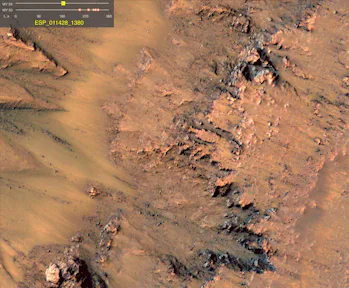
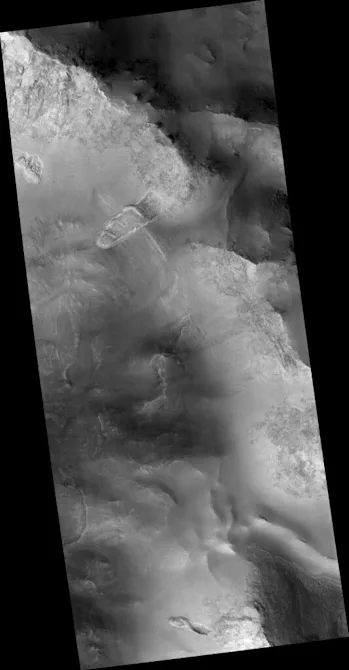
In September, 2018 NASA's Mars Reconnoissance Orbiter caught a glimpse of what appeared to be a recent landslide in a crater near a region of the planet called Nili Fossae.
The landslides were formed by large amounts of rock and soil moving downslope at a speed of up to 360 kilometers per hour, and extending for over tens of kilometers.
However, scientists were not sure what caused the landslides to form.

WHAT'S NEW
Janice Bishop, senior research scientist at the SETI Institute and lead author behind the new study, was studying the unusual chemical processes which take place beneath Antarctica's ice when she noticed a strange similarity to Mars.
"Antartica is a cold and dry environment like Mars," Bishop tells Inverse.
"So we started looking at other analogs as well to try to understand this chemistry."
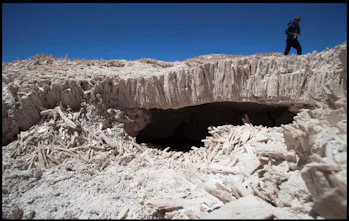
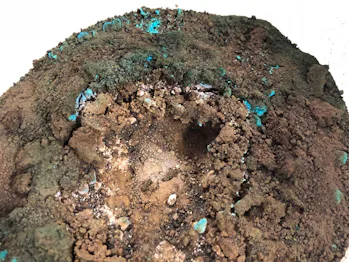
Bishop and her team studied both the Dead Sea in Israel and Salar de Pajonales in the Atacama Desert, in addition to conducting experiments in the lab, to glean further insights as to what may be occurring on Mars to cause changes in the planet's topography.

Through their observations, they found that specific chemical salts interact with gypsum, or water underground, and this causes disruptions on the surface, including ground collapse and landslides.
"The chlorine salts are very deliquescent, they absorb a lot of water like a sponge so they become a liquid," Bishop explains. This is similar to a more terrestrial, and familiar process you can see in your own kitchen, she says.
"If you leave your salt shaker out, it absorbs water, and becomes sticky."
Similarly, the chlorine salt and sulfate found in the icy underground water beneath Mars' surface creates an unstable, liquid-like slush which causes disturbances in the above ground surface.

This same process may have also caused landslides to take place on Earth millions of years ago. However, since then, our planet was covered by oceans and plants which covered its surface, preventing us from observing the markings leftover by early processes on the planet.
"I think Mars is really interesting because it's kind of a window to our origins on early Earth," Bishop says. "On our planet, life took off and we have plants and bacteria, we have highways and roads but on Mars you get to see the rocks, the planet isn’t contaminated by all the things we have here so you can see its history."
Mars may be a dry and desolate planet today, but scientists believe that it may have had a similar start to Earth, beginning as a warm and wet world. However, gradually over time, the planet lost its atmosphere.
"The evolution of the planet was kind of frozen in time, its not that it would’ve been the same as Earth but there could’ve been a lot of similarities," Bishop says.
WHAT'S NEXT
The new study suggests that the subsurface of Mars holds a lot more clues to the history and evolution of the planet than scientists previously believed.
Bishop suggests that more efforts need to be concentrated on drilling beneath the surface of Mars.
"So far, we've only seen the surface," Bishop says.
NASA's Mars rovers have poked at rocks, and the space agency's Insight mission, which has been attempting to drill on the Red Planet, recently called it quits. However, the upcoming European Space Agency's ExoMars mission, which is scheduled to launch in 2022, will dig two meters beneath the surface.
From there, Bishop hopes to get a better understanding of the processes that are taking place beneath the surface.
"Understanding the processes on Mars helps us understand what happened on Earth since our history was erased," she says.
Abstract:
The “Lost” Soviet UFO Files Of The Cold War
Warp Drives, Space Manipulation, And The Pentagon’s UFO Program


According to a report in the New York Times in December 2017 (which you can read in full here), the Defense Department spent $22 million on the Advanced Aerospace Threat Identification Program. That is, however, all that is known. The records do not show how the money was spent, where it went, or why. Only that the figure of $22 million was allocated to this particular platform. In reality, this money would appear to have been earmarked for “black budget” projects – at least according to those who keep an intense eye on government spending.
Sodom and Gomorrah, Mohenjo-Daro – Do The Ancient Texts Describe Nuclear Explosions And Weapons?


“White hot smoke that was a thousand times brighter than the sun rose in infinite brilliance and reduced the city to ashes. Water boiled…horses and war chariots were burned by the thousands… the corpses of the fallen were mutilated by the terrible heat so that they no longer looked like human beings…”
“(4)Before they had gone to bed, all the men from every part of the city of Sodom—both young and old—surrounded the house. (5) They called to Lot, “Where are the men who came to you tonight? Bring them out to us so that we can know (have sex) with them.”
“(10) But the men inside (angels) reached out and pulled Lot back into the house and shut the door. (11) Then they struck the men who were at the door of the house, young and old, with blindness so that they could not find the door.”
“(12) The two men said to Lot, “Do you have anyone else here—sons-in-law, sons or daughters, or anyone else in the city who belongs to you? Get them out of here, (13) because we are going to destroy this place. The outcry to the Lord against its people is so great that he has sent us to destroy it.”
“(28)He looked down toward Sodom and Gomorrah, toward all the land of the plain, and he saw dense smoke rising from the land, like smoke from a furnace.”
UFO Sightings, Alien Abductions, And The Connection To Suspected Underwater Alien Bases!


Astrophysicists: Gamma-ray jets exceed the speed of light
Les « sept minutes de terreur » qui attendent le rover Perseverance le 18 février


[EN VIDÉO] L'atterrissage du rover Perseverance sur Mars Animation montrant la séquence EDL, l'entrée, la descente et l'atterrissage de Perseverance à la surface de Mars.
Dans moins de deux mois, le vaisseau transportant le nouveau grand rover de la Nasa Perseverance et le révolutionnaire Mars Helicopter Ingenuity va entrer dans l'atmosphère de Mars pour les déposer en douceur sur leur site d'exploration. Un moment où toutes les équipes de la mission retiendront leur souffle.
L'arrivée du rover Perseverance à la surface de Mars en quête de traces de vie anciennes ou actuelles sera un des plus grands moments de 2021. Une mission, rappelons-le, très ambitieuse tant sur le plan de la recherche en exobiologie, météorologie, environnement extraterrestre que celui de la préparation de l'installation des premiers êtres humains sur une autre planète.
Pour l'instant, le super-rover à la pointe des technologies (célébré par le Time magazine, on en parle ici), encapsulé dans le vaisseau qui le conduit jusqu'à la Planète rouge, vogue paisiblement dans l'espace interplanétaire à une vitesse de quelque 85.000 km/h ! Les trois quarts de son voyage sont déjà accomplis (77 % ce 24 décembre) et il ne lui reste plus que 56 jours de vol (108 millions de kilomètres) avant d'apercevoir la terre rouge... Comme prévu, ce sera donc le 18 février que la machine va atterrir à l'intérieur du cratère Jezero, une destination bien entendu sciemment choisie par les équipes scientifiques de la mission pour son habitabilité passée, il y a plus de trois milliards et demi d'années, quand il faisait plus chaud à la surface de ce monde.
Comme tous les engins qui veulent toucher le sol de Mars, Perseverance va devoir atterrir en douceur, et ainsi passer d'une vitesse de croisière supérieure à 50.000 km/h à zéro en très peu de temps. La méthode choisie pour cette séquence nommée EDL (entry, descent, and landing) est pratiquement la même que celle employée pour Curiosity, en août 2012. Elle a fait ses preuves.
La très belle animation ci-dessus présente l'enchaînement des différentes actions qui se dérouleront le jour J. Le moment le plus tendu sera bien sûr celui où la capsule plongera dans l'atmosphère jusqu'au terminus au sol quelques minutes plus tard. Un moment crucial pour la mission que la Nasa appelle, à juste titre, « sept minutes de terreur ! » (ici condensées en trois minutes dans la vidéo). Comme le centre de contrôle de Mars 2020 est sur Terre, à des centaines de millions de kilomètres de là, soit une dizaine de minutes-lumière, toutes les actions ont donc été orchestrées à l'avance et le cerveau du vaisseau n'aura plus qu'à jouer la partition qu'on lui aura transmise.
Les « sept minutes de terreur » qui attendent le rover Perseverance le 18 février


[EN VIDÉO] L'atterrissage du rover Perseverance sur Mars Animation montrant la séquence EDL, l'entrée, la descente et l'atterrissage de Perseverance à la surface de Mars.
{
Les « sept minutes de terreur » qui attendent le rover Perseverance le 18 février


[EN VIDÉO] L'atterrissage du rover Perseverance sur Mars Animation montrant la séquence EDL, l'entrée, la descente et l'atterrissage de Perseverance à la surface de Mars.
{
UK’s Area 51: The Mystery Of Rudloe Manor

Many in the British UFO research community believe that alien saucers in the possession of the British Government may have been kept at Rudloe Manor, a Royal Air Force (RAF) station located northeast of Bath, between the towns of Box and Corsham, Wiltshire, United Kingdom.
The Manor was built on top of quarries from which Bath Stone had been extracted, in the 1930s some of the tunnels were converted for use as a Central Ammunition Depot. The vast caverns had some 2,250,000 square feet of space, divided into many smaller chambers.

Are there secret tunnels under Rudloe Manor
The historian Rupert Matthews wrote about the rumours linking the base with UFOs:
“By the later 1990s the rumours had begun to take a more definite form. According to these reports, there was a vast underground complex beneath the apparently innocuous barracks and office buildings scattered in the grounds of the old manor house.
“This much could be checked out and was accurate. The manor had been taken over by the RAF at the start of World War II precisely because these huge underground caverns existed. They were the abandoned workings from which the much prized Bath Stone had been quarried out in the 19th Century.

At the end of 1994, Matthew Williams and Paul Damon visited the Rudloe Manor to investigate the truth about the manor and UFO connection. When they arrive there, the guard asked them what they were doing and they explained that they were UFO researchers who interested with the manor.
Then, Matthew and Paul asked if there is an “Underground Town” existed beneath the manor? The guard stated that there was only a quarry at Rudloe site 2 and no more.
Paul said that he watched a TV Program called “Schofields Quest” and from there he got information about “Underground Town”, if it were only a quarry then it would be no problem and not represent any threat to national security to let the “Schofields Quest” cameras in for a look. The guard stated that the tv crew were misguided and he try to convince them once again that there was nothing at site 2 but a quarry.
A few minutes later, a white van came out of nowhere and parked itself in blocking position in front of Matthew’s car. The van’s door opened and 2 soldiers with semi automatic machine guns emerged. The 3rd person who was the driver of the van came out, he was dressed in cammo gear and he appeared to be a sergeant.
They were questioned by the sergeant about their activities around the manor, and they did their best to answer and provide as much information as they could with their knowledge about the base. However he did not satisfied with their explanation, and asked their proper ID.
Just before he left to make his checks he made the following disturbing statement,
“I am going to check your details. Do not get out of your car whilst I am gone, do you understand?”
“Yes, no problem”, said Matthew and Paul.
“Do not attempt to drive away in the vehicle whilst I am gone, do you understand?”
“We won’t go anywhere.”
“Because if you do try to get out of the vehicle OR try to drive away you WILL BE TAKEN OUT OF CIRCULATION!”
Matthew and Paul were shocked with his warning. Whilst the Sergeant was away at the guardhouse one of the soldiers standing guard paced near their car and they got his attention in order to have a talk. He told them that they had got the whole base on full alert and there was a real stir.
Matthew and Paul said that they were sorry but they could not see that they had done anything wrong. They asked him questions about UFO’s – had he seen any, did he know what went on at Rudloe. He said, “Well who knows what they get up to, but I am not allowed to say anything anyhow.”
When the sergeant returned he said that their details had checked out but he was not happy with both of them being there. He told them that they were not allowed to take photos as it was prohibited. Matthew disagreed and stated that there were no anti photography signs posted so there was no restriction.
He argued that there were signs posted and that Matthew had not seen them. He also said that the base commanders would not give such permission and that if they came back to this base in the future to take photos they would be blocked!
After the incident, Matthew said, “If they are this interested in security of the base then it is obvious that they are hiding something “good” there.
According to Nick Redfern, a British author also ufologist and cryptozoologist who has investigated the Rudloe Manor-UFO connection: ‘The whole Rudloe-UFO saga has been a puzzle in itself.
There’s no doubt that the RAF’s Provost & Security Services – who were based at Rudloe for two decades – have played a role in official UFO investigations. There are even a few declassified files available at the National Archive, Kew. But the big question is the extent, or otherwise, of those investigations
Some researchers have suggested – and particularly Matthew Williams in the mid-to-late 90s – that Rudloe’s role went far beyond that officially admitted by the Ministry of Defence (MoD). Others merely see it as a minor aspect of official UFO investigations that got blown up out of proportion by the UFO research community.’
Sources:
RELATED VIDEOS, selected and posted by peter2011
Scientists Identify a Possible Portal to a 5th Dimension

When the moon is in the Seventh House
And Jupiter aligns with Mars
Then peace will guide the planets
And love will steer the stars
— (Age of Aquarius – The 5th Dimension)
That song was the dawning of the Age of Aquarius and the musical group, the 5th Dimension. Their name referred to adding a fifth dimension to the traditional four-part harmony of a quartet with an additional voice and had nothing to do with the Kaluza–Klein theory. The what?
“We argue that extensions of the SM with a warped extra dimension, together with a new Z2-odd scalar singlet, provide a natural explanation not only for the hierarchy problem but also for the nature of fermion bulk masses and the observed dark matter relic abundance. In particular, the Kaluza-Klein excitations of the new scalar particle, which is required to naturally obtain fermion bulk masses through Yukawa-like interactions, can be the leading portal to any fermion propagating into the bulk of the extra dimension and playing the role of dark matter.”
Well, that abstract from the paper “A warped scalar portal to fermionic dark matter” published in The European Physical Journal C explains everything … not. Fortunately, the fine folks at Vice have taken a stab at breaking down into layperson’s terms the announcement that theoretical physicists at Johannes Gutenberg University have identified a new particle that may open a portal to a 5th dimension beyond height, width, depth and time … and who couldn’t use an extra dimension these days – even if it’s warped?
“The researchers are part of a long scientific tradition that questions whether the four dimensions that humans can comprehend—3D space and time—are really all the universe has to offer. This line of research has produced 5-dimensional field equations that express the implications an extra dimension would have on the universe, and reality itself.
While researching these equations in relation to fermion masses, the team sketched out the existence of a new scalar field associated with a speculative particle that is roughly similar to the Higgs field associated with the famous Higgs boson particle.”
Like all things strange in physics these days, this research is connected with the Higgs boson particle and dark matter. This new heavy particle appears to fit between dark matter and visible matter, especially light. This research began with German mathematician Theodor Kaluza and Swedish physicist Oskar Klein, who in 1921 independently developed the Kaluza–Klein theory which used the fifth dimension to unite gravity with electromagnetic force. That eventually inspired superstring theory and supergravity — the idea that reality is composed of vibrating strands of energy in ten dimensions or more. The Large Hadron Collider is able to pick up indirect evidence of a fifth dimension, which inspired the proposed new particle which could actually open a portal into this fifth dimension. Or, as the researchers call it, “a possible new messenger to the dark sector.”
Are you ready to enter the dark sector? Or did you think we were already in it?
“If this heavy particle exists, it would necessarily connect the visible matter that we know and that we have studied in detail with the constituents of the dark matter, assuming that dark matter is composed out of fundamental fermions, which live in the extra dimension.”
And that takes us back to the Large Hadron Collider. As powerful as it is, the LHC can’t detect it because the particle is too heavy. (Aren’t we all?) The researchers are forced to wait for the building of proposed new colliders — the International Linear Collider, the Compact Linear Collider (CLIC), and the Future Circular Collider. However, it may be too big for those as well. Fortunately, they suspect the new particle might produce gravitational waves which astronomers are already doing a great job detecting and will do even better with future gravitational-wave detectors.
NOW are you ready to enter the dark sector through a portal to the 5th dimension? You may have a long wait. In the meantime, perhaps the advice of that other 5th Dimension can give you something better to do.
“Let the sunshine, let the sunshine in, the sunshine in.”
Good advice.
RELATED VIDEOS, selected and posted by peter2011